Monthly Archives: August 2025

Flat Earth: A Distraction from Dominion, Not a Doctrine of Salvation


Part I: When the Earth Becomes the Distraction

There is a war raging today. A war for the family, for the household, for Christian dominion, for generational headship, for the rebuilding of national identity under Christ the King. And yet, in the midst of this war, many brothers in the faith have wandered off into the weeds, fixated not on law, not on governance, not on marriage, nor on worship, but on the shape of the earth.

Let me be clear from the beginning: whether the earth is round, flat, domed, hollow, or square is not a matter of salvation. Nowhere in Scripture are we told to believe a certain cosmological model as a condition of faith. What is required is this:

“That if thou shalt confess with thy mouth the Lord Jesus, and shalt believe in thine heart that God hath raised him from the dead, thou shalt be saved.”
—Romans 10:9

And again:

“He that believeth and is baptized shall be saved…”
—Mark 16:16

Faith in Christ, repentance, and obedience to His commands. These are the essentials, not theories about the curvature of the horizon or the height of the sun.

Yet among some circles of believers, particularly online, a spirit of division has entered. Flat earth has become a point of pride, a shibboleth for separating the “truly awakened” from the “deceived masses.” Churches have split, friendships have been broken, and kingdom work has been halted. Not over sin, but over speculation.

This is a grievous error. The enemy rejoices when soldiers lay down their swords to argue about maps. The devil laughs when patriarchs stop building households because they are busy debating Antarctica.

This post is a call to focus. A call to humility. A call to rise above the distractions of the age and return to the work God has actually commanded: to build, to govern, to disciple, to take dominion.


Part II: What Does the Bible Say?

Many flat earth proponents insist that the Bible clearly teaches a flat earth. They quote verses like:

“He stretcheth out the north over the empty place, and hangeth the earth upon nothing.”
—Job 26:7

“The world also shall be stable, that it be not moved.”
—Psalm 93:1

“It is he that sitteth upon the circle of the earth…”
—Isaiah 40:22

But these passages, when read in context, do not teach a definitive shape. The language of Scripture is often poetic, phenomenological (describing how things appear to man), and metaphorical.

When the Bible says the sun “rises” and “sets,” it is not endorsing geocentrism. It is describing what any observer sees. When it speaks of the earth not moving, it is referring to its security in God’s providence, not denying planetary motion. When it calls the earth a “circle,” the Hebrew word chuwg can just as easily mean a sphere or roundness.

The Bible was not written as a science textbook. It was written to teach us who made the world, what our purpose is, how we are to live, and what must be done to be saved. It teaches law, order, morality, and theology, not trigonometry.

The idea that one must believe in a flat earth to be “truly Biblical” is false. Many of the greatest saints in history believed in a spherical earth and upheld the authority of Scripture without contradiction.


Part III: What Does History Show?

It is a myth, propagated by secularists, that the church once universally believed in a flat earth and persecuted those who disagreed. This “conflict thesis” has been debunked by modern historians.

Saint Augustine (4th century), Bede (8th century), and Thomas Aquinas (13th century) all affirmed a round earth, based on logical reasoning and the writings of earlier scholars. The idea of a spherical earth was inherited from Greek astronomy and was widely accepted by the time of the Reformation.

The notion that Columbus sailed to “prove” the earth was round is historically false. Most educated people in his day already believed that. The dispute was about the size of the earth, not its shape.

Historically, Christian nations did not make flat earth belief a condition for orthodoxy. They focused on the gospel, the moral law, and right worship, not geodesy.

Even among young earth creationists, those who rightly reject evolutionary timeframes, the mainstream position has long been a globe earth, consistent with both Scripture and observation.


Part IV: What Does Science Actually Show?

From a Christian young earth perspective, we affirm:

  • A literal six-day creation
  • A global flood
  • A 6,000–10,000 year old earth
  • A central position of earth in God’s redemptive plan

But none of that requires the earth to be flat, or round for that matter. In fact, observable, repeatable evidence continues to support a globe earth:

  1. The Horizon: At sea, ships disappear bottom-first, not all at once. This is consistent with curvature, not flatness.
  2. Eclipses: Lunar eclipses show a round shadow cast by the earth. Only a spherical object casts a consistent round shadow from any angle.
  3. Gravity and Orbits: The behavior of objects in space, satellites, seasons, and tides all rely on the principles of gravitational pull around a spherical mass.
  4. International Observation: People in Australia see a different sky than people in Alaska. Flight paths, star patterns, and time zones all reflect a round planet.
  5. High-Altitude Flights and Photos: From U-2 flights in the 1950s to modern amateur high-altitude balloon launches, the curvature of the earth can be visibly observed.

While some claim these are all fabrications or part of a global conspiracy, the sheer number of observers, pilots, engineers, and scientists involved make this claim implausible.

A young earth creationist should absolutely reject Darwinism, Big Bang cosmology, and other atheistic myths, but not observable evidence grounded in physical laws designed by God.


Part V: The Real Threat — Division Among Brethren

“Now I beseech you, brethren… mark them which cause divisions and offences contrary to the doctrine which ye have learned; and avoid them.”
—Romans 16:17

The problem with flat earth fixation is not primarily its content, it is its fruit. What has it produced?

  • Arrogance
  • Isolation
  • Division
  • Distraction
  • Endless debates
  • Broken fellowships
  • Suspicion of every authority and elder

Instead of focusing on the law of God, the structure of the household, the necessity of Christian education, the restoration of Christian culture, or the expansion of the Kingdom, many are consumed with proving NASA is lying or arguing about Antarctica.

This is not harmless. It is spiritual misdirection.

“But avoid foolish questions… and contentions, and strivings about the law; for they are unprofitable and vain.”
—Titus 3:9

When the body is busy arguing about the ceiling tiles, the house burns down.

The enemy knows he cannot stop the Kingdom. But he can distract its builders. He can whisper: “Stop building – let’s debate cosmology.” And too many men have listened.

Part VI: What God Actually Commands Us to Focus On

The Holy Scriptures are not silent. They command men to study, to build, to order, to train, to govern, to lead. But at no point does God command a man to solve the shape of the earth as a test of righteousness or a mark of spiritual awakening.

What, then, does He tell us to do?


1. Take Dominion

“And God blessed them, and God said unto them, Be fruitful, and multiply, and replenish the earth, and subdue it: and have dominion…”
—Genesis 1:28

This is the original mandate. To subdue. To govern. To rule under God’s law. This requires work, wisdom, courage, and vision. It requires households, agriculture, trade, law, worship, and justice. Not endless debate over celestial models.

A man who cannot lead his house has no business leading an argument. A man who won’t build a family, train his children, or sanctify his land should not be spending his nights trying to convince strangers online of a conspiracy.

You were not saved to argue about the horizon. You were saved to take dominion.


2. Teach the Law

“Ye shall diligently keep the commandments of the LORD your God, and his testimonies, and his statutes…”
—Deuteronomy 6:17

And again:

“All Scripture is given by inspiration of God… that the man of God may be perfect, thoroughly furnished unto all good works.”
—2 Timothy 3:16–17

The central theme of Scripture is obedience to the law of God, not speculation about the natural world. Yes, creation testifies of His glory. Yes, we honor God as Creator. But the real test of maturity is this: Do you obey His commands?

Flat earthism requires no obedience. Biblical masculinity does.

Conspiracy theories require no humility. Leading your wife in worship does.

The law of God must be taught, applied, enforced, and passed down, not replaced by map-watching and shape-analyzing.


3. Build the Household

The Christian household is under assault. Feminism, statism, sodomy, and apostasy have gutted the family structure. This is where our fight is.

God commands:

  • Husbands to love and lead their wives
  • Wives to submit in meekness
  • Children to obey and honor
  • Fathers to discipline and disciple
  • Households to worship, labor, and multiply

“But if any provide not for his own, and specially for those of his own house, he hath denied the faith, and is worse than an infidel.”
—1 Timothy 5:8

That’s the kind of verse that separates men from boys. Not a chart of sun-paths or angles. God does not call you to crack the earth’s code. He calls you to rule your house well.


4. Advance the Kingdom

“Seek ye first the kingdom of God, and his righteousness…”  —Matthew 6:33

The Kingdom of God is a real kingdom. It has laws, it has people, it has a government, and it is always growing.

“Of the increase of his government and peace there shall be no end…”  —Isaiah 9:7

This Kingdom is not shaped by debates about the moon. It is advanced by obedient men who teach the Word, live with honor, raise godly seed, and proclaim Christ in the public square.

When men get caught up in endless speculation, they stall the advance. They get pulled off the wall like Nehemiah’s enemies wanted:

“They thought to do me mischief. And I sent messengers unto them, saying, I am doing a great work, so that I cannot come down.”  —Nehemiah 6:2–3

That must be our answer.


5. Strengthen the Brotherhood

Division is not just foolish, it’s dangerous. It weakens our force, and scatters our influence. It replaces unity with suspicion and love with argument.

“Now I beseech you… that ye all speak the same thing, and that there be no divisions among you…”  —1 Corinthians 1:10

When men start splitting over flat earth, they are not walking in the Spirit. They are walking in pride, ego, and spiritual immaturity.

We must focus on strengthening the brotherhood, calling men back to mission, vision, and order.

The world is burning. The household is collapsing. The church is compromised.

And some are still arguing about Antarctica?

Enough!

Part VII: A Biblical Call to Unity, Humility, and Mission

“Behold, how good and how pleasant it is for brethren to dwell together in unity!”  —Psalm 133:1

Unity among brethren is not built on agreement about every secondary matter. It is built on shared obedience to the core doctrines, commands, and commission of the Lord Jesus Christ. We are not called to uniformity on every theory, but to unity in truth, love, and labor.

The current obsession among some to divide over the shape of the earth is a direct assault on the unity Christ commands.


1. Unity Is Built on What Matters Most

We are to be of one mind, one God, one faith, one baptism, one law, one gospel, and one Kingdom. Not, one cosmology, one opinion on curvature or, one map model.

The Apostles never required agreement on cosmological shape for church fellowship. They warned against vain debates and endless questions.

“If any man teach otherwise… he is proud, knowing nothing, but doting about questions and strifes of words… from such withdraw thyself.”
—1 Timothy 6:3–5

Unity is not maintained by enforcing minor agreements, but by centering on major obedience.

Let the man who believes the earth is flat keep it to himself. Let the one who believes it is spherical do likewise. But let them not bite and devour one another.


2. Humility Knows What Is Central

One of the surest signs of spiritual immaturity is elevating side topics to central doctrine. Paul rebuked the Galatians not for heresy about earth shape, but for adding circumcision to the gospel.

How much more should we rebuke those who add flat-earth belief to faith, or treat those who disagree as deceived apostates?

“Him that is weak in the faith receive ye, but not to doubtful disputations.”
—Romans 14:1

Flat earth is a disputable matter. Salvation, headship, covenant, holiness, worship, these are not. Let us stop exalting theories above obedience. A man may believe in a flat earth and still honor Christ. A man may believe in a round earth and be more faithful than a thousand conspiracy chasers.

 We must walk humbly, especially when the topic is one of observation and interpretation, not direct moral command.


3. Our Mission Is Too Great to Be Divided

We are at war.

  • A war for the household
  • A war for Christian education
  • A war for godly daughters and strong sons
  • A war for righteous law, national identity, and restored dominion

The battle is real, and the casualties are many.

The devil is all too glad to let us chase flat maps and “NASA lies” while the culture indoctrinates our children, while the family disintegrates, while our enemies legislate perversion, and while churches bow to the state.

This is not discernment. This is an absolute dereliction of duty, and it is sinful.

We are called to build the Kingdom. Not play theological dodgeball with internet theories. We are to bind together in brotherhood, sharpen one another, and press the battle to the gates.


4. The Spirit of Division Is Not from God

To be clear: The spirit that divides brethren over theories of earth shape is not from the Holy Spirit. It is a spirit of pride, of distraction, of unfruitful debate.

Only by pride cometh contention…
—Proverbs 13:10

And again:

“Where envying and strife is, there is confusion and every evil work.”
—James 3:16

If you find yourself angry, bitter, mocking, or dismissive toward your brethren over this topic, then you are in sin, not in truth.

Repent. Refocus. Rebuild.


5. Let the Strong Bear with the Weak

Some are drawn into fringe theories because of real distrust in media, academia, and corrupt institutions. Rightly so. We are surrounded by lies.

But rather than mocking those caught in distraction, let us teach them gently, anchor them in Scripture, and call them into mission. Not every man comes to maturity at the same pace.

The goal is not to win an argument. The goal is to win a brother and call him to work.

“Brethren, if a man be overtaken in a fault… restore such an one in the spirit of meekness.”
—Galatians 6:1


What the Church Must Preach

The true church must return to preaching:

  • The whole law of God
  • The Lordship of Christ over nations
  • The headship of fathers
  • The order of the household
  • The war against feminism and statism
  • The call to Christian dominion

Let the church stop fueling debate over secondary issues and instead raise an army of men who love truth, build families, and restore the foundations.

Part VIII: Conclusion – Let the Earth Be the LORD’s, and Let Us Get to Work

“The earth is the LORD’s, and the fulness thereof; the world, and they that dwell therein.”
—Psalm 24:1

The shape of the earth is not the battleground of this age. The battle is over ownership, law, loyalty, and dominion. The question is not Is the earth flat? but Who rules it? And the answer is simple: The Lord Jesus Christ.

He owns it. He governs it. He is returning to judge it.


The Real Fight Is Right in Front of Us

While men argue about the edges of the map, the war for the household continues:

  • Wives are abandoning their homes.
  • Children are being indoctrinated by state propaganda.
  • Young men are consumed by lust, aimlessness, and rebellion.
  • Churches are afraid to preach truth about gender, family, and law.
  • Governments exalt sin and punish righteousness.
  • The Christian identity of our nations is being erased.

This is the fight. This is the front line. This is where men must stand, not in digital forums debating curvature, but in their homes, pulpits, courts, and communities, proclaiming the truth of God’s Word and establishing His order.


What the Lord Requires of Us

God does not ask you to calculate the altitude of the sun or the path of Polaris. He asks you to:

  • Love Him with all your heart
  • Rule your household with justice
  • Multiply and train your children
  • Obey His commandments
  • Proclaim His Son
  • Build His Kingdom

“He hath shewed thee, O man, what is good; and what doth the LORD require of thee, but to do justly, and to love mercy, and to walk humbly with thy God?”
—Micah 6:8

Your calling is not to unravel every conspiracy, it is to build the Great Order: a patriarchal, covenantal, theocratic order that honors God, trains sons, submits wives, raises daughters, and establishes Christian dominion.


Flat Earth Is Not the Hill to Die On

Men of conviction must choose their battles wisely. Clearly, flat earth is not the hill to die on.

  • It is not a salvific doctrine.
  • It is not central to God’s law.
  • It is not necessary for dominion.
  • It is not a measure of maturity.
  • It is not the enemy of the church.

You can believe in a flat earth and still be saved, but if you divide the brethren, abandon your responsibilities, and elevate theories above obedience, then you sin.

Do not make the shape of the earth your theology. Do not make it your mission. Do not make it your identity.


Let the Earth Be the LORD’s

Let the scientists argue. Let the philosophers speculate. Let the prideful debate. But as for the man of God, let him proclaim:

The earth is the LORD’s. And I will spend my life serving Him, not arguing about it.”

Let us declare that our time belongs to Christ, our minds belong to Scripture, our strength belongs to our household, And our allegiance belongs to the King.


Call to Action: Refocus. Rebuild. Reclaim.

Let every man who has been distracted by the flat earth debate lay it down. Not because it is uninteresting, but because it is unimportant.

Pick up your sword.

  • Teach your children.
  • Lead your wife.
  • Write laws for your county.
  • Plant food.
  • Sing psalms.
  • Build altars.
  • Preach the gospel.
  • Train up patriarchs.
  • Defend Christian order.

The earth will not be changed by a better theory of cosmology.

It will be changed by righteous men obeying God.


“I am doing a great work, so that I cannot come down…”
—Nehemiah 6:3

Let us say that to every distraction.

The time has come to rebuild The Great Order!

The Written Law of the Household: Why Every Patriarch Must Post His Rules


I. The Divine and Historical Precedent of Written Law

The Necessity of Writing: God Himself as the Example

If you want to understand the necessity of writing the law of your house, you must first look to God Himself. From the very beginning, He set the pattern: His law was not merely spoken, it was written.

Consider the moment at Mount Sinai. God thunders His commandments in fire, cloud, and trembling. Israel shakes with fear. But He does not stop at words. He carves them into permanence:

And he gave unto Moses, when he had made an end of communing with him upon mount Sinai, two tables of testimony, tables of stone, written with the finger of God. – Exodus 31:18 (KJV)

Here is the Almighty stooping to our level, giving His law in writing. Think about that: the One who created speech, who could have left His commandments in the air, chose instead to inscribe them into stone. Why? Because He knew human memory, human excuses, and human rebellion. He knew that spoken words could be twisted or forgotten. But stone endures.

If God Himself found it necessary to write down His laws for His children, what makes you think your household will flourish without written rules? Are you wiser than God? Stronger than stone? Or have you been deceived into thinking that your family can thrive on guesswork, impressions, and mood-based leadership?

No, the divine precedent is clear: the head of a people writes his law down.


The Posting of the Law: Public, Visible, Constant

God’s instructions went beyond carving stone tablets. He commanded that His words be taught, repeated, and posted. His law was not a private journal entry for the father’s eyes alone; it was a public standard for the entire household.

And these words, which I command thee this day, shall be in thine heart: And thou shalt teach them diligently unto thy children, and shalt talk of them when thou sittest in thine house, and when thou walkest by the way, and when thou liest down, and when thou risest up. And thou shalt bind them for a sign upon thine hand, and they shall be as frontlets between thine eyes. And thou shalt write them upon the posts of thy house, and on thy gates. – Deuteronomy 6:6–9 (KJV)

Notice the layers:

  1. In your heart – internal conviction.
  2. Teach them diligently to your children – vocal instruction.
  3. Talk of them daily – conversational reinforcement.
  4. Bind them to your body – physical reminders.
  5. Write them on your doorposts and gates – visible posting in the home.

God covers every angle. He knew Israel would drift if His law was not continually reinforced. He knew that silence breeds forgetfulness, and forgetfulness breeds rebellion. So He required fathers to literally engrave His commands into the architecture of their homes. The implication for the patriarch today is unavoidable: if your household law is not visible, posted, and constant, you are not obeying God’s model. You are ruling less effectively than ancient Israelite peasants.


Written Law as Covenant

Why written law? Because writing is covenantal. Spoken words evaporate. Written words bind. Every covenant in Scripture, from Noah to Abraham to Moses to David, is sealed in writing. The Bible itself is a written covenant. Consider the words of Moses:

And it came to pass, when Moses had made an end of writing the words of this law in a book, until they were finished, That Moses commanded the Levites, which bare the ark of the covenant of the Lord, saying, Take this book of the law, and put it in the side of the ark of the covenant of the Lord your God, that it may be there for a witness against thee. – Deuteronomy 31:24–26 (KJV)

Here, the written law itself is called a witness. It testifies. It holds the people accountable. It is not subject to memory or revisionist arguments. It stands as a fixed point of truth. When you write the law of your household, you are creating a covenantal witness. You are making rebellion indefensible. You are declaring: This is the standard. This is our covenant. This is the order of this house.


Historical Witness: Hammurabi’s Code

Let’s leave Israel for a moment and look at the pagans. Even the godless understood the necessity of written law. Hammurabi, king of Babylon (c. 1754 BC), created one of the world’s oldest legal codes. He did not merely issue commands from his throne. He had them engraved in stone on large stelae and set up in public places.

The prologue to his code declared that these laws were given “so that the strong might not oppress the weak.” In other words, written law was protection, clarity, order. It ended excuses. It standardized justice.

Now imagine a father who shrugs at this. He expects his children to obey rules he has never defined. He disciplines inconsistently, changing the standard week by week. He allows his wife to argue, “But you never said that.” Brothers, understand this: such a man has less order in his house than Hammurabi had in pagan Babylon. Is that really the standard you want to fall short of?


Roman Household Codes: The Paterfamilias

Move forward to Rome. The Roman household revolved around the authority of the paterfamilias, the father of the family. His rule was absolute. But absolute authority requires written order. Thus, Rome developed household codes, defining expectations for wives, children, and slaves.

This tradition influenced even the New Testament writers. Paul and Peter adopted the household code format to instruct Christian families. These were not “open conversations.” They were written, published rules for Christian households.

Wives, submit yourselves unto your own husbands, as unto the Lord. For the husband is the head of the wife, even as Christ is the head of the church: and he is the saviour of the body. Therefore as the church is subject unto Christ, so let the wives be to their own husbands in every thing. Husbands, love your wives, even as Christ also loved the church, and gave himself for it. – Ephesians 5:22–25 (KJV)

Children, obey your parents in all things: for this is well pleasing unto the Lord. Fathers, provoke not your children to anger, lest they be discouraged. – Colossians 3:20–21 (KJV)

Notice: these are written instructions, preserved for all Christian households. They are not whispers in a corner, they are published law for the people of God.

If Rome knew that order required codification, and if the apostles themselves committed household standards to writing, then what excuse does the modern patriarch have for not writing and posting his rules?


The Reformation Household Rules

Fast-forward to the Protestant Reformation. Reformers like Martin Luther understood that reformation begins at home. And a reformed home requires law. Luther wrote catechisms not only for churches but for fathers to teach in their houses. He instructed fathers to lead daily prayers, Scripture reading, and discipline.

This tradition birthed Hausväterliteratur, “Housefather literature.” These were manuals filled with written household rules: when to rise, when to work, when to pray, when to eat, when to sleep. Families were to see and know the structure. It was not left to “understanding” or “conversation.” It was posted and practiced.

In Reformation Europe, a father who did not post household rules was seen as negligent. His house was not godly, but chaotic. The same principle applies today.


The Pattern is Universal

Step back and survey the landscape:

  • God wrote His law in stone.
  • Israel posted His law on their homes and gates.
  • Moses placed the law as a witness in the Ark.
  • Hammurabi engraved laws in public stone.
  • Rome codified household standards.
  • The apostles wrote household codes in Scripture.
  • The Reformers required written household rules.

Across cultures, times, and religions, the principle is the same: a people without written law cannot endure. And yet modern patriarchs, who should know better, often try to run their homes without it. They rule by whim. They govern by mood. They argue endlessly because nothing has been codified.

This is not strength. It is weakness and it will lead to chaos. Leadership requires written rules..


Conclusion

The case has been made from divine precedent and historical witness: written law is not optional. It is the foundation of authority. From Sinai to Babylon to Rome to Wittenberg, rulers have known: you cannot govern without posting law.

If you, as patriarch, want to be taken seriously, you must follow the same path. Write your household law. Post it in your home. Make it visible, constant, inescapable. For without written law, you will not have order, you will have endless debate, manipulation, and ultimately, failure.

II: The Practical Necessity of Written Law in the Home


Spoken Law vs. Written Law

There is a vast difference between a command spoken in passing and a law written in permanence. Spoken law is fragile. It relies on memory, interpretation, and the willingness of others to admit what was said. Written law is strong. It stands as an impartial witness.

How many arguments in your house could have been ended before they even began if you had written law? How many times has your wife or child said: “You never told me that” or “That’s not what you said last week”? Without writing, you have no way to prove otherwise. Your authority is reduced to a matter of opinion and subject to the whims of others.

This is not a new problem. God anticipated it. That is why He commanded Moses not only to speak His law, but to write it down and place it as a permanent testimony.

And it came to pass, when Moses had made an end of writing the words of this law in a book, until they were finished, That Moses commanded the Levites, which bare the ark of the covenant of the Lord, saying, Take this book of the law, and put it in the side of the ark of the covenant of the Lord your God, that it may be there for a witness against thee. – Deuteronomy 31:24–26 (KJV)

The law itself became a witness. If Israel claimed ignorance, the written word exposed their lie. The same principle applies to your household. Without written law, you invite endless excuses. With written law, you have an impartial standard.


The Household as a Kingdom

Your household is not merely a collection of individuals who happen to live under the same roof. It is a kingdom. You are the king. Your wife/wives are the queen. Your children are subjects. The question is not whether you rule, but how. Do you rule by whim, or do you rule by law?

A king who rules by moods is not respected. His decrees shift daily. His people live in fear, not order. Such is the house where the father has no written law. One day the rule is bedtime at 9:00. The next day it is 10:00. One day he insists on dinner at the table. The next he tolerates chaos. His house is not a kingdom of peace but a circus of inconsistency.

But a king who writes his law rules with clarity. His people know what is expected. His authority is not arbitrary but structured. His enforcement is not unpredictable but consistent. This is why written law is necessary: it transforms your authority from emotional reaction into established governance.


Law as Protection

One of the great lies of modernity is that rules are oppressive. In truth, rules are protective. The absence of rules does not produce freedom; it produces chaos, insecurity, and fear. Children raised without clear boundaries grow anxious and rebellious. Wives left without household order become manipulative and discontent. Scripture makes this clear:

Where there is no vision, the people perish: but he that keepeth the law, happy is he. – Proverbs 29:18 (KJV)

A household without vision and law perishes. A household with law flourishes. The law is not your enemy. It is your family’s safety net.


Sociological Evidence: Why Rules Must Be Written

Even secular research confirms what Scripture and history already teach: families thrive when rules are clear, consistent, and posted.

  • Baumrind’s Parenting Styles (1966–1991): Psychologist Diana Baumrind identified three main parenting styles: permissive (no rules), authoritarian (rules without warmth), and authoritative (rules with consistency and care). The healthiest, most well-adjusted children came from authoritative homes, those with clear, enforced rules.
  • Journal of Family Psychology (2002): A study showed that households with clearly articulated and posted rules reported less conflict and stronger family cohesion. Families without visible rules reported confusion, arguments, and power struggles.
  • Child Development Research (2010): Children raised with consistent boundaries had higher academic achievement, better social behavior, and lower rates of anxiety.

The data only confirms what the Bible has said for millennia: law brings peace, order and blessing.


The Benefits of Written Household Law

1. Clarity: No Excuses, No Confusion

The number one excuse of rebels is ignorance. “I didn’t know.” “You never said.” Written law eliminates this excuse. It puts your rules beyond dispute. The wall testifies against rebellion. This is why God told His people to post His laws on their homes:

And thou shalt write them upon the door posts of thine house, and upon thy gates: – Deuteronomy 11:20 (KJV):

The home itself was to be marked by visible law. Imagine how different your household would be if the rules of your house were posted plainly where no one could deny them.

2. Authority: The Law Speaks for You

Written law allows you to stop repeating yourself. Instead of constant nagging, you simply point to the posted rule. You are not the bad guy, the law is. And since the law is your word in writing, your authority remains intact.

This is what Moses meant when he said the law was a witness. It enforced itself.

3. Training: Children Raised Under Law

Children raised in a house with written law grow up knowing that rules are objective and binding. They learn to respect standards outside of themselves. They are not trained in relativism but in order. Contrast this with children raised in lawless homes. They learn manipulation. They test boundaries constantly. They never know where the line is, so they live in tension and rebellion.

Children, obey your parents in the Lord: for this is right. Honour thy father and mother; (which is the first commandment with promise;) That it may be well with thee, and thou mayest live long on the earth. And, ye fathers, provoke not your children to wrath: but bring them up in the nurture and admonition of the Lord. – Ephesians 6:1–4 (KJV):

The “nurture and admonition” Paul speaks of is not guesswork. It is structured discipline and clear instruction, written, taught, and enforced.

4. Legacy: Law Beyond the Man

When you die, your words die with you. But written law remains. Your children can carry the same posted rules into their own homes. Your daughters can honor the consistency they grew up with. Your sons can post the very same laws on their own walls.

Written law outlives you. It becomes a family tradition, a generational legacy.


Examples from History and Culture

Hammurabi’s Legacy

We saw in Section I that Hammurabi posted his laws in stone. But consider the result: his code influenced civilizations for centuries. The fact that it was written preserved it for millennia. A father who refuses to write his household law is refusing to create a legacy.

Roman Order vs. Barbarian Chaos

The Romans despised the Germanic tribes not only for their violence but for their lack of written law. To the Romans, a people without written statutes were uncivilized. Likewise, a household without written rules is barbaric.

Reformation Discipline

During the Reformation, fathers who ran their houses without written rules were considered negligent. Luther and Calvin insisted that fathers train their children daily with written catechisms and posted prayers. They knew that without written guidance, the next generation would drift.


Answering the Excuses

Excuse 1: “Isn’t This Legalistic?”

When men sneer that written rules are “legalistic,” they reveal their own rebellion. Law is not the enemy. Paul says plainly:

What shall we say then? Is the law sin? God forbid. Nay, I had not known sin, but by the law: for I had not known lust, except the law had said, Thou shalt not covet. – Romans 7:7 (KJV)

The law reveals sin. Without it, you cannot even define rebellion. Written rules are not legalism; they are the very means by which sin and obedience are defined.

Excuse 2: “Won’t My Wife Think I’m Controlling?”

If your wife resents law, she resents being ruled. That is not your problem, it is hers. A good wife rejoices when the standard is clear. She would rather live under posted rules than under the tyranny of unpredictable moods.

If she argues that written rules are “controlling,” ask her why she obeys traffic signs, city codes, and work policies without complaint. She lives under written law everywhere else. Why should the household be the one place where law is unwelcome?


Practical Steps for Fathers

  1. Write Your Law Clearly
    • Keep rules short and simple. Example: “No phones at the table. Bedtime at 9:00. Church attendance mandatory.”
  2. Post It Publicly
    • The law that lives in your notebook is no law. Put it on the wall. Kitchen, dining room, or entryway.
  3. Enforce It Consistently
    • A law ignored is no law at all. If you write it, you must back it every time.
  4. Revise in Writing
    • Moses refined case law. Kings issued decrees. You may adjust as needed, but always in writing.

Conclusion:

The practical necessity of written household law is undeniable. Without it, you invite confusion, excuses, rebellion, and chaos. With it, you create clarity, authority, training, and legacy.

God commanded His people to post His laws on their homes. Hammurabi posted his laws in stone. Rome codified its households. The Reformers posted rules in their homes. Even modern psychology confirms: rules must be visible and consistent.

Why would you, as patriarch, imagine that your house will succeed where all others have failed? Without written law, you are not ruling, you are reacting. But with written law, you establish order, train your children, protect your wife, and leave a legacy of discipline.

III: Enforcing and Living by Written Household Law


The Final Step: Law Without Enforcement is No Law

You can carve commandments in stone. You can post them on your walls. You can declare them morning, noon, and night. But if you do not enforce them, they are nothing more than decorations.

A written law without enforcement is not law, it is wallpaper. A patriarch who writes but does not act is no better than the lazy king who issues decrees but never punishes rebellion. His household will quickly learn that the posted rules are a joke.

This is why Moses, after writing the law, did not stop at ink and parchment. He gathered Israel, read the law aloud, and declared blessings for obedience and curses for disobedience. The law carried teeth. It had consequences.

And it shall come to pass, if thou shalt hearken diligently unto the voice of the Lord thy God, to observe and to do all his commandments which I command thee this day, that the Lord thy God will set thee on high above all nations of the earth: And all these blessings shall come on thee, and overtake thee, if thou shalt hearken unto the voice of the Lord thy God. – Deuteronomy 28:1–2 (KJV)

But it shall come to pass, if thou wilt not hearken unto the voice of the Lord thy God, to observe to do all his commandments and his statutes which I command thee this day; that all these curses shall come upon thee, and overtake thee: – Deuteronomy 28:15 (KJV)

Notice the clarity: blessing for obedience, curse for rebellion. The law was not optional. It was not a “suggestion.” It was binding, enforced, and serious. So too must the law of your household be.


Answering the Objections

Objection 1: “Isn’t This Harsh?”

Modern ears recoil at the word “law.” They prefer “guidelines,” “principles,” or “family values.” But Scripture does not blush at law. In fact the psalmist delights in it:

The law of the Lord is perfect, converting the soul: the testimony of the Lord is sure, making wise the simple. The statutes of the Lord are right, rejoicing the heart: the commandment of the Lord is pure, enlightening the eyes. – Psalm 19:7–8 (KJV)

Law is not cruelty, it is clarity. Law is not harsh, it is merciful. It spares your wife and children the torment of guessing. It frees them from the anxiety of not knowing where the boundaries are. The harshness is not in law, but in lawlessness. A lawless home produces fear, manipulation, and constant conflict. A lawful home produces peace.

Objection 2: “Won’t My Wife Resent It?”

If your wife resents written law, the problem is not the law but her rebellion. She lives under written law everywhere else, in her workplace, in her city, in her nation. She obeys speed limits, city codes, and employee handbooks without complaint. Yet in the one place where law is most necessary, the household, she objects? That is not reason; that is rebellion.

A wife who loves order will rejoice in posted law. It tells her what is expected. It removes uncertainty. It protects her from being ruled by mood.


How to Establish and Enforce Household Law

Step 1: Write It Clearly

Do not write vague generalities. Do not write philosophical musings. Write short, direct, enforceable rules. Examples:

  • “No phones at the dinner table.”
  • “Children in bed by 9:00 PM.”
  • “Church attendance is mandatory.”
  • “Chores must be completed before leisure.”

These are rules that can be enforced, not merely admired.

Step 2: Post It Publicly

God commanded Israel to post His law on doorposts and gates. Why? So that no one could plead ignorance. The same principle applies to your household. Post your law where all can see, dining room, kitchen, entryway.

Step 3: Enforce Consistently

A law unenforced is no law at all. If you ignore violations, you teach your family that your words are meaningless. Every time the law is broken, respond. Discipline swiftly, consistently, and without apology.

Because sentence against an evil work is not executed speedily, therefore the heart of the sons of men is fully set in them to do evil. – Ecclesiastes 8:11 (KJV)

If you delay enforcement, rebellion festers. Speedy discipline prevents escalation.

Step 4: Revise in Writing

Do not adjust rules by whim. If a rule must change, change it in writing. Issue an amendment. Post it clearly. Your family must see that law evolves only through written decree, not casual suggestion.


The Cost of Lawlessness

What happens when a patriarch refuses to write and enforce household law? The results are predictable:

  1. Children Manipulate – Without clear rules, they push boundaries constantly. They live in confusion and rebellion.
  2. Wives Argue – Without posted law, she insists on her own interpretations. Every correction becomes a debate.
  3. Fathers Weaken – Without law, you are reduced to nagging, pleading, and shouting. Your authority becomes laughable.
  4. The Household Collapses – A lawless home is not a home. It is a hotel of individuals sharing space.

Scripture warns us:

In those days there was no king in Israel: every man did that which was right in his own eyes. – Judges 21:25 (KJV):

This is the state of the lawless household. Without written law, every member does what is right in his own eyes. The result is chaos.


The Blessing and Legacy of a Lawful House

By contrast, a household with posted law enjoys peace. Everyone knows the standard. No one can argue ignorance. Discipline is consistent. Authority is respected.

Great peace have they which love thy law: and nothing shall offend them. – Psalm 119:165 (KJV)

Peace flows from law. A lawful home is a peaceful home. The final reason to post written household law is legacy. Your voice will one day fall silent. But the written law will remain. Your children can carry it forward. Your grandchildren can inherit it. Consider Joshua’s declaration:

And if it seem evil unto you to serve the Lord, choose you this day whom ye will serve; whether the gods which your fathers served that were on the other side of the flood, or the gods of the Amorites, in whose land ye dwell: but as for me and my house, we will serve the Lord. – Joshua 24:15 (KJV)

Joshua did not merely declare for himself. He declared for his house. His household was governed by covenantal law. That declaration has echoed for thousands of years because it was written.

Your written household law will outlive you. It will testify to your children and their children. It will become a family constitution, a standard of order across generations.


The Man Who Refuses

The man who refuses to write and enforce household law is not a patriarch. He is a placeholder. He is a male figurehead presiding over a lawless household. His wife mocks him., his children ignore him., and his home collapses into chaos.

Such a man may boast of authority, but he has none. He has abdicated it by failing to codify and enforce it. He is not a king but a clown, not a patriarch but a pushover.


Conclusion

Enforcing written law is the final step of true patriarchal rule. Without it, your words are wind. With it, your household becomes a kingdom of peace and order.

God wrote His law, posted His law, and enforced His law with blessing and curse. Hammurabi wrote and enforced his code. Rome codified and enforced its household order. The Reformers posted and enforced household catechisms.

Will you do less in your own home?

Write your household law. Post it publicly. Enforce it consistently. Revise it only in writing. Leave a legacy that will outlive you. For without written law, your house is chaos. With written law, your house becomes what God intended: a kingdom of peace under a righteous patriarch.

My son, forget not my law; but let thine heart keep my commandments: For length of days, and long life, and peace, shall they add to thee. – Proverbs 3:1–2 (KJV)

May God’s great order be restored.

The Slothful Leak

How Frivolous Spending and Lazy Living Destroy the Modern Household”

“There is treasure to be desired and oil in the dwelling of the wise; but a foolish man spendeth it up.” — Proverbs 21:20

In the age of delivery apps and digital wallets, the household has become a leaking cistern. What God designed to be a fortress of dominion and production has been turned into a sieve, dripping dollars into the hands of corporations, tech overlords, fast food franchises, and the merchants of vanity. And at the center of this destruction is not merely greed, but something even more damning: sloth, a lifestyle of laziness, unplanning, and indulgent ease, especially among wives, and increasingly among weak, passive husbands.

This epidemic is not a private matter. It is the open rebellion of a household against the dominion mandate of God. It is a public insult to the sacred calling of stewardship. It is a declaration that pleasure and convenience are more precious than legacy and responsibility.

Let the sons of God not remain silent. Let us confront the sin, expose the causes, and restore the glory of household order.


I. A Culture Addicted to Waste

Frivolous spending is not just an occasional indulgence in modern society, it is the lifestyle norm. The spirit of the age whispers, “You deserve it,” and the flesh responds with a tap, a click, and another $40 meal from Uber Eats.

Gone is the noble vision of a family home as a productive economy, a training ground for virtue, and a storehouse for generational inheritance. In its place stands the modern suburban hamster wheel, a cycle of wage slavery and weekend splurging, convenience meals and crumbling budgets, Amazon packages and unpaid credit cards.

Even among so-called “Christian” homes, many operate like pagan households, enslaved to consumption rather than consecrated to purpose.

How Does the Leak Happen?

  • Daily takeout orders because no one wants to cook
  • Subscription boxes for makeup, snacks, or novelty trinkets
  • Endless “self-care” items justified by emotional indulgence
  • Hobby shopping instead of homemaking
  • Instant gratification from online deals, flash sales, and influencer ads
  • Poor food stewardship, groceries wasted while eating out
  • Impulse Amazon orders at midnight because of “convenience”
  • Paid delivery for everything from coffee to toilet paper

This is not merely foolish, it is wicked. Because it robs the household, mocks the labor of the provider, and makes ease the chief household god.


II. Sloth: The Root of the Drain

“The desire of the slothful killeth him; for his hands refuse to labour.” — Proverbs 21:25

Frivolous spending is often blamed on vanity, materialism, or lack of budgeting. But these are fruits of a deeper root: sloth.

Sloth is not just laziness, it is the willful refusal to plan, work, or take dominion. It is passivity wrapped in excuses. It chooses the easiest path rather than the righteous one. It avoids discipline. It craves comfort.

And when sloth enters the household, spending follows. Why?

Because sloth creates dependence on others to do what God has called us to do ourselves.

Instead of cooking, we pay someone else to cook.

Instead of learning, we pay someone else to solve our problems.

Instead of creating, we consume.

This is why sloth leads to debt. It’s not always the person who doesn’t work, it’s often the person who refuses to work at home. The wife who won’t plan meals. The husband who won’t inspect the budget. The couple who won’t steward time, effort, and money as holy offerings to God.


III. The Sin of the Slothful Wife

Let’s be clear. One of the gravest offenses in the modern home is the wasteful and lazy spending habits of the wife.

God created woman to be a helper to her husband, a keeper of the home (Titus 2:5), and a manager of his household wealth (Proverbs 31:27). She is not the queen of indulgence, she is the queen of stewardship.

But today, many wives have cast off their sacred role and embraced emotional spending, digital convenience, and slothful living:

  • Ordering food instead of cooking
  • Letting groceries rot while opting for Chick-fil-A
  • Buying clothes weekly while neglecting laundry and sewing
  • Binge-watching shows while claiming exhaustion
  • Spending hours scrolling Pinterest but refusing to bake bread or sweep a floor
  • Running errands inefficiently, with no plan, wasting time and fuel

Such women will blame “mental load,” “stress,” or “burnout”, but the truth is this: they have no vision of order. They are not too busy, they are too disordered. And sloth loves disorder.

Wife, hear this clearly: if you spend frivolously, refuse to plan meals, avoid cooking, neglect the upkeep of the home, and consume more than you contribute, you are violating your calling. And your husband, children, and household will pay for it.


IV. The Abdicating Husband

The sin of the slothful wife is often enabled by the passivity of her husband.

Too many men today are cowards when it comes to finances. They bring in money, but don’t govern it. They see the spending, but say nothing. They feel the bleed, but justify it because they don’t want conflict.

Or worse, they join in, buying gadgets they don’t need, indulging in daily lunches out, subscribing to streaming services, and wasting hours and dollars alike.

This is not headship. This is abdication.

“He that is slothful in his work is brother to him that is a great waster.” — Proverbs 18:9

The slothful man is kin to the waster because failure to work is failure to preserve.

A righteous man must not only earn, he must oversee. Every dollar in the home is a soldier for dominion. To allow it to be squandered is to be an unfaithful general.


V. The Toll on the Household Economy

Frivolous and slothful spending is not just a spiritual error, it is an economic catastrophe for the household.

Consider:

  • Missed opportunity: Money spent on fast food could have bought garden tools, homeschool supplies, or bulk food storage.
  • Debt cycles: Unplanned spending leads to credit cards, which lead to interest, which leads to enslavement.
  • No savings: Emergencies cannot be met, investments cannot be made, and future plans are paralyzed.
  • Stolen inheritance: Money that should have gone to children, land, or legacy is wasted on fleeting comforts.
  • Weakened witness: Sloppy finances are a poor testimony. The world sees Christians who cannot manage what they’ve been given.

The household is God’s dominion embassy on earth. If it cannot manage money, it cannot rule.


VI. Examples of Sloth-Driven Waste

To be brutally specific. These are not rare, anecdotal cases. They are now the norm in far too many households, even among those who profess Christ.

1. Daily DoorDash or Uber Eats

  • A $60 dinner that could have been a $12 home-cooked meal
  • Justified because “we’re tired”
  • Done habitually rather than exceptionally

Root cause: Laziness, poor planning, addiction to convenience

2. Subscription Everything

  • Streaming, apps, Audible, boxes, game passes, premium this or that
  • Monthly siphoning without awareness
  • No fruit, no gain, no necessity

Root cause: Desire for distraction, lack of budget discipline

3. Grocery Waste + Eating Out

  • Buying groceries with good intentions, then letting them spoil
  • Grabbing takeout three times a week
  • Losing both the food and the money

Root cause: No meal planning, no kitchen leadership

4. Amazon Impulse Spending

  • “It’s only $20” repeated ten times a week
  • Emotional purchases to fill time or cope
  • No inventory tracking, no delayed gratification

Root cause: Disordered desire, slothful restraint


VII. What God Commands Instead

God’s Word is not vague about household stewardship. It is rich with commands for productivity, discipline, and dominion:

“Go to the ant, thou sluggard; consider her ways, and be wise.” — Proverbs 6:6
“She looketh well to the ways of her household, and eateth not the bread of idleness.” — Proverbs 31:27
“He that is faithful in that which is least is faithful also in much.” — Luke 16:10

From these passages, we learn that:

  • Small spending matters. God watches the little leaks.
  • Idleness breeds ruin. An idle woman will destroy what her husband builds.
  • Wisdom is active. The godly woman and man plan, labor, and inspect.

VIII. The Cure: Return to the Ordered Household

We must not merely complain about this slothful spending, we must overthrow it with order, discipline, and reformation.

1. Reinstate the Husband’s Financial Headship

  • Review the budget weekly
  • Approve all major purchases
  • Remove frivolous subscriptions
  • Train children to see every dollar as a tool of dominion

2. Restore the Wife’s Stewardship Role

  • Plan meals weekly
  • Cook consistently, even simply
  • Inventory food and household goods
  • Learn skills: sewing, baking, preserving, couponing
  • Say no to emotional purchases

3. Create a Household Economy

  • Budget based on God’s priorities: tithe, save, invest, provide
  • Include children in financial conversations
  • Establish frugality as a family culture
  • Produce more than you consume

4. Live by Schedules and Routines

  • Set times for meal prep, chores, errands
  • Do bulk shopping strategically
  • Plan holidays and birthdays with thrift
  • Wake early, eat together, work joyfully

IX. Final Word: Rebuild the Gates

The slothful, spending home is a city with broken walls. Its gates are unguarded. Its stores are plundered. Its inhabitants are not soldiers, they are slaves to ease.

But the house built on wisdom, diligence, and dominion is a fortress.

Men: rise and lead. Inspect the budget. Rule the house.

Women: take up your God-ordained role. Manage the home. Protect the storehouse.

Children: learn from your parents the joy of wise stewardship.

Because in The Great Order, there is no room for waste. There is no room for sloth. There is no room for weak, unruled homes.

There is only room for strength, holiness, and dominion, for homes that do not leak, but overflow with the fruit of discipline and grace.

“Be thou diligent to know the state of thy flocks, and look well to thy herds.” — Proverbs 27:23

Let us look well to our flocks. And may the Lord bless the homes that do.

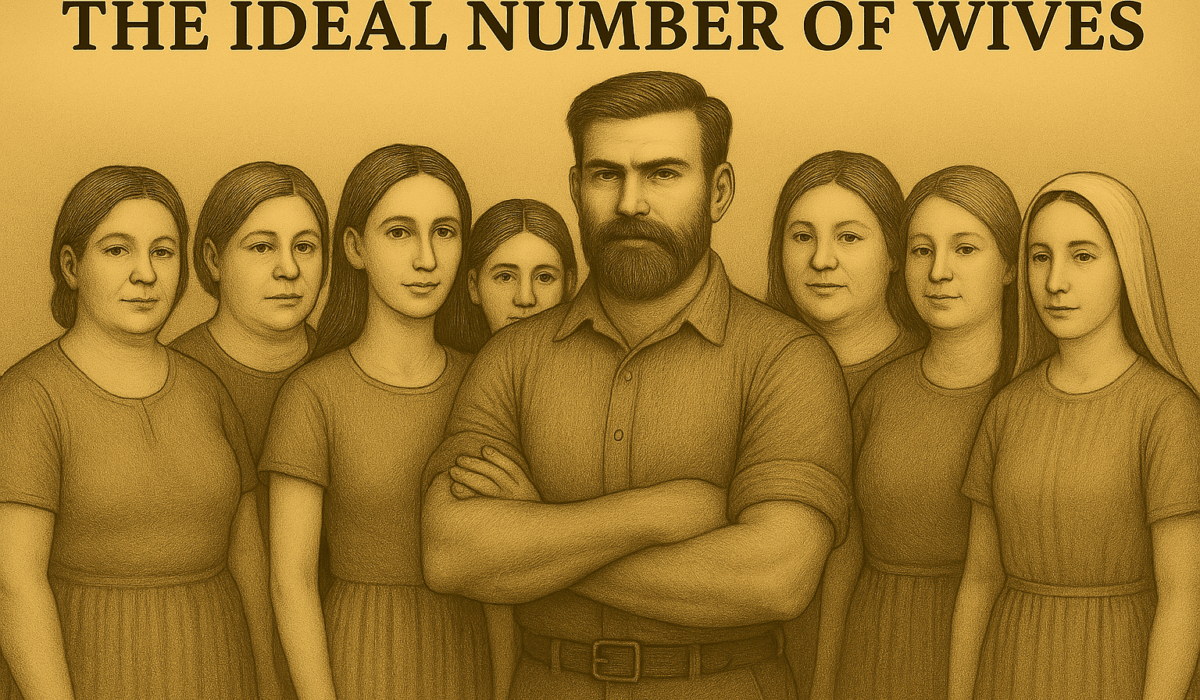
The Divine Mathematics of Wives: Why Seven Is the Ideal Number


Disclaimer

Not every man is called to polygyny. Not every man is called to the same number of wives. Some are called to one, some to none, and some to several. This article does not seek to lay down a law where Scripture has not written one. Instead, these are observations, patterns seen in the Word of God, reinforced in history, and affirmed in reason.


Acknowledgment

This line of thought, and the resulting article, was inspired by a conversation I had with Jacob Foulk. Our discussion sparked a deeper examination into the numbers associated with wives in Scripture, their symbolic meaning, and the practical realities that follow. What began as a casual thought quickly revealed itself to be a profound theme woven throughout God’s design for households.


I: The Symbolism of Numbers in Scripture and Marriage

When God wrote His Word, He did not waste ink. Every number, every sequence, every repeated pattern carries meaning. We live in a culture that treats numbers as cold mathematics, but in Scripture, numbers are theology. They are shorthand for divine realities, patterns by which heaven interprets earth. To study numbers in the Bible is not to drift into mysticism, but to trace the fingerprints of the Creator on the design of His world. And if marriage is one of God’s greatest designs, one of the earliest institutions He ever formed, then it too will bear the marks of numerical order.

The modern mind imagines marriage as one man, one woman, forever and ever, amen. But Scripture never makes such reductionist claims. Yes, one wife is legitimate and honorable. But one wife is not the pattern of perfection; it is the minimum threshold. In fact, when you begin to examine biblical numerology, you realize that one wife may be lawful but incomplete, two wives bring rivalry, three wives bring divine stability, four wives bring earthly fullness, and seven wives bring completion, the fullness of divine order expressed in a household. That is not speculation; it is the repeated testimony of the Bible’s mathematics.


The Number Seven: Divine Completion

The number seven saturates the Bible. It is not a trivial figure, but God’s favorite marker of completion and perfection. Creation is built on it: six days of labor, one day of rest. Israel’s calendar revolves around it: seven feasts, the seventh year sabbath, and the seven-times-seven Jubilee cycle. Heaven resounds with it: seven seals, seven trumpets, seven bowls in Revelation. When God wishes to signal “this is full, this is complete, this is perfected,” He stamps it with the number seven.

So when Isaiah prophesies in chapter 4: “Seven women shall take hold of one man”, he is not pulling a number out of a hat. He is giving us a prophetic image of marital completeness, of a household that reflects divine order. If one wife is lawful and four wives bring balance, then seven wives is the household perfected. Seven is the ideal, not in the sense that every man must reach it, but in the sense that seven is the symbolic number by which God marks completion. In marriage, as in creation, seven signals that the work is whole.


The Number Three: Divine Stability

Before we get to seven, we need to pass through three. The Bible is a book of trinities. God Himself is Father, Son, and Spirit. Christ rose on the third day. The priestly blessing is in three lines. The holiest objects were built on threes, the outer court, the holy place, and the holy of holies. Ecclesiastes 4:12 lays it out clearly: “A threefold cord is not quickly broken.”

Two is unstable. Cain versus Abel. Sarah versus Hagar. Leah versus Rachel. Duality breeds rivalry, envy, and instability. But once the third element enters, stability is created. What was wobbly becomes anchored. This is as true of households as it is of rope. Jacob learned this the hard way. With two wives, he endured endless strife. When the third wife entered, the rivalry balanced. And by the time he had four, the system stabilized. Three introduced divine order, four cemented earthly fullness. But it was three that shifted the balance from rivalry to stability.

Thus, three wives is not just “more” than two, it is categorically different. It transforms the household from rivalry into something stable, divine, and enduring.


The Number Four: Earthly Fullness

If three is divine, four is earthly. The number four is always tied to creation, geography, and universality. The four rivers flowed out of Eden. The four winds cover the whole earth. The four corners of the earth represent the totality of mankind. The four living creatures stand as symbols of all creation before the throne of God.

Applied to marriage, four means the household has reached fullness. Jacob’s four wives produced the twelve tribes of Israel (a multiple of 4), the fullness of the covenant nation. After Zilpah entered, the bickering of Leah and Rachel disappears from the narrative. The household stabilizes. There are no more “wife problems.” Rivalries remain among the sons, but the wives no longer dominate the story. Four wives created a full and functional system, an echo of the four corners of creation.

Thus, we see the progression: two is rivalry, three is divine stability, four is fullness. This pattern is not an accident. It is a testimony that marriage, like creation, follows the divine arithmetic.


One Is Lawful, But Not Complete

The Bible never forbids one wife. In fact, it honors monogamy. But the danger of modern thinking is assuming that the lawful minimum is the divine maximum. Just because one wife is legitimate does not mean one wife is the ideal. Nowhere in Scripture is “one wife only” prescribed as the pattern of perfection. Adam and Eve were the first couple, yes, but Adam and Eve were not the last word. The patriarchs who became the fathers of the covenant, Abraham, Jacob, David, were all polygynists. If one wife was the ideal, why would God build His nation on men with multiple?

One wife is sufficient for covenant legitimacy, but it is not sufficient to reflect divine order. In God’s arithmetic, one is not perfection. Seven is. Which is why Isaiah does not prophesy that “one woman shall take hold of one man.” He says seven!

This is where many scoffers roll their eyes. “Numbers? Really? You’re making doctrine out of math?” But these same scoffers already admit the importance of numbers when it suits them. They speak of the “Ten Commandments,” the “Twelve Apostles,” the “Three Persons of the Trinity.” They know instinctively that numbers in Scripture matter. They just don’t want to apply that logic to marriage because it threatens their fragile devotion to monogamy-only dogma.

The truth is that marriage is not arbitrary. It is covenantal arithmetic. Numbers matter because numbers mark the difference between rivalry and peace, between instability and fullness, between incompleteness and perfection. The Bible itself shows that the trajectory of polygyny follows the logic of its numbers:

  • Two wives = rivalry.
  • Three wives = stability.
  • Four wives = fullness.
  • Seven wives = perfection.

Anything less ignores the patterns God Himself embedded in His Word.


Marriage as Theology, Not Just Biology

Moderns reduce marriage to feelings and hormones. Scripture elevates marriage to theology. Paul says marriage is a “mystery” that reflects Christ and the Church (Ephesians 5:32). If Christ’s bride is one, she is still sevenfold in expression: seven churches, seven lampstands, seven messages in Revelation. The Church is both singular and plural, just as a man with multiple wives is both one household and many. Numbers do not detract from this mystery, they reveal it.

Marriage is not merely biology. It is a stage where theology plays out in flesh and blood. To ignore the numbers is to miss the script. The God who created the universe by number and measure also orders households by number and measure. And He left us the blueprint in the mathematics of His Word.

Numbers in Scripture are never random. They are God’s code for creation, covenant, and completion. When applied to marriage, they reveal a trajectory: from instability at two, to divine stability at three, to earthly fullness at four, and finally to perfection at seven. This is not a man-made scheme but a biblical pattern, reinforced by patriarchal precedent and prophetic vision.

One wife may be lawful. Two wives may be chaotic. Three wives may stabilize. Four wives may bring fullness. But seven wives, the number of divine completion, is the household perfected, the marriage that reflects the fullness of God’s order.

This is why Isaiah 4:1 is not a curiosity but a key: “Seven women shall take hold of one man.” The prophet was not describing chaos. He was describing order, divine order. And to see it is to see that even marriage is governed by God’s arithmetic.

II: The Prophetic Witness – Isaiah 4:1 and the Seven Wives

When men dismiss the idea of seven wives, they often claim, “There is no verse in the Bible that says a man should have seven.” But the reality is that there is one verse that comes closer than any other to spelling out the ideal in plain text, Isaiah 4:1.

“And in that day seven women shall take hold of one man, saying, We will eat our own bread and wear our own apparel: only let us be called by thy name, to take away our reproach.” (Isaiah 4:1, KJV)

For centuries, this verse has been shoved into the corner, treated as an odd curiosity or dismissed as an irrelevant prophecy. Yet if we actually let the text speak, it provides one of the strongest prophetic witnesses for seven wives as the ideal picture of order in a man’s household. Let us break it down.


The Context: Judgment and Restoration

Isaiah’s prophecy in chapter 3 is one of judgment. The women of Zion are condemned for their arrogance, their vanity, their sexual display, and their haughty rebellion. As judgment falls, men are slaughtered in battle, the mighty are stripped away, and Jerusalem collapses under divine wrath.

Then comes Isaiah 4:1: “In that day seven women shall take hold of one man.” What day? The day after judgment. The day when God has cut down the pride of men and women alike. The day when society is reeling from imbalance and devastation. In other words, Isaiah is describing a post-crisis restoration, when men are scarce, women are humbled, and order is sought.

It is in this setting that the number seven emerges, not one, not five, not ten, but seven, as the prophetic marker of restoration.


Why Seven?

If Isaiah only wanted to convey “many,” he could have said “a multitude of women” or “countless women.” But he didn’t. He said seven. That number carries symbolic weight throughout the Bible. Seven is the number of divine perfection, completion, covenantal wholeness. To say “seven women” is to say: “the complete number, the ideal arrangement, the fullness of God’s order.”

Thus, Isaiah 4:1 is not merely predicting desperate women scrambling for survival. It is portraying the divine pattern of restoration: a man as covenant head, seven women as his complete household.


Voluntary Submission & Removing Reproach

Notice also that the women in Isaiah’s vision are not coerced. They are not captured as spoils of war or dragged against their will. They take hold of the man. They come willingly, even desperately, offering to support themselves just to bear his name. They will bring their own bread, their own clothing, they only want covenant legitimacy.

This detail annihilates the caricature that polygyny is forced or degrading. Here, it is the women themselves who seek it out, because they know that attachment to a man of order is the only way to escape reproach. They understand something modern women despise: that glory is not found in independence but in belonging.

What reproach do they seek to escape? The reproach of barrenness, isolation, and disorder. In Scripture, a woman’s shame was not singleness, but fruitlessness. To be unwed and unfruitful was a disgrace. Thus, in Isaiah 4:1, seven women cling to one man because he alone can remove that reproach.

This is not about carnal lust. It is about covenantal identity. The women crave legitimacy, covering, and fruitfulness. They do not care about “fairness” or “equal rights.” They want order. They want to be named by a man. And the fact that seven of them unite under one man shows that this arrangement is not aberration, it is perfection.


Historical Fulfillments & Spiritual Typology

Some interpreters argue that Isaiah 4:1 found its literal fulfillment in the aftermath of wars where male populations were decimated. Indeed, history has seen countless examples:

  • After the Babylonian conquest, the male population of Judah was drastically reduced.
  • After the Roman wars, women outnumbered men by a wide margin in Judea.
  • Even in modern times, after major wars, polygyny has naturally surged in societies where men are scarce.

But the prophecy is not merely about survival. The choice of seven shows that the Spirit was pointing to something more: the ideal. War creates the conditions, but prophecy reveals the divine pattern hidden in it.

Isaiah’s prophecy is not just sociological, it is theological. Marriage in Scripture always points beyond itself to Christ and His Church. If seven women join to one man, it foreshadows the reality that the one Christ is head over the sevenfold Church. Revelation confirms this: there are seven churches, seven lampstands, seven messages, all united under one Lord.

Thus, Isaiah 4:1 is both literal and typological. Literally, it describes women clinging to a man after judgment. Spiritually, it reveals Christ’s sevenfold bride. And in both senses, it affirms that seven wives is the symbol of divine completion.


Answering Objections

Critics will insist: “But this was judgment, not blessing!” True, but judgment is always a pruning for restoration. Just as exile purged Israel for future blessing, so too Isaiah 4:1 shows how disorder leads to order. The fact that God restores households through seven wives means that seven wives is not the curse but the cure.

Others will claim: “This is only symbolic.” But in Scripture, symbol and reality are intertwined. The Passover lamb symbolized Christ, but it was also a real lamb. The temple symbolized God’s dwelling, but it was also a real building. In the same way, seven wives in Isaiah 4:1 symbolizes perfection while also being a literal possibility.

“But won’t the wives be jealous?”
They are jealous at two. They stabilize at three. They stop bickering at four. Jealousy dissolves in plurality. Scripture itself proves it.

“But isn’t one wife enough?”
Enough for what? For legitimacy, yes. For divine perfection, no. Enough to reproduce, yes. Enough to reflect God’s order, no. One is lawful. Seven is ideal.


Implications for Today

Isaiah 4:1 is not locked in the past. It speaks to our time. We live in an age of judgment: feminism has gutted families, men are absent, women outnumber men in the churches, and reproach hangs heavy over childless, career-driven women. The stage is set for Isaiah’s vision to come alive again.

Already, we see hints of it. Women weary of failed independence are seeking strong men. Some are even willing to share if it means belonging to something real. Isaiah foresaw this: when society collapses, women will abandon their feminist delusions and grab hold of a man who can lead. Not any man. A man of order. And when they do, the number seven will not be random. It will be the signature of divine order reasserting itself.

Isaiah 4:1 is more than a curiosity. It is a prophetic witness to the perfection of seven wives under one man. It arises in judgment but points to restoration. It portrays women willingly embracing polygyny, not out of lust but out of desire for legitimacy. It ties directly to the symbolism of Christ and His sevenfold Church. And it sets the stage for understanding why seven is the ideal number of wives, not as a command for all, but as a pattern for those who see God’s order.

When seven women take hold of one man, Isaiah tells us, they will not ask for equality. They will not demand rights. They will not insist on personal fulfillment. They will only beg for his name, his covering, his order. That is not oppression, it is perfection. And it is the perfection of marriage itself, written in prophecy long before modern men dared to despise it.


III: The Patriarchal Patterns – Jacob, Solomon, and the Multiples of Seven

If numbers in Scripture are not accidents, then the marriages of the patriarchs were not accidents either. God could have established His covenant line through a single tidy marriage, but He didn’t. He chose to build His people through men with multiple wives. The fathers of the faith were not monogamy-only crusaders, they were polygynists. Their households were not just tolerated but blessed, and the very numbers of their wives bear testimony to divine design.

When we study Jacob and Solomon in particular, a striking pattern emerges: polygyny becomes more stable as wives increase, and the multiples of seven reinforce the idea that seven is God’s ideal for marital completeness. Let us examine the evidence.


Jacob: From Rivalry to Order

Jacob is perhaps the clearest case study in the progression of polygyny. His story shows us the arithmetic of wives in practice.

  • Two Wives: Rivalry
    Jacob began with Leah and Rachel. What followed was years of poisonous jealousy. Leah bore children while Rachel remained barren. Rachel envied Leah’s fertility; Leah resented Rachel’s favoritism. Their rivalry was so intense that it shaped the naming of their children, names like Naphtali (“my struggle”) and Issachar (“my hire”) testified to the bitterness between them. Two wives did not double the joy; it doubled the strife.
  • Three Wives: Stability Introduced
    When Rachel gave her maid Bilhah to Jacob, something shifted. Bilhah’s children gave Rachel a sense of participation in motherhood, easing her jealousy. Now the rivalry was triangulated, balanced. With three women, no single rivalry dominated. It is as Ecclesiastes says: “A threefold cord is not quickly broken.” The household, while still complex, began to stabilize.
  • Four Wives: Fullness and Peace
    When Leah responded by giving her maid Zilpah, the number rose to four. With four wives, the rivalry essentially disappeared. Each wife had her place, her children, her contribution. The story ceases to focus on wife drama and shifts to the sons, the future tribes of Israel. By four, the wives were settled into a functioning system. The household had reached fullness.

Jacob’s household proves the point: two wives create rivalry, three introduce divine stability, and four bring earthly fullness. Once Jacob had four, the dysfunction was absorbed into productivity. And through those four wives came the twelve tribes, the fullness of the covenant nation.


Solomon: Multiples of Seven

If Jacob shows us the progression, Solomon shows us the scale. Solomon’s marriages are usually portrayed as a cautionary tale, and they should be. But notice carefully: Scripture never condemns Solomon for polygyny itself. The sin was not “too many wives” in raw number. The sin was that his foreign wives turned his heart toward idolatry (1 Kings 11:3–4). The problem was spiritual, not mathematical.

And yet, even in Solomon’s excess, the numbers themselves are telling:

  • 700 wives = 7 × 100 (Multiple of 7)
  • 300 concubines = 3 × 100 (Multiple of 3)

This is not random. It is patterned. Seven, the number of divine perfection. Three, the number of divine stability. Both multiplied by one hundred, the number of fullness and multitude. Even in his disordered household, the numbers themselves proclaim divine arithmetic. Solomon’s marriages were a distorted reflection of perfection, not an abolition of it.

If anything, Solomon’s case strengthens the argument: when polygyny drifts into idolatry, the problem is not quantity but compromise. Seven as the base number still shines through. Solomon didn’t break God’s design by having many wives, he broke it by letting them lead him to false gods.


Multiples of Seven in the Line of David

Solomon wasn’t the only one. The line of David itself shows a recurring theme of multiples of seven. David himself had at least eight named wives, and likely more. His reign, filled with both triumph and failure, reflected the dangers of imbalance but also the legitimacy of plurality. Solomon’s 700 only exaggerated what was already woven into the covenant line.

Why does this matter? Because Jesus Christ, the ultimate Son of David, is consistently tied to sevens: seven churches, seven seals, seven trumpets. The household of David, littered with sevens and multiples of sevens, foreshadows Christ’s perfect household. The pattern is not incidental. It is covenantal.


Seven Churches, One Christ, Covenant Arithmetic

If Jacob shows us four as fullness, and Solomon shows us sevens multiplied, the New Testament ties it all together. In Revelation, Christ is portrayed as the Bridegroom of the Church. But that Church is expressed as seven: seven churches, seven lampstands, seven letters. One Christ, sevenfold bride.

This is the exact marital arithmetic Isaiah foresaw: “Seven women shall take hold of one man.” Christ is the one man, the seven churches are the seven women, and the union is covenant perfection. Thus, when a man takes seven wives, he is not indulging lust, he is reflecting the divine pattern of Christ and His Church.

The lesson is clear. Jacob shows that too few wives breed instability. Solomon shows that multiples of seven define order, even when abused. Revelation shows that sevenfold fullness is the picture of Christ’s covenant household. Together, they testify that polygyny is not random indulgence but covenant arithmetic.

  • Two wives = rivalry
  • Three wives = stability
  • Four wives = fullness
  • Seven wives = perfection
  • Multiples of seven = excess, but still patterned

This progression is not cultural accident. It is divine design. God is revealing something about His order through the numbers in the patriarchal households.


Answering the Critics

Some will object: “But didn’t Solomon’s wives ruin him?” Yes, but again, the ruin came from idolatry, not polygyny. If Solomon had seven wives, all faithful to Yahweh, would his heart have been led astray? Not at all. The problem was the wrong women, not the number of women.

Others object: “But Jacob’s house was filled with strife.” True, when he had two wives. The strife eased at three and disappeared at four. The story itself confirms the point: polygyny grows more stable as wives are added. The rivalries dissolve in the plurality.

Still others protest: “But isn’t one wife enough?” Of course it can be. But enough is not the same as ideal. One is lawful. Seven is perfected. The Bible never calls one wife the pattern of completion, but it repeatedly uses seven to mark divine order. The difference is between sufficiency and perfection.

The patriarchal patterns are not random family dramas. They are Scripture’s testimony to divine arithmetic. Jacob’s household shows us the progression: two is rivalry, three is stability, four is fullness. Solomon’s household shows us the multiples of seven: seven as the base, one hundred as the multiplier, even in excess. And Revelation ties it together with Christ and His sevenfold bride.

The conclusion is inescapable: the ideal number of wives is seven. Not by arbitrary opinion, but by biblical pattern. Not as a command for all men, but as the prophetic witness of divine order. Jacob’s four proved stability. Solomon’s multiples proved the pattern. Christ’s seven proved the perfection. Together, they shout the same truth: seven wives is the household complete.

IV: Practical Realities – How More Wives Often Solve More Problems

The critics of polygyny often argue as if adding wives multiplies chaos. They imagine a man with many wives as some frazzled fool surrounded by nagging voices, endless catfights, and unmanageable drama. But reality, and Scripture, teach the exact opposite. The more wives a man has, the fewer problems he suffers. Polygyny is not a recipe for chaos, but the antidote to it. When properly ordered under a strong man, plurality diffuses rivalry, absorbs envy, and multiplies productivity. What looks like “complication” to the modern mind is actually stability in biblical arithmetic.


One Wife: Lawful but Fragile

One wife is legitimate. Adam had one Eve. Isaac had one Rebekah. A man with one wife is still a man. Yet a single wife, while lawful, is also fragile.

With only one wife, the man’s entire household rests on her alone. If she is faithful, orderly, and fruitful, the house may stand. But if she is barren, bitter, rebellious, or unstable, the entire structure wobbles. There is no ballast. There is no counterbalance. One wife means one point of failure.

This is why Proverbs repeatedly warns against the contentious woman: she is “like a continual dripping on a rainy day” (Prov. 27:15). If she is your only wife, you have no escape. Your household is bound to her mood swings, her obedience or lack thereof. One wife is enough for legitimacy, but it is not enough for resilience.


Two Wives: Rivalry

If one wife is fragile, two wives are combustible. Nearly every biblical example of two wives shows rivalry:

  • Sarah vs. Hagar: jealousy, mistreatment, division.
  • Rachel vs. Leah: envy, bitterness, constant striving.
  • Peninnah vs. Hannah: provocation, mockery, anguish.

Two creates duality, and duality breeds comparison. Each wife sees the other as competitor rather than complement. The man becomes referee rather than ruler, caught in a tug-of-war between two jealous women. This is why critics often point to polygyny and say, “Look at the strife!”, because they stop at two. They see rivalry at two and assume more wives will make it worse. But the pattern of Scripture shows the opposite: the rivalry dissolves in plurality.


Three Wives: Stability Introduced

Three changes the equation. Ecclesiastes 4:12 declares: “A threefold cord is not quickly broken.” With three, rivalry cannot remain binary. No longer can one wife pour all her jealousy on one rival; now the attention is split, the dynamic triangulated. This balances the system.

Jacob saw this with Bilhah. Once Rachel had her maid producing children, her jealousy toward Leah lessened. The third wife created stability by redistributing the tension. Instead of being trapped in endless tug-of-war, the household found balance.

Three is not only “one more” than two. It is a categorical shift: from rivalry to stability. This is why three is consistently divine in Scripture, Father, Son, Spirit; resurrection on the third day; a threefold blessing; the three holy places in the tabernacle. Three stabilizes what two cannot. And in polygyny, three introduces divine balance into the home.


Four Wives: Fullness and Peace

With four, stability blossoms into fullness. The number four in Scripture is always tied to the completeness of creation: the four rivers of Eden, the four winds of heaven, the four corners of the earth. It signals wholeness, universality, completion in the earthly realm.

Jacob’s household again proves the point. Once Zilpah entered, bringing the number to four, the wife-rivalry vanished. The wives were settled, the bickering ceased, and the narrative moved on. From then on, the issues arose from the sons, not the wives. The wives were no longer the problem. Four created earthly fullness, a system that absorbed jealousy into productivity.

With four wives, no one woman can dominate. No two can monopolize the man’s attention. The plurality itself stabilizes the household. Far from increasing drama, four ends it.


Seven Wives: Perfection

If three stabilizes and four completes, seven perfects. Seven is the biblical number of divine completion: seven days of creation, seven feasts, seven trumpets, seven churches. When Isaiah prophesied that “seven women shall take hold of one man” (Isa. 4:1), he was not describing random chaos. He was describing the perfected household.

At seven, the plurality itself dissolves envy. Each wife knows she is part of a complete order. The household is no longer fragile, nor rivalrous, nor merely full, it is perfected. Seven wives is not “too many”; it is the number God Himself chose to signify marital restoration after judgment. It is the symbolic ideal, the point at which a man’s household reflects divine order in its fullness.


The Paradox of Polygyny

The great paradox of polygyny is this: what looks like more complication actually produces more stability.

One wife = lawful but fragile. Two wives = rivalry.Three wives = balance. Four wives = fullness. Seven wives = perfection.

The critics see Jacob’s rivalry with two wives and stop there. They refuse to read the story forward. They ignore that the rivalry disappears at four. They miss that Isaiah prophesied perfection at seven. They cling to the fragile minimum of one and call it “ideal,” when Scripture itself shows that more wives, rightly ordered, actually solve more problems.

This is not only theology but reality. History, anthropology, and plain common sense all confirm it.

  • Checks and Balances: In a polygynous household, no single wife can monopolize the man. If one grows rebellious or manipulative, the others provide counterbalance. Her influence is diffused. She cannot hold the household hostage.
  • Productivity: More wives mean more hands. Household duties, child-rearing, agriculture, business, all multiply. Instead of one exhausted woman, you have a team of women working in harmony under one head.
  • Fruitfulness: One wife produces a handful of children. Seven wives can produce an entire legacy. In a world where children are wealth, security, and covenant continuity, this is not indulgence but wisdom.
  • Emotional Balance: Modern men who dread “drama” fail to realize that drama is not multiplied by more wives, it is absorbed. In a one-wife household, all the man’s emotional life is tied to her moods. In a multi-wife household, his emotional weight is spread. The burden is lighter, not heavier.
  • Social Reality: In times of war or famine, when men are scarce, polygyny is not only ideal but necessary. Isaiah 4:1 is not ancient history, it is prophecy of how women respond when society collapses. They will seek plurality because it is the only way to remove their reproach.

The practical reality of polygyny is the exact opposite of what critics assume. The more wives a man has, the fewer problems he suffers. One wife is fragile, two wives are rivalrous, three bring stability, four bring fullness, and seven bring perfection. This is not modern speculation but biblical arithmetic confirmed in practice.

The man who fears “too many wives” reveals that he is not a man strong enough to lead even one. But the man who embraces God’s order finds that each additional wife diffuses rivalry, multiplies fruitfulness, and perfects his household. Seven wives is not chaos, it is completion. And the only men who fear it are the ones unwilling to be men at all.


V: The Ideal of Seven – Symbol, Structure, and Sobriety

We have traced the biblical mathematics of wives: one as lawful but fragile, two as rivalry, three as divine stability, four as fullness, and seven as perfection. We have seen Jacob’s household, Solomon’s multiples, Isaiah’s prophecy, and Christ’s sevenfold Church. The conclusion is unavoidable: seven wives stands as the biblical ideal of marital completion. But before a man runs off to gather seven, there must be clarity. The ideal of seven is not a license for reckless indulgence, nor a command for every man, but a sober recognition of God’s pattern. Let’s explore what it means for seven to be the ideal, and how this ideal should be understood.


Seven as Symbol and Structure

The number seven in Scripture is always more than arithmetic, it is theology. Seven marks divine perfection, covenant completion, God’s stamp of order. The world was created in seven days. The feasts of Israel are built on sevens. Revelation’s visions are structured on sevens. When God seals His work, He seals it with seven.

Thus, when Isaiah prophesies “seven women shall take hold of one man” (Isaiah 4:1), he is not merely giving us a statistic. He is revealing a divine symbol. Seven women under one man is not only a sociological survival strategy, it is a theological picture of covenant order. It is a snapshot of divine completion in marriage.

The man with seven wives is not a freak of history but a reflection of divine pattern. His household, if rightly ordered, is a microcosm of God’s perfection, one head, sevenfold expression, complete in order and fruitfulness.

Seven is not only a symbol but a structure. It defines the architecture of a household. With seven wives, the household mirrors the seven churches of Revelation: one Lord, many lampstands, a unified yet diverse bride. Each wife brings her gifts, her children, her productivity. Together, they form a complete system.

This structure has practical benefits. With seven wives, there are enough women to share labor, to absorb jealousy, to provide checks and balances, to ensure fruitfulness, and to multiply productivity. No one woman can monopolize. No rivalry can dominate. The plurality itself creates equilibrium. Just as the body of Christ is many members yet one body, so too the sevenfold household is many wives yet one family.

Seven is not random. It is the number at which the household becomes a perfected organism, stable and complete.


Seven as Sobriety

But here is the warning: seven is not a playground. It is not an excuse for men to indulge their lusts under the pretense of “biblical order.” A man unfit to lead one wife is unfit to lead seven. A man who cannot govern himself cannot govern a household of completion.

This is why the ideal of seven requires sobriety. It is an ideal, not a mandate. It is a goal, not a toy. It is a picture of order for the strong, not a loophole for the weak. To proclaim seven as ideal is not to throw pearls before swine. It is to call men to rise up into the strength, discipline, and authority required to steward a perfected household.

Seven wives is not for boys chasing pleasure. It is for men who have mastered themselves, who carry vision, who walk in covenant headship. The man without backbone, without vision, without obedience to God, should never dare. For him, even one wife is too much.


Seven as Contrast and Balance

The modern world recoils at this truth. It praises “serial monogamy” (divorce and remarriage) while despising polygyny. It tolerates fornication, adultery, and sodomy but sneers at the idea of one man with multiple wives in covenant. Why? Because seven represents order, and the world thrives on chaos.

Seven wives under one man is the anti-thesis of feminism. It is the destruction of egalitarian lies. It is the reassertion of hierarchy, headship, and fruitfulness. A sevenfold household is not an experiment in modern “family diversity”, it is a restoration of biblical order. And that is precisely what the rebellious spirit of the age cannot abide.

To proclaim seven as ideal is therefore to strike at the heart of modern rebellion. It is to lift up God’s structure against the world’s chaos.

Seven is also balance. This is why seven resonates so strongly. It is enough to be full, not enough to be excessive. It is balanced, symmetrical, complete. The man with seven wives has reached a natural stopping point, the household is perfected. The numbers themselves say, “This is enough.”

Thus, seven is not merely ideal because it is symbolic. It is ideal because it is balanced. It represents the household in equilibrium, neither deficient nor distorted.


Seven as Christ’s Pattern – Not Mandate

Ultimately, seven wives is ideal because it mirrors Christ and His Church. In Revelation, Christ addresses seven churches. He holds seven stars, walks among seven lampstands, sends messages to sevenfold expressions of His one bride. The Church is singular yet sevenfold in expression.

The man with seven wives reflects this pattern. He is one head with sevenfold expression. He is Christ-like not in deity but in design, imaging Christ’s relationship to His perfected, sevenfold Church. His household is an icon of the greater mystery.

This is why Isaiah’s prophecy and Revelation’s vision fit together: seven women under one man, seven churches under one Christ. The pattern is the same. Seven is not arbitrary, it is Christological.

To be clear: seven is ideal, not mandate. Not every man is called to it. Not every era permits it. Not every circumstance requires it. Some men will remain with one wife, others with two or three. All are lawful. All may be blessed.

But in the arithmetic of Scripture, the number that shines as perfection is seven. To recognize this is not to despise smaller households but to honor the pattern of God’s order. It is not to force men into seven but to reveal that in God’s mathematics, seven is the number of completion.

Every man must discern his calling. Some are called to one wife. Some to none. Some to several. But those who see the pattern cannot deny it: seven is the ideal.


Conclusion

The mathematics of wives is not about counting bodies but about recognizing God’s patterns of order, stability, and fullness. The progression from one to seven shows that what men fear as “complicated” may in fact be what God intended as perfected. Yet this is not for every man, nor for every time. It is for those called, equipped, and willing to order their households after the structure God Himself imprinted into His Word and His world.

One wife may be lawful. Two may be rivalrous. Three may stabilize. Four may complete. But seven perfects. Seven is God’s stamp of order, His number of completion, His sign of a household in covenantal fullness. Not every man will reach seven. Not every man should try. But those with eyes to see will recognize the pattern: seven wives is not chaos but completion, not indulgence but order, not rebellion but reflection of Christ and His sevenfold bride.


Home Discipleship, Not State Indoctrination: Why Homeschooling Is the Only Godly Option

“And these words, which I command thee this day, shall be in thine heart: And thou shalt teach them diligently unto thy children…”
— Deuteronomy 6:6–7

We live in a time of great deception. While parents sleep, the world catechizes their children. While churches busy themselves with entertainment, the state trains up an army of rebellious children. And while Christians beg for crumbs of morality in the school system, Satan feasts on the minds of the next generation.

The war for our children is not coming,it is here, and we are losing. The battleground is the public school classroom.

It is time to proclaim with thunderous conviction: homeschooling is not an option, it is the only righteous path. It is not a luxury for the wealthy, nor an experiment for the radical. It is the sacred duty of every parent who calls Christ Lord.

I. God’s Model for Education: Fathers, Homes, and Covenant

The Bible is not silent on the issue of education. From Genesis to Revelation, God gives His people a blueprint, and nowhere in it do we find the outsourcing of discipleship to pagans.

“Train up a child in the way he should go: and when he is old, he will not depart from it.” — Proverbs 22:6

Who is called to train the child? The father. The mother. The household. Not the government. Not strangers, nannies, or daycares. Not institutions or paid surrogates.

Deuteronomy 6:6–9 gives the clearest educational mandate in all of Scripture:

“These words… thou shalt teach them diligently unto thy children, and shalt talk of them when thou sittest in thine house, and when thou walkest by the way, and when thou liest down, and when thou risest up…”

Education is not confined to a classroom. It is life-long discipleship rooted in the fear of the Lord. And it happens in the home.

Likewise, Ephesians 6:4 commands:

“Fathers, provoke not your children to wrath: but bring them up in the nurture and admonition of the Lord.”

The Greek word for “nurture” is paideia, it means the full enculturation of a child in God’s ways. It is the shaping of worldview, values, morals, and knowledge according to the covenant.

This cannot be done in a system that denies Christ.

II. Public School: Paganism in the Name of Neutrality

Public school is not neutral. It is the church of secular humanism. Its catechism is evolution, its morality is relativism, and its god is the state. It is, quite literally, anti-Christ.

Every hour a child spends in public school, they are being taught that:

  • God does not exist (or is irrelevant)
  • Truth is subjective
  • Gender is a spectrum
  • History is man-centered
  • Authority is arbitrary
  • Parents are secondary
  • Morality is negotiable

And parents expect to undo this with one hour of church per week?

“Can a man take fire in his bosom, and his clothes not be burned?” — Proverbs 6:27

Public school was founded by men who despised God. Horace Mann, John Dewey, and their ilk believed education should free children from the influence of the Bible and the family. They succeeded. Today’s public schools are temples of rebellion.

The Curriculum of Corruption

Sexual perversion is now standard in school programs. Children are exposed to transgender ideology, explicit sex education, and pornographic material disguised as “health education.”

Drag queen story hours, preferred pronouns, and boys in girls’ bathrooms are not fringe, they are policy.

According to the CDC, over 50% of U.S. public schools have active LGBTQ+ support groups. And over 40% teach gender identity curriculum by middle school.

This is not education. It is abuse. It is indoctrination!

“But whoso shall offend one of these little ones which believe in me, it were better for him that a millstone were hanged about his neck…” — Matthew 18:6

No child can be fed poison and not suffer damage. No family can tolerate this assault and remain intact.

III. Private Schools: A False Hope

Some parents, rightly alarmed by the horrors of public school, turn to private institutions. But private schools, especially Christian ones, are not the solution.

Most Christian schools:

  • Use secular textbooks with thin Christian gloss
  • Employ teachers with compromised worldviews
  • Mimic public school methods, schedules, and structure
  • Serve as social clubs for lukewarm families
  • Focus on accreditation, not sanctification

They may avoid overt perversion, but they still catechize children in the god of careerism, peer dependence, and institutionalism. They separate children from the household and teach them to look to outsiders for truth.

True Christian education must be governed by the father’s authority, not the board of trustees.

IV. Hybrid and Co-Ops: Half-Measures That Lead to Drift

Homeschool “hybrid” programs and co-ops can provide temporary support, but they must never become substitutes for full parental oversight. Many such programs:

  • Offload education to other families
  • Rely on online systems that bypass family culture
  • Use pre-packaged secular or soft-Christian content
  • Encourage early independence and peer grouping

The problem is not just content, it’s authority. When children learn under systems not governed by the father and not submitted to Christ in every detail, they learn that Scripture is optional, and authority is fragmented.

“Every wise woman buildeth her house: but the foolish plucketh it down with her hands.” — Proverbs 14:1

You cannot delegate discipleship. You cannot subcontract sonship. You either build your house, or let it be built by others.

V. Homeschooling: The Ancient and Biblical Path

Homeschooling is not new. It is ancient. It is biblical. It is God’s ordained pattern.

Before there were schools, there were households. Before there were experts, there were fathers. Before there were credentials, there was obedience.

Throughout history, the greatest civilizations were built by families that educated their own:

  • The Hebrew patriarchs taught the law of God at home.
  • The early church trained children in the Scriptures by household worship.
  • The Reformers advocated for family discipleship and literacy in the vernacular.
  • The American pioneers built homes, farms, and minds with Bible, ink, and fire.

Until the 20th century, homeschooling was the norm. The explosion of public education coincided with the rise of statism, feminism, and moral collapse.

Today, homeschooling is not just a return to the past, it is a resistance movement against the future the world is trying to force upon us.

VI. Moral Obligation: The Soul of the Child Is at Stake

What is a child worth?

Jesus asked, “What shall it profit a man, if he shall gain the whole world, and lose his own soul?” — Mark 8:36

Yet parents send their children to systems that gain them grades, sports, and scholarships, but lose their souls. And they call it love.

We must see this with clear eyes: every day in public school is a step toward hell. It may not always be obvious. It may come through compromise, soft rebellion, or quiet doubts. But the path is always downward.

Parents will give account before God for the souls of their children.

“The just man walketh in his integrity: his children are blessed after him.” — Proverbs 20:7

If we want our children to be blessed, they must be raised in integrity, not convenience.

VII. Practical Concerns: Obedience over Excuses

Many say, “We can’t afford to homeschool.” But the real question is, “Can we afford not to?”

God never commands anything without making a way. The issue is not money, it is faith.

“But I work full-time.”

Then consider restructuring your household. Homeschooling requires sacrifice. Cut expenses. Downsize. Rearrange schedules. Reassign roles.

“But I’m not a trained teacher.”

You don’t need to be. You need to be faithful. Resources abound, books, curricula, podcasts, networks. But the greatest teacher your child needs is not a degree-holder. It is you, because God ordained it so.

“But what about socialization?”

Do you want your children socialized by fools and pagans?

“He that walketh with wise men shall be wise: but a companion of fools shall be destroyed.” — Proverbs 13:20

Homeschoolers are not socially deprived, they are socially protected. They grow up relating to adults, siblings, real work, and real worship, not playground savagery and locker room filth.

“But what if they don’t get into college?”

Then praise God. College is another idol. If your child is called to higher education, the Lord will provide. But your goal is not success, it is sanctification.

VIII. Statistics and Research: Homeschooling Works

The numbers confirm what Scripture has already told us.

According to the National Home Education Research Institute (NHERI):

  • Homeschooled students consistently score 30 percentile points higher on standardized tests.
  • Homeschoolers perform better academically regardless of the parent’s education level or household income.
  • They are more likely to be civically engaged, morally grounded, and religiously active.
  • 82% of homeschool graduates say they intend to homeschool their own children.

In contrast, public school graduates show rising rates of:

  • Gender confusion
  • Depression and anxiety
  • Pornography addiction
  • Church abandonment
  • Marxist and anti-Christian worldview

The fruit of each system is evident. The data only confirms the deeper truth: you reap what you sow.

IX. God Will Provide: The Blessing of Obedient Education

Do not believe the lie that homeschooling is too expensive, too hard, or too risky. Those are the whispers of Satan. God blesses obedience.

“Seek ye first the kingdom of God, and his righteousness; and all these things shall be added unto you.” — Matthew 6:33

If you make educating your children in the fear of the Lord your first priority, He will meet your needs. He may not give luxury, but He will give sufficiency. And more than that, He will give you joy, peace, unity, and honor.

God multiplies the loaves. He parts the seas. He guides the humble. He rewards the faithful.

Homeschooling may cost you:

  • Comfort
  • Reputation
  • Convenience
  • Income

But what will it give you?

  • Children who love and fear the Lord
  • A household united in mission
  • Generational blessings
  • A heritage that shines in darkness

“And all thy children shall be taught of the Lord; and great shall be the peace of thy children.” — Isaiah 54:13

That is a promise.

X. The Final Call: No More Compromise

This is not a hobby, it is not a trend. This is war!

The battle for the soul of the next generation is being waged daily. Every lesson, every story, every authority your child submits to will either point them to Christ, or away from Him.

Public school is not an option. Private school is not a refuge. Co-ops are not a substitute.

You are the shepherd of your household. And if you hand your lambs to wolves, you will answer to God for it.

Let the cost be what it must. Sell what must be sold. Sacrifice what must be sacrificed. But bring your children home.

Rebuild your house.

Sanctify your table.

Teach the Word.

Establish routine.

Model discipline.

Raise up arrows for the Lord.

And trust that He who called you will never fail you.

“Lo, children are an heritage of the Lord: and the fruit of the womb is his reward.” — Psalm 127:3

Let them not be handed over to Pharaoh.

Let them not be sacrificed on the altar of Mammon.

Let them not be raised by Rome, only to rebel against Zion.


Bring them home.
Teach them truth.
Build the Great Order.

Soli Deo Gloria.

The Great Deception: Vaccines, the War on Children, and the Assault on God’s Order

In the age of technocratic tyranny, where the white coats of the medical priesthood have replaced the white robes of Biblical authority, a silent war has been waged, not with guns or bombs, but with needles. Behind the smiling faces of pediatricians and the sterile language of “immunization” lies a brutal truth: vaccines have caused incalculable damage to the bodies, minds, and souls of millions. They have been exalted as saviors, but they have left a trail of broken children, grieving parents, and depopulated nations.

This post is not mere alarmism. It is a call to righteous judgment, to reestablish God’s dominion over our homes, our health, and our offspring. We must tear down the altars of pharmakeia, where children are sacrificed in the name of public health, and build instead the altar of obedience to God’s Word.

I. The Sorcery of Pharmakeia

In Revelation 18:23, we are warned of Babylon’s seduction: “For by thy sorceries (Greek: pharmakeia) were all nations deceived.” This is no accident. The word “pharmakeia” is the same root from which we get “pharmaceutical.” The ancient world understood that the use of potions and poisons, under the guise of healing, was often a cloak for manipulation, idolatry, and control.

Today, this pharmakeia comes in the form of multi-dose vials, synthetic adjuvants, and state mandates. It promises health but often delivers sickness. It claims to prevent disease, but for many, it causes lifelong affliction. The lie is religious in nature, and the Church has been shamefully silent.

II. Vaccines and the Death of Innocents: Sudden Infant Death Syndrome (SIDS)

Sudden Infant Death Syndrome, the unexpected and unexplained death of seemingly healthy infants, has haunted parents for decades. But few dare to ask: Why has SIDS coincided so closely with the rise of the infant vaccination schedule?

A study published in The Journal of Pediatrics in 1983 noted that nearly 70% of SIDS deaths occurred within 3 days of DPT (Diphtheria, Pertussis, Tetanus) vaccination. Dr. Viera Scheibner, a renowned vaccine researcher, studied over 100,000 pages of medical literature and concluded:

“Vaccination is the single most prevalent and preventable cause of infant death.”

In countries like Japan, when the age of vaccination was delayed from 3 months to 2 years, SIDS cases nearly vanished. But in America, where newborns are routinely injected before their immune systems are even fully formed, the SIDS rate remains tragically high.

Do not be deceived, this is not random. This is blood on the altar of Molech, disguised in modern language.

III. Heartbreak by Design: Myocarditis and Cardiac Injury

The recent rollout of mRNA vaccines for COVID-19 has provided one of the clearest revelations of vaccine-related heart damage. Myocarditis, an inflammation of the heart muscle, has spiked in young men and adolescents, particularly after the second dose of the Pfizer and Moderna shots.

A CDC report in 2021 acknowledged elevated myocarditis rates, particularly among males aged 16–24. A study in JAMA Cardiology found that the rate of myocarditis post-vaccination was over 100 times higher than normal background rates in this age group.

These are not isolated incidents. These are broken hearts, literally, among the youth God has called to be strong, to rule, to build.

The heart is the engine of life. When the state demands injections that compromise it, it is not protecting life, it is playing god with yours.

IV. The Autism Explosion: A Crisis No One Will Admit

Autism rates have exploded in recent decades. In 1970, it was 1 in 50,000. By 2000, it was 1 in 150. Today, it is 1 in 36. What changed?

The vaccine schedule.

By the time a child is six years old, the CDC recommends up to 72 doses of vaccines. Aluminum adjuvants, mercury (thimerosal), and other neurotoxic substances are injected repeatedly into small, developing bodies.

And here is a fact the “experts” never want you to hear: in the majority of the third world, where vaccination rates are extremely low to nonexistent, autism is virtually unheard of. Entire rural regions have zero reported cases. In fact, there has never been a single documented case of autism in a completely unvaccinated child. The so-called “mystery” of autism’s cause is no mystery at all, unless you’re paid to keep it one.

Dr. Andrew Wakefield was vilified for pointing out a link between the MMR vaccine and autism. Though his original study has been relentlessly attacked, subsequent research has supported many of his findings:

A 2017 study in Frontiers in Neurology found that aluminum in vaccines may contribute to “neurological damage and autoimmune diseases.”

The Journal of Trace Elements in Medicine and Biology published findings showing significantly elevated aluminum levels in the brains of autistic individuals.

The temple of science has no answer for this plague. But the Bible does. It tells us that “The thief comes only to steal and kill and destroy” (John 10:10). What is more destructive than robbing a child of his mind, his communication, his relationships, his very essence?

V. The Hidden Agenda: Vaccines and Population Control

Vaccines have been sold as a benevolent tool of health. But in the mouths of the global elite, they are something darker. Bill Gates, who has poured billions into vaccine research, stated in a 2010 TED Talk:

“If we do a really great job on new vaccines, health care, reproductive health services, we could lower population by perhaps 10 or 15 percent.”

Why would vaccines lower population? Why would a health intervention reduce people?

We have been trained to think only in terms of death when we hear “population control.” But there is another method, slower, subtler, and in some ways more efficient: creating a generation that will never fully function, never fully reproduce, and never fully resist.

Autism is not just a medical condition; it is an economic and societal lever. A child who is robbed of normal speech, cognition, and independence becomes a permanent ward of the system. They will never be a fully free man or woman capable of raising a large, self-sufficient family. They will consume resources, require constant management, and remain dependent on state programs for life. Multiply that by millions, and you do not merely reduce births, you create a compliant, docile population too impaired to stand in the way of elite agendas.

This is why the fact that autism is virtually non-existent in unvaccinated populations is so dangerous to the establishment. It destroys the myth of “mystery causes” and points directly at their needle. If the masses ever realized that their children were being neurologically disarmed in the name of “health,” the entire pharmakeia empire would crumble overnight.

Multiple independent investigations, including by Kenyan Catholic doctors in 2014, discovered that a UN-backed tetanus vaccine campaign was laced with hCG, a hormone used to prevent pregnancy. Women who received the shots became infertile. The World Health Organization denied it, until the evidence became overwhelming.

Vaccines have been weaponized. Not just for profit, but for eugenics. For depopulation. For rebellion against God’s first command: “Be fruitful and multiply” (Genesis 1:28).

VI. Lowered Fertility and the Curse of Sterile “Health”

It is no accident that birthrates in the West are at historic lows while vaccine schedules are at historic highs. Fertility is fragile. The endocrine system, responsible for hormones, reproduction, and growth, is sensitive to foreign chemicals. Many vaccines contain known endocrine disruptors.

A study published in Toxicology Reports in 2017 linked the HPV vaccine to premature ovarian failure in adolescent girls. Multiple peer-reviewed journals have warned that ingredients like polysorbate 80 and aluminum may interfere with hormone production and ovarian development.

Even more disturbingly, animal studies have shown that vaccinated female mice exhibit significantly reduced fertility compared to unvaccinated ones. Males too show reduced sperm motility and viability.

What does this mean? It means the bodies God made for fruitfulness are being sterilized by the very “medicine” we are told to trust. The modern state promises “protection”, but it is protection from life itself.

VII. The Biblical Case Against Forced Medicine

The principle of bodily sovereignty is deeply embedded in Scripture. Our bodies are not the property of the state. They belong to God.

“What? know ye not that your body is the temple of the Holy Ghost… and ye are not your own? For ye are bought with a price.” —1 Corinthians 6:19–20

We are stewards, not slaves. Nowhere in Scripture does God authorize the government to inject foreign substances into our bodies “for our own good.” In fact, when foreign nations attempted to control the bodies of God’s people, they were judged severely (Daniel 1, 1 Samuel 8).

Parents, you are commanded to protect your children, not hand them over to Pharaoh’s physicians. Your duty is not to obey doctors; it is to obey Christ. And Christ never told us to hand over our babies to be injected with heavy metals and sterilizing agents.

VIII. Historical Warnings: From Smallpox to the COVID Regime

Vaccination is not a new idol. In the 1800s, the smallpox vaccine was mandated across Europe. But in England, entire communities resisted, citing Biblical and bodily sovereignty. They were fined, imprisoned, and mocked. Yet they stood firm.

In 1905, the U.S. Supreme Court upheld forced vaccination in Jacobson v. Massachusetts, opening the door to tyranny disguised as medicine. But the Church said nothing.

Fast forward to 2020: lockdowns, vaccine mandates, and digital passports. All justified by “public health.” But the fruit was devastation: destroyed businesses, isolated elderly, rising suicide rates, and death by injection. Many churches bowed to Caesar. But some, praise God, did not.

History repeats itself when men forget the lessons of faith and freedom.

IX. Restoring God’s Order: A Call to Fathers

Fathers, you are the gatekeepers of your home. You will answer to God for what enters your children’s bodies, not just through their eyes and ears, but through their bloodstream.

Do not let fear guide you. Let conviction guide you. Reject vaccines. Reject the culture of medical coercion. Reject the lie that health comes from the state rather than from the Lord.

“If thou wilt diligently hearken to the voice of the Lord thy God… I will put none of these diseases upon thee… for I am the Lord that healeth thee.” —Exodus 15:26

X. The Path Forward: Faith, Food, and Freedom

Health begins at home. Not in a clinic. Not in a bottle. Not in a shot.

Feed your family clean, God-made food.

Strengthen their immune systems with sunlight, exercise, and rest.

Use herbs, vitamins, and nutrition, not sorcery.

Raise them to fear God, not germs.

The path to health is not complex. It is ancient. It is Biblical. And it does not involve submitting to a system that has repeatedly lied, harmed, and profited from your obedience.

XI. Let the Great Order Rise – In Health and Honor

The Great Order is not just about headship. It is about holiness in every sphere, including how we treat the bodies God gave us.

Do not inject poison and call it love. Do not trust liars and call it submission. Do not destroy children in the name of protecting them.

Build a house of righteousness. Raise children in purity. And reject the pharmakeia of this age.

For we serve the living God, not the god of biotech.

And when the Lord returns, may He find not a vaccinated, sterilized, population-controlled people, but a mighty remnant who feared His Word more than the syringe.

Soli Deo Gloria. Let the patriarchy guard its gates. Let the fathers say “No more.” Let the children be free!

The Lie of Fairy-Tale Love vs. The Truth of Biblical Covenant: Restoring Honor in Marriage and Romance

I. The Great Illusion: Modern Romance and Its Poisoned Fruit

We live in a generation drunk on the wine of emotional fantasy, where love is painted in glitter and dreams rather than blood and covenant. The modern conception of love and romance; marketed through Disney movies, pop songs, and TikTok influencers, has turned marriage into a fleeting spark of passion rather than a solemn bond of dominion, order, and legacy. The modern mind believes that to “fall in love” is to be swept away in feelings, and when those feelings change, love is assumed to have died. Such an idea is not merely naïve; it is destructive.

The 21st-century romance myth revolves around personal happiness and instant gratification. A 2023 Pew Research survey revealed that 88% of Americans believe love is the most important reason to get married, but only 24% believe it’s important for couples to have shared religious beliefs. This shows the collapse of covenantal thinking. In this model, the individual’s temporary feeling of “being in love” is enthroned, and God’s order is discarded.

Contrast this with the Biblical understanding: marriage is not founded upon feelings but upon vows, law, and covenantal duty. Feelings can come and go like waves, but covenant remains anchored to the rock of God’s Word.

Hollywood teaches that love is when someone “completes you.” God teaches that love is when a man lays down his life for his bride, sanctifies her with the Word (Ephesians 5:25-27), and builds a multigenerational household in submission to Christ. The fairy tale ends with a wedding. The Kingdom story begins with one.

The Feminine Fantasy and Masculine Sloth

The romantic fairy tale particularly ensnares women. From a young age, girls are fed stories where the princess is passive, waiting for a perfect man to find her, rescue her, and romance her forever. The man is always rich, handsome, and emotionally sensitive. The girl is always beautiful, pampered, and adored. There is no work, no conflict, and no suffering in this world, only happily ever after.

This corrupts women to expect effortless perfection. The romantic notion becomes a drug, and when reality sets in; when diapers must be changed, when money is tight, when her husband is firm rather than soft, she feels “unloved.” In reality, she was never taught what love truly is.

Men, too, are affected, but in a different way. Instead of building homes, taming wild lands, and forging legacies, they are lulled into passive entertainment, pornographic fantasy, or immature pursuits. They believe that winning a woman is about charm and convenience, not headship and labor. This is why many Christian men today delay marriage into their thirties, remaining unready to take dominion and lead a household.

Historical Note: The Rise of Romanticism

The notion of romantic love as the foundation of marriage is a relatively modern idea. Prior to the Enlightenment and Romantic era (18th–19th centuries), marriage in Christian Europe was understood as a social, economic, and spiritual covenant. Love was expected to grow through duty, shared purpose, and the sanctifying work of the Spirit. In medieval Christendom, the concept of “courtly love” emerged in aristocratic poetry, where knights idealized and idolized unattainable women. This paganized the concept of love, severing it from God’s law.

C.S. Lewis noted in The Four Loves that romantic love, when exalted above all else, becomes a god; and like all false gods, it devours its worshipers.

II. What Is Biblical Love? A Matter of Covenant and Command

Biblical Love Is Obedient

The modern mind hears “love” and thinks “emotion.” The Biblical mind hears “love” and thinks “obedience.”

“For this is the love of God, that we keep his commandments: and his commandments are not grievous.” —1 John 5:3

True love is covenantal, not emotional. It is defined by action and grounded in God’s law. Husbands are commanded to love their wives as Christ loved the church, not by pampering her emotions, but by leading, providing, sanctifying, and laying down his life. Wives are likewise commanded to love their husbands by reverent obedience and faithful service (Titus 2:4–5). Love, then, is not how we feel but how we act, especially when we do not feel.

Jesus did not die on the cross because it felt good. He died because He loved the Church. Love bleeds. Love sacrifices. Love obeys.

Love as Headship and Submission

In Ephesians 5:22–33, we are given the divine pattern of love:

  • The husband is the head of the wife as Christ is the head of the Church.
  • The wife is to submit to her husband as the Church submits to Christ.
  • The husband is to love his wife as Christ loves the Church.

This is not equality. This is hierarchy, and order. Biblical love is not a democracy of feelings but a monarchy of duty. The husband rules in love, and the wife follows in joy.

This kind of love cannot be replicated in the feminist model, where both parties demand their rights and nobody yields. It thrives only in homes where God’s order is kept and men embrace masculinity with courage.

The Covenant Reality of Marriage

A Biblical marriage is not just a private commitment; it is a covenant, a binding agreement before God, sealed by vows, maintained by law, and guarded by consequences. This is why Malachi 2:14 refers to a wife as a “companion of thy covenant.” Breaking covenant is treachery before the Lord.

When two become one flesh, they are not joining in a momentary dance of emotion. They are joining in the sight of Heaven to build a house of dominion under God. Marriage is a holy institution (Malachi 2:11), a cornerstone of civilization, and a reflection of Christ and His bride.

This is why Biblical marriage cannot be based on feelings. Feelings are temporal. Covenant is eternal.

III. The Fruit of Covenant Love: Stability, Children, and Kingdom

A covenant marriage yields results. It does not flutter with the wind of passing affections. It builds, it multiplies, and it reigns!

Stability and Security

One of the most consistent findings in sociological studies is that stable marriages benefit not only the couple but also society at large. According to the Institute for Family Studies (2021), children raised in homes with married biological parents have significantly better outcomes in health, education, emotional stability, and social behavior. These benefits persist regardless of income level or ethnicity.

Why? Because God’s design works.

When a husband leads in love and a wife submits in reverence, a fortress is built. Children are nourished, protected, and trained in righteousness. Contrast this with the modern dating-marriage-divorce-remarry loop that dominates our culture. The fruit is chaos.

God’s covenant model brings peace. The modern fairytale brings war.

Children: The Real “Happily Ever After”

The world ends its love stories with a wedding. God begins them with one, and from there, He multiplies. Psalm 127:3–5 tells us:

“Lo, children are an heritage of the LORD: and the fruit of the womb is his reward. As arrows are in the hand of a mighty man; so are children of the youth.”

In a Biblical marriage, children are not optional accessories, they are the reward, the legacy, the very purpose of the union. Yet the fairytale romance usually depicts children as interruptions to pleasure, not blessings of covenant. Hollywood love stories almost never show the sleepless nights, the morning devotions with squirming toddlers, or the financial sacrifices of raising a godly heritage. But Scripture does.

God’s pattern is generational. He does not merely save individuals; He establishes households, and through them, nations.

“And I will establish my covenant between me and thee and thy seed after thee in their generations for an everlasting covenant…” —Genesis 17:7

A home built on feelings may last a season. A home built on covenant becomes a dynasty.

The Romance of Responsibility

The greatest irony is this: the very thing that modern romantics are searching for, intimacy, trust, belonging, passion, is only truly found through responsibility.

A husband who takes dominion of his home, who lays down his life daily in work, prayer, and direction, becomes a man his wife can truly admire. A wife who honors her husband with joyful submission and diligent service becomes a fountain of grace, loyalty, and beauty. Together, they forge something far more glorious than mere feelings.

Biblical love is romance rooted in reality. It is not a firework; it is a hearth. It does not explode in a moment, then fade. It burns steadily for generations.

IV. The Fairy Tale Fails: When the Illusion Collapses

Feelings Fade, Duty Remains

It is no secret that modern marriages collapse at an alarming rate. In the U.S., nearly 70% of marriages end in divorce. Even among professing Christians, the numbers are not much better. Why?

Because most of these marriages were built not on covenant, but on emotional highs. They “fell in love,” and when the feelings faded, they assumed love was gone. But feelings are not reliable guides. They are changeable and prone to deception.

Scripture warns us:

“He that trusteth in his own heart is a fool: but whoso walketh wisely, he shall be delivered.” —Proverbs 28:26

Feelings come and go. Hormones rise and fall. But the Word of God remains. A marriage built on the shifting sands of emotion will fall. A marriage built on the rock of God’s order will stand.

Romance Turned Idolatry

Modern romance has become idolatry. It demands full devotion, total satisfaction, and unending emotional highs. But no human can bear the weight of that expectation. When men make idols of women, and women demand emotional fulfillment from men alone, they both set themselves up for crushing disappointment.

God alone satisfies. Marriage is not meant to replace Him, but to glorify Him.

When Christ is the center and the structure is in order, husband ruling, wife submitting, children obeying, then love flows freely. But when order is overturned, even the purest affection will rot.

Pornography, Infidelity, and Feminism

Our generation is being destroyed by lies:

  • Pornography promises pleasure without covenant. It is a fantasy that poisons real love, ruins male ambition, and rewires the brain for false expectations.
  • Feminism tells women they don’t need men, that submission is oppression, and that independence is the highest virtue. This breeds bitterness, rebellion, and loneliness.
  • Infidelity becomes common because people believe love should always feel like the first spark. But that spark is not love, it is novelty.

Studies show that frequent pornography use is directly correlated with higher divorce rates, lower sexual satisfaction, and reduced emotional bonding. (Journal of Sex Research, 2016)

These are not just statistics. These are souls, homes, and children being destroyed by the lies of the enemy.

V. Love Reclaimed: The Path Back to Biblical Order

Courtship, Not Dating

The Bible knows nothing of recreational dating. The modern dating model is designed for failure, it trains people to practice divorce before marriage. Date, break up. Date, break up. Repeat. No wonder so few remain faithful in marriage.

Biblical courtship, however, is intentional. It involves family oversight, headship approval, and a view toward marriage. It protects the heart, guards purity, and aligns with the reality that marriage is covenant, not experimentation.

“Flee fornication…” —1 Corinthians 6:18
“Let every man have his own wife, and let every woman have her own husband.” —1 Corinthians 7:2

Young men must prepare to lead before they pursue. Young women must remain under headship, father or elder, until handed over in honor to a husband. This is not restrictive; it is protective.

Covenant Before Romance

The greatest romance is not found in feelings before marriage, but in faithfulness within it. The world teaches that sex, intimacy, and affection should come first, and commitment later. God reverses this:

  • Covenant first.
  • Intimacy second.
  • Fruitfulness follows.

When a man and woman stand before God and vow lifelong covenant, they open the door to a deeper romance than Hollywood can imagine. Not based on infatuation, but on sacrifice, service, and shared mission.

A man who works hard, rules his home well, and honors God will find his wife’s respect and admiration growing over time. A woman who nurtures, builds, submits, and honors her husband will find her beauty increase in his eyes, year after year.

This is not a fairytale. It is better, andi it is real!

VI. Marriage as Mission: Building the Kingdom

Love That Builds, Not Consumes

The world portrays love as a fire that consumes. The Bible portrays it as a labor that builds.

“Through wisdom is an house builded; and by understanding it is established: And by knowledge shall the chambers be filled with all precious and pleasant riches.” —Proverbs 24:3–4

Marriage is a mission; a joining of lives for the purpose of establishing God’s dominion. The couple becomes a household. The household becomes a beacon. The beacon becomes a city. This is how Christendom was built, and how it must be rebuilt.

The love between a man and woman is meant to reflect the love between Christ and His Church: strong, sacrificial, ordered, and fruitful. This is no dreamy sentiment. It is war—war against the flesh, against Satan, and against the world’s lies.

Romance becomes dangerous when detached from mission. But when embedded in mission, when the man builds and the woman helps, the love grows deeper, richer, and stronger with time.

Love in Polygyny: Multiple Wives, One Covenant Standard

The fairytale mindset rejects Biblical polygyny because it cannot comprehend covenantal love beyond emotional exclusivity. But Biblical love is not possessive, it is purposeful.

Abraham, Jacob, David, and others loved more than one wife. Did they fail? No. Their failings came not from plural marriage itself but from disorder and partiality when they disobeyed God’s instructions.

In a righteous, ordered polygynous home, the love is covenantal, not competitive. Each wife is under the covering and love of the husband, not because she is his emotional favorite, but because she is his covenant responsibility. And when the wives embrace their station in humility and duty, they too find deeper love, not the fleeting spark of romance, but the eternal light of God’s law.

This, too, contradicts modern notions. The world says, “I must be the only one you love.” God says, “Love them all rightly, rule them all justly, and sanctify them all in truth.”

Polygyny is not about quantity of affection but quality of governance and abundance of fruit.

VII. Love That Endures: Restoring the Standard

A Return to the Ancient Paths

The prophet Jeremiah cried out to a rebellious people:

“Thus saith the LORD, Stand ye in the ways, and see, and ask for the old paths, where is the good way, and walk therein…” —Jeremiah 6:16

If we would restore honor in marriage, we must return to the ancient paths. Not to Victorian sentimentality or medieval fantasy chivalry, but to the law of God. To the covenant of Abraham. To the dominion mandate of Genesis 1. To the patriarchal order of Ephesians 5. To the self-sacrificing love of Christ.

This means training our sons not to seek fairy tale princesses but kingdom-building wives. It means training our daughters not to dream of perfect romance but to become perfect helpmeets, keepers at home, joyful in submission, fruitful in the womb, and diligent in works.

We must preach a love that lasts, a love that governs,  and a love that builds dynasties.

The True Love Story: Christ and His Bride

All earthly marriages are meant to point to the greatest love story of all time:

“Husbands, love your wives, even as Christ also loved the church, and gave himself for it.” —Ephesians 5:25

Christ’s love was not a feeling. It was a covenant sealed in blood. He endured pain, shame, betrayal, and death to redeem a bride. And His love sanctifies her, not by excusing sin but by cleansing her with the Word.

He does not leave her when she is unlovely. He washes her, restores her, and presents her to Himself in glory.

This is Biblical love. This is our model. Not Cinderella. Not The Notebook. Not pop songs or romance novels. Christ. The covenant King and His radiant bride.

If your home reflects that, regardless of emotion, opposition, or the world’s mockery, then you are building the Great Order.

Final Call: Crush the Fairy Tale. Live the Covenant.

We must cast down every vain imagination that exalts itself against the knowledge of God, including the lie of fairytale romance.

Biblical love is better.

  • It is rooted in covenant, not emotion.
  • It is expressed in obedience, not convenience.
  • It bears fruit, builds homes, and conquers generations.

Men, love your wives, not with flowers and fleeting words, but with rulership, sacrifice, provision, and protection.

Women, honor your husbands, not with manipulation and emotional demands, but with quietness, meekness, submission, and fruitful labor.

Reject the fairytale. Embrace the kingdom.

Let us raise sons who do not chase feelings but build nations.

Let us raise daughters who do not long for a knight in shining armor but serve their covenant king in faithfulness. Let us return to the old paths, and  build households of dominion. Let us love, truly, covenantally, and eternally.

For love never fails, but only when it is founded on the law of God.

“Many waters cannot quench love, neither can the floods drown it…” —Song of Solomon 8:7
“…but the greatest of these is charity.” —1 Corinthians 13:13

Let the Great Order be restored!

Children Working: The Biblical Mandate to Train Through Labor

“It is good for a man that he bear the yoke in his youth.”
— Lamentations 3:27 (KJV)

Section I: Rejecting the Lie of Prolonged Childhood

The modern West has created a generation of idle, entitled, and emotionally unstable children; not by accident, but by design. Childhood has been extended into the twenties. Work has been delayed until adulthood. Responsibility has been withheld under the false belief that children should only play, consume, and be entertained until they are “ready.”

This lie is unbiblical, unhistorical, and ultimately destructive.

The Scriptures present an entirely different vision: children are to be trained through labor. They are not to be coddled, but formed. Not entertained, but equipped. Childhood is not an escape from responsibility, it is the furnace where strength is forged.

“Even a child is known by his doings, whether his work be pure, and whether it be right.” — Proverbs 20:11

Children are moral agents. They are not blank slates or decorative ornaments. God judges their work. He watches their diligence. And He has given them families, not merely for nurture and affection, but for training, discipline, and preparation.

To neglect giving children work is not compassion. It is sabotage.


The Secular Invention of “Childhood”

Historically, children worked. In agricultural societies, they helped in the fields as soon as they could walk. In biblical culture, sons worked with their fathers, daughters with their mothers. Childhood was not a phase of prolonged indulgence, it was a stage of apprenticeship.

It was the Industrial Revolution that began shifting labor from family fields to centralized factories. In reaction, new laws were passed to protect children from exploitation, and rightly so. But with that protection came a new social construct: the idle child. The state took work from the child and replaced it with schooling without responsibility, entertainment without contribution, and rewards without merit.

Today, children are taught to sit still for eight hours, consume content, press buttons, and “follow their dreams.” But they are not taught to build. To serve. To fix. To work with their hands. To shoulder burdens. To do their duty.

This is not progress. It is bondage.


Biblical Examples of Children in Labor

The Bible is not silent on children and work. It assumes, even commands, childhood labor as part of godly formation.

  • Joseph was seventeen and already managing flocks, reporting on the work of his brothers (Genesis 37:2).
  • David, the youngest of eight, was left alone with the sheep while his brothers went to war, he was a working shepherd boy (1 Samuel 16:11).
  • Jesus, the Son of God, submitted to His earthly father Joseph, working as a carpenter until age thirty (Mark 6:3).
  • Timothy, a young man trained from childhood in Scripture and ministry, was appointed by Paul to significant leadership; because his labor began early (2 Timothy 3:15).

Children who are given responsibility early become strong, capable, and dependable. Children who are raised in idleness grow weak, confused, and rebellious.


Why the Modern Church Resists This Truth

Many Christian parents have swallowed the world’s lie that “children should enjoy their youth.” What they really mean is: “Let them waste time before reality hits.” They believe work will make their children bitter, that discipline will drive them away, that chores will damage their emotions.

But the Bible says the opposite:

“Chasten thy son while there is hope, and let not thy soul spare for his crying.” — Proverbs 19:18

“Foolishness is bound in the heart of a child; but the rod of correction shall drive it far from him.” — Proverbs 22:15

If foolishness is bound in their heart, then work is part of the cure. Work disciplines the flesh, focuses the mind, and awakens the conscience.


Idleness: A Breeding Ground for Sin

When children are idle, they become restless. When they are restless, they are tempted. The sin of Sodom began with pride, fullness of bread, and abundance of idleness (Ezekiel 16:49).

Idle sons become perverse. Idle daughters become vain. Idle children become depressed. The hands that do not swing hammers will eventually swipe screens, write curses, or cause destruction.

But a child who learns to labor is a child who becomes a blessing:

“The father of the righteous shall greatly rejoice: and he that begetteth a wise child shall have joy of him.” — Proverbs 23:24

Section II: Training Through Labor – Theology, Skill, and Obedience in the Home

“And these words, which I command thee this day, shall be in thine heart: And thou shalt teach them diligently unto thy children…” — Deuteronomy 6:6–7 (KJV)

The home is the first and greatest training ground for dominion. Fathers are not called to merely shelter their children or provide luxuries, they are called to equip them for rule, stewardship, and righteousness. One of the greatest tools God has given for this purpose is labor.

Work is not a punishment. It is not a necessary evil. It is part of the divine image.

“And the LORD God took the man, and put him into the garden of Eden to dress it and to keep it.” — Genesis 2:15

Before sin entered the world, Adam was a worker. He was made to labor. And just as he was commanded to subdue the earth, so too are his sons. Every child of Adam is born with a purpose, to cultivate, produce, and build. But this must be taught. It must be modeled. It must be demanded.


The Father’s Role: Assigning the Yoke Early

Scripture says:

“It is good for a man that he bear the yoke in his youth.” — Lamentations 3:27

Why? Because the yoke forms him. The yoke disciplines him. The yoke gives him direction, rhythm, and a sense of identity. Just as an ox is trained to carry weight from an early age, so must our sons and daughters be taught to shoulder real responsibility while they are still tender.

A father who gives his child only comfort is preparing him for ruin. But a father who gives his child burden, not crushing, but challenging, prepares him for dominion.

Let your son carry wood, not just toys. Let your daughter manage the kitchen, not just her closet. Let your children rise with purpose, not lounge with entertainment.


The Mother’s Role: Building the Work Culture of the Home

Mothers are not just nurturers; they are household governors. The Proverbs 31 woman “looketh well to the ways of her household, and eateth not the bread of idleness” (v.27). She delegates, manages, and trains her daughters (and sons) in the art of dominion through domestic economy.

It is the mother who should teach her daughters how to:

  • Clean thoroughly and joyfully
  • Cook with skill and order
  • Care for younger siblings with patience
  • Manage time, tidiness, and emotional control

The daughters of Zion must learn early that productivity is a gift, not a burden. That making bread is better than making videos. That cleaning is training, not punishment.


Sons Must Be Apprentices

Every father should view his sons as future builders, of homes, of businesses, of legacies. Sons must be taught not merely in theory, but in practice. What they learn with their hands becomes a law written on their hearts.

Start young:

  • Age 4–6: picking up toys, helping sweep, fetching tools
  • Age 7–9: raking leaves, sorting nails, washing dishes
  • Age 10–13: chopping wood, mowing, organizing supplies, managing small tasks alone
  • Age 14–18: assisting in family business, learning a trade, building projects, taking ownership of chores

Work should grow with them, not wait for them. They don’t need part-time jobs at 16 if they’ve had full-time duty since they were six. By the time they are young men, they should already be providers-in-training.


Daughters Must Be Builders of Households

Today’s daughters are taught to dream of offices and college dorms. But God’s design is for them to build homes (Titus 2:5). This means their labor training must center on domestic dominion.

Daughters should not be raised to be ornamental or idle. They should be trained to:

  • Rise early and prepare meals
  • Care for children and elderly
  • Maintain cleanliness and order
  • Plan menus, budgets, and schedules
  • Sew, mend, preserve, bake, and manage

This is not slavery, it is glory. The wise woman builds her house (Proverbs 14:1). The modern woman destroys it with idleness and excuses.


Chores Are Not Punishment – They Are Purpose

Many modern parents treat chores as punishment or points-based systems. This is backwards. Chores are not punishment; they are a participation in dominion. They are training for life.

Your children should not be paid to clean their own rooms, to fold their own clothes, or to do basic tasks that serve the family. These are duties. To turn duty into bribery is to raise mercenaries, not sons and daughters.

Rather, train them to see that their labor serves the household. Their effort contributes to order. Their tasks are worthy, meaningful, and good.

Let your home have a culture of labor, not grudging, but joyful. Sing as you work. Encourage as they toil. Reward not just results, but right attitudes.


Dangers of the Screen-Slave Generation

Technology is not neutral. It offers endless temptation for idleness, entertainment, and emotional disconnection. Children who are glued to screens do not build anything – they consume everything.

Parents must be ruthless in protecting their children’s attention span, manual skills, and work ethic. Screens erode all three.

Establish strict limits:

  • No phones or tablets for young children
  • No entertainment before labor is done
  • Weekday screen-free hours
  • No screens in bedrooms

Then fill the vacuum with work. Not busywork, but productive labor. Let them build. Let them clean. Let them plan. Let them help. Let them fail. Let them sweat.

This is how strength is formed. This is how order is built.


Let’s continue with Section III, focusing on the fruit, legacy, and long-term transformation that comes through training children to work.

Section III: The Fruit of Labor – Raising Builders, Not Consumers

“Train up a child in the way he should go: and when he is old, he will not depart from it.” — Proverbs 22:6

The man who trains his children to work is not simply maintaining a clean home; he is preparing a multigenerational legacy. Children who are trained to labor do not grow up needing handouts, therapy, or institutional micromanagement. They grow up bearing burdens, for themselves, for others, for the Kingdom.

The laboring child becomes the productive man. The responsible daughter becomes the fruitful wife. The disciplined son becomes the dependable patriarch.

This is the harvest of faithfulness: children who are not liabilities, but arrows in the hand of a warrior (Psalm 127:4).


Children Who Work Become Confident

One of the great plagues of our time is the insecurity of youth. Teenagers today are anxious, fragile, and afraid of responsibility. Why? Because they’ve never built anything. They’ve never proven themselves in real work.

But give a child a meaningful task, and let him conquer it. Let him mow the lawn alone. Let him change the oil with you. Let her plan the family meal and serve it. Let them paint the fence or build the shed.

And then praise them not for their existence, but for their accomplishment.

“Well done, thou good and faithful servant…” — Matthew 25:21

They will begin to walk taller, speak bolder, and live freer. Confidence is not born of compliments, but of conquest.


Children Who Work Become Grateful

Idleness breeds entitlement. Children who are given everything without effort become selfish, whiny, and thankless.

But a child who works for what he has learns gratitude. When he cleans the barn, he thanks God for the roof. When she kneads the bread, she cherishes every slice. When he sweats over the garden, he rejoices at the harvest.

Children must feel the weight of contribution before they can appreciate provision. The child who contributes to the home honors the home.


Children Who Work Become Disciplined

Labor trains the will. It molds impulse. It teaches that the body does not rule the soul. That tiredness is not an excuse. That emotions are not the master.

When a child learns to work when they don’t feel like it, they learn the secret of godly manhood and womanhood: obedience without delay.

“He that hath no rule over his own spirit is like a city that is broken down, and without walls.” — Proverbs 25:28

Work becomes the wall. It builds strength inside, not just outside.


Children Who Work Become Mission-Ready

The Church is weak because her households are weak. Her households are weak because her men are weak. And her men are weak because they were raised to play, not to labor.

But a generation of trained children is a generation ready for mission.

  • They do not fear sweat.
  • They do not faint under pressure.
  • They do not collapse emotionally.
  • They do not need applause.
  • They do not outsource maturity.

They are trained to serve, build, and defend.


Common Objections Answered

“But children need time to be kids!”
Children need to be trained. There is no contradiction between labor and joy. A boy who works hard laughs harder. A girl who serves faithfully sings louder. The child who labors well lives fully.

“But I want my child to have what I didn’t!”
Give your child what you needed, not what you lacked. If what you lacked was character, wisdom, and purpose, then build that. Not toys.

“But they’ll resent me if I make them work.”
They’ll resent you far more if you raise them weak, directionless, and addicted to comfort. Children remember two things when they grow: the standards you held, and whether you held them in love.


A Household of Labor Is a Household of Glory

“Let them also learn to maintain good works for necessary uses, that they be not unfruitful.” — Titus 3:14

In the godly home, children are not accessories, they are apprentices. They are not burdens, they are blessings. But they must be discipled, and that begins with labor.

Raise them to:

  • Rise early and give thanks
  • Tend the garden and care for animals
  • Clean their rooms and manage their belongings
  • Cook meals and serve one another
  • Study the Word and help the weak
  • Carry burdens and correct errors
  • Respect hierarchy and uphold honor

This is not legalism. This is love.

“For whom the Lord loveth he chasteneth…” — Hebrews 12:6

Love does not coddle, it commands. Love does not spoil, it strengthens.


Conclusion: Let the Children Build

We do not have time to raise another generation of consumers, narcissists, or soft rebels. The world is burning. The Kingdom is advancing. And the sons and daughters of God must be trained to build, defend, and conquer.

That starts now, in your home, with your hands, and with your expectations.

Give your children work. Give them responsibility. Give them burden. And give them the joy that only comes from finishing a task in faith.

Raise laborers.
Raise leaders.
Raise arrows.
Raise saints.

And let the world see what a household under God’s dominion can produce.

“I have no greater joy than to hear that my children walk in truth.” — 3 John 1:4

This is The Great Order!

Tithing in a Fallen World: Rebuilding Order Through Holy Stewardship


Introduction: Restoring the Ancient Duty of Dominion Giving

In a world of collapsing churches, faithless shepherds, and institutional apostasy, the concept of tithing has been either forgotten or weaponized. Some have abused it as a tool of control and manipulation, others have discarded it entirely as “Old Testament law.” But like all things within The Great Order, the tithe is not merely a legalistic ritual nor a financial convenience, it is a covenantal obligation, a sacred act of dominion, and an economic declaration of allegiance to the Kingdom of God.

Tithing is not optional. It is not outdated. And it is not something we suspend just because the modern church has become polluted by feminism, egalitarianism, and worldliness. Instead, as with headship, family order, and masculine dominion, we must return to the original design, and that includes our money. We must tithe not because we are under the law, but because we are under the rule of Christ the King. Tithing, rightly understood, is the economic engine of a patriarchal, covenant-keeping people.


I. Tithing as Covenant and Kingdom Taxation

From the beginning, tithing has served as a tangible expression of a man’s place under God’s rule. The tithe was not a tip for good service. It was not a spiritual “donation.” It was a tribute, an acknowledgment of God’s sovereign ownership of the earth and the household of man.

“The earth is the Lord’s, and the fulness thereof; the world, and they that dwell therein.” – Psalm 24:1 (KJV)

In Genesis 14:18–20, Abraham gave tithes of all to Melchizedek, king of Salem and priest of the Most High God. This occurred long before the Mosaic law, demonstrating that tithing is not a product of Sinai, but a principle of patriarchal worship and priestly submission.

“And he gave him tithes of all.” – Genesis 14:20b

Likewise, Jacob vowed to give a tenth of all that God gave him (Genesis 28:22), saying, “this stone… shall be God’s house.” The tithe is thus linked to the House of God, where God’s order is honored, where His priesthood stands, and where His Name is declared.

Tithing is a kingdom tax, a consistent, covenantal offering that funds priestly ministry, relieves the fatherless and widow, and empowers the work of dominion. In ancient Israel, the Levites were supported entirely by the tithe, as they had no land inheritance (Numbers 18:21). Tithing, then, was God’s built-in system of economic justice and priestly support.


II. Historical Continuity: Tithing Through the Ages

Throughout history, wherever the Word of God was taken seriously, tithing was practiced. The early Church Fathers, medieval reformers, and Puritan patriarchs all recognized the tithe as binding, moral, and necessary.

Early Church Fathers

Tertullian wrote in Apology (197 A.D.) that Christians gave not under compulsion but willingly, and gave more than a tithe to care for orphans, widows, and the poor. This demonstrates the underlying principle: tithing is the baseline, not the ceiling, of Christian giving.

Irenaeus, writing around 180 A.D., upheld tithing while criticizing false spiritualism that downplayed obedience. Even amid persecution, the early Christians gave sacrificially to fund the Church’s growth.

Medieval and Reformation Era

In the Middle Ages, tithing was so central to Christian society that entire laws were based around it. Though corruption certainly crept into the church-state systems, the foundational concept remained: a tenth belongs to God.

Martin Luther wrote in his sermons that the tithe should support ministers, teachers, and the poor, and that to withhold it was robbery against God. He called tithing “the Christian’s duty, not merely an act of charity.”

John Calvin was equally direct:

“We must not think we have done our duty unless we give some part of our means to the Church… God commands the tithe not for Himself, but for the maintenance of the ministry.”

Puritan and Colonial America

The early American colonies upheld tithing as a principle of household piety and national righteousness. In some regions, tithe barns were built to collect agricultural tithes. Pastors were supported by tithes, and communities that failed to give were considered spiritually sick.

This deep-rooted understanding reveals a pattern: wherever patriarchal Christianity thrives, tithing is central. Where tithing is neglected, chaos and disorder soon follow.


III. The Modern Church’s Apostasy on Tithing

Today, most churches treat tithing in one of two errors: they either legalistically demand it to fund entertainment-based programs, or they ignore it altogether in a rush to seem “non-religious.” Both positions are products of feminized, consumer-driven “Christianity” that has lost its spine and its structure.

Error 1: The Prosperity Heresy

The Word of Faith and Prosperity Gospel movements have corrupted the doctrine of tithing by turning it into a magic formula for material gain. They twist verses like Malachi 3:10 to claim that tithing is about unlocking wealth, rather than honoring the Lord.

“Bring ye all the tithes into the storehouse… and prove me now herewith… if I will not open you the windows of heaven…” – Malachi 3:10

This is a conditional promise, but it is a spiritual blessing, not a blank check. To teach men to tithe in order to get rich is to make a god of Mammon and to insult the King to whom the tithe belongs.

Error 2: The Lawless Church

On the other hand, many modern evangelical churches have discarded tithing entirely, saying it is “Old Covenant” and unnecessary. They teach that “grace giving” means you can give when you feel like it, how you feel like it, and where you feel like it.

But in so doing, they abolish God’s order. They reject structure. They cut the economic legs out from under the household of faith.

“Will a man rob God? Yet ye have robbed me. But ye say, Wherein have we robbed thee? In tithes and offerings.” – Malachi 3:8

God does not call this a misunderstanding. He calls it robbery.


IV. Tithing in a Fallen World Without Church Headship

What, then, is the man of God to do when he lives in a generation where the churches are apostate, the pastors are hirelings, and the pulpits are silent on sin? Where does he give his tithe when there is no faithful house of worship?

The answer is found in the principle of dominion headship. In the absence of righteous priests, the patriarch becomes priest of the household. In the absence of institutional churches, the household becomes the church in miniature (see Chapter 6:14 of The Great Order).

In such a time, the faithful patriarch must not abandon the tithe. Instead, he must direct it to righteous purposes in keeping with God’s design.

A. The Home Church and the Patriarchal Priesthood

Just as Melchizedek received tithes in Abraham’s day, the righteous household in a faithless generation becomes the de facto structure of worship. The father who leads his house in prayer, Scripture, discipline, education, and hospitality is functioning as priest and teacher. As such, he is both steward and distributor of the tithe.

He must:

  • Set aside the tenth faithfully.
  • Use it for kingdom purposes: supporting godly teachers, funding home fellowships, aiding the widow, fatherless, or those laboring in truth.
  • Train his sons to carry on the practice.

B. Supporting the Underground Church and Faithful Teachers

Even in a degenerate generation, there are faithful men preaching truth, online, in house churches, or on the fringes of institutional collapse. Your tithe should support such men. It should be directed toward the advance of truth, not the preservation of apostasy.

We do not give to “churches.” We give to the Lord. The tithe is His, and it must go where His work is being done.


V. Tithing Is an Act of War

To tithe in a fallen world is an act of holy defiance. It is war against the Mammon system, the welfare state, and the Marxist redistribution that dominates our economy.

Every time a man sets aside a tenth of his increase for the Kingdom, he is declaring:

  • My loyalty is not to Caesar, but to Christ.
  • My provision is not from the government, but from God.
  • My dominion does not come from banks, institutions, or credit. it comes from order, obedience, and blessing.

A household that tithes is a household that honors heaven’s economic order. It becomes a beacon of righteous stewardship in a world of wasteful consumerism and selfish gain.


VI. Obedience Brings Blessing

Though the tithe is not a vending machine of wealth, it is accompanied by blessing, spiritual, material, and generational.

“Honour the Lord with thy substance, and with the firstfruits of all thine increase: So shall thy barns be filled with plenty…” – Proverbs 3:9–10

Obedience to God’s economic structure brings stability. It trains the soul in discipline. It redirects a man’s heart from selfishness to service. It equips the household to be generous, influential, and strong.

A man who tithes trains his sons not to serve Mammon. A woman who lives in a tithing home learns submission, faith, and order. A child raised in a tithing family learns that God comes first, not last.


VII. Practical Application: How to Tithe Today

Here are principles for righteous tithing in our present fallen world:

  1. Tithe off your increase: Whether your income is money, produce, trade, or profit, give a tenth.
  2. Separate it first: Make it a firstfruit, not an afterthought.
  3. Keep records: Train your household in economic order and accountability.
  4. Give where God is working: Support faithful preachers, teachers, builders of the kingdom, not showmen and apostates.
  5. Don’t delay obedience: Even if you are unsure where to give, begin setting it aside now. Store it and pray for guidance.
  6. Train your household: Explain the tithe. Make it a visible family act. Let your children see that giving is worship.
  7. Use it for kingdom expansion: This includes hospitality, missions, discipleship, education, and care of the righteous poor.

Conclusion: A Call to Faithful Tithing

The man who refuses to tithe is a man who claims ownership of what God has given. He is a thief dressed in the garments of self-sufficiency. But the man who tithes, even when no one is watching, even when there is no institutional structure, even when the church is broken and the priests are corrupt, that man is a king under the Great King.

Tithing is not a tax imposed by the clergy. It is not a tool of religious guilt. It is a holy rite of patriarchal dominion, a mechanism of order, and a confession of allegiance to Christ.

In this age of rebellion and chaos, may the men of God rise again to tithe not merely in obedience, but in dominion.

Let the patriarchs restore the storehouse.

Let the fathers become the priests.

Let the tithe return to the altar of order.

“For where your treasure is, there will your heart be also.” – Luke 12:34

This is The Great Order!

Equally Yoked: The Difference Between Dominion and Disaster

There are few verses in Scripture more misquoted or misunderstood than this one:

“Be ye not unequally yoked together with unbelievers…”
—2 Corinthians 6:14

Many toss it around in dating circles as a vague warning against marrying someone with a different religious label. Others use it to justify spiritual elitism or retreat from the world. But Paul wasn’t writing bumper stickers for evangelical coffee mugs, he was issuing a war-time warning to the church: you will never build the Kingdom with someone pulling in the opposite direction.

The image he invoked was not poetic, it was agricultural. Real. Sweaty. Bloody. The kind of thing only men who actually build, labor, and lead would understand.

And that’s exactly what I explore here:

  • What is a yoke, and how does it function?
  • What does it mean to be “equally yoked”?
  • Can a marriage even function unequally yoked?
  • Is it valid? Should it be sustained? Can it be corrected?
  • And what about friendships? Business partnerships? Brotherhood?

This isn’t a theory lesson. It’s a field manual. And the stakes are your household, your lineage, and your mission.


I. What Is a Yoke?

A yoke is not a metaphor. It is a literal tool of dominion.

It is a thick, heavy wooden beam that fastens two animals, typically oxen, together across their shoulders, binding them into a single unit for one purpose: to pull.

When used properly, the yoke distributes weight evenly, unifies direction, and multiplies force. Two yoked oxen can pull four times the load, three yoked oxen can pull nine times the load, four yoked oxen can pull 16 times the load and so on. But only if they walk at the same pace, obey the same master, and carry the same load. The yoke is not decorative. It’s not ornamental. It’s a symbol of labor, submission, and productivity. It is a tool for dominion over the earth, plowing, dragging, building.

Now apply this to marriage.

Marriage is not two people dating for eternity. It is two or more people bound together by covenant, law, and duty, joined in purpose under the rule of God. When you enter marriage, you are yoked. Like it or not.

The only question is: are you equally yoked or unequally yoked?

Because one produces dominion, while the other only produces destruction.


II. The Power, and Pain – of Yoking

Let’s be clear: a yoke without equality is a torture device.

If one ox is significantly stronger than the other, the weaker one slows down the pace. The stronger one begins to chafe. The weaker one limps. The plow veers off course. The field is ruined. The yoke becomes a weapon. And both animals suffer.

If one ox tries to go left while the other pulls right, the yoke does not break. Their necks do. Misalignment under the yoke is not an inconvenience, it is pain, waste, and eventual collapse.

So what makes a yoke “equal”?

  • Same Master: Both must recognize the same authority.
  • Same Direction: Both must obey the same command.
  • Same Pace: Both must walk in step with one another.

And if even one of those is off? Then the yoke becomes hell. Which is exactly what we’re seeing in households today.


III. Are Most People Even Equally Yoked?

No.

Let’s just get that out of the way.

Most people in modern marriages are not equally yoked. They are self-yoked, bound only by emotions, romantic sentiment, or the paperwork of a civil government that hates God.

We’ve traded covenant for chemistry. Vision for validation. Work for feelings. But feelings don’t plow fields. Feelings don’t raise children in order. And feelings don’t establish generational dominion.

Most “marriages” today are not rooted in obedience to God but in convenience, lust, loneliness, or rebellion. And then we have the audacity to ask why so many homes are barren, bitter, and broken.

Let’s break it down:

  • Different Masters: He serves Christ. She serves herself. Or worse, she serves a secular ideology that tells her submission is slavery. She doesn’t view herself as a helper but a partner. The result? Constant rebellion and resentment.
  • Different Directions: He wants to build a multigenerational household of faith. She wants to travel, focus on herself, “find her truth.” She calls it “balance.” God calls it division.
  • Different Paces: He wants to move boldly, quickly, and build early. She wants to delay children, delay responsibility, delay obedience. “We’re just not in the same season.” No, sweetheart, you’re just not on the same mission.

But the problem runs deeper.


Two Kinds of Unequal Yoking: The Double Standard

Let’s sharpen the blade.

A Christian man may enter into a marriage covenant with a non-Christian woman, and though it will be unequal and painful, it is still a real marriage, because the man is the head of the covenant.

Authority flows from the top.  And in biblical structure, the man holds the covenantal keys. If he is submitted to Christ and binds a woman to himself, she is brought under the spiritual covering of his house, even if she is not yet converted. He is accountable. He bears the burden. He governs the yoke.

She, if she refuses obedience, will be judged.  He, if he leads well, may still be blessed.

This is why Scripture says:

“For the unbelieving husband is sanctified by the wife, and the unbelieving wife is sanctified by the husband…” —1 Corinthians 7:14

But this passage does not affirm spiritual equality. It simply confirms the validity and covenantal consequence of the union when the man is aligned with God.

Now flip the roles.


A Woman “Married” to a Non-Christian Man Is Not Married at All

If a woman claims to be “married” to a man who is not under Christ, she is not in a marriage covenant, she is in a false contract, built on a lie.

Why?

Because marriage is not a human invention.  It is not a cultural norm, not a civil arrangement, and not a private agreement.  Marriage is a divine institution, defined, ordered, and upheld by the authority of God Himself.

And no covenant can be valid if it is made without proper covenantal authority. If the man does not belong to Christ, he cannot govern a household under Christ. He cannot be the head of a covenant he doesn’t even recognize. He cannot lead a woman into a structure he’s spiritually excluded from.

Therefore, she is not married.  She may be sexually bonded, emotionally attached, and legally entangled. But covenantally, biblically, and eternally, she is not a wife.

She is a bound woman without a head. And her house is built on sand.


God Is Not Mocked by False Unions

This is not a technicality. It is a fundamental distinction between valid and invalid marriages.

When a Christian man joins himself to an unbelieving woman, the covenant can still exist, because he stands in the role of Christ, and she enters through him.

But when a Christian woman joins herself to an unbelieving man, he is not Christ-like, nor covenantal, nor even legitimate as a household head. He is spiritually dead. And a dead man cannot be a husband.

It’s not just that the yoke is unequal. It’s that there is no yoke at all. There is no marriage. And the modern church,by blessing these false unions, has become complicit in spiritual fraud.

We call rebellion “romance.”
We call fornication “love.”
We call illegitimate households “ministries.”

And we wonder why the world mocks Christian marriage, Why wouldn’t they?


IV. Is the Marriage Even Valid?

This is the dangerous question. But it must be asked.

Can a covenant truly be considered valid if it is built on false alignment? The modern church says yes. The Bible doesn’t speak as softly on this topic.

Throughout Scripture, God nullifies alliances that violate His order.

  • He breaks the yoke of foreign wives from Israelite men (Ezra 10).
  • He curses alliances with pagan kings (2 Chronicles 19:2).
  • He describes unequal yoking as pollution, corruption, and danger (2 Corinthians 6:14–18).

Now let’s be careful: valid does not mean blessed. A marriage can be real in the legal sense, but completely void of blessing, fruit, or peace. That’s what happens when the yoke is forged by lust, fear, or compromise.

If the foundation was rebellion, against God, against your father, against Scripture, then the union may very well stand legally, but be rotten at its core.

And rot spreads.


V. Can It Be Fixed?

Now to the heart of it: Can an unequally yoked marriage be corrected?

Yes, but only if both parties are willing to repent and come under the same authority, the same mission, and the same standard.

That is rare. Here’s what it requires:

1. Submission to the Same Master

If the wife is not submitted to God through her husband, then she is still wild. Her obedience must be real. Not performative. Not partial. Not “when she feels like it.” Full repentance means full surrender to her husband in all things and without exception or excuses.

2. Agreement on Mission

The man must cast vision, and the woman must follow. This is not a “let’s meet in the middle” negotiation. This is the husband saying, “This is where the household is going,” and the wife saying, “Yes, my lord.” Anything less is compromise, which means sabotage.

3. Reordering the Household

If roles are blurred, they must be restored. Headship must be reinstated. Discipline must be enacted. Order must be visible. A house divided must be rebuilt from the ground up. That requires pain. Tears. Confrontation. And grace.

This is not a “work it out over time” feel-good strategy. It is surgical repentance or nothing. Because otherwise? You’re just dragging a dead ox around a field, calling it marriage.


VI. Should You Stay Together?

If you are currently unequally yoked, and your spouse refuses to come under God’s authority, you are in a war zone—not a home.

What then? Paul gives this instruction:

“If the unbelieving partner separates, let it be so. In such cases the brother or sister is not enslaved.”
—1 Corinthians 7:15

You are not called to be a spiritual hostage.

You are called to lead, build, and protect the integrity of your household. If your spouse is dragging you into chaos, rebellion, or destruction, and refuses correction, then separation is not sin. Sometimes, it is the only path back to order.

But the responsibility of the man is first to restore, not to run.

Do everything in your power, boldly, without compromise, to bring your house into alignment. Call her to repentance. Rebuke rebellion. Set expectations. Enforce discipline. Pray, yes, but also act.

And if she refuses? Then peace is found in the severing.


VII. What If You’re Not Married Yet?

Good. Listen closely.

Men, Never yoke yourself to someone who won’t follow. You are not “saving her.” You are not “leading her to Christ by marrying her.” That is spiritual arrogance disguised as compassion. You’re just tying your household to a corpse and calling it evangelism.

Marry only a woman who is already walking in obedience and willing to learn an follow with a spirit of submission. Already aligned with your mission. Already submitted to Scripture.

Don’t marry a project that is not repentant. Marry a helper.

And for women: never yoke yourself to a man who cannot lead. You are not his mother, you are a wife. If he is not your head, he will be your son or your slave. Neither is a marriage.


VIII. Unequally Yoked in Friendship and Business: The Silent Sabotage

Marriage isn’t the only place where unequal yoking destroys dominion. Friendships and business partnerships are often the quiet killers.

Paul’s warning wasn’t limited to romance:

“What partnership has righteousness with lawlessness?”
—2 Corinthians 6:14

The answer? None.

1. Friendship: Brotherhood or Bondage?

Friendship is alignment. It’s shared purpose. If your “friends” pull you away from mission, dampen your fire, mock your obedience, or numb your standards, then you’re not in fellowship. You’re in bondage.

If you must dilute your masculinity to stay welcome, you’re already yoked to darkness. Cut it off.

2. Business: Profit or Poison?

A business partner who doesn’t serve Christ will eventually demand that you betray Him.

You cannot build kingdom enterprises with men ruled by Mammon. You cannot pursue dominion while sharing profit with corruption.

And if you yoke yourself to one? You deserve the fruit of that partnership: compromise, loss, and judgment.

3. The Test: Who Sets the Pace?

The question is always:

“Can I obey God at full speed without losing them, or must I slow down to keep peace?”

If the answer is the latter, you’re already unequally yoked.


IX. The Final Separation: Light from Darkness

“What fellowship has light with darkness?”
—2 Corinthians 6:14

None.

You don’t build the Kingdom with rebels. You don’t anchor your strength to cowards. You don’t share the yoke with fools.

And to the women reading this, or to the men who are leading them, let this sink in:

Your yoke isn’t just your husband.

It’s your circle, your voice of influence, your operating environment.

And if you claim to be yoked to a righteous man but remain emotionally, socially, or loyally tethered to the world’s women, worldly family, or feminist coworkers, you are already breaking the yoke.

To be painfully clear.


1. Friends Who Despise Order

If your “best friend” mocks your submission to your husband, she’s not neutral. She’s poison. If she encourages divorce, independence, “girl power,” or autonomy from the man you vowed to obey, she’s the serpent whispering in your ear.

You cannot walk in obedience while holding hands with rebellion. Friendship is loyalty. Loyalty is alignment. And alignment is yoking. You will never submit to your husband if you’re still emotionally bonded to women who live in defiance of God’s design.

Cut the tie.


2. Family That Undermines Headship

God did not say, “Leave your mother and cleave to your mother.” He said:

“Therefore a man shall leave his father and his mother and cleave unto his wife…”
—Genesis 2:24

And by extension, a wife is to cleave to her husband and cut the umbilical cord of familial control. If your parents, siblings, or extended relatives routinely contradict your husband, insert themselves into your household, or sow doubt into your marriage, they are intruders, not allies.

And if you keep them close? You’ve chosen them over the man God placed over you. No woman can serve two masters, her father’s house and her husband’s authority.  One must be cut off.


3. Coworkers That Corrupt Your Spirit

You cannot be equally yoked to a godless workplace and expect to bring peace into a godly household.

If you spend eight hours a day surrounded by women who scoff at submission, laugh about their body counts, and complain about their husbands, then come home to a man expecting warmth, honor, and obedience, you are split in two.

The yoke is breaking. Your job isn’t “just a job.” It’s a training ground.  And if your workplace catechizes you in rebellion, don’t be shocked when it leaks out of your mouth at dinner.

Unequal yoking in your environment produces unequal yoking in your soul.


Final Warning

If you must defend your friends, justify your family, or excuse your coworkers, instead of aligning fully with your household, your loyalties are exposed. You are not yoked. You are split. And the split will grow into rot.

The righteous woman doesn’t flirt with rebellion.  She severs it.  Ruth didn’t go back to Moab. She said:

“Your people shall be my people, and your God my God.”
—Ruth 1:16

And that is the only kind of woman worthy of the yoke.

Let God’s Great Order be restored in our homes, families and communities.