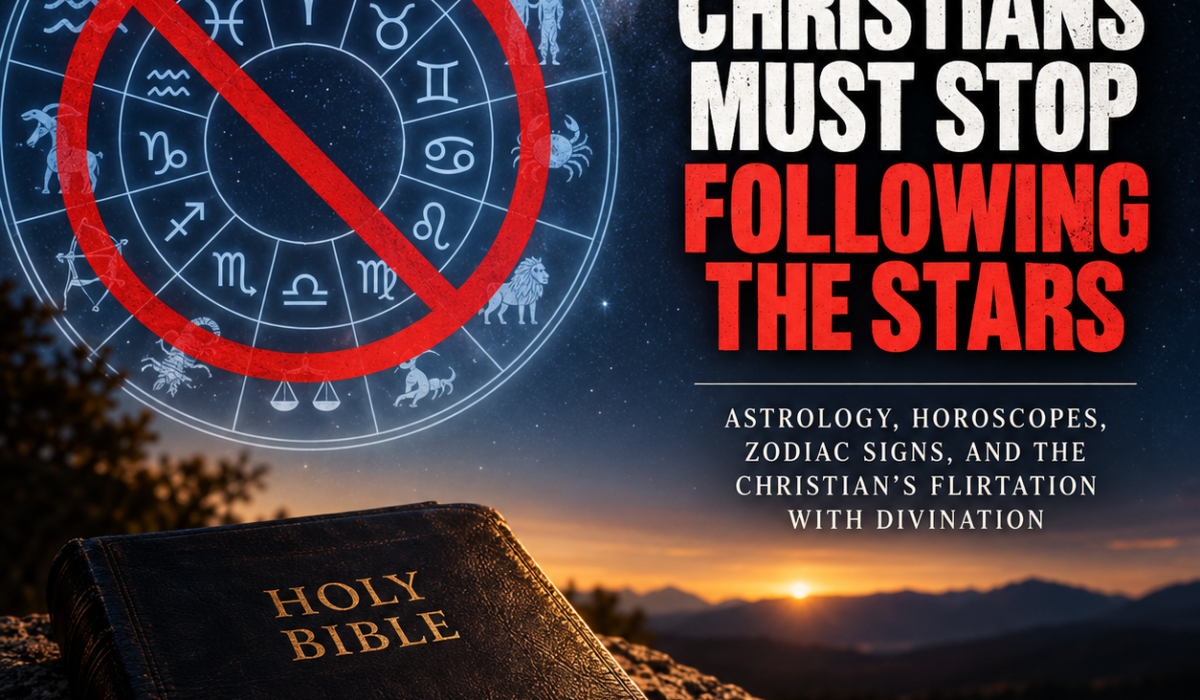
Astrology, Horoscopes, Zodiac Signs, and the Christian’s Flirtation with Divination
Introduction
Christians have developed an impressive talent for taking practices Scripture condemns, sanding off the pagan vocabulary, wrapping them in pretty graphics, and pretending God doesn’t really mind. Astrology is a particularly embarrassing example. We will confess that God created the heavens, governs creation, knows the future, numbers the hairs upon our heads, and directs the steps of men, and then, asks the local witch whether being a Scorpio explains why we are moody on Tuesdays. Christians read horoscopes, discuss zodiac compatibility, blame personality defects on Mercury being in retrograde, and casually identify themselves by astrological signs as though the Almighty assigned His children celestial personalities. “I’m a Christian; I don’t believe in astrology. I just check my horoscope.” Splendid. And presumably one might consult a medium just because Grandma was interesting to talk to.
The problem is considerably more serious than silly newspaper predictions. Astrology is an ancient system of divination: an attempt to derive hidden knowledge concerning human affairs, character, destiny, relationships, and/or future events from celestial phenomena. Its historical roots stretch deep into the pagan religious cultures of Mesopotamia, where heavenly bodies were associated with divine powers and celestial events were interpreted as communications concerning earthly affairs. Scholars trace systematic Mesopotamian celestial divination into the second millennium BC, while the zodiacal and horoscopic forms familiar to later civilizations developed during the first millennium BC before passing into the Hellenistic world. The biblical answer was to distinguish between looking at the heavens to behold the works of God and looking to the heavens for knowledge that belongs to God. The former is worshipful observation. The latter is divination. And Christians need to recover enough theological backbone to know the difference.
I. Astrology Is Divination, Not Harmless Entertainment
Before Christians are able to think clearly about astrology, they must stop allowing modern vocabulary to conceal ancient practices. “Zodiac sign” sounds whimsical. “Horoscope” sounds like something printed beside the crossword puzzle. “Compatibility chart” sounds almost scientific. But the underlying proposition is: the configuration of celestial bodies at or around your birth supposedly reveals information about your personality, relationships, tendencies, opportunities, or destiny. That is an attempt to acquire otherwise hidden knowledge through interpretation of celestial signs. Historically, that is what astrology was. Mesopotamian scholars observed celestial phenomena as signs carrying significance for events on earth; by the late first millennium BC, Babylonian scholars had developed zodiacal astrology and horoscopy that connected celestial configurations with individual human circumstances. Calling it “just for fun” does not alter what the practice actually is.
Scripture condemns attempts to obtain supernatural knowledge through unauthorized means. Deuteronomy 18:10–12 prohibits divination, fortune-telling, interpreting omens, sorcery, mediums, and related practices. The theological principle is clear: God’s people are not permitted to shop around in the spiritual marketplace for alternative sources of hidden knowledge. Isaiah even mocks Babylon’s dependence upon astrologers: “Let now the astrologers, the stargazers, the monthly prognosticators, stand up, and save thee” (Isaiah 47:13, KJV). The sarcasm is biblical, so I feel entirely comfortable borrowing some. Where exactly were those magnificent celestial consultants when Babylon needed them? Apparently Saturn had neglected to update the emergency evacuation horoscope.
This also prevents a common objection. Genesis 1:14 says the heavenly lights are for “signs, and for seasons, and for days, and years.” Yes. The heavens genuinely communicate something. Psalm 19 says that they “proclaim the glory of God.” Celestial bodies establish calendars, mark seasons, aid navigation, and display extraordinary order within creation. None of that means Mars determines whether you should marry Jennifer. God assigning legitimate functions to heavenly bodies does not authorize men to invent additional ones.
Indeed, the Christian objection is stronger when astrology is subjected to ordinary empirical scrutiny. In a famous 1985 Nature study, Shawn Carlson conducted double-blind tests of natal astrology designed with input from both scientists and astrologers. The study tested whether natal charts could accurately characterize personality, under conditions intended to address objections from practicing astrologers; the results failed to establish the claimed astrological ability. So the Christian is confronted with something remarkable: astrology asks us to entertain a method rooted historically in pagan divination, condemned in principle by Scripture, and unable to demonstrate its central claims reliably under controlled testing. That is quite a résumé.
The question is why a Christian would deliberately consult a system built upon a premise fundamentally alien to biblical revelation. God commands His people to seek wisdom from Him. The stars are magnificent servants. They make terrible prophets.
II. The Zodiac Has a Pedigree, and It Is Not Christian!
If we are going to invite an idea into the Christian household, it seems reasonable to ask where it came from. Astrology does not descend from Moses, the prophets, Christ, or the apostles. Its ancestry lies substantially in the divinatory traditions of the ancient pagan world, particularly Mesopotamia. Written evidence for Mesopotamian astrology reaches back into the third millennium BC, while systematic observation of celestial phenomena as omens developed during the Old Babylonian period. By the Neo-Assyrian era, court scholars routinely watched the heavens and reported perceived celestial messages to kings. Historian M. Willis Monroe notes that astrology functioned alongside other forms of divination as a means by which messages attributed to the gods were supposedly decoded. So when Karen announces that she cannot date a Capricorn because “the universe is warning her,” she is recycling, in considerably cheaper packaging, an ancient system of pagan divination.
The familiar twelve-part zodiac emerged from this Mesopotamian intellectual environment. Scholars trace the uniform zodiac (twelve equal sections of thirty degrees) to Babylonia in roughly the late fifth century BC. Around the same period, Babylonian scholars developed horoscopy: using the positions of the sun, moon, and planets within this zodiacal framework to make claims about individual lives and earthly events. This tradition subsequently traveled beyond Babylonia and became deeply influential in the Greco-Roman world. The modern zodiac developed historically from cultures in which celestial phenomena, religion, omens, and divination were intimately intertwined. Mesopotamian sources treated planets as gods or manifestations of gods and celestial events as signs through which the gods communicated with humanity.
Early Christians consequently had good reason to regard astrological fatalism as incompatible with their faith. Augustine knew the attraction personally: before his conversion matured, he consulted astrologers. He later condemned the practice and attacked the idea that human conduct could be blamed upon Venus, Saturn, or Mars. In On Christian Doctrine, he described natal astrology as superstition that placed men into bondage to the stars. His objection exposes the theological issue beautifully. Christianity declares that the heavens are creation; astrology continually tempts man to treat creation as an oracle (worshiping the creation in lieu of The creator). Christianity tells man to seek the Creator; astrology teaches him to interpret created objects for secret knowledge about himself. Christianity grounds human identity in God, moral responsibility, providence, wisdom, and obedience; astrology inverts portions of those things into celestial machinery. Christians should therefore stop asking whether astrology seems entertaining and ask the more uncomfortable historical question: Why are people redeemed from paganism still consulting paganism’s oldest methods for interpreting their lives? The zodiac may have received prettier fonts, smartphone apps, and Instagram graphics. Its family tree has not changed.
III. Scripture Does Not Leave Astrology in a “Gray Area”
Christians sometimes discuss astrology as though Scripture does not address the matter and we are therefore left squinting into a theological fog. We are not. Deuteronomy 18:10–12 expressly forbids divination, fortune-telling, and the interpretation of omens, describing such practices as an “abomination unto the LORD.” Leviticus 19:26 likewise forbids enchantment and the “observing” of times. The prohibition is broader than any single technique because the underlying offense is broader: man attempts to obtain hidden knowledge through a means God has not appointed. Astrology fits comfortably within that category. A horoscope is, after all, a forecast supposedly derived from celestial configurations. Adding a glittery constellation and calling it “zodiac guidance” does not magically transform divination into Christian recreation.
Jeremiah is even more uncomfortable for the Christian astrologer: “Learn not the way of the heathen, and be not dismayed at the signs of heaven” (Jeremiah 10:2, KJV). Isaiah 47:13–14 is more devastating still. Addressing Babylon, the prophet mocks its astrologers, stargazers, and monthly prognosticators, challenging them to save the nation from approaching judgment. They cannot (of course). Daniel makes essentially the same theological distinction before Nebuchadnezzar. The king’s astrologers, magicians, and diviners cannot reveal his mystery, “but there is a God in heaven that revealeth secrets” (Daniel 2:28). There is the dividing line: hidden knowledge belongs to God. The biblical answer to uncertainty is dependence upon divine revelation, wisdom, prayer, providence, and obedience.
Then comes the inevitable objection: “But the Magi followed a star!” Indeed they did. Matthew 2 records an extraordinary celestial sign announcing an extraordinary historical event: the birth of the King. It does not record the Magi calculating whether Mary and Joseph were romantically compatible because she was a Virgo and he had unfortunate Saturn energy. A sovereign act of God employing a celestial sign (for navigation) does not establish a general system whereby planetary positions reveal everyone’s personality and future..
The Bible’s position is remarkably coherent. The heavens declare God’s glory; they do not replace His counsel. God may sovereignly use signs in His creation, but man is not thereby authorized to construct systems of divination from them. Christians are commanded to trust the Lord, seek wisdom, test spirits, obey revelation, and acknowledge God’s providence. The stars have a biblical purpose. They point upward toward their Creator.
IV. Astrology Feels “Accurate” Because Human Beings Are Remarkably Easy to Impress (Deceive)
“But my zodiac description is so accurate.” Of course it is. It was designed to feel accurate. Astrology survives partly because human beings possess an extraordinary ability to recognize themselves in sufficiently broad descriptions. Psychologist Bertram Forer demonstrated this beautifully in his famous 1949 experiment on what he called the “fallacy of personal validation.” Students completed a personality test and were subsequently given what they believed were individualized personality assessments. In reality, every student received the same generalized profile. Nevertheless, the students overwhelmingly (92%) regarded the supposedly personalized description as accurate. Forer’s point was: our subjective recognition of ourselves in a personality description is not evidence that the method producing it is valid.
This phenomenon became known as the Forer Effect, or Barnum Effect, and astrology practically begs to demonstrate it. Tell someone, “You value independence, but sometimes desire reassurance from others,” and congratulations, you have successfully described approximately everybody who has ever survived adolescence. Tell him that he can be outgoing in comfortable situations but reserved around unfamiliar people, and suddenly Saturn has cracked the mysteries of his soul. In a 1980 experiment specifically involving astrology, eighteen students were told that an astrologer would construct personality profiles from their birth information. They were actually given identical profiles, yet again, showed a high level (94%) of acceptance of the supposedly individualized descriptions.
Astrology also benefits from confirmation bias. We naturally notice information that confirms existing expectations while discounting contradictions. Read ten vague predictions, encounter two things that vaguely resemble them, and those two become evidence that “my horoscope was freakishly accurate.” The other eight disappear down the memory hole. Better still, horoscope language is commonly elastic enough that failure itself can be reinterpreted as success. This is a practice that possesses all the accountability standards of a crooked used-car salesman.
More importantly, when astrological claims have been subjected to controlled testing, the impressive mystical fog completely evaporates. Shawn Carlson’s well-known double-blind experiment, published in Nature in 1985, tested the proposition that natal charts could accurately describe subjects’ personality traits. The study was designed with astrologers involved in establishing experimental procedures and subjected astrological claims to blinded testing rather than relying upon personal impressions. The results did not support the astrologers’ claimed ability.
None of this proves that every astrologer is deliberately dishonest. Something more mundane (and perhaps more instructive) is happening. People are excellent pattern-seeking creatures and poor judges of systems that flatter their expectations. Scripture therefore warns, “The simple believeth every word: but the prudent man looketh well to his going” (Proverbs 14:15). Christianity requires us to not be intellectually gullible and lazy. If astrology supposedly reveals objective truths about personality, compatibility, and destiny, then its claims should survive objective examination.
V. “Just for Fun” Is a Terrible Excuse for Pagan Worship
At this point someone inevitably retreats to the final defensive position: “I don’t actually believe in astrology. I just read horoscopes for fun.” But Christians should ask why divination is acceptable just because we consume it recreationally. Scripture does not teach believers to experiment casually with practices opposed to biblical worship provided they maintain sufficient irony while doing so. Paul tells Christians to “prove all things; hold fast that which is good” and “abstain from all appearance of evil” (1 Thessalonians 5:21–22, KJV). In Ephesus, converts who had practiced magical arts did not preserve their occult literature as amusing coffee-table material; Acts 19:19 records that they publicly burned it. Their conversion produced separation from their former practices, not a Christianized fascination with them.
There is also a subtler danger: astrology relocates identity. Scripture describes Christians according to categories such as creation, sin, redemption, character, calling, obedience, gifts, wisdom, and union with Christ. Astrology introduces an alternative anthropology in which personality becomes partially explained by celestial circumstances at birth. Suddenly impatience is “because I’m an Aries,” emotional volatility belongs to being a Cancer, and relational incompatibility can be blamed on conflicting signs. Convenient, certainly. Yet Christianity insists upon moral agency. “Every one of us shall give account of himself to God” (Romans 14:12). Your temperament may influence your struggles; it does not excuse your sins. And Jupiter will not be appearing beside you at judgment to explain your communication problems.
The same corruption enters relationships and decision-making. Zodiac compatibility encourages people to evaluate potential spouses, friendships, conflicts, and personalities through categories possessing neither biblical authority nor reliable empirical foundation. Even casual exposure can normalize those categories until someone begins saying, “I know it’s silly, but…” immediately before allowing it to influence an actual judgment. Research on superstition more broadly has shown that people resort to superstitious practices particularly under circumstances involving uncertainty or perceived lack of control. That should concern Christians, because uncertainty is where faith is supposed to operate.
The Christian alternative is not ignorance of the heavens. Study astronomy. Learn the constellations. Understand planetary motion. Stand beneath a genuinely dark sky and become appropriately small. “The heavens declare the glory of God; and the firmament sheweth his handywork” (Psalm 19:1). But admire the stars without asking them for counsel. They are creations, not counselor.
And perhaps that is astrology’s deepest theological insult. God made the stars to declare His glory, and fallen man has somehow managed to make them declare ours. We took a universe pointing toward its Creator and turned it into a personality quiz. Christians, of all people, should know better.
Conclusion: Stop Following the Stars and Follow the One Who Made Them
Strip away the memes, apps, compatibility charts, and fashionable vocabulary, and the fundamental proposition remains unchanged: human beings are seeking information about personality, relationships, circumstances, or destiny by interpreting celestial bodies. Historically, that practice grew from ancient systems of celestial divination; biblically, God repeatedly condemns divination and the interpretation of omens; empirically, astrology has failed to demonstrate the extraordinary powers attributed to it under controlled examination; psychologically, we possess well-documented tendencies toward confirmation bias and personal validation that help explain why vague astrological descriptions can feel remarkably accurate. Christians therefore have no compelling historical, theological, rational, or scientific reason to retain astrology, and numerous reasons to reject it. We do not need Aries to explain our anger, Gemini to excuse our inconsistency, Scorpio to justify our intensity, or Mercury retrograde to explain why we forgot the password again. We need wisdom, discipline, repentance, discernment, and the humility to admit that the problem is us.
So stop consulting horoscopes. Stop identifying yourself by zodiac signs. Stop checking romantic compatibility against birth charts. Stop asking the heavens questions God never appointed them to answer. And stop hiding spiritual foolishness beneath the increasingly tired defense of “I only do it for fun.” Christians were called out of darkness. If you want to understand yourself, examine your heart under the light of Scripture. If you need wisdom, “ask of God” (James 1:5). If you need direction, trust in the Lord rather than your own understanding (Proverbs 3:5–6). If you want to know whether someone will make a suitable spouse, examine faith, character, fruit, wisdom, maturity, fidelity, and conduct. And if you want to look at the stars, then by all means look up. Study them. Marvel at them. Learn their names, movements, distances, and extraordinary beauty. Then remember what Isaiah says of God: “He calleth them all by names” (Isaiah 40:26). The Christian does not need to fear the stars, worship the stars, consult the stars, or follow the stars. We worship, consult, trust, and follow the God who made them.