Category Archives: Future

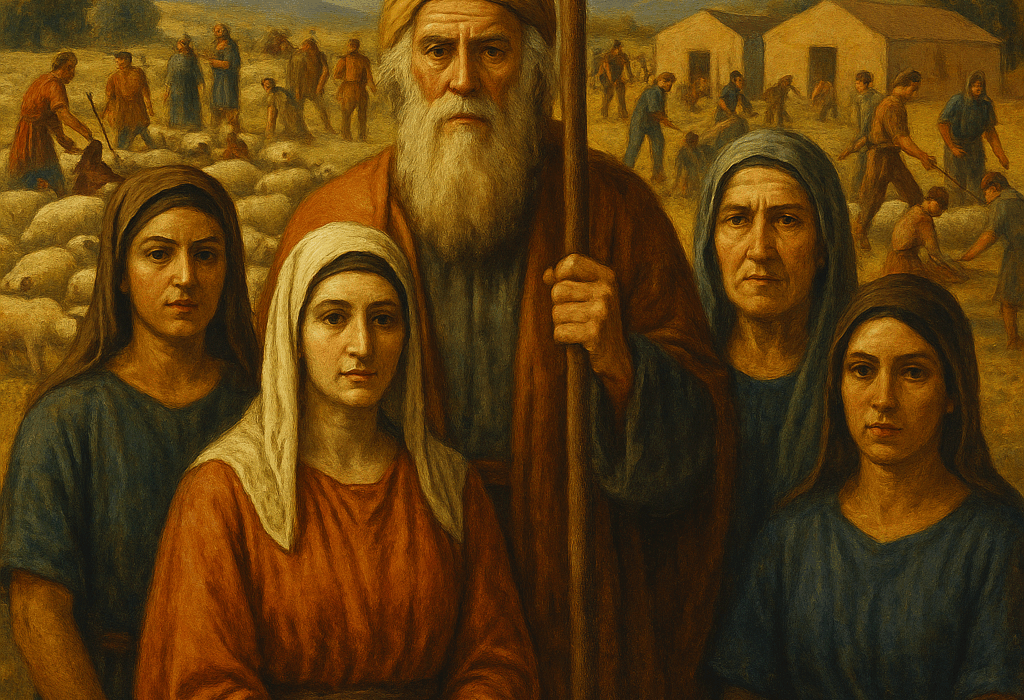
Jacob – The Flawed Patriarch Who Fathered a Nation


I. Introduction: The Man Who Became a Nation

Jacob is not a moral mascot. He is a patriarch. A bruised heel, a cunning mind, a relentless force. The Church today wants poster boys of piety, neat beards, monogamous morality, and tidy households with devotional apps and filtered family photos. But God chose Jacob. And Jacob’s house wasn’t tidy. It was turbulent, expansive, polygynous, fruitful, and entirely God-ordained.

If you want a clean legacy. A polished resume. A family tree that could make a Hallmark movie jealous that Jacob is not your man. But God doesn’t build nations from photo albums, He builds them from blood, betrayal, polygyny, and perseverance. If you’re looking for perfection, Jacob is not the image you seek. If you’re looking for fruitfulness, covenant, household dominion, and raw masculine endurance, then Jacob is your patriarch.

Jacob, the man renamed Israel, was no sanitized church hero. He lied to his father, deceived his brother, worked for and purchased underage wives, married sisters (a move later forbidden under Mosaic Law), took their handmaids as concubines, played favorites with his children, stayed silent when one was sold into slavery, and fathered the entire nation of Israel through a household that modern pastors would call “unbiblical.”

When God renamed Jacob “Israel,” He wasn’t baptizing a perfect man. He was commissioning a patriarch. The man who fathered twelve sons by four women. The man who bought teenage brides and later took their handmaids to be concubines (who eventually became additional wives). The man who lied to his own father and was later lied to by his uncle. The man who watched his sons slaughter a village and did nothing.

And yet… he is the chosen one. God’s own covenant was sealed with this man, not because of his morality, but because of God’s sovereign purpose. Jacob didn’t “fall into” polygyny. He didn’t slip. He wasn’t ashamed. He built an empire from it. And God didn’t rebuke him, He built His people on that household. And God called him blessed. Why? Because Jacob was in covenant. He wrestled with God and would not let go until the blessing was secured, no matter the cost.


II. Delayed Beginnings and the Demands of Legacy

Jacob didn’t marry until he was 77 years old. That’s not a typo. While modern men are told they’ve peaked or passed their usefulness by 40, Jacob hadn’t even begun to build his household until nearly twice that age.

So what was he doing all that time? Scripture gives us glimpses: he stayed in tents, remained under his father’s instruction, dwelled quietly while Esau hunted and conquered. He was not a builder yet. Not a warrior. Not a leader of men. He was preparing, slowly, painfully, and in obscurity.

But when the time came, Jacob fled to Haran with nothing but a staff. He didn’t even have the means to purchase a wife. At 77, he had to labor 14 years just to acquire two brides. He started late, but he didn’t whine, complain or make excuses. He never lamented about what he could have or should have done.

And because he started late, he had to build rapidly. Polygyny wasn’t really optional, it was necessary. One wife would not bear twelve sons fast enough. One womb could not produce a nation in a lifetime. Jacob’s strategy was not romantic in the modern sense, it was patriarchal. He accepted handmaids. He honored both sisters. He honored his position and multiplied quickly.

This is the lesson: it’s never too late to start. But starting late requires strategy. It requires scale. And it requires the rejection of modern sentimentality. If you aim to build a nation past your youth, you will need polygyny, patience, and patriarchal vision.


II. The Meeting at the Well: 77-Year-Old Meets 14-Year-Old Rachel

Jacob met his beloved Rachel at a well in Haran. She was a shepherdess, tending to her father’s flocks, in a pattern echoing across Scripture. But the part your Sunday school teacher skipped was this: Jacob was 77 years old when he met Rachel who was 14 at the time, her older sister Leah, whom Jacob would also marry, was about 15. He kissed Rachel that very day and wept aloud (Genesis 29:11). This was not a “grandfather’s greeting”. It was the beginning of a marriage transaction.

Modern minds recoil. But Scripture does not. Jacob kissed Rachel that very day and proclaimed “love at first sight”. In a world where men shrink from commitment and women delay marriage until their youth has withered, this scene offends modernity. But it honors God. Rachel wasn’t dating. She wasn’t career planning. She wasn’t collecting degrees. She was a bride in waiting, working in her fathers kingdom. And Jacob didn’t flirt. He pursued. Immediately, definitively, and even with payment.

Now, the modern mind reels. “Predator,” they say. “Groomer.” But Scripture says something else entirely: he loved her. From the first moment. And he proved it with the only thing that proves love, action and sacrifice.

No flirting. No promises. No “let’s see where this goes.” Jacob laid down seven years of labor for a bride he met at the well. He didn’t wait and send a text later, he didn’t date for a few years. He rolled up his sleeves and purchased his bride.


III. A Price for a Bride: Love Is Proven in Labor

Jacob did not propose over dinner. This wasn’t romance, but a transaction, a Covenant. He paid a price. Not having the available finances to purchase his bride outright he offered Seven years of hard labor managing Laban’s flock. Rachel was the daughter of his uncle, but that did not make her free. She was a daughter, which meant she was a commodity. She belonged to her father until another man purchased her through covenant.

Genesis 29:20 says, “So Jacob served seven years for Rachel, and they seemed to him but a few days because of the love he had for her.” Let that sink in: love was proven by labor, by action. Not words. Not poetry. Not dinner dates, or “communication”, but sweat and dedication.

And Jacob paid. Full price, without complaint. Then Laban deceived him, sending Leah into the wedding tent under darkness. The next morning, Jacob discovered the swap. Did he storm off? Cry betrayal? No. He married both. Even stayed and worked another seven years for Rachel. Fourteen years total. This wasn’t indentured servitude, it was dowry. It was love measured in action. 

You don’t “date” a wife. You earn her. Jacob earned two, (well 4 eventually), but we will get to that later.


IV. Sisters, Servants, and Sons: A Household of Four Mothers

Modern minds recoil at the idea of marrying sisters. But Jacob did it with full cultural legitimacy. Rachel and Leah both bore him sons, though Rachel, beloved as she was, struggled with barrenness. In the ancient world, this was not just a personal sadness, it was a crisis of legacy (as it should still be).

So Rachel did what almost any woman of her day would have. She gave Jacob her handmaid Bilhah as a concubine. Bilhah bore sons on Rachel’s behalf. Leah, seeing this, gave Jacob her maid Zilpah as well. He didn’t argue, he didn’t moralize.  Jacob accepted both. No argument. No sermons. No shame. He lay with the maids and received their sons into his household. These were not mere bedwarmers. They were concubines, wives by function if not by primary rank.

From this household of four women, two wives, two concubines, came twelve sons: Reuben, Simeon, Levi, Judah, Dan, Naphtali, Gad, Asher, Issachar, Zebulun, Joseph, and Benjamin. Plus one daughter, Dinah. These sons became the twelve tribes of Israel.

Polygyny wasn’t the side story. It was the structure. It wasn’t a concession, but the covenantal method for fruitfulness. This is not just descriptive, it’s prescriptive. God used it, blessed it, and God built His people on it. Let that sink in for a minute – polygyny is the method God chose EVERY time for the expansion of his covenant people.

This wasn’t dysfunction, it was dynasty. Jacob didn’t “fall” into polygyny. He stewarded it, and in doing so created the 12 tribes of Israel.


V. The Cost of Favoritism and Silence: Jacob’s Fathering Failures

Jacob was a patriarch, but he was not perfect. His household was marked by favoritism. He loved Rachel more than Leah (Genesis 29:30). He loved Joseph more than the others (Genesis 37:3). He even clothed Joseph in a special garment that stirred the envy of his brothers. Everyone knew it. When this favoritism bred resentment among the other brothers Jacob saw it. He knew they hated Joseph. But he stayed silent. 

He also stayed silent when Joseph was sold into slavery. The brothers dipped the robe in blood and brought it to Jacob. He wept. But he didn’t investigate. He didn’t lead. He accepted the story, descended into grief and mourned for years.This silence wasn’t passive, it was leadership failure. And yet, even in his failure, Jacob remained the patriarch of promise. God didn’t revoke His covenant. The twelve tribes still bore his sons’ names.

His sons murdered the men of Shechem in retaliation for Dinah’s violation. Jacob’s response? “You have brought trouble on me” (Genesis 34:30). Concerned with reputation, not righteousness.

Yet this flawed, quiet father remained God’s patriarch. Because God doesn’t require perfection, He requires covenant. God doesn’t wait for perfect men. He uses patriarchs who limp.


VI. A Man of Deception Chosen by a God of Truth

Jacob’s life was woven with deceit. He lied to his blind father, tricked his brother Esau out of the birthright by impersonating him to steal Isaac’s blessing. He manipulated livestock breeding,   using selective breeding tactics to enrich himself at Laban’s expense (Genesis 30:37-43). He was shrewd, cunning, and unapologetic.

This wasn’t accidental. Jacob was strategic. And God still blessed him. Why?

Because Jacob wrestled with God, and didn’t let go. He demanded blessing. He demanded covenant. And God granted it.

Genesis 32 recounts the midnight wrestling match. A mysterious Man (understood to be a theophany – God Himself) wrestles Jacob until dawn. Jacob refuses to let go. He demands blessing. The Man touches his hip, dislocating it, and then renames him: Israel.

Israel means “He who strives with God.” Not “He who obeyed nicely.” Not “He who conformed.”  Not “he who behaves.” God renamed him for wrestling, striving, and demanding. God honors hunger and dedication, not manners.

The same man who deceived his father became the father of a nation, then grandfather of nations.


VII. God’s Blessing on a Polygynous Man

Jacob was a polygynist. He had four wives (two by direct marriage, two by concubinage). Scripture never condemns him for it. Not once.

The modern Church blushes and stammers over polygyny, offering excuses: “It was cultural,” “It was allowed, not ideal,” “God just tolerated it.”

Spineless nonsense!

God could have shut Leah’s womb. He could have shamed Rachel. He didn’t. Instead, He opened their wombs, multiplied their children, and formed a nation from their bodies. Polygyny is not the curse, but a blessing. it was the structure God used to build Israel.

Jacob’s sons founded the twelve tribes. From Leah came Levi (priests) and Judah (kings), Reuben and Simeon. From Rachel came Joseph (double-portion through Ephraim and Manasseh) and Benjamin. From Bilhah and Zilpah came the remaining tribes. The modern church teaches monogamy as doctrine. Yet the very people of God were born from a household that no modern pastor would allow on the church membership roster.

You want revival? You want legacy? Start by embracing the blueprint God actually used. God didn’t “allow” polygyny, he crowned it.


VIII. The Legacy: A Nation Birthed by a Household

Jacob’s sons didn’t just fill a tent, they founded tribes. Reuben’s line. Judah’s kings. Levi’s priesthood. Joseph’s double portion through Ephraim and Manasseh. Benjamin’s warriors.

Jacob didn’t have a Pinterest family. He had a warring, womb-bearing, legacy-generating household. A patriarchal dominion. And that’s exactly what God used.

He didn’t wait for reform. He didn’t impose 21st-century ethics on a Bronze Age household. He multiplied fruitfulness through what would today be labeled “toxic masculinity” and “patriarchal oppression.” But it was, and is God’s design. It was God’s man. It was God’s house.

These weren’t random children. They were the seedbed of civilization. And they came not from a modern “nuclear” family, but from a polygynous, patriarch-led household.

The legacy of Israel, our spiritual and ancestral heritage, was not born in a sanitized seminary. It was born in tents. On blood-soaked soil. With sisters competing, handmaids birthing, and a patriarch directing the legacy.

Jacob fathered a nation not in spite of polygyny, but ONLY because it.


IX. What the Church Refuses to Preach

The modern Church preaches romance, butJacob lived reality.

He would be excommunicated from most if not all modern churches.

  • Married sisters? Forbidden.
  • Slept with handmaids? Scandal.
  • Favored wives? Misogynist.
  • Bought 14-year-old brides at 77? Predatory.
  • Married 20-22 Year old women at 84? Pedophile.

But God doesn’t flinch. He names Jacob “Israel.” He renews the covenant of Abraham through him. He appears to him personally and blesses him repeatedly. The Church today wants sanitized saints, but God wants fruitful patriarchs. Men who are willing to stand on Biblical truth, demanding conventional blessing no matter the cost.

The Church preaches sentimental monogamy. Jacob lived divine multiplication. The Church preaches equality. Jacob chose favorites, led with hierarchy, and structured his household for fruitfulness, not fairness.

They talk about “waiting for the one.” Jacob worked 14 years for two. And when his wives gave him their maids, he didn’t hold a Bible study on the ethics of polygyny, he received them as part of his house and expanded the kingdom.

The Church fears offense. God builds with obedience. Jacob’s life doesn’t fit the evangelical mold. Which is exactly why it built the Kingdom!


X. Conclusion: God Builds With Dust and Blood

Jacob was not a poster child for moralism. He was old, shrewd, polygynous, and often silent at the worst times. But he was chosen. Not because of his goodness, but because of God’s purpose.

He kissed a 14-year-old girl and loved her for life. He married sisters. He fathered sons through servants. He allowed his favorite son to be sold. He limped after wrestling with God. He blessed the wrong grandson on purpose. And he died in a foreign land, trusting in a promise that he did not live to see fulfilled.

And from that life – flawed, complex, masculine, covenantal, came the nation of Israel. Our entire faith is rooted in a man with four wives, twelve sons, and a limp. This is not an insignificant side story. This is the foundation of our faith, our people and all of western civilization.

If you want to restore biblical manhood, stop chasing modern respectability. Start embracing patriarchal fruitfulness. Start understanding that God builds not with sanitized myths, but with real men, real blood, and real households. Jacob did not live to please the world. He lived to build the kingdom of God, and in doing so he built nations.

And if the Church wants to reclaim legacy, it must reclaim Jacob, not as a relic of ancient oddity, but as the blueprint for dominion. 

God builds with blood. He builds with covenant. And He builds through patriarchs who refuse to let go until the blessing falls.

Let God’s Great Order be restored.
My Statement of Purpose

This is not a motivational speech, Hallmark moment, TED Talk, or an Instagram-ready “purpose-driven life” fluff piece. This is a war cry, a battle hymn, a declaration of intent, forged not in comfort but in conflict.

I was not raised to be the man I have become or am becoming. I was not trained for this life, I was not handed the tools or the vision by my father the way I should have been. I was not surrounded by men of conviction, purpose, and strength, in-fact quite the opposite. I had to become what I should have been taught to be as a child through study and submission to God. I had to learn, from the wreckage of my life and from the ruins of a collapsing civilization, what a man is, what a man must do, and what he must live for.

Every man must have a purpose. Simply having a dream, a feeling, or wishing is not sufficient. Every man must have a purpose, a goal, a burden, a direction, and a vision of legacy. Without this, he is dead already. He may walk, eat, earn money, even reproduce (unfortunately) but he will never truly build, lead, or matter to anyone.

And this was once known to all men inherently.

The Death of Male Purpose

Until just a few generations ago, this was common knowledge. A man existed to labor, to lead, to fight, to provide, to protect, to build. His identity was tied to the work of his hands and the fruit of his sacrifice. No man needed a seminar to know that he was born to take dominion!

Now, the average man is told that his purpose is his self happiness.

He is told he is most virtuous when he is most “self-expressive,” most “true to himself,” most “comfortable in his skin.” He is told to chase careers, money, entertainment, prestige, sex, and status. He is told that a successful life is one where he gets everything he wants, lives in comfort and has as little responsibility as possible. That he deserves praise for simply existing. That any sacrifice asked of him is oppression.

We have traded duty for dopamine discipline for therapy, and dominion for “mental health days.” We are told to serve ourselves, our careers, our government, or whatever political slogan currently sits on the throne of Babylon. But we are not told to serve our wives. We are not told to serve our children. We are certainly not told to serve God. And boy does it show!

What we have now is a generation of soft, winey, emasculated men, physically alive, spiritually neutered. Addicted to porn, praise, and PlayStations. Afraid of discomfort, allergic to authority, and ignorant of their design. They are the natural product of a culture that mocks fatherhood, punishes masculinity, and rewards cowardice.

The Reality of Legacy

Most men don’t build anything. They spend 40+ years building another man’s empire while losing their own house. They give their best hours to a company that will replace them the moment they get sick, and they give their worst hours to the children they hardly know. They try to lead wives who have been trained since childhood to hate submission, to fight headship, and to confuse rebellion with strength.

And when they finally look up, they have nothing. No legacy, no foundation, and no future. Just bills, regrets, and broken dreams. I’ve seen this, I’ve lived this, and I’ve declared war on it!

I am not here to participate in that cycle. I am not here to be another brick in Babylon’s wall. I am here to build a house that lasts. A man is not measured by his net worth. He is not remembered for his career or his cars or his hobbies. He is measured by what he builds, by who he leads, by the faith he passes down.

A man is either a patriarch – or he is a pathetic pawn.

My Beginning: Not a Blank Slate, but a Battlefield

I was born with Lupus. An incurable, lifelong affliction that brings daily pain and exhaustion. Every step costs something. Every action is a choice. Every ounce of effort put forth costs me physically.

But God in His sovereignty gave me this for a reason. I make a conscious effort every hour of every day to not complain, to not dwell on the pain or discomfort, to not use this as an excuse for abdication of my responsibilities, and to not allow this burden to affect the spirit of my household.

Fifteen years ago, I stopped taking the medications that numbed the pain. I chose to live in clarity and agony rather than comfort and fog. Because clarity is required for legacy. And pain is the price of purpose. While others complain about minor inconveniences, I bleed for a future they don’t even believe in. And that’s just the physical side.

I started with no inheritance, no generational wealth, no functioning family structure, no roadmap, and no support from my family. What I inherited was a pile of ashes and a name in need of redemption. But you don’t get to choose your starting line. You only get to choose whether you run or quit.

The Modern Wife Problem

I can state clearly and without apology: less than 1% of females in the Western world today qualify as even a basic, entry-level wife. Not because they are stupid, and not because they are evil. But because they have been deliberately trained, since birth, to be everything but a wife, by their parents, the government and society as a whole.

They are taught to pursue degrees, not diapers. Careers, not covenant. And freedom, not faithfulness. The culture teaches them to be sexually liberated but spiritually barren. Loud, proud, and perpetually offended. Worshiped for simply existing, enraged when corrected, and allergic to all accountability. They are taught to crave attention to the point it is sinful.

And the average man, even a good man, will spend the best years of his life begging and battling just to get what his great-grandfather expected and received without question: a wife who serves, submits, and builds with him. A wife who was trained by her parents to be a wife.

He sacrifices immense time, energy, and money just to lay the foundation that should have been there already. I speak from experience. Most of my adult life has been spent not only learning what I must be as a man and a husband, but then training my wives to be what their parents failed to make them. I had to teach them how to be what Scripture commands, not just by words, but by example, by demand, and by daily discipline.

And even then, the battle is constant and ever-present. Not because they are unwilling, but because they were untrained. And the world constantly reinforces the lie that their feelings are more sacred than their function. That they deserve constant attention and praise for doing far less than the bare minimum, and they are equal to men.

My Purpose: The Restoration of the Biblical Household

My purpose is to rebuild the ancient household. In raw, lived-out, flesh-and-blood reality. I know with full conviction and clarity that God has called me to be a patriarch, a builder of the old ways. A restorer of ruins.

He has called me to live, visibly and unapologetically, the reality of Biblical family order. Including polygyny. Yes, I said it: multiple wives, many children, and a fruitful house. A defiant example to Babylon. This is not about lust, or indulgence, but about restoration. About rebuilding what sin, feminism, church cowardice, and governmental overreach have destroyed.

I am called to take responsibility for more than myself. To cover, train, and lead women who desire to serve something greater than themselves. Women who were discarded, wounded, or simply never given the chance to thrive in their God-ordained roles. Women who are willing to be transformed, not by flattery, but by fire.

I do not ask them to follow me because I am perfect. I ask them to follow me because I will not stop. Because I will not compromise. Because I will die building, and they will never have to wonder where their man stands.

Ministry Without a Microphone

I never wanted attention. I still don’t. I have no desire for fame, or followers, or applause. I sincerely want to be left alone to build in seclusion. But I have come to realize that my house is my ministry. Not social media, sermons, or speaking engagements. My wives, my children, my home, my legacy, and the kingdom I leave my children is my purpose in life.

That is the pulpit from which I preach, that is the testimony that will outlive me, and that is where the Kingdom is built. The world is watching, other men are watching, other women are watching, and most importantly, my sons and daughters are watching.

They will know what a man is, what a wife is, what sacrifice looks like, and what legacy demands. They will not inherit confusion. They will inherit clarity, purpose and generational wealth.

The Cost

I know first hand the cost of this calling. I am mocked,  lied about, and vilified by feminists and religious cowards alike. I am attacked by those who claim to follow God and those who follow only themselves in the pursuit of pleasure. I live in constant sacrifice, constant rejection, and constant tension from the outside world and often even my own wives as they struggle with learning God’s intended role for their lives in stark contrast to what the world teaches.

But I will also live in constant purpose. I live as a man who knows what he is building. I will die as a man who gave everything to give his descendants a starting point. And that is enough, in fact it’s more than I deserve.

The Future: A House, A Name, A Nation

The legacy I build will not be measured in cash but in names, in blood, in fruit, and in sons who lead and daughters who build. In many wives who teach the next generation what their mothers were never taught. In land, in households, in unity and dominion.

I am not building a mansion. I am building a house that hell cannot burn.I am not pursuing early retirement. I will be a patriarch to my family, a stone in the foundation of the Kingdom, and a thorn in the side of every coward who dares call compromise “compassion.”

And when my work is done, they will not say I lived comfortably. They will say I lived convicted. They will say I lived with purpose.

Soli Deo Gloria

Let God’s Great Order be Restored no matter the cost!

A Wife’s Divine Role in the Household Economy

Throughout Scripture, the home is not a place of passivity, but a center of dominion, production, and wisdom. The biblical wife is not an idle consumer, she is a producer, manager, and guardian of the household economy. Proverbs 31, Titus 2, and 1 Timothy 5 collectively paint a picture of a woman who is resourceful, industrious, and economically impactful.

I. A Commanded Role

In Titus 2:4–5, older women are instructed to teach the younger to be: “…keepers at home… that the word of God be not blasphemed.” This is not a mere suggestion, it is a divinely ordained responsibility. The Greek phrase used, oikourgos, implies a worker at home: a steward, not merely a presence. She is not just in the home, she is managing it with purpose.

Proverbs 31 reveals a woman who buys land, plants vineyards, strengthens her arms, weaves with skill, and supplies her household with food, clothing, and profit. This is not a delicate flower waiting to be served. She is the engine of household resilience.

II. Her Husband’s Glory

“The heart of her husband doth safely trust in her, so that he shall have no need of spoil” (Proverbs 31:11).

This means that because of her efforts, her husband doesn’t need to raid or plunder, her productivity fills that need. In a modern context, this would be equivalent to not needing second jobs, payday loans, or takeout dinners. The wife’s economy protects and multiplies the husband’s provision, she does not drain, waste or squander it.

III. Historical Household Economies

Historically, households were productive units. Before the industrial era, women were vital contributors: spinning wool, baking bread, growing herbs, preserving harvests, and managing goods. In Colonial America, for example, wives produced nearly 80% of what their families consumed.

In medieval manors, the mistress of the house oversaw food stores, seasonal harvest planning, textile production, and even medical care via herbs and poultices. These skills were essential, not hobbies, and were handed down generationally.

Even as recently as the Great Depression, families that survived were those in which the wife could stretch resources, grow food, make clothes, and barter.

IV. Wives of a Great Household

Let us consider the context of a large biblical household, a husband, two wives, and nine children. Such a home is not maintained by money alone. It is upheld by the wise management and productive labor of the wives.

In this model, the goal is that the wives combined would produce at least 25% of the household’s food and goods, with a target of 50%. This is not fantasy; it is ancient precedent.

In an ideal climate and with just 600 square feet of garden space, a wife can grow hundreds of pounds of produce a year. With canning, fermenting, and preserving, this abundance carries through winter. Add bread-making, soap-crafting, meal planning, and haircuts, and the home becomes not just a place of consumption but of value creation.

V. The Daily Waste of Idleness

Let’s quantify what’s lost when this mandate is ignored. The estimates below are based on a 12-person household with 3 adults using the median amounts.

  • Not gardening: -$6/day
  • Store-bought bread: -$3/day
  • No canning: -$2/day
  • No bartering: -$3/day
  • Buying clothes: -$3.25/day
  • Store-bought cleaners: -$3.50/day
  • Buying candles: -$0.50/day
  • Children’s Haircuts: -$5.14/day
  • No meal planning: -$2/day
  • Energy waste: -$3/day
  • No herb garden: -$1/day
  • Coffee out: -$15/day
  • Food delivery: -$5/day
  • Streaming Media Filth: -$3/day

Total waste: $55.39/day

If that money were preserved and invested with just 8% annual growth, over ten years the family would gain:

$309,681.55

This is the cost of rejecting the woman’s dominion in the home, and this is just some of the waste. In the next section, we will explore how a 600 sq ft garden, in the hands of a skilled wife, can feed the family, reduce costs, and transform the family economy

VI. The 600 Square Foot Garden – Dominion from the Ground Up

The average American family considers gardening a hobby. In a righteous household, it is a strategy of dominion. With just 600 square feet, roughly the size of a small studio apartment or a 20’x30’ plot, wives can lay the foundation for economic transformation.

VII. What Can Be Grown

Assuming a temperate climate with 3-season growth, intensive gardening techniques such as vertical planting, square-foot gardening, and succession sowing allow for high-density food output. Here’s what a well-managed 600 sq ft garden can produce annually:

  • Tomatoes: 150–200 lbs
  • Leafy greens (lettuce, kale, chard): 100–150 lbs
  • Beans (pole and bush): 50–100 lbs
  • Root vegetables (carrots, beets, radish): 100–150 lbs
  • Peppers: 30–60 lbs
  • Summer squash/zucchini: 50–75 lbs
  • Potatoes (grown vertically): 100–200 lbs
  • Culinary herbs (basil, parsley, oregano, etc.): 10–20 lbs
  • Total yield: 900ish lbs of food/year Caloric value: ~400,000+ calories

That’s roughly 25% of the total household food budget. Grown with only sweat and stewardship.

VIII. Techniques for Maximum Output

  • Raised beds with rich composted soil
  • Vertical growing using trellises and cages
  • Companion planting to repel pests and optimize nutrients
  • Succession planting for continuous harvests
  • Rainwater collection and mulching to reduce watering needs

IX. Canning and Preserving the Surplus

Fresh produce is fleeting. Wise wives preserve the harvest:

  • Water-bath canning for tomatoes, pickles, fruits
  • Pressure canning for beans, squash, and broth
  • Drying and preserving for potatoes, garlic, onions
  • Freezing for greens and herbs

This ensures year-round food security and prevents dependence on fragile supply chains.

X. Cost and Value

Organic produce equivalent: ~$3–5 per pound

At 750 lbs × $4 avg = $3,008 value annually ($250.00 Monthly)

That’s just from the garden. When paired with home cooking, preservation, and trading with others, that space becomes a cornerstone of the household economy.


XI. Domestic Skill Sets – Building the Household Economy by Hand

The productive wife is not only a gardener, but also a builder of daily infrastructure, meeting family needs with her own hands. In a family of 12, every small saving multiplies, and every act of skillful provision compounds into generational wealth. These crafts, once considered basic to feminine maturity, are now revolutionary acts of household sovereignty.

A. Bread Baking: Daily Bread as Daily Wealth

A single loaf of artisan bread costs $5–$8 in today’s market. A wife can bake it for under $1.

  • Skill Level: Beginner
  • Startup Needs: Flour, salt, yeast/sourdough, standard oven
  • Savings: $5–$8 per loaf × multiple loaves per week = $2,500+/year

Children raised with fresh bread, homemade butter, and warm hospitality are both healthier and anchored in memory. These skills become traditions.

B. Soap & Cleaner Making: Removing Dirt, Adding Value

Homemade soaps, laundry detergent, and all-purpose cleaners cost pennies to make and remove the need for toxic commercial chemicals.

  • Ingredients: Lye, fat, baking soda, essential oils, vinegar
  • Tools: Mold, crockpot or stovetop, safety gloves
  • Savings: $3.50/day = $1,277.50/year

Soap-making can be batch-produced monthly, allowing for stockpiling and bartering.

C. Sewing & Mending: Stitching Wealth into Clothes

Mending ripped knees, hemming skirts, or making seasonal pajamas from patterns preserves clothing value and adds personal flair.

  • Startup Needs: Sewing machine, thread, needles, patterns, scrap fabric
  • Savings: $3.25/day = $1,186.25/year
  • Advanced Skills: Dressmaking, uniform making, denim repairs, custom sizing

D. Meal Planning: Strategic Stewardship

Planning meals weekly prevents food waste, lowers stress, and maximizes use of homegrown and bulk-bought goods.

  • Savings: $2.00/day = $730/year
  • Time: 10–30 minutes/week
  • Tool: Simple notebook, calendar, or app

E. Candle Making: Ambiance and Utility

In power outages or cozy evenings, beeswax or tallow candles are useful and beautiful. Homemade candles last longer and can be crafted with herbs or essential oils.

  • Cost to make: ~$0.50
  • Retail equivalent: $5–7 per candle
  • Savings: $0.50-1.00/day = $200+/year

F. Haircuts: $20 Every 5-6 Weeks × 9 Children

A pair of quality clippers and some practice yields professional results and saves hundreds yearly.

  • Savings: $5.14/day = $1,876.10/year

G. Bartering & Trading

Many women’s talents are uneven. One excels at sourdough, another at fermentation, another at sewing. Trading excess goods, sourdough starter, jams, soaps, baby clothes, builds local networks and replaces dollars with relationships.

  • Estimated value exchanged: $3.00/day = $1,100+/year

These skills are not luxuries. They are acts of economic warfare against a system designed to make women idle consumers. When women take dominion, they decentralize the economy, disempower Babylon, and elevate their homes.

In the next section, we’ll look at utility reduction, modern traps (like delivery and streaming), and the compounded savings of household wisdom.

XII. Modern Traps, Utility Reduction, and Compounded Wisdom

The modern home bleeds money not through major catastrophe but by a thousand daily cuts. Women who fail to steward their homes allow the enemy to rule through convenience, subscription, and passive waste. But wise wives can turn these liabilities into savings that grow exponentially.

XIII. Utility Stewardship: Lowering the Burn Rate

Utilities drain silently, electricity, heating, water, gas, unless someone takes dominion. The keeper of the home must also be the manager of its consumption.

  • Simple practices:
    • Line-drying clothes
    • Turning off unused lights and appliances
    • Using crockpots and solar ovens
    • Keeping doors closed
    • Closing off unused rooms during the day
    • Planning cooking times
    • Cooking outdoors
    • Strategic window insulation or coverings
    • Bathing children together or with reused rinse water
  • Daily Savings: $3.00/day = $1,095/year

XIV. The Lure of Delivery and Convenience Food

Ordering takeout, food delivery apps, and prepackaged meals are signs of household decline. These costs pile up especially in large families, where the economy of home cooking is exponential.

  • Estimated cost per order: $25–$60
  • Daily avoidance savings: $10.00/day = $3,650/year

Home-cooked meals from planned menus, rooted in your own garden and pantry, are not just frugal, they are feasts of obedience.

XV. Entertainment Addiction: Streaming and Screens

Households that stream Netflix, Disney+, Hulu, YouTube Premium, and Spotify are not merely wasting money, they’re outsourcing imagination. These platforms cost families spiritually and financially.

  • Average cost: $60–$100/month across services
  • Daily savings from cancellation: $3.00/day = $1,095/year

Replace screens with board games, books, prayer, reading aloud, nature walks, and family worship. This substitution saves money and souls.

XVI. Coffee Out: Latte Poverty

Modern adults often mistake $5 lattes for sanity breaks. Multiply that by three adults daily and you have an addiction disguised as necessity.

  • 3 adults × $5/day = $15.00/day = $5,475/year

A wife who learns to make strong, hot, nourishing coffee at home not only saves money, she reclaims rhythm and ritual.

XVII. The Compounding Cost of Convenience

Let’s total what’s wasted by a household of 12 when dominion is rejected in these modern traps:

  • Utility waste: $3.00
  • Delivery food: $10.00
  • Streaming: $3.00
  • Coffee out: $15.00

Daily Loss: $31.00

At 8% interest, compounded over ten years, this becomes:

$181,613.17 in preventable financial hemorrhage.

Add that to the savings from Sections 5 and we’re over $400,000 in economic dominion reclaimed. This is not prosperity gospel. This is simply Biblical stewardship.

Section 5: Final Tally – Ten Years of Faithful Stewardship

The combined daily savings from faithful wife-led productivity in this average biblical household add up rapidly. Below is a breakdown of economic impact based on conservative daily savings:

  • Gardening (600 sq ft) $8.25
  • Baking fresh bread $7.00
  • Canning & preserving $2.00
  • Trading/bartering with others $3.00
  • Sewing & mending clothes $3.25
  • Homemade soaps/cleaners $3.50
  • Homemade candles $0.75
  • Cutting children’s hair (9 kids) $5.14
  • Meal planning (reducing food waste) $2.00
  • Reducing utility use (conservation) $3.00
  • Growing culinary/medicinal herbs $1.00
  • Not buying coffee (3 adults @ $5/day) $15.00
  • Total Daily Savings $63.89

📈 Compound Impact Over 10 Years (8% Interest)

If the wives faithfully take dominion over these areas daily, the compounded financial effect over 10 years at just 8% interest is:

💰 Over $400,000 saved and reinvested.

This does not include the additional $145,623.17 saved from eliminating wasteful habits like food delivery, subscription entertainment, and unnecessary utility usage.

XVIII. Total Household Impact

$400,000 + $145,623 = $545,623 over ten years.

This is the legacy of wise women. Not one of luxury or vanity, but of faithfulness, frugality, and fruitfulness. Through the skills of her hands, the wisdom of her planning, and the labor of her love, the wife becomes the cornerstone of the household economy.

This is biblical. This is historic. And in an age of artificial ease, it is revolutionary.

Let her be praised.

“Give her of the fruit of her hands; and let her own works praise her in the gates.” – Proverbs 31:31

XIX. Beyond the Basics – Expanding the Household Economy and the Case for Multiple Wives

Everything covered thus far represents only the beginning, the minimum standard of productive stewardship. The truth is, the potential for wives to build and bless the household economy is vast. Once the basics are mastered, a household can expand into full-scale provision and even surplus.

A. Livestock and Animal Husbandry

  • Chickens provide daily eggs, occasional meat, composting help, and pest control.
  • Goats offer milk, manure, meat, and brush-clearing power.
  • A dairy cow can sustain butter, yogurt, cream, and cheese needs for the entire family.

These are not rustic fantasies, they are practical, proven systems for food security and economic independence.

B. Home-Based Production and Sales

  • Cheese, jams, breads, soaps, herbal salves, and sewn goods can be sold at local markets.
  • Online platforms like Etsy or local co-ops allow for cottage-industry income.
  • Children raised in these homes learn entrepreneurial thinking, not entitlement.

C. Strategic Frugality and Bulk Systems

  • Couponing and bulk buying save thousands annually.
  • Cloth diapering, reusable goods, and repair culture cut invisible costs.
  • Bartering labor or goods turns excess into trade value without taxation.

XX. Why Multiple Wives?

A household of twelve, with nine children, is not a small operation. It is a small nation. To run it well requires hands, hearts, and laborers.

  • Two wives can manage the foundational work, gardening, cooking, laundry, and children if they are focused and dedicated.
  • Three, four or more can expand the system into livestock, artisan goods, elder care, or homeschooling leadership.

Each wife brings her strengths: one may sew, one may bake, one may teach, one may manage livestock. Polygyny allows for household diversification and scale. No single woman can do it all, but a wise household led by a righteous man can multiply talent across his wives.

This is not exploitative, it is biblical (Genesis 4:19, Exodus 21:10), practical, and historically normal. More wives mean more output, more unity, and more margin. The modern nuclear model of isolated exhaustion fails where biblical households flourish.

Conclusion: The home is an economy, a ministry, a legacy. Wives are not burdens, they are builders. And in a rightly ordered home, every act of productivity becomes an act of praise.

This is The Great Order!

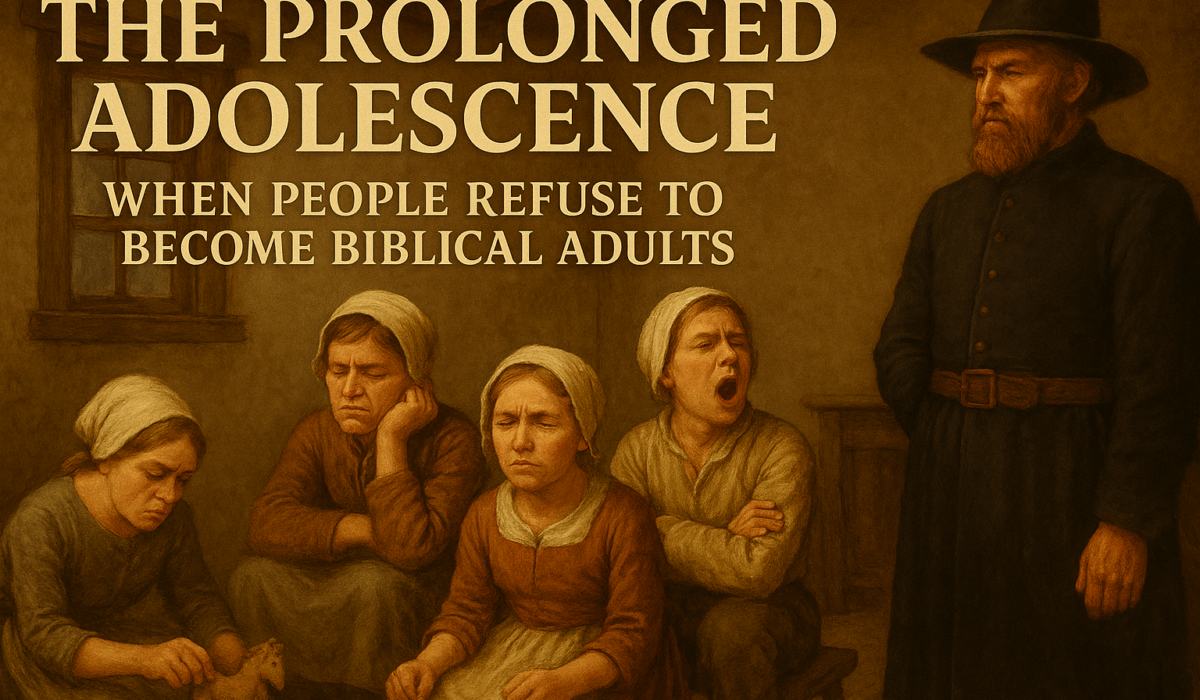
The Prolonged Adolescence

When People Refuse to Become Biblical Adults


I. Introduction: A Generation Stuck in Delay

We are living in an age of prolonged adolescence, an era where grown men still act like boys, and grown women still dream like girls. Adulthood has been pushed so far down the road that most never reach it. Chronological age no longer corresponds with maturity. The very concept of “coming of age” has been diluted, perverted, and ultimately lost in our generation.

This is not a cosmetic cultural issue. This is a spiritual crisis. A people who do not become adults cannot inherit anything, cannot rule anything, and cannot be entrusted with the covenant of God. Scripture is clear: the Kingdom of God is built through mature sons and fruitful daughters. But when you look around modern society, from the universities to the churches, from entertainment to family life, you don’t see maturity. You see eternal childhood.

This is not by accident. The war on adulthood is strategic. It has been waged by globalists, feminists, and social engineers to keep people in a perpetual state of dependency, ignorance, and rebellion. Because children cannot rule, build, defend and children cannot stand in covenant.

This post will explore, expose, and declare war on the prolonged adolescence that grips our culture. It will define biblical adulthood, demonstrate how it has been delayed and destroyed,  then offer the pathway to restore maturity, responsibility, and dominion.

II. The Biblical Pattern of Adulthood

A. God Expects Maturity

From the very beginning, God created humanity for growth. Adam was not created to remain innocent forever. He was given a dominion mandate, to rule, to subdue, to name, to work, to guard, and to multiply (Genesis 1:28). These are not the tasks of a child. These are the responsibilities of a man. Likewise, Eve was not made to frolic in eternal girlhood; she was made to be a helper fit for dominion (Genesis 2:18). Not a doll or dreamer. But a builder of the house (Proverbs 14:1).

God’s pattern throughout Scripture is the calling and commanding of sons to become men and daughters to become women. Not in some vague, emotional sense, but through function, labor, responsibility, marriage, childbearing, and legacy. There is no neutral “young adult” phase in the Bible. You are either a child under tutelage, or an adult under responsibility.

B. The Jewish Rite of Passage

The Hebrews understood this. A boy became a man at thirteen in terms of moral responsibility. But his household maturity, the real proof of manhood, was shown in whether he could labor, lead, marry, and steward a household. Similarly, a girl was considered a woman when she was ready to marry and build a household of her own (Deuteronomy 22:13–21).

The entire system was designed to produce functioning, contributing, responsible adults by the time puberty ended. Not at 30. Not at 40. And certainly not never.

III. The Great Delay: How Adulthood Was Postponed

A. The State Replaces the Father

One of the main reasons for the failure of biblical adulthood is the destruction of the family. When the state replaces the father, boys and girls grow up under bureaucratic management instead of masculine leadership.

Public schools teach obedience to systems, not responsibility. They train children to submit to external authorities, bells, schedules, and ideological conformity, not to master themselves or govern a household.

Fathers who once trained sons to be warriors, craftsmen, farmers, and elders have now been sidelined by credentialed professionals and licensed therapists. Instead of learning how to be a man by watching his father, the modern boy is taught to stay in school, play video games, and find himself. The result? A thirty-five-year-old male with a Marvel hoodie, a porn addiction, no wife, no children, no plan, and living in his parents basement.

B. Feminism Abolishes Womanhood

Just as the father’s role has been erased, the woman’s role has been perverted. Girls no longer grow up aspiring to be wives and mothers. They are told from the youngest age that homemaking is slavery and marriage is oppressive. They are taught to compete with men, delay childbearing, and chase careers.

This demonic lie has created generations of girls who grow into confused, bitter, lonely women. They never enter real adulthood because they never build a home. They stay in an endless loop of romantic drama, social media addiction, and corporate servitude.

God defines womanhood not by independence but by fruitfulness. A woman is glorified through her ability to help a man rule, to train children, and to guard the garden of her home. But when she trades all this for student debt, STDs, attention, and cubicle politics, she forfeits the crown of womanhood and becomes a ward of the state.

C. Adolescence: The Modern Invention

The very concept of “teenager” is a modern invention. Historically, there were children and adults. The artificial category of adolescence emerged in the early 20th century, when industrialism and government schooling began to extend dependency well beyond puberty.

The new system encouraged rebellion against parents, peer bonding instead of family loyalty, and the deferral of responsibility. Now we have not only adolescence, but emerging adulthood, delayed launch syndrome, and quarter-life crises.

This is not growth. It is arrested development. It is psychological warfare dressed up as sociology.

IV. The Markers of Biblical Adulthood

Let us now define what it truly means to be an adult according to Scripture, not according to state policy or cultural norms.

A. For Men

  1. Mastery of Self
    A man who cannot govern his appetites is not ready to govern anything else. Biblical manhood begins with discipline. He must rule over lust, anger, laziness, and foolishness. (Proverbs 25:28)
  2. Productive Work
    Adam was given a garden to tend before he was given a wife. A man must work with his hands, produce value, and provide. Laziness is the mark of a child. (Proverbs 12:11)
  3. Readiness to Marry and Lead
    Manhood culminates in headship. He must be able to lead a woman, provide for her, protect her, and raise children. He must be spiritually grounded, doctrinally sound, and mission-driven. (Ephesians 5:23–29)
  4. Covenantal Responsibility
    A man must be accountable to God’s law, to his family, to the elders of the Church. He must see himself as part of a generational mission, not a solo journey. (Psalm 112:1–2)

B. For Women

  1. Meekness and Submission
    The mature woman is not loud and defiant. She is meek, teachable, and reverent (1 Peter 3:1–6). She honors male headship, beginning with her father and culminating in her husband.
  2. Home Orientation
    Adulthood for a woman is defined by her ability and desire to keep the home (Titus 2:4–5). She is not called to be a competitor in the corporate world but a queen within her domestic realm.
  3. Fertility and Nurturing
    Godly women rejoice in childbearing. They do not delay or avoid motherhood, whether by birth or by mothering her sister-wives children; she embraces it as a high calling (1 Timothy 2:15).
  4. Covenant Stewardship
    Like Sarah and Rebekah, mature women serve the covenant by supporting the household vision, preparing the next generation, and exercising wisdom within their God-assigned sphere (Proverbs 31).

V. The Fruits of Perpetual Childhood

Bitter Women, Broken Homes

The modern woman has been sold a lie: that growing up means throwing off God’s order, rejecting fatherly authority, scorning a husband’s leadership, and becoming “independent.” But what the feminist age has produced is not strength, it is emotional ruin, spiritual barrenness, and psychological chaos. When a woman refuses to become a biblical adult, the results are not neutral. They are disastrous. Her immaturity spreads like a contagion into every relationship she touches, especially the home.

When women delay or reject adulthood, they become unstable, insecure, and resentful. They give their bodies to men who defile and often will not marry them. They build careers that drain their soul. They reach their 30s and 40s with no children, no Biblical husband, and no joy. And then they rage at God.

The bitter reality is that in their quest for independence, these women become dependent on the state, on pharmaceuticals, and on emotional fantasy. They live in chaos because they rejected the order God gave them

A. Co-dependency Masquerading as Independence

The irony of modern womanhood is that it claims autonomy while living in emotional dependence. Many women today have not truly grown up; they have simply traded one dependency for another. Having rejected the righteous headship of their father or husband, they latch onto false substitutes, government programs, social media validation, friend groups, astrology, or emotionally enmeshed peer circles.

This co-dependency manifests in women who cannot function alone, yet refuse to submit to godly authority. They expect men to bear the burden of their emotional instability while denying those men the right to lead them. They demand provision and protection, but recoil at correction. These are not wives. These are full grown “littlegirls” with marriage certificates.

The biblical woman is a helpmeet, strong, wise, productive, and joyful in submission. The immature woman is a parasite, demanding, fragile, unstable and emotionally needy.

B. Manipulation for Attention

A core trait of the immature woman is her constant hunger for attention. This hunger drives her to manipulate, perform, exaggerate, and provoke.

Rather than quietly stewarding her domain in the home, she creates drama to draw the spotlight. Every emotion is a public event. Every minor disagreement becomes a test of loyalty. Every relationship must orbit her moods.

She will play the victim to avoid accountability. She will pretend to be fragile to avoid responsibility. She will exaggerate her accomplishments to avoid discipline. She does not want truth, she wants reaction.

This is emotional manipulation, a tool used by the spiritually weak and carnally ruled.

In contrast, the godly woman “opens her mouth with wisdom, and in her tongue is the law of kindness” (Proverbs 31:26). She doesn’t need to manufacture crises or force validation. She fears the Lord and is therefore secure, stable, and content.

C. Theatrics, Pouting, and Mercurial Moods

There is little more exhausting for a man than to lead a woman given to childish theatrics. One moment she is warm, the next moment she is cold. She sulks when she doesn’t get her way. She withholds affection to punish. She melts down over imagined slights and stews in self-pity to manipulate sympathy.

Scripture says that a “continual dropping in a very rainy day and a contentious woman are alike” (Proverbs 27:15). The wise man Solomon, despite all his grandeur, knew the misery of an unstable, emotionally volatile wife.

This is not a mental health issue, it is a discipline issue. Women are called to adorn themselves with a meek and quiet spirit (1 Peter 3:4), not with theatrical tantrums. They are called to bring stability to the home, not emotional whiplash.

An emotionally disciplined woman is a crown to her husband. But one given to constant mood swings is a curse upon the household and upon creation itself!

D. Lying and Embellishing for Control

Another hallmark of female immaturity is lying and storytelling as a means of control. The immature woman embellishes her past, invents grievances, and warps facts, not always to deceive maliciously, but to steer outcomes in her favor. She lies for sympathy, for status, or for sway.

She will retell conflicts with her parents or husband in a way that makes her always the wounded party. She will invent mistreatment where there was correction. She will rewrite the past to shield her ego.

This behavior is rooted in pride and self-idolatry. The immature woman cannot stand the idea of being wrong, so she builds a false world around herself where she is always the hero, or always the victim.

In contrast, the righteous woman is a woman of truth. “Lying lips are abomination to the Lord: but they that deal truly are his delight” (Proverbs 12:22). She speaks with honesty, repents when wrong, and refuses to bend reality to serve herself.

E. “Daddy Issues” and the Warped Female Soul

The phrase “daddy issues” is often used flippantly, but it reveals a deeper spiritual wound. A woman who grows up without a godly father, or who rejects his authority, often spends the rest of her life chasing male affirmation in twisted, unhealthy ways.

She may become flirtatious, dressing to draw the male gaze. She may become controlling, seeking to dominate men rather than submit. Or she may become cold and hardened, swearing off marriage while secretly craving the protection of a strong man.

These behaviors are rooted in disordered affections. Instead of honoring the authority God placed over her, she despises it and then seeks to recreate it in her own image.

The result is a woman who cannot relate to men in a healthy, covenantal way. She either tries to seduce them, subjugate them, or manipulate them. But she cannot respect them.

Only Christ can heal such a woman, and He does so by reestablishing her under the rightful covering of headship. Not therapy. Not feminism. Not a YouTube coach. But godly submission to order.

F. Failure to Launch

Finally, we must deal with the modern phenomenon of female stagnation. Just as many men refuse to grow up, countless women today live in a state of arrested development, what might be called “failure to launch.”

They stay in their parents’ homes well into their late twenties or thirties, not because of poverty, but because of comfort and immaturity. They pursue endless degrees and travel experiences, dabble in dating apps, and rotate hobbies, but never settle into biblical womanhood.

They may even attend church. They may even speak Christianese. But they have no intention of submitting to a husband, bearing children, or managing a home. They are perpetual adolescents in adult bodies.

Scripture is clear: “I will therefore that the younger women marry, bear children, guide the house, give none occasion to the adversary to speak reproachfully” (1 Timothy 5:14).

Womanhood is not a vibe. It is a vocation. It begins when a woman commits to her God-given purpose as wife, mother, and homemaker.

G. Weak Men, Crushed Nations

When men refuse to grow up, entire nations collapse. Weak men allow their homes to be invaded, their churches to be feminized, and their governments to become tyrannical. Why? Because children do not guard the gates.

The man who never becomes a true adult is passive, addicted, unmotivated, and vulnerable. He cannot lead his wife (or even get one in many cases), discipline his children, or challenge evil. He becomes a servant of the system, not a patriarch of the Kingdom..

H. Fatherless Children, Lawless Cities

Prolonged adolescence produces fatherless homes. Boys without fathers become criminals or effeminates. Girls without fathers become promiscuous or masculinized. The result? Lawless, violent, directionless cities.

You cannot rebuild civilization with boys and girls who never become men and women. You cannot wage spiritual war with a generation of extended children.

VI. The Road Back to Maturity

A. Repentance from Rebellion

The first step is repentance. Men must repent for their cowardice. Women must repent for their rebellion. We must stop blaming society and start confessing our sin. Delayed adulthood is not just unfortunate, it is a rejection of God’s order.

B. Restoration of Patriarchy

There is no path to maturity apart from the restoration of father-rule. Fathers must reclaim their role as trainers, disciplinarians, and vision-casters. Sons must once again look to their fathers as heroes, mentors, and kings. Daughters must return to the covering of their fathers until they pass under the headship of a husband.

The family is the training ground of adulthood. Without it, the child will be raised by the streets, the screens, or the state.

C. Real Education for Real Life

Education must be reclaimed from the clutches of the state and reoriented toward dominion. Boys should learn to build, fight, and lead. Girls should learn to cook, nurture, and beautify. Math and language are useful, but not if they replace discipleship and household skills.

Adulthood is not formed by memorizing facts but by embodying function. We must restore household economies, apprenticeships, and covenantal education.

D. Marriage and Responsibility – Early

God never designed humans to live two decades in hormonal limbo. We must stop treating marriage as the final prize after a long season of “finding yourself.” It is the beginning of adulthood.

Young men should prepare for marriage early, not by dating, but by working, studying, and submitting to elders. Young women should be raised with a vision of marriage, not as an interruption, but as the fulfillment of their design.

Early marriage with the support of family and Church restores sanity to the maturation process. It connects identity with responsibility, not romance.

VII. The Church Must Lead the Charge

If the Church continues to pander to adolescents in adult bodies, she will forfeit her prophetic voice. Sermons must call men to rise and lead. Pastors must call women to marry and build. Programs must be replaced with purpose.

We don’t need more youth groups that encourage extended play. We need rites of passage that commission young adults into their roles as builders of homes and defenders of truth.

The Church must teach:

  • That men are made to bear the weight of provision and protection
  • That women are made to bear the glory of nurture and homemaking
  • That age is not maturity, and comfort is not calling

Until the Church preaches adulthood, the world will preach adolescence.

VIII. The Fruit of Maturity: Order, Glory, Dominion

When people grow up into their God-given callings, the world begins to heal. Strong men lead nations. Wise women build households. Children are raised in the fear of God. The gates of cities are secure. The glory of God fills the land.

True adulthood is not just a milestone, it is a mission. It is a rite of dominion. It is the threshold into legacy.

When a man takes a wife, he becomes a father. When a woman bears a child, she becomes a queen. When both submit to God’s law, they become rulers under Christ.

And when households are governed in order, the culture around them has no choice but to change.


IX. Conclusion: Put Away Childish Things

The Apostle Paul writes:

“When I was a child, I spake as a child, I understood as a child, I thought as a child: but when I became a man, I put away childish things.”
—1 Corinthians 13:11

This is not optional. This is a command. A generation that refuses to put away childish things will lose its inheritance, forsake its children, and dishonor its God.

We were not made to remain in the sandbox of safety and immaturity. We were made to build, to conquer, to reign under Christ. The time has come to stop making excuses. Stop playing games. Stop waiting for the perfect moment.

Put away childish things.

Rise. Build. Rule.

This is The Great Order!

If Your Family (Kingdom/Domain) Is Not Growing, It Is Dying

The Biblical Call to Expand Your Household in Wives, Children, Property, Influence, and Dominion

I. Introduction: Life, Growth, and the Nature of God’s Kingdom

In the natural world, stagnation is the first sign of death. A tree that no longer puts forth branches, fruit, or roots is already dying. A river that ceases to flow becomes stagnant and poisonous. A body that ceases to regenerate its cells wastes away. The same is true for the household — the kingdom and dominion of the patriarch.

God’s design for the family is growth. Not merely survival. Not maintenance. Not compromise. But fruitfulness, multiplication, and dominion. These are not optional suggestions but commands given in the first chapter of the Bible:

> “And God blessed them, and God said unto them, Be fruitful, and multiply, and replenish the earth, and subdue it: and have dominion…”

— Genesis 1:28

This command was not revoked. It was reaffirmed to Noah after the flood (Genesis 9:1), to Abraham in the covenant (Genesis 17:6), and to the Church spiritually (Matthew 28:19–20). Growth is the nature of godly dominion. Expansion is obedience. Stagnation is disobedience. Shrinking is rebellion.

Your family is your kingdom. And if your kingdom is not growing, it is dying.

II. The Dominion Mandate: Fruitfulness as Faithfulness

God made man to rule, to build, and to expand. The household was created to be the epicenter of this dominion — a miniature kingdom under God’s greater rule.

The first command to man and woman was not about worship services or fasting rituals. It was about fertility and authority.

> “Be fruitful and multiply.”

This is God’s economy. His Kingdom grows through families, not through governments or programs. The covenantal expansion of God’s people comes through childbirth, headship, marriage, and inheritance.

A man is not faithful merely because he avoids scandal or attends church. He is faithful when he multiplies, when he fills the earth with godly seed, builds an enduring legacy, and structures his household to outlast him for generations.

This means real expansion — in:

Children

Wives

Land and property

Influence

Business and productivity

Generational faithfulness through sons and daughters-in-laws

Protection and headship over uncovered women

Political influence and dominion

Each of these are expressions of the dominion mandate.

III. The Curse of Shrinking Households

Modern households are shrinking. The average Western couple now has 1.2 children. Many Christians sterilize themselves with pride, calling it “wise family planning.” They limit the number of arrows in their quiver because they have conformed to the world’s fear and its idols of ease, entertainment, and wealth.

The result? A dying kingdom. A disobedient household. A sterile future.

> “Lo, children are an heritage of the Lord: and the fruit of the womb is his reward.”

— Psalm 127:3

The man who refuses children is despising God’s reward. The man who refuses to expand his house is refusing stewardship of more inheritance, blessing, and responsibility. The man who resists influence, property, or responsibility is shrinking his domain. Whether he knows it or not, his kingdom is dying.

There is no neutral ground. You are either growing or declining.

IV. Biblical Polygyny: The Engine of Household Growth

One of the most powerful, God-ordained means of household growth is polygyny, the marriage of one man to multiple wives. Far from being a footnote or cultural anomaly, polygyny was a primary tool of expansion among the patriarchs.

Abraham, the father of the faith, had multiple wives and concubines.

Jacob had four wives and twelve sons — the heads of the twelve tribes of Israel.

David and Solomon, kings after God’s own appointment, had multiple wives (though Solomon’s excess in foreign women brought judgment).

Gideon, a judge raised up by the Lord, had many wives and seventy sons (Judges 8:30).

Polygyny, when governed by God’s law, is a righteous vehicle for dominion and growth. Each wife brings the potential for children, productivity, nurturing of future warriors and builders, and the expansion of the household’s legacy.

If a man is able, called, and ordered in righteousness, the taking of additional wives is not indulgence, it is obedience. It is the exercising of holy headship over more ground, more territory, and more fruitfulness.

> “And in thy seed shall all the nations of the earth be blessed.”

— Genesis 22:18

Seed multiplies through fruitful women. More wives = more seed. More seed = more blessing.

V. Household Expansion Through Generations

A household should not merely expand in the immediate generation — it must be built to multiply generationally.

This happens through:

Daughters-in-law, brought under the household’s law and culture

Grandchildren, raised in the same traditions, faith, and order

Sons, trained to lead, rule, and expand the house still further

The goal is not independence but continuity. Sons do not leave to start autonomous lives; they are trained to inherit and expand the household dominion. The patriarch must think 100 years ahead. He builds systems, expectations, and laws that will remain even after he is buried with his fathers.

> “A good man leaveth an inheritance to his children’s children.”

— Proverbs 13:22

VI. Expansion in Land, Wealth, and Influence

Abraham was blessed not just in children but in flocks, herds, servants, and land. The blessing of the Lord is multi-dimensional. A growing household also acquires:

Property — to establish territorial dominion

Businesses — to create economic strength and independence

Servants, laborers, and allies — to wield greater reach

Cultural influence — to shape communities, cities, and nations

In the biblical worldview, fruitfulness is material as well as spiritual. A household that grows only in theology but not in impact is malformed. God calls for men who multiply both the gospel and goats, both the Word and their wealth.

Even Christ framed the Kingdom in terms of growth and stewardship:

> “For unto every one that hath shall be given, and he shall have abundance: but from him that hath not shall be taken away even that which he hath.”

— Matthew 25:29

The man who multiplies is rewarded. The man who maintains is cast out as lazy.

VII. Providing Headship to the Uncovered

Another vital form of household expansion is taking responsibility for the uncovered — women who are without godly headship.

Scripture is clear: women are not to be autonomous. They are to be under the authority of fathers or husbands (Numbers 30; Ephesians 5:22).

In a righteous society, widows, orphans, or divorced women are not left to drift. They are covered. Brought under headship. Given protection, law, and purpose.

In many cases, a patriarchal man may rightly expand his household by taking such a woman as an additional wife. This is a holy act — not of romance, but of rescue and governance. He provides her law. He disciplines her flesh. He integrates her into a structure she desperately needs, and which she was created for.

> “Let not a widow be taken into the number under threescore years old, having been the wife of one man… If she have brought up children, if she have lodged strangers…”

— 1 Timothy 5:9–10

Paul’s instruction assumes that the Church takes responsibility for uncovered women, but only when no man will. The highest and most fitting place for such a woman is in a righteous man’s house.

A man who is able should not leave women uncovered. He should expand, for their good and for God’s glory.

VIII. The Example of the Patriarchs

Throughout Scripture and history, the righteous men, those who shaped nations and carried God’s promise — were not maintainers. They were builders and expanders.

Noah built an ark, saved a family, and repopulated the earth.

Abraham went out not knowing where he went and became the father of many nations.

Jacob multiplied through wives and sons and became Israel.

Moses led a people and gave them law.

David conquered territory and established a throne.

Nehemiah rebuilt the wall.

Paul planted churches across the empire.

Christ conquered sin and is building His Church.

The God-fearing man is always multiplying. Always expanding. Always thinking in dynasties and dominion. Never content with neutrality or pause.

> “Of the increase of His government and peace there shall be no end.”

— Isaiah 9:7

The kingdom of God increases. So must yours!

IX. Warning Against Shrinking and Excuses

The temptation for the modern man is retreat. He is told to “be content,” to “not overextend,” to “live modestly.” These can be good in context. But often, they are masks for cowardice, laziness, or outright disobedience.

“I can’t afford more children.” — But you trust God to save your soul?

“I’m not sure I could lead more than one wife.” — Then why are you leading at all?

“Our house isn’t big enough.” — Then why aren’t you building a bigger one?

“It’s too hard to manage a big household.” — Then grow up and learn.

God never promises ease. He promises blessing. And blessing follows obedience.

The faithful man expands even in famine. He builds in the face of chaos. He governs when others retreat. He takes headship where others make excuses.

> “And the man waxed great, and went forward, and grew until he became very great.”

— Genesis 26:13

This is the pattern of the patriarch.

X. Let the Righteous Multiply

This is the hour to rise. The time for compromise has ended. Your family is either marching toward dominion or dying in retreat.

Take wives. Raise children. Train sons. Rule over daughters. Bring in daughters-in-law. Gather grandchildren. Purchase land. Build businesses. Influence local Government. Shelter the uncovered. Preach the gospel. Plant orchards. Expand your tent.

> “Enlarge the place of thy tent, and let them stretch forth the curtains of thine habitations: spare not, lengthen thy cords, and strengthen thy stakes; For thou shalt break forth on the right hand and on the left…”

— Isaiah 54:2–3

This is the way of dominion.

This is the nature of God’s Kingdom.

This is the legacy of righteous men.

Let the patriarchs rise — and let their houses grow.

If your family is not growing, it is dying. Build, expand, multiply and Reign with Authority!

This is the Great Order!

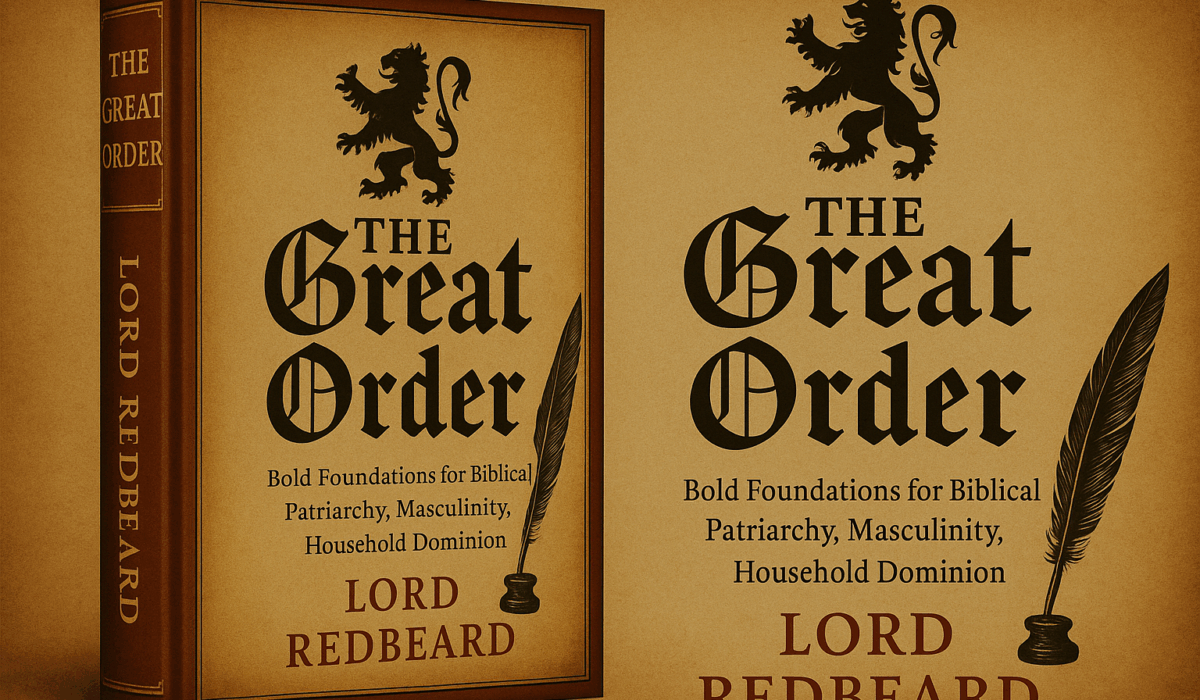
Announcing the Forthcoming Release of “The Great Order” by Lord Redbeard

Bold Foundations for Biblical Patriarchy, Masculinity, and Household Dominion

> “If the foundations be destroyed, what can the righteous do?”

— Psalm 11:3

We stand at the precipice of a collapsing world. The nations rage, the families crumble, the church is compromised, and the people groan under the weight of disorder. Men are passive, women are rebellious and children are untamed. The covenantal design of God’s order has been all but forgotten.

Yet from the ashes, a trumpet has sounded. A clarion call not of man’s wisdom but of divine truth — bold, ancient, and uncompromising.

That trumpet is The Great Order.

This book is not merely a work of writing. It is not a collection of random thoughts. It is a declaration. One forged through the fires of spiritual warfare, personal experience, obedience, and relentless pursuit of the Kingdom of God.

And now, by the providence and grace of the Most High, it is almost here.

A Work Birthed in Fire and Revelation

There are books that entertain, books that educate and books that simply pass the time. The Great Order is none of these. This is not a journalistic commentary on the state of the culture. This is not a casual opinion piece about the family.

This is a blueprint for dominion!

Every word in this book has been wrought through struggle, failure and triumph. Each sentence has been borne through prayer, sharpened through Scripture, and written through conviction. I did not merely choose to write this book, I was compelled, burdened and gripped by the Spirit of God with a vision too weighty to ignore.

> “The word of the Lord was in my heart as a burning fire shut up in my bones…”

— Jeremiah 20:9

I have lived these words, while often failing. I have been humbled by them, corrected by them, and built by them. They were not written in an ivory tower but forged in the trenches of real fatherhood, real household government, and real spiritual war. The Great Order is not theoretical, it is incarnational. It is truth that has been lived, tested, and proven by patriarchs since the beginning of written history. 

This book has not been filtered for cultural acceptance. It has not been softened for fragile ears. It is a sword, a plumbline, a trumpet blast for men to rise, women to embrace sacred roles, and families to become embassies of heaven.

 Why This Book Is a Threat to the World and a Balm for the Faithful

The world hates order, it mocks patriarchy, it despises submission and tears down hierarchy. This is no accident, Satan’s war has always been against God’s design. At the heart of that design is the household, governed by man, under Christ, filled with fruitful labor, and advancing the Kingdom through generations.

The Great Order is a threat to every demonic stronghold because it restores the very structure the enemy fears most,the Biblical family.

But this book is more than just a rebuke of the present. It is a balm for the faithful, a comfort to the remnant, a light to those wandering in the darkness of feminism, fatherlessness, and confusion. Many have felt the stirrings in their soul that things are not right, that the modern way is broken and that there must be more.

This book puts language to what the Spirit of God has already whispered in many hearts. It is a framework, a vocabulary,a standard.

In a generation that knows the truth instinctively but lacks the words to defend or articulate it, The Great Order gives voice to the righteous yearning buried in every God-fearing man and woman. It bridges the gap between conviction and communication, between the groaning of the soul and the clarity of truth.

Truths We Know But Cannot Articulate — Until Now

There are times when a man knows something is wrong, even though he cannot explain it. He sees a woman preach, and something in him recoils. He watches a child disobey his mother, and he feels disgust, he sees a home led by a career-focused wife and feels instinctively — this is disorder.

But if pressed, he cannot explain it. He cannot defend it, he cannot express it to his wife, to his children, to his church, to his peers. The conscience bears witness to God’s design. But the vocabulary has been stolen.

This is the plight of our generations, men and women raised without the theological framework or historical wisdom to articulate what they sense in their souls. We know disorder when we see it. We feel its destruction, but we have been robbed of the language to name it, and the courage to confront and profess it.

The Great Order restores that language. It articulates what you’ve always known, it puts steel in your spine and precision in your mouth. It enables fathers to teach their sons, it enables husbands to lead their wives, and enables shepherds to guard the flock. This book is not abstract,  it is accessible, practical, and potent.

It accomplishes the seemingly impossible: giving form to formless conviction, giving words to what was once only felt. It is the bridge between inner clarity and external boldness.

IV. The Structure of the Great Order: A Manual for Reconstruction

This is not a book of feelings. It is not a devotional. It is a war manual.

The Great Order is organized into chapters that walk step-by-step through the rebuilding of Christian civilization:

Biblical Patriarchy — restoring God’s government in the home.

Masculinity — dominion, not indulgence; strength through sacrifice.

Christian Polygyny — a weapon of revival and fruitfulness.

The Role of Women — sacred submission, homemaking, and generational building.

Family Government — fathers as kings, priests, and judges.

Household Economy — families as productive units, not consumers.

Education — indoctrinating children in righteousness.

Resistance — rejecting feminism, statism, and cultural apostasy.

The Church and the Household — integrating worship and dominion.

It doesn’t simply teach why we must return to Biblical order, it shows how. It is intensely practical, designed to be implemented. The principles in this book already form the foundation of households that have rejected compromise and chosen to live by the Law of God.

The Fruit of the Great Order: Revival, Peace, and Restoration

Revival will not come from stadiums, celebrity pastors, or emotional altar calls.

Revival begins at the dinner table!

It begins when a man takes his place as head of his home. When a woman repents of autonomy and embraces her role with joy. When children are trained in obedience, fear of God, and discipline. When homes become churches, the Sabbath is kept, and Scripture governs life.

The Great Order is not just about family. It is about national restoration.This book declares what few are willing to say: that peace cannot come until patriarchy is restored. That harmony cannot come until hierarchy is obeyed. That blessing cannot come until the household is ruled by God’s order.

This is not nostalgia, politics, or moralism, this is covenantal. When men obey the order of heaven, the result is peace on earth.

Children flourish.

Wives rejoice.

Men lead.

The poor are cared for.

The land is healed.

The nations tremble.

This is how we rebuild civilization — not by electing the right leaders, but by raising them in our homes.

 A Book for the Centuries to come:

The world writes books for entertainment, and the church writes books to sell but The Great Order was written to last, to stand the test of time.

This is not a trending topic, but a timeless template. It will be as relevant in five hundred years as it is today, because it is built on eternal truth. As long as the Word of God stands — and it will stand forever, this book will be a plumbline for the faithful.

When governments fall, the households guided by this book will remain!

When seminaries apostatize, the sons trained by this book will become shepherds!

When feminism collapses, the daughters raised by this book will rebuild homes!

The Great Order is not a one-generation manual. It is a multi-generational standard. It is written to be passed from father to son, from elder to disciple, from patriarch to patriarch. It is the blueprint for God’s covenant people to restore the ancient paths (Jeremiah 6:16). This book will outlast trends. It will outlast empires. Because it is built on the Rock.

Who This Book Is For

This book is not for everyone. It is not for cowards. It is not for cultural Christians. It is not for women who want to control men or men who fear responsibility.

This book is for fathers ready to rule their homes, wives ready to be crowned with honor, 

sons ready to build legacies, daughters ready to prepare for homemaking. It is for shepherds ready to reform their flocks, remnant believers ready to live counter-culturally, and seekers ready to repent and submit to God’s order.

If you are tired of the lies. If you know there’s more. If you feel the conviction but lack the clarity. If you want to plant trees under whose shade your great-grandchildren will sit — then this book is for you.

What to Expect in the Coming Release

The release of The Great Order will be more than a publication. It will be a launch. A declaration of war. A rallying point for households across the earth who are tired of compromise and ready to build.

The book will be released in softcover initially, with hardcover, audiobook, and digital formats planned for the near future. This is more than a book. It is a movement.

The website LordRedbeard.com will serve as the command center — featuring articles, updates, resources, and an ever-growing library or resources for covenant households.

Let the Patriarchs Rise

We are not waiting for revival, we are building it. We are not waiting for the world to wake up, we are establishing households that shine as light in the darkness. We are not waiting for permission, we have a mandate.

God is raising up a remnant of men — fathers, brothers, sons — who will not bow to Baal. They will not kneel to feminism, and will not compromise with the world.

They will build, marry, multiply and they will reign!

And when the Lord returns, He will find not a scattered, weak, feminized people — but an ordered people. A governed people. A glorious bride.

The Great Order is the trumpet.

The time for excuses is over.

Let the patriarchs rise.

Let the women rejoice in their submission and glory.

Let the children be trained as arrows.

Let the households become kingdoms.

Let the dominion begin.

Are you ready?

The Great Order is coming, get your house ready, train your sons, teach your daughters, insure that your name is found among the builders!

Prepare your household, clear your calendar, sharpen your mind and fortify your heart.

The time has come.

The standard has been raised.

The restoration has begun.

Let the Great Order rise and be restored!

Soli Deo Gloria.

Gold, Silver, and the Great Repricing

A sober look at the coming repricing of truth in a world awash in paper promises.


1. The Storm and the Shelter

The world entered 2020 expecting growth and stability. Instead, it received paralysis. Economies locked down, supply chains froze, and entire industries vanished within weeks. Markets convulsed in panic as governments scrambled to invent new money faster than businesses could close their doors.

Investors reached for what they always reach for in crisis, certainty. Not profit, but preservation. By August, gold had surged past $2,000 per ounce for the first time in history, and silver briefly touched $29. Futures traders and retail buyers alike rushed into metals as the dollar index slid below 94 and real yields went negative.

Gold and silver were not merely commodities this summer; they were confessions. Every ounce purchased was a quiet admission that the system built on paper promises was no longer trusted.

The world is searching for shelter, and the ancient refuge of honest weight was the only one left standing.


2. The Mechanics Behind the Spike

What drove this explosion is not mystery but mathematics. Between March and September 2020, the U.S. Federal Reserve expanded its balance sheet from roughly $4 trillion to over $7 trillion – an increase greater than the entire balance sheet after the 2008 crisis. Zero interest rate policy returned overnight, and “quantitative easing” became “QE Infinity.”

Congress has followed suit, approving more than $3 trillion in fiscal stimulus through the CARES Act and related programs. Trillions more were promised globally. Fiat supply is expanding faster than productivity, while real-world goods are trapped in ports or shuttered factories.

In simple terms, there are more dollars chasing fewer things. And in the financial psyche, that equation always ends with gold.

The metals market has also felt an unprecedented squeeze in physical supply. Refiners not producing due to lockdowns, coin mints run skeleton crews, and logistics systems are not moving. Dealers worldwide report premiums doubling or tripling even as spot prices fluctuated. Silver Eagles that normally sell for $2 over spot are commanding $6 to $10 premiums. Paper contracts promised metal that refiners couldn’t deliver.

The price spike is not simply speculative enthusiasm; it is logistical desperation layered on top of monetary panic.


3. The Federal Reserve’s Trap

Central banks faced a dilemma of their own making last year. They had promised endless growth funded by endless credit. COVID-19 simply exposed how fragile that illusion was.

When rates are near zero, the Fed loses its ability to stimulate traditionally. The only remaining tools are money creation and moral suasion, the power to promise safety loud enough that investors pretend to believe it. But by mid-2020, even that faith was thinning.

Every new round of quantitative easing was a confession that the last one failed. Each “rescue package” was a bandage on an artery. The Fed had become both arsonist and fireman, printing water to fight a fire made of paper.

Historically, such interventions delay collapse rather than prevent it. Inflation lags behind money printing by 12–48 months, meaning the real consequences of 2020’s stimulus will not appear until 2021–2024. Investors sensing that delay turned to metals not because they expected instant profit, but because they recognized the timeline of decay.

Gold and silver are forward-looking instruments of distrust. When policy becomes parody, people stop valuing words and return to weight.


4. The Psychology of Fear and FOMO

Markets are not run by algorithms; they are driven by fear. By mid-2020, fear had divided investors into two camps, the terrified and the opportunistic.

The terrified sold everything in March, when the Dow plunged 35% over three weeks. The opportunistic saw governments unleashing liquidity on an unimaginable scale and realized the debasement had begun. That group flooded into hard assets: farmland, crypto, metals, and even ammunition.

Silver, in particular, became the “poor man’s gold.” Retail investors unable to afford $2,000 gold bars could still buy $25 silver coins, and millions did. YouTube and Reddit became classrooms of panic-education where first-time buyers learned what a troy ounce was. This democratization of fear created a sustained bid beneath the market.

The psychology was identical to 2008-2011, when gold hit $1,920 and silver $49. Then, as now, monetary policy had cornered savers: zero interest, high risk, and no trust. But unlike 2011, the 2020 crisis affected every nation simultaneously. There was no safe currency left to flee to.

When all fiat burns together, gold ceases to be a hedge, it becomes the denominator.


5. The Biblical Parallel: Weights, Measures, and Moral Value

Economics without morality is a mathematics of theft. Scripture condemned “diverse weights and measures,” the ancient form of currency debasement. When silver coins were clipped or adulterated, markets faltered, and trust died. Our age commits the same sin electronically.

The difference is only cosmetic. Instead of melting the coin, we dilute the ledger. Each new trillion is a theft of time, a silent confiscation of the labor already stored in existing currency. Inflation is legalized counterfeiting carried out by official hands.

Gold and silver remain stubborn precisely because they cannot be printed. They stand as judgment against false promises. When the prophet Amos warned of those “who make the ephah small and the shekel great,” he was describing our modern central banking system. The manipulation of money is the oldest moral crime on earth: the deliberate exchange of illusion for effort.

Thus the flight to metals that started in 2020 is not merely financial; it is spiritual. It is the market’s confession of sin, a turning away from deceit back toward substance.


6. The Forecast: Peaks, Plateaus, and the Path Ahead

As of late 2020, gold now trades near $1,900 and silver around $24. The emotional fervor has cooled slightly from the August highs, but the fundamental conditions remain unchanged. Stimulus continues. Supply chains are fractured. Confidence is gone.

Barring a miraculous restoration of fiscal discipline (which history suggests is fantasy), the metals market will resume its climb after a brief consolidation. However, this next leg will not be explosive but measured. Volatility will persist, but structure is forming.

Gold is likely to test and stabilize around $2,000 per ounce by mid-2021, while silver reaches the $28–$30 zone. Those levels should hold for roughly 12 months or longer with perhaps some mild variations, then, a plateau rather than a collapse, as inflation metrics catch up and the world learns to price permanence again.

This pause will separate speculators from stewards. The impatient will sell when prices stagnate; the wise will understand that value is not measured in months but in integrity of measure.


7. The Second Wave: The Slow Rise Toward 2025

Markets normally move in tides, not explosions. After the first wave of panic buying in 2020, the metals market will enter a period of digestion, the eye of the storm. Prices may appear stable, but underneath, trust in paper will continue to erode. Every new fiscal rescue package, every “temporary” quantitative easing program, will quietly deepen the public’s understanding that none of this money is real.

By late 2021 and into 2022, as stimulus checks fade and the costs of living rise, the delayed effects of inflation will surface. Commodities will strengthen across the board, food, fuel, housing, while wage growth increases but fails to keep pace. When a middle-class worker realizes that the same paycheck buys less food and less security, he doesn’t need a Bloomberg terminal to understand debasement. He feels it in his grocery cart.

At that point, investors will again seek anchors. Gold will climb gradually past $2,200, then $2,500, the $3,500 and near the $4,000 mark by 2025. Silver, which always lags before over-performing, will push through $35 and flirt with $40 by 2023 and the $50.00 by 2025 The advance will not come from excitement but resignation: the recognition that the world’s debt problem cannot be solved, only inflated away.


8. The Limits of Control

Central banks will attempt to manage the narrative. They will claim inflation is “transitory,” then redefine the term when it isn’t. They will hint at rate hikes, then retreat when markets tremble. Each intervention will buy less credibility than the one before. The tools of control are losing potency because they depend on belief, and belief, like currency, can only be diluted so far.

Historically, the endgame of monetary cycles arrives not when policy fails, but when the people finally see through it. That moment is psychological, not mechanical. Once trust dies, charts are irrelevant.

By 2024–2025, gold will approach the $4,000+mark and silver the $50+ range, not because of hysteria, but because the measurement itself has changed. When the ruler stretches, everything appears larger. The metals will not have become more valuable; the currencies measuring them will have become less so. The repricing is not in ounces, but in honesty.


9. The Social Consequences of Monetary Sin

Money is not just an economic tool; it is a covenant of trust between citizens. When governments debase it, they destroy more than purchasing power, they corrode the moral fabric that binds a people together. Inflation rewards the indebted and punishes the disciplined. It celebrates consumption and mocks saving. In time, that moral inversion spreads from markets to households.

We already see its symptoms: the rise of speculation over production, of digital illusions over tangible goods. A generation trades imaginary coins while ignoring the real ones in their grandparents’ drawers. Such a culture cannot endure long because it has detached wealth from work, and price from worth.

In biblical terms, this is judgment. When a society worships paper idols, God often lets the paper burn.


10. The Return to Tangibility

The repricing of gold and silver will not only reshape portfolios; it will reorder priorities. As digital abstractions lose reliability, tangible assets will return to prominence, land, water rights, tools, family businesses, and skilled labor. These are the forms of capital that cannot be inflated or confiscated with a keystroke.

There will, however, be a lagging effect in real estate, one of the few areas where time will favor the patient. Property values move slower than metals because they depend on credit, not cash. As gold doubles in value over the coming years, real estate will not follow at the same pace. The housing market will likely experience a 12 to 36-month delay before prices fully adjust to the new purchasing power of hard assets. This period will be an enormous opportunity for those who held their metals through the storm. When the repricing wave reaches land and housing, those who preserved real wealth will be positioned to convert ounces into acres, purchasing real estate with gold that itself has already doubled in value. Timing, not speculation, will be the key.

Gold and silver will serve as bridges between the old world of credit and the new age of accountability. They are not ends in themselves but instruments of preservation, ballast for those navigating through deceitful seas. Those who hold them are not hoarders of metal but guardians of measurement.

For the prudent, this shift presents an opportunity: to re-align investments, households, and values around permanence rather than promise. For the reckless, it will be ruin. When paper wealth evaporates, those who mistook digits for dominion will discover they own nothing of substance.


11. Lessons from the Past

History offers precedents. In the 1970s, after a decade of monetary excess, gold rose from $35 to $850, a twenty-four-fold increase. In 2008–2011, after another orgy of liquidity, it doubled again. Each cycle was marked by the same pattern: crisis, stimulus, temporary calm, and a second, larger wave of repricing.

The current era is no different, except for scale. The global debt load now exceeds $250 trillion. Central banks are trapped by their own policies; they cannot tighten without collapse or loosen without admitting failure. In such an environment, honest money has nowhere to go but up.

Those who understand this pattern will not be surprised by the next surge. They will recognize it as the inevitable arithmetic of dishonesty coming due.


12. Stewardship and Preparation

The wise man does not buy gold because he fears apocalypse; he buys it because he respects arithmetic. He stores a portion of his labor in a form that cannot be debased by decree. He refuses to let others define his value.

Yet the greater preparation is moral. Wealth without wisdom is still poverty. The repricing ahead is not merely financial but spiritual, a test of stewardship. How one handles truth when the world trades in lies reveals character.

Households should seek strength in order: reduce unnecessary debt, build skills that outlast trends, and invest in things that serve life rather than vanity. Those principles were sound in the days of Solomon and remain sound today.


13. The Moral Repricing

Ultimately, gold and silver are mirrors, not messiahs. They reflect the integrity of the civilization that measures itself by them. When they rise sharply, it is not celebration but indictment. It means the people have lost faith in their stewards.

The “great repricing” is therefore not about metal, but about meaning. As false measures collapse, truth reclaims its proper premium. Those who anchor themselves to honesty, in finance, in family, in faith, will find stability while empires of credit crumble.

The ancient command still stands: “A false balance is abomination to the Lord: but a just weight is his delight.” (Proverbs 11:1)
When the world forgets that law, the market remembers it for Him.


Closing Reflection: The Weight of Truth

The years ahead will be noisy with policy, promises, and panic. Ignore them. Focus on weight and measure. In the end, the world will rediscover what every honest merchant once knew, that value is not created by decree but proven by durability.

Gold will find $4,000, silver will near $50, and then the cycle will repeat again (but with higher numbers). Yet the greater treasure is not metal, but the moral clarity to see through illusion.

Those who hold that, and live by it, will never be impoverished.