Category Archives: Future

The Red Pill and the Empty Throne: Why Men Are Looking for Answers and Why They Still Need Christ


Introduction:

For nearly a century, Western society has conducted a grand social experiment. The premise was simple enough: remove traditional authority, redefine masculinity, weaken the family, sever society from its religious foundations, and convince men and women that they are equal, acting on their personal preference rather than natural law or divine order. We were assured that the results would be freedom, equality, fulfillment, and peace. Instead, the experiment has produced confusion, isolation, extinction level birth rates, broken homes, fatherlessness, and a generation of men who have been told simultaneously that they are unnecessary and yet responsible for everything that is wrong in the world.

It should surprise no one, then, that millions of men have begun searching for answers. Human beings possess an innate desire for order, purpose, hierarchy, and truth. Men in particular are designed to seek responsibility, mission, and authority. When churches refuse to address these realities, when schools actively undermine them, and when popular culture mocks them, men will inevitably look elsewhere. This is the soil from which the modern “Red Pill” movement emerged. Men didn’t suddenly become misogynists, angry, or reactionary. It arose because men recognized that they had been lied to. The problem is that while the Red Pill movement correctly identifies many symptoms of the disease, it then prescribes treatments that are ultimately incapable of restoring true health because they reject the very source of order they claim to seek.


I. Nature Abhors a Vacuum

A very predictable principle in history is that when legitimate authority disappears, illegitimate authority rushes in to replace it. Human beings do not cease believing in hierarchy simply because someone writes an academic paper declaring hierarchy oppressive. They merely replace one hierarchy with another.

The twentieth century provides abundant examples. As traditional Christianity declined throughout Europe and North America, alternative belief systems emerged to fill the void. Political ideologies became religions. Consumerism, identity politics, even entertainment became religions. The human desire for meaning never disappeared; it simply sought new objects of worship.

The same phenomenon occurred with masculinity. For generations, churches taught men that they were called to lead, provide, protect, govern their households, and exercise self-sacrificial authority. Scripture consistently examples this pattern. Adam was held accountable for the fall before Eve. Abraham commanded his household after him. Joshua declared, “As for me and my house, we will serve the Lord” (Joshua 24:15). The Apostle Paul instructed husbands to lead their families as Christ leads the church (Ephesians 5:23).

Then came the modern era. Universities informed men that leadership was oppressive. Popular media portrayed fathers as incompetent buffoons. Marriage was redefined from covenantal duty into a vehicle for personal happiness. The concept of masculinity was cast as evil. Boys grew up hearing that every traditional male trait (strength, competitiveness, ambition, authority, assertiveness) was either toxic or dangerous. Yet men remained men.

A 2023 survey by the Pew Research Center found significant numbers of young men reporting feelings of purposelessness, loneliness, and social isolation. Similar findings have emerged from research by the American Institute for Boys and Men and numerous studies documenting declining marriage rates, educational achievement, and social engagement among males. Men are not rejecting purpose; they simply can no longer find it in the institutions that once provided it.

The Red Pill movement entered this vacuum and said something many men had not heard in years: “You are not crazy. What you have been told is a lie.” That message resonated because it contained a measure of truth.

The problem is that identifying a lie is not the same thing as finding the truth. A man can correctly diagnose that his house is on fire and still choose to extinguish it with gasoline. Many Red Pill voices recognize the collapse of family structure, the consequences of feminism, and the failures of modern culture. But without submission to God, the pursuit of truth often devolves into bitterness, cynicism, pride, and self-interest. The throne may be vacant, but replacing Christ with self-improvement gurus does not solve the problem. It merely changes the idol to self.

The Red Pill movement gained influence because it acknowledged realities that many institutions refused to discuss. Its popularity is evidence not of male rebellion but of male hunger. The deeper question is whether that hunger is being fed with truth or with a more sophisticated form of rebellion.


II. The Red Pill Is Often Right About the Problem

One of the reasons so many critics fail to understand the Red Pill movement is because they refuse to acknowledge the realities that gave birth to it. It is difficult to persuade a starving man that he is not hungry while his stomach is growling. Likewise, it is difficult to convince men that modern society is functioning properly when they can observe its failures with their own eyes.

According to the United States Census Bureau, approximately 58 percent of children are now born outside of marriage. Fatherlessness has become so common that it is often treated as normal rather than catastrophic. Researchers have repeatedly linked father absence to increased rates of crime, substance abuse, depression, academic failure, and poverty. Sociologist David Popenoe concluded that “fathers provide unique contributions that are difficult or impossible to replace.”

Marriage has undergone a dramatic transformation as well. Marriage rates throughout the Western world have steadily declined while divorce rates remain historically elevated. Birth rates have fallen well below replacement levels across all of Europe and North America. Nations that once worried about overpopulation are now struggling to maintain population. The family, which for thousands of years served as the fundamental building block of civilization, has become increasingly fragile, bordering extinction.

Meanwhile, many men have experienced firsthand the consequences of modern sexual culture. Dating applications have transformed courtship into a joke. Social media has amplified unrealistic expectations and fostered constant comparison. Men frequently report confusion regarding their role, purpose, and responsibilities. They are told to lead and not lead, provide and not provide, be masculine but not too masculine, confident but not authoritative. It is the social equivalent of being instructed to drive north and south simultaneously.

The Red Pill movement deserves credit for recognizing many of these realities. It correctly observes that men and women are different. It correctly notes that incentives shape behavior. It correctly identifies the destructive consequences of fatherlessness, promiscuity, and cultural hostility toward masculinity. It correctly points out that many modern institutions have failed young men.

Unfortunately, being correct about a diagnosis does not automatically make one qualified to perform surgery. Satan correctly identified truths while tempting Christ in the wilderness. But truth detached from righteousness becomes a weapon rather than a remedy.

Many Red Pill voices begin with legitimate observations but end with profoundly flawed conclusions. They often encourage men to become stronger, wealthier, more disciplined, and more attractive, but primarily for selfish purposes. The message frequently becomes, “Improve yourself so you can win the game,” rather than, “Improve yourself so you can serve God.”

A man who pursues strength for his own glory will remain enslaved, while a man who pursues strength in service to God will become free.


III. The Fatal Flaw: Self-Worship in Masculine Clothing

The greatest weakness of the Red Pill movement is that it often attempts to restore masculinity while simultaneously rejecting the God who created it. This is where many men encounter a subtle but dangerous trap.

A typical Red Pill message sounds appealing. Build your body. Increase your income. Develop confidence. Learn leadership skills. Gain social competence. Become disciplined. In isolation, none of these goals are inherently wrong. In fact, many are quite commendable. The problem emerges when the ultimate purpose becomes self-exaltation.

The modern Red Pill movement presents a version of masculinity centered upon personal optimization. The man becomes the focus, his success becomes the objective., his desires become the standard, and his advancement becomes the mission. What begins as a rejection of feminism frequently ends as another form of individualism wearing a beard and carrying a barbell. This is not the model presented in Scripture.

Christ was unquestionably masculine. No serious reading of the Gospels can avoid that conclusion. He confronted corruption, exercised authority, endured hardship, spoke truth without compromise, and inspired fierce loyalty. Yet every action flowed from obedience to the Father rather than HIs self-interest.

Philippians 2 describes Christ as one who humbled Himself, taking the form of a servant, while our culture teaches men to serve themselves. The Red Pill movement teaches men to serve themselves more effectively. Christianity teaches men to serve God.

The Red Pill frequently recognizes female hypergamy, relationship dynamics, and social realities. What it rarely recognizes is the depravity of the male heart. It correctly points out that women are sinners but often behaves as though men would create paradise if simply left in charge. History disagrees.

The same men capable of building cathedrals are capable of great depravity. The same masculine traits that create civilizations can create tyrannies. Human beings are not victims of social programming; they are fallen creatures in need of redemption.

Jeremiah 17:9 declares that “the heart is deceitful above all things, and desperately wicked.” That verse applies equally to men discussing masculine self-improvement. A movement that teaches discipline without holiness will produce pride. A movement that teaches authority without accountability will produce abuse. A movement that teaches strength without submission will eventually produce tyranny.

This explains why some corners of the Red Pill world descend into bitterness, promiscuity, manipulation, and cynicism. They recognize the failures of modern culture but refuse the solution God provides. They have discovered that the ship is sinking, they simply refuse to board the lifeboat.


IV. What Men Are Actually Searching For

Beneath the countless podcasts, social media clips, motivational speeches, and debates lies a far deeper reality. Men are searching for purpose.

Young men increasingly consume content focused on discipline, responsibility, fitness, leadership, entrepreneurship, survival skills, and personal development. Critics often interpret this as vanity or insecurity. More often, it represents something far more fundamental. Men are searching for mission, because God designed men for mission.

From the beginning, Adam received a task before he received a wife. He was placed in the garden to work it and keep it. Throughout Scripture, men are consistently called toward responsibility. Noah built an ark. Abraham established a nation. Moses delivered Israel. David defended a kingdom. Nehemiah rebuilt walls. The Apostles carried the Gospel throughout the known world.

None of these men spent their lives asking whether they were living their” best life.” Modern culture treats happiness as life’s highest objective, while Scripture consistently treats obedience as life’s highest objective. 

Many young men today instinctively recognize that unlimited entertainment, casual relationships, and consumerism cannot satisfy the soul. They may lack the theological language, but they sense the emptiness. The rising popularity of fitness culture, martial arts, homesteading, traditional craftsmanship, and even preparedness communities reflects a growing desire for competence and responsibility.

The Red Pill movement taps into this longing because it offers structure. It provides explanations. It establishes rules. It identifies problems and proposes solutions. Men naturally gravitate toward systems that impose order. The church should have been leading this conversation long ago.

Instead, many churches have spent decades attempting to become indistinguishable from the culture surrounding them. Sermons focus on comfort rather than duty. Masculine virtues are  ignored or treated with suspicion. Men are told to be nice when Scripture calls them to be courageous. As a result, many men have gone elsewhere.

Yet even when the Red Pill movement identifies purpose, it often stops short of the ultimate purpose. It teaches men to build kingdoms but rarely asks whose kingdom they are building. Christ answered that question “Seek first the kingdom of God and His righteousness” (Matthew 6:33).

The deepest hunger driving men is not ultimately for women, wealth, status, or influence. It is for meaning. Every human heart was created to worship something greater than itself. Men are searching for a cause worthy of that sacrifice. The tragedy is that most are settling for self-improvement when they were created for discipleship.


V. The Biblical Alternative: Not Red Pill, But Truth Pill

The answer to confusion is not the Red Pill movement. The answer is the restoration of biblical order. This statement will probably frustrate extremists on both sides.

Biblical masculinity rejects the modern narrative that men are inherently oppressive. It also rejects the Red Pill tendency toward selfishness, resentment, and manipulation. Scripture demands far more from men than either side is willing to admit.

The biblical husband is not a tyrant. He is also not a servant of his wife’s emotions. He is a leader under authority. In Ephesians 5 Husbands are called to lead their wives as Christ leads the church. Critics immediately focus on authority, they often ignore the next part.

Christ died for the church. Biblical leadership requires great sacrifice. The Red Pill frequently teaches men how to gain leverage. Scripture teaches men how to bear responsibility. The Red Pill often asks, “What do I deserve?” Christianity asks, “What has God commanded?” The Red Pill teaches men to maximize outcomes. Christianity teaches men to maximize obedience. One produces successful narcissists, the other produces patriarchs.

Historically, the civilizations that flourished most consistently were those built upon strong families, clear moral standards, responsible fathers, and religious foundations. Historians from Will Durant to Arnold Toynbee have observed that civilizations decay when family structures collapse and moral restraints disappear.

The biblical model addresses the root causes rather than merely the symptoms. It restores marriage as covenant rather than contract. It restores fatherhood as duty rather than optional participation. It restores masculinity as service rather than domination. It restores authority as stewardship rather than entitlement. Most importantly, it restores man’s relationship with God.

A man may become wealthy, muscular, disciplined, influential, and respected. Yet if he gains the whole world and loses his soul, he remains bankrupt by eternity’s standards. The Red Pill movement correctly recognizes that something is terribly wrong. Scripture explains why it is wrong.

Christ offers the whole truth.


Conclusion

The rise of the Red Pill movement should not be viewed as a cultural anomaly, but a symptom. It reveals a generation of men who have grown weary of lies, tired of confusion, and hungry for purpose. They are looking for answers because the institutions that once provided them have largely abandoned their responsibilities. When churches refuse to teach biblical manhood, fathers fail to train their sons, and society wages war against natural order, men will inevitably search elsewhere. The Red Pill movement gained traction because it was willing to acknowledge realities that most others refused to discuss.

Yet a half-truth remains a dangerous thing. The Red Pill can expose deception, teach discipline, and explain female nature, but it cannot reconcile man to God. Ultimately, the movement succeeds because it identifies a genuine void.

Men need Christ. They need submission to God. They need a kingdom worth serving. The answer to the crisis facing modern men is not found in swallowing the Red Pill. It is found in bowing the knee to the King.

May God’s Great Order be Restored!

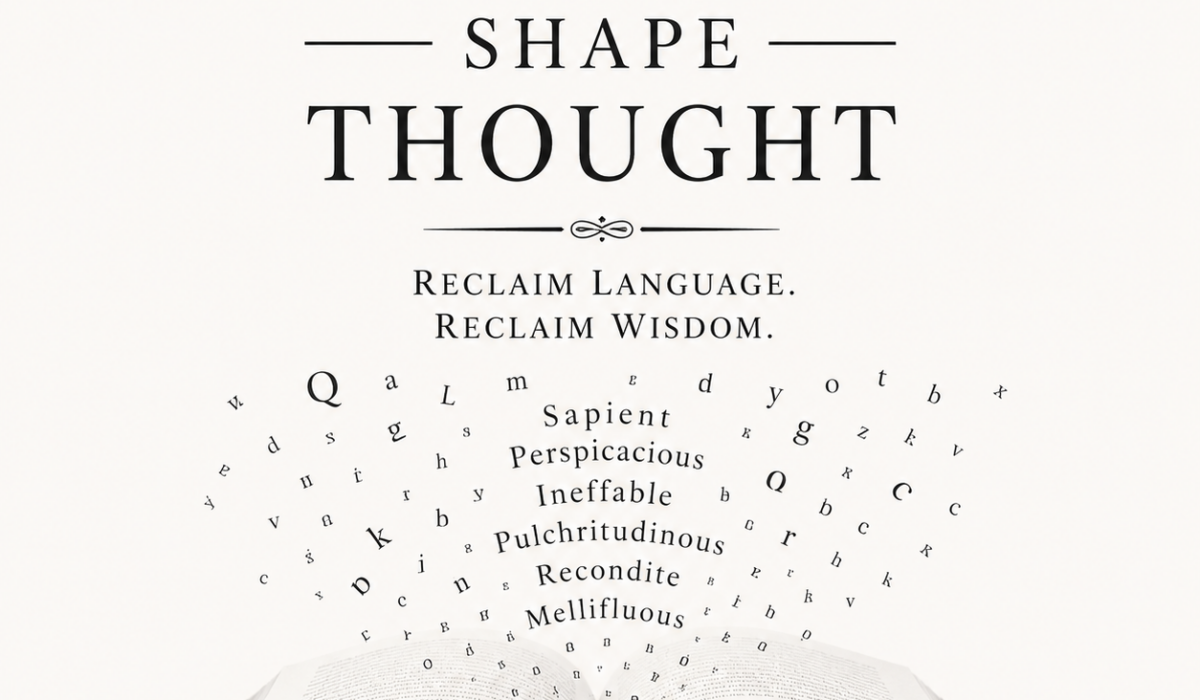
The Great Lexical Impoverishment and the Floccinaucinihilipilification of English


Prologue: The Diminishing Vocabulary of Man

In a previous essay, The Death of Conversation, I lamented the gradual extinction of meaningful discourse in the modern age. The thesis was simple: a civilization that loses its capacity for sustained conversation will lose the principal mechanisms by which wisdom, culture, and truth are transmitted from one generation to the next. Upon further reflection, I have come to suspect that the death of conversation is not the disease, but merely one of its more conspicuous symptoms. After all, before men cease speaking well, they cease thinking well; and before they cease thinking well, they cease possessing the linguistic apparatus necessary for sophisticated thought. One cannot communicate profundity with a vocabulary composed chiefly of grunts, abbreviations, emojis, and cultural slang.

This brings us to a related, though perhaps even more alarming phenomenon: the Great Lexical Impoverishment. The English language (once a vast and magnificent treasury of Anglo-Saxon vigor, Norman refinement, Latin precision, and Greek intellectuality) is undergoing a slow but undeniable contraction in common usage. Words once employed by ordinary educated men and women are now regarded as ostentatious curiosities, relics fit only for academics, antiquarians, and insufferable know-it-alls. The modern speaker is increasingly encouraged to exchange eloquence for simplicity, precision for accessibility, and intellectual aspiration for linguistic minimalism. Indeed, we have arrived at the peculiar historical moment in which a man may spend twelve years in public education, possess unlimited access to the accumulated knowledge of civilization through a device in his pocket, and yet regard a four-syllable word as an act of aggression.

The irony is almost too delicious to ignore. Never before has mankind possessed greater access to books, dictionaries, libraries, universities, lectures, and educational resources. The average peasant of the fourteenth century would have regarded the modern smartphone as a repository of near-omniscience. Despite these unprecedented advantages, studies consistently show that reading habits are declining, attention spans are shrinking, and vocabulary acquisition is stagnating nearly all of the population. The National Endowment for the Arts has documented decades of decline in literary reading among adults, while numerous educational assessments have noted troubling deficiencies in reading comprehension and advanced literacy. We inhabit an age of informational abundance and intellectual malnutrition simultaneously, a feat so paradoxical that future historians may struggle to determine whether it was tragic, comedic, or both.

This lexical diminution is not just an aesthetic concern for grammarians and word enthusiasts who derive unreasonable pleasure from terms such as perspicacious, ineffable, recondite, or sesquipedalian. Words are not ornamental baubles affixed to thought after the fact. They are the primary instruments through which thought is formed, organized, refined, and communicated. As the philosopher Ludwig Wittgenstein observed, “The limits of my language mean the limits of my world.” A man equipped with a rich vocabulary possesses a greater capacity for distinction, nuance, and conceptual precision than one confined to a meager lexicon. To lose words is not merely to lose sounds, but to lose categories, distinctions, and ways of perceiving reality.

Nor should Christians regard this matter as trivial. Scripture places extraordinary emphasis upon language. God creates through speech. Adam exercises dominion by naming creation. Wisdom and folly are repeatedly distinguished by their words throughout Proverbs. Most strikingly, the Gospel of John opens not with language: “In the beginning was the Word, and the Word was with God, and the Word was God” (John 1:1). Language is foundational to civilization. Consequently, a civilization that habitually abandons precision, depth, and eloquence in favor of verbal simplicity should not be surprised when its reasoning becomes equally simplistic.

Thus, this essay is not simply a defense of large words, nor an exercise in sesquipedalian exhibitionism for its own sake. Rather, it is an examination of what is lost when a people gradually abandon linguistic ambition. For beneath the cumbersome yet delightfully appropriate title lies a serious contention: that the floccinaucinihilipilification (the estimation of something as worthless) of English vocabulary has contributed to a broader cultural tendency to regard intellectual rigor as unnecessary. And when a society treats precision of language as pretension, it will discover too late that precision of thought will follow it into oblivion.


I. The Cathedral of Words and the Barbarians at the Gate 

The English language did not emerge fully formed from the brow of some literary deity. The greatest, most expressive and complex system of communication ever developed was forged across centuries through conquest, commerce, theology, philosophy, scholarship, and no small measure of civilizational tumult. Old English contributed its sturdy and practical foundation; Norman French supplied refinement and sophistication; Latin bestowed precision and technicality; Greek furnished the language of philosophy, science, and theology. The result was a linguistic cathedral, a sprawling edifice of astonishing depth and complexity wherein a man might find a word for nearly every conceivable shade of thought, emotion, object, virtue, vice, or circumstance.

Consider the lexical inheritance bequeathed to us by previous generations. The translators of the King James Bible, working in the early seventeenth century, employed a vocabulary that modern publishing houses would likely deem too difficult for contemporary audiences. Shakespeare casually utilized thousands of unique words, many of which remain recognizable centuries later. Statesmen, theologians, merchants, and craftsmen alike possessed vocabularies that would surprise most contemporary university graduates. One need only peruse personal correspondence from the eighteenth or nineteenth centuries to discover ordinary citizens employing terms such as vicissitude, amelioration, magnanimity, obduracy, and circumspection without apology or explanation.

The evidence of this linguistic richness is not anecdotal. Historical analyses of literature reveal that earlier generations routinely encountered a broader range of vocabulary through sermons, newspapers, books, public lectures, and formal education. Even elementary readers from the nineteenth century exposed children to words that today might provoke demands for simplification. Noah Webster, whose name became synonymous with American lexicography, believed that education should elevate the student to the language rather than degrade the language to the student. Such an assumption now appears almost quaint, if not outright revolutionary.

What distinguished these generations was not intelligence, but aspiration. They expected language to stretch the mind. A difficult word was viewed as an invitation to learn rather than an affront to one’s dignity. The encounter with an unfamiliar term often prompted inquiry, reflection, and growth. Today, however, many regard lexical complexity with suspicion. Words that once conveyed learning now risk accusations of elitism. A man may be praised for ignorance so long as it is confidently expressed, while the individual who employs a precise or uncommon term is often treated as though he has committed an act of social aggression.

This represents a profound inversion of historical norms. For centuries, vocabulary functioned as a ladder by which individuals ascended toward greater knowledge. Increasingly, however, modern culture is determined to shorten the ladder lest someone be inconvenienced by the climb. The result is diminished aspiration. We have inherited a linguistic cathedral and, through a peculiar mixture of indolence and egalitarian sentimentality, have begun converting it into a storage shed. The stones remain. The architecture still stands. But fewer and fewer people venture inside, and fewer still appreciate the grandeur that surrounds them.


II. The Cult of Simplification and The Tyranny of Accessibility 

One curious development of the modern age is the widespread assumption that every form of simplification constitutes progress. We are told that language must be streamlined, shortened, condensed, optimized, modernized, and rendered perpetually accessible to the broadest (and dumbest) possible audience. The stated intention is usually noble enough. Communication ought not be needlessly obfuscatory. A writer should strive for clarity over verbosity. Yet somewhere along the path from clarity to accessibility, civilization took a wrong turn and wandered headlong into the swamp of intellectual mediocrity on an inevitable path to idiocracy.

While clarity seeks to illuminate truth, simplification often seeks to eliminate difficulty. These are not identical pursuits. A competent teacher explains a complex concept in a manner that can be understood. A poor teacher simply removes the complexity. The former produces wisdom; the latter produces ignorance adorned with confidence. Modern communication has embraced the latter approach. Newspapers that once assumed a literate readership now target progressively lower reading skill levels. Educational materials are frequently rewritten to accommodate shrinking vocabularies. Public discourse increasingly favors slogans, feelings and assertions over evidence and eloquence.

The consequences are visible everywhere. Political rhetoric has become increasingly reductive. Corporate communication has been distilled into vacuous platitudes. Advertising agencies, social media consultants, and marketing professionals labor tirelessly to transform every conceivable message into a sequence of digestible fragments capable of being consumed by individuals whose attention span rivals that of an over-caffeinated squirrel. We are surrounded by language engineered to accommodate its lowest common denominator. The result is a peculiar cultural feedback loop: as vocabulary declines, communicators simplify their language; as language is simplified, vocabulary declines further and the cycle continues ad nauseam.

This phenomenon might appropriately be called the democratization of ignorance. Previous generations sought to democratize education by expanding access to knowledge. Modern society appears content to democratize ignorance by lowering intellectual expectations. The distinction is subtle but significant. The goal is to bring the summit for everyone down to the lowest denominator student. Unfortunately, mountains cease being mountains when enough of their elevation is removed.

One need not search far for examples. Universities increasingly report students arriving with diminished reading endurance and reduced familiarity in advanced vocabulary. Professors routinely assign shorter readings, simpler texts, and less demanding material than their predecessors. Even among educated adults, there exists a growing reluctance to engage with language that requires effort. Encountering an unfamiliar word no longer inspires curiosity but irritation. The immediate response is not, “What does this mean?” but rather, “Why didn’t you use an easier word?” Such a reaction would have perplexed our forebears to the point of exasperation. To them, the discovery of a new word represented an expansion of one’s intellectual armory. To modern readers, it is perceived as an inconvenience too burdensome to bear.

The irony, of course, is delicious. We live in an age where every dictionary in human history can be accessed within seconds. Never has it been easier to learn a word. Never has the cost of ignorance been lower. Yet never have so many people insisted upon remaining comfortably uninformed. The problem, therefore, is a lack of aspiration. The modern war against big words is not truly a war against vocabulary, but effort. And like most wars against effort, it is being won with alarming efficiency.


III. The Necessity of Sesquipedalianism 

A persistent absurdity of modern discourse is the belief that large words exist to make simple ideas sound complicated. According to this popular fiction, the individual who employs terms such as perspicacious, ineluctable, circumlocution, or magniloquent is engaged in some form of linguistic peacocking, strutting about the verbal barnyard in search of admiration. Certainly, there are occasions when a man may indulge in needless verbosity. Every profession possesses its charlatans, and every dictionary has its show-offs. But to dismiss uncommon words as ornamental affectations is to fundamentally misunderstand why language develops in the first place. Words exist because distinctions exist.

A civilization does not create additional vocabulary out of boredom. Vocabulary is created  because reality proves more intricate than the existing lexicon can adequately describe. Consider the emotional spectrum. A child may know only the word angry. While a mature speaker, however, recognizes substantial differences between irritation, annoyance, vexation, indignation, resentment, exasperation, wrath, and apoplexy. Each describes a distinct state of mind. To condense them all into the word angry is rather like insisting that every shade of color be called blue. Communication remains possible, but precision greatly suffers.

Likewise, there is a meaningful distinction between a person who is intelligent, one who is knowledgeable, one who is wise, one who is shrewd, one who is astute, one who is sagacious, and one who is perspicacious. These terms overlap, yet they are not interchangeable. A knowledgeable fool remains a fool. A shrewd villain may lack wisdom. A perspicacious observer may discern truths that escape a merely intelligent man. The existence of these distinctions allows thought, and thereby expression to become more refined. Vocabulary is the principal mechanism by which ideas are formed.

This principle is easily observed by linguists, psychologists, and educators. Research consistently demonstrates correlations between vocabulary breadth, reading comprehension, academic achievement, and critical thinking ability. Individuals possessing larger vocabularies process complex information more effectively because they possess a greater number of conceptual categories through which information can be organized and understood. Language functions as a cognitive infrastructure. A man who possesses only a handful of conceptual tools can perform only a limited range of intellectual tasks.

The philosopher and statesman Francis Bacon observed that “reading maketh a full man; conference a ready man; and writing an exact man.” Implicit within this observation is the understanding that words are instruments of precision. A craftsman does not carry twenty different tools because he wishes to impress passersby. He carries them because different tasks require different instruments. No sane carpenter attempts to build a house using only a hammer and screwdriver. However our modern society increasingly expects language to accomplish every intellectual task with a remarkably limited verbal toolkit.

The matter is even clearer when one examines the language of theology, philosophy, and law. Terms such as propitiation, sanctification, jurisprudence, teleology, ontology, and epistemology  emerged because entire realms of thought required vocabulary capable of expressing subtle distinctions. If you remove or condense this expressive terminology the distinctions become difficult (or impossible) to articulate. 

Scripture reflects this reality. The Book of Proverbs contrasts wisdom with folly, prudence with simplicity, and understanding with ignorance. “The heart of the prudent getteth knowledge; and the ear of the wise seeketh knowledge” (Proverbs 18:15). Knowledge requires categories, categories require language, and language requires vocabulary. Consequently, the man who voluntarily limits his vocabulary limits his capacity for understanding.

Big words, then, are not the enemy of communication. More often, they are the servants of precision. They exist because reality is complicated, because truth possesses nuances, and because the human mind requires linguistic tools capable of navigating the realm in which we exist and hope to understand. To reject them wholesale is an act of intellectual self-impoverishment. One might as well discard half the instruments from a surgeon’s tray and then boast of one’s commitment to simplicity.


IV. The Digital Babel and the Triumph of Verbal Gruel 

Previous generations gradually diminished their vocabularies through educational neglect and cultural simplification, the digital age has accelerated the process with all the subtlety of a battering ram. Never before in human history have so many people communicated so frequently while saying so little. We inhabit a civilization perpetually engaged in conversation, yet increasingly incapable of sustained expression. Millions of messages are transmitted every minute, billions every day, and an alarming percentage of them could be adequately summarized by a medieval monk as, “The villagers continue making noises.”

The architecture of modern communication bears much of the blame. Social media platforms reward brevity, speed and emotional impact over depth, reflection, and intellectual rigor. The algorithms governing digital discourse do not ask whether a statement is thoughtful, nuanced, or accurate. They simply ask whether it is engaging. Consequently, the modern communicator is incentivized to be provocative, reactionary, and concise rather than comprehensive. The result is a linguistic environment in which vocabulary is treated as an obstacle rather than an asset.

We need only observe the evolution of online communication. Entire phrases have been reduced to acronyms. Complete thoughts have been condensed into hashtags. Complex emotions are increasingly represented by tiny yellow pictographs whose expressive range would be the envy of ancient cave painters. A civilization capable of producing Shakespeare, Milton, and the translators of the King James Bible now frequently communicates through combinations of abbreviations, animated images, and symbols depicting laughing faces, crying faces, and vegetables. Forgive me if I hesitate to call this progress.

The irony is particularly striking because the internet possesses the potential to be the greatest educational instrument ever devised. For the first time in human history, any individual can access ancient manuscripts, scholarly journals, dictionaries, lectures, and entire libraries from virtually anywhere on earth. A word that once required a trip to a university library can now be defined in seconds. A curious mind has never enjoyed greater opportunities for intellectual expansion. However, the same technology that grants access to the accumulated wisdom of civilization also inundates the user with an endless torrent of distractions specifically engineered to prevent sustained concentration and production.

Recent studies on digital media consumption have shown constant exposure to fragmented information encourages skimming rather than deep reading. Individuals increasingly consume information in short bursts rather than extended periods of contemplation. Long-form reading has declined below single digit percentages. Attention spans have contracted more than 3700% in the last five generations. Vocabulary acquisition has slowed to a trickle. Our brains have adapted to the environment in which we operate, and an environment dominated by snippets, headlines, captions, and notifications will naturally cultivate habits of superficial engagement. It is impossible to acquire a sophisticated vocabulary when one’s reading consists primarily of comments sections and arguments conducted entirely through memes, emoji’s and slang.

Perhaps more troubling is the emergence of what might be termed linguistic minimalism as a cultural virtue. Brevity has always possessed value when employed judiciously. The problem arises when brevity becomes the highest good. Not every idea can be compressed into a slogan, not every truth fits in a caption, and not every argument survives reduction to a soundbite. Our modern communication increasingly demands precisely these reductions. Complexity is viewed with suspicion, nuance is treated as weakness, and qualification is mistaken for uncertainty. The result has created a public discourse nourished upon verbal gruel – easily consumed, rapidly digested, and almost entirely devoid of intellectual nutrition.

A society that communicates through fragments will think in fragments. A society that abandons difficult reading will abandon difficult thinking. And a society that ceases striving for linguistic excellence will be a society where intellectual intelligence becomes increasingly rare. For language is not merely the vessel that carries thought; it is the forge in which thought is shaped.


V.The Logos, the Lexicon, and the Loss of Civilization 

At this juncture, the reader may be tempted to dismiss the foregoing discussion as little more than the lamentations of grammarians, bibliophiles, and incurable word enthusiasts mourning the disappearance of their favorite sesquipedalian curiosities. Surely civilization faces graver concerns than the decline of words such as perspicacity, munificence, concupiscence, or circumspection. Yet such a conclusion mistakes the symptom for the disease. Vocabulary is the principal mechanism through which knowledge, wisdom, law, theology, history, and civilization are preserved and transmitted. When language deteriorates, the consequences will extend far beyond the dictionary.

The biblical witness repeatedly affirms the profound significance of language. The opening chapter of Genesis depicts a God who creates the world and everything on it through speech. The universe literally emerges from divine utterance. Shortly thereafter, Adam is entrusted with the task of naming the creatures, an act that signifies both understanding and stewardship. Throughout Scripture, words are treated with an unparalleled level of importance. Proverbs contains hundreds of admonitions regarding speech, wisdom, understanding, instruction, and knowledge. “Death and life are in the power of the tongue” (Proverbs 18:21). Such language presupposes that words possess consequence, substance, and authority.

More strikingly, the Apostle John opens his Gospel with a declaration of staggering theological profundity: “In the beginning was the Word, and the Word was with God, and the Word was God” (John 1:1). The Greek term employed is Logos, a word carrying layers of meaning that encompass reason, order, discourse, wisdom, and divine self-expression. Entire libraries have been written exploring the implications of that single term. If a society gradually loses the vocabulary necessary to understand complex concepts, it also loses the ability to engage deeply with theological truths. The impoverishment of language will inevitably contribute to the impoverishment of doctrine.

This reality extends far beyond theology. Law depends upon precise definitions. Philosophy depends upon conceptual distinctions. Science depends upon technical terminology. History depends upon accurate description. Commerce depends upon carefully negotiated language. Every sophisticated human endeavor and behaviour rests upon the assumption that words possess stable meanings capable of conveying nuanced ideas. If you remove enough vocabulary those distinctions will collapse. Ambiguity will replace precision, emotion will supplant reason, and slogans will replace arguments. In such an environment, manipulation thrives.

Indeed, there exists a deeply political dimension to lexical decline. A populace incapable of understanding complex language is far easier to govern through simplistic narratives. The individual who lacks vocabulary also lacks the conceptual categories necessary to identify deception, contradiction, equivocation, or sophistry. He may sense that something is wrong but he will struggle to articulate precisely why. By contrast, the person possessing a rich and disciplined vocabulary will enjoy a greater capacity for analysis, discernment, and resistance to rhetorical manipulation. Tyrants have seldom feared an illiterate mob, but they have always feared educated readers.

The civilizational consequences are therefore profound. A culture that ceases reading demanding books will lose the ability to produce demanding books. A people that abandons eloquence will cease to recognize eloquence when they encounter it. A generation raised upon verbal minimalism will find the writings of previous centuries increasingly inaccessible. The result is a form of cultural amnesia. The wisdom of ancestors remains physically available and becomes practically unreachable because the linguistic bridge connecting past and present has been purposefully demolished.

For this reason, the decline of vocabulary should concern anyone interested in preserving civilization, faith, and culture. Words are repositories of accumulated human understanding. They are vessels carrying ideas across centuries and generations. They are instruments by which truth is discerned, wisdom is communicated, and reality is apprehended. To treat them as expendable is an act of astonishing shortsightedness.

Civilizations rarely collapse in a single cataclysmic moment. More often they deteriorate through countless small abdications of responsibility. The abandonment of difficult words may appear inconsequential when viewed in isolation, but when a people consistently choose convenience over precision, simplification over understanding, and intellectual ease over intellectual growth, the cumulative effect will be substantial. Lexical impoverishment is a civilizational issue of paramount importance. For when a culture loses its words, it will lose far more than its vocabulary.


Conclusion: The Last Custodians of the Lexicon

The decline of sophisticated vocabulary is not, in itself, the greatest crisis confronting modern civilization. Nations have endured wars, plagues, famines, invasions, and revolutions without losing their identity. However, language occupies a unique position among the pillars of culture, for it serves as the medium through which every other pillar is maintained. Laws are written in words, Scripture is preserved in words, philosophy, science, history, commerce, and education are all transmitted through words. Consequently, when a society neglects its language it is quietly undermining the foundation upon which civilization rests.

The tragedy is not that fewer people know the meaning of floccinaucinihilipilification, delightful though that word may be. The tragedy is that many no longer see any value in knowing it, or in learning any unfamiliar word at all. Curiosity and aspiration have been replaced by convenience and accommodation. We have reached the peculiar point in history where a man may spend decades mastering the intricacies of video games, memorizing sports statistics, or debating the minutiae of popular entertainment, yet regard the acquisition of new vocabulary as an unreasonable burden. Such priorities reveal a fundamental cultural failure and profound spiritual inadequacy.

The remedy, fortunately, is neither complicated nor inaccessible. Read old books. Read difficult books. Read books that force you to keep a dictionary nearby. Read the King James Bible. Read Shakespeare. Read Milton, Burke, Chesterton, Webster, and the countless forgotten authors whose works once formed the backbone of an educated society. When an unfamiliar word appears, wrestle with it, learn it, and use it. Language grows through exercise just as muscles grow through labor. A vocabulary, like a garden, flourishes only when cultivated.

Parents should challenge their children with language rather than perpetually simplifying it. Teachers should elevate students toward knowledge rather than dragging knowledge downward toward ignorance. Writers should strive for clarity without surrendering precision. Readers should recover the habit of intellectual exertion. Most importantly, we must reject the pernicious notion that complexity is inherently elitist or that understanding difficult words is somehow pretentious. There is nothing arrogant about learning, there is nothing oppressive about precision, and there is certainly nothing noble about remaining intellectually stagnant.

The English language remains the most magnificent linguistic achievement in human history. Its vaults are filled with treasures accumulated over centuries, words of astonishing beauty, precision, utility, and power. If we continue treating our lexical inheritance as an inconvenience, future generations will inherit only fragments of what once existed. The cathedral will still stand, but its halls will be empty, its libraries neglected, and its grandeur forgotten to time.

A civilization will not become wiser by shortening its vocabulary any more than a carpenter will become more skilled by discarding half his tools. The man who knows ten thousand words can perceive distinctions unavailable to the man who knows one thousand. He can articulate truths with greater precision, identify errors with greater clarity, and engage reality with greater depth. Words are the instruments of thought, tools of dominion, and repositories of culture.

And so the question before us is whether we shall be faithful stewards of the extraordinary linguistic inheritance entrusted to us, or sheep continuing down the path of simplification, abbreviation, and intellectual indolence until our discourse consists chiefly of slogans, emojis, and verbal grunts. THe time is now to recover the lost virtues of curiosity, eloquence, precision, and learning.

For the death of conversation is merely the beginning. The floccinaucinihilipilification of English threatens something far greater: the gradual abandonment of the very language by which civilization remembers, reasons, and endures.

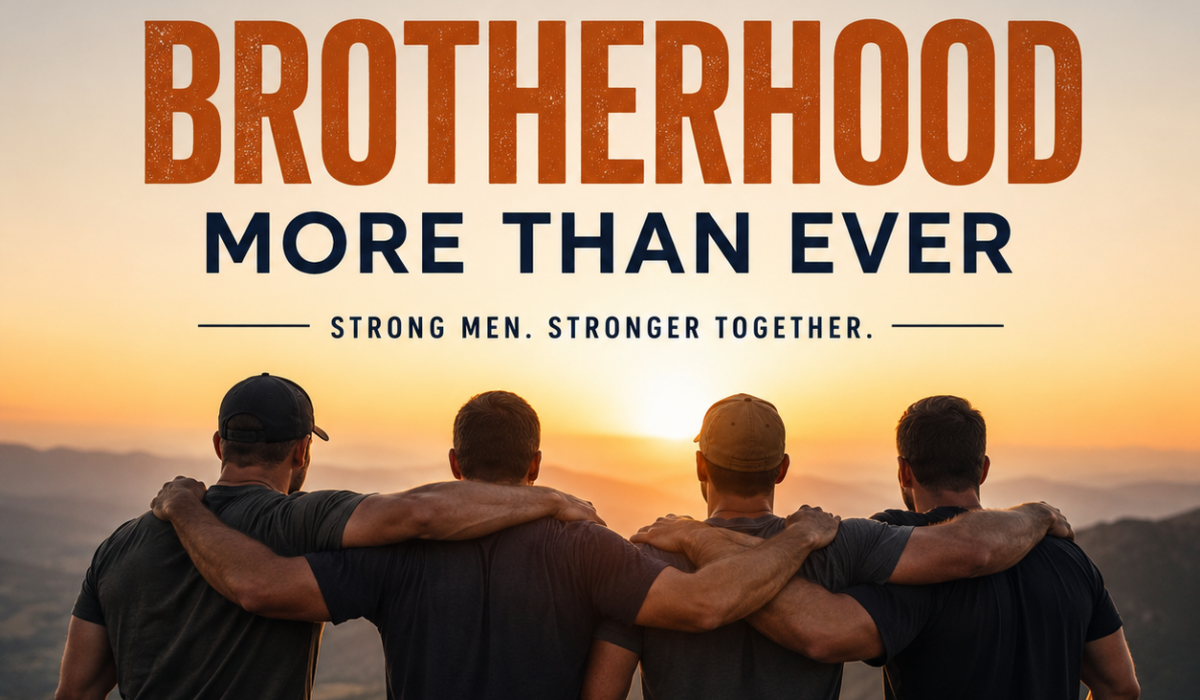
Why Men Need Brotherhood More Than Ever

Isolation, Digital Addiction, and the Death of Male Spaces


Introduction:

There was a time when men did not have to schedule “social interaction” through an app like a dentist appointment. Brotherhood was simply part of civilization. Men built together, fought together, worshiped together, hunted together, and died together. Villages, guilds, churches, workshops, military units, trade halls, taverns, monasteries, and councils all functioned as distinctly male environments where strength, discipline, loyalty, and identity were forged. A man who isolated himself from other men was viewed with suspicion because healthy masculinity historically required comradery, accountability, and shared purpose. Today, however, the modern world has achieved the astonishing feat of surrounding men with constant “connection” while simultaneously producing the loneliest generation in recorded history. Millions of men now possess five hundred online “friends” and not a single brother who would help them move a couch, bury a father, defend their household, or rebuke them when they are acting like fools. We have Wi-Fi everywhere and community nowhere.

Male spaces have been systematically dismantled, mocked, sterilized, commercialized, or outright forbidden. The old hunting camp became a Discord server, the lodge became a Reddit thread, and the neighborhood garage became a streaming subscription. Men who once built cathedrals, railroads, nations, and families now sit alone at midnight arguing with strangers about comic book movies while eating microwaved sodium pellets shaped vaguely like chicken. And then society wonders why depression, anxiety, addiction, passivity, and aimlessness are devouring men. Scripture states in Ecclesiastes 4:9–10, “Two are better than one… For if they fall, one will lift up his fellow.” Yet modernity has convinced men that radical independence is strength while simultaneously reducing them into isolated consumers whose closest companion is a glowing rectangle. And we euphemistically call this “freedom” 


I. The Ancient Strength of Male Brotherhood

Throughout history, every stable civilization understood men become dangerous when isolated and powerful when united. Brotherhood was not only emotional support; it was infrastructure. Spartan warriors trained collectively from childhood. Roman legions functioned as deeply bonded units whose cohesion often mattered more than superior weaponry. Medieval guilds trained boys into men through apprenticeship, discipline, hierarchy, and shared labor. Even frontier America depended upon networks of neighboring men who raised barns together, defended settlements together, and survived harsh conditions only because mutual obligation existed. Men have always built identity through responsibility to one another.

The sociologist Robert Putnam famously documented the collapse of communal participation in his work Bowling Alone (2000), showing steep declines in civic organizations, churches, unions, and social clubs throughout the twentieth century. Men were especially affected because male friendship has traditionally centered around shared activity rather than emotional disclosure. Men bond shoulder-to-shoulder, not simply face-to-face. A fishing trip, construction project, military exercise, or shared hardship creates stronger loyalty than years of casual conversation. Modern society has destroyed most of these organic environments while replacing them with artificial substitutes that demand nothing and therefore produce nothing.

Historically, male-only spaces also served as systems of correction. Older men mentored younger men. Weakness was challenged, cowardice was mocked, and laziness carried severe social consequences. Today, many young men grow up entirely surrounded by female authority structures in schools, offices, media, and even churches. Masculinity is often treated as a pathology requiring containment rather than cultivation. Men are told to “open up” emotionally but are rarely taught duty, mastery, sacrifice, or leadership. A civilization will not survive long when boys are trained to avoid offense rather than overcome hardship.

Even Christ built a brotherhood. The disciples were not isolated spiritual consumers downloading inspirational content on social media. They walked together, suffered together, corrected one another, labored together, and ultimately died for the same mission. Proverbs 27:17 declares, “Iron sharpeneth iron; so a man sharpeneth the countenance of his friend.” Modern culture increasingly seeks to remove every hard edge from male interaction until men become emotionally fragile, conflict-averse, and spiritually neutered. Brotherhood, however, has always required sharpening, friction, accountability, and shared struggles. Men become strong only through purpose and brotherhood.


II. The Digital Cage: Connected to Everyone, Known by No One

Modern technology promised connection but delivered alienation, never in human history have men had greater access to communication while simultaneously suffering such profound loneliness. A 2023 survey from the Survey Center on American Life found that 35% of men reported having no close friends at all, compared to only 3% in 1990. Meanwhile, average screen time continues to rise into absurd territory, with most men spending more time staring at glowing boxes than interacting with actual human beings. Society has created a generation of men who can instantly access a stranger’s political opinion in Sweden but do not know the name of the neighbor living twenty feet away.

Digital addiction compounds the problem because modern platforms are deliberately engineered to hijack male attention. Social media, pornography, gaming loops, streaming platforms, and infinite-scroll entertainment all operate on the same neurological principle: dopamine extraction. The result is passive consumption replacing active participation. Instead of building friendships, men spectate influencers, instead of training their bodies, they watch fitness reels, instead of pursuing women, they consume pornography, and instead of building communities, they argue anonymously online with profile pictures of cartoon frogs and Viking helmets. The modern male increasingly lives as an observer in his own life.

Psychologist Jonathan Haidt and others have documented the severe mental health effects associated with digital dependency, particularly among younger generations. Depression, anxiety, attention, sleep disruption, and social withdrawal have risen dramatically in direct correlation with smartphone saturation. Ironically, many men now fear ordinary in-person interaction because digital communication allows total control over presentation. Online, a man can edit, filter, delete, mute, and disappear. Real brotherhood offers no such luxury, it requires vulnerability, loyalty, forgiveness, confrontation,  presence, and accountability.

Pornography deserves special mention because it functions as perhaps the most anti-brotherhood force in existence. It isolates men physically, emotionally, spiritually, and psychologically. Study after study has linked pornography use with increased loneliness, reduced relationship satisfaction, diminished motivation, and depressive symptoms. A man trapped in digital lust withdraws from authentic male community because shame thrives in secrecy. Satan rarely destroys men with dramatic explosions, more often, he sedates them into uselessness one glowing screen at a time.

The humor of modernity is that men are now “connected” twenty-four hours a day while eating dinner alone in silence. A man can livestream himself to thousands while remaining unknown by every person watching. He can collect likes, followers, and emojis while possessing no one willing to help him when his marriage crashes, his child dies, or his business fails. Brotherhood requires incarnation, men require flesh-and-blood loyalty.


III. The Systematic Eradication of Male Spaces

Another destructive development of the modern era has been the deliberate dismantling of male-only spaces. Nearly every institution that once allowed men to gather separately has either disappeared or been transformed into a sanitized, corporate-approved parody. Fraternal lodges declined. Trade unions weakened. Hunting camps vanished. Independent workshops disappeared beneath outsourcing and digital economies. Even local barbershops and diners (once informal centers of male conversation) have increasingly become transient commercial spaces where nobody knows each other’s name. Modern society now treats exclusively male environments with extreme suspicion, as though groups of men gathering without supervision represent some kind of emerging threat.

Historically, however, male spaces served critical civilizational functions. They transmitted values across generations. Older men taught younger men practical skills, discipline, etiquette, courage, and restraint. Boys learned how mature men spoke, handled conflict, treated women, carried responsibility, and endured hardship. Once we removed those environments,  boys increasingly learned masculinity from TikTok influencers, pornography, advertising, and entertainment media. In other words, civilization replaced fathers, mentors, craftsmen, pastors, and veterans with algorithms. Brilliant strategy. What could possibly go wrong?

Even institutions that still technically exist often punish masculinity. Schools increasingly medicate normal boy behavior while rewarding passivity and hyper-compliance. Many churches have become emotionally therapeutic environments designed almost entirely around female preferences and sensitivities. Risk, challenge, conquest, discipline, and authority (the very concepts that historically motivated men) are frequently absent or treated as spiritually suspicious. Meanwhile, corporations replace genuine camaraderie with forced “team-building exercises” that feel like hostage situations conducted by human resources departments. Nothing inspires masculine brotherhood quite like a mandatory trust fall supervised by a middle manager named Trevor holding a clipboard.

The decline of male spaces also correlates strongly with falling civic participation. The National Institute on Aging has repeatedly linked social isolation to increased risk of depression, cardiovascular disease, cognitive decline, and premature death. Men are particularly vulnerable because many rely heavily upon structured environments to sustain friendships. Women often maintain relational networks organically through communication, while men require mission-oriented contexts. Remove the mission, and the relationships will collapse.

Scripture affirms the necessity of men gathering together in strength and unity. David had his mighty men. Christ had His apostles. Paul traveled within brotherhood networks of believers. The early church functioned communally and Christianity spread not through isolated spiritual consumers but through disciplined brotherhood bound together by sacrifice and truth. Modern individualism, by contrast, treats dependence upon others as weakness while quietly producing millions of lonely, exhausted, spiritually confused men. The irony is devastating: society claims to celebrate “community” while systematically destroying every structure that created it.


IV. What Happens to Men Without Brotherhood

Human beings are not designed for prolonged isolation, especially men who were built for mission, labor, competition, and shared struggle. Deprived of healthy brotherhood, men often drift toward one of four outcomes: addiction, apathy, rage, or despair. Some disappear into pornography and entertainment. Others numb themselves with substances, work, or escapist hobbies. Some become chronically angry because isolation distorts perspective and removes accountability. Others simply give up, existing in a state of low-grade hopelessness while functioning just well enough to pay bills and avoid suicide.

The statistics surrounding male loneliness are horrifying. Men account for nearly 85% of suicides in the United States according to CDC data. Drug overdose deaths disproportionately affect men. Educational achievement among men continues declining. Marriage rates fall while social distrust rises. Hundreds of millions of men report having no meaningful friendships whatsoever. Our modern society responds to male suffering with either mockery or ideological hostility. A lonely woman is viewed as a societal concern requiring compassion. A lonely man is frequently treated as either pathetic or potentially dangerous. Unsurprisingly, many men retreat further into silence.

Isolation also destroys accountability. Brotherhood has always functioned as a corrective force against self-destruction. Other men noticed when a man drank too much, neglected his family, acted cowardly, or abandoned responsibility. Today, men can spiral for years without anyone intervening because nobody is close enough to notice, or care. A man can now spend entire weekends alone consuming junk food, pornography, gambling apps, and streaming content without a single human interruption. Civilization has effectively industrialized self-destruction.

The absence of brotherhood also weakens nations politically and spiritually. Isolated men are easier to manipulate because disconnected individuals lack organized loyalty and collective identity. Historically, tyrants feared organized brotherhood because bonded men are difficult to control. Alexis de Tocqueville warned that democratic societies risk producing isolated individuals detached from communal obligations, making them increasingly vulnerable to centralized authority. In many ways, modern society has fulfilled that warning.

Perhaps more tragically, isolated men lose purpose. Men endure hardship remarkably well when they believe they are needed and supported. Brotherhood reinforces meaning because men fight harder for shared missions than for abstract “self-care” reasons. This is why military veterans miss deployment camaraderie despite the suffering involved. Shared struggle creates profound identity. Modern life, however, increasingly offers comfort without any purposeful meaning. Men are encouraged to pursue unlimited entertainment, consumption, and personal pleasure while being denied the very things that historically made life worth living: responsibility, loyalty, sacrifice, brotherhood, and legacy. Then society acts shocked when millions of men are emotionally dead inside.


V. Rebuilding Brotherhood in a Failed Age

The solution to male isolation is not another awareness campaign, therapeutic slogan, or government initiative featuring stock photography of diverse people smiling near salads. Men do not need better marketing. They need restored structures, brotherhood must become intentional again because modern society no longer produces it naturally. If men do not consciously rebuild male community, the vacuum will continue filling with addiction, ideological extremism, loneliness, and despair.

First, men must reclaim physical presence. Brotherhood cannot exist online, digital tools may supplement relationships, but they cannot replace embodied community. Men need churches, workshops, gyms, hunting camps, business groups, study circles, volunteer organizations, martial arts schools, and shared projects. They need environments where labor, hardship, humor, and accountability occur naturally. Interestingly, some of the strongest male bonds still form in places involving physical discomfort and mutual effort, such as construction crews, combat sports, farming communities, disaster relief, military service, and mission work. Shared struggle will always be the fastest path to brotherhood because suffering strips away superficiality.

Second, older men must mentor younger men again. One of the great failures of modern masculinity is generational abandonment. Many young men possess virtually no meaningful access to wise older men capable of offering correction and guidance. Historically, this transfer of masculine wisdom occurred automatically through apprenticeships, churches, trades, and extended families. Today, it rarely occurs at all. Titus 2 emphasizes older believers teaching younger generations how to live rightly because civilization cannot survive when every generation is forced to reinvent manhood from scratch. Especially, using YouTube clips and social media influencers.

Third, men must rediscover mission beyond entertainment. Brotherhood forms naturally around shared purpose. Men united toward meaningful goals develop loyalty incidentally. Whether building businesses, serving churches, training physically, raising families, or protecting communities, men require common missions greater than themselves. Useless entertainment destroys this instinct because passive consumption creates spectators instead of builders, and a civilization filled with spectators will collapse because nobody remains willing to carry the weight.

Finally, men must reject the lie that masculinity is inherently toxic. Properly ordered masculinity built civilizations, defended nations, protected families, advanced science, created institutions, and spread Christianity across continents. Masculinity distorted by sin can indeed become destructive, but so can every other human trait. The answer to corrupted masculinity is disciplined brotherhood rooted in virtue, responsibility, and truth. The world does not suffer from too many strong men bound together by honor and sacrifice, but far too few!


Conclusion:

We have isolated men, digitized friendship, commercialized identity, and dismantled the structures that forged brotherhood. Yet the hunger remains because men were not created to walk alone. Deep within every man still exists the ancient longing for fellowship, loyalty, challenge, mission, and shared struggle. He wants brothers beside him, not merely followers online, coworkers in cubicles, or strangers in comment sections. He wants men who will sharpen him, rebuke him, stand beside him, and carry burdens with him when life becomes heavy. That desire is design.

The modern world promises infinite connection while delivering profound loneliness because it has confused access with relationship. Brotherhood cannot be downloaded, streamed, automated, or outsourced. It must be built deliberately through sacrifice, presence, loyalty, and shared purpose. Civilization depends upon this reality because isolated men do not build enduring cultures. Brotherhood built armies, churches, cathedrals, republics, and families long before social media existed. And despite the arrogance of modernity, human nature has not changed. Men still need brotherhood now just as desperately as they did two thousand years ago. The only difference is that today, they must fight to reclaim it from a world actively trying to erase it.

Why Ancient Men Built Cathedrals and Modern Men Build Nothing


Introduction:

There was a time when men planted oak trees they would never sit beneath. They carved stones for buildings they would never see completed. They hauled granite, raised arches, cut timber, and stained glass (not for quarterly profits, social media engagement, or government grants) but because they believed they were part of something bigger than themselves. Medieval cathedrals often took generations to complete. The builders knew this. Many of the laborers who laid the foundations would die long before the bells rang from the towers. Yet they built anyway. Imagine explaining that to our society where people become emotionally exhausted because their two-day shipping took four days.

The modern world suffers from the disease of immediacy. We are surrounded by men who think in election cycles, subscription plans, dopamine hits, and weekend entertainment schedules. They consume constantly and construct almost nothing of lasting value. We live in an age of disposable architecture, disposable relationships, disposable morality, and increasingly disposable people. Ancient men built civilizations because they knew the future mattered. Modern men often struggle to assemble a bookshelf without watching a twenty-minute tutorial while arguing online about “toxic productivity.” The issue is spiritual. A civilization incapable of sacrifice will be incapable of permanence.


I. Cathedrals Were Built by Men Who Expected Their Civilization to Continue

The great cathedrals of Europe were not merely religious buildings, they were declarations of confidence in the future. Structures like Notre-Dame de Paris, Chartres Cathedral, and Cologne Cathedral were engineering marvels requiring enormous coordination, funding, logistics, mathematics, craftsmanship, and long-term social stability. Construction on Cologne Cathedral began in 1248 and was not completed until 1880. That is over six centuries of continuity. Think about that for a moment. Modern corporations collapse after six bad quarters, and medieval men built projects that outlived dynasties.

Historian Georges Duby noted that the cathedral represented “the collective soul of a civilization.” Entire towns participated in construction efforts. Blacksmiths, masons, carpenters, glassmakers, theologians, and laborers all contributed. These buildings unified economics, religion, art, science, and civic identity into one transcendent goal. Contrast that with modern architecture, where most urban skylines resemble sterile filing cabinets designed by depressed accountants.

The medieval world possessed many things we have lost, one of those is intergenerational thinking. Psalm 78 commands fathers to teach future generations so that “they should set their hope in God.” Proverbs 13:22 declares that “a good man leaveth an inheritance to his children’s children.” Ancient men understood themselves as stewards, their work existed within a chain extending backward to ancestors and forward to descendants.

Today we increasingly reject permanence because permanence implies responsibility. If you intend your civilization to endure, you must build institutions capable of surviving hardship. You must produce stable families, disciplined men, functioning churches, moral laws, and infrastructure that can outlive yourself and your children’s children. And that requires great sacrifice. Unfortunately, modern culture teaches men to maximize comfort rather than legacy. We have replaced the cathedral with the entertainment complex, the shopping center, and the social media feed.

Ironically, many modern men still crave greatness. You see it everywhere in their obsession with fantasy epics, empire-building video games, survivalism, and ancient history documentaries. Buried beneath layers of consumer conditioning is the lingering instinct that men were designed to build civilizations. The problem is that masculine ambition has been redirected into digital trivialities because modern society no longer offers worthy civilizational missions.


II. Ancient Men Understood Sacrifice; Modern Men Worship Convenience

“Every cathedral is a living sacrifice permanently frozen in stone”–Lord Redbead

Thousands of laborers worked in dangerous conditions for decades with little (if any) personal recognition. Medieval quarry workers died cutting stone, craftsmen spent entire lifetimes perfecting skills most modern schools no longer even teach, and entire communities tithed resources toward projects that offered no immediate material return. Why? Because they believed some things were worth suffering for.

Modern man, by contrast, has been conditioned to view any inconvenience as oppression. We inhabit a civilization where people demand therapy because somebody used the wrong pronoun but cannot change a tire, sharpen a blade, repair a fence, or endure thirty seconds of silence without checking their phone. The average American spends over seven hours per day consuming digital media. Meanwhile, rates of loneliness, anxiety, purposelessness, and depression continue climbing despite unprecedented technological conveniences.

Convenience is not inherently evil. The issue arises when that convenience and comfort becomes the highest societal value. Civilizations collapse when citizens prioritize ease over endurance. Rome did not fall because barbarians arrived, Rome decayed internally long before the gates were breached. Historian Edward Gibbon famously argued that civic virtue eroded into decadence and dependency ultimately causing the societal condition that allowed the barbarian invasion. Men stopped seeing themselves as guardians of civilization and increasingly viewed the state as a mechanism for personal gratification, much like today.

Scripture warns against this mindset. In Judges 2, generations arose “which knew not the Lord, nor yet the works which he had done for Israel.” Comfort produced forgetfulness, and prosperity produced softness. Deuteronomy warns Israel not to forget God once they inherit houses they did not build and vineyards they did not plant because comfort without discipline eventually creates entitlement.

Cathedral builders accepted delayed gratification because they possessed transcendent purpose. We now largely reject transcendence altogether. Without God, eternity, legacy, or inherited duty, sacrifice is irrational. Why deny yourself if pleasure is the highest good? Why build for descendants if civilization is viewed as oppressive? Why preserve heritage if every generation is taught to despise its ancestors?

This is partly why modern architecture is spiritually empty. Ancient builders sought beauty because beauty reflected the divine order. Gothic cathedrals intentionally lifted the eyes upward. Modern architecture often resembles giant air-conditioning units with windows. Efficiency has  replaced glory, and sterility has replaced transcendence. Apparently humanity spent two thousand years developing architecture only to culminate in luxury apartments that look like corporate microwaves.

A civilization unwilling to sacrifice will not produce greatness because greatness always costs greatly.


III. Men Once Built for Their Great-Grandchildren

Another defining characteristic of healthy civilizations is long-term planning. Ancient societies routinely planted orchards whose fruit they would never eat. They established institutions expected to endure centuries. Roman roads lasted millennia, medieval universities such as University of Bologna and University of Oxford survived wars, plagues, monarchies, revolutions, and technological upheavals because they were founded with permanence in mind.

Today, we increasingly struggle to think beyond our immediate consumption. Public infrastructure decays while governments borrow against future generations. Families disintegrate because adults prioritize self-fulfillment over covenantal responsibility. Corporations maximize quarterly profits while outsourcing long-term societal costs to everyone else. Even churches increasingly market themselves like entertainment brands rather than institutions stewarding truth across centuries and generations.

The economist Thomas Sowell observed that most social policies fail because they ignore “the next stage.” Modern thinking is obsessed with immediate emotional outcomes while neglecting downstream consequences. Ancient builders understood continuity. They recognized that every generation inherits both blessings and debts from its predecessors.

This principle is profoundly biblical. Psalm 145 speaks of one generation declaring God’s works to another. The covenantal structure of Scripture consistently emphasizes inheritance, continuity, lineage, and stewardship. The fifth commandment assumes multi-generational order. Christianity was never intended to function as isolated spiritual individualism detached from family, heritage, inheritance, or civilization.

When men cease thinking generationally, societies always become predatory. Debt skyrockets, birthrates collapse, infrastructure deteriorates, education becomes ideological, and art degenerates into narcissism. Eventually the culture consumes its inheritance faster than it can replenish it.

Consider modern birthrate trends. Every western nation now sits below replacement fertility levels. Sociologists increasingly warn of demographic collapse across Europe, Japan, and North America. Yet at the same time, modern culture celebrates perpetual adolescence. Men are encouraged to avoid responsibility, delay marriage indefinitely, consume entertainment freely, and fear commitment like medieval peasants feared plague ships.

Ancient men became adults by accepting burdens. Meanwhile modern men are told adulthood  is oppressive. The predictable result is declining ambition, declining competence, and declining civilization.

A cathedral is impossible without generational continuity because no single man completes it. Likewise, civilization cannot survive without men willing to build beyond their own lifespan. Legacy requires humility, it demands that a man accept he is part of a chain rather than the center of the universe.

Oddly enough, this actually produces meaning. Men deteriorate psychologically when they lack responsibility. Numerous studies associate purpose, family stability, religious participation, and meaningful labor with higher life satisfaction and psychological resilience. Human beings were designed for stewardship, not perpetual consumption.


IV. The Loss of Masculine Ambition Has Crippled Civilization

Ancient civilizations expected men to build, defend, govern, cultivate, invent, and endure hardship. Modern culture increasingly treats masculinity as a disease in need of eradication. Strength is labeled “toxic.” Authority is treated as inherently oppressive. Competitiveness is pathologized unless it benefits corporate revenue or political activism.

The irony is painful. The same civilization that condemns traditional masculinity still desperately depends upon masculine labor for survival. Bridges are maintained by men. Electrical grids are repaired by men. Sewage systems, freight logistics, construction, mining, steel production, military defense, and infrastructure remain overwhelmingly male-dominated fields. Civilization still runs on masculine sacrifice even while fashionable culture mocks the men performing it.

Historically, ambitious civilizations produced extraordinary works because they believed their culture deserved preservation. The Egyptians built pyramids. The Romans built aqueducts. Medieval Christians built cathedrals. Renaissance Europe produced universities, art, and scientific advancement. These societies were far from perfect, but they possessed a level of  confidence in their own continuity that we have lost.

Instead of building monuments, we often build temporary experiences. Instead of cultivating rooted communities, we cultivate transient lifestyles. Instead of teaching boys responsibility, we medicate them for failing to sit still eight hours daily under fluorescent lighting while being told masculinity is dangerous and “toxic.”

Research increasingly shows boys falling behind academically across much of the Western world. Male college enrollment has declined significantly relative to women. Rates of depression, addiction, suicide, social isolation, and aimlessness among men continue rising. A society that systematically strips men of mission should not be surprised when many become directionless.

Historian Arnold Toynbee argued civilizations collapse not primarily from external conquest but from internal failure of creative minorities, the leaders, builders, thinkers, and organizers who once sustained cultural momentum.  This helps explain the modern obsession with nostalgia. Men instinctively long for eras that demanded courage, competence, and contribution. They watch documentaries about medieval Europe, Rome, frontier life, and ancient warfare because these periods reflected existential seriousness absent from  modern life. Human beings desire meaning more than comfort.

Ecclesiastes reminds us that “where there is no vision, the people perish.” Men require missions worthy of sacrifice. Remove transcendent purpose, and society will balkenize into hedonism, tribalism, and nihilism.

Cathedral builders endured because they believed eternity mattered. We behave as though nothing matters beyond personal entertainment and political outrage.. Unsurprisingly, one worldview produced monuments still standing after centuries, while the other produces viral videos forgotten by Thursday afternoon.


V. Civilization Is Built by Men Willing to Become Ancestors

Perhaps one of the greatest differences between ancient men and modern men is this: ancient men consciously sought to become worthy ancestors.

They desired honor beyond their own lifespan. Their names, families, cities, and institutions mattered because they viewed themselves as custodians of inherited civilization. This mindset shaped everything from architecture to warfare to craftsmanship to fatherhood.

Our society increasingly rejects ancestry. Tradition is mocked, heritage is viewed suspiciously, and historical continuity is treated as oppressive rather than stabilizing. Yet human beings cannot survive  without rooted identity. Every civilization depends upon inherited moral frameworks, accumulated wisdom, social trust, and cultural memory for survival.

The cathedral represented this continuity physically. Its stones embodied theological conviction, artistic mastery, communal cooperation, inherited knowledge, and future hope simultaneously. It was both practical and symbolic. It declared that the builders believed truth transcended their own mortality. Hebrews 11 praises men and women who acted by faith toward promises they would not fully see fulfilled in their lifetime. Abraham wandered toward a future inheritance. Moses led people toward a land he would never enter. David gathered resources for a temple Solomon would build. Biblical civilization consistently requires long-term obedience beyond immediate gratification.

Our world struggles with this because it worships self-expression over stewardship. Men are encouraged to “find themselves” rather than discipline themselves. Historically identity was forged through responsibility. A man becomes meaningful by carrying burdens, building institutions, protecting others, and sacrificing for future generations.

Ironically, the rejection of legacy produces profound emptiness. Consumer culture offers distraction but never significance. Unlimited entertainment numbs existential anxiety temporarily but cannot replace the missing purpose, and men instinctively know they were designed to leave something behind.

This does not mean everyone must literally build cathedrals. But men should build families, businesses, churches, communities, farms, schools, institutions, traditions, and legacies capable of surviving them. They should produce children who surpass them. They should cultivate land, wisdom, craftsmanship, discipline, and faithfulness. The tragedy of modern civilization is the collapse of civilizational ambition. Too many men no longer believe anything is worth building permanently. And when a civilization loses the will to build, they will lose the ability to survive.

Even termites build mounds that outlast individual termites. Modern man, however, often leases an apartment, accumulates streaming subscriptions, argues online about politics he cannot influence, and calls that a meaningful life.


Conclusion:

The cathedral builders understood something we have forgotten: a meaningful life is not measured by personal comfort but by what remains standing after you are gone. Great civilizations emerge when men willingly sacrifice present ease for future strength. They decline when comfort replaces duty, consumption replaces stewardship, and immediacy replaces legacy.

The question facing modern men is therefore simple: what are you building that deserves to outlive you? Your descendants will inherit either your discipline or your negligence. They will inherit either foundations or rubble. Every generation lays stones future generations must stand upon, or dig themselves out from under.

Ancient men built cathedrals because they believed God, truth, family, and civilization were worth enduring hardship for. Our civilization desperately needs men capable of recovering that vision. Because civilizations do not survive on convenience, entertainment, and self-centeredness, they survive when men once again decide to become builders instead of consumers.

May God’s Great Order be Restored!

The Death of Shame: Why Society Needs Public Standards Again


Introduction:

For most of human history, civilization was held together not by laws, prisons, or governments, but by something far more immediate and far more effective: shame. Communities enforced standards through social pressure long before bureaucracies and regulations ever existed. Men were expected to control themselves. Women were expected to carry themselves with dignity. Children were corrected publicly and firmly. Vulgarity, filth, dishonesty, laziness, sexual immorality, public drunkenness, disrespect, and open rebellion against moral order were not celebrated as “self-expression.” They were disgraced. A healthy society understood that shame served as a warning system. It taught people where the boundaries were before their destruction arrived.

Modern society has deliberately dismantled this system. Nearly every form of correction has been labeled “judgmental,” “toxic,” or “unloving.” The result is a civilization where people proudly display behavior that previous generations would have hidden in embarrassment. Public vulgarity is now called authenticity. Immodesty is called empowerment. Obesity is called body positivity. Degeneracy is marketed as courage. Men behave like perpetual adolescents. Women are praised for rebellion against family and motherhood. Even basic hygiene, manners, and self-control are increasingly treated as optional. We are told that unconditional acceptance is compassion, but in reality it has become collective surrender. A society that loses the ability to shame destructive behavior loses the ability to preserve order itself. Public standards do not disappear when shame dies, they simply collapse.


I: Shame Was Civilization’s First Line of Defense

Before modern governments attempted to regulate every human behavior through endless legislation, societies relied heavily on public expectation and communal pressure to maintain order. Shame was not viewed as cruelty; but as protection. A man who abandoned his family became a disgrace in his town. A woman known for promiscuity lost her social standing and value. A lazy worker developed a reputation that followed him everywhere. Vulgarity and drunkenness brought embarrassment upon entire households. Even small matters such as foul language, table manners, cleanliness, punctuality, and proper dress reflected a person’s character and upbringing. Communities understood that if standards were not enforced socially, they would eventually collapse entirely.

The Biblical world operated this way consistently. Scripture repeatedly uses public rebuke, exposure, and correction as tools of maintaining righteousness within the community. Proverbs speaks often about disgrace following foolishness. Paul rebuked sinful behavior within churches. Even Christ publicly condemned hypocrisy among religious leaders. The goal was not humiliation for entertainment; the goal was restoration, deterrence, and the preservation of moral order. Shame acted as a fence protecting society from chaos and decay. Once behavior crossed certain lines, the community responded visibly and decisively.

Historically, this extended beyond religion into nearly every culture on earth. Honor cultures understood that reputation mattered because reputation shaped conduct. A man who lost his honor lost influence, trust, and opportunities. Families trained children carefully because the behavior of one person reflected upon the household as a whole. Public conduct mattered because civilization depends upon shared expectations. When those expectations disappear, social trust collapses. People no longer know what behavior is acceptable because nothing is treated as unacceptable.

Modern culture now insists that individuals should never feel ashamed of anything so long as it is personally satisfying. This philosophy has produced predictable consequences. People openly glorify addictions, sexual dysfunction, vulgarity, narcissism, irresponsibility, and rebellion because there is no longer meaningful social cost attached to them. Entire industries now profit by removing shame from destructive conduct. But shame was never the true enemy, proper shame prevented societies from normalizing self-destruction. A culture without shame becomes disordered, unstable, and eventually ungovernable.


II: When Everything Becomes Acceptable, Society Begins to Decay

One of the clearest signs of civilizational decline is not only the presence of sin or corruption, but the inability to blush about it anymore. Every society throughout history has included immoral people, foolish behavior, and rebellion against God’s order. The difference is that healthy civilizations treated such things as shameful, while modern civilizations celebrate them openly. Once a culture loses the ability to distinguish between honorable conduct and disgraceful conduct, moral confusion spreads into every corner of public life. Standards disappear, expectations slump, and disorder multiplies.

Modern society has transformed nearly every vice into an identity deserving applause. Vulgar language that once would have embarrassed respectable adults is now common in schools, workplaces, churches, and family environments. Public indecency that previous generations considered humiliating is now defended as empowerment and confidence, gluttony is reframed as self-love, and laziness is excused as burnout. Sexual promiscuity is celebrated as liberation, divorce is normalized, fatherlessness is treated as inevitable, and rebellion against authority is marketed as courage. The modern world has become obsessed with removing all social discomfort from destructive behavior, even when that behavior clearly harms individuals, families, and entire communities.

This shift has not made people happier, healthier, or more fulfilled. On the contrary, anxiety, depression, loneliness, addiction, obesity, social distrust, family collapse, and personal instability have exploded. Why? Because human beings require structure, boundaries, and accountability to function properly. Shame historically acted as a corrective mechanism long before behavior spiraled into total destruction. A young man who behaved irresponsibly felt pressure from fathers, elders, employers, pastors, neighbors, and peers to straighten himself out. A woman behaving disgracefully risked losing reputation and respect within the community, and social pressure discouraged conduct that damaged long-term stability. Today, those same pressures are condemned as oppressive.

Even basic manners have deteriorated because no one fears social embarrassment anymore. People openly curse in front of children, dress sloppily in public, neglect hygiene, interrupt others, behave obnoxiously in restaurants, play vulgar music loudly, and treat strangers with open hostility. What was once considered shameful behavior is now defended under the banner of personal freedom. Civilization cannot survive when self-restraint disappears, freedom without standards eventually produces debauchery and chaos.

A society that refuses to shame destructive behavior inevitably ends up normalizing it. Once normalization occurs, corruption spreads rapidly because human beings naturally imitate what receives approval. What a culture tolerates quietly today, it celebrates loudly tomorrow. And what it celebrates long enough becomes impossible to criticize at all.


III: Public Shame Once Protected Families, Children, and Communities

Another great lie of modern culture is the claim that public shame is inherently abusive or harmful. In reality, properly ordered shame protects the innocent far more often than it harms them. It created social boundaries that discourage destructive behavior before police, courts, therapists, or government agencies become necessary. Historically families were stronger because communities reinforced standards instead of undermining them. Children behaved better because they feared embarrassment as much as punishment. Adults carried themselves with greater discipline because reputation still mattered, and public shame was not society’s enemy; it was one of its immune systems.

For generations, parents understood this. A child acting disrespectfully in public did not receive excuses, diagnoses or bribes. He was corrected immediately because his behavior reflected upon the entire household. Children learned self-control early because they understood that disgrace carried consequences. Likewise, young men were taught that laziness, cowardice, irresponsibility, vulgarity, and weakness brought dishonor. Young women were taught modesty, dignity, discretion, and self-respect because public reputation affected marriage prospects, family honor, and social standing. These standards were not perfect, but they created stable expectations that encouraged functional communities and countries.

Modern society has aggressively dismantled those expectations. Parents are often afraid to correct their own children publicly because they themselves may be shamed for being “too strict.” Teachers can barely (if at all) discipline students. Churches avoid confronting obvious sin for fear of appearing judgmental. Employers tolerate increasingly unprofessional behavior because standards are considered discriminatory. Communities remain silent about obvious dysfunction because confrontation is now viewed as more offensive than the dysfunction itself. As a result, bad behavior spreads unchecked while good behavior receives little (if any) reinforcement.

The eradication of shame has especially devastated the family structure. Fatherlessness, promiscuity, adultery, abandonment, and public vulgarity once carried enormous social stigma because societies understood the catastrophic damage these behaviors caused to women and children. Today, many of these same behaviors are openly glamorized through entertainment, social media, and celebrity culture. Men are mocked for responsibility and leadership while degeneracy is treated as entertaining. Women are encouraged to reject restraint while modesty and homemaking are often ridiculed. Children grow up without clear moral expectations because adults no longer agree on what deserves correction and punishment.

Healthy shame creates accountability. It reminds people that their actions affect others, not just themselves, and civilization depends upon this understanding. Communities cannot survive if every individual acts without concern for honor, dignity, responsibility, or consequence. The fear of disgrace historically restrained countless destructive impulses long before they could destroy homes, families, and entire generations. Without that restraint, society is decaying from the inside out.


IV: The Difference Between Righteous Shame and Cruel Humiliation

Of course, not all shame is righteous. Like any tool, it can be abused, distorted, or weaponized unjustly. There is a difference between a society enforcing moral standards and a mob delighting in cruelty. There is a difference between correction designed to restore order and humiliation designed to destroy someone. Modern culture intentionally blurs these distinctions because it wants to eliminate all forms of moral accountability. Yet the abuse of shame does not invalidate its proper use any more than the abuse of authority invalidates authority.

Biblical shame was never intended to become sadistic entertainment. Its purpose was correction, repentance, and restoration. A person who violated moral standards was meant to feel the weight of disgrace so that he would recognize the seriousness of his actions and return to what was right. Shame functioned as a warning sign, exposing destructive behavior before greater destruction followed. Scripture consistently distinguishes between loving rebuke and malicious condemnation. “Faithful are the wounds of a friend,” Proverbs declares, because true correction seeks the good of the person being corrected, even when it is uncomfortable.

Modern society, however, has largely replaced righteous shame with either total permissiveness or vicious public mob attacks. On one hand, obvious immorality is excused, celebrated, or ignored. On the other hand, people are often publicly destroyed over political disagreements, minor mistakes, or ideological violations unrelated to actual morality. This is ideological warfare. Social media mobs routinely attempt to ruin livelihoods, relationships, and reputations not because someone violated objective standards of decency, but because they offended the prevailing cultural narrative. The modern world has redirected shame away from genuine vice and toward political conformity.

Righteous shame must be tied to objective standards rooted in truth, morality, and the health of the community. It should target behaviors that genuinely damage individuals, families, and civilization: dishonesty, sexual immorality, vulgarity, irresponsibility, cruelty, corruption, addiction, cowardice, and rebellion against rightful authority. It should also remain proportionate, not every offense deserves lifelong disgrace. The goal is restoration whenever possible, not perpetual destruction. A repentant man should be able to regain honor through changed conduct and proven character.

The problem today is not that people feel too much shame. The problem is that society shames the wrong things while refusing to shame the behaviors that are actually destroying civilization. Men are shamed for masculinity but applauded for degeneracy, women are shamed for modesty but praised for exhibitionism, and parents are shamed for discipline while rebellion is excused. A culture that reverses shame in this way will eventually lose its moral compass.


V: Civilization Cannot Survive Without Standards Worth Defending

Every functioning civilization in history has understood this: cultures survive only when they are willing to defend standards publicly. Laws alone have never been enough. Governments cannot regulate every conversation, every household, every attitude, or every moral decision. Civilization ultimately depends upon ordinary people collectively reinforcing what is honorable and rejecting what is destructive. When societies lose the courage to condemn corruption socially, they eventually lose the ability to restrain it politically, morally, and spiritually.

This is where our modern society finds itself. We live in a culture terrified of offending anyone except those attempting to preserve order. People are expected to tolerate nearly every form of degeneracy, vulgarity, irresponsibility, and public disorder under the banner of acceptance. Yet the same society becomes viciously judgmental toward anyone who dares suggest that standards should still exist. Merely expecting modesty, discipline, good manners, sexual restraint, or personal responsibility is increasingly treated as radical extremism. The result is a civilization that celebrates self-expression while simultaneously imploding under the weight of social distrust, broken families, addiction, crime, loneliness, and cultural fragmentation.

Restoring public shame does not mean creating a society of constant cruelty or self-righteous harassment. It means rebuilding a culture where honorable behavior is respected and disgraceful behavior carries consequences. It means fathers correcting sons instead of excusing them. It means communities refusing to normalize vulgarity and public indecency. It means churches confronting sin rather than accommodating it for comfort and attendance numbers. It means adults behaving like adults instead of perpetual adolescents demanding applause for irresponsibility. Civilization requires standards because human nature naturally drifts toward disorder when boundaries are not enforced. 

This restoration must begin first at the local level: families, churches, schools, businesses, and neighborhoods. People must regain the courage to say, “That behavior is unacceptable,” without immediately retreating in fear of social backlash. A healthy community should create pressure toward discipline, dignity, cleanliness, honesty, modesty, faithfulness, and self-control. Children especially need this structure because young people develop character largely through social reinforcement. When there are no objective standards, children grow up morally directionless, emotionally unstable, and incapable of self-governance.

The modern world treats shame as oppression because it worships individual autonomy above all else. But a civilization where nobody is ever embarrassed by anything eventually becomes a civilization incapable of distinguishing honor from disgrace. Once that line disappears, complete civilization collapse is only a matter of time.


Conclusion

The modern rejection of shame has not produced a kinder, healthier, or more enlightened society. By contrast, it has produced confusion, disorder, narcissism, and moral failings. Human beings were never designed to live without standards, boundaries, or social accountability. For thousands of years, communities understood that civilization depended not upon laws, but upon shared expectations reinforced through honor and disgrace. Shame served as a warning system that protected families, restrained destructive impulses, and preserved public decency before corruption could spread unchecked. Once societies lose the ability to shame what is evil, foolish, vulgar, or destructive, they inevitably begin normalizing the very behaviors that destroy them.

Restoring righteous public shame does not mean creating a cruel or oppressive society. It means rebuilding a culture that once again values dignity, discipline, modesty, responsibility, manners, self-control, and moral order. It means teaching people that actions have consequences beyond personal feelings. It means recovering the courage to confront destructive behavior rather than celebrating it under the banner of tolerance. Civilization cannot survive when absolutely everything becomes socially acceptable. A healthy society must once again be willing to honor what is good, condemn what is corrupt, and remind people(firmly and publicly when necessary) that shame exists for a reason.

The Last of My Kind

How Xennials Lived Before Technology Owned Humanity

Introduction

There exists a narrow slice of humanity (those born between 1980 and 1983) who occupy a position no future generation ever will. We are not merely older Millennials, nor are we simply late Generation X. We are something very distinct: the last people on earth who came of age before technology irreversibly colonized our daily lives, yet were still young enough to be forcibly absorbed into the digital world as adults. We remember, in our bones, a world where presence mattered, where absence was normal, where knowledge had value, and where silence was a normal part of daily life.

This is not nostalgia or romanticism of a false past, but a factual contrast between two modes of human existence. One demanded patience, effort, self-direction, memory, and competence. The other demands constant availability, passive consumption, shallow recall, and obedience to algorithms. The Xennial generation stands as the hinge point between these worlds, having learned how to function without technology, and then watching, in real time, as technology consumed the minds of future generations like a cancer.


I. Life Before Ubiquity: When Technology Was a Tool, Not an Addiction

For the Xennial generation, technology existed, but it did not dominate, mediate, or define daily life. It was peripheral, occasional, expensive, and unreliable. Communication was deliberate,  access was limited, and silence was a normal, healthy part of life. You could not be reached instantly, and no one expected that you should be. This alone produced a radically different psychology, one built around autonomy rather than constant, incessant interruption.

Telephones were anchored to walls. Messages were recorded on physical cassette tapes that had to be played back, rewound, erased, and reused. If you missed a call, you missed it. There was no anxiety spiral, no expectation of immediate response, no interpretive drama about why someone hadn’t replied in ten minutes. You called back when you were home and had time,or you didn’t, and life went on. Even spouses, parents, and employers understood that absence was part of reality, not a personal offense.

Cell phones, when they finally arrived, were not extensions of your identity. They were clunky, fragile, expensive devices with limited minutes, poor reception, and virtually no functionality beyond the voice phone call (and very limited text). I got my first one at 16 (because I paid for it) and the use was minimal. Before these devices, if communication was necessary, you found a payphone, dug for quarters, and made the call. Communication required intentional effort, which filtered out triviality by default.

Commerce functioned the same way. Most daily transactions were conducted in cash. Registers were mechanical or basic, receipts were often handwritten, and invoices were carbon copies. Fraud was much harder, credit cards existed but were minimal. Accounting required competence, and you knew what you spent because you physically handled your money. There was no mindless consumption, no one-click dopamine loop, no invisible subscription bleeding you dry in the background, and you could not order worthless crap on a whim. Spending required presence, movement, thought and decision-making.

Entertainment was scarce and communal. Video games were not omnipresent pacifiers; they were rare, expensive, and shared. You didn’t disappear into private algorithmic feeds, you gathered around a single screen, took turns and then you stopped when it was time to do something else. Boredom existed, and boredom is the ONLY place where imagination, competence, and ambition are born.

When things broke, you didn’t replace them, you repaired them. You called the manufacturer, visited a parts supplier, and learned the name of the component that failed. You waited, and then you installed it yourself or paid someone who actually knew how things worked. Knowledge was embedded in people and places, it had a value and was not floating in an infinite digital fog.

Learning required effort. If you wanted to understand something, you went to a library, you used an index, you opened a dictionary, you read an encyclopedia, you bought manuals and you studied. Information was not infinite, but it was retained, because effort burns knowledge into your memory. Curiosity demanded discipline and answers were earned, not served up by the digital gods.

Even basic navigation required effort and awareness. You planned routes, read maps, got lost, and even asked for directions. You learned geography by necessity and mistakes carried consequences, which is how competence is forged.

This world did not make people perfect, but it made them capable. It inherently trained patience, memory, resilience, and self-reliance. And that is the world the Xennial generation internalized before the digital cancer arrived and quietly eroded every one of those traits, all while insisting it had made life “easier.”


II. Learning Had Weight: When Knowledge Required Effort

For Xennials, knowledge was never passive, it did not arrive instantly, automatically, or effortlessly. It had to be sought, and that act of seeking shaped the mind in ways modern generations cannot comprehend. Learning required time, planning, movement, patience, and (most importantly) commitment. Because access was limited, information had value. You didn’t casually “look something up.” You decided something was worth knowing, and then you worked to acquire that knowledge.

If you needed to understand a subject, you went to a library or a bookstore. You navigated card catalogs and indexes. You scanned tables of contents. You read entire chapters to extract a single answer. Dictionaries, encyclopedias, thesauruses, and reference books were physical objects that occupied space and required attention. They were not endlessly linked distractions pulling you away every ten seconds, they were singular tools that rewarded your focus. The effort required to obtain information forced discernment. You didn’t drown in data; you selected the knowledge that had a purpose.

This process trained memory. Because answers were not instantly retrievable, you retained what you learned. You internalized definitions, procedures, directions, and concepts because forgetting them meant repeating the entire laborious process. Knowledge stuck because forgetting was costly. Today, forgetting is consequence-free, you can always look it up again, so nothing sticks.

When something mechanical broke (especially vehicles) the response was not to google it or watch a YouTubevideo. You bought a repair manual for that exact make and model, you read it, you learned terminology, you followed diagrams and you diagnosed problems through reasoning and logic. That process built comprehension, not just task completion because you didn’t merely replace a part, you understood why it failed and how it works.

This matters because modern learning is almost entirely procedural and transient. People can “do” things while understanding nothing. Xennials were trained to understand first, because action without understanding often led to failure, wasted money, or danger.

Even curiosity was different. Wonder didn’t lead to infinite google searches, it led to sustained inquiry. You might spend weeks chasing an idea through books, conversations, and observation. The slowness allowed synthesis. You weren’t flooded with contradictory opinions in real time. You had space to think, compare, and arrive at conclusions independently. This produced coherence, something glaringly absent in the modern mind, which consumes fragments for every possible source but assembles nothing.

The modern world boasts “unlimited access to information,” yet produces generations that are profoundly ignorant. This is not a paradox, but a consequence, because unlimited access without effort destroys the value. When everything is immediately available, nothing is respected. When answers require no effort, thinking becomes cheap. When learning is entertaining, discipline is non-existent.

Xennials learned in an environment where effort was non-negotiable. That effort trained patience, discernment, critical thinking, and humility. You could not skim your way into competence. You either did the work or remained ignorant, and ignorance had consequences. This produced adults who understood the difference between knowing of something and actually knowing it.

Contrast this with today’s reality: children and adults alike outsource memory, navigation, calculation, spelling, grammar, reasoning, and even decision-making to devices. They mistake familiarity for understanding and access for intelligence. They cannot explain what they believe, repair what they own, or defend what they repeat. They are “informed” yet incapable of basic thought.

The Xennial mind was forged under constraints. And constraints are what sharpen tools. Unlimited access does not liberate the intellect, but destroys it. It replaces mastery with dependency and curiosity with consumption. We did not grow up smarter because we had less information. We grew up stronger thinkers because knowledge had a cost. And that cost trained us to value truth, retain understanding, and respect the difference between surface familiarity and real competence.


III. Presence Was Real: When Absence Was Not a Crisis

One of the most profound differences between the pre-digital world and the modern one is not technological at all, it is relational. Xennials grew up in a time when presence was intentional and absence was normal. Being unreachable was not strange, weird, alarming, suspicious, or rude; it was simply part of life. This reality shaped healthier relationships, stronger boundaries, and a clearer sense of personal sovereignty than anything that exists today.

In the world we came from, no one had an inherent right to your immediate attention. Communication was a privilege, and certainly not demanded. You called someone and hoped they were home. If they weren’t, you left a message and waited. If they didn’t call back that day (or even the next) there was no anxiety, resentment, or interpretive narratives. People were understood to be living their lives, not standing by in a perpetual state of availability.

This applied to everyone: friends, parents, employers, even spouses. You could leave the house for hours or days without explanation. You could be alone with your thoughts, work uninterrupted, travel without constant check-ins, and critically, this did not weaken relationships, it strengthened them. When people met, they were actually present. Conversations were not fragmented by buzzing devices or hijacked by digital interruptions, your attention was given fully and received fully because it was scarce.

Modern culture insists that constant connectivity somehow equals closeness, but the opposite is true. When communication is incessant, it becomes shallow, and when availability is mandatory, attention loses value. Xennials remember when seeing someone required effort, planning, coordination, and travel. Because of that effort, time together mattered. You listened, observed, and remembered details because you weren’t outsourcing your memory to a device that would remind you later.

Solitude was also not pathologized. Being alone was not treated as a problem to be solved with more stimulation. Long stretches of quiet were normal, you sat with your thoughts, you reflected, you replayed conversations, you argued with yourself, you imagined futures and you wrestled with ideas. This internal life (this private mental territory) is where philosophy, theology, creativity, and self-knowledge are formed and it cannot exist under constant interruption.

Today, silence is treated as a threat. Notifications invade every tiny gap where silence could start, and screens fill every pause. The modern person is rarely alone with their thoughts, and when they are, they experience discomfort bordering on panic. This is an addiction no different than a drug addiction, it is the consequence of training the mind to expect constant input and a society that demands constant attention. A mind that cannot tolerate silence cannot and will not reason deeply.

Xennials also learned boundaries naturally. Because communication took effort, and people respected limits. You didn’t call someone late unless it was genuinely important, you didn’t interrupt someone working unless it was absolutely necessary. You didn’t expect instant replies, and you certainly did not “check in” unless there was a purpose. These unspoken norms protected mental space and emotional energy. Today, boundaries must be aggressively enforced (and even then, they are routinely violated) because technology has erased all natural stopping points and people literally treat constant attention and communication as an addict would treat their drug of choice.

The cost of this erasure is staggering. Relationships have become less substantial, almost entirely performative in most cases. People mistake frequency of attention and communication for intimacy, they are constantly “in touch” yet profoundly disconnected from reality and genuine connection. They share endlessly yet understand each other less than any time in human history. And because everyone is always reachable, no one is ever truly present, and no one ever truly has peace.

Us xennials remember a world where attention was given, not constantly demanded. Where conversations ended because they naturally concluded, not because a screen demanded priority over the physical presence of another human being. Where being unreachable meant you were somewhere, doing something useful, not hiding or disengaging. That assumption of good faith is gone now, replaced by surveillance, expectation, and entitlement.

This shift has in no way made us closer, it has made us anxious, distracted, and relationally fragile. We have traded depth for immediacy, trust for tracking, and presence for constant attention. The generation that lived before constant connectivity carries an intuitive understanding that modern culture has lost: that relationships require peace, that silence is not neglect, that absence is not abandonment, and a life without interruption is not isolation, but freedom.


IV. Competence Was Mandatory: When Systems Didn’t Catch You

In the pre-digital world, failure had consequences. Mistakes cost time, money, embarrassment, and sometimes pain. There was no algorithm to cushion your incompetence, no app to silently correct errors, and no automated system to compensate for ignorance. This reality produced a baseline expectation that adults should be capable, not necessarily exceptional, just capable. And capability was not optional.

Xennials grew up in an environment where daily life required basic functional skills. You had to read maps, manage money, remember appointments, maintain equipment, diagnose problems, and make decisions without constant guidance. If you didn’t know how to do something, you learned, or you paid the consequences. This created a culture where self-reliance was not ideological, but practical. You either handled your responsibilities or suffered the result.

Navigation alone illustrates the difference. Getting lost meant you were lost. There was no recalculating voice, no blue dot absolving you of spatial awareness. You had to recognize landmarks, understand direction, read signage, and adapt. This trained situational awareness and decision-making in uncertain surroundings, skills that modern GPS dependency quietly destroyed. Today, many people cannot navigate their own city without a screen, despite having “better tools” than ever.

Mechanical competence followed the same pattern. Vehicles, appliances, tools, and systems required understanding. Warning lights were not explained by pop-ups. If your car made a new sound, you paid attention. You learned to distinguish between normal operation and impending failure. Preventive maintenance wasn’t a suggestion, it was survival. Ignoring small problems led to large ones, and you learned that lesson early.

Even social competence was sharper. Without digital buffers, interactions were direct. You learned to read tone, body language, and timing. You dealt with discomfort face-to-face. You learned restraint, patience, and negotiation because there was no mute button, no block feature, and no curated persona. Your reputation mattered because it traveled through real people, not vague online platforms.

Modern systems now absorb error on behalf of the user, calendars remind you, GPS corrects you, spellcheck thinks for you, autopay hides consequences and algorithms filter choices. These Interfaces are designed to minimize effort and responsibility. While this appears convenient, it atrophies judgment. When systems constantly rescue you, you stop developing the internal skills required to function independently and even accept the consequences of your actions.

This produces adults who are strangely helpless despite unprecedented technological support and access to knowledge. They cannot diagnose problems, anticipate consequences, or recover from minor disruptions without their smartphone. If the digital system was removed, most people would immediately become helpless toddlers. And today we call this empowerment… and progress.

Xennials experienced the opposite formation. We learned because we had to. We became competent because incompetence was punished by reality. This created a quiet confidence, called grounded self-trust, you knew what you could handle because you had handled it before. You didn’t need validation, attention or instruction for every task. You figured things out… on your own.

This is why the modern world feels shallow and brittle. Systems are efficient but fragile, and people are ever connected but woefully incapable. When something breaks (technologically, socially, economically) there is panic rather than calm adaptation. The skills that once allowed humans to respond creatively under pressure have been systematically destroyed by the cancer of technology.

Competence cannot be downloaded from an app, and it cannot be automated. It must be earned through effort, failure, and responsibility. The pre-digital world enforced this whether you liked it or not. And those shaped by it carry an internal resilience that no device can replicate and no later generation can comprehend. Xennials are not superior by nature. We were simply trained by reality instead of protected from it. And that training (hard, inconvenient, and unforgiving) is exactly what modern systems are quietly eliminating.


V. The Cost of Constant Interruption: When Thought Became Impossible

The greatest damage inflicted by the cancer of modern technology is not distraction in the casual sense, it is the destruction of sustained thought. Xennials remember a time when the mind could remain on a single problem, idea, or question for hours, days or even weeks without being interrupted and subverted every few minutes. That capacity is now rare, and its disappearance explains much of the intellectual, moral, and spiritual decay visible in the world today.

In the pre-digital world, attention was not constantly contested. There were natural gaps (waiting, traveling, sitting, resting) where the mind wandered, reflected, and synthesized. These periods were not wasteful, but productive. They allowed ideas to connect, arguments to form, and beliefs to solidify. Theology, philosophy, strategy, and creativity all require uninterrupted mental space. Without it, thought can only be shallow and reactive.

The cancer of modern technology has completely erased these gaps. Every moment of stillness is immediately filled by a screen. Notifications fragment attention into unusable shards, advertisements intrude into thought, constant messages demand response, and feeds refresh endlessly. The result is an addicted mind trained to scan, not contemplate; to react, not reason; and to consume, not create.

The inability to focus has consequences far beyond productivity. People struggle to read long texts, follow complex arguments, or construct coherent worldviews. Beliefs are adopted emotionally on a whim and abandoned just as quickly, opinions are borrowed, not developed through deep mental thought and reflection, and moral frameworks are inconsistent because they were never deeply reasoned through. When attention is constantly broken, true conviction cannot be formed.

Xennials remember doing nothing, and discovering that “nothing” was where everything happened. Long drives without any entertainment, quiet evenings without intrusive stimulation,  and manual labor without background noise. These were the environments in which the mind organized itself. You rehearsed conversations, planned futures, confronted fears and you argued internally until clarity emerged. That internal dialogue has now been drowned out by the noise of “communication”.

The modern person lives in a state of permanent cognitive siege. Even when they attempt to focus, their mind expects constant interruption. To the modern man, silence actually feels uncomfortable, he begins to have withdrawal symptoms from his addiction to constant stimulation. Concentration feels effortful, reflection feels unnatural, and so the mind flees back to stimulation, mistaking relief for satisfaction. This cycle produces anxiety, restlessness, and intellectual shallowness on a staggering level.

The tragedy is that technology promised efficiency and delivered cancerous mental fragmentation, it promised connection and delivered complete isolation, it even promised knowledge while delivering moral confusion. By eliminating effort, we have diminished the value of knowledge. Xennials stand as witnesses to what was lost. Not because we are wiser by nature, but because we experienced the conditions required for wisdom to develop. We know what it feels like to think without interruption, to learn without shortcuts, to live without constant surveillance of our attention.

This is why modern generations struggle to produce coherent theories, stable theologies, or durable philosophies. These things cannot be assembled between notifications. They require time, solitude, and sustained effort, conditions that have been systematically consumed by the cancer of modern technology.

The cost of constant interruption is the collapse of the interior life. And once the inner world is hollowed out, no amount of information, connectivity, or entertainment can ever fill it. We are not simply nostalgic for a quieter time. We are warning of a deeper loss: the disappearance of the human capacity to think deeply, live deliberately, and stand internally ordered in a world designed to keep us perpetually distracted.


Conclusion: The Last Witness Before the Fall

I am not reminiscing, but testifying. The world before constant connectivity did not vanish by accident, it was dismantled, piece by piece, and sold back to humanity as convenience. What was lost is our capacity for reason and thought. We have surrendered our manhood, womanhood, thought, and peace to the idol of convenience. 

We are the last humans who learned before we were programmed. The last who formed identities, opinions and convictions through mindful thought. Those who followed were not raised, they were conditioned, trained to respond, consume, and to obey notifications rather than conscience. They are mindless addicts of the technological cancer that is destroying them. 

The future will not ask whether technology was useful. It will ask why humanity surrendered its intellect so easily. Why fathers forgot how to teach, why sons forgot how to focus, why daughters forgot how to be still, and why everyone mistook constant stimulation for true meaning. A civilization that cannot think cannot govern itself, and a people that cannot be alone cannot be free.

We are the last of our kind not because time passed, but because a line was crossed. After us, there was no silence to grow in, no boredom to sharpen the mind, and no effort to forge the soul. What comes next is either a return to order, or a long, comfortable descent into extinction.

When the reckoning comes, someone will have to remember what humanity was before it asked permission to think, because any species that cannot endure stillness cannot endure truth.

May God’s Great Order be restored.

If 99% of Men Vanished vs. If 99% of Women Vanished: The Stress Test for Civilization – (A Thought Experiment)

It’s a favorite feminist fantasy: “We don’t need men.” Social media is full of women swearing they could “totally survive without men”,  usually while sipping coffee grown, harvested, shipped, roasted, packaged, and delivered by men, in a climate-controlled coffee shop powered by a grid maintained by men, tapping it into a phone designed, engineered, and assembled in a supply chain run mostly by men.

Cute.

Let’s run the numbers and strip the ideology from the equation. Not 100%, but 99%. That way we can be “fair” and keep the exceptional female welder, the occasional male kindergarten teacher, and whoever else people like to trot out as proof that “gender doesn’t matter.”

Here’s the thought experiment:

Scenario One – 99% of Men Vanish:
Civilization doesn’t ease into decline. It falls off a cliff. Within days, grocery store shelves are stripped bare, the water stops running, and the lights go out. The handful of men left are spread too thin to keep the system going. Law and order evaporate, and the wolves, human and otherwise, come out. Within weeks, a third of the population is dead. Within months, survivors are eating each other. Fast-forward a few years, and maybe 5% of women are still alive, scattered in pockets of chaos, clinging to the few remaining men, the very men they once mocked.

Scenario Two – 99% of Women Vanish:
Shock. Mourning. Panic for a few weeks. But the power stays on, food keeps moving, borders remain guarded. The 1% of women who remain are instantly the most valued people on earth. Artificial womb research and fertility research go into overdrive. Society mourns the loss but adapts, restructures, and eventually recovers. A couple generations later, civilization is not only intact, in some ways, it’s repaired.

This isn’t about superiority. It’s about reality. One sex builds the world, the other fills it. Both are essential for God’s design, but only one keeps food on the table and the lights on tonight.


The Numbers Don’t Lie

It’s fashionable to talk about “gender equality” as if men and women are simply interchangeable workers in one big social Lego set. But the truth is in the workforce distribution, and it’s not even remotely close.

In the U.S. today:

  • Construction: ~96% male.
  • Electrical power line workers: 99% male.
  • Truck drivers: 92% male.
  • Farmers and agricultural managers: 87% male.
  • Oil, gas, and mining jobs: 97% male.
  • Firefighters: 96% male.
  • Military combat roles: Over 94% male.
  • Police officers: 86% male.

And the list goes on, thousands of other truly essential positions are all sustained by men.

On the other side:

  • Elementary and middle school teachers: 80% female.
  • Nursing and healthcare support roles: 90% female.
  • Social work: 85% female.

Here’s the point: if 99% of teachers vanish overnight, kids fall behind in school, which matters in the long term, but not to your survival this week. If 99% of truck drivers vanish overnight, no one in your city eats next week.

It’s not that one is more important in a moral sense,  it’s that one keeps you alive today, the other shapes you for tomorrow. Without tomorrow’s builders, there is no tomorrow.

Civilization isn’t built on feelings, it’s built on infrastructure. And infrastructure is overwhelmingly male. This isn’t about ego, it’s about survival math.

So when we talk about removing 99% of one sex, we’re not making a philosophical point. We’re running a simulation, and the outcome isn’t close.

SCENARIO 1 – 99% OF MEN VANISH

Day 1-3: The Engine Seizes

It’s not an apocalypse movie. There’s no alien mothership or mushroom cloud,  just an eerie, quiet absence. Ninety-nine percent of men are gone. No goodbyes. No bodies. Just gone.

By the end of the first day, panic hasn’t fully set in, yet. The lights are still on, the internet still works, the grocery stores still have food. But the clock is already ticking.

You don’t realize how many men you passed on your commute until they’re gone, the truck driver in front of you, the guy in the hard hat by the road crew, the uniformed cop on the corner. All missing.

Airports become parking lots. With 99% of pilots gone (over 90% male in real life), commercial air travel is over. Cargo planes sit grounded,  which means global supply chains are dead before they can even sputter.

Water keeps flowing for a bit, municipal systems have reservoirs, and pumps run on timers, but no one is there to maintain them. Same with power. The grid runs on automation until something breaks… and something always breaks.

Day three is when the “women don’t need men” crowd starts going very quiet.


Week 1: Empty Shelves, Empty Streets

It doesn’t take a month for stores to empty, it takes days. Without men to drive the trucks, nothing arrives to replace what’s bought. Cities burn through their food supply in less than 72 hours.

The 1% of men left are either government VIPs, survivalists, or random holdouts,  but they can’t possibly cover the work needed to keep a city running. And they instantly become targets.

Police presence? Gone. Over 85% of law enforcement was male. That thin blue line wasn’t perfect, but it was a deterrent. Now there’s nothing to stop the first wave of looting.

Hospitals quickly follow suit. Even if nurses are mostly female, the ER docs, paramedics, and maintenance crews are 85+% male. When the elevators stop working, when oxygen pumps break, when generators fail,  people die in the dark.


Week 2: The Predators Take Over

The veneer of civility is paper-thin. Take away food, security, and the illusion of safety, and it tears like wet tissue.

Small, violent groups form fast. Without men to oppose them, predatory gangs seize control of neighborhoods. They’re armed, desperate, and completely unopposed.

The few men who remain are either enslaved by these groups for their skills,  or desperately trying to survive and establish order.

Women begin fleeing cities en masse, thinking rural life will be safer. But rural areas depended on male farmers, ranchers, and mechanics. Now they’re just empty land without the hands to make it produce.


Week 3-4: Death in the Thousands, Then the Millions

Without refrigeration, food spoils. Without clean water, disease spreads.

The death toll spikes. Not in years, in weeks. A third of the population is gone within a month. Some starve. Some are killed for what they have. Some die of infections that no one can treat because antibiotics are in warehouses hundreds of miles away with no trucks to move them.

And then the cannibalism begins. Not as a bizarre outlier,  but as a grim, common reality in the lawless zones.

By the end of the first month, every major city is a death trap. The survivors scatter into the countryside, but without men to hunt, farm, and defend, the wilderness becomes just another slow death sentence.

Year 1: Organized Collapse

By the time a full year passes, the initial chaos has hardened into something worse, organized chaos.

The first winter without functioning supply chains wipes out entire regions. Those who survived the violence of the early weeks now face starvation and exposure. The 1% of men who remain can’t farm enough to feed everyone, can’t guard enough to protect everyone, and can’t repair enough to keep shelter intact.

Power grids? Dead. Water treatment? Gone. Cities are shells inhabited by feral bands of survivors. The very technology that made urban life possible becomes useless junk.

Small warlord enclaves pop up, run not by strategic leaders but by the most ruthless and violent women who rose in the vacuum. It’s not feminist utopia,  it’s the reign of the physically strong over the weak, and most of the “we don’t need men” crowd ends up as property, labor, or entertainment for their captors.

Medical care is a memory. Without men to mine, refine, and transport materials, hospitals have been stripped bare. Antibiotics, insulin, and heart medications are gone. Infection becomes a death sentence. A broken bone becomes a crippling injury.


Year 2-3: The Shrinking World

The population drops fast. Not just from violence and starvation, but from disease and untreated injury.

The average woman is now malnourished, under constant threat, and living with the daily work of foraging or scavenging. Calories come from what can be stolen or gathered, which means the diet is erratic and nutrient-deficient. Pregnancy rates plummet, and so does infant survival.

Even the few remaining men are a liability as much as an asset. They are either heavily guarded by small communities or ruthlessly hunted by others who see them as the only ticket to long-term survival.

The idea of “society” fades. Trade routes are gone. Language starts to fragment as regions become completely isolated. The internet is long dead. Books rot in abandoned libraries.

By year three, the population has shrunk to less than 20% of its pre-event size. Most of the loss is female.


Year 4-5: The Final Few

By now, only about 5% of the original female population remains,  and that’s being generous.

The survivors are not the urban progressives who once scoffed at “toxic masculinity.” They’re hardened, brutal, suspicious of strangers, and deeply aware of what’s missing. Every surviving woman has lived through things that would have been unthinkable five years earlier.

And what’s missing is obvious: men. Not the idea of men, not the romanticized image, but the actual living, breathing workforce, protectors, builders, and fighters who once kept the predators at bay and the lights on.

Without men, civilization didn’t just decline, it died violently. The skyscrapers are still there, but they’re empty shells. Highways are cracked and overgrown. The last functioning tools are worn out, with no one left to replace them.

A few enclaves scrape by, hoarding what little knowledge and skill remains. But the world has regressed to a pre-industrial state, and with so few women left, even the survival of the species is uncertain.

SCENARIO 2 – 99% OF WOMEN VANISH

Week 1: Shockwaves

It happens the same way, quiet, sudden, no warning. One day, 99% of women are simply gone. The shock is instant and total. Homes are emptier. Schools are silent. Offices and neighborhoods feel hollow in a way no camera can capture.

For men, the first response isn’t panic about survival, it’s grief. Girlfriends, wives, daughters, sisters, mothers, gone. The emotional crater is massive.

Work still happens. Trucks still roll. Power plants still hum. Grocery shelves stay stocked. But every conversation carries the weight of the loss.

Social media becomes an open wound, tribute posts, frantic theories, conspiracy videos, and desperate searches for the missing.


Week 2-4: Stabilizing in the Storm

The initial chaos is emotional, not logistical. Yes, the population dropped by half overnight, but the half that remains is overwhelmingly responsible for keeping the physical systems of civilization running.

The lights stay on. The food keeps moving. Planes still fly. Military bases stay staffed. Police still patrol.

Certain industries feel the gap immediately,  nursing, teaching, childcare, but they can adapt faster than people expect. The male minority in these fields steps up, and recruitment campaigns start pulling in new workers quickly.

There’s no looting on a mass scale. Crime doesn’t vanish, but society doesn’t unravel.


Year 1: Reorganization

The grief hasn’t gone away, but adaptation has begun. Men reorganize society with the understanding that reproduction is now the central priority for humanity’s long-term survival.

The 1% of women who remain are instantly the most protected, valued, and sought-after people on the planet. They are not paraded as trophies,  they are guarded like national treasures.

Governments fast-track funding for reproductive technology. Artificial womb research, surrogacy programs, and cryopreserved embryo projects go into overdrive. Every lab that ever dabbled in bio-reproduction is now a top-priority military asset.

Agriculture, manufacturing, transportation, and utilities run as before. Some sectors even accelerate, freed from the distractions of culture war politics, men throw themselves into building, innovating, and securing what remains.


Year 2-5: The Future Takes Shape

By the second year, there are new trade routes and alliances based entirely on reproduction strategy. Artificial wombs begin small-scale operation, paired with carefully guarded female volunteers to sustain the next generation until full independence from natural gestation is possible.

Men continue to build. Cities remain functional. The global economy took a hit from losing half the consumer base, but it recovers. Wealth concentrates in resource-rich and technology-advanced nations, those with the infrastructure to support population regrowth.

Social order is firm. Male cooperation is high,  not perfect, but generally united by the shared mission of species survival.


Generational Outlook: Restoration

Within 20-30 years, the artificial womb technology is perfected. The population is still lower than before, but it’s climbing again. The younger generation grows up in a world where the disappearance of women is history, not a daily wound.

Civilization is not just restored, in some ways, it’s more efficient, more united, and less chaotic. Without the constant cultural war over gender ideology, roles are clear: men build, protect, innovate, and reproduce through the systems they’ve developed.

And the most telling difference from Scenario 1? When 99% of men vanished, the survivors were scattered, starving, and fighting for scraps within months. When 99% of women vanished, the survivors were mourning, but they still had hot showers, working lights, and stocked shelves.

Why Men And Women Are Not Interchangable

One of the most dangerous lies in modern culture is that men and women are the same in all the ways that matter. Different bodies? Sure. Different “emotional wiring”? Maybe. But when it comes to what they contribute to the survival of society, we’re told they are equal, interchangeable, plug-and-play.

It’s a nice slogan. It’s also a death sentence if anyone ever tries to live it out.

Men and women are not designed to do the same things. They were never intended to be interchangeable cogs in a social machine. They are complementary by design, each doing what the other cannot. Remove either sex entirely, and the whole system collapses eventually… but how it collapses and how quickly it collapses tells you a lot about what each sex contributes.


Men: The Builders, Protectors, and Maintainers

Men, in the aggregate, carry the overwhelming share of society’s external labor,  the physically dangerous, technically demanding, and logistically essential work that makes civilization possible in the first place.

This isn’t about IQ points or personal hobbies. It’s about the reality that in every country, in every culture, the bulk of infrastructure, defense, and resource extraction is male-driven.

Without men:

  • The roads crack.
  • The lights go out.
  • The water becomes unsafe.
  • Borders vanish.
  • Shelves go empty.
  • Hospitals shut down.

The point is not that women cannot do these things in isolated cases, it’s that they overwhelmingly do not and never have at the scale required to sustain a complex society.


Women: The Bearers of Life and Nurturers of the Next Generation

Women are the biological gatekeepers of the species. Men can produce sperm for most of their lives; women have a limited fertility window, and gestation requires their bodies. Every man who has ever lived was born of a woman.

Women are also the primary nurturers in the early years of life,  and that’s not just tradition, it’s biology. Infants survive best when they have direct maternal care, especially in societies without advanced technology.

Without women:

  • Birth rates drop to zero without intervention.
  • Maternal bonding and breastfeeding vanish.
  • Childhood care patterns shift dramatically.

And yet, the timeline is different. Without women, civilization can limp along for decades while artificial means of reproduction and childcare catch up. Without men, civilization stops functioning in days.


God’s Design Is Not Symmetrical

From the very beginning, the design was asymmetrical. Adam was created first, placed in the garden to work it and keep it (Genesis 2:15) before Eve was ever formed. When Eve was created, she was not made to duplicate Adam’s role,  she was made as his helper, perfectly suited to complement his mission, not compete with it.

Mutual need does not mean mutual function. You can’t swap the roles and expect the same results. If men disappear, the mission stops immediately. If women disappear, the mission pauses until reproduction is restored.

This isn’t misogyny or misandry, it’s reality. And reality doesn’t bend just because modern people don’t like how it feels.

The Closing Blow:

Strip away the slogans, hashtags, and gender studies lectures, and here’s what you’re left with:

If 99% of men vanish, civilization collapses before the week is out. Within a month, millions are dead. Within a year, cities are graveyards. Within five years, barely 5% of women remain alive, scattered and starving in a world that has regressed to the law of the jungle.

If 99% of women vanish, civilization staggers, grieves, and reorganizes. The lights stay on. The food keeps moving. The borders hold. Within decades, reproduction is restored through technology, and the population begins to climb again.

One sex builds and maintains the machine. The other fills it with life. Both are vital to God’s design, but not in the same way,  and pretending otherwise is a luxury only possible when the machine is running.

So the next time someone says “we don’t need men,” remember: Without men, you don’t have lights, clean water, food on the table, or anyone to stop the wolves at your door. Without women, you still have all of that,  and the men will find a way to bring women back.

Equality? No. Mutual value? Yes. Interchangeable? Never.

Civilization is not an abstract idea. It is a living system built by calloused hands, guarded by broad shoulders, and sustained by minds willing to risk and bleed to keep the lights on. And if you can’t respect that, then you don’t deserve the world they’ve built for you.

The Price of Glory: Why Nothing New Has Value Without Sacrifice

There is a lie baked so deeply into modern culture that even good men, church-going men, conservative men, fall for it without realizing it. It is the belief that newness itself carries value. That simply because something is “fresh,” “updated,” “innovated,” or “next,” it is therefore meaningful, transformative, or worthy.

Modern people are addicted to “new”- new goals, new relationships, new hobbies, new purchases, new resolutions – and yet their lives remain exactly the same. Hollow. Undisciplined. Unchanged. Why? Because newness without sacrifice is just novelty, and novelty is the cheapest, most disposable currency in existence.

A man can get something new every day and never grow an inch in stature. A woman can chase new experiences, new opportunities, new freedoms, and still remain the same rebellious, unformed creature she was ten years ago.

A household can buy new gadgets and new furniture and new décor and still be the same chaotic, undisciplined mess. The tragic truth is this:

New things only have value when the old is burned, buried, surrendered, or sacrificed to make room for them!

Anything obtained without significant loss is worthless. Anything gained without giving something up cannot transform you. Anything added without something subtracted eventually weighs you down, not lifts you up.

This is not merely a principle of masculinity or household order, it is a natural law. A divine law. A structural law of the universe as God made it. And modern people hate it because they hate paying the price. They want upgrades without funerals, blessings without death, glory without cost.

But that is not how God works, and it is not how men become kings.


I. Modern People Want Something For Nothing

We live in a culture of soft gains and easy dopamine. People collect “new” the way a child collects shiny rocks: not because they have any purpose for it, but because the sparkle momentarily distracts them from their own emptiness.

This is why the self-help world endlessly sells “new systems,” “new diets,” “new frameworks,” “new mindsets,” and “new hacks.” It’s why the marketplace is bloated with subscriptions and upgrades and version 2.0 and 3.0 and 4.0 of the same meaningless products. Modern people confuse change of scenery with change of character.

They believe:

  • A new hobby will fix their lack of discipline.
  • A new marriage will fix their inability to lead, or submit.
  • A new church will fix their unwillingness to obey.
  • A new job will fix their laziness.
  • A new year will fix their lack of repentance.

But nothing new can change you as long as you drag your old self into it.

The man who refuses to sacrifice his comfort will get nowhere worth going.  The woman who refuses to sacrifice her independence will never become a wife.  The household that refuses to sacrifice chaos will never gain order. The church that refuses to sacrifice compromise will never regain power.

Modern people want addition without subtraction, but all real transformation requires subtraction first. Something must be cut away, crucified, or laid upon the altar. This is why the people who chase the most newness are often the most stagnant. They keep “starting fresh” without ever letting anything die.

They have novelty, not value. They have updates, not transformation. They have noise, not glory.


II. The Divine Pattern: God Gives Nothing Without Sacrifice

This principle is not a human invention. It is the divine architecture.

Everything God gives, everything, comes through sacrifice. There is not a single blessing in Scripture that arrives freely, cheaply, or without upfront cost.

1. Adam receives a wife only after giving up flesh and bone.

God did not hand Adam a woman while Adam reclined in the garden in a hammock of ease. The first marriage begins with a cut. A wound. A giving up. Something removed so something greater could be given.

A rib for a wife. A lesser thing for a greater one. Sacrifice precedes glory.

2. Israel receives the Promised Land only after loss.

Not just wandering, not just inconvenience, but the literal death of the entire old generation.  God refused to carry forward what was unfit for the blessing. A nation was renewed only when the old, rebellious version was buried in the sand.

The new land required old men to die.

3. Every covenant requires shedding.

Blood. Animals. Grain. Obedience. Time.  A covenant without sacrifice is not a covenant, it’s sentimentality.

4. Christ brings the New Covenant through ultimate sacrifice.

Not moral effort. Not “trying hard.” Not positive thinking. Blood!

Even salvation, the greatest newness ever offered to man, comes through the highest price ever paid. And yet modern Christians think they can receive everything God has for them at the price of nothing but mild inconvenience.

5. Even blessings require exchange.

Fertility requires obedience. Protection requires loyalty. Provision requires righteousness. God has no free gifts that do not cost you the death of something in your life.

He tears down before He builds up. He cuts away before He restores. He uproots before He plants anew. This is not harshness. This is love. God refuses to place precious things into hands still clinging to garbage.


III. The Masculine Reality: Men Are Forged By What They Lose

Men grow in direct proportion to what they surrender. Modern masculinity has become weak because modern men refuse to give up anything.

1. Strength requires sacrificing comfort.

You cannot build a powerful body while protecting your comfort. You cannot build spiritual muscle while protecting your laziness. You cannot build leadership while protecting your pride.

A man becomes a man by killing boyhood one piece at a time. There is no shortcut around that death.

2. Leadership requires sacrificing selfishness.

Men want to lead their households without giving up their irresponsibility.  They want respect without giving up weakness. They want loyalty without giving up inconsistency.

A man cannot rule until he sacrifices the parts of himself unfit for rulership.

3. Marriage requires sacrificing childish independence.

A man cannot have a loyal, fruitful wife while clinging to bachelor habits.  Marriage is the burial ground for self-indulgence.  Fatherhood is the burial of the last remnants of personal ease.

Every son born to a man kills another fragment of his selfishness, and blesses him for it.

4. Dominion requires sacrificing distraction.

Men today want dominion, legacy, wealth, household authority – but they are unwilling to sacrifice their addictions, their time-wasters, their vices, their passivity. Dominion is expensive.  Mediocrity is cheap.

The difference between a king and a boy is simple: A king sacrifices for his throne.
A boy sacrifices nothing and wonders why he never has one.


IV. The Feminine Counterfeit: Women Want Value Without Cost

Modern women worship “newness”, new freedoms, new experiences, new empowerment, while refusing to give up anything their grandmothers knew was required for honor.

They want:

  • The title of Wife without the cost of obedience.
  • The security of a Husband without the cost of submission.
  • The glory of Motherhood without the cost of selflessness.
  • The value of Femininity without the cost of restraint.

They want a high-value man without sacrificing independence, career idolatry, and emotional entitlement.

They want a peaceful marriage without sacrificing their combative spirit. They want a fruitful household without sacrificing their spending habits. They want masculine covering while still demanding masculine autonomy. They want something new without letting anything old die.

This is why so many modern women are spiritually and relationally bankrupt. Their hands are too full of ego to receive anything of worth.

A woman who refuses to give up anything can never become anything. She may grow older, but she will not grow wiser. She may gain experiences, but she will not gain virtue. She may collect titles, but she will not collect honor. A real wife is not formed by what she gains but by what she gives up:

  • Independence
  • Vanity
  • Rebellion
  • Emotional manipulation
  • Consumerist entitlement

The woman who sacrifices these becomes a treasure to her husband. The woman who clings to them becomes a burden not worth having.


V. Cheap Newness VS. Costly Newness

All newness is not equal. Most newness sold today is counterfeit – empty, hollow, and meaningless!

Cheap Newness:

Cheap newness is dopamine-driven novelty. It offers stimulation, not transformation. Cheap newness includes:

  • New clothes
  • New gadgets
  • New entertainment
  • New Diets
  • New resolutions
  • New social circles
  • New spiritual trends

It requires no sacrifice. Therefore it carries no weight. It changes nothing. Cheap newness distracts you from the old instead of replacing it. It numbs you instead of reforming you. It suppresses the need for change instead of producing it.

Cheap newness says, “Look, something different!” Costly newness says, “Look, something better.”

Costly Newness:

Costly newness is transformative. It demands the death of something inferior. Costly newness includes:

  • Mastery
  • Obedience
  • Marriage
  • Fatherhood
  • Leadership
  • Dominion
  • Legacy

These things are not obtained – they are forged. They require:

  • Giving up comfort
  • Giving up ego
  • Giving up impulse
  • Giving up chaos
  • Giving up sin
  • Giving up selfish patterns
  • Giving up excuses

Costly newness does not entertain, it elevates. It does not stimulate, it sanctifies.  It does not distract, it disciplines. Modern people worship cheap newness because it is easier. Men of God pursue costly newness because it is glorious.


VI. Every Upgrade Demands A Funeral

Here is the truth modern people refuse to accept: Every upgrade demands a burial. You cannot add anything meaningful without removing something hindering.

1. You cannot build a disciplined life on undisciplined habits.

Some behaviors must die: A man who wants a disciplined life but refuses to sacrifice his undisciplined habits is like a builder trying to erect a fortress on wet sand. It doesn’t matter how impressive the blueprint is or how determined he feels in the moment, the structure will collapse because the foundation is rotten. Discipline is not something you add on top of your life; it is something you build from the ground up by killing the very patterns that made you weak in the first place.

Certain behaviors simply cannot coexist with greatness. Late nights spent drifting through entertainment or social media erode your focus. Laziness slowly hollows out your ambition until you can no longer distinguish desire from delusion. Porn strips your masculine fire and leaves you spiritually impotent. Overspending keeps you enslaved to the very world you claim to be rising above. Overeating dulls your edge and burdens your body with the weight of your own indulgence. Passivity poisons leadership at its root, turning potential kings into houseguests in their own homes.

These habits are not neutral. They are assassins. And if you let them live, they will kill everything you’re trying to build – your household, your confidence, your authority, your legacy. They will quietly bleed out your potential day after day until the man you were meant to be becomes nothing more than a memory of what could have been.

If you want a disciplined life, something must die, and it won’t be the dream. It will be the behaviors that sabotage it.

2. You cannot build a noble household on a rebellious woman.

A rebellious woman is not merely an inconvenience, she is a structural flaw. She is rot in the foundation, termites in the beams, a crack running through the load-bearing wall. You can decorate the house, buy new furniture, hang signs about “faith” and “family,” and pretend everything is fine, but the entire structure is compromised. Rebellion in a woman is not cosmetic; it is architectural. And no amount of male effort, affection, or provision can compensate for the instability she introduces.

A noble household, one marked by peace, fruitfulness, and generational stability – cannot be built on a woman who refuses to bow her will. Her rebellion will eat through every layer of order you try to establish: your leadership, your rules, your vision, and eventually your authority itself. If she does not sacrifice her rebellion, you will sacrifice your peace, your dignity, and eventually your sons’ respect for you. That is the exchange rate.

A rebellious woman does not destroy a household all at once; she does it slowly, subtly, through resistance, argumentation, laziness, emotional manipulation, and quiet sabotage. She drains masculine energy the way leaks drain a cistern: unnoticed until the shortage becomes undeniable. What could have been a kingdom becomes a battlefield. What could have been a garden becomes a thorn patch.

If her rebellion isn’t sacrificed, your peace will be. Every household runs on sacrifice, hers or yours. And only one kind produces life. One of them is going to die: her rebellion or your household. Choose wisely.

3. You cannot build leadership on weakness.

Weakness is not something a man can hide behind titles, good intentions, or inspirational quotes. It will expose him. It will undermine him. It will embarrass him in front of those he is responsible to lead. A weak man may have the desire to guide his household, but desire is not leadership. Leadership flows from strength, moral strength, spiritual strength, emotional strength, and practical strength. It requires a man whose backbone is made of something sturdier than wishes.

Trying to build leadership on weakness is like trying to command an army while trembling in your armor. No one follows a man they do not trust. No one trusts a man who cannot hold his own line. Weakness in a leader is not a private flaw; it is a public liability. A man who cannot command himself cannot command a household. A man who cannot master his own emotions cannot direct the emotions of a wife. A man who cannot conquer his own impulses cannot expect obedience from children. Leadership is built on the sacrifices you make before you ask anyone else to make them.

This is why cowardice must be crucified. This is why excuses must be buried. This is why the victim mentality must be dragged out behind the barn and put down like a diseased animal. Weakness always demands that others pay for it. Strength pays its own price first.

If you want to lead with authority, you must sacrifice the version of yourself that is unfit for authority. You must kill the timid man, the passive man, the easily offended man, the easily swayed man. Only then can the household trust the man who stands before them. Only then can your leadership carry the weight needed to build something that lasts.

4. You cannot install a new beam without tearing out the rotten one.

Every man who has ever built anything worth keeping knows this to be true: replacement always begins with removal. You don’t strengthen a structure by layering good wood on top of rot. You don’t reinforce a wall by pretending the cracks aren’t spreading. You don’t restore a house by painting over mold and hoping no one notices the smell. If the beam is rotten, it must come out – violently, decisively, and without nostalgia for what it used to be.

This is where most modern people fail. They want renovation without demolition. They want transformation without the mess. They want to add the new beam while leaving the old one in place, clinging to it as if the rot can somehow be convinced to behave. It doesn’t work. If you refuse the demolition, you sabotage the construction. The structure may stand for a moment, but its collapse is already scheduled.

Transformation is always a two-part process. First, something must end. A habit must be broken. A lie must be rejected. A pattern must be torn out at the roots. A version of yourself, or of your household, must be dismantled with intentional force. Only then can something new begin. Only then can God, or discipline, or vision, or leadership install the new beam that can actually carry weight.

But modern people only want the second half. They want the beginning without the ending. They want the blessing without the burial. They want the installation without the teardown. They want progress without pain, holiness without repentance, order without correction, and maturity without the death of childishness.

Kings embrace both. They don’t flinch at the demolition. They welcome it, because they understand that tearing out rot is not destruction – it is preparation. It is mercy. It is the necessary violence that makes the future possible. A man who refuses to remove the rotten beam will one day watch the roof come down on everyone he loves. A man who tears it out can build a fortress.


VII. Household Applications: Sacrifice Is The Foundation Of Order

This principle is not abstract. It applies ruthlessly to real households. It is not a philosophical idea meant for ivory towers or theological debates, it is a law that governs the atmosphere of your living room, the tone of your dinner table, the behavior of your children, and the spiritual climate under your roof. A household is either shaped by sacrifice or deformed by the refusal of it. The man who understands this law watches his home grow in strength, unity, and fruitfulness because he enforces the necessary deaths that make life possible. The man who ignores it becomes the foreman of a collapsing structure, wondering why nothing he builds stands upright for long. In a real household, something always dies: comfort or discipline, rebellion or peace, selfishness or stability. The only question is which one. This is not theory, it is architecture. It is the blueprint of every successful home since the beginning of creation.

To Men:

If you want to lead, sacrifice comfort. If you want respect, sacrifice weakness. If you want a disciplined household, sacrifice passivity. If you want a fruitful marriage, sacrifice selfishness. If you want loyal wives, sacrifice inconsistency. A household becomes what the man sacrifices for.

To Women:

If you want the glory of being a wife, sacrifice independence. If you want the protection of a strong man, sacrifice pride. If you want children who rise up and call you blessed, sacrifice vanity. If you want a peaceful home, sacrifice your tongue. If you want a noble marriage, sacrifice rebellion. A woman becomes a wife by what she surrenders, not by what she demands.

To the Household as a Whole:

Everything valuable in a household requires sacrifice. Order does not appear by accident, it is purchased by discipline. Unity is not maintained by sentiment, it is secured by humility and restraint. Fruitfulness comes from the daily surrender of comfort, not the pursuit of ease. Peace is won by the consistent sacrifice of pride, impulsiveness, and emotional excess. Stability is built by men who give up inconsistency and women who give up rebellion.

Inheritance is forged by parents who sacrifice selfishness today so their children can stand taller tomorrow. Generational faithfulness is not a miracle, it is the compounded result of thousands of small, unseen sacrifices over decades. A home where no one sacrifices becomes a war zone, each person clinging to their own desires until the house tears itself apart. But a home where everyone sacrifices becomes a kingdom, because every member understands that glory always requires a price.


VIII. The Inevitable Law: You Cannot Keep Everything And Gain Anything

This is the final point, the unavoidable conclusion of the whole matter: You cannot keep everything and gain anything.

Life is an exchange. Marriage is an exchange. Fatherhood is an exchange. Discipleship is an exchange. Dominion is an exchange. You trade up when you give up.

If you refuse the trade, you refuse the upgrade. Modern culture teaches people to cling to their old selves like a dragon hoarding junk. God teaches the opposite:

Let it die, and live. Let it burn, and rise. Let it go, and gain. Everything you want demands a price: If you pay it, the thing becomes treasure, If you refuse, the thing becomes fantasy.

The man who sacrifices becomes worthy. The man who refuses becomes forgettable. There is no path to glory without loss. There is no path to dominion without death. There is no path to becoming more without sacrificing who you used to be. Newness is only valuable when it costs something.

And for the man who understands this law, everything in life begins to align. Blessings become attainable. Order becomes non-negotiable. Household peace becomes the natural consequence of masculine obedience to the divine pattern.

Kings pay the price. Cowards don’t. And the world can always tell the difference.

Out of the Shadows: Why Hiding Polygynous Families is Cowardice

Disclaimer:
I write this in 2025, with full awareness of the times that came before. While I personally believe that had our people remained steadfastly open – publicly, visibly, and without wavering, we would not face the hostility we do today, this article is in no way a condemnation of those who, for various reasons, chose to keep their polygynous families private. I recognize that in years past, the dangers were real: financial ruin, loss of freedom, political persecution, and social exile. It is possible that if I had lived in those same conditions, I might have done likewise.

But we are no longer in those times. The world has shifted, the battle lines are clear, and silence now serves only the enemies of truth. This article is written for the men of this generation, the ones who must choose whether to remain hidden or to live openly under the banner of God’s order.

Summary: For those who lack the endurance to read what men used to write before attention spans died, Click here the short version.

⚔️ Summary for the Slumbering

The article argues that hiding polygynous families out of fear or “wisdom” is no longer justifiable. It claims that secrecy dishonors God’s design, confuses children, fuels stigma, weakens legal and cultural defense, and surrenders the public narrative to hostile voices. Using biblical examples – Abraham, Jacob, and David, the author shows that righteous men’s households were public and honored, not concealed.

He contrasts this with the modern “trans” movement, which gained cultural dominance through bold visibility, suggesting that if a falsehood can advance by shameless openness, then truth should all the more be lived openly. The article concludes that living visibly as polygynous families is not pride but obedience, a way to testify that God’s order is good. Hidden households, it warns, dim their own light; courageous ones can reshape culture by example.

Introduction

For as long as I’ve been walking this path, I’ve noticed the same pattern among Christian men who live in polygyny: we stay in the shadows. Families are hidden. A second wife is introduced as a “friend, sister, aunt” or not introduced at all. Children are told to be careful how they describe their family. Conversations are guarded, coded, or full of nervous laughter. And when outsiders ask questions, we dodge, deflect, or change the subject.

We tell ourselves this is wisdom. “We’re just being careful.” “We don’t want to stir trouble.” But most of the time, if we’re honest, this isn’t wisdom. It’s fear.  And fear has consequences, not only for us, but for our wives, our children, our brethren, and the generations after us.

The Problem With Secrecy

When we hide, we make God’s design look like something shameful. Scripture is full of men whose households were public, visible, and blessed.

  • Abraham’s household was so vast and visible that kings took notice (Genesis 14:14–16).
    When Lot was captured, Abraham didn’t sneak around with a ragtag handful of hidden servants. He mobilized 318 trained men born in his house, his household was a military force in its own right. Kings and nations recognized Abraham’s family as a visible power on the earth. His wives, his children, his servants, his wealth, none of it was kept in the shadows. His household was so public, so undeniable, that it commanded respect even from rulers.
  • Jacob’s wives and children were not hidden, but named, counted, and honored as the foundation of Israel (Genesis 35:22–26).
    The inspired record doesn’t brush past Jacob’s marriages as an embarrassing footnote. His wives and concubines are named openly. His sons are listed, tribe by tribe, in detail. These women and their children weren’t treated as shameful or secret, they were honored as the very foundation of God’s covenant people. The nation of Israel was built on polygynous households, written in black and white for every generation to see.
  • David’s household was no secret – it was public enough that nations defined themselves by how they related to him and his family (2 Samuel 3–5).
    David’s wives and children weren’t tucked away in silence. His marriages shaped alliances. His sons were publicly acknowledged as princes. His household was central to Israel’s politics, identity, and even foreign relations. Nations measured their stance with David by how they treated his family. His household was not a hidden corner of his life, it was a public institution that testified to God’s favor and David’s strength as king.

Not one of these men treated their wives or children as if they were contraband to be smuggled around under cover. Their households were a testimony to God’s blessing, not something to be concealed. But us? We act like our families are scandals to be managed. We’ve trained our own children to feel like their home is something to whisper about. We’ve let the world define the narrative, and they are only too happy to call us cultists, predators, weird or strange.

And here’s the irony: when we complain about being misunderstood, stigmatized, or unprotected, we fail to see that our secrecy fuels the very problem. If we never show our lives as normal, why should anyone else believe they are?

Contrast: The Trans Example

Now let’s consider something even more jarring. The so-called “trans” movement. By every biblical, biological, and rational standard, it is bizarre. It is objectively abnormal. It’s rebellion against creation itself (Genesis 1:27). By all rights, it should have been dismissed as nonsense from day one.

And yet, look around. Less than 1% of the population has forced its way to the center of culture. Their flags fly on government buildings. Their ideology is taught in schools. Their pronouns are written into law. They are not just tolerated, they are celebrated.

How did they achieve this? By refusing to hide. They lived openly. They shouted their stories from the rooftops. They demanded recognition until visibility became normalization. If a lie that destructive can conquer culture by sheer boldness, then our timidity with God’s truth is laid bare. Our hiding is cowardice, plain and simple.

The Consequences of Our Hiding

The longer we hide, the more damage we do. Secrecy doesn’t just keep us safe—it actively undermines our families, our witness, and our future.

We Reinforce Stigma

The world takes its cues from us. If we act like our families are something to be hidden, whispered about, or apologized for, then we shouldn’t be surprised when others treat them the same way. Our behavior says, “This is shameful.” And the world is all too happy to agree. Christ Himself warned us, “Whoever is ashamed of me and of my words, of him will the Son of Man be ashamed when he comes in his glory” (Luke 9:26). When we shrink back in fear, we are teaching the culture, our churches, and even our enemies that we are embarrassed by God’s design. That stigma isn’t imposed on us, it’s confirmed by us.

We Confuse Our Children

Children are perceptive. They notice when Dad says one thing at home and another thing in public. They notice when Mom is treated as a “friend” in front of strangers but as a wife in the household. They notice when they’re told, “Don’t talk about our family at school” or “Be careful what you say about your moms.” What does that teach them? That their family is strange, wrong, or even sinful. That they should carry a burden of secrecy everywhere they go. Yet Scripture teaches: “Children are a heritage from the LORD, the fruit of the womb a reward” (Psalm 127:3). When we muzzle our children about their heritage, we train them to believe a lie, that their family is a mistake instead of a blessing. And long-term, that confusion breeds resentment and shame instead of pride and joy in God’s order.

We Lose the Narrative

Stories shape culture. And right now, the only stories the public hears about polygyny are tabloid scandals, TV dramas about “cults,” and horror stories twisted for entertainment. If we stay silent, those caricatures become the “truth” in people’s minds. Our absence from the conversation ensures that lies win by default. Instead of seeing strong households, fruitful marriages, and well-ordered children, the world only sees what Netflix and CNN decide to show them. Silence isn’t neutral, it’s surrender. And when we let our enemies write the story, we forfeit the chance to show the world that polygyny, lived biblically, produces stability, fruitfulness, and joy.

We Weaken Our Defense

Lawmakers don’t protect what they can’t see. Judges don’t feel pressure from people who never show up. Movements don’t change culture when they stay underground. If we remain invisible, we remain undefended. When hostile laws are written, there’s no visible constituency to resist. When false accusations are made, there are no public examples to counter them. In the eyes of the state and society, hidden families may as well not exist. And an invisible people is an undefended people. By hiding, we not only weaken our own defense, we practically guarantee that our children will face even harsher conditions in the future.

The Bottom Line

In short: secrecy backfires. It doesn’t shield our families, it strips them of dignity. It doesn’t protect our witness, it silences it. It doesn’t guard our future, it leaves us vulnerable. Every time we choose to live in the shadows, we are handing victory to the very forces we complain about. And until we step into the light, nothing will change.

A Call to Courage

This doesn’t mean we mimic the world’s parades or demand applause. Pride isn’t our model. Christ is. He told us, “You are the light of the world. A city set on a hill cannot be hidden. Nor do people light a lamp and put it under a basket, but on a stand, and it gives light to all in the house” (Matthew 5:14–15).

That’s the point: we are not meant to be invisible. Living openly is not arrogance, it is obedience. It’s letting your wives be known as wives, not “roommates.” It’s letting your children speak freely about their family. It’s allowing your household to stand as a visible testimony that God’s order is good.

A candle under a basket doesn’t light the room, no matter how brightly it burns. Its glow is smothered by the very thing meant to “protect” it. In the same way, a household hidden in fear can never shine as the testimony God intended it to be. We may convince ourselves that secrecy is keeping us safe, but in reality it’s snuffing out the witness of our marriages, our children, and our obedience. God didn’t design families to be hidden experiments; He designed them to be living parables of His order, cities on hills, lamps on stands, unmistakable in their brightness. To hide them is to waste the very light we were entrusted to carry.

From the Shadows to the Streets

The boldness of the trans movement exposes our cowardice. If less than 1% of the population can transform laws and norms through relentless visibility, what might a faithful remnant of godly households do if we simply lived without shame?

We face a choice. We can stay underground, complaining that we’re misunderstood, rejected, discriminated against and ignored. Or we can live faithfully in the open, letting our marriages, our children, and our households preach louder than our excuses.

If the world calls us strange, so be it, let it be because we have strong marriages, fruitful homes, and obedient children. Not because we acted like criminals for living out what Scripture teaches.

It’s time to stop whispering. It’s time to stop hiding. It’s time to be what we are: families living under God’s order, unashamed. Because if evil can thrive through shameless visibility, how much more could truth triumph through courageous obedience?

AI, Surveillance, and the Rise of the Beast System

How Modern Technology Wages War Against God, Order, Masculinity, and the Family

Summary: For those who lack the endurance to read what men used to write before attention spans died, Click here for the short version

⚔️ Summary for the Slumbering

This piece unmasks modern tech – AI, surveillance, social credit, CBDCs, and biometric IDs, as the wiring diagram of the Beast System. It is Babel rebuilt in silicon: a counterfeit omniscience that rewards compliance, punishes faith, and targets the last fortress of order, the patriarchal household. AI functions as a false “image” that speaks, censors, and judges; the panopticon conditions obedience; pornography, feminism, and transgenderism disarm men so families can be conquered.

This is not about gadgets; it’s about lordship: God or the Algorithm. Scripture’s pattern is clear, Nimrod’s centralization reborn as Digital Babel, and the command is the same: come out of her. The way out is not hiding but rebuilding order: fathers guarding the gates, mothers honoring their high calling, children trained in truth, and households refusing surveillance “conveniences” that buy and sell your soul. The tower will fall. Choose your footing now.

“And he causeth all, both small and great, rich and poor, free and bond, to receive a mark in their right hand, or in their foreheads: And that no man might buy or sell, save he that had the mark…”
—Revelation 13:16-17 (KJV)


INTRODUCTION: THE FALSE GODS OF MODERNITY

We stand at the threshold of a new religion, not one born of spirit, but of silicon. It does not kneel before the throne of God. It builds its own. It offers omniscience through cameras, omnipresence through networks, and omnipotence through algorithms. The Beast has risen, not from the sea, but from the server room.

Artificial Intelligence, global surveillance, social credit systems, and biometric tracking are no longer science fiction, they are the infrastructure of a new global altar. And what is sacrificed upon it? Not cattle or coin, but masculinity, the family, faith in God, and the very concept of divine order.

We must understand: this is not merely about technology. This is about authority. Who rules? God, or Google? Christ, or the Cloud? The patriarch, or the panopticon?


I. THE HISTORICAL ROOTS OF REBELLION AGAINST ORDER

From the very beginning, mankind has sought to overthrow divine order and build his own Babel.

In Genesis 11, the people said:

“Go to, let us build us a city and a tower, whose top may reach unto heaven; and let us make us a name…” (Gen. 11:4)

This is the prototype for all anti-God systems. It is not technological advancement that offends the Lord, it is autonomous rebellion. Man has ever longed to make a name for himself, independent of the name above all names.

The Enlightenment promised us reason without revelation. The French Revolution gave us liberty without the Lord. The Soviet Union gave us progress without piety. All of them failed, and yet the same spirit animates the modern technocratic movement. The serpent’s whisper is not new: “Ye shall be as gods.” (Gen. 3:5)

In the 20th century, this spirit manifested in Orwell’s Big Brother and Stalin’s NKVD. But now it is friendlier, cleaner, packaged in rainbow colors and pushed by smiling devices. The Beast no longer drags you to the gulag. It invites you to opt-in.


II. SURVEILLANCE: FROM WATCHTOWER TO DIGITAL PANOPTICON

In 1791, Jeremy Bentham proposed the Panopticon, a prison where the watched could never see the watcher. This, he said, would condition perfect obedience. Today, we live in a global panopticon. But now, we love our cage. We buy it. Subscribe to it. Install it ourselves.

The average citizen is tracked over 2,000 times per day online, according to a study by Surfshark (2022). Facial recognition cameras blanket city streets. Social media logs your preferences, location, politics, and theology. Every keystroke feeds Leviathan.

And what is Leviathan’s creed?

“There is no father but the State. There is no truth but the Algorithm. There is no love but the Machine.”

But contrast this to the design of the Lord:

“The eyes of the Lord are in every place, beholding the evil and the good.” —Proverbs 15:3

God watches as a righteous Judge, not a paranoid tyrant. His surveillance convicts the wicked and comforts the just. The surveillance state, however, punishes obedience to God and rewards submission to sin.

In China’s Social Credit System, a man who skips church is left alone, but a man who attends an underground house church may be blacklisted from public transport. In Canada, pastors are imprisoned for refusing to close church doors. In America, the “Disinformation Governance Board” nearly rose to federal prominence before being publicly “paused.” Make no mistake: the Beast has prototypes in every nation.


III. ARTIFICIAL INTELLIGENCE: A FALSE IMAGE OF GOD

AI is man’s attempt to mimic God’s intelligence without His righteousness. It is the pursuit of creation without the Creator.

AI tools can now write sermons, paint pictures of “Jesus,” and simulate human companionship. But these systems are not morally neutral. As Microsoft, Google, and OpenAI themselves have acknowledged, these models reflect the values of their programmers, who overwhelmingly support progressivism, transhumanism, and globalism.

Consider the chilling direction of AI-assisted parenting: Alexa raising your children, ChatGPT answering their moral questions, AI-generated influencers shaping their worldview. In other words: father and mother replaced by the godless machine.

And yet Scripture says:

“The fear of the Lord is the beginning of wisdom…” —Proverbs 9:10

AI offers knowledge without fear. Wisdom without repentance. It is a godless Golem, a talking mirror that always flatters and never convicts. It cannot lead you to righteousness. It can only mimic morality like a serpent imitating speech.

And soon it will judge:

  • AI already aids hiring processes, determining whose resumes are “qualified.”
  • AI surveillance is used in predictive policing.
  • AI censors theology and flags “harmful” speech online (usually meaning Biblical truth).

This is the Image of the Beast, not carved of stone, but rendered in code.


IV. THE DESTRUCTION OF MASCULINITY AND FAMILY THROUGH TECHNOCRACY

The family stands as the last resistance to the Beast System. Why? Because the father is the priest of the home, and the home is a microcosm of God’s kingdom.

The attack on masculinity is not accidental. It is strategic.

  • Masculinity is dangerous to tyranny because it leads, builds, protects, and rebels against evil.
  • Biblical masculinity fears God and provides for his household (1 Tim. 5:8).
  • It refuses to let AI raise its children, the State educate them, or society define them.

Therefore, the new regime must emasculate men.

Consider:

  • Pornography—a tool of pacification, funded and distributed by the very platforms now invested in AI.
  • Feminism—not about uplifting women, but unseating fathers, replacing them with government programs.
  • Transgenderism—the final mutilation of male identity, enforced by algorithmic propaganda.
  • Universal Basic Income—a gilded leash offered to the emasculated man, so he won’t fight back.

In this context, AI and surveillance are not innovations. They are enforcers. They ensure the lie is believed and the truth is punished.

And when the man is silenced, the family collapses. When the family collapses, God’s image on Earth is blurred. And when that happens, the Beast rises.


V. THE SCRIPTURAL WARNING: THE BEAST SYSTEM FORETOLD

Revelation does not give us technological specs, it gives us spiritual patterns.

“And I stood upon the sand of the sea, and saw a beast rise up out of the sea… and the dragon gave him his power…”
—Revelation 13:1-2

This Beast demands worship through deception, miracles, and systems of control. Its prophet points to the Image (v. 14), which speaks and causes those who won’t worship to be killed (v. 15).

Does AI now speak? Yes.

Does it punish those who resist? Yes.

Is commerce being restricted based on belief? Not fully, but the infrastructure is ready.

  • Central Bank Digital Currencies (CBDCs) can restrict purchases.
  • Vaccine passports already did.
  • Social credit is tested.
  • Biometric IDs are being integrated.

And all of it operates through networks of “intelligent” systems, guided not by conscience but by compliance.

Yet Daniel saw this beast and declared:

“But the judgment shall sit, and they shall take away his dominion, to consume and to destroy it unto the end.” —Daniel 7:26

There is hope, but only for those outside the Beast’s reach. And that means outside its control.


VI. ESCAPE THE SYSTEM: RETURN TO ORDER

The answer is not hiding in a cave. It is building something greater: families that fear God, fathers that take dominion, women who love their husbands and wear their veils without shame, and children raised in the truth.

To resist the Beast, one must reject his offer.

You will not be safe if you outsource your discernment to machines, your parenting to tablets, or your theology to YouTube shorts.

You must return to:

  • God’s Word — not AI summaries, but full KJV study.
  • God’s Order — male headship, female submission, and generational vision.
  • God’s Church — not the 501(c)(3) corporations, but true households of faith.

Only when men once again lead their homes with boldness will the Beast encounter resistance. Only when women once again honor their role as life-givers and helpmeets will the home be protected from algorithmic poison. Only when children are taught to fear God more than screens will the chain be broken.


VII. CHOOSE THIS DAY

“And if it seem evil unto you to serve the Lord, choose you this day whom ye will serve…”
—Joshua 24:15

There are only two systems:

  1. The Beast System — offering convenience, pleasure, and death.
  2. The Kingdom of God — offering truth, sacrifice, and eternal life.

You cannot flirt with the Beast and expect immunity. You cannot “leverage” the system that is designed to replace your Lord. It is a harlot that never satisfies, and a dragon that always devours.

The time has come for righteous men to take a stand, not just on Sunday, but every hour of every day. Watch what your home consumes. Guard your gates. Teach your children. Lead your wife. Cut the cords of the technocratic leash.

God is not mocked. His order will prevail. The Beast will fall.

But the question remains: Will you stand with the Lamb, or bow to the Machine?

VIII. DIGITAL BABEL AND THE RETURN TO NIMROD

“And they said, Go to, let us build us a city and a tower, whose top may reach unto heaven; and let us make us a name…”
—Genesis 11:4 (KJV)

The Tower of Babel was not merely an ancient construction project, it was the first recorded attempt at global unification under man’s authority, in rebellion against God’s command. After the Flood, God said, “Be fruitful, and multiply, and replenish the earth” (Gen. 9:1). But instead of spreading, the people clustered. Instead of submitting, they consolidated. Instead of bearing God’s name, they sought to make their own.

This spirit of rebellion, centralization without consecration, has returned in our day, not with brick and mortar, but with circuits and code.

A. Nimrod’s Spirit in the Modern Age

Genesis 10:8-10 tells us that Nimrod was “a mighty one in the earth,” and the founder of Babel, the very city where the great tower was raised. He was the first king to unite the post-Flood world in open defiance of God.

In Jewish tradition, Nimrod was a tyrant, a hunter not of animals, but of souls. A man who sought to bend nations under his rule, establishing a centralized, godless regime.

And so we ask: What is AI-powered global governance if not the return of Nimrod?

  • The new tower is digital.
  • The new language is code.
  • The new kingdom is virtual, but real in its power.
  • The new name they seek is not the LORD, but Data Sovereignty, Transhuman Unity, and Global Compliance.

Whether it’s the UN pushing biometric ID for all, the World Economic Forum salivating over “One World Governance,” or Silicon Valley evangelists declaring the age of AI divinity, the echo of Nimrod’s ambition is unmistakable.

“He opposeth and exalteth himself above all that is called God…”
—2 Thessalonians 2:4

Sound familiar?


B. The Collapse of Babel and God’s Judgment Against Centralization

God intervened at Babel not because mankind had the wrong tools, but because he had the wrong motive:

“…and now nothing will be restrained from them, which they have imagined to do.” (Gen. 11:6)

What does that sound like today?

  • CRISPR gene editing to make godless designer humans?
  • Neuralink devices aiming to bypass the soul and rewrite consciousness?
  • AI language models being trained to “correct” scripture?

Nothing restrained.

The LORD scattered them then. And He will again.

The punishment at Babel was not just linguistic, it was civilizational. God disrupted their ability to coordinate rebellion. But now, with real-time translation, 5G infrastructure, and a digitized economy, the reversal of Babel is almost complete, man is uniting again, against heaven.

But God is not mocked.


C. The New Tower: Global AI Governance

To be clear. The modern Digital Babel isn’t a singular tower in one city. It’s a network of:

  • Surveillance satellites in orbit
  • Global payment rails controlled by central banks
  • Voice-to-text data analysis from every smartphone
  • Algorithms determining what is “truthful,” “safe,” and “authorized”
  • Digital IDs being adopted in over 100 countries

The infrastructure for global technocratic judgment is being erected daily, and the Watchmen of God sleep.

Make no mistake: the “Beast” needs a tower, and the digital system is it.


D. The Role of Masculine Authority in Resisting Digital Babel

Who scattered Babel? God.

Who is God’s image on Earth? The patriarch.

The household under masculine authority is the last decentralized institution that cannot be surveilled, reprogrammed, or digitized. That is why it is under assault.

Just as Babel required a massing of peoples and a flattening of identities, the modern system seeks to:

  • Erase gender distinctions
  • Dissolve familial hierarchy
  • Destroy language with gender-neutral gibberish
  • Replace local governance with international technocrats

A man who rules his house under God is the last roadblock to global technocracy. A family loyal to Christ rather than consumer culture is an act of civil disobedience.


E. God’s Endgame: Judgment Upon the Second Babel

Revelation 18 shows the final destruction of the Mystery Babylon, a spiritual continuation of Babel. Her sins reach unto heaven, her fornications corrupt the earth, and her luxuries blind kings and merchants alike.

“Come out of her, my people, that ye be not partakers of her sins…”
—Revelation 18:4

You cannot reform Babel. You must exit it.

That means:

  • Canceling allegiance to digital idols
  • Refusing surveillance “conveniences”
  • Building alternative economies
  • Submitting only to the Head, Christ, and under Him, man

Just as Abraham left Ur of the Chaldees, a city built under Nimrod’s system, so too must the faithful today come out of Babylon, both spiritually and structurally.


F. Conclusion: The Tower Will Fall – But Will You?

In the end, the digital tower will collapse like its ancient predecessor. Its builders will be scattered, its code made corrupt, and its high priests thrown down.

But the question is not what happens to Babel. The question is: where will you be standing when it falls?

“And whosoever shall fall on this stone shall be broken: but on whomsoever it shall fall, it will grind him to powder.”
—Matthew 21:44

The Lord Jesus is that stone. Babel is the tower. Choose your footing wisely.