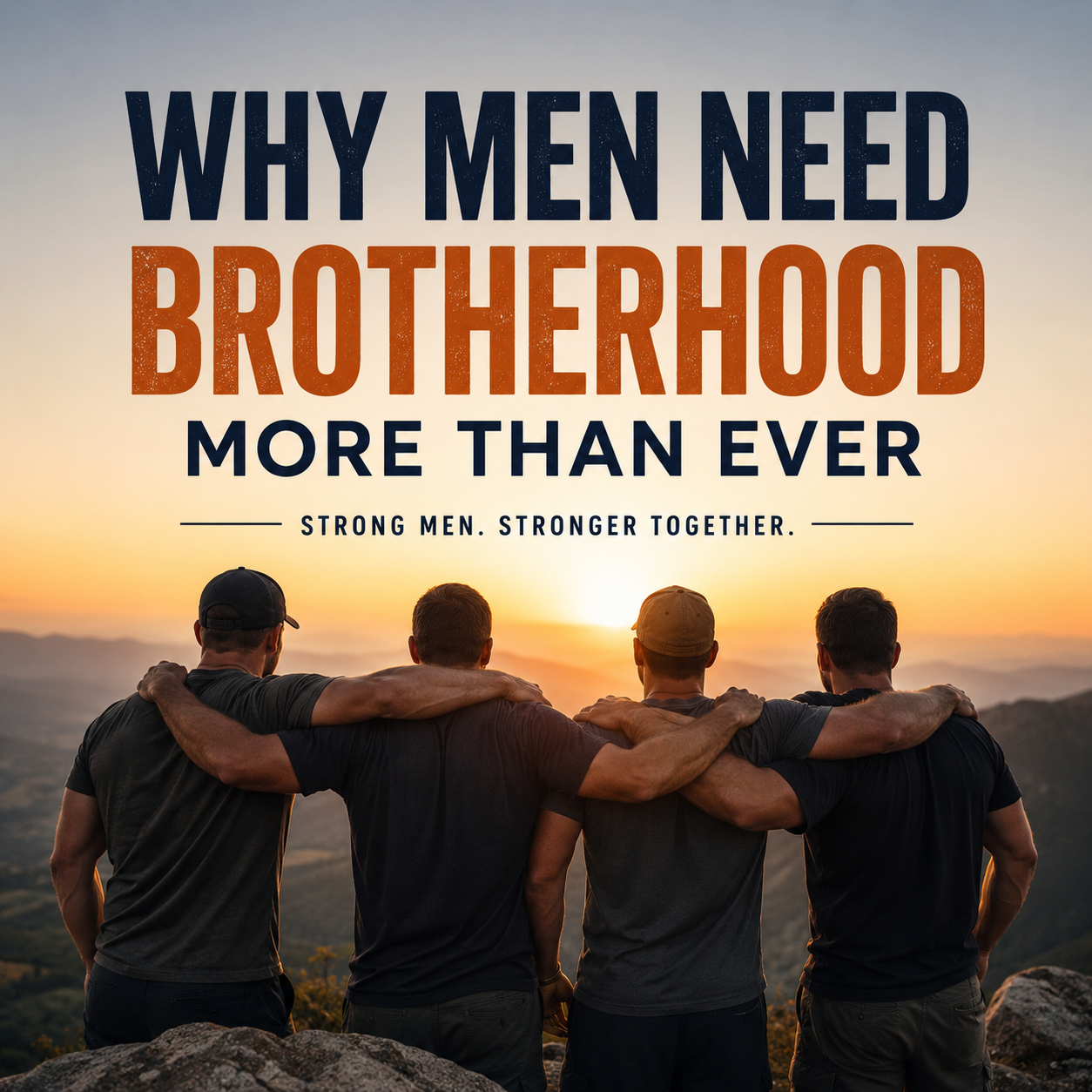
Isolation, Digital Addiction, and the Death of Male Spaces
Introduction:
There was a time when men did not have to schedule “social interaction” through an app like a dentist appointment. Brotherhood was simply part of civilization. Men built together, fought together, worshiped together, hunted together, and died together. Villages, guilds, churches, workshops, military units, trade halls, taverns, monasteries, and councils all functioned as distinctly male environments where strength, discipline, loyalty, and identity were forged. A man who isolated himself from other men was viewed with suspicion because healthy masculinity historically required comradery, accountability, and shared purpose. Today, however, the modern world has achieved the astonishing feat of surrounding men with constant “connection” while simultaneously producing the loneliest generation in recorded history. Millions of men now possess five hundred online “friends” and not a single brother who would help them move a couch, bury a father, defend their household, or rebuke them when they are acting like fools. We have Wi-Fi everywhere and community nowhere.
Male spaces have been systematically dismantled, mocked, sterilized, commercialized, or outright forbidden. The old hunting camp became a Discord server, the lodge became a Reddit thread, and the neighborhood garage became a streaming subscription. Men who once built cathedrals, railroads, nations, and families now sit alone at midnight arguing with strangers about comic book movies while eating microwaved sodium pellets shaped vaguely like chicken. And then society wonders why depression, anxiety, addiction, passivity, and aimlessness are devouring men. Scripture states in Ecclesiastes 4:9–10, “Two are better than one… For if they fall, one will lift up his fellow.” Yet modernity has convinced men that radical independence is strength while simultaneously reducing them into isolated consumers whose closest companion is a glowing rectangle. And we euphemistically call this “freedom”
I. The Ancient Strength of Male Brotherhood
Throughout history, every stable civilization understood men become dangerous when isolated and powerful when united. Brotherhood was not only emotional support; it was infrastructure. Spartan warriors trained collectively from childhood. Roman legions functioned as deeply bonded units whose cohesion often mattered more than superior weaponry. Medieval guilds trained boys into men through apprenticeship, discipline, hierarchy, and shared labor. Even frontier America depended upon networks of neighboring men who raised barns together, defended settlements together, and survived harsh conditions only because mutual obligation existed. Men have always built identity through responsibility to one another.
The sociologist Robert Putnam famously documented the collapse of communal participation in his work Bowling Alone (2000), showing steep declines in civic organizations, churches, unions, and social clubs throughout the twentieth century. Men were especially affected because male friendship has traditionally centered around shared activity rather than emotional disclosure. Men bond shoulder-to-shoulder, not simply face-to-face. A fishing trip, construction project, military exercise, or shared hardship creates stronger loyalty than years of casual conversation. Modern society has destroyed most of these organic environments while replacing them with artificial substitutes that demand nothing and therefore produce nothing.
Historically, male-only spaces also served as systems of correction. Older men mentored younger men. Weakness was challenged, cowardice was mocked, and laziness carried severe social consequences. Today, many young men grow up entirely surrounded by female authority structures in schools, offices, media, and even churches. Masculinity is often treated as a pathology requiring containment rather than cultivation. Men are told to “open up” emotionally but are rarely taught duty, mastery, sacrifice, or leadership. A civilization will not survive long when boys are trained to avoid offense rather than overcome hardship.
Even Christ built a brotherhood. The disciples were not isolated spiritual consumers downloading inspirational content on social media. They walked together, suffered together, corrected one another, labored together, and ultimately died for the same mission. Proverbs 27:17 declares, “Iron sharpeneth iron; so a man sharpeneth the countenance of his friend.” Modern culture increasingly seeks to remove every hard edge from male interaction until men become emotionally fragile, conflict-averse, and spiritually neutered. Brotherhood, however, has always required sharpening, friction, accountability, and shared struggles. Men become strong only through purpose and brotherhood.
II. The Digital Cage: Connected to Everyone, Known by No One
Modern technology promised connection but delivered alienation, never in human history have men had greater access to communication while simultaneously suffering such profound loneliness. A 2023 survey from the Survey Center on American Life found that 35% of men reported having no close friends at all, compared to only 3% in 1990. Meanwhile, average screen time continues to rise into absurd territory, with most men spending more time staring at glowing boxes than interacting with actual human beings. Society has created a generation of men who can instantly access a stranger’s political opinion in Sweden but do not know the name of the neighbor living twenty feet away.
Digital addiction compounds the problem because modern platforms are deliberately engineered to hijack male attention. Social media, pornography, gaming loops, streaming platforms, and infinite-scroll entertainment all operate on the same neurological principle: dopamine extraction. The result is passive consumption replacing active participation. Instead of building friendships, men spectate influencers, instead of training their bodies, they watch fitness reels, instead of pursuing women, they consume pornography, and instead of building communities, they argue anonymously online with profile pictures of cartoon frogs and Viking helmets. The modern male increasingly lives as an observer in his own life.
Psychologist Jonathan Haidt and others have documented the severe mental health effects associated with digital dependency, particularly among younger generations. Depression, anxiety, attention, sleep disruption, and social withdrawal have risen dramatically in direct correlation with smartphone saturation. Ironically, many men now fear ordinary in-person interaction because digital communication allows total control over presentation. Online, a man can edit, filter, delete, mute, and disappear. Real brotherhood offers no such luxury, it requires vulnerability, loyalty, forgiveness, confrontation, presence, and accountability.
Pornography deserves special mention because it functions as perhaps the most anti-brotherhood force in existence. It isolates men physically, emotionally, spiritually, and psychologically. Study after study has linked pornography use with increased loneliness, reduced relationship satisfaction, diminished motivation, and depressive symptoms. A man trapped in digital lust withdraws from authentic male community because shame thrives in secrecy. Satan rarely destroys men with dramatic explosions, more often, he sedates them into uselessness one glowing screen at a time.
The humor of modernity is that men are now “connected” twenty-four hours a day while eating dinner alone in silence. A man can livestream himself to thousands while remaining unknown by every person watching. He can collect likes, followers, and emojis while possessing no one willing to help him when his marriage crashes, his child dies, or his business fails. Brotherhood requires incarnation, men require flesh-and-blood loyalty.
III. The Systematic Eradication of Male Spaces
Another destructive development of the modern era has been the deliberate dismantling of male-only spaces. Nearly every institution that once allowed men to gather separately has either disappeared or been transformed into a sanitized, corporate-approved parody. Fraternal lodges declined. Trade unions weakened. Hunting camps vanished. Independent workshops disappeared beneath outsourcing and digital economies. Even local barbershops and diners (once informal centers of male conversation) have increasingly become transient commercial spaces where nobody knows each other’s name. Modern society now treats exclusively male environments with extreme suspicion, as though groups of men gathering without supervision represent some kind of emerging threat.
Historically, however, male spaces served critical civilizational functions. They transmitted values across generations. Older men taught younger men practical skills, discipline, etiquette, courage, and restraint. Boys learned how mature men spoke, handled conflict, treated women, carried responsibility, and endured hardship. Once we removed those environments, boys increasingly learned masculinity from TikTok influencers, pornography, advertising, and entertainment media. In other words, civilization replaced fathers, mentors, craftsmen, pastors, and veterans with algorithms. Brilliant strategy. What could possibly go wrong?
Even institutions that still technically exist often punish masculinity. Schools increasingly medicate normal boy behavior while rewarding passivity and hyper-compliance. Many churches have become emotionally therapeutic environments designed almost entirely around female preferences and sensitivities. Risk, challenge, conquest, discipline, and authority (the very concepts that historically motivated men) are frequently absent or treated as spiritually suspicious. Meanwhile, corporations replace genuine camaraderie with forced “team-building exercises” that feel like hostage situations conducted by human resources departments. Nothing inspires masculine brotherhood quite like a mandatory trust fall supervised by a middle manager named Trevor holding a clipboard.
The decline of male spaces also correlates strongly with falling civic participation. The National Institute on Aging has repeatedly linked social isolation to increased risk of depression, cardiovascular disease, cognitive decline, and premature death. Men are particularly vulnerable because many rely heavily upon structured environments to sustain friendships. Women often maintain relational networks organically through communication, while men require mission-oriented contexts. Remove the mission, and the relationships will collapse.
Scripture affirms the necessity of men gathering together in strength and unity. David had his mighty men. Christ had His apostles. Paul traveled within brotherhood networks of believers. The early church functioned communally and Christianity spread not through isolated spiritual consumers but through disciplined brotherhood bound together by sacrifice and truth. Modern individualism, by contrast, treats dependence upon others as weakness while quietly producing millions of lonely, exhausted, spiritually confused men. The irony is devastating: society claims to celebrate “community” while systematically destroying every structure that created it.
IV. What Happens to Men Without Brotherhood
Human beings are not designed for prolonged isolation, especially men who were built for mission, labor, competition, and shared struggle. Deprived of healthy brotherhood, men often drift toward one of four outcomes: addiction, apathy, rage, or despair. Some disappear into pornography and entertainment. Others numb themselves with substances, work, or escapist hobbies. Some become chronically angry because isolation distorts perspective and removes accountability. Others simply give up, existing in a state of low-grade hopelessness while functioning just well enough to pay bills and avoid suicide.
The statistics surrounding male loneliness are horrifying. Men account for nearly 85% of suicides in the United States according to CDC data. Drug overdose deaths disproportionately affect men. Educational achievement among men continues declining. Marriage rates fall while social distrust rises. Hundreds of millions of men report having no meaningful friendships whatsoever. Our modern society responds to male suffering with either mockery or ideological hostility. A lonely woman is viewed as a societal concern requiring compassion. A lonely man is frequently treated as either pathetic or potentially dangerous. Unsurprisingly, many men retreat further into silence.
Isolation also destroys accountability. Brotherhood has always functioned as a corrective force against self-destruction. Other men noticed when a man drank too much, neglected his family, acted cowardly, or abandoned responsibility. Today, men can spiral for years without anyone intervening because nobody is close enough to notice, or care. A man can now spend entire weekends alone consuming junk food, pornography, gambling apps, and streaming content without a single human interruption. Civilization has effectively industrialized self-destruction.
The absence of brotherhood also weakens nations politically and spiritually. Isolated men are easier to manipulate because disconnected individuals lack organized loyalty and collective identity. Historically, tyrants feared organized brotherhood because bonded men are difficult to control. Alexis de Tocqueville warned that democratic societies risk producing isolated individuals detached from communal obligations, making them increasingly vulnerable to centralized authority. In many ways, modern society has fulfilled that warning.
Perhaps more tragically, isolated men lose purpose. Men endure hardship remarkably well when they believe they are needed and supported. Brotherhood reinforces meaning because men fight harder for shared missions than for abstract “self-care” reasons. This is why military veterans miss deployment camaraderie despite the suffering involved. Shared struggle creates profound identity. Modern life, however, increasingly offers comfort without any purposeful meaning. Men are encouraged to pursue unlimited entertainment, consumption, and personal pleasure while being denied the very things that historically made life worth living: responsibility, loyalty, sacrifice, brotherhood, and legacy. Then society acts shocked when millions of men are emotionally dead inside.
V. Rebuilding Brotherhood in a Failed Age
The solution to male isolation is not another awareness campaign, therapeutic slogan, or government initiative featuring stock photography of diverse people smiling near salads. Men do not need better marketing. They need restored structures, brotherhood must become intentional again because modern society no longer produces it naturally. If men do not consciously rebuild male community, the vacuum will continue filling with addiction, ideological extremism, loneliness, and despair.
First, men must reclaim physical presence. Brotherhood cannot exist online, digital tools may supplement relationships, but they cannot replace embodied community. Men need churches, workshops, gyms, hunting camps, business groups, study circles, volunteer organizations, martial arts schools, and shared projects. They need environments where labor, hardship, humor, and accountability occur naturally. Interestingly, some of the strongest male bonds still form in places involving physical discomfort and mutual effort, such as construction crews, combat sports, farming communities, disaster relief, military service, and mission work. Shared struggle will always be the fastest path to brotherhood because suffering strips away superficiality.
Second, older men must mentor younger men again. One of the great failures of modern masculinity is generational abandonment. Many young men possess virtually no meaningful access to wise older men capable of offering correction and guidance. Historically, this transfer of masculine wisdom occurred automatically through apprenticeships, churches, trades, and extended families. Today, it rarely occurs at all. Titus 2 emphasizes older believers teaching younger generations how to live rightly because civilization cannot survive when every generation is forced to reinvent manhood from scratch. Especially, using YouTube clips and social media influencers.
Third, men must rediscover mission beyond entertainment. Brotherhood forms naturally around shared purpose. Men united toward meaningful goals develop loyalty incidentally. Whether building businesses, serving churches, training physically, raising families, or protecting communities, men require common missions greater than themselves. Useless entertainment destroys this instinct because passive consumption creates spectators instead of builders, and a civilization filled with spectators will collapse because nobody remains willing to carry the weight.
Finally, men must reject the lie that masculinity is inherently toxic. Properly ordered masculinity built civilizations, defended nations, protected families, advanced science, created institutions, and spread Christianity across continents. Masculinity distorted by sin can indeed become destructive, but so can every other human trait. The answer to corrupted masculinity is disciplined brotherhood rooted in virtue, responsibility, and truth. The world does not suffer from too many strong men bound together by honor and sacrifice, but far too few!
Conclusion:
We have isolated men, digitized friendship, commercialized identity, and dismantled the structures that forged brotherhood. Yet the hunger remains because men were not created to walk alone. Deep within every man still exists the ancient longing for fellowship, loyalty, challenge, mission, and shared struggle. He wants brothers beside him, not merely followers online, coworkers in cubicles, or strangers in comment sections. He wants men who will sharpen him, rebuke him, stand beside him, and carry burdens with him when life becomes heavy. That desire is design.
The modern world promises infinite connection while delivering profound loneliness because it has confused access with relationship. Brotherhood cannot be downloaded, streamed, automated, or outsourced. It must be built deliberately through sacrifice, presence, loyalty, and shared purpose. Civilization depends upon this reality because isolated men do not build enduring cultures. Brotherhood built armies, churches, cathedrals, republics, and families long before social media existed. And despite the arrogance of modernity, human nature has not changed. Men still need brotherhood now just as desperately as they did two thousand years ago. The only difference is that today, they must fight to reclaim it from a world actively trying to erase it.
Ain’t that the truth.
This is why we have to bring back male ONLY spaces!
I’ll be your bro…
This is true, men do need other men that can provide them council. People in general for the most part are social creatures and need other people. I do want to say though that women also need this. Society as a whole is struggling because noone can make genuine meaningful connections, and they also do not know what it means to do that.