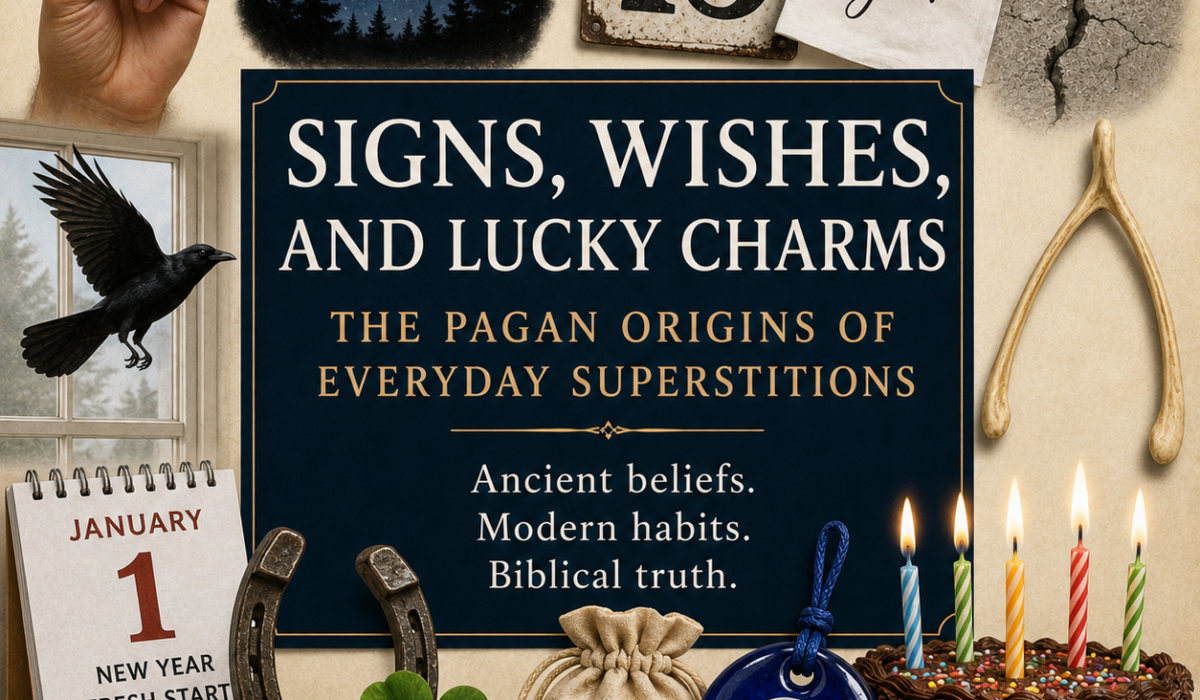
The Human Hunger for Luck: Why Men Trust Rituals More Than Providence
Human beings have a remarkable talent for inventing shortcuts around uncertainty. Rather than trusting God, obeying His commands, and accepting that some things remain beyond our knowledge, men and women throughout history have sought signs, omens, rituals, charms, and magical formulas that promised a glimpse behind the curtain of providence. Whether gazing at the heavens, carrying a talisman, blowing out candles, or crossing fingers, the underlying desire remains consistent: to influence the future without submitting to the God who governs it.
The ancient pagan world was saturated with rituals designed to manipulate fate, attract blessings, and avoid misfortune. Many of those practices inevitably survived the collapse of the civilizations that created them. Their gods disappeared, their temples crumbled, and their priests vanished. But their superstitions lingered, quietly slipping into everyday life until millions practiced them without ever questioning their origins. In this article, we examine ten more enduring superstitions, tracing their origins, meanings, and progression through history. More importantly, we will compare them to the biblical worldview, which rejects luck, omens, and magical thinking in favor of trust in God’s sovereign providence.
I. Crossing Fingers for Good Luck
Few gestures are more universal than crossing one’s fingers for good luck. Children do it before a test, athletes do it before a competition, and adults do it before job interviews, medical procedures, and financial decisions. It has become such a routine part of modern life that no one stops to ask where the practice originated.
The roots of finger-crossing reach deep into ancient pagan Europe. Long before it became associated with Christianity, the crossing of two lines was believed to create a point of spiritual power. Various cultures viewed intersecting lines as locations where supernatural forces could be concentrated or invoked. People would physically touch crossed objects or create cross-shaped symbols to attract favorable outcomes from unseen “spiritual” powers.
As Christianity spread, the symbolism of the cross became attached to the practice, but the underlying purpose remained largely unchanged. Rather than serving as an expression of faith in Christ, the gesture continued to function as a ritual intended to influence events. Eventually it became detached from any clear religious meaning and simply evolved into a cultural shorthand for “I hope luck is on my side.”
Scripture never teaches blessing as something that can be summoned through hand gestures. Throughout the Bible, God’s favor, success and blessing are linked to obedience, wisdom, and divine providence. Proverbs 3:5 reminds believers to “Trust in the LORD with all your heart, and lean not on your own understanding.”
Crossing fingers may seem harmless, but it reflects an ancient impulse to seek control over uncertain outcomes through symbolic acts rather than trust in God. The gesture has changed little over the centuries. Only the explanation has faded.
II. Making a Wish on a Shooting Star
For millennia, human beings have looked at the night sky and imagined messages hidden among the stars. One enduring example of that belief is seeing a shooting star grants an opportunity to make a wish.
The superstition can be traced to ancient Greece and Rome. Philosophers such as Ptolemy recorded beliefs that the gods occasionally opened the heavens to observe humanity. During these moments, stars would move across the sky, creating what we now know as meteors. Because these events were associated with divine attention, people believed wishes made during such occurrences were more likely to be heard and granted.
The logic was thoroughly pagan. The cosmos was viewed as populated by deities whose favor could be gained through proper timing and ritual behavior. A shooting star became a celestial doorway through which requests could be delivered to supernatural powers.
Over time, scientific understanding explained the true nature of meteors. They were, after all, not divine signals but fragments of cosmic debris burning in Earth’s atmosphere. But the superstition survived. Even those who understand astronomy blindly continue the ritual. Our knowledge advanced, but the tradition remained.
The Bible condemns attempts to seek guidance, blessing, or revelation from the heavens. Deuteronomy 4:19 warns against being drawn away to worship the sun, moon, and stars. The heavens declare God’s glory, but they are not tools for granting wishes.
There is nothing wrong with appreciating the beauty of a meteor streaking across the sky. The problem arises when people attribute spiritual power to the event. A shooting star is not a heavenly customer-service window for processing human requests.
III. The Number 13 Is Unlucky
Perhaps no iniotic superstition has influenced modern architecture, business practices, and popular culture more than fear of the number thirteen. Hotels omit the thirteenth floor, airlines skip row thirteen, and buildings are designed around avoiding a number that many people irrationally fear.
The origins of this belief are complex and ancient. In Norse mythology, the trickster god Loki arrived as the thirteenth guest at a banquet, resulting in chaos and death. Similar concerns appeared in ancient cultures that viewed twelve as a number of completeness: twelve months, twelve zodiac signs, twelve tribes, twelve Olympian gods. Thirteen disrupted the established order and therefore became associated with instability and misfortune.
During the Middle Ages, additional legends reinforced this fear. Some even connected it to the Last Supper, where thirteen individuals sat at the table before Christ’s crucifixion. Over time, separate traditions merged into a widespread cultural belief that thirteen possessed inherently negative qualities.
The irrationality is obvious upon minimal examination. If thirteen is universally unlucky, why is it considered fortunate in some cultures? Why do countless people experience perfectly ordinary lives while residing at addresses containing the number? The answer is obvious. Numbers possess no moral character.
Scripture frequently uses numbers symbolically, but never attributes magical power to them. The number thirteen is neither cursed nor blessed.
Fear of thirteen survives because superstition thrives where reason retreats. Entire industries accommodate the belief, not because evidence supports it, but because fear is remarkably persistent and profitable.
IV. Saying “Bless You” When You Sneeze
Of all the superstitions examined in this series, saying “Bless you” after a sneeze occupies an unusual position. Unlike many customs rooted directly in paganism, this practice emerged from a mixture of ancient superstition, folk medicine, and later religious adaptation. However, the underlying fears that fueled it remain unmistakably superstitious.
Ancient cultures viewed sneezing as a spiritually significant event. Some believed the soul temporarily left the body during a sneeze. Others feared that evil spirits could enter during the brief moment of vulnerability. Among Greeks and Romans, sneezes were interpreted as omens or messages from the gods. A sneeze at the right moment could validate a statement; a sneeze at the wrong moment could signal impending trouble.
During outbreaks of plague in Europe, blessings were sometimes offered as prayers for health and protection. Pope Gregory I is associated with encouraging such responses during a devastating epidemic. Over time, the custom became detached from its historical context and evolved into a reflexive social courtesy.
This matters because offering a genuine prayer for someone’s health is entirely biblical. While believing that a sneeze creates a supernatural emergency requiring a verbal counterspell is anything but.
Today, most people say “Bless you” simply because it is polite. Even though the ancient fears have largely disappeared. This superstition reminds us how easily ordinary events become wrapped in spiritual folklore. A sneeze is simply a bodily reflex and nothing more.
The Bible encourages believers to pray for one another continually, not when someone unexpectedly expels air through their nose at high velocity.
V. Don’t Step on a Crack
Of all the playground superstitions this one has achieved the longest cultural longevity:
“Step on a crack, break your mother’s back.”
Children have repeated the warning for generations, carefully avoiding sidewalk cracks as though the health of their mothers depended upon it. Thankfully, orthopedic surgeons have yet to confirm the connection.
The superstition originated from older forms of sympathetic magic, the same magical philosophy responsible for many ancient charms and curses. Sympathetic magic assumes that one action can mysteriously affect an unrelated person or object through invisible connections. If one could harm a representation of a person, the actual person might suffer consequences.
Numerous cultures practiced rituals based upon this principle. Footprints, shadows, dolls, and symbolic representations were believed capable of influencing the individuals they represented. The sidewalk crack superstition is a child’s simplified inheritance of these much older magical concepts.
The progression is fascinating. Ancient magical theories evolved into nursery rhymes. Pagan ritual became playground entertainment. The original worldview disappeared, but fragments remained hidden inside children’s games. Scripture rejects such notions. God governs the affairs of men, not cracks in concrete.
The popularity of the rhyme reveals something deeper. People enjoy believing that simple actions produce dramatic consequences. Reality is far less exciting. Sidewalk cracks do not determine family health. They merely indicate that concrete expands and contracts over time.
In this case, (as usual) modern engineering provides a far better explanation than ancient superstition.
VI. Birds Flying Into a House or Window Foretell Death or Misfortune
Across Europe, Asia, and parts of North America, this superstition has proven remarkably enduring: a bird striking a window or entering a home supposedly foretells death, tragedy, or serious misfortune.
The origins of this belief stretch back thousands of years. Ancient peoples viewed birds as messengers between the earthly and spiritual realms. Because birds moved between heaven and earth, they were considered carriers of divine messages, omens, or warnings. Entire systems of divination developed around observing bird behavior. The Romans practiced augury, interpreting the movements of birds to predict future events and determine the will of the gods.
When a bird unexpectedly entered a dwelling, it was interpreted as a supernatural communication. Because death was mysterious and feared, unusual bird behavior became linked to impending mortality.
The superstition persisted through the Middle Ages and into modern folklore. Even today, many people experience genuine anxiety when a bird collides with a window. The reality is that modern buildings contain large reflective surfaces that birds frequently mistake for open sky.
Scripture condemns divination and the interpretation of omens. Deuteronomy 18 explicitly forbids such practices. While God occasionally used animals in extraordinary circumstances throughout biblical history, He never instructed His people to monitor bird collisions for hidden messages about the future.
The bird striking your window is simply demonstrating the limitations of avian depth perception. The event may be unfortunate, but it is not prophetic.
VII. A Wishbone Grants a Wish
The Thanksgiving wishbone tradition appears charming enough. Two people pull opposite ends of a dried wishbone, and the person receiving the larger piece supposedly receives good fortune or has a wish granted. It feels harmless, festive, and vaguely nostalgic.
Its origins, however, are unsurprisingly ancient, and Pagan. The practice can be traced to the Etruscans of ancient Italy, who regarded certain birds as possessing prophetic abilities. Chickens were believed capable of communicating divine knowledge. Their bones, particularly the forked clavicle later known as the wishbone, became objects associated with supernatural favor.
The Romans adopted the practice and spread it throughout their empire. As the custom evolved, touching or preserving the bone became associated with obtaining blessings from the gods or spirits. Eventually the ritual transformed into the familiar bone-breaking contest known today.
The progression illustrates a recurring theme in this series. Ancient religious significance slowly fades while the ritual survives. Few modern participants believe chickens possess prophetic powers, yet tens of millions continue performing a ritual originally based on precisely that assumption.
The Bible offers no support for seeking favor through fowl bones. Blessing comes from Godalone. While there is nothing inherently sinful about family games or holiday traditions, attributing supernatural power to a chicken bone crosses into the realm of Pagan superstition.
The wishbone tradition survives because it combines competition, anticipation, and hope. Human beings enjoy rituals that promise favorable outcomes. The only problem is that the future is not determined by which cousin pulls harder during Thanksgiving dinner.
VIII. New Year’s Good-Luck Customs
Few days generate more superstitious behavior than New Year’s Day. Across the world, people consume specific foods, wear particular colors, make specific noises, avoid certain activities, and perform elaborate rituals designed to ensure prosperity during the coming year.
The origins vary by culture but share common pagan roots. Ancient societies viewed transitional periods as spiritually dangerous. The boundary between one year and another was considered a moment when supernatural forces might exert unusual influence. Protective rituals developed to secure favorable outcomes and ward off misfortune.
Romans exchanged gifts for luck. Europeans rang bells and created loud noises to drive away evil spirits. Various cultures assigned supernatural significance to foods such as black-eyed peas, lentils, grapes, pork, or cabbage. Each promised wealth, fertility, health, or success.
Many people now participate simply because “it’s tradition.” But Scripture never teaches that prosperity can be secured through ceremonial foods or calendar rituals. Tomorrow belongs to God whether the date is January first or July fifteenth. James reminds believers that life is uncertain and that plans should always be made with the acknowledgment, “If the Lord wills” (James 4:15).
Celebrating a new year is perfectly appropriate. Trusting in cabbage, peas, grapes, or noise-making devices to determine future blessings is another matter entirely. The calendar changes at midnight. Providence does not.
IX. Good Luck Charms and Talismans
Perhaps no category of superstition is more widespread than the use of lucky charms and talismans. Across civilizations and centuries, people have carried objects believed to attract fortune, provide protection, or ward off evil.
Ancient Egypt produced amulets shaped like scarabs and deities. Greece and Rome employed protective symbols against curses and evil spirits. Norse cultures carried carved runes. Countless societies developed similar objects despite vast geographic separation.
The reasoning: People desired tangible control over invisible dangers. A charm provided comfort because it offered the illusion of security. Over time, the specific objects changed while the underlying belief remained. Lucky coins, gemstones, bracelets, pendants, keychains, and countless other items inherited the role once occupied by ancient amulets.
The biblical problem is straightforward. Trust placed in charms is misplaced trust. In Scripture, God’s people are repeatedly instructed to place their confidence in Him rather than objects. Israel’s history contains repeated warnings against idolatry because humans are prone to assigning spiritual power to physical things.
A lucky charm cannot and will not alter providence, protect a soul, or influence the will of God. Its real power lies elsewhere, in humanity’s persistent desire to believe that security can be purchased, carried, or worn around the neck. Ancient pagans trusted amulets, and we continue that Pagan tradition today. The underlying superstition remains remarkably unchanged.
X. Wishing on Birthday Candles
The birthday cake, complete with candles and a wish, appears so wholesome that few people ever consider its origins. Yet like many beloved traditions, it carries traces of ancient pagan beliefs.
Historians generally trace the custom to ancient Greece, where cakes adorned with candles were offered to Artemis, goddess of the moon. The glowing candles represented celestial light, and the rising smoke was believed to carry prayers or wishes upward to divine beings.
Later European traditions incorporated similar ideas. Candles became associated with fate, blessing, and future fortune. The act of silently making a wish before extinguishing them preserved the belief that hidden desires could be transmitted through ritual actions.
The progression from pagan offering to children’s birthday party took centuries, but the basic concept survived intact. A wish is made, a ritual action is performed, and favorable outcomes are hoped for.
Most modern participants treat the practice as harmless fun. Few imagine moon goddesses receiving messages from cake smoke. Nevertheless, the custom demonstrates how thoroughly ancient Pagan religious concepts have survived beneath layers of cultural adaptation.
Scripture teaches believers to bring requests directly to God through prayer. Wishes are not sent through candles, smoke, stars, bones, charms, or rituals. The Creator of the universe requires neither cake nor atmospheric delivery systems. There is certainly nothing wrong with celebrating birthdays. Gratitude for another year of life is entirely appropriate. But the blessing comes from God alone.
Conclusion
The superstitions examined in this article differ widely in appearance, but they share a common foundation. Whether fingers, stars, numbers, sneezes, birds, bones, charms, candles, or calendar rituals, each originated from humanity’s attempt to gain knowledge, favor, protection, or control apart from God. The symbols changed and the cultures changed, but the underlying impulse did not. Fallen man has always preferred rituals he can perform to faith he must exercise.
Scripture offers a fundamentally different worldview. That the future is not governed by luck. Blessings are not secured through omens. Protection is not found in charms. Wisdom does not come from stars, birds, numbers, or wishes. “The lot is cast into the lap, but its every decision is from the LORD” (Proverbs 16:33). The Christian’s confidence rests in the sovereign God who rules heaven and earth. Ancient paganism survives today more as entertainment and tradition, but its assumptions remain the same. The challenge for believers is to reject the worldview beneath it and place their trust entirely in the providence of God.
Series Complete
Part I: Luck,Omens and Folly
Part II: Signs, Wishes & Lucky Charms
Part III: Weather, Wildlife, and Wisdom from the Front Porch