Introduction
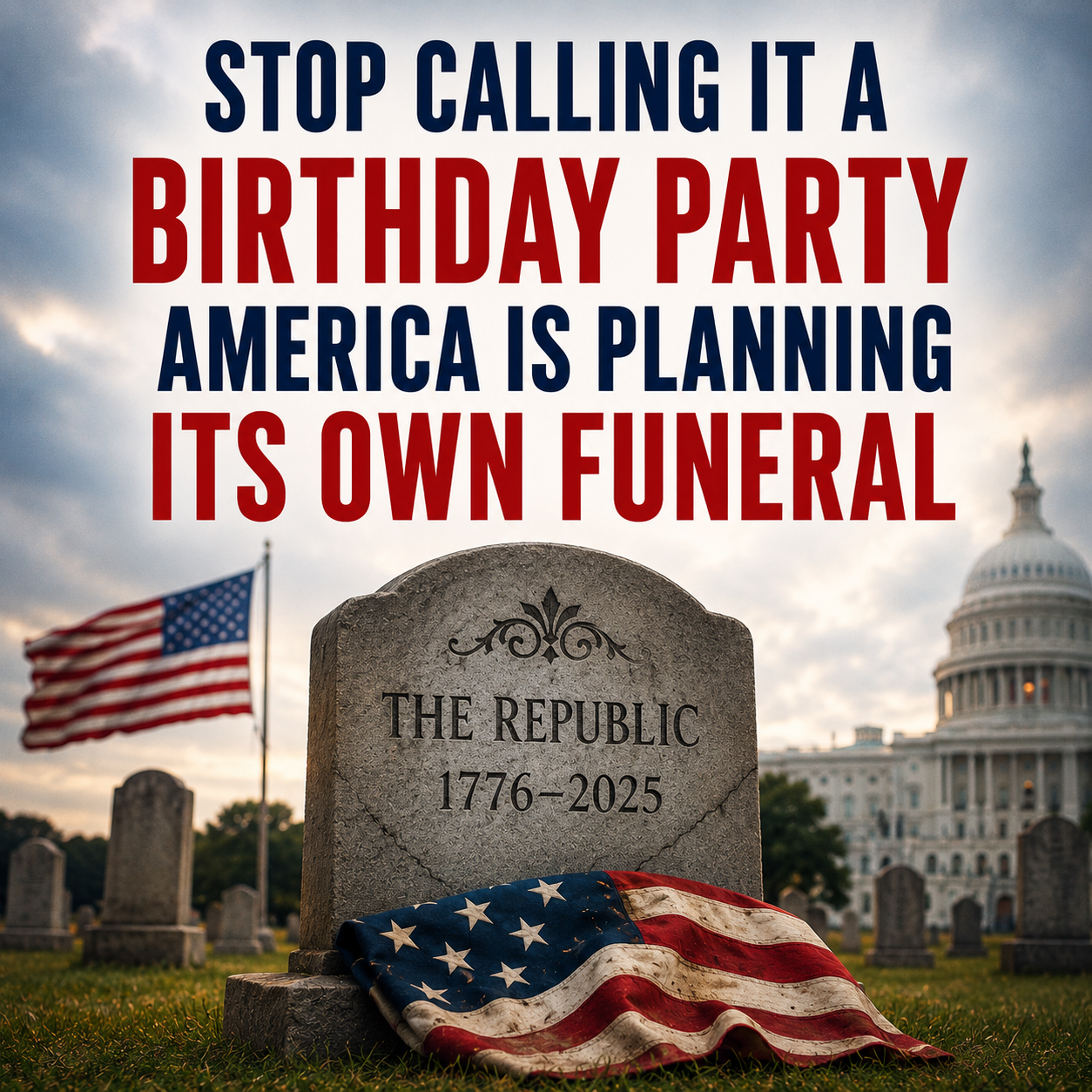
Every Fourth of July, Americans gather beneath exploding fireworks, wave flags, grill hamburgers, and sing songs celebrating the birth of a nation unlike any the world had ever seen. Children laugh, sparklers illuminate suburban cul-de-sacs, and patriotic music echoes through parks and small towns. For a few fleeting hours, we collectively pretend that everything is exactly as it ought to be. We call it Independence Day, celebrate America’s birthday, and congratulate ourselves for preserving the “land of the free.” But birthdays celebrate life. They celebrate growth, health, and a promising future. Should we instead be considering a funeral to commemorate what has died?
Perhaps it is time to ask the question: are we celebrating the birth of a republic while quietly attending its funeral? A nation is not immortal simply because it once accomplished something extraordinary. Rome was once unconquerable. Athens once shaped civilization. The British Empire once ruled a quarter of the earth. History offers no shortage of civilizations that assumed their greatness guaranteed their perpetual survival, and the American Republic is no exception. Our founders understood liberty to be fragile, demanding, and inseparable from virtue. As John Adams observed, “Our Constitution was made only for a moral and religious people. It is wholly inadequate to the government of any other.” Now we must ask “Do the American people still possess the character necessary to preserve what previous generations sacrificed to establish?”
I. The Most Dangerous Lie Americans Believe About Freedom
A great misunderstanding in modern America is philosophical. We have forgotten what freedom is. Ask the average citizen to define liberty, and the general answer is: “It means I can do whatever I want.” Freedom has been reduced to unrestricted personal autonomy, the removal of all restraints, and the absence of accountability. In practice, liberty has become little more than socially acceptable selfishness. That understanding would have been wholly foreign not only to all of Christian teaching but also to all of the statesmen whose names we proudly invoke every July.
Classical political philosophy distinguished between liberty and license. Liberty was understood as the ordered freedom to pursue what is good, true, and just. License was the unrestrained pursuit of desire and appetite. This matters because appetites, when left unchecked produce bondage. Scripture explains this paradox. Jesus declared, “Whosoever committeth sin is the servant of sin” (John 8:34, KJV), while the Apostle Paul warned, “Stand fast therefore in the liberty wherewith Christ hath made us free” (Galatians 5:1), cautioning believers not to use liberty “for an occasion to the flesh” (Galatians 5:13). Biblical liberty was never synonymous with moral anarchy. It was freedom from slavery to sin in order to become servants of righteousness.
Republics are uniquely dependent upon the self-government of their citizens. Monarchies may survive with passive subjects. Dictatorships require fearful subjects. A constitutional republic, however, requires disciplined citizens capable of restraining themselves without constant supervision. When self-restraint declines, external restraint inevitably expands. This is observable throughout history. Every vice that individuals refuse to govern eventually invites institutions to regulate it. As a result, families disintegrate, and bureaucracies grow. Communities abandon responsibility, and centralized authority fills the vacuum. The erosion of character always creates demand for greater control.
The irony is humorous, were it not so tragic. Americans proudly proclaim that no one can tell them what to do while simultaneously inviting governments, corporations, algorithms, and financial institutions to organize nearly every aspect of their lives. We reject moral authority only to submit ourselves to addiction, consumerism, debt, screens, entertainment, and overt tyranny of convenience. We congratulate ourselves on being independent while carrying chains of our own choosing. A man mastered by his appetites is no freer because his prison lacks bars. Liberty has never meant the absence of restraint, but has always required the discipline to choose what is right over what is desired.
II. America Won Independence in 1776, The Hard Part Came After.
Winning a revolution is dramatic, while governing a free people is not. The War for Independence demanded courage on the battlefield, but preserving the republic demanded something less glamorous and far more difficult: millions of ordinary citizens exercising discipline in daily life. It required fathers who governed their households, churches that formed moral character, communities that cultivated civic responsibility, and citizens who understood that liberty survives only when people voluntarily limit themselves according to principle.
The generation that secured American independence understood this connection. The Declaration of Independence grounds human rights not in government but in the Creator, affirming that men “are endowed by their Creator with certain unalienable Rights.” Rights were therefore understood to exist alongside duties. Independence was never conceived as radical individualism without moral obligation, but political liberty ordered beneath divine authority. Remove the latter, and the former will lose its foundation. That is why early American political discourse so frequently emphasized religion, virtue, and education, not because the founders agreed on every theological question, but because they all recognized that republican institutions depended upon a populace capable of governing itself.
The truth is that no constitution, however brilliant, can compensate indefinitely for a citizenry unwilling to exercise self-control. A written charter cannot raise children, honor marriage vows, restrain greed, cultivate honesty, or teach sacrifice. Those habits are formed first in homes, reinforced in churches and local communities, and only secondarily reflected in civil government. When those formative institutions fail, governments will assume authority they were never designed to bear. The result is malicious tyranny in an expanding administrative state as a response to a lack of capacity for personal responsibility.
This is where Independence Day becomes deeply ironic. We celebrate political independence while most Americans struggle to exercise personal independence. A society increasingly burdened by unsustainable debt, widespread loneliness, declining civic participation, addiction, and chronic distraction illustrates that external liberty cannot sustain a free people. The founders gave America constitutional mechanisms; they could not guarantee the character required to preserve them. The revolution of 1776 secured freedom from a distant crown. Every generation since has faced a more demanding revolution, the daily conquest of self. That battle cannot be won with muskets, elections, or fireworks.
III. Fireworks Cannot Hide National Decay
There is something ironically poetic about fireworks. They explode with breathtaking brilliance, command everyone’s attention for a few glorious seconds, and then vanish into darkness. Perhaps that is why they have become the perfect symbol of modern America. Every Fourth of July, we illuminate the night sky while carefully avoiding the shadows gathering beneath our feet. We celebrate the memory of a great civilization while pretending its present condition is a temporary inconvenience. Our patriotism has become less about honestly loving our country and more about politely ignoring her illnesses.
History teaches us that civilizations rarely collapse because they lose a single battle. They collapse because they lose themselves. The Roman Republic slowly surrendered civic virtue to luxury, political corruption, dependence upon the state, and public entertainment that distracted citizens from their declining institutions. The historian Will Durant observed that “a great civilization is not conquered from without until it has destroyed itself from within.” Whether you study Rome, Greece, or countless lesser empires, the pattern is consistent. External enemies administer the final blow, but internal decay prepares the corpse in advance.
America would do well to remember this lesson. We are wealthier than any civilization in history, but surveys report widespread loneliness, declining trust in institutions, and growing social isolation. Marriage rates have declined catastrophically over the past several decades, fertility has fallen below replacement levels, and millions of children continue to grow up outside stable two-parent homes. These trends carry measurable consequences for educational outcomes, economic mobility, crime, and long-term social stability. Social scientists continue to debate causes and policy responses, but almost none seriously dispute that the family remains the foundational institution upon which healthy societies depend.
Nonetheless, every July we reassure ourselves that everything is fine because the grills are hot, the flags are flying, and the fireworks are spectacular. It is rather like repainting a house whose foundation is on fire. The fresh coat may impress the neighbors, but it does nothing to quell the structural failure below.Much like a physician who refuses to diagnose disease is not compassionate; he is negligent. Likewise, a citizen who refuses to acknowledge national decay is not patriotic; he is sentimental. Love tells the truth, even when the truth is painful. America deserves more than nostalgic speeches. She deserves citizens courageous enough to confront reality before the celebration becomes nothing more than an annual memorial service for a once great republic.
IV. Moral Decay Always Becomes Political Decay
Politics is treated as the engine of civilization, but history suggests the opposite. Governments reflect the character of the people far more than they create it. Legislatures do not invent dishonesty; they inherit it. Courts do not manufacture moral confusion; they adjudicate the disputes produced by it. We frequently speak as though every national problem begins in Washington, but Washington is downstream from millions of decisions made in homes, churches, schools, businesses, and neighborhoods every single day.
This principle is presented throughout Scripture. Proverbs declares, “Righteousness exalteth a nation: but sin is a reproach to any people” (Proverbs 14:34, KJV). The prophet Hosea warned that societies reap what they sow: “For they have sown the wind, and they shall reap the whirlwind” (Hosea 8:7). These describe a pattern repeatedly confirmed throughout history. Character shapes culture, culture shapes institutions, and institutions shape governments. When honesty becomes optional, corruption always follows. When families weaken, bureaucracies expand to address problems families once solved. When personal responsibility diminishes, public dependency increases.
This is why so many political debates are hollow. Americans passionately argue over presidents, parties, elections, judges, taxes, and legislation while quietly neglecting the institutions that produce virtuous citizens. No constitutional amendment can teach integrity to a dishonest child. No executive order can create faithful wives. No Supreme Court decision can instill courage, discipline, or self-control. Civilization is built around dinner tables long before it is debated in legislative chambers.
This reality should humble both political optimists and cynics. Elections matter. Laws matter. Good government matters. But no republic can long survive when its citizens expect politicians to solve problems that originate in the human heart. The decline of a nation starts long before the collapse of its government. It begins when ordinary people gradually abandon the habits that made self-government possible. By the time political institutions visibly deteriorate, the deeper moral erosion has been underway for generations.
V. America Doesn’t Need Another Revolution: It Needs Another Repentance.
Calls for revolution have become fashionable. Every election cycle, someone announces that America stands on the brink of civil war, national divorce, or a second revolution. The rhetoric is emotionally satisfying. It flatters our desire to imagine ourselves as modern descendants of Lexington and Concord. It also conveniently shifts responsibility somewhere else, that our problems are caused by corrupt rulers. Repentance begins by asking whether the corruption has first taken root within us.
Eighteenth-century America had been profoundly shaped by religious life, local self-government, voluntary associations, and the habits of responsibility that historians continue to recognize as essential to the development of the early republic. The colonies were far from perfect, and neither were the founders. They disagreed on many things, and often fell short of their own ideals. Yet they generally understood something we have forgotten: liberty requires a people capable of governing themselves. A republic cannot be maintained indefinitely by procedural rules. It requires virtue, sacrifice, accountability, and a willingness to submit personal desires to higher principles.
Scripture shows us national renewal. God told Solomon, “If my people, which are called by my name, shall humble themselves, and pray, and seek my face, and turn from their wicked ways; then will I hear from heaven, and will forgive their sin, and will heal their land” (2 Chronicles 7:14, KJV). The emphasis is on repentance. The prophets called Israel to examine itself before blaming foreign enemies. Judgment, they insisted, begins with covenant unfaithfulness long before it arrives through invading armies.
Perhaps that is the message America most needs to hear this Independence Day. The republic does not need louder slogans, larger parades, or more spectacular fireworks. It needs fathers who lead with integrity, mothers who cultivate virtue, churches willing to preach truth, neighbors who recover genuine community, and citizens who understand that liberty begins with self-government under God. Political renewal will follow such a revival, but it cannot substitute for it. Every person eventually answers the same question: will you humble yourself before truth, or will you continue celebrating until the funeral procession has begun?
Conclusion
This Fourth of July, millions of Americans will gather to celebrate a birthday. They will wave flags, sing patriotic songs, and watch fireworks burst across the evening sky. There is nothing inherently wrong with celebration, nor should we fail to honor the extraordinary achievement represented by the birth of the American Republic. The men of 1776 pledged “their Lives, their Fortunes and their sacred Honor” to secure a liberty they believed was worth sacrificing everything. Their courage deserves remembrance, and their vision deserves gratitude. But without stewardship it is meaningless. A nation can preserve the memory of its founding while simultaneously abandoning the principles that made its founding possible.
The question before us is therefore whether we are celebrating a birthday while it should be a funeral. If liberty has become license, if self-government has given way to self-indulgence, if virtue has been exchanged for comfort, and if repentance has been replaced by empty ceremony, then the greatest threat to the Republic is staring back at us from the mirror every morning. The fireworks will fade. The smoke will clear. The music will end. When it does, the future of this nation will depend upon whether we possess the wisdom, humility, and courage to recover the character that made that greatness possible in the first place.