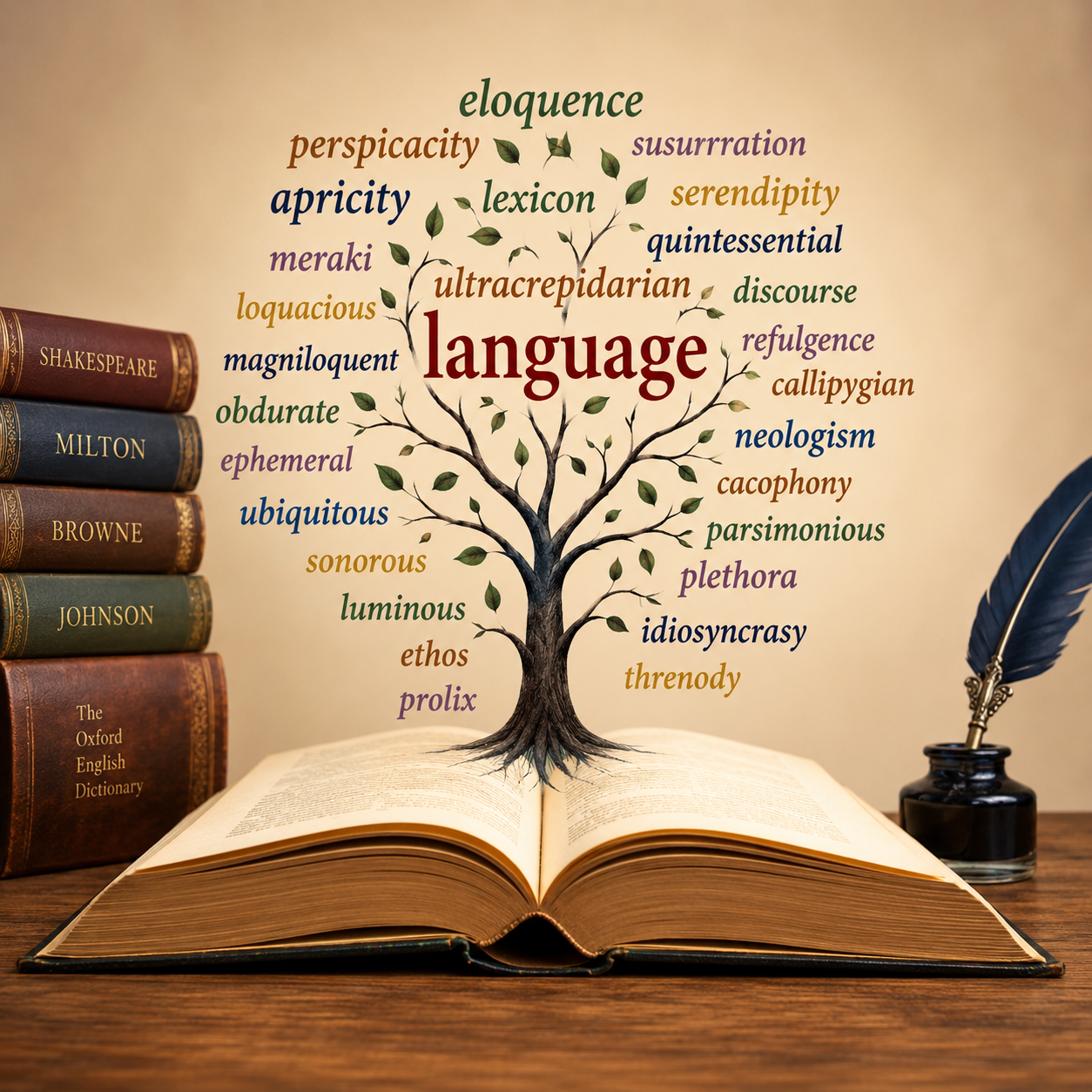
Author’s Disclaimer
Before anyone accuses me of trying to write like a sixteenth-century Oxford professor who swallowed a dictionary, allow me to explain the purpose of this article.
I have already written extensively on many of these same concepts in plain-ish, accessible-ish English for the average-ish reader. This article was never intended to be another practical introduction to the subject. Instead, it was written as a personal intellectual exercise, a deliberate attempt to explore the outer boundaries of the English lexicon, to stretch my vocabulary, to resurrect obsolete and archaic expressions that have fallen into neglect, and to remind myself just how astonishingly vast our language is.
English possesses the richest vocabulary ever assembled, and somehow modern writing relies upon a surprisingly small collection of familiar words and repetitive expressions. I wanted to see how far that trend could be reversed while still producing coherent, scholarly prose. This project became less about the topic and more about celebrating linguistic diversity, historical vocabulary, etymological inheritance, and stylistic craftsmanship.
Whether the result is delightful, exhausting, pretentious, entertaining, educational, or all of the above is for the reader to decide. Either way, the objective has been accomplished if even a handful of forgotten words return to active service and inspire others to appreciate the extraordinary depth, beauty, and expressive power of the great English language.
Introduction: In Praise of Lexical Abundance
Language, despite perpetual proclamations celebrating its inexhaustible fecundity, frequently suffers an indignity scarcely acknowledged beyond philological circles: lexical impoverishment masquerading as eloquence. Contemporary prose, bureaucratic memoranda, journalistic reportage, pedagogical manuals, and algorithmically sanitized correspondence increasingly orbit a diminutive constellation of interchangeable expressions whose incessant reiteration gradually abrades nuance, attenuates precision, and anesthetizes imagination. One encounters endless cascades of important, interesting, amazing, and unique, as though civilization collectively misplaced the remaining hundreds of thousands of available vocables somewhere beneath a governmental filing cabinet. Such verbal penury reflects educational minimalism, commercial expediency, and the mistaken conviction that accessibility necessitates monotonous diction. It emphatically does not.
Philology, conversely, reveals an altogether grander inheritance. The English tongue constitutes not merely a language but an immense lexical palimpsest wherein Anglo-Saxon earthiness, Norman jurisprudence, ecclesiastical Latin, Hellenistic abstraction, Norse pragmatism, Renaissance exuberance, scientific nomenclature, colonial borrowings, mercantile argot, dialectal survivals, and antiquarian curiosities coexist with astonishing fecundity. The Oxford English Dictionary catalogues hundreds of thousands of lexical entries while historical corpora preserve innumerable archaisms whose semantic exactitude remains unimpaired despite modern neglect. Sir Thomas Browne wrote, “Oblivion is not to be hired,” an aphorism whose applicability extends delightfully toward forgotten vocabulary. Words seldom perish because they become defective; they merely succumb to indolence, fashion, or pedagogical oversimplification. Their resurrection requires not linguistic revolution nor governmental intervention, but simply readers possessing curiosity exceeding that of a houseplant.
I. The Great Lexical Inheritance: English as Civilization’s Most Voracious Borrower
No substantial examination of linguistic diversity can commence without acknowledging an incontrovertible historical phenomenon: English achieved preeminence magnificent kleptomania whilst maintaining the posture of immaculate purity. Whereas linguistic nationalists periodically fantasize concerning pristine origins, historical philologists recognize instead an exuberant accumulation resembling an antiquarian warehouse whose proprietor never discarded anything remotely serviceable. Anglo-Saxon furnished bread, bone, hearth, storm, and wife; Old Norse contributed ransack, window, knife, and sky; Norman French deposited jurisprudential terminology alongside aristocratic refinement; ecclesiastical Latin disseminated theological abstraction; Greek bestowed philosophical exactitude; subsequently Arabic, Persian, Hindi, Nahuatl, Malay, Italian, Dutch, Spanish, Portuguese, Chinese, Japanese, countless African languages, and innumerable regional dialects enriched an already prodigious repository. Any assertion that English lacks expressive amplitude therefore exhibits approximately the same credibility as alleging the Atlantic Ocean suffers hydrological deficiency.
The Norman Conquest of 1066 inaugurated perhaps the most consequential lexical amalgamation in European history. Thereafter, rustic cultivators continued tending cows, calves, swine, and sheep, yet aristocratic banquets featured beef, veal, pork, and mutton. Such semantic bifurcation produced extraordinary stratification whereby parallel vocabularies conveyed subtly divergent registers, social resonances, and rhetorical implications. Consequently, a physician might diagnose cardiovascular insufficiency, an anatomist examine the heart, and a poet lament heartbreak, each expression possessing impeccable legitimacy despite divergent provenance. Shakespeare exploited precisely this polyglot inheritance, employing approximately 20,000 distinct lexical forms throughout his dramatic corpus, while the translators responsible for the 1611 King James Version interwove Saxon simplicity with Latinate solemnity so dexterously that countless subsequent stylists unconsciously imitated their cadence.
Samuel Johnson likewise appreciated lexical abundance without succumbing to pedantry. “Words,” he remarked, “are the daughters of earth, and things are the sons of heaven.” The observation remains salutary because vocabulary exists as instrumentation and not as ornamental upholstery. Distinguishing pusillanimity from timorousness, querulousness from objurgation, perspicacity from mere cleverness, or susurration from ordinary whispering permits conceptual discrimination otherwise unattainable. Precision invariably enlarges cognition.
Curiously, many modern compositions accomplish precisely the opposite. Corporate memoranda celebrate innovation while repeating the identical adjective seventeen times within three paragraphs. Educational treatises extol critical thinking through monotonous phraseology sufficiently repetitive to induce cataleptic torpor. Political declamations recycle slogans with liturgical persistence, apparently presuming that reiteration metamorphoses banality into profundity. Such practices resemble commissioning an orchestral symphony permitting exclusively triangle percussion: technically musical, perhaps, yet lamentably undernourished.
Obsolete expressions deserve particular rehabilitation, not from antiquarian sentimentality but because many encapsulate distinctions contemporary vocabulary neglects. A snollygoster identified an unscrupulous opportunist devoid of principled conviction; apricity denoted winter sunshine’s genial warmth; ultracrepidarian described one pontificating beyond genuine expertise – surely a classification enjoying renewed relevance within digital civilization. Likewise, gramercy, yclept, eftsoons, whilom, forsooth, and maugre possess undeniable charm alongside historical significance. Their occasional deployment neither transforms prose into theatrical parody nor obliges readers toward lexicographical pilgrimage; instead, judicious incorporation reminds audiences that civilization inherited an immeasurably richer verbal patrimony than prevailing stylistic orthodoxy habitually acknowledges.
Indeed, linguistic magnificence flourishes through cultivated remembrance, disciplined discrimination, and fearless lexical stewardship. A capacious vocabulary constitutes neither pretension nor affectation; rather, it remains the indispensable armory of every serious thinker unwilling to wage intellectual campaigns armed exclusively with verbal butter knives.
II. Semantic Exactitude, Etymological Memory, and the Curious Decline of Verbal Precision
Vocabulary constitutes magnitudes greater than an ornamental assemblage of impressive syllables intended to bewilder inattentive auditors or intimidate unfortunate undergraduates. Every lexeme embodies accumulated centuries of migration, adaptation, semantic accretion, cultural upheaval, and intellectual refinement. Etymology, consequently, resembles neither antiquarian frivolity nor scholastic affectation; rather, it functions as linguistic archaeology wherein every recovered fragment illuminates forgotten civilizations, discarded philosophies, vanished occupations, obsolete technologies, and metamorphosing patterns of human contemplation. To examine a single expression with philological diligence frequently uncovers an unsuspected chronicle extending across empires, monasteries, marketplaces, battlefields, scriptoria, and universities. One scarcely encounters a more economical repository of civilization.
Consider, for illustration, the remarkable peregrinations of salary, originating from the Latin salarium, conventionally associated with salt, itself once sufficiently precious to influence commerce, preservation, taxation, diplomacy, and military logistics. Likewise, candidate descends from candidatus, describing aspirants clothed in conspicuously whitened garments, while sinister originally denoted merely “left-handed” before centuries of superstition burdened the unfortunate adjective with ominous connotations. Such semantic peregrinations demonstrate that language never remains quiescent. Meanings proliferate, contract, bifurcate, ameliorate, pejorate, and occasionally perform acrobatics sufficiently astonishing to perplex even seasoned lexicographers.
Historical linguistics furnishes innumerable examples of lexical transmogrification. During the medieval period, silly signified blessedness or innocence before gradually descending toward foolishness. Awful once indicated profound reverential awe rather than mediocre disappointment with a restaurant entrée. Artificial formerly implied accomplished craftsmanship instead of synthetic imitation. Even nice, perhaps modern English’s most catastrophically overworked adjective, has traversed an extraordinary itinerary encompassing ignorance, foolishness, extravagance, delicacy, fastidiousness, precision, agreeableness, and finally that magnificent semantic swamp wherein practically anything (from lasagna to constitutional jurisprudence) apparently qualifies as “nice.” One could easily pity the poor word after such relentless conscription.
The erosion of semantic discrimination rarely occurs through deliberate conspiracy; indolence ordinarily suffices. Repetition gradually abrades specificity until formerly distinct expressions become interchangeable verbal wallpaper. George Orwell lamented this tendency when observing that political and bureaucratic discourse habitually substitutes nebulosity for lucidity. C. S. Lewis similarly cautioned against the degradation of words through careless inflation. Their admonitions retain undiminished pertinence because lexical dilution impoverishes cognition. If every occurrence becomes epic, every inconvenience traumatic, every disagreement violence, and every preference identity, proportional judgment quietly evaporates beneath rhetorical hyperbole. Magniloquence unsupported by discrimination degenerates into bombast; understatement pursued beyond reason dissolves into pallor. Philological equilibrium demands neither extravagance nor austerity but appropriateness of application.
Nonetheless lamentable is the widespread abandonment of exquisite, serviceable vocabulary merely because dictionaries inconveniently contain additional pages. English once delighted in expressions such as cacoethes for an irresistible, frequently mischievous impulse; velleity for an inclination insufficiently vigorous to inspire action; redamancy describing reciprocal affection; serein identifying fine evening precipitation beneath apparently cloudless heavens; nictitate meaning to blink; querimonious characterizing habitual complaint; deipnosophist denoting a brilliant conversationalist at table; psithurism signifying the whispering of leaves; elenchus describing rigorous refutation through interrogative reasoning; and philocalist, one devoted to beauty in every manifestation. None proves wholly superfluous. Each encapsulates an experiential distinction otherwise requiring cumbersome circumlocution. A civilization abandoning such precision resembles an artisan voluntarily exchanging an exquisitely furnished workshop for a single, slightly warped hammer.
Renaissance humanists understood this principle. Desiderius Erasmus compiled De Copia, urging students toward inexhaustible verbal abundance by cultivating synonymy, syntactic flexibility, rhetorical variation, and stylistic dexterity. Quintilian had earlier advocated comparable exercitationes, maintaining that eloquence flourishes through disciplined amplification rather than mechanical repetition. Their pedagogical philosophy rejected verbosity, and, instead, recognized that multiplicity of expression reflects multiplicity of perception. A speaker possessing fifty methods of articulating an observation perceives nuances inaccessible to one possessing a mere five.
Accordingly, genuine linguistic diversity demands more than encyclopedic accumulation of obscure terminology. It requires intellectual stewardship, semantic conscientiousness, historical awareness, and stylistic discernment. Every recovered archaism, resurrected technicality, rehabilitated provincialism, or rediscovered borrowing enlarges expressive possibility while honoring generations of forgotten scribes, monks, merchants, dramatists, sailors, printers, grammarians, schoolmasters, translators, and lexicographers whose cumulative labors transformed English into an instrument of almost inexhaustible expressive amplitude. To neglect so magnificent an inheritance because shorter words occasionally appear on advertising billboards would constitute a carelessness equal to outright lexical prodigality, a magnificently preventable act of cultural squandermania.
III. Eloquence Against Entropy: Literature, Oratory, and the Custodianship of Civilization’s Vocabulary
Every civilization will reveal its intellectual disposition through language. Monumental architecture may crumble beneath seismic convulsion, imperial frontiers may dissolve through conquest, currencies may depreciate into numismatic curiosities, and dynasties may vanish into genealogical obscurity; nevertheless, surviving literature preserves a culture’s imagination with astonishing fidelity. Vocabulary therefore constitutes considerably more than communicative apparatus. It serves simultaneously as archive, reliquary, mnemonic repository, philosophical instrument, and civilizational compass. Whenever lexical diversity contracts, conceptual diversity will soon follow with disquieting punctuality. Minds deprived of verbal precision will cease cultivating analytical precision soon thereafter.
History resoundingly corroborates this universal observation. Classical Athens fostered an astonishing constellation of tragedians, historians, rhetoricians, philosophers, mathematicians, and statesmen whose linguistic dexterity reflected equally remarkable intellectual fecundity. Rome inherited, assimilated, and amplified Hellenic eloquence while contributing jurisprudential precision scarcely rivaled thereafter. Medieval monasteries, despite enduring caricatures portraying them as gloomy warehouses populated exclusively by sleep-deprived copyists, quietly preserved innumerable manuscripts through patient transcription inside scriptoria illuminated more by perseverance than candlelight. Had those supposedly tedious monks preferred perpetual entertainment instead of parchment, considerable portions of antiquity might have evaporated irretrievably. Civilization, therefore, on occasion owes its continuance to remarkably stubborn librarians.
The Renaissance thereafter rekindled classical philology with exhilarating exuberance. Humanists traversed Europe searching cathedral chests, neglected abbeys, aristocratic collections, and forgotten cupboards for manuscripts abandoned during preceding centuries. Poggio Bracciolini famously rediscovered Quintilian and Lucretius, while Aldus Manutius revolutionized printing through editions rendering Greek and Latin authors accessible to scholars across the continent. Erasmus, Scaliger, Casaubon, Lipsius, and countless contemporaries regarded lexical abundance as indispensable intellectual equipment(we no call the ostentatious) Their correspondence displays astonishing varietas, elegant periodicity, and etymological consciousness simply never encountered within contemporary electronic messaging, wherein complete emotional universes apparently fit inside three abbreviations, two emojis, and an animated potato applauding enthusiastically. It seems “progress” has assumed quite the curious disguise.
Great oratory likewise cannot shine with monotonous reiteration, but depends upon lexical amplitude. Abraham Lincoln’s Second Inaugural Address derives enduring grandeur from measured cadence, biblical resonance, restrained solemnity, and impeccable verbal discrimination. Winston Churchill’s wartime speeches united Saxon directness with Latinate elevation, producing prose simultaneously accessible and majestic. Frederick Douglass wielded language possessing prophetic fervor, juridical exactitude, historical consciousness, and moral gravitas. Edmund Burke, Daniel Webster, John Henry Newman, and G. K. Chesterton similarly demonstrated that rhetorical magnificence emerges through disciplined craftsmanship. As Cicero observed, “Historia magistra vitae” (history remains life’s instructor) and eloquence constitutes her most persuasive pedagogue.
Scripture provides perhaps the most compelling testimony regarding lexical stewardship. The translators responsible for the King James Version selected expressions with extraordinary sensitivity toward cadence, register, alliteration, and semantic precision. Their decisions permanently influenced English literature, jurisprudence, hymnody, political discourse, and daily conversation. Phrases such as “the valley of the shadow of death,” “a still small voice,” “the powers that be,” and “fight the good fight” entered common parlance because translators revered verbal beauty alongside theological fidelity. The result became neither archaic relic nor museum exhibit but a living linguistic treasury whose influence extends across four centuries.
Modern technology, paradoxically, presents both unprecedented opportunity and formidable peril. Never before has humanity possessed instantaneous access to comprehensive dictionaries, historical corpora, digitized manuscripts, multilingual concordances, searchable lexicons, pronunciation archives, and etymological databases. Simultaneously, algorithmic recommendation systems reward brevity, predictability, emotional provocation, and lexical conformity because familiar patterns maximize engagement statistics. The consequence resembles planting an immense botanical garden while encouraging visitors to admire exclusively the parking lot. Abundance exists, curiosity, has run amiss.
The remedy requires not pedantic exhibitionism nor affected grandiloquence. Rather, it demands deliberate cultivation. Read Chaucer despite occasional bewilderment. Wrestle with Milton, Johnson, Browne, Melville, Hopkins, Eliot, Borges, and Nabokov without surrendering after encountering unfamiliar terminology. Consult dictionaries recreationally. Annotate margins. Resurrect neglected expressions whenever genuine precision recommends them. Distinguish prolixity from richness, obscurity from profundity, ornamentation from elegance, verbosity from copiousness. Above all, refuse the fashionable superstition that intellectual accessibility necessitates lexical malnutrition.
Language should never resemble disposable packaging nor ephemeral software awaiting routine replacement. It must constitute humanity’s cumulative inheritance, patiently assembled across millennia by innumerable speakers whose names vanish while their words endure. Every resurrected archaism, every carefully selected synonym, every rediscovered idiom, every rehabilitated technicality, and every meticulously chosen phrase participates in that magnificent continuum. To preserve lexical diversity, therefore, is an act of cultural custodianship, scholarly fidelity, and civilizational gratitude. The richest vocabulary ultimately belongs not to the ostentatious collector of obscure expressions but to the diligent steward who recognizes that every forgotten word resembles an extinguished lantern awaiting only a thoughtful hand to rekindle its illumination.
Conclusion
Language remains humanity’s most astonishing collaborative achievement: an ever-expanding cathedral erected without a solitary architect, sustained by innumerable generations whose voices continue resonating long after their mortal pilgrimage concluded. Every forgotten archaism, every neglected synonym, every resurrected provincialism, every meticulously preserved technicality, and every felicitous neologism enlarges not only our vocabulary but consciousness. Philological abundance is neither elitism nor eccentricity; it constitutes intellectual stewardship. A civilization relinquishing lexical precision gradually forfeits conceptual precision, rhetorical dexterity, historical continuity, and ultimately the capacity to articulate distinctions upon which wisdom depends. As Johann Wolfgang von Goethe observed, “He who knows no foreign language knows nothing of his own.” The maxim applies with equal force to historical vocabulary, for one cannot genuinely comprehend English while remaining ignorant of the magnificent sedimentary strata from which its expressive grandeur emerged.
Accordingly, the conscientious reader ought to regard dictionaries as inexhaustible treasuries inviting perpetual exploration. Let obsolete expressions reawaken, neglected formulations reenter discourse, forgotten idioms reacquire vitality, and uncommon locutions resume honorable service wherever precision, elegance, or delight recommends their employment. Resist the fashionable seduction of monotonous simplification whenever richer alternatives await discovery. Cultivate curiosity with unwavering perseverance, embrace etymological memory with scholarly gratitude, and wield language not as a blunted implement but as the exquisitely forged instrument civilization has patiently fashioned across millennia. For vocabulary, like liberty, withers through neglect, flourishes through faithful custodianship, and rewards every generation sufficiently audacious to preserve its magnificent inheritance rather than exchanging immeasurable abundance for the sterile convenience of perpetual repetition.