Monthly Archives: October 2026

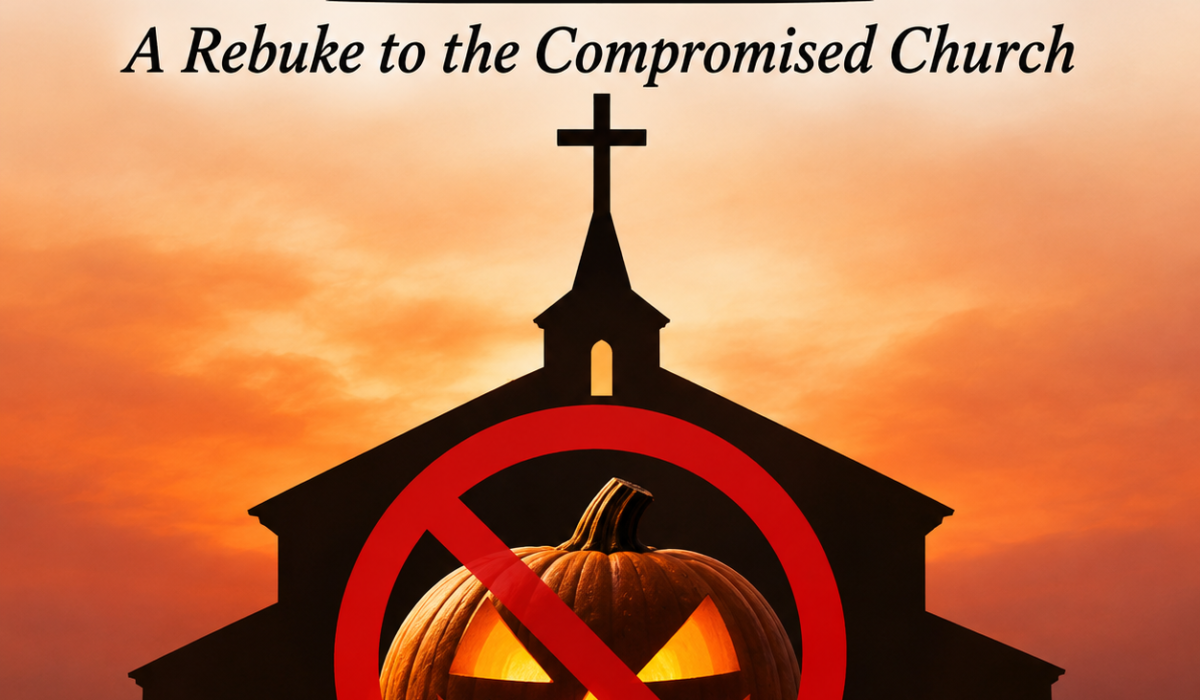
An Epistle Against the Baptism of Halloween: A Rebuke to the Compromised Church

To the pastors who have traded Biblical conviction for attendance, to the elders who have compromised their integrity, and to the Christians are comfortable celebrating what they profess to reject.


To the Churches of This Present Age:

I write not to congratulate you upon your ingenuity, nor to commend the astonishing creativity with which you have learned to accommodate the customs of the world, but to rebuke an ecclesiastical hypocrisy so thoroughly normalized that many among you no longer recognize it. You profess allegiance to Jesus Christ, proclaim the authority of Holy Scripture, and declare yourselves a people called out of darkness into His marvelous light. Yet when the appointed season of Halloween approaches, your congregations begin preparing celebrations of their own, carefully designed to preserve the festivities while concealing their association hidden by a vocabulary of religious respectability. You have renamed the occasion. You have not separated yourselves from the prevailing culture, but constructed a Christian imitation of its celebration. And having exchanged witches for scarecrows, skeletons for hay bales, and haunted houses for decorated automobiles, you congratulate yourselves upon a victory over darkness that is indistinguishable from complete surrender.

What shall we say to such things? Shall we praise the ingenuity of a Church that has manufactured a theological justification for virtually anything its members desire? Shall we admire pastors who possess sufficient creativity to transform Halloween into a Harvest Festival, Trunk-or-Treat, Light Party, Family Fun Night, or Community Outreach Celebration, while lacking the conviction to tell their congregations not every worldly observance requires a Christian equivalent? You who proclaim that Christ has called His followers to be separate, why are you so terrified of separation? You who preach that obedience is greater than sacrifice, why do you labor so diligently to devise alternatives to obedience? You who insist that Scripture is sufficient, why must the cultural calendar continually furnish occasions for celebrations that are in obvious opposition to Holy Scripture. The institutional Church has appointed itself the architect of Halloween’s rehabilitation, falsely claiming religious permission where it was required to exercise spiritual discernment.


I. You Have Not Rejected Halloween; You Have Baptized It

Let us dispense with the insulting pretense that changing the designation of an observance changes the essential character thereof. If a congregation assembles on October 31 knowing Halloween is approaching, advertises an event specifically as an alternative to Halloween, organizes activities modeled upon Halloween customs, and/or distributes candy to children whose anticipation has been cultivated by Halloween, by what extraordinary exercise of theological reasoning does that congregation conclude that Halloween has ceased to determine its conduct? The matter is not settled by the removal of objectionable decorations. Neither is it settled by the substitution of biblical costumes, cheerful music, or evangelical literature. These alterations may change the appearance of the occasion, but they do not erase the causal dependence upon the celebration supposedly being rejected.

Consider the absurdity of Trunk-or-Treat. Children who would otherwise proceed from residence to residence collecting candy are instead directed from automobile to automobile collecting candy. The fundamental activity, annual anticipation, and cultural occasion remain intact. The Church has accomplished nothing more than relocating Halloween onto ecclesiastical property. Are we seriously expected to regard this geographical adjustment as a triumph of holiness? Does an activity become sanctified because the asphalt belongs to a congregation? Does a costume acquire righteousness when worn beneath the supervision of an elder? Does the distribution of candy become an act of Christian distinction because the person distributing it attends Sunday worship? The absurdity of such thought is cause for vomit. 

And what of the Harvest Festival, that particularly convenient invention by which churches claim to celebrate agricultural abundance whilst the surrounding culture celebrates Halloween? If the harvest is genuinely the object of thanksgiving, why is the celebration so dependent upon October 31? Why does it reproduce the seasonal excitement of Halloween rather than arise independently from the agricultural calendar or the biblical feasts? If Halloween never existed, would your congregation have organized the same elaborate festivities on the same date? If not, then cease insulting the intelligence of your congregation by pretending that the harvest is the principal cause of your assembly. Your observance is governed by the very occasion you claim to have renounced. You are knowingly participating in the highest holy day of Satanism.

The same criticism without exception applies to Light Parties, costume carnivals, specially organized service nights, and annual family celebrations deliberately established as Halloween substitutes. Their individual activities are anything but innocent because of the context. Fellowship is good. Hospitality is good. Evangelism is good. Service to one’s neighbor is good. The moral legitimacy of an individual activity does not establish the wisdom or legitimacy of the religious observance constructed around it. We must examine not only what is being done, but why it is being done, what occasion governs it, and what spiritual instruction its repetition communicates.

The Apostle Paul certainly did not instruct the Church to imitate the cultural festivities of unbelievers with carefully modified decorations, but to examine their conduct and refuse fellowship with the unfruitful works of darkness (Ephesians 5:11). His admonition was not an invitation to creatively find substitutes for every worldly celebration. Nor did he imagine that the Church’s mission depended upon its ability to provide a religious counterpart to whatever entertained the surrounding pagans.

You may call your celebration whatever you please. You may decorate it with Scripture, surround it with prayer, and advertise it beneath the false banner of Christian fellowship. But if Halloween remains the reason your celebration exists, then Halloween remains the occasion to which your institution has subordinated its authority. If you are celebrating halloween in any form, you are not a follower of Jesus Christ.


II. You Have Forgotten the Difference Between Worshiping God and Pleasing God

The profound fundamental theological error underlying this accommodation is the presumption that religious intention possesses the authority to sanctify whatever practice Christians choose to adopt. Such reasoning is not only careless; it stands in direct opposition with Scripture and there are severe warnings concerning such worship.

In Exodus 32. Aaron did not simply announce the abandonment of Israel’s religious identity. Having fashioned the golden calf image, he constructed an altar and proclaimed a feast to the LORD. The people offered sacrifices, participated in festivities, and attached the name of Israel’s God to their celebration. The invocation of His name did not transform their disobedience into worship. The fact that they claimed to honor God did not establish that God was honored.

A modern harvest festival is the equivalent to Israel’s idolatrous worship before the golden calf. The comparison concerns the underlying principle: human beings possess an astonishing capacity to confuse religious intention with divine authorization. They imagine that because they have incorporated sacred language into an observance, the observance has thereby acquired sacred legitimacy. But Scripture exposes the danger of approaching God according to our own invention while disregarding His revealed will.

Deuteronomy 12:30–31 warns Israel against investigating the religious practices of surrounding pagan nations and attempting to worship the LORD according to those patterns. The immediate context is idolatrous worship and its abominations. The warning establishes that the practices of surrounding societies must not become the unquestioned model for the worship of God’s people.

Jeremiah 10:2 likewise warns against learning the ways of the nations. Christ later rebuked religious authorities for elevating similar traditions above divine commandment, declaring that they had made the commandment of God ineffective through their traditions (Matthew 15:3–9). The issue in these passages is the substitution of earthly religious invention for fidelity to divine revelation.

To the contemporary Church: By what authority have you made Halloween alternatives a recurring feature of Christian life? Why is a celebration constructed in deliberate correspondence with Halloween? Why should it become a cherished ecclesiastical tradition, defended with greater enthusiasm you exhibit for biblical instructions.

You speak of redeeming the culture. Yet where has Christ commissioned you to redeem pagan cultural celebrations by reproducing their attractions under the Christian banner? Redemption in Scripture concerns deliverance from bondage, reconciliation to God, and transformation through Christ. To describe every religiously modified cultural practice as “redeemed” is to employ a profound theological concept with astonishing carelessness.

Martin Luther’s polemics against ecclesiastical presumption were directed specifically at the elevation of human inventions to obligations of religion. He distinguished between useful arrangements and traditions imposed upon conscience as though they possessed divine authority. That distinction should trouble modern pastors who never claim that God commanded a Halloween festival, yet defend its existence as though questioning it were an assault upon Christian fellowship.

The Church is not commissioned to institute whatever celebrations its members desire and then demand that Scripture be interpreted generously enough to accommodate them, quite the opposite.


III. You Neglect the Appointed Feasts of God While Inventing Festivals of Your Own

Hypocrisy is particularly conspicuous and evident when you have sufficient time to organize Trunk-or-Treat, but insufficient interest to study the Feast of Tabernacles. You can assemble committees to decorate automobiles, coordinate costumes, purchase candy, and advertise a Harvest Festival, yet the appointed times described in Leviticus 23 remain unfamiliar to substantial portions of your congregation. Your children know exactly when Halloween is, what costumes they intend to wear, and what festivities their church has prepared. Ask those same children to explain the Feast of Weeks, the Day of Atonement, or the significance of the Feast of Trumpets, and how many will be able to give answer?

Leviticus 23 identifies its observances as the appointed feasts of the LORD. The chapter establishes sacred assemblies and commemorations connected to God’s creation, deliverance, provision, judgment, and covenantal relationship with His people. Passover recalls deliverance through sacrifice. Unleavened Bread commemorates separation and redemption. The Feast of Weeks celebrates divine provision. The Day of Atonement focuses our attention toward repentance and reconciliation. Tabernacles commemorates Israel’s wilderness dependence upon God and His sustaining faithfulness.These feasts form the scriptural world in which Jesus and His apostles lived, worshiped, taught, and understood the unfolding purposes of God.

Jesus observed Passover (Luke 22:7–15). John records being at the Feast of Tabernacles (John 7:2–14). Acts 2 locates the outpouring of the Holy Spirit at Pentecost, the Feast of Weeks. Paul references the Feast of Unleavened Bread in his moral exhortation to the Corinthians, invoking its imagery to demand sincerity and truth rather than malice and wickedness (1 Corinthians 5:7–8).

Even granting the broadest possible Christian liberty concerning their formal observance of these feasts, the present contradiction remains disgraceful at best. How has the Church acquired such boundless enthusiasm for a festival it invented as  a sanitized version of the highest Satanic holy day while displaying such remarkable indifference toward the festivals God established in Scripture?

How can a congregation plead that biblical feast observance is unnecessary while treating its annual Halloween alternative as indispensable? Why are pastors prepared to defend the legitimacy of a Light Party with elaborate arguments concerning Christian freedom, yet unwilling to devote comparable effort to explaining the theological significance of the Day of Atonement? Why do children receive weeks of excitement surrounding an autumn celebration while remaining ignorant of the biblical calendar through which God instructed Israel concerning holiness, remembrance, repentance, and thanksgiving?

Do not misunderstand my accusation. The mere existence of a voluntary church gathering surrounding the Oct 31date is Satanic worship. Every Christian participating in these events bears the consequences of idol worship.

You possess a treasury of biblical history and sacred instruction and you repeatedly turn toward the surrounding culture for Satanic and Pagan inspiration. You have inherited the Scriptures, but the entertainment calendar has become your supreme liturgical adviser. And then you wonder why your congregations possess so little understanding of biblical worship.


IV. Would Christ Have Led His Disciples Through the Streets Collecting Candy?

Let us now confront a question that easily exposes the absurdity of the entire enterprise. If Jesus Christ walked among us today, would He gather Peter, James, John, and the other disciples, dress them in costumes, distribute bags, and lead them through the neighborhood collecting candy on Halloween?

Would Paul interrupt his missionary labors to organize a costume competition in the Corinthian assembly? Would he advise the Galatians that their children need not feel excluded from the festivities of their neighbors, provided that the congregation constructed a suitably Christian substitute? Would he instruct Timothy to ensure that the Ephesian church offered an annual celebration corresponding to the popular religious and cultural observances of the surrounding Pagan city?

These questions are obviously rhetorical, no professing Christian could be so profoundly stupid as to think any legitimacy exists for such foolishness. Nevertheless, the questions expose the extraordinary distance between the priorities of apostolic Christianity and the priorities of the contemporary religious entertainment complex we know as “churchianity”

Christ rebuked religious hypocrisy, confronted traditions that displaced God’s commandments, demanded repentance, and warned discipleship required the rejection of familial and social expectations. He did not promise His followers that obedience would always be entertaining, culturally convenient, or socially acceptable.

Consider Paul, who admonished the Corinthians for their disorder, rebuked the Galatians for their departure from the truth of the Gospel, and warned believers against conformity to the present age. His pastoral concern that believers might abandon holiness, compromise truth, tolerate corruption, and confuse worldly wisdom with spiritual maturity.

And consider Luther, whose ferocious denunciations of religious corruption were fueled by his conviction that ecclesiastical authorities had obscured the Word of God twisted by traditions, pretensions, and institutional interests. Would he commend such priorities? Or would he demand that the Church cease confusing popularity with piety?

Has the modern Church has become so preoccupied with keeping its members entertained that it can scarcely imagine a form of discipleship requiring them to abstain from a popular celebration?


V. You Have Made Your Children Comfortable With Compromise

And now I must turn to parents, for the consequences of this ecclesiastical foolishness are not confined to church programming. You are teaching your children a theology of accommodation.

You tell them that Halloween is objectionable, but immediately assure them that they need not surrender its pleasures. You warn them against the celebration, then provide a carefully modified imitation. You insist that Christians must be different from the world, but construct an alternative so similar that the distinction is difficult to articulate beyond the identity of the organizers. What principle do you imagine your children are learning?

That obedience sometimes requires sacrifice? That conviction must remain steadfast even when the surrounding culture offers something attractive? That the people of God need not participate in every popular custom?

Or are they learning that whenever Christian conviction threatens to deprive them of some anticipated pleasure, the Church will invent a theological accommodation that preserves the pleasure while removing the discomfort? You have confused protecting children from disappointment with preparing children for discipleship.

Christ explicitly warned that following Him will provoke opposition and require sacrifice (Luke 14:25–33). Paul instructed believers not to conform to this age (Romans 12:2). Peter described Christians as sojourners and pilgrims whose conduct should reflect their distinctive allegiance to God (1 Peter 2:11–12). And Modern Christian parenting is determined to eliminate precisely the experiences through which such distinctions would become meaningful.

A child who learns that his family does not celebrate Halloween has not suffered some intolerable deprivation. He has encountered an opportunity to understand conviction. A child who learns that the Satanic, Pagan community celebrates something his household declines has encountered an elementary lesson in principled independence. Such instruction must be accompanied by patience, explanation, and love, not fearmongering or contempt for neighbors. But it certainly should not be abandoned because obedience may disappoint a child.

And pastors, your responsibility is greater still. James 3:1 warns that teachers will receive harsher judgment. Acts 20:28 charges elders to shepherd the flock entrusted to their care. Those who teach possess an obligation to cultivate discernment. When a congregation organizes its annual Halloween substitute, its leadership communicates the Church’s priorities, whether intentionally or otherwise. The children observe what the institution celebrates. They notice what receives money, publicity, preparation, and excitement. They also notice what does not.

If the appointed feasts of Scripture receive little attention while Halloween alternatives receive elaborate celebration, do not be astonished when the next generation concludes that the latter are more significant to Christian life than the former. You cannot teach separation while institutionalizing pagan substitutions and you cannot cultivate conviction by ensuring that conviction never costs us anything. Do not expect children to honor distinctions that their spiritual authorities have labored so diligently to erase.


VI. An Indictment of the Shepherds Who Prefer Popularity to Obedience

The most severe rebuke belongs not to children collecting candy, nor to parents who have uncritically accepted familiar customs, but to those entrusted with the teaching and governance of the Church. Pastors, what precisely are you attempting to accomplish?

If your objective is evangelism, why must evangelism assume the form of a Halloween alternative? If your objective is fellowship, why must fellowship imitate the calendar of the Pagan culture? If your objective is thanksgiving, why must thanksgiving be concentrated upon the evening of Halloween? If your objective is service, why must your annual service event derive its identity from the occasion you claim to oppose?

Do you lack sufficient biblical reasons to gather the people of God? Do you lack the intestinal fortitude to stand for Biblical truth? Must Satan first announce a celebration before the Church discovers an occasion for communal activity?

The Church was commissioned to make disciples, baptize believers, teach obedience to Christ, proclaim the Gospel, care for the needy, and persevere in holiness. There is a profound difference between engaging the surrounding culture for the sake of the Gospel and allowing that culture to determine the Church’s priorities.

Paul became all things to all people in order that he might save some (1 Corinthians 9:19–23). But his missionary adaptability was not unlimited, he remained subordinate to the law of Christ and the integrity of the Gospel. His willingness to engage people where they lived cannot reasonably be used as authorization for pagan religious imitation.

We must examine whether a practice is beneficial, edifying, or consistent with a congregation’s witness. Paul declared that although certain things might be lawful, not all things are expedient or edifying (1 Corinthians 10:23).

We must ask if the institution has exercised wisdom, maintained consistency, honored biblical priorities, and taught its members to distinguish cultural accommodation from Christian faithfulness. You may insist that your event attracts visitors. So might countless other forms of entertainment, but attendance is not proof of spiritual legitimacy. You may insist that families enjoy it. Enjoyment is not a theological argument.

If your defense ultimately amounts to the assertion that people enjoy the event and would resent its cancellation, then at least possess the integrity to acknowledge that congregational preference has become the idol you worship.

The Church does not exist to preserve any pleasure its members have inherited from the surrounding culture, but to bear witness to Christ. A shepherd who cannot distinguish between feeding the flock and entertaining the flock is NOT a man of the one true everlasting God.


VII. Repent of the Imitation and Recover the Courage to Be Separate

What, then, must be done?

First, abandon the pretense. If your congregation has constructed any annual celebration surrounding Halloween, acknowledge the connection and do not conceal it beneath euphemisms. Examine whether the gathering would exist in the same form without Halloween’s cultural influence.

Second, cease treating Christian separation as an inconvenience. The Church does not require a substitute for every celebration it declines to observe. There is no spiritual deficiency in allowing October 31 to pass without so much as a passing thought. There is no commandment requiring children to receive candy, wear costumes, or attend a festival because their neighbors do so.

Third, recover the biblical calendar as an object of serious theological instruction. Teach the appointed feasts of Leviticus 23. Explain their historical meaning, covenantal context, prophetic significance, and relationship to the ministry of Christ. 

Fourth, restore intellectual honesty to the Church. Romans 14 is not an all-purpose instrument for dismissing every concern about accommodation, just as Deuteronomy 12 is not to be stretched beyond its context to prohibit every cultural practice not expressly commanded in Scripture. Sound theology demands careful interpretation The objective is to expose traditions that Christians have defended without adequate discernment.

Finally, remember that the Church’s calling is to proclaim Christ faithfully, demonstrate holiness, practice charity, and remain obedient even when obedience is unpopular.

I do not condemn the child who receives a piece of candy, the family that gathers for a meal, or the believer who performs an act of mercy on October 31. The date is not cursed, and Christians must not surrender any specific day to superstition. My indictment concerns the deliberate ecclesiastical construction of Halloween substitutes and the theological evasions by which those substitutes are defended.

If your church would not have organized the celebration but for Halloween, then have the courage to ask why your church is participating in Pagan worship. And if the answer troubles you, seek repentance, reform, and a better ordering of your priorities.


A Final Admonition to the Church

To the modern Church, I leave this charge: cease congratulating yourselves for the religious ingenuity with which you have accommodated what you profess to reject. Your Fall Festivals, Trunk-or-Treat celebrations, Light Parties, and carefully invented Halloween alternatives are not evidence of spiritual maturity. They instead reveal a profound unwillingness to endure the smallest inconvenience of being different. You possess the Scriptures, the testimony of the prophets, the teaching of the apostles, and the example of Christ. You possess a biblical inheritance rich with appointed times, sacred history, covenantal instruction, and occasions for thanksgiving. And yet, much like Israel, you repeatedly permit pagan idol worship to dictate the timing, structure, and character of your festivities. You have become extraordinarily proficient at providing Christian substitutes for Satanic customs while remaining astonishingly reluctant to examine those substitutes by the standard of Scripture.

Let this be the end of the excuses. Let pastors recover the courage to instruct rather than entertain, let parents recover the conviction to distinguish obedience from indulgence, and let congregations cease mistaking Pagan worship for evangelistic achievement. The Church need not fear October 31, nor must it regard every activity performed upon that date as defilement. But neither must it bow before the expectation that Halloween deserves an annual Christian counterpart or participation. Let the world celebrate according to its customs, and let the people of God order their lives according to Scripture, conscience, wisdom, and fidelity to Christ. For a Church that cannot bear to abstain from a pagan celebration has not demonstrated the triumph of Christian liberty. 

May God’s Great Order be Restored!

The Illiterate Christian: When Sermons Replace Scripture and Strangers Replace the Husband

The Abdication of Biblical Literacy, the Outsourcing of Spiritual Authority, and the Lack of Household Discipleship


Introduction

Christianity has entered an extraordinary age of religious accessibility accompanied by an equally extraordinary crisis of biblical understanding. Never before in human history have so many people possessed such immediate access to Scripture, theological instruction, historical commentary, and religious discourse, yet the modern Christian demonstrates an astonishing inability to distinguish divine revelation from the opinions of those claiming to interpret it. Millions consume an endless succession of sermons, podcasts, devotional videos, religious books, and inspirational messages, accumulating the vocabulary of Christianity without developing a coherent understanding of doctrine. They can enthusiastically repeat the pronouncements of celebrated pastors, quote fashionable theological personalities, and defend denominational traditions, yet struggle to establish convictions through independent examination of the biblical text. The tragedy is spiritual dependency impersonating discipleship. We have cultivated generations of Christians who are perpetually being taught but never learning, regularly receiving instruction while never developing the competence to examine that instruction. They have mistaken listening for studying, agreement for understanding, and “religious” consumption for spiritual maturity.

Nowhere is this deterioration more consequential than within the Christian household, where the abandonment of biblical literacy accompanies the abandonment of spiritual responsibility. Scripture establishes the family as a fundamental setting for religious instruction, with fathers commanded to cultivate knowledge of God’s commandments among their children and husbands specifically identified as sources of instruction for their wives (Deuteronomy 6:6–7; 1 Corinthians 14:35). Contemporary Christianity has normalized the outsourcing of these responsibilities to pastors, religious celebrities, online ministries, and an expanding marketplace of competing theological authorities. A husband may possess scarcely enough biblical knowledge to explain the foundations of his own convictions while his wife receives hours of religious instruction from men whose doctrines he has never examined. More troubling still is the phenomenon of a wife who readily embraces the counsel of a distant religious personality while dismissing substantially identical instruction from the husband with whom she shares her household. The result is a modern culture of religious consumption that undermined personal biblical literacy, weakened household discipleship, and confused the distinction between receiving instruction and surrendering spiritual discernment. If Christian families are to recover meaningful theological competence, they must begin by restoring the responsibility to study, understand, test, and faithfully communicate the Word of God themselves.


I. The Great Biblical Illiteracy: A Generation That Listens but Does Not Study

The contemporary Christian possesses access to biblical resources that would have astonished any previous generation. The invention of movable-type printing in fifteenth-century Europe, exemplified by Gutenberg’s Bible of 1455, helped transform the production and circulation of Scripture. Subsequent vernacular translations, expanding literacy, and increasingly affordable printed editions made personal biblical study accessible to populations previously dependent upon comparatively scarce manuscripts and public religious instruction. Today, entire libraries of biblical translations, ancient-language resources, historical commentaries, and theological scholarship can be accessed instantaneously. We have learned that accessibility must never be confused with intellectual competence. Possessing a Bible does not establish biblical literacy, any more than owning a library establishes scholarship. Knowledge requires focused study, disciplined examination, contextual understanding, and the willingness to test previous assumptions against the testimony of Scripture.

The American Bible Society’s State of the Bible 2024 reported that approximately 38 percent of American adults qualified as Bible Users under its definition of interacting with Scripture at least three or four times annually outside a church service. That extraordinarily modest threshold is disturbing: occasional exposure to biblical material is sufficiently uncommon to warrant classification as meaningful engagement. Meanwhile, Lifeway Research’s 2021 study of Protestant churchgoers found that only 31 percent reported reading the Bible daily. Congregations are now composed of individuals (⅔) who regularly hear biblical passages expounded yet seldom undertake the sustained intellectual labor necessary to examine those passages independently.

Paul instructed Timothy, “Study to shew thyself approved unto God, a workman that needeth not to be ashamed, rightly dividing the word of truth” (2 Timothy 2:15). The Bereans were commended because they “searched the scriptures daily, whether those things were so” (Acts 17:11). Significantly, they examined even apostolic preaching rather than accepting religious instruction simply because an authoritative speaker delivered it. Hebrews 5:12–14 likewise rebukes spiritual immaturity and associates maturity with developed discernment. Biblical understanding is an essential discipline of Christian growth and there are no shortcuts.

The distinction between hearing and understanding must consequently remain unmistakable. A sermon may introduce a doctrine, illuminate a passage, or encourage serious reflection, but it can never substitute for the listener’s responsibility to examine the text. A podcast may communicate theological conclusions, but repeating those conclusions does not establish comprehension of their foundations. A Christian who knows what his favorite preacher believes but cannot demonstrate why Scripture teaches it has not acquired biblical understanding; he has simply acquired another man’s opinions. The objective of Christian instruction should never be the perpetual production of dependent listeners, but the cultivation of believers increasingly competent to understand, evaluate, and faithfully apply the Word of God.

References: American Bible Society, State of the Bible 2024; Lifeway Research, Americans Are Fond of the Bible, Don’t Actually Read It (2016); Elizabeth L. Eisenstein, The Printing Press as an Agent of Change (1979). 


II. The Abdication of the Husband: When the Head of the Household is Spiritually Illiterate

The biblical household is not intended to function as a spiritually dependent satellite of the institutional church, receiving its entire theological identity from whichever religious personality happens to occupy the pulpit (or the screen). The transmission of divine commandments in Scripture is presented as a fundamental responsibility of family life, with fathers bearing a particularly solemn obligation to instruct those entrusted to their care. Deuteronomy 6:6–7 commands that God’s words remain upon the heart and be diligently taught to one’s children, whether sitting within the house, traveling upon the road, retiring at night, or rising in the morning. This is not an occasional ceremonial responsibility satisfied through attendance at a weekly religious gathering but an expectation of continuous instruction woven into the activities of daily life. The household is therefore not merely a place where Christians reside between religious services, but the primary setting in which biblical knowledge, moral discipline, and spiritual understanding ought to be cultivated.

The New Testament reinforces the weight of this responsibility. Ephesians 6:4 instructs fathers to bring up their children “in the nurture and admonition of the Lord,” while 1 Corinthians 14:35 identifies husbands as appropriate sources of religious instruction for their wives. Ephesians 5:25–27 further portrays the husband’s love through Christ’s sanctifying the church, a comparison carrying profound implications for the seriousness with which Christian husbands must approach their responsibilities. These passages together establish a substantial biblical foundation for active paternal instruction and conscientious marital leadership. A husband who claims authority over his household while possessing neither the knowledge nor the discipline necessary to provide meaningful spiritual guidance has embraced the privileges of leadership while neglecting its corresponding obligations.

Historically, household religious instruction occupied the primary place within Christian faith. The Protestant Reformation emphasized domestic catechesis, exemplified by Martin Luther’s Small Catechism of 1529, which directed its teachings toward the head of the family for instruction within the household. The Westminster Larger and Shorter Catechisms likewise emerged from a seventeenth-century religious culture that placed considerable importance upon systematic doctrinal education. These examples demonstrate that organized family instruction is not and has never been an eccentric theological preference. It belongs to a long and substantial tradition of domestic religious responsibility.

The husband must ask: What exactly is he leading if he cannot explain the Scriptures upon which his claimed authority rests? It is intellectually indefensible to demand theological respect while remaining incapable of distinguishing biblical commandments from inherited customs, denominational assumptions, or personal preferences. A man who expects his wife to respect his spiritual judgment must cultivate that judgment through diligent study, humility, reading Scripture, and consistent obedience. He cannot reasonably demand discernment from his household while outsourcing his own discernment to another man.

Spiritual headship is not a ceremonial title, a masculine entitlement, or a convenient justification for issuing religious pronouncements. The husband has an obligation to become sufficiently acquainted with the Word of God that his household receives genuine instruction rather than recycled opinions. The husband who neglects Scripture while demanding unquestioning acceptance of his interpretations has not demonstrated biblical leadership; he has exposed the inadequacy of his preparation. Before condemning the spiritual dependency of his wife or children, he must first examine whether his own negligence created the instructional vacuum they have sought to fill.

Historical references: Martin Luther, Small Catechism (1529); Westminster Assembly, Westminster Shorter Catechism (1647). Biblical references: Deuteronomy 6:6–7; Ephesians 5:25–27; Ephesians 6:4; 1 Corinthians 14:35. 


III. The Stranger in the Household: When Outside Religious Teachers Become Spiritual Authorities

There is a profound distinction between a wife independently studying the Word of God and a wife receiving theological instruction from another man whose interpretations, convictions, and religious judgments have never been examined by her husband. The former concerns direct engagement with divine revelation; the latter introduces an additional authority into the intellectual and spiritual formation of the household. Scripture must remain the supreme standard by which every Christian evaluates doctrine, while the pronouncements of pastors, authors, and religious commentators remain fallible interpretations subject to examination. Modern Christianity obscures this distinction by treating religious instruction as inherently harmless, provided the individual delivering it possesses a pastoral title, an impressive following, or a sufficiently respectable reputation. Such assumptions are the very opposite of biblical discernment. Paul warned that even religious teachers could introduce destructive doctrines, declaring that “of your own selves shall men arise, speaking perverse things, to draw away disciples after them” (Acts 20:30). The existence of a religious platform or following is no guarantee of theological accuracy.

Within a patriarchal biblical marriage, this concern carries particular significance. First Corinthians 11:3 identifies the husband as the head of the wife, while 1 Corinthians 14:35 directs women seeking clarification to ask their husbands at home. Titus 2:3–5, meanwhile, expressly provides for older women to instruct younger women concerning their domestic and moral responsibilities. These passages establish meaningful distinctions between marital leadership, household instruction, and appropriate teaching relationships. The household principle advocated here is the obvious theological application: a wife should not independently consume outside male religious instruction unless her husband participates in that instruction or has examined and approved the specific material beforehand. Even a generally reliable teacher may advance an interpretation that conflicts with the family’s understanding of Scripture.

The practical danger is especially apparent when outside instruction acquires greater influence than the husband’s own counsel (and it will). A wife will dismiss an argument when presented by her husband, only to embrace substantially identical reasoning when delivered by a charismatic preacher or celebrated theologian. This phenomenon is not confined to women; men likewise surrender independent judgment to admired religious personalities. Nevertheless, within marriage it will produce a destructive confusion of responsibilities when an outsider’s opinions are the effective standard by which the husband’s biblical instruction is judged. The question is not whether a pastor may possess greater theological knowledge than a husband. He certainly may. The question is whether the husband has responsibly examined the instruction entering his household and whether both spouses are evaluating its claims against the Scripture.

The Bereans provide the necessary corrective: they examined Paul’s preaching against the Scriptures (Acts 17:11). Likewise, 1 John 4:1 commands believers to test the spirits rather than accept every religious claim. No Christian household should surrender its doctrinal judgment to an unfamiliar voice simply because that voice speaks confidently about God. This responsibility demands competence rather than authoritarian presumption. A husband’s presence does not make false doctrine true, and his approval cannot elevate his preference above divine revelation. His responsibility is to examine teachings faithfully, explain his conclusions intelligibly, and remain accountable to the Scriptures he expects his household to honor.


IV. The Inversion of Authority: When a Wife Trusts a Stranger More Than Her Husband

Another revealing contradiction within contemporary Christian marriage occurs when a wife enthusiastically receives religious instruction from an outside male preacher while treating the biblical counsel of her own husband with suspicion, indifference, or outright contempt. A theological argument dismissed at the kitchen table can suddenly acquire extraordinary credibility when repeated from a pulpit, presented in an expensive hardcover, or delivered through a professionally produced video on social media. The substance of the teaching has not changed; only the identity and perceived prestige of the messenger have changed. This is not evidence of superior discernment, but may instead reveal a deeply misplaced understanding of authority and, in which public recognition commands greater respect than personal responsibility. The husband, whose character and conduct are visible daily, must defend every conclusion, while the distant religious personality receives the benefit of an authority cultivated through reputation, presentation, and selective exposure without accountability.

This tendency can be examined through the established psychological concept of the authority bias, whereby individuals assign disproportionate credibility to statements associated with recognized or apparently authoritative figures. Stanley Milgram’s obedience experiments, published in 1963, demonstrated the powerful influence that perceived institutional authority can exert on behavior. Human beings are demonstrably susceptible to the influence of authoritative presentation. Religious titles, academic credentials, eloquent speech, and large audiences will therefore encourage confidence that exceeds the evidentiary strength of a teacher’s argument. None of these attributes transforms a theological opinion into divine revelation. Scripture repeatedly directs attention away from superficial appearances and toward the substance of what is taught (Matthew 7:15–20; 1 Thessalonians 5:21).

Within the biblical framework of marital headship, this problem deserves examination. Ephesians 5:22–24 describes the wife’s relationship to her husband through the language of submission, while Ephesians 5:25 commands the husband to love his wife sacrificially, following Christ’s example. These obligations are not interchangeable with the authority of a popular pastor, nor do they make the husband infallible. Nevertheless, a wife who habitually dismisses her husband’s carefully reasoned biblical instruction simply because she prefers another man’s religious personality undermines the very marital order she professes to recognize. Equally, a husband who demands agreement without demonstrating scriptural justification mistakes personal dominance for theological leadership. Biblical authority must remain subordinate to biblical truth above all else.

The necessary distinction is between principled disagreement and habitual disregard. A wife is not required to accept an interpretation that contradicts Scripture simply because her husband advances it; Acts 5:29 establishes the fundamental priority of obedience to God first. But neither should the opinions of an outside teacher supersede the husband’s responsible efforts to instruct his household. The restoration of household order requires more than insisting upon submission. It requires husbands who can explain what Scripture teaches, wives who respect and submit to their husbands leadership, and marriages in which outside religious personalities are never permitted to become arbiters of divine truth.

Reference: Stanley Milgram, “Behavioral Study of Obedience,” Journal of Abnormal and Social Psychology, 67, no. 4 (1963): 371–378. 


V. Reclaiming the Biblical Household: Restoring Scripture, Discernment, and Spiritual Order

The restoration of biblical literacy and household discipleship will not be accomplished through another fashionable ministry initiative, an additional devotional application, or the acquisition of another religious bestseller destined to gather dust beside an unopened Bible. It requires a fundamental reordering of Christian priorities, beginning with the recognition that divine revelation must occupy a position of authority no one can legitimately usurp. Scripture commands us to become disciples of Christ, whose teachings must be understood, examined, and obeyed. Jesus condemned religious traditions that displaced divine commandments, declaring, “Full well ye reject the commandment of God, that ye may keep your own tradition” (Mark 7:9). The warning remains applicable wherever inherited assumptions, institutional loyalties, or charismatic personalities are permitted to determine doctrine independently of the biblical text.

For the Christian husband, restoration begins with disciplined personal study. He must develop familiarity not only with isolated proof texts but with the historical setting, literary context, theological continuity, and practical implications of Scripture. Second Timothy 2:15 demands diligence in rightly handling the Word of truth, while 1 Peter 3:15 calls believers to be prepared to explain the grounds of their convictions. Household instruction must become an intentional practice rather than an occasional response to domestic disagreement. Regular reading, thoughtful discussion, careful examination of disputed doctrines, and the instruction of children must characterize a household in which biblical leadership is taken seriously. A husband cannot reasonably expect his family to develop reverence for Scripture while his own religious education consists of listening to other men explain passages he has never studied

Within the Biblical household standard, outside male religious instruction must likewise be approached with discernment. A wife may study Scripture independently and receive appropriate instruction from other women, as contemplated by Titus 2:3–5. When considering the teaching of an outside male pastor, author, or commentator, the proposed safeguard is that her husband either participate in that instruction or review and approve the specific material beforehand. This is a prudential application of marital headship and doctrinal oversight rather than an explicitly stated universal prohibition in Scripture. 

Such responsibility must never become an excuse for intellectual laziness, arbitrary restrictions, or the suppression of legitimate biblical questions. Acts 17:11 praises those who examined religious instruction, and 1 Thessalonians 5:21 commands believers to “prove all things; hold fast that which is good.” The husband must welcome careful scriptural examination, including examination of his own conclusions. His responsibility is not to replace the authority of an outside preacher with the equally unexamined authority of himself, but to cultivate a household whose convictions can withstand scrutiny because they rest upon Scripture.

The objective is not a family that repeats the husband’s theology, but a family that understands why its convictions are biblical. When husbands study diligently, wives engage Scripture conscientiously, and children receive systematic instruction, the household will be less vulnerable to religious manipulation and fashionable doctrinal confusion. That is the meaningful restoration of spiritual order: not the silencing of inquiry, but the disciplined subordination of every voice to the revealed Word of God.


Conclusion: The Word of God Must Reign Where the Opinions of Men Have Ruled

A great tragedy of contemporary Christianity is that so many have willingly exchanged the responsibility of understanding the word of God for the convenience of having someone else explain it. We have produced a religious culture overflowing with sermons yet impoverished in discernment, saturated with theological commentary yet unfamiliar with the Scriptures those commentaries supposedly illuminate. Christians can identify their favorite pastors, defend their preferred denominations, and repeat the fashionable arguments of celebrated religious TikTok personalities while remaining incapable of establishing their convictions through careful examination of the biblical text. This intellectual dependency is especially destructive in the household, where husbands neglect their responsibility to provide spiritual instruction and wives look beyond their marriages for the theological guidance their husbands have failed to cultivate.

The resulting disorder cannot be corrected by demanding greater respect for marital authority. It must begin with the restoration of the competence, discipline, and responsibility that make meaningful spiritual leadership possible. A husband who cannot explain Scripture has little justification for presenting himself as its authoritative interpreter, while a wife who habitually elevates the pronouncements of an outside religious personality above the carefully examined biblical instruction of her husband ought to consider whether she has confused religious celebrity with spiritual rebellion. Neither spouse is exempt from the obligation to test doctrine against the Word of God. As Isaiah 8:20 states, “To the law and to the testimony: if they speak not according to this word, it is because there is no light in them.” The ultimate standard is neither the popularity of the preacher nor the position of the husband, but the authority of divine revelation.

The restoration of the Christian household demands something more substantial than superficial religiosity, ceremonial headship, or passive attendance at weekly worship services. It demands husbands who open their Bibles before opening their mouths, who investigate doctrines before imposing conclusions, and who understand that spiritual leadership is an obligation requiring continual intellectual and moral preparation. It demands wives who diligently examine Scripture, recognize the significance of marital order, and exercise discernment concerning the outside voices they permit to shape their religious convictions. It demands families in which biblical instruction is practiced consistently, theological questions are answered thoughtfully, and every interpretation remains subject to examination. Outside teachers may provide valuable knowledge, historical insight, and legitimate correction, but they must never become substitutes for personal study or authorities within the household.

The apostle Paul warned of those who are “ever learning, and never able to come to the knowledge of the truth” (2 Timothy 3:7). That warning should trouble every Christian whose religious education consists of consuming external teaching without corresponding understanding. Turn off the endless procession of preachers. Open the Scriptures. Study what God commanded. Husbands, become capable of teaching your households. Wives, become diligent students of the Word and respect the authority of your husband above the youtube preacher. Let every Christian remember that hearing another man speak about God is not the same thing as knowing what God has spoken. A household grounded in Scripture has no need to fear examination, because its authority rests not upon the eloquence of strangers, the prestige of institutions, or the unquestioned opinions of men, but upon the enduring truth of the Word of God.

Let God’s Great Order be Restored!

The Counterfeit Life: Why Video Games Are More Destructive Than Pornography

The Seduction of Artificial Accomplishment and the Abdication of God-Given Responsibility


Introduction

Our civilization has perfected the art of providing men and women with the sensation of accomplishment without requiring them to accomplish anything useful. We have created artificial worlds in which we can all be mighty conquerors, prosperous landowners, accomplished architects, victorious warriors, and celebrated heroes, all while remaining comfortably seated before an illuminated screen. A man will command armies while failing to govern himself. A woman will cultivate magnificent virtual gardens while her actual household deteriorates around her. Both will accumulate extraordinary wealth, construct elaborate civilizations, and complete hundreds (or thousands) of demanding objectives without producing a single tangible improvement in their physical circumstances. We are a society increasingly proficient at accomplishing absolutely nothing while experiencing the psychological satisfaction of having accomplished something extraordinary. And nowhere is this peculiar contradiction more apparent than in the modern obsession with electronic gaming.

Christian communities have rightly devoted considerable attention to the spiritual and relational destruction associated with pornography, while another form of artificial gratification has become so thoroughly normalized that its moral implications are seldom (if ever) seriously examined. Video games, whether played upon sophisticated computers, elaborate gaming consoles, common smartphones, or inexpensive tablets, have infiltrated every demographic of contemporary society. The middle-aged woman compulsively arranging colored candies upon her telephone is participating in the same fundamental phenomenon as the young man spending his evenings conquering imaginary kingdoms. The superficial differences between their preferred entertainments does not obscure their common psychological architecture: artificial challenges, manufactured rewards, simulated advancement, and the gratifying illusion of achievement. Indeed, the central contention of this examination is that electronic gaming represents a danger greater than pornography, and more comprehensive, because pornography offers counterfeit sexual gratification while gaming offers counterfeit purpose, accomplishment, adventure, responsibility, and identity. Gaming progressively diminishes the human appetite for genuine responsibilities, accomplishments, and purposes for which God created mankind.


I. The Great Counterfeit: Artificial Achievement Has Replaced Genuine Purpose

Human beings were not created to simply exist, consume, and entertain themselves. From the beginning mankind received a commission involving responsibility, cultivation, stewardship, and productive dominion. In Genesis 1:28 God commanded humanity to be fruitful, multiply, replenish the earth, subdue it, and exercise dominion over creation. Genesis 2:15 further described Adam’s placement within the garden of Eden to dress and keep it. Work, cultivation, responsibility, and purposeful activity were established before sin entered the world. They were not punishments imposed upon fallen humanity but fundamental elements of mankind’s original vocation. Human beings were designed to engage meaningfully with God’s creation, develop their capacities, fulfill their obligations, and produce something of genuine value through their endeavors.

Modern gaming offers an extraordinary counterfeit of these legitimate human aspirations. Psychological research provides insight to its appeal. In their 2010 scholarly article, A Motivational Model of Video Game Engagement, Andrew K. Przybylski, C. Scott Rigby, and Richard M. Ryan examined gaming through self-determination theory, identifying the satisfaction of psychological needs involving competence, autonomy, and relatedness as important explanations for gaming’s motivational attraction. In other words, electronic games are particularly engaging because they make participants feel capable, influential, successful, and connected. These experiences are psychologically meaningful even when the accomplishments produced by them exist only in fantasy. The research established an important mechanism of gaming engagement.

Consider the implications. A man who struggles to establish financial stability will nevertheless become extraordinarily wealthy in an imaginary economy. A woman who finds daily household management tedious will enthusiastically devote hours to cultivating virtual crops, organizing digital possessions, and decorating fictional homes. The problem is these activities demand sustained attention and disciplined participation, that is precisely what makes their displacement of real-world responsibility so troubling. The participant will exercise genuine diligence toward an objective possessing no lasting significance beyond the game.

Herein lies the central danger: the psychological reward of achievement will become separated from achievement’s tangible substance. A person will experience the satisfaction of progress without materially improving his circumstances, fulfilling his obligations, or advancing his God-given calling. Such artificial gratification will become habitual, and it raises a serious moral and psychological question: why endure the inconvenience of difficult responsibilities when a fake world offers easier, more immediate, and more predictable victories? The ultimate tragedy is that counterfeit accomplishments have increasingly competed with the ambition required to pursue authentic ones.

Scripture tells us Satan is the great counterfeiter, the adversary whose methods depend not only upon the rejection of God’s established order, but upon its imitation, distortion, and corruption. He does not need to eliminate mankind’s God-given desires if he can redirect those desires toward fraudulent substitutes. He offers counterfeit wisdom in place of divine revelation, counterfeit freedom in place of righteous obedience, counterfeit intimacy in place of covenantal fidelity, and counterfeit fulfillment in place of genuine purpose. The apostle Paul warned “Satan himself is transformed into an angel of light” (2 Corinthians 11:14), revealing the deceptive nature of an enemy who disguises corruption as something desirable.

Christ likewise identifies him as “a liar, and the father of it” (John 8:44). This is the spiritual pattern we must recognize in fake accomplishment: the legitimate human desire for dominion, achievement, cultivation, and meaningful responsibility has been redirected toward an imitation that promises satisfaction without fulfilling the divine commission. Whenever a counterfeit is displacing what God has ordained, Christians must recognize the spiritual danger rather than excuse the substitution because it is entertaining, innocent, or socially acceptable. Satan need not persuade a man to abandon his desire for greatness if he can persuade him to squander that desire becoming great in a world that does not exist.

References: Przybylski, Rigby, and Ryan, Review of General Psychology (2010), 14(2), 154–166. 


II. The Epidemic of Artificial Living: An Entire Civilization Lost in Entertainment

The magnitude of modern electronic gaming is staggering, and its true prevalence is obscured by misleading distinctions between traditional video games and supposedly harmless mobile entertainment. The young man commanding virtual armies upon an expensive gaming computer and the middle-aged woman compulsively matching colored candies upon her smartphone are participating in variations of the same fundamental activity. Both devote genuine time, attention, and mental energy to completing artificial objectives in exchange for invisible rewards. According to the Entertainment Software Association’s 2025 Essential Facts About the U.S. Video Game Industry, approximately 255 million Americans, representing roughly 69 percent of the population, play video games at least one hour daily. Importantly, this research includes gaming across multiple platforms, including mobile devices. The phenomenon is therefore neither exclusively masculine nor confined to adolescent entertainment. It has become a commonplace feature of American life, embraced by adults who would otherwise ridicule the very suggestion that they are habitual gamers.

The collective expenditure upon electronic gaming is beyond comprehension. According to Sensor Tower’s State of Mobile Gaming 2025, approximately 390 billion hours were devoted to mobile gaming worldwide in 2024 alone. Additional research from Newzoo documented more than 100 billion hours of computer gaming and 210 Billion Hours of console gaming in 2022. These figures illustrate an industry consuming human attention on an unimaginable scale: more than 700 billion hours, equivalent to approximately 79 million years of human existence. Consider the magnitude of this extraordinary expenditure. How many neglected households might have been restored? How many children might have received meaningful instruction? How many marriages strengthened, businesses established, communities improved, and skills cultivated? How many hours might have been devoted to studying Scripture, pursuing wisdom, developing discipline, or fulfilling the responsibilities God has entrusted to us?  The staggering magnitude of this pursuit demands significant moral examination. We have become a civilization capable of investing extraordinary diligence, ingenuity, and perseverance into imaginary worlds while allowing countless opportunities for genuine accomplishment to wither. Just imagine what could have been accomplished if a fraction of that devotion had been directed toward the world God created.

The enormous cumulative expenditure of human attention is particularly disturbing when examined over an extended period. Consider the average gamer who devotes three hours daily to electronic gaming. This consumes 1,095 hours annually, 10,950 hours over a decade, and 21,900 hours across twenty years. That represents two and a half uninterrupted years of existence surrendered to nothing. These calculations are the average an American gamer plays daily, they demonstrate the extraordinary consequences of habitual entertainment. And even these calculations fail to account for the additional time spent anticipating games, discussing imaginary achievements, purchasing virtual commodities, or mentally rehearsing objectives that possess no independent existence beyond the screen.

The World Health Organization formally recognized gaming disorder within the eleventh revision of its International Classification of Diseases, identifying impaired control, increasing priority assigned to gaming, and continued participation despite harmful consequences as central characteristics. The Christian examination of gaming must extend considerably beyond the narrow boundaries of clinical diagnosis. A person need not satisfy the medical definition of addiction to have surrendered substantial portions of life to an unprofitable pursuit. Indeed, a most insidious feature of normalized entertainment is that individuals will enthusiastically participate in their own stagnation without experiencing their conduct as pathological.

The apostle Paul commanded believers to walk circumspectly, “redeeming the time, because the days are evil” (Ephesians 5:15–16). This is not an invitation to calculate how many hours remain available for entertainment after our minimum obligations have been discharged, but a summons to recognize time as an irreplaceable stewardship entrusted by Almighty God. Every hour expended upon imaginary victories is an hour unavailable for cultivating wisdom, strengthening family relationships, acquiring practical competence, improving one’s household, serving one’s neighbor, or contemplating divine truth. The gravest loss, however, remains invisible: the thousands of hours surrendered to artificial entertainment, and the thousands of genuine accomplishments, relationships, and opportunities that might have emerged had those hours been faithfully invested elsewhere.

References: Entertainment Software Association, 2025 Essential Facts About the U.S. Video Game Industry; World Health Organization, ICD-11: Gaming Disorder; Ephesians 5:15–16 (KJV).


III. The Corruption of Desire: How Artificial Rewards Undermine Discipline, Ambition, and Responsibility

Perhaps the most insidious danger of electronic gaming is not the obvious expenditure of time, but the inescapable reality that the individual’s relationship with effort, gratification, and accomplishment will be reshaped. The human mind naturally responds to progress, mastery, achievement, and reward. These mechanisms are indispensable to productive living, encouraging mankind to persevere through difficulty and pursue meaningful objectives. Electronic games, however, concentrate these experiences with carefully engineered environments where advancement is measurable, rewards are frequent, and success is continually inevitable and reinforced. Research by King, Delfabbro, and Griffiths (2010) examined the structural characteristics of video games, including reward systems and other features that encourage persistent participation. Gaming does provide the emotional satisfaction associated with productive labor while circumventing the uncertainty, responsibility, and tangible consequences accompanying genuine achievement.

This artificial gratification creates a troubling contrast between simulated existence and real life. Real accomplishments demand months, years, or even decades of disciplined effort before producing meaningful results. Building a prosperous household, cultivating a successful marriage, raising competent children, mastering a profession, or developing physical strength requires perseverance through monotony, frustration, disappointment, and delayed gratification. Games, by comparison, provide immediate feedback, conspicuous advancement, escalating challenges, and predictable rewards. When individuals are accustomed to these concentrated experiences, mundane responsibilities appear comparatively tedious and unrewarding. The man who plays games will lose ambition, by a mechanism through which habitual gaming replaces the development of patience, perseverance, and genuine accomplishment.

The resulting temptation toward escapism is equally concerning. Rather than confronting marital dissatisfaction, financial irresponsibility, professional stagnation, household disorder, or personal inadequacy, an individual will retreat into an artificial environment where competence and success remain conveniently accessible. A man unable to exercise discipline over his own appetites can nevertheless command virtual civilizations with extraordinary power. A woman unwilling to cultivate order within her home will devote remarkable diligence to arranging imaginary homes and maintaining digital gardens. The contradiction is not only humorous, but exposes the reality of misplaced devotion. What ought to be directed toward tangible stewardship is instead expended upon elaborate simulations of the very responsibilities being neglected.

Scripture warns that “where your treasure is, there will your heart be also” (Matthew 6:21). Whatever repeatedly receives our attention, enthusiasm, resources, and emotional investment reveals our priorities. Proverbs 12:11 likewise contrasts productive cultivation with the pursuit of vain things. The biblical concern is that a person can remain technically capable of abandoning a game while nevertheless having cultivated a profound preference for imaginary accomplishment over genuine responsibility. Artificial success has become sufficiently satisfying so that most individuals no longer feel compelled to pursue the real achievements, difficult obligations, and purposeful endeavors that God has placed before them.

Reference: King, D. L., Delfabbro, P. H., and Griffiths, M. D. (2010). “Video Game Structural Characteristics: A New Psychological Taxonomy.” International Journal of Mental Health and Addiction, 8, 90–106.


IV. The Hidden Casualties: The Destruction of Health, Household, Relationships, and Spiritual Discipline

The consequences of habitual electronic gaming extend far beyond diminished ambition and squandered opportunity. Its influence will penetrate every dimension of responsibility, producing a gradual deterioration that often escapes recognition because its effects accumulate incrementally. Physical inactivity, disrupted sleep, emotional dependency, financial waste, diminished social engagement, and neglected household obligations are among a few of the casualties of gaming. The World Health Organization’s recognition of gaming disorder acknowledges that gaming behavior can become sufficiently persistent and disruptive to produce significant impairment in personal, familial, social, educational, and occupational functioning. Research published by Exelmans and Van den Bulck (2015) likewise identified associations between video gaming and adverse sleep outcomes among adults.

Consider the household in which husband and wife are habitual consumers of artificial gratification. The husband retreats into imaginary battles while meaningful conversations are avoided, necessary repairs accumulate, and opportunities to instruct his children are missed. His wife will simultaneously devote substantial portions of her day to mobile games, fictional entertainments, and other digital distractions while domestic responsibilities receive only intermittent attention. Neither individual perceives the full extent of the deterioration because the consequences emerge gradually. A neglected conversation becomes emotional distance; postponed maintenance becomes disorder; abandoned instruction becomes lost parental influence. Meanwhile, the gaming environment continues supplying immediate affirmation for accomplishments bearing little relationship to the actual needs of the household. What began as entertainment has become a competing system of priorities, steadily displacing the duties upon which family stability depends.

The financial and psychological dimensions warrant equal scrutiny. Contemporary games employ microtransactions, artificial scarcity, randomized rewards, daily participation incentives, and other mechanisms designed to encourage continued engagement. Research by Zendle and Cairns (2018) identified an association between loot-box spending and problematic gambling, raising concerns about monetization systems that exploit behavioral vulnerabilities. Beyond financial expenditure, habitual gaming will become an individual’s preferred response to frustration, boredom, disappointment, or emotional discomfort. Rather than developing patience, confronting adversity, or cultivating meaningful relationships, the participant learns to seek refuge within a substitute environment where rewards are conveniently accessible. Such patterns will undermine self-government and perseverance.

Scripture establishes a different standard. First Timothy 5:8 emphasizes the solemn obligation to provide for one’s household, while Proverbs 24:30–34 portrays the ruin arising from neglected cultivation and habitual indolence. First Corinthians 6:12 declares, “I will not be brought under the power of any.” These passages furnish principles by which the consequences of such things must be judged. A husband cannot excuse neglected leadership with imaginary victories, a wife cannot substitute virtual cultivation for actual stewardship, and neither can claim faithful obedience while allowing artificial pleasures to displace genuine responsibilities. The question is whether the household, its relationships, and its spiritual life would have flourished more fully had that attention been invested where God placed it.

References: Exelmans, L., and Van den Bulck, J. (2015), “Sleep Quality Is Negatively Related to Video Gaming Volume in Adults,” Journal of Sleep Research, 24(2), 189–196. Zendle, D., and Cairns, P. (2018), “Video Game Loot Boxes Are Linked to Problem Gambling,” PLOS ONE, 13(11), e0206767.


V. Redeeming the Time: The Biblical Obligation to Reject the Satanic Substitution

The Christian must ultimately confront a question far more consequential than whether electronic gaming constitutes a clinically recognized addiction or an immediately identifiable transgression: Can the deliberate pursuit of imaginary accomplishments be reconciled with the solemn obligation to steward the life Almighty God has entrusted to us? Scripture emphasizes purposeful living, disciplined conduct, productive labor, and the responsible cultivation of your abilities. Colossians 3:23 commands believers, “And whatsoever ye do, do it heartily, as to the Lord, and not unto men.” First Corinthians 10:31 similarly states, “Whether therefore ye eat, or drink, or whatsoever ye do, do all to the glory of God.” These admonitions establish a comprehensive standard extending well beyond religious observances into the decisions governing our daily lives. The Christian life is not divided into sacred obligations and morally inconsequential hours during which divine expectations cease to apply.

Defenders of gaming frequently appeal to the necessity of recreation, relaxation, and personal enjoyment. Yet these concepts must not be carelessly conflated. Rest restores the body and mind; recreation, properly understood, will renew one’s capacity for meaningful activity. Electronic gaming, by contrast, is designed to stimulate attention through escalating challenges, artificial objectives, competitive engagement, and carefully structured rewards. Such stimulation may be enjoyable, and moderate gaming may provide genuine psychological relaxation for some individuals, but enjoyment does not establish spiritual profitability or rest., “All things are lawful for me, but all things are not expedient” (1 Corinthians 6:12), exposes the inadequacy of defending an activity because Scripture contains no explicit prohibition against it. The question of Christian stewardship concerns not only what one may lawfully undertake, but what one ought wisely to pursue.

Consider the adult who insists that fifteen minutes of gaming a few evenings each week constitutes an insignificant indulgence. Certainly, forty-five minutes weekly represents a modest expenditure compared with habitual gaming. Nevertheless, those minutes possess genuine alternative possibilities: prayer, Scripture reading, meditation, meaningful conversation, practical instruction, or quiet contemplation. Their existence does not automatically render every alternative sinful, but it does demand an examination of our priorities. Why should a mature Christian prefer cultivating imaginary accomplishments over pursuing genuine understanding, spiritual maturity, or productive responsibility? The burden of justification becomes especially substantial when the activity’s principal attraction consists of rewards detached from meaningful achievement.

For those unwilling to abandon electronic entertainment immediately, I propose a simple introductory discipline: The Scripture-to-Entertainment Challenge. For thirty consecutive days, limit all electronic gaming and recreational screen entertainment (Tablet/Phone/Television) to the amount of time devoted that day to physically reading Scripture. Ten minutes spent reading the Bible permits no more than ten minutes of entertainment. Desire an hour of television or an hour of Candy Crush? First sit down, open the Scriptures, and read attentively for an entire hour. Listening passively to an audio recording while occupied elsewhere does not satisfy this challenge. Neither does promising to read later. The Word comes first, and entertainment remains subordinate. This exercise does not suggest that Bible reading purchases moral permission for unprofitable behavior; rather, it exposes the disparity between professed spiritual priorities and actual daily devotion. If a Christian cannot endure the discipline of giving God’s Word equal precedence over personal entertainment then entertainment is his god.


Conclusion: Abandon the Counterfeit and Reclaim the Life God Gave You

The great tragedy of electronic gaming is not that countless men and women surrender extraordinary portions of their lives to imaginary pursuits, but that they will gradually become satisfied with the counterfeit existence those pursuits provide. Satan, the ancient deceiver and great counterfeiter, has always sought to redirect mankind’s God-given desires toward substitutes that imitate fulfillment while diverting the heart from its proper obligations.

 Pornography offers the illusion of intimacy without covenant, commitment, or genuine communion; electronic gaming offers the illusion of achievement without corresponding responsibility, productive dominion, or physical accomplishment. Both present the temptation to exchange something authentic for something imaginary, to satisfy legitimate desires through illegitimate or unprofitable substitutes. The Christian must therefore examine not only the obvious consequences of these indulgences but also the opportunities, ambitions, relationships, and spiritual growth they displace. Scripture warns that “men shall be lovers of their own selves” and “lovers of pleasures more than lovers of God” (2 Timothy 3:2–4). What more sobering description could be offered of a civilization that increasingly designs it’s existence around the gratification of entertainment while neglecting the very responsibilities for which mankind was created?

If you cannot devote at least as much time to the Word of God as you devote to entertaining yourself, your entertainment is your master; you have made yourself a god, and you are worshipping yourself. Your pleasure is your governing authority, your gratification your highest priority, and your personal satisfaction the object around which your existence revolves. This is the essence of practical idolatry: enthroning the self where Almighty God belongs.

The time has come for Christian adults to cease defending childish distractions with elaborate justifications about moderation, harmless amusement, and deserved relaxation. This is not a condemnation of legitimate rest, meaningful fellowship, or the wholesome enjoyment of God’s creation, but a call to distinguish genuine restoration from the pursuit of substitute accomplishment. I therefore challenge every adult Christian to abandon solitary electronic gaming entirely, reject the counterfeit and redirect that appetite for achievement toward something worthy of the life God has entrusted to you. Build something. Cultivate something. Restore your household. Strengthen your marriage. Instruct your children. Develop your abilities. Serve your community. Study the Scriptures. Pray. Exercise dominion over your body and circumstances rather than imaginary kingdoms. And before protesting that fifteen minutes of gaming a few times a week is surely permissible, ask yourself a more searching question: Can you present that time before the throne of Almighty God and confidently declare that cultivating imaginary accomplishments was a worthy expression of the stewardship He entrusted to you?

If your defense rests entirely upon the assertion that the activity is not expressly forbidden, you have already reduced Christian obedience to the lowest standard you believe you can escape judgment for violating. The objective of a faithful Christian life is not to discover how much purposeless indulgence God will tolerate, but to devote ourselves wholeheartedly to the calling He has placed before us. You were not created to become a hero in a world that does not exist while remaining a spectator in the world God commanded you to cultivate. Put down the game. Pick up your responsibilities. Reclaim your ambition. And start living the life you were created to live.

May God’s Great Order be Restored!

Spoiled Pig Syndrome: When Weak Husbands Cultivate Entitled Wives

How Modern Culture, Misguided Love, and the Abandonment of Biblical Headship Can Destroy a Marriage


Introduction

Modern Western society has spent generations systematically dismantling the traditional understanding of marriage, replacing the biblical principles of masculine headship, feminine submission, mutual obligation, and covenantal responsibility with an increasingly individualistic philosophy of personal gratification and self-determination. Within this cultural environment, women are frequently encouraged to regard submission as subjugation, independence as the ultimate expression of empowerment, and the accommodation of their desires as an essential measure of their husband’s devotion. Popular entertainment, social media, and contemporary relationship discourse reinforce the expectation that a woman’s emotional satisfaction is the center of the marital relationship, while any assertion of masculine authority is subjected to outright condemnation. Simultaneously, men are encouraged to demonstrate their love through perpetual accommodation, extravagant attention, material indulgence, and the avoidance of confrontation, even when doing so requires abandoning their convictions and neglecting their responsibilities as leaders. The predictable consequence is a destructive cycle in which unreasonable expectations are continually reinforced, legitimate boundaries disappear, and the husband discovers that the very conduct he believed would secure his wife’s affection has instead cultivated resentment, entitlement, and perpetual dissatisfaction. When a man repeatedly rewards behavior he should be correcting, he should not be astonished when that behavior becomes increasingly entrenched.

An unexpectedly instructive analogy for this phenomenon emerges from animal husbandry in the form of what miniature-pig owners commonly describe as Spoiled Pig Syndrome (SPS). The term refers to a collection of problematic behaviors attributed to inconsistent boundaries, excessive indulgence, and the inadvertent reinforcement of demanding conduct. SPS is the underlying concept of behavioral reinforcement that offers a useful illustration of how repeated accommodation will encourage increasingly unreasonable expectations. Within marriage, the problem is not simply the wife has become demanding, manipulative, or ungrateful; it is that the husband has spent years unintentionally reinforcing those behaviors through misguided expressions of affection and an unwillingness to exercise appropriate judgment. My purpose is not to suggest that every assertive woman is rebellious, that every marital disagreement constitutes insubordination, or that husbands are entitled to obedience irrespective of their own conduct. Rather, it is to confront a particular reality within contemporary Christian marriage: most husbands have unknowingly participated in creating the very household dysfunction they now condemn, because they have mistaken appeasement for love.

The remedy begins not with blaming women for every marital difficulty, but with restoring a biblically grounded understanding of love, accountability, personal responsibility, and the solemn obligations of headship.


I. The Cultural Manufacture of Entitlement: When Submission Becomes a Dirty Word

To understand the deterioration of traditional marital expectations, we must first examine the profound ideological transformation of Western marriage over the past two centuries. Historically, marriage operated within social, religious, and legal frameworks that recognized differentiated responsibilities between husbands and wives. The nineteenth-century doctrine of coverture, described by William Blackstone in his Commentaries on the Laws of England (1765–1769), subsumed much of a married woman’s independent legal identity under that of her husband. Such arrangements are synonymous with biblical righteousness. Subsequent transformations in marital law, economic participation, educational opportunity, and prevailing social philosophy fundamentally altered expectations surrounding authority, independence, and domestic responsibility. By the late twentieth century, the companionate and individualistic ideals of marriage had increasingly displaced older institutional models. Sociologist Andrew J. Cherlin examined this transition in his influential 2004 article, The Deinstitutionalization of American Marriage, describing the weakening of established social norms governing marital conduct and the increasing emphasis upon individualized expectations.

The difficulty, from a traditional Christian patriarchal perspective, is not that women possess education, property, intelligence, or meaningful opportunities beyond domestic life. Scripture celebrates the industrious, economically capable, and discerning wife of Proverbs 31. Rather, the theological conflict arises when her personal autonomy is elevated to an absolute principle that renders voluntary submission, differentiated marital responsibilities, and masculine headship inherently objectionable. Ephesians 5:22–23 instructs wives to submit to their husbands and identifies the husband as the head of the wife, while Titus 2:4–5 emphasizes marital affection, domestic responsibility, and appropriate conduct. These passages remain central to complementarian interpretations of Christian marriage.

Modern digital culture introduces an additional complication through its commercialization of attention and validation. Social media platforms reward conspicuous self-presentation, public affirmation, and the continuous pursuit of engagement. Research by Nesi and Prinstein (2015), published in the Journal of Abnormal Child Psychology, examined social comparison and feedback-seeking among adolescents, illustrating how digital environments will intensify validation-oriented behavior. Such findings establish that women are generally demanding excessive attention and rejecting marital responsibility. These studies illuminate mechanisms through which external affirmation has become psychologically significant.

The resulting concern is a marital philosophy in which affection has become confused with constant gratification and disagreement is interpreted as mistreatment. A wife will come to expect unlimited accommodation, while her husband, conditioned to believe that keeping her perpetually happy constitutes successful leadership, progressively abandons his judgment to avoid conflict. Marriage has become an institution organized around the satisfaction of one person’s demands rather than the faithful discharge of both spouses’ obligations, resentment and dysfunction have become increasingly difficult to avoid. Biblical headship, properly understood, requires neither authoritarian domination nor servile appeasement, but disciplined, sacrificial, and accountable leadership.


II. Spoiled Pig Syndrome: The Behavioral Consequences of Rewarding Entitlement

Among miniature-pig owners, the expression Spoiled Pig Syndrome (SPS) describes a collection of undesirable behaviors attributed to excessive indulgence, inconsistent boundaries, and the repeated reinforcement of demanding conduct. According to educational resources published by Mini Pig Info and Autumn Acres Mini Pet Pigs, animals exhibiting these behaviors have become increasingly possessive, aggressive, resistant to direction, and insistent upon receiving attention or food whenever they demand it. An animal initially rewarded for relatively harmless persistence will learn that squealing, pushing, or other disruptive behavior produces the desired result. SPS is a husbandry designation rather than a scientifically established psychiatric diagnosis, the behavioral principles underlying this description are hardly revolutionary. Psychologist B. F. Skinner demonstrated through his foundational research on operant conditioning, particularly The Behavior of Organisms (1938), that the consequences following behavior will substantially influence its future occurrence. Behavior that consistently produces a desirable outcome will be repeated, even when the individual providing that reinforcement never intended to encourage it.

The relevance to human relationships is apparent when we examine the consequences of repeatedly accommodating unreasonable demands. Consider a husband who consistently abandons legitimate obligations whenever his wife is upset, purchases expensive gifts to terminate arguments, or withdraws reasonable expectations whenever confronted with hostility. Initially, such concessions appear compassionate, generous, or simply expedient. Over time, however, both spouses will become participants in a self-reinforcing cycle: one learns that escalating dissatisfaction produces concessions, while the other learns that surrendering his position provides temporary relief from conflict. Behavioral psychology recognizes a related phenomenon through the principle of negative reinforcement, wherein a behavior becomes more likely because it removes or reduces an unpleasant experience. Research by Gerald Patterson and colleagues on coercive family processes, developed in works such as Coercive Family Process (1982), provides a useful framework for understanding how reciprocal patterns of conflict and capitulation will become entrenched. Although much of this research concerns parent-child interactions, its principles offer an obvious analogy for dysfunctional adult relationships.

Scripture likewise recognizes the dangers of indulgence apart from wisdom and accountability. Proverbs 29:21 warns, “He that delicately bringeth up his servant from a child shall have him become his son at the length” (KJV), a proverb which has historically invited reflection upon indulgence and misplaced expectations. The broader lesson concerns the consequences of repeatedly establishing expectations without exercising discernment.

The tragedy is that a husband may believe he is demonstrating extraordinary love while inadvertently cultivating a relationship in which generosity is interpreted as obligation, accommodation has become entitlement, and reasonable disagreement provokes escalating hostility. The problem emerges when they are repeatedly employed to reward manipulation, purchase temporary peace, or avoid necessary correction. A man who continually reinforces destructive conduct should not be surprised when that conduct becomes habitual. Before condemning the resulting atmosphere within his marriage, he must examine the patterns of behavior he has encouraged, the boundaries he has abandoned, and the leadership responsibilities he has neglected.


III. The Husband Who Created the Problem: When Appeasement Replaces Love

Perhaps the most uncomfortable aspect of what I have termed Spoiled Pig Syndrome within marriage is that the husband bears considerable responsibility for cultivating the very behavior he subsequently condemns. Most men enter marriage having been conditioned by contemporary culture to believe that successful husbandry consists of keeping their wives happy, avoiding confrontation, satisfying emotional demands, and demonstrating affection through continual accommodation and attention. They have been taught that a good husband says yes, that disagreement constitutes insensitivity, and that maintaining domestic peace requires surrendering personal convictions without question. Consequently, they spend years making concessions they know to be unwise, apologizing to terminate arguments, and sacrificing legitimate priorities to prevent temporary dissatisfaction. Such men do not necessarily lack love for their wives; they lack a proper understanding of what biblical love requires. They mistake the avoidance of conflict for the preservation of peace, failing to recognize that peace purchased through perpetual capitulation is neither stable nor sustainable.

The Apostle Paul’s instruction in Ephesians 5:25 establishes Christ’s sacrificial love as the model for husbands: “Husbands, love your wives, even as Christ also loved the church, and gave himself for it.” Yet Christ’s willingness to sacrifice Himself never involved compromising righteousness, affirming falsehood, or abandoning His mission to satisfy the demands of others. His love was simultaneously compassionate, truthful, disciplined, and unwavering in principle. Likewise, 1 Corinthians 16:13–14 commands believers to “stand fast in the faith” and “be strong,” while immediately insisting, “Let all your things be done with charity.” Biblical masculinity therefore cannot be reduced to either authoritarian severity or indiscriminate accommodation. It requires the moral courage to maintain righteous convictions while exercising patience, tenderness, and self-restraint.

Research on marital interaction further illustrates the destructive potential of entrenched conflict patterns. Christensen and Heavey’s 1990 study, Gender and Social Structure in the Demand/Withdraw Pattern of Marital Conflict, examined recurring dynamics in which one spouse pressures for change while the other withdraws. Such patterns demonstrate how habitual responses will perpetuate relational dissatisfaction. A husband who continually retreats from necessary conversations and correction will unintentionally reinforce the very conflict he hopes to escape.

The responsibility for correcting this dysfunction begins with honest self-examination. If you have spent fifteen years teaching your wife that anger overrides your judgment, that unreasonable demands produce concessions, and that your convictions disappear whenever she becomes dissatisfied, you cannot reasonably expect fifteen years of established expectations to vanish because you recently discovered biblical headship. Nor does your previous inconsistency absolve either spouse of responsibility for present conduct. Genuine reform requires repentance, clearly communicated expectations, consistent boundaries, and the patient demonstration of trustworthy leadership. A husband must cease confusing appeasement with affection, but he must also resist the temptation to replace years of passivity with sudden tyranny. His objective is not to punish his wife for patterns he helped establish, but to cultivate a marriage characterized by integrity, mutual accountability, and principled conduct. A man who cannot govern his own fear of conflict has little reason to imagine that asserting authority will enable him to govern his household wisely.


IV. When the Wife Becomes the Authority: The Consequences of Abandoned Headship

Another consequential development within a marriage characterized by persistent appeasement is the gradual displacement of principled leadership by emotional leverage. This transformation develops incrementally as disagreements are resolved according to which spouse expresses the greatest dissatisfaction, applies the most persistent pressure, or demonstrates the strongest willingness to prolong conflict. The husband eventually discovers that his decisions are no longer governed by conviction, prudence, or biblical responsibility, but by his anticipation of his wife’s reaction. He begins asking not what is righteous, necessary, or beneficial for the household, but what course of action will provoke the least resistance. When a man’s fear of his wife’s displeasure is the governing principle of his decisions, he has effectively surrendered his judgment to the very conflict he was avoiding. Within patriarchal marriage, this represents a serious failure of headship, although it should not be confused with the legitimate practice of consulting one’s wife or respecting her opinion.

Scripture warns against allowing human approval to supersede moral responsibility. Proverbs 29:25 declares, “The fear of man bringeth a snare: but whoso putteth his trust in the LORD shall be safe.” A man who habitually sacrifices his convictions to secure his wife’s approval is increasingly vulnerable to manipulation, irrespective of whether that manipulation originates with his wife, relatives, employers, or society. Similarly, James 1:8 describes the double-minded man as “unstable in all his ways,” illustrating the dangers of inconsistency and divided conviction. Biblical headship requires a husband to exercise responsibility without permitting intimidation, resentment, or the pursuit of temporary gratification to determine his conduct.

Contemporary relationship research provides a useful distinction between influence and coercion. Studies of marital conflict, including the demand-withdraw research of Christensen and Heavey (1990), demonstrate that persistent patterns of pressure and withdrawal will undermine relationship satisfaction. When the wife repeatedly employs threats, humiliation, emotional retaliation, or deliberate disruption to secure compliance, the resulting relationship will be increasingly governed by coercive patterns rather than respect.

The tragedy is compounded when a husband mistakes the absence of immediate confrontation for genuine marital harmony. His wife may appear satisfied because her preferences prevail, while he becomes progressively resentful, passive, and spiritually disengaged. Eventually, he may attempt to reverse years of established expectations through abrupt assertions of authority, provoking further conflict rather than meaningful reform. Authority that has been neglected for years cannot be responsibly restored through anger, intimidation, or demands for instantaneous submission. The husband must first recover his own consistency, courage, and self-discipline, while recognizing that his wife remains accountable for her conduct and entitled to dignity, communication, and fair treatment. A household governed by emotional coercion is dysfunctional regardless of which spouse exercises it. Genuine biblical leadership requires neither servitude nor domination, but steadfast conviction exercised through wisdom, sacrificial love, and righteous accountability.


V. Correcting Years of Misguided Leadership: Restoring Biblical Order Without Becoming a Tyrant

A husband recognizing that he has inadvertently cultivated entitlement, reinforced destructive behavior, and neglected his responsibilities as the spiritual head of his household is only the beginning of meaningful reform. The considerably more difficult undertaking involves correcting patterns of conduct that have developed over decades, particularly when both spouses have become accustomed to a marital arrangement fundamentally opposed to the biblical model the husband now professes to embrace. One of the gravest mistakes such men make is assuming that the discovery of biblical headship immediately confers the credibility, maturity, and practical competence necessary to exercise it effectively. A man who has spent fifteen years surrendering his convictions, avoiding confrontation, and purchasing temporary peace through indiscriminate accommodation cannot reasonably expect his wife to embrace an entirely different understanding of marriage merely because he has experienced a theological awakening. A change in conviction can (and should) occur overnight; the restoration of credibility, trust, and consistent leadership ordinarily requires considerably more time. Genuine repentance demands more than the announcement of new expectations. It requires sustained evidence that the husband has undergone a meaningful transformation.

Scripture establishes a compelling foundation for this process through the relationship between wisdom, responsibility, and self-government. Proverbs 16:32 states, “He that is slow to anger is better than the mighty; and he that ruleth his spirit than he that taketh a city.” A husband incapable of governing his own emotions, impulses, resentments, and insecurities cannot provide stable leadership within marriage. Likewise, Ephesians 5:28–29 instructs husbands to love their wives as their own bodies, nourishing and cherishing them rather than treating them with hostility or contempt. These obligations exist even when a wife behaves unreasonably, but the husband’s responsibility to demonstrate sacrificial love does not require him to accommodate manipulation, dishonesty, or destructive conduct.

Research concerning relationship stability further reinforces the importance of consistent behavioral change. John Gottman’s longitudinal investigations of marital interaction, including work published with Robert Levenson in the 1990s, identified recurring patterns of conflict, emotional regulation, and interaction associated with relationship outcomes. Such findings illustrate why entrenched relational difficulties cannot be resolved through declarations of authority or isolated demonstrations of improved behavior. Meaningful change requires consistency, accountability, and the deliberate replacement of destructive interaction patterns.

Restoring biblical leadership must begin with the husband’s repentance. He must establish reasonable boundaries, communicate expectations, fulfill his obligations faithfully, and demonstrate through sustained conduct that his convictions are genuine. His wife must likewise remain accountable for her own choices, recognizing that marriage cannot flourish when either spouse employs manipulation, contempt, or coercion to obtain compliance. The objective is not to exchange one dysfunctional arrangement for another, replacing habitual capitulation with intimidation or domination. It is to cultivate a household characterized by principled leadership, mutual responsibility, trust, and spiritual maturity. The man who genuinely desires to lead his household must first demonstrate that he possesses the discipline to lead himself. 


Conclusion: Reaping What You Have Sown, The Consequences of Abandoned Headship

The phenomenon described above as Spoiled Pig Syndrome within marriage is ultimately not an indictment of women alone, but a condemnation of the cultural conditioning, misguided expectations, and failures of personal responsibility that will transform an otherwise promising marriage into an exhausting cycle of entitlement, resentment, manipulation, and perpetual dissatisfaction. For generations, influential elements of Western culture have increasingly challenged traditional biblical marital headship and submission, while simultaneously promoting an ideal of romantic devotion that confuses sacrificial love with unconditional accommodation. Within this environment, most husbands have been persuaded that their principal responsibility is to keep their wives perpetually happy, regardless of the sacrifices required, the principles compromised, or the destructive behaviors inadvertently reinforced. They have surrendered their judgment to avoid confrontation, rewarded unreasonable demands to achieve temporary peace, and abandoned necessary boundaries under the mistaken impression that doing so constituted exemplary husbandry.

Then, after years of reinforcing these expectations, they express astonishment when generosity is treated as obligation, disagreement is interpreted as mistreatment, and basic responsibilities become subjects of endless negotiation. Scripture provides an unmistakable warning in Galatians 6:7: “Be not deceived; God is not mocked: for whatsoever a man soweth, that shall he also reap.” This should compel every man to examine the habits, expectations, and relational patterns his conduct has helped establish. You cannot spend years cultivating entitlement through indiscriminate indulgence, reinforcing destructive behavior through perpetual capitulation, and surrendering your convictions to avoid confrontation, then reasonably expect to reap a household characterized by gratitude, cooperation, stability, and respect. Nor can a wife absolve herself of responsibility by pointing to her husband’s previous inconsistency. Both spouses remain morally accountable for their conduct before Almighty God, and neither love nor submission should ever be perverted into an excuse for selfishness, manipulation, intimidation, or neglect.

The restoration of a righteous household begins with the husband’s willingness to confront the deficiencies in his own character, judgment, and leadership. A man who has spent decades accommodating every demand cannot repair the resulting dysfunction through an ultimatum, an angry sermon, or the arbitrary imposition of new rules. He must first demonstrate the very qualities he expects his household to respect: integrity, consistency, patience, self-discipline, courage, fairness, and unwavering obedience to biblical principles. Likewise, a wife who desires a stable and loving marriage must recognize that affection does not entitle her to unlimited indulgence or attention, and that the responsibilities of marriage extend beyond the satisfaction of her immediate desires. Within Christian headship, Ephesians 5:25–33 establishes a standard of sacrificial love that demands far more of a husband than the assertion of authority, while Ephesians 5:22–24 articulates the corresponding theological understanding of marital submission. These obligations must be approached with humility, recognizing that genuine spiritual leadership cannot be forced through fear, coercion, or the suppression of another person’s legitimate concerns.

A husband who mistakes appeasement for love will discover that surrendering his convictions will not guarantee peace; a husband who mistakes domination for leadership will discover that demanding obedience will not establish righteousness. The answer to years of misguided indulgence is neither continued capitulation nor retaliatory tyranny, but a return to principled conduct, consistent accountability, and the patient cultivation of a marriage grounded in truth. Ultimately, the question is whether he possesses the honesty to acknowledge how his own conduct has contributed to the problem. Before condemning the harvest, examine what you have been sowing. Before demanding respect, demonstrate character worthy of respect. And before proclaiming yourself the head of your household, make certain you have learned to govern yourself.

Biblical Authority, Marital Stewardship, and the Folly of Taking Another Wife Before Leading the First


Introduction

One of the questions I am most frequently asked by men pursuing biblical polygyny is whether a husband should proceed with taking an additional wife when his first wife remains steadfastly opposed to the arrangement. It is a question that invariably exposes a profound misunderstanding of the distinction between biblical authority and the righteous exercise thereof. Within the framework of biblical plural marriage, there is no universal scriptural requirement that a husband obtain the permission, approval, or consent of an existing wife before entering another marriage. Nevertheless, the absence of such a requirement should never be mistaken for an endorsement of reckless decision-making, negligent leadership, or the deliberate cultivation of discord within one’s household. The question is whether he possesses the spiritual maturity, demonstrated faithfulness, practical competence, and godly wisdom necessary to govern the family he proposes to establish. Scripture distinguishes between what is lawful and what is expedient (1 Corinthians 6:12; 10:23), and any man incapable of recognizing that distinction has already demonstrated a deficiency in the discernment required of a biblical patriarch.

The uncomfortable reality is that many men are enamored with the privileges they associate with patriarchal authority long before they develop the character necessary to discharge its obligations. They discover the biblical precedent for plural marriage, immerse themselves in theological arguments defending its legitimacy, and subsequently expect their wives to embrace conclusions that likely have taken them months or years to reach. Some have only recently repented of longstanding failures in their own marriages, yet presume that their newfound convictions should immediately command the confidence and cooperation of women who have endured years of inconsistent leadership. Others are so preoccupied with acquiring another wife that they scarcely consider whether they have faithfully shepherded the one currently entrusted to their care. My position is straightforward: biblical authority is not a substitute for biblical stewardship, and the ability to take another wife is not evidence of preparedness to lead another wife. A man who desires to expand his household must first examine the condition of his existing household, the credibility of his leadership, and the motives underlying his ambitions. Before asking whether his wife has fulfilled her responsibilities, he would do well to determine whether he has fulfilled his own.


I. Biblical Authority Is Not a License for Foolishness

We must begin by establishing the distinction between the authority a husband possesses and the wisdom with which he exercises it. Scripture provides numerous historical examples of plural marriage among the patriarchs and within ancient Israel. Abraham, Jacob, David, and others maintained households involving multiple wives, while the Mosaic Law explicitly regulated certain obligations arising within such arrangements. Exodus 21:10 states that when a man takes another wife, the existing wife’s food, clothing, and marital rights must not be diminished. Deuteronomy 21:15–17 likewise addresses inheritance rights in a household containing two wives, prohibiting a father from depriving his firstborn son of his lawful inheritance because he favors another wife. These passages establish that plural marriage existed within Israel’s legal framework and that its practice carried enforceable responsibilities. They do not, however, establish an unrestricted entitlement to additional wives, nor do they settle every Christian theological dispute concerning the application of these precedents.

Within the biblical-polygyny interpretation, Scripture does not establish the first wife’s consent as a prerequisite for another marriage. In this case the absence of a biblical veto is not the absence of biblical accountability. A husband theoretically possesses the authority to take five additional wives without first seeking the approval of those already married to him. Whether doing so would be prudent, particularly within the social, legal, and relational realities of the modern world, is an entirely different matter. Such conduct could cultivate resentment, suspicion, insecurity, and antagonism, thereby undermining the very familial unity he claims to desire. 

The Apostle Paul articulates the governing principle: “All things are lawful for me, but all things are not expedient” (1 Corinthians 6:12, KJV). Although Paul’s immediate context concerns Christian liberty, the distinction between permissibility and expediency remains instructive. Proverbs 14:15 similarly, “The simple believeth every word: but the prudent man looketh well to his going.” Biblical leadership requires foresight, restraint, and an honest assessment of the consequences. It is not sufficient for a husband to demonstrate that a contemplated action falls within his understanding of scriptural permission; he must also consider whether that action advances the welfare, stability, and spiritual condition of those entrusted to him.

A patriarch does not demonstrate his fitness to govern by exercising every authority he believes himself to possess. He demonstrates it through disciplined judgment, fair treatment, and the deliberate cultivation of a household capable of flourishing under his care. A man may possess the authority to establish a plural family through his decisions, but he cannot build the harmony of that family through authority alone. The acquisition of additional wives is not synonymous with the successful establishment of a biblical household. One is an event; the other is a continuing responsibility requiring wisdom, patience, sacrifice, and consistent leadership.


II. The First Wife Is a Reflection of the Husband’s Leadership: Stewardship Before Expansion

A most troubling tendency I observe among men pursuing biblical polygyny is their eagerness to condemn the perceived rebelliousness, disobedience, and defiance of their wives while demonstrating remarkably little willingness to examine the quality of their own leadership. When a wife consistently resists her husband’s direction, the first question a responsible patriarch should ask is whether he has faithfully demonstrated the character, wisdom, and consistency necessary to cultivate trust in his leadership and respect in his home. This is not to suggest that a husband bears absolute responsibility for every decision his wife makes, nor that disagreement constitutes rebellion. Rather, it recognizes that the spiritual condition and relational atmosphere of a household reveal much about the leadership exercised within it. Ephesians 5:25 commands husbands to love their wives “even as Christ also loved the church, and gave himself for it,” establishing sacrificial responsibility, rather than personal gratification, as the defining characteristic of Christian headship.

Scripture reinforces this principle through the qualifications established for ecclesiastical leadership. In 1 Timothy 3:4–5, Paul requires an overseer to be “one that ruleth well his own house,” subsequently asking, “For if a man know not how to rule his own house, how shall he take care of the church of God?” Although these instructions specifically concern church officers, their underlying reasoning is readily applicable to domestic stewardship: demonstrated competence in existing responsibilities provides meaningful evidence of preparedness for greater responsibilities. A man who has neglected the spiritual instruction, emotional welfare, and practical stability of his first marriage should seriously question the wisdom of assuming additional marital obligations.

This is particularly relevant when a husband experiences genuine repentance and spiritual transformation. Perhaps he spent ten years demonstrating inconsistency, selfishness, negligence, or an inadequate understanding of biblical marriage before discovering the responsibilities of patriarchal leadership. His convictions have changed dramatically within a matter of months, but his wife’s accumulated experiences did not disappear alongside his former beliefs. A man cannot spend a decade teaching his wife through poor example and then reasonably demand that a few months of improved conduct erase everything his previous behavior established. Credibility and respect must be cultivated through sustained consistency, not proclaimed through newly acquired theological knowledge.

Research concerning relationship trust supports the importance of dependable conduct. Rempel, Holmes, and Zanna’s 1985 study, Trust in Close Relationships, identified predictability, dependability, and faith as important dimensions of interpersonal trust. These findings reinforce the practical importance of consistent behavior. The husband who genuinely desires to lead his wife toward understanding and potentially welcoming plural marriage should therefore invest in patient instruction, exemplary conduct, honest communication, and demonstrated faithfulness. His objective should be to cultivate the confidence and cooperation upon which a peaceful household depends. If a man has not yet learned to faithfully shepherd one wife, his immediate priority should be improving his stewardship, not multiplying the responsibilities he has already struggled to fulfill.


III. Repentance, Patience, and the Years Required to Establish Trust

Another grievous error committed by men who discover biblical patriarchy and polygyny later in marriage is the presumption that their personal transformation should produce an immediate and corresponding transformation in their wives. A man may spend years immersed in secular egalitarianism, neglecting his spiritual responsibilities, compromising biblical principles, and establishing patterns of conduct fundamentally inconsistent with the leadership he now professes to embrace. Upon discovering what he believes to be the scriptural order of marriage, he repents, reorganizes his convictions, and begins conducting himself differently. Yet scarcely has he embarked upon this transformation before he expects his wife to abandon years of established expectations, accept his newly asserted authority, and enthusiastically embrace the prospect of another woman entering their marriage. Repentance may occur in a moment, but the restoration of credibility requires sustained evidence of genuine transformation. A husband who fails to appreciate this distinction risks confusing his wife’s understandable caution with deliberate insubordination.

Scripture emphasizes that genuine repentance must be substantiated through corresponding conduct. John the Baptist admonished the Pharisees and Sadducees to “Bring forth therefore fruits meet for repentance” (Matthew 3:8, KJV), while James declares that faith without works is dead (James 2:17). These passages establish a principle extending well beyond their immediate contexts: professions of spiritual transformation must be corroborated by observable behavior. A husband who formerly exercised poor judgment cannot reasonably expect unquestioning confidence because he now professes superior understanding. His wife must be afforded the opportunity to observe whether his newfound convictions produce enduring patience, self-discipline, fairness, sacrificial love, and consistency under adversity.

Contemporary relationship research provides additional insight into this process. In their 2010 article, An Attachment Perspective on Forgiveness, published in the Journal of Personality and Social Psychology, Finkel, Burnette, and Scissors examined how attachment-related processes influence forgiveness within close relationships. Although forgiveness and restored trust are not identical, the research illustrates why relational recovery cannot simply be commanded into existence. Likewise, the biblical instruction that husbands dwell with their wives “according to knowledge” (1 Peter 3:7) demands attentiveness to their circumstances rather than indifference toward their concerns.

Consequently, a husband pursuing plural marriage must recognize that patient shepherding may require years of consistent instruction, demonstrated integrity, and deliberate relationship-building. His objective should ideally extend beyond securing reluctant acquiescence toward cultivating genuine understanding and willing cooperation, without assuming that agreement can be guaranteed. This does not establish a biblical requirement that his wife enthusiastically endorse every decision, nor does it suggest that indefinite opposition necessarily invalidates his convictions. It establishes something more fundamental: a man who claims to possess the maturity to lead multiple wives must first demonstrate the patience necessary to faithfully lead the wife he already has. If his supposed transformation cannot withstand the inconvenience of waiting, perhaps that transformation is not yet as complete as he imagines.


IV. Faithful in Little, Faithful in Much: Why Another Wife Is Not an Entitlement

Among the most dangerous misconceptions entertained by men pursuing biblical polygyny is the assumption that because Scripture permits plural marriage, God is somehow obligated to provide them with additional wives. Nothing could be further from the biblical understanding of divine blessing and human stewardship. Proverbs 18:22 declares, “Whoso findeth a wife findeth a good thing, and obtaineth favour of the LORD,” while Proverbs 19:14 affirms that “a prudent wife is from the LORD.” A wife is not a commodity to be acquired, a possession to which a man is inherently entitled, or a reward that can be demanded upon achieving some arbitrary measure of spiritual advancement. She is a blessing entrusted to his care, accompanied by solemn obligations before Almighty God. If a man has demonstrated negligence, inconsistency, and spiritual immaturity in his existing marriage, on what grounds does he presume that God is directing him to assume even greater responsibility?

Christ establishes an instructive principle in Luke 16:10: “He that is faithful in that which is least is faithful also in much: and he that is unjust in the least is unjust also in much.” Greater responsibility does not miraculously correct deficiencies in character; it frequently exposes and magnifies them. A husband who struggles to provide consistent leadership, fair treatment, emotional attentiveness, and spiritual instruction within one marriage should not imagine that introducing additional wives will somehow remedy those deficiencies. Indeed, the complexities of a plural household demand greater administrative competence, financial discipline, interpersonal judgment, and impartiality, not less.

Consider Adam, the first husband, to whom God entrusted Eve as a suitable companion (Genesis 2:18–24). When confronted with his own disobedience, Adam responded, “The woman whom thou gavest to be with me, she gave me of the tree, and I did eat” (Genesis 3:12). Rather than accepting unqualified responsibility for his transgression, he attempted to redirect blame toward his wife and, implicitly, toward the God who provided her. Scripture records no additional wife for Adam. While I make no claim that God deliberately denied him another wife as punishment, his example nevertheless presents a sobering illustration of failed accountability within the first marriage.

This raises a further question of spiritual discernment. When another woman expresses interest in joining a man’s household, he should not automatically interpret her appearance as divine authorization. Scripture instructs believers to “prove all things; hold fast that which is good” (1 Thessalonians 5:21). Attraction, opportunity, and personal desire are not infallible indicators of providence. Before proclaiming that God has sent you another wife, examine whether you have faithfully stewarded the wife He has already given you. Not every opportunity constitutes a divine endorsement, and no man should mistake the gratification of his ambitions for confirmation of God’s will.


V. Building a Biblical Household: The Difference Between Acquiring Wives and Cultivating a Flourishing Family

The ultimate objective of biblical patriarchal leadership is the establishment of a righteous, orderly, prosperous, and spiritually flourishing household. A man may successfully enter multiple marriages while utterly failing to cultivate the harmony, mutual affection, cooperation, and stability necessary to sustain them. Indeed, the historical record of plural marriage within Scripture demonstrates that the mere existence of a biblically recognized marital arrangement does not guarantee domestic tranquility. Jacob’s household was afflicted by rivalry between Rachel and Leah (Genesis 29–30), while Elkanah’s family experienced bitter contention between Hannah and Peninnah (1 Samuel 1:1–8). These accounts do not establish that plural marriage is inherently dysfunctional; they demonstrate that its practice does not exempt a husband from the consequences of jealousy, favoritism, deficient judgment, and unresolved interpersonal conflict. 

Historical scholarship further illustrates the importance of distinguishing marital structure from household stability. Anthropologist George P. Murdock’s Ethnographic Atlas (1967) documented the widespread cultural recognition of polygyny across numerous societies, demonstrating that plural marriage is neither a historical anomaly nor an exclusively biblical phenomenon. Nevertheless, the prevalence of an institution does not establish the wisdom of every individual arrangement. Contemporary research by Jankowiak, Sudakov, and Wilreker, published in Ethnology (2005), examined co-wife relationships across cultures and identified recurrent tensions involving jealousy, competition, and unequal treatment in non-Christian cultures. Such findings underscore the necessity of deliberate leadership, equitable provision, and careful attention to relational dynamics.

This is precisely why I encourage husbands to pursue something greater than reluctant submission from their existing wives. Ideally, a husband should patiently cultivate a household in which his first wife understands his convictions, trusts his judgment, respects him and genuinely welcomes the prospect of another woman joining the family. Such enthusiastic agreement is not an absolute biblical prerequisite; nevertheless, its practical value is self-evident. A wife who willingly participates in building a plural household contributes to an entirely different domestic atmosphere than one who experiences its establishment as an abrupt, unwanted imposition. Her concerns deserve consideration, and her personal agency must not be confused with a husband’s desire for unquestioning compliance.

Proverbs 24:3–4 says, “Through wisdom is an house builded; and by understanding it is established: And by knowledge shall the chambers be filled with all precious and pleasant riches.” The biblical household is therefore constructed through more than authority; it requires wisdom, understanding, and knowledge. If your methods for acquiring another wife undermine the peace, trust, and stability of the family you already possess, you should seriously question whether you are building a household or enlarging a problem. The measure of a patriarch is not how many women he marries, but how faithfully he fulfills his responsibilities toward those who have entrusted their lives and futures to him.


Conclusion: The Burden of Biblical Headship and the Responsibility of Faithful Stewardship

The question of whether a husband should take another wife despite the steadfast opposition of his first cannot be adequately answered through an appeal to biblical authority on its own. Within the scriptural framework of plural marriage established in scripture, the consent of an existing wife is not a prerequisite for an additional marriage. Nevertheless, the possession of authority neither guarantees the wisdom of its exercise nor absolves a man of responsibility for its consequences. A husband who has neglected the spiritual instruction, protection, provision, and faithful shepherding of his existing wife should be far more concerned with correcting his own deficiencies than expanding the household over which he presides. This is especially true of men who have only recently embraced biblical patriarchy after years (or decades) of inconsistent conduct, inadequate leadership, or outright disobedience to God. Genuine repentance is indispensable, but repentance must produce enduring fruit, and credibility must be established through demonstrated faithfulness rather than demanded through declarations of authority. A wife who has spent years experiencing poor leadership cannot reasonably be expected to embrace an entirely different marital structure because her husband has recently discovered a theological justification for pursuing it. Ideally, he will patiently guide his household toward a shared understanding of his convictions, cultivating the trust, cooperation, and willing participation necessary for a flourishing plural family. While such agreement is not, in my understanding, a scriptural requirement, neither should its absence be treated with indifference. There may indeed be exceptional circumstances in which a husband has faithfully fulfilled his responsibilities over an extended period and his wife remains irreconcilably opposed. Yet even then, her opposition does not relieve him of his existing covenantal obligations, nor does it automatically establish rebellion or justify abandonment. Biblical headship is demonstrated by the wisdom, righteousness, patience, and accountability with which he governs himself and fulfills his responsibilities.

Ultimately, men pursuing biblical polygyny must abandon the presumption that additional wives constitute an entitlement accompanying their theological convictions. Scripture describes a prudent wife as a blessing from the LORD (Proverbs 19:14). The principle of faithful stewardship articulated in Luke 16:10 should therefore weigh heavily upon every husband contemplating the expansion of his household. If he has not faithfully cultivated the marriage already entrusted to him, why should he presume himself prepared for the obligations of another? If his first household remains characterized by preventable discord, neglected responsibilities, and inconsistent leadership, what reasonable expectation does he have that multiplying those responsibilities will produce greater harmony? And when another woman unexpectedly enters his life, offering the possibility of an additional marriage, by what authority does he confidently proclaim that she has been sent by God? Not every opportunity is a blessing, not every desire is divine direction, and not every open door is an invitation from the Almighty.

The history of Adam should serve as a sobering reminder that a man can receive a good gift from God and nevertheless fail in his responsibility toward it. God entrusted Adam with Eve, and when confronted with his disobedience, Adam sought to shift responsibility toward the very woman he had been given. Scripture records no additional wife for him, and we have no basis for imagining that his leadership was deserving of one. Let every aspiring patriarch therefore examine himself before presuming to enlarge his household. Let him demonstrate his convictions through conduct, his repentance through consistency, his authority through righteous judgment, and his faith through obedience. For the measure of a godly husband is found in the faithfulness with which he honors the responsibilities he has undertaken. Before asking God to entrust you with another wife, ask yourself whether you have been a faithful steward of the wife He has given you. And before declaring that another woman has been sent by God, make certain you are not simply mistaking the fulfillment of your own desires for the blessing of the LORD.

The Greatest Genocide in Human History

More Children Have Been Killed by Abortion Than Humanity Has Lost to All Its Wars, Crusades, and Pandemics Combined


Introduction

Human history has constructed an extensive vocabulary for catastrophe. We speak solemnly of the Black Death, recoil at the mechanized slaughter of the First World War, memorialize the tens of millions consumed by the Second, and recount the conquests of Mongols, Romans, Ottomans, Persians, and Europeans as chapters written in blood. We remember crusades, civil wars, genocides, revolutions, famines, and epidemics because the loss of human life demands remembrance. The numbers are staggering. The World Health Organization has placed the Black Death at roughly 40–75 million deaths, the Justinianic plague at 25–50 million, the 1918 influenza pandemic at 20–50 million, and smallpox across several centuries at approximately 500 million. Yet even these almost incomprehensible numbers pale in comparison when placed beside a form of human destruction so normalized that modern society refuses even to place its victims in the category of the dead.

We will proceed from a proposition that changes the entire moral arithmetic: human life begins at conception. Once accepted, abortion ceases to be a medical procedure, political controversy, or exercise of personal autonomy; it becomes the intentional murder of an already-existing human life. For purposes of the analysis that follows, we will further stipulate approximately 75 million conventional abortions annually, an additional 50 million post-conception deaths annually attributed to emergency contraception under the assumptions stated for this article, and approximately three billion induced abortions cumulatively across history. The exact accounting may forever remain beyond recovery, particularly where clandestine procedures and ancient populations are concerned. The central question, however, is not whether the final ledger differs by a few million, but whether civilization has developed a moral vocabulary capable of mourning battlefield deaths while excluding an incomparably larger class of human beings because they died before anyone heard them cry.


I. Before Counting the Dead, Decide Who Counts

Every calculation of human mortality begins with a philosophical decision disguised as a statistical one: Who qualifies for inclusion? A historian counting the dead at Waterloo does not subtract soldiers because they were young, unconscious, disabled, unwanted, or incapable of surviving independently. Their developmental condition is irrelevant to their humanity. If human life begins at conception, consistency requires applying the same principle to prenatal human beings. Their size, location, dependency, and stage of development describe circumstances of human existence; they do not establish the absence of human existence.

This premise radically alters the historical ledger. Modern abortion research estimates approximately 73.3 million induced abortions annually during 2015–2019, with an uncertainty interval of 66.7–82.0 million. Researchers arrived at these figures through Bayesian modeling incorporating surveys, official statistics, published studies, contraceptive information, and demographic data rather than counting officially reported procedures. Sixty-one percent of pregnancies during that period were estimated to end in abortion. 

Conventional demographic terminology records abortion as a pregnancy outcome; the framework adopted here counts each abortion as the death of a human being because personhood is not postponed until birth. Scripture presents prenatal existence in personal language. David writes, “Thine eyes did see my substance, yet being unperfect,” while describing God’s knowledge of him during his formation in the womb. Psalm 139 therefore speaks not of meaningless biological material awaiting humanity, but of the same individual David existing through an earlier and unfinished stage of development. Genesis establishes the larger theological foundation: mankind bears the image of God.

Definitions determine what civilization permits itself to see. If the unborn are excluded before the arithmetic begins, abortion will never appear in a list of humanity’s great genocide events regardless of how many abortions occur. The conclusion has been embedded in the denominator.

But restore the conceived child to the human ledger and the picture changes immediately. Seventy-five million deaths per year would equal approximately 342,465 per day, 14,269 per hour, and 238 per minute. At that scale, abortion is an industrial-scale destruction of human life whose magnitude is the worst catastrophe our species has ever seen.


II. The Ledger of Human Catastrophe

Before abortion can be placed beside the great catastrophes of history, those catastrophes deserve to be considered on their own. Human beings have demonstrated an extraordinary capacity both to kill one another and to perish from forces beyond their control. Empires have marched armies across continents; religious wars have devastated populations; revolutions have consumed their own societies; and infectious diseases have erased communities faster than armies could conquer them. The numbers attached to these events are necessarily estimates, and even modern wars produce disputes over whether civilians, famine, disease, and indirect mortality belong in the final count. Nevertheless, the broad magnitude of history’s principal disasters can be reconstructed sufficiently to comprehend their scale.

Consider war first. The Mongol conquests are commonly associated with deaths numbering in the tens of millions. The Taiping Rebellion of nineteenth-century China likewise killed tens of millions. The Thirty Years’ War devastated Central Europe, while the Napoleonic Wars consumed millions more. Then industrial civilization transformed warfare. The First World War produced military and civilian deaths measured in the tens of millions. Barely two decades later came the Second World War (the bloodiest conventional military conflict in recorded history) with estimates generally ranging around 70–85 million deaths. The “Holocaust,” strategic bombing, massacres, starvation, disease, and unprecedented battlefield slaughter are parts of a catastrophe so enormous that humanity reorganized much of the international political order in its aftermath. (britannica.com)

Disease has been still more ruthless. The fourteenth-century Black Death destroyed an extraordinary portion of the populations it encountered. WHO historical material places its death toll around 40–75 million, while noting substantially higher estimates elsewhere. The same review places the Justinianic plague around 25–50 million, the 1918 influenza pandemic around 20–50 million, and cumulative smallpox mortality across centuries at approximately 500 million. (applications.emro.who.int) These were not statistics to the people who endured them. They were empty houses, orphaned children, abandoned farms, overflowing cemeteries, and communities watching neighbors die faster than graves could be dug.

Then come the crusades, religious wars, civil conflicts, colonial conquests, revolutions, genocides, rebellions, and innumerable lesser campaigns scattered throughout history. Their casualties range from thousands to millions. Some overlap with larger conflicts; some estimates include indirect mortality while others count only violent deaths. 

We can deliberately grant history’s great catastrophes generous estimates and still ask what happens when their enormous combined ledger is placed beside the stipulated figure of approximately three billion abortions across human history. Three billion is not just another large number. 

The chart that follows therefore serves an important purpose. Read the names slowly. Look at the wars, plagues, invasions, rebellions, crusades, and pandemics that generations have remembered as monuments to human suffering. Consider the lives represented by those numbers rather than allowing millions to become abstractions.

Then keep one number in mind:

3,000,000,000.

That is the number against which the ledger will ultimately be measured.

DateEventEstimate
499–449 BCGreco-Persian Wars200,000
431–404 BCPeloponnesian War300,000
334–323 BCAlexander’s Conquests750,000
264–146 BCPunic Wars1,400,000
58–50 BCGallic Wars850,000
AD 66–136Roman–Jewish Wars1,500,000
165–180Antonine Plague5,000,000
184–280Three Kingdoms Wars34,000,000
249–262Plague of Cyprian3,000,000
541–549Plague of Justinian37,500,000
602–628Byzantine–Sasanian War500,000
632–750Early Islamic Conquests2,000,000
735–737Japanese Smallpox Epidemic1,500,000
755–763An Lushan Rebellion13,000,000
1096People’s Crusade15,000
1096–1099First Crusade100,000
1101Crusade of 110150,000
1147–1149Second Crusade75,000
1189–1192Third Crusade100,000
1202–1204Fourth Crusade30,000
1206–1368Mongol Conquests40,000,000
1208–1229Albigensian Crusade600,000
1212Children’s Crusade10,000
1217–1221Fifth Crusade30,000
1228–1229Sixth Crusade5,000
1230s–1280sNorthern/Baltic Crusades100,000
1248–1254Seventh Crusade30,000
1270Eighth Crusade10,000
1271–1272Ninth Crusade5,000
1337–1453Hundred Years’ War2,900,000
1346–1353Black Death57,500,000
1369–1405Conquests of Timur12,000,000
1419–1434Hussite Wars100,000
1455–1487Wars of the Roses70,000
1520s onwardAmerican Smallpox Epidemics20,000,000*
1545–1548Cocoliztli Epidemic10,000,000
1562–1598French Wars of Religion3,000,000
1576–1580Second Cocoliztli Epidemic2,250,000
1592–1598Japanese Invasions of Korea1,000,000
1618–1648Thirty Years’ War6,250,000
1618–1683Ming–Qing/Manchu Conquest25,000,000
1629–1631Italian Plague1,000,000
1642–1651English Civil Wars200,000
1656–1658Naples Plague1,000,000
1665–1666Great Plague of London100,000
1700–1721Great Northern War350,000
1720–1722Great Plague of Marseille100,000
1756–1763Seven Years’ War1,125,000
1770–1772Russian Plague75,000
1775–1783American Revolutionary War85,000
1792–1802French Revolutionary Wars1,250,000
1803–1815Napoleonic Wars4,750,000
1810s–1820sSpanish-American Wars of Independence600,000
1817–1824First Cholera Pandemic300,000
1826–1837Second Cholera Pandemic500,000
1839–1860Opium Wars75,000
1846–1860Third Cholera Pandemic1,000,000
1850–1864Taiping Rebellion45,000,000
1853–1856Crimean War625,000
1855–1960Third Plague Pandemic12,500,000
1856–1873Panthay Rebellion1,000,000
1861–1865American Civil War735,000
1862–1877Dungan Revolt10,000,000
1863–1875Fourth Cholera Pandemic500,000
1864–1870Paraguayan War750,000
1870–1871Franco-Prussian War215,000
1881–1896Fifth Cholera Pandemic500,000
1889–1890Russian Flu1,000,000
1894–1895First Sino-Japanese War35,000
1899–1902Second Boer War87,500
1899–1923Sixth Cholera Pandemic800,000
1904–1905Russo-Japanese War150,000
1910–1920Mexican Revolution1,500,000
1912–1913Balkan Wars140,000
1914–1918World War I18,500,000
1917–1922Russian Civil War9,500,000
1918–1920Spanish Flu35,000,000
1927–1949Chinese Civil War6,500,000
1935–1936Second Italo-Ethiopian War530,000
1936–1939Spanish Civil War550,000
1937–1945Second Sino-Japanese War20,000,000
1939–1945World War II77,500,000
1945–1954First Indochina War500,000
1946–1949Greek Civil War130,000
1947Partition of India Violence1,100,000
1950–1953Korean War3,500,000
1954–1962Algerian War950,000
1955–1975Vietnam War3,000,000
1957–1958Asian Flu2,500,000
1960–1965Congo Crisis100,000
1960–1996Guatemalan Civil War200,000
1967–1970Nigerian/Biafran War2,000,000
1968–1970Hong Kong Flu2,500,000
1971Bangladesh Liberation War1,650,000
1975–1990Lebanese Civil War135,000
1975–2002Angolan Civil War650,000
1977–1992Mozambican Civil War1,000,000
1978–presentAfghan Conflicts2,000,000
1980–1988Iran–Iraq War750,000
1981–presentHIV/AIDS Pandemic45,000,000
1983–2005Second Sudanese Civil War1,500,000
1990–1991Gulf War62,500
1991–2001Yugoslav Wars135,000
1994Rwandan Genocide/Civil War800,000
1996–1997First Congo War200,000
1998–2003Second Congo War4,200,000
2001–2021Afghanistan War175,000
2002–2004SARS774
2003–2011+Iraq War200,000†
2009–2010H1N1 Pandemic362,500
2011–presentSyrian Civil War550,000†
2014–2016West African Ebola Epidemic11,300
2014–presentYemen Conflict300,000†
2019–presentCOVID-197,000,000+ reported†
2020–2022Tigray War300,000†
2022–presentRussia–Ukraine WarOngoing – no final toll

III. Three Billion Missing Lives

Numbers eventually become too large for the human mind to comprehend. Ten deaths can be imagined. Ten thousand become a crowd. Ten million become an abstraction. Three billion scarcely resembles a number at all. Yet approximately three billion human lives have been deliberately ended through abortion across history. This figure is an historical estimate rather than a count recoverable from complete records. But the modern data demonstrate why cumulative totals become enormous so rapidly. The World Health Organization currently estimates approximately 73 million induced abortions worldwide every year, representing about 30 percent of all pregnancies and 65 percent of unintended pregnancies. A major WHO/Guttmacher modeling study similarly estimated 73.3 million abortions annually during 2015–2019, with an uncertainty interval of 66.7–82 million. Then an additional 50 million from plan B and other pills.

Pause over what 105 million actually means. It is approximately 342,465 per day, 14,269 per hour, and 238 per minute, or about two every second. At that rate, a population equivalent to the entire death toll of every war is reached within months. Approximately one billion abortions would accumulate in eight years. Three billion therefore represents forty years at 75 million annually, not an unimaginable span of antiquity, but less than a modern lifetime.

Nor are global abortion estimates simply totals copied from government registries. Researchers acknowledge that abortion data are incomplete in many countries and employ statistical models incorporating official statistics, surveys, published research, pregnancy intentions, demographic information, and other evidence. The WHO/Guttmacher estimates covering 1990–2019 were produced using a Bayesian framework specifically because direct reporting varies substantially between countries. This matters because clandestine abortion is increasing.

The stipulated calculation used here goes further. Approximately 150 million Plan B doses are sold annually, two-thirds are used, and half of those uses occur post-conception, producing an additional 50 million prenatal deaths each year. Conventional abortion and these post-conception losses together produce approximately 125 million intentional prenatal murders annually.

Honestly three billion looks rather conservative. Even the detractors will readily admit there has been at least 2 Billion.

Scripture asks: “Where is Abel thy brother?” Cain answered, “I know not: Am I my brother’s keeper?” (Genesis 4:9, KJV). The question reverberates because moral responsibility cannot be erased by refusing to acknowledge the victim. If conception marks the beginning of human life, billions of children do not disappear from history because their deaths occurred behind clinic doors, through pills, or before their mothers ever held them. They still belong in the ledger.


IV. The Dead We Mourn and the Dead We Refuse to Count

There is a peculiar inconsistency in modern civilization’s treatment of human death. We build monuments for soldiers, museums for genocide victims, memorials for terrorist attacks, and cemeteries for the casualties of war. We preserve photographs, recover names, identify remains, and teach children that behind every historical statistic stood an individual human being whose life possessed value. This instinct is correct. A million deaths are not fundamentally a statistic; they are one death multiplied a million times. Yet when the subject turns to abortion, the language changes. The victim disappears from the grammar. Instead of a human being murdered, a “pregnancy is terminated.” Instead of describing what is destroyed, society describes the “procedure” by which the destruction occurs.

The magnitude makes that linguistic distinction consequential. The World Health Organization estimates approximately 73 million induced abortions worldwide every year and reports that roughly 29 percent of all pregnancies end in induced abortion.

Another 50 million annual post-conception deaths attributed here to Plan B use, producing approximately 125 million intentionally terminated prenatal lives per year (approximately 60% of total pregnancies).

If conception marks the beginning of a human life, 100 million plus abortions every year constitute an extraordinary annual death toll. No speculative component is necessary to make that observation. At 125 million annually, approximately 1.25  billion abortions occur in a decade if the rate remains constant. Three decades at that rate produces 3.75 billion. The scale rapidly enters territory almost impossible to comprehend.

Scripture condemns the shedding of innocent blood. Proverbs declares that among the things the Lord hates are “hands that shed innocent blood” (Proverbs 6:17, KJV). The principle does not depend upon whether the victim was famous, powerful, useful, wanted, or capable of defending himself. Indeed, moral law is most severely tested where the victim possesses no power with which to demand recognition.

That is the center of the abortion question. The unborn cannot march, they cannot vote, they cannot testify before legislatures, erect monuments, write histories, or demand that their names be carved into stone. They depend entirely upon the living to decide whether they will even be counted.

They are human beings from conception, and refusing to count them does not change what we have done to them. It changes only the history we are willing to tell.


V. When the Ledgers Are Compared

Now place the ledgers beside one another. On one side stand the great killing fields and catastrophes of recorded history: ancient conquests, crusades, religious wars, imperial campaigns, civil wars, revolutions, the Mongol invasions, the Thirty Years’ War, the Napoleonic Wars, the Taiping Rebellion, two World Wars, Korea, Vietnam, and the countless conflicts surrounding them. Add the great pestilences: the Plague of Justinian, the Black Death, smallpox, cholera, the 1918 influenza pandemic, HIV/AIDS, COVID-19, and all other epidemics represented in the preceding chart. Their combined toll reaches into the hundreds of millions (Perhaps even one Billion). But no reasonable accounting makes these catastrophes anything less than an ocean of human suffering.

The Second World War alone killed approximately 70–85 million people. Historical WHO material places the Black Death around 40–75 million, the Justinianic plague around 25–50 million, and the 1918 influenza pandemic around 20–50 million. Smallpox, considered across centuries has been credited with approximately 500 million deaths. (britannica.com) (applications.emro.who.int) These numbers should horrify us. Nothing in this comparison diminishes them. Every corpse on every battlefield, every plague victim, every civilian buried beneath rubble, and every child carried to a mass grave represents an individual human tragedy.

But now place beside them the murder victims of abortion.

3,000,000,000 abortions.

Three billion deaths would equal approximately forty Second World Wars, using 75 million as a representative figure for that conflict. It would equal sixty pandemics killing 50 million people apiece. Even the extraordinary estimate of approximately 500 million cumulative smallpox deaths across centuries would have to occur six times over to equal three billion.

And the murder has not stopped.

At the stipulated rate of 75 million conventional abortions annually, another population equivalent to the approximate death toll of World War II disappears every year. Add in Plan B murders, the annual figure rises to approximately 125 million prenatal lives, meaning another billion deaths would accumulate in only eight years if those rates remained constant.

This is why abortion cannot coherently remain a historical footnote under a conception-based definition of human life. If the unborn child is human (and it is), then abortion is not merely comparable to humanity’s great episodes of mass death, it belongs in the accounting beside them. And under the cumulative premise adopted here, its estimated victims exceed the combined magnitude of the major wars, crusades, and pandemics assembled in our historical ledger.

Christ’s words establish a principle appropriate to victims who possess neither armies nor political influence: “Inasmuch as ye have done it unto one of the least of these… ye have done it unto me” (Matthew 25:40, KJV).


Conclusion: The Blood Beneath the Silence

History will not judge our civilization by the euphemisms it invented, but by the realities those euphemisms concealed. We rightly recoil at trenches filled with soldiers, cities reduced to rubble, villages emptied by conquest, and generations consumed by plague. We speak the names of Germany, Verdun, Hiroshima, the Black Death, and the killing fields with solemnity because human beings died there. Yet the human being in the womb belong to the same human family? If life begins at conception, there is no intellectually coherent reason to count the dead of Gettysburg, Normandy, the Somme, medieval Europe, or a plague-stricken city while excluding the child deliberately murdered before birth. Approximately three billion abortions across history dwarf even the extraordinary combined ledger of the major wars, crusades, and pandemics catalogued above. And the destruction continues at a scale measured not merely in millions per generation, but tens of millions every year. Scripture warned long before statistical modeling existed that God hates “hands that shed innocent blood” (Proverbs 6:17, KJV). Numbers can only expose the magnitude of what happens when that value is denied.

The final indictment, therefore, is against the astonishing moral contradiction required to mourn humanity selectively. We erect monuments to the dead while denying that other dead ever qualified for inclusion. We teach children that every victim of war matters, condemn ancient kings for slaughtering innocents, prosecute those who murder the defenseless, and insist that civilized societies are measured by how they protect the vulnerable, then construct an exception where human beings are most vulnerable of all. Three billion is not merely a statistic. It represents three billion beginnings interrupted, three billion human histories never permitted to unfold, and three billion voices that could never testify on their own behalf. Abel’s blood cried from the ground, and God asked Cain the question every generation will face: “Where is Abel thy brother?” (Genesis 4:9, KJV). Our generation will likewise leave an answer. Future civilizations may look upon our age and wonder how people who possessed ultrasound, genetics, embryology, advanced medicine, and unprecedented knowledge of prenatal development could see so clearly what was growing within the womb and still construct elaborate arguments for why it did not count. Wars eventually end. Crusades pass into history. Pandemics burn themselves out. But a civilization that makes peace with the murder of its own children has merely taught barbarism to speak politely.

The Most Dangerous Place on Earth

Why, Statistically Speaking, the Womb is More Dangerous Than a War Zone in a 3rd World Country.


Methodological Note: This article proceeds from several stipulated premises for purposes of argument. Among them are that individual human life begins at conception; that post-conception use of emergency contraception constitutes the termination of that life; that approximately 75 million induced abortions occur annually; that approximately 50 million additional post-conception losses result from emergency contraception. Some of these propositions are difficult to quantify on purpose. They are therefore assumptions of the argument. Uppsala University’s Uppsala Conflict Data Program estimated nearly 160,000 deaths from organized violence in 2024.


Introduction

Ask the average person to identify the most dangerous place on earth and his imagination immediately supplies the usual collection of horrors. Gaza. Ukraine. Sudan. A trench under artillery fire. A village caught between militias. Perhaps some miserable patch of ocean where the local fishermen die on the regular. These places are unquestionably dangerous. War has followed mankind from antiquity to the present, and Scripture observes that there is “a time of war, and a time of peace” (Ecclesiastes 3:8). The question is which environment gives an individual human being the poorest statistical prospect of emerging alive. The arithmetic is profoundly uncomfortable.

The thesis of this article is consequently simple and deliberately provocative: under the premises stated above, the most dangerous place on planet Earth for a human being is in the womb, and the paradox is especially striking when set against the safety, wealth, medicine, and technological sophistication associated with the developed world. Indeed, using the stipulated figures of this analysis, even participation in humanity’s war zones presents a dramatically smaller probability of death than conception presents of failing to reach birth. That sounds absurd only because modern statistics begin counting the human population after birth while abortion statistics inhabit a separate conceptual ledger. Move the starting line backward to conception and the picture changes radically. The same civilization capable of neonatal intensive-care units, fetal surgery, genomic medicine, and billion-dollar campaigns for human rights has constructed an extraordinary exception: the smallest human beings are excluded from the accounting. It is difficult to lose a statistical contest when your casualties are not permitted onto the scoreboard.


I. The Arithmetic We Prefer Not to Perform

Begin with numbers rather than rhetoric. The United Nations’ demographic estimates place annual global births at roughly 132 million in 2025. The World Health Organization, meanwhile, estimates approximately 75 million induced abortions every year, stating that roughly three in ten pregnancies end in induced abortion. Then add the 50 million annual post-conception deaths attributed to emergency contraception, together with the additional reproductive losses and we have an average death rate of 40%. The methodological point is these categories cannot simply be divided by annual live births as though births represented all conceptions. The denominator must be the estimated number of conceived human beings under the assumptions being employed.

Modern demographic language generally counts births, pregnancies, abortions, miscarriages, and contraceptive events in different statistical categories. That arrangement may be perfectly useful for public-health administration, but is philosophically inadequate the moment conception is understood as the beginning of an individual human life. Suddenly they become possible outcomes experienced by members of the same defined population: conceived human beings.

Now place beside this the spectacle of war. Uppsala University’s Uppsala Conflict Data Program estimated that nearly 160,000 people died from organized violence in 2024, which it described as the fourth-most violent year since the 1994 Rwandan genocide. That is horrifying. No sane person should trivialize it. Yet against a global population exceeding eight billion, 160,000 deaths constitute only a minute fraction of humanity. Even if, for purposes of this article, we accept the much broader premise that roughly one percent of mankind participates in or is directly exposed to confrontation activity annually, the resulting mortality risk remains nowhere remotely near the sixty-percent failure-to-survive rate between conception and birth.

And there lies the uncomfortable truth. An active warzone in a 3rd world country is vastly safer for any human being than a womb in a 1st world country.

A newly conceived human being begins existence facing odds that would make an infantryman cower in fear. The irony is almost too severe for satire: modern civilization surrounds pregnancy with ultrasound machines, obstetric specialists, prenatal vitamins, fetal monitoring, emergency surgery, and some of the finest medical technology humanity has ever possessed, and yet, by the moral accounting, survival to birth is only forty percent.

“Before I formed thee in the belly I knew thee,” declares Jeremiah 1:5. Our civilization has become extraordinarily good at not seeing what is in the womb.


II. When a War Zone Is Statistically Safer

There is something offensive about saying that a war zone can be safer than a womb. That is precisely why the comparison must be made. War is the cultural archetype of danger: artillery, drones, collapsing buildings, gunfire, mines, starvation, and men deliberately attempting to kill one another. Yet researchers correctly distinguish between the number of deaths and the rate of death. Our World in Data notes that dividing conflict deaths by the population at risk is useful because it tells us an individual’s probability of dying from conflict. In other words, “war is dangerous” is not a statistical measurement. Dangerous to whom, and at what rate? 

Approximately one percent of the world’s population participates in or is directly exposed to war and confrontation activity annually. With humanity numbering more than eight billion, one percent represents roughly eighty million people. Approximately 160,000 annual deaths from organized violence would produce a crude mortality ratio of roughly 0.2 percent, approximately one death for every five hundred persons represented in the exposure group. The calculation is deliberately broad and inclusive to lessen the possible counter arguments: conflict researchers warn that civilian and combatant populations, exposure, geography, and definitions differ substantially so I went with the largest number available. Nevertheless, the comparison illustrates the scale involved.

The Uppsala Conflict Data Program recorded approximately 159,800 deaths from organized violence in 2024, during a year containing 61 state-based armed conflicts and eleven conflicts reaching UCDP’s threshold for “war.” It’s not like humanity was not enjoying some unprecedented outbreak of universal peace. Indeed, 2024 represented historically high conflict activity by post-1946 measures. Yet even amid that violence, the number killed remained a tiny proportion of the world’s population.

History makes the contrast more sobering. More than seven million soldiers died in the First World War, while more than twenty-one million combatants died in the Second World War. Those two catastrophes account for roughly three-quarters of conventional-war combat deaths recorded since 1800 in the historical dataset summarized by Our World in Data. These were killing fields on a scale almost beyond comprehension.

The difference between a 0.2-percent crude conflict mortality ratio and a 60-percent prenatal mortality proportion is approximately 300-fold (or 30,000%) Even multiplying the former several times over would scarcely rescue the comparison.

Isaiah condemned those who “call evil good, and good evil” (Isaiah 5:20). We have achieved something perhaps still stranger. We call one place a battlefield. We call the other healthcare.


III. Civilization’s Peculiar Definition of Safety

One might naturally assume that the wealthiest societies would provide the safest environment for human life at every stage. After all, developed nations possess antibiotics, sterile operating rooms, neonatal intensive-care units, fetal surgery, advanced imaging, abundant food, clean water, and emergency medicine that would have appeared miraculous to our ancestors. Maternal and infant survival have been transformed by these achievements. Yet technological capacity to preserve life does not produce a corresponding moral determination to preserve it. Our civilization has become extraordinarily proficient at keeping human beings alive while simultaneously redefining which human beings it believes must be kept alive.

Following World War II, abortion remained restricted throughout much of the world. Liberalization accelerated first in Eastern and Central Europe and then across developed nations during the 1960s and 1970s; scholars reviewing the period note that between 1950 and 1985, nearly all industrialized countries liberalized their abortion laws. In the United States the transformation was rapid. CDC records show just over 22,000 reported legal abortions in 1969. By 1972 (before Roe v. Wade) the number exceeded 586,000. Following Roe in January 1973, 615,831 legal abortions were reported that year. This was an extraordinary institutional change within only a few years.

Wealth does not, by itself, produce higher conventional abortion rates. A WHO/Guttmacher analysis estimated that during 2015–2019 high-income countries where abortion was broadly legal experienced about 21 abortions per 1,000 women aged 15–49, compared with 32 per 1,000 in high-income countries with greater legal restrictions. So rich countries do not have more abortions.

Developed civilization possesses unprecedented resources with which to protect prenatal human life while simultaneously possessing unprecedented technological and institutional mechanisms for deliberately preventing that life from reaching birth. Medicine can detect a fetal heartbeat, map chromosomes, photograph development in extraordinary detail, operate upon children before delivery, and sometimes save infants born months prematurely. And yet this sophistication has provided no immunity against moral contradiction.

“For what shall it profit a man, if he shall gain the whole world, and lose his own soul?” (Mark 8:36).

We gained the ability to see inside the womb. Then we spent decades arguing over whether what we saw possessed the right to remain there.


IV. The Invisible Dead: How Definitions Determine the Body Count

Statistics possess an overt weakness: before anything can be counted, someone must decide what qualifies for inclusion. That decision is often dishonest; every scientific discipline requires definitions. But definitions will determine the moral appearance of the resulting numbers. If human life begins at birth, prenatal death occupies one category. If meaningful human status begins at viability, the ledger changes again. If, as stipulated throughout this article, an individual human life begins at conception, then the denominator changes dramatically. Events conventionally separated into abortion, embryonic loss, and certain post-conception contraceptive events suddenly concern the fate of the same population: conceived human beings.

The Hippocratic Oath traditionally included the pledge, “I will not give to a woman an abortive remedy,” (nlm.nih.gov) Christianity developed an even more explicit tradition of prenatal moral concern. The Didache, generally dated to the late first or early second century, commanded: “you shall not murder a child by abortion nor kill that which is born.” (earlychristianwritings.com) Whatever disagreements surrounded embryology in antiquity, opposition to deliberately destroying developing human life is hardly an invention of twentieth-century American politics.

Scripture likewise treats life within the womb as sacred. David declares, “thou didst cover me in my mother’s womb” and describes his “unperfect” substance as already known by God (Psalm 139:13–16). Jeremiah is told, “Before I formed thee in the belly I knew thee” (Jeremiah 1:5). Luke describes John the Baptist as a brephos (a baby) leaping in Elizabeth’s womb (Luke 1:41–44). These passages are theological, obviously, but their anthropology is important: the being inside the womb is spoken of personally.

If approximately 75 million induced abortions occur annually and another 50 million conceived lives are lost through the post-conception emergency-contraception pharmaceutical mechanisms, that produces 125 million deaths per year before considering the additional underlying abortion categories. Compare that with the stipulated approximately 160,000 annual deaths from wars and confrontations. The former figure is roughly 800 times larger.

The comparison exposes the enormous power of classification. Kill 160,000 people amid gunfire, and governments commission reports, historians record the dead, journalists publish photographs, and memorials eventually bear their names.

Lose billions before birth, and whether civilization even calls them dead depends largely upon where it decided humanity’s accounting should begin. Perhaps the most effective way to make a death statistically disappear is not to conceal the body, but to declare that the body never existed.


V. When Progress Becomes a Euphemism for Power

Every civilization can be summed up by asking a single question: What may the strong do to the weak? Human history provides an unpleasant catalogue of answers. Infants were sacrificed in the ancient world; slaves were treated as property; conquered peoples were massacred; racial and ethnic classifications were invoked to exclude populations from protections. The recurring principle, however, is: injustice is considerably easier once the victim is assigned a status that places him outside the community’s protection. Power will never announce, “We have decided to mistreat human beings.” It will begin by narrowing the definition of those to whom society believes its obligations apply.

The twentieth century supposedly taught humanity particular suspicion toward such reasoning. The Universal Declaration of Human Rights opens by recognizing the “inherent dignity” and “equal and inalienable rights of all members of the human family.” (un.org) The principle is magnificent because inherent dignity is not supposed to depend upon usefulness, strength, independence, intelligence, popularity, or permission from somebody stronger. A right that exists only when another person wants you around is not inalienable.

If the unborn child is a living human organism (and if individual human life possesses inherent rather than conferred value) then size, dependency, location, and developmental maturity cannot determine whether intentional killing becomes permissible. Dependency certainly distinguishes a child from an adult. It does not distinguish a child from humanity. Newborns are dependent. The profoundly disabled are dependent. The elderly may become dependent. Human dignity cannot coherently rest upon one’s ability to pay rent and open pickle jars without assistance.

The Biblical standard is much simpler. Proverbs commands: “Open thy mouth for the dumb in the cause of all such as are appointed to destruction” (Proverbs 31:8). Christ repeatedly inverted hierarchies of power, identifying greatness with service and demanding protection of the vulnerable. Christianity’s moral question must ask whether they possess the authority.

And thus we return to our extraordinary statistical paradox. Modern men cross an active battlefield and face better odds than he faced during the first months of his own existence.

How does this fact not disturb us? We have armored vehicles for soldiers, humanitarian conventions for prisoners, shelters for refugees, international organizations for civilians, and laws protecting endangered animals.

We call ourselves advanced, while murdering innocent babies.


Conclusion: The Battlefield We Refuse to See

Strip away the euphemisms, political affiliations, medical terminology, and carefully separated statistical categories, and the argument arrives at a deeply uncomfortable conclusion. The most dangerous place on Earth for a human being is not a trench, a bombed-out city, a famine-stricken province, or a village caught between opposing armies. It is the womb. More provocatively still, it is the womb surrounded by all the advantages of modern civilization: electricity, clean water, hospitals, universities, advanced medicine, constitutional government, and enough technological sophistication to photograph a developing child in three dimensions before he has a name. Humanity recoils, rightly, from roughly 160,000 annual deaths attributed here to wars and confrontations, while we are murdering and discarding billions of babies.. Even allowing for the enormous methodological differences between these categories, the disparity is the point. We call the battlefield dangerous because we count its dead. We photograph them, identify them, investigate their deaths, publish casualty estimates, negotiate ceasefires, erect monuments, and teach succeeding generations their history. But if human life begins at conception, then our conventional accounting has excluded an immense population when that population is smallest, weakest, most dependent, and least capable of objecting to the terms of its exclusion. The modern world has not solved the ancient problem of the strong exercising power over the weak. We have simply acquired cleaner rooms, better vocabulary, and substantially more sophisticated paperwork.

The issue, therefore, is ultimately larger than abortion, contraception, demographic methodology, or even the deliberately shocking comparison with warfare. It concerns what civilization means when it speaks of human rights. If those rights are inherent, they cannot logically originate from wantedness, viability, independence, geography, or the permission of another human being. If they are instead bestowed by society, then they are not inherent rights at all; they are privileges granted by whoever presently possesses sufficient power to define the requirements. Scripture states: “Lo, children are an heritage of the LORD: and the fruit of the womb is his reward” (Psalm 127:3). The womb, in that conception, ought to represent sanctuary, the first home of humanity, the place where the strong shelter the weak because the weak cannot shelter themselves. And therein lies the indictment. A civilization cannot congratulate itself because its streets are peaceful, its hospitals immaculate, its armies restrained, and its citizens comparatively safe. The measure of civilization is not simply how comfortably the powerful live, but how faithfully they protect those possessing no power whatsoever. If an active war zone in the developing world can indeed offer better statistical prospects than humanity’s first home. We should respond by asking how the womb ever became so dangerous.