
Monthly Archives: September 2026

The Household Is a Body: Adding Members to Supply What Is Lacking


Introduction

Plural marriage is usually discussed as though the question were numerical: How many wives may a man have? What a remarkably shallow question. Scripture never treats a household as a collection of interchangeable human units, and it certainly does not present additional responsibility as though God were handing out trophies for masculine achievement. A household is an organism of government, production, nurture, worship, education, hospitality, inheritance, and generational continuity. The more useful question, therefore, is not only whether another wife may be added, but what does her addition supply to the household that was previously lacking? What is the purpose? Paul provides a useful principle when he rejoices at the arrival of Stephanas, Fortunatus, and Achaicus: “for that which was lacking on your part they have supplied” (1 Corinthians 16:17, KJV). Paul was not discussing marriage, of course, but the principle is applicable: wise government recognizes deficiency and welcomes capable people who supply it.

That principle is even clearer when placed beside Paul’s theology of differing gifts. “Having then gifts differing according to the grace that is given to us,” he writes in Romans 12:6. Likewise, the body has many members, each performing a different function (1 Corinthians 12:12–27). Applied carefully by analogy to the household, the implication is straightforward. Human beings are all different. One woman may possess extraordinary patience with children; another may have exceptional administrative ability. One may thrive in hospitality and food production, another in education, medicine, business, accounting, agriculture, or artistic work. A plural household that merely multiplies identical capacities while ignoring its deficiencies has misunderstood the advantage of plurality. Adding another wife should enlarge not only the headcount but the competence, resilience, productivity, and ministry of the household. Otherwise, congratulations: you have discovered the ancient patriarchal art of creating more work without increasing productivity or capacity.


I. That Which Was Lacking, They Supplied

Paul’s statement in 1 Corinthians 16:17 does not disguise deficiency with soft language. Something was lacking, and the arrival of particular people supplied it. Immediately afterward he says, “For they have refreshed my spirit and yours: therefore acknowledge ye them that are such” (v. 18). Competent people were valuable because their presence accomplished something that absence could not. Modern culture treats admitting deficiency as weakness. Scripture is considerably less neurotic. Moses needed administrators (Exodus 18:17–26). The apostles needed qualified men to oversee daily distribution (Acts 6:1–6). Paul needed coworkers. The body needs members possessing different gifts and strengths. Biblical government repeatedly solves insufficiency by placing capable people where capability is required for the missions allocated.

A household should be examined with similar sobriety. Every family possesses finite labor, knowledge, time, energy, and aptitude. Research on household economics has long recognized specialization as one means by which families increase productive capacity, although modern economists debate how specialization should be distributed and how changing labor markets alter its advantages. The underlying principle remains: when people possess different comparative strengths, coordinated labor will accomplish more than everyone attempting every task equally. Apparently heaven did not receive the memo on equality.

This makes the selection of an additional wife considerably more serious than attraction alone. Proverbs 31 praises a woman whose competence spans textiles, commerce, property acquisition, agriculture, household administration, charity, and instruction. She is valuable not because she has a marital title but because “she looketh well to the ways of her household” (Proverbs 31:27). Scripture praises her productive capacity.

Thus, before expanding a plural household, a husband should be able to identify its deficiencies. Is the family weak in education? Administration? Hospitality? Agriculture? Childcare? Enterprise? Health? Community ministry? Domestic organization? The answer does not reduce a prospective wife to an employee; marriage entails covenantal, emotional, sexual, familial, and spiritual obligations far exceeding a division of labor. It does, however, reject the equally foolish notion that abilities are irrelevant.

Paul’s body analogy supplies the governing logic: “If they were all one member, where were the body?” (1 Corinthians 12:19). Difference creates complementary strength. Applied analogically rather than exegetically, the same principle offers a compelling model for plural household formation: do not merely add another member; recognize what is lacking, recognize what God has placed in her, and ask whether her gifts strengthen the whole household.


II. Complementarity, Not Redundancy

If the household is strengthened by differing gifts, then merely adding another person with exactly the same strengths (or weaknesses) does not necessarily remedy it. Paul asks, “If the whole body were an eye, where were the hearing?” (1 Corinthians 12:17). His point concerns the church, but the organizational principle is the same: a body composed entirely of its most impressive member would be grotesque rather than strong. Seven eyes do not make a better body. They make an exceptionally observant medical emergency. Likewise, a plural household should not be assembled by repeatedly selecting the same personality, aptitude, temperament, and interests simply because the husband happens to prefer that particular “type.”

Historically, large households survived through differentiated labor. Agricultural households especially required overlapping but distinct competencies: food preservation, textile production, dairying, gardening, animal husbandry, childcare, accounting, trade, nursing, and management of servants or dependent kin. Historian Laurel Thatcher Ulrich’s study of eighteenth-century New England women, Good Wives (1982), illustrates how extensive and economically significant women’s household production was. Such women were not decorative dependents awaiting instructions about supper. Their knowledge constituted part of the productive infrastructure of the household. The division of labor varied enormously but large households require broad competence.

Scripture presents women with noticeably different capacities. Abigail demonstrates extraordinary diplomacy, judgment, and crisis management (1 Samuel 25:14–35). Lydia is presented as a merchant and household head whose home becomes useful to the early Christian mission (Acts 16:14–15, 40). Priscilla participates with Aquila in explaining “the way of God more perfectly” to Apollos (Acts 18:26). The Proverbs 31 woman combines commerce, property management, manufacturing, charity, household oversight, and wisdom. Scripture clearly has room for female competence in more than one shape.

A husband considering another wife should therefore ask what she actually brings, not materially, but intellectually, temperamentally, reproductively, spiritually, domestically, and relationally. Perhaps the household already possesses excellent domestic organization but desperately lacks someone gifted in teaching. Perhaps agriculture flourishes while bookkeeping resembles an archaeological excavation. Perhaps several children require different educational approaches. Perhaps the family’s business interests have expanded beyond the administrative capacity of its present members.

This is not an argument for marrying a résumé. A woman is a covenantal member of the family, not an applicant for “Wife Division III, Benefits Included.” Character, faithfulness, affection, compatibility, and covenant remain indispensable. Yet pretending ability does not matter is equally absurd. Paul commands believers to recognize differing gifts (Romans 12:4–8). A wise patriarch should do likewise. The objective is not collecting wives who duplicate one another, but building a household whose members possess complementary strengths and whose combined capacities exceed what any one of them could accomplish.


III. Expansion Must Follow Capacity, Not Appetite

Recognizing that another woman possesses abilities lacking in the household does not automatically mean a man is prepared to marry her. There is an inconvenient word that tends to spoil grand ambitions: capacity. Scripture permits plural marriage in several contexts, but it never permits a husband to use expansion as an excuse for neglect. Exodus 21:10 establishes the principle: when another wife is taken, the first wife’s “food, her raiment, and her duty of marriage, shall he not diminish. Addition does not authorize subtraction. A man cannot enlarge his household beyond his capacity for provision.

This principle accords with a broader finding in organizational research: growth increases coordination costs. Economist Ronald Coase’s classic 1937 essay “The Nature of the Firm” argued that organizations expand only while the advantages of internal organization exceed the costs of coordinating additional activity. A family is not a corporation, obviously, but the underlying constraint is universal. Every additional relationship creates additional communication, scheduling, resource, and governance demands. A plural household therefore does not only gain another pair of hands; it creates another marital relationship requiring time, provision, affection, communication, protection, and integration into the existing family structure.

Scripture connects authority with demonstrated stewardship. Before a man is entrusted with church oversight, Paul requires that he be “one that ruleth well his own house” (1 Timothy 3:4). Paul then asks the sensible question: “For if a man know not how to rule his own house, how shall he take care of the church of God?” (v. 5). The immediate subject is ecclesiastical qualification, not plural marriage, but the principle of tested government applies naturally: greater responsibility follows demonstrated competence.

The same logic governs household expansion. Is the existing household financially stable? Are conflicts reasonably resolved? Are children receiving adequate instruction and paternal attention? Are present wives secure in their provision and place within the family? Does the husband possess sufficient discipline, administrative ability, and resources to govern a larger household without turning his home into an ecclesiastically themed reality television show?

A prospective wife may indeed supply something lacking in the family, as Stephanas, Fortunatus, and Achaicus supplied what was lacking for Paul (1 Corinthians 16:17). But she must not be recruited to compensate for deficiencies that are fundamentally the husband’s responsibility to correct. A new wife can expand a functioning household; she cannot magically transform incompetent government into competent government. Biblical expansion therefore requires two simultaneous realities: she should bring genuine strength to the body, and the existing body should possess the capacity to receive, honor, provide for, and properly integrate her.


IV. Do Not Recruit an Eye and Train Her to Be a Hand

One of the more foolish ways to build a strong household would be to recognize that a woman possesses a valuable ability absent from the family, marry her partly because of that strength, and then spend the next five years training it out of her. Yet families and organizations routinely make this mistake. They identify talent, bring it inside, and subsequently demand conformity. Paul’s body analogy cuts directly against such thinking: “If the whole body were an eye, where were the hearing?” (1 Corinthians 12:17). The strength of the body exists not despite differentiated functions but partly because of them. If God distributes different abilities among people, wise government does crush those differences because uniformity is easier to manage.

Modern organizational research teaches this principle. Management scholars have long distinguished between assembling people with complementary knowledge and merely duplicating existing competencies. Research on what psychologists call “functional diversity” suggests that groups gain access to broader information, perspectives, and problem-solving resources when members possess different backgrounds and skills, although those benefits depend heavily upon competent coordination. Diversity without order will produce conflict; order without meaningful differentiation will produce stagnation. The objective is neither chaos nor sameness, but coordinated difference. Scripture expressed the concept rather more elegantly two millennia ago: “there are diversities of gifts, but the same Spirit” (1 Corinthians 12:4).

A husband governing a plural family should therefore become a student of the women within his household. One may possess unusual patience and pedagogical instinct. Another may understand numbers, contracts, and enterprise. Another may have an instinctive grasp of nutrition, agriculture, hospitality, medicine, craftsmanship, or logistics. Temperament matters as well. Abigail’s discernment under pressure accomplished what Nabal’s wealth could not (1 Samuel 25). Proverbs 31 praises a wife because her judgment and industry create measurable household strength: “She considereth a field, and buyeth it” (v. 16), while “the law of kindness is in her tongue” (v. 26). Competence and femininity are hardly biblical enemies.

This also means that adding a wife should not begin with, “How quickly can I make her operate exactly like the others?” Household standards should certainly exist. Shared faith, moral expectations, mutual obligations, schedules, discipline, and governmental order are necessary because several distinct people must live as one family. But unity is not the same as uniformity.

There is a particular irony when an overextended household begins forcing its existing wives into roles for which they possess neither aptitude nor inclination simply because the work must be done, while those same women resist the addition of another wife who actually possesses the missing strengths. One wife struggles through bookkeeping she hates, another attempts to teach subjects she barely understands, another is buried beneath administrative work that exhausts her, and everyone complains that there are not enough hours in the day, yet the possibility of welcoming a woman who is naturally gifted in precisely those areas is treated as a threat rather than a relief. At that point jealousy has become an obstacle to the household’s proper functioning.

The existing wife effectively says, “I do not want this responsibility, I am not particularly good at this responsibility, I am overwhelmed by this responsibility, but I also do not want another woman here who could perform it well.” That is protecting her exclusivity at the expense of the household. If the entire argument of the body is that different members supply different functions, then insisting that the existing members continue performing functions poorly rather than permitting the body to gain the member it lacks is backward. A wise household should not make women miserable by demanding that every wife become competent at everything. It should cultivate what each woman does well, supply what she lacks through the strengths of others, and refuse to let jealousy turn necessary complementarity into unnecessary exhaustion. 

The husband’s task is not to train interchangeable wives, but to recognize, discipline, coordinate, and cultivate distinct strengths toward a common household mission. If the family already has three excellent hands but desperately needs an eye, finding an eye and demanding that she become Hand Number Four rather defeats the purpose. A patriarch should not fear differentiated competence. He should learn to govern it. The mature plural household is stronger when its women are united in purpose while deliberately developed in the particular abilities through which each can supply what the others lack.


V. Her Strength Must Become the Household’s Strength

The final measure of an additional wife’s gifts is not whether she possesses impressive abilities, but whether those abilities become productive assets of the household as a whole. Paul’s theology of gifts repeatedly returns to this principle. “The manifestation of the Spirit is given to every man to profit withal” (1 Corinthians 12:7). Gifts are given for common benefit, not private distinction. Likewise, Peter instructs believers, “As every man hath received the gift, even so minister the same one to another” (1 Peter 4:10). Ability creates responsibility. The biblical question is Whom does her ability strengthen?

Specialization can increase efficiency, but specialization can also produce little kingdoms. The wife responsible for education may begin treating the children as exclusively her domain. The woman managing finances may hoard information because apparently QuickBooks confers hereditary nobility. Another may become territorial about the kitchen, garden, business, or family calendar. At that point division of responsibility has ceased producing cooperation and begun producing fiefdoms. Scripture’s body metaphor offers the corrective: “the eye cannot say unto the hand, I have no need of thee” (1 Corinthians 12:21). Distinct authority over a responsibility does not create independence from the body.

Historical households understood this interdependence from necessity. Before industrialization transferred much production outside the home, households commonly functioned as substantial economic units. Historian Peter Laslett’s work on preindustrial English households demonstrated that the household was an important unit of production, consumption, apprenticeship, service, and social organization. Individual tasks could be differentiated considerably, yet their products flowed toward the maintenance and advancement of the household. Bread baked, cloth produced, accounts maintained, children instructed, animals tended, and goods traded ultimately served a common institution and mission.

A well-governed plural family must recover that institutional consciousness. If one wife excels in education, her knowledge should elevate the educational culture of the entire family. If another understands nutrition and health, her competence should improve household practices. If another possesses business ability, her success should strengthen family enterprise and generational stability. Ideally, expertise also becomes transferable: the specialist leads without making everyone else helpless.

This returns us to Paul’s wonderfully practical statement: “that which was lacking on your part they have supplied” (1 Corinthians 16:17). The emphasis is upon supply. Their presence filled a deficiency and refreshed others. That should be a serious consideration when contemplating another marriage. The question is not whether another wife would make the household larger, more interesting, or more prestigious. Will her presence supply something genuinely lacking, and will the household provide a place where her gifts can mature and benefit everyone?

Plurality by itself is not strength. Ordered complementarity is. A wise patriarch does not collect wives; he builds a household in which distinct women, possessing distinct strengths, contribute those strengths toward one coherent family mission. Otherwise he has not constructed a body. He has merely assembled a crowd.


Conclusion: Build the Household, Not Just Enlarge It

The biblical principles considered here produce a far more serious vision of plural household formation than the caricature generally offered by either its critics or its enthusiasts. Scripture recognizes differentiated gifts (Romans 12:6), insists that a healthy body requires different members performing different functions (1 Corinthians 12:14–21), demands that increased responsibility never become an excuse for neglecting existing obligations (Exodus 21:10), and gives us Paul’s wonderfully uncomplicated appreciation for men who arrived and supplied an existing deficiency: “that which was lacking on your part they have supplied” (1 Corinthians 16:17). Applied analogically to plural marriage, these principles suggest that another wife should represent more than another name on the family roster. She enters with abilities, temperament, experience, knowledge, relationships, and productive capacity that will strengthen the entire household. A wise husband should therefore know his household well enough to identify what it possesses, what it lacks, what it can sustain, and what kind of woman would genuinely complement the women already in it. If he cannot identify the deficiency, cannot explain how expansion serves the household’s mission, and cannot demonstrate the capacity to govern what he already possesses, perhaps the immediate need is not Wife Number Next.

Ultimately, the objective is not the accumulation of women but the construction of a formidable, enduring, multigenerational household. Numbers are meaningless without order; plurality is unimpressive without productivity; authority is hollow without stewardship. The patriarchal household at its best should resemble Paul’s body: many members, differentiated functions, mutual dependence, coordinated labor, and one coherent purpose. One wife’s abundance supplies another’s lack; another contributes strength where the husband is deficient; each member becomes more capable because she belongs to something larger than herself. The husband’s responsibility is to perceive those gifts, provide the structure in which they can flourish, prevent specialization from degenerating into rivalry, and direct the household’s combined strength toward worship, children, hospitality, enterprise, ministry, inheritance, and generational continuity. Do not ask, “Can I add another wife?” Ask the considerably more important question: “What is lacking in this household, what does she uniquely supply, and am I capable of governing the greater thing we could become together?” When those questions can be answered soberly, plurality ceases to be mere multiplication and becomes what every healthy household should strive toward: different strengths brought under common purpose, each supplying what another lacks, until the whole becomes stronger than any of its members could have been alone.
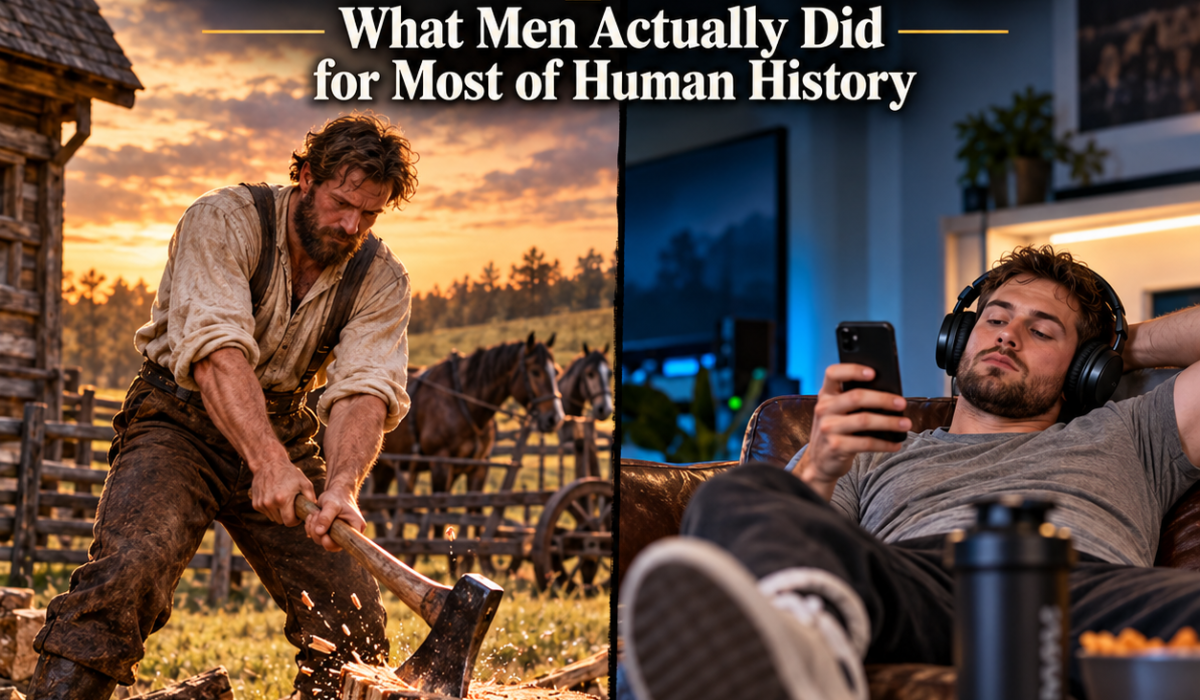

The Man Who Never Split Wood

What Men Actually Did for Most of Human History


Introduction

In Part I, I examined how radically technology transformed women’s domestic labor. I now turn the same unforgiving historical lens toward men, and gentlemen, the comparison is not flattering. Again, for the sake of argument, we will work from the premise of an earth roughly 10,000 years old while recognizing that competing chronologies differ dramatically. The precise number changes nothing essential here. For nearly the entirety of recorded human civilization, the average man lived without automobiles, tractors, chainsaws, power drills, hydraulic equipment, electric saws, furnaces, hardware stores stocked with standardized parts, GPS, computers, telephones, YouTube tutorials, or a cheerful technician arriving Tuesday between noon and four because the toilet makes a funny noise. Civilization was built, cultivated, defended, repaired, transported, and maintained through human muscle, animal power, simple machines, accumulated skill, and an astonishing quantity of sweat.

Modern men inherited the fruits of that labor, and then most of us became spectators. We watch other men build houses on television. We watch other men hunt on YouTube. We pay another man to change our oil, sharpen our blades, repair our fences, replace our faucets, service our furnaces, cut our trees, grow our food, butcher our meat, and assemble the furniture delivered to our front doors. Meanwhile, the average American adult man spends hours each day consuming leisure media, and sedentary employment has replaced much of the occupational movement that characterized agricultural and industrial work. None of this means every historical man was a rugged frontiersman or that every modern man is incompetent (although most are). Specialists, merchants, scholars, clerks, priests, craftsmen, servants, and urban laborers have existed throughout history. But the broad historical pattern is that basic male life demanded a degree of physical capability and practical usefulness that modern infrastructure increasingly makes optional. Scripture’s command is correspondingly unsentimental: “If any would not work, neither should he eat” (2 Thessalonians 3:10).The historical expectation was remarkably simple: a grown man was required to be useful.


I. The Household Needed a Man Who Could Actually Do Things

For most of human history (99+%), a man’s home was not simply the place he returned to after work. His home was part of the work. Land had to be cleared, cultivated, drained, fenced, and maintained. Buildings required construction and constant repair. Wood needed to be felled, cut, split, hauled, stacked, and seasoned. Wells and drainage systems had to be dug. Animals required shelters and fences. Tools broke and needed handles, sharpening, repair, or replacement. Roads deteriorated. Roofs leaked. Wagons broke. Storms knocked things down. Winter arrived every year with absolutely no concern for whether a man was “going through a lot right now.”

American agricultural records illustrate how dominant this world remained surprisingly recently. In 1925, approximately 41 percent of the American workforce was employed in agriculture; by 2000, the figure had fallen below 2 percent. Mechanization transformed what remained. The USDA describes twentieth-century agriculture as undergoing enormous productivity gains as tractors replaced horses and increasingly sophisticated machinery reduced labor requirements. In other words, the disappearance of physically demanding farm labor from average male experience is not some ancient transition. It happened largely within the last few generations.

Before mechanization, however, muscle remained the machinery. The National Park Service’s descriptions of nineteenth-century farming document men plowing, planting, harvesting, constructing and repairing fences, maintaining buildings and equipment, caring for livestock, cutting timber, and performing the seasonal work required to keep farms functioning. Specialized trades existed, certainly, but rural necessity rewarded broad competence. A broken handle did not justify a forty-minute drive to Home Depot. A man repaired it, fashioned another, borrowed one, improvised, or discovered that tomorrow’s work was not getting done.

Scripture assumes this productive relationship between man and creation. Adam is placed in the garden “to dress it and to keep it” (Genesis 2:15). After the Fall, man’s relationship to provision becomes laborious: “In the sweat of thy face shalt thou eat bread” (Genesis 3:19). Paul later commands men to “work with your own hands” (1 Thessalonians 4:11). Biblical masculinity is therefore productive. It cultivates, protects, builds, provides, and maintains.

Strip away electricity, municipal water, supermarkets, mechanics, contractors, delivery services, GPS, power tools, and Google. What remains?

Your great-grandfather’s value to his household could be demonstrated by looking around the property. A depressing number of modern men would demonstrate theirs by pointing toward the Wi-Fi router and announcing that they know how to restart it.


II. Work Was Supposed to Hurt

Modern men frequently describe themselves as “exhausted” after spending eight hours in a climate-controlled building, sitting in an ergonomically engineered chair, staring at illuminated rectangles, and occasionally enduring the savage physical ordeal of walking to the conference room. Mental exhaustion is real, and sedentary work carries genuine health consequences, but historical perspective remains merciless. For most working men throughout agricultural and early industrial civilization, earning tomorrow’s bread required the sustained expenditure of physical strength.

Agriculture meant plowing, digging, sowing, harvesting, threshing, hauling, fencing, cutting timber, handling animals, repairing equipment, and working according to daylight, weather, and season rather than convenience. Industrialization did not immediately rescue men from physical hardship; it frequently relocated it. Men entered mines, foundries, logging camps, railroads, shipyards, mills, docks, construction sites, and factories. The U.S. Bureau of Labor Statistics describes early industrial working conditions as extraordinarily hazardous by modern standards. Around 23,000 industrial workers were killed in workplace accidents in 1913, equivalent to roughly 61 deaths per 100,000 workers. By 2023, the comparable fatal occupational injury rate was 3.5 per 100,000 full-time-equivalent workers.

Hours were different as well. Historical BLS studies show manufacturing employees around the turn of the twentieth century were working approximately 60 hours per week, while six-day schedules remained standard. Agricultural labor could be still less obedient to clocks. Crops did not stop ripening because forty hours had elapsed. Livestock did not recognize weekends. Harvest did not offer paid time off. A man’s workday was determined by what necessity required, and necessity was an employer with a notoriously poor human-resources department. For most of human history a man with a family would work 80-100 hours per week.

Scripture treats strenuous labor as an expected component of provision. Paul reminds the Thessalonians, “neither did we eat any man’s bread for nought; but wrought with labour and travail night and day” (2 Thessalonians 3:8). Proverbs contrasts diligent labor with the poverty produced by sloth: “In all labour there is profit” (Proverbs 14:23). The biblical ideal is not pointless suffering or reckless destruction of the body, but willingness to endure difficulty in pursuit of duty.

Modern machinery has mercifully removed tremendous amounts of physical suffering (for better or worse). But perhaps a civilization in which men once swung hammers for twelve hours can reasonably expect us to survive forty-five minutes at the gym without photographing it.

Our ancestors worked until their bodies became tired. We have become remarkably skilled at becoming tired before our bodies have done anything useful at all.


III. Danger Was Part of the Job Description

Historical masculinity developed in a world where danger could rarely be delegated to somebody else. This does not mean every farmer spent his evenings wrestling bears or repelling marauders from the front porch. Most men, most days, presumably preferred remaining alive. But basic male responsibilities routinely placed men around large animals, axes, saws, firearms, deep water, falling timber, unstable mines, furnaces, heavy machinery, construction, severe weather, and transportation systems with few (if any) of the safeguards modern people regard as normal. When something dangerous had to be done, the expectation was straightforward: men would do it.

The occupational record makes the point. The Bureau of Labor Statistics estimates that approximately 23,000 American workers died from occupational injuries in 1913, producing an estimated death rate around 61 per 100,000 workers. Modern workplace fatalities remain disproportionately male. In recent BLS data, men account for more than 90 percent of fatal occupational injuries, reflecting their continued concentration in dangerous industries such as logging, fishing, construction, transportation, agriculture, extraction, and protective services. The modern man who climbs electrical towers, fights fires, works offshore, cuts timber, mines coal, repairs power lines after hurricanes, or pours concrete forty stories above the street therefore retains something ancient: civilization still depends upon men willing to perform jobs from which sensible people instinctively recoil.

War added another dimension. Across civilizations, military obligation fell solely upon men. American experience alone stretches from colonial militias and the Revolution through the Civil War, two world wars, Korea, Vietnam, and subsequent conflicts. During World War II, more than 16 million Americans served in the armed forces, the overwhelming majority men. More than 400,000 American military personnel died. When the state believed civilization required defending, young men were expected to leave their homes and accept the possibility that they would not return.

Scripture similarly connects masculine duty with courage. David tells Solomon, “Be thou strong therefore, and shew thyself a man” (1 Kings 2:2). Paul commands the Corinthians, “quit you like men, be strong” (1 Corinthians 16:13, KJV). Courage is not the absence of fear; but the subordination of fear to obligation.

Modern civilization has made life extraordinarily soft. Seat belts, building codes, emergency medicine, workplace regulation, fire departments, weather forecasting, engineered machinery, and countless other improvements prevent suffering our ancestors simply endured.

The tragedy is not that modern men face less danger. The tragedy is that some have mistaken safety for the highest masculine virtue. A man need not manufacture unnecessary danger to prove himself. But he should remain the person who can be counted upon when danger arrives. Because when something goes bump in the night, nobody respects the husband who rolls over and whispers, “Honey, would you mind checking that?”


IV. A Husband Was Responsible Whether He Felt Like It or Not

Strength without responsibility is merely an impressive animal. The historical expectation placed upon a husband and father was not simply that he possess muscles, tools, land, or authority, but that he answer for the condition of his household. He was expected to secure provision, maintain property, protect dependents, teach children, plan for scarcity, manage resources, honor obligations, and solve problems before those problems became disasters. Adulthood brought duties that could not simply be abandoned because performing them had become unpleasant.

Provision illustrates the point. Before modern insurance systems, government benefits, consumer credit, pensions, and extensive institutional safety nets, the household carried far more economic risk. A failed harvest, injured animal, damaged roof, lost employment, illness, or winter shortage would become a family crisis. The responsible man therefore had to think beyond today. Grain was stored. Fuel was accumulated. Buildings were maintained. Tools were repaired before they failed completely. Debts mattered. Reputation mattered. Relationships with neighbors mattered. Competence functioned as a form of societal insurance.

Scripture shares this principle. Paul writes, “if any provide not for his own, and specially for those of his own house, he hath denied the faith” (1 Timothy 5:8). Joshua identifies household leadership with spiritual responsibility: “as for me and my house, we will serve the LORD” (Joshua 24:15). Abraham is commended because God knew that he would “command his children and his household after him” to keep the way of the Lord (Genesis 18:19). Biblical fatherhood is therefore not reducible to depositing money into a checking account. Provision matters, but so do instruction, discipline, foresight, example, and government of oneself.

That is where modern masculinity has become embarrassingly theatrical. A man can grow a beard, buy a truck, own seventeen firearms, deadlift impressive numbers, quote Marcus Aurelius on social media, and still leave every meaningful household responsibility to his wife. If everyone around you must compensate for your irresponsibility, your appearance is irrelevant.

Our ancestors faced circumstances we should be grateful not to face. But comfort has not repealed responsibility. A husband with automatic payroll, online banking, municipal utilities, supermarkets, power tools, modern medicine, GPS, insurance, and instant access to information possesses advantages his great-grandfather could scarcely imagine.

He therefore has far fewer excuses. Your family should not have to drag you toward adulthood. The roof may no longer require you to split shingles by hand, and dinner may no longer depend upon what you harvested. But the ancient question remains:

When something goes wrong in your household, are you the man everyone looks toward, or another problem everyone has to manage?


V. Then the Machines Arrived, and Men Got Comfortable Too

The technological revolution did not only liberate women from buckets, washboards, and stove-heated irons. It liberated men from axes, horses, hand drills, crosscut saws, shovels, and enormous quantities of backbreaking labor. Agricultural mechanization transformed farming. Internal-combustion engines replaced animal power. Tractors pulled implements that once required teams of horses and multiple laborers. Chainsaws turned hours of chopping and sawing into minutes. Excavators moved in an afternoon what generations of men once moved with picks, shovels, carts, and aching backs. Pneumatic tools, electric motors, hydraulic equipment, forklifts, cranes, power steering, electric starters, and cordless tools progressively multiplied what one man’s body could accomplish.

Then infrastructure removed still more labor. Furnaces replaced the daily management of household fires. Municipal water eliminated wells and pumps. Automobiles replaced enormous amounts of walking and animal transportation. Hardware stores supplied standardized materials. Professional trades became increasingly specialized. Telephones eliminated journeys made to exchange information. Computers automated calculations and paperwork. GPS meant a man no longer even needed to know where he was. Today, a homeowner can watch a ten-minute instructional video, order the necessary component without leaving his couch, and have it deposited on his porch tomorrow morning. Never in history has practical knowledge been more accessible. And somehow helplessness has increased exponentially.

We now have men who cannot change a tire despite carrying a device containing detailed instructions in their pockets. Men own garages containing thousands of dollars in tools they barely know how to use. Food arrives through an application, entertainment streams continuously into the house, thermostats maintain temperature, lawn equipment propels itself, and automobiles warn us when the tires need air. We have constructed a civilization in which a man can survive while understanding almost nothing about the systems keeping him alive.

That is technological achievement. It is also a spiritual temptation.

Christ’s parable of the talents condemns the servant who receives resources and produces nothing with them (Matthew 25:14–30). The principle extends beyond money: greater resources create greater opportunities for stewardship and greater responsibility. If machinery saves four hours of labor, the question becomes what we do with those four hours. Build something? Study? Train? Teach our children? Serve our neighbors? Strengthen our marriages? Develop another useful skill?

Or spend them playing video games, watching other men play sports while scrolling through videos of other men building things?

Technology should make capable men more capable. A power saw should multiply the carpenter, not replace him. The internet should multiply knowledge, not curiosity’s funeral. Modern prosperity has placed the productive capacity of kings into average hands.

Grandfather split wood because otherwise his children froze to death. His grandson owns a hydraulic splitter, a chainsaw, a pickup truck, heated gloves, and a weather app. And somehow he is still “too tired” to do anything meaningful.


Conclusion: You Inherited the Tools, Now Become Worthy of Them

None of this means the past was some masculine paradise to which sensible men should desperately attempt to return (although it is quite tempting). Men were crushed by machinery, buried in mines, killed by falling timber, crippled on farms, drowned at sea, maimed in factories, and sent home from wars in boxes (when their bodies came home at all.) Their work frequently destroyed their joints, lungs, hearing, backs, and hands. Modern safety standards, medicine, machinery, infrastructure, specialization, and automation could be blessings used to our advantage. Keep the chainsaw. Keep the tractor. Keep the power drill. For the love of all that is good, keep indoor plumbing. The point is that previous generations endured extraordinary difficulty because responsibility demanded it, while we increasingly treat generic inconvenience as though it were extraordinary suffering. They developed competence because incompetence carried consequences. They learned to build, repair, cultivate, navigate, protect, provide, improvise, endure, and finish what they started because households and communities depended upon men who could actually do things. We inherited the civilization those men built, along with machines that multiply our strength, information they spent lifetimes acquiring, medical care they could scarcely imagine, and tools capable of turning a day’s labor into an hour’s work. Our inheritance should have produced more capable men, not useless boys.

The question, therefore, is not whether you can reproduce your great-grandfather’s life. You should not need to. The question is what you are doing with everything he never had. Scripture says, “For unto whomsoever much is given, of him shall be much required” (Luke 12:48). That should haunt men today. You possess transportation faster than kings, information greater than ancient libraries, tools stronger than teams of laborers, communication spanning the planet, food requiring virtually no personal production, and machines performing work that consumed enormous portions of your ancestors’ lives. So what have you built with the difference? Can your family depend upon you? Can you repair anything? Grow anything? Build anything? Protect anyone? Teach your children? Control your appetites? Endure discomfort without becoming insufferable? Put down the telephone and work when nobody is watching? Lead when circumstances are difficult? Finish something difficult simply because it needs finishing? Masculinity has never been about beards, boots, trucks, muscles, weapons, cigars, or posting quotations about bears. It is about becoming the sort of man upon whom other people can safely place weight. We do not need to abandon modern civilization and return to splitting every board with an axe. We need to stop allowing modern civilization to make us soft, passive, dependent, and useless. Your ancestors survived without almost everything you possess. The least you can do is become a man worthy of having it.

The Woman Who Had No Dishwasher

What Women Actually Did for Most of Human History


Introduction

For the sake of this discussion, I am going to work from the premise that the earth is roughly 10,000 years old. I am perfectly aware that some readers will put the number below 6,500 and others will ridiculously add several billion years to it, although that would in-fact only strengthen my argument. Whether you begin the clock six thousand years ago, ten thousand years ago, or six billion years ago, the overwhelming majority of human existence occurred without electricity, automobiles, refrigeration, indoor plumbing, washing machines, telephones, supermarkets, air conditioning, microwaves, dishwashers, Amazon Prime, or a glowing rectangle capable of delivering groceries, gossip, entertainment, and validation without requiring its owner to put on shoes. Modern domestic life is not merely somewhat easier than historical domestic life. It belongs to an entirely different technological universe.

Modern Western civilization has eliminated enormous portions of the physical labor necessary to maintain a household while simultaneously convincing us that minimum basic household life has become unbearably exhausting. Nowhere is the contradiction more striking than in the transformation of women’s domestic work. This is not an argument that women of the past universally lived identical lives. A wealthy Roman matron with servants, an enslaved woman, a medieval peasant, an eighteenth-century farmwife, and a nineteenth-century factory worker occupied radically different circumstances. But across agrarian societies (and particularly among ordinary rural households) the home was not never a place of leisure and consumption. It was a productive economic institution, and the wife/wives was its principal laborer and manager. This historical reality should therefore be understood before declaring that loading six plates into an electric dishwasher after dinner constitutes an unprecedented burden upon womankind.

I. The Household Was a Workshop, Not a Lounge

For most women throughout history, “staying home” did not mean sitting inside waiting for a husband to return. The home was a workshop, kitchen, schoolroom, laundry, dairy, garden headquarters, food-processing facility, textile shop, nursery, infirmary, and small commercial enterprise compressed into one economic unit. National Park Service material on early nineteenth-century American farm women describes women cooking, cleaning, raising children, tending kitchen gardens, caring for poultry and dairy animals, preserving and pickling food, making soap and candles, producing blankets and quilts, sewing and mending clothing, and assisting with work in fields, barns, and forests. Their basic production would supply roughly one-half to two-thirds of a family of 5’s  food, while surplus goods generated cash or barter credit for the things not made/grown by her.

Laundry alone makes the modern complaint department look rather pampered. Without indoor plumbing, fresh water had to be hauled into the household and dirty water carried back out. The Smithsonian documents nineteenth-century laundress Catherine Lynch hauling approximately 25 pails of water for a single load, each weighing about 21 pounds. Clothes were soaked, scrubbed in hot lye (lye that she also made) suds, boiled, repeatedly rinsed, starched, dried, and then ironed the following day. The Library of Congress likewise records women drawing water from rivers, melting snow when cisterns froze, splitting material for fuel when wood ran short, and rubbing clothing against washboards until hands and knuckles bled from the combination of lye and friction. There was no button marked DELICATES, and these women were certainly not “delicate”.

Scripture’s description of the industrious wife was perfectly recognizable in such a world. Proverbs 31 portrays her seeking wool and flax, working with her hands, providing food for her household, planting a vineyard from her earnings, making her arms strong, producing garments, selling merchandise, and watching diligently over her household. She is explicitly contrasted with idleness. This is not the portrait of a dependent, but of productive domestic authority.

Historically, the household consumed only because it produced. Food had to be grown, processed, preserved, cooked, and stored. Clothing had to be produced and maintained. Water had to be obtained. Fuel had to be gathered and fires maintained. Children required instruction and supervision. Animals required daily care. Nothing happened because it was outsourced or done by an appliance overnight.

The historical homemaker did not just “keep house.” In a very real economic sense, she helped manufacture the household’s existence every morning and kept manufacturing it until nightfall.


II. Before the Faucet, the Refrigerator, and the Magic Buttons

Modern women speak of “making dinner” as though preparing the food constitutes the entire operation. Historically, preparing the food was simply the final act of a much longer production. Before a woman could boil potatoes, wash vegetables, make bread, clean dishes, bathe a child, scrub a floor, or wash clothing, she first required two things the modern household receives t invisibly: water and heat. Neither came through a pipe or wire. Both required her labor.

The Library of Congress describes mid-nineteenth-century household life as involving “exhausting physical labor from sunup to sundown.” Women chopped and hauled wood, tended fires, carried and heated water, cooked meals, canned and pickled food, and performed the endless cleaning surrounding those activities. One woman recorded in her 1855 diary, “We have to work ourselves nearly to death to keep victuals on the table.” That sentence should be printed above every modern refrigerator beside the family calendar.

Water might come from a well, spring, cistern, pump, creek, or river. Wherever it came from, it possessed one particularly inconvenient characteristic: it did not walk into the house by itself. Every gallon required somebody to draw it, carry it, store it, use it carefully, and frequently heat it. When the cistern or stream froze, the family resorted to melting snow, an operation one woman summarized with magnificent understatement as “tedious.” Today women become irritated and impatient when the faucet takes twelve seconds to heat up while they are wasting 20 gallons of water..

Then there was fire. Cooking required wood to be cut, gathered, hauled, stored, and continually replenished. Open-hearth cooking meant manipulating heavy pots around flames and hot coals while controlling temperature through experience rather than a digital thermostat. The Library of Congress notes that women boiled food in large pots suspended over fires, baked in covered vessels nestled among coals, and fried in iron pans placed directly over them. Burns and scalds were regular hazards. Cast-iron cooking stoves were increasingly available during the nineteenth century, but they still demanded wood or coal and constant attention.

And after obtaining the food, water, and fire, she then faced preservation. Without electric refrigeration, seasonal abundance had to be transformed into something that could survive the off season: drying, salting, smoking, pickling, fermenting, preserving, and eventually home canning were essential components of domestic economy. Historical scholarship on early American technology consequently treats food preservation as a significant household technology, closely connected to women’s labor and family dietary decisions.

Nor did the woman of the household simply reach beneath the sink for a brightly colored bottle promising to remove grease, disinfect countertops, whiten laundry, and leave everything smelling vaguely like a tropical waterfall. The cleaning products had to be made. In most households, wood ashes (already produced by the fires necessary for heating and cooking) were leached with water to produce an alkaline solution used in cleaning and traditional soapmaking. Fats saved from slaughtering and cooking could then be rendered and combined with lye to produce soap. Historical accounts of household production consequently place soapmaking alongside other basic domestic tasks such as candle making, preserving, spinning, and textile work.

The process was hardly equivalent to ordering a twelve-pack of detergent online: traditional lye mixtures would be caustic, proportions varied, fats required preparation, and the resulting soap required considerable labor before it ever cleaned a shirt, floor, dish, or human being. Even cleanliness had an entire chain of production behind it. The historical housewife not only scrubbed the laundry, scoured the cookware, cleaned the house, and washed the family, she would first have to manufacture the substances with which she did the scrubbing. Modernity quietly eliminated another occupation from the household and then placed the finished product in a plastic bottle beneath the sink. 

Modern civilization has reduced much of this chain to opening a refrigerator, turning a knob, or pressing START, and complaining that the grocery delivery substituted the wrong brand of sour cream. Our foremothers would have regarded the modern kitchen as something approaching sorcery.


III. Your Closet Used to Be a Manufacturing Project

Walk into a modern American home and count the textiles. Shirts, pants, dresses, underwear, socks, towels, sheets, blankets, curtains, tablecloths, children’s clothing, work clothes, winter clothes, the average household possesses a small mountain of fabric that arrived already woven, cut, stitched, dyed, sized, packaged, and ready to use. When something wears out, or even gets a small defect we just replace it. For all of history, however, clothing represented accumulated material, money, and labor. The National Park Service notes that until the middle of the nineteenth century, only the wealthiest women could afford not to sew; for ordinary women, sewing, knitting, and mending were necessary simply to keep the family properly clothed.

Before industrial production, the process would extend far beyond just sewing. Depending upon place, period, and household, textile production involved processing wool or flax, spinning fiber into thread, weaving or obtaining cloth, cutting garments, sewing seams by hand, knitting, patching, darning, and repeatedly altering clothing so that expensive material was reused. Even by the mid-nineteenth century, the Smithsonian notes that 91% of women’s clothing was still custom-made in the home. Sewing machines dramatically accelerated the work after their introduction, but the Smithsonian’s collections explicitly describe them as labor-saving devices that freed time for (naturally) other household chores. Progress had arrived. Congratulations, madam: you may now finish sewing sooner so you can begin washing.

And washing was not “throwing a load in the washer.” Before indoor plumbing, fresh water had to be carried in and dirty water carried out. Household laundry, overwhelmingly women’s work, relied upon tubs, wash sticks, washboards, soaps, physical scrubbing, rinsing, wringing, drying, and finally pressing. The Smithsonian preserves these implements  because laundering was such a substantial component of domestic labor.

Then came ironing. There was no lightweight electric iron with selectable temperature, steam burst, and automatic shutoff. The aptly named sad iron (“sad” deriving from an older sense meaning solid or heavy) was a substantial piece of metal heated for use. Later designs such as Mary Potts’s detachable-handle irons allowed several iron bodies to be heated and rotated through the work, improving efficiency and providing crude temperature management. Such irons remained in manufacture well into the mid twentieth century.

Consider what modern technology has condensed. We purchase finished clothing with a few taps on a telephone. We throw dirty garments into one machine, transfer them to another, and complain bitterly about folding them afterward.

Our great-grandmothers would probably have sympathized. Right after they stopped laughing.


IV. Mother, Teacher, Nurse, and Household Economist

Physical labor was only one small portion of a woman’s historical responsibilities. While bread was rising, clothing needed mending, animals required attention, and tomorrow’s water and fuel still had to be gathered, there remained the inconvenient matter of raising human beings. Children were not sent away into institutional care for eight or ten hours while their mother completed her work. For most of history they lived, learned, worked, worshiped, and matured within the household economy. Mothers therefore performed not only maternal duties but substantial educational, moral, medical, and vocational ones. Children learned prayers, manners, household skills, basic literacy, and the practical competencies necessary for adult life through family and community instruction. In America, for example, childhood instruction occurred in homes, churches, apprenticeships, and small local schools rather than through anything resembling the modern educational system.

The household was also an economic enterprise. Historians have well documented women’s participation in dairy production, poultry keeping, gardening, textile work, food preservation, boarding, market trading, and innumerable forms of home manufacture. The National Park Service notes that nineteenth-century women would contribute between one-half and two-thirds of the family’s food (family of 5-6) while selling or bartering surplus butter, eggs, vegetables, cloth, and other goods for an additional one-third. (nps.gov) A competent wife was therefore not simply consuming her husband’s income while performing chores in exchange. Husband, wife, children, land, animals, tools, and accumulated skills constituted an interconnected productive unit. The household produced most of what it consumed, and exchanged some of its surplus for what it could not produce. Ultimately only purchasing 10-25% of the total goods consumed.

Scripture reflects this economic conception of capable womanhood. The Proverbs 31 woman evaluates and purchases a field, plants a vineyard, manufactures linen garments, sells them, supplies merchants, provides food for her household, and “looketh well to the ways of her household, and eateth not the bread of idleness” (Proverbs 31:27). Her domesticity is government, stewardship, production, and enterprise. And all of this occurred while children were home with her.

There was no daycare drop-off followed by six uninterrupted hours, no grocery delivery scheduled between appointments, no pediatric nurse line, no YouTube tutorial, and no group chat of forty-seven mothers debating whether little Ezekiel’s runny nose required an emergency room. The household was the institution. And the woman was the principal administrator.


V. Then, Almost Overnight, the Machines Arrived

This world did not disappear in some misty, prehistoric age. Our grandparents and great-grandparents lived through its disappearance. In 1940, 60% of American homes still lacked what the Census Bureau now calls “indoor plumbing” – hot and cold piped water, a bathtub or shower, and a flush toilet. By 1950 roughly one-half still lacked it; even in 1960 the figure remained about one-third. The transformation of basic domestic life is not ancient history. There are Americans alive today who were born into homes without facilities we now regard as the minimum requirements of civilization.

Then the machines came, and one by one they began abolishing entire categories of women’s labor.

Consider 1960, hardly the Middle Ages. The Census reported that approximately two out of four American households had a clothes washing machine, meaning mechanized washing had become widespread within living memory. Yet air conditioning was found in only 8% occupied housing units. Most of those had a single air conditioned room rather than central systems. Only 10 percent of Southern homes had air conditioning. The modern American woman who walks from her climate-controlled bedroom into her climate-controlled kitchen, throws clothing into an automatic washer, retrieves food from an electric refrigerator, and complains that the house is two degrees too warm inhabits a domestic environment that would have been luxurious beyond imagination to most women who ever lived.

And every invention eliminated a chain of labor. Running water did not merely eliminate walking to the well; it eliminated every trip associated with every gallon used. The washing machine did not merely replace scrubbing; it replaced soaking, boiling, beating, rinsing, and wringing. Refrigeration reduced the relentless necessity of preservation and altered food storage. Electric and gas ranges removed much of the labor of building, feeding, and regulating cooking fires. Vacuum cleaners mechanized sweeping. Electric irons eliminated stove-heated sad irons. Automobiles reduced miles into minutes. Telephones enabled communication from days into seconds. Supermarkets outsourced enormous portions of food production, processing, slaughtering, preserving, packaging, and storage.

Modern women now spend more time complaining about how hard they have it, how tired they are, and how they have “too much” to do, than they actually spend doing anything productive.

We inherited machines that perform the labor of servants, infrastructure that would have astonished kings, and instant communication that would have appeared supernatural. And somehow we turned all that saved labor into being “overwhelmed” and lazy.


Conclusion: We Have More Help (and Less Excuse) Than Ever Before

None of this requires us to pretend that every woman in history lived the same life, that every woman personally performed every task described in these pages, or that modern women experience no legitimate hardship. Wealthy women had servants; poor women frequently worked both inside and outside their homes; urban households differed from rural ones; and industrialization created its own brutal forms of labor.The argument is the past was far more difficult, yet the women were happier and more content. Daily existence demanded physical competence, endurance, patience, resourcefulness, and a willingness to perform necessary work whether one felt particularly inspired that morning or not. The historical woman could not postpone carrying water because she was emotionally drained by carrying water. The cow remained unimpressed by her anxiety. Bread did not knead itself in recognition of her need for “self-care.” Winter showed no interest in whether splitting kindling felt overwhelming. Necessity imposed discipline because failure produced consequences. Scripture praises this kind of diligent woman: “She girdeth her loins with strength, and strengtheneth her arms” and “eateth not the bread of idleness” (Proverbs 31:17, 27). Strength, productivity, stewardship, and service are treated not as extraordinary achievements worthy of perpetual applause, but as basic minimum characteristics of mature womanhood.

Modern Western women inherited mechanical servants. Water arrives under pressure. Sewage disappears through pipes. Electricity illuminates the night. Machines wash clothing and dishes. Refrigerators preserve food. Climate-control systems defeat summer heat and winter cold. Automobiles erase distance. Supermarkets place the agricultural production of an entire continent at her fingertips. A telephone provides immediate access to husbands, mothers, sisters, friends, entertainment, libraries, maps, banking, shopping, and nearly the accumulated knowledge of civilization. Yet convenience has a peculiar ability to become invisible once we grow accustomed to it. Yesterday’s unimaginable luxury has become today’s minimum expectation, and today’s minimum will become tomorrow’s grievance. Perhaps, then, the lesson our foremothers offer is not that women should abandon washing machines and march toward the creek carrying buckets in some theatrical reenactment of 1850 (although that is certainly tempting). Keep the washing machine. Keep the refrigerator. Praise God for the air conditioner. The lesson is that extraordinary convenience should produce extraordinary gratitude, greater productivity, and higher expectations for what we accomplish with the time technology has returned to us. We possess more tools, more comfort, more information, more mobility, and more assistance than any generation in the history of the world. The appropriate response is to look at everything we have been given, straighten our backs, tend faithfully to the people and responsibilities entrusted to us, and perhaps stop behaving as though folding the laundry after a machine washed and dried it for you constitutes persecution.

The Household as a Kingdom Enterprise

Building the Plural Family for Mission, Specialization, and Generational Dominion


Introduction

Modern Western culture has reduced the household until it is scarcely recognizable as the institution that governed most of human history. The family has become a consumption unit: earn wages elsewhere, purchase nearly everything from strangers, outsource their education, outsource food production, outsource elder care, outsource childcare, outsource health, outsource craftsmanship, outsource charity, and wonder why the household possesses neither economic power nor generational continuity. The biblical household was far more substantial. Abraham’s bayith included children, servants, livestock, property, military capability, commercial activity, and hundreds of trained men; Genesis 14:14 records 318 men born in his house whom he could mobilize. The household was not merely where Abraham slept after work, but an enterprise. Scripture presents family, property, inheritance, production, hospitality, education, worship, and multigenerational purpose as interconnected realities. “A good man leaveth an inheritance to his children’s children” (Proverbs 13:22). That requires considerable vision, sacrifice and coordination.

A genuinely exceptional plural household should therefore ask a question larger than, How many wives may a man have? The more important question is, What could a properly ordered household accomplish with the combined gifts, labor, intelligence, fertility, specialization, and devotion of multiple capable adults united beneath one mission? I propose an eight-division model: one patriarchal office of governance and seven major spheres of household responsibility entrusted to multiple wives (Household & Hospitality, Food & Provision, Children & Education, Health & Fitness, Farm & Stewardship, Commerce & Administration, and Culture, Ministry & Community.) Seven wives are not presented here as a universal biblical command, nor as a magic number guaranteeing righteousness. A household of fewer can certainly accomplish extraordinary things, and a household of seven incompetent people can accomplish the astonishing feat of producing seven times the confusion and destruction. The principle is capacity organized under purpose. When responsibilities exceed personnel, existing members are forced to carry the load of multiple positions. When God provides additional capable people, specialization increases. And when a patriarch possesses no mission requiring greater capacity, collecting wives merely to possess wives is not kingdom building, but vanity.


I. The Household Is an Institution, Not a Collection of Competitors

The first conceptual error is the assumption that adding another capable woman to a plural household diminishes the women already there. That assumption assumes marriage is a contest for scarcity rather than a cooperative institution ordered toward a common mission. Paul gives us a useful organizational principle when describing the Church: “the body is not one member, but many” (1 Corinthians 12:14). The eye cannot tell the hand, “I have no need of thee” (12:21). Different abilities make the body possible. Likewise, Paul rejoiced when Stephanas, Fortunatus, and Achaicus arrived because “that which was lacking on your part they have supplied” (1 Corinthians 16:17). Their contribution was valuable precisely because they supplied something currently deficient. Apparently Paul did not consider recognizing a deficiency an assault on everybody’s self-esteem.

This principle is basic wisdom everywhere except, curiously, wherever modern romantic assumptions are permitted to overrule it. A competent business owner does not hire a bookkeeper who is worse with numbers than he is so that his ego can remain intact. He hires expertise. Organizations derive enormous benefit from specialization because division of labor permits individuals to concentrate upon areas in which their knowledge, aptitude, and experience create greater productivity. Adam Smith illustrated the economic consequences of specialization with the pin factory in The Wealth of Nations (1776): dividing production into specialized operations dramatically increased output. A household is not a pin factory, obviously, and wives are not employees. The analogy concerns organization. Complex missions are more capable when responsibilities are deliberately distributed among competent people.

That means the arrival of a woman who cooks better than the current cook, teaches mathematics better than the current teacher, understands accounting better than the administrator, or possesses agricultural knowledge nobody else has should not be seen as a threat. She should constitute an acquisition of capability. Proverbs 31 describes the excellent wife as economically and domestically formidable: she evaluates a field and buys it, plants a vineyard, conducts commerce, provides food, manages her household, produces goods, serves the poor, and teaches wisdom. Her competence strengthens her husband rather than threatening him: “The heart of her husband doth safely trust in her” (Proverbs 31:11).

The same reasoning applies among wives. Another woman’s excellence does not erase yours. Her strength becomes household strength. If she knows what you do not, learn from her. If she excels where you excel, sharpen one another. If she supplies what the household lacks, thank God that the deficiency has been supplied.

This is why recruitment should not be imagined as the husband’s solitary pursuit. When an enterprise is understaffed, good members frequently know good candidates. They recommend friends, relatives, colleagues, and people whose character and abilities they have observed firsthand. A mission-oriented plural household has even greater reason to think cooperatively. A wife who recognizes that the family’s expanding educational, agricultural, administrative, hospitality, or ministry responsibilities exceed present capacity should be able to say, without jealousy or reservation, “We need another capable woman.” That is maturity.

The objective, however, must remain the mission. More people multiply whatever already exists. Order can become greater order; disorder can become industrial-scale disaster. Therefore the patriarch’s responsibility is to ensure that every addition strengthens its character, capacity, unity, and service to God. Christ’s principle remains decisive: “unto whomsoever much is given, of him shall be much required” (Luke 12:48). A larger household is a larger stewardship.


II. Why Seven? Scale, Specialization, and the Eight-Division Household

Why seven wives? First, let us dispose of an argument I am NOT making. Scripture nowhere commands every man (or any man) to acquire seven wives, nor does Isaiah 4:1 establish a universal household staffing requirement merely because seven women appear in the prophecy. Biblical numerology certainly makes seven an interesting number (creation itself establishes the seven-day pattern) but symbolism is not to be confused with legislation. The argument here is organizational: if we attempt to identify the major recurring responsibilities necessary for a large, productive, multigenerational household, they are arranged into eight broad divisions: one governing office under the husband and seven operational spheres capable of being entrusted to seven wives. 

The first division belongs to the husband: Patriarch & Governance. His responsibility is direction, spiritual leadership, protection, judgment, capital allocation, long-range planning, conflict resolution, and coordination of the whole. The seven operational divisions are Household & Hospitality; Food & Provision; Children & Education; Health & Fitness; Farm & Stewardship; Commerce & Administration; and Culture, Ministry & Community. Together these encompass the complete life of a serious household: its home, table, children, bodies, productive property, finances, relationships, traditions, and mission. Each wife may become the principal steward of one sphere without becoming its solitary laborer. A chief financial officer does not personally enter every receipt; neither must the wife overseeing Food & Provision personally peel every potato. Leadership means ensuring the work is organized and accomplished.

The advantage is specialization. Economists have recognized for centuries that division of labor increases productive capacity, while modern organizational research likewise distinguishes between simply adding personnel and structuring complementary expertise. Scripture expresses the underlying principle beautifully: “Two are better than one; because they have a good reward for their labour” (Ecclesiastes 4:9). The passage continues, “a threefold cord is not quickly broken” (4:12). Cooperative strength allows coordinated people to accomplish things none could accomplish efficiently alone.

Yet the model remains scalable. A man with one wife still possesses all eight divisions; he and his wife simply wear several hats each. With three wives, responsibilities are consolidated into larger portfolios. With five, specialization increases further. With seven, each major operational division can theoretically have a dedicated steward. A vacant position does not mean the family ceases functioning any more than a company closes because its secretary resigned last Tuesday. Responsibilities are temporarily redistributed until greater capacity becomes available.

This also explains why more is not automatically better. Adding personnel without increasing competence, character, resources, governance, or mission produces bureaucracy or chaos. Seven wives require a husband capable of governing a considerably more complex household, just as a company employing seventy people requires more leadership ability than a man operating alone from his garage. Scripture’s principle that “to whom men have committed much, of him they will ask the more” (Luke 12:48) applies here.

Therefore the exceptional plural household should never measure success by headcount. Measure it by stewardship, fruit, capability, children raised well, people served, resources produced, wisdom transmitted, and generations prepared to continue the mission. Seven wives may permit extraordinary specialization. But seven is capacity, not accomplishment. The accomplishment is what that household builds with it.


III. Recruiting Strength: Why Excellence Should Be Welcomed, Not Feared

If the plural household is genuinely organized around mission, then an important cultural principle must be established early: another woman’s excellence is not your deficiency. Her ability to do something better than you does not make you less valuable; it makes the household more capable. Paul asks, “Are all apostles? are all prophets? are all teachers?” (1 Corinthians 12:29). The obvious answer is no. Human beings possess different gifts, temperaments, experiences, and aptitudes. A wise institution organizes them. This is why competent business owners routinely hire people who outperform them in particular fields. The entrepreneur who cannot keep books hires an accountant. The visionary who struggles with operations finds an administrator. The farmer consults the veterinarian; the physician hires the mechanic. Only an extraordinarily insecure man insists that everyone surrounding him must be less capable than himself, and this principle applies likewise to women.

The same principle should be applied within a plural family. Suppose one wife is an exceptional educator but mediocre gardener. Another understands livestock, soil, orchards, and food production. A third possesses unusual administrative ability; spreadsheets apparently bring her joy, proving once again that God creates all sorts of people for reasons beyond our understanding. A fourth may excel at hospitality, another at nutrition and physical training. Their differences, properly ordered, are the mechanism by which unity is productive. Romans 12 describes differing gifts (teaching, ministry, giving, ruling, mercy) while commanding each to exercise his gift diligently (Romans 12:4–8). Biblical unity never requires identical ability or competition.

This radically changes how prospective additions to the household should be considered. Character, faith, compatibility, wisdom, and genuine marital commitment remain indispensable; a wife is obviously not an employee hired from a résumé. Nevertheless, capability matters. A patriarch pursuing a substantial generational mission must reasonably consider what a prospective wife contributes to that mission, just as she should consider whether joining that household enables her gifts to bear greater fruit. Proverbs 31 praises such productive competence. The virtuous woman strengthens rather than merely occupies her household.

The implication: existing wives should become recruiters rather than gatekeepers. If the family has outgrown its present capacity, who understands its needs better than the women already carrying the workload? Businesses routinely encourage trusted employees to recruit and recommend strong candidates because good people frequently know other good people. A wife may know a woman of proven character whose gifts would beautifully complement the household. Why should her first instinct be, “Keep her away,” rather than, “Could she strengthen what we are building?”

Jealousy is a terrible organizational philosophy. Scripture commands believers to reject envy and selfish rivalry (Philippians 2:3; James 3:16). That does not mean we should ignore relational difficulties or pretend affection can be managed like payroll. Marriage involves covenant, intimacy, trust, and human hearts. A prudent patriarch therefore does not weaponize “the mission” to bulldoze legitimate concerns. Good governance listens, judges, and builds unity.

But neither should fear become sovereign. If another woman’s virtue, intelligence, strength, or competence threatens us simply because it exceeds our own, the problem is not her excellence. A kingdom-minded household will cultivate the opposite instinct: Bring us people who make us stronger. Bring the teacher who teaches better, the gardener who grows more, the administrator who organizes what others overlook, and the woman whose gifts supply what is presently lacking. As Paul said of Stephanas, Fortunatus, and Achaicus, “that which was lacking on your part they have supplied” (1 Corinthians 16:17).

That is reinforcement. A household serious about accomplishing something larger than itself must know the difference.


IV. One Household, Many Divisions: Authority, Cooperation, and Filling the Gaps

Specialization is useful only when specialized parts remain subordinate to the whole. A household divided into many major spheres must therefore never become competing kingdoms sharing an address. There is one household, one mission, and one governing structure. The divisions exist only to clarify responsibility. Paul employs this logic when describing the body: “For as the body is one, and hath many members… so also is Christ” (1 Corinthians 12:12). The hand performs one function, the eye another, yet neither possesses an independent mission. Likewise, the wife responsible for Children & Education should possess meaningful authority within that sphere, but education must still coordinate with the family’s spiritual objectives, finances, health standards, agricultural work, calendar, and overall direction established by the husband. A department that refuses coordination has ceased functioning as a department is no longer contributing to the mission.

This is why every division requires both ownership and permeability. Ownership means somebody is accountable. Household & Hospitality does not become “everyone’s responsibility” in the conveniently modern sense that usually means nobody noticed the bathroom was out of toilet paper. One wife owns the system. Food & Provision has a steward. Health & Fitness has a steward. Commerce & Administration has a steward. Yet stewardship does not mean every task within that category belongs exclusively to her hands. The wife overseeing Food may assign children to pantry inventory, ask another wife to prepare supper while she is ill, coordinate nutritional requirements with Health, and request produce forecasts from Farm & Stewardship. Her responsibility is not personally doing everything. Her responsibility is making certain everything gets done.

This is particularly important when positions are vacant. A household with one, two, three or four wives does not somehow possess only four of the eight divisions. It possesses all eight responsibilities because reality does not eliminate accounting, education, cooking, maintenance, and health simply because nobody has been assigned a dedicated position. The existing adults absorb those functions. Perhaps one wife oversees Household, Hospitality, and Food; another manages Education and Culture; another carries Health, Farm, and portions of Administration. The husband may temporarily absorb bookkeeping or agricultural management himself. This is precisely what happens in growing enterprises. Vacant positions create additional workload disrupting the productivity and slowing the growth, ultimately hindering the mission.

As the household expands, however, responsibilities can be progressively separated. Organizational scholars describe this process as increasing specialization: growth creates enough complexity and workload to justify narrower roles. The small business owner initially answers phones, sells products, pays invoices, cleans the office, and probably unclogs the toilet because apparently “Chief Executive Officer” is Latin for the problem eventually becomes yours. Growth permits those responsibilities to be delegated to people better positioned to perform them. Household growth operates similarly. Additional capable wives will reduce role overload while increasing expertise, resilience, and productive (even reproductive) capacity.

There should consequently be deliberate overlap and cross-training. Ecclesiastes says, “if they fall, the one will lift up his fellow” (4:10). A family should never become so specialized that only one person knows how to perform any essential function. The administrator should not be the sole human being capable of locating insurance documents. The Food steward should not take the secret of breadmaking to the grave. The Education steward should maintain records others can understand. Competence should spread throughout the household even while accountability remains concentrated.

Above these divisions stands the patriarchal office, whose purpose is coordination. Exodus 18 provides a useful administrative principle when Jethro warns Moses that attempting to personally handle every matter would wear him away and counsels delegated responsibility (to 70 people) (Exodus 18:17–23). Delegation made Moses’s authority sustainable. Likewise, a husband who insists upon personally deciding every tiny purchase, curriculum adjustment, garden row, medical appointment, and linen rotation has constructed an administrative hostage situation.

His task is to establish mission, standards, priorities, resources, boundaries, and accountability; appoint responsibility intelligently; resolve conflicts between divisions; evaluate results; and intervene where necessary. Authority should produce order that permits capable people to act. The result is neither eight autonomous individuals nor one exhausted man attempting to perform eight jobs, but a coordinated household in which responsibility is identifiable, assistance is expected, vacancies are absorbed, strengths are cultivated, and every division understands that its ultimate purpose is the flourishing and mission of the whole family.

That is how a household stops merely surviving together and builds a legacy together.


V. Greater Capacity, Greater Accountability: Building a Household Worth Multiplying

The strongest argument for a large plural household is that, under exceptional leadership and united around an exceptional mission, many capable adults will accomplish more than a smaller household ever could. Scripture states the governing principle: “For unto whomsoever much is given, of him shall be much required” (Luke 12:48). More wives, more children, more land, more income, more businesses, and more influence are therefore liabilities on the stewardship ledger until they are converted into fruit. The patriarch who desires multiple wives because multiple wives sound impressive has misunderstood the proposition. The question is what comes out of that household and enters the Kingdom because they sat there together.

Historically, powerful households were productive institutions because they concentrated people, skills, property, and generations around common interests. Biblical patriarchal households would encompass agriculture, livestock, servants, trade, hospitality, defense, inheritance, and religious instruction. Abraham’s household was substantial enough that Genesis 14:14 records 318 trained men “born in his own house” whom he mobilized to rescue Lot. The point is not that every Christian family should maintain a private infantry regiment (although that’s not a bad idea) but that the biblical house should possess extraordinary institutional capacity. Abraham was stewarding something considerably larger than a modern nuclear family, and his legacy still thrives.

A well-ordered plural household will similarly convert scale into impact. Multiple specialized wives will allow one household simultaneously to educate numerous children, cultivate significant acreage, preserve food, operate businesses, maintain rigorous health standards, practice extensive hospitality, care for aging relatives, disciple younger people, support charitable work, produce intellectual or artistic work, and build assets intended to survive several generations. The economic concept of economies of scale is relevant here: resources become more productive when shared across a larger organization. One kitchen can feed many people. One farm can employ many hands. One library can educate many children. Vehicles, equipment, land, workshops, businesses, and administrative systems will serve an entire extended household rather than being redundantly recreated in numerous isolated homes.

Children multiply the implications further. Psalm 127 calls children “an heritage of the LORD” and compares them to “arrows in the hand of a mighty man” (vv. 3–4). An arrow, however, is useful because it is deliberately formed, aimed, and sent. A large household producing many poorly trained children has not created a great legacy, but disgrace. Legacy requires formation. Children must inherit faith, discipline, knowledge, productive skills, family history, property where possible, and an understanding that they received an inheritance partly so they might enlarge it for those who follow.

This is why the eight-division model ultimately concerns much more than domestic efficiency. Household & Hospitality creates a place capable of receiving others. Food & Provision establishes abundance and security. Children & Education transmits knowledge. Health & Fitness develops capable bodies. Farm & Stewardship converts creation into productive resources. Commerce & Administration preserves and multiplies assets. Culture, Ministry & Community carries the household’s influence outward. And Patriarch & Governance keeps every sphere pointed toward a common destination and “on mission”. Seven wives are therefore seven potentially formidable stewards participating in one consequential household.

But scale magnifies failure as efficiently as it magnifies success. A weak patriarch with one disordered relationship will not become stronger by acquiring an additional (or six additional) relationships. Financial irresponsibility multiplied by multiple people remains irresponsibility, now on a wholesale scale. Favoritism, poor communication, laziness, unresolved jealousy, deficient provision, and arbitrary leadership will become progressively more destructive as the household grows. Scripture’s qualification for leadership is therefore relevant in principle: a man must be one who “ruleth well his own house” (1 Timothy 3:4). Paul’s organizational logic is unmistakable: competence demonstrated in the household precedes greater responsibility.

The exceptional plural family should consequently expand only because its mission requires capacity. Growth should follow demonstrated stewardship. When responsibilities are overflowing because the household is producing, teaching, serving, cultivating, building, hosting, ministering, and preparing another generation, additional strength has somewhere meaningful to go. Then another capable wife does not merely make the family bigger. She makes its reach broader, its work deeper, its weaknesses fewer, and its future stronger.

The goal is therefore not seven wives, the goal is a household worthy of seven regardless of how many God ultimately adds.


Conclusion: The Measure Is the Mission

The case presented here is not an argument that every man needs seven wives (many do not deserve one), nor that every successful plural household must conform mechanically to an eight-division organizational chart. This is simply an argument for intentional household government. Every family already possesses responsibilities involving leadership, home, food, children, health, productive resources, administration, culture, and community whether anybody has bothered to name them or not. A small household combines those responsibilities among fewer shoulders; a larger household should increasingly specialize them. The proposed patriarch-plus-seven model simply carries that principle toward its logical organizational conclusion: seven major spheres, ordered under one governing patriarch, one household, and one mission. Vacancies can be covered. Responsibilities can overlap. Gifts can be shared. Divisions can be reorganized as circumstances require. But the governing attitude must remain that expressed by Paul: “that which was lacking on your part they have supplied” (1 Corinthians 16:17). The wise household therefore cannot resent the person who supplies what it lacks. It welcomes strength. A wife need not fear the woman who can teach better than she can, keep books better than she can, cultivate land better than she can, or accomplish some task she cannot accomplish at all. Neither should the husband surround himself with women selected because they will never challenge his competence. Weak men collect dependents; capable patriarchs cultivate capable people. If another woman can strengthen the household, advance its mission, bless its children, relieve overloaded members, and contribute gifts presently absent, her excellence is additional capital entrusted to the family. And a mature wife who sees a genuine deficiency should be capable not merely of tolerating reinforcement when it arrives, but even of helping identify it. If businesses understand that good people recruit good people, surely a household claiming to pursue something more consequential than quarterly earnings can grasp the same elementary principle.

But with that vision comes an equally severe warning: do not build a large household merely for admiration or attention. Seven wives (or even a second wife) will not transform a purposeless man into a patriarch any more than hiring multiple executives will transform a man without a product into an industrialist. Multiplication magnifies what already exists. It can multiply order, production, hospitality, education, wealth, children, charity, ministry, resilience, and generational influence, or it can multiply debt, neglect, rivalry, confusion, disorder, and spectacularly complicated dysfunction. Christ’s warning hangs over the entire model: “For unto whomsoever much is given, of him shall be much required” (Luke 12:48). A man pursuing greater household capacity should first possess something worthy of that capacity: a calling, a direction, demonstrated discipline, provision, wisdom, justice, and a mission large enough to require additional hands. Then the question is no longer, How many wives may I have? but, How much good could this household accomplish if every person God entrusted to it were deliberately organized, equipped, valued, and deployed according to her strengths?

A farm may become an inheritance. A table may become hospitality for hundreds. A schoolroom may shape generations. Businesses may finance ministry. Children may carry the family’s faith and accumulated wisdom farther than their parents ever could. Multiple women of character and ability, united with a capable husband beneath a common purpose, represents a potentially extraordinarily productive household institution. The number is not the achievement. The household is not the mission. The household is the instrument. The measure is the fruit, and the mission is the Kingdom of God.

Why Christians Must Stop Following the Stars

Astrology, Horoscopes, Zodiac Signs, and the Christian’s Flirtation with Divination


Introduction

Christians have developed an impressive talent for taking practices Scripture condemns, sanding off the pagan vocabulary, wrapping them in pretty graphics, and pretending God doesn’t really mind. Astrology is a particularly embarrassing example. We will confess that God created the heavens, governs creation, knows the future, numbers the hairs upon our heads, and directs the steps of men, and then, asks the local witch whether being a Scorpio explains why we are moody on Tuesdays. Christians read horoscopes, discuss zodiac compatibility, blame personality defects on Mercury being in retrograde, and casually identify themselves by astrological signs as though the Almighty assigned His children celestial personalities. “I’m a Christian; I don’t believe in astrology. I just check my horoscope.” Splendid. And presumably one might consult a medium just because Grandma was interesting to talk to.

The problem is considerably more serious than silly newspaper predictions. Astrology is an ancient system of divination: an attempt to derive hidden knowledge concerning human affairs, character, destiny, relationships, and/or future events from celestial phenomena. Its historical roots stretch deep into the pagan religious cultures of Mesopotamia, where heavenly bodies were associated with divine powers and celestial events were interpreted as communications concerning earthly affairs. Scholars trace systematic Mesopotamian celestial divination into the second millennium BC, while the zodiacal and horoscopic forms familiar to later civilizations developed during the first millennium BC before passing into the Hellenistic world. The biblical answer was to distinguish between looking at the heavens to behold the works of God and looking to the heavens for knowledge that belongs to God. The former is worshipful observation. The latter is divination. And Christians need to recover enough theological backbone to know the difference.


I. Astrology Is Divination, Not Harmless Entertainment

Before Christians are able to think clearly about astrology, they must stop allowing modern vocabulary to conceal ancient practices. “Zodiac sign” sounds whimsical. “Horoscope” sounds like something printed beside the crossword puzzle. “Compatibility chart” sounds almost scientific. But the underlying proposition is: the configuration of celestial bodies at or around your birth supposedly reveals information about your personality, relationships, tendencies, opportunities, or destiny. That is an attempt to acquire otherwise hidden knowledge through interpretation of celestial signs. Historically, that is what astrology was. Mesopotamian scholars observed celestial phenomena as signs carrying significance for events on earth; by the late first millennium BC, Babylonian scholars had developed zodiacal astrology and horoscopy that connected celestial configurations with individual human circumstances. Calling it “just for fun” does not alter what the practice actually is.

Scripture condemns attempts to obtain supernatural knowledge through unauthorized means. Deuteronomy 18:10–12 prohibits divination, fortune-telling, interpreting omens, sorcery, mediums, and related practices. The theological principle is clear: God’s people are not permitted to shop around in the spiritual marketplace for alternative sources of hidden knowledge. Isaiah even mocks Babylon’s dependence upon astrologers: “Let now the astrologers, the stargazers, the monthly prognosticators, stand up, and save thee” (Isaiah 47:13, KJV). The sarcasm is biblical, so I feel entirely comfortable borrowing some. Where exactly were those magnificent celestial consultants when Babylon needed them? Apparently Saturn had neglected to update the emergency evacuation horoscope.

This also prevents a common objection. Genesis 1:14 says the heavenly lights are for “signs, and for seasons, and for days, and years.” Yes. The heavens genuinely communicate something. Psalm 19 says that they “proclaim the glory of God.” Celestial bodies establish calendars, mark seasons, aid navigation, and display extraordinary order within creation. None of that means Mars determines whether you should marry Jennifer. God assigning legitimate functions to heavenly bodies does not authorize men to invent additional ones.

Indeed, the Christian objection is stronger when astrology is subjected to ordinary empirical scrutiny. In a famous 1985 Nature study, Shawn Carlson conducted double-blind tests of natal astrology designed with input from both scientists and astrologers. The study tested whether natal charts could accurately characterize personality, under conditions intended to address objections from practicing astrologers; the results failed to establish the claimed astrological ability. So the Christian is confronted with something remarkable: astrology asks us to entertain a method rooted historically in pagan divination, condemned in principle by Scripture, and unable to demonstrate its central claims reliably under controlled testing. That is quite a résumé.

The question is why a Christian would deliberately consult a system built upon a premise fundamentally alien to biblical revelation. God commands His people to seek wisdom from Him. The stars are magnificent servants. They make terrible prophets.


II. The Zodiac Has a Pedigree, and It Is Not Christian!

If we are going to invite an idea into the Christian household, it seems reasonable to ask where it came from. Astrology does not descend from Moses, the prophets, Christ, or the apostles. Its ancestry lies substantially in the divinatory traditions of the ancient pagan world, particularly Mesopotamia. Written evidence for Mesopotamian astrology reaches back into the third millennium BC, while systematic observation of celestial phenomena as omens developed during the Old Babylonian period. By the Neo-Assyrian era, court scholars routinely watched the heavens and reported perceived celestial messages to kings. Historian M. Willis Monroe notes that astrology functioned alongside other forms of divination as a means by which messages attributed to the gods were supposedly decoded. So when Karen announces that she cannot date a Capricorn because “the universe is warning her,” she is recycling, in considerably cheaper packaging, an ancient system of pagan divination.

The familiar twelve-part zodiac emerged from this Mesopotamian intellectual environment. Scholars trace the uniform zodiac (twelve equal sections of thirty degrees) to Babylonia in roughly the late fifth century BC. Around the same period, Babylonian scholars developed horoscopy: using the positions of the sun, moon, and planets within this zodiacal framework to make claims about individual lives and earthly events. This tradition subsequently traveled beyond Babylonia and became deeply influential in the Greco-Roman world. The modern zodiac developed historically from cultures in which celestial phenomena, religion, omens, and divination were intimately intertwined. Mesopotamian sources treated planets as gods or manifestations of gods and celestial events as signs through which the gods communicated with humanity.

Early Christians consequently had good reason to regard astrological fatalism as incompatible with their faith. Augustine knew the attraction personally: before his conversion matured, he consulted astrologers. He later condemned the practice and attacked the idea that human conduct could be blamed upon Venus, Saturn, or Mars. In On Christian Doctrine, he described natal astrology as superstition that placed men into bondage to the stars. His objection exposes the theological issue beautifully. Christianity declares that the heavens are creation; astrology continually tempts man to treat creation as an oracle (worshiping the creation in lieu of The creator). Christianity tells man to seek the Creator; astrology teaches him to interpret created objects for secret knowledge about himself. Christianity grounds human identity in God, moral responsibility, providence, wisdom, and obedience; astrology inverts portions of those things into celestial machinery. Christians should therefore stop asking whether astrology seems entertaining and ask the more uncomfortable historical question: Why are people redeemed from paganism still consulting paganism’s oldest methods for interpreting their lives? The zodiac may have received prettier fonts, smartphone apps, and Instagram graphics. Its family tree has not changed.


III. Scripture Does Not Leave Astrology in a “Gray Area”

Christians sometimes discuss astrology as though Scripture does not address the matter and we are therefore left squinting into a theological fog. We are not. Deuteronomy 18:10–12 expressly forbids divination, fortune-telling, and the interpretation of omens, describing such practices as an “abomination unto the LORD.” Leviticus 19:26 likewise forbids enchantment and the “observing” of times. The prohibition is broader than any single technique because the underlying offense is broader: man attempts to obtain hidden knowledge through a means God has not appointed. Astrology fits comfortably within that category. A horoscope is, after all, a forecast supposedly derived from celestial configurations. Adding a glittery constellation and calling it “zodiac guidance” does not magically transform divination into Christian recreation.

Jeremiah is even more uncomfortable for the Christian astrologer: “Learn not the way of the heathen, and be not dismayed at the signs of heaven” (Jeremiah 10:2, KJV). Isaiah 47:13–14 is more devastating still. Addressing Babylon, the prophet mocks its astrologers, stargazers, and monthly prognosticators, challenging them to save the nation from approaching judgment. They cannot (of course). Daniel makes essentially the same theological distinction before Nebuchadnezzar. The king’s astrologers, magicians, and diviners cannot reveal his mystery, “but there is a God in heaven that revealeth secrets” (Daniel 2:28). There is the dividing line: hidden knowledge belongs to God. The biblical answer to uncertainty is dependence upon divine revelation, wisdom, prayer, providence, and obedience.

Then comes the inevitable objection: “But the Magi followed a star!” Indeed they did. Matthew 2 records an extraordinary celestial sign announcing an extraordinary historical event: the birth of the King. It does not record the Magi calculating whether Mary and Joseph were romantically compatible because she was a Virgo and he had unfortunate Saturn energy. A sovereign act of God employing a celestial sign (for navigation) does not establish a general system whereby planetary positions reveal everyone’s personality and future..

The Bible’s position is remarkably coherent. The heavens declare God’s glory; they do not replace His counsel. God may sovereignly use signs in His creation, but man is not thereby authorized to construct systems of divination from them. Christians are commanded to trust the Lord, seek wisdom, test spirits, obey revelation, and acknowledge God’s providence. The stars have a biblical purpose. They point upward toward their Creator.


IV. Astrology Feels “Accurate” Because Human Beings Are Remarkably Easy to Impress (Deceive)

“But my zodiac description is so accurate.” Of course it is. It was designed to feel accurate. Astrology survives partly because human beings possess an extraordinary ability to recognize themselves in sufficiently broad descriptions. Psychologist Bertram Forer demonstrated this beautifully in his famous 1949 experiment on what he called the “fallacy of personal validation.” Students completed a personality test and were subsequently given what they believed were individualized personality assessments. In reality, every student received the same generalized profile. Nevertheless, the students overwhelmingly (92%) regarded the supposedly personalized description as accurate. Forer’s point was: our subjective recognition of ourselves in a personality description is not evidence that the method producing it is valid.

This phenomenon became known as the Forer Effect, or Barnum Effect, and astrology practically begs to demonstrate it. Tell someone, “You value independence, but sometimes desire reassurance from others,” and congratulations, you have successfully described approximately everybody who has ever survived adolescence. Tell him that he can be outgoing in comfortable situations but reserved around unfamiliar people, and suddenly Saturn has cracked the mysteries of his soul. In a 1980 experiment specifically involving astrology, eighteen students were told that an astrologer would construct personality profiles from their birth information. They were actually given identical profiles, yet again, showed a high level (94%) of acceptance of the supposedly individualized descriptions.

Astrology also benefits from confirmation bias. We naturally notice information that confirms existing expectations while discounting contradictions. Read ten vague predictions, encounter two things that vaguely resemble them, and those two become evidence that “my horoscope was freakishly accurate.” The other eight disappear down the memory hole. Better still, horoscope language is commonly elastic enough that failure itself can be reinterpreted as success. This is a practice that possesses all the accountability standards of a crooked used-car salesman.

More importantly, when astrological claims have been subjected to controlled testing, the impressive mystical fog completely evaporates. Shawn Carlson’s well-known double-blind experiment, published in Nature in 1985, tested the proposition that natal charts could accurately describe subjects’ personality traits. The study was designed with astrologers involved in establishing experimental procedures and subjected astrological claims to blinded testing rather than relying upon personal impressions. The results did not support the astrologers’ claimed ability.

None of this proves that every astrologer is deliberately dishonest. Something more mundane (and perhaps more instructive) is happening. People are excellent pattern-seeking creatures and poor judges of systems that flatter their expectations. Scripture therefore warns, “The simple believeth every word: but the prudent man looketh well to his going” (Proverbs 14:15). Christianity requires us to not be intellectually gullible and lazy. If astrology supposedly reveals objective truths about personality, compatibility, and destiny, then its claims should survive objective examination. 


V. “Just for Fun” Is a Terrible Excuse for Pagan Worship

At this point someone inevitably retreats to the final defensive position: “I don’t actually believe in astrology. I just read horoscopes for fun.” But Christians should ask why divination is acceptable just because we consume it recreationally. Scripture does not teach believers to experiment casually with practices opposed to biblical worship provided they maintain sufficient irony while doing so. Paul tells Christians to “prove all things; hold fast that which is good” and “abstain from all appearance of evil” (1 Thessalonians 5:21–22, KJV). In Ephesus, converts who had practiced magical arts did not preserve their occult literature as amusing coffee-table material; Acts 19:19 records that they publicly burned it. Their conversion produced separation from their former practices, not a Christianized fascination with them.

There is also a subtler danger: astrology relocates identity. Scripture describes Christians according to categories such as creation, sin, redemption, character, calling, obedience, gifts, wisdom, and union with Christ. Astrology introduces an alternative anthropology in which personality becomes partially explained by celestial circumstances at birth. Suddenly impatience is “because I’m an Aries,” emotional volatility belongs to being a Cancer, and relational incompatibility can be blamed on conflicting signs. Convenient, certainly. Yet Christianity insists upon moral agency. “Every one of us shall give account of himself to God” (Romans 14:12). Your temperament may influence your struggles; it does not excuse your sins. And Jupiter will not be appearing beside you at judgment to explain your communication problems.

The same corruption enters relationships and decision-making. Zodiac compatibility encourages people to evaluate potential spouses, friendships, conflicts, and personalities through categories possessing neither biblical authority nor reliable empirical foundation. Even casual exposure can normalize those categories until someone begins saying, “I know it’s silly, but…” immediately before allowing it to influence an actual judgment. Research on superstition more broadly has shown that people resort to superstitious practices particularly under circumstances involving uncertainty or perceived lack of control. That should concern Christians, because uncertainty is where faith is supposed to operate.

The Christian alternative is not ignorance of the heavens. Study astronomy. Learn the constellations. Understand planetary motion. Stand beneath a genuinely dark sky and become appropriately small. “The heavens declare the glory of God; and the firmament sheweth his handywork” (Psalm 19:1). But admire the stars without asking them for counsel. They are creations, not counselor.

And perhaps that is astrology’s deepest theological insult. God made the stars to declare His glory, and fallen man has somehow managed to make them declare ours. We took a universe pointing toward its Creator and turned it into a personality quiz. Christians, of all people, should know better.


Conclusion: Stop Following the Stars and Follow the One Who Made Them

Strip away the memes, apps, compatibility charts, and fashionable vocabulary, and the fundamental proposition remains unchanged: human beings are seeking information about personality, relationships, circumstances, or destiny by interpreting celestial bodies. Historically, that practice grew from ancient systems of celestial divination; biblically, God repeatedly condemns divination and the interpretation of omens; empirically, astrology has failed to demonstrate the extraordinary powers attributed to it under controlled examination; psychologically, we possess well-documented tendencies toward confirmation bias and personal validation that help explain why vague astrological descriptions can feel remarkably accurate. Christians therefore have no compelling historical, theological, rational, or scientific reason to retain astrology, and numerous reasons to reject it. We do not need Aries to explain our anger, Gemini to excuse our inconsistency, Scorpio to justify our intensity, or Mercury retrograde to explain why we forgot the password again. We need wisdom, discipline, repentance, discernment, and the humility to admit that the problem is us.

So stop consulting horoscopes. Stop identifying yourself by zodiac signs. Stop checking romantic compatibility against birth charts. Stop asking the heavens questions God never appointed them to answer. And stop hiding spiritual foolishness beneath the increasingly tired defense of “I only do it for fun.” Christians were called out of darkness. If you want to understand yourself, examine your heart under the light of Scripture. If you need wisdom, “ask of God” (James 1:5). If you need direction, trust in the Lord rather than your own understanding (Proverbs 3:5–6). If you want to know whether someone will make a suitable spouse, examine faith, character, fruit, wisdom, maturity, fidelity, and conduct. And if you want to look at the stars, then by all means look up. Study them. Marvel at them. Learn their names, movements, distances, and extraordinary beauty. Then remember what Isaiah says of God: “He calleth them all by names” (Isaiah 40:26). The Christian does not need to fear the stars, worship the stars, consult the stars, or follow the stars. We worship, consult, trust, and follow the God who made them.

Identify as They/Them? That’s How Demons Identify Themselves

Demonic Plurality, Gender Confusion, and the Question Nobody Wants to Ask


Introduction

There are subjects one approaches academically, and there are subjects one approaches with the uncomfortable advantage of personal experience. For me, demonic confrontation belongs to the latter category. I have personally confronted what I understood to be demonic presence, and during that encounter I demanded a name,the response was that they were “Legion” and that they were “many.” I cannot reproduce this experience for a laboratory, or demand that a skeptical reader accept my interpretation merely because I experienced it. Nor do I need to. What I would like to focus on is how closely the language echoed an account recorded nearly two thousand years ago. When Jesus confronted the demoniac in Mark 5 and demanded a name, the answer was plurality: “My name is Legion: for we are many” (Mark 5:9). The Greek (onoma moi, “my name,” followed by polloi esmen, “we are many.”)

That memory is increasingly difficult for me to ignore while watching the West descend into profound confusion concerning whether a person is male or female. Among the more conspicuous linguistic features of modern gender ideology is the adoption by most of these  individuals of plural-form they/them pronouns as markers of a nonbinary identity. While scripture does not directly teach that somebody using they/them pronouns is therefore possessed by demons. But Christians should not ignore patterns, avoid asking theological questions, or skip examining what our culture’s language reveals about its conception of humanity. Scripture repeatedly presents God as Creator, divider, namer, and establisher of order. Modern gender ideology increasingly asks man to detach identity from the created body and use it as subjective self-definition. The question before us is this: Why does biblical demonic imagery move toward fragmentation and plurality, while biblical creation moves toward distinction, coherence, and order, and what, if anything, should Christians learn from that contrast?


I. “My Name Is Legion: For We Are Many”

Mark 5 presents a disturbing encounter with the demonic. Jesus meets a man living among tombs, isolated from society, violent toward himself, extraordinarily difficult to restrain, and dominated by an unclean spirit. Christ asks: “What is thy name?” The response: “My name is Legion: for we are many” (Mark 5:9). One voice answers, yet that voice describes plurality. One human body stands before Christ, yet numerous demonic beings are subsequently distinguished from the man. Luke makes the point even more explicitly, explaining that the name Legion was used “because many devils were entered into him” (Luke 8:30). The term Legion evoked a Roman military formation, a multitude operating with collective purpose.

When I demanded a name from what I believed I was confronting, I encountered the same basic language: Legion; they were many. The thing that remains especially memorable is the collision between singular and plural identity. “My name” becomes “we are many.” The individual before Christ had not become biologically plural; rather, foreign spiritual personalities had imposed themselves upon him. And when Christ delivered him, Mark describes the restored man as sitting, clothed, and “in his right mind” (Mark 5:15). The narrative moves from domination and disorder toward restoration.

That biblical pattern does not give Christians permission to point at every gender-confused person and shout “Legion!” The Christian enemy is not the confused person: “we wrestle not against flesh and blood” (Ephesians 6:12).

But compassion does not require intellectual blindness. Scripture gives Christians categories of creation and distortion, order and disorder, truth and deception. Genesis presents humanity as embodied creatures (“male and female created he them” – Genesis 1:27) whose identity begins with God’s creative act. The demonic repeatedly seeks to distort what God establishes.

So when a civilization begins teaching people that the sexed body need not define male or female identity, that internal perception may supersede created embodiment, and that even basic language must be reconstructed around those claims, Christians are should ask theological questions about the direction of the culture. The significant parallel with Legion is not a magical property hidden inside the English pronoun they, but the broader biblical contrast between an identity received from the Creator and an identity fractured or reconstructed apart from Him. That is a considerably more serious question than pronouns, and considerably harder to dismiss.


II. “Male and Female Created He Them”: Identity Begins with the Creator

Any Christian discussion of sex and identity must begin somewhere more authoritative than feelings, fashion, politics, or whichever terminology was added to the corporate HR manual last Tuesday. It must begin in Genesis. “So God created man in his own image…male and female created he them” (Genesis 1:27). The Hebrew terms zakar and neqevah identify male and female respectively. Genesis 2 then develops the distinction bodily: woman is formed as woman and brought to man, establishing both differentiation and complementarity. Most importantly, Jesus appeals directly to this creation account when discussing marriage: “he which made them at the beginning made them male and female” (Matthew 19:4). Christ apparently missed the seminar explaining that Genesis had become an outdated “social construct.”

Biblical anthropology therefore begins with received identity. Before Adam determines anything about himself, God has created him. Before Eve defines herself, God has formed her. Their bodies are not incidental containers carrying some supposedly more authentic identity hidden inside. Christianity is profoundly embodied. God forms man from dust (Genesis 2:7); sexual union joins husband and wife as “one flesh” (Genesis 2:24); Christ assumes an actual human body; bodily resurrection stands at the center of Christian hope; and Paul consequently declares, “your body is the temple of the Holy Ghost” and “ye are not your own” (1 Corinthians 6:19). The Christian body is neither meaningless biological equipment nor raw material awaiting psychological reinterpretation.

That places Christianity on a collision course with any philosophy maintaining that subjective identity possesses authority to redefine the significance of the sexed body. This does not mean every person experiencing gender dysphoria is dishonest, malicious, or demonically possessed. There are those who are genuinely mentally deranged (not of a sound mind). Truth requires refusing to declare every proposed explanation of suffering correct.

Here the issue is deeper than whether English permits singular they. It does, and has for centuries in contexts where a person’s sex is unknown or unspecified. The theological dispute concerns something entirely different: Who possesses authority to define the human person? Christianity answers: the Creator. Modern expressive individualism increasingly answers: the self.

And that is where disorder begins. Once the internal self becomes sovereign, the body can be treated as negotiable evidence. Male and female cease being realities to receive and become identities to accept, reject, combine, or transcend. Christianity moves in the opposite direction. We do not discover freedom by escaping created reality but by rightly ordering ourselves within it. The first question of Christian identity is therefore “What did God make me?” Until that question is put back in the proper order, no quantity of newly minted terminology will resolve the confusion.


III. “They/Them”: When Grammar Becomes a Declaration of Identity

We need to dispose of one weak argument before making the stronger one. The word they has been used in English with singular reference for centuries. Chaucer employed forms of singular they, and writers including Shakespeare used similar constructions. Even the King James Bible contains constructions that function comparably when referring to an indefinite person. So the argument cannot always be, “They is grammatically plural; therefore anyone using it for one person is demonic.” That would be linguistically simplistic, and theologically embarrassing. When someone says, “Somebody left their umbrella,” nobody needs an exorcist. The sex of the unknown umbrella-owner simply has not been specified.

Contemporary identity-based they/them usage, however, makes a different claim. Here the pronoun is deliberately chosen because an individual no longer identifies exclusively as a man or woman. But language also communicates ideas, and Christians are perfectly entitled to examine those ideas. In this case, the significant development is the proposition about human identity that the pronoun can be employed to express: that one’s internal conception of self can take precedence over the male-female distinction embodied in biological sex.

In Mark 5, the unsettling feature is not so much that demons happened to use a plural pronoun. It is the strange movement between singular and plural: “My name is Legion: for we are many.” The biblical narrative depicts plurality because multiple spirits are present. Does modern nonbinary identity hint that multiple demons inhabit one body? 

This concerns unity, identity, and authority. Biblical anthropology presents the human as an embodied whole whose created nature precedes his subjective interpretation of himself. Modern identity theory reverses that hierarchy: the internal declaration is authoritative, while the body must be linguistically (and sometimes medically) reinterpreted accordingly. The self increasingly has become both creature and creator.

Scripture warns repeatedly against exchanging created truth for self-authorized alternatives. “Every man did that which was right in his own eyes”. Christianity instead calls the believer to deny himself (Luke 9:23), bring thoughts into obedience to Christ (2 Corinthians 10:5), and receive even his body as belonging to God (1 Corinthians 6:19–20).

So language can reveal theology. When language becomes a vehicle for declaring that subjective identity outranks created reality, Christians should examine what is being confessed rather than obediently pretending that only grammar is at stake. Legion’s “we are many” is an indicator that gender ideology is demonic. It provides a haunting biblical image of why Christians should take questions of identity, plurality, and spiritual disorder considerably more seriously than our culture does.


IV. Confusion Is Not a Christian Virtue

Christianity has never treated confusion as an enlightened destination. Paul writes, “God is not the author of confusion, but of peace” (1 Corinthians 14:33). The broader biblical pattern is unmistakable. Creation begins with God imposing distinction and order: light from darkness, waters above from waters below, sea from dry land, and finally male and female. Throughout Scripture, God names, separates, defines, and establishes boundaries. Biblical order ultimately possesses a structure established by God rather than invented by us.

The rapid expansion of contemporary gender categories therefore deserves serious examination. Pew Research Center reported in 2025 that 5.6% of U.S. adults identified as transgender or nonbinary, rising to 9.1% among adults younger than thirty. (pewresearch.org) Such numbers establish that contemporary understandings of identity have shifted substantially, especially among younger generations. Christians should be investigating such a transformation while understanding the cause.

Scripture gives us spiritual discernment. Paul warns that Christian struggle ultimately extends beyond “flesh and blood” to spiritual powers (Ephesians 6:12), while John commands believers to “try the spirits whether they are of God” (1 John 4:1). A Christian worldview necessarily asks whether ideas conform to God’s created order.

A confused person is not the enemy. A suffering person is not the enemy. Someone experiencing profound discomfort concerning his or her sex deserves compassion, patience, truth, and human dignity. But compassion does not require Christians to sanctify confusion. Jesus showed compassion toward people without pretending their belief, desire, or behavior was therefore good.

The West’s deeper crisis is consequently not pronouns. It is authority. Does reality correct our perception, or must reality be redefined until it affirms our perception? Christianity answers that creation possesses meaning because a Creator precedes us. “It is he that hath made us, and not we ourselves” (Psalm 100:3). That sentence may be among the most radically countercultural declarations Christians can make today. We are creatures before we are self-interpreters. And when subjective identity contradicts created reality, Christianity commands us to bring the self back into alignment with the One who made it.


V. Compassion Without Capitulation

. Every person standing before us (male, female, confused, confident, rebellious, wounded, agreeable, obnoxious, or otherwise) is made in the image of God (Genesis 1:27). Scripture commands Christians to speak “the truth in love” (Ephesians 4:15), to demonstrate gentleness, and to remember that our ultimate struggle is “not against flesh and blood” (Ephesians 6:12). Consequently, the young person identifying as nonbinary is not your enemy. Neither is the coworker demanding they/them pronouns. And Christians should be bold in proclaiming the truth.

But Christian compassion has been badly redefined if it requires us to affirm every person’s interpretation of himself. Jesus loved people without surrendering truth to their self-perception. Christianity teaches that all of us possess desires, thoughts, impulses, and interpretations that must be corrected rather than celebrated. “If any man will come after me,” Christ says, “let him deny himself” (Luke 9:23). That command is devastating to the modern doctrine of expressive individualism because it places Christ there. Every Christian eventually discovers something within himself that must be denied, disciplined, reordered, or crucified.

When Christ encountered the man in Mark 5, He did something important: He distinguished the man from what tormented him. Jesus did not treat the afflicted man’s condition as his authentic identity. The demons were driven away; the man remained. Afterward he was found clothed and “in his right mind” (Mark 5:15). What if dysphoria is demonic possession, and Christians should confront those demons? Would that not illustrate a profoundly Christian principle: loving a person does not require affirming everything operating within that person’s experience as constitutive of who he truly is.

The church therefore needs a rebuke of cowardice.. We can pray, reason, teach, counsel, and love while continuing to confess that God created mankind male and female. The Christian response is hopeful: You are God’s creature. Your life has meaning because He made you. Your body is not meaningless. Your identity is not something you must manufacture from nothing. And the answer to confusion is reconciliation with the Creator who knew what He was doing when He made you.


Conclusion: We Are Not Our Own Creators

So, does identifying as they/them mean someone is possessed by demons? Perhaps. I have personally confronted what I understood to be demonic presence, demanded a name, and heard the language of plurality: Legion; they were many. Long before my experience, Mark recorded the same unsettling declaration: “My name is Legion: for we are many” (Mark 5:9). Scripture presents demonic influence in Mark 5 alongside domination, disorder, and a disturbing collision of singular and plural voices, while Christ’s intervention produces liberation and restoration. Genesis, meanwhile, presents human identity beginning not with autonomous self-definition but with divine creation: “male and female created he them” (Genesis 1:27). The Christian should therefore resist cowardice. We should ask whether a civilization increasingly uncertain about something as fundamental as male and female is moving toward greater understanding of creation, or further confusion about it.

Ultimately, this article is about the ancient question beneath every rebellion against created order: Who gets to say what man is? Christianity’s answer is uncompromising. We did not create ourselves. We do not own ourselves. We do not possess sovereign authority to redefine ourselves according to every internal perception that demands recognition. “It is he that hath made us, and not we ourselves” (Psalm 100:3). Christ does not call us to discover an identity immune from contradiction; He calls us to deny ourselves, take up our cross, and follow Him (Luke 9:23). That command applies to every one of us. So when Christians encounter gender confusion, our response should be confrontation of the underlying evil. Do not lie about creation merely because telling the truth is socially unacceptable. The Christian answer to a fractured conception of identity is restoration beneath the authority of the Creator. The demons in Mark said, “We are many.” Christians should be very careful about which voice teaches them how to understand humanity.