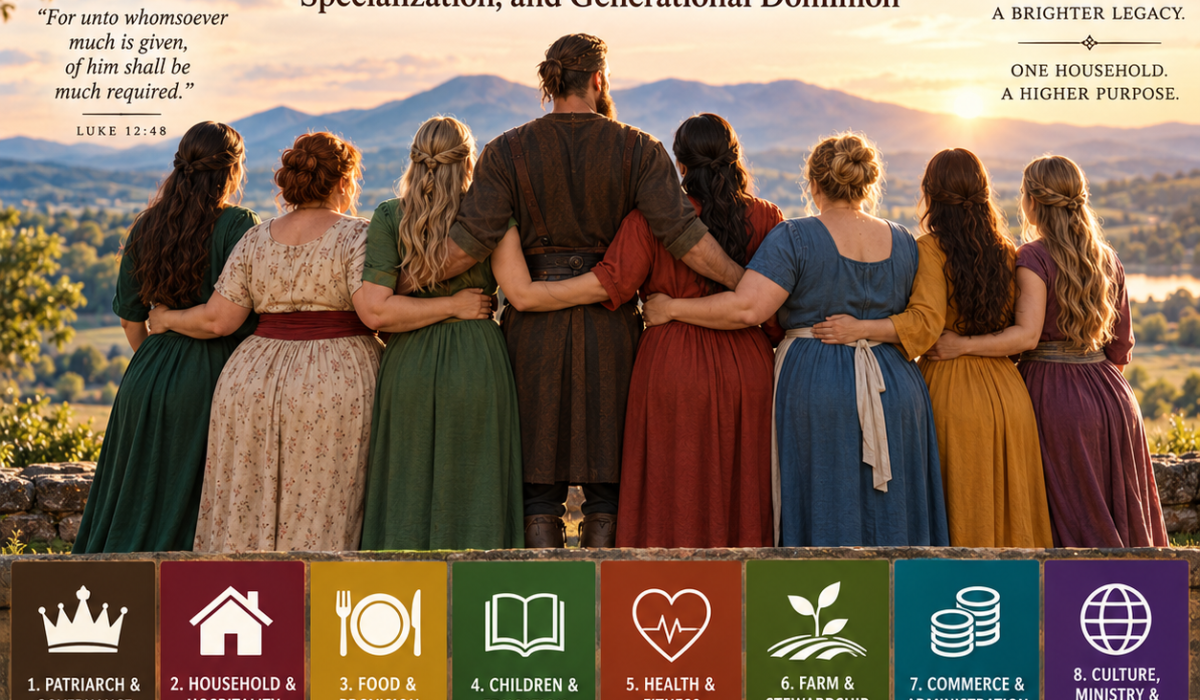
Building the Plural Family for Mission, Specialization, and Generational Dominion
Introduction
Modern Western culture has reduced the household until it is scarcely recognizable as the institution that governed most of human history. The family has become a consumption unit: earn wages elsewhere, purchase nearly everything from strangers, outsource their education, outsource food production, outsource elder care, outsource childcare, outsource health, outsource craftsmanship, outsource charity, and wonder why the household possesses neither economic power nor generational continuity. The biblical household was far more substantial. Abraham’s bayith included children, servants, livestock, property, military capability, commercial activity, and hundreds of trained men; Genesis 14:14 records 318 men born in his house whom he could mobilize. The household was not merely where Abraham slept after work, but an enterprise. Scripture presents family, property, inheritance, production, hospitality, education, worship, and multigenerational purpose as interconnected realities. “A good man leaveth an inheritance to his children’s children” (Proverbs 13:22). That requires considerable vision, sacrifice and coordination.
A genuinely exceptional plural household should therefore ask a question larger than, How many wives may a man have? The more important question is, What could a properly ordered household accomplish with the combined gifts, labor, intelligence, fertility, specialization, and devotion of multiple capable adults united beneath one mission? I propose an eight-division model: one patriarchal office of governance and seven major spheres of household responsibility entrusted to multiple wives (Household & Hospitality, Food & Provision, Children & Education, Health & Fitness, Farm & Stewardship, Commerce & Administration, and Culture, Ministry & Community.) Seven wives are not presented here as a universal biblical command, nor as a magic number guaranteeing righteousness. A household of fewer can certainly accomplish extraordinary things, and a household of seven incompetent people can accomplish the astonishing feat of producing seven times the confusion and destruction. The principle is capacity organized under purpose. When responsibilities exceed personnel, existing members are forced to carry the load of multiple positions. When God provides additional capable people, specialization increases. And when a patriarch possesses no mission requiring greater capacity, collecting wives merely to possess wives is not kingdom building, but vanity.
I. The Household Is an Institution, Not a Collection of Competitors
The first conceptual error is the assumption that adding another capable woman to a plural household diminishes the women already there. That assumption assumes marriage is a contest for scarcity rather than a cooperative institution ordered toward a common mission. Paul gives us a useful organizational principle when describing the Church: “the body is not one member, but many” (1 Corinthians 12:14). The eye cannot tell the hand, “I have no need of thee” (12:21). Different abilities make the body possible. Likewise, Paul rejoiced when Stephanas, Fortunatus, and Achaicus arrived because “that which was lacking on your part they have supplied” (1 Corinthians 16:17). Their contribution was valuable precisely because they supplied something currently deficient. Apparently Paul did not consider recognizing a deficiency an assault on everybody’s self-esteem.
This principle is basic wisdom everywhere except, curiously, wherever modern romantic assumptions are permitted to overrule it. A competent business owner does not hire a bookkeeper who is worse with numbers than he is so that his ego can remain intact. He hires expertise. Organizations derive enormous benefit from specialization because division of labor permits individuals to concentrate upon areas in which their knowledge, aptitude, and experience create greater productivity. Adam Smith illustrated the economic consequences of specialization with the pin factory in The Wealth of Nations (1776): dividing production into specialized operations dramatically increased output. A household is not a pin factory, obviously, and wives are not employees. The analogy concerns organization. Complex missions are more capable when responsibilities are deliberately distributed among competent people.
That means the arrival of a woman who cooks better than the current cook, teaches mathematics better than the current teacher, understands accounting better than the administrator, or possesses agricultural knowledge nobody else has should not be seen as a threat. She should constitute an acquisition of capability. Proverbs 31 describes the excellent wife as economically and domestically formidable: she evaluates a field and buys it, plants a vineyard, conducts commerce, provides food, manages her household, produces goods, serves the poor, and teaches wisdom. Her competence strengthens her husband rather than threatening him: “The heart of her husband doth safely trust in her” (Proverbs 31:11).
The same reasoning applies among wives. Another woman’s excellence does not erase yours. Her strength becomes household strength. If she knows what you do not, learn from her. If she excels where you excel, sharpen one another. If she supplies what the household lacks, thank God that the deficiency has been supplied.
This is why recruitment should not be imagined as the husband’s solitary pursuit. When an enterprise is understaffed, good members frequently know good candidates. They recommend friends, relatives, colleagues, and people whose character and abilities they have observed firsthand. A mission-oriented plural household has even greater reason to think cooperatively. A wife who recognizes that the family’s expanding educational, agricultural, administrative, hospitality, or ministry responsibilities exceed present capacity should be able to say, without jealousy or reservation, “We need another capable woman.” That is maturity.
The objective, however, must remain the mission. More people multiply whatever already exists. Order can become greater order; disorder can become industrial-scale disaster. Therefore the patriarch’s responsibility is to ensure that every addition strengthens its character, capacity, unity, and service to God. Christ’s principle remains decisive: “unto whomsoever much is given, of him shall be much required” (Luke 12:48). A larger household is a larger stewardship.
II. Why Seven? Scale, Specialization, and the Eight-Division Household
Why seven wives? First, let us dispose of an argument I am NOT making. Scripture nowhere commands every man (or any man) to acquire seven wives, nor does Isaiah 4:1 establish a universal household staffing requirement merely because seven women appear in the prophecy. Biblical numerology certainly makes seven an interesting number (creation itself establishes the seven-day pattern) but symbolism is not to be confused with legislation. The argument here is organizational: if we attempt to identify the major recurring responsibilities necessary for a large, productive, multigenerational household, they are arranged into eight broad divisions: one governing office under the husband and seven operational spheres capable of being entrusted to seven wives.
The first division belongs to the husband: Patriarch & Governance. His responsibility is direction, spiritual leadership, protection, judgment, capital allocation, long-range planning, conflict resolution, and coordination of the whole. The seven operational divisions are Household & Hospitality; Food & Provision; Children & Education; Health & Fitness; Farm & Stewardship; Commerce & Administration; and Culture, Ministry & Community. Together these encompass the complete life of a serious household: its home, table, children, bodies, productive property, finances, relationships, traditions, and mission. Each wife may become the principal steward of one sphere without becoming its solitary laborer. A chief financial officer does not personally enter every receipt; neither must the wife overseeing Food & Provision personally peel every potato. Leadership means ensuring the work is organized and accomplished.
The advantage is specialization. Economists have recognized for centuries that division of labor increases productive capacity, while modern organizational research likewise distinguishes between simply adding personnel and structuring complementary expertise. Scripture expresses the underlying principle beautifully: “Two are better than one; because they have a good reward for their labour” (Ecclesiastes 4:9). The passage continues, “a threefold cord is not quickly broken” (4:12). Cooperative strength allows coordinated people to accomplish things none could accomplish efficiently alone.
Yet the model remains scalable. A man with one wife still possesses all eight divisions; he and his wife simply wear several hats each. With three wives, responsibilities are consolidated into larger portfolios. With five, specialization increases further. With seven, each major operational division can theoretically have a dedicated steward. A vacant position does not mean the family ceases functioning any more than a company closes because its secretary resigned last Tuesday. Responsibilities are temporarily redistributed until greater capacity becomes available.
This also explains why more is not automatically better. Adding personnel without increasing competence, character, resources, governance, or mission produces bureaucracy or chaos. Seven wives require a husband capable of governing a considerably more complex household, just as a company employing seventy people requires more leadership ability than a man operating alone from his garage. Scripture’s principle that “to whom men have committed much, of him they will ask the more” (Luke 12:48) applies here.
Therefore the exceptional plural household should never measure success by headcount. Measure it by stewardship, fruit, capability, children raised well, people served, resources produced, wisdom transmitted, and generations prepared to continue the mission. Seven wives may permit extraordinary specialization. But seven is capacity, not accomplishment. The accomplishment is what that household builds with it.
III. Recruiting Strength: Why Excellence Should Be Welcomed, Not Feared
If the plural household is genuinely organized around mission, then an important cultural principle must be established early: another woman’s excellence is not your deficiency. Her ability to do something better than you does not make you less valuable; it makes the household more capable. Paul asks, “Are all apostles? are all prophets? are all teachers?” (1 Corinthians 12:29). The obvious answer is no. Human beings possess different gifts, temperaments, experiences, and aptitudes. A wise institution organizes them. This is why competent business owners routinely hire people who outperform them in particular fields. The entrepreneur who cannot keep books hires an accountant. The visionary who struggles with operations finds an administrator. The farmer consults the veterinarian; the physician hires the mechanic. Only an extraordinarily insecure man insists that everyone surrounding him must be less capable than himself, and this principle applies likewise to women.
The same principle should be applied within a plural family. Suppose one wife is an exceptional educator but mediocre gardener. Another understands livestock, soil, orchards, and food production. A third possesses unusual administrative ability; spreadsheets apparently bring her joy, proving once again that God creates all sorts of people for reasons beyond our understanding. A fourth may excel at hospitality, another at nutrition and physical training. Their differences, properly ordered, are the mechanism by which unity is productive. Romans 12 describes differing gifts (teaching, ministry, giving, ruling, mercy) while commanding each to exercise his gift diligently (Romans 12:4–8). Biblical unity never requires identical ability or competition.
This radically changes how prospective additions to the household should be considered. Character, faith, compatibility, wisdom, and genuine marital commitment remain indispensable; a wife is obviously not an employee hired from a résumé. Nevertheless, capability matters. A patriarch pursuing a substantial generational mission must reasonably consider what a prospective wife contributes to that mission, just as she should consider whether joining that household enables her gifts to bear greater fruit. Proverbs 31 praises such productive competence. The virtuous woman strengthens rather than merely occupies her household.
The implication: existing wives should become recruiters rather than gatekeepers. If the family has outgrown its present capacity, who understands its needs better than the women already carrying the workload? Businesses routinely encourage trusted employees to recruit and recommend strong candidates because good people frequently know other good people. A wife may know a woman of proven character whose gifts would beautifully complement the household. Why should her first instinct be, “Keep her away,” rather than, “Could she strengthen what we are building?”
Jealousy is a terrible organizational philosophy. Scripture commands believers to reject envy and selfish rivalry (Philippians 2:3; James 3:16). That does not mean we should ignore relational difficulties or pretend affection can be managed like payroll. Marriage involves covenant, intimacy, trust, and human hearts. A prudent patriarch therefore does not weaponize “the mission” to bulldoze legitimate concerns. Good governance listens, judges, and builds unity.
But neither should fear become sovereign. If another woman’s virtue, intelligence, strength, or competence threatens us simply because it exceeds our own, the problem is not her excellence. A kingdom-minded household will cultivate the opposite instinct: Bring us people who make us stronger. Bring the teacher who teaches better, the gardener who grows more, the administrator who organizes what others overlook, and the woman whose gifts supply what is presently lacking. As Paul said of Stephanas, Fortunatus, and Achaicus, “that which was lacking on your part they have supplied” (1 Corinthians 16:17).
That is reinforcement. A household serious about accomplishing something larger than itself must know the difference.
IV. One Household, Many Divisions: Authority, Cooperation, and Filling the Gaps
Specialization is useful only when specialized parts remain subordinate to the whole. A household divided into many major spheres must therefore never become competing kingdoms sharing an address. There is one household, one mission, and one governing structure. The divisions exist only to clarify responsibility. Paul employs this logic when describing the body: “For as the body is one, and hath many members… so also is Christ” (1 Corinthians 12:12). The hand performs one function, the eye another, yet neither possesses an independent mission. Likewise, the wife responsible for Children & Education should possess meaningful authority within that sphere, but education must still coordinate with the family’s spiritual objectives, finances, health standards, agricultural work, calendar, and overall direction established by the husband. A department that refuses coordination has ceased functioning as a department is no longer contributing to the mission.
This is why every division requires both ownership and permeability. Ownership means somebody is accountable. Household & Hospitality does not become “everyone’s responsibility” in the conveniently modern sense that usually means nobody noticed the bathroom was out of toilet paper. One wife owns the system. Food & Provision has a steward. Health & Fitness has a steward. Commerce & Administration has a steward. Yet stewardship does not mean every task within that category belongs exclusively to her hands. The wife overseeing Food may assign children to pantry inventory, ask another wife to prepare supper while she is ill, coordinate nutritional requirements with Health, and request produce forecasts from Farm & Stewardship. Her responsibility is not personally doing everything. Her responsibility is making certain everything gets done.
This is particularly important when positions are vacant. A household with one, two, three or four wives does not somehow possess only four of the eight divisions. It possesses all eight responsibilities because reality does not eliminate accounting, education, cooking, maintenance, and health simply because nobody has been assigned a dedicated position. The existing adults absorb those functions. Perhaps one wife oversees Household, Hospitality, and Food; another manages Education and Culture; another carries Health, Farm, and portions of Administration. The husband may temporarily absorb bookkeeping or agricultural management himself. This is precisely what happens in growing enterprises. Vacant positions create additional workload disrupting the productivity and slowing the growth, ultimately hindering the mission.
As the household expands, however, responsibilities can be progressively separated. Organizational scholars describe this process as increasing specialization: growth creates enough complexity and workload to justify narrower roles. The small business owner initially answers phones, sells products, pays invoices, cleans the office, and probably unclogs the toilet because apparently “Chief Executive Officer” is Latin for the problem eventually becomes yours. Growth permits those responsibilities to be delegated to people better positioned to perform them. Household growth operates similarly. Additional capable wives will reduce role overload while increasing expertise, resilience, and productive (even reproductive) capacity.
There should consequently be deliberate overlap and cross-training. Ecclesiastes says, “if they fall, the one will lift up his fellow” (4:10). A family should never become so specialized that only one person knows how to perform any essential function. The administrator should not be the sole human being capable of locating insurance documents. The Food steward should not take the secret of breadmaking to the grave. The Education steward should maintain records others can understand. Competence should spread throughout the household even while accountability remains concentrated.
Above these divisions stands the patriarchal office, whose purpose is coordination. Exodus 18 provides a useful administrative principle when Jethro warns Moses that attempting to personally handle every matter would wear him away and counsels delegated responsibility (to 70 people) (Exodus 18:17–23). Delegation made Moses’s authority sustainable. Likewise, a husband who insists upon personally deciding every tiny purchase, curriculum adjustment, garden row, medical appointment, and linen rotation has constructed an administrative hostage situation.
His task is to establish mission, standards, priorities, resources, boundaries, and accountability; appoint responsibility intelligently; resolve conflicts between divisions; evaluate results; and intervene where necessary. Authority should produce order that permits capable people to act. The result is neither eight autonomous individuals nor one exhausted man attempting to perform eight jobs, but a coordinated household in which responsibility is identifiable, assistance is expected, vacancies are absorbed, strengths are cultivated, and every division understands that its ultimate purpose is the flourishing and mission of the whole family.
That is how a household stops merely surviving together and builds a legacy together.
V. Greater Capacity, Greater Accountability: Building a Household Worth Multiplying
The strongest argument for a large plural household is that, under exceptional leadership and united around an exceptional mission, many capable adults will accomplish more than a smaller household ever could. Scripture states the governing principle: “For unto whomsoever much is given, of him shall be much required” (Luke 12:48). More wives, more children, more land, more income, more businesses, and more influence are therefore liabilities on the stewardship ledger until they are converted into fruit. The patriarch who desires multiple wives because multiple wives sound impressive has misunderstood the proposition. The question is what comes out of that household and enters the Kingdom because they sat there together.
Historically, powerful households were productive institutions because they concentrated people, skills, property, and generations around common interests. Biblical patriarchal households would encompass agriculture, livestock, servants, trade, hospitality, defense, inheritance, and religious instruction. Abraham’s household was substantial enough that Genesis 14:14 records 318 trained men “born in his own house” whom he mobilized to rescue Lot. The point is not that every Christian family should maintain a private infantry regiment (although that’s not a bad idea) but that the biblical house should possess extraordinary institutional capacity. Abraham was stewarding something considerably larger than a modern nuclear family, and his legacy still thrives.
A well-ordered plural household will similarly convert scale into impact. Multiple specialized wives will allow one household simultaneously to educate numerous children, cultivate significant acreage, preserve food, operate businesses, maintain rigorous health standards, practice extensive hospitality, care for aging relatives, disciple younger people, support charitable work, produce intellectual or artistic work, and build assets intended to survive several generations. The economic concept of economies of scale is relevant here: resources become more productive when shared across a larger organization. One kitchen can feed many people. One farm can employ many hands. One library can educate many children. Vehicles, equipment, land, workshops, businesses, and administrative systems will serve an entire extended household rather than being redundantly recreated in numerous isolated homes.
Children multiply the implications further. Psalm 127 calls children “an heritage of the LORD” and compares them to “arrows in the hand of a mighty man” (vv. 3–4). An arrow, however, is useful because it is deliberately formed, aimed, and sent. A large household producing many poorly trained children has not created a great legacy, but disgrace. Legacy requires formation. Children must inherit faith, discipline, knowledge, productive skills, family history, property where possible, and an understanding that they received an inheritance partly so they might enlarge it for those who follow.
This is why the eight-division model ultimately concerns much more than domestic efficiency. Household & Hospitality creates a place capable of receiving others. Food & Provision establishes abundance and security. Children & Education transmits knowledge. Health & Fitness develops capable bodies. Farm & Stewardship converts creation into productive resources. Commerce & Administration preserves and multiplies assets. Culture, Ministry & Community carries the household’s influence outward. And Patriarch & Governance keeps every sphere pointed toward a common destination and “on mission”. Seven wives are therefore seven potentially formidable stewards participating in one consequential household.
But scale magnifies failure as efficiently as it magnifies success. A weak patriarch with one disordered relationship will not become stronger by acquiring an additional (or six additional) relationships. Financial irresponsibility multiplied by multiple people remains irresponsibility, now on a wholesale scale. Favoritism, poor communication, laziness, unresolved jealousy, deficient provision, and arbitrary leadership will become progressively more destructive as the household grows. Scripture’s qualification for leadership is therefore relevant in principle: a man must be one who “ruleth well his own house” (1 Timothy 3:4). Paul’s organizational logic is unmistakable: competence demonstrated in the household precedes greater responsibility.
The exceptional plural family should consequently expand only because its mission requires capacity. Growth should follow demonstrated stewardship. When responsibilities are overflowing because the household is producing, teaching, serving, cultivating, building, hosting, ministering, and preparing another generation, additional strength has somewhere meaningful to go. Then another capable wife does not merely make the family bigger. She makes its reach broader, its work deeper, its weaknesses fewer, and its future stronger.
The goal is therefore not seven wives, the goal is a household worthy of seven regardless of how many God ultimately adds.
Conclusion: The Measure Is the Mission
The case presented here is not an argument that every man needs seven wives (many do not deserve one), nor that every successful plural household must conform mechanically to an eight-division organizational chart. This is simply an argument for intentional household government. Every family already possesses responsibilities involving leadership, home, food, children, health, productive resources, administration, culture, and community whether anybody has bothered to name them or not. A small household combines those responsibilities among fewer shoulders; a larger household should increasingly specialize them. The proposed patriarch-plus-seven model simply carries that principle toward its logical organizational conclusion: seven major spheres, ordered under one governing patriarch, one household, and one mission. Vacancies can be covered. Responsibilities can overlap. Gifts can be shared. Divisions can be reorganized as circumstances require. But the governing attitude must remain that expressed by Paul: “that which was lacking on your part they have supplied” (1 Corinthians 16:17). The wise household therefore cannot resent the person who supplies what it lacks. It welcomes strength. A wife need not fear the woman who can teach better than she can, keep books better than she can, cultivate land better than she can, or accomplish some task she cannot accomplish at all. Neither should the husband surround himself with women selected because they will never challenge his competence. Weak men collect dependents; capable patriarchs cultivate capable people. If another woman can strengthen the household, advance its mission, bless its children, relieve overloaded members, and contribute gifts presently absent, her excellence is additional capital entrusted to the family. And a mature wife who sees a genuine deficiency should be capable not merely of tolerating reinforcement when it arrives, but even of helping identify it. If businesses understand that good people recruit good people, surely a household claiming to pursue something more consequential than quarterly earnings can grasp the same elementary principle.
But with that vision comes an equally severe warning: do not build a large household merely for admiration or attention. Seven wives (or even a second wife) will not transform a purposeless man into a patriarch any more than hiring multiple executives will transform a man without a product into an industrialist. Multiplication magnifies what already exists. It can multiply order, production, hospitality, education, wealth, children, charity, ministry, resilience, and generational influence, or it can multiply debt, neglect, rivalry, confusion, disorder, and spectacularly complicated dysfunction. Christ’s warning hangs over the entire model: “For unto whomsoever much is given, of him shall be much required” (Luke 12:48). A man pursuing greater household capacity should first possess something worthy of that capacity: a calling, a direction, demonstrated discipline, provision, wisdom, justice, and a mission large enough to require additional hands. Then the question is no longer, How many wives may I have? but, How much good could this household accomplish if every person God entrusted to it were deliberately organized, equipped, valued, and deployed according to her strengths?
A farm may become an inheritance. A table may become hospitality for hundreds. A schoolroom may shape generations. Businesses may finance ministry. Children may carry the family’s faith and accumulated wisdom farther than their parents ever could. Multiple women of character and ability, united with a capable husband beneath a common purpose, represents a potentially extraordinarily productive household institution. The number is not the achievement. The household is not the mission. The household is the instrument. The measure is the fruit, and the mission is the Kingdom of God.