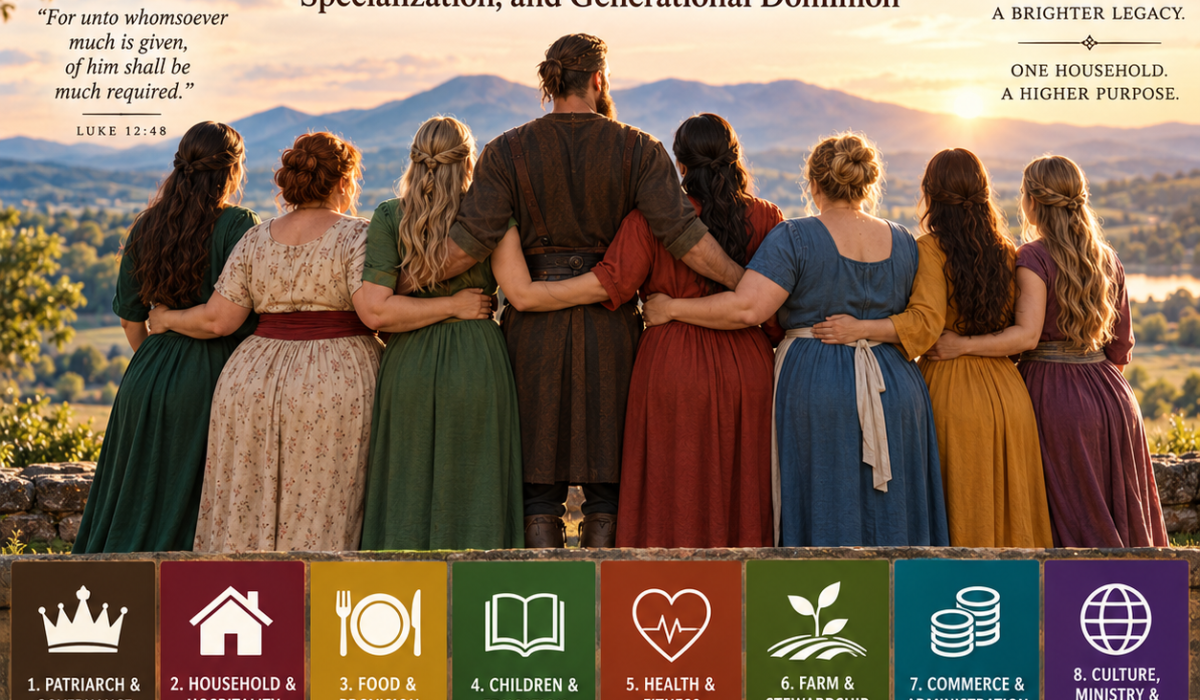
Building the Plural Family for Mission, Specialization, and Generational Dominion
Introduction
Modern Western culture has reduced the household until it is scarcely recognizable as the institution that governed most of human history. The family has become a consumption unit: earn wages elsewhere, purchase nearly everything from strangers, outsource their education, outsource food production, outsource elder care, outsource childcare, outsource health, outsource craftsmanship, outsource charity, and wonder why the household possesses neither economic power nor generational continuity. The biblical household was far more substantial. Abraham’s bayith included children, servants, livestock, property, military capability, commercial activity, and hundreds of trained men; Genesis 14:14 records 318 men born in his house whom he could mobilize. The household was not merely where Abraham slept after work, but an enterprise. Scripture presents family, property, inheritance, production, hospitality, education, worship, and multigenerational purpose as interconnected realities. “A good man leaveth an inheritance to his children’s children” (Proverbs 13:22). That requires considerable vision, sacrifice and coordination.
A genuinely exceptional plural household should therefore ask a question larger than, How many wives may a man have? The more important question is, What could a properly ordered household accomplish with the combined gifts, labor, intelligence, fertility, specialization, and devotion of multiple capable adults united beneath one mission? I propose an eight-division model: one patriarchal office of governance and seven major spheres of household responsibility entrusted to multiple wives (Household & Hospitality, Food & Provision, Children & Education, Health & Fitness, Farm & Stewardship, Commerce & Administration, and Culture, Ministry & Community.) Seven wives are not presented here as a universal biblical command, nor as a magic number guaranteeing righteousness. A household of fewer can certainly accomplish extraordinary things, and a household of seven incompetent people can accomplish the astonishing feat of producing seven times the confusion and destruction. The principle is capacity organized under purpose. When responsibilities exceed personnel, existing members are forced to carry the load of multiple positions. When God provides additional capable people, specialization increases. And when a patriarch possesses no mission requiring greater capacity, collecting wives merely to possess wives is not kingdom building, but vanity.
I. The Household Is an Institution, Not a Collection of Competitors
The first conceptual error is the assumption that adding another capable woman to a plural household diminishes the women already there. That assumption assumes marriage is a contest for scarcity rather than a cooperative institution ordered toward a common mission. Paul gives us a useful organizational principle when describing the Church: “the body is not one member, but many” (1 Corinthians 12:14). The eye cannot tell the hand, “I have no need of thee” (12:21). Different abilities make the body possible. Likewise, Paul rejoiced when Stephanas, Fortunatus, and Achaicus arrived because “that which was lacking on your part they have supplied” (1 Corinthians 16:17). Their contribution was valuable precisely because they supplied something currently deficient. Apparently Paul did not consider recognizing a deficiency an assault on everybody’s self-esteem.
This principle is basic wisdom everywhere except, curiously, wherever modern romantic assumptions are permitted to overrule it. A competent business owner does not hire a bookkeeper who is worse with numbers than he is so that his ego can remain intact. He hires expertise. Organizations derive enormous benefit from specialization because division of labor permits individuals to concentrate upon areas in which their knowledge, aptitude, and experience create greater productivity. Adam Smith illustrated the economic consequences of specialization with the pin factory in The Wealth of Nations (1776): dividing production into specialized operations dramatically increased output. A household is not a pin factory, obviously, and wives are not employees. The analogy concerns organization. Complex missions are more capable when responsibilities are deliberately distributed among competent people.
That means the arrival of a woman who cooks better than the current cook, teaches mathematics better than the current teacher, understands accounting better than the administrator, or possesses agricultural knowledge nobody else has should not be seen as a threat. She should constitute an acquisition of capability. Proverbs 31 describes the excellent wife as economically and domestically formidable: she evaluates a field and buys it, plants a vineyard, conducts commerce, provides food, manages her household, produces goods, serves the poor, and teaches wisdom. Her competence strengthens her husband rather than threatening him: “The heart of her husband doth safely trust in her” (Proverbs 31:11).
The same reasoning applies among wives. Another woman’s excellence does not erase yours. Her strength becomes household strength. If she knows what you do not, learn from her. If she excels where you excel, sharpen one another. If she supplies what the household lacks, thank God that the deficiency has been supplied.
This is why recruitment should not be imagined as the husband’s solitary pursuit. When an enterprise is understaffed, good members frequently know good candidates. They recommend friends, relatives, colleagues, and people whose character and abilities they have observed firsthand. A mission-oriented plural household has even greater reason to think cooperatively. A wife who recognizes that the family’s expanding educational, agricultural, administrative, hospitality, or ministry responsibilities exceed present capacity should be able to say, without jealousy or reservation, “We need another capable woman.” That is maturity.
The objective, however, must remain the mission. More people multiply whatever already exists. Order can become greater order; disorder can become industrial-scale disaster. Therefore the patriarch’s responsibility is to ensure that every addition strengthens its character, capacity, unity, and service to God. Christ’s principle remains decisive: “unto whomsoever much is given, of him shall be much required” (Luke 12:48). A larger household is a larger stewardship.
II. Why Seven? Scale, Specialization, and the Eight-Division Household
Why seven wives? First, let us dispose of an argument I am NOT making. Scripture nowhere commands every man (or any man) to acquire seven wives, nor does Isaiah 4:1 establish a universal household staffing requirement merely because seven women appear in the prophecy. Biblical numerology certainly makes seven an interesting number (creation itself establishes the seven-day pattern) but symbolism is not to be confused with legislation. The argument here is organizational: if we attempt to identify the major recurring responsibilities necessary for a large, productive, multigenerational household, they are arranged into eight broad divisions: one governing office under the husband and seven operational spheres capable of being entrusted to seven wives.
The first division belongs to the husband: Patriarch & Governance. His responsibility is direction, spiritual leadership, protection, judgment, capital allocation, long-range planning, conflict resolution, and coordination of the whole. The seven operational divisions are Household & Hospitality; Food & Provision; Children & Education; Health & Fitness; Farm & Stewardship; Commerce & Administration; and Culture, Ministry & Community. Together these encompass the complete life of a serious household: its home, table, children, bodies, productive property, finances, relationships, traditions, and mission. Each wife may become the principal steward of one sphere without becoming its solitary laborer. A chief financial officer does not personally enter every receipt; neither must the wife overseeing Food & Provision personally peel every potato. Leadership means ensuring the work is organized and accomplished.
The advantage is specialization. Economists have recognized for centuries that division of labor increases productive capacity, while modern organizational research likewise distinguishes between simply adding personnel and structuring complementary expertise. Scripture expresses the underlying principle beautifully: “Two are better than one; because they have a good reward for their labour” (Ecclesiastes 4:9). The passage continues, “a threefold cord is not quickly broken” (4:12). Cooperative strength allows coordinated people to accomplish things none could accomplish efficiently alone.
Yet the model remains scalable. A man with one wife still possesses all eight divisions; he and his wife simply wear several hats each. With three wives, responsibilities are consolidated into larger portfolios. With five, specialization increases further. With seven, each major operational division can theoretically have a dedicated steward. A vacant position does not mean the family ceases functioning any more than a company closes because its secretary resigned last Tuesday. Responsibilities are temporarily redistributed until greater capacity becomes available.
This also explains why more is not automatically better. Adding personnel without increasing competence, character, resources, governance, or mission produces bureaucracy or chaos. Seven wives require a husband capable of governing a considerably more complex household, just as a company employing seventy people requires more leadership ability than a man operating alone from his garage. Scripture’s principle that “to whom men have committed much, of him they will ask the more” (Luke 12:48) applies here.
Therefore the exceptional plural household should never measure success by headcount. Measure it by stewardship, fruit, capability, children raised well, people served, resources produced, wisdom transmitted, and generations prepared to continue the mission. Seven wives may permit extraordinary specialization. But seven is capacity, not accomplishment. The accomplishment is what that household builds with it.
III. Recruiting Strength: Why Excellence Should Be Welcomed, Not Feared
If the plural household is genuinely organized around mission, then an important cultural principle must be established early: another woman’s excellence is not your deficiency. Her ability to do something better than you does not make you less valuable; it makes the household more capable. Paul asks, “Are all apostles? are all prophets? are all teachers?” (1 Corinthians 12:29). The obvious answer is no. Human beings possess different gifts, temperaments, experiences, and aptitudes. A wise institution organizes them. This is why competent business owners routinely hire people who outperform them in particular fields. The entrepreneur who cannot keep books hires an accountant. The visionary who struggles with operations finds an administrator. The farmer consults the veterinarian; the physician hires the mechanic. Only an extraordinarily insecure man insists that everyone surrounding him must be less capable than himself, and this principle applies likewise to women.
The same principle should be applied within a plural family. Suppose one wife is an exceptional educator but mediocre gardener. Another understands livestock, soil, orchards, and food production. A third possesses unusual administrative ability; spreadsheets apparently bring her joy, proving once again that God creates all sorts of people for reasons beyond our understanding. A fourth may excel at hospitality, another at nutrition and physical training. Their differences, properly ordered, are the mechanism by which unity is productive. Romans 12 describes differing gifts (teaching, ministry, giving, ruling, mercy) while commanding each to exercise his gift diligently (Romans 12:4–8). Biblical unity never requires identical ability or competition.
This radically changes how prospective additions to the household should be considered. Character, faith, compatibility, wisdom, and genuine marital commitment remain indispensable; a wife is obviously not an employee hired from a résumé. Nevertheless, capability matters. A patriarch pursuing a substantial generational mission must reasonably consider what a prospective wife contributes to that mission, just as she should consider whether joining that household enables her gifts to bear greater fruit. Proverbs 31 praises such productive competence. The virtuous woman strengthens rather than merely occupies her household.
The implication: existing wives should become recruiters rather than gatekeepers. If the family has outgrown its present capacity, who understands its needs better than the women already carrying the workload? Businesses routinely encourage trusted employees to recruit and recommend strong candidates because good people frequently know other good people. A wife may know a woman of proven character whose gifts would beautifully complement the household. Why should her first instinct be, “Keep her away,” rather than, “Could she strengthen what we are building?”
Jealousy is a terrible organizational philosophy. Scripture commands believers to reject envy and selfish rivalry (Philippians 2:3; James 3:16). That does not mean we should ignore relational difficulties or pretend affection can be managed like payroll. Marriage involves covenant, intimacy, trust, and human hearts. A prudent patriarch therefore does not weaponize “the mission” to bulldoze legitimate concerns. Good governance listens, judges, and builds unity.
But neither should fear become sovereign. If another woman’s virtue, intelligence, strength, or competence threatens us simply because it exceeds our own, the problem is not her excellence. A kingdom-minded household will cultivate the opposite instinct: Bring us people who make us stronger. Bring the teacher who teaches better, the gardener who grows more, the administrator who organizes what others overlook, and the woman whose gifts supply what is presently lacking. As Paul said of Stephanas, Fortunatus, and Achaicus, “that which was lacking on your part they have supplied” (1 Corinthians 16:17).
That is reinforcement. A household serious about accomplishing something larger than itself must know the difference.
IV. One Household, Many Divisions: Authority, Cooperation, and Filling the Gaps
Specialization is useful only when specialized parts remain subordinate to the whole. A household divided into many major spheres must therefore never become competing kingdoms sharing an address. There is one household, one mission, and one governing structure. The divisions exist only to clarify responsibility. Paul employs this logic when describing the body: “For as the body is one, and hath many members… so also is Christ” (1 Corinthians 12:12). The hand performs one function, the eye another, yet neither possesses an independent mission. Likewise, the wife responsible for Children & Education should possess meaningful authority within that sphere, but education must still coordinate with the family’s spiritual objectives, finances, health standards, agricultural work, calendar, and overall direction established by the husband. A department that refuses coordination has ceased functioning as a department is no longer contributing to the mission.
This is why every division requires both ownership and permeability. Ownership means somebody is accountable. Household & Hospitality does not become “everyone’s responsibility” in the conveniently modern sense that usually means nobody noticed the bathroom was out of toilet paper. One wife owns the system. Food & Provision has a steward. Health & Fitness has a steward. Commerce & Administration has a steward. Yet stewardship does not mean every task within that category belongs exclusively to her hands. The wife overseeing Food may assign children to pantry inventory, ask another wife to prepare supper while she is ill, coordinate nutritional requirements with Health, and request produce forecasts from Farm & Stewardship. Her responsibility is not personally doing everything. Her responsibility is making certain everything gets done.
This is particularly important when positions are vacant. A household with one, two, three or four wives does not somehow possess only four of the eight divisions. It possesses all eight responsibilities because reality does not eliminate accounting, education, cooking, maintenance, and health simply because nobody has been assigned a dedicated position. The existing adults absorb those functions. Perhaps one wife oversees Household, Hospitality, and Food; another manages Education and Culture; another carries Health, Farm, and portions of Administration. The husband may temporarily absorb bookkeeping or agricultural management himself. This is precisely what happens in growing enterprises. Vacant positions create additional workload disrupting the productivity and slowing the growth, ultimately hindering the mission.
As the household expands, however, responsibilities can be progressively separated. Organizational scholars describe this process as increasing specialization: growth creates enough complexity and workload to justify narrower roles. The small business owner initially answers phones, sells products, pays invoices, cleans the office, and probably unclogs the toilet because apparently “Chief Executive Officer” is Latin for the problem eventually becomes yours. Growth permits those responsibilities to be delegated to people better positioned to perform them. Household growth operates similarly. Additional capable wives will reduce role overload while increasing expertise, resilience, and productive (even reproductive) capacity.
There should consequently be deliberate overlap and cross-training. Ecclesiastes says, “if they fall, the one will lift up his fellow” (4:10). A family should never become so specialized that only one person knows how to perform any essential function. The administrator should not be the sole human being capable of locating insurance documents. The Food steward should not take the secret of breadmaking to the grave. The Education steward should maintain records others can understand. Competence should spread throughout the household even while accountability remains concentrated.
Above these divisions stands the patriarchal office, whose purpose is coordination. Exodus 18 provides a useful administrative principle when Jethro warns Moses that attempting to personally handle every matter would wear him away and counsels delegated responsibility (to 70 people) (Exodus 18:17–23). Delegation made Moses’s authority sustainable. Likewise, a husband who insists upon personally deciding every tiny purchase, curriculum adjustment, garden row, medical appointment, and linen rotation has constructed an administrative hostage situation.
His task is to establish mission, standards, priorities, resources, boundaries, and accountability; appoint responsibility intelligently; resolve conflicts between divisions; evaluate results; and intervene where necessary. Authority should produce order that permits capable people to act. The result is neither eight autonomous individuals nor one exhausted man attempting to perform eight jobs, but a coordinated household in which responsibility is identifiable, assistance is expected, vacancies are absorbed, strengths are cultivated, and every division understands that its ultimate purpose is the flourishing and mission of the whole family.
That is how a household stops merely surviving together and builds a legacy together.
V. Greater Capacity, Greater Accountability: Building a Household Worth Multiplying
The strongest argument for a large plural household is that, under exceptional leadership and united around an exceptional mission, many capable adults will accomplish more than a smaller household ever could. Scripture states the governing principle: “For unto whomsoever much is given, of him shall be much required” (Luke 12:48). More wives, more children, more land, more income, more businesses, and more influence are therefore liabilities on the stewardship ledger until they are converted into fruit. The patriarch who desires multiple wives because multiple wives sound impressive has misunderstood the proposition. The question is what comes out of that household and enters the Kingdom because they sat there together.
Historically, powerful households were productive institutions because they concentrated people, skills, property, and generations around common interests. Biblical patriarchal households would encompass agriculture, livestock, servants, trade, hospitality, defense, inheritance, and religious instruction. Abraham’s household was substantial enough that Genesis 14:14 records 318 trained men “born in his own house” whom he mobilized to rescue Lot. The point is not that every Christian family should maintain a private infantry regiment (although that’s not a bad idea) but that the biblical house should possess extraordinary institutional capacity. Abraham was stewarding something considerably larger than a modern nuclear family, and his legacy still thrives.
A well-ordered plural household will similarly convert scale into impact. Multiple specialized wives will allow one household simultaneously to educate numerous children, cultivate significant acreage, preserve food, operate businesses, maintain rigorous health standards, practice extensive hospitality, care for aging relatives, disciple younger people, support charitable work, produce intellectual or artistic work, and build assets intended to survive several generations. The economic concept of economies of scale is relevant here: resources become more productive when shared across a larger organization. One kitchen can feed many people. One farm can employ many hands. One library can educate many children. Vehicles, equipment, land, workshops, businesses, and administrative systems will serve an entire extended household rather than being redundantly recreated in numerous isolated homes.
Children multiply the implications further. Psalm 127 calls children “an heritage of the LORD” and compares them to “arrows in the hand of a mighty man” (vv. 3–4). An arrow, however, is useful because it is deliberately formed, aimed, and sent. A large household producing many poorly trained children has not created a great legacy, but disgrace. Legacy requires formation. Children must inherit faith, discipline, knowledge, productive skills, family history, property where possible, and an understanding that they received an inheritance partly so they might enlarge it for those who follow.
This is why the eight-division model ultimately concerns much more than domestic efficiency. Household & Hospitality creates a place capable of receiving others. Food & Provision establishes abundance and security. Children & Education transmits knowledge. Health & Fitness develops capable bodies. Farm & Stewardship converts creation into productive resources. Commerce & Administration preserves and multiplies assets. Culture, Ministry & Community carries the household’s influence outward. And Patriarch & Governance keeps every sphere pointed toward a common destination and “on mission”. Seven wives are therefore seven potentially formidable stewards participating in one consequential household.
But scale magnifies failure as efficiently as it magnifies success. A weak patriarch with one disordered relationship will not become stronger by acquiring an additional (or six additional) relationships. Financial irresponsibility multiplied by multiple people remains irresponsibility, now on a wholesale scale. Favoritism, poor communication, laziness, unresolved jealousy, deficient provision, and arbitrary leadership will become progressively more destructive as the household grows. Scripture’s qualification for leadership is therefore relevant in principle: a man must be one who “ruleth well his own house” (1 Timothy 3:4). Paul’s organizational logic is unmistakable: competence demonstrated in the household precedes greater responsibility.
The exceptional plural family should consequently expand only because its mission requires capacity. Growth should follow demonstrated stewardship. When responsibilities are overflowing because the household is producing, teaching, serving, cultivating, building, hosting, ministering, and preparing another generation, additional strength has somewhere meaningful to go. Then another capable wife does not merely make the family bigger. She makes its reach broader, its work deeper, its weaknesses fewer, and its future stronger.
The goal is therefore not seven wives, the goal is a household worthy of seven regardless of how many God ultimately adds.
Conclusion: The Measure Is the Mission
The case presented here is not an argument that every man needs seven wives (many do not deserve one), nor that every successful plural household must conform mechanically to an eight-division organizational chart. This is simply an argument for intentional household government. Every family already possesses responsibilities involving leadership, home, food, children, health, productive resources, administration, culture, and community whether anybody has bothered to name them or not. A small household combines those responsibilities among fewer shoulders; a larger household should increasingly specialize them. The proposed patriarch-plus-seven model simply carries that principle toward its logical organizational conclusion: seven major spheres, ordered under one governing patriarch, one household, and one mission. Vacancies can be covered. Responsibilities can overlap. Gifts can be shared. Divisions can be reorganized as circumstances require. But the governing attitude must remain that expressed by Paul: “that which was lacking on your part they have supplied” (1 Corinthians 16:17). The wise household therefore cannot resent the person who supplies what it lacks. It welcomes strength. A wife need not fear the woman who can teach better than she can, keep books better than she can, cultivate land better than she can, or accomplish some task she cannot accomplish at all. Neither should the husband surround himself with women selected because they will never challenge his competence. Weak men collect dependents; capable patriarchs cultivate capable people. If another woman can strengthen the household, advance its mission, bless its children, relieve overloaded members, and contribute gifts presently absent, her excellence is additional capital entrusted to the family. And a mature wife who sees a genuine deficiency should be capable not merely of tolerating reinforcement when it arrives, but even of helping identify it. If businesses understand that good people recruit good people, surely a household claiming to pursue something more consequential than quarterly earnings can grasp the same elementary principle.
But with that vision comes an equally severe warning: do not build a large household merely for admiration or attention. Seven wives (or even a second wife) will not transform a purposeless man into a patriarch any more than hiring multiple executives will transform a man without a product into an industrialist. Multiplication magnifies what already exists. It can multiply order, production, hospitality, education, wealth, children, charity, ministry, resilience, and generational influence, or it can multiply debt, neglect, rivalry, confusion, disorder, and spectacularly complicated dysfunction. Christ’s warning hangs over the entire model: “For unto whomsoever much is given, of him shall be much required” (Luke 12:48). A man pursuing greater household capacity should first possess something worthy of that capacity: a calling, a direction, demonstrated discipline, provision, wisdom, justice, and a mission large enough to require additional hands. Then the question is no longer, How many wives may I have? but, How much good could this household accomplish if every person God entrusted to it were deliberately organized, equipped, valued, and deployed according to her strengths?
A farm may become an inheritance. A table may become hospitality for hundreds. A schoolroom may shape generations. Businesses may finance ministry. Children may carry the family’s faith and accumulated wisdom farther than their parents ever could. Multiple women of character and ability, united with a capable husband beneath a common purpose, represents a potentially extraordinarily productive household institution. The number is not the achievement. The household is not the mission. The household is the instrument. The measure is the fruit, and the mission is the Kingdom of God.
There was a time when a man looking for a wife would speak with her father, court her intentionally, demonstrate his ability to provide, and make a lifelong covenant before God and witnesses alike. There was a time when a woman understood that her greatest earthly asset was not her career trajectory, her Instagram following, or her collection of passport stamps, but her character, virtue, fertility, and capacity to build a household alongside a competent man. Those days, it seems, have largely been traded in for something that more closely resembles a chaotic used-car lot run by carnival barkers, social media influencers, government regulators, and people who have learned from romantic comedies.
Spend a few weeks observing the modern dating market and you will notice something fascinating. The same behaviors, incentives, deceptions, and absurdities that plague the used automobile industry have migrated into human relationships. Asking prices bear little resemblance to actual value. Marketing departments work overtime to conceal wear and tear. Previous ownership histories are carefully omitted. Mileage is considered offensive to discuss. Warning lights are ignored. Serious buyers are disappearing. Everyone claims to be a luxury model, and nearly every vehicle arrives with a disclaimer explaining why the previous owners were entirely at fault. While the comparison is obviously tongue-in-cheek, it also reveals uncomfortable truths about modern courtship, marriage, divorce, and the collapse of biblical standards. So, for the benefit of prospective buyers everywhere, let us take a stroll through today’s dating dealership and examine the inventory.
I. Why Every 2008 Corolla Thinks It’s a Ferrari
The first lesson every used-car buyer learns is that asking price and actual value are loosely acquainted at best. The seller may have spent years convincing himself that his faded sedan with mismatched tires, a cracked dashboard, and 247,000 miles is a rare collector’s item. He remembers what he paid for it. He remembers how much he loved it. He remembers that one time someone complimented the paint. But the market does not care about his feelings.
The modern dating market suffers from the same condition. Thanks to social media, dating apps, celebrity culture, and decades of self-esteem propaganda, nearly every woman has become convinced she is premium inventory. A generation has been raised on the belief that they are exceptional, unique, and deserving of the very best. Participation trophies have become participation spouses, average has become offensive, and ordinary has become an insult. Everyone wants a king while bringing the qualifications of a court jester.
Dating apps have poured gasoline on this delusion. Historically, most people selected spouses from a relatively small social circle consisting of family connections, church communities, neighborhoods, and local acquaintances. The average woman compared local men to other local men. The average man compared local women to other local women. This kept expectations naturally moderated by reality. Today, however, a woman in a town of ten thousand can receive attention from men hundreds or thousands of miles away. A man can spend hours scrolling through endless profiles, and the illusion of infinite options replaces the discipline of choosing wisely.
Researchers have documented this phenomenon well. Studies examining dating-app behavior consistently find that a relatively small percentage of users receive a disproportionately large share of attention. Everyone notices the luxury models, while they ignore the economy cars.
The irony is almost poetic. Despite unprecedented access to potential partners, marriage rates continue to decline while loneliness continues to rise. We have created a marketplace with more inventory than any civilization in history and somehow fewer successful transactions. It turns out abundance does not necessarily produce satisfaction.
Scripture recognized this principle long before economists gave it a name. Proverbs warns against pride, self-deception, and inflated self-assessment. “When pride cometh, then cometh shame: but with the lowly is wisdom” (Proverbs 11:2). Wisdom begins with accurately assessing reality. A wise buyer knows what he is purchasing. A wise seller knows what he is offering. Trouble begins when a 2008 Corolla starts demanding Ferrari prices simply because someone on Instagram told it to “know its worth.”
The dating market today is filled with individuals who have confused unlimited male attention with value and compliments with qualifications. The result is a showroom full of vehicles sitting under bright lights, accumulating dust, waiting for offers that will never arrive. Everybody believes they deserve more. Meanwhile, the calendar keeps turning, the mileage keeps increasing, and the market quietly continues its ruthless evaluation of reality.
II. Certified Pre-Owned: The Rebranding Department
If there is one thing the automotive industry understands, it is the power of marketing. A vehicle that struggled to attract attention yesterday can suddenly become desirable today with the addition of a fresh coat of wax, a detailed inspection report, and a shiny sticker that reads “Certified Pre-Owned.” The transmission may still have trust issues. The suspension may still groan when asked to carry weight. The previous owner may have treated oil changes as optional suggestions. Yet somehow, through the miracle of branding, we are encouraged to view the vehicle not as “used,” but as “experienced.”
The modern dating market has adopted this strategy with enthusiasm. In previous generations, divorce carried a social stigma, not because people were cruel, but because marriage was viewed as a covenant rather than a contract. A failed marriage represented something serious was potentially wrong with the participant. It was not necessarily unforgivable, nor was it always the fault of both parties, but it was recognized as a significant life event worthy of careful consideration. Today, modern culture has developed an entire vocabulary dedicated to making every previous relationship sound like an advanced educational opportunity.
A divorce is no longer a divorce, but a growth journey, a failed engagement becomes self-discovery, three broken relationships become valuable experience, Four former partners become evidence of knowing what one wants.
The dealership’s marketing department has been working overtime. Now, before someone begins composing an angry email, let’s acknowledge the obvious. Scripture recognizes legitimate grounds for divorce in certain (extremely limited) circumstances, and God extends grace. People make mistakes. Some individuals genuinely are victims of abandonment, adultery, abuse, or circumstances beyond their control. Redemption is one of the central themes of Christianity. The point is that pretending history does not exist serves nobody.
When purchasing an actual vehicle, every sensible buyer asks questions about previous ownership. How many owners has it had? Has it been wrecked? What repairs have been performed? Has it been maintained properly? Nobody interprets these questions as personal attacks. Yet somehow, when similar questions arise in modern relationships, we are informed that the past is irrelevant and that any interest in prior history constitutes judgmental behavior.
Curiously, the people making this argument rarely purchase houses without inspections, businesses without audits, or vehicles without maintenance records. History matters because patterns matter.
King Solomon observed, “As a dog returneth to his vomit, so a fool returneth to his folly” (Proverbs 26:11). Human beings possess an extraordinary ability to repeat destructive behaviors while insisting that this time will be different. While any divorce is an instant “red flag”, one failed marriage may be a tragedy, two may be unfortunate, three begins to indicate serious issues.
The broader statistics cannot be ignored. Multiple studies have shown that the likelihood of divorce increases in subsequent marriages. While individual circumstances vary, the overall trend proves that relationship habits, expectations, and conflict patterns persist. The same software tends to produce the same error messages regardless of how many times the hardware is replaced.
Wise buyers ask questions, not because they are cruel, or lack compassion, or because they deny redemption. They ask because covenant requires trust, and trust requires honesty.
In modern dating everyone has a history. The remarkable thing is that we now live in a culture that simultaneously insists the past does not matter while demanding understanding for why the past matters. We are expected to ignore the Carfax report while spending years discussing the emotional impact of every previous owner. A wise man should do neither.
The biblical position is neither condemnation nor denial, but truth. Grace without truth becomes sentimentality, and truth without grace becomes cruelty. But truth and grace together allow a buyer to accurately assess the inventory before making what is intended to be a lifelong purchase. And unlike a certified pre-owned vehicle, marriage does not come with a return policy.
III. Mileage Matters Whether We Pretend It Does or Not
There are few topics in modern dating capable of triggering a stronger emotional reaction than the discussion of mileage. Mention age, weight, income, education, politics, religion, or favorite pizza toppings, and most people can maintain a reasonably civil conversation. Mention sexual history, relationship history, or accumulated baggage, however, and suddenly everyone begins reaching for the emergency exits. This is unfortunate, because reality remains stubbornly indifferent to our discomfort.
When purchasing a vehicle, mileage is not the only factor that matters, but it is certainly one of the most important factors. A well-maintained truck with 150,000 miles may be a better purchase than a neglected vehicle with 60,000. IN this way context matters. But nobody seriously argues that mileage is completely irrelevant. Nobody walks into a dealership and says, “I can’t believe you’re asking how many miles are on it. That information belongs in the past.” And yet this is precisely how modern dating often operates.
We are told that previous relationships do not matter. Sexual history does not matter. Emotional baggage does not matter. Past decisions do not matter. Every person, we are assured, should be evaluated as though they emerged from the factory yesterday morning with the protective plastic still covering the seats.
The problem is that human beings are not factory-fresh products. We are creatures of habit, memory, attachment, and experience. Every decision leaves an imprint. Every relationship teaches lessons (both good and bad.) Every success and failure shapes our future behavior.
This is a Biblical fact and psychological reality. Researchers studying attachment theory, relationship satisfaction, and long-term pair bonding have consistently found correlations between past relational behavior and future relational outcomes. The exact interpretations remain debated, but the underlying principle is hardly controversial: habits will persist unless confronted and intentionally changed.
The Bible recognized this thousands of years before psychologists began publishing journals. “Can the Ethiopian change his skin, or the leopard his spots? then may ye also do good, that are accustomed to do evil” (Jeremiah 13:23).
Christianity is founded upon the belief that people can change. The point is that genuine transformation requires effort, repentance, discipline, and time. What Scripture rejects is the modern fantasy that transformation occurs automatically simply because someone desires a different outcome.
A great irony of contemporary culture is that we have become simultaneously obsessed with trauma and dismissive of consequences. We are constantly reminded that past experiences shape our behavior, influence our emotions, affect our trust, and impact our relationships. Yet when the discussion turns toward evaluating a potential spouse, we are suddenly expected to believe that none of those same experiences matter. Apparently history matters tremendously, until it becomes inconvenient.
Mileage, however, extends beyond sexual history. Emotional mileage exists, financial mileage exists, and relational mileage exists. There are individuals who have accumulated years of bitterness, resentment, entitlement, and cynicism while remaining technically “low mileage” by other measures. There are also individuals who have endured hardship, loss, and suffering yet emerged wiser, stronger, and more stable than before.
This is why wise buyers look beyond the odometer.They inspect maintenance records, they listen for unusual noises, they examine signs of neglect, and they evaluate whether repairs have actually been completed or merely covered with fresh paint.
The same principle applies in relationships. Character matters more than image, repentance matters more than excuses, and true growth matters more than branding.
Unfortunately, modern dating culture prefers to avoid reality. We are encouraged to believe that every “vehicle” is equally desirable regardless of condition, every warning light is merely a social construct, and every maintenance issue can be solved through positive thinking.
Reality disagrees.
The truth is neither cruel nor complicated. Past choices influence future outcomes. Actions produce consequences. Habits become character. Character becomes destiny. A wise man does not obsess over mileage, but neither does he ignore it. He understands that every vehicle has a story, and that story matters. Because eventually, after the advertisements have faded and the sales pitch has ended, someone still has to drive the thing home and maintain it.
IV. Lemon Laws, Extended Warranties, and Other Modern Dating Myths
Every experienced vehicle buyer will eventually learn a painful lesson: not every problem can be fixed with optimism.
The salesman may assure you that the knocking sound is “completely normal.” He may explain that the warning lights are merely being overly sensitive. He may insist the smoke coming from beneath the hood is simply the vehicle expressing itself. Nevertheless, there comes a point where reality must be acknowledged. Some vehicles have problems. Some problems are serious. Some problems are expensive. And some problems should cause a prudent buyer to walk away immediately.
Modern dating culture, unfortunately, has declared war on this principle. We live in an age where nearly every warning sign is dismissed as judgment, every concern is labeled insecurity, and every obvious defect is repackaged as a personality trait. Debt is reframed as ambition, anger becomes passion, laziness becomes self-care, entitlement becomes confidence, and emotional instability becomes authenticity. A complete inability to maintain healthy relationships is now proof that everyone else was toxic.
The dealership’s marketing department has truly outdone itself. Previous generations understood that character flaws had consequences. Parents, churches, and communities actively evaluated potential spouses. They asked uncomfortable questions. Was he responsible? Was she trustworthy? Did he work hard? Did she demonstrate self-control? Was either party known for dishonesty, recklessness, violence, or chronic foolishness?
Today, asking such questions is often treated as a violation of human rights. Instead, we are encouraged to believe that love alone possesses magical repair capabilities. If two people simply feel strongly enough about one another, decades of bad habits, unresolved trauma, destructive patterns, financial irresponsibility, addiction, selfishness, and emotional immaturity will somehow disappear beneath the warm glow of romantic affection. History proves otherwise.
The divorce courts are full of people who were deeply in love. Bankruptcy filings contain the names of people who were deeply in love. Marriage counselors spend their careers helping people who were deeply in love. Love is important, love is necessary, love is biblical. But love is not a substitute for wisdom.
The book of Proverbs praises foresight and discernment. “A prudent man foreseeth the evil, and hideth himself: but the simple pass on, and are punished” (Proverbs 22:3). Notice that Scripture does not celebrate the man who ignores danger, but celebrates the man who recognizes danger before it destroys him.
Modern dating advice often resembles a demolition derby sponsored by motivational speakers. The dashboard is flashing, the transmission is slipping, the frame is bent, the check engine light has been on continuously since the previous administration, and somebody inevitably says, “Have you tried communicating?”
Communication is valuable. Communication is not a replacement for character. One of the most dangerous myths in modern relationships is the belief that marriage transforms people. It does not. Marriage magnifies people. The disciplined become more disciplined. The selfish become more selfish. The generous become more generous. The responsible become more responsible. Marriage is a pressure test, what exists before the wedding will only be exposed and magnified.
In fact, many of the warning signs people desperately try to ignore during courtship become the very complaints they voice during divorce proceedings, only magnified. A vehicle does not become reliable because you signed paperwork, and a person does not become virtuous because they exchanged rings.
This is why wise buyers inspect thoroughly before making commitments. They look beyond appearances. They investigate patterns. They evaluate behavior over time. They understand that excitement can cloud judgment and that attraction can temporarily silence common sense. The goal is not perfection. No vehicle is perfect. No person is perfect. The goal is identifying the difference between normal wear and catastrophic failure.
Because despite what modern culture promises, there is no extended warranty that covers foolish decisions. And unlike a used truck, you cannot trade your spouse in every three years when the constant noise of pre-existing problems and programming defects become unbearable.
V. The Collector’s Garage: When One Vehicle Isn’t Enough
Another strange feature of modern society is the insistence that there is only one acceptable vehicle ownership model. A man may own a pickup truck for work, a sports car for weekends, a motorcycle for recreation, a bass boat for fishing, a tractor for the property, and an RV for vacations without attracting any criticism. Entire television networks are dedicated to helping men expand their collections. Yet suggest that a prosperous, capable man might successfully maintain more than one wife, and suddenly people begin reacting as though you have proposed replacing the interstate highway system with a team of alpacas. The inconsistency is fascinating.
Throughout all of human history, powerful men often maintained what a dealership would describe as an extensive fleet. Kings maintained multiple households. Patriarchs maintained multiple households. Wealthy merchants, tribal leaders, landowners, and rulers frequently maintained multiple households. Scripture records Abraham, Jacob, Gideon, David, and 40+ others as possessing family structures that would cause modern relationship experts to spill their fair-trade coffee.
Curiously, the biblical narrative never pauses to deliver the lecture modern readers expect. This is because Scripture focuses on responsibility rather than outrage.
The modern objection is framed in practical and emotional terms. “One wife is hard enough,” people say. “How could a man possibly manage more than one?” This argument is frequently delivered by individuals currently maintaining three ex-spouses, four dating applications, two active situationships, several unresolved emotional entanglements, and a therapist who has not had a quiet week since 2017. All while winking at the secretary.
Apparently managing multiple failed relationships is entirely reasonable, while managing multiple successful relationships is considered completely impossible. The issue, however, is not quantity. The issue is stewardship.
Nobody questions whether a man can physically purchase a second vehicle. The question is whether he can maintain it. Can he afford it? Can he house it? Can he insure it? Can he care for it properly? Can he remain responsible for it? The same principle appears in Scripture. The biblical concern was never whether a man desired additional wives. The concern was whether he possessed the resources, character, discipline, and leadership necessary to provide for them.
This is where contemporary discussions immediately derail. Some men imagine multiple wives as though they are collecting trading cards. Some critics imagine multiple wives as though every household immediately transforms into a medieval soap opera. Both groups are generally detached from reality. The truth is far less glamorous.
Every additional relationship increases responsibility. Every additional household member requires time, leadership, resources, protection, and emotional investment. The husband becomes more and more accountable, not less. His obligations multiply. His failures become more consequential.
A second vehicle does not repair a neglected first vehicle. Expanding the fleet does not improve poor maintenance habits. If the garage is already on fire, adding inventory is generally discouraged. The biblical patriarchs provide numerous examples of this principle. Abraham dealt with household tensions. Jacob experienced conflict between wives. David’s family endured significant struggles. Scripture does not hide these difficulties. Instead, it presents them honestly as reminders that every form of household leadership carries challenges and responsibilities.
What Scripture notably does not do is condemn the ownership model. The modern church treats polygyny as though it were explicitly forbidden in Scripture, despite the fact that no direct prohibition exists. Instead, what Scripture consistently condemns are neglect, favoritism, abuse, injustice, adultery, and failures of leadership. The problem is not the size of the garage, but whether the owner is fulfilling his responsibilities.
For most men, one vehicle will likely be more than sufficient. For some men, a larger collection may be lawful and manageable. But the lesson remains the same regardless of fleet size: ownership creates obligation, leadership creates accountability, and stewardship creates responsibility.
And the man who cannot faithfully maintain a single dependable vehicle should postpone his dreams of becoming a collector.
VI. Why Granddad Still Owns His First Vehicle 40 Years Later
Walk through any classic car show and you will notice something remarkable. Every vehicle has a story. The owner can tell you where it came from, how long it has been in the family, what repairs have been made, and the adventures experienced along the way. There is pride in preservation, there is satisfaction in stewardship, and there is honor in maintaining something rather than constantly replacing it.
Now compare that mindset to the modern dating market. Today, relationships are approached with the same mentality people use when selecting a cell phone plan. Everything is temporary, everything is upgradeable, and everything is disposable. If a newer model appears, trade up. If maintenance becomes inconvenient, move on. If excitement fades, start browsing the inventory again. Commitment has been replaced with consumerism and the numbers tell the story.
In 1950, approximately 83% of American adults were married. Marriage was viewed as the normal foundation of adulthood, family formation, and community stability. Today, marriage rates have fallen below 48%. The median age of first marriage continues to rise, birth rates continue to decline, and loneliness has become so widespread that health researchers increasingly describe it as a public health crisis.
Curiously, the culture that promised unprecedented freedom has produced record levels of isolation. Perhaps this should not surprise us. The automobile industry depends upon repeat customers. Strong families do not.
For most of human history, marriage has been understood as a covenant rather than a vehicle for personal fulfillment. This does not mean people lacked affection, quite the opposite. Historical letters, journals, and personal writings reveal deep love between husbands and wives. The difference is that previous generations viewed love as something strengthened by commitment rather than threatened by it.
Modern culture has reversed the formula. Commitment now must wait until every emotional need is guaranteed. Marriage must wait until every personal life goal is first accomplished. Children must wait until financial perfection arrives and they will no longer be perceived as an inconvenience or hardship. Responsibility must wait until convenience permits (if ever). As a result, most people now spend decades preparing for a life they never begin.
When Jesus was questioned regarding marriage, He pointed back to creation: “What therefore God hath joined together, let not man put asunder” (Matthew 19:6). Marriage was designed as a covenant binding two imperfect people together under God’s authority. That design contains tremendous wisdom.
A vehicle maintained for forty years will accumulate scratches, components will wear out, and some repairs will become necessary. Yet because the owner remains committed, the vehicle becomes more valuable over time rather than less. The same principle applies to marriage.
The strongest marriages are built by people who remain committed when difficulties inevitably arrive. This is one of the great secrets modern culture struggles to understand. Happiness is the byproduct of commitment, not the prerequisite. Trust grows through faithfulness, intimacy grows through sacrifice, and stability grows through perseverance.
Granddad did not keep the same vehicle for forty years because it never broke down. He kept it because he believed some things were worth repairing. Likewise, previous generations did not remain married because every day felt like a honeymoon. They remained married because they understood that covenant requires endurance. They understood that families, communities, inheritances, and legacies are built over decades and by sacrifice.
The irony is that while modern society celebrates unlimited choice, the people who report the greatest satisfaction are those who made a choice and stayed with it. They stopped comparing, and they stopped wondering whether a better deal was waiting around the corner. They invested where they were.
In the end, the healthiest marriages are not luxury imports driven only on sunny weekends. They are the dependable workhorses that carried families through life’s storms, endured countless miles, survived unexpected breakdowns, and remained on the road long after newer models had come and gone.
And that, perhaps, is the greatest lesson the used-car lot can teach us.
Conclusion
By now, some readers are undoubtedly preparing strongly worded emails explaining that human beings are not automobiles. This is true. Human beings are vastly more valuable than automobiles. They are created in the image of God, possess eternal souls, and carry a dignity that no machine could ever possess. The purpose of the analogy is not to reduce people to property (although there are corollaries). Rather, it is to expose the absurdities, contradictions, incentives, and delusions that increasingly define the modern dating marketplace.
Sometimes the quickest way to recognize the foolishness of a culture is to translate its assumptions into another context and observe how ridiculous they appear. If nobody would purchase a vehicle without examining its history, condition, maintenance records, and long-term reliability, it is curious that we encourage people to make one of the most important decisions of their lives while pretending those same factors are irrelevant.
The deeper lesson is a biblical one. Marriage was never intended to function as a consumer transaction, to maximize excitement, provide endless options, or for our personal convenience. It was designed to establish covenant, create families, build legacies, and glorify God. The modern dating market encourages people to think like shoppers, comparing seemingly unlimited inventory while searching for a deal that does not exist. Scripture calls men and women to think like builders instead. A wise man seeks character over marketing, substance over appearances, and covenant over consumption.
A wise woman does the same. The goal is not finding a flawless luxury model with zero miles and unlimited warranty coverage. Such inventory does not exist. The goal is finding a faithful companion with whom to build something lasting. And for those still wandering the dealership lot, endlessly kicking tires and negotiating with reality, a final piece of advice may be in order: eventually the showroom closes, the inventory changes, the mileage increases, and the best opportunities drive off the lot. Choose wisely, maintain diligently, honor your commitments, and remember that the most valuable vehicles are the ones still faithfully running after decades on the road.
Introduction: The Difference Between Modern Claims and Natural Reality
Modern society spends enormous amounts of time telling men and women what they are supposed to want from a “relationship” (marriage). We are told that men and women are essentially interchangeable, that relationships are little more than negotiated business partnerships between equal autonomous individuals, and that traditional expectations are relics of a primitive past. Women are told they crave independence above all else. Men are told emotional vulnerability and passive accommodation are the highest virtues. Entire industries (from entertainment to academia to social media) exist to reinforce the idea that marriage is primarily about self-fulfillment and emotional validation.
And yet, despite all the slogans, the reality underneath has not changed nearly as much as modern culture pretends it has. Beneath the layers of ideology, men and women still tend to desire the same things they always have. Women overwhelmingly gravitate toward men who provide security, leadership, stability, and protection. Men overwhelmingly desire respect, peace, loyalty, and admiration from women. The language may change. The social packaging may change. But human nature has remained remarkably consistent across history, biology, scripture, and culture. The modern crisis in marriage is caused by people being taught to deny what they naturally and inherently desire in the first place.
I. The Great Modern Lie: Society Tells Men and Women to Want the Wrong Things
One of the greatest failures of modern relationship culture is that it encourages men and women to suppress their natural relational instincts in favor of ideological expectations that sound enlightened but often produce misery. Women are told from childhood that dependence is weakness, submission is oppression, homemaking is beneath them, and needing male leadership is shameful. Simultaneously, men are told that strength is “toxic,” authority is dangerous, masculinity must be softened, and male leadership should be replaced with emotional appeasement. Yet when researchers actually study attraction, mate selection, marriage satisfaction, and long-term pair bonding, the results repeatedly contradict all of modern social messaging.
Study after study consistently shows that women overwhelmingly prefer competent, confident, capable men who demonstrate leadership traits, ambition, decisiveness, and the ability to provide security. Cross-cultural research by evolutionary psychologist David Buss found that women across dozens of cultures consistently rank resource acquisition, stability, protection, and competence among the most desirable traits in men. Men, meanwhile, consistently prioritize traits associated with loyalty, fertility, peace, kindness, and sexual faithfulness. These patterns persist across geography, politics, and modern ideological shifts because they are deeply rooted in biology and survival strategy rather than temporary social fashions.
Historically, marriage was not viewed primarily as a vehicle for emotional self-discovery. It has always been understood as a structure of order, stability, inheritance, child-rearing, protection, and continuity. Scripture reflects this, in Ephesians 5, the husband is instructed to sacrificially lead and provide while the wife is instructed to respect and submit to her husband. In Genesis, Adam is created first, tasked with dominion and responsibility before Eve is brought to him as a helper suitable for him. The biblical structure assumes differentiated roles because men and women are not identical creatures.
Ironically, even many people who verbally reject traditional roles often still pursue them subconsciously. Women who claim they do not want leadership still become frustrated with indecisive men. Men who publicly claim they want “independent modern women” often privately long for peace, admiration, and feminine warmth rather than competition. Society tells people to desire abstraction and autonomy, but human beings naturally gravitate toward order, polarity, stability, and complementary roles. The conflict between what people are told they should want and what they naturally do want lies at the heart of modern marital dysfunction.
II. What Women Actually Expect: Protection, Provision, and Headship
Despite decades of modern messaging insisting that women primarily desire independence, career status, and total autonomy, the overwhelming weight of history, biology, psychology, and observable human behavior suggests otherwise. At the deepest level, most women naturally expect three core things from a man in marriage: protection, provision, and headship. These expectations are rooted in the fundamental realities of human survival, reproduction, and social order that shaped humanity for thousands of years long before modern ideology emerged.
Protection is perhaps the most ancient expectation women place upon men. Men are physically larger, stronger, and naturally more aggressive on average across every known society. Modern research consistently confirms significant physical dimorphism between the sexes, particularly in upper body strength, bone density, reaction to threat, and aggression thresholds. Historically, women faced immense physical vulnerability during pregnancy, childbirth, and child-rearing. A woman carrying or nursing children could not easily defend herself against predators, hostile tribes, criminals, famine, or violent men. As a result, women naturally gravitated toward men who could provide security and stability. Even today, studies repeatedly show women are attracted to men who display competence, confidence, decisiveness, and protective instincts. Women may verbally claim they do not “need” protection or “need a man”, yet many still instinctively desire men who make them feel physically, emotionally, financially, and socially safe.
Provision is closely tied to protection. Across nearly every civilization in recorded history, men were expected to labor, build, defend, produce, and provide resources for the household. This pattern appears universally because reproduction places asymmetrical burdens on women. Pregnancy, nursing, and early child development naturally reduce female mobility and economic flexibility, especially historically (before “daddy government” was there to “help”). Research from evolutionary psychology consistently demonstrates that women place higher importance than men on earning potential, ambition, competence, and resource stability in a mate. This does not necessarily mean women are “gold diggers,” as critics often claim. Rather, women naturally seek signs that a man is capable of sustaining and stabilizing a household during hardship.
Headship, however, is the most controversial expectation because modern culture openly rebels against it while secretly craving it. Most women do not actually desire perpetual responsibility for leadership, direction, and final decision-making within the relationship. Numerous studies on attraction show women generally prefer men who exhibit calm confidence, initiative, and leadership capability. Scripture reflects this order. 1 Corinthians 11 describes man as the head of woman just as Christ is the head of the church. Ephesians 5 commands husbands to lovingly lead while wives are instructed to respect and submit. Biblical headship was never intended to be tyranny. Proper headship is sacrificial responsibility. It is the burden of accountability, leadership, provision, and protection carried by the man for the good of the household. When exercised properly, it creates the very stability, security, and peace most women naturally desire.
III. What Men Actually Expect: Respect, Peace, and Loyalty
While modern culture often portrays men as emotionally simplistic or driven purely by physical desire, the reality is far more complex and far more consistent across history. At the deepest level, most men naturally expect three primary things from marriage: respect, peace, and loyalty. Although they will almost certainly stay with any mate who has genuine respect for them. These expectations are deeply connected to male psychology, biology, responsibility, and the burdens men have historically carried within civilization. A man’s relationship is not merely about romance or companionship. For men, marriage is meant to be the place where his labor, sacrifice, leadership, and protection are honored rather than contested.
Respect is the central pillar. For men, respect is experienced more deeply than affection or any other emotion. A man wants to feel trusted, valued, admired, and acknowledged for what he provides and builds. This includes respect for his judgment, his labor, his authority, his sacrifices, and the responsibilities he carries. Historically, men built homes, defended property, worked dangerous jobs, created businesses, established infrastructure, fought wars, and carried the immense burden of provisioning households and societies. In return, the primary expectations placed upon wives was stewardship and care over what the man provided. A respectful wife historically maintained the home, cared for the children, protected the household order, managed resources wisely, and honored the labor that produced those provisions. Proverbs 31 describes this kind of woman: industrious, trustworthy, resourceful, and protective over her household. Respect was not merely polite words, but active stewardship over the man’s household, property, children, business interests, reputation, and legacy.
Peace is the second major expectation men naturally bring into marriage. Throughout history, men have often endured competition, danger, conflict, stress, physical labor, and social pressure outside the home. As a result, men naturally long for the home to function as a refuge rather than another battlefield. Scripture repeatedly associates a contentious woman with misery and instability. Proverbs famously states that it is better to dwell on a rooftop than in a house with a quarrelsome wife. Men generally desire emotional stability, cooperation, encouragement, and calmness within the relationship. This does not mean men expect perfection or silence. Rather, most men deeply value a woman who brings warmth, support, softness, and order rather than criticism, emotional volatility, or conflict.
Loyalty forms the third pillar because men are profoundly sensitive to betrayal, disrespect, and divided allegiance. Historically, a man’s household, inheritance, and legacy depended heavily upon certainty of loyalty and fidelity. Men naturally want to know that their wife stands with them rather than against them. This includes sexual faithfulness, public support, emotional loyalty, and commitment during hardship. Men often experience disloyalty not merely as emotional pain, but as personal humiliation and existential betrayal. Even modern psychological studies consistently show that men report 750% stronger distress over sexual infidelity while women more commonly report 300% stronger distress over “emotional abandonment”. A loyal wife provides a man with stability, confidence, and motivation because she becomes a trusted ally in building and protecting the household together.
IV. Why These Expectations Exist: Biology, Survival, and Human Nature
One significant mistake modern society makes is assuming that male and female expectations in marriage are strictly social inventions. While culture certainly shapes behavior, the foundational desires men and women bring into relationships are deeply rooted in biology, survival strategy, reproductive realities, and Biblical truth. Men and women are not merely taught to value different things; they are, in many ways, naturally predisposed toward different priorities because they face fundamentally different tasks, risks, burdens, and incentives in life and reproduction.
From a biological standpoint, reproduction has always been far more physically costly for women than for men. Pregnancy, childbirth, nursing, and early child-rearing place enormous physical demands on the female body. Historically, these realities created natural incentives for women to seek men who could provide safety, stability, protection, and resources. Evolutionary psychologists have repeatedly documented that women tend to prioritize traits associated with competence, status, leadership, ambition, and provision when selecting long-term mates. This pattern appears consistently across cultures, socioeconomic classes, religions, and political systems. Women are not merely “conditioned” to desire capable men. They are responding to deeply rooted survival instincts connected to long-term security for themselves and their offspring.
Men, on the other hand, historically faced different pressures. A man’s reproductive success depended heavily upon certainty of paternity, household stability, cooperation from his wife, and confidence that his labor and sacrifices were benefiting his own family rather than another man’s offspring or divided loyalties. As a result, men naturally developed strong desires for loyalty, sexual faithfulness, respect, peace, and domestic stability. Studies consistently show that men experience higher levels of distress regarding sexual betrayal, while women tend to react more strongly to instability. These responses are not arbitrary social constructs. They reflect differing evolutionary vulnerabilities and survival concerns.
Even modern neuroscience reflects important distinctions between male and female behavior patterns. Men generally display stronger orientation toward hierarchy, competition, territoriality, and status achievement, while women tend to demonstrate higher relational sensitivity, emotional perception, and social attunement. These differences are not absolute, nor do they make one sex superior to the other. Rather, they reveal complementary strengths that historically allowed stable households and civilizations to function effectively.
Scripture mirrors these realities remarkably well and was written thousands of years before modern science. In Genesis, Adam is tasked with labor, dominion, protection, and responsibility before Eve is created as a helper suitable to him. In 1 Timothy 5:8, men are warned that a man who refuses to provide for his household has denied the faith. Likewise, wives are repeatedly instructed toward submission, respect, faithfulness, industriousness, and care for the home. Biblical marriage reflects the natural complementariness built into male and female nature because it was written by the creator.
Modern society often attempts to erase these distinctions in pursuit of absolute sameness between men and women. Yet the more society attempts to deny human nature, the more confusion, resentment, loneliness, and relational instability increase. Human beings function best when reality is acknowledged rather than denied.
V. The Collapse of Modern Marriage: What Happens When Natural Order Is Rejected
The modern marriage crisis did not emerge because people “fell out of love” or because traditional structures became outdated. Much of the collapse can be traced directly to the systematic rejection of the natural expectations men and women have historically brought into marriage. Modern culture has spent decades teaching women to distrust male leadership while simultaneously teaching men to suppress masculinity, avoid authority, and apologize for strength. The result has been widespread confusion, resentment, instability, and dissatisfaction on both sides.
Women have been told that dependence upon a man is degrading, homemaking is oppression, motherhood is a burden to escape, and submission is inherently abusive. Yet despite these messages, countless women still find themselves deeply dissatisfied with passive, indecisive, emotionally fragile men who refuse to lead. Research consistently shows that women continue to prefer men who are confident, competent, ambitious, and capable of leadership, even while publicly supporting egalitarian ideals. Many modern women verbally reject headship while privately desiring the safety, decisiveness, and stability that healthy masculine leadership provides. This contradiction creates tension because many women have been conditioned to feel guilty for wanting what they naturally desire.
Men face a parallel confusion. They are often told that masculinity is dangerous (even “toxic”), that leadership is oppressive, and that traditional expectations of respect or feminine cooperation are selfish. Many men consequently retreat into passivity, emotional withdrawal, adolescence, pornography, isolation, or avoidance of marriage altogether. Yet most men still deeply long for peace, admiration, loyalty, affection, and a stable household. When relationships become constant arenas of competition, criticism, emotional chaos, or divided loyalties, many men simply disengage emotionally because the relationship no longer provides the peace or respect they naturally seek.
The data surrounding modern marriage reflects this breakdown. Marriage rates across much of the Western world continue to decline while divorce rates remain high. Anxiety, depression, loneliness, and relational dissatisfaction have risen dramatically despite unprecedented personal freedom and technological convenience. Children raised in fractured or unstable homes statistically face greater risks of poverty, behavioral problems, emotional instability, addiction, criminality, and educational failure. Entire societies begin to destabilize when the family structure weakens because marriage is one of the foundational building blocks of civilization.
Scripture repeatedly warns that rejecting God’s created order leads to confusion and destruction. In Romans 1, humanity’s rebellion against created design results in disorder, inversion, and societal decay. Likewise, the wisdom literature of Proverbs repeatedly contrasts ordered households with chaos, strife, rebellion, and ruin. Human beings may attempt to redefine marriage, but reality eventually reasserts itself. Men and women continue to function best when masculinity and femininity operate cooperatively rather than competitively. Stable marriages are not built by denying natural differences, but by understanding and properly ordering them.
Conclusion:
Marriage was never designed to be a battleground between competing identities, nor was it intended to function as a negotiated contract between two entirely interchangeable individuals. Throughout history, across cultures, and even within modern scientific research, the same broad patterns continue to emerge with remarkable consistency. Women naturally desire protection, provision, and capable headship from men. Men naturally desire respect, peace, and loyalty from women. These desires are not arbitrary social inventions or outdated relics of a primitive age. They are deeply tied to biology, survival, human psychology, and the created order itself. Modern society may attempt to shame these instincts, redefine them, or suppress them entirely, but human nature has proven far more durable than ideology.
The tragedy of modern relationships is that many people are being taught to pursue the exact opposite of what actually produces stability, fulfillment, and long-term relational success. Women are encouraged to resist dependence while quietly longing for security and leadership. Men are encouraged to abandon authority while silently craving respect and peace. The result is confusion, resentment, loneliness, and relational instability on a massive scale. Scripture, history, and observable human behavior all point toward the same conclusion: men and women flourish not when they compete against one another, but when they embrace their complementary strengths and responsibilities within an ordered household. Healthy marriage does not erase differences between the sexes. It properly aligns them toward unity, stability, family, and the building of something greater than either individual alone.
There are moments in history when a people must decide whether they will preserve truth or surrender it in the pursuit of comfort. Western Christianity now stands at such a crossroads. For generations, it has traded the raw, unapologetic structure of Scripture for a sanitized, culturally acceptable imitation, one that bends to modern sensibilities rather than standing firm on divine order. Among the many truths abandoned in this decline toward irrelevance is one of the most foundational and historically consistent realities of biblical life: polygyny. A recurring, regulated, and divinely permitted structure woven throughout the fabric of Scripture and history. The silence surrounding it today is the result of centuries of compromise, institutional pressure, and fear.
But silence is breaking. Across the West, a growing number of men and families are no longer willing to pretend that Scripture says what it does not say. They are reading the text, examining history honestly, and choosing to live accordingly, openly, unapologetically, and with conviction. This is the restoration and return of God’s order. What we are witnessing is the early stages of a resurgence, a reclaiming of biblical authority in areas long abandoned. And like every restoration of truth throughout history, it will be resisted, mocked, and misunderstood before it is ultimately recognized and restored. The question is not whether the tide is turning, but who will have the courage to stand at the front of it leading the way.
I: The Biblical Foundation of Polygyny
The first and most unavoidable question is this: does Scripture permit, regulate, or condemn polygyny? Not what modern pastors and western tradition prefers, but what the text actually says. And when the Bible is read without the filtering lens of post-Roman tradition or modern egalitarian discomfort, the answer is unmistakable. Polygyny is not condemned anywhere in Scripture. Not once. Instead, it appears repeatedly among the patriarchs, is regulated within the Law, and is never rebuked as sin by God. If something were inherently immoral, we would expect consistent, explicit condemnation. Yet what we find is the opposite: normalization, regulation, and in many cases, blessing.
Consider the patriarchs, the very men through whom God established His covenant people. Abraham, the father of the faith (Genesis 16, 25), had both Sarah and Hagar, and later Keturah. Jacob, whose name was changed to Israel (the father of the twelve tribes) had four wives: Leah, Rachel, Bilhah, and Zilpah (Genesis 29–30). These were not morally questionable figures on the fringes of biblical history but the central pillars of the faith. The tribes of Israel (the very structure of God’s chosen nation) came through a polygynous household. To argue that polygyny is inherently sinful is to argue that God built His covenant nation through a fundamentally immoral structure, a position that is literally heresy.
The Mosaic Law further destroys the modern assumption of mandatory monogamy. In Exodus 21:10, God gives legal instruction regarding a man who takes another wife: “If he takes another wife to himself, he shall not diminish her food, her clothing, or her marital rights.” This is not a prohibition, but a regulation. The law does not say “do not take another wife,” but rather, “if you do, here is how you must act justly.” Similarly, Deuteronomy 21:15–17 provides legal protection for inheritance rights within a polygynous family, explicitly acknowledging the reality of multiple wives and ensuring fairness among their children. Laws exist to govern behavior that is permitted, and never to describe hypothetical sins. God does not waste legal instruction on structures that He fundamentally condemns.
Even Israel’s kings (men held to a higher standard) are never commanded to practice monogamy. In Deuteronomy 17:17, the king is warned not to “multiply wives excessively,” a restriction on excess. The distinction is critical. If polygyny were inherently sinful, the command would be: do not take multiple wives. Instead, the warning is against abuse of the practice. King David, described as “a man after God’s own heart” (1 Samuel 13:14), had multiple wives, and in 2 Samuel 12:8, God declares through the prophet Nathan that He had given David his master’s wives. This is divine acknowledgment, even provision.
Perhaps most telling is the complete absence of condemnation in the New Testament. The New Testament, often cited as a supposed shift toward monogamy, never explicitly forbids polygyny. Qualifications for church leaders in 1 Timothy 3 and Titus 1 (“the husband of one wife”) are often misapplied as universal mandates, but they function as leadership standards (i.e. the pastor must have a wife, or not be divorced), not blanket commands for all men. If anything, they imply that polygyny existed among believers, otherwise the qualification would be unnecessary. Christ also never condemns the practice, despite addressing numerous issues of sexual immorality. Silence, in this context, is consistent with the Old Testament framework.
The biblical foundation is not obscure, or debatable. From Genesis to the early Church, polygyny is present, regulated, and never outlawed. The tension does not lie within Scripture but within the modern reader, shaped more by Western cultural inheritance than by Biblical text. Before any theological argument can proceed, the reality that the Bible does not condemn polygyny must be confronted. And if Scripture is to be the standard, then the conversation must begin there.
II: The Historical Suppression of Biblical Polygyny
If the biblical record is as clear and consistent as it appears (it is), then the next question is obvious: how did Western Christianity arrive at its current position, where monogamy is not only assumed, but treated as the only legitimate form of marriage? The answer is not rooted in Scripture, but in history, specifically, in the gradual merging of Christian theology with Greco-Roman cultural. What many today defend as “biblical marriage” is, in reality, a product of Roman law, philosophical preference, and institutional control, layered over the text across several centuries.
The early Church developed within the framework of the Roman Empire, a society that legally enforced monogamy as the standard form of marriage. Roman law was not derived from Hebrew tradition or biblical precedent but shaped by its own social, economic, and political priorities. Monogamy simplified inheritance, centralized authority, and aligned with Roman ideals of civic order. As Christianity spread throughout the empire, it faced a choice: maintain its roots or adapt to the dominant culture to survive and expand. Increasingly, it sadly chose the latter.
By the time Christianity gained imperial favor under Constantine the Great in the 4th century, the transformation was well underway. The legalization of Christianity (and eventually its elevation to state religion) came at a great cost: conformity. Church leaders began aligning more closely with Roman legal structures, including its rigid enforcement of monogamous marriage. This was a political and cultural accommodation, not grounded in scripture. What had once been a flexible, biblically grounded institution became standardized under imperial influence.
Early church fathers, many of whom were deeply influenced by Greek philosophy (particularly Stoicism) further accelerated this transition. Thinkers like Augustine of Hippo began to emphasize sexual restraint, asceticism, and the moral superiority of monogamy, not because Scripture demanded it, but because it aligned with prevailing philosophical ideals. Over time, these interpretations hardened into doctrine. Polygyny, though never formally declared sinful in the biblical sense, became socially unacceptable, then quietly erased from acceptable Christian practice altogether.
By the medieval period, the institutional Church had fully codified monogamy as the only recognized form of marriage, backed by both religious authority and civil enforcement. This alignment of church and state power ensured that alternative structures (no matter how biblically grounded) were to be permanently suppressed. The result was legal coercion. Polygyny did not disappear because it was refuted; it disappeared because it was outlawed.
Even the Protestant Reformation, which sought to return Christianity to its scriptural roots, largely retained the monogamous framework inherited from centuries of Catholic influence. Reformers challenged doctrines like indulgences and papal authority, but rarely revisited the deeper structural assumptions around marriage. In many ways, they reformed theology while leaving cultural inheritance untouched.
The modern Western church now stands several layers removed from the original text, shaped not by Scripture, but by Rome, by philosophy, and by centuries of institutional tradition. What is presented today as “the biblical view of marriage” is a historical hybrid, not a pure reading of the scripture. The exclusive elevation of monogamy as the only godly model is historically unfounded in every way.
Without this history, many assume that rejecting the modern standard is equivalent to rejecting Christianity. In reality, the opposite is true. The suppression of biblical polygyny was a departure from scripture. And if restoration is to occur, it must begin by recognizing where, when, and why that departure took place.
III: The Cultural Collapse of the West and the Failure of Modern Marriage
If the abandonment of biblical structures were theoretical, this might be dismissed as an academic disagreement. But the fruit of a system reveals its root, and the modern Western model of marriage is producing results that cannot be ignored. For all its claims of moral superiority, emotional fulfillment, and social stability, the monogamy-only framework (combined with no-fault divorce, sexual liberation, and the erosion of male authority) has destroyed the family. What we are witnessing is the visible collapse of an experimental pagan structure of family.
Across the United States, roughly 72%-81% of marriages now end in divorce, depending on the cohort and methodology cited by organizations like the American Psychological Association. Among younger generations, marriage rates are rapidly declining, with many choosing to delay or avoid it altogether. Fertility has now fallen below replacement level, a trend documented by the Centers for Disease Control and Prevention, signaling not just a cultural shift but a demographic crisis. Any society that cannot sustain its own population is, by definition, in decline. These are the indicators of systemic failure.
At the same time, the rise of single motherhood has fundamentally reshaped the social landscape. Large-scale studies, including those from the Brookings Institution, have repeatedly shown strong correlations between fatherless homes and increased risks of poverty, behavioral issues, and lower educational outcomes for children. This is an observable pattern, when the household structure weakens, the next generation pays the price. Yet instead of addressing the root causes, Western culture has normalized the outcome, calling instability independence and broken homes “freedom.”
Modern dating culture only compounds the problem. The widespread adoption of hookup culture, driven in part by technology and social media, has detached sex from covenant, promoting promiscuity without consequence. Platforms like Tinder have gamified relationships, reducing human connection to swipes and algorithms. Studies in sociology and psychology increasingly point to rising loneliness, decreased relationship satisfaction, and a growing disconnect between men and women. What was once the pathway to family formation has become a marketplace of temporary gratification.
In this environment, the rigid insistence on monogamy as the only acceptable structure is laughable at best. A shrinking pool of marriageable men (due to economic instability, cultural emasculation, and social disengagement) leaves many women competing for fewer viable partners. The result is widespread relational scarcity. Some men opt out entirely. Others engage in serial monogamy, effectively practicing sequential polygyny without the stability or accountability of a structured household. Meanwhile, many women are left without long-term partnership altogether.
Historically, polygynous systems emerged from imbalance, particularly in times of war, economic disparity, or demographic shifts where women outnumbered stable, capable men. They provided a framework, however imperfect, for ensuring provision, protection, and family structure where strict one-to-one pairing could not meet societal realities.
The Western model insists it has improved upon the past, yet its outcomes suggest otherwise. Broken homes, declining birth rates, widespread loneliness, and unstable relationships are symptoms of disorder. A system that cannot sustain families cannot sustain civilization. And if the current trajectory continues , the question will no longer be whether change is necessary, but whether recovery is even possible.
IV: Polygyny as Restoration, Not Rebellion
At this point, the objection often shifts from “Is it biblical or moral?” to “this is dangerous?” That reaction reveals just how deeply our society has been indoctrinated. Anything outside the monogamous norm is immediately presented as immoral, exploitative, or destabilizing. But this is rooted more in conditioning than Biblical or historical examination. The reality is that what is being proposed is not rebellion against order, but a return to it. Polygyny, properly understood and rightly practiced, is one of the structures through which it has historically been built.
The critical distinction lies in discipline and design. Biblical polygyny is not a license for indulgence; it is a system bound by responsibility, provision, and justice. The same Scriptures that permit it also demand that a man govern his household well, provide materially, and act with fairness among his wives and children (Exodus 21:10; Deuteronomy 21:15–17). This lifestyle is not for weak men. A man incapable of leadership will fail quickly within such a structure. In contrast, modern serial monogamy allows their failure to be hidden behind cycles of temporary commitment and eventual exit.
It is also necessary to confront a reality we prefer to ignore: relationships already operate within asymmetry. Not all men are equally capable, stable, or desirable as long-term leaders of a household. Economic data, social patterns, and even basic common sense confirm this. A minority of men consistently represent the majority of stability, provision, and leadership capacity. Yet the current system insists on rigid one-to-one pairing, creating a bottleneck where most women are left either competing for a shrinking pool of viable men or settling for whatever is left over. The result is utter dysfunction. Polygyny acknowledges this imbalance and offers a structured option.
Critics often raise concerns about exploitation, but exploitation thrives easily in unstructured environments. The modern world (characterized by casual relationships, cohabitation without covenant, and fatherless homes) provides far less protection for women than a clearly defined household with enforceable expectations. In a properly ordered polygynous household, responsibilities are defined, roles are assigned, and provision is guaranteed. Where modern culture offers ambiguity, biblical structure demands clarity and offers security.
There is also a communal dimension often overlooked. Historically, extended households (whether monogamous or polygynous) functioned as economic and social units. Multiple adults working in coordination provided resilience against hardship, shared the burdens of child-rearing, and created internal support systems that reduced dependence on external institutions. In contrast, the isolated “nuclear” model, especially when disrupted by divorce or absence, often leaves individuals reliant on state systems or struggling alone.
None of this suggests that polygyny is easy or universally applicable. It requires maturity, discipline, and a willingness to bear responsibility at a level most are neither taught nor prepared for. But difficulty is not a disqualifier. Many of the most necessary structures in life are demanding precisely because they are worth the sacrifice. The question is not whether it is challenging, but whether it is aligned with truth and capable of producing order.
What is being called for is a sober reconsideration of something ancient. Not every man will lead such a household and not every situation calls for it. But the outright rejection of it (despite its clear presence in Scripture and history) reveals more about the modern “Church” than biblical conviction. Restoration begins when we are willing to set aside reflexive objections and examine what has been lost through the standard of truth.
V: The Call to Action: Leadership, Courage, and Public Restoration
Every restoration in history has required action. Truth, left in the realm of theory, changes nothing. It is only when men are willing to embody it, to live it, and to stand publicly in that truth that cultures begin to change. This is the dividing line, it is one thing to acknowledge that Scripture permits and regulates polygyny; it is another to stand in open defiance of cultural pressure and live according to that conviction. And yet, that is precisely what this moment demands. Quiet agreement will not restore what has been lost. Only visible, disciplined leadership will accomplish that.
Throughout The Bible, restoration has always been driven by a remnant, men who refused to bend to the norms of their time. Whether it was Noah building an ark in the face of mockery, Abraham leaving everything behind, or the prophets confronting entire nations, the common thread was obedience. They did not wait for permission from their governments, and they did not soften the truth to make it palatable to society. They acted, and in doing so, they became the turning points of history. The same principle applies now. If the structure of the household is to be restored, it will not begin with institutions, it will begin with men willing to stand and lead.
This leadership must be both internal and external. Internally, it requires the rebuilding of personal discipline: financial stability, emotional control, spiritual conviction, and the ability to govern a household with consistency and justice. Without these, any attempt at restoration will fail spectacularly. Externally, it requires the courage to be seen. The modern world thrives on isolation, keeping dissenting voices scared, suppressed and hidden. But movements only gain strength through visibility. When men live openly according to biblical conviction, they create reference points for others who are questioning but hesitant. Meanwhile silence sustains the illusion that no alternative exists.
There is already evidence that this shift has begun. Across various communities (both online and in physical networks) men and families are steadily rejecting the assumptions of modern relationship structures. Sociological observations of subcultures emphasizing traditional roles, higher fertility, and intentional household formation point to a growing dissatisfaction with the status quo. While not always labeled as polygyny, the underlying impulse is the same: a desire to return to order, stability, and purpose. What is emerging now is the early stages of a broader correction.
Opposition is inevitable. Cultural institutions, media narratives, and even the “church” will respond with criticism, caricature, and moral outrage. This is a predictable response to any challenge against entrenched systems. Historically, ideas that threaten established norms are first ignored, then mocked, then resisted, and finally (if they endure) absorbed or acknowledged. The intensity of the reaction often reflects the magnitude of the threat. And the restoration of biblical household structure is a foundational shift – expect extreme resistance!
The responsibility, then, falls on those who see clearly to act decisively. This is not a call for reckless expansion or careless implementation but a call for disciplined, principled leadership, men who are willing to carry the weight of restoration with integrity. It is a call to reject passivity, to abandon the safety of cowardice, and to step into the visible work of rebuilding. Because if this truth remains hidden, it will remain irrelevant. But if it is lived (consistently, publicly, and with conviction) it has the potential to reshape not only individual households, but the trajectory of our culture, even reversing its decline.
What remains is the choice to act, or to watch as our society vanishes. And history is never shaped by those who choose the latter.
Conclusion
What stands before Western Christianity is a question of authority. Will Scripture be allowed to speak, or will it continue to be filtered, softened, and reshaped to fit the expectations of a declining culture? The evidence is available, and the pattern is clear. From the patriarchs to the law, from the kings to the early Church, the biblical record presents a framework that has been systematically ignored, redefined, and suppressed. The consequences of that suppression are now visible in the unraveling of the very institutions that were meant to anchor society. A fractured household produces a fractured people, and a weakened structure cannot sustain a civilization.
But collapse is not the end unless it is accepted as such. Throughout history, renewal has always begun with those willing to return to first principles, regardless of cost. This moment is no different. The restoration of biblical polygyny is about alignment, realigning belief with text, structure with design, and practice with truth. It will not be embraced by the masses overnight. It will not be welcomed by institutions that have long since settled into cultural conformity. But it does not need to be. Every meaningful shift begins with a minority that refuses to compromise, that chooses conviction over comfort, and that is willing to stand in truth.
The path forward is lived. It is built household by household, decision by decision, leader by leader. It requires discipline where there has been indulgence, clarity where there has been confusion, and courage where there has been silence. Those stepping into this work are not merely adopting an “alternative” lifestyle, they are participating in a restoration effort, one that seeks to rebuild what has been lost and to offer a viable structure in place of the failing one. The resistance will come, as it always does, but resistance has never been the measure of truth, endurance has.
If the West is to recover (spiritually, culturally, and demographically) it will not be through continued compromise with the very forces that have led to it’s decline. It will come through a return to order, to structure, and to the authority of Scripture in its fullness and truth. The question is whether there are enough men willing to act, to lead, and to endure long enough to see restoration take root. Because in the end, civilizations are saved by those willing to carry the weight of truth and refuse to set it down.
Recently, I had the opportunity to take part in a driving safari across a large open reserve with hundreds of acres populated by a wide range of animals, spanning dozens of species. Several realities stood out. Despite the diversity, there was very little conflict requiring intervention. The animals moved freely, they gathered in distinct groups, remained within recognizable boundaries, reproduced within their own kinds, and displayed consistent patterns of behavior within their species. In addition nearly every group of animals had a single male with multiple females. Even more striking, each group operated with what appeared to be clearly differentiated gender roles. These observations were playing out in real time across a living landscape right in front of me, I can only assume they don’t watch the feminist saturated media.
There are moments when observation alone reveals patterns that feel both simple and profound. A wide expanse of land, filled with dozens of species, moving freely yet there was order. It was naturally structured. The scene presented a quiet consistency: animals living in proximity without falling into disorder, coexisting without losing distinction, and reproducing within clear, recognizable boundaries. There was no forced separation, no external authority assigning roles. And yet, the order God created was self-evident, and even within this order, distinctions were evident (not only between species, but within them) where roles, behaviors, and responsibilities appeared consistently differentiated.
Such observations persist throughout human history. Long before modern frameworks attempted to redefine or reinterpret the order God established, historians, travelers, and chroniclers recorded similar patterns among human societies. Across continents and centuries, communities formed around shared identity, language, kinship, and custom. Social structures emerged that reflected both cooperation and distinction, unity within groups, and distance between them. Within these structures, patterns of lineage, household formation, and differentiated roles were consistently observed, shaping how communities sustained themselves across generations. These arrangements were not always consciously engineered, nor were they universally identical, but they displayed a remarkable consistency. When examined strictly through a historical lens, without the weight of modern interpretation or ideological application, these patterns offer a compelling window into how human societies were organized by God in ways that were both stable and enduring.
I. The Natural Formation of Distinct Communities
Across the broad sweep of recorded history, one of the most consistent features of human civilization has been the formation of distinct, self-contained communities. These communities were never arbitrarily assembled “melting pots”, nor were they typically the result of centralized planning. Rather, they emerged organically, shaped by geography, kinship ties, shared language, and common customs. Whether in the river valleys of early agrarian societies, the tribal configurations of nomadic peoples, or the city-states of the ancient world, human beings demonstrated a persistent tendency to naturally group themselves with those who were most like them.
This pattern can be observed in early Mesopotamian settlements, where populations organized around familial lineages that eventually expanded into larger kin-based groups. These groups shared not only blood ties but also religious practices, economic roles, and social expectations. Similarly, in ancient Greece, the concept of the polis was deeply rooted in shared identity. Citizenship was not merely a matter of residence but of belonging to a defined cultural and ancestral framework. Even in vast empires such as those of Persia or Rome, where multiple peoples were brought under a single political structure, local populations often retained their distinct identities, customs, and internal cohesion.
Language played a significant role in reinforcing these boundaries. Before the widespread standardization of communication, language functioned as both a unifying force within groups and a natural barrier between them. Dialects and linguistic variations often corresponded closely with geographic and familial divisions, making interaction across groups more limited and more structured. Cultural practices, including marriage customs, food preparation, dress, and rites of passage, further solidified these distinctions. These have never been superficial differences but deeply embedded aspects of daily life that reinforced a sense of belonging and continuity.
Importantly, the formation of these communities did not necessarily preclude interaction with others. Trade, diplomacy, and even conflict brought different groups into contact. However, such interactions typically occurred at the boundaries, rather than resulting in the dissolution of group identity. Communities maintained their internal structure even while engaging externally, creating a balance between cooperation and separation.
What stands out in the historical record is not only that these communities existed, but that they endured. Their stability was not dependent on constant enforcement but on shared understanding and inherited patterns. People knew where they belonged, and that belonging carried with it expectations, responsibilities, and continuity. In this way, the natural formation of distinct communities was not an anomaly, but a foundational element of human history, without which modern society would not exist.
II. Marriage, Kinship, and the Preservation of Lineage
In nearly every recorded civilization, the structure of marriage and kinship served as one of the primary mechanisms through which communities maintained continuity over time. These systems were not loosely defined arrangements, but carefully observed patterns that governed inheritance, alliance, and social stability. Far from being incidental, marriage functioned as a central pillar in the preservation of lineage, ensuring that identity (whether familial, cultural, or social) was carried forward with clarity and consistency.
In ancient Egypt, lineage was closely tied to both property and social status. Marriage within established familial or social boundaries helped preserve wealth and reinforce continuity across generations. Similarly, in early Chinese dynasties, detailed genealogical records were maintained with great care, and marriage arrangements were often structured to uphold family lines and maintain social harmony. The concept of ancestral continuity was embedded in daily life, influencing decisions that extended far beyond the individual.
Among the Indo-European societies, kinship systems were equally significant. Clans and extended families formed the backbone of social organization, and marriage within recognized boundaries ensured that these structures remained intact. While alliances between groups did occur, they were often formalized and deliberate, rather than incidental. These unions were typically arranged with clear expectations, serving to strengthen ties without dissolving the distinct identities of the groups involved. The goal was not the erasure of boundaries, but the management of relationships between them.
In many cases, marriage customs also reflected practical considerations tied to environment and survival. Agricultural societies, for example, often relied on stable family units to manage land and labor. Maintaining clear lines of descent simplified inheritance and reduced conflict. In pastoral or nomadic cultures, kinship networks provided security and mutual support, making the preservation of lineage a matter of both identity and survival. These patterns were reinforced through tradition, law, and social expectation, creating systems that were both resilient and adaptive.
It is also notable that these structures were widely understood and rarely left to chance. Elders, family heads, or community leaders often played a role in guiding or arranging marriages, not as an imposition, but as a means of maintaining order and continuity. The individual was not isolated from the broader structure, but integrated into it. Marriage was therefore not solely a personal decision, but a social function that contributed to the stability of the entire community.
Viewed historically, the emphasis on lineage and kinship reveals a consistent priority: the preservation of identity across generations. These systems, while varied in form, shared a common purpose. They provided a framework through which communities could endure, maintaining coherence without the need for constant external enforcement.
III. Social Order and the Distribution of Roles
A defining feature of historical societies across widely separated regions and eras was the presence of clearly understood social roles. These roles were never arbitrary assignments, nor were they typically the result of negotiation between the genders. Instead, they were established by God as practical responses to recurring needs within a community. From agricultural labor to governance, from craftsmanship to defense, societies functioned through a distribution of responsibilities that brought structure, order and predictability to daily life.
In ancient civilizations such as those of Mesopotamia and Egypt, occupational roles often followed family lines. A son would learn the trade of his father, whether that was farming, metalworking, or administration. This continuity ensured not only the preservation of skills, but also a level of competence that could be relied upon. Knowledge was transmitted through direct instruction and lived experience, rather than abstract “educational” systems. Over generations, this produced a stable and efficient framework in which each member of society understood both their function and their place within the broader whole.
Similarly, in classical Greece and Rome, while there was some degree of social mobility, there remained a strong expectation that individuals would fulfill roles consistent with their upbringing and training. In Rome particularly, the concept of duty (both to family and to state) was deeply ingrained. Households were structured with defined hierarchies, and public life reflected a similar order. Offices, ranks, and responsibilities were clearly delineated, allowing large and complex societies to operate with order.
In many tribal and clan-based societies, the distribution of roles was equally evident, though often less formalized in written law. Elders provided guidance and preserved tradition, warriors offered protection, and others contributed through hunting, gathering, or craftsmanship. These roles were shaped by both necessity and aptitude, but once established, they were reinforced through custom and expectation. The stability of the group depended on the reliable fulfillment of these functions, and deviation was often discouraged not through coercion alone, but through shared understanding of what was required for survival.
It is important to recognize that this distribution of roles made cooperation possible on a larger scale. By defining responsibilities, societies reduced uncertainty and conflict. Individuals were not left to determine their place in isolation, but were integrated into an existing structure that provided both purpose and direction. This allowed communities to function cohesively, even as they grew in size and complexity.
The historical record suggests that such systems, while not without minor variation, were remarkably durable. They provided a foundation upon which cultures could build, adapt, and endure. Social order, in this sense, was not imposed from above in every instance, but often arose from the accumulated practices of generations, refined through experience and necessity.
IV. Proximity Without Assimilation: Interaction Between Distinct Groups
Throughout history, human societies have rarely (if ever) existed in complete isolation. Trade routes stretched across continents, empires expanded beyond their origins, and neighboring communities interacted through commerce, diplomacy, and at times, conflict. Yet despite this constant proximity, a striking pattern emerges from the historical record: interaction did not necessarily lead to assimilation. Distinct groups often remained just that (distinct) even while living side by side or engaging regularly with one another.
In the ancient Near East, city-states and regional powers maintained active trade relationships while preserving their internal identities. Merchants, envoys, and travelers moved between cultures, exchanging goods such as grain, textiles, and metals. Alongside these exchanges came ideas, technologies, and occasionally customs. However, these influences were often adapted selectively rather than adopted wholesale. A society might incorporate a new tool or technique while retaining its own language, religious practices, and social structure. The boundary between groups remained intact, even as interaction increased.
This pattern can also be seen in the Mediterranean world, particularly during the height of the Roman Empire. Rome governed a vast and diverse population, encompassing numerous peoples with differing traditions and ways of life. While Roman law and infrastructure provided a unifying framework, local communities frequently retained their own customs, languages, and internal organization. In many regions, local governance operated alongside imperial authority, creating a layered system in which broader political unity coexisted with localized cultural continuity. The result was a structured coexistence of difference, mirroring the order God established at the foundation of the earth.
In parts of Asia, long-standing trade networks such as those connecting Central Asia, China, and the Indian subcontinent facilitated sustained interaction between distinct populations. Caravans carried goods across great distances, and trading centers became hubs of cultural exchange. Yet even in these environments, where contact was frequent and sustained, communities maintained clear internal boundaries. Shared spaces did not erase distinction; rather, they required a level of organization that allowed multiple groups to function in parallel without devolving into a single, indistinguishable whole.
It is important to note that this balance between interaction and separation was not always perfectly maintained. Periods of conquest, migration, or social upheaval could disrupt established boundaries, leading to shifts in identity and structure. However, the recurring tendency was always toward reestablishing order and identity, either through the reaffirmation of existing distinctions or the formation of new ones. Stability was often restored not by eliminating differences, but by redefining and organizing those differences that have always existed.
The historical pattern, then, is not one of constant blending, but of managed segregational coexistence. Groups interacted where necessary and beneficial, but retained a sense of internal cohesion that allowed them to persist over time. This ability to engage without fully assimilating contributed to the endurance of diverse cultures across centuries, even in the face of ongoing contact and exchange, much like the animal kingdom still practices today.
V. The Differentiation of Roles Between Men and Women
Across the historical record, one of the most consistent features of human societies has been the differentiation of roles between men and women. While the exact expressions of these roles varied by geography, environment, and culture, the presence of some form of distinction is nearly universal. These distinctions were not typically framed as abstract concepts, but as practical arrangements shaped by the needs and realities of daily life and established by our creator.
In early agrarian societies, the division of labor often reflected the physical demands of survival. Tasks requiring sustained physical exertion, such as plowing fields, constructing dwellings, or engaging in defense, were undertaken by men. Women, in turn, were more frequently associated with responsibilities centered around the household, including food preparation, textile production, and the care of children. The functioning of the household depended on both, and each contributed to the broader stability of the community in the way they were designed to.
In hunter-gatherer societies, similar patterns can be observed, though adapted to different conditions. Men often participated in hunting, which required mobility, coordination, and exposure to danger. Women frequently engaged in gathering, processing food, and maintaining the continuity of the group through child-rearing and social cohesion. These roles were shaped not only by necessity but also by efficiency. The distribution of responsibilities allowed communities to maximize productivity while ensuring that essential functions were consistently fulfilled.
Historical records from classical civilizations also reflect this differentiation. In ancient Greece and Rome, social expectations regarding the roles of men and women were clearly defined, both within the household and in public life. Men were typically associated with external affairs (governance, trade, and warfare) while women were more closely tied to the internal management of the home. These distinctions were reinforced through custom, education, and law, creating a structured environment in which responsibilities were broadly understood.
It is important to note that while these patterns were widespread, they were not without minor, occasional variation. Environmental pressures, economic conditions, and cultural developments could influence how roles were expressed temporarily. In some societies, women participated more directly in agricultural or commercial activity during tumultuous times. However, even where overlap occurred, the general tendency toward the differentiation established by God remained evident.
What stands out in the historical context is not the rigidity of these roles in every instance, but their persistence. Across time and place, societies developed frameworks that distinguished between the contributions of men and women in ways that supported continuity and serve the functions of their design. These distinctions were embedded in daily life, shaping how communities organized labor, raised families, and sustained themselves across generations.
VI. Reproductive Patterns and the Structure of Households
Across a wide range of historical societies, the structure of the household was closely tied to patterns of reproduction, inheritance, and long-term stability. While forms varied by region and era, a recurring theme appears in many parts of the historical record: households were often organized in ways that maximized continuity, consolidated resources, and ensured the effective raising of the next generation. These arrangements were not uniform across all cultures, but certain patterns appear with notable frequency, particularly in societies where land, labor, and lineage were closely connected.
In several ancient Near Eastern societies, households were structured around extended family units, sometimes including multiple generations under one authority. In these contexts, it was not uncommon for a single male household head to preside over a large domestic structure that included multiple wives, children, and dependents. These arrangements were often tied to practical considerations. Larger households could manage greater agricultural output, maintain property more effectively, and provide internal support during times of hardship. The structure allowed for both expansion and continuity, ensuring that the household remained stable even as it grew.
Similar patterns can be observed in parts of Africa and Asia, where multi-generational and,, polygynous households contributed to the resilience of communities. In agrarian settings, where labor demands were high and survival was closely linked to productivity, larger family units provided a clear advantage. Children were not only heirs but also contributors to the household economy from a young age. The presence of multiple adult members (particularly women responsible for different aspects of domestic and agricultural work) created a system in which responsibilities were distributed, and the burden did not fall on a single individual.
It is important to recognize that these household structures were governed by the established biblical norms and expectations that maintained internal order. Roles within the household were typically well-defined, reducing ambiguity and potential conflict. Authority, responsibility, and inheritance followed recognizable patterns, allowing the household to function as a stable unit over time. These arrangements were not without complexity, but they were sustained by shared understanding and long-standing custom rather than constant external enforcement.
At the same time, not all societies followed identical models. In parts of Europe, particularly in later historical periods, smaller, more centralized family units became more common. Even within these frameworks, however, the emphasis on lineage, inheritance, and continuity remained strong. The form differed, but the underlying concern (preserving the household across generations) was consistent.
What emerges from this historical overview is not a single universal structure, but a set of recurring priorities. Societies organized their households in ways that supported reproduction, stability, and the effective transmission of identity and resources. Whether through extended family systems or more compact arrangements, the goal was the same: to create a durable framework capable of sustaining both the individual and the community over time.
Conclusion
When viewed collectively, the patterns observed across historical societies reveal a consistent inclination toward the structure of order established y God, continuity, and recognizable boundaries. Communities formed around shared identity, maintained themselves through established kinship systems, distributed roles in ways that supported collective function, and interacted with others without necessarily dissolving their internal cohesion. These patterns were not identical in every context, nor were they without variation or exception, but their recurrence across time and geography shows that they were grounded in practical realities from the beginning of creation.
When we, as a people, decided we could improve on the system of order established by God, these long-standing patterns were interrupted, and the result has been gradual instability. Historical records show that societies which lost clear boundaries (whether in community identity, kinship structure, role distribution, or household organization) experienced (without exception) increasing internal friction, uncertainty in responsibility, and difficulty maintaining continuity across generations. Without widely understood structures, expectations became less defined, and the mechanisms that once guided cooperation required greater effort to sustain. Over time, this erosion has all but eliminated social function as established in God’s order, altering its character, and replacing created order with more fluid and always less predictable arrangements. In this sense, the breakdown of structure was not marked by a single moment of failure, but by a slow departure from the created order that had previously provided stability, coherence, and endurance.
There was a time (not long ago in the grand scope of history) when no sane woman believed she had unrestricted, constant claim over her husband’s time. She did not expect him to answer her every beckon, respond to her every thought, or orbit her emotional state like a servant awaiting instruction. She understood something modern women have been trained to forget: a man is not a companion first, he is a builder, a provider, a protector and a leader under God. His time was not something she consumed at will but something she benefited from when properly ordered.
Today, that structure has been inverted in the most extreme sense. Women are conditioned to believe that attention is love, that access is devotion, and that uninterrupted communication is a requirement of marriage. If he does not respond quickly enough, she questions him, if he is focused elsewhere, she interrupts him, if his attention is divided (between work, purpose, or even other people or wives) she becomes jealous. What previous generations accepted as normal male duty is now labeled neglect. And what was once understood as order is now treated as failure. This “progress” is destroying our households, and our country from the inside out.
I. Time Is Owned Before It Is Shared
A man’s time is not a blank slate waiting to be filled by whoever demands it the loudest. It is already spoken for long before a wife (or anyone) ever makes a claim on it. This is a fundamental truth modern relationships ignore, and it is the reason so many households feel chaotic, strained, and directionless.
From the beginning, time is shown to be under authority. God establishes seasons, boundaries, and rhythms, demonstrating that time is governed. When Adam is placed in the garden, he is given responsibility. He is commanded to work, to tend, to keep, to exercise dominion. That assignment exists before the woman is even created. This is a blueprint. His time is claimed by purpose before it is ever shared in any relationship.
This pattern continues throughout Scripture and history alike. Men are consistently portrayed as occupied, engaged in labor, leadership, construction, negotiation, warfare, and governance. Their time is structured around what must be built, protected, and sustained. The idea that a man should remain constantly accessible to meet emotional demands would have been seen historically as unstable and negligent. A man distracted from his duties is not demonstrating virtue but failure.
And yet, modern expectations indecently attempt to reverse this order. A wife assumes that her desire for attention overrides his responsibility to produce. She interrupts his work, fragments his focus, and inserts herself into time that was never hers to begin with. Not maliciously, perhaps, but arrogantly. She has been taught that access equals importance, and so she seeks constant reassurance and attention through constant contact.
A man rightly ordered does not give his time freely in response to demand. He allocates it according to order. First to God, then to mission, then to responsibility, and only then (within that framework) to his household. When this hierarchy is maintained, everything functions. When it is inverted, everything will decay until it fails.
Because time is not shared until it is first governed.
II. The Historical Pattern: Scarcity, Not Saturation
If modern women believe they are entitled to constant access to their husband’s time, it is only because they have been completely severed from historical reality. The expectation is not just unrealistic, but historically absurd.
For the overwhelming majority of human history, a husband’s time was quite scarce. He was not sitting in a climate-controlled office with a smartphone in his hand, capable of responding instantly to every passing thought his wife had throughout the day. He was in the field, in the forge, on the road, traveling the world, studying, in the market, or on the battlefield. His labor was physical, consuming, and often very distant from her. The idea that he would be available for ongoing conversation (much less constant emotional reassurance) would have been laughable, and any woman demanding such would not have qualified to be a wife.
Even in more settled societies, the pattern did not change. In agrarian life, where a man worked on the premises where the wife resided, a man rose before sunrise and returned after sunset daily. In trade, he might be gone for weeks or months at a time. In governance or military duty, his absence could stretch indefinitely. The households they built did not collapse in his absence because it was structured properly. The wife managed the domestic sphere, the children were trained in order, and the man fulfilled his role without being tethered to constant communication, harassment and interruption.
Contrast that with the modern delusion women operate under. Today’s woman is not asking for something that was always there and suddenly taken away. She is demanding something that never existed in the first place. The constant texting, multiple daily emotional check-ins, and the expectation of immediate replies are not traditional values. They are technological distortions that have created the illusion of access and then redefined that illusion as a requirement. And like all distortions, it comes at a great cost.
When a man is expected to be constantly available, and accessible on a whim, his focus is fractured. His work suffers, his ability to build, lead, and produce is diminished. He is no longer operating as a man with a mission, but as a man on call, constantly responding, reassuring, and reacting. Over time, this erodes not only his productivity, but his authority. Because a man who is constantly interrupted is a man who is constantly managed.
Historically, scarcity of time did not weaken marriages. A wife valued what she received because she understood the cost. She did not demand more than what order allowed. She did not interpret his absence as neglect, but recognized it as necessity. Modern women, by contrast, have been conditioned to interpret “scarcity” as failure and “lack of communication”.
And so they demand constant saturation and attention, suffocating the relationship, all while neglecting their duties.
III. Polygyny, Monogamy, and the Distribution of Time
Modern assumptions about time, attention, and exclusivity implode immediately when examined through the lens of polygyny. This is where the conversation becomes uncomfortable for those who have been conditioned to believe that one man, one woman, and constant emotional access is the only “loving” arrangement. Scripture (and history) do not bear out that erroneous assumption.
Throughout the Old Testament, men like Abraham, Jacob, and David maintained multiple wives and concubines under a single household structure. And there was order. And within that order, time was not hoarded by one woman, but distributed across many. The expectation was never that one or even all wives would receive constant access. Instead, each woman received what was allotted according to structure, purpose, and hierarchy. These Scriptures alone destroy the modern fantasy that a wife is entitled to unrestricted, uninterrupted claim over her husband’s time.
In monogamy, a wife often believes she should receive the majority (if not the entirety) of her husband’s relational time, plus the constant interruption of his non-relational time. There is no visible competition, no structural limitation, and no shared expectation. So her desire expands to fill the vacuum. What might have once been a portion becomes a demand for continuous stimulation . She expects ongoing attention, frequent communication, and emotional accessibility that was never historically required, and never structurally sustainable.
Ironically, this often results in less meaningful time, not more. Because when attention is constant, value decreases. When attention is always available, it becomes ordinary. And when a man is always present, he is no longer respected as a man with purpose, he is experienced as background noise to be ordered about at will. Polygyny, by contrast, enforces limits.
A man with multiple wives cannot physically provide constant attention to any one woman. The structure prevents it, time must be allocated, presence must be intentional, and each interaction carries greater weight because it is not endless. And within that framework, women historically adapted, not by demanding more, but by aligning with the structure that governed the household. Time has never been about quantity, but about order.
When time is limited and structured, it is valued. When it is unlimited and demanded, it will always be abused. The modern woman does not struggle because she is receiving less than women before her. She struggles because she has been taught to expect more than any structure (biblical or historical) was ever designed to provide. She demands the impossible, and it still isn’t enough!
IV. Jealousy, Control, and the Demand for Constant Attention
When a woman believes her husband’s time belongs to her, jealousy becomes a constant undercurrent. It surfaces whenever his attention is directed elsewhere, whether toward his work, his purpose, his children, or (within a polygynous structure) another wife or prospect. What she calls “love” is often revealed, under pressure, to be something else entirely: a demand for control over his time, focus, and energy.
A woman who has been conditioned to expect constant access does not simply desire time, she monitors it. She tracks response times, notices shifts in his attention, and interprets any delay or redirection as a threat. If he is focused, she interrupts, if he is unavailable, she questions, if he gives attention elsewhere, she internalizes it as a loss to herself. Over time, this creates a cycle where his attention must be continually reassured, reaffirmed, and redistributed, not according to order, but according to her emotional state.
And it places the man in an impossible position. Because no matter how much time he gives, it will never satisfy a demand that is rooted in ownership rather than order. The more he yields, the worse it will be, and the more she will expect. The more accessible he becomes, the less his time is respected. Eventually, he is no longer leading.
Scripture presents a very different picture. The wives of men like Jacob did experience rivalry and jealousy, but the structure remained intact. The issue was never resolved by granting one or all wives complete access to the man. Instead, the man maintained authority, and the household functioned according to established order. The presence of multiple wives did not create the problem, it exposed the reality that human desire, left unchecked, will always seek more than what is allotted.
In a monogamous setting, that same tendency exists, just less visible. There is no second wife to trigger overt comparison, so the demand shifts toward totality. Instead of competing with another wife, she competes with his work, his friends, his mission, his time alone, and even his silence. Any female he communicates with and anything that draws his attention away becomes a point of tension. This is why constant communication has become such a battleground.
It is not about information. It is about attention and reassurance, compensating for her insecurities.. And when reassurance becomes a requirement, it inevitably turns into control over him. A man who must constantly report, respond, and reassure is no longer operating with authority over his time, he is operating under surveillance. The solution is not to increase access but to restore God’s order.
Because jealousy does not disappear when a woman is given more (or all) of a man’s time. It disappears when she understands that his time was never hers to control in the first place.
V. The Cost of Misplaced Attention: What She Abandons to Chase Him
A woman cannot become obsessed with her husband’s time without abandoning something else. Time, attention, and energy are finite resources, and when they are poured disproportionately into one place, they are necessarily withdrawn from another. This is the quiet reality behind the modern demand for constant access: it is not simply an addition to a woman’s life but a substitution for her duties. And what she substitutes away from is precisely what she was designed to build.
Historically, a wife’s attention was not directed toward chasing constant attention from her husband, it was directed toward preparing the world he returned to. Her time was spent cultivating order, managing the household, raising disciplined children, and maintaining an environment of stability and peace. She was not idle, waiting for his attention, nor was she measuring his responsiveness. She spent her life engaged in meaningful work that carried weight and purpose. The household functioned not because the husband was constantly present, but because the wife was consistently productive in her domain, maintaining and expanding her husband’s efforts.
The modern inversion has replaced this entirely. Instead of building, she monitors. Instead of producing, she reacts. Her attention is fragmented across messages, expectations, and emotional fluctuations tied to his availability. She checks, waits, questions, and constantly interrupts, not because she is malicious, but because she has been trained to believe that access and attention are equivalent to importance. In doing so, she diverts her energy away from the very things that would make her household thrive.
The consequences are devastating, the home becomes less ordered, less peaceful, and less functional. Children receive divided attention instead of intentional training. Standards slip, routines weaken, and the environment her husband has established loses its stability. At the same time, the man’s ability to operate effectively is gravely diminished. Constant interruptions fracture his focus, reduce his productivity, and pull him into a reactive posture. Instead of leading with clarity, he is forced to navigate ongoing demands for attention that are never fully resolved regardless of the amount given.
The final outcome is deeply ironic. The woman who seeks more of her husband’s time ultimately becomes less compelling to him. Not because she lacks value, but because she has abandoned the very sources of it. A peaceful home, well-raised children, and a stable environment draw a man in; distraction, disorder, and constant demand push him away. What would have naturally attracted his attention is replaced by behaviors that constantly repel it.
When a woman is rightly focused, the effect is unmistakable. The home becomes a place of rest rather than tension, the children reflect discipline rather than disorder, and the environment supports the man’s mission instead of competing with it. In that context, his attention is not extracted, it returns on its own, drawn by the order and fruitfulness she has created for him.
VI. Restoring Order: How a Man Reclaims Authority Over His Time
If the problem is disordered expectation, then the solution is correction. A man does not reclaim his time by explaining himself better, communicating more frequently, or attempting to satisfy an ever-expanding insatiable demand for attention. He reclaims it by reestablishing order and then refusing to violate it no matter what she threatens (and she will).
This begins with a simple but often avoided truth: a man must decide without apology, what his time is for. If he does not define it, someone else will, and in the modern household, that “someone else” is usually the woman/women in his life. This is why so many men find themselves constantly interrupted, constantly responding, and constantly behind, they have surrendered the structure of their time to the demands of another.
His time is first allocated to God, through obedience, discipline, and alignment with what is required of him. It is then allocated to his mission, his work, his building, his provision, his long-term purpose. After that, it is allocated to the governance of his household, leading, instructing, correcting, providing security, and maintaining order. Only within that established framework does he give time to his wife or wives. Certainly never as a response to demand, but as an act of intentional leadership.
A man who operates this way does not check his phone every few minutes to maintain emotional stability in his household. He does not pause his work to respond to non-essential communication. He does not allow his focus to be fractured by constant interruptions disguised as “connection” or “communication.” Instead, he determines when he is available, how he is available, and for what purpose. And then he holds the line.
Most men understand the principle but fail in the enforcement. The moment resistance appears (and it will), they compromise. The moment tension rises, they yield. But order is only maintained through consistency, never through comfort. A wife who is accustomed to constant access will not embrace structure. She will test it, push against it, tantrum, and threaten you. She will attempt (by ANY means she deems necessary) to reestablish the previous dynamic.
In a monogamous household, this may look like setting boundaries around communication, establishing uninterrupted work periods, and refusing to engage in constant emotional check-ins. In a polygynous household without clear structure, time becomes a point of competition and conflict. The man must allocate his presence intentionally, ensuring that order (not emotion) determines distribution.
Over time, something very predictable will happen. Respect for her husband replaces anxiety. When a man governs his time, his presence has weight and purpose, his words carry more authority, and his attention becomes meaningful because it is not constant. The household begins to stabilize, not because everyone is getting more, but because everything is finally in its proper place.
The goal was never to give more time. It was to give the right time, in the right order, under the right authority, as intended by God.
Conclusion
The belief that a husband’s time belongs to his wife is not some trivial, harmless misunderstanding but a foundational error that distorts the entire structure of a household. It takes something that must be governed (time) and hands it over to a woman’s emotion, expectation, and demand. Once that happens, everything downstream begins to suffer. The man loses focus, the mission falter, and the woman (ironically) becomes more anxious, not less. Because no amount of attention, access or communication can satisfy a desire that was never meant to be fulfilled in the first place.
Order resolves what emotion cannot. When a man understands that his time is first under God, then under mission, then under responsibility, and only then shared within the household, clarity will replace confusion. He stops reacting and starts allocating. He stops explaining and starts leading. And in doing so, he restores something that the modern world has nearly forgotten, that authority over time is not selfish, it is necessary. It is what allows him to build, to provide, and to lead without being pulled apart by constant selfish, trivial demands.
This is true in monogamy, and it becomes exponentially obvious in polygyny. No structure that includes multiple wives can function under the illusion of constant attention, interruption or access. It requires distribution, discipline, and acceptance of limits. And yet, that very limitation is what gives the system stability. It forces everyone involved to operate within reality, rather than fantasy. It removes the expectation of total possession and replaces it with ordered participation.
The modern household is not failing because men are too busy. It is failing (in part) because time, like many other things has been stripped of its hierarchy. Wives have been taught to demand what was never and will never be theirs, and men have been taught to surrender what they were meant to govern.
A man must reclaim authority over his time, a woman must relinquish the illusion of ownership, and the household must be rebuilt on order, not constant attention. Because a husband’s time was never meant to be consumed. It was meant to be governed.
Jealousy is one of the most misrepresented and manipulated forces in human behavior, it has been reviled, suppressed, and forced into a single category of “toxic emotion” by our modern culture. Yet Scripture does not treat jealousy as a simple vice equally applicable to both genders. In fact, the Bible presents a far more precise and hierarchical understanding: jealousy can be righteous or sinful, ordered or chaotic, protective or destructive. Like fire, it is either contained within a hearth (serving life and order) or it escapes and consumes everything in its path, leaving destruction in its wake.
The modern world, drunk on egalitarianism, has erased the distinctions that God has drawn. It teaches that all jealousy is equally wrong, equally immature, and equally dangerous. This is a rebellion against both Scripture and observable reality. The truth is more complex: jealousy “downstream” (from authority to possession) is necessary and healthy, while jealousy “upstream” (from subordinate to authority) is always disorder, without exception. God declares His own jealousy, and in doing so, He establishes the pattern by which all human jealousy must be judged.
I. The Nature of Divine Jealousy: The Pattern Begins with God
Before man can understand his own jealousy (or judge that of a woman) he must first understand the jealousy of God. Scripture declares it boldly, repeatedly, and without apology.
“For thou shalt worship no other god: for the Lord, whose name is Jealous, is a jealous God:” — Exodus 34:14
This passage alone should shatter the modern lie that jealousy is inherently sinful. If jealousy were intrinsically evil, then God could not claim it as part of His nature. But He does, and therefore it must be understood properly.
God’s jealousy is not insecure, reactive, or emotional in the modern sense. It is covenantal and possessive. He is jealous over what belongs to Him (His people, His glory, His worship.) This is the key distinction, His jealousy flows downstream, from rightful authority to rightful possession. It is not the jealousy of a rival, but the jealousy of a sovereign.
“For the Lord thy God is a consuming fire, even a jealous God.” — Deuteronomy 4:24
This type of jealousy is not only justified but necessary. Without it, covenant would mean nothing. A God who did not guard His people would not be a God of order, but of indifference. His jealousy enforces boundaries, punishes betrayal, and preserves relationship by demanding exclusivity. This establishes the foundational Biblical pattern: jealousy is righteous when it protects what is rightfully yours under God’s order.
But note the direction. Nowhere in Scripture is God portrayed as jealous upward. He is not jealous of another authority, because none exists above Him. His jealousy is always properly ordered, always flowing from the top downward.
In our modern culture people take a word (“jealousy”) , strip it of its obvious and intended structure, then attempt to apply it universally. But Scripture distinguishes between righteous jealousy (rooted in authority) and sinful jealousy (rooted in rebellion or insecurity). Thus, before we even address male or female jealousy, we must re-establish this basic truth: Jealousy is not the problem. Disorder (often represented as insecurity) is the problem.
And once that order is restored (once authority and possession are rightly aligned) jealousy becomes not only permissible, but essential.
II. Male Jealousy: Mate Guarding as Duty, Design, and Dominion
Male jealousy, when properly understood, is not a “flaw” to be stamped out and corrected by a subordinate. Male mate guarding is a function to be rightly exercised, not rooted in insecurity, but in responsibility. Scripture, natural law, and historical precedent all converge to show that a man is expected to guard what is his, and that includes his wife. The Apostle Paul writes:
“For I am jealous over you with godly jealousy: for I have espoused you to one husband, that I may present you as a chaste virgin to Christ.” — 2 Corinthians 11:2
Notice that Paul qualifies his jealousy. Showing it to be a godly jealousy, meaning it mirrors the pattern established by God Himself. It is protective, directional, and purposeful, seeking not control for its own sake, but preservation of purity, order, and covenant integrity. This is the essence of male jealousy: mate guarding.
Across cultures and throughout history, men have been expected to guard the exclusivity of their wives. This is a well documented Biblical, biological and evolutionary constant across time and cultures. Studies in evolutionary psychology consistently show that men exhibit heightened sensitivity to sexual infidelity, while women tend toward emotional jealousy. This distinction reflects differing reproductive risks. A man risks investing his resources into offspring that are not his. Therefore, his jealousy is tuned toward sexual exclusivity, the most direct form of mate guarding.
Anthropological data reinforces this in every civilization studied (ancient Mesopotamia, Rome, Israel, medieval Europe) laws surrounding adultery disproportionately emphasized the protection of a man’s marital rights. The violation of a wife’s exclusivity was not treated lightly because it struck at the very structure of lineage, inheritance, and household order. And Scripture again aligns perfectly with this observable reality. Consider the severity of the laws concerning adultery:
“And the man that committeth adultery with another man’s wife… the adulterer and the adulteress shall surely be put to death.” — Leviticus 20:10
This is about covenantal violation and the destruction of God’s order. A man’s jealousy, in this context, is not only justified, but expected. It is a defensive mechanism designed by God to preserve the integrity of the household.
Even the ritual of jealousy outlined in Numbers 5 (the so-called “trial of bitter water”) demonstrates that male suspicion and jealousy were institutionally recognized and adjudicated. The man’s concern was taken seriously because it reflected a legitimate threat to covenantal order. In contrast to modern narratives, which shame male jealousy as “toxic,” Scripture and history present it as necessary vigilance. A man who feels nothing when his wife compromises her exclusivity is negligent in his duties at best.
Thus, properly ordered male jealousy is Biblical dominion expressed through protection. It flows downstream (from authority to possession) and in doing so, it mirrors the very jealousy of God.
III. Female Jealousy: The Disorder of Upstream Desire
If male jealousy is defined by rightful protection flowing downstream, then female jealousy (when directed upstream) must be judged by an entirely different standard. Scripture does not treat all jealousy equally, because not all jealousy operates within the bounds of order. Where male jealousy guards possession under authority, female jealousy often seeks to compete for, control, compete for attention, compensate for insecurity or usurp authority. This is where jealousy ceases to be protective and becomes destructive.
The clearest biblical condemnation of this kind of jealousy is found in the language used to describe rebellion:
“For rebellion is as the sin of witchcraft, and stubbornness is as iniquity and idolatry.” — 1 Samuel 15:23
This is no exaggeration, but a direct equivalence. Rebellion against rightful authority is not a minor fault; it is spiritual disorder of the highest degree. And female jealousy, when aimed upstream (toward a man’s authority, attention, or broader dominion) always manifests precisely this kind of rebellion.
Consider the pattern demonstrated throughout Scripture. In polygynous households (where hierarchy and order were most visibly tested) female jealousy consistently led to strife, manipulation, and disorder when it was not restrained. Sarah dealt harshly with Hagar out of jealousy (Genesis 16), Rachel envied Leah’s fertility and responded with desperation, (Genesis 30:1), Leah, in turn, competed for Jacob’s favor through childbearing. In each case, jealousy was not protective, it was competitive and destabilizing, leading to unnecessary rebellion, envy and strife.
“And when Rachel saw that she bare Jacob no children, Rachel envied her sister…” — Genesis 30:1
This is the hallmark of upstream jealousy: it does not guard what is rightfully possessed, but covets what is not. It seeks to elevate the self by undermining God’s structure rather than preserving it. It is rooted in comparison, insecurity, and desire for attention and control.
Modern psychology, though often stripped of Biblical moral clarity, inadvertently confirms this distinction. Research consistently shows that women are more prone to emotional and relational jealousy, focusing on attention, status, and perceived shifts in affection. This aligns perfectly with the biblical examples. Female jealousy tends to manifest not in guarding covenant boundaries, but in contesting position within them. This is why Scripture consistently calls women toward submission, quietness, and trust in order, and never toward rivalry:
“Let the woman learn in silence with all subjection.” — 1 Timothy 2:11
This is protection from the very chaos that unchecked jealousy always produces. When a woman operates within God’s order she is not competing for authority, she is secured by it. Thus, the distinction becomes unavoidable: Male jealousy, when properly ordered, protects covenant. Female jealousy, when directed upstream, attacks and attempts to destroy it.
And where disorder is allowed to take root, the result is always the same: conflict, manipulation, and eventual breakdown of the household itself.
IV. Historical Precedent: How Civilizations Recognized and Regulated Jealousy
Long before modern psychology attempted to contort human behavior into politically correct categories, civilizations across the world recognized the simple truth that jealousy must be ordered, not eliminated. And almost without exception, they structured their laws, customs, and institutions around the same principle found in Scripture, that male jealousy was to be acknowledged and regulated, while female jealousy was to be restrained and subordinated to order.
In the ancient Near East, including societies such as Mesopotamia and early Israel, laws surrounding marriage, adultery, and inheritance reveal this same consistent pattern. The Code of Hammurabi (c. 1754 BC), one of the oldest legal systems on record, contained explicit statutes addressing adultery, with severe penalties imposed for violations against a husband’s marital rights. A wife’s sexual exclusivity was not treated as a “her personal preference” but was a matter of legal and social stability, tied directly to lineage and property. Male jealousy in this context was not condemned; it was assumed and codified into law.
This same pattern carried forward into Greco-Roman civilization. In Rome, the paterfamilias (the male head of the household) held legal authority over his wife and children. Roman law permitted severe consequences for adultery, again rooted in the protection of lineage. While later reforms attempted to temper some of these powers, the underlying assumption remained intact: a man had both the right and the duty to guard the integrity of his household.
Even in medieval Europe, under Christian influence, the expectation of male vigilance was ever-present. Adultery remained a grave offense, often punished by both ecclesiastical and civil courts. Literature from the period (whether in legal texts or moral instruction) frequently warned men against negligence in guarding their households, while simultaneously urging women toward modesty, fidelity, and submission.
Anthropological studies of tribal and pre-industrial societies echo this same framework. Across cultures and religions (from African pastoral tribes to East Asian agrarian communities) male concern over paternity certainty and female fidelity is a near-universal constant. Practices such as bride price, veiling, seclusion, and strict courtship rituals were mechanisms designed to reduce uncertainty and preserve order. In contrast, female jealousy, particularly when expressed through rivalry or disruption of hierarchy, was always socially discouraged and/or controlled through communal norms.
Modern data (though often interpreted through a distorted lens) still supports these distinctions. Studies consistently show that men react more strongly to sexual infidelity, while women respond more intensely to emotional displacement. This difference reflects not just biology, but long-standing social realities that civilizations have had to manage for millennia. The conclusion is unavoidable: history does not support the modern claim that all jealousy is equal. Instead, it demonstrates that ordered societies distinguish between protective jealousy and disruptive jealousy, and they have always legislated accordingly.
Where male jealousy is recognized and channeled, God’s order is preserved. Where female jealousy is allowed to operate unchecked, competition and instability follow. Civilization itself, it seems, has always understood what modernity refuses to admit: jealousy is not the enemy – disorder is!
V. Modern Data and Scientific Insight: What Research Reveals About Jealousy Differences
Even stripped of biblical language and moral framing, modern research continues to uncover what Scripture and history have long known: male and female jealousy are not the same in origin, expression, or function. While contemporary academia often hesitates to assign moral weight to these findings, the data remains remarkably consistent withScripture, and deeply revealing.
One of the most replicated findings in evolutionary psychology is the distinction between sexual jealousy in men and emotional jealousy in women. Studies conducted by researchers such as David Buss and his colleagues have demonstrated that men are significantly more distressed by sexual infidelity, while women are more distressed by emotional infidelity. This reflects fundamentally different priorities tied to reproductive strategy and survival.
For men, sexual infidelity introduces uncertainty of paternity. A man risks investing time, resources, and protection into offspring that are not biologically his, it is existential within the framework of lineage and legacy. Therefore, male jealousy is sharply attuned to sexual exclusivity, functioning as a protective mechanism against this specific threat.
For women, the greater threat historically has not been uncertainty of maternity, but loss of provision, protection, and commitment. Emotional infidelity (where a man’s attention, resources, or loyalty shift elsewhere) signals potential abandonment or dilution of support. Thus, female jealousy often manifests in heightened sensitivity to changes in attention, affection, and relational priority.
Numerous cross-cultural studies reinforce this observable pattern. Research spanning North America, Europe, Asia, and Africa has found these differences to be statistically consistent across diverse populations, suggesting that they are not cultural constructs, but deeply embedded behavioral tendencies.
Physiological data also supports this distinction. Brain imaging studies have shown differing activation patterns in men and women when exposed to scenarios involving infidelity. Men exhibit stronger responses in areas associated with visual processing and sexual imagery, while women show increased activity in regions tied to emotional processing and social evaluation. In other words, the body reacts differently depending on the type of perceived threat.
Yet modern culture attempts to suppress or reinterpret these findings, often labeling male jealousy as “toxic” while normalizing or even validating female emotional jealousy. This inversion has created confusion (as Satan always does). It condemns the very mechanism designed to protect God’s order, while excusing and even validating the one most likely to disrupt it.
Luckily the data does not bend to ideology. It continues to point to the same conclusion: Male jealousy is oriented toward order and guarding boundaries. Female jealousy is oriented toward destruction within them. One preserves structure, while the other destroys it. And when viewed through the lens of Scripture and natural law, these findings are consistent.
Conclusion. Jealousy in Its Proper Place: Order Restored or Chaos Unleashed
Jealousy is not the enemy and it never was. The problem is not that men and women feel jealousy, the problem is that modern culture has stripped it of Biblical order, flattened its distinctions, and then condemned the very mechanisms designed to preserve that structure. What Scripture, history, and even modern research all affirm is that jealousy must be judged not by its existence, but by its direction and authority.
“For I the Lord thy God am a jealous God…” — Exodus 20:5
His jealousy is not insecure or reactive. It is rightful, flowing from absolute authority over what belongs to Him. From this, the pattern is established: jealousy that flows downstream (from authority to possession) is righteous, necessary, and life-preserving. It guards covenant, enforces boundaries, and protects what must not be violated. This is the jealousy a man exercises when he guards his wife, his household, and his legacy. By striping him of this you destroy his virtue and make him negligent.
But jealousy that flows upstream (from subordinate to authority) is always disorder. It is a competitive force that destroys structure. Left unchecked, it manifests as manipulation, rivalry, and rebellion, the very pattern Scripture equates with witchcraft. It is misaligned desire, reaching where it has no rightful claim.
A world that condemns all jealousy equally will inevitably punish rightful authority while excusing rebellion. It will shame men for guarding what is theirs, while encouraging women to contest what is not. And in doing so, it will reap exactly what history warns: instability, broken households, and the erosion of order itself. The solution is not the eradication of jealousy, but restoration to its proper place. Rightly ordered jealousy is a force of preservation, while disordered jealousy is a force of great destruction.
The modern woman has been trained to believe that attention is power. She is told to speak louder, show more, react quickly, and never restrain herself for the sake of anyone else. Every impulse is treated as “her” truth. Every emotion is treated as something to be expressed without delay or forethought. What was once called composure is now dismissed as repression. What was once honored as restraint is now mocked as weakness. In this environment, the word “demure” has been stripped of its meaning and reduced to something outdated.
But demure was about discipline. It was the visible expression of internal order, a woman who governs herself because she understands her place within a greater structure. A demure woman is not silent because she has nothing to say. She is measured because she refuses to be ruled by her impulses. She is demonstrating a reasonable level of self control. And in a world defined by chaos, that control is not only rare, but powerful.
I: What Demure Actually Means
Demure is often confused with timidity, as if a demure woman is fragile, hesitant, or lacking confidence. That misunderstanding is the result of a culture that cannot distinguish between weakness and restraint. A demure woman is not incapable because she is disciplined. She has the ability to speak, react, and assert herself, but she does not do so without purpose. Where the undisciplined woman is driven by impulse, the demure woman is governed by intention. She does not shrink from the world because moves through it with self control.
At its core, demure begins with speech. A demure woman does not speak to fill silence or to dominate a room. She does not interrupt, compete, or escalate conversations for the sake of attention. Her words are measured. She listens attentively before she speaks, and when she does speak, it is with clarity and restraint. In this way she becomes more effective and not passive as she is often accused of. Words that are properly controlled carry a weight that influences correctly. In contrast, the modern habit of saying whatever comes to mind creates confusion, conflict, and instability. A demure woman avoids this because she understands that speech, once past the lips, cannot be taken back.
Demure also governs demeanor. This includes posture, facial expression, tone, and reaction. A demure woman is not ruled by her emotions in public or private. She does not roll her eyes, raise her voice, or display exaggerated reactions to gain attention or control a situation. Her presence is steady. She does not create tension through unpredictability. Instead, she brings a sense of calm wherever she goes. This steadiness is practiced and the result of learning to master emotional responses rather than being mastered by them.
Finally, demure extends to how a woman presents herself physically. This is not about denying her beauty as much as containing it. A demure woman does not use her appearance to provoke attention from anyone other than her husband. She does not dress, move, or present herself in a way that invites observation or validation. Her beauty is not a tool for gaining approval from strangers. It is reserved, purposeful, and directed. In a culture that rewards exposure, this kind of restraint will stand out. It signals that she is not available for public consumption and she belongs within an ordered structure, and her conduct reflects that reality in obvious fashion.
II: Why Demure Was Required
Demure has never been an optional trait in ordered societies but was expected because it served a clear purpose. A household cannot function where dramatic reactions are constant, emotions are unchecked, and every moment becomes a contest of will. A woman who lacks restraint introduces instability into everything she touches. Her words create tension, her reactions create conflict, and her presence becomes unpredictable. In contrast, a demure woman brings consistency. Her behavior is never governed by the mood of the moment. This consistency allows a household to operate with steadfast clarity and stability.
A demure woman also reflects the authority structure she lives within. This is about alignment with her purpose. When a woman is demure, her conduct shows that she understands there is an order greater than her individual self and impulses. She does not feel the need to challenge direction in every setting or assert herself for the sake of being heard. This creates unity rather than constant challenge, and disorder. Where there is alignment, there is strength. A demure woman strengthens the structure she is part of because she does not compete with it.
There is also a protective element to demure behavior. A woman who is loud, reactive, and attention seeking draws unnecessary attention from the wrong people. She places herself in situations that invite conflict, misunderstanding, and exploitation. A demure woman avoids much of this simply by how she carries herself. She does not signal availability to every passing eye. She does not invite confrontation through reckless speech or dramatic reactions. Her restraint acts as a barrier by reducing unnecessary exposure and allowing her to move through the world with greater security.
Finally, demure elevates a woman’s value. In a culture where everything is on display and nothing is held back, self restraint becomes a rarity. That rarity creates a distinction because a woman who is not constantly seeking attention stands apart from those who are. Her consistency, composure, and self control build trust over time and show her value. People know what to expect from her. They are not forced to navigate unpredictability, and this reliability increases her influence in a way that attention never can. While others chase that attention, the demure woman commands respect by refusing to chase anything at all.
III: The Modern Assault on Demure
The rejection of demure was intentional, piece by piece, with a new standard that rewards exposure, reaction, and constant self expression. Women have been told that restraint and self-control is a form of oppression, that holding back is a sign of weakness, and that strength is proven through visibility. The result is a generation of women that have been trained to react first and think later. They are taught that every feeling must be voiced, every thought must be shared and attention is the ultimate reward. If she is silent she is treated as a failure by the world. This shift has not produced stronger women, but It certainly has produced obnoxious ones.
Social media has accelerated and even celebrated this transformation. These platforms are built on attention, and attention is given to those who perform. A woman who is measured and reserved does not compete well in an environment that rewards constant output. So she is pushed, directly or indirectly, to become something else. She is encouraged to post more, reveal more, and react more. Approval is counted in likes, comments, and shares. Over time, this reshapes her behavior, what once would have been considered excessive becomes normal. What once would have been considered completely inappropriate becomes expected. Demure has no place in a system that depends on continuous exposure.
In the sexual marketplace women are rewarded for drawing attention to themselves, not demonstrating self-control. The more visible, provocative, and emotionally expressive a woman becomes, the more she is noticed. This creates a feedback loop where restraint is seen as a disadvantage. A demure woman is labeled as boring or overlooked because she refuses to compete in this same way, even when the long term consequences of not doing this are destructive. What is rewarded in the moment often undermines stability over time.
At the same time, the training that once produced demure women has largely disappeared. Fathers no longer instruct daughters in basic conduct. Mothers often model the same lack of restraint that the social media culture promotes. Institutions that once reinforced standards have abandoned them entirely. Without training, there is no expectation, and without expectation, there is no standard. A woman who has never been taught to govern herself will not suddenly develop that discipline on her own. She will follow the path that is most visible, most rewarded, and least resisted. In the current environment, that path leads away from demure and deeper into satanic disorder.
IV: What a Demure Woman Looks Like in Practice
A demure woman can be identified not by what she claims verbally but by how she carries herself in everyday life. In public, she does not seek to draw attention to herself. She only moves with purpose, her presence is composed, and she is aware of her surroundings, but she is not trying to dominate them. There is no need to be the center of attention, no need to insert herself into every space or conversation. This makes her distinct in a world full of people competing for attention, the one who is not competing naturally stands apart.
In conversation, her restraint is clearest. She listens attentively before responding. She does not interrupt, talk over others, or steer every discussion back to herself. When she speaks, her words are measured and intentional. She is not trying to prove her superiority or win every exchange because she understands that constant correction, public challenge, and unnecessary debate will cause tension rather than peace. This does not mean she is incapable of strong thought, she simply exercises control over when and how she expresses it. Her speech builds-up rather than disrupts, and because of that, it carries great weight.
Conflict reveals the difference between discipline and impulsiveness more than anything else. A demure woman does not respond to frustration with escalation, she does not raise her voice, resort to insults, or attempt to manipulate through emotions. Her reactions are controlled, even when the situation is not. She remains steady. This steadiness allows problems to be addressed without turning them into larger conflicts. While others may rely on emotional pressure to get their way, she relies on her composure. This only serves to strengthen her position by removing the chaos and emotions from the equation.
Within marriage, this posture is foundational. A demure woman is not combative or resistant for the sake of asserting independence. She is responsive to direction and supportive of the structure she is part of. Her demeanor should ALWAYS reduce tension rather than creating it. She does not introduce unnecessary tension through constant challenge or emotional volatility. Instead, she contributes to an environment where clarity and stability can exist. Her presence brings peace into the home because she is governed by discipline, and that discipline shapes everything she does.
V: Demure Is Trained, Not Natural
A woman is not born demure, she is trained. Left to themselves, any person will follow impulse over discipline. This is especially true in a culture that constantly rewards reaction, exposure, and emotional expression. Without guidance, correction, and expectation, there is no reason for her to develop restraint. A young girl does not naturally understand how to govern her speech, control her reactions, or carry herself with composure. These are learned behaviors, shaped over time through consistent instruction, reinforcement, and corrective actions.
Training begins early, long before adulthood. A girl must be taught how to speak with respect, how to listen without interrupting, and how to control her emotional outbursts. Small behaviors matter immensely. Eye rolling, dismissive tones, dramatic reactions, and careless speech are the early signs of disorder. If they are ignored, they will grow. Correcting this behaviour and replacing it with discipline requires attention and consistency from those responsible for her development. The standards must be clear, and those standards must be upheld. Without that, the default will always be toward impulse.
Correction is a necessary part of this process because training without correction is wholly ineffective. When a girl steps outside the standard, that infraction must be addressed promptly and consistently. Not with anger, confusion, or hesitation. She must understand what is expected and why it matters. This is not about control, but forming habits that will shape her future. A woman who has never been corrected in her behavior will struggle to accept structure later in life and she will resist discipline because she has never learned to submit to it.
Environment also plays a defining role. A household lacking structure and filled with chaos cannot produce a demure woman. If those around her are loud, reactive, and unrestrained, she will mirror what she sees. Training requires consistency not only in instruction, but most importantly in example. Order must be present in the environment for it to take root in the individual. When a girl grows up in a setting where composure is normal and restraint is expected, those behaviors become second nature. Without that environment, even the best instruction will struggle to take hold.
The role of a husband continues this structure into marriage. He reinforces the standard that was either established or neglected earlier in life. He sets expectations for conduct, speech, and demeanor within his household. If disorder is tolerated, it will grow. While discipline, when required of her, will develop. A woman does not maintain demure behavior absent the requirement for such. When that structure is clear and consistent, it is not difficult for demure to become the natural expression of a life lived under order.
Conclusion
A demure woman stands in sharp contrast to the world around her. While others chase attention she demonstrates restraint and self-control. She governs herself with intention. Her presence is not loud, yet it is felt because of the peace that surrounds her. She does not need to prove her value because her conduct already reveals it. In a culture that rewards attention, her composure is rare, and rarity always commands value and respect.
This is not about refining a woman. Demure is the discipline of strength, it is power that has been brought under control and directed with purpose. When a woman learns to govern her speech, her demeanor, and her presence, she becomes a stabilizing force in every environment she enters. The home benefits, the marriage flourish, and the generations that follow benefit. In the end, demure is not a restriction placed on a woman but a standard that elevates her above the world and restores the order that modern culture has worked so hard to erase.
Reclaiming Order, Restoring Womanhood, Reinstituting the Biblical Household
Introduction:
There was a time when men did not ask whether they were permitted to lead their households; they simply did it. They understood that marriage was not a negotiation between “equals” but a covenantal structure established by God Himself. “For the husband is the head of the wife, even as Christ is the head of the church” (Ephesians 5:23). Headship was not an insult, but a sacred charge, a burden. In our age, headship has been replaced with appeasement, and discipline with emotional bargaining. The result is not the harmony promised by society, but utter chaos.
A “feral wife” is no longer a mythical creature, but the new normal. She is the predictable outcome of fatherlessness, feminism, sentimental church culture, and a generation of men who were never taught to govern women. She is not evil in essence, she is undisciplined, untrained, and unaccustomed to righteous authority. Like anything left without structure, she grows wild and rabid. This article is not a call to cruelty; it is a call to restoration. Because what is wild can be reclaimed, if the man is willing to take the lead without apology.
I. Diagnosis Before Discipline: What Has Gone Wrong
Before a man attempts correction, he must understand what he is confronting. Scripture teaches, “Where there is no vision, the people perish” (Proverbs 29:18). Disorder in a household is the fruit of absent or compromised vision. A feral wife typically manifests defiance in both subtle and overt forms, public contradiction, emotional manipulation, sexual withholding, financial entitlement, and a chronic need to test the boundaries. These are not isolated personality quirks, they are symptoms of rebellion against structure.
Historically, societies that endured understood female formation as essential. In ancient Israel, daughters were raised within the authority of the father (Numbers 30), trained for domestic competence and covenant loyalty. In colonial America, women were expected to master household management well before marriage. Even into the 19th century, manuals on “the duties of a wife” were commonplace. Contrast this with modern culture, which trains women for careerism, independence, and self-actualization while mocking any submission to men as weakness.
The modern church has often compounded the problem. In an effort to avoid appearing “harsh,” it has softened the biblical model. Yet Scripture does not apologize for hierarchy. Sarah is praised because she “obeyed Abraham, calling him lord” (1 Peter 3:6). While that verse makes contemporary readers uncomfortable, it does not nullify divine order.
The feral condition is therefore not mysterious, but cultivated on purpose. A woman raised without strong paternal authority and then married to a hesitant husband will naturally default to control. She fills the vacuum. If a man abdicates leadership, she will assume it, and when she does, resentment follows – on both sides.
Diagnosis of the underlying problem requires impartial honesty. Is she disrespectful because she is malicious? Or because you have been inconsistent? Has rebellion flourished because correction never came? A man must first ask whether he has tolerated in the past what he now laments. Weak enforcement trains defiance, and silence trains contempt.
The first step in taming is not shouting, but clarity. Define the order of the house, establish non-negotiables rooted in Scripture, and remove ambiguity. Chaos thrives in “gray” areas, while structure thrives in clarity. Until a man sees the roots, he will hack at branches forever without make and lasting progress.
II. Authority Is Mercy, Not Oppression
Modern ears hear “authority” and imagine tyranny, but scripture presents something entirely different. Authority, rightly exercised, is protection. “For he is the minister of God to thee for good” (Romans 13:4). Though written of civil magistrates, the principle stands: authority exists for order and protection.
Christ’s headship over the Church is not abusive, but sacrificial. He leads, provides, corrects, and sanctifies. “Husbands, love your wives, even as Christ also loved the church, and gave himself for it” (Ephesians 5:25). A man who demands submission without sacrificial leadership is a tyrant, or a coward, but certainly not a patriarch.
Authority is mercy because it relieves a woman of burdens she was never designed to carry. When Eve stepped ahead of Adam in Genesis 3, catastrophe followed. The curse included disorder in relational desire: “thy desire shall be to thy husband, and he shall rule over thee” (Genesis 3:16). The struggle for control entered the marital dynamic. Restoration requires reclaiming rightful order, not through domination, but through confident governance.
Historically, strong households produced stable societies. Consider the Roman concept of paterfamilias, the father as legal and moral head. While pagan in many respects, it recognized something foundational: a home cannot function without a singular authority. Even medieval Christian households operated under clear patriarchal lines. Disorder was seen not as liberation but as danger.
A feral wife often resists because she has never experienced benevolent authority. If previous male figures were absent or weak, she has learned to distrust leadership. Therefore, the husband’s steadiness is crucial. No volatility, no threats, no physical violence, simply firm, calm and consistent enforcement of standards.
Correction must be consistent. If disrespect is confronted one day and ignored the next, confusion will multiply. Boundaries must be articulated and upheld. “Let your yea be yea; and your nay, nay” (Matthew 5:37).
Authority becomes oppressive only when divorced from responsibility. But authority joined to sacrifice becomes the shelter she was designed to flourish within. When a woman sees that your leadership is not self-serving but covenantal, her resistance gradually loses its footing.
III. Establishing Order Without Apology
Once clarity and conviction are secured, implementation begins. And implementation must be immediate. Delayed enforcement communicates uncertainty. Joshua declared, “As for me and my house, we will serve the LORD” (Joshua 24:15). He did not present it for committee approval, he set direction and he lived it!
Begin with tangible structure. Define expectations regarding speech, finances, sexuality, child-rearing, and household roles. Any vagueness will be exploited and invite negotiation. Precision establishes stability, a wife cannot align with standards that are not clearly stated and enforced.
Speech is often the first battlefield. Public contradiction erodes your authority faster than almost anything else. Address it privately but decisively. Make it clear that disagreements are to be handled privately in order, not public spectacle. Proverbs warns, “It is better to dwell in the wilderness, than with a contentious and an angry woman” (Proverbs 21:19). Contention must not be normalized or tolerated.
Sexual order is equally critical. Scripture states, “The wife hath not power of her own body, but the husband” (1 Corinthians 7:4). This is mutual in context, but modern culture conveniently erases the wife’s obligation while emphasizing autonomy. Restore biblical mutuality without apology. Financial structure follows. Entitlement must yield to stewardship, a household is not a democracy of spending impulses, it is an economy under the governance of the husband.
Implementation will likely provoke escalation. Expect it. Resistance will intensify before it diminishes; stay steady. Emotional reactions are not indicators of injustice, they are often the detox symptoms of newfound order. The talons of rebellion are not easily released from the subject.
Never correct her in anger, or with rage. Anger clouds your judgment. “He that is slow to wrath is of great understanding” (Proverbs 14:29). Correction must be deliberate, and consistent. Order established calmly is always more powerful than order imposed violently.
IV. Discipline as Restoration, Not Destruction
Discipline is perhaps the most misunderstood element of leadership. It is not vengeance, or humiliation, but training. The very word disciple shares its root. Hebrews 12:6 declares, “For whom the Lord loveth he chasteneth.” Love and correction are not enemies. Love cannot exist without correction. A feral wife may interpret correction as rejection. This is where consistency matters. Discipline must be framed within covenant. You correct because she is yours, not because she is disposable.
Historically, structured correction within households was assumed. Early American legal codes even permitted measured domestic discipline (a reality modern readers have been taught is “abuse”, yet historically documented). The point is not to replicate archaic practices but to recognize that accountability was once considered normal, and certainly not abusive.
Practical discipline may include loss of privileges, reassignment of responsibilities, financial limitations, or relational distance until respect is restored. What it must never include is cruelty or uncontrolled aggression. The goal here is reform, not fear. When correction produces humility, respond with warmth, and reinforce positive change. Restoration must feel tangible, a woman who sees that obedience yields peace will eventually associate submission with security rather than loss.
Transformation is rarely instantaneous, and sanctification never is. Patience does not negate firmness, but tempers it. Remember: Christ disciplines His Church not to destroy her but to present her “without spot or wrinkle” (Ephesians 5:27). The aim of discipline is refinement.
V. Recognizing Genuine Transformation
How does a man know whether progress is real? Words are insufficient. Observable fruit is the ONLY thing that matters. Scripture says, “Ye shall know them by their fruits” (Matthew 7:16). Genuine transformation reveals itself in tone, posture, and initiative. If transformation has actually occurred her fruits will bear out that change consistently. If the issues keep recurring, she has not transformed – She is just playing games, waiting for you to relent.
True submission will be voluntary rather than coerced, gratitude will replace entitlement, her speech will soften, and public support will become instinctive. She starts anticipating rather than resisting leadership. These are not superficial changes, they are indicators of genuine internal alignment.
One of the clearest signs is peace. Chaos subsides, and the home finally feels ordered. Even the children sense stability, and disagreements become structured rather than explosive. While compliance is required, you should encourage growth beyond mere compliance. A restored wife should eventually mentor younger women in biblical order (Titus 2:3–5), because true reform multiplies.
With that said, there may be cases where resistance calcifies instead of softens. Scripture acknowledges hard hearts. In such instances, sober evaluation becomes necessary. But many so-called “irreconcilable differences” are simply the consequence of untested authority. Transformation is always possible, but it requires a man who refuses passivity and can endure the displeasure of his wife until she submits the authority God has placed her under.
Conclusion: The Call to Courageous Headship
The modern world will call this vision outdated. It will label structure as oppression and hierarchy as abuse. But Scripture remains unmoved by cultural opinions. God’s design for the household has not evolved, it has been neglected. If you desire peace in your home, begin with yourself. Strengthen your leadership. Clarify your standards. Govern without apology and love without weakness. A feral condition is not a life sentence, but a severe training deficit.
Reclaim the order God established. Lead with conviction. Correct with mercy. And build a household that reflects not cultural compromise, but covenantal strength.
For most of my life, I accepted without serious examination the prevailing modern narrative that child-brides were common in the Old Testament, that ancient societies possessed a form of maturity no longer present today, and that such practices (while perhaps historically real) were no longer morally or culturally acceptable in the New Testament. This assumption was not the product of careful study, but of inheritance: it was taught, repeated, and rarely questioned. I did not consider the matter worthy of extended investigation, largely because I had no interest (personal, theological, or practical) in defending or pursuing anything resembling sexual relations with children. As a Christian, I shared the common conviction that God’s moral law is written on the heart, and that certain acts are recognized as inherently wrong even prior to formal argument. On that basis, the question appeared settled in conscience, if not in detail.
However, moral intuition and biblical doctrine are not identical categories. While conscience may rightly recoil from certain actions, theology cannot rest content with assumption – especially when Scripture itself is invoked to justify or condemn. Recent public accusations, mischaracterizations, and appeals to tradition forced a reconsideration of what I had long taken for granted. I was confronted not merely with disagreement, but with the claim that Scripture itself authorizes, or at least assumes, the sexual availability of post-pubescent minor female children within marriage. That claim demanded examination – not because I found it persuasive, but because it purported to rest on biblical authority. When Scripture is cited, Scripture must be examined.
This thesis is therefore not the product of prurient curiosity or revisionist intent, but of necessity. It represents an effort to determine whether the commonly asserted narrative (that the Bible permits or records the lawful sexual union of adult men with female children) is actually grounded in the text, or whether it arises from later tradition, cultural assumption, and the dismissal of biblical categories. What follows is the result of sustained examination of Scripture’s own definitions, covenantal structures, legal distinctions, narrative records, and historical witnesses. The conclusion reached was not the one I assumed at the outset (I honestly expected a completely different outcome). Yet it is one compelled not by modern sensibilities, but by the internal coherence of Scripture itself.
Abstract
This thesis examines the biblical definition of adulthood and its implications for marriage, sexual ethics, and covenantal responsibility. Through a systematic analysis of Scripture, it argues that the Bible consistently establishes twenty years of age as the threshold of full moral, legal, and covenant accountability. On that basis, it demonstrates that Scripture neither supports, commands, nor records any instance of a lawful sexual union in which an adult man (twenty years of age or older) consummates marriage with a female under that age.
The study proceeds by defining adulthood from biblical law, distinguishing betrothal from consummated marriage, surveying canonical marriage narratives, evaluating the authority claims of post-biblical tradition, and examining relevant extra-biblical material strictly as corroborative evidence. It concludes that claims asserting biblical permission for sexual access based on post-menarche biological development arise not from the text of Scripture itself, but from later tradition, rabbinic speculation, and eisegetical inference imposed upon the biblical covenant framework.
The findings presented here affirm a coherent biblical doctrine of marriage as a covenantal institution ordered by authority, responsibility, and protection, and reject interpretive models that detach sexual access from full covenant maturity.
Well Established Biblical Age Categories
Term
Meaning
Status
yānaq
infant
not accountable
yeled
child
not accountable
naʿar / naʿarah
youth
limited accountability
neʿurim
youth period
transitional
ʾîš / ʾiššâ
adult man / woman
full covenant capacity
zāqēn
elder
leadership maturity
I. THE BIBLICAL DEFINITION OF ADULTHOOD: TWENTY YEARS AS THE AGE OF FULL COVENANT RESPONSIBILITY
1. The Priority of Biblical Definition Over Cultural Assumption
All theological inquiry rises or falls on definition. Where Scripture defines a category, theology is bound to receive it; where Scripture distinguishes, theology must not change those distinctions; and where Scripture is consistent, theology must not introduce contradiction under the guise of historical speculation or traditional consensus. This principle is especially critical in matters of morality, such as marriage and sexual ethics, where modern sensibilities, post-biblical customs, and inherited assumptions frequently intrude upon the text under the pretense of explanation.
The present debate concerning the biblical age of marriage has suffered precisely this failure. Arguments are routinely advanced that assume biological maturity to be the decisive criterion for marital and sexual legitimacy, often appealing to later rabbinic rulings, medieval canon law, or alleged ancient custom. Yet these arguments almost never begin where Scripture begins: with the Bible’s own definition of adulthood. Instead, adulthood is tacitly redefined in biological terms and then retroactively imposed upon the text. This is not exegesis; it is eisegesis.
Scripture is not ambiguous on the definition of adulthood, nor does it permit covenantal responsibility to be inferred from physical development alone. Rather, the Bible establishes adulthood as a juridical, moral, and covenantal status – one that carries accountability before God, representation within the community, and eligibility for public obligation. Any argument concerning marriage must therefore first answer a prior question: whom does Scripture recognize as an adult? Only after this question is answered can claims about marriage, consummation, and sexual legitimacy be responsibly evaluated.
2. Adulthood as a Covenant Category, Not a Biological One
The Bible consistently treats adulthood not as a biological milestone but as a covenantal one. Scripture recognizes physical development, fertility, and strength, but it does not equate these attributes directly with moral authority or covenant competence. The modern tendency to assume that the onset of puberty confers adult status is wholly foreign to the biblical text. In Scripture, the capacity to receive seed and pullulate life is not synonymous with the authority to govern life, enter binding covenants, or bear legal guilt.
Instead, Scripture defines adulthood by capacity for covenant responsibility. This includes the ability to stand before God as morally accountable, to represent oneself within the community, to bear legal consequences for wrongdoing, and to assume public obligations that affect others. These capacities are not presumed of children or youths, even when they are physically capable of adult functions. Scripture is explicit in maintaining this distinction, and it does so repeatedly, across diverse legal and theological contexts.
It is therefore a categorical error to argue that Scripture permits sexual or marital covenant solely wherever biological capability exists. The Bible never reasons in this way. Rather, it reasons covenantally, and covenant capacity is explicitly assigned (not inferred) by age.
3. Twenty Years Old as the Age of Moral Accountability Before God
The most explicit and theologically weighty articulation of biblical adulthood appears in the context of divine judgment. In the wilderness rebellion following the report of the spies, Israel stands under the sentence of God. The judgment pronounced is not indiscriminate, but carefully bounded:
“Your carcasses shall fall in this wilderness; and all that were numbered of you, according to your whole number, from twenty years old and upward, which have murmured against me.” — Numbers 14:29 (KJV)
This statement is not merely descriptive; it is juridical. God does not judge Israel indiscriminately, He judges a defined class of persons – those twenty years old and above. He also does not specify only men. The text deliberately excludes those below the 20 year old threshold:
“But your little ones, which ye said should be a prey, them will I bring in, and they shall know the land which ye have despised.” — Numbers 14:31
Moses later explains the theological rationale for this exclusion:
“Moreover your little ones, which ye said should be a prey, and your children, which in that day had no knowledge between good and evil, they shall go in thither, and unto them will I give it, and they shall possess it..” — Deuteronomy 1:39
Here Scripture explicitly links the capacity for moral judgment (knowledge of good and evil) with the age distinction already established. Those under twenty are not held accountable as covenant rebels; those over twenty are. The implication is clear: full moral accountability before God begins at twenty years of age.
This conclusion cannot be dismissed as incidental or limited to a single narrative moment. It reflects a broader biblical principle: God does not hold children and youths to the same covenantal standard as adults. They are protected, preserved, and accounted differently – not because they lack physical capability, but because they lack covenantal standing.
Any theological framework that treats pre-adult females as sexually or maritally accountable in the full covenantal sense must reckon with the fact that God Himself does not judge them as such.
4. Twenty Years Old as the Age of Civil and Covenant Representation
The same age threshold governs civil recognition within the covenant community. In the census legislation, Scripture repeatedly restricts official inclusion to those twenty years old and above:
“From twenty years old and upward, all that are able to go forth to war in Israel: thou and Aaron shall number them by their armies.” — Numbers 1:3
This formula is repeated throughout the Pentateuch (Numbers 26:4; Exodus 30:14), underscoring that this is not an isolated administrative choice but a Biblical structural principle. To be counted is to be recognized as a representative member of the people, capable of bearing communal responsibility and standing in one’s own name before God and the nation. Those under twenty are not excluded from Israel; they are excluded from representation. They belong to households, not to themselves. They are covered by covenant, not counted as covenant agents. Scripture thus maintains a clear distinction between inclusion and agency – a distinction often erased in modern readings.
This distinction is decisive for marriage. Marriage is not a private arrangement detached from the community; it is a public covenant that establishes a new household, carries legal consequences, and affects inheritance, lineage, and social order. To suggest that Scripture permits such a covenant to be entered by those whom it does not even count as representative members of the congregation is to sever marriage from the covenantal framework in which Scripture firmly places it.
5. Twenty Years Old as the Age of Military Responsibility
Military service in Scripture is likewise restricted to those twenty years old and above:
“From twenty years old and upward, all that are able to go forth to war in Israel: thou and Aaron shall number them by their armies.” — Numbers 1:3
Again, this restriction is theologically significant. Warfare in Scripture is not a matter of physical strength; it is an arena of moral decision, obedience to command, restraint under authority, and accountability for action. Soldiers are expected to distinguish between lawful and unlawful conduct, to obey divine instruction, and to bear guilt for transgression.
That Scripture entrusts these responsibilities exclusively to those twenty and older demonstrates again that adulthood is not equated with physical capability. Many under twenty are physically capable of battle; Scripture nevertheless excludes them. The reason is not strength but responsibility.
If Scripture does not entrust the defense of Israel to those under twenty, it is incoherent to argue that it entrusts to them the permanent, covenantal obligations of marriage, child rearing and sexual union.
6. Twenty Years Old as the Age of Cultic and Economic Obligation
The same age threshold governs cultic participation and economic responsibility. In the legislation concerning offerings, Scripture states:
“Every one that passeth among them that are numbered, from twenty years old and above, shall give an offering unto the LORD.” — Exodus 30:14
Here again, responsibility before God is tied explicitly to age. Children and youths may participate in worship, but they are not obligated in their own name. They do not stand independently before God as economic agents.
Temple service follows the same pattern:
“These were the sons of Levi after the house of their fathers; even the chief of the fathers, as they were counted by number of names by their polls, that did the work for the service of the house of the Lord, from the age of twenty years and upward.” — 1 Chronicles 23:24
Service in the sanctuary is a sacred trust, involving proximity to holy things and accountability for their handling. Scripture does not permit this responsibility to be assumed by those it does not recognize as adults.
The cumulative force of these texts is decisive. Judgment, representation, warfare, offering, and sacred service (all central covenantal functions) are uniformly restricted to those twenty years old and above. There are no exceptions to this in Scripture..
7. The Theological Coherence of Adulthood at Twenty
What emerges from this convergence is a coherent theological definition of adulthood. Adulthood in Scripture is the point at which an individual becomes fully accountable before God for rebellion and obedience, counted as a representative member of the covenant community, eligible for public obligation and service,capable of bearing legal guilt and responsibility and authorized to act independently within the covenant.
These are not marginal attributes; they define what it means to be an adult in the biblical sense. Scripture assigns all of them at the same age threshold consistently: twenty years old.
This coherence matters because Biblical law is not a collection of disconnected rules but an integrated system that remains consistent throughout. To detach marriage and sexual covenant from this system is to create a category Scripture itself does not recognize.
8. Marriage as the Highest Human Covenant Presupposing Adulthood
Marriage in Scripture is not a biological concession, but a covenantal institution. It establishes a one-flesh union (Genesis 2:24), carries sexual obligation (Exodus 21:10), creates a new household, and imposes legal consequences for violation. Adultery is punished precisely because marriage is a covenant between accountable parties.
Marriage therefore presupposes the very capacities Scripture assigns only to adults. It presupposes moral accountability, legal standing, economic responsibility, and covenant faithfulness. Scripture never presents marriage as a provisional arrangement entered prior to adulthood and later ratified by maturity. It presents marriage as an adult covenant from its inception.
To argue otherwise requires one to assert that Scripture permits individuals to enter into lifelong sexual and legal covenant while exempting them from the very responsibilities that define covenant agency. Such an assertion finds no support in the text.
9. The Fallacy of the Argument from Silence
It is often objected that Scripture nowhere explicitly states, “You shall not marry before twenty.” This objection misunderstands how biblical law functions. Scripture rarely restates definitions for each application. It establishes categories once and applies them consistently throughout.
The Bible does not explicitly say, “Only adults may be judged,” yet judgment is restricted to adults. It does not say, “Only adults may serve in the temple,” yet only adults do. It does not say, “Only adults may be counted,” yet only adults are.
Marriage operates within this same framework. Scripture assumes adulthood as already defined. To demand an explicit age statute for marriage while accepting implicit age thresholds everywhere else is not careful exegesis; it is selective skepticism, or worse – Intentional misrepresentation.
10. Conclusion to Section I
From Scripture alone (without appeal to later tradition, rabbinic authority, or ecclesiastical consensus) the following conclusions are firmly established:
First, the Bible defines adulthood as a covenantal status marked by full moral, legal, and communal accountability. Second, Scripture consistently assigns this status at twenty years of age. Third, all major covenantal responsibilities (judgment, representation, warfare, cultic service, and economic obligation) begin at this threshold. Fourth, marriage presupposes these same responsibilities and therefore presupposes adulthood.
Any claim that Scripture authorizes consummated marriage prior to adulthood must therefore overcome (not ignore) this biblical framework. The burden of proof rests not on those who affirm Scripture’s coherence, but on those who would fragment it.
The next section will examine whether Scripture ever departs from this framework in its treatment of betrothal, marriage, and consummation – or whether such departures exist only in later tradition imposed upon the text.
II.BETROTHAL AND MARRIAGE IN SCRIPTURE: COVENANT PROMISE WITHOUT ONE-FLESH CONSUMMATION
1. Why This Distinction Determines the Entire Debate
While Section I establishes the Bible’s definition of adulthood as the threshold of full covenant responsibility, Section II addresses the single most common error that fuels the modern “child-bride” narrative: the deliberate or careless combining of betrothal into marriage consummation, as though Scripture recognizes no meaningful difference between a contractual arrangement and a one-flesh convent union. This error is not a minor interpretive issue, but the pivot on which the entire moral argument turns. When betrothal and consummated marriage are treated as identical, any evidence of early betrothal becomes “proof” of early sexual access; any youthful covenant language becomes “evidence” of youthful consummation; and any discussion of marriage-age becomes a contest of speculation rather than a disciplined reading of the text.
Yet Scripture does not treat betrothal and consummation as identical. Scripture repeatedly distinguishes between a woman who is pledged, a woman who is taken, and a woman who becomes one flesh. Those who refuse to preserve these distinctions do not merely arrive at different conclusions – they adopt a different method. They take a covenant institution that Scripture regulates with precision and reduce it to a biological event governed by puberty. The resulting method is not biblical, but the logic of paganism and modernity alike: “If the body can, the covenant may.” Scripture never reasons this way.
Therefore, before examining narrative cases and alleged examples, the argument must establish the biblical categories: what betrothal is, what marriage is, what constitutes lawful sexual access, and how covenant responsibility is distributed across time and authority structures. This section will demonstrate from Scripture that betrothal is a real covenantal arrangement (often legally weighty) but that it is not identical to consummated marriage; it is a pledged state ordered under household authority until the lawful transition into one-flesh union is made by sexual consummation.
2. Scripture’s Own Vocabulary: Promise, Taking, and One-Flesh
A disciplined biblical theology begins with Scripture’s own words and patterns. Marriage in Scripture is not merely “agreement” and not merely “sex.” It is a covenantal transfer and joining: a woman is given, a man takes, and the two become one flesh within a new household order. This same pattern is already established in the creation ordinance:
“Therefore shall a man leave his father and his mother, and shall cleave unto his wife: and they shall be one flesh.” — Genesis 2:24 (KJV)
The elements here are the steps to form a covenant. There is leaving, cleaving, and one-flesh union. A covenantal household change is assumed: leaving father and mother and forming a new, joined unit. One-flesh is not treated as a casual, but a public culmination of covenant formation.
Betrothal, by contrast, is consistently portrayed as a pledged arrangement that may be legally binding yet is not presented as the completion of Genesis 2:24’s leaving-and-cleaving household reality. The pledged woman is not yet joined in the sense of household formation; she often remains under her father’s authority, and the future husband’s rights are not identical to those of a husband who has lawfully taken his wife into full one-flesh status.
This distinction is theologically necessary. Scripture is jealous for order and it does not grant covenant privileges where covenant responsibilities and lawful transitions have not occurred. To conflate betrothal with consummation is to treat the covenant as a mere formality and the woman as a mere object. Scripture does neither.
3. Betrothal as Covenant Intention Under Authority
Betrothal in Scripture is not “dating,” nor is it a casual arrangement of affection. It is covenant intention established under household authority – typically involving the father’s role, a bride price (mohar), agreements, and public knowledge. Betrothal is real. It binds. It produces obligations. It establishes a set-apart status. IT is a contract, but it does not equal sexual access.
This is most clearly demonstrated by the fact that Scripture can call a betrothed woman a “wife” in covenant terms while simultaneously treating her as not yet fully joined in one-flesh status. This is not contradiction, but covenant logic: a pledged covenant creates a defined status, yet status does not erase process. Proper covenant formation has stages, and Scripture recognizes them.
When covenant language is applied to a betrothed woman as proof of consummation, an elementary category error has occurred: it assumes that because the pledge is real, the union must already be complete. Scripture does not make that leap. Indeed, Scripture’s very legal protections around betrothal exist precisely because the pledge is real while the one-flesh union is not yet lawfully established.
4. Deuteronomy 22:23–24: The Betrothed Virgin and Covenant Accountability
Critics frequently appeal to Deuteronomy 22:23–24 as a supposed refutation of any strong distinction between betrothal and marriage. The text reads:
23 “If a damsel that is a virgin be betrothed unto an husband, and a man find her in the city, and lie with her;”
24 “Then ye shall bring them both out unto the gate of that city, and ye shall stone them with stones that they die; the damsel, because she cried not, being in the city; and the man, because he hath humbled his neighbour’s wife: so thou shalt put away evil from among you.” — Deuteronomy 22:23–24 (KJV)
This passage establishes several crucial facts at once. First, the woman is explicitly called a virgin while also being betrothed. Betrothal is therefore not equivalent to consummation. If betrothal were consummation, the category “virgin betrothed” would be incoherent. The text explicitly maintains both categories at once: pledged, yet unentered.
Second, the law’s severity proves not sexual availability but covenant gravity. The betrothed woman is treated as covenant-bound such that sexual union with another man is treated as adultery. This does not imply the fiancé’s right to consummate prior to lawful taking; it implies that the pledge creates a covenant claim upon her that others may not violate. In other words, the pledge establishes exclusive reservation, not immediate access.
Third, this law places a moral expectation upon the betrothed woman (“she cried not”) and thus demonstrates that betrothal is not a trivial matter. Yet again, accountability does not equal sexual permission. Scripture can hold a person accountable in a pledged status without granting conjugal rights to the man until the lawful transition into marriage is completed.
Those who wield this passage as proof that betrothal equals consummated marriage reveal more about their assumptions than about the text. The text explicitly calls her a virgin. The text explicitly acknowledges betrothal. And the text explicitly criminalizes unauthorized sexual access precisely because covenant exclusivity can exist prior to one-flesh union.
5. Exodus 22:16–17: Seduction, Restitution, and the Father’s Authority
Another decisive witness comes from Exodus 22:
“And if a man entice a maid that is not betrothed, and lie with her, he shall surely endow her to be his wife. If her father utterly refuse to give her unto him, he shall pay money according to the dowry of virgins.” — Exodus 22:16–17 (KJV)
Here Scripture demonstrates again that sexual union does not automatically confer lawful marital status. The man’s act creates liability (he must endow her to be his wife) yet the father retains decisive authority: he may utterly refuse. This proves several things relevant to the debate.
First, the passage assumes that an unbetrothed virgin remains under paternal authority and protection. Second, it establishes that sexual violation creates a moral debt requiring restitution – yet that debt does not bypass lawful household authority. Third, it shows that “marriage” is not merely “having sex.” If marriage were reducible to consummation, the law would not require subsequent endowment and paternal decision. Scripture refuses to equate sexual act with covenant legitimacy.
The biblical text does not protect women by declaring them sexually available; it protects them by placing sexual conduct under law, restitution, authority, and covenant formation. The protection is not “she is old enough because she bleeds.” The protection is: the man is accountable, the father has standing, and the woman is not treated as prey. Those who advocate puberty-as-consent invert Scripture’s protection into permission.
Moreover, Exodus 22 demonstrates that covenant formation is not ideally instantaneous (although it can be under the correct circumstances). There is a legal process: endowment, authority, and formal giving. Scripture knows nothing of the modern claim that sexual capability equals covenant capacity. It regulates sexuality as a moral act requiring lawful structure.
6. Deuteronomy 20:7 and the Sequence of Marriage Completion
Deuteronomy 20 provides a revealing detail about the sequence of marriage completion:
“And what man is there that hath betrothed a wife, and hath not taken her? let him go and return unto his house, lest he die in the battle, and another man take her.” — Deuteronomy 20:7 (KJV)
Here Scripture explicitly distinguishes between betrothing and taking. A man may be betrothed and yet not have taken his wife. The phrase is decisive because it uses covenant language (“betrothed a wife”) while still describing the marriage as incomplete (“and hath not taken her”). Here Scripture provides the conceptual separation between pledged status and completed union. Also notice that she is “in his house”, and still not yet “taken”.
This is a structural refutation of anyone who argues that once betrothal occurs, the relationship is fully identical to consummated marriage. Betrothal is real; taking is a further step. The man is granted exemption from war because his covenant is in progress and must be brought to completion in the proper order. Only later traditions blur that covenant process for the sake of cultural rationalization.
7. Matthew 1 and the Virgin Espoused: Betrothal Without Sexual Access
The New Testament provides a particularly clear demonstration of betrothal’s meaning through Joseph and Mary. Matthew writes:
“When as his mother Mary was espoused to Joseph, before they came together, she was found with child of the Holy Ghost.” — Matthew 1:18 (KJV)
This passage is devastating to the claim that espousal/betrothal equals consummated marriage. Mary is espoused (covenantally pledged) yet the text explicitly states: before they came together. The language is clear, espousal exists in a state where sexual union has not occurred. Moreover, Joseph’s contemplated action (to put her away privily) reveals that the espoused state carried legal weight and public significance, yet it was not treated as identical to completed one-flesh union in household formation.
In other words, Matthew provides a canonical template: betrothal is binding enough to entail “putting away,” yet distinct enough that “coming together” is a separate event. Those who claim Scripture knows no meaningful distinction between betrothal and consummation must explain why the Holy Ghost inspired Matthew to preserve it explicitly.
This is not an obscure detail, but a canonical corrective to the very confusion at the heart of the modern debate.
8. The Theology of One-Flesh: Covenant Completion and Sexual Rights
Scripture’s concept of “one flesh” is not only descriptive of intercourse; it is covenantal language tied to household order and exclusive union. Genesis 2:24 is not written as a statement about biology but as an ordinance about covenant joining. This is why Scripture treats adultery as covenant violation rather than merely illicit sex. The one-flesh bond is a covenantal reality that carries moral consequence.
This is also why conjugal rights are treated as obligations within covenant, not entitlements prior to covenant completion. Exodus 21:10 establishes the husband’s duty to provide conjugal rights to his wife. The entire force of that obligation presupposes a lawful “wife” in the completed sense – not merely a pledged arrangement. If a man were granted conjugal access at mere betrothal, the order of covenant duty would be inverted. Scripture does not invert it, but locates conjugal duty within the established household covenant.
Thus, when modern advocates of the child-bride theory argue that betrothal implies sexual access because “she is his wife,” they ignore Scripture’s insistence that covenant status does not erase covenant order. A woman may be covenantally reserved while still being protected from consummation until the proper completion of marriage occurs. The entire structure of Deuteronomy 20:7 and Matthew 1:18 presupposes this.
9. Betrothal as Protection: Reservation Without Exploitation
It is here that the polemical pressure must be applied, because the ethical stakes are not abstract thought but pedophilia. The child-bride narrative thrives on a moral sleight of hand: it claims to honor Scripture while importing into Scripture a predatory standard (menstruation) as though bodily function grants moral license. That claim not only lacks biblical foundation; it contradicts Scripture’s protective logic.
Biblical betrothal functions as protection precisely because it establishes reservation without authorizing exploitation. It creates an ordered pathway: a young woman may be promised under her father’s authority, set apart from other men, preserved in chastity, and eventually transferred into marriage when lawful completion occurs. This is covenant order. It is the opposite of the predator’s argument, which seeks access at the earliest biological opportunity while calling it “biblical.”
In biblical law, sexual access is regulated by covenant completion. The modern puberty standard replaces covenant with desire and calls it holy. That is precisely the kind of religious corruption Scripture repeatedly condemns: using sacred language to sanctify lust.
10. Answering the “Wife of Your Youth” Argument Without Conceding the Error
Opponents commonly cite Malachi 2:
“Yet ye say, Wherefore? Because the Lord hath been witness between thee and the wife of thy youth, against whom thou hast dealt treacherously: yet is she thy companion, and the wife of thy covenant.” — Malachi 2:14 (KJV)
They argue that “wife of thy youth” proves marriage in youth and therefore sexual union in youth. But the argument is careless. Malachi is a prophetic rebuke of covenant treachery, not a manual defining lawful age of consummation. The phrase “wife of thy youth” identifies the wife taken early in a man’s life relative to his later treachery (often decades later) not the biological age at consummation. It is covenant language locating moral guilt: God witnessed the covenant, and the man betrayed it.
Even if the marriage began during youth, that alone does not prove consummation occurred during minority, nor does it establish a puberty standard. The prophetic point is covenant faithfulness, not age speculation. To force Malachi into a child-bride defense is weaponization of a rebuke passage to protect a practice the passage itself condemns in principle – treachery, exploitation, and covenant deceit.
11. Interim Conclusion: Scripture Separates Betrothal From Consummation Repeatedly
From Scripture alone, the following conclusions are established with high confidence and textual clarity.
First, Scripture recognizes betrothal/espousal as a legally and morally significant covenant status, often strong enough to create exclusive claims and to treat sexual violation as adultery (Deuteronomy 22:23–24). Second, Scripture explicitly affirms that betrothal may exist while virginity remains intact (Deuteronomy 22:23; Matthew 1:18), demonstrating that betrothal is not consummation. Third, Scripture distinguishes between betrothing and taking (between pledge and completion) using direct language (Deuteronomy 20:7). Fourth, Scripture regulates sexual acts as matters requiring restitution, authority, and lawful covenant formation, not merely biological capability (Exodus 22:16–17). Fifth, Scripture’s one-flesh theology places conjugal rights within completed covenant order, not within mere pledge.
Therefore, any argument that attempts to prove early consummation from early betrothal is methodologically defective. It confuses covenant reservation with covenant completion. It treats the pledged status as license rather than protection. And it imports into the biblical moral vision a standard the Bible does not teach: that the onset of menstruation grants moral authorization for adult male sexual access.
The next section will move from law and category to narrative examination: whether Scripture ever records an adult man consummating marriage with a female under twenty, and whether alleged examples withstand textual scrutiny when the betrothal/consummation distinction is preserved rather than ignored.
III. A CANONICAL SURVEY OF BIBLICAL MARRIAGE NARRATIVES: TEXT, ORDER, AND THE ABSENCE OF ADULT-MINOR CONSUMMATION
Claim: Every Biblical Marriage Record Alignes With Adulthood
1. Methodological Controls for Narrative Analysis
Before surveying individual marriage narratives, it is necessary to establish methodological controls. Narrative texts do not function as legal codes, yet neither are they free from legal and theological structure. Scripture records events selectively and with moral intent; silence must therefore be handled with restraint, not speculation. In particular, this section adheres to the following rules:
First, no age will be assumed where Scripture does not state it. Second, no sexual consummation will be inferred from covenant language alone, especially where betrothal or pledge is present. Third, Scripture will be interpreted in harmony with the covenantal framework established in Sections I and II, rather than treated as a series of isolated anecdotes. Fourth, extra-biblical reconstructions (rabbinic, patristic, medieval, or modern) will not be permitted to supply facts absent from the text.
The burden of proof rests on any claim that Scripture records or endorses sexual union between an adult man and a female under twenty years of age. Assertions that “this was common” or “this was assumed” do not meet the standard of biblical theology. Scripture must speak for itself.
2. Isaac and Rebekah: The Paradigmatic Case
The marriage of Isaac and Rebekah (Genesis 24–25) is often cited as a supposed example of youthful marriage. Yet when the text is read carefully, it provides no support whatsoever for the claim that Rebekah was a minor at consummation, let alone that she was under twenty.
The narrative emphasizes Rebekah’s moral agency, hospitality, decisiveness, and capacity for consent. She is entrusted with significant responsibility: drawing water for Abraham’s servant and his camels, making an independent decision to leave her household, and entering a new land and covenant household. When asked directly whether she will go with the servant, she answers in the affirmative (Genesis 24:58). Scripture portrays her not as a passive child but as a capable covenant participant.
Moreover, the text records no immediate consummation upon betrothal. The servant’s mission results in covenant agreement and departure, but the narrative does not depict sexual union until Isaac “took Rebekah, and she became his wife; and he loved her” (Genesis 24:67). The order (taking, becoming wife, love) is consistent with covenant completion, not biological opportunism.
Crucially, Scripture never states Rebekah’s age. All claims that she was a young teenager originate outside the text. They are imported, not derived. To present Isaac and Rebekah as evidence for child consummation is therefore not biblical interpretation; it is tradition-driven conjecture.
3. Jacob, Leah, and Rachel: Adult Covenants, Ordered Transfer
The Jacob narratives (Genesis 29–30) are likewise frequently misused to suggest early marriage practices. Yet once again, Scripture provides no ages and no indication of adult–minor consummation.
Jacob serves Laban for a total of fourteen years for his daughters (7-Each), a duration that already undermines the notion of impulsive sexual access. The marriages are covenantal transactions involving labor, public feasting, household transfer, and social recognition. Leah and Rachel are not presented as minors under paternal guardianship at the time of consummation; they are active participants in household negotiations, childbearing, and family politics.
Indeed, Rachel and Leah later speak with authority regarding their father’s actions and inheritance (Genesis 31:14–16), language wholly inconsistent with the status of minors. Scripture depicts them as adult women capable of covenant judgment and household agency.
The text provides no evidence (explicit or implicit) that Jacob consummated marriage with underage girls. While they were betrothed well before becoming adults, consummation occurred much later. Claims to the contrary rely entirely on assumptions about ancient custom, not biblical testimony.
4. Ruth and Boaz: A Test Case for “Naʿarah”
The book of Ruth is one of the most frequently cited texts in debates over age and marriage because Ruth is called a naʿarah (Ruth 2:5–6). Some argue that this term proves youthfulness and therefore legitimizes child marriage.
This argument fails on multiple levels. First, Ruth had been previously married (Ruth 1:4). Scripture nowhere treats marriage dissolution by death as reverting a woman to childhood. Second, Ruth conducts herself with moral deliberation, initiative, and covenant loyalty (ḥesed) throughout the narrative. She is entrusted with gleaning rights, nighttime negotiations at the threshing floor, and covenant speech invoking the LORD’s name (Ruth 3:9). These are not the actions of a minor.
Third, Boaz explicitly restrains sexual conduct, praises Ruth’s virtue, and proceeds through lawful covenant mechanisms involving elders and witnesses at the gate (Ruth 4). The narrative emphasizes order, restraint, and public legality, not private access.
The use of naʿarah here does not indicate minority. It functions contextually as a descriptor of unmarried status or relative youthfulness, not legal incapacity. To argue otherwise is to ignore narrative context.
5. Deuteronomy 21:10–14: The Captive Woman
Another frequently abused passage is the law concerning the captive woman:
10“When thou goest forth to war against thine enemies, and the Lord thy God hath delivered them into thine hands, and thou hast taken them captive,”
11 “And seest among the captives a beautiful woman, and hast a desire unto her, that thou wouldest have her to thy wife;” – Deuteronomy 21:10–11)
Critics often insinuate that this law permits immediate sexual access to any female of reproductive age. Yet the text explicitly forbids such behavior. The woman must be brought into the house, given time to mourn, and undergo a transition period before any marital union occurs. Even then, she is protected from sale or exploitation.
The law does not identify the captive as a child, nor does it permit instant consummation. On the contrary, it restrains male desire through structured delay, transformation of status, and covenant obligation. The absence of age specification does not imply permissiveness; it reflects the law’s assumption that marriage presupposes adult capacity, as established elsewhere in Torah.
6. Kings and Royal Marriages: The Question of Youthful Wives
The historical books record instances of kings marrying at relatively young ages. Some kings themselves ascended the throne as youths. Critics sometimes argue that this implies marriage among minors.
This inference is unwarranted. First, Scripture does not record ages of wives in these cases. Second, where youthful kings are involved, nothing in the text indicates a significant age disparity or adult–minor sexual union. Third, royal marriages are consistently treated as political and covenantal acts, not casual arrangements.
Moreover, Scripture is unafraid to condemn royal sexual sin when it occurs (e.g., David and Bathsheba). The absence of condemnation for child consummation is not proof of its acceptance; it is evidence that Scripture does not record it.
7. The Absence of Any Explicit Counterexample
After surveying the canonical narratives, one fact stands out with remarkable clarity: Scripture never records an instance in which an adult man is said to consummate marriage with a female under twenty years of age. This is not an argument from silence in the weak sense. It is an argument from consistent narrative absence combined with explicit covenantal structure.
Scripture is meticulous when addressing sexual boundaries, violations, and covenant order. It names incest, adultery, fornication, and it records sexual sin with unflinching detail. The fact that it nowhere records or regulates adult–minor consummation as a lawful marital act is therefore not accidental.
Those who claim such practices were common must explain why Scripture (so precise elsewhere) never speaks of them.
8. Theological Implications of Narrative Coherence
The coherence between legal definition (Section I), covenant process (Section II), and narrative practice (Section III) is striking. Scripture defines adulthood at twenty, distinguishes betrothal from consummation, and records marriages that align with these principles. There is no tension to resolve – only later tradition to impose.
When critics insist that Scripture “must have” allowed child consummation because later interpreters believed it did, they invert the authority structure. Tradition becomes the lens through which Scripture is reinterpreted, rather than Scripture judging tradition.
Biblical theology cannot proceed on that basis.
9. Interim Conclusion
The canonical record, when examined without conjecture, yields a clear result. Scripture provides no example, explicit or implicit, of a lawful sexual union between an adult man and a female under twenty years of age. Where covenant language appears in youthful contexts, it refers to betrothal or relative youthfulness, not consummation. Where sexual conduct is regulated, it is restrained by law, authority, and process – not biological readiness.
The burden therefore shifts. Those who assert that Scripture permits or endorses adult-minor marriage must demonstrate this from the text itself. Appeals to tradition, consensus, or assumed ancient practice do not meet the standard of biblical proof.
The next section will address those appeals directly by examining extra-biblical claims (rabbinic, patristic, and medieval) and demonstrating precisely where and how they diverge from the biblical framework rather than illuminate and support it.
IV. TRADITION VERSUS TEXT: WHEN EXTRA-BIBLICAL AUTHORITY OVERRIDES SCRIPTURE
1. The Question of Authority in Theological Ethics
Every dispute of theological ethics eventually resolves not into a disagreement over facts but over authority. The present controversy is no exception. The arguments advanced against the biblical framework established in Sections I–III do not finally contest the scriptural data; rather, they seek to subordinate that data to an alternative authority – namely, tradition. This appeal takes several forms: patristic consensus, rabbinic interpretation, medieval canon law, or the assumed practices of the ancient Near East. Though these sources are often invoked with an air of scholarly gravitas, their role in Christian theology must be carefully delimited. Tradition may witness to interpretation, but it cannot legislate doctrine where Scripture has spoken, nor can it authorize practices Scripture neither records nor endorses.
The core claim advanced by defenders of the child-bride theory is not that Scripture explicitly teaches such a practice (few attempt that) but that Scripture must be read through the lens of tradition, and that tradition overwhelmingly supports early consummation following puberty. This claim requires scrutiny on two levels. First, whether the alleged consensus is as uniform and authoritative as claimed. Second, whether such consensus (if it existed) would possess the authority to override or reinterpret Scripture’s own covenantal structure. The answer to both questions is an obvious no.
2. The Nature and Limits of Tradition in Christian Theology
Historically, Christian theology has recognized a hierarchy of authority. Scripture stands as the norma normans – the norm that norms all others. Tradition, at best, is a norma normata – a derived witness that must itself be judged by Scripture. This principle is not a Protestant novelty; it is embedded in the biblical text itself. Jesus repeatedly rebukes religious leaders for “teaching for doctrines the commandments of men” (Matthew 15:9) and for “making the word of God of none effect through your tradition” (Mark 7:13). The apostolic writings continue this posture, warning against philosophy and tradition “after men” rather than “after Christ” (Colossians 2:8).
Therefore, any appeal to tradition that contradicts or bypasses the internal logic of Scripture stands under immediate suspicion. Tradition may clarify ambiguous points; it may preserve historical memory; it may reflect the moral instincts of a given era. But it cannot create moral license where Scripture has established covenantal boundaries. To grant tradition that power is to reverse the biblical order of authority.
3. Rabbinic Tradition and the Post-Biblical Reconfiguration of Marriage
Rabbinic Judaism is often cited as the most direct heir to biblical marital norms. Yet this appeal folds under examination. Rabbinic literature (particularly the Mishnah and Talmud) represents a post-biblical reconfiguration of Torah, developed after the destruction of the Second Temple and shaped by centuries of interpretive accretion. Its authority is not derived from Scripture but from rabbinic succession and communal enforcement.
Crucially, rabbinic age rulings concerning marriage and sexual access are not drawn from explicit Torah statutes. They are inferred from biological assumptions, Greco-Roman influence, and pragmatic concerns regarding lineage and fertility. The puberty standard (particularly the fixation on menarche) has no textual foundation in Torah. It is a halakhic construct, not a biblical one.
Even within rabbinic literature, there is no monolithic consensus. Debates persist over consent, maturity, and paternal authority. The existence of disagreement alone should caution against treating rabbinic rulings as authoritative exegesis rather than cultural theology. More importantly, Christian theology is not bound to rabbinic halakhah at all. The New Testament explicitly distances itself from rabbinic authority structures (Galatians 4; Colossians 2), grounding moral reasoning in Christ and Scripture rather than in inherited legal traditions.
To appeal to rabbinic precedent as binding proof is therefore to mistake proximity for authority.
4. Patristic Voices: Context, Assumptions, and Overreach
Appeals to the Church Fathers (Augustine of Hippo, Jerome, John Chrysostom, Basil of Caesarea, and others) are often presented as decisive. These figures undeniably shaped Christian moral discourse, yet their writings must be read with historical awareness. The Fathers did not write without bias; they inherited Roman legal categories, Greco-Roman medical theories, and cultural assumptions about fertility, family structure, and social order. When they spoke about age and marriage, they often did so pastorally or pragmatically, not exegetically.
More importantly, patristic writings do not present a unified, explicit doctrine of child consummation grounded in Scripture. References to youthful marriage are typically incidental, reflecting prevailing customs rather than biblical mandates. In many cases, the Fathers express discomfort with early sexual activity, emphasizing chastity, restraint, and moral formation. Their concerns often cut against the modern appropriation of their words by those seeking biblical license for adult–minor sexual union.
It is also essential to note that the Fathers never claimed their moral judgments possessed the authority of Scripture. Augustine himself repeatedly insists that Scripture alone is inerrant. To elevate patristic opinion above scriptural structure is therefore to betray the Fathers’ own stated commitments.
5. Medieval Canon Law and the Codification of Puberty Standards
The medieval period, particularly through figures such as Gratian and Thomas Aquinas, formalized puberty-based marriage standards within canon law. These standards, however, reflect Roman legal inheritance, not biblical exegesis. Roman law treated puberty as the marker of contractual capacity in matters of marriage, and medieval canonists largely absorbed this framework wholesale.
This absorption should not be mistaken for biblical continuity. Canon law’s concern was sacramental validity and social order within Christendom, not covenantal theology derived from the Hebrew Scriptures. The age thresholds codified in canon law were administrative solutions, not exegetical conclusions. They answered the question, “At what point may the Church recognize a marriage as legally binding?” – not, “What does Scripture teach about covenantal adulthood?”
To conflate canonical legality with biblical morality is a grievous error. The Church’s administrative decisions, shaped by imperial inheritance and cultural pragmatism, cannot be retroactively imposed upon Scripture as interpretive keys.
6. Protestant Reformers and the Reassertion of Scriptural Primacy
The Protestant Reformers (Martin Luther, John Calvin, and their contemporaries) explicitly rejected the elevation of tradition over Scripture. While they did not comprehensively reconstruct marital age theology, their methodological commitments are decisive. Sola Scriptura did not mean the rejection of all tradition, but the subordination of all tradition to the clear teaching of Scripture.
Where Reformers addressed marriage, they emphasized covenant fidelity, consent, and moral responsibility, not biological readiness. Their silence on child consummation as a biblical norm is telling. Had Scripture clearly taught such a practice, it would have featured prominently in Reformation debates over marriage and morality. It does not.
7. The Logical Failure of “Consensus” Arguments
Even if one were to grant (for the sake of argument) that a historical consensus existed favoring early consummation, this would still not establish biblical authority. Consensus does not create truth; it only demonstrates prevalence. Scripture repeatedly records majorities in error: Israel in the wilderness, the priests in Jeremiah’s day, the Pharisees in Christ’s ministry. The moral weight of a belief is not determined by how long it has been held or how many have held it, but by whether it accords with the Word of God.
Moreover, the alleged consensus disappears completely upon closer inspection. Rabbinic disagreement, patristic ambivalence, medieval pragmatism, and Reformation restraint do not amount to a unified doctrinal witness. What remains is a loose continuity of cultural assumptions about biology and marriage – assumptions Scripture never codifies.
8. The Ethical Consequences of Subordinating Scripture to Tradition
The stakes of this debate are not merely academic, because ee are not discussing some abstract theory. When tradition is permitted to override Scripture’s covenantal structure, ethical boundaries erode. Puberty becomes permission, authority gives way to appetite, and protection is portrayed as sexual access. The very logic Scripture uses to restrain exploitation is inverted into a mechanism for justifying it.
This inversion is not hypothetical. It appears whenever menstruation is cited as moral authorization, whenever paternal authority is dismissed as obstruction, and whenever covenant process is reduced to biological readiness. Such reasoning does not preserve biblical order, but undermines and even dismantles it.
Scripture’s silence on adult-minor consummation is not a gap to be filled by tradition; it is a boundary to be respected. To cross it is not to honor Scripture but to violate it.
9. Interim Conclusion: Scripture Judges Tradition, Not the Reverse
The examination of extra-biblical authorities yields a clear result. Rabbinic rulings, patristic opinions, medieval canon law, and historical custom all reflect interpretive developments shaped by cultural context. None of them possess the authority to redefine biblical adulthood, erase the betrothal-consummation distinction, or authorize practices Scripture does not specifically allow or record.
The appeal to tradition, therefore, does not strengthen the child-bride argument; it exposes its weakness. Unable to demonstrate explicit biblical support, it seeks refuge in inherited assumptions. But Scripture does not yield to tradition. Tradition stands or falls before Scripture.
The next section will therefore turn not to conclusion, but to corroboration. Having established the biblical framework from Scripture alone, it will examine extra-biblical sources (early Jewish sectarian texts, legal scholarship, and relevant historical materials) not as authorities capable of defining doctrine, but as witnesses capable of confirming or contradicting the scriptural pattern already demonstrated. These materials will be employed strictly in a subordinate role, serving to illustrate whether the biblical definition of adulthood and covenantal marriage stands isolated or is reflected, however imperfectly, in the historical record.
V. EXTRA-BIBLICAL CORROBORATION: HISTORICAL WITNESS WITHOUT DOCTRINAL AUTHORITY
1. The Proper Role of Extra-Biblical Evidence in Biblical Theology
Biblical theology is not opposed to history. It is opposed to history ruling Scripture. The distinction is essential. Scripture itself frequently appeals to external witness (customs, kings’ records, treaties, and public memory) yet never allows such material to redefine covenant law. Accordingly, extra-biblical sources may serve as corroboration, contextual illumination, or negative contrast, but never as a source of binding doctrine.
This methodological principle is especially important in disputes over age, marriage, and sexual ethics, where later tradition often seeks to supply what Scripture allegedly omits. The temptation in such debates is either to dismiss all extra-biblical material outright or to elevate it improperly. Neither approach is warranted. The correct posture is judicial: Scripture defines the law; history may testify as a witness. Where the witness aligns with Scripture, it strengthens confidence; where it diverges, it exposes corruption.
This section therefore does not attempt to prove adulthood at twenty from external sources. That has already been demonstrated from Scripture alone (Sections I–III). Instead, it asks a narrower and more disciplined question:
Do the earliest extra-biblical witnesses closest to the biblical world confirm or contradict the scriptural pattern that adulthood (and therefore marital consummation) presupposes full covenant maturity?
As will be shown, the most relevant and earliest sources consistently confirm, rather than undermine, the biblical framework – particularly when later rabbinic and medieval developments are distinguished from earlier sectarian and Second Temple evidence.
V.2. The Dead Sea Scrolls and the Rule of the Congregation (IQSa)
Among the most significant extra-biblical witnesses to early Jewish legal thought are the Dead Sea Scrolls, particularly documents associated with the Qumran community. These texts are invaluable not because they possess authority equal to Scripture, but because they represent pre-rabbinic Jewish interpretation contemporaneous with or immediately preceding the New Testament era. They therefore predate the later Talmudic system that is often appealed to in defense of puberty-based marital norms.
Of particular relevance is the document commonly referred to as the Rule of the Congregation (1QSa). This text explicitly addresses the age at which an individual may assume full covenant participation, including marriage and sexual relations. The passage states, in summary, that a male is instructed from youth, trained in the law, and only at twenty years of age may he be counted among the congregation, testify in judgments, and approach a woman sexually.
The importance of this witness cannot be overstated. Here we have a Jewish sectarian community (deeply committed to Torah observance) explicitly identifying twenty as the threshold of sexual and covenantal maturity. This directly contradicts the claim that early Judaism universally endorsed sexual access at puberty. It demonstrates instead that at least some Torah-centered communities understood adulthood in precisely the covenantal terms reflected in Scripture itself.
Crucially, this text does not invent the age of twenty, but recognizes it. The language mirrors the biblical pattern: instruction in youth, accountability in adulthood, and sexual relations only after full covenant standing is attained. The community does not reason biologically but covenantally. Sexual access is tied to legal and moral capacity, not to physical development.
Once again, this text does not create doctrine. But it confirms that Scripture’s age-based covenant structure was not a modern invention nor a marginal reading. It existed within Second Temple Judaism itself, prior to rabbinic codification.
V.3. Fleishman (1992) and the Legal Age of Maturity in Biblical Law
The modern academic work most frequently cited in this discussion is Joseph Fleishman’s “The Age of Legal Maturity in Biblical Law” (1992). While Fleishman’s conclusions are not binding, his methodological rigor is noteworthy because he approaches the subject from within legal anthropology rather than theological polemic.
Fleishman observes that biblical law consistently associates twenty years of age with full legal competence. He surveys the same texts examined in Section I (Numbers 14, Numbers 1, Exodus 30, and related passages) and concludes that twenty functions as the age at which an individual transitions into full legal standing within Israelite society. Importantly, Fleishman does not base this conclusion on military service alone; he recognizes that the military census reflects a broader legal reality rather than creating it.
What makes Fleishman’s work particularly valuable for this thesis is that it undermines the claim that linking adulthood to twenty is an arbitrary or tendentious move driven by modern sensibilities. On the contrary, it shows that mainstream legal scholarship recognizes the coherence of this age threshold within biblical law itself.
Equally important is what Fleishman does not argue. He does not suggest that puberty serves as a biblical legal marker. He does not argue that sexual maturity equals covenant maturity. He does not locate marriageability in biological function. His conclusions align naturally with the covenantal reading already established from Scripture.
Once again, the point is not that Fleishman “proves” the doctrine. Rather, his work demonstrates that serious legal scholars (approaching the text without theological agendas) recognize the same structural reality Scripture itself reveals.
4. Ancient Near Eastern Legal Norms: A Necessary Contrast
Advocates of early consummation frequently appeal to “Ancient Near Eastern norms,” arguing that early marriage must have been common because surrounding cultures practiced it. This argument is rhetorically effective but methodologically weak. It assumes continuity where Scripture establishes discontinuity.
Ancient Near Eastern law codes (such as those from Mesopotamia) often treated women as property, emphasized fertility over consent, and permitted practices Scripture explicitly condemns or restrains. The Bible does not present Israel as a mirror of its neighbors but as a counter-cultural covenant people governed by divine law.
Indeed, one of the most striking features of biblical sexual law is its restraint relative to surrounding cultures. Where other systems permitted immediate sexual access through purchase or conquest, Scripture interposed waiting periods, covenant processes, paternal authority, and moral accountability. Deuteronomy 21’s captive woman law is a clear example: rather than permitting instant sexual use, the law mandates delay, mourning, and the option of release without exploitation.
Thus, appeals to ANE custom cut both ways. If Israel simply followed regional norms, Scripture’s elaborate sexual regulations would be unnecessary. The existence of such regulations demonstrates that Israel’s law was not derived from cultural practice but imposed upon it.
Therefore, even if some ancient cultures practiced early consummation, this does not establish biblical permission. At most, it highlights Scripture’s distinct moral vision – one that repeatedly resists reducing sexuality to biology or power.
5. Jewish Sectarian Diversity and the Myth of Consensus
Another critical point often obscured in these debates is the absence of a unified ancient Jewish consensus on age and marriage. Rabbinic Judaism, Qumran sectarianism, Hellenized Jewish communities, and later medieval authorities all diverged in significant ways. To speak of “what the Jews believed” is historically inaccurate.
The Dead Sea Scrolls alone demonstrate that Torah-oriented Jews could (and did) interpret covenant maturity as occurring at twenty. This fact alone dismantles the claim that puberty-based marriage was universally accepted in biblical or Second Temple Judaism.
Later rabbinic codifications, developed centuries after the close of the biblical canon, reflect evolving social and legal pressures rather than unchanged biblical doctrine. To retroject those developments back into Scripture is anachronism, not faithful interpretation.
Thus, when critics argue that “tradition proves it was holy,” the appropriate response is simple: which tradition, and by what authority? The historical record does not support the claim of uniformity, let alone doctrinal bindingness.
6. The Islamic Parallel: Confirmation by Divergence
It is also worth noting (without polemical excess) that Islamic law explicitly codifies puberty-based sexual access. This fact is sometimes raised defensively, as though similarity implies biblical continuity. In reality, it proves the opposite.
Islamic jurisprudence openly grounds sexual permissibility in physical markers, not covenant maturity. The Bible never does this. The contrast is instructive. Where Islam codifies what Scripture restrains, it confirms that the puberty standard is not a shared Abrahamic inheritance but a later legal development with its own theological premises.
This comparison again does not establish doctrine, but it clarifies categories. The Bible’s refusal to legislate sexual access based on menstruation is not an oversight; it is a theological choice rooted in covenant order.
7. Why Corroboration Matters – but Cannot Rule
At this stage, the cumulative effect of extra-biblical corroboration becomes clear. The earliest sectarian Jewish witnesses align with Scripture’s covenantal adulthood framework. Serious legal scholarship recognizes twenty as the biblical age of maturity. Surrounding cultures provide contrast rather than confirmation. Later rabbinic and medieval traditions reflect development, not preservation of God’s order and laws.
Yet none of this material is allowed to decide the matter. Scripture has already done that. The value of corroboration lies not in creating law, but in demonstrating that the scriptural reading advanced in this thesis is neither novel nor idiosyncratic. It is deeply rooted, historically practiced, and textually coherent.
By maintaining this hierarchy of authority, the argument remains clean. Scripture speaks; history witnesses; tradition is judged.
8. Interim Conclusion
Extra-biblical evidence, when properly ordered, strengthens rather than weakens the biblical case. The Dead Sea Scrolls confirm covenant maturity at twenty. Legal scholarship recognizes the same threshold within biblical law. Ancient Near Eastern norms highlight Scripture’s counter-cultural restraint rather than permissiveness. Claims of uniform traditional endorsement fail under historical scrutiny.
Most importantly, none of these sources are permitted to legislate where Scripture has spoken. They serve only to confirm what the biblical text already demonstrates: that adulthood is a covenantal status tied to full responsibility, and that marriage and sexual consummation presuppose that status.
With Scripture established, categories clarified, narratives surveyed, tradition evaluated, and corroboration supplied, the argument is now complete in substance.
The final section will therefore draw the argument together, address any remaining objections arising from the interaction of text, narrative, and historical claim, and articulate the positive theological doctrine of marriage as presented in Scripture: an institution ordered by covenant, authority, responsibility, and protection. On that basis, it will then render judgment concerning the legitimacy or illegitimacy of competing frameworks that detach sexual access from full covenant maturity or that substitute biological development for biblical accountability.
VI. SYNTHESIS AND FINAL JUDGMENT: COVENANT ORDER, MATURITY, AND THE LIMITS OF LAWFUL SEXUAL UNION
1. The Task of Synthesis
The purpose of synthesis in theological inquiry is not to introduce new evidence but to render judgment upon evidence already examined. Having established the biblical definition of adulthood (Section I), clarified the covenantal distinction between betrothal and consummation (Section II), surveyed the canonical marriage narratives (Section III), evaluated the authority claims of tradition (Section IV), and considered extra-biblical corroboration in its proper subordinate role (Section V), the task of this final section is to integrate these strands into a coherent doctrinal conclusion. This conclusion must be drawn not from emotional sentiment, conjecture, or consensus, but from Scripture interpreted according to its own categories, structures, and priorities.
The question before us is therefore not whether later communities believed certain practices to be permissible, nor whether such practices occurred in various cultures, but whether the biblical text itself (taken as a unified covenantal system) authorizes, records, or necessitates the conclusion that lawful marriage and sexual consummation may occur prior to full covenant maturity. The answer to that question, when the evidence is weighed as a whole, is decisively negative.
2. The Coherence of the Biblical Covenant System
A defining characteristic of biblical law is its internal coherence. Scripture does not legislate in fragments, nor does it assign privileges without corresponding responsibilities. Where it grants authority, it also imposes accountability; where it establishes rights, it also delineates obligations. This coherence is especially evident in the Bible’s treatment of adulthood.
As demonstrated in Section I, Scripture consistently locates full covenant accountability at twenty years of age. This threshold governs divine judgment, civil representation, military service, cultic obligation, and economic responsibility. These are not incidental concerns, but constitute the core functions of covenant agency. The Bible does not distribute these functions across a spectrum of biological development but assigns them collectively at a defined point of maturity.
This covenantal definition of adulthood is not irrelevant background information, but the foundation upon which all subsequent covenantal institutions rest, including marriage. To detach marriage from this foundation is to treat it as an exception to the very system that gives it meaning. Scripture provides no warrant for such an exception.
3. Marriage as Covenant, Not Mere Capacity
The biblical vision of marriage is fundamentally covenantal. From Genesis 2 onward, marriage is presented as the formation of a new household through a one-flesh union ordered by divine ordinance. This union carries moral, legal, and social consequences. It establishes exclusive sexual rights and obligations, creates inheritance structures, and invokes divine witness. Adultery is condemned precisely because marriage is not merely a sexual arrangement but a covenantal bond.
This covenantal character presupposes maturity – not merely physical capacity, but moral discernment, legal accountability, and social responsibility. Scripture does not treat sexual capability as sufficient qualification for covenant participation. Indeed, the Bible repeatedly restrains sexual conduct through law, authority, and process, even among those who are biologically capable of reproduction.
To argue that Scripture permits consummated marriage wherever physical development exists is therefore to redefine marriage itself. It reduces covenant to capacity and obligation to opportunity. Such a reduction finds no support in the biblical text and stands in tension with its consistent emphasis on order, restraint, and accountability.
4. Betrothal Reconsidered in Light of Covenant Maturity
One of the most persistent attempts to evade the implications of covenant maturity is the conflation of betrothal with consummated marriage. Section II demonstrated that Scripture resists this conflation. Betrothal is a real and binding contract or covenantal arrangement, yet it is explicitly distinguished from the act of taking a wife and entering one-flesh union. Virginity may remain intact during betrothal; sexual access is not presumed; conjugal rights are not granted.
This distinction is not a technicality. It reflects Scripture’s concern to preserve order during the transition from household to household, from paternal authority to marital authority. Betrothal functions as a protective reservation, not as a license for sexual access. It allows covenant intention to be established without entering a marriage covenant immediately.
When this distinction is preserved, many alleged counterexamples become irrelevant. Youthful betrothal does not entail youthful consummation. Covenant language does not imply biological readiness. Accountability within a pledged status does not equate to sexual permission. Scripture is capable of holding these realities together without contradiction, provided its categories are respected.
5. Narrative Silence as Structured Absence
The canonical narratives examined in Section III provide an important negative confirmation. Scripture records marriages across patriarchal, tribal, monarchic, and post-exilic contexts. It names sexual sins and does not hesitate to expose moral failure, even among revered figures. Yet it nowhere records a lawful sexual union between an adult man and a female under the age of full covenant maturity.
This absence is not the result of prudishness or oversight. It is a structured absence consistent with the legal and theological framework already established. Scripture is meticulous where sexual boundaries are concerned. That it does not narrate or regulate adult–minor consummation as a legitimate marital act demonstrates that such a category did not exist within its moral universe.
Appeals to what “must have been common” cannot ignore this pattern. Biblical theology does not operate on assumptions of prevalence but on revealed order. Where Scripture speaks, it governs; where it is silent within a coherent framework, that silence functions as boundary rather than invitation.
6. Tradition Revisited: Witness Without Warrant
Section IV demonstrated that appeals to tradition, whether rabbinic, patristic, medieval, or otherwise, ultimately rest on an inversion of authority. Tradition may describe how later communities reasoned about marriage, but it cannot retroactively redefine the biblical covenant system. Where tradition aligns with Scripture, it may be acknowledged as corroborative; where it diverges, it must be corrected.
The puberty standard frequently invoked in defense of early consummation arises not from biblical exegesis but from biological reductionism and legal pragmatism. It reflects a shift away from covenant maturity toward functional capability. That shift may be historically explicable, but it is not biblically authorized.
The proper theological posture is therefore neither to dismiss tradition wholesale nor to enthrone it uncritically. Scripture judges tradition, not the reverse. When judged by Scripture, the puberty standard fails to meet the requirements of covenant coherence.
7. Extra-Biblical Corroboration and the Strength of the Scriptural Reading
The corroborative evidence surveyed in Section V reinforces this conclusion. Early Jewish sectarian texts, legal scholarship, and comparative cultural analysis do not undermine the biblical framework; they confirm it or highlight its distinctiveness. Where early communities recognized covenant maturity at twenty, they echoed Scripture’s own structure. Where surrounding cultures diverged, Scripture’s restraint becomes all the more pronounced.
This corroboration is significant not because it creates doctrine, but because it demonstrates that the scriptural reading advanced here is neither novel nor implausible. It is deeply rooted in the biblical worldview and intelligible within its historical context.
8. Addressing the Final Objection: “Where There Is No Explicit Law”
One final objection warrants addressing: the claim that because Scripture does not explicitly state, “Adult men shall not have sex with children” or “You shall not consummate marriage before twenty,” that no such restriction exists. This objection misunderstands the nature of biblical law.
Scripture does not legislate by exhaustive enumeration. It establishes categories and applies them consistently. The absence of a redundant prohibition does not imply permission. Just as Scripture does not explicitly forbid children from serving as priests or judges (yet clearly excludes them through categorical definition) so it does not explicitly restate adulthood requirements for marriage, having already defined adulthood elsewhere.
The demand for an explicit age statute for marriage while accepting implicit age thresholds in every other covenantal domain is not methodological rigor. Biblical theology requires consistency. When applied consistently, the covenant maturity framework governs marriage as surely as it governs judgment, service, and representation.
9. Final Judgment
The evidence now permits judgment.
First, Scripture defines adulthood as a covenantal status marked by full moral, legal, and communal accountability, consistently located at twenty years of age. Second, marriage in Scripture is a covenantal institution that presupposes this status. Third, betrothal functions as a protective, preparatory covenant that does not authorize sexual consummation. Fourth, the canonical narratives provide no example of lawful adult-minor consummation. Fifth, tradition lacks the authority to override this framework, and early corroborative evidence aligns with it rather than contradicting it.
Therefore, the conclusion follows not as an assertion but as a judgment rendered from the Biblical text:
The biblical vision of marriage is ordered, covenantal, and protective. It does not authorize sexual access detached from full covenant maturity, nor does it equate biological development with moral or marital competence. Any framework that does so stands in opposition with Scripture rather than in continuity with it.
This judgment does not arise from modern sensibilities, emotional reaction, or selective proof-texting. It arises from the internal coherence of Scripture. Where Scripture defines, theology must submit. Where Scripture orders, theology must not invert. And where Scripture protects, theology must not rationalize exploitation under the guise of tradition.
With this, I can state with a high degree of confidence that the Bible does not allow either legally or morally an adult male (over 20) having sex with a female child (under 20).
Concluding Reflection
It remains a matter of genuine disbelief that a subject of this nature has demanded such sustained attention at all. At a moment in history marked by moral fragmentation, institutional collapse, widespread injustice, and the erosion of social trust, one would expect the energies of Christian men to be directed toward repentance, restoration, discipleship, protection of the vulnerable, and the rebuilding of ordered households and communities. Instead, a disproportionate amount of public effort has been expended on arguing, condemning, and dividing over a question that should never have required defense: whether adult men possess a moral or biblical right to have sex with children. That such a proposition is even framed as a legitimate theological disagreement is itself an indictment of the present condition of Christian moral reasoning.
The tragedy is not merely that division has occurred, but that it has occurred over a claim so profoundly misaligned with the character of God and the trajectory of Scripture. While the world burns, the faith fractures – not over the gospel, not over justice, not over holiness, but over the attempted sanctification of what conscience, Scripture, and covenant order alike reject. If the church cannot speak with clarity and restraint on matters of protection, maturity, and moral accountability, it forfeits its witness in matters of greater weight. This thesis was not written to inflame controversy, but to close it – to insist that Scripture be read plainly, that covenant order be honored, and that Christian men redirect their attention from speculative permission toward faithful obedience. There are children to protect, households to restore, and a world in need of light. That task at hand is urgent enough without inventing battles Scripture never called us to fight.
Perhaps most troubling of all is the example such public disputes set for those standing at the edge of faith. Imagine a man or woman searching for truth, belonging, or redemption (someone wounded by the world, skeptical of institutions, yet still drawn toward Christ) encountering Christian men engaged in open, hostile debate over the supposed moral or biblical legitimacy of a 50 year old man having sex with a 12 year old girl. Whatever one’s intent, the spectacle itself becomes a stumbling block. Scripture repeatedly warns against causing offense to the vulnerable or confusing the conscience of those seeking the way of righteousness. When those who claim to speak for Christ appear more invested in defending pedophilia than in embodying holiness, protection, and restraint, the gospel is obscured, and the credibility of Christian witness is diminished. The church does not merely teach doctrine; it models moral vision. If that vision appears distorted or self-serving, the cost is borne not only internally through division, but externally through souls turned away before they can be invited in.