Monthly Archives: June 2026

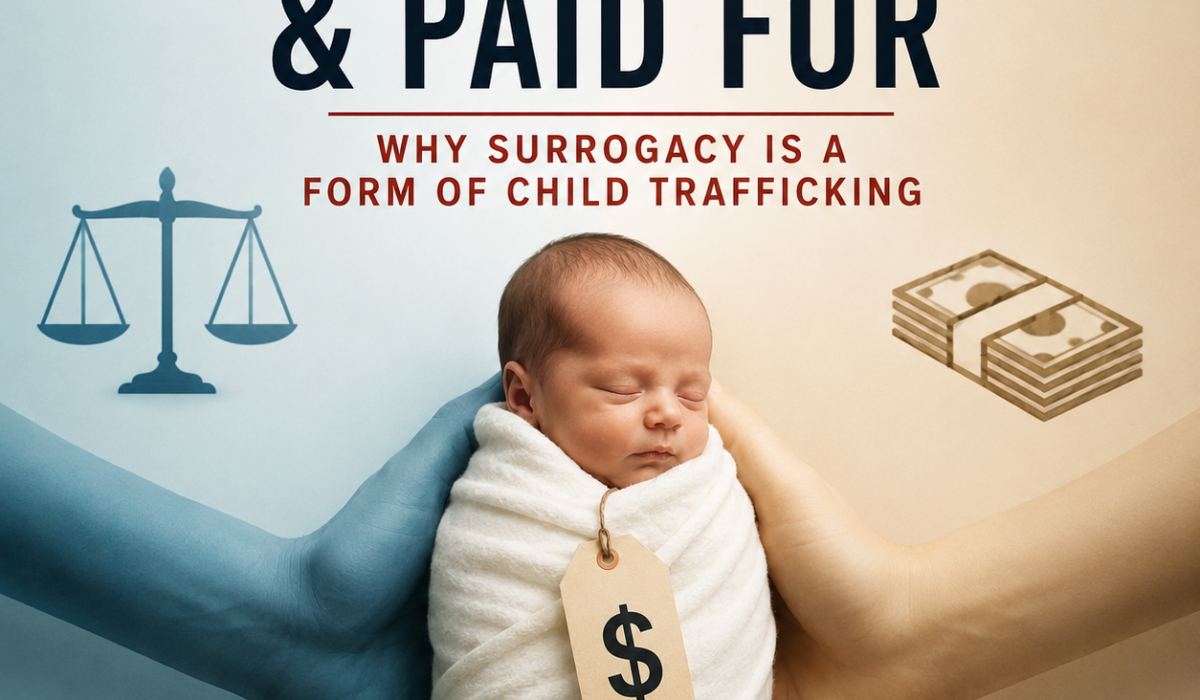
Bought and Paid For: Why Surrogacy is Modern Child Trafficking


Modern surrogacy is marketed as a beautiful act of generosity: hopeful parents finally holding a long-awaited baby, smiling doctors standing beside expensive fertility clinics, and emotionally charged slogans about “creating families.” The public relations machine surrounding the modern child trafficking industry is powerful, polished, and deeply emotional. Yet beneath the sentimental language lies the reality. Surrogacy is a commercial system in which human beings are contractually commissioned, manufactured through reproductive technology, and transferred in exchange for money. Strip away all the polite euphemisms, and the structure resembles something disturbingly close to child trafficking.

That comparison shocks people because modern society has learned to separate immoral acts from acceptable ones through language rather than substance. If a child is exchanged through illegal networks, society calls it trafficking. If a child is produced through lawyers, clinics, contracts, and six-figure payments, society calls it “family building.” But legality has never determine morality. History is filled with legal systems that institutionalized deeply evil practices. The central question is not whether surrogacy is legal in certain jurisdictions, but whether paying to obtain a child through contractual transfer fundamentally commodifies human life. Once that question is honestly answered, the parallels become impossible to ignore. Even setting aside the serious moral, psychological, medical, and theological problems associated with surrogacy (of which there are many), the transaction increasingly mirrors the logic, mechanics, and incentives of trafficking.


I: When Children Become Products

The defining feature of commerce is simple: a product is commissioned, produced, and transferred in exchange for compensation. Commercial surrogacy follows that framework. Intended parents pay agencies, lawyers, fertility clinics, and surrogate mothers in order to obtain a child. In the United States, commercial surrogacy arrangements commonly range from $100,000 to over $500,000 once medical procedures, legal fees, agency fees, insurance, embryo transfers, and “surrogate compensation” are included. The child is the object of the transaction.

The surrogacy industry often insists that parents are merely paying for “services,” not for the child. But this is simply not true. If the surrogate miscarries, intended parents frequently demand refunds, repeat procedures, or contractual remedies. Contracts routinely specify selective abortion clauses, embryo quantity requirements, health expectations, and behavioral restrictions. In many agreements, intended parents exercise extraordinary control over the pregnancy (and even the mother) because they view the outcome as something purchased and expected. That is not the language of gift, sacrifice, or adoption, but the language of consumer entitlement.

One of the clearest demonstrations that surrogacy operates as a commercial ownership arrangement rather than a purely compassionate act is found in the abortion and “selective reduction” clauses embedded in surrogacy contracts. Intended parents frequently demand contractual authority over whether the surrogate must terminate the pregnancy in cases involving disability, genetic abnormality, multiple embryos, or medical complications. In these agreements, the surrogate can face financial penalties, breach-of-contract lawsuits, criminal charges, and/or the withholding of compensation if she refuses. Courts have repeatedly wrestled with disputes involving intended parents demanding abortion and surrogates resisting those demands. The existence of such clauses exposes the underlying logic of the industry: the child is not treated as a sovereign human life but a commissioned product subject to quality control standards. A mother carrying her own child would never be viewed as contractually obligated to murder that child at another person’s request. Yet within commercial surrogacy, this requirement is normalized because the financial structure encourages the paying parties to view themselves as entitled decision-makers over both the pregnancy and the unborn child. 

Bioethicist Dr. Renate Klein, editor of Surrogacy: A Human Rights Violation, argued that surrogacy “turns women into breeders and children into commodities.” Meanwhile, philosopher Michael Sandel warned in What Money Can’t Buy that market logic increasingly invades areas of life where it does not belong, including human reproduction. Once human life becomes subject to contract and commercial expectation, moral boundaries no longer exist.

Even secular legal scholars have acknowledged the resemblance between commercial surrogacy and human trafficking systems. The European Parliament condemned surrogacy in 2015, stating that the practice “undermines the human dignity of the woman” and that the “human body and its reproductive functions should not be treated as commodities.” Critics across political and religious lines increasingly recognize that the industry monetizes both women and children simultaneously.

Scripture states in Psalm 127:3, “Children are a heritage from the Lord, the fruit of the womb a reward.” A reward is received from God, not commissioned through contractual acquisition.

The uncomfortable reality is: when money changes hands specifically so a child can be conceived, carried, and transferred to paying adults, society has already crossed into morally dangerous territory. The existence of legal paperwork does not eliminate commodification.


II: The Exploitation of Women and Economic Coercion

Commercial surrogacy depends heavily upon greed. Why don’t we see wealthy couples becoming surrogates for poorer women. The flow only moves in one direction: affluent individuals purchase reproductive labor from women in financially vulnerable positions, or women that value money more than human life. That imbalance is foundational to the industry itself.

In countries where commercial surrogacy expanded rapidly, exploitation scandals quickly followed. India became one of the world’s largest surrogacy hubs before tightening restrictions in response to widespread ethical concerns. Women living in poverty were recruited to carry babies for wealthy foreigners while agencies profited enormously from the arrangement. A 2013 report by the Centre for Social Research in India documented cases in which surrogates were isolated from their families, pressured into medical decisions, and inadequately informed about health risks. Similar concerns emerged in Thailand, Ukraine, Georgia, and other international surrogacy markets.

The industry often presents surrogate mothers as empowered entrepreneurs making free choices. If a woman agrees to rent her womb because she cannot pay medical bills, avoid eviction, or feed her children, how voluntary is the arrangement? Economic coercion does not disappear because contracts are signed.

Feminist scholar Andrea Dworkin once warned that systems which commercialize the female body inevitably become systems of exploitation. Even many degenerates who support abortion rights have expressed discomfort with surrogacy because it transforms pregnancy into paid labor subject to customer expectations. The surrogate’s body becomes a managed production environment overseen by clinics, agencies, and intended parents.

Medical risks are also significant. Surrogates face heightened risks of gestational diabetes, preeclampsia, postpartum depression, cesarean delivery, hemorrhage, and emotional trauma. A 2018 study published in Human Reproduction found 140% increased obstetric complications among surrogate pregnancies compared to traditional pregnancies. Yet despite these risks, surrogacy agencies frequently emphasize financial compensation over any long-term consequences.

The biblical vision of motherhood bears no resemblance to commercial surrogacy. Pregnancy is portrayed in Scripture as deeply relational, covenantal, and familial. In Genesis, the womb is consistently treated as sacred territory under God’s authority, not an economic asset for temporary lease. 

Surrogacy advocates frequently speak about compassion for infertile couples, and infertility is undeniably painful. But compassion cannot justify exploitation. A society that solves one person’s suffering by financially incentivizing another person’s bodily risk and emotional sacrifice is redistributing suffering downward through economic power.


III: The Deliberate Separation of Mother and Child

One of the most unnatural elements of surrogacy is that it intentionally creates maternal separation. The child is conceived with the expectation that the woman carrying him or her will surrender the baby immediately after birth. What adoption addresses after tragedy or crisis, surrogacy deliberately engineers in advance.

For decades, attachment research has demonstrated that bonds between mother and child begin in the womb. Studies published in journals such as Infant Behavior and Development show that unborn babies recognize maternal voices, rhythms, hormones, and stress patterns long before birth. Pregnancy is not simply biological incubation; it is relational formation. The surrogate mother and unborn child are connected physically, hormonally, neurologically, and emotionally throughout gestation.

Surrogacy contracts, however, require everyone involved to suppress or deny the significance of that bond. Surrogates are often instructed to emotionally distance themselves from the baby. Intended parents are encouraged to view the surrogate primarily as a carrier rather than a mother. The language has been engineered to weaken natural human attachment. Terms like “gestational carrier” replace “mother” because the industry understands the emotional power of motherhood.

Yet reality consistently intrudes. Nearly all surrogate mothers report grief, depression, and/or emotional distress after relinquishment. Children born through surrogacy increasingly describe identity confusion and emotional struggles related to their origins. Some feel fragmented by the knowledge that conception, gestation, genetics, and parenting were divided among multiple parties connected through financial arrangements.

Psychologist Nancy Verrier, author of The Primal Wound, argued that early maternal separation leaves profound psychological effects even when infants cannot consciously articulate the experience. While debate continues over the extent of those effects, it is increasingly difficult to maintain the fiction that maternal detachment is emotionally neutral.

The comparison to trafficking becomes especially troubling here because trafficking systems often involve the severing of natural family bonds for the desires or demands of others. Again, defenders object that intended parents love the child deeply. But traffickers may also claim benevolent intentions. Intent alone cannot sanctify morally distorted systems.

The Bible consistently emphasizes the unity between mother and child. Psalm 22:10 declares, “Upon you I was cast from my birth, and from my mother’s womb you have been my God.” The womb is not treated as a rental environment disconnected from maternal identity. Likewise, Isaiah 49:15 asks, “Can a woman forget her nursing child?” Scripture assumes maternal attachment is powerful, natural, and good.

Surrogacy requires society to deny this reality because acknowledging it would destabilize the industry, costing them billions of dollars. If pregnancy creates genuine maternal bonds, then commercial contracts demanding relinquishment are pre-negotiated separation agreements involving the ownership of human children.


IV: The Global Industry and the Machinery of Trafficking

Trafficking is not only about illegal abduction. Modern trafficking systems often involve legal paperwork, intermediaries, transportation networks, financial transactions, and often vulnerable  “3rd world” populations. By that broader definition, international surrogacy increasingly mirrors every other human trafficking infrastructure.

The global surrogacy market is projected to exceed tens of billions of dollars in coming years as demand rises among wealthy clients. Agencies recruit surrogate mothers, fertility clinics manufacture embryos, lawyers navigate parentage laws, brokers coordinate international arrangements, and children are transferred across borders after birth. Entire industries now exist to facilitate the movement of human children from reproductive suppliers to paying consumers.

Numerous scandals have exposed the dark underbelly of this machine. During the war in Ukraine, international media outlets reported chaotic scenes involving dozens of surrogate-born infants stranded in clinics awaiting pickup by foreign parents. The images were jarring: rows of babies produced through international reproductive contracts, delayed in transfer because geopolitical circumstances interrupted delivery logistics.

In another infamous case, the “Baby Gammy” scandal in Thailand involved the intended parents  abandoning one twin born with Down syndrome while taking the healthy sibling, because if children are just goods, then why pay for damaged ones? The case highlighted how easily children conceived through contractual arrangements can become subject to consumer preference and rejection.

Commercial surrogacy also creates complicated citizenship, legal parentage, and custody disputes. Some children born through international surrogacy arrangements have effectively become stateless due to conflicting national laws regarding parenthood. Others become trapped in prolonged legal conflicts between genetic contributors, surrogates, and intended parents.

The language of trafficking is difficult to avoid because the mechanics are the same. A woman is recruited, money changes hands, a child is produced under contract, legal intermediaries facilitate transfer, and wealthy clients acquire custody rights. International transportation (or occasionally domestic) then follows. The only substantial difference is paperwork.

From a biblical perspective, Babel-like technological ambition frequently leads humanity into moral confusion when capability outruns wisdom. Ecclesiastes 8:11 warns that when judgment against wrongdoing is delayed, “the heart of the children of man is fully set to do evil.” Modern reproductive technology has enabled humanity to separate conception, pregnancy, genetics, parenthood, sexuality, and family into modular commercial services. But the ability to do something does not establish a moral right to do it.

Industrialized surrogacy has never resembled compassionate caregiving, it is nothing more than supply-chain management for human reproduction.


V: The Loss of Human Dignity in the Age of Reproductive Commerce

At its core, the surrogacy debate is about whether human beings possess intrinsic dignity or market value. Once reproduction enters the marketplace children inevitably become products evaluated according to preference, specification, and consumer expectations.

Modern fertility clinics already allow embryo screening for sex selection and genetic abnormalities. In most cases, embryos are discarded because they fail to meet desired criteria. Surrogacy intensifies this logic because the child is not conceived naturally but intentionally commissioned through expensive technological processes. The emotional and financial investment encourages consumers to view themselves as entitled purchasers rather than grateful recipients of sacred life.

This mentality has reshaped parenthood. Historically, children were understood as gifts from God, entrusted to families. Modern reproductive commerce increasingly treats children as lifestyle acquisitions obtained through sufficient resources and technological advances. Desire has become entitlement, and pregnancy has become outsourced labor.

Underneath much of the modern fertility industry lies a deeper spiritual problem: the refusal to accept limits, timing, order, or authority outside the self. Scripture presents children as blessings given by God within covenantal structure. Yet modern surrogacy culture increasingly encourages people to circumvent natural, moral, relational, and even biological boundaries through money and technology rather than first examining whether their lives are aligned with God’s design.

In many cases, little attention is given to spiritual order, repentance, health restoration, or disciplined living. A culture drowning in processed food, hormonal disruption, obesity, pharmaceutical dependence, pornography, sexual disorder, delayed marriage, and rejection of biblical family structure now turns to laboratories and commercial wombs to solve problems that are often downstream of rebellion against natural and divine order. Instead of asking, “How do we honor God and restore healthy households?” society increasingly asks, “How do we obtain the outcome we desire regardless of cost?” The issue is not infertility, but humanity’s growing insistence on sovereignty over creation.

Scripture does not mock the pain of barrenness. Sarah, Rachel, Hannah, and Elizabeth (and others) all wept over infertility. But in each case, the answer was ultimately found in God’s providence rather than commercialized markets. Their stories point toward dependence upon God, prayer, covenant faithfulness, and trust.

The language used by the industry reveals the shift. Intended parents are called “clients.” Agencies advertise “guaranteed programs.” Clinics discuss “success rates” and “deliverables.” Some agencies even market “premium surrogate packages” resembling luxury service tiers. Human reproduction is no longer described in relational or familial terms, but increasingly in commercial terminology.

Pope Francis condemned surrogacy in 2024 as a practice that “violates the dignity” of both women and children because it turns the child into “an object of trafficking.” While many theological traditions differ on various reproductive questions, there is growing consensus among religious ethicists that surrogacy fundamentally risks reducing human life to a transaction.

Even secular critics increasingly warn that the marketization of reproduction destroys social morality. Political philosopher Michael Walzer argued that certain human goods become corrupted when bought and sold, and parenthood belongs among those goods. Love, family, and children cease to function properly once subordinated to consumer logic.

Surrogacy supporters frequently ask emotionally compelling questions: “Should infertile couples never have children?” The answer: Painful desires do not automatically justify every possible solution. Not every longing can be fulfilled morally. Human dignity imposes boundaries even on deeply emotional aspirations.

The fundamental issue remains unchanged no matter how sophisticated the technology becomes: if a child is intentionally produced through paid contractual arrangements for transfer to purchasing adults, then society has already entered territory dangerously adjacent to trafficking. The presence of compassion does not change the commodification. 


Conclusion:

Modern society often mistakes technological advancement for moral progress. Surrogacy is celebrated because it has been advertised as compassionate, sophisticated, and empowering. But civilizations are not judged by what they can accomplish technologically. They are judged by whether they preserve the dignity of the weak, the integrity of the family, and the sanctity of human life. Commercial surrogacy completely fails all three tests.

The deepest danger of surrogacy is not simply that it exploits women, confuses children, or enriches fertility corporations. The deepest danger is that it trains society to think of human beings as products obtainable through sufficient money, legal engineering, and technological power. Since that mentality has taken hold, the moral foundation beneath human dignity has eroded rapidly. Our civilization now sells children, and convinces everyone they are doing something good.

The Lost Art of Raising Dangerous Boys


Introduction:

Society has developed a strange obsession with turning boys into harmless little domesticated pets. We drug them when they fidget, shame them when they compete, isolate them from risk, remove every sharp object from their environment, and then stare in confusion when they grow into anxious, directionless, weak men who panic at minor inconveniences and fold under pressure. We have built an entire cultural system dedicated to the sterilization of masculinity. Schools reward passivity, media mocks competence, and corporations demand compliance. Meanwhile, parents hover over boys like Secret Service agents guarding a national treasure from bicycles, tree branches, and pocketknives. Heaven forbid little Billy learn how to climb something taller than a beanbag chair without a helmet, a waiver form, and three emotional support counselors nearby.

Historically, civilizations inherently understood what we have apparently forgotten: Boys are designed for conquest, hardship, building, protection, exploration, and controlled aggression. A healthy civilization disciplines and directs these traits. Scripture presents young men as workers, shepherds, hunters, warriors, builders, and leaders, not as permanently supervised adolescents medicated until they are docile. Proverbs 22:6 commands fathers to train children in the way they should go. Dangerous boys become useful men when forged correctly, while harmless boys become liabilities. The difference is training.


I. Civilization Was Built by Boys Who Were Allowed to Become Men

For most of human history, survival depended on competent young males who could endure hardship, solve problems, navigate danger, and shoulder responsibility early in life. By age twelve, most boys throughout history were already contributing meaningful labor to farms, trade guilds, hunting parties, military preparation, and family businesses. Medieval apprentices began training between ages ten and twelve. Frontier boys in early America handled livestock, firearms, axes, and land management as young as eight, long before modern society believes a teenager can safely operate a toaster without adult supervision.

The industrial and post-industrial eras gradually removed boys from meaningful responsibility. Instead of working alongside fathers and communities, boys became institutionalized through prolonged public schooling systems that increasingly resemble behavior-management facilities rather than educational environments. Historian and educator John Taylor Gatto argued that compulsory schooling suppresses independence, risk-taking, and initiative in favor of conformity and compliance. He has been proven right in the most sombering way possible. A system designed around sitting still for eight hours straight naturally punishes boys whose brains are wired for movement, experimentation, and competition.

Research supports the reality that boys and girls develop differently neurologically and behaviorally. Studies published through institutions such as the American Psychological Association and National Institutes of Health have documented sex-based developmental differences in impulsivity, risk assessment, and physical activity patterns. Boys display higher sensation-seeking behavior and greater physical aggression from an early age. The modern solution has largely been to suppress these traits chemically and psychologically rather than channel them productively. Apparently, if a boy enjoys climbing rocks, wrestling his friends, and inventing ways to jump over things, he now requires drugs and counseling.

Scripture treats masculinity as a given trait for young boys. David killed lions and bears while still young (1 Samuel 17:34–36). Jesus worked as a carpenter in a culture where manual labor was normal male development. Boys historically became dangerous in useful ways because they were expected to become capable, and capability requires exposure to difficulty. You cannot produce resilient men through perpetual insulation any more than you can produce strong steel without fire.


II. Safety Culture Is Producing Fragile Men

Modern parenting treats ordinary childhood experiences as catastrophic threats. Trees are dangerous, pocketknives are dangerous, roughhousing is dangerous, and camping without Wi-Fi apparently borders on a humanitarian crisis. Entire generations of boys are now raised inside sanitized digital cages where simulated accomplishment replaces real competence. They conquer imaginary kingdoms online while remaining incapable of changing a tire, building a fire, or speaking confidently to strangers while looking them in the eye with a firm handshake.

Psychologist Jonathan Haidt, particularly in The Coddling of the American Mind, documents how overprotection contributes directly to anxiety, fragility, and emotional instability among younger generations. Children develop resilience through manageable exposure to stress, conflict, failure, and risk, but never through permanent emotional quarantine. The immune system strengthens through exposure and so does the character.

Research from the Centers for Disease Control and Prevention has shown alarming increases in anxiety, depression, and emotional dysfunction among adolescents over the past two decades. Meanwhile, outdoor activity, unsupervised play, and practical labor have sharply declined. The correlation cannot be ignored, boys denied challenge do not become peaceful; they become restless, depressed, addicted, passive, or explosive. Energy that is not directed productively eventually leaks destructively.

Historically, many cultures intentionally used rites of passage to transition boys into manhood. Spartan boys endured harsh discipline and physical testing. Roman boys trained in responsibility and civic duty. Indigenous tribes worldwide incorporated hunting, endurance trials, wilderness survival, and responsibility rituals. Even early American communities expected boys to contribute economically and physically to household survival. Modern culture has replaced these systems with social media, processed food, unlimited entertainment, and antidepressants. Truly an inspiring trade!

Scripture repeatedly ties maturity to endurance and discipline. Hebrews 12:11 says that discipline is painful in the moment but later yields “the peaceful fruit of righteousness.” James 1:2–4 commands believers to count trials as joy because testing produces steadfastness. Yet modern parenting philosophies operate as though the highest moral good is making sure little Brayden never experiences discomfort stronger than a mildly disappointing Wi-Fi signal.

A boy who never struggles never develops confidence. Real confidence can only come from overcoming resistance. True confidence will never come from receiving participation trophies for breathing correctly during recreational soccer.


III. Boys Need Tools, Responsibility, and Real Work

Another great lie of modern culture is the idea that responsibility somehow harms children. In reality, meaningful responsibility is precisely what gives boys purpose, confidence, and direction. Boys desperately want to matter. They want to build things, fix things, carry things, defend things, and accomplish things. When society denies them productive outlets, they will seek destructive substitutes.

Historically, boys learned competence by participating directly in adult life. They worked beside fathers, craftsmen, farmers, mechanics, soldiers, and tradesmen. The skills were transferred relationally and practically. A boy learned responsibility because responsibility was unavoidable. Today, most teenage boys reach adulthood without ever being trusted with meaningful obligations beyond remembering a password for Netflix.

Studies on adolescent development consistently show that responsibility and practical competence improve self-esteem and emotional stability. Research published in the Journal of Adolescence has linked structured responsibility and skill development with increased resilience and lower behavioral problems. Boys who feel useful will behave better than boys treated like liabilities, or inconveniences.

There is also neurological value in practical labor. Manual skills engage coordination, problem-solving, patience, spatial reasoning, and perseverance simultaneously. Working with tools teaches consequences immediately and honestly. Wood does not care about your feelings, engines do not respond to emotional affirmations, and gravity remains deeply committed to objective reality regardless of how empowered someone feels on TikTok.

Scripture presents work as formative and honorable. Proverbs praises diligence, labor, preparedness, and craftsmanship. Jesus’ parables are filled with workers, builders, shepherds, managers, laborers, and stewards because productive responsibility reflects The divine order. Idleness, meanwhile, is treated as spiritually and socially dangerous.

The modern obsession with eliminating risk from boys’ environments will produce adults incapable of handling normal life. A boy trusted to split wood, work on engines, cook meals, manage money, care for siblings, and maintain property develops competence. Competence produces confidence. Confidence reduces fear. Fearful men are easily manipulated. Competent men are notoriously difficult to control. And perhaps that is part of the problem.

A civilization dependent on passive consumers has little use for independent, dangerous, competent men. Dangerous does not mean criminal, dangerous means capable of action, defense, resistance, sacrifice, leadership, and endurance. A civilized society depends on such men while simultaneously pretending to despise them.


IV. Discipline Is Not Abuse, It Is Mercy

Contemporary culture frequently confuses discipline with cruelty because it has embraced the fantasy that unrestricted emotion produces healthy people. It does not. Human beings, especially young boys, require structure, correction, standards, accountability, and consequences. Without discipline, raw masculine energy will become chaos, with discipline, it will become civilization.

The biblical model of fatherhood is deeply rooted in correction and instruction. Proverbs 13:24 states, “Whoever spares the rod hates his son, but he who loves him is diligent to discipline him.” We may recoil at such verses because contemporary culture increasingly views authority as oppressive, but every functioning institution on earth operates through hierarchy, standards, and consequences. Sports teams discipline. Military units discipline. Martial arts discipline. Skilled trades discipline. Even orchestras discipline. But somehow fathers are expected to raise boys through bribery, negotiation and therapeutic vocabulary.

The irony is that boys actually crave strong boundaries. Numerous developmental studies show children perform better psychologically when raised within environments containing clear expectations and consistent consequences. Research associated with developmental psychologist Diana Baumrind’s authoritative parenting model found that children raised with warmth combined with firm structure consistently demonstrate stronger emotional regulation and social competence than children raised permissively.

Historically, disciplined boys became reliable men because discipline trained self-control before adulthood amplified the consequences of not having self control. A boy who cannot govern himself emotionally becomes a man governed by impulse. Such men become addicts, cowards, tyrants, parasites, and/or perpetual adolescents. Civilization will collapse when too many men remain undisciplined boys into adulthood.

Discipline also teaches boys something modern culture hates to admit: actions have consequences. This reality is mercy. A father correcting laziness, disrespect, recklessness, or cowardice early will spare his son catastrophic failure later. Better a bruised ego at fourteen than a destroyed life at forty.

Even Christ’s disciples underwent rigorous correction, testing, and hardship. Jesus did not build strong men through perpetual affirmation circles around artisanal coffee and emotional journaling exercises. He challenged them, rebuked them, sent them into difficulty, and demanded sacrifice. Biblical masculinity has never resembled the modern therapeutic softness we see today.

A dangerous boy without discipline will become a threat. A dangerous boy with discipline will become a protector, builder, husband, father, leader, and defender. The goal is not eliminating masculine force. The goal is teaching a boy when, where, and how to wield it properly and righteously. 


V. Hardship Creates Men Comfort Never Could

Every generation claims to want strong men while simultaneously constructing environments designed to prevent strength from developing. Strength is born from hardship, endurance emerges from suffering, courage grows through danger, and wisdom develops through failure. Why then does modern society insist on engineering adulthood without hardship, this is roughly as intelligent as attempting to build muscle without training.

The Roman philosopher Seneca wrote, “Difficulties strengthen the mind, as labor does the body.” History repeatedly confirms this principle. Generations shaped by hardship produce resilience, innovation, and sacrifice. Generations raised in excess exhibit entitlement, emotional fragility, and decadence. This cycle has appeared in every collapsing civilization for all of recorded history.

Today boys are increasingly disconnected from physical struggles. According to data from the World Health Organization, physical inactivity among youth has risen dramatically worldwide. Simultaneously, screen time, obesity, social isolation, anxiety, and depression continue climbing. Human beings were not designed to live permanently indoors under artificial light consuming digital stimulation for fourteen hours a day while arguing online about fictional superheroes with strangers.

Hardship also teaches perspective. A boy who hikes mountains, works in heat, trains physically, loses competitions, repairs broken machinery, and faces controlled adversity develops internal stability that cannot be achieved by any other means. He learns he can survive discomfort. He learns pain is temporary. He learns failure is survivable. Most importantly, he learns the world does not exist to revolve around his feelings.

Scripture consistently frames hardship as refinement. Romans 5:3–4 teaches that suffering produces endurance, character, and hope. The Apostle Paul describes the Christian life using athletic, military, and labor imagery because strength is forged, not granted magically through affirmations.

This does not mean fathers should abuse sons or invent unnecessary cruelty. It means fathers must stop stealing growth opportunities through overprotection. Let boys climb, let them build, let them fail, and let them compete. Let them get bruised, dirty, exhausted, frustrated, corrected, and tested. Within reason, these experiences are the very mechanisms through which boys become men.

A civilization unable to produce strong men will become dependent on stronger men from elsewhere. History is brutally consistent with this outcome.


Conclusion:

Modern culture keeps asking why so many young men feel lost, angry, weak, addicted, passive, and purposeless. The answer is we stopped raising boys to become dangerous men under discipline and started raising them to become permanently supervised consumers. We replaced fathers with institutions, challenge with entertainment, apprenticeship with algorithms, and courage with comfort. Now we act shocked when masculinity is replaced by confusion, escapism, and dysfunction.

The solution is neither cruelty nor machismo, but ordered masculinity rooted in responsibility, discipline, faith, competence, and endurance. Boys need fathers who demand something from them. They need work that matters, hardship that shapes them, risks that test them, and standards that refine them. They need Scripture, structure, tools, dirt, challenge, correction, and purpose. The world does not need fewer dangerous men. It needs more dangerous men governed by wisdom, discipline, and righteousness. History was built by such men. And until we rediscover how to raise them again, history will remember us as the civilization of useless cowards.

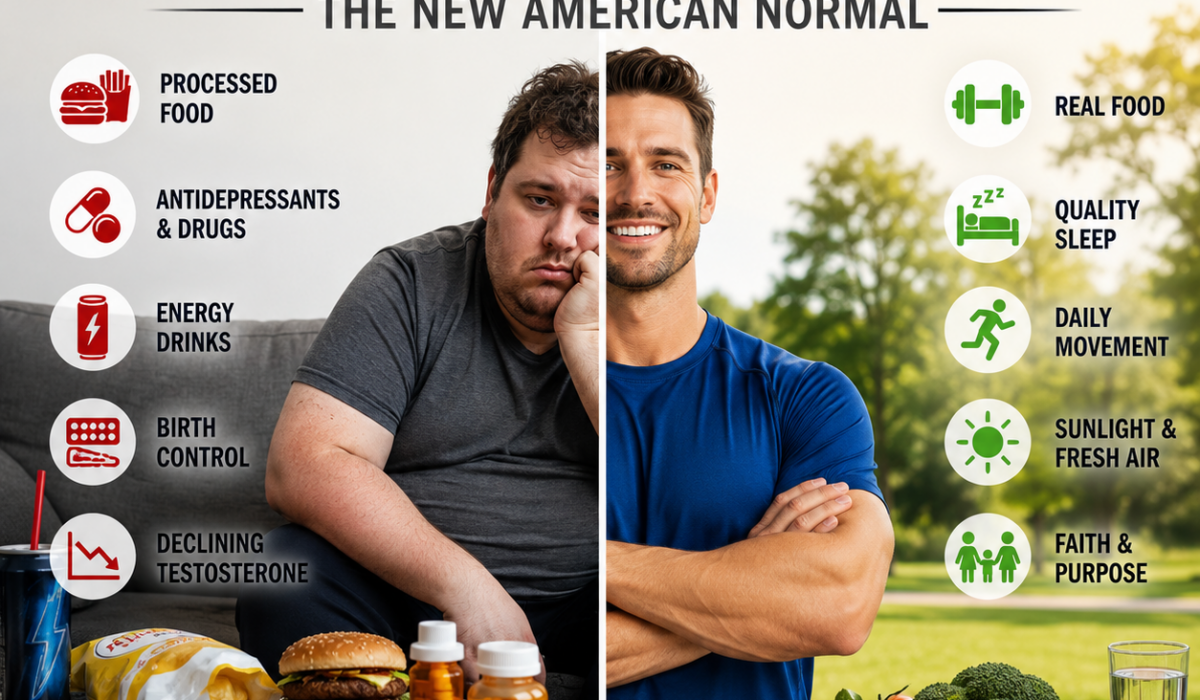
Fat, Tired, and Drugged: The New American Normal


Introduction:

America is the richest nation in human history, and yet millions of Americans wake up exhausted, overweight, anxious, inflamed, medicated, and dependent on stimulants to survive the day. The modern American lifestyle has normalized conditions that would have been considered signs of severe societal decline only a few generations ago. Obesity rates continue climbing well past 50%. Testosterone levels continue falling. Antidepressant prescriptions are handed out like candy. Birth control is consumed for years or decades at a time, starting as young as 12. Energy drinks have become breakfast for teenagers and adults alike. Meanwhile, processed food dominates grocery shelves while chronic disease consumes families physically, mentally, spiritually, and financially.

This is no accident. A culture built around convenience, comfort, pharmaceutical dependency, entertainment, sedentary living, and industrialized food production was always going to produce weak, exhausted, unhealthy people. Scripture warns repeatedly that gluttony, sloth, indulgence, and lack of self-control bring destruction. “Whether therefore ye eat, or drink, or whatsoever ye do, do all to the glory of God” (1 Corinthians 10:31). The body is not a disposable shell, but a physical vessel through which men and women fulfill their responsibilities before God, family, and society. A civilization full of weak, sick, distracted, chemically dependent people cannot sustain strength, order, productivity, or freedom for long.


I. The Obesity Crisis Is Not “Normal”

The United States is now one of the most overweight nations on earth. According to the Centers for Disease Control and Prevention, more than 50% of American adults are obese, and obesity rates among children continue to rise dramatically. Severe obesity has become increasingly common, particularly among younger adults. Conditions once associated primarily with advanced age (type 2 diabetes, hypertension, fatty liver disease, joint degeneration, and cardiovascular disease) are now commonplace in teenagers and young adults. Yet despite this national emergency, obesity has become culturally normalized. Entire industries now exist to convince people that being dangerously overweight is merely another harmless body type rather than a serious medical condition with devastating consequences to themselves and their families.

The average American diet today barely resembles food. Grocery stores are filled with ultra-processed products loaded with refined sugar, industrial seed oils, preservatives, artificial dyes, chemical stabilizers, and empty calories. Researchers at the National Institutes of Health have found that ultra-processed foods dramatically increase calorie consumption and weight gain compared to minimally processed diets. Modern food engineering is intentionally designed to override satiety signals, maximize cravings, and encourage overconsumption. The result is a population constantly eating yet chronically malnourished. Many Americans consume thousands of calories daily while remaining deficient in essential nutrients, vitamins, minerals, and protein quality.

Physical inactivity compounds the problem. Previous generations worked physically demanding jobs, walked more frequently, spent time outdoors, and engaged in regular manual labor. Today millions sit for ten or more hours daily staring at screens, commuting in vehicles, and vegetating on couches at night. The body was designed for movement, resistance, labor, sunlight, and exertion. Instead, modern life encourages passivity, and convenience has replaced discipline. Escalators replace stairs, delivery apps replace walking, and entertainment replaces activity. Even children increasingly spend their lives indoors staring at phones and tablets rather than running, climbing, building, or exploring.

Scripture condemns gluttony and excess because they destroy both the body and the character. Proverbs 23:20-21 warns, “Be not among winebibbers; among riotous eaters of flesh: For the drunkard and the glutton shall come to poverty.” Gluttony is not only about appearance; it reflects disordered appetites and lack of control over the flesh. A society that cannot govern its eating habits will struggle to govern anything else. The obesity epidemic is evidence of cultural collapse, broken discipline, industrial exploitation, and spiritual disorder.


II. Exhausted by Design: Energy Drinks, Sleep Deprivation, and Burnout

Americans are exhausted. Not merely tired after hard work, but chronically fatigued, mentally foggy, overstimulated, sleep deprived, and emotionally drained. Instead of addressing the underlying causes, millions attempt to chemically force themselves through the day with caffeine, sugar, stimulants, and energy drinks. The global energy drink industry is now worth tens of billions of dollars annually, targeting teenagers, young adults, blue-collar workers, athletes, gamers, and office employees alike. What was once an occasional stimulant has become a daily survival mechanism for many people.

Energy drinks are often loaded with massive doses of sugar, synthetic stimulants, and chemical additives. Studies published in journals such as the Journal of the American Heart Association have linked energy drink consumption to elevated blood pressure, heart rhythm abnormalities, anxiety, insomnia, and cardiovascular complications. Consumption continues rising because many Americans are trying to compensate for lifestyles fundamentally at odds with human biology. Poor diets, lack of exercise, excessive screen exposure, artificial lighting, stress, and constant digital stimulation destroy natural energy systems. Rather than restoring healthy rhythms, people simply pour drugs into their system to cover up the problem..

Sleep deprivation has become a public health epidemic. The CDC estimates that roughly two-thirds of American adults fail to get sufficient sleep due to stimulant and cell phone use. Chronic sleep deprivation affects testosterone production, insulin sensitivity, mood regulation, cognitive performance, immune function, and weight management. Sleep is biological maintenance, God designed the human body around cycles of work and rest. Psalm 127:2 warns, “It is vain for you to rise up early, to sit up late, to eat the bread of sorrows.” Modern culture glorifies burnout, hustle, endless productivity, and constant availability, even as people physically and mentally deteriorate.

Technology intensifies the problem further. Notifications, social media scrolling, binge streaming, late-night gaming, and constant smartphone exposure keep millions overstimulated well into the night. Blue light exposure suppresses melatonin production and disrupts circadian rhythms. Meanwhile, modern workers are mentally overloaded while physically inactive, a combination uniquely damaging to the human body. The result is a population simultaneously exhausted and unable to rest properly.

Most people today are not energetic at all; they are chemically stimulated zombies oscillating between drug highs and emotional crashes. They wake exhausted, medicate with stimulants, survive on sugar and processed food, stare at screens for twelve hours, then lie awake at night unable to sleep. This is managed dysfunction. A nation running on stimulants instead of strength will collapse under the weight of its own exhaustion. True vitality requires discipline, movement, sunlight, proper food, meaningful work, physical fitness, and ordered living, not another oversized can of synthetic chemical energy.


III. The Pharmaceutical Nation: Antidepressants, Anxiety Medication, and Dependency

America is heavily medicated. According to data from the National Center for Health Statistics, antidepressant use has risen dramatically over the past several decades, particularly among women. Millions of Americans now take selective serotonin reuptake inhibitors (SSRIs), anti-anxiety medications, sleep aids, mood stabilizers, and other psychiatric drugs long-term. Many people suffer from severe psychological conditions requiring medical intervention. But the sheer scale of pharmaceutical dependency raises questions about the deeper causes of America’s mental health crisis.

Modern life systematically produces anxiety, isolation, purposelessness, and emotional instability. Families are fractured, communities are weak, and Churches are hollow or compromised, while social media fosters comparison, envy, outrage, and loneliness. Men lack direction. Women place themselves in situations with impossible expectations. Children grow up immersed in digital addiction and confusion. Most Americans spend very little time outdoors, rarely exercise, eat nutrient-poor diets, sleep poorly, and remain disconnected from meaningful relationships and physical labor. Unsurprisingly, depression and anxiety flourish in such an environment.

Instead of addressing foundational issues, society turns more and more to medication. Pharmaceutical intervention can temporarily reduce symptoms, but drugs cannot replace purpose, discipline, healthy relationships, sunlight, exercise, spiritual grounding, or meaningful responsibility. Numerous studies show strong links between exercise and improved mental health outcomes. Research published in JAMA Psychiatry found that regular physical activity significantly reduces depression risk. Nutritional deficiencies, hormonal imbalances, inflammation, poor sleep, and sedentary lifestyles all contribute heavily to emotional instability, and these factors are frequently ignored in favor of quick pharmaceutical solutions.

There are also legitimate concerns regarding side effects and long-term dependency. Antidepressants produce emotional blunting, sexual dysfunction, weight gain, withdrawal symptoms, and many other serious complications. Most patients report feeling emotionally numb rather than healed. The issue is not that all psychiatric medication is evil or unnecessary, but that America increasingly treats symptoms while refusing to confront the root causes. It is easier to medicate dysfunction than rebuild healthy lives and communities.

Scripture recognizes the reality of despair, sorrow, and suffering, but consistently points people toward endurance, wisdom, discipline, community, and trust in God rather than chemical escape. Elijah experienced profound despair. David wrote about grief and anguish throughout the Psalms. Yet biblical healing involved restoration, purpose, obedience, fellowship, and renewed strength, not perpetual dependency upon substances to emotionally survive daily life.

A society drowning in antidepressants while simultaneously abandoning family structure, physical health, spiritual order, and meaningful labor should not be shocked when mental illness becomes an epidemic. Human beings were not designed to live isolated, overstimulated, sedentary, purposeless lives disconnected from God, nature, work, and community. Medication may sometimes be necessary, but no civilization can medicate itself into wholeness while continuing to poison the foundations of human flourishing.


IV. Declining Testosterone and the Collapse of Masculine Vitality

Testosterone levels among men have declined significantly over recent decades. Multiple studies, including research published in the Journal of Clinical Endocrinology & Metabolism, have documented measurable declines in male testosterone levels even after controlling for age. Simultaneously, sperm counts have fallen dramatically in many Western nations. Researchers continue debating the exact causes, but agree contributors include obesity, sedentary living, endocrine-disrupting chemicals, poor sleep, chronic stress, processed food consumption, environmental toxins, excessive pornography consumption, and declining physical activity.

The consequences extend far beyond the gym. Testosterone affects energy, motivation, muscle mass, bone density, confidence, mood stability, sexual function, competitiveness, fertility, and overall vitality. Low testosterone is associated with fatigue, depression, reduced ambition, increased body fat, diminished strength, and decreased resilience. A civilization full of physically weak, passive, exhausted men will inevitably experience broader social decline. Strong families, stable communities, economic productivity, national defense, and leadership all depend heavily upon healthy, capable men.

Modern culture treats masculinity as suspicious or dangerous. Boys are increasingly medicated, over-screened, under-disciplined, physically inactive, and deprived of meaningful male mentorship. Physical risk-taking and rough play are discouraged while unlimited digital entertainment is encouraged. Men consume pornography at unprecedented levels, weakening discipline, distorting sexuality, and training the brain toward artificial stimulation rather than real responsibility and connection. Meanwhile, processed foods and endocrine disruptors saturate daily life through plastics, pesticides, cosmetics, and industrial chemicals.

Exercise, especially resistance training, remains one of the most powerful natural methods for improving male hormonal health. Sleep quality, proper nutrition, body fat reduction, sunlight exposure, stress reduction, and meaningful purpose also play critical roles. However, instead of rebuilding healthy masculine habits, society encourages escapism, passivity, and comfort. Many men now spend more time consuming entertainment than building skills, leading families, improving health, and pursuing purpose combined.

Scripture consistently portrays masculine strength, endurance, leadership, and discipline as virtues. 1 Corinthians 16:13 states: “Watch ye, stand fast in the faith, quit you like men, be strong.” Biblical masculinity is responsible strength under godly order. Men are called to work, protect, lead, build, sacrifice, and endure hardship. Weakness, laziness, addiction, and passivity undermine not only the individual man but everyone depending upon him.

The collapse of masculine vitality is not a private issue confined to doctors’ offices or gym memberships. It affects marriage rates, fertility rates, child stability, workforce productivity, military readiness, and societal confidence. A nation cannot remain healthy while systematically producing exhausted, infertile, physically weak, distracted men addicted to comfort, porn and entertainment. Rebuilding masculine health requires restoring discipline, physical labor, exercise, nutritional sanity, spiritual order, and responsibility, not merely handing out another drug.


V. Birth Control, Hormonal Manipulation, and the War Against Natural Order

Hormonal birth control fundamentally altered our society. Since its widespread adoption in the 1960s, millions of women have spent decades suppressing natural reproductive functions through synthetic hormones. While birth control is often promoted as liberation and convenience, growing numbers of researchers and physicians have raised concerns regarding the physical, emotional, relational, and societal consequences of long-term hormonal manipulation.

Hormonal contraceptives increase risks for blood clots, stroke, hypertension, mood changes, depression, reduced libido, and other complications in women. Research published in journals such as JAMA Psychiatry has explored the links between hormonal contraception and increased depression risk, particularly among adolescents. Most women also report emotional blunting, weight gain, anxiety changes, altered attraction patterns, and diminished overall well-being. Yet public discussion surrounding these issues is still politically charged and heavily simplified.

The broader cultural implications are equally significant. Birth control contributed heavily to the normalization of consequence-free sexuality, delayed marriage, declining fertility rates, broken families, and the separation of sex from covenant, responsibility, and childbearing. The United States now faces declining birth rates alongside widespread relational instability. Millions pursue careers, consumption, entertainment, and unlimited self-fulfillment while postponing or rejecting marriage and family formation completely. Meanwhile, fertility struggles continue rising even among younger couples.

Modern culture simultaneously tells women that motherhood is burdensome while insisting  pharmaceutical intervention is empowering. Rather than encouraging women toward holistic health, stable families, proper nutrition, reduced stress, and natural fertility support, society increasingly pushes hormonal suppression as a normal lifestyle. In many cases, birth control is prescribed to also mask deeper health issues such as poor metabolic health, obesity, insulin resistance, inflammation, and/or hormonal dysfunction without addressing root causes.

This broader pattern reflects a civilization increasingly hostile toward the natural biological order. Processed foods damage metabolism, endocrine disruptors interfere with hormones, chronic stress destabilizes the body, and pharmaceutical dependency becomes normalized. This causes fertility to decline, and family structures to weaken. Then society attempts to medically engineer solutions for the problems it created through disorder and indulgence.

Scripture treats children as blessings rather than burdens. Psalm 127:3 declares, “Lo, children are an heritage of the Lord: and the fruit of the womb is his reward.” This does not mean every medical circumstance is simple or identical, nor does it eliminate the complexity surrounding reproductive health. But it does expose how radically modern attitudes have changed. A civilization that increasingly fears children, suppresses fertility, and chemically manipulates natural biological functions while simultaneously destroying its own physical health should not be surprised when emotional instability, relational dysfunction, and demographic collapse follow closely behind.


Conclusion

The modern American condition is increasingly defined by contradiction: overfed yet malnourished, stimulated yet exhausted, medicated yet miserable, entertained yet purposeless. Obesity, declining testosterone, antidepressant dependency, energy drink addiction, processed food consumption, and hormonal disruption are interconnected symptoms of a civilization disconnected from discipline, natural order, meaningful labor, healthy families, physical fitness, and spiritual truth. America did not become fat, tired, and drugged overnight. These conditions emerged gradually through decades of comfort worship, industrialized food systems, pharmaceutical dependence, technological overstimulation, and cultural decay.The solution will not come through another fad diet, another prescription, another stimulant, or another motivational slogan. Restoration will require repentance, discipline, responsibility, movement, sunlight, proper food, meaningful work, strong families, and spiritual order. It will require rejecting the lie that weakness is normal and dysfunction is inevitable. Romans 12:2 commands believers, “Be not conformed to this world: but be ye transformed by the renewing of your mind.” A healthier nation begins with healthier individuals willing to reject passive consumption and reclaim mastery over their appetite, habits, body, and mind. The path back will not be easy, but neither is living as a chronically exhausted, chemically dependent shell of what human beings were designed to become.