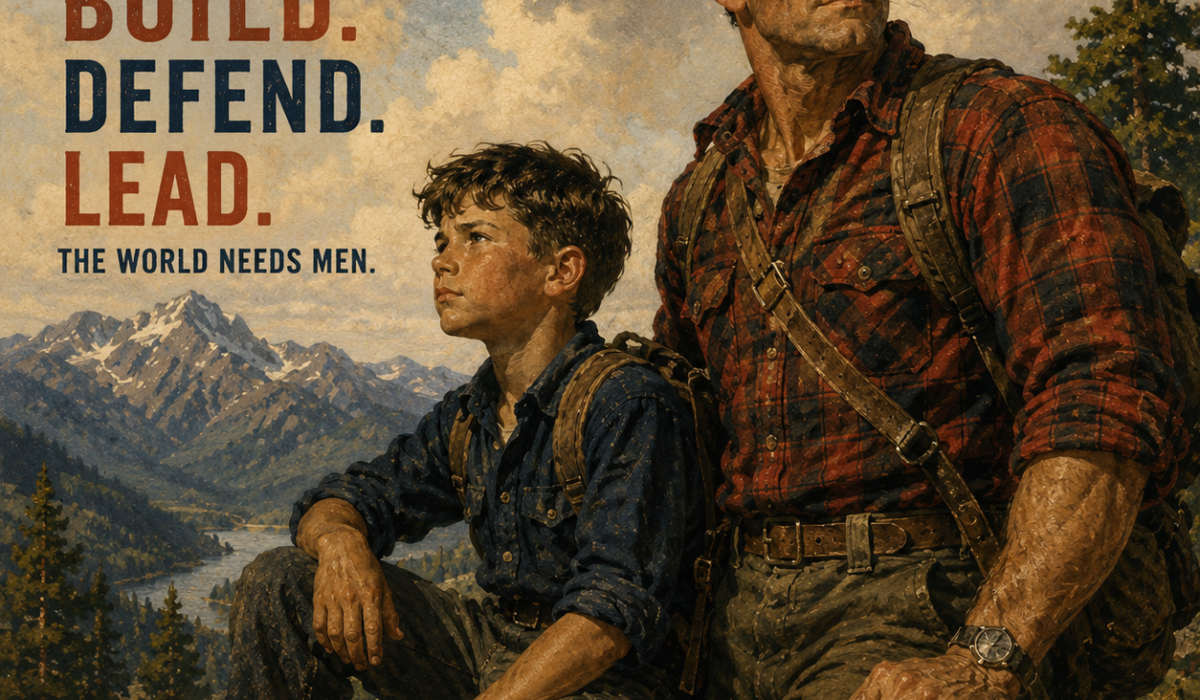
Introduction:
Society has developed a strange obsession with turning boys into harmless little domesticated pets. We drug them when they fidget, shame them when they compete, isolate them from risk, remove every sharp object from their environment, and then stare in confusion when they grow into anxious, directionless, weak men who panic at minor inconveniences and fold under pressure. We have built an entire cultural system dedicated to the sterilization of masculinity. Schools reward passivity, media mocks competence, and corporations demand compliance. Meanwhile, parents hover over boys like Secret Service agents guarding a national treasure from bicycles, tree branches, and pocketknives. Heaven forbid little Billy learn how to climb something taller than a beanbag chair without a helmet, a waiver form, and three emotional support counselors nearby.
Historically, civilizations inherently understood what we have apparently forgotten: Boys are designed for conquest, hardship, building, protection, exploration, and controlled aggression. A healthy civilization disciplines and directs these traits. Scripture presents young men as workers, shepherds, hunters, warriors, builders, and leaders, not as permanently supervised adolescents medicated until they are docile. Proverbs 22:6 commands fathers to train children in the way they should go. Dangerous boys become useful men when forged correctly, while harmless boys become liabilities. The difference is training.
I. Civilization Was Built by Boys Who Were Allowed to Become Men
For most of human history, survival depended on competent young males who could endure hardship, solve problems, navigate danger, and shoulder responsibility early in life. By age twelve, most boys throughout history were already contributing meaningful labor to farms, trade guilds, hunting parties, military preparation, and family businesses. Medieval apprentices began training between ages ten and twelve. Frontier boys in early America handled livestock, firearms, axes, and land management as young as eight, long before modern society believes a teenager can safely operate a toaster without adult supervision.
The industrial and post-industrial eras gradually removed boys from meaningful responsibility. Instead of working alongside fathers and communities, boys became institutionalized through prolonged public schooling systems that increasingly resemble behavior-management facilities rather than educational environments. Historian and educator John Taylor Gatto argued that compulsory schooling suppresses independence, risk-taking, and initiative in favor of conformity and compliance. He has been proven right in the most sombering way possible. A system designed around sitting still for eight hours straight naturally punishes boys whose brains are wired for movement, experimentation, and competition.
Research supports the reality that boys and girls develop differently neurologically and behaviorally. Studies published through institutions such as the American Psychological Association and National Institutes of Health have documented sex-based developmental differences in impulsivity, risk assessment, and physical activity patterns. Boys display higher sensation-seeking behavior and greater physical aggression from an early age. The modern solution has largely been to suppress these traits chemically and psychologically rather than channel them productively. Apparently, if a boy enjoys climbing rocks, wrestling his friends, and inventing ways to jump over things, he now requires drugs and counseling.
Scripture treats masculinity as a given trait for young boys. David killed lions and bears while still young (1 Samuel 17:34–36). Jesus worked as a carpenter in a culture where manual labor was normal male development. Boys historically became dangerous in useful ways because they were expected to become capable, and capability requires exposure to difficulty. You cannot produce resilient men through perpetual insulation any more than you can produce strong steel without fire.
II. Safety Culture Is Producing Fragile Men
Modern parenting treats ordinary childhood experiences as catastrophic threats. Trees are dangerous, pocketknives are dangerous, roughhousing is dangerous, and camping without Wi-Fi apparently borders on a humanitarian crisis. Entire generations of boys are now raised inside sanitized digital cages where simulated accomplishment replaces real competence. They conquer imaginary kingdoms online while remaining incapable of changing a tire, building a fire, or speaking confidently to strangers while looking them in the eye with a firm handshake.
Psychologist Jonathan Haidt, particularly in The Coddling of the American Mind, documents how overprotection contributes directly to anxiety, fragility, and emotional instability among younger generations. Children develop resilience through manageable exposure to stress, conflict, failure, and risk, but never through permanent emotional quarantine. The immune system strengthens through exposure and so does the character.
Research from the Centers for Disease Control and Prevention has shown alarming increases in anxiety, depression, and emotional dysfunction among adolescents over the past two decades. Meanwhile, outdoor activity, unsupervised play, and practical labor have sharply declined. The correlation cannot be ignored, boys denied challenge do not become peaceful; they become restless, depressed, addicted, passive, or explosive. Energy that is not directed productively eventually leaks destructively.
Historically, many cultures intentionally used rites of passage to transition boys into manhood. Spartan boys endured harsh discipline and physical testing. Roman boys trained in responsibility and civic duty. Indigenous tribes worldwide incorporated hunting, endurance trials, wilderness survival, and responsibility rituals. Even early American communities expected boys to contribute economically and physically to household survival. Modern culture has replaced these systems with social media, processed food, unlimited entertainment, and antidepressants. Truly an inspiring trade!
Scripture repeatedly ties maturity to endurance and discipline. Hebrews 12:11 says that discipline is painful in the moment but later yields “the peaceful fruit of righteousness.” James 1:2–4 commands believers to count trials as joy because testing produces steadfastness. Yet modern parenting philosophies operate as though the highest moral good is making sure little Brayden never experiences discomfort stronger than a mildly disappointing Wi-Fi signal.
A boy who never struggles never develops confidence. Real confidence can only come from overcoming resistance. True confidence will never come from receiving participation trophies for breathing correctly during recreational soccer.
III. Boys Need Tools, Responsibility, and Real Work
Another great lie of modern culture is the idea that responsibility somehow harms children. In reality, meaningful responsibility is precisely what gives boys purpose, confidence, and direction. Boys desperately want to matter. They want to build things, fix things, carry things, defend things, and accomplish things. When society denies them productive outlets, they will seek destructive substitutes.
Historically, boys learned competence by participating directly in adult life. They worked beside fathers, craftsmen, farmers, mechanics, soldiers, and tradesmen. The skills were transferred relationally and practically. A boy learned responsibility because responsibility was unavoidable. Today, most teenage boys reach adulthood without ever being trusted with meaningful obligations beyond remembering a password for Netflix.
Studies on adolescent development consistently show that responsibility and practical competence improve self-esteem and emotional stability. Research published in the Journal of Adolescence has linked structured responsibility and skill development with increased resilience and lower behavioral problems. Boys who feel useful will behave better than boys treated like liabilities, or inconveniences.
There is also neurological value in practical labor. Manual skills engage coordination, problem-solving, patience, spatial reasoning, and perseverance simultaneously. Working with tools teaches consequences immediately and honestly. Wood does not care about your feelings, engines do not respond to emotional affirmations, and gravity remains deeply committed to objective reality regardless of how empowered someone feels on TikTok.
Scripture presents work as formative and honorable. Proverbs praises diligence, labor, preparedness, and craftsmanship. Jesus’ parables are filled with workers, builders, shepherds, managers, laborers, and stewards because productive responsibility reflects The divine order. Idleness, meanwhile, is treated as spiritually and socially dangerous.
The modern obsession with eliminating risk from boys’ environments will produce adults incapable of handling normal life. A boy trusted to split wood, work on engines, cook meals, manage money, care for siblings, and maintain property develops competence. Competence produces confidence. Confidence reduces fear. Fearful men are easily manipulated. Competent men are notoriously difficult to control. And perhaps that is part of the problem.
A civilization dependent on passive consumers has little use for independent, dangerous, competent men. Dangerous does not mean criminal, dangerous means capable of action, defense, resistance, sacrifice, leadership, and endurance. A civilized society depends on such men while simultaneously pretending to despise them.
IV. Discipline Is Not Abuse, It Is Mercy
Contemporary culture frequently confuses discipline with cruelty because it has embraced the fantasy that unrestricted emotion produces healthy people. It does not. Human beings, especially young boys, require structure, correction, standards, accountability, and consequences. Without discipline, raw masculine energy will become chaos, with discipline, it will become civilization.
The biblical model of fatherhood is deeply rooted in correction and instruction. Proverbs 13:24 states, “Whoever spares the rod hates his son, but he who loves him is diligent to discipline him.” We may recoil at such verses because contemporary culture increasingly views authority as oppressive, but every functioning institution on earth operates through hierarchy, standards, and consequences. Sports teams discipline. Military units discipline. Martial arts discipline. Skilled trades discipline. Even orchestras discipline. But somehow fathers are expected to raise boys through bribery, negotiation and therapeutic vocabulary.
The irony is that boys actually crave strong boundaries. Numerous developmental studies show children perform better psychologically when raised within environments containing clear expectations and consistent consequences. Research associated with developmental psychologist Diana Baumrind’s authoritative parenting model found that children raised with warmth combined with firm structure consistently demonstrate stronger emotional regulation and social competence than children raised permissively.
Historically, disciplined boys became reliable men because discipline trained self-control before adulthood amplified the consequences of not having self control. A boy who cannot govern himself emotionally becomes a man governed by impulse. Such men become addicts, cowards, tyrants, parasites, and/or perpetual adolescents. Civilization will collapse when too many men remain undisciplined boys into adulthood.
Discipline also teaches boys something modern culture hates to admit: actions have consequences. This reality is mercy. A father correcting laziness, disrespect, recklessness, or cowardice early will spare his son catastrophic failure later. Better a bruised ego at fourteen than a destroyed life at forty.
Even Christ’s disciples underwent rigorous correction, testing, and hardship. Jesus did not build strong men through perpetual affirmation circles around artisanal coffee and emotional journaling exercises. He challenged them, rebuked them, sent them into difficulty, and demanded sacrifice. Biblical masculinity has never resembled the modern therapeutic softness we see today.
A dangerous boy without discipline will become a threat. A dangerous boy with discipline will become a protector, builder, husband, father, leader, and defender. The goal is not eliminating masculine force. The goal is teaching a boy when, where, and how to wield it properly and righteously.
V. Hardship Creates Men Comfort Never Could
Every generation claims to want strong men while simultaneously constructing environments designed to prevent strength from developing. Strength is born from hardship, endurance emerges from suffering, courage grows through danger, and wisdom develops through failure. Why then does modern society insist on engineering adulthood without hardship, this is roughly as intelligent as attempting to build muscle without training.
The Roman philosopher Seneca wrote, “Difficulties strengthen the mind, as labor does the body.” History repeatedly confirms this principle. Generations shaped by hardship produce resilience, innovation, and sacrifice. Generations raised in excess exhibit entitlement, emotional fragility, and decadence. This cycle has appeared in every collapsing civilization for all of recorded history.
Today boys are increasingly disconnected from physical struggles. According to data from the World Health Organization, physical inactivity among youth has risen dramatically worldwide. Simultaneously, screen time, obesity, social isolation, anxiety, and depression continue climbing. Human beings were not designed to live permanently indoors under artificial light consuming digital stimulation for fourteen hours a day while arguing online about fictional superheroes with strangers.
Hardship also teaches perspective. A boy who hikes mountains, works in heat, trains physically, loses competitions, repairs broken machinery, and faces controlled adversity develops internal stability that cannot be achieved by any other means. He learns he can survive discomfort. He learns pain is temporary. He learns failure is survivable. Most importantly, he learns the world does not exist to revolve around his feelings.
Scripture consistently frames hardship as refinement. Romans 5:3–4 teaches that suffering produces endurance, character, and hope. The Apostle Paul describes the Christian life using athletic, military, and labor imagery because strength is forged, not granted magically through affirmations.
This does not mean fathers should abuse sons or invent unnecessary cruelty. It means fathers must stop stealing growth opportunities through overprotection. Let boys climb, let them build, let them fail, and let them compete. Let them get bruised, dirty, exhausted, frustrated, corrected, and tested. Within reason, these experiences are the very mechanisms through which boys become men.
A civilization unable to produce strong men will become dependent on stronger men from elsewhere. History is brutally consistent with this outcome.
Conclusion:
Modern culture keeps asking why so many young men feel lost, angry, weak, addicted, passive, and purposeless. The answer is we stopped raising boys to become dangerous men under discipline and started raising them to become permanently supervised consumers. We replaced fathers with institutions, challenge with entertainment, apprenticeship with algorithms, and courage with comfort. Now we act shocked when masculinity is replaced by confusion, escapism, and dysfunction.
The solution is neither cruelty nor machismo, but ordered masculinity rooted in responsibility, discipline, faith, competence, and endurance. Boys need fathers who demand something from them. They need work that matters, hardship that shapes them, risks that test them, and standards that refine them. They need Scripture, structure, tools, dirt, challenge, correction, and purpose. The world does not need fewer dangerous men. It needs more dangerous men governed by wisdom, discipline, and righteousness. History was built by such men. And until we rediscover how to raise them again, history will remember us as the civilization of useless cowards.