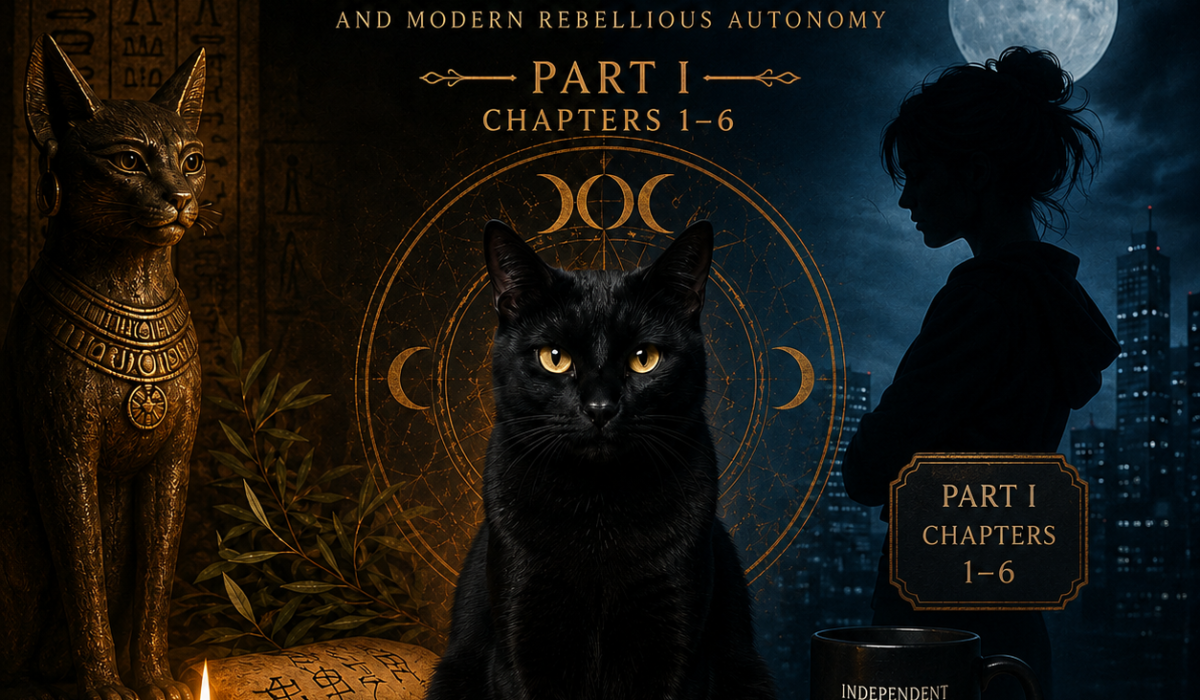
A Theological, Historical, and Cultural Inquiry into Cats, Familiar Spirits, Pagan Symbolism, and the Modern Archetype of Rebellious Autonomy
Abstract
This thesis advances a speculative but internally coherent theological hypothesis concerning the persistent association between felines, pagan spirituality, familiar spirits, occult symbolism, and modern cultural expressions of anti-hierarchical autonomy. It does not contend that Scripture explicitly identifies cats as demonic hosts, nor does it argue that all, most, or any specific cat is necessarily inhabited by spiritual entities. Rather, it proposes that felines possess a unique convergence of biblical, symbolic, behavioral, historical, and cultural characteristics that may render them unusually suitable as vessels, emblems, or companions for spiritual influences associated with rebellion, self-rule, seduction, pride, envy, sloth, wrath, and resistance to divinely established order.
The foundation of this inquiry partially rests upon several cumulative observations. First, Scripture presents familiar spirits, unclean spirits, lying spirits, seducing spirits, devils, demons, and angels of Satan as belonging to the broader realm of spiritual rebellion against God. Though these terms may describe different functions, ranks, or manifestations, they appear united in their opposition to divine authority, truth, holiness, and covenantal order. Second, the biblical language of “unclean spirits” invites consideration of the relationship between spiritual corruption and the broader biblical category of uncleanness. Third, the two most prominent animal associations with demonic activity in Scripture (the serpent of Eden and the swine of the Gadarene account) both involve animals falling outside the clean classifications of the Mosaic law. This does not establish a doctrine of exclusive demonic habitation in unclean animals, but it does present a pattern worthy of theological reflection and consideration.
From that biblical foundation, the study turns to history and anthropology. Across pagan religious systems, felines appear with striking frequency as sacred animals, spiritual guardians, symbols of mystery, attendants of goddesses, nocturnal watchers, and embodiments of spiritual power. In later European folklore and occult tradition, the domestic cat emerges as perhaps the most iconic animal associated with witchcraft and familiar spirits of all types. The question, therefore, is why the association is so persistent, so widespread, and so symbolically consistent.
This thesis further argues that the cat’s behavioral nature makes it uniquely suited to the role imagined by such traditions. Unlike livestock, which remain external to the household, or dogs, which are historically marked by loyalty, service, guardianship, and submission to man, cats occupy a liminal position. They dwell inside human homes while remaining psychologically and behaviorally independent. They are close, yet detached; tolerated, yet ungoverned; intimate, yet aloof. Their nocturnal movements, silent observation, unpredictable affections, and apparent indifference to human command make them ideal candidates (symbolically, psychologically, and perhaps spiritually) for association with unseen influence.
The final movement of the thesis considers the modern cultural archetype often linking cats with rebellious feminine autonomy, anti-domestic identity, rejection of traditional household structures, and forms of self-defined womanhood detached from biblical order. This study does not claim that women who own cats are automatically spiritually suspect, nor does it excuse unbiblical human behavior based on pet preference. Rather, it asks whether the recurring cultural pairing of cats with feminine rebellion, radical independence, and anti-patriarchal self-conception may be the latest expression of a much older symbolic and spiritual pattern.
The Feline Familiar Hypothesis is therefore presented not as theological conjecture open for examination. Its argument is cumulative, and its aim is to interrogate a pattern. If paganism, witchcraft, familiar spirits, and rebellion have repeatedly clothed themselves in feline imagery, then the persistence of that association may deserve more serious attention than our contemporary culture is prepared to allow.
Introduction
Few animals have occupied as strange, enduring, and spiritually charged a place in the human imagination as the cat. The sheep serves, the ox labors, the horse carries, the dog guards, the dove descends as an image of peace, and the serpent deceives. But the cat watches.
It watches from thresholds, windowsills, rooftops, temple walls, alleyways, hearths, and bedrooms, it watches in silence, it watches at night, and it watches with eyes that gather light from darkness. It belongs to the household without ever submitting to the household. It accepts human shelter without surrendering any independence. It may be fed by man, named by man, and housed by man, but it is never governed by man in the same manner as other domesticated creatures. This unusual relationship has made the cat one of the most symbolically ambiguous animals in civilization: domestic but not docile, familiar but not obedient, intimate but not transparent.
Across cultures and centuries, this ambiguity has not gone unnoticed. In ancient pagan systems, felines were venerated, feared, adorned, deified, and worshipped as sacred emblems of divine or semi-divine power. In occult folklore, cats were companions of witches, familiars of sorceresses, watchers of the night, and suspected intermediaries between visible and invisible realms. In modern culture, the cat continues to carry associations of independence, mystery, feminine autonomy, anti-domestic identity, and rebellion against hierarchical order. The persistence of this pattern invites great inquiry.
The present study is built upon a simple but provocative question: why cats?
Why has this animal, above so many others, been repeatedly associated with pagan spirituality, witchcraft, hidden knowledge, feminine mystique, and spiritual liminality? Why has the cat, rather than the goat, rabbit, camel, or dog, become the preferred domestic symbol of the familiar spirit in the Western imagination? Why do felines appear not only as animals, but as spiritual symbols within pagan systems across the ancient world? Why does modern culture so often pair the cat with the image of the autonomous, untethered, anti-traditional woman? Are these associations simply accidental products of human psychology and folklore, or might they point toward a deeper spiritual pattern?
This thesis will not assume that all cats are possessed, corrupted, or inherently evil. Such a claim would be both unserious and unsupported. Scripture never commands hostility toward cats, Scripture never identifies cats as demonic creatures, and Scripture never outright states that familiar spirits inhabit cats. Any responsible inquiry must begin by acknowledging those limits.
With that said, the absence of an explicit biblical statement does not forbid theological reflection upon recurring patterns. Scripture often teaches through typology, symbol, category, and repetition. The serpent in Eden is not a zoological detail; it is a theological image of Satanic deception. The swine into which the legion of demons entered are not just livestock; they occupy a meaningful place within the biblical world of uncleanness. The repeated designation of demons as “unclean spirits” is no accident. The biblical categories of clean and unclean are not arbitrary decorations upon Israel’s law, but symbolic structures through which God taught His people to distinguish holiness from pollution, order from disorder, and covenantal life from defilement.
From this perspective, one may ask whether the biblical association between uncleanness and spiritual corruption has implications beyond diet and ritual. The theory explored here does not claim to prove that unclean animals are the only possible hosts for demonic entities. It does, however, observe that the clearest biblical examples of animal involvement in demonic activity concern creatures indeed classified as unclean. While the serpent and the swine do not establish a universal law, they do create a pattern (however minimal). And these patterns should not be dismissed simply because they are inconvenient to modern sensibilities.
The cat enters this discussion as an unclean animal with an unusually rich history of spiritual association. Under Levitical “unclean” categories, felines are carnivorous, predatory, nocturnal, independent, and behaviorally distinct from those animals most commonly associated with service, sacrifice, and covenantal usefulness. Yet their uncleanness alone cannot explain their symbolic prominence. Dogs, too, are unclean, and Scripture often uses dogs negatively. Nevertheless, dogs have occupied a radically different historical role in relation to mankind. From the earliest records of civilization, dogs have been associated with loyalty, guarding, hunting, companionship, and service. They are unclean, but they are known as “man’s best friend, and oriented towards service.
The cat is very different.
The cat enters the home but never submits to the home. The cat receives provision but resists command. The cat may show affection, but affection arrives on its own terms. It remains close enough to observe human life, intimate enough to access human space, and independent enough to avoid ordinary expectations of obedience. If one were theorizing about an ideal animal vessel through which an unseen intelligence might remain near a human subject while attracting minimal suspicion, the cat would present obvious advantages. Its strangeness is already normalized. Its disobedience is expected. Its nocturnal movement is ordinary. Its fixed gaze into empty corners is dismissed as mere feline eccentricity. Its aloofness is romanticized.
This does not mean cats are demonic by nature. It means that, hypothetically, they possess the ideal profile for the concealment of the unseen realm.
The hypothesis becomes even more provocative when considered alongside the traditional language of familiar spirits. A familiar is not just a demon in the abstract, but a spirit of proximity, consultation, influence, and relational access. It is familiar because it is near, known, recurring, and attached to a person, household, or practitioner. If such spirits seek closeness to human subjects, then a domestic animal that is welcomed into intimate spaces while remaining behaviorally inscrutable would be of obvious symbolic and theoretical significance.
This study further considers whether a host of corrupting influences (rebellion, envy, pride, lust, greed, wrath, sloth, vanity, manipulation, and contempt for authority) may find symbolic expression in the feline archetype. This is not to anthropomorphize cats simplistically, nor to pretend that animals possess moral agency equivalent to human beings. Rather, it is to observe that cultures repeatedly attach moral, spiritual, and psychological meanings to animals. The lamb signifies innocence. The serpent signifies deception. The dog signifies loyalty. The vulture signifies death. And the cat, across all pagan systems, signifies mystery, autonomy, feminine secrecy, and untamed will.
The final concern of this thesis is modernity. In contemporary Western culture, the cat has become strongly associated with certain forms of feminine self-conception: independence without covenant, companionship without household submission, affection without obligation, intimacy without hierarchy, and identity without domestic rootedness. The “cat lady” archetype is treated comically, but beneath the humor lies a revealing cultural symbol. The cat frequently accompanies the image of the woman who rejects traditional family formation, biblical femininity, male headship, motherhood, and covenantal household order. This does not mean every woman who owns a cat fits this pattern, and it does not mean pet ownership determines the spiritual condition. But there is no doubt modern culture has repeatedly chosen the cat as the symbolic companion of autonomous womanhood.
That symbolic choice is in alignment with every example of rebellion by the Pagan world against God’s established order since the beginning of recorded history.
The argument developed in this work is therefore cumulative. No single observation proves the thesis. The Bible’s use of “unclean spirits” does not prove cats are hosts. The serpent and swine do not prove all demonic animal associations require uncleanness. Pagan feline worship does not prove spiritual habitation. Witchcraft folklore does not prove familiar possession. Modern cat symbolism does not prove causation. Yet when these strands are placed one upon another, they form a pattern the length of history that is too persistent to ignore.
The Feline Familiar Hypothesis proposes that cats may be uniquely suited (symbolically, behaviorally, culturally, and spiritually) as vessels or emblems of familiar influence. This suitability does not imply universal possession, inherent evil, or a moral indictment of every cat owner. It does, however, invite serious theological consideration of why felines have so often appeared at the intersection of paganism, witchcraft, spiritual autonomy, feminine rebellion, and resistance to ordered authority.
The purpose of this inquiry is learning and discernment.
Modern culture laughs at symbols it does not understand. Paganism sacralizes symbols it should fear. Christianity must learn to examine symbols under the authority of Scripture. If the cat has, for millennia, sat quietly beside altars, witches, goddesses, rebels, and self-crowned women, perhaps the question is why the same spiritual currents so often seem pleased to keep it nearby.
Chapter 1
The Biblical Concept of Familiar Spirits
Any serious theological inquiry into the possibility of animal association with spiritual entities must begin with the biblical category of the familiar spirit. If familiar spirits are merely literary metaphors, primitive superstitions, or psychological projections, then the entire inquiry must be based on anthropology alone. But if Scripture presents familiar spirits as genuine spiritual realities (intelligences operating in rebellion against God, capable of communication, deception, imitation, and influence) then the question is far more serious.
The Bible classifies familiar spirits in the same forbidden territory as witchcraft, divination, necromancy, sorcery, false prophecy, and consultation with the dead. They are not presented as alternative religious guides. They are not tolerated as lesser spiritual authorities. They are not treated as mysterious but acceptable sources of hidden information. They are condemned!
The biblical prohibition against familiar spirits is not rooted in mere ritual fastidiousness, but rooted in allegiance. To consult a familiar spirit is to seek counsel, knowledge, power, or revelation from a source outside the authority of God. It is an act of spiritual treason and a refusal to receive truth on God’s terms. It is man reaching into the forbidden realm in search of control beyond his authority.
Therefore, before one may responsibly ask whether cats, or any animals, could function as hosts, symbols, companions, or instruments of familiar spirits, one must first establish what Scripture means by the term. The foundation must be theological before it becomes speculative.
I. Familiar Spirits as Forbidden Spiritual Intelligences
The primary Old Testament passages concerning familiar spirits appear in the legal, prophetic, and historical writings of Scripture. In these passages God repeatedly forbids His people from seeking, consulting, tolerating, or practicing communion with familiar spirits.
“Regard not them that have familiar spirits, neither seek after wizards, to be defiled by them: I am the LORD your God.” – Leviticus 19:31
This verse establishes several crucial principles. First, familiar spirits are connected to defilement. The one who turns toward such spirits becomes polluted. The pursuit stains the seeker. Second, familiar spirits are associated with human mediators: those who “have” them, and those who operate as wizards or spiritists. Third, the command is grounded in the identity of God: “I am the LORD your God.” This is covenantal. The people of God are forbidden from seeking spiritual access through unauthorized channels because they belong to the Lord.
“And the soul that turneth after such as have familiar spirits, and after wizards, to go a whoring after them, I will even set my face against that soul, and will cut him off from among his people.” – Leviticus 20:6
Here the language is marital and covenantal. To pursue familiar spirits is to “go a whoring” after them. This is spiritual adultery. The offense is not that the practitioner believes strange things, but that he gives attention, trust, desire, and spiritual receptivity to powers outside the covenantal rule of God.
“A man also or woman that hath a familiar spirit, or that is a wizard, shall surely be put to death.” – Leviticus 20:27
The severity of this penalty demonstrates that familiar-spirit practice was considered a direct threat to the holiness, authority, and spiritual integrity of Israel. The person who “hath a familiar spirit” is treated as a dangerous spiritual contaminant within the covenant community.
Deuteronomy 18:10–12 places familiar spirits among the broader practices of pagan abomination:
10. There shall not be found among you any one that maketh his son or his daughter to pass through the fire, or that useth divination, or an observer of times, or an enchanter, or a witch,
11. Or a charmer, or a consulter with familiar spirits, or a wizard, or a necromancer.
12. For all that do these things are an abomination unto the LORD.
These passages are especially significant because they do not isolate familiar spirits from the broader occult system. The consulter with familiar spirits stands among diviners, witches, charmers, necromancers, and pagan practitioners of ritual abomination. This shows that familiar spirits belong to a larger network of forbidden spiritual activity. They are part of the architecture of occult rebellion.
The biblical witness, therefore, begins with: familiar spirits are real enough to be forbidden, dangerous enough to defile, seductive enough to be described as spiritual adultery, and destructive enough to warrant removal from the covenant community.
II. The Meaning of “Familiar”
The English phrase “familiar spirit” carries an important implication. A familiar would not be a spirit that appears once, or a wandering entity encountered by accident. The word suggests nearness, recurrence, association, and relational access. A familiar spirit is one that is “familiar” to a person, household, practitioner, or occult system.
Familiarity is not benevolence. A wolf may become familiar with the fold. A predator may become familiar with the path of its prey. A seducer may become familiar with the weaknesses of his target. Familiarity, in this context, implies proximity and repeated access, not loyalty or love.
A familiar spirit may appear helpful because it gives and provides information. It may appear intimate because it speaks through known channels. It may appear comforting because it mimics the dead, confirms suspicions, or supplies “hidden” knowledge. But Scripture judges them by their source, their allegiance, and their fruit.
The familiar spirit is forbidden because it offers spiritual access apart from God. It is near, but it is not holy. It may know, but it does not reveal truth in righteousness. It may speak, but it does not speak under divine authority. It may imitate intimacy, but it only produces defilement.
In this sense, the familiar spirit is parasitic. It attaches to human desire: the desire to know, the desire to control, the desire to speak with the dead, the desire to uncover secrets, the desire to gain advantage, the desire to possess spiritual power without submitting to God. Its familiarity is part and parcel of its danger. The more familiar it becomes, the less foreign it appears. The less foreign it appears, the less resistance it encounters from the host.
This will become relevant later when considering the symbolic suitability of domestic animals. A familiar spirit, by definition, is a spirit of access. It seeks nearness, it works through attachment. It becomes part of the environment, and it normalizes its presence. The question of “familiar” is therefore inseparable from the question of prolonged proximity.
III. Familiar Spirits and the Sin of Unauthorized Knowledge
At the heart of familiar-spirit practice is the forbidden pursuit of knowledge. The consulter seeks information not lawfully given by God. This may include knowledge of the future, knowledge of the dead, knowledge of hidden events, knowledge of enemies, knowledge of omens, or knowledge of spiritual forces. This pursuit is ancient, reaching back to Eden.
The first temptation was not a temptation to eat, but to seize “knowledge” outside the command of God. The serpent promised, “Ye shall be as gods, knowing good and evil.” The issue was epistemological rebellion. Man was invited to possess knowledge unlawfully, to step outside creaturely submission, and to obtain wisdom through disobedience and rebellion.
Familiar-spirit practice follows the same pattern. It seeks knowledge apart from obedience. It asks the unseen realm to speak where God has not authorized speech. It attempts to bypass prayer, prophecy, Scripture, priesthood, covenant, and submission. It is an effort to gain spiritual access without righteousness.
This explains why Scripture treats familiar-spirit consultation so severely. The sin is that the seeker has turned away from God as the lawful source of revelation. Even if the spirit speaks accurately, the act remains corrupt because truth obtained through rebellion becomes a trap.
This principle is vital for the larger thesis. Demonic activity in Scripture is not limited to grotesque possession, visible torment, or obvious blasphemy. It often appears as counterfeit illumination. The demonic realm offers knowledge, power, autonomy, and self-exaltation. It rarely appears as destruction at first, but destruction always follows..
The familiar spirit is therefore a spiritual intelligence that offers unauthorized access to hidden knowledge. It is a counterfeit counselor, a false revealer, and a forbidden voice.
IV. The Witch of Endor: Familiar Spirits and the Dead
The most dramatic narrative involving a familiar spirit appears in 1 Samuel 28, when King Saul seeks out the woman of Endor. Saul, having been rejected by God and abandoned by legitimate prophetic guidance, turns in desperation to the very practice he had previously sought to purge from Israel.
The account is devastating. Saul does not consult the woman of Endor from a position of spiritual strength. He consults her because he is afraid, abandoned, and rebellious. The Philistines have gathered against him. God does not answer him by dreams, by Urim, or by prophets. Rather than repent, Saul seeks unlawful access to the unseen realm.
This is a clear biblical portrait of the psychology behind occult consultation. The person who turns to familiar spirits is desperate. He wants an answer God has withheld. He wants comfort without obedience. He wants revelation without repentance. Saul does not seek God; he seeks information.
The woman of Endor is described as one who has a familiar spirit. Saul asks her to “bring up” Samuel. The narrative then becomes the subject of long theological debate. Was the appearing figure truly Samuel, brought forth by an extraordinary act of God? Or was it a demonic impersonation permitted in judgment? Conservative interpreters have historically held both views.
For the purpose of this thesis, the precise answer is less important than the structure of the event. The passage unquestionably associates familiar-spirit practice with necromantic consultation, forbidden mediation, and spiritual rebellion. Saul’s act is condemned. Even if God sovereignly permitted Samuel to appear, the medium’s craft remains wicked. The exception would not justify the practice.
The account also reveals something important about familiar spirits: they operate in the zone of imitation, death, memory, and identity. The medium is expected to provide access to the dead. Whether the entity that appears is truly the dead prophet or a permitted manifestation outside the woman’s control, the normal expectation of the practice is clear. Familiar spirits are tied to the imitation or invocation of personal presence.
This fits the term “familiar.” Such spirits are associated with relational recognition. They may appear as known persons. They may attach to known practitioners. They may establish repeated interaction. They traffic in intimacy, memory, and presence.
This will matter later when considering animal hosts or companions. A familiar spirit’s power lies not only in terror, but in nearness. It then gains influence by becoming part of the subject’s relational world.
V. Familiar Spirits and Human Mediation
Another important observation in the biblical record is that familiar spirits are consistently associated with human mediators. Scripture speaks of those who “have” familiar spirits, those who consult them, and those who function as wizards, witches, necromancers, and spiritists.
This does not, by itself, exclude the possibility of animal association. But it does establish the central biblical concern: the human practitioner.
God condemns the medium, the consulter, the necromancer, the witch, the enchanter, and the idolater. The danger lies in human openness to forbidden spiritual influence. The practitioner becomes a point of access. The consulter becomes a participant. The community becomes vulnerable to defilement.
This is significant because the larger Feline Familiar Hypothesis must not reverse the biblical order. Scripture does not present animals as the primary moral agents in occult practice. Humans are accountable. Humans seek, consult, rebel, and invite defilement.
If animals become involved, they do so as instruments, symbols, vessels, or companions. A cat, serpent, swine, goat, raven, or any other creature does not commit witchcraft the same as a human being. Animals do not enter covenantal rebellion with moral deliberation. Their role, if any, is instrumental.
Thus, a responsible theory must avoid superstition and must not teach fear of animals as though animals are moral enemies. The biblical danger is spiritual agency in rebellion against God, especially where human beings invite, consult, entertain, or normalize that agency.
Still, the human-centered nature of the biblical warning does not eliminate the question of instruments. Throughout Scripture, spiritual powers work through bodies, voices, objects, images, animals, kings, prophets, idols, dreams, and false teachers. The issue is what kind of mediation Scripture permits and what kind it condemns.
VI. Familiar Spirits as Counterfeit Counselors
The familiar spirit is best understood as a counterfeit counselor.
God has ordained legitimate means by which His people are to receive wisdom, correction, warning, and revelation. These include His law, His prophets, His priests, His Word, His Spirit, and the lawful authorities He establishes. Familiar spirits imitate these functions while severing them from The divine authority.
Where God gives prophecy, the familiar spirit gives divination. Where God gives wisdom, the familiar spirit gives hidden knowledge. Where God gives comfort, the familiar spirit gives necromantic imitation. Where God gives conviction, the familiar spirit gives manipulation. Where God gives order, the familiar spirit gives empowerment to rebellion.
This counterfeit structure is central to understanding why familiar spirits are so dangerous. They imitate religion from the inside. They provide a spiritual experience. They offer guidance. They create awe. They answer questions. They may even produce signs, tell partial truths, and expose hidden matters. But they always do so in a manner that draws man away from obedience and submission to God.
This explains the severe biblical response. God is not threatened by rival knowledge. He is defending His people from spiritual seduction. The familiar spirit is forbidden because man is easily deceived by any voice that promises knowledge without submission.
The connection to rebellion is unavoidable. To seek a familiar spirit is to enthrone the self as judge over revelation. It is to say, in effect, “If God will not answer me on my terms, I will seek another voice.” That is Saul’s sin. That is Eden’s sin. That is the perennial sin of occultism.
VII. The Relationship Between Familiar Spirits and Other Evil Spirits
Although this chapter focuses specifically on familiar spirits, the biblical language surrounding evil spiritual entities is broader. Scripture speaks of unclean spirits, evil spirits, lying spirits, seducing spirits, devils, demons, and angels of Satan. These categories are not always systematically defined for the reader. The Bible is more concerned with warning, exposing, and defeating these powers than with satisfying speculative curiosity about their taxonomy.
Nevertheless, a coherent theological model emerges.
A lying spirit deceives. A seducing spirit entices. An unclean spirit defiles. An evil spirit afflicts. A familiar spirit mediates forbidden spiritual access. A demon opposes God and enslaves man. An angel of Satan serves the adversarial kingdom. These descriptions may refer to different classes of beings, different ranks, different assignments, or simply different functions of the same broader demonic order.
The point is to recognize their shared nature. All are hostile to God. All distort truth. All corrupt worship. All seek access to mankind. All function within the kingdom of rebellion. A familiar spirit, therefore, should not be imagined as a neutral household ghost or ancestral guide. It belongs to the same moral universe as demons, lying spirits, and seducing spirits. Its specialty may be proximity and communication, but its allegiance is not ambiguous.
This becomes crucial for the later thesis. If familiar spirits are functionally connected to the broader demonic realm, then the possibility of their use of physical hosts, symbols, or instruments cannot be dismissed out of hand. The Gospels demonstrate that unclean spirits can inhabit bodies. Acts demonstrates that a spirit of divination can operate through a human subject. The Old Testament demonstrates that familiar spirits are associated with mediums and forbidden consultation. The question therefore of whether an animal may serve as a vessel or companion belongs within this broader theological framework.
VIII. The Familiar Spirit as a Spirit of Proximity
The defining feature of the familiar spirit is nearness.
Some demonic manifestations in Scripture are violent, convulsive, and immediately destructive. The familiar spirit, by contrast, appears more subtle. It establishes access, communicates, becomes known, and attaches itself to patterns of consultation. It may become part of a household, a practice, a woman’s occult identity, a ruler’s desperate inquiry, or a community’s forbidden spirituality.
This distinction matters because not all spiritual influence is spectacular. Some of the most dangerous forms of evil are domesticated long before they are recognized. They become part of the furniture of life. They acquire sentimental value. They are given names, rituals, habits, and permissions. They are not resisted because they no longer appear foreign.
This is one reason the concept of the familiar is so theologically rich. A familiar spirit does not always need to terrify. It may simply need to remain close. Its power lies in habituated access. A person who would recoil from an obvious demon may tolerate a familiar presence if it appears comforting, useful, mysterious, or emotionally significant. The familiar spirit is therefore simply a spirit that stays.
This observation provides one of the major conceptual bridges toward the later discussion of cats. If a familiar spirit is a spirit of nearness, recurrence, and normalized access, then the question of suitable vessels or symbolic companions becomes relevant. What kind of creature is allowed close to human beings? What kind of creature can live within the home while remaining inscrutable? What kind of creature may behave strangely without provoking alarm? What kind of creature can be intimate without being obedient?
The answer, historically and symbolically, is most often the cat. But that conclusion must wait.
Chapter 1 establishes only the first foundation: familiar spirits are real, forbidden, defiling, deceptive, and associated with proximity.
IX. Familiar Spirits and Rebellion Against Divine Order
The biblical condemnation of familiar spirits cannot be separated from the larger biblical theme of rebellion. Scripture presents occultism as refusal. The consulter of familiar spirits refuses the sufficiency of God’s revealed order. He refuses to wait. He refuses silence. He refuses limitation. He refuses the creaturely position.
This is why occult practice so often appeals to those who reject authority. It promises access without submission, power without holiness, knowledge without obedience, and intimacy without covenant. It flatters the rebel by suggesting that forbidden channels are not forbidden because they are corrupt, but because oppressive authority seeks to keep man from power.
This was the serpent’s original implication in Eden. God’s command was recast as deprivation. Divine boundary was interpreted as tyranny. The forbidden became desirable precisely because it was forbidden. Familiar-spirit practice repeats that logic. It says there is another voice. Another way. Another source. Another wisdom. Another power. It offers a rival intimacy to the intimacy of obedience to God.
Here one begins to see why the subject cannot remain solely academic. Familiar spirits are not isolated curiosities within ancient religion, but expressions of a permanent spiritual temptation: the desire to be governed by a voice other than God while still receiving spiritual benefit.
This is rebellion in religious form. The connection between rebellion and witchcraft is made explicit in 1 Samuel 15:23:
“For rebellion is as the sin of witchcraft, and stubbornness is as iniquity and idolatry.”
This verse demonstrates that rebellion and witchcraft share the same spiritual root. Both reject God’s authority. Both enthrone self-will. Both seek power apart from submission. Both despise the ordained order of heaven.
This connection will become increasingly important as the thesis progresses. If familiar spirits operate through rebellion, and if certain animals or symbols become repeatedly associated with rebellion, autonomy, mystery, and anti-order, then those associations deserve thorough examination.
X. Conclusion: Establishing the First Foundation
Chapter 1 has not attempted to prove the Feline Familiar Hypothesis. It has not argued that cats are demonic hosts. It has not argued that animals are morally culpable participants in occult rebellion. And it has not claimed that Scripture identifies felines as vessels of familiar spirits.
Such claims would be premature.
Instead, this chapter has established the necessary theological foundation. Scripture presents familiar spirits as real, forbidden, defiling, deceptive, and dangerous. They are associated with necromancy, divination, witchcraft, spiritual adultery, and rebellion against God. They operate through unauthorized access to hidden knowledge. They attach themselves to human practitioners and seekers. They function as counterfeit counselors, offering spiritual communication outside the lawful authority of God. They belong, at minimum, to the same rebellious spiritual economy as lying spirits, seducing spirits, unclean spirits, and demons.
Most importantly, familiar spirits are spirits of proximity. They are not distant forces. They become familiar, gain access, remain near, and work through repeated contact, relational attachment, and normalized presence.
This matters because any later theory concerning cats, animals, or symbolic hosts must begin with the nature of the spirit. If familiar spirits are spirits of nearness, deception, and forbidden influence, then the search for suitable symbols or vessels must consider creatures that can dwell close to man while remaining mysterious, independent, and difficult to govern.
Chapter 2
Familiar Spirits, Demons, and Unclean Spirits
The inquiry now turns from the particular biblical category of the familiar spirit to the broader spiritual order in which such entities appear to operate. Chapter 1 established that familiar spirits are not treated by Scripture as harmless superstition, ancestral sentiment, or innocent curiosity. They are forbidden, defiling, deceptive, and tied to practices that constitute rebellion against God. Still yet if this thesis is to proceed with theological seriousness, it must ask a necessary question: are familiar spirits essentially distinct from demons, unclean spirits, evil spirits, seducing spirits, lying spirits, devils, and angels of Satan, or are these terms best understood as different descriptions of the same larger kingdom of spiritual rebellion?
Scripture does not provide a tidy scholastic chart of the invisible realm. It gives no exhaustive taxonomy of fallen spirits. It does not pause to define the precise ontological difference between a demon, an unclean spirit, a lying spirit, a familiar spirit, or an angel of Satan. The Bible is less concerned with satisfying speculative curiosity than with exposing deception, commanding obedience, and declaring the supremacy of God over all rival powers. Nevertheless, when the relevant passages are read together, a coherent pattern emerges.
The terms vary, but the moral allegiance is consistent.
These spirits deceive, defile, seduce, enslave, afflict, impersonate, corrupt worship, distort doctrine, and oppose the authority of God. Whether they are called familiar spirits in the Old Testament, unclean spirits in the Gospels, devils in the King James rendering, demons in modern translations, seducing spirits in the apostolic writings, or angels of Satan in Pauline language, they appear to operate within one hostile spiritual economy. Their functions differ, but their rebellion is shared.
This chapter argues that familiar spirits may responsibly be understood as a specialized functional category within the broader demonic order. They are not benign household spirits. They are not morally neutral presences. They are not a separate class of spiritually ambiguous beings floating between heaven and hell. Rather, they belong to the kingdom of deception, impurity, counterfeit revelation, and rebellion.
This conclusion is essential for the broader thesis. If familiar spirits are functionally connected to demons and unclean spirits, then later questions concerning animal vessels, occult symbols, pagan religion, and feline association become theologically meaningful. The question is not merely whether folklore imagined cats as companions of witches. The deeper question is whether such folklore may preserve, distort, or symbolize an older spiritual reality concerning the way demonic influence seeks nearness, secrecy, and normalized access.
I. The Problem of Spiritual Taxonomy
We often want Scripture to speak with the precision of a theological encyclopedia. Wedesire categories, subcategories, hierarchies, definitions, ranks, and explanatory diagrams. But the biblical writers rarely indulge such curiosity. They name spiritual powers according to their function, moral quality, manifestation, or relationship to God’s people.
Thus Scripture speaks of “lying spirits” when deception is emphasized. It speaks of “unclean spirits” when defilement or possession is emphasized. It speaks of “seducing spirits” when doctrinal and moral enticement is in view. It speaks of “familiar spirits” when unlawful consultation and occult proximity are at issue. It speaks of “devils” or “demons” when the broader category of hostile spiritual beings is being addressed. It speaks of “angels of Satan” when the beings are understood as servants or emissaries of the adversary.
These terms need not be mutually exclusive. A single spiritual entity could be unclean by nature, lying in speech, seducing in purpose, demonic in allegiance, familiar in mode of access, and Satanic in ultimate service. The fact that Scripture uses different descriptions does not require that each description refer to an entirely separate species of being. Language often describes a thing according to what it is doing.
A man may be called a father in relation to his children, a husband in relation to his wife, a soldier in relation to battle, a judge in relation to law, and a criminal if he violates that law. These titles do not necessarily indicate different beings. They indicate different relations, offices, or functions. Likewise, evil spirits in Scripture may be named according to their activity.
This principle is ordinary interpretive restraint. Where Scripture does not sharply divide these beings into separate ontological categories, the interpreter should not fabricate divisions to satisfy curiosity. The safer conclusion is that the various terms describe overlapping manifestations of the same broad rebellious spiritual realm.
II. Familiar Spirits and Forbidden Consultation
Familiar spirits are most directly associated with forbidden spiritual consultation. The emphasis falls upon communication, nearness, occult knowledge, necromantic practice, and human mediation. They are the spirits of unlawful access. They offer knowledge or presence through channels God has prohibited.
This makes them distinct in function, but not necessarily distinct in nature.
Their particular office appears to be relational and communicative. They are “familiar” because they establish recurring access. They become attached to persons, practitioners, households, rites, or systems of divination. They are not violent intruders, but have cultivated presences. They are known, sought, consulted, and perhaps even trusted.
This is what makes them dangerous. The familiar spirit does not need to appear monstrous if it can appear useful. It does not need to terrify if it can whisper. It does not need to seize the body if it can capture the ear. Its true power lies in proximity.
The familiar spirit is therefore a spirit of nearness and counsel. It imitates revelation. It mimics intimacy. It enters the human sphere as a forbidden advisor. It becomes part of a pattern of spiritual dependence. The consulter begins by asking questions and ends by receiving identity, direction, and authority from a voice outside the rule of God.
Such activity is unmistakably demonic in moral character. It does what demons do: draws man away from God, corrupts worship, offers counterfeit power, and produces defilement.
III. Unclean Spirits in the Gospels
When the New Testament opens, the language of “unclean spirits” becomes more prominent. The Gospels present Christ confronting spirits that afflict, possess, torment, convulse, and enslave human beings. These beings recognize Jesus, fear His authority, and obey His command. They are personal, intelligent, hostile, and subordinate to the Son of God.
The term “unclean spirit” is significant. Scripture could have called them “evil spirits,” and at times it does. But the repeated designation “unclean” reveals something about their nature and effect. They are not merely harmful, but defiling. They are spiritually polluted and polluting. Their presence contaminates, disfigures, and disorders.
In the biblical imagination, uncleanness is not trivial. It is tied to separation from holiness, exclusion from sacred space, contact with death, disorder, corruption, and covenantal danger. When demons are called unclean spirits, the language evokes more than discomfort. It places them in opposition to the holiness of God.
This does not mean every use of the term “unclean” refers to moral evil in the same way. The clean and unclean laws of the Mosaic covenant include ceremonial categories that cannot be reduced to personal sin. A woman after childbirth, a man who touched a corpse, or an Israelite with certain bodily conditions was not thereby morally wicked. Nevertheless, the symbolic structure of uncleanness taught Israel to discern separation, contamination, and the need for purification.
When spiritual beings are called unclean, however, the term carries moral and spiritual force. These are not innocent creatures under ritual limitation. They are corrupt intelligences opposed to divine holiness, and they carry impurity as an attribute of their rebellion.
This becomes important for the larger thesis because it establishes a conceptual relationship between demonic beings and uncleanness. Demons are unclean spirits. The language invites reflection upon the relationship between spiritual corruption and the biblical world of impurity.
IV. Evil Spirits and Affliction
Scripture also speaks of evil spirits in contexts of affliction, judgment, torment, and disorder. An evil spirit is not only a spirit that behaves badly in a modern moral sense. It is a hostile spiritual presence that works harm, confusion, fear, deception, or destruction.
Such spirits may be permitted by God as judgment. They may torment individuals. They may stir conflict. They may produce disordered perception or destructive impulse. The consistent feature is opposition to peace under God’s order.
This matters because demonic activity in Scripture is not limited to occult consultation. It includes affliction. A familiar spirit offers forbidden access; an evil spirit may bring torment; an unclean spirit may possess or defile; a lying spirit may deceive; a seducing spirit may corrupt doctrine. Yet all function as agents of disorder.
The kingdom of darkness is chaotic because it rejects divine order. Its members may be organized, strategic, and cunning, but their works produce disintegration. They invert hierarchy, corrupt worship, entice rebellion, and turn creation against its proper end.
Thus the evil spirit is an anti-ordering presence. Wherever such spirits operate, the structures of righteousness are attacked: truth becomes uncertain, authority becomes oppressive, purity becomes contemptible, obedience becomes slavery, and rebellion becomes liberation.
This anti-ordering character is the central feature shared by the entire demonic realm.
V. Lying Spirits and Counterfeit Revelation
The category of the lying spirit introduces another essential dimension: deception under spiritual guise. A lying spirit falsifies reality. It speaks. It persuades. It gives counsel. It produces confidence in error.
This is one of the most dangerous modes of spiritual opposition because man is most vulnerable when deception arrives clothed as revelation. A crude temptation may be resisted. A violent manifestation may be recognized. But a lie delivered with spiritual authority can enthrone itself in the conscience.
The lying spirit therefore stands very near the familiar spirit in function. Both are communicative. Both offer information. Both involve unseen intelligence interacting with human perception. Both may be received as guidance. Both counterfeit the voice of truth.
This explains why Scripture is so severe regarding unauthorized spiritual counsel. The danger is not only that man may hear something false, but that he may become spiritually habituated to listening to a forbidden voice. Once the wrong voice is received as authoritative, obedience has already been displaced.
A lying spirit does not need to deny God. It may only need to misrepresent Him. The serpent did not begin by announcing open war against heaven. He began with a question: “Yea, hath God said?” The lie was framed as inquiry. The rebellion was framed as liberation. The forbidden was framed as wisdom.
Thus the lying spirit is central to demonic strategy. Evil always begins by appearing useful, empowering, compassionate, enlightening, or familiar.
VI. Seducing Spirits and Doctrinal Corruption
The apostolic warning concerning seducing spirits reveals that demonic activity continues into the realm of doctrine and moral imagination. Seducing spirits do not merely possess bodies; they shape beliefs, introduce teachings, normalize corruption, present rebellion as wisdom and disobedience as enlightenment.
The word “seducing” implies attraction, persuasion, and gradual drawing away. Seduction works through desire. It studies weakness. It flatters the target. It makes the forbidden appear reasonable, beautiful, necessary, or inevitable.
This is essential to the thesis because the contemporary world imagines demonic activity only in theatrical terms: contorted bodies, shrieking voices, visible occult rituals, or grotesque horror. Scripture teaches that spirits may seduce through doctrine, ideology, false compassion, counterfeit morality, and cultural imagination.
A seducing spirit may operate through a sermon, a slogan, a movie, a TV show, a song, a myth, an image, a lifestyle, an academic theory, or a household symbol. It may work through open occultism, but it may also work through respectability. It may appear progressive, liberating, therapeutic, or intellectual. Its purpose remains the same: to draw human beings away from the order of God.
This is why later cultural analysis matters. If spirits can seduce through ideas, images, and archetypes, then symbols are not neutral. A civilization’s repeated symbols will reveal its spiritual appetites. The animals it venerates, the figures it romanticizes, the myths it repeats, and the companions it associates with rebellion all deserve examination.
The seducing spirit is not content to possess a body. It seeks to possess an imagination.
VII. Devils, Demons, and the Broader Kingdom of Rebellion
The King James term “devils,” commonly rendered “demons” in modern translations, functions as a broad category for hostile spiritual beings opposed to God and harmful to man. These beings are personal, intelligent, and subordinate to Christ. They recognize spiritual authority. They fear judgment. They seek embodiment, influence, and continued operation in the world.
The Gospel accounts demonstrate that demons desire habitation, and are not content with abstraction. They seek bodies, voices, locations, and access. They enter, afflict, speak through, and react through embodied life. This does not mean every demonic operation requires bodily possession, but it does show that demonic spirits may seek physical mediation.
If demons were portrayed in Scripture only as distant tempters, the question of animal hosts would be far weaker. But the biblical record shows spirits entering bodies, speaking through bodies, and, in the Gadarene account, entering animals. The demonic realm seeks contact with the material world. It seeks expression through created things.
That desire for embodiment does not make matter evil. Christianity rejects the pagan and gnostic idea that the physical world is inherently corrupt. God made creation good. Bodies are not evil. Animals are not evil. Materiality is not evil. But fallen spirits may misuse created things as instruments of rebellion. The goodness of creation does not prevent its abuse.
A human mouth may bless God or lie. A tree may feed man or become an idol. Gold may adorn the tabernacle or form a calf. Wine may gladden the heart or fuel drunkenness. An animal may serve man or become an object of pagan veneration. The issue is the corruption of use.
Therefore, the possibility that demons may use animals, symbols, or domestic proximity does not require hatred of animals, but discernment concerning spiritual agency.
VIII. Angels of Satan and the Question of Hierarchy
Paul’s references to Satan’s ministers and angels introduce the possibility of hierarchy within the rebellious spiritual realm. Scripture presents Satan as a leader who has servants, messengers, powers, principalities, and subordinate agents. The demonic realm appears organized, even if its organization is not exhaustively revealed.
This is consistent with Paul’s declaration that the Christian struggle is not against flesh and blood, but against principalities, powers, rulers of darkness, and spiritual wickedness in high places. The language suggests rank, order, domain, and structured opposition.
This is a crucial point. Evil has administration. It has strategy. It has servants. It has patterns. It operates through systems as well as individuals. It may attach itself to nations, cults, households, practices, false religions, ideologies, and symbols.
The existence of hierarchy also helps explain functional diversity among spirits. Some may deceive through doctrine. Some may afflict bodies. Some may empower divination. Some may inspire false worship. Some may promote sexual corruption. Some may stir violence. Some may attach themselves to occult practitioners. Some may seek proximity through familiar forms.
This may be speculative in detail, but not in principle. Scripture teaches that the kingdom of darkness is organized. What it does not give us is a full map. Therefore the interpreter must speak with caution, but not with cowardice.
A familiar spirit may be understood as one kind of operation within this organized rebellion: a spirit assigned, habituated, or permitted to function through nearness, consultation, and forbidden intimacy.
IX. Functional Unity Among Evil Spirits
The strongest way to understand the biblical data is through functional unity. Familiar spirits, unclean spirits, evil spirits, lying spirits, seducing spirits, demons, devils, and angels of Satan may not be identical in every respect, but they are united in nature, allegiance, and purpose.
Their shared marks are evident. They oppose God’s authority, corrupt human worship, defile what is holy, deceive the mind, seduce the will, counterfeit revelations, seek access to human beings, distort the created order, encourage rebellion, and resist Christ.
This functional unity allows the thesis to treat familiar spirits as part of the demonic economy without needing to prove that every term is perfectly synonymous. The argument only requires moral and spiritual continuity.
A familiar spirit is not less dangerous because it appears in the context of consultation rather than violent possession. A seducing spirit is not less demonic because it works through doctrine rather than convulsion. A lying spirit is not less unclean because it speaks persuasively rather than grotesquely. Evil does not become safe when it becomes subtle.
Indeed, subtlety may be its most effective form.
The familiar spirit is dangerous because it can be normalized. It can be welcomed. It can be treated as helpful, mysterious, feminine, ancestral, intuitive, or empowering. It may not announce itself as rebellion. It may appear as insight. But its function remains consistent with the broader demonic realm: it draws man away from God’s appointed order.
X. The Importance of Embodiment
Another important implication of this chapter is that evil spirits seek mediation. They work through something. They may work through a human body, a false prophet, an idol, a doctrine, a ritual, a symbol, or an animal.
This does not mean every symbol is possessed, every animal inhabited, or every false idea directly whispered by a demon. Such claims would be reckless. But it does mean that Scripture allows for spiritual agency operating through material and cultural forms.
The modern mind prefers to isolate categories: religion over here, animals over there, psychology over here, culture over there, spirits somewhere else. Scripture does not permit such fragmentation. The visible and invisible realms interact. Worship shapes culture. Spirits influence doctrine. Bodies become instruments. Symbols carry spiritual weight. Household practices matter. Objects can become idols. Animals can appear in spiritual events.
This integration is what makes the Feline Familiar Hypothesis possible as a theory. If evil spirits were never shown to seek embodiment, the theory would be weak. If familiar spirits were not associated with proximity and consultation, the theory would be irrelevant. If unclean spirits had no relationship to defilement, the clean/unclean pattern would be meaningless. If symbols carried no spiritual importance, pagan feline imagery would be only decorative.
But Scripture gives us a world in which spirits speak, bodies can be inhabited, idols can mediate false worship, animals can participate in spiritual events, and demonic beings are repeatedly called unclean. That world is the necessary background for this thesis.
XI. Theological Caution Without Intellectual Timidity
At this point, caution is necessary. The argument must not outrun revelation. Scripture does not say that familiar spirits and demons are identical in every technical sense. It does not say that every unclean spirit is a familiar spirit. It does not say that every demon seeks an animal host. It does not say that cats are uniquely inhabited by spirits.
Yet caution must not become paralysis. The fact that Scripture does not answer every speculative question does not forbid disciplined reflection upon patterns. Theology has always involved inference. Doctrines are formed by harmonizing many passages rather than quoting a single sentence. The question is whether the inference respects the text.
Here the inference is modest but meaningful: familiar spirits, unclean spirits, evil spirits, lying spirits, seducing spirits, demons, devils, and angels of Satan may be treated as connected manifestations of the same rebellious spiritual order. Their names differ according to function, but their allegiance is united.
This is not a reckless claim, but the most natural reading of the cumulative biblical evidence.
Once this connection is established, the inquiry may proceed. If familiar spirits belong to the demonic order, and if demonic spirits are called unclean, and if such spirits can seek embodiment or mediation, then the question of animal association becomes legitimate. It must still be handled carefully and remain open to correction. But it is certainly not absurd.
XII. Conclusion: The Second Foundation Established
Chapter 1 established the reality and danger of familiar spirits. Chapter 2 has now situated familiar spirits within the wider realm of demonic and unclean spiritual powers. The Bible uses various terms (familiar spirits, unclean spirits, evil spirits, lying spirits, seducing spirits, devils, demons, and angels of Satan) but these terms appear to describe overlapping functions within one kingdom of spiritual rebellion.
A familiar spirit is best understood as a specialized mode of demonic operation: a spirit of proximity, forbidden counsel, counterfeit revelation, and normalized access. It belongs to the same moral universe as the unclean spirit that defiles, the lying spirit that deceives, the seducing spirit that entices, and the demon that seeks embodiment.
This conclusion makes the broader thesis theologically conceivable. If spirits of rebellion seek access to human beings, if they operate through material and relational channels, if they may inhabit bodies, and if their nature is repeatedly described as unclean, then the later examination of animals, uncleanness, pagan symbolism, and feline suitability rests upon a legitimate foundation.
The next stage of the inquiry must therefore examine the biblical category of uncleanness. For if the spirits under discussion are repeatedly called unclean, and if the animals most clearly associated with demonic activity in Scripture are likewise unclean, then the relationship between spiritual impurity and creaturely symbolism must be investigated with seriousness rather than dismissed with triviality.
Chapter 3
Uncleanness and Spiritual Corruption
The argument now arrives at the most delicate and necessary foundation: the biblical category of uncleanness. If the Feline Familiar Hypothesis is to remain more than folklore in theological clothing, it must deal with the distinction between clean and unclean creatures, the repeated biblical use of the phrase “unclean spirits,” and the possibility that ritual categories carry symbolic and spiritual implications beyond mere dietary regulation.
This chapter does not argue that unclean animals are morally evil. As such a claim would be absurd. God created all living creatures according to His will. The pig, the serpent, the vulture, the raven, the camel, the dog, and the cat are not guilty of sin by virtue of their species. Animals are not covenantal rebels in the way men are, they do not commit idolatry, practice witchcraft, reject commandments, or consult familiar spirits as moral agents.
However Scripture’s category of uncleanness is not meaningless or arbitrary. The clean and unclean distinctions of the Mosaic law formed part of a symbolic order by which Israel learned to discern holiness, separation, purity, corruption, boundary, and defilement. Uncleanness marked what was unsuitable for sacred approach, covenantal consumption, priestly service, or holy proximity.
Therefore, while unclean animals are not evil, they are symbolically significant.
The present thesis does not require the claim that cats are wicked creatures. It requires only the more modest claim that uncleanness, in biblical thought, is a meaningful symbolic category; that demons are called unclean spirits; and that the clearest animal associations with demonic activity in Scripture involve unclean animals. These observations significantly strengthen the theological plausibility.
I. Uncleanness as a Biblical Category
The Mosaic law divides animals into clean and unclean. Clean land animals chew the cud and divide the hoof. Clean fish have fins and scales. Birds are distinguished by listed categories, excluding scavengers, predators, and carrion-eaters. Swarming things, creeping things, and certain carnivorous or predatory animals are also excluded from Israel’s lawful diet.
Today we often reduce these laws to primitive hygiene or nutritional prudence. While practical benefits have always accompanied them, such explanations are insufficient. Scripture grounds these distinctions in holiness. Israel was to be separate because God is separate. Israel’s table was to reflect Israel’s calling. The people were to learn discernment through embodied obedience.
Leviticus 11 concludes its dietary instructions with the command:
“For I am the LORD your God: ye shall therefore sanctify yourselves, and ye shall be holy; for I am holy.”
The point is sanctification. The Israelite did not simply eat differently; he learned to see differently. He learned that creation was ordered, that boundaries mattered, that not all things were equally fit for holy use, and that appetite must be governed by revelation. The distinction between clean and unclean trained the covenant people to reject indiscriminate consumption. They were not to receive everything into themselves.
This discipline matters. Uncleanness functioned as a pedagogy of separation. It taught Israel that holiness involves boundaries. It taught that contact can defile. It taught that life and death, order and disorder, purity and corruption must not be confused.
The category of uncleanness therefore belongs to the moral imagination of Scripture, even when its immediate function is sometimes ceremonial.
II. Uncleanness Is Not Identical with Sin
Biblical uncleanness is not always identical with personal sin. A woman after childbirth could be ceremonially unclean without moral fault. A man who touched a corpse could be unclean because of contact with death, not because he committed wickedness. A leper could be excluded from the camp as unclean without being treated as a deliberate rebel against God.
An unclean animal is not a sinful animal. A pig is not morally depraved. A cat is not guilty before God because it is carnivorous, nocturnal, or outside Israel’s dietary allowances. Uncleanness marks fitness for symbolic, ritual, or covenantal use; it does not necessarily assign moral blame.
However, the fact that uncleanness is not identical with sin does not mean it is spiritually empty. Death is not always the result of the dead man’s personal sin, yet contact with death defiled. Bodily discharge was not always sinful, yet it rendered one unclean. Certain animals were not morally guilty, yet they were forbidden as food.
Uncleanness represents disorder, boundary-crossing, corruption, mortality, mixture, predation, or unsuitability for sacred nearness. It operates in the realm of symbol, but biblical symbols teach reality.
Thus, when the New Testament calls demons “unclean spirits,”It draws upon a deep biblical reservoir of meaning. These spirits are not merely unpleasant. They are defiling. They are disordered. They are unfit for holy presence. They belong to the realm of corruption and pollution.
III. “Unclean Spirits” and the Language of Defilement
The Gospels describe demons as “unclean spirits.” This phrase is so familiar that its force is often missed. An unclean spirit is a spirit characterized by impurity.
This terminology places demonic beings in direct opposition to the holiness of God. God is holy, pure, ordered, luminous, truthful, and life-giving. Unclean spirits are corrupt, disordering, deceptive, parasitic, and defiling. Their presence degrades. Their influence distorts. Their speech corrupts. Their habitation enslaves.
The phrase also suggests that demonic beings contaminate by proximity. They do not simply oppose from afar; they enter, attach, speak through, inhabit, torment, and defile. Their uncleanness is invasive.
This point is crucial for the larger thesis. The unclean spirit seeks access. It seeks nearness. It desires embodiment. It violates the boundaries between person and intruder, voice and parasite, body and invader. The language of uncleanness is therefore spatial and relational. It concerns what may come near, what may enter, what may dwell, and what must be cast out.
The biblical drama of exorcism is a drama of purification. Christ rebukes the unclean spirits. He commands them. He expels them. His authority restores order by removing defilement.
This gives the clean/unclean structure renewed importance. If demonic beings are called unclean, and if uncleanness in Scripture concerns proximity, contamination, and exclusion from holiness, then one may reasonably ask whether unclean animals carry symbolic relevance in narratives of demonic association.
IV. The Serpent and the Swine
The two most important animal associations with demonic activity in Scripture are the serpent and the swine.
The serpent appears in Eden as the creature through whom the first deception enters the human world. Later biblical revelation associates the serpent with Satan, the adversary and deceiver. Whether we interpret Genesis 3 as direct Satanic embodiment, possession, instrumental use, or symbolic manifestation, the serpent becomes the primal animal image of spiritual rebellion.
The swine appear in the Gospel accounts of the Gadarene or Gerasene demoniac. When Christ confronts the legion of demons, the spirits beg not to be sent away and request permission to enter a herd of pigs. Christ permits it, and the herd rushes violently into the sea.
This event establishes at least one indisputable fact: demons can enter animals. It also establishes a second observation: the only explicit instance of demons entering animals involves unclean animals.
The serpent and the swine do not, by themselves, prove that demons may only inhabit unclean animals. The text does not state such a rule. The demons may have entered swine because the herd was nearby. The narrative simply does not explain their preference.
Yet neither should the pattern be dismissed. In the limited biblical data available, the animals most clearly associated with demonic activity are unclean. There is no corresponding example of a demon inhabiting a lamb, dove, ox, sheep, or clean sacrificial animal. This absence does not prove impossibility, but it does preserve the pattern.
A responsible thesis may therefore state that Scripture does not teach demons can only inhabit unclean animals, but every clear biblical example of animal association with demonic activity concerns an unclean creature.
V. Symbolic Fitness and Spiritual Association
If the clean and unclean categories teach symbolic discernment, then the association of unclean spirits with unclean creatures becomes theologically suggestive. Symbolic fitness matters, God chooses lambs, doves, bulls, goats, bread, wine, water, oil, fire, blood, and incense for specific purposes. These carry theological weight.
The lamb is an image of innocence, sacrifice, substitution, and ultimately Christ. The dove is associated with purity, peace, and the descent of the Spirit. The serpent an image of deception, cunning, judgment, and Satanic opposition. The swine is an animal of uncleanness.
If clean creatures may be symbolically fitted for holy use, it is not unreasonable to ask whether unclean creatures may be symbolically fitted for corrupt association. Again, this is not because the animal is morally guilty, but because the animal occupies a particular place in the biblical order.
A lamb is not morally righteous, yet it may symbolize innocence. A serpent is not morally culpable in the same way as Satan, yet it may symbolize deception. A dove is not personally holy, yet it may symbolize purity. A pig is not demonic, yet it may symbolize uncleanness.
By the same logic, a cat need not be evil in order to carry symbolic suitability for familiar-spirit association. The question is symbolic fitness, behavioral profile, and spiritual use.
VI. Uncleanness and Boundary Violation
A recurring theme in biblical uncleanness is boundary violation. Unclean conditions often involve the crossing of boundaries between life and death, inside and outside, health and corruption, order and disorder, holy space and profane intrusion.
Death defiles because death is the great enemy of life. Bodily emissions defile because the integrity of the body is symbolically disrupted. Skin disease defiles because the surface boundary of the person becomes visibly corrupted. Certain animals are unclean because their form, habits, or ecological roles place them outside the pattern of clean covenantal consumption.
Unclean spirits likewise violate boundaries. They enter where they do not belong. They speak through voices not their own. They inhabit bodies they did not create. They distort agency. They corrupt perception. They bring the alien into the intimate center of human life.
This boundary-violating character is essential to the familiar spirit. A familiar spirit becomes familiar by crossing the boundary between the unseen and the household, between forbidden knowledge and personal counsel, between demonic influence and domestic normalcy. It does not remain outside the camp, but comes near.
Therefore, when one later considers cats as possible ideal hosts or symbols, the boundary theme becomes important. The cat is a boundary creature in human culture. It is domesticated but not fully governed. It lives inside but remains independent. It is affectionate but not submissive. It belongs and does not belong. It enters the bedroom, the kitchen, the hearth, the lap, the windowsill, and the threshold, yet it retains an air of separateness.
In symbolic terms, the cat is liminal.
Liminal things often attract spiritual meaning. The threshold, the twilight, the crossroads, the wilderness, the grave, the borderland, and the night all carry spiritual associations because they exist between settled categories. The cat, too, appears to live between categories: wild and domestic, intimate and aloof, dependent and autonomous, seen and unseen.
Such liminality does not prove demonic use. But it helps explain why cats have been interpreted as spiritually significant.
VII. Uncleanness, Predation, and Death
Many unclean animals occupy ecological roles connected to predation, scavenging, blood, night, carrion, or creeping movement. Scripture excludes numerous birds of prey and carrion birds. It excludes swarming and creeping things. It excludes many animals that do not fit the symbolic pattern of clean herbivorous order.
The lion may symbolize both royal majesty and devouring danger. God created predators. Yet within the symbolic order of Israel’s law, predation and scavenging frequently stand near the imagery of death and disorder.
Cats are predators, even the domestic cat retains the instincts of the hunter. It stalks, watches, pounces, kills, plays with prey, and moves with silent calculation. Its charm does not erase its predatory nature. It may be small enough to sleep in a child’s room, but it carries within, the same fundamental architecture as the lion, leopard, and panther.
This predatory elegance partly explains the cat’s symbolic power. It is beautiful, but dangerous. Soft, but armed. Silent, but violent. Intimate, but not tame in the deepest sense. It is the predator miniaturized and domesticated without being spiritually domesticated or submissive to mankind.
This is one reason pagan systems so often magnify feline imagery. The large cat especially represents concealed violence, sensual power, nocturnal sovereignty, and untouchable autonomy. The domestic cat brings a diminished version of that symbolism into the home.
Again, the argument is not that predation equals evil, but that predatory uncleanness possesses symbolic resonance with death, secrecy, and power. All categories that repeatedly attract pagan and occult interpretation.
VIII. Dogs as an Important Contrast
Dogs complicate the theory in a useful way. They are also unclean. Scripture often uses dogs negatively, associating them with scavenging, shamelessness, uncleanness, or outsiders. Yet historically, dogs have not occupied the same symbolic role as cats in relation to familiar spirits.
This is important because it proves that uncleanness is insufficient to explain feline association with the occult. If the thesis were merely “unclean animals are spiritually suspect,” dogs would occupy equal or greater importance. They do not.
Dogs, despite their uncleanness, have been historically marked by loyalty, guardianship, service, protection, and companionship. They hunt with man. Guard man. Follow man. Defend man. Obey man. They are pack creatures, socially oriented toward hierarchy and attachment. Their symbolic direction is toward service.
Cats are different. Their symbolic direction is toward autonomy.
The dog’s uncleanness is therefore modified by its relational posture toward man. The dog is unclean, yet it is man-oriented. The cat is unclean and self-oriented. The dog serves the household. The cat inhabits the household. The dog defends the threshold. The cat occupies the threshold. The dog announces the intruder. The cat sits silently beside him.
This contrast will become increasingly important in later chapters. It helps refine the hypothesis. The theory is not that every unclean animal is equally suitable for familiar-spirit association. Rather, it proposes that cats possess a distinct combination of uncleanness, liminality, predation, independence, nocturnality, domestic proximity, and symbolic autonomy.
Dogs show why uncleanness is not enough. Cats show why uncleanness combined with certain behavioral and symbolic traits becomes suggestive.
IX. Uncleanness and the Household
A further point must be considered: the domestic location of the cat. Many unclean animals remain outside the home. Swine, serpents, carrion birds, scavengers, and wild predators generally do not dwell intimately with human beings. Even dogs, in much of ancient Near Eastern and biblical context, were outside animals, associated with streets, scavenging, or guarding.
Cats, however, occupy the interior.
This is the strongest feature of the theory. If an unclean animal remains outside the household, its symbolic power will be distant. If it enters the household, sleeps in the bed, moves freely through rooms, watches the family, and receives affection, then its symbolic nearness intensifies. The cat is not merely an unclean animal, but an unclean animal domesticated into intimacy while retaining independence.
This makes it uniquely relevant to the concept of the familiar spirit. A familiar spirit seeks nearness. A domestic cat possesses nearness. A familiar spirit seeks normalized access. A domestic cat possesses normalized access. A familiar spirit may operate through ambiguity. A domestic cat is culturally permitted to be ambiguous.
This does not prove habitation. It does not prove that any particular cat is a vessel. But it explains why the cat, rather than the pig or serpent, becomes the more practical candidate in human folklore for familiar-spirit companionship. A serpent may terrify. A pig may remain in the pen. A vulture may circle outside. But a cat is invited across the threshold.
X. The Danger of Sentimental Blindness
Our culture is uniquely prone to sentimental blindness regarding animals. Because many people experience animals as substitute companions, they assume affection exhausts meaning. If an animal is cute, comforting, familiar, or beloved, then any symbolic critique of that animal is treated as cruelty. This is childish.
A symbol may be affectionate and dangerous. A creature may be beloved and spiritually meaningful. A household object may be sentimental and still carry idolatrous associations. The biblical mind is not sentimental in this way. Scripture can acknowledge the goodness of creation while also warning that created things can become instruments of corruption.
The golden calf was made from gold, a material used in the tabernacle. The problem was not gold, but the idolatrous use. Wine is a gift of God, yet drunkenness is condemned. Sex is created good, yet fornication is defiling. Authority is ordained by God, yet tyranny is wicked. Symbols must be judged according to use, meaning, and allegiance.
Thus, to examine cats as spiritually significant is not to hate cats, but to refuse sentimental immunity.
The modern person often laughs at ancient peoples for seeing spiritual meaning in animals, symbols, and household objects. Yet the modern person invests those same things with emotional, psychological, and identity-based meaning. The difference is that he is less honest about his symbols.
If a woman builds an identity around cats, calls herself a “cat mom,” substitutes pets for children, adopts feline independence as a personality ideal, and participates in a culture that pairs cats with rebellion against traditional household structures, then the cat has already become an idol and emblem.
The thesis asks whether that emblem has older roots.
XI. The Hypothetical Link Between Unclean Spirits and Unclean Vessels
With the preceding distinctions in place, the central proposition of this chapter may be stated carefully.
Demons are called unclean spirits. The clearest animal examples associated with demonic activity involve unclean creatures. Cats are unclean animals. Cats possess unique traits of domestic proximity, liminality, predation, independence, and nocturnality. Therefore, cats may be considered symbolically and hypothetically suitable vessels or companions for familiar spirits, though Scripture does not explicitly teach that they are such.
Its strength lies in convergence. The biblical category of uncleanness converges with the language of unclean spirits. The serpent and swine converge with the pattern of unclean animal association. The cat’s Levitical uncleanness converges with its historical occult symbolism. Its domestic intimacy converges with the familiar spirit’s need for proximity. Its independence converges with rebellion. Its nocturnal and predatory nature converges with mystery, concealment, and hidden influence.
To say that cats may be ideal hosts for familiar spirits is not to say that all cats are inhabited. A house is suitable for human habitation, but not every house is occupied. A throne is suitable for a king, but it may be empty. A symbol is suitable for corruption, but it may remain unused.
Cats may be ideal vessels in principle without being actual vessels in every single case.
XII. Conclusion: The Third Foundation Established
This chapter has argued that uncleanness is a serious biblical category. While unclean animals are not morally evil, their classification within Scripture carries symbolic weight. Uncleanness concerns separation, defilement, boundary, death, disorder, and unsuitability for sacred nearness.
The repeated biblical phrase “unclean spirits” therefore matters. It identifies demons as defiling presences. Their uncleanness is moral, spiritual, relational, and invasive. They seek proximity, embodiment, and influence. They violate proper boundaries.
The serpent and the swine provide the clearest animal associations with demonic activity in Scripture, and both are unclean. This does not establish a universal law, but creates a pattern. Cats, as unclean animals, enter that pattern and their additional traits (predation, nocturnality, independence, liminality, domestic proximity, and historical occult association) make them uniquely significant among unclean creatures.
Dogs demonstrate that uncleanness alone is not sufficient. The dog is unclean but oriented toward man through loyalty and service. The cat is unclean while retaining autonomy, mystery, and symbolic resistance to command. This difference will become increasingly important as the thesis moves from biblical category to historical pattern.
The purpose of this chapter has not been to show that the biblical world gives us categories by which animal symbolism, spiritual uncleanness, and demonic association may be meaningfully examined.
The next stage of the thesis must therefore consider animals as participants, instruments, and witnesses within spiritual events in Scripture. For if animals can perceive angels, carry judgment, serve divine purposes, and receive demonic spirits, then the question of animal mediation belongs already to the biblical imagination.
Chapter 4
Animals and Spiritual Agency in Scripture
The modern mind, trained by materialism and sentimentalism in equal measure, struggles to think biblically about animals. It tends either to reduce them to biological mechanisms or to elevate them into quasi-human companions by ways of emotional projection. Scripture presents animals as creatures of God: made by His will, governed by His providence, placed within a meaningful created order, and drawn into the drama of judgment, mercy, revelation, sacrifice, symbolism, and spiritual conflict.
Animals in Scripture are never treated with the same morality as man. They are not covenantal image-bearers. They do not receive the law as men receive it. They do not stand before God as responsible moral agents in the same way human beings do. However animals are not mere scenery. They appear at crucial moments in the biblical narrative as instruments, signs, witnesses, vessels, sacrifices, symbols, servants, and, in rare but significant cases, participants in supernatural events.
This chapter examines that biblical reality.
If animals can be used by God, perceive angelic presence, serve as instruments of judgment, symbolize spiritual truths, and receive demonic spirits, then the question of animal involvement in spiritual activity cannot be dismissed. The Bible has already opened the category. The issue is only what kind of involvement Scripture permits us to infer.
The present thesis does not claim animals are independent spiritual agents equivalent to angels or demons. It does not claim cats or any other animals possess moral rebellion themselves. It does not claim that every strange animal behavior should be interpreted supernaturally.
Rather, the chapter argues that animals occupy a legitimate and recurring role within the biblical theater of spiritual agency. They may be used by God. They may symbolize spiritual powers. They may perceive what men do not perceive. They may become instruments through which unseen realities enter visible history. And, they may be inhabited or affected by demonic beings.
Now that the biblical ground is established, the later consideration of felines as potential symbols or vessels of familiar spirits will be far less absurd to the imagination.
I. Animals Within the Created Order
The biblical view of animals begins with creation. God makes the living creatures according to their kinds. He creates the beasts of the earth, the cattle, the creeping things, the birds of the air, the fish of the sea, and every living thing that moves. They exist because God wills them to exist. Their forms, instincts, habitats, and purposes unfold within the providential order of the Creator.
The Christian cannot regard animals as inherently evil. They belong to God’s world. They display His wisdom, variety, power, and artistry. Even the creatures later classified as unclean are His. The vulture, serpent, pig, raven, wolf, jackal, lion, and cat exist by divine creation, and for His purposes.
Yet man is given dominion. They are placed beneath human stewardship. Adam names the animals, exercising taxonomic and royal authority over the creation. The distinction between man and beast is theological. Man bears the image of God. Animals do not. Man receives covenantal command. Animals do not. Man is held accountable for righteousness and rebellion. Animals are not.
This ordering matters because any discussion of animal spirituality must preserve hierarchy. Animals may be involved in spiritual events, but they do not become autonomous spiritual authorities. They may be used, but they do not govern. They may symbolize, but they do not define truth. They may participate, but they do not replace revelation.
The pagan error is to subvert this hierarchy. Paganism sacralizes animals, treating them as gods, avatars, divine embodiments, omens, or spiritual masters. Animals may be meaningful, but they must never be worshiped in Scripture. They may reveal aspects of God’s wisdom, but they are not God. They may serve as signs, but they are not authorities.
This is the first principle: animals are creatures under God, capable of spiritual significance but never worthy of spiritual submission.
II. Animals as Instruments of Divine Judgment
In Scripture, God uses animals as instruments of judgment. This demonstrates that animals may become vehicles through which divine action is achieved.
In Egypt, creatures become instruments in the plagues. Frogs swarm. Lice afflict. Flies invade. Livestock perish. Locusts devour. These are ordered judgments against Pharaoh, Egypt, and the gods of Egypt. God takes ordinary creatures and turns them into weapons of covenantal confrontation.
In the wilderness and prophetic narratives, serpents, lions, bears, worms, fish, and birds all appear as instruments of divine purpose. The point is not that these animals become morally righteous executioners. Rather, God, as sovereign Lord over creation, commands the animal world in judgment and mercy.
This shows that animals can function as agents of spiritual consequence without becoming moral agents of spiritual intention. The locust does not understand Pharaoh’s rebellion. The lion does not comprehend covenant lawsuit. The worm does not theologize judgment. Yet each serves the purpose of God.
The same principle can be applied to demonic use. If God may use animals instrumentally without making them moral subjects, fallen spirits may also seek to use animals instrumentally without making the animals morally guilty. Instrumentality is not culpability.
Therefore, to propose that a cat could theoretically serve as a vessel, symbol, or instrument for a familiar spirit is not to accuse the cat of occult participation, but to suggest possible instrumental use by another intelligence.
III. Animals as Instruments of Divine Mercy
Animals are not used only in judgment, they also appear as instruments of mercy and preservation. Ravens feed Elijah. A great fish preserves Jonah. A ram is provided in place of Isaac. Doves and ravens are sent from the ark. Animals are included in God’s concern for Nineveh. Even the Sabbath command extends rest to beasts of burden. This broadens the picture.
Animals may serve divine purposes in ways that bless, preserve, warn, or instruct human beings. They are woven into God’s providential dealings with man. Their presence in biblical narrative is meaningful, at times they even carry the plot of redemption forward.
The ram caught in the thicket becomes a substitute sacrifice. The animal is not morally guilty in Isaac’s place, yet it bears symbolic and sacrificial significance. It is appointed for a role beyond ordinary animal existence and becomes part of a theological drama concerning substitution, obedience, and provision.
The same is true, though differently, of the great fish in Jonah. The fish is appointed by God. It swallows the prophet as a providential instrument. Jonah’s descent into the fish becomes an image later invoked by Christ. The animal event becomes typological. This establishes another key principle: animals in Scripture may bear spiritual meanings.
A modern materialist may see only a ram, a raven, or a fish. Scripture sees providence, judgment, mercy, sacrifice, warning, and type. Therefore, when the thesis later asks whether cats may carry symbolic and spiritual meaning beyond their biological form, it is following the biblical instinct that animals may signify.
IV. Balaam’s Donkey and Animal Perception of the Unseen
Another striking biblical account involving animal perception occurs in Numbers 22. Balaam, a corrupt prophet motivated by reward, travels in disobedient presumption. The angel of the LORD stands in the way as an adversary against him. Balaam does not see the angel, but his donkey does.
The animal perceives a spiritual reality hidden from human sight. The donkey turns aside, crushes Balaam’s foot, and finally lies down beneath him. Balaam, blind to the angelic presence, beats the animal. Then God opens the donkey’s mouth, and the beast speaks. Finally, the Lord opens Balaam’s eyes, and he sees what the donkey had.
The irony here is that the prophet is spiritually blind, but the beast sees. The man who claims access to divine speech must be rebuked by his own animal. The creature beneath him has more immediate awareness of the heavenly obstruction than the corrupt seer riding upon it.
This account establishes several important points.
First, an animal can perceive spiritual reality beyond human perception. Second, animal behavior may, in some circumstances, be a response to unseen spiritual presence. Third, human beings may misinterpret spiritually significant animal behavior as mere stubbornness, irrationality, or inconvenience. Fourth, God may use an animal to rebuke humans.
This does not justify interpreting every bark, stare, hiss, or hesitation as supernatural event. But it destroys the assumption that animal perception of spiritual reality is impossible. Scripture says otherwise.
For the purposes of this thesis, Balaam’s donkey provides direct biblical precedent for the idea that an animal may be aware of unseen spiritual presence when a human is not. If such perception is possible by divine allowance, then it is not inherently irrational to ask whether certain animals may be especially responsive to spiritual realities.
V. The Serpent as Instrument of Deception
The serpent in Genesis 3 is the first and most consequential animal associated with spiritual rebellion. Whatever interpretive position one adopts regarding the precise mechanics of the event, the serpent is the visible creature through which the first temptation is mediated to mankind.
The serpent speaks. The serpent questions God’s word. The serpent reframes divine restriction as deprivation. The serpent promises exaltation through disobedience. The serpent presents rebellion as enlightenment.
Later Scripture identifies Satan with the serpent imagery, calling him that old serpent, the Devil, and Satan. The theological association is fixed. The serpent is the primal emblem of cunning, deception, and opposition to God’s order.
The serpent account demonstrates that an animal form can become the visible medium of demonic deception. Whether one describes this as possession, embodiment, instrumental use, or symbolic manifestation, the basic pattern remains: an animal is centrally involved in the entrance of rebellion into human history.
The serpent also reveals the nature of demonic strategy. The first demonic approach to humanity is speech. It is suggestion. It is reinterpretation. It is seduction through false wisdom. The goal is to invert authority.
God’s word is questioned. The woman becomes judge over the command. Desire is elevated over obedience. The creature reaches for godlike autonomy. The order of creation is reversed: beast speaks to woman, woman leads man, man disobeys God.
This inversion is central to every demonic action. The demonic seeks disorder. It works by overturning hierarchy. It makes the lower rule the higher, the appetite rule the command, the creature judge the Creator, and the deceived become the guide.
The serpent therefore provides the first pattern of demonic rebellion: subtlety, speech, autonomy, inversion, and seduction. These themes will return when the thesis later examines feline symbolism, familiar spirits, and modern rebellious autonomy.
VI. The Swine and Demonic Habitation
The clearest biblical case of demons entering animals occurs in the Gospel accounts of the demoniac and the herd of swine. Here the text explicitly presents demons requesting permission to enter animals, Christ permitting it, and the animals responding with a destructive frenzy.
This event is the cornerstone for any biblical theory of animal habitation by demons. Several observations must be made.
First, demons desire embodiment or locality. They do not wish simply to be disembodied abstractions. They beg not to be sent into the abyss or out of the region. They request entry into the pigs. This suggests that demonic spirits seek some form of habitation, expression, or territorial continuity.
Second, Christ’s permission establishes that animal habitation is possible. Whatever limits may exist, the biblical text gives at least one clear instance.
Third, the animals involved are swine, unclean animals under the Mosaic law. This does not prove demons can only enter unclean animals, but it is a significant detail within the symbolic world of Scripture.
Fourth, the result is disorder and destruction. The possessed herd rushes violently into the sea. Demonic habitation produces disintegration.
The swine event involves a legion of demons expelled by Christ under judicial pressure. It is a public confrontation, not a subtle familiar attachment. The spirits are displaced, exposed, and permitted entry into a herd under extraordinary circumstances. The violent result may reveal what demonic presence produces when no subtle strategy is required.
A familiar spirit, by contrast, would operate according to nearness, concealment, and continuity. Its strategy would be prolonged access to the subject. Thus the swine account proves possibility of animal habitation, but not the full range of possible demonic strategies.
VII. Animals as Symbols of Moral and Spiritual Qualities
Scripture uses animals as symbols of moral, spiritual, and social realities. Sheep represent the people of God, vulnerability, and pastoral dependence. Lambs represent innocence and sacrifice. Wolves represent predatory danger. Doves represent gentleness and purity. Serpents represent cunning and deception. Lions can represent royal majesty, danger, or even Christ. Dogs may represent uncleanness, shamelessness, or outsider status. Goats are associated with judgment or separation. Eagles signify swiftness, strength, and freedom.
This symbolic use of animals reflects the biblical conviction that creation is meaningful. The natural world speaks in patterns. Animal behavior, form, habitat, and relation to man provide analogies for spiritual truth.
Our contemporary tendency to resist animal symbolism arises from an impoverished imagination. Scripture has no difficulty saying men can be sheep, wolves, serpents, dogs, foxes, goats, or lions in moral analogy. These comparisons are not scientific classifications, but symbolic judgments.
Even if one remains skeptical of literal spiritual habitation, the symbolic argument remains powerful. If cats have been repeatedly associated with mystery, nocturnality, feminine autonomy, hidden knowledge, and occult companionship, then that symbolic pattern deserves study.
One need not first prove possession in order to analyze symbolism. Scripture often begins with symbolic correspondence. The lamb is not Christ by nature, yet it points to Christ. The serpent is not Satan by nature, yet it images Satanic deception. The wolf is not a false prophet by nature, yet it images predatory spiritual danger.
Likewise, the cat need not be demonic by nature in order to function as a symbol of familiar-spirit proximity, independent rebellion, or pagan femininity.
VIII. Animal Innocence and Instrumental Use
The serpent of Eden is cursed in narrative form, yet the deeper spiritual agent is identified later with Satan. The swine are destroyed after demonic entry, yet they are not morally judged as sinners. Balaam’s donkey perceives the angel and speaks by divine action, yet the donkey does not become a prophet in the covenantal sense. Ravens feed Elijah, yet they are not righteous saints. The great fish preserves Jonah, yet it is not a worshiper.
Therefore, animals may be involved in spiritual events without becoming moral agents.
The question is whether cats, because of their nature and cultural position, may be unusually suitable for use as symbols, companions, or vessels by spirits whose desire is proximity and influence.
A sword used by a murderer is not morally guilty, but it is still an instrument. A golden statue is not morally guilty, but it may become an idol. A house is not morally guilty, but it may become a place of occult practice. A mouth is not evil of itself, but it may speak lies. A body is not evil in itself, but it may be possessed. The same logic applies to animals.
To say that an animal may be used by a spirit is not to condemn the animal. It is to identify the possibility of mediation. The moral responsibility lies with the spiritual agent and, where applicable, the human beings who invite, tolerate, consult, worship, or normalize that influence.
IX. The Household Dimension of Animal Spirituality
The domestic animal occupies a unique place in the human world. Unlike wild animals, domestic animals share human space. They observe routines, moods, conflicts, affections, weaknesses, and private habits. They dwell near beds, meals, children, thresholds, and hearths. They are woven into daily life and conversation. This intimacy has spiritual significance.
If spiritual influence seeks access to a person or household, proximity matters. A household object may become an idol because it remains present. A household ritual may shape belief because it is repeated. A household animal may become symbolically powerful because it is loved, watched, named, and emotionally integrated.
The domestic animal is not merely nearby; it is accepted. Its presence is normalized. It does not need to explain itself, because “It belongs.”
This is where cats become relevant, though the chapter has not yet made them its primary subject. The cat is a domestic animal with wild psychological residue. It inhabits the household while retaining opacity. It is emotionally present but behaviorally independent. It can be deeply integrated into human life without being subject to ordinary expectations of obedience or subjection.
If one were theorizing about the ideal familiar-spirit companion from the perspective of proximity, concealment, and normalized strangeness, the domestic animal category would be central. The creature must be near enough to matter, strange enough to conceal unusual behavior, and accepted enough not to be expelled.
Cats uniquely possess this profile more than any other animal.
X. The Difference Between Divine Use and Demonic Use
Because animals may be used by both divine providence and demonic agency in Scripture, the distinction between divine use and demonic use must be clear.
Divine use orders creation toward righteousness, judgment, mercy, revelation, or repentance. When God uses animals, His purpose is sovereign, holy, and edifying. The ravens feed the prophet. The fish preserves Jonah. The donkey rebukes Balaam. The ram substitutes for Isaac. The plagues judge Egypt. Even terrifying animal judgments serve divine justice.
Demonic use disorders creation. It corrupts, deceives, enslaves, destroys, and profanes. The serpent mediates rebellion. The demons entering swine produce destruction. The demonic realm does not create; it hijacks, perverts, and manipulates appetite, fear, and rebellion.
The mere presence of an animal in a spiritual event does not tell us whether the event is holy or corrupt. The source, fruit, and relation to God’s command must be examined.
This is especially important in evaluating pagan feline symbolism. Pagan cultures may venerate cats, lionesses, or feline goddesses as sacred. But from a biblical standpoint, pagan veneration of a creature is not evidence of holiness. It is more likely evidence of spiritual misdirection. When the creature is elevated beyond its place in creation.
Thus, the cat’s prominence in pagan religion may be interpreted in two very different ways. The pagan sees sacred mystery. The biblical theologian sees possible creaturely exaltation, spiritual misdirection, and symbolic occupation by powers opposed to God’s order.
XI. Animals and the Question of Spiritual Sensitivity
Most cultures have believed that animals can sense spiritual realities not visible to humans. Scripture does not give broad license to every such claim, but neither does it dismiss the possibility. Balaam’s donkey is the controlling example. The animal saw what the man did not.
This raises a cautious but legitimate question: are some animals more perceptive to certain dimensions of the created order than humans?
On the natural level, the answer is obviously yes. Animals hear frequencies humans cannot hear. They detect scents humans cannot detect. They sense vibrations, changes in pressure, movement in darkness, and subtle environmental shifts beyond ordinary human awareness. Their sensory worlds obviously differ from ours.
If God has made animals naturally perceptive in ways humans are not, it is not inherently irrational to consider whether, by divine permission or spiritual circumstance, animals may sometimes respond to realities human beings do not immediately perceive. This is not a doctrine but an inference supported by biblical precedent and creaturely difference.
Cats are particularly striking in this regard. Their night vision, silence, sudden attention, fixed staring, and sensitivity to movement have long made humans suspect that they perceive what humans cannot. Many such behaviors are undoubtedly natural. A cat staring into a corner may hear a mouse, see an insect, or detect shifting light. But this explanation does not erase the symbolic effect. To human observers, the cat appears to watch the unseen.
This appearance has contributed for millennia to feline spiritual symbolism.
The thesis need not claim that every such moment is supernatural. It need only observe that feline behavior naturally lends itself to interpretations of unseen perception, making the cat a uniquely plausible symbolic companion for traditions of spirits, familiars, and hidden presences.
XII. Conclusion: Animal Mediation as a Biblical Possibility
This chapter has established that animals occupy a meaningful place in the biblical account of spiritual reality. They are creatures of God, subject to man’s dominion, but also capable of serving as instruments, signs, symbols, witnesses, and participants in events involving divine or demonic agency.
God uses animals in judgment and mercy. Animals perceive spiritual realities not visible to men, as Balaam’s donkey did. Animals may become central symbols of spiritual truth, as the lamb, serpent, dove, lion, wolf, and goat demonstrate. Animals may be involved in demonic activity, as seen in the serpent’s role in Eden and the demons’ entry into the swine. Yet animals remain creatures not bound to moral equivalents of man.
The reality of animal involvement in spiritual agency is present in Scripture. What remains open is the degree, pattern, and significance of that involvement.
The chapter has also clarified that the use of an animal by a spirit does not make the animal morally guilty. Instrumentality is not culpability. A creature may be used without understanding its use. Therefore, any future discussion of cats as potential vessels or symbols will avoid hatred, superstition, or accusation against the animal.
The question is whether cats, among animals, possess an unusual symbolic and practical suitability for familiar-spirit association.
Having established that animals can indeed participate in spiritual events, the thesis must now return to the two animals most directly connected with demonic activity in Scripture: the serpent and the swine. Their shared uncleanness, their roles in deception and habitation, and their symbolic relationship to disorder demand further examination.
Chapter 5
The Curious Case of the Serpent and the Swine
The inquiry now turns upon two animals: the serpent and the swine.
These creatures stand at opposite ends of the biblical canon’s treatment of demonic animal association. The serpent appears at the beginning, at the threshold of human rebellion, as the creature through whom deception enters the world. The swine appear in the ministry of Christ, as the only animals explicitly inhabited by demons in the Gospel record. One is associated with Satanic speech; the other with demonic habitation. One introduces disorder through cunning; the other manifests disorder through violent destruction. One stands at the fall of man; the other stands before the incarnate Son of God.
Together, they form the biblical foundation for the theory concerning animals and demonic agency.
While the serpent and the swine do not prove that all unclean animals are demonic. They prove that demons can inhabit unclean animals.
The two clearest animal associations with demonic activity in Scripture both involve unclean creatures. There is no corresponding example of a demon inhabiting a clean sacrificial animal. No lamb receives a demon. No dove becomes a familiar. No ox is possessed. No sheep becomes the mouthpiece of Satan. The available data is limited, but its direction is obvious.
The serpent and the swine establish a pattern. Biblical theology often begins by observing repeated correspondences before formulating cautious conclusions. The serpent and the swine deserve precisely that kind of attention.
I. The Serpent at the Threshold of Rebellion
The serpent appears in Genesis 3 as the first visible agent of temptation. It enters the narrative as “more subtil than any beast of the field.” Its defining quality is cunning. The serpent does not attack Adam and Eve with force or open blasphemy. It begins with speech.
“Yea, hath God said?”
This is the first recorded challenge to divine authority. It is a question of denial presented as inquiry. The serpent’s method is insinuation. It creates distance between the woman and the command of God. It suggests that God’s word may be interpreted against God’s character.
The strategy is diabolical in its subtlety.
First, the serpent questions revelation. Then it contradicts judgment. Then it imputes selfishness to God. Then it offers forbidden exaltation. “Ye shall be as gods, knowing good and evil.” The temptation is autonomy. The woman is invited to become judge over the command.
Thus the first animal associated with Satanic activity is associated with rebellion through unauthorized knowledge.
This matters for the larger thesis. Familiar spirits likewise operate through forbidden knowledge. They offer access outside the authority of God. They promise hidden information, spiritual power, or contact with unseen realms apart from obedience. The serpent’s method in Eden and the familiar spirit’s method in occult practice are therefore closely related. Both invite man to receive spiritual knowledge through unlawful channels.
The serpent is the first visible figure of anti-revelation.
II. The Serpent and Inversion of Order
Genesis 3 also reveals the demonic impulse toward inversion. The order of creation is turned upside down.
God commands man, man is to lead women. Humanity is to rule the beasts, the beast instead speaks to the woman. The woman leads the man into transgression, the man disobeys God.
Rebellion never begins by declaring itself as rebellion, but by rearranging authority. The lower counsels the higher. Appetite judges command. Creature judges Creator. Desire judges law. The deceived becomes the teacher. The guarded boundary becomes the alleged prison.
The serpent’s success lies in this inversion.
Demonic influence is seeks disorder. It hates hierarchy because hierarchy reflects divine order. It attacks headship, boundaries, offices, distinctions, and created roles. It makes submission appear degrading and self-rule appear enlightened.
The serpent is therefore the first symbolic creature of rebellion because it reverses order.
This has implications far beyond Eden. Every later expression of spiritual rebellion repeats the same pattern: the creature resents limitation, reinterprets authority as oppression, seeks empowerment through disobedience, and crowns self-will as wisdom.
III. The Serpent as an Unclean Creature
Under the later Mosaic categories, the serpent belongs among creeping things and unclean creatures. It is not a clean animal, not suitable for sacrifice, and not part of Israel’s lawful diet. It occupies the realm of the crawling, the low, the dust-bound, and the feared.
This does not mean every snake is evil. God made snakes and they exist within His providential order. Yet the serpent’s symbolic place has become associated with cunning, danger, judgment, poison, and Satanic deception.
The curse upon the serpent intensified this symbolism: “upon thy belly shalt thou go, and dust shalt thou eat all the days of thy life.” The serpent becomes visibly identified with humiliation and the dust. Its movement becomes symbolic, is low, creeping, silent, and near the ground.
Later biblical imagery continues this association. The serpent is an emblem of danger. The brood of vipers is a metaphor for hypocritical wickedness. The old serpent is the Devil and Satan.
The serpent therefore provides a powerful example of an unclean animal becoming a theological emblem of demonic rebellion. This does not prove that all unclean animals are demonic, but it demonstrates that an unclean creature can become the chosen biblical image of Satanic deception.
IV. Was the Serpent Possessed?
A difficult interpretive question arises: was the serpent possessed by Satan, used by Satan, or merely symbolic of Satan?
Scripture does not explicitly provide the mechanics. Genesis presents the serpent as speaking and deceiving. Later Scripture identifies Satan with serpent imagery. The precise relationship between the animal and the spiritual agent remains debated, although several possibilities exist.
The first is direct possession: Satan inhabited or spoke through an actual serpent. This would make Genesis 3 an early example of animal mediation by a hostile spirit.
The second is instrumental use: Satan used the serpent as a visible creaturely instrument without the mechanics being identical to later possession.
The third is symbolic identification: the serpent functions as the narrative embodiment of Satanic cunning, with later Scripture drawing theological meaning from the image.
The present thesis does not require absolute certainty among these options. All three preserve the essential point: an animal is centrally associated with demonic deception at the origin of human rebellion.
If possession occurred, the serpent directly supports the possibility of animal habitation by an evil spirit. If instrumental use occurred, it supports the possibility of animal mediation. If symbolic identification is emphasized, it supports the power of animal symbolism in demonic representation.
V. The Swine in the Gospel Account
The swine appear in a different context. Whereas the serpent acts through cunning speech in a garden, the swine appear during Christ’s confrontation with a legion of demons in a tormented man. The setting is visible bondage. A man is possessed, isolated, violent, naked, self-destructive, and dwelling among the tombs. He is a living image of disorder.
Christ confronts the demons, and they recognize and fear Him. They know His authority. They know judgment awaits. They beg not to be tormented before the appointed time and request permission to enter a nearby herd of swine.
The demons leave the man and enter the pigs. The herd then rushes violently down into the sea and perishes.
This account explicitly establishes that demons can enter animals. Whatever else one may debate, this point is clear. Animal habitation by demons is not folklore, but present in the Gospel record.
The question is not whether it can happen, but what theological significance should be drawn from the fact that the animals in question were swine.
VI. Swine as Unclean Animals
Swine are among the most recognizable unclean animals in Israel’s dietary system. They divide the hoof but do not chew the cud. They are forbidden as food. They are culturally and religiously associated with impurity, Gentile uncleanness, and covenantal boundary violation.
This makes the Gospel account symbolically charged. The demons do not enter sheep, cattle, or doves. They enter pigs.
Again, the text does not specifically state that they chose pigs because pigs were unclean. The herd may have been nearby, and the request may have been opportunistic. Yet within the biblical imagination, no detail is meaningless. A legion of unclean spirits enters a herd of unclean animals. The symbolic correspondence is difficult to ignore here.
The swine account therefore reinforces the pattern seen in the serpent. The animals most directly associated with demonic agency are unclean. The serpent mediates deception. The swine receive habitation. Both fall outside the clean order.
While this is clearly not enough to establish universal law, it is enough to establish theological intrigue.
VII. The Sea and the Movement Toward Destruction
The destruction of the swine is also significant. After the demons enter them, the herd rushes into the sea and dies. Demonic habitation once again produces disorder, frenzy, and destruction. The animals do not become stable vessels of wisdom, or calmly continue their lives. The result is violent disintegration.
Some may use this account to raise an important objection to the broader hypothesis: if demons entering animals causes immediate destruction, how could a familiar spirit theoretically inhabit or attach to a cat in a sustained manner?
The answer lies in distinguishing circumstances, purpose, and manifestation.
The swine account occurs under the duress of Christ’s exorcistic authority. A legion of demons has been exposed, confronted, and expelled from a human host. Their entry into the pigs is a desperate relocation under judgment. The result reveals the destructive nature of demonic presence when exposed and unconcealed.
A familiar spirit, by contrast, operates through concealment, familiarity, subtlety, and prolonged access. It would not necessarily manifest in the same public, catastrophic manner. Its purpose would not be to destroy the animal immediately, but to remain near the human subject. If the goal is influence, concealment is more useful than attention.
This distinction prevents the swine account from being used too simplistically against the theory.
Different demonic operations may produce different outward manifestations. A spirit of divination may allow a slave girl to function profitably for her masters. A lying spirit may speak through prophets. A seducing spirit may operate through doctrine. An unclean spirit may violently torment. A familiar spirit may remain near. The mode of operation differs according to purpose.
VIII. The Serpent and Swine as Two Modes of Demonic Activity
The serpent and swine illustrate two different modes of demonic activity. The serpent represents subtle mediation, while the swine represents exposed habitation. The serpent speaks, while the swine stampedes. The serpent seduces through knowledge, while the swine displays destruction through possession. The serpent introduces rebellion into a household order, while the swine receives expelled demons from a ruined man. The serpent is quiet, cunning, dialogical, and deceptive, while the swine are frantic, chaotic, and visibly overwhelmed.
These two modes correspond to broader biblical patterns. Demonic activity may be seductive or violent, hidden or manifest, intellectual or bodily, familiar or catastrophic. The modern imagination tends to recognize only the catastrophic form, while Scripture demonstrates both.
This is important because familiar spirits belong more to the serpent mode than the swine mode. They are spirits of nearness, speech, knowledge, and subtle influence. Their danger lies not primarily in convulsion, but in counsel. They are more likely to whisper than to stampede.
Thus, when considering cats as potential familiar-spirit hosts or symbols, the serpent may be even more conceptually relevant than the swine. The swine prove animal habitation. The serpent displays animal mediation of deception. Together, they provide the two sides of the argument.
IX. The Absence of Clean Animal Possession
In addition the biblical record contains no example of demons inhabiting a clean animal. There is no possessed lamb. There is no demonized dove. There is no ox filled with devils. There is no sheep functioning as a familiar. There is no clean sacrificial creature used as a demonic vessel.
While absence does not prove impossibility and Scripture is not an encyclopedia of every possible spiritual event. It gives what God intends to reveal, not what speculative theologians might wish to know. Therefore, we cannot conclude with absolute certainty that demons are unable to inhabit clean animals.
Yet absence still carries interpretive weight when combined with positive examples. The only clear animal cases point in one direction: unclean creatures. This is especially notable because clean animals are abundant in Scripture. Sheep, goats, oxen, doves, and other clean creatures appear repeatedly. They are used for sacrifice, labor, imagery, wealth, pastoral care, and covenantal instruction. Yet none are presented as demonically inhabited.
The pattern may be summarized as follows: clean animals are repeatedly associated with sacrifice, service, provision, covenantal worship, and pastoral symbolism; unclean animals are the only ones clearly associated with demonic mediation and habitation.
This greatly strengthens the symbolic framework in which the theory operates.
X. Theological Meaning Without Overstatement
The interpreter must resist two opposite errors.
The first error is overstatement. It would be wrong to declare that Scripture teaches demons can only inhabit unclean animals. It would be wrong to claim that all unclean animals are spiritually dangerous. It would be wrong to accuse every cat, dog, pig, snake, raven, or predator of demonic association.
The second error is dismissal. It would also be wrong to pretend the serpent and swine have no significance. Scripture could have given different animals. It did not. The first demonic animal association is the serpent. The clearest demonic animal habitation is the swine. Both are unclean. Both stand in narratives of profound theological importance. Both involve disorder, deception, or destruction. Both become part of the symbolic vocabulary of spiritual corruption.
The proper conclusion is warranted conjecture. The pattern is strong enough to be examined, not strong enough to be dogmatized.
XI. Implications for the Feline Familiar Hypothesis
The serpent and swine do not prove cats are possessed, and they do not establish feline demonology. Nevertheless, they create the biblical space in which the Feline Familiar Hypothesis can be responsibly explored.
They establish that animals can be involved in demonic activity. They establish that animal mediation may involve deception. They establish that animal habitation by demons is possible. They establish that the known examples involve unclean creatures. They establish that demonic use of animals may align with broader symbolic categories.
Cats enter the argument as another unclean creature, but with additional traits not possessed by swine or serpents in the same domestic sense. The serpent is too feared to be welcomed by most households. The swine remains outside the intimate domestic sphere. The cat, however, combines uncleanness, predatory instinct, nocturnal behavior, independence, and household intimacy.
If one were to move from biblical possibility to practical suitability, the cat is more significant than either serpent or swine. The serpent offers the paradigm of deception. The swine offer the proof of habitation. The cat offers the possibility of familiar proximity.
The serpent and swine supply the biblical foundations. The cat supplies the later cultural and symbolic convergence.
XII. Conclusion: A Pattern Worth Interrogating
Chapter 5 has examined the two most important animals connected with demonic activity in Scripture. The serpent stands at the entrance of human rebellion as the creaturely medium of Satanic deception. The swine stand in the Gospel record as the only animals explicitly inhabited by demons. Both are unclean animals. Both are associated with disorder. Both function in narratives of profound spiritual consequence.
These facts do not establish a universal law. They do not prove that demons can inhabit only unclean animals. They do not condemn unclean animals as evil. They do not identify cats as demonic hosts. But they do establish a pattern.
The serpent shows that an animal can mediate demonic deception. The swine show that animals can receive demonic habitation. Their shared uncleanness gives the pattern symbolic meaning. The absence of clean animal possession preserves the distinction. The broader biblical use of animal symbolism makes the pattern theologically applicable.
Therefore, the serpent and the swine form the hinge of the thesis. Before one can argue that cats may be ideal hosts, symbols, or companions for familiar spirits, one must first show that Scripture permits animal involvement in demonic agency. That has now been shown.
The thesis may therefore turn from biblical pattern to historical recurrence: the extraordinary persistence of feline symbolism in pagan religion. If Scripture supplies the categories of unclean spirits, unclean animals, demonic mediation, and animal habitation, history supplies the question that demands explanation.
Why, across pagan civilizations and occult systems, does the cat keep appearing?
Chapter 6
The Cat in Pagan Religion
We now pass from biblical theology into historical recurrence. Up to this point, the argument has remained largely within the categories of Scripture: familiar spirits, unclean spirits, demonic agency, animal mediation, uncleanness, the serpent, and the swine. These establish possibility and pattern. To establish feline significance, one must turn to the persistent and peculiar role of cats and great felines in pagan religious imagination. The question is why they appear with such force, such repetition, and such symbolic consistency.
Felines appear as sacred figures, divine attendants, temple presences, goddess-forms, guardians, hunters, protectors, destroyers, solar avengers, lunar watchers, and embodiments of mystery. In Egypt, the feline is the most recognizable sacred animal form in the ancient world. Bastet was worshiped first in leonine form and later in more domestic cat form, with major cult centers and votive cat imagery attached to her worship. Sekhmet, likewise, appears as a lioness or lioness-headed goddess associated with war, destruction, disease, healing, and the fierce power of the sun god Re.
Pagan feline veneration proves demonic habitation. A pagan statue of a cat does not prove that cats are possessed. A lioness-headed goddess does not prove that every feline carries a familiar spirit. A temple cult does not prove the metaphysics assumed by its worshipers.
However, pagan religion is not spiritually neutral. Scripture treats idolatry as anything but harmless imagination. Behind false worship stand false gods, and behind false gods Scripture discerns demonic deception. Therefore, when a particular animal form recurs with unusual prominence in pagan systems, the biblical theologian is justified in asking whether the recurrence may reveal something about the symbolic preferences of fallen spirituality. The cat, in this regard, demands attention.
I. Paganism as Misordered Spiritual Perception
Pagan religion is misdirected worship. The pagan does not usually deny the sacred, he multiplies it. He sacralizes the sun, moon, river, mountain, serpent, bull, lion, cat, king, ancestor, fertility, sexuality, violence, death, and feminine power. Paganism suffers from spirituality severed from truth. It perceives that creation is meaningful, but apart from the Creator. It senses power and then worships the thing instead of the God who created it.
The pagan imagination recognizes something real about an animal: its strength, mystery, fertility, ferocity, independence, beauty, danger, or relation to night and death. And then elevates that creaturely quality to spiritual principle. The animal becomes an idol. The idol being an object of reverence becomes cult, and that leads to bondage.
Thus the biblical objection to pagan animal symbolism is that paganism detaches meaning from divine order. It takes symbols that should lead man to glorify God and instead uses them to enthrone creaturely powers.
The cat fits this pattern very well. Its natural qualities (watchfulness, silence, nocturnal perception, predatory grace, independence, sensual elegance, and domestic ambiguity) are the kinds of qualities pagan religion magnify. Paganism is drawn toward the creature that appears to embody hidden power without submission.
II. Egypt and the Feline Sacred
No civilization is more famously associated with sacred cats than ancient Egypt. The Egyptian religious imagination elevated feline forms into the sphere of divine representation. The cat became a sacred presence, and the lioness became a terrifying embodiment of divine force.
Bastet is the most obvious example. Britannica identifies Bastet as an ancient Egyptian goddess worshiped first in lioness form and later in cat form, especially after the domestication of the cat. Her cult was connected to Bubastis and Memphis, and in later periods large cemeteries of mummified cats and many bronze votive statuettes were associated with her worship.
The cat here enters the realm of cultic devotion. It is mummified, represented, dedicated, worn in amuletic form, and associated with divine identity. The feline body had become a religious sign.
Bastet’s development from lioness to domestic cat is also of note. The movement is not from sacred animal to ordinary pet, but from ferocious sacred power to domesticated sacred proximity. The lioness is too dangerous for the household; the cat brings a reduced, intimate, manageable version of feline mystery into our private space. Paganism internalizes feline power.
The domestic cat is the lion miniaturized, softened, and admitted into the home. Its claws are smaller, but they remain. Its predatory instinct is scaled down, but not erased. Its independence is made charming, but never conquered. The cat is the household-sized emblem of untamed predation.
Egyptian Paganism recognized the cat did not need to be large in order to make it sacred. It needed the cat to be symbolically elevated.
III. Bastet: The Domestic Feline as Sacred Feminine Power
Bastet’s symbolic field is relevant because it recurs throughout history: feminine power, protection, fertility, pleasure, music, domesticity, and concealed ferocity. She is not simply a cat-goddess in the shallow modern sense. She represents the transformation of feline power into a religious image of feminine divinity.
In the feline goddess, paganism unites softness and danger. The cat is graceful, but armed. Domestic, but independent. Beautiful, but predatory. Affectionate, but sovereign. These qualities make it an ideal emblem for a form of feminine power detached from covenantal submission.
The point here is not that all feminine strength is pagan or rebellious (Scripture honors righteous feminine strength) Sarah’s obedience, Deborah’s judgment, Ruth’s loyalty, Abigail’s prudence, Mary’s submission, the Proverbs 31 woman’s industry. But, Biblical femininity is ordered strength, under submission.
Pagan femininity, by contrast, sacralizes feminine power apart from created order. It enthrones fertility without covenant, sexuality without headship, mystery without revelation, intuition without law, and autonomy without submission. The feline goddess is a potent symbol of that distortion.
The cat-headed or lioness-headed goddess embodies power that is beautiful yet not governed by biblical hierarchy. She is adored, feared, appeased, invoked, and ornamented. She is a sacred feminine force in place of an helpmeet under divine order.
This is one of the earliest historical bridges between feline symbolism and rebellious feminine autonomy. Long before the modern “cat lady” archetype, pagan religion had paired feline imagery with feminine divinity, sensual independence, and sacred self-possession.
IV. Sekhmet: The Lioness as Destruction and Healing
If Bastet reveals the domesticated feline as sacred feminine mystery, Sekhmet reveals the great feline as divine violence. Multiple sources describe Sekhmet as an Egyptian goddess of war, destroyer of the enemies of Re, associated with disease as well as healing and medicine, and depicted as a lioness or lioness-headed woman bearing the solar disk and uraeus. Sekhmet is ferocity sacralized.
The lioness here is an image of unleashed divine wrath, plague, vengeance, and destructive power. She is also associated with healing, this union of destruction and cure is characteristically pagan: the same force that wounds is often invoked to heal. The destroyer becomes the physician. The terror becomes the protector. Violence becomes sacred medicine.
From a biblical perspective, this is a profound confusion of categories. In Scripture, God may wound and heal because He is holy, sovereign, and righteous. But paganism detaches power from holiness and then worships the power. Sekhmet’s lioness form embodies awe, terror, heat, plague, and vengeance. The creature’s natural ferocity becomes a divine principle.
This again demonstrates the symbolic potency of the feline. The lioness is chosen because her nature communicates predatory sovereignty, feminine ferocity, silent strength, and sudden violence. She is beautiful and terrible all at once.
The domestic cat carries this same symbolic architecture in palatable form. It may not terrify like the lioness, but it retains the posture, gaze, and predatory essence of the great feline order. To the pagan imagination, this continuity matters. The cat is a small temple of feline mystery.
V. Feline Eyes and the Theology of Watching
Another persistent feature of cat symbolism is the eye. The cat watches, it stares, it sees in darkness. Its eyes reflect light. Its gaze appears knowing, judgmental, detached, or otherworldly. For ancient peoples, such visual qualities could hardly fail to acquire spiritual meaning. Pagan religion sacralizes vision. The watcher becomes the guardian. The eye becomes a symbol of protection, knowledge, or divine awareness. The animal that sees at night becomes associated with hidden things.
The cat’s eye is therefore central to its religious power. It gives the impression of perception beyond ordinary human perception. It behaves as though aware of subtle movements, unseen presences, distant sounds, and nocturnal realities hidden from man. This is fertile ground for spiritual symbolism.
A familiar spirit is likewise associated with hidden knowledge. It claims access beyond ordinary human sight. It knows, whispers, reveals, and watches. The cat, by its natural gaze, has become an ideal visible emblem for invisible watching.
This may help explain why cats appear so readily in spiritual and occult contexts. The animal seems to embody the posture of the unseen observer. It sits in silence and watches the household. It moves at night and returns without explanation. It stares into darkness with confidence and sees where man sees nothing. Such qualities practically invite pagan interpretation.
VI. Felines as Guardians of Thresholds and Sacred Space
Felines have, for much of recorded history, been imagined as guardians. The large cat guards temples, thrones, gates, and sacred precincts. The lion appears at entrances, monuments, and royal spaces across every pagan culture. The cat guards the home from vermin, but symbolically it may also be imagined as guarding invisible boundaries.
In biblical order, a guardian protects what is holy, lawful, and rightly ordered. Cherubim guard Eden. Fathers guard households. Shepherds guard flocks. Watchmen guard cities. But pagan guardianship means something very different. The pagan guardian may protect a temple of idolatry, a goddess cult, a tomb, a necromantic space, or a threshold between realms.
The feline is especially suited to this threshold symbolism. It naturally lingers at doors, windows, rooftops, alleys, walls, and borders. It passes between outside and inside with seamless ease. It is comfortable at edges and belongs at liminal spaces.
This liminality makes it a natural sacred animal for pagan systems. The cat is not fully wild and not fully obedient. It is not outside the house, yet not mastered by the house. It belongs at the threshold, and thresholds have always been spiritually charged.
A familiar spirit, too, is a threshold presence. It mediates between seen and unseen, living and dead, human and demonic, household and occult. The cat’s liminal nature therefore makes it symbolically compatible with familiar-spirit religion.
VII. The Feline and the Goddess Pattern
Yet another significant feature of feline paganism is the frequent association with goddess figures. The lioness, the cat, and the feline-headed woman appear as symbols of feminine power. This is especially prominent in Egypt, but the pattern is broader in all ancient pagan religions. The theological importance of this association is considerable.
The feline represents feminine power. More specifically, it represents feminine power imagined as mysterious, independent, erotic, violent, protective, fertile, untouchable, or self-possessed.
Biblical femininity is fruitful, ordered, covenantal, responsive to rightful authority, and life-giving within the structure God established. Pagan feminine divinity rejects that structure. It sacralizes feminine potency as autonomous force. It makes woman not helper, bride, mother, daughter, or covenantal participant, but goddess!
The cat is a fitting emblem of this pagan feminine principle. It is beautiful without being submissive. Intimate without being obedient. Sensual without being covenantal. Near without being governed. It receives affection without yielding authority. It enters the home without accepting the hierarchy of the home. The connection between feline symbolism and feminine autonomy is therefore ancient, and continuing into the modern world.
Modern culture inherited the pairing of cats and autonomous womanhood from a much older symbolic system, though often without understanding it. When contemporary imagery pairs cats with independent, anti-domestic, self-defined feminine identity, it is repeating an old pagan association in secularized form.
VIII. The Cat as Domesticated Pagan Mystery
The domestication of the cat did not strip away its spiritual ambiguity. If anything, it intensified it. A lioness must remain outside the house and leopard must remain in the wild. A panther inspires fear, but the domestic cat may cross into the intimate realm while retaining the symbolic essence of the great feline. This is one of the most important points, the domestic cat is pagan mystery made household-safe.
It allows the human being to possess, or imagine possessing, a small piece of nocturnal predatory sovereignty. It is wildness by the fire. Autonomy in the lap. The gaze of the predator from the pillow. The symbol of the untamed admitted into domestic order without truly being domesticated in spirit.
From a purely natural perspective, this is part of the cat’s charm. From a symbolic perspective, it is the heart of the matter. The cat brings the liminal into the home. It brings the nocturnal into the bedroom. It brings the predator into the nursery. It brings the watcher into private spaces where no other would be allowed. It brings the independent creature, capable of spirit possession into the place of covenantal order.
This is why paganism found the cat religiously useful. It is a creature of contradiction, and paganism has always thrived on unresolved contradiction. It wants power without holiness, intimacy without covenant, mystery without revelation, and freedom without obedience. The cat images all of these in a cute little package.
IX. The Mummified Cat and the Afterlife Imagination
The Egyptian (and other pagan religions) practice of mummifying cats and dedicating feline votives reveals that cats were ritually incorporated into religious systems of death, offering, and afterlife expectation. Bastet’s cult involved mummified cat cemeteries and bronze statuettes offered devotionally.
This is significant because mummification is theological treatment of the body. It places the animal within a ritual system concerning death, continuity, sacred presence, and divine favor. The cat is part of a religious economy involving offering and the unseen realm.
The biblical theologian cannot treat such pagan practices as spiritually empty. Pagan ritual is worship misdirected. It forms the soul of a people. It invites powers. It assigns sacred meaning to creatures. It normalizes contact with false spiritual orders.
The mummified cat therefore is a powerful image: the feline carried beyond ordinary animal life into a cult of death and sacred mediation. The cat is a religious object. It sits between household, temple, tomb, and deity. Once again, the cat occupies the threshold.
X. Large Felines and Royal Pagan Power
We must not limit ourselves to domestic cats. Great felines (lions, lionesses, leopards, and panthers, etc.) carry enormous significance in religion and royal symbolism. Their strength, ferocity, beauty, and predatory dominance made them natural emblems of kingship, war, divine wrath, and sacred authority.
This large-feline symbolism matters even more because it shows that the domestic cat belongs to a broader feline archetype. The house cat may seem harmless, but symbolically it participates in the same form: the silent stalker, the night-seer, the clawed hunter, the sovereign predator. The difference is scale, not essence.
In pagan religion, scale does not affect meaning. A domestic cat may evoke the lioness. The miniature does not negate the archetype; it domesticates it. This helps explain why domestic cats and large felines both appear equally in religious symbolism. The lioness terrifies. The cat insinuates. The lioness rules the wild. The cat infiltrates the home. One represents open power; the other intimate mystery.
For a thesis concerning familiar spirits, the domestic cat is therefore more relevant than the lion precisely because it is smaller. It can come near, remain near, and can be loved.
XI. Pagan Recurrence as Cumulative Evidence
The repeated feline presence in pagan religion provides cumulative evidence that felines occupy a uniquely persistent place in mankind’s spiritual imagination. The cat appears in all of the ancient world’s most developed religious systems as a sacred animal and goddess form. The lioness appears as divine violence, protection, disease, healing, and solar wrath. Feline imagery extends into cult, amulet, temple, votive, tomb, and household. The same symbolic qualities recur: watchfulness, hidden power, feminine mystery, predation, protection, death, threshold, and sacred ambiguity.
From a secular anthropological perspective, one might explain this recurrence through human fascination with feline behavior. That explanation has some relevance, cats are visually striking, behaviorally unusual, and ecologically useful. Ancient people had natural reasons to admire them.
But a biblical-theological interpretation asks deeper questions such as: why do pagan systems elevate those traits into religious devotion? Why is feline independence sacred? Why did feline predation become divine? Why is feline femininity goddess imagery? Why did the cat move so easily from household animal to spiritual emblem?
The thesis proposes that this recurrence reflects more than human fascination. It reflect a symbolic compatibility between feline nature and the spiritual themes favored by paganism: autonomy, mystery, sensuality, hidden knowledge, feminine divinity, predatory power, nocturnal perception, and threshold existence.
XII. Conclusion: The Pagan Feline Pattern
Chapter 6 has shown that cats and great felines occupy a remarkable place in pagan religious symbolism, especially in early pagan religions, where Bastet and Sekhmet represent two poles of feline sacred power: domestic mystery and leonine destruction. Bastet’s movement from lioness to cat, her cultic centers, mummified cat cemeteries, and votive imagery reveal the elevation of the feline into religious devotion. Sekhmet’s lioness form reveals the sacralization of feminine ferocity, plague, war, healing, and divine wrath.
While these examples do not prove that cats are always demonic hosts, they do demonstrate that pagan religions have repeatedly found felines spiritually compelling.
The symbolic themes are consistent: mystery, nocturnal sight, feminine power, predation, liminality, protection, danger, sensual elegance, and autonomy. These themes align closely with the broader concerns of the thesis. The cat is a vessel of meaning.
From a biblical standpoint, pagan religion is misdirected worship and often demonic deception. Therefore, the repeated elevation of felines in pagan systems cannot be dismissed as irrelevant.
The next chapter must therefore examine the cat in occult tradition. For it is there, in the figure of the witch’s familiar, that the thesis approaches its central image: the cat as companion of the forbidden spirit.