Category Archives: Politics

Silence Is Civilization: Why Great Men Once Had Peace, and Why Modern Man No Longer Can Think


Introduction

There was a time when silence was normal. A man could walk for hours without hearing another human voice. He could work without notifications. He could read without vibration in his pocket. He could think without being hunted every fifteen seconds by advertisements, updates, messages, alerts, calls, opinions, gossip, headlines, and demands for his attention. The modern world has become hostile to thought itself. Stillness has been replaced with constant, incessant stimulation. Reflection has been replaced with reaction. And the result is complete civilizational decline.

Every great civilization was built by men who possessed long stretches of uninterrupted thought. The cathedrals of Europe, the philosophical foundations of Greece, the scientific revolutions of the Enlightenment, the great works of literature, theology, architecture, engineering, music, and governance, none of them were (or could have been) produced in an environment of constant interruption. A civilization capable of greatness requires men capable of concentration, contemplation, and solitude. Yet modernity has constructed a world in which silence feels uncomfortable, men now panic in empty rooms, they reach for phones in elevators. They scroll while eating, while driving, while speaking to their children, and even while lying in bed beside their wives. We have created a society terrified of stillness because stillness forces a man (or woman) to confront himself.


I. Great Works Were Born in Silence

The greatest achievements in human history have always been forged in isolation, quiet, and long periods of uninterrupted labor. Isaac Newton developed many of the foundations of modern physics while isolated during the plague years. Nikola Tesla was notorious for requiring extended periods of solitude to think and design. Ludwig van Beethoven took long solitary walks through forests carrying notebooks filled with musical ideas. Blaise Pascal wrote, “All of humanity’s problems stem from man’s inability to sit quietly in a room alone.” That statement may be more true now than when he wrote it nearly four hundred years ago.

The human mind is not designed for distraction, or “multitasking”. Deep work requires uninterrupted cognitive immersion. Modern neuroscience increasingly confirms what great thinkers always understood: concentration is biologically expensive. A study from the University of California, Irvine found that after interruptions, workers can take over twenty minutes to fully regain focus. Multiply that across the dozens or hundreds of interruptions per day and it becomes obvious why modern men feel mentally exhausted while accomplishing very little of permanence.

The problem is not just phones. Phones are only the delivery mechanism for a deeper disease: perpetual accessibility. Modern man is expected to be reachable at all times by spouses, employers, strangers, family members, customers, social media platforms, advertisers, and increasingly even algorithms. Historically, access to a man was limited by geography, travel, distance, social hierarchy, and basic courtesy. Today anyone can intrude into a man’s consciousness instantly. The psychological consequence has been catastrophic.

Scripture repeatedly associates wisdom with stillness and withdrawal. Psalm 46:10 declares, “Be still, and know that I am God.” Jesus Christ repeatedly withdrew from crowds to solitary places to pray and think. In Mark 1:35, “rising very early in the morning, while it was still dark, he departed and went out to a desolate place.” Solitude was preparation for clarity and power.

One must ask a painful question: if the men who built Western civilization had possessed smartphones, social media accounts, endless entertainment, and wives demanding constant attention and emotional engagement, would they have accomplished anything at all? Would the libraries have been written? Would the symphonies have been composed? Would the discoveries have been made? Or would civilization have drowned beneath distraction before it ever rose?


II. Human History Was Far Quieter Than Modern Life

For most of human history, silence was ordinary, nightfall imposed stillness. There were no televisions screaming in every room, no engines roaring down highways, no endless playlists filling every moment with artificial sound. Even cities were dramatically quieter than modern suburban life. A medieval peasant, a frontier farmer, or a monastic scholar experienced more uninterrupted quiet in a single week than most modern men experience in an entire year.

This matters because the human nervous system was designed for those conditions. The brain was not designed to process perpetual sensory bombardment. Modern environments assault the senses: fluorescent lights, traffic noise, screens, advertisements, notifications, music in stores, conversations, alarms, and digital chatter. The result is chronic cognitive fatigue. Many people now literally cannot tolerate silence because their minds have become so addicted to mental stimulation. The silence reveals anxiety they have spent years trying to suppress.

Henry David Thoreau retreated to Walden Pond not because he hated humanity, but because he recognized that constant interruption destroys perception. “I went to the woods because I wished to live deliberately,” he wrote. Deliberate living requires enough stillness to observe reality. Constant distraction keeps a man permanently reactive instead of intentional.

Even family structure historically protected male concentration in ways modern culture no longer respects. There once existed a widespread understanding that a man engaged in study, craftsmanship, writing, or labor would not be disturbed frivolously. The workshop, the study, the library, the field, and even the walk functioned as protected spaces of thought. Today interruption is treated as a right. A buzzing phone, a trivial text, a meaningless social media notification, or casual emotional demands now interrupt and override his concentration.

The average modern person consumes more information in a single day than many historical individuals encountered in months. And despite this endless flood of information, wisdom appears to be declining. Why? Because wisdom is not information accumulation, wisdom requires digestion, contemplation, silence, and synthesis. The modern world produces data without reflection.

Ecclesiastes 3 reminds us that there is “a time to keep silence, and a time to speak.” Modern society has abolished the first half of that verse. Everything must be commented on immediately, every opinion must be shared instantly, and every emotional impulse must be broadcast publicly. Men no longer think before speaking because they no longer possess the stillness required for thinking.

Western civilization was built by men who could endure (even embrace) silence. Modern civilization increasingly produces men who cannot survive five minutes without checking a glowing rectangle.


III. Constant Interruption Is Destroying Masculinity

A man incapable of sustained focus is weak, not merely intellectually, but spiritually and morally. Masculinity has always required the ability to direct attention voluntarily toward difficult, long-term objectives. A distracted man becomes emotionally reactive, impulsive, shallow, and easily manipulated. That is precisely the kind of man the modern system prefers.

The endless interruption of modern life fragments the masculine authority. Historically, a patriarch exercised dominion over his household partly because his mind was not perpetually occupied by trivialities. He had time to think, plan, build, and establish vision. Today many men spend their lives trapped in cycles of distraction. Their minds belong not to themselves, but to those constantly demanding his engagement and attention.

Modern technology companies openly engineer addiction. Former executives from Facebook, Google, and other platforms have publicly admitted that these systems are designed to hijack dopamine pathways and maximize compulsive use. Infinite scrolling, notifications, likes, autoplay, algorithmic feeds, and constant novelty are engineered behavioral traps. These traps affect all humans but there is a greater effect of the female brain.

The consequences extend directly into marriage and family life. Men once returned home from labor with mental space intact, now many men never mentally leave the world, in fact most were never able to concentrate on their work due to the constant interruptions from home, family, and social media. Likewise, many wives no longer understand boundaries regarding attention and interruption. Emotional immediacy has become normalized. Every feeling must be processed instantly, every thought must be communicated immediately, and every discomfort demands immediate validation. The result is perpetual mental fragmentation. This produces exhaustion.

Arthur Schopenhauer observed, “Talent hits a target no one else can hit; genius hits a target no one else can see.” But seeing what others cannot see requires uninterrupted depth of perception. A distracted civilization may still produce consumers, entertainers, and bureaucrats, but it cannot consistently produce great men.

Scripture regularly portrays godly men withdrawing for periods of isolation and focus. Moses ascended mountains alone, in silence. Elijah fled into the wilderness. Christ retreated into deserts. Paul spent years in preparation before his public ministry. Solitude was the preparation for greater responsibility.

Modernity, however, treats isolation almost as pathology. A man sitting quietly reading is considered antisocial. A man unavailable for constant communication is viewed as rude. A man who disconnects from social media appears suspicious. Society now punishes the very conditions required for greatness.

One cannot build cathedrals while being harassed by calls, text, emails and notifications every three minutes.


IV. The Death of Boredom Has Killed Creativity

Boredom once (and for most of human history) served an essential human function. It created the mental space necessary for imagination, reflection, and creativity. When the mind is not constantly occupied, it begins generating connections, ideas, memories, questions, and solutions. Many of humanity’s greatest insights emerged during silence.

Today boredom has been virtually exterminated. Every idle moment is immediately filled with content. Waiting rooms, grocery lines, elevators, restaurants, sidewalks, and even bathrooms have become opportunities for digital consumption. The human brain is never allowed to wander freely anymore. This is profoundly dangerous.

Research from the University of Central Lancashire found that boredom significantly enhances creative thinking by encouraging internal reflection and imaginative problem-solving. Yet modern systems monetize attention so aggressively that uninterrupted internal thought has become economically undesirable. A man who sits quietly cannot be advertised to effectively.

C.S. Lewis warned that noise and busyness could become tools of spiritual destruction. In The Screwtape Letters, distraction functions as a demonic strategy. A man constantly entertained rarely examines his soul.

The consequences are visible everywhere. People consume enormous amounts of media yet produce almost nothing enduring. They mistake consumption for participation. Listening to podcasts about discipline becomes a substitute for discipline itself. Watching videos about philosophy replaces philosophical thinking. Endless commentary replaces original organic thought and revolutionary ideas.

The modern obsession with productivity also misunderstands the conditions necessary for meaningful work. Many of the greatest thinkers spent enormous amounts of time walking, sitting, reflecting, staring out windows, praying, journaling, or simply remaining alone with their thoughts. These were the incubation periods for ideas powerful enough to shape civilizations.

Even artistic achievement depended upon silence. Could Johann Sebastian Bach have composed while responding to text messages every few minutes? Could Dante Alighieri have written The Divine Comedy while checking social media notifications? Could Michelangelo have painted the Sistine Chapel ceiling while being harassed with modern digital overstimulation?

The question sounds humorous until you realize this will determine the future of civilization. A culture incapable of silence eventually becomes incapable of greatness because greatness requires sustained contemplation. The modern world is drowning in stimulation while starving for wisdom.


V. Reclaiming Silence Is an Act of Rebellion

To pursue silence today is almost revolutionary. Modern society trains people to fear solitude because solitude breaks the system’s control over attention. A man alone with his thoughts becomes harder to manipulate. He begins asking questions. He begins observing reality instead of reacting to narratives.

Reclaiming silence requires intentional discipline. It means turning devices off. It means walking without headphones. It means reading long books instead of consuming fragmented clips. It means building households where constant interruption is not normalized. It means restoring boundaries around thought. The modern man must relearn how to be unreachable, and remind those around him this is normal.

This does not mean abandoning responsibility. It means recognizing that uninterrupted thought is a responsibility. A father incapable of concentration cannot lead effectively, a husband incapable of reflection cannot govern wisely, and a civilization incapable of stillness cannot sustain itself.

Blaise Pascal understood that silence reveals truths many people desperately avoid. This is why modern culture fills every second with noise. Music in stores, screens in restaurants, podcasts during workouts, videos during meals, and endless scrolling before sleep. Silence confronts man with eternity, mortality, guilt, purpose, and God. While noise allows escape.

Scripture repeatedly ties wisdom to quietness. Isaiah 30:15 declares, “In quietness and in trust shall be your strength.” Quietness. The irony is striking: modern technology promised liberation, yet many people now live psychologically enslaved to devices they cannot set down for even a few minutes. The tools designed to serve humanity increasingly dominate it.

A civilization does not collapse because of military defeat or economic hardship. Civilizations collapse when their people lose the ability to think deeply, govern themselves, and pursue transcendent goals. Constant interruption erodes all three of these. Silence, therefore, is not laziness, stillness is not weakness, and solitude is not escapism.

They are, in fact, the preconditions for wisdom.


Conclusion

The modern world has created unprecedented levels of intrusion, interruption, stimulation, and accessibility, yet simultaneously produced astonishing levels of anxiety, exhaustion, confusion, and shallow thinking. Human beings were never designed to live under perpetual cognitive assault. The great works of history emerged from cultures that still permitted silence, reflection, contemplation, and deep uninterrupted labor. Without those conditions, civilization will collapse.

If Western civilization is to produce great men again (builders, thinkers, inventors, theologians, statesmen, artists, fathers, and visionaries) then silence must be reclaimed deliberately. Men must once again learn to sit quietly, think deeply, pray earnestly, read slowly, work carefully, and disconnect unapologetically from the machinery of endless distraction. The future may depend less upon acquiring more information and more upon recovering the ancient human ability to be still long enough to hear wisdom speak.

The Death of Shame: Why Society Needs Public Standards Again


Introduction:

For most of human history, civilization was held together not by laws, prisons, or governments, but by something far more immediate and far more effective: shame. Communities enforced standards through social pressure long before bureaucracies and regulations ever existed. Men were expected to control themselves. Women were expected to carry themselves with dignity. Children were corrected publicly and firmly. Vulgarity, filth, dishonesty, laziness, sexual immorality, public drunkenness, disrespect, and open rebellion against moral order were not celebrated as “self-expression.” They were disgraced. A healthy society understood that shame served as a warning system. It taught people where the boundaries were before their destruction arrived.

Modern society has deliberately dismantled this system. Nearly every form of correction has been labeled “judgmental,” “toxic,” or “unloving.” The result is a civilization where people proudly display behavior that previous generations would have hidden in embarrassment. Public vulgarity is now called authenticity. Immodesty is called empowerment. Obesity is called body positivity. Degeneracy is marketed as courage. Men behave like perpetual adolescents. Women are praised for rebellion against family and motherhood. Even basic hygiene, manners, and self-control are increasingly treated as optional. We are told that unconditional acceptance is compassion, but in reality it has become collective surrender. A society that loses the ability to shame destructive behavior loses the ability to preserve order itself. Public standards do not disappear when shame dies, they simply collapse.


I: Shame Was Civilization’s First Line of Defense

Before modern governments attempted to regulate every human behavior through endless legislation, societies relied heavily on public expectation and communal pressure to maintain order. Shame was not viewed as cruelty; but as protection. A man who abandoned his family became a disgrace in his town. A woman known for promiscuity lost her social standing and value. A lazy worker developed a reputation that followed him everywhere. Vulgarity and drunkenness brought embarrassment upon entire households. Even small matters such as foul language, table manners, cleanliness, punctuality, and proper dress reflected a person’s character and upbringing. Communities understood that if standards were not enforced socially, they would eventually collapse entirely.

The Biblical world operated this way consistently. Scripture repeatedly uses public rebuke, exposure, and correction as tools of maintaining righteousness within the community. Proverbs speaks often about disgrace following foolishness. Paul rebuked sinful behavior within churches. Even Christ publicly condemned hypocrisy among religious leaders. The goal was not humiliation for entertainment; the goal was restoration, deterrence, and the preservation of moral order. Shame acted as a fence protecting society from chaos and decay. Once behavior crossed certain lines, the community responded visibly and decisively.

Historically, this extended beyond religion into nearly every culture on earth. Honor cultures understood that reputation mattered because reputation shaped conduct. A man who lost his honor lost influence, trust, and opportunities. Families trained children carefully because the behavior of one person reflected upon the household as a whole. Public conduct mattered because civilization depends upon shared expectations. When those expectations disappear, social trust collapses. People no longer know what behavior is acceptable because nothing is treated as unacceptable.

Modern culture now insists that individuals should never feel ashamed of anything so long as it is personally satisfying. This philosophy has produced predictable consequences. People openly glorify addictions, sexual dysfunction, vulgarity, narcissism, irresponsibility, and rebellion because there is no longer meaningful social cost attached to them. Entire industries now profit by removing shame from destructive conduct. But shame was never the true enemy, proper shame prevented societies from normalizing self-destruction. A culture without shame becomes disordered, unstable, and eventually ungovernable.


II: When Everything Becomes Acceptable, Society Begins to Decay

One of the clearest signs of civilizational decline is not only the presence of sin or corruption, but the inability to blush about it anymore. Every society throughout history has included immoral people, foolish behavior, and rebellion against God’s order. The difference is that healthy civilizations treated such things as shameful, while modern civilizations celebrate them openly. Once a culture loses the ability to distinguish between honorable conduct and disgraceful conduct, moral confusion spreads into every corner of public life. Standards disappear, expectations slump, and disorder multiplies.

Modern society has transformed nearly every vice into an identity deserving applause. Vulgar language that once would have embarrassed respectable adults is now common in schools, workplaces, churches, and family environments. Public indecency that previous generations considered humiliating is now defended as empowerment and confidence, gluttony is reframed as self-love, and laziness is excused as burnout. Sexual promiscuity is celebrated as liberation, divorce is normalized, fatherlessness is treated as inevitable, and rebellion against authority is marketed as courage. The modern world has become obsessed with removing all social discomfort from destructive behavior, even when that behavior clearly harms individuals, families, and entire communities.

This shift has not made people happier, healthier, or more fulfilled. On the contrary, anxiety, depression, loneliness, addiction, obesity, social distrust, family collapse, and personal instability have exploded. Why? Because human beings require structure, boundaries, and accountability to function properly. Shame historically acted as a corrective mechanism long before behavior spiraled into total destruction. A young man who behaved irresponsibly felt pressure from fathers, elders, employers, pastors, neighbors, and peers to straighten himself out. A woman behaving disgracefully risked losing reputation and respect within the community, and social pressure discouraged conduct that damaged long-term stability. Today, those same pressures are condemned as oppressive.

Even basic manners have deteriorated because no one fears social embarrassment anymore. People openly curse in front of children, dress sloppily in public, neglect hygiene, interrupt others, behave obnoxiously in restaurants, play vulgar music loudly, and treat strangers with open hostility. What was once considered shameful behavior is now defended under the banner of personal freedom. Civilization cannot survive when self-restraint disappears, freedom without standards eventually produces debauchery and chaos.

A society that refuses to shame destructive behavior inevitably ends up normalizing it. Once normalization occurs, corruption spreads rapidly because human beings naturally imitate what receives approval. What a culture tolerates quietly today, it celebrates loudly tomorrow. And what it celebrates long enough becomes impossible to criticize at all.


III: Public Shame Once Protected Families, Children, and Communities

Another great lie of modern culture is the claim that public shame is inherently abusive or harmful. In reality, properly ordered shame protects the innocent far more often than it harms them. It created social boundaries that discourage destructive behavior before police, courts, therapists, or government agencies become necessary. Historically families were stronger because communities reinforced standards instead of undermining them. Children behaved better because they feared embarrassment as much as punishment. Adults carried themselves with greater discipline because reputation still mattered, and public shame was not society’s enemy; it was one of its immune systems.

For generations, parents understood this. A child acting disrespectfully in public did not receive excuses, diagnoses or bribes. He was corrected immediately because his behavior reflected upon the entire household. Children learned self-control early because they understood that disgrace carried consequences. Likewise, young men were taught that laziness, cowardice, irresponsibility, vulgarity, and weakness brought dishonor. Young women were taught modesty, dignity, discretion, and self-respect because public reputation affected marriage prospects, family honor, and social standing. These standards were not perfect, but they created stable expectations that encouraged functional communities and countries.

Modern society has aggressively dismantled those expectations. Parents are often afraid to correct their own children publicly because they themselves may be shamed for being “too strict.” Teachers can barely (if at all) discipline students. Churches avoid confronting obvious sin for fear of appearing judgmental. Employers tolerate increasingly unprofessional behavior because standards are considered discriminatory. Communities remain silent about obvious dysfunction because confrontation is now viewed as more offensive than the dysfunction itself. As a result, bad behavior spreads unchecked while good behavior receives little (if any) reinforcement.

The eradication of shame has especially devastated the family structure. Fatherlessness, promiscuity, adultery, abandonment, and public vulgarity once carried enormous social stigma because societies understood the catastrophic damage these behaviors caused to women and children. Today, many of these same behaviors are openly glamorized through entertainment, social media, and celebrity culture. Men are mocked for responsibility and leadership while degeneracy is treated as entertaining. Women are encouraged to reject restraint while modesty and homemaking are often ridiculed. Children grow up without clear moral expectations because adults no longer agree on what deserves correction and punishment.

Healthy shame creates accountability. It reminds people that their actions affect others, not just themselves, and civilization depends upon this understanding. Communities cannot survive if every individual acts without concern for honor, dignity, responsibility, or consequence. The fear of disgrace historically restrained countless destructive impulses long before they could destroy homes, families, and entire generations. Without that restraint, society is decaying from the inside out.


IV: The Difference Between Righteous Shame and Cruel Humiliation

Of course, not all shame is righteous. Like any tool, it can be abused, distorted, or weaponized unjustly. There is a difference between a society enforcing moral standards and a mob delighting in cruelty. There is a difference between correction designed to restore order and humiliation designed to destroy someone. Modern culture intentionally blurs these distinctions because it wants to eliminate all forms of moral accountability. Yet the abuse of shame does not invalidate its proper use any more than the abuse of authority invalidates authority.

Biblical shame was never intended to become sadistic entertainment. Its purpose was correction, repentance, and restoration. A person who violated moral standards was meant to feel the weight of disgrace so that he would recognize the seriousness of his actions and return to what was right. Shame functioned as a warning sign, exposing destructive behavior before greater destruction followed. Scripture consistently distinguishes between loving rebuke and malicious condemnation. “Faithful are the wounds of a friend,” Proverbs declares, because true correction seeks the good of the person being corrected, even when it is uncomfortable.

Modern society, however, has largely replaced righteous shame with either total permissiveness or vicious public mob attacks. On one hand, obvious immorality is excused, celebrated, or ignored. On the other hand, people are often publicly destroyed over political disagreements, minor mistakes, or ideological violations unrelated to actual morality. This is ideological warfare. Social media mobs routinely attempt to ruin livelihoods, relationships, and reputations not because someone violated objective standards of decency, but because they offended the prevailing cultural narrative. The modern world has redirected shame away from genuine vice and toward political conformity.

Righteous shame must be tied to objective standards rooted in truth, morality, and the health of the community. It should target behaviors that genuinely damage individuals, families, and civilization: dishonesty, sexual immorality, vulgarity, irresponsibility, cruelty, corruption, addiction, cowardice, and rebellion against rightful authority. It should also remain proportionate, not every offense deserves lifelong disgrace. The goal is restoration whenever possible, not perpetual destruction. A repentant man should be able to regain honor through changed conduct and proven character.

The problem today is not that people feel too much shame. The problem is that society shames the wrong things while refusing to shame the behaviors that are actually destroying civilization. Men are shamed for masculinity but applauded for degeneracy, women are shamed for modesty but praised for exhibitionism, and parents are shamed for discipline while rebellion is excused. A culture that reverses shame in this way will eventually lose its moral compass.


V: Civilization Cannot Survive Without Standards Worth Defending

Every functioning civilization in history has understood this: cultures survive only when they are willing to defend standards publicly. Laws alone have never been enough. Governments cannot regulate every conversation, every household, every attitude, or every moral decision. Civilization ultimately depends upon ordinary people collectively reinforcing what is honorable and rejecting what is destructive. When societies lose the courage to condemn corruption socially, they eventually lose the ability to restrain it politically, morally, and spiritually.

This is where our modern society finds itself. We live in a culture terrified of offending anyone except those attempting to preserve order. People are expected to tolerate nearly every form of degeneracy, vulgarity, irresponsibility, and public disorder under the banner of acceptance. Yet the same society becomes viciously judgmental toward anyone who dares suggest that standards should still exist. Merely expecting modesty, discipline, good manners, sexual restraint, or personal responsibility is increasingly treated as radical extremism. The result is a civilization that celebrates self-expression while simultaneously imploding under the weight of social distrust, broken families, addiction, crime, loneliness, and cultural fragmentation.

Restoring public shame does not mean creating a society of constant cruelty or self-righteous harassment. It means rebuilding a culture where honorable behavior is respected and disgraceful behavior carries consequences. It means fathers correcting sons instead of excusing them. It means communities refusing to normalize vulgarity and public indecency. It means churches confronting sin rather than accommodating it for comfort and attendance numbers. It means adults behaving like adults instead of perpetual adolescents demanding applause for irresponsibility. Civilization requires standards because human nature naturally drifts toward disorder when boundaries are not enforced. 

This restoration must begin first at the local level: families, churches, schools, businesses, and neighborhoods. People must regain the courage to say, “That behavior is unacceptable,” without immediately retreating in fear of social backlash. A healthy community should create pressure toward discipline, dignity, cleanliness, honesty, modesty, faithfulness, and self-control. Children especially need this structure because young people develop character largely through social reinforcement. When there are no objective standards, children grow up morally directionless, emotionally unstable, and incapable of self-governance.

The modern world treats shame as oppression because it worships individual autonomy above all else. But a civilization where nobody is ever embarrassed by anything eventually becomes a civilization incapable of distinguishing honor from disgrace. Once that line disappears, complete civilization collapse is only a matter of time.


Conclusion

The modern rejection of shame has not produced a kinder, healthier, or more enlightened society. By contrast, it has produced confusion, disorder, narcissism, and moral failings. Human beings were never designed to live without standards, boundaries, or social accountability. For thousands of years, communities understood that civilization depended not upon laws, but upon shared expectations reinforced through honor and disgrace. Shame served as a warning system that protected families, restrained destructive impulses, and preserved public decency before corruption could spread unchecked. Once societies lose the ability to shame what is evil, foolish, vulgar, or destructive, they inevitably begin normalizing the very behaviors that destroy them.

Restoring righteous public shame does not mean creating a cruel or oppressive society. It means rebuilding a culture that once again values dignity, discipline, modesty, responsibility, manners, self-control, and moral order. It means teaching people that actions have consequences beyond personal feelings. It means recovering the courage to confront destructive behavior rather than celebrating it under the banner of tolerance. Civilization cannot survive when absolutely everything becomes socially acceptable. A healthy society must once again be willing to honor what is good, condemn what is corrupt, and remind people(firmly and publicly when necessary) that shame exists for a reason.

Restoring Biblical Polygyny: The Last Stand for Western Christianity


Introduction

There are moments in history when a people must decide whether they will preserve truth or surrender it in the pursuit of comfort. Western Christianity now stands at such a crossroads. For generations, it has traded the raw, unapologetic structure of Scripture for a sanitized, culturally acceptable imitation, one that bends to modern sensibilities rather than standing firm on divine order. Among the many truths abandoned in this decline toward irrelevance is one of the most foundational and historically consistent realities of biblical life: polygyny. A recurring, regulated, and divinely permitted structure woven throughout the fabric of Scripture and history. The silence surrounding it today is the result of centuries of compromise, institutional pressure, and fear.

But silence is breaking. Across the West, a growing number of men and families are no longer willing to pretend that Scripture says what it does not say. They are reading the text, examining history honestly, and choosing to live accordingly, openly, unapologetically, and with conviction. This is the restoration and return of God’s order. What we are witnessing is the early stages of a resurgence, a reclaiming of biblical authority in areas long abandoned. And like every restoration of truth throughout history, it will be resisted, mocked, and misunderstood before it is ultimately recognized and restored. The question is not whether the tide is turning, but who will have the courage to stand at the front of it leading the way.


I: The Biblical Foundation of Polygyny

The first and most unavoidable question is this: does Scripture permit, regulate, or condemn polygyny? Not what modern pastors and western tradition prefers, but what the text actually says. And when the Bible is read without the filtering lens of post-Roman tradition or modern egalitarian discomfort, the answer is unmistakable. Polygyny is not condemned anywhere in Scripture. Not once. Instead, it appears repeatedly among the patriarchs, is regulated within the Law, and is never rebuked as sin by God. If something were inherently immoral, we would expect consistent, explicit condemnation. Yet what we find is the opposite: normalization, regulation, and in many cases, blessing.

Consider the patriarchs, the very men through whom God established His covenant people. Abraham, the father of the faith (Genesis 16, 25), had both Sarah and Hagar, and later Keturah. Jacob, whose name was changed to Israel (the father of the twelve tribes) had four wives: Leah, Rachel, Bilhah, and Zilpah (Genesis 29–30). These were not morally questionable figures on the fringes of biblical history but the central pillars of the faith. The tribes of Israel (the very structure of God’s chosen nation) came through a polygynous household. To argue that polygyny is inherently sinful is to argue that God built His covenant nation through a fundamentally immoral structure, a position that is literally heresy.

The Mosaic Law further destroys the modern assumption of mandatory monogamy. In Exodus 21:10, God gives legal instruction regarding a man who takes another wife: “If he takes another wife to himself, he shall not diminish her food, her clothing, or her marital rights.” This is not a prohibition, but a regulation. The law does not say “do not take another wife,” but rather, “if you do, here is how you must act justly.” Similarly, Deuteronomy 21:15–17 provides legal protection for inheritance rights within a polygynous family, explicitly acknowledging the reality of multiple wives and ensuring fairness among their children. Laws exist to govern behavior that is permitted, and never to describe hypothetical sins. God does not waste legal instruction on structures that He fundamentally condemns.

Even Israel’s kings (men held to a higher standard) are never commanded to practice monogamy. In Deuteronomy 17:17, the king is warned not to “multiply wives excessively,” a restriction on excess. The distinction is critical. If polygyny were inherently sinful, the command would be: do not take multiple wives. Instead, the warning is against abuse of the practice. King David, described as “a man after God’s own heart” (1 Samuel 13:14), had multiple wives, and in 2 Samuel 12:8, God declares through the prophet Nathan that He had given David his master’s wives. This is divine acknowledgment, even provision.

Perhaps most telling is the complete absence of condemnation in the New Testament. The New Testament, often cited as a supposed shift toward monogamy, never explicitly forbids polygyny. Qualifications for church leaders in 1 Timothy 3 and Titus 1 (“the husband of one wife”) are often misapplied as universal mandates, but they function as leadership standards (i.e. the pastor must have a wife, or not be divorced), not blanket commands for all men. If anything, they imply that polygyny existed among believers, otherwise the qualification would be unnecessary. Christ also never condemns the practice, despite addressing numerous issues of sexual immorality. Silence, in this context, is consistent with the Old Testament framework.

The biblical foundation is not obscure, or debatable. From Genesis to the early Church, polygyny is present, regulated, and never outlawed. The tension does not lie within Scripture but within the modern reader, shaped more by Western cultural inheritance than by Biblical text. Before any theological argument can proceed, the reality that the Bible does not condemn polygyny must be confronted. And if Scripture is to be the standard, then the conversation must begin there.


II: The Historical Suppression of Biblical Polygyny

If the biblical record is as clear and consistent as it appears  (it is), then the next question is obvious: how did Western Christianity arrive at its current position, where monogamy is not only assumed, but treated as the only legitimate form of marriage? The answer is not rooted in Scripture, but in history, specifically, in the gradual merging of Christian theology with Greco-Roman cultural. What many today defend as “biblical marriage” is, in reality, a product of Roman law, philosophical preference, and institutional control, layered over the text across several centuries.

The early Church developed within the framework of the Roman Empire, a society that legally enforced monogamy as the standard form of marriage. Roman law was not derived from Hebrew tradition or biblical precedent but shaped by its own social, economic, and political priorities. Monogamy simplified inheritance, centralized authority, and aligned with Roman ideals of civic order. As Christianity spread throughout the empire, it faced a choice: maintain its roots or adapt to the dominant culture to survive and expand. Increasingly, it sadly chose the latter.

By the time Christianity gained imperial favor under Constantine the Great in the 4th century, the transformation was well underway. The legalization of Christianity (and eventually its elevation to state religion) came at a great cost: conformity. Church leaders began aligning more closely with Roman legal structures, including its rigid enforcement of monogamous marriage. This was a political and cultural accommodation, not grounded in scripture. What had once been a flexible, biblically grounded institution became standardized under imperial influence.

Early church fathers, many of whom were deeply influenced by Greek philosophy (particularly Stoicism) further accelerated this transition. Thinkers like Augustine of Hippo began to emphasize sexual restraint, asceticism, and the moral superiority of monogamy, not because Scripture demanded it, but because it aligned with prevailing philosophical ideals. Over time, these interpretations hardened into doctrine. Polygyny, though never formally declared sinful in the biblical sense, became socially unacceptable, then quietly erased from acceptable Christian practice altogether.

By the medieval period, the institutional Church had fully codified monogamy as the only recognized form of marriage, backed by both religious authority and civil enforcement. This alignment of church and state power ensured that alternative structures (no matter how biblically grounded) were to be permanently suppressed. The result was legal coercion. Polygyny did not disappear because it was refuted; it disappeared because it was outlawed.

Even the Protestant Reformation, which sought to return Christianity to its scriptural roots, largely retained the monogamous framework inherited from centuries of Catholic influence. Reformers challenged doctrines like indulgences and papal authority, but rarely revisited the deeper structural assumptions around marriage. In many ways, they reformed theology while leaving cultural inheritance untouched.

The modern Western church now stands several layers removed from the original text, shaped not by Scripture, but by Rome, by philosophy, and by centuries of institutional tradition. What is presented today as “the biblical view of marriage” is a historical hybrid, not a pure reading of the scripture. The exclusive elevation of monogamy as the only godly model is historically unfounded in every way.

Without this history, many assume that rejecting the modern standard is equivalent to rejecting Christianity. In reality, the opposite is true. The suppression of biblical polygyny was a departure from scripture. And if restoration is to occur, it must begin by recognizing where, when, and why that departure took place.


III: The Cultural Collapse of the West and the Failure of Modern Marriage

If the abandonment of biblical structures were theoretical, this might be dismissed as an academic disagreement. But the fruit of a system reveals its root, and the modern Western model of marriage is producing results that cannot be ignored. For all its claims of moral superiority, emotional fulfillment, and social stability, the monogamy-only framework (combined with no-fault divorce, sexual liberation, and the erosion of male authority) has destroyed the family. What we are witnessing is the visible collapse of an experimental pagan structure of family.

Across the United States, roughly 72%-81% of marriages now end in divorce, depending on the cohort and methodology cited by organizations like the American Psychological Association. Among younger generations, marriage rates are rapidly declining, with many choosing to delay or avoid it altogether. Fertility has now fallen below replacement level, a trend documented by the Centers for Disease Control and Prevention, signaling not just a cultural shift but a demographic crisis. Any society that cannot sustain its own population is, by definition, in decline. These are the indicators of systemic failure.

At the same time, the rise of single motherhood has fundamentally reshaped the social landscape. Large-scale studies, including those from the Brookings Institution, have repeatedly shown strong correlations between fatherless homes and increased risks of poverty, behavioral issues, and lower educational outcomes for children. This is an observable pattern, when the household structure weakens, the next generation pays the price. Yet instead of addressing the root causes, Western culture has normalized the outcome, calling instability independence and broken homes “freedom.”

Modern dating culture only compounds the problem. The widespread adoption of hookup culture, driven in part by technology and social media, has detached sex from covenant, promoting promiscuity without consequence. Platforms like Tinder have gamified relationships, reducing human connection to swipes and algorithms. Studies in sociology and psychology increasingly point to rising loneliness, decreased relationship satisfaction, and a growing disconnect between men and women. What was once the pathway to family formation has become a marketplace of temporary gratification.

In this environment, the rigid insistence on monogamy as the only acceptable structure is laughable at best. A shrinking pool of marriageable men (due to economic instability, cultural emasculation, and social disengagement) leaves many women competing for fewer viable partners. The result is widespread relational scarcity. Some men opt out entirely. Others engage in serial monogamy, effectively practicing sequential polygyny without the stability or accountability of a structured household. Meanwhile, many women are left without long-term partnership altogether.

Historically, polygynous systems emerged from imbalance, particularly in times of war, economic disparity, or demographic shifts where women outnumbered stable, capable men. They provided a framework, however imperfect, for ensuring provision, protection, and family structure where strict one-to-one pairing could not meet societal realities. 

The Western model insists it has improved upon the past, yet its outcomes suggest otherwise. Broken homes, declining birth rates, widespread loneliness, and unstable relationships are symptoms of disorder. A system that cannot sustain families cannot sustain civilization. And if the current trajectory continues , the question will no longer be whether change is necessary, but whether recovery is even possible.


IV: Polygyny as Restoration, Not Rebellion

At this point, the objection often shifts from “Is it biblical or moral?” to “this is dangerous?” That reaction reveals just how deeply our society has been indoctrinated. Anything outside the monogamous norm is immediately presented as immoral, exploitative, or destabilizing. But this is rooted more in conditioning than Biblical or historical examination. The reality is that what is being proposed is not rebellion against order, but a return to it. Polygyny, properly understood and rightly practiced, is one of the structures through which it has historically been built.

The critical distinction lies in discipline and design. Biblical polygyny is not a license for indulgence; it is a system bound by responsibility, provision, and justice. The same Scriptures that permit it also demand that a man govern his household well, provide materially, and act with fairness among his wives and children (Exodus 21:10; Deuteronomy 21:15–17). This lifestyle is not for weak men. A man incapable of leadership will fail quickly within such a structure. In contrast, modern serial monogamy allows their failure to be hidden behind cycles of temporary commitment and eventual exit. 

It is also necessary to confront a reality we prefer to ignore: relationships already operate within asymmetry. Not all men are equally capable, stable, or desirable as long-term leaders of a household. Economic data, social patterns, and even basic common sense confirm this. A minority of men consistently represent the majority of stability, provision, and leadership capacity. Yet the current system insists on rigid one-to-one pairing, creating a bottleneck where most women are left either competing for a shrinking pool of viable men or settling for whatever is left over. The result is utter dysfunction. Polygyny acknowledges this imbalance and offers a structured option.

Critics often raise concerns about exploitation, but exploitation thrives easily in unstructured environments. The modern world (characterized by casual relationships, cohabitation without covenant, and fatherless homes) provides far less protection for women than a clearly defined household with enforceable expectations. In a properly ordered polygynous household, responsibilities are defined, roles are assigned, and provision is guaranteed. Where modern culture offers ambiguity, biblical structure demands clarity and offers security.

There is also a communal dimension often overlooked. Historically, extended households (whether monogamous or polygynous) functioned as economic and social units. Multiple adults working in coordination provided resilience against hardship, shared the burdens of child-rearing, and created internal support systems that reduced dependence on external institutions. In contrast, the isolated “nuclear” model, especially when disrupted by divorce or absence, often leaves individuals reliant on state systems or struggling alone. 

None of this suggests that polygyny is easy or universally applicable. It requires maturity, discipline, and a willingness to bear responsibility at a level most are neither taught nor prepared for. But difficulty is not a disqualifier. Many of the most necessary structures in life are demanding precisely because they are worth the sacrifice. The question is not whether it is challenging, but whether it is aligned with truth and capable of producing order.

What is being called for is a sober reconsideration of something ancient. Not every man will lead such a household and not every situation calls for it. But the outright rejection of it (despite its clear presence in Scripture and history) reveals more about the modern “Church” than biblical conviction. Restoration begins when we are willing to set aside reflexive objections and examine what has been lost through the standard of truth.


V: The Call to Action: Leadership, Courage, and Public Restoration

Every restoration in history has required action. Truth, left in the realm of theory, changes nothing. It is only when men are willing to embody it, to live it, and to stand publicly in that truth that cultures begin to change. This is the dividing line, it is one thing to acknowledge that Scripture permits and regulates polygyny; it is another to stand in open defiance of cultural pressure and live according to that conviction. And yet, that is precisely what this moment demands. Quiet agreement will not restore what has been lost. Only visible, disciplined leadership will accomplish that.

Throughout The Bible, restoration has always been driven by a remnant, men who refused to bend to the norms of their time. Whether it was Noah building an ark in the face of mockery, Abraham leaving everything behind, or the prophets confronting entire nations, the common thread was obedience. They did not wait for permission from their governments, and they did not soften the truth to make it palatable to society. They acted, and in doing so, they became the turning points of history. The same principle applies now. If the structure of the household is to be restored, it will not begin with institutions, it will begin with men willing to stand and lead.

This leadership must be both internal and external. Internally, it requires the rebuilding of personal discipline: financial stability, emotional control, spiritual conviction, and the ability to govern a household with consistency and justice. Without these, any attempt at restoration will fail spectacularly. Externally, it requires the courage to be seen. The modern world thrives on isolation, keeping dissenting voices scared, suppressed and hidden. But movements only gain strength through visibility. When men live openly according to biblical conviction, they create reference points for others who are questioning but hesitant. Meanwhile silence sustains the illusion that no alternative exists.

There is already evidence that this shift has begun. Across various communities (both online and in physical networks) men and families are steadily rejecting the assumptions of modern relationship structures. Sociological observations of subcultures emphasizing traditional roles, higher fertility, and intentional household formation point to a growing dissatisfaction with the status quo. While not always labeled as polygyny, the underlying impulse is the same: a desire to return to order, stability, and purpose. What is emerging now is the early stages of a broader correction.

Opposition is inevitable. Cultural institutions, media narratives, and even the “church” will respond with criticism, caricature, and moral outrage. This is a predictable response to any challenge against entrenched systems. Historically, ideas that threaten established norms are first ignored, then mocked, then resisted, and finally (if they endure) absorbed or acknowledged. The intensity of the reaction often reflects the magnitude of the threat. And the restoration of biblical household structure is a foundational shift – expect extreme resistance!

The responsibility, then, falls on those who see clearly to act decisively. This is not a call for reckless expansion or careless implementation but a call for disciplined, principled leadership, men who are willing to carry the weight of restoration with integrity. It is a call to reject passivity, to abandon the safety of cowardice, and to step into the visible work of rebuilding. Because if this truth remains hidden, it will remain irrelevant. But if it is lived (consistently, publicly, and with conviction) it has the potential to reshape not only individual households, but the trajectory of our culture, even reversing its decline.

What remains is the choice to act, or to watch as our society vanishes. And history is never shaped by those who choose the latter.


Conclusion

What stands before Western Christianity is a question of authority. Will Scripture be allowed to speak, or will it continue to be filtered, softened, and reshaped to fit the expectations of a declining culture? The evidence is available, and the pattern is clear. From the patriarchs to the law, from the kings to the early Church, the biblical record presents a framework that has been systematically ignored, redefined, and suppressed. The consequences of that suppression are now visible in the unraveling of the very institutions that were meant to anchor society. A fractured household produces a fractured people, and a weakened structure cannot sustain a civilization.

But collapse is not the end unless it is accepted as such. Throughout history, renewal has always begun with those willing to return to first principles, regardless of cost. This moment is no different. The restoration of biblical polygyny is about alignment, realigning belief with text, structure with design, and practice with truth. It will not be embraced by the masses overnight. It will not be welcomed by institutions that have long since settled into cultural conformity. But it does not need to be. Every meaningful shift begins with a minority that refuses to compromise, that chooses conviction over comfort, and that is willing to stand in truth.

The path forward is lived. It is built household by household, decision by decision, leader by leader. It requires discipline where there has been indulgence, clarity where there has been confusion, and courage where there has been silence. Those stepping into this work are not merely adopting an “alternative” lifestyle, they are participating in a restoration effort, one that seeks to rebuild what has been lost and to offer a viable structure in place of the failing one. The resistance will come, as it always does, but resistance has never been the measure of truth, endurance has.

If the West is to recover (spiritually, culturally, and demographically) it will not be through continued compromise with the very forces that have led to it’s decline. It will come through a return to order, to structure, and to the authority of Scripture in its fullness and truth. The question is whether there are enough men willing to act, to lead, and to endure long enough to see restoration take root. Because in the end, civilizations are saved by those willing to carry the weight of truth and refuse to set it down.

May God’s Great Order be Restored!

The 1% Rebellion: How a Century of Arrogance Rewrote 99% of God’s Order

There is a lie so deeply embedded in the modern mind that we no longer recognize it as a lie. Rather, it is assumed, repeated, enforced, and weaponized without examination. That lie is this: that the current age (this 1% sliver of human history) is the most enlightened, the most just, the most morally advanced era that has ever existed. And from that poisoned root flows every modern distortion of truth, every inversion of order, and every rejection of what came before. We have simply declared war on the past and crowned ourselves victors without ever asking if we understood the battle.

For nearly all of human history (across nations, languages, empires, and covenants) there existed a shared understanding of reality that had never, until recently, been debated. God’s created order was simply accepted. Authority was not questioned at every turn, the family was not redefined, and we never found it necessary to defy the created order. Yet in the span of roughly a century (a blink in the timeline of mankind) those foundations have been dismantled, mocked, and replaced with unstable substitutes. And now, in breathtaking arrogance, modern man dares to judge the other 99% of history by the warped standards of the 1% that abandoned it.


I. The Ancient Consensus: Order Was Inherent

For the overwhelming majority of human history, the fundamental structures of life were not open for debate. God’s created order was obvious to anyone with an IQ above room temperature. Across civilizations as distant as ancient Israel, imperial Rome, dynastic China, and medieval Europe, there existed a striking and undeniable consistency in how societies were ordered. Authority flowed downward, households were governed, fathers ruled their homes, kings ruled their nations, priests mediated the sacred, and above all of it stood God (or the gods) whose authority has never been subject to human revision and interpretation. When radically different peoples, separated by geography, language, and culture, arrive at the same structural conclusions, you are no longer looking at culture preference, but  reality pressing itself onto human civilization.

Scripture presents God’s order as the design we must structure our lives and societies by. In Genesis, dominion is given, man is commanded to subdue, to rule, and to exercise authority over creation. This pattern cascades through every layer of biblical structure. The patriarchs did not hold family meetings to determine direction; they led. Abraham did not ask for consensus before moving his household, he obeyed God and the household followed. The law given through Moses issued commands backed by consequence. And in the New Testament, the same structure persists. Wives are commanded to submit, children to obey, and men to lead as reflections of divine order. “For God is not the author of confusion, but of peace” (1 Corinthians 14:33). Peace, in Scripture is the presence of rightly ordered authority.

What modern man calls “oppression,” the ancient world rightly understood as necessity. Not because they were cruel, but because they were not delusional about human nature. They understood something we have chosen to forget: that without structure, authority, and hierarchy  there is no stability, there is no accountability, and there is no freedom. This is why even pagan societies (those without the fullness of biblical revelation) still built rigid systems of authority. They recognized, however imperfectly, that order is not a social construct. Structured order is a basic requirement of long-term societal survival.

Our modern world recoils at this in horror because they have been trained to equate authority with abuse and submission with weakness. But that is not how history understood it, and it is not how Scripture defines it. Authority is protection, submission is alignment, and obedience is wisdom. These were not arbitrary burdens placed on humanity, but were guardrails that made civilization possible. The fact that nearly every society in human history independently affirmed these truths cannot be dismissed. When you reject something that universal, you are not making progress. You are stepping outside the boundaries that God established to keep humanity intact, and then calling the fall “freedom.”


II. The Modern Revolt: When Man Rejected What God Established

What God established, as we followed for thousands of years, was not gradually refined over millennia as we have been led to believe, instead it was aggressively attacked and viciously dismantled over a very short time. The last century did not produce a careful evolution of thought. While often presented as a revolt against injustice, it was in truth, a revolt against structure itself. Authority was no longer to be respected, it was to be questioned, then resisted, then destroyed. The household was no longer to be governed, and religion was no longer to be obeyed, but reinterpreted, softened, and eventually subordinated to our desires. What we are witnessing is rebellion, clean, deliberate, and theological in nature, whether modern man admits it or not.

Scripture describes this pattern with unsettling clarity. “Every man did that which was right in his own eyes” (Judges 21:25). That verse is an indictment of modern culture. It is the definition of disorder. And yet, that exact condition is now held up as the highest good in modern society. Personal autonomy has replaced obedience, self-expression has replaced submission, and individual desire has replaced the divine commands. What God established as fixed, man now treats as fluid. Our world is in open defiance of divine order.

The rejection of authority has not stopped at the throne or the church, the home has also been invaded. The father, once the unquestioned head of the household, has been reduced to a partner, participant, or worse, an unnecessary figure altogether. The mother, once honored within a defined structure, has been pushed into a role that often demands she abandon that structure entirely. Children, once trained in obedience, are now raised to challenge, question, and assert themselves as equals to those tasked with leading them. This is no accident, when you remove hierarchy, you do so for the purpose of eliminating harmony and replacing it with  competition. And when every member of the household is competing for authority, the household ceases to function as a unit, much like with see in the broader society today.

Even the church, which should have stood as the final line of resistance, has largely capitulated, being absorbed with modern culture. Instead of proclaiming truth and calling for repentance, it has softened, offered affirmations, and rebranded as “contextual,” “cultural,” or “misunderstood,” anything that conflicts with modern sensibilities. But truth that must be softened to survive is no longer truth, and that reality will become more costly the longer it persists.

This is the modern revolt, the rejection of authority itself. Not the correction of abuse, but the elimination of God’s established structure. And in doing so, modern man has untethered himself from the very framework that defined, restrained, and preserved human civilization for millennia. He now drifts (confident, expressive, and utterly unmoored) calling it freedom, while the foundations beneath him continue to collapse.


III. The Rewriting of History: Judging the Past by a Corrupt Standard

Once the revolt was well underway, it was not enough to simply abandon the old order, modern man had to justify his rebellion. And the most effective way to do that was not by proving himself right, but by declaring the past wrong. Entire civilizations, spanning thousands of years, were suddenly placed on trial, not in their own context, not according to the standards they lived by, but under the artificial lens of modern ideology. What could not be erased was reinterpreted, what could not be reinterpreted was condemned, and what could not be condemned outright was simply ignored. This is deeply dishonest,  intentional revision on a grand scale.

Ancient societies are labeled “primitive” not because they lacked intelligence, but because they refused to conform to our modern values. Biblical structures are dismissed as “cultural artifacts” rather than acknowledged as divine prescriptions. The patriarchal framework that dominated nearly every civilization is caricatured. Authority is recast as oppression, hierarchy is reframed as injustice, and submission is rebranded as degradation. But these are accusations rooted in a pre-decided conclusion: that modern man is morally superior to all who came before him.

Scripture warns us against this kind of arrogance. “Say not thou, What is the cause that the former days were better than these? for thou dost not enquire wisely concerning this” (Ecclesiastes 7:10). This article is not a call to blind nostalgia, but a warning against shallow judgment. The modern world does not “inquire wisely” about the past. It does not seek to understand why structures existed, what purpose they served, or what stability they provided. It simply assumes they were wrong because they are not in-line with the current “understanding.” This is chronological arrogance, the belief that being later in time automatically makes one more correct.

Consider the audacity of the modern position. For thousands of years, societies across the globe (many of which had no contact with one another) arrived at similar conclusions about authority, family structure, gender roles, and social order. Then, within a narrow slice of recent history, those conclusions were abruptly rejected. And instead of questioning the anomaly, we question the entirety of what came before it. We do not ask, “Why did they all agree?” We ask, “Why were they all wrong?” This is revisionist indoctrination.

Even the Scriptures are not spared, passages that were once understood clearly are now subjected to endless reinterpretation, not because the text has changed, but because the reader has. Commands regarding submission, obedience, and order are softened, contextualized, or dismissed entirely in an attempt to align eternal truth with temporary culture. But when the standard shifts from God’s Word to man’s comfort, the result is inevitable: truth becomes fluid, authority is no longer respected, and history becomes something to be rewritten.

This is the true cost of the modern lens. It corrupts the past. And when a society loses the ability to accurately understand where it came from, it also loses the ability to correctly determine where it is going. What remains is a people untethered from both origin and direction, confidently condemning their ancestors while unknowingly repeating their own errors, only this time without the benefit of inherited wisdom to correct them.


IV. The Collapse of Function: When Order Is Removed, Consequences Follow

These ideas produce outcomes. And when you dismantle the structures that governed human life for all of human history, you trigger consequences. The modern world loves to speak in abstractions (freedom, equality, autonomy, equity) but reality responds to structure. And when structure is removed, what follows is not liberation, but breakdown. You do not get a better-functioning society when you strip away authority, hierarchy, and defined roles. You get confusion, instability, and eventual collapse, no matter how appealing the language used to justify it.

This principle is demonstrated in Scripture: “Where there is no vision, the people perish” (Proverbs 29:18). Vision, in this context, is not ambition, but order, direction, and revealed authority. Remove it, and the result is decay. You can see it in every layer of modern life. The family, once the most stable and durable institution in human history, is now in tatters. Households are divided, roles are blurred, and leadership is either absent or constantly challenged. What was once a unit designed for continuity and strength has become a revolving door of instability, with each generation less anchored than the last.

Masculinity, once defined by responsibility, leadership, and restraint, has been either neutered or caricatured. Men are told to abandon authority but are given no viable replacement for it. The predictable result is passivity, confusion, and in many cases, complete withdrawal. And where men refuse to lead, others will fill the vacuum, and without the structure or accountability that leadership requires. Then they have the gall to call this “progress.”

Women, likewise, have not been burdened under the guise of “liberation.” Stripped of defined roles and clear expectations, they are now expected to function in every capacity at once, without the structural support that once made those roles sustainable. The promise was freedom; the result has often been exhaustion, instability, and dissatisfaction. Because when you remove the framework that orders responsibility, you multiply it, then scatter it across every aspect of life.

Even the broader society reflects this collapse. Institutions that once commanded respect now struggle to maintain legitimacy. Authority figures are questioned at every turn, not based on their actions, but on the mere fact that they hold authority at all. Discipline is viewed with automatic suspicion. Any standard is seen as oppressive. And without standards, there is no consistent measure for behavior, only shifting expectations driven by emotion and opinion.

The unavoidable reality is this: when you remove order you get disorder. When you reject hierarchy you get chaos. And when you abandon the structures that governed human life for millennia, you create something fragile, volatile, and unsustainable. The modern world is not evidence that the old ways were wrong, but evidence of what happens when they are ignored.


V. The Judgment of God: When a Civilization Refuses Order

There is a point at which disorder becomes judicial. Scripture not only describes what happens when man rejects God’s order; it explains why it happens. At a certain threshold, God no longer observes rebellion, but responds to it by giving man over to the very chaos he demands. The most chilling passages in Scripture are not those where God strikes immediately, but those where He withdraws restraint and allows a people to descend into the full expression of their own desires. This is judgment.

Romans 1 lays this out. “Professing themselves to be wise, they became fools… Wherefore God also gave them up…” That phrase repeats like a drumbeat of consequence. Given up to uncleanness, to vile affections, and given over to a reprobate mind. When a society rejects truth, redefines righteousness, and inverts what God has established, the result is degradation under divine allowance. God does not need to destroy such a society immediately. He allows it to unravel itself.

This is precisely where our world finds itself. The rejection of authority, the dissolution of the family, the confusion of roles, the redefinition of morality are symptoms of a deeper reality: a civilization that has rejected the order of God and is now experiencing the consequences of that rejection. What was once unthinkable is now normalized. What was once condemned is now celebrated. And what was once honored is now ridiculed. This is inversion, and inversion is a hallmark of judgment.

Even more sobering is the fact that this condition often comes with a sense of confidence. Those under judgment do not typically recognize it. They believe themselves to be advancing, improving, evolving. They create new language to justify old sins. They construct moral frameworks that affirm what God has already condemned. And they surround themselves with voices that reinforce the illusion. “Woe unto them that call evil good, and good evil; that put darkness for light, and light for darkness” (Isaiah 5:20). That is a diagnosis.

History confirms that civilizations do not collapse simply because of external threats. They collapse when the internal order decays. When discipline erodes, when authority is mocked, when moral clarity is replaced with relativism, the structure cannot hold. And when that collapse comes, it is often sudden, but never without warning. The warning is the disorder itself.

This is the final stage of the 1% rebellion, not merely rejecting the past, not merely rewriting truth, but standing under the consequences of that rejection while insisting it is virtue. And that is the most dangerous position a society can occupy. Because when judgment is mistaken for progress, repentance is not considered, and without repentance, the outcome is inevitable.


Conclusion

The issue before us is foundational. It is not about preferences, trends, or generational differences. We must decide whether reality is something we were appointed by the creator or something we invent. For 99% of human history, that question did not have to be asked. Order was not created by man, authority was not negotiated, and the family was not an experiment. Above all, God was not subject to reinterpretation, He was the standard by which all things were measured. That world was not perfect, but it was anchored. It understood that stability does not come from reinvention, but from alignment with what is fixed and true.

But in the last 100 years, man has attempted something unprecedented. He has stepped outside of that inherited order and declared himself the architect of a new one. He has taken what was clear and made it muddy. What was commanded, he has made optional. And in doing so, he has made himself god. The modern world is not standing on the shoulders of history; it is severed from it, drifting, unstable, and increasingly unable to explain the very disorder it continues to produce.

The question, then, is whether the past was closer to reality than what we have now. Whether the structures that endured for thousands of years did so because they were oppressive, or because they were ordained by God. Whether the commands of God were burdens, or guardrails. And whether the collapse we are witnessing is the result of rebellion.

Because in the end, the choice is not between old and new. It is between order and disorder. Between submission to what God has established, or rebellion against it. And history (nearly all of it) has already shown us which one sustains civilization, and which one destroys it.

May God’s Great Order be Restored!

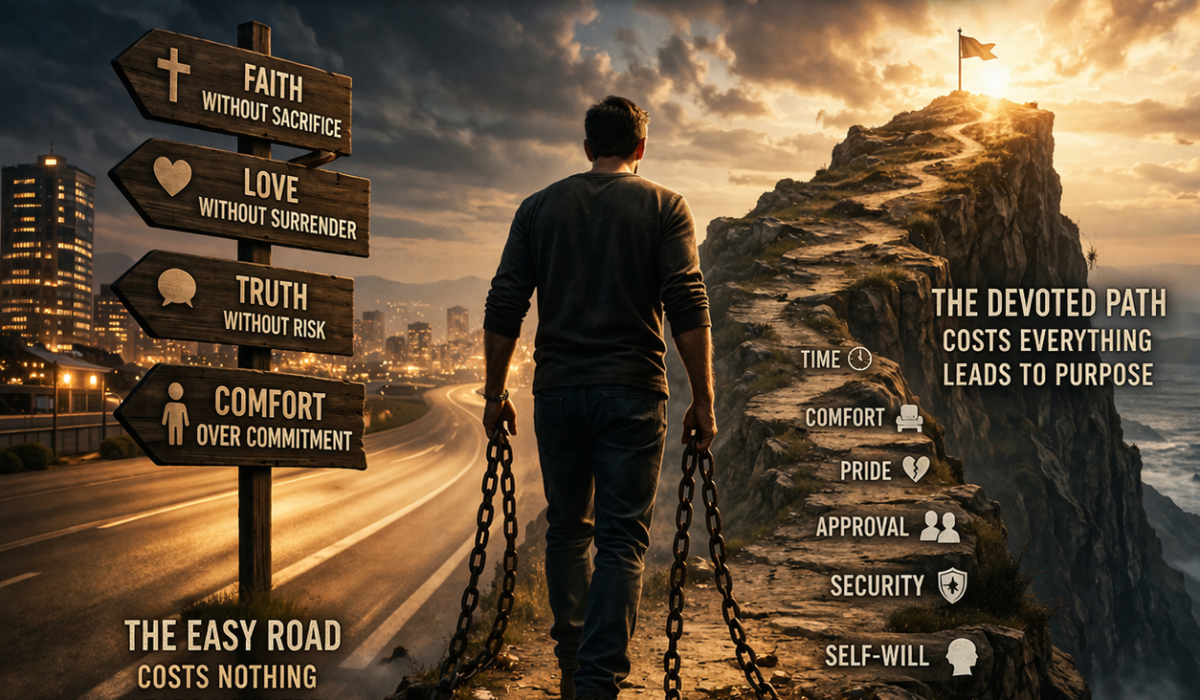
Devotion That Costs Nothing Is Worth Nothing

Everyone claims devotion. The word is thrown around casually, worn like a badge, spoken as if saying it makes it so. Men claim devotion to truth, Christians claim devotion to God, Women claim devotion to their husbands, and husbands claim devotion to their families. But when you begin to examine those claims (when you strip away comfort, convenience, and social approval) you find something quite unsettling. What most people call devotion has never been tested, never been proven, and most importantly, has never cost them anything significant.

That is the problem. Devotion that costs nothing requires nothing. It demands no sacrifice, no loss, no discomfort, no risk. It is maintained as long as it is easy, as long as it is beneficial, as long as it does not interfere with personal desires. But the moment a price is introduced )reputation, relationships, comfort, control, money) that so-called devotion ceases. And that which disappears under pressure was never real to begin with. True devotion is not revealed in words or intentions, but in cost. If it did not cost you something to hold onto it, then you were never really devoted in the first place.


I. Devotion Has Always Required Sacrifice

There has never been a version of true devotion (real, binding, immovable devotion) that did not require sacrifice. This is not a modern idea, nor is it an extreme interpretation but the consistent pattern found across history, across Scripture, and across every serious commitment that has ever existed. Devotion, by its very nature, demands that something be given up in order to prove that what is held onto matters more. Without that exchange, there is no weight behind the claim. Where there is no proof, there is no devotion.

Look at the pattern laid out in Scripture. When Abraham was called to prove his devotion, he was asked for his son. The command was not symbolic, convenient, easy to explain or comfortable to carry out. It cut directly against his desires, his future, and his understanding. And that is precisely why it was proof. Devotion is only revealed when obedience costs you something you are not willing to lose. If Abraham had been asked to give what he did not value, it would have proven nothing.

The same pattern follows in the lives of the disciples of Jesus Christ. They did not demonstrate devotion by agreement. They left livelihoods, security, reputation, and in many cases, their very lives. They were rejected, ridiculed, and hunted. Their devotion was measurable in what they lost. And that loss was the evidence. You cannot separate their devotion from the cost they paid to prove it and to maintain it.

Even outside of Scripture, the principle holds true. Every meaningful commitment (whether to a cause, a mission, a family, or a calling) demands sacrifice. The man devoted to building something gives up comfort and leisure. The man devoted to mastery gives up distraction and ease. The man devoted to his household gives up autonomy and selfish ambition. In every case, devotion narrows his life. It removes options and it forces him to choose (and to keep choosing) what matters most at the expense of everything else.

People in our modern culture want to claim devotion without accepting its defining characteristic. They want the identity without the cost. But devotion without sacrifice is not devotion at all. What you choose when it is easy, when it benefits you, and when it aligns with your desires is not devotion. Of course, the moment it stops being easy, the moment it begins to cost you something real, preference disappears and only true devotion remains.

And that is the dividing line. Devotion is not proven when everything is aligned in your favor. True devotion is proven when maintaining that devotion requires you to give something up, something you would rather keep. That is the moment of truth. That is the point where words are exposed, where intentions are tested, and where reality is revealed. Because in the end, devotion is not what you say you value but what you are willing to sacrifice to keep it.


II. The Modern Lie: Devotion Without Cost

The modern world has perfected a lie that would have been laughable to past generations: the idea that devotion can exist without cost. And people have embraced this fantasy because it allows them to claim identity without undergoing transformation, to speak with authority without paying a price, and to feel righteous without ever being tested.

Nowhere is this more obvious than in modern Christianity. Men and women claim devotion to God, but their lives remain untouched by it. There is no separation from the world, no obedience that cuts against personal desire, no willingness to endure rejection or loss. Faith has been redefined into something that fits comfortably into an already self-directed life. It asks for nothing that would disrupt routine, threaten relationships, or require real sacrifice. And yet, it is still erroneously called devotion.

But devotion that never contradicts your will is not devotion. If your “faith” has never required you to stand alone, to lose something, to obey when it hurts, then it has never been tested. And what is untested cannot be trusted. A devotion that costs nothing is indistinguishable from a preference that happens to be socially acceptable.

The same lie has infected marriage. Women will speak openly about their devotion to their husbands, about loyalty, support, and love, but what did it cost them? What was surrendered? What was laid down? If marriage requires no real loss, no yielding of control, no restructuring of priorities, no submission of self, and no abandoning of the old life, then what exists is not devotion, but proximity. She did not give herself; she added a man to her life and she is not a wife.

Real devotion in marriage is not measured by words or displays of emotion, but by what is given up. It is seen in the quiet, consistent surrender of self, of preferences, of autonomy, of the constant demand to be centered. Without that cost, what is called “devotion” is simply coexistence with “benefits”.

And then there is truth. Everyone claims to stand for it. Everyone believes themselves to be a person of principle, until telling the truth comes with consequences. Until it threatens income, reputation, relationships, or social standing. Suddenly, truth becomes negotiable. It becomes something to be softened, delayed, or avoided entirely. And in that moment, their false claim is exposed.

Because truth, like all real devotion, demands a price. If you only speak it when it is safe, then you are not devoted to truth, comfort is your god. If you only stand firm when there is no risk, then you are not courageous, you are a coward. The presence of cost is what separates conviction from convenience.

This is the modern lie: that you can have devotion without sacrifice, identity without cost, and commitment without loss. But when the illusion is stripped away, what remains is emptiness. Because devotion that demands nothing gives nothing, and in the end, it produces nothing real at all.


III. Cost Is the Proof of Devotion

Cost is not an insignificant unfortunate side effect of devotion but the very proof of it. This is where most people fundamentally misunderstand the concept. They see sacrifice as something extreme, something reserved for the especially committed, something beyond what should reasonably be expected. But that thinking reveals the crux of the problem. If devotion does not require sacrifice, then it requires nothing at all. And if it requires nothing, then it proves nothing.

Every claim of devotion is ultimately tested at the point of cost. The test comes when maintaining that devotion forces a choice, when something must be given up in order to remain faithful to what is claimed. That is the moment where reality is revealed. Because if nothing is at stake, then nothing has been chosen. And if nothing has been chosen, then there is no devotion, only agreement with what was already easy.

This is why cost is the ultimate dividing line. It forces prioritization, and demands that one thing be valued above another. You cannot claim to be devoted to something if you have never had to choose it over something else you wanted. Devotion is not simply what you say you value, but what you consistently choose when there is a competing option. And the greater the cost of that choice, the clearer the devotion.

If a man claims devotion to his work, but abandons it the moment it becomes difficult, then he was never devoted. If a woman claims devotion to her marriage, but resists any loss of control or comfort, then she is not devoted. If a person claims devotion to truth, but retreats when it becomes dangerous, costly or unpopular, then they are not committed. Cost exposes all of this instantly. It removes ambiguity, strips away language and reveals reality. Because when faced with loss (whether it is comfort, approval, opportunity, or control) people show what they actually value. They reveal what they are truly devoted to, not by what they say, but by what they are unwilling to lose.

And this is why devotion cannot exist without cost. Without sacrifice, there is no separation from alternatives. Without loss, there is no prioritization. Without risk, there is no commitment. Devotion requires all three, it demands that you narrow your life, that you bind yourself to something in such a way that walking away would cost you more than staying. Most people avoid this entirely. They structure their lives to ensure that their “devotions” never conflict with their desires. They carefully maintain a version of commitment that never forces them to choose, never requires them to sacrifice, never exposes them to loss. And in doing so, they protect themselves from ever having to prove anything.

But that protection comes at a price. Because devotion that is never tested is never real. And when the moment inevitably comes (when cost is introduced, when sacrifice is required) what they claimed was devotion collapses instantly. Not because it failed, but because it never existed in the first place.


IV. Cheap Devotion Is a Lie People Tell Themselves

Cheap devotion exists because people want the reward of being seen as devoted without paying the price required to become it.This is a deliberate construction, a way to maintain a certain identity while avoiding the cost that would make that identity real. People do not drift into cheap devotion; they build it, protect it, and defend it, because it allows them to feel aligned with something higher without ever being constrained by it.

This is why cheap devotion is so often loud. It talks constantly, declares itself, posts, signals, affirms, and insists. It surrounds itself with language, symbolism, and appearance, all designed to create the impression of commitment. But the moment that devotion is required to produce action (real action that carries a cost) it stalls, hesitates, negotiates, and eventually retreats.

The man who claims to be devoted to truth will speak boldly when there is no consequence, but suddenly becomes measured and cautious when his reputation or money is at stake. The woman who claims devotion to her husband will speak of loyalty and support, but resists any expectation that disrupts her autonomy or challenges her preferences. The Christian who claims devotion to God will profess faith openly, but avoids any obedience that would isolate them from the culture around them. In each case, the pattern is the same: the claim is strong, but the cost is completely avoided.

What makes this particularly grievous is that cheap devotion is convincing, especially to the person holding it. It allows them to point to words, intentions, and selective actions as proof. It gives them just enough evidence to reassure themselves that their devotion is real, even while they carefully avoid any situation that would truly test it. Over time, they become insulated from reality. They no longer measure their devotion by what it costs, but by how strongly they feel or how often they declare it.

But reality is not deceived by their perception. Cheap devotion can never produce real outcomes because it is not rooted in real commitment. It cannot endure pressure because it has never been built to withstand it. And when the moment comes (when sacrifice is required, when loss is unavoidable) it collapses instantly. Because what was being maintained was not devotion, but the mere appearance of it.

This is why cheap devotion is ultimately a lie, a self-deception that allows a person to live comfortably while believing they are committed. It removes the tension that real devotion creates. It eliminates the need for discipline, for sacrifice, for hard decisions. And in doing so, it strips devotion of its very nature. Because real devotion binds,it limits, and it costs. Cheap devotion does none of these things. It asks nothing, gives nothing, and ultimately means nothing. And the longer a person clings to it, the further they get from anything real.


V. What Real Devotion Actually Looks Like

If cheap devotion is defined by what it avoids, real devotion is defined by what it embraces. It expects great cost and accepts great sacrifice. Real devotion understands from the beginning that to be bound to something is to lose the freedom to choose otherwise. And instead of resisting that reality, it leans into it.

Real devotion costs you something you wanted to keep, not just something easy to give up, but something that forces a decision. It requires you to surrender comfort when comfort competes with your commitment. It demands that you give up control when control stands in the way of order. It calls for the laying down of preferences, habits, and even relationships when they conflict with what you have chosen to be devoted to. This is the point. Devotion that never threatens what you want or have is devotion that has never taken hold.

It also forces consistency. Real devotion is not reactive, not emotional, and not dependent on circumstances. It does not rise and fall based on mood, convenience, or external validation. It is steady because it is anchored in a decision that has already accounted for and expects the cost. The man devoted to his work does not abandon it when it becomes difficult because difficulty was assumed. The woman devoted to her household does not withdraw when it becomes demanding because great demand was expected. The person devoted to truth does not go silent when it becomes dangerous because danger was part of the agreement from the beginning.

And because real devotion is rooted in cost, it naturally narrows a person’s life. It removes options. It closes doors. It eliminates alternatives that would conflict with what has already been chosen. This is often what people fear most. They want to keep every door open, every option available, every path accessible. But devotion requires the opposite. It binds you to one path and forces you to walk it regardless of what or who you must leave behind.

This is why real devotion always produces results. It builds things, sustains things, and creates stability, order, and momentum because it is not constantly renegotiated. It does not collapse under pressure because it has already been tested through cost. What remains after sacrifice is  stronger, more defined, and more real.

This is the difference. Real devotion is not loud, but it is unmistakable. It does not need constant declaration because it is demonstrated in action, in sacrifice, in consistency over time. It is seen in what a person gives up without complaint, in what they endure without retreat, and in what they protect even when it would be easier to walk away.

In the end, real devotion is simple to recognize, not by what is said, but by what it costs.


Conclusion

Stop claiming devotion to things that have cost you nothing. Strip away the language, the identity, the fake performance, and ask the only question that actually matters: what has this cost me? Because that is where the truth is found. Not in what you say, not in what you feel, not in what you intend, but in what you have been willing to lose in order to hold on. If your faith has required no obedience that hurt, no separation that stung, no sacrifice that mattered, then it is not devotion. If your marriage has demanded no surrender of self, no yielding of control, no restructuring of your life, then it is not devotion. If your commitment to truth has never put you at risk, never forced you to stand when it would have been easier to sit down, then it is not devotion.

You are always paying a cost. Every day, in every area of your life, something is being spent, your time, your energy, your attention, your loyalty. The only question is what you are spending it on. Because where your cost goes reveals your devotion. Devotion is demonstrated, and it is demonstrated at the point of sacrifice, at the moment where you choose to lose something in order to remain faithful to what you claim matters most. If there is no cost, there is no devotion. And if there is no devotion, then all that remains is a lie dressed up as something real.

May God’s Great Order be Restored!

Fasting: The Discipline That Restores Dominion


Introduction

Throughout Scripture, fasting appears wherever men and women of God sought clarity, repentance, victory, or divine intervention. Moses fasted forty days on Mount Sinai before receiving the Law. Elijah fasted on his journey to Horeb. Esther called a national fast before confronting the king. And Jesus Himself began His earthly ministry with a forty-day fast in the wilderness. Fasting is not an outdated fringe spiritual practice reserved for monks and mystics, it is a foundational discipline woven throughout the life of God’s people. Yet in modern Christianity, it has been quietly abandoned, or replaced by a softer, more comfortable religion that avoids hardship and spiritual exertion.

At its core, fasting is the deliberate denial of physical appetite in order to sharpen spiritual awareness and strengthen obedience. The Bible presents fasting as an act of humility before God, a weapon in spiritual warfare, and a discipline that subdues the flesh. As one theological reflection describes it, fasting is the act of abstaining from something good so that one may concentrate more fully on God. Yet fasting is more than a spiritual ritual. Throughout history (and increasingly in modern research) it has also been recognized for its physical and psychological benefits. Scientific studies show that structured fasting can improve metabolic health, reduce inflammation, improve blood sugar control, lengthen lifespan, and even support cardiovascular health.

This article explores fasting from every angle: biblical, historical, practical, physical, and spiritual. We will examine its role in family leadership, masculine discipline, biblical feasts, spiritual warfare, and the restoration of order in the Christian life. We will also confront the uncomfortable truth that the modern church rarely (if ever) fasts because modern believers rarely deny themselves. Yet the men and women who shaped history (biblical patriarchs, prophets, apostles, and reformers) understood something we have largely forgotten. Fasting is not weakness, but training for dominion.


I. The Biblical Foundation of Fasting

Fasting is not a modern spiritual experiment, but a deeply rooted biblical practice that appears throughout both the Old and New Testaments whenever God’s people sought repentance, guidance, deliverance, or spiritual strength. From the patriarchs to the prophets, from kings to apostles, fasting consistently appears alongside prayer as one of the most powerful disciplines available to believers. Yet unlike many modern spiritual trends, fasting was never presented as optional. It was assumed to be part of a faithful life before God.

The earliest biblical command connected to fasting appears in the Day of Atonement. In Leviticus, the Lord commanded Israel:

 “And this shall be a statute for ever unto you: that in the seventh month, on the tenth day of the month, ye shall afflict your souls… for on that day shall the priest make an atonement for you, to cleanse you, that ye may be clean from all your sins before the Lord.” –Leviticus 16:29–31

The phrase “afflict your souls” has historically been understood by Jewish interpreters as fasting and self-denial. Even today, Yom Kippur remains the most widely observed fast in Judaism. The principle is clear: fasting is an outward act that reflects inward humility. It is the deliberate lowering of the body so the spirit may be lifted toward God.

Throughout Israel’s history, fasting frequently accompanied moments of national crisis. When the prophet Joel warned Israel of impending judgment, his solution was not political reform or military strength, it was repentance expressed through fasting.

 “Therefore also now, saith the Lord, turn ye even to me with all your heart, and with fasting, and with weeping, and with mourning: And rend your heart, and not your garments…–Joel 2:12–13

Notice the pattern: fasting was never meant to be an empty ritual. God rejected outward fasting that was not accompanied by genuine repentance. The prophet Isaiah delivered one of the strongest rebukes against hypocritical fasting in Scripture.

 “Is not this the fast that I have chosen? to loose the bands of wickedness, to undo the heavy burdens… to let the oppressed go free… Is it not to deal thy bread to the hungry…?” –Isaiah 58:6–7

True fasting, according to God, produces transformation. It humbles the individual and restores justice within the community. In the New Testament, fasting intensifies. Before beginning His ministry, Jesus fasted forty days in the wilderness.

 “Then was Jesus led up of the Spirit into the wilderness to be tempted of the devil. And when he had fasted forty days and forty nights, he was afterward an hungred.Matthew 4:1–2

Christ’s fast is not merely symbolic. It reveals the powerful truth that fasting prepares the believer for confrontation with evil. Immediately following this fast, Jesus faced temptation from Satan. His victory came not through physical strength, but through spiritual clarity and obedience to Scripture. Even more telling is what Jesus assumed about the future practice of fasting among His followers.

 “Moreover when ye fast, be not, as the hypocrites… that they may appear unto men to fast… But thou, when thou fastest, anoint thine head, and wash thy face… and thy Father, which seeth in secret, shall reward thee openly.Matthew 6:16–18

Notice that Jesus did not say “if you fast.” He said “when you fast.” Fasting was expected. The early church continued this pattern. In the Book of Acts, leaders fasted before making major decisions.

 “As they ministered to the Lord, and fasted, the Holy Ghost said, Separate me Barnabas and Saul… And when they had fasted and prayed, and laid their hands on them, they sent them away.” –Acts 13:2–3

The pattern is clear and unmistakable: prayer, fasting, and then clarity. From Moses to the apostles, fasting appears whenever God’s people sought divine direction. It humbled the flesh, sharpened spiritual perception, and prepared men and women to act with conviction. In other words, fasting was never merely about deprivation of food, it was about alignment with God’s will.


II. Fasting as Discipline: Mastery of the Flesh

One of the most overlooked purposes of fasting is the cultivation of discipline. At its simplest level, fasting forces a man (or woman) to confront the most basic human appetite: hunger. The body demands satisfaction. The stomach growls, energy dips, and irritation creeps in. Yet fasting requires a deliberate act of mastery, choosing obedience over your impulses. In this way, fasting becomes a training ground for dominion over the flesh. Scripture consistently teaches that the greatest battle a man fights is not against enemies outside him, but against desires within him. A man who cannot say “no” to his own appetites will rarely stand firm against temptation, pressure, or sin.

The Apostle Paul understood this principle. In writing about spiritual discipline, he compared the Christian life to the training of an athlete preparing for competition. Discipline is required, restraint is required, and mastery over the body is essential.

 “24. Know ye not that they which run in a race run all, but one receiveth the prize? So run, that ye may obtain. 25. And every man that striveth for the mastery is temperate in all things. Now they do it to obtain a corruptible crown; but we an incorruptible. 26. I therefore so run, not as uncertainly; so fight I, not as one that beateth the air: 27. But I keep under my body, and bring it into subjection: lest that by any means, when I have preached to others, I myself should be a castaway.” –1 Corinthians 9:24–27

Paul speaks of keeping his body under and bringing it into subjection. The picture is one of deliberate control. The body is not meant to command the man, the man is meant to command the body. Hunger, fatigue, and physical craving are powerful forces, but Scripture never treats them as rightful masters. Fasting is one of the clearest ways to train that hierarchy. When a man voluntarily denies himself food for a time, he proves to himself that appetite does not rule him. This theme appears elsewhere in Scripture as well. The Bible repeatedly warns that a man ruled by appetite becomes spiritually dull and morally unstable.

 “He that hath no rule over his own spirit is like a city that is broken down, and without walls.” –Proverbs –25:28

A city without walls is defenseless. In ancient times (and modern) it invited invasion, looting, and destruction. Solomon uses this image appropriately, a man who cannot govern his own impulses becomes spiritually exposed. Temptation enters easily, anger spills out quickly, and lust finds an open door. Discipline, on the other hand, builds walls of protection around the soul.

Historically, Christian thinkers recognized fasting as one of the most effective tools for cultivating this inner rule. The early church father John Chrysostom wrote, “Fasting is the support of our soul: it gives us wings to ascend on high.” Similarly, Martin Luther observed that fasting “subdues the flesh and prepares the spirit for prayer.” These observations were not mystical exaggerations; they reflected the practical reality that when the body is restrained, the mind becomes sharper and the spirit more attentive.

Modern research increasingly confirms these ancient insights. Studies in behavioral psychology show that individuals who practice voluntary restraint in one area often develop stronger self-control in others. This phenomenon, sometimes called discipline spillover, demonstrates that habits of restraint reinforce broader character formation. A man who regularly practices discipline (whether through training, structured eating, or fasting) develops greater control over speech, temper, and impulse.

There is also a distinctly masculine dimension to this discipline. Throughout history, rites of passage for men often included hardship, hunger, and deprivation. Military training programs, survival training, and even traditional monastic orders recognized the same truth: comfort breeds weakness, while controlled hardship builds resilience. Fasting fits squarely into this pattern. It is voluntary hardship with a spiritual purpose. Jesus also demonstrated this principle before beginning His ministry.

“1.Then was Jesus led up of the Spirit into the wilderness to be tempted of the devil. 2. And when he had fasted forty days and forty nights, he was afterward an hungred. 3. And when the tempter came to him, he said, If thou be the Son of God, command that these stones be made bread. 4. But he answered and said, It is written, Man shall not live by bread alone, but by every word that proceedeth out of the mouth of God.” –Matthew 4:1–4

Christ’s response reveals the purpose of fasting. Hunger speaks loudly, but it does not have the final authority. The Word of God does. When practiced faithfully, fasting trains believers to live by this hierarchy, spirit over flesh, obedience over appetite, and God’s Word over bodily cravings.


III. Fasting in the Household: Leadership, Family, and Biblical Order

Fasting is not exclusively a private spiritual exercise; it has profound implications for the household. Throughout Scripture, spiritual leadership within the family often begins with the discipline and humility of the man who leads it. When a husband and father practices fasting, he is doing more than denying himself food, he is modeling spiritual authority, self-control, and submission to God. The household watches the habits of its head. If the leader pursues comfort and indulgence, the family follows that pattern. But if the leader pursues discipline and obedience, the family learns reverence and order.

One of the clearest biblical examples of household leadership through spiritual discipline is found in the life of Ezra. Before leading the people of Israel back to Jerusalem, Ezra called the community to fast together so that they might seek God’s guidance and protection.

 “21.Then I proclaimed a fast there, at the river of Ahava, that we might afflict ourselves before our God, to seek of him a right way for us, and for our little ones, and for all our substance. 22. For I was ashamed to require of the king a band of soldiers and horsemen to help us against the enemy in the way: because we had spoken unto the king, saying, The hand of our God is upon all them for good that seek him; but his power and his wrath is against all them that forsake him. 23. So we fasted and besought our God for this: and he was intreated of us.” –Ezra 8:21–23

Notice the language Ezra uses. The fast was not only for himself; it was “for us, and for our little ones.” The leader understood that the spiritual posture of the family affected the welfare of the entire community. When men humble themselves before God, the blessing and protection of God extends beyond the individual and into the household.

Scripture consistently places responsibility for spiritual leadership upon the man of the house. The discipline of fasting reinforces this role by training the leader to seek God before acting. A man who fasts regularly becomes slower to react emotionally and quicker to seek wisdom. This aligns with the biblical expectation that fathers teach and guide their families according to God’s law.


“6. And these words, which I command thee this day, shall be in thine heart: 7. And thou shalt teach them diligently unto thy children, and shalt talk of them when thou sittest in thine house, and when thou walkest by the way, and when thou liest down, and when thou risest up.” Deuteronomy 6:6–7

Teaching Scripture requires more than knowledge; it requires example. Children observe far more than they listen. When they see their father (or mother) willingly abstain from food in order to seek God, they learn that faith is not merely spoken, it is practiced. The home becomes a place where devotion is lived rather than merely discussed.

Historically, many Christian households practiced regular family fasting. In certain seasons of the church calendar, families would abstain from particular foods, share simpler meals, or devote time to prayer instead of normal routines. The purpose was not punishment or legalism, but orientation. Fasting reminded the family that life does not revolve around consumption, entertainment, or convenience. Life revolves around obedience to God.

Even short household fasts can have profound effects. A father might call for a day of fasting before making a major decision, before beginning a new venture, or when facing difficulty within the family. The act communicates something powerful: the household seeks God first. It teaches children that prayer and humility come before strategy and decision.

This pattern is visible even in times of national crisis within Scripture. When King Jehoshaphat faced a massive invading army, he did not immediately assemble troops. Instead, he called the entire nation to fast and seek the Lord first.

“3. And Jehoshaphat feared, and set himself to seek the Lord, and proclaimed a fast throughout all Judah. 4. And Judah gathered themselves together, to ask help of the Lord: even out of all the cities of Judah they came to seek the Lord.” –2 Chronicles 20:3–4

Leadership in Scripture consistently begins with humility before God. Fasting expresses that humility. It acknowledges that strength, wisdom, and protection ultimately come from the Lord.

When a household practices fasting (even occasionally) it begins to reorient its priorities. Meals become blessings rather than expectations, prayer becomes central rather than incidental, and gratitude replaces entitlement. In this way, fasting quietly restores order within the home: God first, the leader submitted to Him, and the family walking together in obedience.


IV. Fasting as Spiritual Warfare

Fasting is not only an act of humility or personal discipline; Scripture also presents it as a weapon in spiritual warfare. The Bible repeatedly reveals that there are moments when prayer alone is not enough, when deeper spiritual resistance requires deeper spiritual preparation. In these moments, fasting sharpens prayer, focuses the mind, and humbles the body so that the believer stands before God with greater clarity and dependence.

One of the clearest demonstrations of this principle appears during the ministry of Jesus. After the disciples failed to cast out a demon, they asked Christ privately why their authority had failed. His answer revealed that some spiritual battles require intensified spiritual preparation.

“19. Then came the disciples to Jesus apart, and said, Why could not we cast him out? 20. And Jesus said unto them, Because of your unbelief: for verily I say unto you, If ye have faith as a grain of mustard seed, ye shall say unto this mountain, Remove hence to yonder place; and it shall remove; and nothing shall be impossible unto you. 21. Howbeit this kind goeth not out but by prayer and fasting.” –Matthew 17:19–21

Christ’s words reveal a sobering reality: not all spiritual opposition is equal. Some struggles yield quickly to prayer and faith, while others require deeper spiritual preparation. Fasting, when combined with prayer, strengthens the believer’s focus and dependence on God. It removes distractions, humbles pride, and aligns the heart more closely with the will of God.

The prophet Daniel provides another powerful example of fasting connected to spiritual warfare. During a period of intense prayer and fasting, Daniel received a heavenly visitation explaining that unseen spiritual resistance had delayed the answer to his prayer.

“2. In those days I Daniel was mourning three full weeks. 3. I ate no pleasant bread, neither came flesh nor wine in my mouth, neither did I anoint myself at all, till three whole weeks were fulfilled.” –Daniel 10:2–3

Later in the chapter, the angel explained what had been occurring behind the scenes while Daniel prayed and fasted.

“12. Then said he unto me, Fear not, Daniel: for from the first day that thou didst set thine heart to understand, and to chasten thyself before thy God, thy words were heard, and I am come for thy words. 13. But the prince of the kingdom of Persia withstood me one and twenty days: but, lo, Michael, one of the chief princes, came to help me; and I remained there with the kings of Persia.” –Daniel 10:12–13

Daniel’s fast coincided with a spiritual conflict taking place beyond his human sight. His humility and persistence in prayer played a role in a spiritual struggle between angelic and demonic forces. This passage reminds believers that spiritual warfare is often invisible, yet very real. The New Testament reinforces this reality repeatedly. The Apostle Paul warned believers that the true battle of faith is not primarily against human enemies.

“For we wrestle not against flesh and blood, but against principalities, against powers, against the rulers of the darkness of this world, against spiritual wickedness in high places.” –Ephesians 6:12 (KJV)

If the conflict is spiritual, the weapons must also be spiritual. Prayer, fasting, repentance, and obedience become instruments through which believers seek God’s power against forces they cannot see.

Historically, many Christian leaders practiced fasting specifically during times of spiritual conflict. The early church frequently fasted before missionary journeys, during persecution, and when confronting serious doctrinal disputes. Even during periods of revival, fasting often accompanied intense prayer. Many of the great awakenings in church history were preceded by believers humbling themselves through fasting and repentance.

Fasting does not manipulate God or force His hand. Rather, it positions the believer in a posture of humility and dependence. It quiets the overbearing noise of daily life and turns the heart toward God with greater intensity. In spiritual warfare, clarity matters.

Ultimately, fasting reminds believers that victory does not come through human strength. The battle belongs to the Lord. Yet throughout Scripture, God repeatedly responds when His people humble themselves before Him. Fasting becomes one of the ways that humility is expressed, not as an empty ritual, but as a declaration that spiritual victory comes from God alone.


V. The Practical Practice of Fasting: Forms, Health, and Restoration

While fasting is deeply spiritual, it is also profoundly practical. Scripture presents fasting in several different forms, demonstrating that it is not a rigid ritual but a flexible discipline applied according to circumstance, need, and calling. Some fasts are short, some extended; some involve complete abstinence from food, while others involve the removal of certain foods or comforts. What unites them is not the exact method, but the purpose: humbling oneself before God and sharpening spiritual focus.

One of the simplest and most common biblical fasts is the normal fast, which involves abstaining from food while continuing to drink water. This type of fast appears frequently in Scripture. For example, when Queen Esther called the Jewish people to seek deliverance from destruction, she instructed them to fast together before she approached the king.

“15. Then Esther bade them return Mordecai this answer, 16. Go, gather together all the Jews that are present in Shushan, and fast ye for me, and neither eat nor drink three days, night or day: I also and my maidens will fast likewise; and so will I go in unto the king, which is not according to the law: and if I perish, I perish.” –Esther 4:15–16

Esther’s fast was intense and urgent. It demonstrated that fasting is often tied to moments of serious decision, danger, or national crisis. The goal was not physical suffering for its own sake, but spiritual clarity and divine favor.

Another biblical form is the partial fast, in which certain foods are avoided while basic nourishment continues. This type of fast appears in the life of Daniel. During a season of mourning and prayer, he deliberately limited his diet.

“2. In those days I Daniel was mourning three full weeks. 3. I ate no pleasant bread, neither came flesh nor wine in my mouth, neither did I anoint myself at all, till three whole weeks were fulfilled.” –Daniel 10:2–3 (KJV)

This form of fasting allowed Daniel to remain physically sustained while still practicing restraint and devotion. Many believers today adopt similar practices by abstaining from rich foods, sweets, alcohol, or other indulgences during periods of prayer.

Scripture also records supernatural fasts, though these are rare and clearly empowered by God. Moses fasted forty days while receiving the Law.

“And he was there with the Lord forty days and forty nights; he did neither eat bread, nor drink water. And he wrote upon the tables the words of the covenant, the ten commandments.” –Exodus 34:28 (KJV)

Likewise, Elijah and Jesus both fasted forty days during pivotal moments of divine preparation. These fasts were extraordinary and not presented as routine practices for ordinary believers. They remind us that fasting ultimately depends upon God’s strength, not merely human willpower.

Beyond spiritual benefits, fasting has increasingly been studied for its physical effects. Medical research in recent decades has shown that structured fasting can improve metabolic flexibility, support blood sugar regulation, and stimulate a cellular repair process known as autophagy, in which the body removes damaged cellular components. Studies from institutions such as the National Institute on Aging and research summarized in journals like The New England Journal of Medicine have explored how intermittent fasting may contribute to improved cardiovascular health, reduced inflammation, and improved insulin sensitivity.

These findings do not replace the spiritual purpose of fasting, but they illustrate something remarkable: practices embedded in Biblical tradition often align with biological wisdom. What Scripture presents as spiritual discipline often carries physical benefits as well.

Practically speaking, fasting can take many forms in daily life. Some believers practice a weekly fast, abstaining from food for one day each week. Others fast during specific seasons of prayer, before making major decisions, or during times of repentance. Even short fasts (such as skipping one or two meals) can create space for prayer, reflection, health benefits, and renewed focus.

Ultimately, fasting restores a sense of order to human life. It reminds us that food, comfort, and pleasure are blessings, not masters. When believers periodically step away from these things voluntarily, they rediscover a powerful truth: life is sustained not merely by what we consume, but by the God who provides it.


Conclusion

Fasting is one of the oldest disciplines practiced by the people of God, yet it remains one of the most neglected in modern Christianity. Throughout Scripture, fasting appears wherever men and women sought repentance, clarity, deliverance, or divine intervention. Prophets fasted before delivering warnings to nations. Kings called for fasting in times of crisis. Apostles fasted before appointing leaders and launching missionary work. Even our Lord Jesus Christ began His earthly ministry with a prolonged fast in the wilderness. Whenever God’s people desired to draw nearer to Him, fasting often accompanied prayer.

Fasting was never meant to be an empty ritual or public display. The prophets repeatedly condemned fasting that was done for attention. God does not respond to hunger alone; He responds to humility, repentance, and obedience. The true fast reshapes the heart. It trains the believer to put the spirit above the flesh, obedience above appetite, and devotion above comfort. When practiced faithfully, fasting becomes a tool that strengthens discipline, sharpens spiritual awareness, restores order within the household, and prepares believers to face both physical and spiritual challenges with deepened clarity and faith.

In a culture built on constant consumption, fasting stands as a quiet act of rebellion. It reminds the believer that life does not revolve around appetite, convenience, or entertainment. Life revolves around obedience to God. Through fasting, the believer reorders his priorities: God first, discipline over indulgence, and eternal truth over temporary satisfaction.

For this reason, fasting remains as relevant today as it was in the days of the prophets and apostles. It is a discipline that humbles the proud, strengthens the weak, and restores spiritual clarity in a distracted world. And for those willing to practice it faithfully, fasting continues to serve its ancient purpose, drawing the heart of man back toward the God who sustains him.


Call to Action

The truth is simple: less than 5% ofChristians today fast on a regular basis. Not because Scripture discourages it, but because modern comforts have replaced discipline. We live in a culture where food is constant, convenience is expected, and self-denial is treated as unnecessary or extreme. Yet the pattern of Scripture tells us the men and women who walked closely with God were not strangers to hunger. They fasted when they sought guidance. They fasted when they repented. They fasted when they faced danger. And they fasted when they needed clarity before acting. Fasting was not reserved for spiritual elites, it was part of a faithful life.

Jesus Himself assumed His followers would fast. In His teaching on prayer, giving, and fasting, He used the same language for each discipline.

“16. Moreover when ye fast, be not, as the hypocrites, of a sad countenance: for they disfigure their faces, that they may appear unto men to fast. Verily I say unto you, They have their reward. 17. But thou, when thou fastest, anoint thine head, and wash thy face 18. That thou appear not unto men to fast, but unto thy Father which is in secret: and thy Father, which seeth in secret, shall reward thee openly.” –Matthew 6:16–18

Notice that Christ did not say “if” you fast, He said “when.” The expectation was clear. Fasting would be part of the believer’s life, practiced quietly and sincerely before God.

So begin somewhere. You do not need to start with forty days in the wilderness. Start with a single meal. Skip lunch every day this week and spend that time in prayer. Or dedicate a full 24 hour day to fasting and seeking God’s direction. Fathers can even introduce the discipline gently within the household by leading the family in a simple fast before an important decision or season of prayer. The point is not performance; the point is obedience.

In a world drowning in excess, fasting restores perspective. It reminds us that our strength does not come from the abundance of our table but from the presence of our God. When believers willingly humble themselves in this way, they rediscover something the modern church has largely forgotten: discipline strengthens their faith.

The challenge is simple. Fast, pray, seek God. And watch what clarity follows.

May God’s Great Order be restored!

Taming a Feral Wife

Reclaiming Order, Restoring Womanhood, Reinstituting the Biblical Household


Introduction:

There was a time when men did not ask whether they were permitted to lead their households; they simply did it. They understood that marriage was not a negotiation between “equals” but a covenantal structure established by God Himself. “For the husband is the head of the wife, even as Christ is the head of the church” (Ephesians 5:23). Headship was not an insult, but a sacred charge, a burden. In our age, headship has been replaced with appeasement, and discipline with emotional bargaining. The result is not the harmony promised by society, but utter chaos.

A “feral wife” is no longer a mythical creature, but the new normal. She is the predictable outcome of fatherlessness, feminism, sentimental church culture, and a generation of men who were never taught to govern women. She is not evil in essence, she is undisciplined, untrained, and unaccustomed to righteous authority. Like anything left without structure, she grows wild and rabid. This article is not a call to cruelty; it is a call to restoration. Because what is wild can be reclaimed, if the man is willing to take the lead without apology.


I. Diagnosis Before Discipline: What Has Gone Wrong

Before a man attempts correction, he must understand what he is confronting. Scripture teaches, “Where there is no vision, the people perish” (Proverbs 29:18). Disorder in a household is the fruit of absent or compromised vision. A feral wife typically manifests defiance in both subtle and overt forms, public contradiction, emotional manipulation, sexual withholding, financial entitlement, and a chronic need to test the boundaries. These are not isolated personality quirks, they are symptoms of rebellion against structure.

Historically, societies that endured understood female formation as essential. In ancient Israel, daughters were raised within the authority of the father (Numbers 30), trained for domestic competence and covenant loyalty. In colonial America, women were expected to master household management well before marriage. Even into the 19th century, manuals on “the duties of a wife” were commonplace. Contrast this with modern culture, which trains women for careerism, independence, and self-actualization while mocking any submission to men as weakness.

The modern church has often compounded the problem. In an effort to avoid appearing “harsh,” it has softened the biblical model. Yet Scripture does not apologize for hierarchy. Sarah is praised because she “obeyed Abraham, calling him lord” (1 Peter 3:6). While that verse makes contemporary readers uncomfortable, it does not nullify divine order.

The feral condition is therefore not mysterious, but cultivated on purpose. A woman raised without strong paternal authority and then married to a hesitant husband will naturally default to control. She fills the vacuum. If a man abdicates leadership, she will assume it, and when she does, resentment follows – on both sides.

Diagnosis of the underlying problem requires impartial honesty. Is she disrespectful because she is malicious? Or because you have been inconsistent? Has rebellion flourished because correction never came? A man must first ask whether he has tolerated in the past what he now laments. Weak enforcement trains defiance, and silence trains contempt.

The first step in taming is not shouting, but clarity. Define the order of the house, establish non-negotiables rooted in Scripture, and remove ambiguity. Chaos thrives in “gray” areas, while structure thrives in clarity. Until a man sees the roots, he will hack at branches forever without make and lasting progress.


II. Authority Is Mercy, Not Oppression

Modern ears hear “authority” and imagine tyranny, but scripture presents something entirely different. Authority, rightly exercised, is protection. “For he is the minister of God to thee for good” (Romans 13:4). Though written of civil magistrates, the principle stands: authority exists for order and protection.

Christ’s headship over the Church is not abusive, but sacrificial. He leads, provides, corrects, and sanctifies. “Husbands, love your wives, even as Christ also loved the church, and gave himself for it” (Ephesians 5:25). A man who demands submission without sacrificial leadership is a tyrant, or a coward, but certainly not a patriarch.

Authority is mercy because it relieves a woman of burdens she was never designed to carry. When Eve stepped ahead of Adam in Genesis 3, catastrophe followed. The curse included disorder in relational desire: “thy desire shall be to thy husband, and he shall rule over thee” (Genesis 3:16). The struggle for control entered the marital dynamic. Restoration requires reclaiming rightful order, not through domination, but through confident governance.

Historically, strong households produced stable societies. Consider the Roman concept of paterfamilias, the father as legal and moral head. While pagan in many respects, it recognized something foundational: a home cannot function without a singular authority. Even medieval Christian households operated under clear patriarchal lines. Disorder was seen not as liberation but as danger.

A feral wife often resists because she has never experienced benevolent authority. If previous male figures were absent or weak, she has learned to distrust leadership. Therefore, the husband’s steadiness is crucial. No volatility, no threats, no physical violence, simply firm, calm and consistent enforcement of standards.

Correction must be consistent. If disrespect is confronted one day and ignored the next, confusion will multiply. Boundaries must be articulated and upheld. “Let your yea be yea; and your nay, nay” (Matthew 5:37).

Authority becomes oppressive only when divorced from responsibility. But authority joined to sacrifice becomes the shelter she was designed to flourish within. When a woman sees that your leadership is not self-serving but covenantal, her resistance gradually loses its footing.


III. Establishing Order Without Apology

Once clarity and conviction are secured, implementation begins. And implementation must be immediate. Delayed enforcement communicates uncertainty. Joshua declared, “As for me and my house, we will serve the LORD” (Joshua 24:15). He did not present it for committee approval, he set direction and he lived it!

Begin with tangible structure. Define expectations regarding speech, finances, sexuality, child-rearing, and household roles. Any vagueness will be exploited and invite negotiation. Precision establishes stability, a wife cannot align with standards that are not clearly stated and enforced.

Speech is often the first battlefield. Public contradiction erodes your authority faster than almost anything else. Address it privately but decisively. Make it clear that disagreements are to be handled privately in order, not public spectacle. Proverbs warns, “It is better to dwell in the wilderness, than with a contentious and an angry woman” (Proverbs 21:19). Contention must not be normalized or tolerated.

Sexual order is equally critical. Scripture states, “The wife hath not power of her own body, but the husband” (1 Corinthians 7:4). This is mutual in context, but modern culture conveniently erases the wife’s obligation while emphasizing autonomy. Restore biblical mutuality without apology. Financial structure follows. Entitlement must yield to stewardship, a household is not a democracy of spending impulses, it is an economy under the governance of the husband.

Implementation will likely provoke escalation. Expect it. Resistance will intensify before it diminishes; stay steady. Emotional reactions are not indicators of injustice, they are often the detox symptoms of newfound order. The talons of rebellion are not easily released from the subject.

Never correct her in anger, or with rage. Anger clouds your judgment. “He that is slow to wrath is of great understanding” (Proverbs 14:29). Correction must be deliberate, and consistent. Order established calmly is always more powerful than order imposed violently.


IV. Discipline as Restoration, Not Destruction

Discipline is perhaps the most misunderstood element of leadership. It is not vengeance, or humiliation, but training. The very word disciple shares its root. Hebrews 12:6 declares, “For whom the Lord loveth he chasteneth.” Love and correction are not enemies. Love cannot exist without correction. A feral wife may interpret correction as rejection. This is where consistency matters. Discipline must be framed within covenant. You correct because she is yours, not because she is disposable.

Historically, structured correction within households was assumed. Early American legal codes even permitted measured domestic discipline (a reality modern readers have been taught is “abuse”, yet historically documented). The point is not to replicate archaic practices but to recognize that accountability was once considered normal, and certainly not abusive.

Practical discipline may include loss of privileges, reassignment of responsibilities, financial limitations, or relational distance until respect is restored. What it must never include is cruelty or uncontrolled aggression. The goal here is reform, not fear. When correction produces humility, respond with warmth, and reinforce positive change. Restoration must feel tangible, a woman who sees that obedience yields peace will eventually associate submission with security rather than loss.

Transformation is rarely instantaneous, and sanctification never is. Patience does not negate firmness, but tempers it. Remember: Christ disciplines His Church not to destroy her but to present her “without spot or wrinkle” (Ephesians 5:27). The aim of discipline is refinement.


V. Recognizing Genuine Transformation

How does a man know whether progress is real? Words are insufficient. Observable fruit is the ONLY thing that matters. Scripture says, “Ye shall know them by their fruits” (Matthew 7:16). Genuine transformation reveals itself in tone, posture, and initiative. If transformation has actually occurred her fruits will bear out that change consistently. If the issues keep recurring, she has not transformed – She is just playing games, waiting for you to relent.

True submission will be voluntary rather than coerced, gratitude will replace entitlement, her speech will soften, and public support will become instinctive. She starts anticipating rather than resisting leadership. These are not superficial changes, they are indicators of genuine internal alignment.

One of the clearest signs is peace. Chaos subsides, and the home finally feels ordered. Even the children sense stability, and  disagreements become structured rather than explosive. While compliance is required, you should encourage growth beyond mere compliance. A restored wife should eventually mentor younger women in biblical order (Titus 2:3–5), because true reform multiplies.

With that said, there may be cases where resistance calcifies instead of softens. Scripture acknowledges hard hearts. In such instances, sober evaluation becomes necessary. But many so-called “irreconcilable differences” are simply the consequence of untested authority. Transformation is always possible, but it requires a man who refuses passivity and can endure the displeasure of his wife until she submits the authority God has placed her under.


Conclusion: The Call to Courageous Headship

The modern world will call this vision outdated. It will label structure as oppression and hierarchy as abuse. But Scripture remains unmoved by cultural opinions. God’s design for the household has not evolved, it has been neglected. If you desire peace in your home, begin with yourself. Strengthen your leadership. Clarify your standards. Govern without apology and love without weakness. A feral condition is not a life sentence, but a severe training deficit.

Reclaim the order God established. Lead with conviction. Correct with mercy. And build a household that reflects not cultural compromise, but covenantal strength.

May God’s Great Order be restored!

The Hidden Order of the Galaxy: What Star Wars Reveals About Power, Tyranny, and the Pattern of Creation


Introduction:

For nearly half a century, the Star Wars universe has captivated audiences across generations, and for good reason. To most viewers it is simply a thrilling space opera with heroes and villains, starships and battles, rebels fighting against an oppressive empire. Yet the enduring power of the story suggests something far deeper. Great stories do not survive for decades merely because they are entertaining; they endure because they resonate with patterns embedded in the sub-conscious human understanding of reality. Myths, epics, and sacred narratives throughout history have echoed the same structures: light and darkness, freedom and tyranny, humility and domination. These themes reflect the moral architecture of creation itself.

This is precisely why Star Wars is timeless. Beneath the grand spectacle lies a narrative framework that mirrors the ancient storytelling traditions from the time of creation onward. Its structure follows the same rhythm found in countless epics before it, including The Lord of the Rings by J. R. R. Tolkien. Both works are built on a triadic pattern, three acts that mirror the rise, fall, and restoration of order. In Star Wars this structure appears in the nine canonical films conceived by George Lucas, arranged as three trilogies. Each trilogy reflects a stage of the larger narrative: the fall of the Republic, the struggle against tyranny, and the ultimate restoration of balance. When examined carefully, the saga reveals a profound moral and structural pattern that echoes the deeper order woven into creation itself.

The evidence supporting this interpretation is vast, far more extensive than a single article could possibly contain. One could easily devote an entire series of books to exploring the symbolism, philosophy, and historical parallels embedded within the Star Wars narrative. From political structures and economic systems to spiritual traditions and mythic archetypes, the layers of meaning are immense. In the interest of brevity, however, we will focus only on some of the most obvious and unmistakable themes, patterns so clear and consistent that they alone are more than sufficient to demonstrate the deeper order at work within the story. By examining these elements through the framework of The Fall, The Struggle, and The Restoration, the underlying structure becomes impossible to ignore for anyone in possession of more than two brain cells.


I. The Fall

1. The Corruption of the Republic

At the beginning of the saga, the galaxy is governed by the Galactic Republic, a vast political union of thousands of star systems. On paper, it represents liberty, representation, and cooperation among independent worlds. A democratic senate exists, systems retain their identities, and power is theoretically distributed equally rather than concentrated. Yet beneath this appearance of order, the Republic is failing. Corruption, bureaucracy, and powerful financial interests have hollowed out the very institutions meant to preserve the liberty of the people established by the founders.

This deterioration is highlighted in The Phantom Menace, where the Senate proves incapable of responding decisively to the blockade of Naboo. Instead of acting to defend a member world, the Senate is gridlocked in procedure, committees, and endless debate. Chancellor Valorum himself admits the scale of the problem when he says, “The Republic is not what it once was.” What was meant to be a guardian of freedom has become paralyzed by its own overbearing structure.

Behind this paralysis stand powerful economic institutions such as the InterGalactic Banking Clan, the Trade Federation, and other corporate alliances. These organizations wield enormous influence over galactic politics. Their fleets rival those of governments, and their representatives sit within the political system. In many ways, they function less like businesses and more like sovereign powers. When conflict arises, these institutions are not merely observers, they actively shape events by financing wars, manipulating trade, and exerting pressure on the Republic’s leadership.

The story demonstrates a fundamental political truth: republics rarely collapse through sudden conquest. Instead, they decay slowly from within as bureaucracy expands, institutions weaken, and the people entrusted with power gradually trade responsibility for corruption. In this environment, a crisis (whether real or manufactured) becomes the perfect catalyst for transformation.

This is precisely the opportunity exploited by Palpatine, a senator from Naboo who quietly begins consolidating his influence. Publicly he presents himself as a humble servant of the Republic. Privately he is Darth Sidious, a Sith Lord orchestrating events from the shadows. By manipulating both political factions and financial powers, he creates the conditions necessary to dismantle the Republic.

The fall of the Republic therefore begins not with a battle, but with corruption.The institutions that once protected liberty have been infiltrated by evil powers and will be used as instruments of manipulation. The leaders become complacent, economic power has become intertwined with political authority, and by the time the Republic recognizes the danger, the transformation has progressed past the point of no return. The idea of the structure of freedom remains, but the substance has been hollowed out to the point it no longer has any authority.

History has shown repeatedly that when this process occurs, the rise of tyranny is close behind.

2. The Rise of Hidden Power

LIke most other real historical events, tyranny does not appear suddenly or openly. It emerges quietly, concealed behind respectable institutions and public offices. The rise of Emperor Palpatine illustrates this like watching a mirror of many corollary modern political figures. Before he became emperor, he was the little known Senator Palpatine of Naboo, he was calm, polite, and outwardly devoted to the Republic. Yet behind this unassuming exterior lies Darth Sidious, the true architect of the Republic’s destruction.

This dual identity is central to the theme of hidden power. The dark side in Star Wars rarely operates in the open, it hides, it manipulates, and it deceives. Palpatine orchestrates both sides of the Clone Wars while presenting himself publicly as the Republic’s protector. As Sidious, he commands the Separatist leadership. As Chancellor, he guides the Republic’s response to the very war he secretly created.

This strategy of internal division is devastating: creating a crisis so large that people willingly surrender their freedoms in exchange for security. In Attack of the Clones, the Senate grants Palpatine emergency powers to raise a clone army. Then, what begins as a temporary measure becomes the foundation of absolute authority. By the time the war reaches its climax in Revenge of the Sith, Palpatine’s control over the Republic’s military and political systems is nearly complete. Palpatine’s famous declaration captures the moment:

“In order to ensure the security and continuing stability, the Republic will be reorganized into the first Galactic Empire.”

With thunderous applause from the Senate, the Galactic Empire is born. The tragedy of the scene lies not only in the rise of tyranny, but in the fact that it occurs with the approval of those meant to defend its liberty. Senator Padmé Amidala observes the moment with quiet horror and delivers one of the most memorable lines in the entire saga:

“So this is how liberty dies… with thunderous applause.”

The transformation is nearly complete. A republic that once valued representation and balance of power has willingly placed itself under the authority of a single ruler. The institutions remain, but their purpose has changed. The Senate becomes ceremonial, and regional governors replace local leadership. Military power now ruthlessly enforces obedience to the galactic empire across the galaxy with extreme prejudice. 

The most important lesson here is that tyranny disguises itself as order, security, and stability. It promises protection from chaos while quietly concentrating power in fewer and fewer hands. By the time the mask is removed, the machinery of control is already firmly in place. Thus the fall of the Republic is not simply the victory of a villain. It is the culmination of a long process in which hidden power gradually replaces open governance. The Empire does not conquer the Republic from the outside, it grows from within it.

3. The Temptation of Power

While political corruption and hidden manipulation drive the fall of the Republic, the deeper cause of the galaxy’s collapse lies in something far older and more universal: the temptation of power. The Star Wars saga consistently presents power as something seductive, promising control, security, and the ability to bend reality to one’s will. Yet the story also makes clear that the pursuit of power for its own sake ultimately leads to corruption and destruction.

This theme is embodied most clearly in the tragic story of Anakin Skywalker, the young Jedi believed to be the Chosen One destined to bring balance to the Force. Introduced in The Phantom Menace, Anakin begins as a gifted but humble boy with remarkable potential. The Jedi Council recognizes his extraordinary connection to the Force, but they also sense a dangerous vulnerability within him. Yoda famously warns:

“Fear is the path to the dark side. Fear leads to anger, anger leads to hate, hate leads to suffering.”

And that warning proves prophetic. Anakin’s fear of loss (particularly his fear of losing Padmé Amidala) becomes the emotional doorway through which the dark side enters his life. Palpatine, ever the patient manipulator, exploits this fear masterfully. Rather than confronting Anakin, he slowly convinces the young Jedi that the power of the dark side can prevent death itself. In doing so, he presents power not as domination, but as salvation.

The moment of transformation occurs in Revenge of the Sith, when Anakin finally abandons the Jedi and pledges himself to Palpatine. In that instant he becomes Darth Vader, the most feared enforcer of the Empire. What began as a desire to protect those he loved becomes a dark descent into tyranny and violence.

This arc reflects a timeless moral principle: evil rarely begins as a deliberate embrace of darkness. Instead, it often begins with seemingly noble intentions that become twisted through pride, fear, and the desire for control. The promise of unlimited power becomes irresistible when one believes it can be used for good. The Jedi themselves understand this danger. Their teachings emphasize discipline, humility, and service precisely because they recognize how easily power can corrupt even the most gifted individuals. As Yoda later warns Luke Skywalker:

“Once you start down the dark path, forever will it dominate your destiny.”

Thus the fall of Anakin mirrors the fall of the Republic itself. Both begin with noble ideals and immense potential. Both are slowly corrupted by fear and the temptation of power. And both ultimately become instruments of tyranny. By the end of the prequel trilogy, the galaxy has entered its darkest hour: the Republic has become an empire, the Jedi Order has been destroyed, and the Chosen One himself has become the very symbol of oppression.

The fall is complete. The age of struggle is about to begin.


II. The Struggle

1. The Rebellion of the Free

With the fall of the Republic and the rise of the Galactic Empire, the galaxy enters a long and oppressive phase. The Senate is eventually dissolved, regional governors enforce imperial rule, and dissent is crushed with overwhelming military force. Yet tyranny, no matter how powerful it may appear, always produces resistance from the devoted few. From the ashes of the Republic emerges a new movement dedicated to restoring liberty – the Rebel Alliance.

Unlike the Empire, which rules through fear and centralized authority, the Rebel Alliance is a coalition of independent systems, freedom fighters, and former senators who refuse to accept imperial domination. Leaders such as Mon Mothma, Leia Organa, and other dissidents organize scattered resistance cells into a unified rebellion. Their goal is not conquest or personal power; but the restoration of the Republic and the return of self-government to the galaxy. They selflessly place their lives on the line for the cause of liberty.

This contrast between the Empire and the Rebels highlights one of the central moral themes of Star Wars: the difference between power imposed through force and authority grounded in consent. The Empire governs through force and intimidation. Its massive fleets of Star Destroyers patrol the galaxy, and weapons like the Death Star serve as tools of terror meant to ensure obedience. Grand Moff Tarkin makes this strategy explicit when he explains that fear of the battle station will keep systems in line.

Meanwhile the Rebels operate according to a completely different philosophy. They possess far fewer resources and vastly smaller fleets, they rely on cooperation, courage, and shared purpose rather than coercion. Their pilots proudly wear the insignia of the rebellion, and their leaders speak openly about their cause. Even when forced to hide their bases for survival (such as the hidden headquarters on Yavin in A New Hope) their principles remain public and unmistakable.

The visual symbolism of the two factions reinforces this stark contrast. Imperial leaders frequently appear cloaked in dark robes or concealed behind armor and masks. Darth Vader is literally encased within a mechanical suit that hides his humanity and identity. By contrast, the heroes of the rebellion stand openly as themselves. Figures such as Luke Skywalker, Leia, and other rebel pilots fight without masks, their identities and loyalties clearly visible.

This imagery reflects an enduring moral pattern found in many mythic traditions: tyranny thrives in secrecy and concealment, while those who defend liberty stand openly in the light. While the Empire governs through intimidation and hidden manipulation, the Rebels fight through courage and steadfast conviction.

Though vastly outnumbered and outgunned, the rebellion represents something far more powerful than military strength – the unyielding inalienable human right for freedom.

2. The Preservation of Ancient Wisdom

Another crucial dimension of the struggle against the Empire is the preservation of knowledge, specifically, the ancient spiritual teachings of the Jedi Order. When the Empire rises to power in Revenge of the Sith, one of its first acts is the systematic destruction of the Jedi. Through Order 66, the clone army turns against the very guardians of peace it once served alongside, exterminating nearly the entire Order in a single coordinated betrayal. The Jedi Temple is seized, its archives destroyed or confiscated, and the traditions of the Force are driven nearly to extinction.

This is no accident, tyrannical regimes throughout history have always sought to eliminate the custodians of ancient wisdom. The Jedi represent more than warriors or diplomats, they embody a disciplined philosophy that teaches humility, restraint, and service. Such teachings stand in direct opposition to the Sith philosophy of domination and control. By destroying the Jedi, the Empire attempts to erase not just its enemies, but the very moral framework capable of resisting it.

Yet the knowledge does not disappear entirely. A few surviving Jedi escape the purge, including Obi-Wan Kenobi and Yoda. These two figures become living repositories of the ancient teachings. In exile, they quietly safeguard what remains of the Jedi tradition, waiting for the moment when the knowledge can be passed to a new generation. That opportunity arrives with the emergence of Luke Skywalker. When Luke first encounters Obi-Wan in A New Hope, the old Jedi begins training him in the ways of the Force. Obi-Wan explains the spiritual foundation of the galaxy in simple but profound terms:

“The Force is what gives a Jedi his power. It’s an energy field created by all living things. It surrounds us, penetrates us, and binds the galaxy together.”

This statement reflects the deeper metaphysical dimension of the saga. Beneath its political conflicts lies a worldview in which life itself is interconnected through a spiritual order. The Jedi’s task has always been to live in harmony with that order, serving as guardians rather than rulers.

The Empire, by contrast, rejects this philosophy fourthrightly. The Sith seek to dominate the Force rather than cooperate with it. Power is not something to be respected or balanced; but something to be seized and wielded without restraint. In the hands of the Empire, knowledge becomes a tool of control rather than wisdom.

By preserving the Jedi teachings, the surviving masters ensure that the spiritual foundation of the galaxy is not completely erased. Even in the darkest hour of imperial rule, the ancient wisdom survives, hidden, protected, and waiting to be rediscovered. Thus the struggle against tyranny is not fought only with fleets and armies. It is also fought through the preservation of truth, tradition, and moral knowledge. For without those foundations, even victory on the battlefield would prove meaningless.

3. The Battle for the Soul of the Galaxy

The struggle against the Empire is not fought only with starships and armies. Beneath the military conflict lies a far deeper battle, the struggle for the moral and spiritual direction of the galaxy itself. In Star Wars, every character is confronted with a fundamental choice between two opposing paths: the discipline of the light side or the seductive power of the dark side. This conflict is most vividly embodied in the relationship between Luke Skywalker and his fallen father, Darth Vader.

The Empire represents more than political tyranny; it represents a philosophy of domination. The Sith believe that power justifies itself, that strength is the ultimate virtue, and those who possess it have the right to rule with absolute authority. This worldview is summarized in the Sith doctrine often referred to as the Rule of Two, in which a master and apprentice continually seek greater power, even if that power ultimately leads them to betray one another. Loyalty, mercy, and restraint are considered weaknesses by this side.

The Jedi tradition teaches precisely the opposite. The Jedi believe that power must always be governed by discipline and humility. They serve the Force rather than attempting to dominate it. This is why Yoda repeatedly warns Luke that anger and hatred are the quickest paths to destruction. The dark side may offer immediate strength, but that strength comes at the cost of one’s soul.

The confrontation between Luke and Vader in Return of the Jedi illustrates this timeless moral conflict perfectly. Throughout the film, Emperor Palpatine attempts to manipulate Luke into embracing hatred and killing his father. The Emperor understands that if Luke strikes Vader down in anger, he will have taken the first step toward becoming a Sith himself.

At the height of the duel, Luke nearly gives in to this temptation. After overpowering Vader, he stands poised to deliver the final blow. Instead, he looks at his mechanical hand (mirroring the mechanical hand of his father) and realizes the path he is about to take. In a moment of profound clarity, he throws his weapon aside and declares:

“I am a Jedi, like my father before me.”

This act of refusal is the turning point of the entire saga. Luke rejects the seductive offer of domination that defines the Empire. He chooses mercy instead of vengeance, faith instead of hatred. In doing so, he demonstrates that the true power of the light side lies not in violence but in moral courage. And that courage is the only way to true freedom.

The Empire believes that power determines your destiny. Luke proves that destiny is determined by your choices. By refusing to become what the Emperor expects him to be, he breaks the cycle of corruption that began with the fall of the Republic and begins the path to restoration.

The battle for the galaxy is therefore not merely a struggle between fleets and armies. It is a struggle over the very nature of power itself, and over whether the future will be ruled by domination or by restraint.


III. The Restoration

1. Redemption and the Return of the Father

At the heart of the Star Wars saga lies one of the most powerful themes in all moral storytelling: redemption. The fall of Anakin Skywalker into the darkness of Darth Vader represents the deepest tragedy of the galaxy’s history. Yet the story does not end with corruption, the final movement of the saga reveals that even the most fallen among us may still choose to repent and return to the light. Though our actions have consequences, ultimately, where there is breath, there is hope. 

Throughout the original trilogy, Luke Skywalker refuses to accept the idea that his father is beyond redemption. While others see Vader only as the Emperor’s ruthless and evil enforcer, Luke senses that something of Anakin still survives beneath the armor and mask. This conviction sets him apart from nearly every other character in the story. Where others see only the crimes of the past, Luke sees the possibility of restoration and pursues that intuition regardless of the possible outcome.

This belief becomes central to the climax of Return of the Jedi. When Luke willingly surrenders himself to Vader and the Emperor, he does so not as a warrior seeking victory, but as a son seeking reconciliation. He believes that confronting his father with compassion rather than hatred may awaken the humanity buried beneath years of darkness.

The Emperor, however, intends the encounter to end very differently. Emperor Palpatine attempts to provoke Luke into anger, hoping to repeat the same process that once corrupted his father Anakin. The strategy is clear: if Luke kills Vader in hatred, he will take his father’s place as the Emperor’s new apprentice and the cycle of evil will be perpetuated.

When Luke refuses and casts aside his weapon, Palpatine unleashes his full power upon him, striking him with devastating bursts of Force lightning. It is at this moment that the transformation of Vader finally occurs. Watching his son suffer, the buried conscience of Anakin Skywalker resurfaces. For years Vader served the Empire out of fear, anger, and submission to the dark side. Now he is forced to confront the consequences of that allegiance, the fact that his sins have been visited upon his son.

In a decisive act of sacrifice, Vader seizes the Emperor and throws him into the reactor shaft of the Death Star, destroying the Sith master and ending his reign. This act costs Vader his mortal life, but it restores his identity as Anakin Skywalker. In saving his son, he finally fulfills the prophecy of the Chosen One, bringing balance to the Force by destroying the Sith.

HIs redemption does not erase his past, but it proves that even the most corrupted life can still choose a different ending. Through Anakin’s final act, the cycle of tyranny that began with the fall of the Republic is broken. The father returns, not as Vader the tyrant, but as Anakin the redeemed.

2. The Collapse of Tyranny

When Darth Vader destroys Emperor Palpatine aboard the Death Star II in Return of the Jedi, the moment represents more than the death of a tyrant. It marks the collapse of the entire imperial structure that had dominated the galaxy for decades. Tyrannies often appear invincible, built upon immense military power and centralized authority, yet history repeatedly shows that such systems are far more fragile than they seem. When the individual at the center of that structure falls, the machinery of control can quickly begin to unravel.

The Galactic Empire had been designed around absolute tyranical authority. Every level of command ultimately answered to the Emperor himself. Regional governors enforced his will, fleets executed his orders, and fear served as the glue holding the system together. Grand Moff Tarkin had articulated this philosophy years earlier when he explained that fear of the Death Star would keep the star systems in line. The Empire ruled not through loyalty or consent, but through fear and intimidation.

But systems built on fear contain an inherent weakness: they depend entirely on the continued presence of the power that inspires that fear. Once that power is destroyed, the illusion of permanence fades. When the Emperor dies and the second Death Star is destroyed, the symbolic heart of imperial authority is shattered. People begin to realize there is hope, and the future starts looking brighter.

At the same time, the Rebel Alliance launches a coordinated assault against the imperial fleet. Led by figures such as Admiral Ackbar and supported by the ground assault on Endor, the rebels exploit the Empire’s sudden vulnerability. Without the Emperor’s direct command and without the protective shield around the battle station, imperial forces lose their strategic advantage.

The victory at Endor therefore represents more than a military triumph. It reveals the fundamental weakness of authoritarian systems. Empires often appear unstoppable because they possess vast armies, enormous weapons, and rigid hierarchies. Yet their reliance on centralized authority makes them susceptible to cascading failure. Remove the central figure or the central symbol of power, and the entire structure becomes a target.

By contrast, the rebellion’s strength lies in its decentralization. The alliance is composed of many independent groups and systems united by a shared commitment to freedom. If one leader falls, others rise. If one base is destroyed, another is established elsewhere. The rebellion is not dependent on a single figure or institution, but a shared vision of liberty.

Thus the fall of the Empire demonstrates a profound lesson about power: tyranny may dominate for a time, but systems built on fear cannot endure indefinitely. When courage and unity confront centralized oppression, even the most formidable empire will collapse in a single decisive moment.

3. The Restoration of Balance

With the death of Emperor Palpatine and the destruction of the second Death Star, the long shadow cast over the galaxy is lifted. The collapse of the Galactic Empire does more than end a regime of tyranny, it restores a fundamental balance that had been disrupted for generations. In the mythology of Star Wars, this balance is not merely political; but spiritual, moral, and cosmic.

From the earliest moments of the saga, the Jedi spoke of a prophecy surrounding Anakin Skywalker, the Chosen One who would “bring balance to the Force.” For many years, this prophecy appeared tragically mistaken. Anakin’s fall into darkness seemed to destroy the very order he was meant to protect. The Jedi were exterminated, the Republic was dismantled, and the Sith ruled the galaxy with tyrannical authority. Yet the prophecy was not wrong, it was simply misunderstood.

Balance did not come through the perfection of the Jedi Order or the dominance of the Republic. It came through the destruction of the Sith themselves. When Anakin ultimately turns against his master and sacrifices himself to destroy the Emperor, he fulfills the prophecy in the most unexpected way possible. The last Sith Lord is eliminated, and the corrupt lineage that had manipulated galactic history for centuries is finally extinguished.

In this sense, the restoration of balance mirrors the deeper moral structure that runs throughout the entire saga. Evil often appears overwhelming in the moment. Tyranny rises, institutions collapse, and darkness spreads across the world. Yet the story of Star Wars insists that such conditions can never be permanent. The moral order of the universe has a way of reasserting itself through the courage, sacrifice, and choices of a remnant people.

The victory at Endor marks the beginning of a new chapter for the galaxy. The Rebel Alliance celebrates its triumph, but the goal has never been simply to destroy the Empire. The ultimate objective is the restoration of a free and balanced order. In the years that follow, the rebel movement transforms into a renewed republic dedicated once again to self-governance and cooperation among the star systems.

Luke Skywalker now stands as the last trained Jedi, carrying forward the teachings preserved by Yoda and Obi-Wan Kenobi. Through him, the ancient wisdom of the Jedi Order survives and begins to take root once again.

Thus the saga concludes where it began, with the enduring balance between power and responsibility, freedom and order, light and darkness. The cycle of fall, struggle, and restoration is complete, demonstrating that while evil may rise for a season, it can never ultimately extinguish the deeper order woven into the fabric of creation.


Conclusion

The story of Star Wars endures not simply because of nostalgia, but because it echoes a deeper pattern embedded within both human storytelling and the structure of life itself. The saga follows a rhythm that has appeared in countless myths, sacred texts, and historical narratives: the fall of a once-just order, the long and painful struggle against tyranny, and the eventual restoration of balance through courage, sacrifice, and redemption. This pattern reflects the same moral architecture that has shaped civilizations and guided human understanding since the creation.

When examined through this lens, Star Wars reveals itself as far more than entertainment. It is a modern corollary that mirrors the eternal struggle between light and darkness, freedom and tyranny, humility and power. The empire rises, the rebellion fights, and balance is restored, not because of chance, but because the deeper order of creation ultimately asserts itself. The hidden structure of the galaxy is the same structure that governs every age: tyranny may ascend for a time, but it will always be confronted by the remnant: those willing to stand for freedom, liberty, and the light of truth.

The Last of My Kind

How Xennials Lived Before Technology Owned Humanity

Introduction

There exists a narrow slice of humanity (those born between 1980 and 1983) who occupy a position no future generation ever will. We are not merely older Millennials, nor are we simply late Generation X. We are something very distinct: the last people on earth who came of age before technology irreversibly colonized our daily lives, yet were still young enough to be forcibly absorbed into the digital world as adults. We remember, in our bones, a world where presence mattered, where absence was normal, where knowledge had value, and where silence was a normal part of daily life.

This is not nostalgia or romanticism of a false past, but a factual contrast between two modes of human existence. One demanded patience, effort, self-direction, memory, and competence. The other demands constant availability, passive consumption, shallow recall, and obedience to algorithms. The Xennial generation stands as the hinge point between these worlds, having learned how to function without technology, and then watching, in real time, as technology consumed the minds of future generations like a cancer.


I. Life Before Ubiquity: When Technology Was a Tool, Not an Addiction

For the Xennial generation, technology existed, but it did not dominate, mediate, or define daily life. It was peripheral, occasional, expensive, and unreliable. Communication was deliberate,  access was limited, and silence was a normal, healthy part of life. You could not be reached instantly, and no one expected that you should be. This alone produced a radically different psychology, one built around autonomy rather than constant, incessant interruption.

Telephones were anchored to walls. Messages were recorded on physical cassette tapes that had to be played back, rewound, erased, and reused. If you missed a call, you missed it. There was no anxiety spiral, no expectation of immediate response, no interpretive drama about why someone hadn’t replied in ten minutes. You called back when you were home and had time,or you didn’t, and life went on. Even spouses, parents, and employers understood that absence was part of reality, not a personal offense.

Cell phones, when they finally arrived, were not extensions of your identity. They were clunky, fragile, expensive devices with limited minutes, poor reception, and virtually no functionality beyond the voice phone call (and very limited text). I got my first one at 16 (because I paid for it) and the use was minimal. Before these devices, if communication was necessary, you found a payphone, dug for quarters, and made the call. Communication required intentional effort, which filtered out triviality by default.

Commerce functioned the same way. Most daily transactions were conducted in cash. Registers were mechanical or basic, receipts were often handwritten, and invoices were carbon copies. Fraud was much harder, credit cards existed but were minimal. Accounting required competence, and you knew what you spent because you physically handled your money. There was no mindless consumption, no one-click dopamine loop, no invisible subscription bleeding you dry in the background, and you could not order worthless crap on a whim. Spending required presence, movement, thought and decision-making.

Entertainment was scarce and communal. Video games were not omnipresent pacifiers; they were rare, expensive, and shared. You didn’t disappear into private algorithmic feeds, you gathered around a single screen, took turns and then you stopped when it was time to do something else. Boredom existed, and boredom is the ONLY place where imagination, competence, and ambition are born.

When things broke, you didn’t replace them, you repaired them. You called the manufacturer, visited a parts supplier, and learned the name of the component that failed. You waited, and then you installed it yourself or paid someone who actually knew how things worked. Knowledge was embedded in people and places, it had a value and was not floating in an infinite digital fog.

Learning required effort. If you wanted to understand something, you went to a library, you used an index, you opened a dictionary, you read an encyclopedia, you bought manuals and you studied. Information was not infinite, but it was retained, because effort burns knowledge into your memory. Curiosity demanded discipline and answers were earned, not served up by the digital gods.

Even basic navigation required effort and awareness. You planned routes, read maps, got lost, and even asked for directions. You learned geography by necessity and mistakes carried consequences, which is how competence is forged.

This world did not make people perfect, but it made them capable. It inherently trained patience, memory, resilience, and self-reliance. And that is the world the Xennial generation internalized before the digital cancer arrived and quietly eroded every one of those traits, all while insisting it had made life “easier.”


II. Learning Had Weight: When Knowledge Required Effort

For Xennials, knowledge was never passive, it did not arrive instantly, automatically, or effortlessly. It had to be sought, and that act of seeking shaped the mind in ways modern generations cannot comprehend. Learning required time, planning, movement, patience, and (most importantly) commitment. Because access was limited, information had value. You didn’t casually “look something up.” You decided something was worth knowing, and then you worked to acquire that knowledge.

If you needed to understand a subject, you went to a library or a bookstore. You navigated card catalogs and indexes. You scanned tables of contents. You read entire chapters to extract a single answer. Dictionaries, encyclopedias, thesauruses, and reference books were physical objects that occupied space and required attention. They were not endlessly linked distractions pulling you away every ten seconds, they were singular tools that rewarded your focus. The effort required to obtain information forced discernment. You didn’t drown in data; you selected the knowledge that had a purpose.

This process trained memory. Because answers were not instantly retrievable, you retained what you learned. You internalized definitions, procedures, directions, and concepts because forgetting them meant repeating the entire laborious process. Knowledge stuck because forgetting was costly. Today, forgetting is consequence-free, you can always look it up again, so nothing sticks.

When something mechanical broke (especially vehicles) the response was not to google it or watch a YouTubevideo. You bought a repair manual for that exact make and model, you read it, you learned terminology, you followed diagrams and you diagnosed problems through reasoning and logic. That process built comprehension, not just task completion because you didn’t merely replace a part, you understood why it failed and how it works.

This matters because modern learning is almost entirely procedural and transient. People can “do” things while understanding nothing. Xennials were trained to understand first, because action without understanding often led to failure, wasted money, or danger.

Even curiosity was different. Wonder didn’t lead to infinite google searches, it led to sustained inquiry. You might spend weeks chasing an idea through books, conversations, and observation. The slowness allowed synthesis. You weren’t flooded with contradictory opinions in real time. You had space to think, compare, and arrive at conclusions independently. This produced coherence, something glaringly absent in the modern mind, which consumes fragments for every possible source but assembles nothing.

The modern world boasts “unlimited access to information,” yet produces generations that are profoundly ignorant. This is not a paradox, but a consequence, because unlimited access without effort destroys the value. When everything is immediately available, nothing is respected. When answers require no effort, thinking becomes cheap. When learning is entertaining, discipline is non-existent.

Xennials learned in an environment where effort was non-negotiable. That effort trained patience, discernment, critical thinking, and humility. You could not skim your way into competence. You either did the work or remained ignorant, and ignorance had consequences. This produced adults who understood the difference between knowing of something and actually knowing it.

Contrast this with today’s reality: children and adults alike outsource memory, navigation, calculation, spelling, grammar, reasoning, and even decision-making to devices. They mistake familiarity for understanding and access for intelligence. They cannot explain what they believe, repair what they own, or defend what they repeat. They are “informed” yet incapable of basic thought.

The Xennial mind was forged under constraints. And constraints are what sharpen tools. Unlimited access does not liberate the intellect, but destroys it. It replaces mastery with dependency and curiosity with consumption. We did not grow up smarter because we had less information. We grew up stronger thinkers because knowledge had a cost. And that cost trained us to value truth, retain understanding, and respect the difference between surface familiarity and real competence.


III. Presence Was Real: When Absence Was Not a Crisis

One of the most profound differences between the pre-digital world and the modern one is not technological at all, it is relational. Xennials grew up in a time when presence was intentional and absence was normal. Being unreachable was not strange, weird, alarming, suspicious, or rude; it was simply part of life. This reality shaped healthier relationships, stronger boundaries, and a clearer sense of personal sovereignty than anything that exists today.

In the world we came from, no one had an inherent right to your immediate attention. Communication was a privilege, and certainly not demanded. You called someone and hoped they were home. If they weren’t, you left a message and waited. If they didn’t call back that day (or even the next) there was no anxiety, resentment, or interpretive narratives. People were understood to be living their lives, not standing by in a perpetual state of availability.

This applied to everyone: friends, parents, employers, even spouses. You could leave the house for hours or days without explanation. You could be alone with your thoughts, work uninterrupted, travel without constant check-ins, and critically, this did not weaken relationships, it strengthened them. When people met, they were actually present. Conversations were not fragmented by buzzing devices or hijacked by digital interruptions, your attention was given fully and received fully because it was scarce.

Modern culture insists that constant connectivity somehow equals closeness, but the opposite is true. When communication is incessant, it becomes shallow, and when availability is mandatory, attention loses value. Xennials remember when seeing someone required effort, planning, coordination, and travel. Because of that effort, time together mattered. You listened, observed, and remembered details because you weren’t outsourcing your memory to a device that would remind you later.

Solitude was also not pathologized. Being alone was not treated as a problem to be solved with more stimulation. Long stretches of quiet were normal, you sat with your thoughts, you reflected, you replayed conversations, you argued with yourself, you imagined futures and you wrestled with ideas. This internal life (this private mental territory) is where philosophy, theology, creativity, and self-knowledge are formed and it cannot exist under constant interruption.

Today, silence is treated as a threat. Notifications invade every tiny gap where silence could start, and screens fill every pause. The modern person is rarely alone with their thoughts, and when they are, they experience discomfort bordering on panic. This is an addiction no different than a drug addiction, it is the consequence of training the mind to expect constant input and a society that demands constant attention. A mind that cannot tolerate silence cannot and will not reason deeply.

Xennials also learned boundaries naturally. Because communication took effort, and people respected limits. You didn’t call someone late unless it was genuinely important, you didn’t interrupt someone working unless it was absolutely necessary. You didn’t expect instant replies, and you certainly did not “check in” unless there was a purpose. These unspoken norms protected mental space and emotional energy. Today, boundaries must be aggressively enforced (and even then, they are routinely violated) because technology has erased all natural stopping points and people literally treat constant attention and communication as an addict would treat their drug of choice.

The cost of this erasure is staggering. Relationships have become less substantial, almost entirely performative in most cases. People mistake frequency of attention and communication for intimacy, they are constantly “in touch” yet profoundly disconnected from reality and genuine connection. They share endlessly yet understand each other less than any time in human history. And because everyone is always reachable, no one is ever truly present, and no one ever truly has peace.

Us xennials remember a world where attention was given, not constantly demanded. Where conversations ended because they naturally concluded, not because a screen demanded priority over the physical presence of another human being. Where being unreachable meant you were somewhere, doing something useful, not hiding or disengaging. That assumption of good faith is gone now, replaced by surveillance, expectation, and entitlement.

This shift has in no way made us closer, it has made us anxious, distracted, and relationally fragile. We have traded depth for immediacy, trust for tracking, and presence for constant attention. The generation that lived before constant connectivity carries an intuitive understanding that modern culture has lost: that relationships require peace, that silence is not neglect, that absence is not abandonment, and a life without interruption is not isolation, but freedom.


IV. Competence Was Mandatory: When Systems Didn’t Catch You

In the pre-digital world, failure had consequences. Mistakes cost time, money, embarrassment, and sometimes pain. There was no algorithm to cushion your incompetence, no app to silently correct errors, and no automated system to compensate for ignorance. This reality produced a baseline expectation that adults should be capable, not necessarily exceptional, just capable. And capability was not optional.

Xennials grew up in an environment where daily life required basic functional skills. You had to read maps, manage money, remember appointments, maintain equipment, diagnose problems, and make decisions without constant guidance. If you didn’t know how to do something, you learned, or you paid the consequences. This created a culture where self-reliance was not ideological, but practical. You either handled your responsibilities or suffered the result.

Navigation alone illustrates the difference. Getting lost meant you were lost. There was no recalculating voice, no blue dot absolving you of spatial awareness. You had to recognize landmarks, understand direction, read signage, and adapt. This trained situational awareness and decision-making in uncertain surroundings, skills that modern GPS dependency quietly destroyed. Today, many people cannot navigate their own city without a screen, despite having “better tools” than ever.

Mechanical competence followed the same pattern. Vehicles, appliances, tools, and systems required understanding. Warning lights were not explained by pop-ups. If your car made a new sound, you paid attention. You learned to distinguish between normal operation and impending failure. Preventive maintenance wasn’t a suggestion, it was survival. Ignoring small problems led to large ones, and you learned that lesson early.

Even social competence was sharper. Without digital buffers, interactions were direct. You learned to read tone, body language, and timing. You dealt with discomfort face-to-face. You learned restraint, patience, and negotiation because there was no mute button, no block feature, and no curated persona. Your reputation mattered because it traveled through real people, not vague online platforms.

Modern systems now absorb error on behalf of the user, calendars remind you, GPS corrects you, spellcheck thinks for you, autopay hides consequences and algorithms filter choices. These Interfaces are designed to minimize effort and responsibility. While this appears convenient, it atrophies judgment. When systems constantly rescue you, you stop developing the internal skills required to function independently and even accept the consequences of your actions.

This produces adults who are strangely helpless despite unprecedented technological support and access to knowledge. They cannot diagnose problems, anticipate consequences, or recover from minor disruptions without their smartphone. If the digital system was removed, most people would immediately become helpless toddlers. And today we call this empowerment… and progress.

Xennials experienced the opposite formation. We learned because we had to. We became competent because incompetence was punished by reality. This created a quiet confidence, called grounded self-trust, you knew what you could handle because you had handled it before. You didn’t need validation, attention or instruction for every task. You figured things out… on your own.

This is why the modern world feels shallow and brittle. Systems are efficient but fragile, and people are ever connected but woefully incapable. When something breaks (technologically, socially, economically) there is panic rather than calm adaptation. The skills that once allowed humans to respond creatively under pressure have been systematically destroyed by the cancer of technology.

Competence cannot be downloaded from an app, and it cannot be automated. It must be earned through effort, failure, and responsibility. The pre-digital world enforced this whether you liked it or not. And those shaped by it carry an internal resilience that no device can replicate and no later generation can comprehend. Xennials are not superior by nature. We were simply trained by reality instead of protected from it. And that training (hard, inconvenient, and unforgiving) is exactly what modern systems are quietly eliminating.


V. The Cost of Constant Interruption: When Thought Became Impossible

The greatest damage inflicted by the cancer of modern technology is not distraction in the casual sense, it is the destruction of sustained thought. Xennials remember a time when the mind could remain on a single problem, idea, or question for hours, days or even weeks without being interrupted and subverted every few minutes. That capacity is now rare, and its disappearance explains much of the intellectual, moral, and spiritual decay visible in the world today.

In the pre-digital world, attention was not constantly contested. There were natural gaps (waiting, traveling, sitting, resting) where the mind wandered, reflected, and synthesized. These periods were not wasteful, but productive. They allowed ideas to connect, arguments to form, and beliefs to solidify. Theology, philosophy, strategy, and creativity all require uninterrupted mental space. Without it, thought can only be shallow and reactive.

The cancer of modern technology has completely erased these gaps. Every moment of stillness is immediately filled by a screen. Notifications fragment attention into unusable shards, advertisements intrude into thought, constant messages demand response, and feeds refresh endlessly. The result is an addicted mind trained to scan, not contemplate; to react, not reason; and to consume, not create.

The inability to focus has consequences far beyond productivity. People struggle to read long texts, follow complex arguments, or construct coherent worldviews. Beliefs are adopted emotionally on a whim and abandoned just as quickly, opinions are borrowed, not developed through deep mental thought and reflection, and moral frameworks are inconsistent because they were never deeply reasoned through. When attention is constantly broken, true conviction cannot be formed.

Xennials remember doing nothing, and discovering that “nothing” was where everything happened. Long drives without any entertainment, quiet evenings without intrusive stimulation,  and manual labor without background noise. These were the environments in which the mind organized itself. You rehearsed conversations, planned futures, confronted fears and you argued internally until clarity emerged. That internal dialogue has now been drowned out by the noise of “communication”.

The modern person lives in a state of permanent cognitive siege. Even when they attempt to focus, their mind expects constant interruption. To the modern man, silence actually feels uncomfortable, he begins to have withdrawal symptoms from his addiction to constant stimulation. Concentration feels effortful, reflection feels unnatural, and so the mind flees back to stimulation, mistaking relief for satisfaction. This cycle produces anxiety, restlessness, and intellectual shallowness on a staggering level.

The tragedy is that technology promised efficiency and delivered cancerous mental fragmentation, it promised connection and delivered complete isolation, it even promised knowledge while delivering moral confusion. By eliminating effort, we have diminished the value of knowledge. Xennials stand as witnesses to what was lost. Not because we are wiser by nature, but because we experienced the conditions required for wisdom to develop. We know what it feels like to think without interruption, to learn without shortcuts, to live without constant surveillance of our attention.

This is why modern generations struggle to produce coherent theories, stable theologies, or durable philosophies. These things cannot be assembled between notifications. They require time, solitude, and sustained effort, conditions that have been systematically consumed by the cancer of modern technology.

The cost of constant interruption is the collapse of the interior life. And once the inner world is hollowed out, no amount of information, connectivity, or entertainment can ever fill it. We are not simply nostalgic for a quieter time. We are warning of a deeper loss: the disappearance of the human capacity to think deeply, live deliberately, and stand internally ordered in a world designed to keep us perpetually distracted.


Conclusion: The Last Witness Before the Fall

I am not reminiscing, but testifying. The world before constant connectivity did not vanish by accident, it was dismantled, piece by piece, and sold back to humanity as convenience. What was lost is our capacity for reason and thought. We have surrendered our manhood, womanhood, thought, and peace to the idol of convenience. 

We are the last humans who learned before we were programmed. The last who formed identities, opinions and convictions through mindful thought. Those who followed were not raised, they were conditioned, trained to respond, consume, and to obey notifications rather than conscience. They are mindless addicts of the technological cancer that is destroying them. 

The future will not ask whether technology was useful. It will ask why humanity surrendered its intellect so easily. Why fathers forgot how to teach, why sons forgot how to focus, why daughters forgot how to be still, and why everyone mistook constant stimulation for true meaning. A civilization that cannot think cannot govern itself, and a people that cannot be alone cannot be free.

We are the last of our kind not because time passed, but because a line was crossed. After us, there was no silence to grow in, no boredom to sharpen the mind, and no effort to forge the soul. What comes next is either a return to order, or a long, comfortable descent into extinction.

When the reckoning comes, someone will have to remember what humanity was before it asked permission to think, because any species that cannot endure stillness cannot endure truth.

May God’s Great Order be restored.

January 1st, Rome, and the Theft of Time

Should Christians Observe the Modern New Year?


I. Who Decides When the Year Begins? (Biblical Authority vs Roman Authority)

One of the least questioned assumptions in modern Christianity is the calendar. Most believers instinctively treat January 1st as the new year – a fresh start, a reset, a chance to “do better.” But Scripture does not, and God does not leave beginnings and endings to human invention.

In the Bible, God defines the start of the year, not Rome, not culture, not tradition.

“This month shall be for you the beginning of months. It shall be the first month of the year for you.” (Exodus 12:2)

This declaration occurs in the context of Passover, redemption, and deliverance. The biblical year begins in spring, during the month of Abib (later called Nisan) (roughly March-April). This aligns with creation itself: planting, birth, renewal, and forward motion. Biblically, a new year begins when life begins moving again.

By contrast, January 1st begins the year in mid-winter, a season associated with dormancy, death, and survival rather than growth. God consistently ties renewal to life, not decay.

The modern Christian calendar is largely inherited from Rome, not Scripture. While God’s people were commanded to keep Sabbaths and feasts that marked time according to covenant rhythms, Rome developed a bureaucratic calendar designed for empire management, taxation, and civil control. When Christianity later merged with Roman authority, the Church absorbed Rome’s calendar rather than correcting it.

This matters because time is important, whoever defines the calendar defines when people reset, when they reflect, when they repent, when they celebrate and when they rest. In Scripture, those rhythms belong to God. The question is not whether Christians can acknowledge January 1st as a date on a civic calendar. The question is whether believers should spiritually invest meaning, ritual, or renewal into something God never sanctified.

The Bible already provides a yearly renewal rhythm – Passover, Feast of Weeks, and Feast of Tabernacles – each tied to covenant, obedience, provision, and accountability. January 1st simply disrupts that rhythm.

Before asking whether New Year’s traditions are pagan, satanic, or harmless, Christians must first ask a more foundational question: Who has the authority to define beginnings? God – or Rome?


II. January, Janus, and the Pagan Rewriting of Time

January is not just any random winter month – it is named after a pagan god.

The month derives its name from Janus, a Roman deity associated with beginnings and endings, transitions, doorways and gates, threshold moments and looking backward and forward simultaneously.

Janus was commonly depicted with two faces, one facing the past, one facing the future. This symbolism is not incidental; it perfectly mirrors modern New Year language: “reflect on the past year” and “look ahead to the next.”

In ancient Rome, January 1st was not a secular event but a religious one. Offerings were made to Janus, vows were sworn, and favors were sought for the coming year. These rituals were intended to secure prosperity, success, and stability. New Year’s resolutions originate here.

Resolutions were not self-help exercises. They were vows – religious commitments made at temple gates. Biblically, vows are serious matters.

“When you make a vow to God, do not delay in fulfilling it.” (Ecclesiastes 5:4)

God never commands annual vows tied to January 1st. That practice originates in pagan religion. To be clear: modern Christians making resolutions are not knowingly worshiping Janus. But ignorance of origin does not make a practice acceptable. Scripture repeatedly warns God’s people not to adopt the forms of pagan worship, even if the names are changed.

Rome did not merely rename months, they reframed time itself, shifting renewal away from redemption and toward human willpower, optimism, and self-reinvention. That shift is theological, whether people want to acknowledge it or not.

January 1st is not evil because it is “demonic.” It is problematic because it represents subverted  authority, a calendar shaped by pagan empire rather than divine command. When we make “New Years Resolutions” – we are making a vow to a pagan God in exchange for His blessing.


III. April, the Spring New Year, and the Origin of April Fool’s Day

Historically, many cultures (including large portions of Christian Europe) recognized the spring as the beginning of the year. Even after Rome began experimenting with January starts, New Year celebrations often occurred between March 25 and April 1, aligning with agricultural and biblical logic.

When the Gregorian calendar was imposed in the late 16th century, January 1st was standardized as the official New Year across Roman-aligned territories. Those who continued to celebrate the New Year in spring were mocked, pranked, and ridiculed. Over time, this ridicule became a tradition mocking Christians – what we now call April Fool’s Day.

April Fool’s Day is a cultural by-product of Rome enforcing calendar authority and shaming the Christians who resisted it. The real irony is those who maintained the older, life-centered New Year were labeled fools, while the winter-based Roman calendar became “normal.”

This episode of history highlights that calendar changes are not administrative but religious. They reshape identity, memory, and obedience. When Rome moved the New Year, it didn’t just change a date, it rewired cultural instincts about renewal, beginnings, and accountability. Biblically speaking, spring remains the only God-defined New Year. January 1st exists because Christians chose compromise over obedience – not because God revised His calendar.


IV. Is There Anything Satanic About the Modern New Year?

There is no biblical evidence that January 1st is a satanic holy day or that demons demand explicit worship through fireworks and countdowns. Claims to the contrary drift into speculation and weaken legitimate critique.

However, Scripture consistently portrays Satan as a counterfeiter, not an inventor. His strategy is inversion, imitation, compromise and substitution.

Consider the pattern:

God begins years in spring (life) – Rome begins years in winter (death), God ties renewal to redemption – Culture ties renewal to self-reinvention, God calls repentance through obedience – Culture calls repentance through willpower and optimism.

This is a counterfeit structure. Modern New Year celebrations are also marked by predictable moral patterns such as drunkenness, sexual immorality, disorder and the attitude of “One last night to sin before I get serious”.

Scripture condemns this pattern (Romans 13:13). While not satanic in the occult sense, it aligns with fleshly excess and lawlessness, not holiness. The danger is not demons hiding behind party hats. The danger is normalizing a pagan rhythm of renewal while ignoring God’s appointed ones.


V. What Should a Christian Household Do?

Christians are not commanded to observe January 1st. They are commanded to walk in discernment and faithful responses fall into three responsible categories:

1. Reject ritual participation
Treat January 1st as any normal day. No vows. No resolutions. No spiritual language.

2. De-ritualize it (Compromise less)
Acknowledge the calendar without assigning meaning or moral weight.

3. Re-anchor renewal biblically
Have a “new Years” celebration on April 1st, Tie reflection, repentance, and recommitment to it instead.

The goal is not isolation, it is alignment. Time belongs to God. When Christians passively inherit Rome’s rhythms without questioning them, they surrender authority they were never meant to.

New Year’s Day (January 1st) does not need to be feared, but it should no longer be treated as neutral once its origins are understood. The real issue is not Janus. The real issue is who gets to tell God’s people when a year begins.

And Scripture has already answered that question.

1 2 3 8