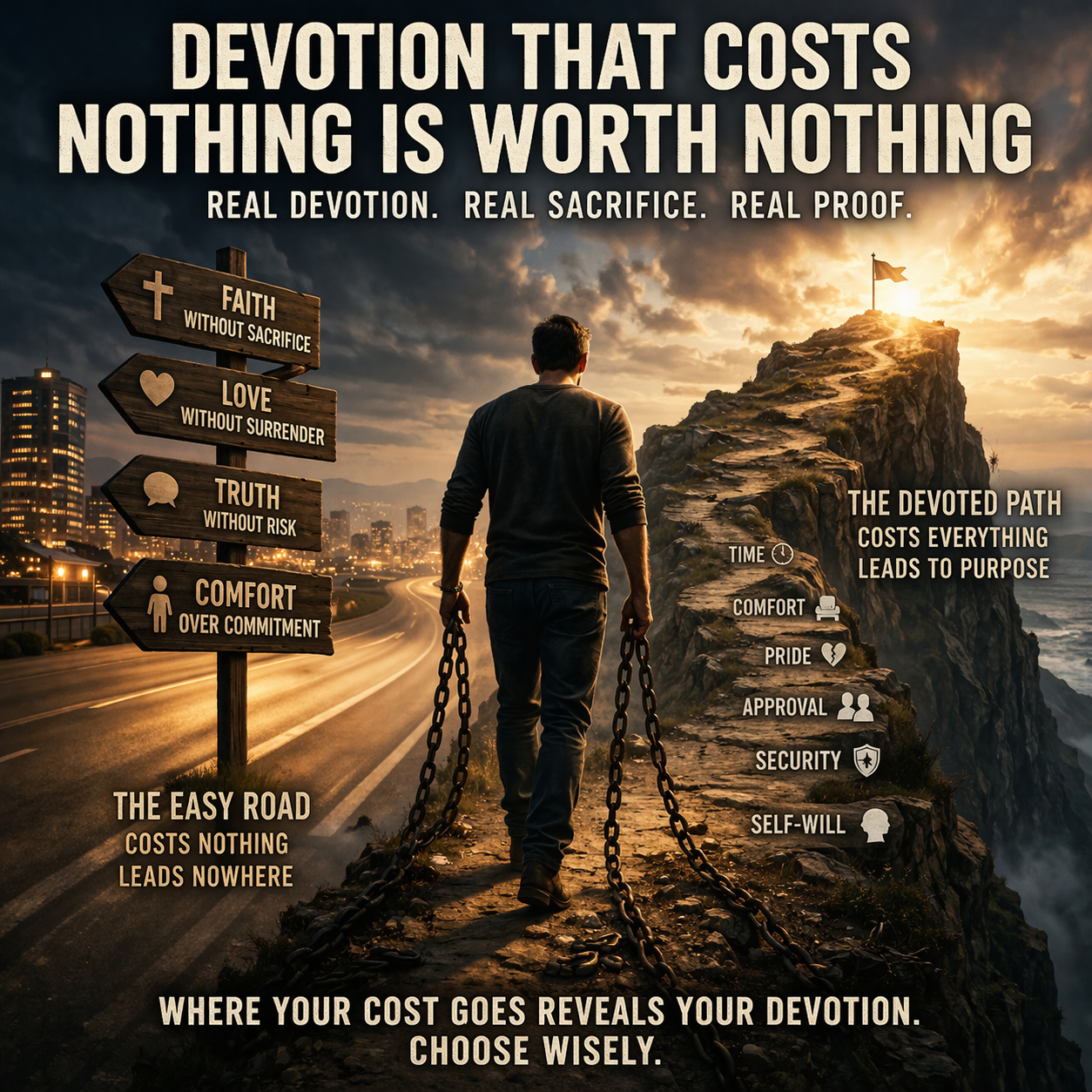
Everyone claims devotion. The word is thrown around casually, worn like a badge, spoken as if saying it makes it so. Men claim devotion to truth, Christians claim devotion to God, Women claim devotion to their husbands, and husbands claim devotion to their families. But when you begin to examine those claims (when you strip away comfort, convenience, and social approval) you find something quite unsettling. What most people call devotion has never been tested, never been proven, and most importantly, has never cost them anything significant.
That is the problem. Devotion that costs nothing requires nothing. It demands no sacrifice, no loss, no discomfort, no risk. It is maintained as long as it is easy, as long as it is beneficial, as long as it does not interfere with personal desires. But the moment a price is introduced )reputation, relationships, comfort, control, money) that so-called devotion ceases. And that which disappears under pressure was never real to begin with. True devotion is not revealed in words or intentions, but in cost. If it did not cost you something to hold onto it, then you were never really devoted in the first place.
I. Devotion Has Always Required Sacrifice
There has never been a version of true devotion (real, binding, immovable devotion) that did not require sacrifice. This is not a modern idea, nor is it an extreme interpretation but the consistent pattern found across history, across Scripture, and across every serious commitment that has ever existed. Devotion, by its very nature, demands that something be given up in order to prove that what is held onto matters more. Without that exchange, there is no weight behind the claim. Where there is no proof, there is no devotion.
Look at the pattern laid out in Scripture. When Abraham was called to prove his devotion, he was asked for his son. The command was not symbolic, convenient, easy to explain or comfortable to carry out. It cut directly against his desires, his future, and his understanding. And that is precisely why it was proof. Devotion is only revealed when obedience costs you something you are not willing to lose. If Abraham had been asked to give what he did not value, it would have proven nothing.
The same pattern follows in the lives of the disciples of Jesus Christ. They did not demonstrate devotion by agreement. They left livelihoods, security, reputation, and in many cases, their very lives. They were rejected, ridiculed, and hunted. Their devotion was measurable in what they lost. And that loss was the evidence. You cannot separate their devotion from the cost they paid to prove it and to maintain it.
Even outside of Scripture, the principle holds true. Every meaningful commitment (whether to a cause, a mission, a family, or a calling) demands sacrifice. The man devoted to building something gives up comfort and leisure. The man devoted to mastery gives up distraction and ease. The man devoted to his household gives up autonomy and selfish ambition. In every case, devotion narrows his life. It removes options and it forces him to choose (and to keep choosing) what matters most at the expense of everything else.
People in our modern culture want to claim devotion without accepting its defining characteristic. They want the identity without the cost. But devotion without sacrifice is not devotion at all. What you choose when it is easy, when it benefits you, and when it aligns with your desires is not devotion. Of course, the moment it stops being easy, the moment it begins to cost you something real, preference disappears and only true devotion remains.
And that is the dividing line. Devotion is not proven when everything is aligned in your favor. True devotion is proven when maintaining that devotion requires you to give something up, something you would rather keep. That is the moment of truth. That is the point where words are exposed, where intentions are tested, and where reality is revealed. Because in the end, devotion is not what you say you value but what you are willing to sacrifice to keep it.
II. The Modern Lie: Devotion Without Cost
The modern world has perfected a lie that would have been laughable to past generations: the idea that devotion can exist without cost. And people have embraced this fantasy because it allows them to claim identity without undergoing transformation, to speak with authority without paying a price, and to feel righteous without ever being tested.
Nowhere is this more obvious than in modern Christianity. Men and women claim devotion to God, but their lives remain untouched by it. There is no separation from the world, no obedience that cuts against personal desire, no willingness to endure rejection or loss. Faith has been redefined into something that fits comfortably into an already self-directed life. It asks for nothing that would disrupt routine, threaten relationships, or require real sacrifice. And yet, it is still erroneously called devotion.
But devotion that never contradicts your will is not devotion. If your “faith” has never required you to stand alone, to lose something, to obey when it hurts, then it has never been tested. And what is untested cannot be trusted. A devotion that costs nothing is indistinguishable from a preference that happens to be socially acceptable.
The same lie has infected marriage. Women will speak openly about their devotion to their husbands, about loyalty, support, and love, but what did it cost them? What was surrendered? What was laid down? If marriage requires no real loss, no yielding of control, no restructuring of priorities, no submission of self, and no abandoning of the old life, then what exists is not devotion, but proximity. She did not give herself; she added a man to her life and she is not a wife.
Real devotion in marriage is not measured by words or displays of emotion, but by what is given up. It is seen in the quiet, consistent surrender of self, of preferences, of autonomy, of the constant demand to be centered. Without that cost, what is called “devotion” is simply coexistence with “benefits”.
And then there is truth. Everyone claims to stand for it. Everyone believes themselves to be a person of principle, until telling the truth comes with consequences. Until it threatens income, reputation, relationships, or social standing. Suddenly, truth becomes negotiable. It becomes something to be softened, delayed, or avoided entirely. And in that moment, their false claim is exposed.
Because truth, like all real devotion, demands a price. If you only speak it when it is safe, then you are not devoted to truth, comfort is your god. If you only stand firm when there is no risk, then you are not courageous, you are a coward. The presence of cost is what separates conviction from convenience.
This is the modern lie: that you can have devotion without sacrifice, identity without cost, and commitment without loss. But when the illusion is stripped away, what remains is emptiness. Because devotion that demands nothing gives nothing, and in the end, it produces nothing real at all.
III. Cost Is the Proof of Devotion
Cost is not an insignificant unfortunate side effect of devotion but the very proof of it. This is where most people fundamentally misunderstand the concept. They see sacrifice as something extreme, something reserved for the especially committed, something beyond what should reasonably be expected. But that thinking reveals the crux of the problem. If devotion does not require sacrifice, then it requires nothing at all. And if it requires nothing, then it proves nothing.
Every claim of devotion is ultimately tested at the point of cost. The test comes when maintaining that devotion forces a choice, when something must be given up in order to remain faithful to what is claimed. That is the moment where reality is revealed. Because if nothing is at stake, then nothing has been chosen. And if nothing has been chosen, then there is no devotion, only agreement with what was already easy.
This is why cost is the ultimate dividing line. It forces prioritization, and demands that one thing be valued above another. You cannot claim to be devoted to something if you have never had to choose it over something else you wanted. Devotion is not simply what you say you value, but what you consistently choose when there is a competing option. And the greater the cost of that choice, the clearer the devotion.
If a man claims devotion to his work, but abandons it the moment it becomes difficult, then he was never devoted. If a woman claims devotion to her marriage, but resists any loss of control or comfort, then she is not devoted. If a person claims devotion to truth, but retreats when it becomes dangerous, costly or unpopular, then they are not committed. Cost exposes all of this instantly. It removes ambiguity, strips away language and reveals reality. Because when faced with loss (whether it is comfort, approval, opportunity, or control) people show what they actually value. They reveal what they are truly devoted to, not by what they say, but by what they are unwilling to lose.
And this is why devotion cannot exist without cost. Without sacrifice, there is no separation from alternatives. Without loss, there is no prioritization. Without risk, there is no commitment. Devotion requires all three, it demands that you narrow your life, that you bind yourself to something in such a way that walking away would cost you more than staying. Most people avoid this entirely. They structure their lives to ensure that their “devotions” never conflict with their desires. They carefully maintain a version of commitment that never forces them to choose, never requires them to sacrifice, never exposes them to loss. And in doing so, they protect themselves from ever having to prove anything.
But that protection comes at a price. Because devotion that is never tested is never real. And when the moment inevitably comes (when cost is introduced, when sacrifice is required) what they claimed was devotion collapses instantly. Not because it failed, but because it never existed in the first place.
IV. Cheap Devotion Is a Lie People Tell Themselves
Cheap devotion exists because people want the reward of being seen as devoted without paying the price required to become it.This is a deliberate construction, a way to maintain a certain identity while avoiding the cost that would make that identity real. People do not drift into cheap devotion; they build it, protect it, and defend it, because it allows them to feel aligned with something higher without ever being constrained by it.
This is why cheap devotion is so often loud. It talks constantly, declares itself, posts, signals, affirms, and insists. It surrounds itself with language, symbolism, and appearance, all designed to create the impression of commitment. But the moment that devotion is required to produce action (real action that carries a cost) it stalls, hesitates, negotiates, and eventually retreats.
The man who claims to be devoted to truth will speak boldly when there is no consequence, but suddenly becomes measured and cautious when his reputation or money is at stake. The woman who claims devotion to her husband will speak of loyalty and support, but resists any expectation that disrupts her autonomy or challenges her preferences. The Christian who claims devotion to God will profess faith openly, but avoids any obedience that would isolate them from the culture around them. In each case, the pattern is the same: the claim is strong, but the cost is completely avoided.
What makes this particularly grievous is that cheap devotion is convincing, especially to the person holding it. It allows them to point to words, intentions, and selective actions as proof. It gives them just enough evidence to reassure themselves that their devotion is real, even while they carefully avoid any situation that would truly test it. Over time, they become insulated from reality. They no longer measure their devotion by what it costs, but by how strongly they feel or how often they declare it.
But reality is not deceived by their perception. Cheap devotion can never produce real outcomes because it is not rooted in real commitment. It cannot endure pressure because it has never been built to withstand it. And when the moment comes (when sacrifice is required, when loss is unavoidable) it collapses instantly. Because what was being maintained was not devotion, but the mere appearance of it.
This is why cheap devotion is ultimately a lie, a self-deception that allows a person to live comfortably while believing they are committed. It removes the tension that real devotion creates. It eliminates the need for discipline, for sacrifice, for hard decisions. And in doing so, it strips devotion of its very nature. Because real devotion binds,it limits, and it costs. Cheap devotion does none of these things. It asks nothing, gives nothing, and ultimately means nothing. And the longer a person clings to it, the further they get from anything real.
V. What Real Devotion Actually Looks Like
If cheap devotion is defined by what it avoids, real devotion is defined by what it embraces. It expects great cost and accepts great sacrifice. Real devotion understands from the beginning that to be bound to something is to lose the freedom to choose otherwise. And instead of resisting that reality, it leans into it.
Real devotion costs you something you wanted to keep, not just something easy to give up, but something that forces a decision. It requires you to surrender comfort when comfort competes with your commitment. It demands that you give up control when control stands in the way of order. It calls for the laying down of preferences, habits, and even relationships when they conflict with what you have chosen to be devoted to. This is the point. Devotion that never threatens what you want or have is devotion that has never taken hold.
It also forces consistency. Real devotion is not reactive, not emotional, and not dependent on circumstances. It does not rise and fall based on mood, convenience, or external validation. It is steady because it is anchored in a decision that has already accounted for and expects the cost. The man devoted to his work does not abandon it when it becomes difficult because difficulty was assumed. The woman devoted to her household does not withdraw when it becomes demanding because great demand was expected. The person devoted to truth does not go silent when it becomes dangerous because danger was part of the agreement from the beginning.
And because real devotion is rooted in cost, it naturally narrows a person’s life. It removes options. It closes doors. It eliminates alternatives that would conflict with what has already been chosen. This is often what people fear most. They want to keep every door open, every option available, every path accessible. But devotion requires the opposite. It binds you to one path and forces you to walk it regardless of what or who you must leave behind.
This is why real devotion always produces results. It builds things, sustains things, and creates stability, order, and momentum because it is not constantly renegotiated. It does not collapse under pressure because it has already been tested through cost. What remains after sacrifice is stronger, more defined, and more real.
This is the difference. Real devotion is not loud, but it is unmistakable. It does not need constant declaration because it is demonstrated in action, in sacrifice, in consistency over time. It is seen in what a person gives up without complaint, in what they endure without retreat, and in what they protect even when it would be easier to walk away.
In the end, real devotion is simple to recognize, not by what is said, but by what it costs.
Conclusion
Stop claiming devotion to things that have cost you nothing. Strip away the language, the identity, the fake performance, and ask the only question that actually matters: what has this cost me? Because that is where the truth is found. Not in what you say, not in what you feel, not in what you intend, but in what you have been willing to lose in order to hold on. If your faith has required no obedience that hurt, no separation that stung, no sacrifice that mattered, then it is not devotion. If your marriage has demanded no surrender of self, no yielding of control, no restructuring of your life, then it is not devotion. If your commitment to truth has never put you at risk, never forced you to stand when it would have been easier to sit down, then it is not devotion.
You are always paying a cost. Every day, in every area of your life, something is being spent, your time, your energy, your attention, your loyalty. The only question is what you are spending it on. Because where your cost goes reveals your devotion. Devotion is demonstrated, and it is demonstrated at the point of sacrifice, at the moment where you choose to lose something in order to remain faithful to what you claim matters most. If there is no cost, there is no devotion. And if there is no devotion, then all that remains is a lie dressed up as something real.
May God’s Great Order be Restored!
This is just another guilt trip. Not everyone has the time, money, or energy to ‘sacrifice’ constantly. Stop pretending devotion has to cost something, you can be devoted and comfortable, just look at Joel Osteen.
Nothing ever has value unless it cost you something to get it.
This hits hard. Too often we talk about devotion like it’s a warm feeling, but true commitment requires sacrifice. Well written and very challenging
My dovotion to truth has cost me everything, but also given me everything
This article really resonated with me. I am a teacher at a Christian School, this is going to be our classroom topic next week, Thank you
This trap is easily avoidable by not being devoted to anyone or anything.
you know who is not worth anythin. the person that writes this garbage
well, this was an interesting read. I feel like though that sometimes it is not lack of devotion per say, but mourning what was and will not be again for some people.
That’s a fair observation but it actually proves my point more than it challenges it. Mourning what was lost can be real, and sometimes appropriate. Scripture is full of lament. But mourning and devotion are not the same thing, and more importantly, mourning does not excuse the absence of devotion.
In fact, what you’re describing often becomes the very mechanism people use to avoid costly devotion. It’s easier to grieve what used to be than to step into what is required now. It’s easier to falsely romanticize a past season than to sacrifice in the present one.
But devotion has always been measured in what you do despite how you feel. That’s the whole point. As even the biblical pattern shows, true sacrifice is defined by cost, not r emotions. So yes, mourning exists, but if mourning becomes a resting place instead of a short, passing season, it becomes rebellion in the form of resistance.
At some point, every person has to decide: Will I honor what was… Or will I obey what is required now?
Because only one of those is devotion.