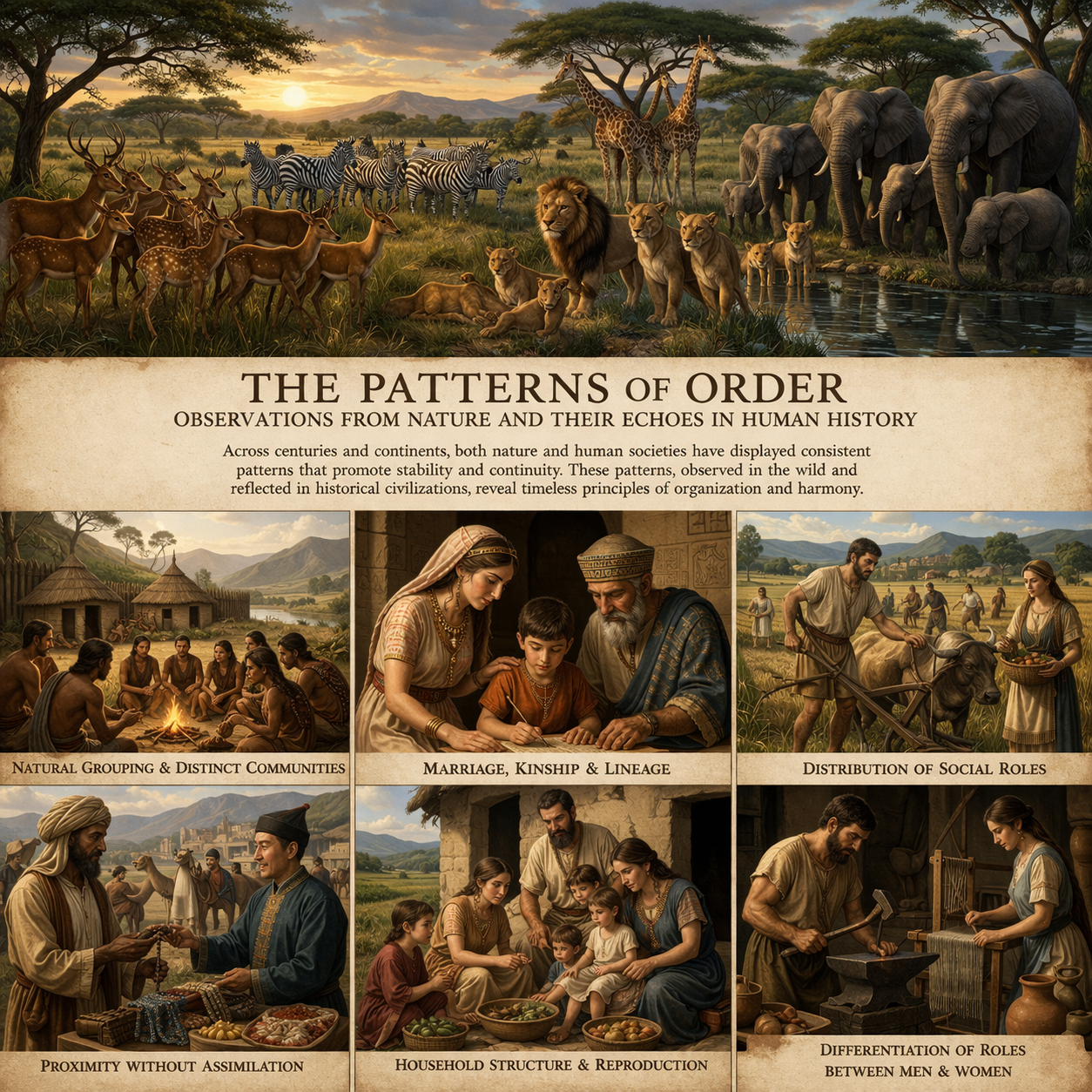
Recently, I had the opportunity to take part in a driving safari across a large open reserve with hundreds of acres populated by a wide range of animals, spanning dozens of species. Several realities stood out. Despite the diversity, there was very little conflict requiring intervention. The animals moved freely, they gathered in distinct groups, remained within recognizable boundaries, reproduced within their own kinds, and displayed consistent patterns of behavior within their species. In addition nearly every group of animals had a single male with multiple females. Even more striking, each group operated with what appeared to be clearly differentiated gender roles. These observations were playing out in real time across a living landscape right in front of me, I can only assume they don’t watch the feminist saturated media.
There are moments when observation alone reveals patterns that feel both simple and profound. A wide expanse of land, filled with dozens of species, moving freely yet there was order. It was naturally structured. The scene presented a quiet consistency: animals living in proximity without falling into disorder, coexisting without losing distinction, and reproducing within clear, recognizable boundaries. There was no forced separation, no external authority assigning roles. And yet, the order God created was self-evident, and even within this order, distinctions were evident (not only between species, but within them) where roles, behaviors, and responsibilities appeared consistently differentiated.
Such observations persist throughout human history. Long before modern frameworks attempted to redefine or reinterpret the order God established, historians, travelers, and chroniclers recorded similar patterns among human societies. Across continents and centuries, communities formed around shared identity, language, kinship, and custom. Social structures emerged that reflected both cooperation and distinction, unity within groups, and distance between them. Within these structures, patterns of lineage, household formation, and differentiated roles were consistently observed, shaping how communities sustained themselves across generations. These arrangements were not always consciously engineered, nor were they universally identical, but they displayed a remarkable consistency. When examined strictly through a historical lens, without the weight of modern interpretation or ideological application, these patterns offer a compelling window into how human societies were organized by God in ways that were both stable and enduring.
I. The Natural Formation of Distinct Communities
Across the broad sweep of recorded history, one of the most consistent features of human civilization has been the formation of distinct, self-contained communities. These communities were never arbitrarily assembled “melting pots”, nor were they typically the result of centralized planning. Rather, they emerged organically, shaped by geography, kinship ties, shared language, and common customs. Whether in the river valleys of early agrarian societies, the tribal configurations of nomadic peoples, or the city-states of the ancient world, human beings demonstrated a persistent tendency to naturally group themselves with those who were most like them.
This pattern can be observed in early Mesopotamian settlements, where populations organized around familial lineages that eventually expanded into larger kin-based groups. These groups shared not only blood ties but also religious practices, economic roles, and social expectations. Similarly, in ancient Greece, the concept of the polis was deeply rooted in shared identity. Citizenship was not merely a matter of residence but of belonging to a defined cultural and ancestral framework. Even in vast empires such as those of Persia or Rome, where multiple peoples were brought under a single political structure, local populations often retained their distinct identities, customs, and internal cohesion.
Language played a significant role in reinforcing these boundaries. Before the widespread standardization of communication, language functioned as both a unifying force within groups and a natural barrier between them. Dialects and linguistic variations often corresponded closely with geographic and familial divisions, making interaction across groups more limited and more structured. Cultural practices, including marriage customs, food preparation, dress, and rites of passage, further solidified these distinctions. These have never been superficial differences but deeply embedded aspects of daily life that reinforced a sense of belonging and continuity.
Importantly, the formation of these communities did not necessarily preclude interaction with others. Trade, diplomacy, and even conflict brought different groups into contact. However, such interactions typically occurred at the boundaries, rather than resulting in the dissolution of group identity. Communities maintained their internal structure even while engaging externally, creating a balance between cooperation and separation.
What stands out in the historical record is not only that these communities existed, but that they endured. Their stability was not dependent on constant enforcement but on shared understanding and inherited patterns. People knew where they belonged, and that belonging carried with it expectations, responsibilities, and continuity. In this way, the natural formation of distinct communities was not an anomaly, but a foundational element of human history, without which modern society would not exist.
II. Marriage, Kinship, and the Preservation of Lineage
In nearly every recorded civilization, the structure of marriage and kinship served as one of the primary mechanisms through which communities maintained continuity over time. These systems were not loosely defined arrangements, but carefully observed patterns that governed inheritance, alliance, and social stability. Far from being incidental, marriage functioned as a central pillar in the preservation of lineage, ensuring that identity (whether familial, cultural, or social) was carried forward with clarity and consistency.
In ancient Egypt, lineage was closely tied to both property and social status. Marriage within established familial or social boundaries helped preserve wealth and reinforce continuity across generations. Similarly, in early Chinese dynasties, detailed genealogical records were maintained with great care, and marriage arrangements were often structured to uphold family lines and maintain social harmony. The concept of ancestral continuity was embedded in daily life, influencing decisions that extended far beyond the individual.
Among the Indo-European societies, kinship systems were equally significant. Clans and extended families formed the backbone of social organization, and marriage within recognized boundaries ensured that these structures remained intact. While alliances between groups did occur, they were often formalized and deliberate, rather than incidental. These unions were typically arranged with clear expectations, serving to strengthen ties without dissolving the distinct identities of the groups involved. The goal was not the erasure of boundaries, but the management of relationships between them.
In many cases, marriage customs also reflected practical considerations tied to environment and survival. Agricultural societies, for example, often relied on stable family units to manage land and labor. Maintaining clear lines of descent simplified inheritance and reduced conflict. In pastoral or nomadic cultures, kinship networks provided security and mutual support, making the preservation of lineage a matter of both identity and survival. These patterns were reinforced through tradition, law, and social expectation, creating systems that were both resilient and adaptive.
It is also notable that these structures were widely understood and rarely left to chance. Elders, family heads, or community leaders often played a role in guiding or arranging marriages, not as an imposition, but as a means of maintaining order and continuity. The individual was not isolated from the broader structure, but integrated into it. Marriage was therefore not solely a personal decision, but a social function that contributed to the stability of the entire community.
Viewed historically, the emphasis on lineage and kinship reveals a consistent priority: the preservation of identity across generations. These systems, while varied in form, shared a common purpose. They provided a framework through which communities could endure, maintaining coherence without the need for constant external enforcement.
III. Social Order and the Distribution of Roles
A defining feature of historical societies across widely separated regions and eras was the presence of clearly understood social roles. These roles were never arbitrary assignments, nor were they typically the result of negotiation between the genders. Instead, they were established by God as practical responses to recurring needs within a community. From agricultural labor to governance, from craftsmanship to defense, societies functioned through a distribution of responsibilities that brought structure, order and predictability to daily life.
In ancient civilizations such as those of Mesopotamia and Egypt, occupational roles often followed family lines. A son would learn the trade of his father, whether that was farming, metalworking, or administration. This continuity ensured not only the preservation of skills, but also a level of competence that could be relied upon. Knowledge was transmitted through direct instruction and lived experience, rather than abstract “educational” systems. Over generations, this produced a stable and efficient framework in which each member of society understood both their function and their place within the broader whole.
Similarly, in classical Greece and Rome, while there was some degree of social mobility, there remained a strong expectation that individuals would fulfill roles consistent with their upbringing and training. In Rome particularly, the concept of duty (both to family and to state) was deeply ingrained. Households were structured with defined hierarchies, and public life reflected a similar order. Offices, ranks, and responsibilities were clearly delineated, allowing large and complex societies to operate with order.
In many tribal and clan-based societies, the distribution of roles was equally evident, though often less formalized in written law. Elders provided guidance and preserved tradition, warriors offered protection, and others contributed through hunting, gathering, or craftsmanship. These roles were shaped by both necessity and aptitude, but once established, they were reinforced through custom and expectation. The stability of the group depended on the reliable fulfillment of these functions, and deviation was often discouraged not through coercion alone, but through shared understanding of what was required for survival.
It is important to recognize that this distribution of roles made cooperation possible on a larger scale. By defining responsibilities, societies reduced uncertainty and conflict. Individuals were not left to determine their place in isolation, but were integrated into an existing structure that provided both purpose and direction. This allowed communities to function cohesively, even as they grew in size and complexity.
The historical record suggests that such systems, while not without minor variation, were remarkably durable. They provided a foundation upon which cultures could build, adapt, and endure. Social order, in this sense, was not imposed from above in every instance, but often arose from the accumulated practices of generations, refined through experience and necessity.
IV. Proximity Without Assimilation: Interaction Between Distinct Groups
Throughout history, human societies have rarely (if ever) existed in complete isolation. Trade routes stretched across continents, empires expanded beyond their origins, and neighboring communities interacted through commerce, diplomacy, and at times, conflict. Yet despite this constant proximity, a striking pattern emerges from the historical record: interaction did not necessarily lead to assimilation. Distinct groups often remained just that (distinct) even while living side by side or engaging regularly with one another.
In the ancient Near East, city-states and regional powers maintained active trade relationships while preserving their internal identities. Merchants, envoys, and travelers moved between cultures, exchanging goods such as grain, textiles, and metals. Alongside these exchanges came ideas, technologies, and occasionally customs. However, these influences were often adapted selectively rather than adopted wholesale. A society might incorporate a new tool or technique while retaining its own language, religious practices, and social structure. The boundary between groups remained intact, even as interaction increased.
This pattern can also be seen in the Mediterranean world, particularly during the height of the Roman Empire. Rome governed a vast and diverse population, encompassing numerous peoples with differing traditions and ways of life. While Roman law and infrastructure provided a unifying framework, local communities frequently retained their own customs, languages, and internal organization. In many regions, local governance operated alongside imperial authority, creating a layered system in which broader political unity coexisted with localized cultural continuity. The result was a structured coexistence of difference, mirroring the order God established at the foundation of the earth.
In parts of Asia, long-standing trade networks such as those connecting Central Asia, China, and the Indian subcontinent facilitated sustained interaction between distinct populations. Caravans carried goods across great distances, and trading centers became hubs of cultural exchange. Yet even in these environments, where contact was frequent and sustained, communities maintained clear internal boundaries. Shared spaces did not erase distinction; rather, they required a level of organization that allowed multiple groups to function in parallel without devolving into a single, indistinguishable whole.
It is important to note that this balance between interaction and separation was not always perfectly maintained. Periods of conquest, migration, or social upheaval could disrupt established boundaries, leading to shifts in identity and structure. However, the recurring tendency was always toward reestablishing order and identity, either through the reaffirmation of existing distinctions or the formation of new ones. Stability was often restored not by eliminating differences, but by redefining and organizing those differences that have always existed.
The historical pattern, then, is not one of constant blending, but of managed segregational coexistence. Groups interacted where necessary and beneficial, but retained a sense of internal cohesion that allowed them to persist over time. This ability to engage without fully assimilating contributed to the endurance of diverse cultures across centuries, even in the face of ongoing contact and exchange, much like the animal kingdom still practices today.
V. The Differentiation of Roles Between Men and Women
Across the historical record, one of the most consistent features of human societies has been the differentiation of roles between men and women. While the exact expressions of these roles varied by geography, environment, and culture, the presence of some form of distinction is nearly universal. These distinctions were not typically framed as abstract concepts, but as practical arrangements shaped by the needs and realities of daily life and established by our creator.
In early agrarian societies, the division of labor often reflected the physical demands of survival. Tasks requiring sustained physical exertion, such as plowing fields, constructing dwellings, or engaging in defense, were undertaken by men. Women, in turn, were more frequently associated with responsibilities centered around the household, including food preparation, textile production, and the care of children. The functioning of the household depended on both, and each contributed to the broader stability of the community in the way they were designed to.
In hunter-gatherer societies, similar patterns can be observed, though adapted to different conditions. Men often participated in hunting, which required mobility, coordination, and exposure to danger. Women frequently engaged in gathering, processing food, and maintaining the continuity of the group through child-rearing and social cohesion. These roles were shaped not only by necessity but also by efficiency. The distribution of responsibilities allowed communities to maximize productivity while ensuring that essential functions were consistently fulfilled.
Historical records from classical civilizations also reflect this differentiation. In ancient Greece and Rome, social expectations regarding the roles of men and women were clearly defined, both within the household and in public life. Men were typically associated with external affairs (governance, trade, and warfare) while women were more closely tied to the internal management of the home. These distinctions were reinforced through custom, education, and law, creating a structured environment in which responsibilities were broadly understood.
It is important to note that while these patterns were widespread, they were not without minor, occasional variation. Environmental pressures, economic conditions, and cultural developments could influence how roles were expressed temporarily. In some societies, women participated more directly in agricultural or commercial activity during tumultuous times. However, even where overlap occurred, the general tendency toward the differentiation established by God remained evident.
What stands out in the historical context is not the rigidity of these roles in every instance, but their persistence. Across time and place, societies developed frameworks that distinguished between the contributions of men and women in ways that supported continuity and serve the functions of their design. These distinctions were embedded in daily life, shaping how communities organized labor, raised families, and sustained themselves across generations.
VI. Reproductive Patterns and the Structure of Households
Across a wide range of historical societies, the structure of the household was closely tied to patterns of reproduction, inheritance, and long-term stability. While forms varied by region and era, a recurring theme appears in many parts of the historical record: households were often organized in ways that maximized continuity, consolidated resources, and ensured the effective raising of the next generation. These arrangements were not uniform across all cultures, but certain patterns appear with notable frequency, particularly in societies where land, labor, and lineage were closely connected.
In several ancient Near Eastern societies, households were structured around extended family units, sometimes including multiple generations under one authority. In these contexts, it was not uncommon for a single male household head to preside over a large domestic structure that included multiple wives, children, and dependents. These arrangements were often tied to practical considerations. Larger households could manage greater agricultural output, maintain property more effectively, and provide internal support during times of hardship. The structure allowed for both expansion and continuity, ensuring that the household remained stable even as it grew.
Similar patterns can be observed in parts of Africa and Asia, where multi-generational and,, polygynous households contributed to the resilience of communities. In agrarian settings, where labor demands were high and survival was closely linked to productivity, larger family units provided a clear advantage. Children were not only heirs but also contributors to the household economy from a young age. The presence of multiple adult members (particularly women responsible for different aspects of domestic and agricultural work) created a system in which responsibilities were distributed, and the burden did not fall on a single individual.
It is important to recognize that these household structures were governed by the established biblical norms and expectations that maintained internal order. Roles within the household were typically well-defined, reducing ambiguity and potential conflict. Authority, responsibility, and inheritance followed recognizable patterns, allowing the household to function as a stable unit over time. These arrangements were not without complexity, but they were sustained by shared understanding and long-standing custom rather than constant external enforcement.
At the same time, not all societies followed identical models. In parts of Europe, particularly in later historical periods, smaller, more centralized family units became more common. Even within these frameworks, however, the emphasis on lineage, inheritance, and continuity remained strong. The form differed, but the underlying concern (preserving the household across generations) was consistent.
What emerges from this historical overview is not a single universal structure, but a set of recurring priorities. Societies organized their households in ways that supported reproduction, stability, and the effective transmission of identity and resources. Whether through extended family systems or more compact arrangements, the goal was the same: to create a durable framework capable of sustaining both the individual and the community over time.
Conclusion
When viewed collectively, the patterns observed across historical societies reveal a consistent inclination toward the structure of order established y God, continuity, and recognizable boundaries. Communities formed around shared identity, maintained themselves through established kinship systems, distributed roles in ways that supported collective function, and interacted with others without necessarily dissolving their internal cohesion. These patterns were not identical in every context, nor were they without variation or exception, but their recurrence across time and geography shows that they were grounded in practical realities from the beginning of creation.
When we, as a people, decided we could improve on the system of order established by God, these long-standing patterns were interrupted, and the result has been gradual instability. Historical records show that societies which lost clear boundaries (whether in community identity, kinship structure, role distribution, or household organization) experienced (without exception) increasing internal friction, uncertainty in responsibility, and difficulty maintaining continuity across generations. Without widely understood structures, expectations became less defined, and the mechanisms that once guided cooperation required greater effort to sustain. Over time, this erosion has all but eliminated social function as established in God’s order, altering its character, and replacing created order with more fluid and always less predictable arrangements. In this sense, the breakdown of structure was not marked by a single moment of failure, but by a slow departure from the created order that had previously provided stability, coherence, and endurance.
so we just like animals?
This was an interesting article and is so true. When humans go against God’s design, and start believing and acting like they know better than God, it is total chaos.