Introduction
Every year Father’s Day arrives with less fanfare than Mother’s Day. There are fewer cards sold, fewer emotional commercials, and considerably fewer social media campaigns declaring fathers to be heroes. In modern culture, fathers are portrayed as optional to family life, bumbling sitcom characters who can barely operate a grill, much less lead a household. But beneath the jokes lies the reality that civilization depends upon fathers.
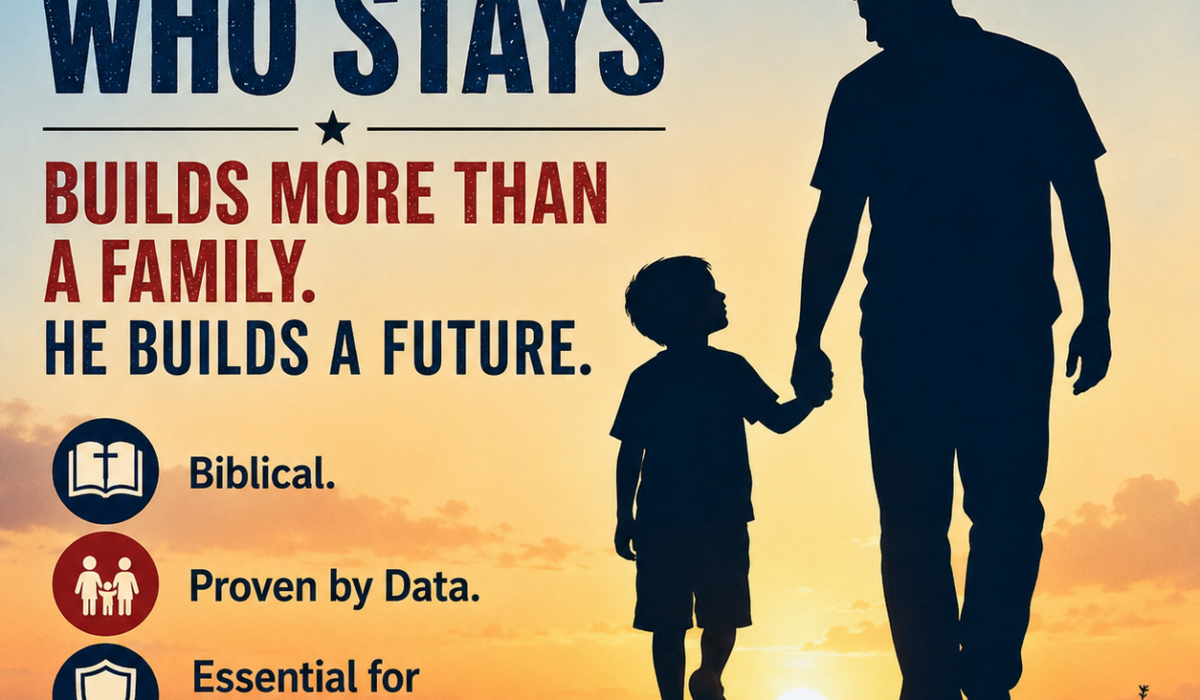
This Father’s Day, I want to honor a particular group of men. Not merely biological fathers, but fathers who stayed. Fathers who got up before sunrise, worked long hours, paid bills they did not create, fixed problems they did not cause, sacrificed dreams they never complained about, and quietly carried responsibilities that no one noticed. The fathers who changed diapers, attended ballgames, disciplined children, taught life lessons, prayed at dinner tables, and remained faithful when leaving would have been far easier. These men don’t make headlines. Yet history, Scripture, and an overwhelming mountain of social science all point to the same conclusion: when fathers stay, children thrive
I. The Most Important Man in the House
For many decades, our culture has repeated the fiction that fathers are interchangeable, optional, or unnecessary. The data has always said otherwise. The evidence is so overwhelming that it would be considered settled science if it supported ANY other social claim.
Researchers across decades have consistently found that children raised by their married biological mother and father experience substantially better outcomes across every measurable category, in nearly every measurable category the disparage is several hundred percent (or more). They are less likely to live in poverty, less likely to drop out of school, less likely to abuse drugs, less likely to engage in criminal behavior, and more likely to form stable families of their own. Sociologist Sara McLanahan summarized years of family research with a simple observation: children who grow up with only one biological parent are substantially disadvantaged compared to those raised by both parents.
The U.S. Census Bureau and numerous academic studies have shown that father absence is the strongest predictor of childhood poverty. While money is certainly part of the equation, fathers contribute something that cannot be measured by income. They provide structure, protection, discipline, accountability, identity, and stability. A father teaches a child how to navigate reality in a way that is impossible for ANY mother.
Scripture recognized this truth, Proverbs repeatedly portrays fathers as teachers, protectors, and guides. Psalm 127 describes children as arrows in the hand of a warrior, implying intentional direction. Ephesians 6:4 instructs fathers specifically to bring children up in the discipline and instruction of the Lord.
None of this diminishes the tremendous sacrifices made by many single mothers. Many women have heroically carried burdens they never intended to bear. But honoring those sacrifices should not require us to pretend that fatherlessness is harmless. If a pilot successfully lands what’s left of an airplane after losing an engine, we applaud the pilot. We do not conclude that airplanes only need one engine.
The most important man in a child’s life is the father who consistently shows up. Not because fathers are superior to mothers, but because children require both. Nature, Scripture, and common sense all agree on that point.
II. Fatherlessness: America’s Most Ignored Social Crisis
America spends billions of dollars addressing crime, poverty, addiction, educational failure, and mental health problems. Meanwhile the strongest predictor of all these outcomes is fatherlessness. Why are we not investing into understanding why fathers are not staying in the home?
According to data compiled over decades by researchers, children from father-absent homes are dramatically overrepresented in every negative social outcome. They are several orders of magnitude more likely to experience behavioral problems, incarceration, substance abuse, academic struggles, and emotional difficulties. While correlation is not causation in every individual case, the pattern is obvious.
Consider the juvenile justice system. Analyses have found that more than 85% percent of incarcerated youth come from homes without resident fathers. Similar patterns appear in studies of gang involvement, school discipline, and violent crime. Again and again, researchers “discover” the same factor appearing at the top of the list.
Why? Because fathers serve as society’s primary source of order. A good father establishes boundaries. He teaches delayed gratification. He models responsibility. He demonstrates how to control impulses. These are civilization virtues.
Historically, every successful society understood this principle. Ancient Israel emphasized paternal instruction. The Greeks valued household leadership. The Romans considered stable families essential to public order. Even cultures separated by geography, language, and religion always arrived at similar conclusions regarding the importance of fathers.
Modern entertainment mocks this reality. Television has given us a parade of incompetent fathers (from Homer Simpson to Peter Griffin) while simultaneously presenting maternal authority as unquestionable.
Contrast that with some of the most beloved father figures in popular culture. Mufasa sacrifices himself for Simba. Uncle Phil becomes a father to a boy abandoned by his own. Even Darth Vader (perhaps cinema’s most famous bad father) eventually demonstrates that redemption requires accepting paternal responsibility. Popular culture accidentally reveals what social science confirms, that people instinctively understand the importance of fathers because they feel the void when fathers are absent.
Fatherlessness is an economic issue, an educational issue, a spiritual issue, a crime issue, a mental health issue, and ultimately a cultural issue. The collapse of fatherhood reaches schools, courts, Churches, prisons, and governments alike.
III. How Modern Culture Devalued Fatherhood
One of the strangest developments of the last half-century is that fatherhood has been simultaneously praised in speeches and undermined in practice. We celebrate fathers in theory while constructing a culture that increasingly treats them as expendable.
Beginning in the latter half of the twentieth century, dramatic shifts occurred in attitudes toward marriage, divorce, sexuality, and family structure. While feminism bears great culpability, no single movement bears sole responsibility, but many cultural forces collectively contributed to weakening the expectation that fathers should remain permanently connected to their families.
The sexual revolution separated intimacy from commitment. No-fault divorce made family dissolution simple. Popular media increasingly portrayed marriage as restrictive and paternal authority as suspicious. Feminist thought explicitly challenged traditional family structures, arguing that dependence upon husbands was inherently oppressive and that motherhood should be liberated from traditional expectations.
To be clear, every feminist has advocated for fatherlessness in some fashion. It is impossible to deny that the feminist movement spent decades minimizing the importance of fathers while elevating individual autonomy above family cohesion. The results are clearly visible throughout modern society.
The irony is striking. At the exact moment social science began producing stronger evidence for the importance of fathers, popular culture intensified its criticism of traditional fatherhood. Men were told they were unnecessary, dangerous, toxic, incompetent, privileged, or obsolete. Then society expressed utter shock when men disengaged from marriage and family formation.
Human beings tend to live up (or down) to expectations. When a culture repeatedly tells men they are not needed, some eventually believe it.
Scripture offers a very different vision. Fathers are covenantal leaders accountable before God. Biblical fatherhood is neither domination nor passivity, but sacrificial responsibility. It means carrying burdens, protecting those entrusted to you, and accepting accountability for the welfare of your household.
The biblical model has endured since the beginning of time because it aligns with human nature, and reflects God’s established order. Children benefit when fathers lead with wisdom. Wives benefit when husbands embrace responsibility. Communities benefit when families remain stable.
A civilization cannot spend decades dismantling fatherhood and then wonder why social stability is crumbling. What we celebrate, we cultivate. What we mock, we will lose.
IV. Why Fathers Matter More Than We Admit
The influence of a father extends far beyond childhood. In many ways, fathers help shape how their children perceive reality.
A father is a son’s first example of manhood. Through daily observation, boys learn work ethic, courage, discipline, integrity, and self-control. They discover what responsibility looks like when it is embodied rather than explained.
For daughters, fathers play an equally significant role. Every study on the topic has shown that father involvement influences self-esteem, relationship choices, emotional security, and educational outcomes. A daughter who experiences consistent paternal affection and protection gains a valuable reference point for future relationships. She learns what respect looks like because she has seen it firsthand.
The effects extend into adulthood. Research on intergenerational family patterns demonstrates that stable families reproduce stability, while family fragmentation almost always perpetuates itself across generations. Children frequently imitate what they witnessed growing up, whether healthy or unhealthy.
This is the primary reason fatherhood carries such extraordinary weight. A father is not simply raising children; he is shaping future fathers, future mothers, future husbands, future wives, and future citizens. The impact will echo across decades.
History provides countless examples. Many great leaders, inventors, pastors, soldiers, entrepreneurs, and statesmen have credited fathers for instilling the habits that later defined their success. While talent matters, character determines whether talent flourishes or self-destructs.
The opposite is also true. A father who abandons his responsibilities creates wounds that linger for years. Some individuals overcome those wounds and build remarkable lives eventually. Their success should be celebrated. But exceptional cases do not invalidate the general truth, and we cannot construct social policy around the exceptions.
Perhaps the greatest tragedy of fatherlessness is the loss of daily presence. The missed conversations. The absent guidance. The lessons never taught. The memories never created.
No government program can replace a father’s discipline. No institution can replicate a father teaching his son how to work or his daughter how she should be treated. These moments appear ordinary in the moment but prove priceless in retrospect.
A father’s greatest gift is his presence.
V. A Standing Ovation for the Men Who Stayed
This Father’s Day, society should spend less time celebrating celebrity fathers and more time honoring ordinary men who quietly fulfilled their obligations.
The father who worked overtime to pay for braces. The father who coached little league after a ten-hour shift. The father who stayed faithful during difficult seasons. The father who attended school plays, fixed bicycles, helped with homework, and knelt beside his children in prayer. These men never receive awards, but their contribution to civilization exceeds that of any public figure.
Our culture celebrates dramatic gestures while overlooking consistent responsibility. Children rarely remember grand speeches. They remember who showed up, they remember who was there when life became difficult, and they remember who remained.
The most heroic fathers are often the least visible. They are not trending on social media, and they are not receiving standing ovations. They are simply doing what fathers have done throughout history: providing, protecting, leading, teaching, and loving.
Scripture honors such men. Proverbs praises diligence, wisdom, and faithful leadership. The Apostle Paul compared spiritual leadership to fatherhood. God frequently reveals His relationship to His people through the language of fatherhood.
Even popular culture occasionally stumbles into this truth. We cheer for characters like Mufasa, Uncle Phil, and Atticus Finch because they embody virtues we instinctively admire. We recognize courage when we see it. We recognize sacrifice when we witness it. Most importantly, we recognize the profound difference between a father who stays and a father who leaves.
The future of any nation ultimately depends fathers who embrace their responsibilities. Every stable neighborhood, successful school, thriving church, and prosperous community rests upon countless fathers who chose duty over convenience.
That choice deserves recognition. That choice deserves gratitude. That choice deserves honor.
Conclusion
This Father’s Day, let us celebrate the men who remained at their posts. Not the perfect fathers, because no such men exist. Rather, the faithful fathers. The fathers who understood that raising children is a lifelong calling. The men who carried burdens without applause, endured sacrifices without recognition, and stayed when leaving would have been far easier.
To every father who stayed: THANK YOU. The statistics say you matter. History says you matter. Scripture says you matter. Most importantly, your children know you matter. Long after the gifts are forgotten and the cards are discarded, your presence will remain one of the greatest blessings your family ever received. Civilization is built one household at a time, and strong households are built by fathers who stay.
May God’s Great Order be Restored!