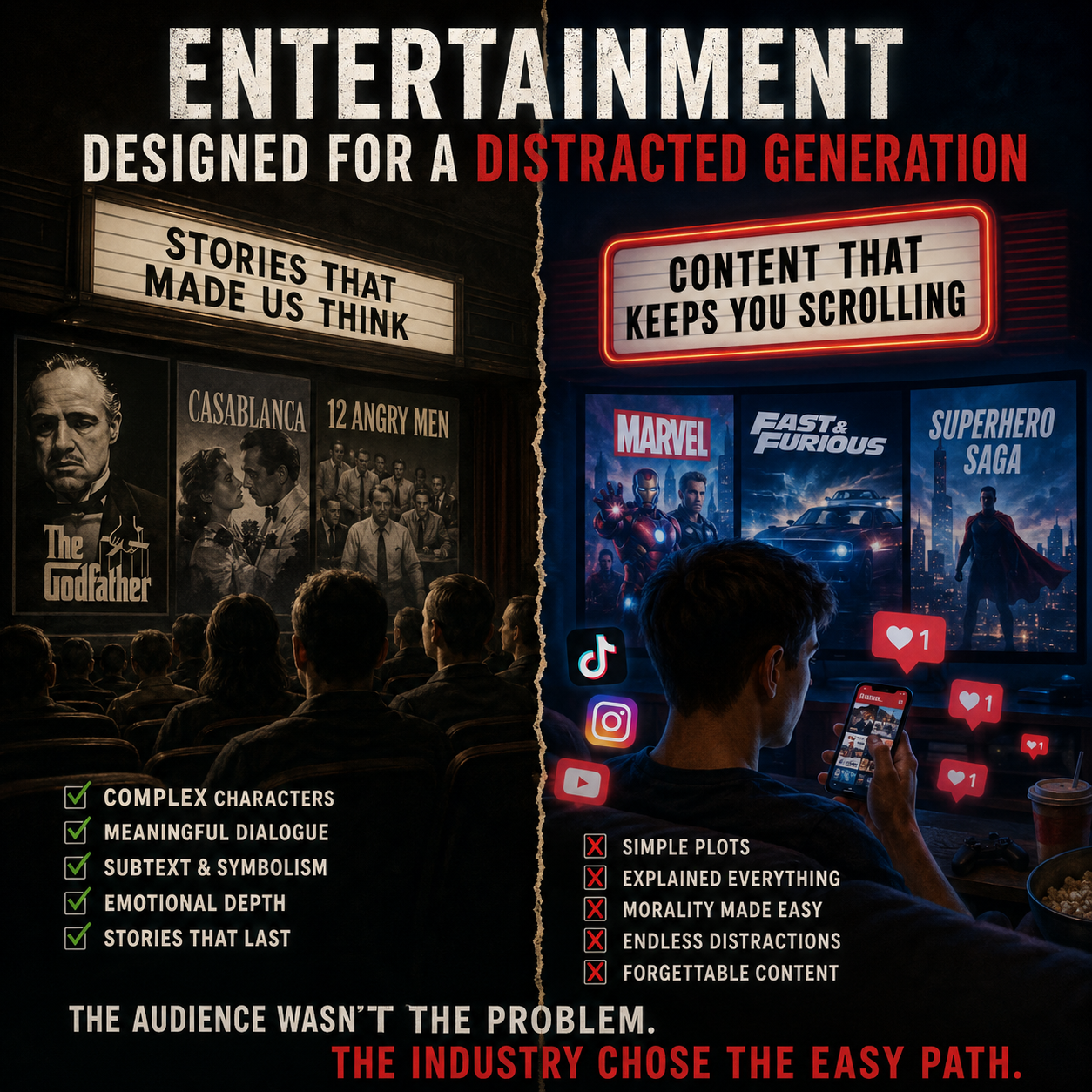
There was a time when movies expected something from the audience. They expected attention, patience, and thought. A viewer was supposed to follow the story, understand subtext, recognize symbolism, and sit with tension without needing every plot point spoon-fed back to him every ten minutes. Films like The Godfather, No Country for Old Men, Blade Runner, and There Will Be Blood trusted audiences enough to let silence speak. They allowed scenes to breathe. They assumed the viewer was intelligent and engaged enough to keep up. Modern Hollywood, by contrast, assumes the exact opposite.
Today’s mainstream entertainment industry increasingly operates under the belief that the average viewer is distracted, impatient, emotionally fragile, and intellectually lazy. Scripts are simplified, dialogue is repetitive, and characters explain their emotions instead of expressing them naturally. Entire scenes now exist purely to restate plot points because studios assume audiences are scrolling social media while watching. The result is entertainment that feels less like storytelling and more like brightly colored content slurry designed to keep half-conscious consumers barely engaged long enough to finish the episode. Even actors, directors, and producers within Hollywood have openly admitted this decline. The industry knows exactly what it is doing and the audience has been conditioned not to care.
I: Hollywood No Longer Writes for Attention Spans, It Writes Around Their Absence
One of the most revealing admissions about modern filmmaking came recently from Matt Damon. Damon explained that streaming platforms now pressure filmmakers to repeat plot information multiple times throughout a movie because executives know audiences are distracted by their phones. According to Damon, studios want films to “restate the plot three or four times in the dialogue” because viewers are only half-paying attention.
That statement exposes the current modern entertainment philosophy.
Hollywood is no longer creating stories for attentive audiences sitting in dark theaters, but creating background noise for people simultaneously scrolling Instagram, texting friends, and checking notifications. The modern script is built around constant distraction and interruption. Every few minutes the audience must be “re-anchored” because executives assume viewers mentally left the movie several scenes ago. This fundamentally changes the storytelling structure. Suspense becomes difficult to accomplish because subtlety requires memory, complex character development weakens because nuanced motivations require sustained attention, and symbolism disappears because symbolism demands interpretation instead of instant gratification.
Modern scripts increasingly resemble content optimized for distracted consumption rather than art designed for immersion. This explains why contemporary dialogue often sounds unnaturally expository. Characters constantly explain themselves, motivations are announced instead of revealed, and emotional beats are verbally repeated to ensure nobody misses the point. The audience is treated less like participants and more like exhausted consumers whose brains must be handheld through every narrative moment.
Streaming culture dramatically accelerated this problem. The rise of short-form content platforms like TikTok conditioned millions of people to consume media in fragmented bursts measured in seconds rather than scenes. Hollywood adapted downward instead of demanding better. Rather than resisting the collapsing attention spans, studios redesigned entertainment to accommodate them. Action scenes arrive earlier, dialogue is faster, cuts are quicker, and emotional scenes are shorter. Even cinematography increasingly prioritizes overstimulation over composition.
This is not accidental artistic evolution, but corporate adaptation to behavioral decline.
Writers who once trusted audiences to think now write for the “second-screen viewer”, the person watching television while simultaneously browsing another device. Modern entertainment therefore becomes dumber, louder, and more repetitive because distraction punishes complexity. The result is content that feels strangely forgettable even when technically impressive. Massive budgets now produce films that audiences barely remember six months later because nothing meaningful was ever asked of them intellectually while viewing.
Hollywood has surrendered to the reality of the shortened attention spans it has helped to create.
II: The Marvelization of Cinema and the Rise of Formulaic Storytelling
When legendary director Martin Scorsese compared Marvel films to “theme parks,” many people dismissed him as an out-of-touch elitist. Yet his criticism struck a nerve precisely because so many filmmakers privately agreed with him. Scorsese argued that modern blockbuster filmmaking lacked genuine emotional danger and psychological depth.
He was correct.
Modern franchise entertainment is increasingly engineered not around storytelling but around consumption predictability. While Marvel did not invent this formula, they certainly perfected and industrialized it. Every emotional beat, joke timing, action sequence, and character arc became mathematically optimized for mass audience retention. The films are rarely allowed to become too serious, too reflective, too uncomfortable, or too complex because broad commercial appeal demands emotional safety. The problem is corporate algorithmic storytelling.
Large studios discovered that formula reduces financial risk. Therefore, familiarity is safer than originality, predictable structures are easier to market globally, and simplified morality translates across cultures. Humor keeps scenes from becoming emotionally heavy, while constant spectacle prevents boredom. The audience receives dopamine spikes at regular intervals while never being challenged too deeply. It is the cinematic equivalent of fast food, engineered for maximum consumption with minimum resistance.
This approach eventually spread beyond superhero films into nearly every genre. Action movies became interchangeable, modern fantasy lost it’s mythic depth, and science fiction abandoned philosophical exploration in favor of quips and explosions. Even dramas increasingly feel sanitized and emotionally artificial. Every film now seems terrified of silence, ambiguity, or any discomfort.
The consequences reach beyond the artistic preference. Formulaic storytelling trains audiences to expect constant stimulation and immediate emotional payoff. Viewers become less tolerant of slow pacing, subtle themes, or unresolved tension. Studios then interpret this conditioned impatience as natural audience preference and simplify content even further. The cycle feeds itself until we are living in the movie “Idiocracy”.
Meanwhile, genuinely intelligent storytelling struggles commercially because audiences have been retrained by years of narrative spoon-feeding. A film that requires patience or reflection now risks being labeled “slow” or “boring.” Movies once praised for restraint would likely fail modern studio test screenings because audiences conditioned by hyperactive editing no longer know how to sit quietly inside a scene.
Even successful directors increasingly speak about the pressure to conform. Studios demand scripts that are easier to follow internationally, simpler to market digitally, and less likely to alienate fragmented audiences. Artistic risk becomes financially dangerous in an era dominated by billion-dollar franchises.
The irony is that many viewers feel exhausted by modern entertainment precisely because it lacks depth. The endless spectacle without substance has become emotionally numbing. Audiences consume more content than ever while remembering less of it. The movies are louder, bigger, faster, and more expensive, yet somehow much emptier.
Hollywood has optimized storytelling until it barely resembles storytelling anymore.
III: The Infantilization of Adult Audiences
Modern entertainment increasingly treats adults like oversized children. This is one of the most obvious (and least discussed) realities of contemporary media.
Dialogue has become simpler, moral complexity has diminished, and villains are cartoonishly evil or comically misunderstood. Heroes constantly explain their feelings, and humor interrupts tension every few minutes because studios fear sincerity might make audiences uncomfortable. Entire films now feel emotionally padded, as though writers are terrified viewers might experience confusion, silence, or reflection for more than thirty consecutive seconds.
Even children’s entertainment once respected audiences more than much of modern adult entertainment does today. Older animated films often contained layered themes, tragedy, philosophical tension, and emotional maturity. Modern media, however, increasingly assumes viewers cannot process complexity without being emotionally guided through every scene.
Commentators like Matt Walsh have openly criticized this trend, arguing that modern films are frequently “dumbed down” even for younger audiences. The criticism reflects a growing frustration shared across ideological lines: modern storytelling increasingly underestimates the audience. This infantilization appears in several ways.
First, scripts now over-explain everything. Characters narrate their motivations rather than allowing viewers to infer meaning through behavior. Emotional subtext has been replaced by explicit exposition. Instead of trusting audiences to interpret conflict, writers verbally summarize it.
Second, moral ambiguity has largely disappeared. Older films often allowed audiences to wrestle with uncomfortable truths or unresolved ethical dilemmas. Modern mainstream entertainment increasingly avoids ambiguity because studios fear online backlash, controversy, or audience confusion. Stories therefore become morally and emotionally sanitized.
Third, humor is weaponized against seriousness. Modern films frequently interrupt emotional scenes with jokes because executives fear audiences might disengage if the tension lasts too long. The result is emotional whiplash. Serious moments cannot sink in because the film immediately reassures viewers that nothing is truly uncomfortable or meaningful.
Fourth, visual overstimulation has replaced narrative engagement. Modern editing styles are often hyperactive because slower pacing risks losing distracted audiences. Shots are shorter, colors are brighter, and dialogue is faster. Everything has become optimized for passive stimulation rather than active thought.
This has broader cultural implications. Entertainment shapes our mental expectations. Audiences conditioned by simplified narratives eventually struggle with more demanding material. Long-form reading declines, patience weakens, and complex storytelling feels “confusing” simply because many viewers have been trained to expect constant clarification and stimulation.
Hollywood executives did not create cultural decline alone, but they absolutely adapted to it, and profited from it. Instead of elevating audiences, the industry increasingly mirrors and reinforces intellectual passivity.
The modern viewer is being entertained, he is being managed.
IV: Data Analytics Replaced Artistic Instinct
There was a time when filmmakers made movies by instinct, vision, and artistic conviction. Studios certainly cared about profits, but executives still gambled on strange ideas, unconventional pacing, morally difficult stories, and directors with strong creative identities. Today, however, entertainment is increasingly shaped by analytics, algorithms, focus groups, and engagement metrics.
Modern streaming platforms gather enormous amounts of behavioral data about viewers: when they pause, when they stop watching, which scenes retain attention, which thumbnails attract clicks, and which emotional beats generate engagement. Over time, storytelling has become reverse-engineered around consumer behavior rather than artistic expression.
This has created entertainment that feels strangely synthetic.
Characters have become less human and more archetypal because archetypes test better across demographics. Emotional beats are exaggerated because subtlety performs poorly in audience retention models. Dialogue has become repetitive because distracted viewers respond better to constant reinforcement. Open-ended storytelling has weakened because ambiguity reduces broad audience satisfaction scores.
The entertainment industry increasingly resembles the fast-food industry. Every creative decision is tested for mass consumption efficiency.
This also explains why so much modern content feels visually identical. The same color grading, the same pacing, the same sarcastic humor, and the same emotionally safe character arcs. Risk has become the enemy because data-driven entertainment punishes unpredictability.
Streaming culture has intensified this problem further because content quantity is now more important than quality longevity. Studios no longer focus primarily on creating films that endure culturally for decades. Instead, platforms prioritize an endless flow of low quality content that keeps subscribers continuously engaged. The goal is not timeless storytelling, but attention retention metrics.
This shift fundamentally changes the artistic incentives. A slow-burning masterpiece that people discuss for thirty years is less valuable to streaming corporations than ten disposable series that generate short-term engagement spikes. As a result, writers increasingly produce content optimized for immediate binge consumption rather than lasting cultural significance.
Even actors and filmmakers have acknowledged this transformation publicly. Matt Damon’s comments about plot repetition reveal an industry no longer pretending otherwise. Studios openly tailor scripts around distracted viewing behavior because engagement metrics matter more than narrative integrity.
The audience, meanwhile, becomes conditioned by the very system designed around its weaknesses. Constant algorithmic optimization creates entertainment that feels immediately consumable but emotionally hollow. Viewers finish entire seasons only to forget them within a week because the content was engineered for the retention of attention, not resonance.
This is why older films often remain culturally alive decades later while many modern blockbusters vanish instantly from public memory. Older filmmakers sought meaning, tension, and emotional truth, while modern studios often seek engagement velocity.
One creates art, the other creates content.
V: Audiences Are Starving for Depth Whether They Realize It or Not
Despite everything, there remains overwhelming evidence that audiences still crave meaningful storytelling. Whenever a film dares to respect viewers intellectually and emotionally, people respond with surprising enthusiasm. The success of slower, more thoughtful productions consistently proves that audiences have not entirely lost their appetite for depth, they have simply been underserved for years.
Films like Oppenheimer, Dune, and even television series like Breaking Bad or True Detective succeeded because they treated audiences like adults capable of attention, interpretation, and emotional patience. These projects resisted the modern obsession with constant overstimulation and narrative simplification. They demanded engagement rather than passive consumption.
Many people are exhausted by disposable entertainment even if they cannot fully articulate why.
Modern viewers often describe contemporary movies as “forgettable” in discussions surrounding modern entertainment. The issue is not only declining quality in a technical sense. Many modern productions feature incredible visual effects, strong acting, and enormous budgets. Yet they leave almost no emotional or intellectual imprint because they were never designed to challenge, disturb, or linger in the mind.
Great storytelling requires friction. It requires tension, ambiguity, silence, consequence, and emotional vulnerability. Modern entertainment frequently avoids these things because they are harder to optimize for mass distracted audiences.
Ironically, the very technologies that fragmented attention also created a counter-reaction. Many viewers increasingly seek long-form podcasts, deep-dive video essays, classic films, physical books, and slower storytelling experiences because they instinctively recognize how shallow most modern content feels. The human mind still hungers for meaning even when culture conditions it toward distraction.
This explains why older films continue attracting younger audiences decades later. Great storytelling transcends generations because truth, conflict, sacrifice, fear, longing, and moral struggles never become obsolete. Meanwhile, highly optimized algorithmic entertainment often ages immediately because it was built around temporary engagement trends rather than the universal human experience.
Even within Hollywood, many creatives privately express frustration with the current system. Directors repeatedly criticize studio interference, formulaic writing requirements, and the dominance of franchise-driven storytelling. The problem is not that talented writers disappeared, the problem is that corporate entertainment increasingly suppresses risk in favor of predictable consumption patterns.
Audiences feel the difference whether consciously or subconsciously. A truly great film leaves people unsettled, reflective, emotionally moved, or morally challenged. Much of modern entertainment simply fills time. It distracts, stimulates, and occupies attention without nourishing thought.
That is the real tragedy. Cinema once aimed to reveal something about humanity. Now much of it simply aims to survive the next distracted scroll.
Conclusion
Modern movies and television did not become shallow on accident. They were systematically reshaped around distracted viewing habits, collapsing attention spans, algorithmic analytics, and corporate risk aversion. Hollywood increasingly writes for audiences assumed to be multitasking, emotionally fragile, and intellectually impatient. Scripts are simplified not because writers lack talent, but because executives believe complexity harms engagement. The industry openly admits this now. When Matt Damon reveals that platforms want plots repeated for viewers distracted on their phones, he is describing an entertainment culture that surrendered to distraction instead of resisting it.
Yet the continued success of thoughtful, emotionally serious storytelling proves something important: not all audiences are not incapable of depth. Some are simply starving for it. Human beings still crave meaning, tension, beauty, mystery, and emotional truth. The problem is that modern entertainment increasingly treats viewers like overstimulated consumers rather than thinking adults. Cinema was once an art form that challenged audiences to rise higher. Today, much of Hollywood lowers itself to meet the shortest attention span in the room.
It is tiresome to be watching a show and have the whole thing figured out within 5 minutes