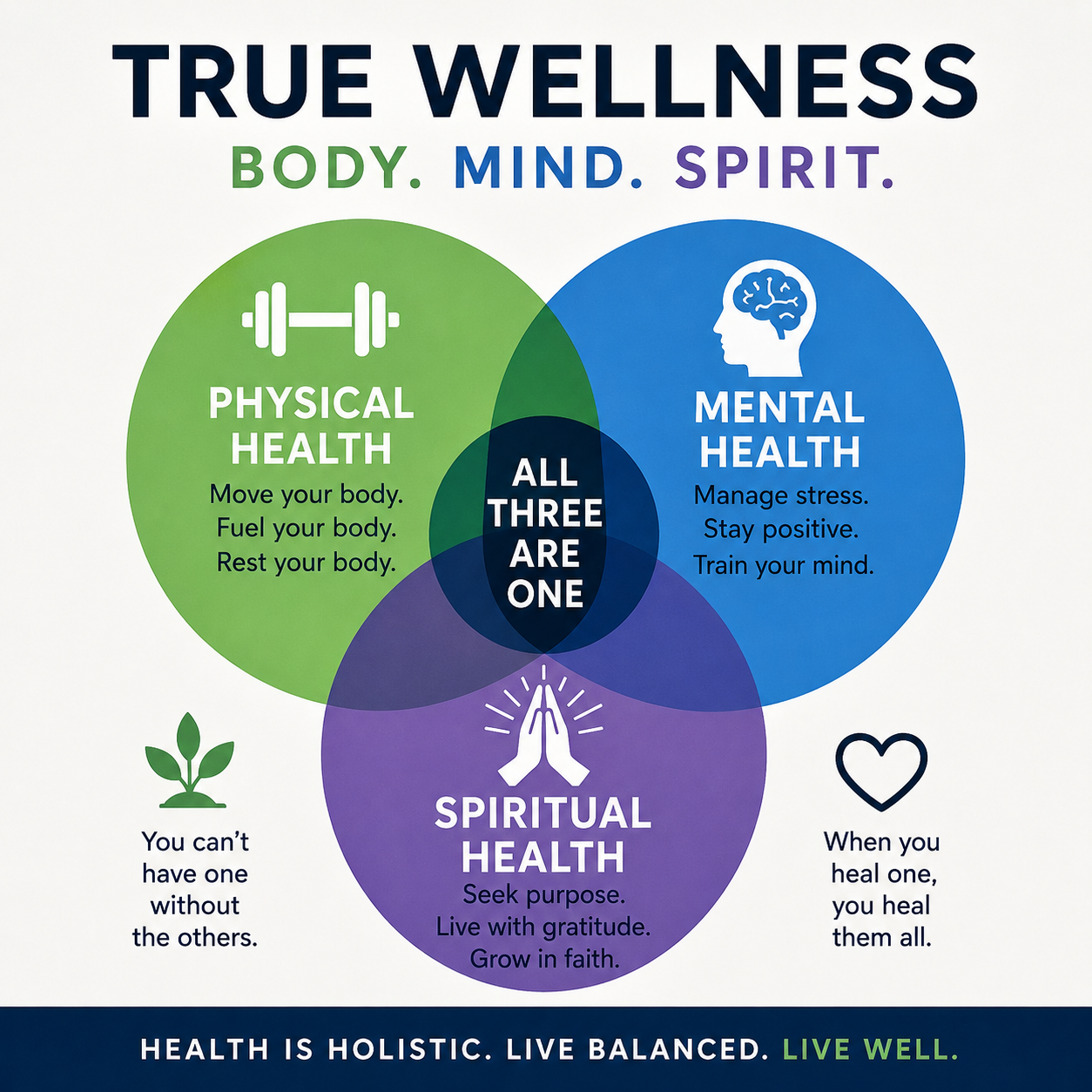
Introduction:
Modern society has mastered the art of compartmentalization. We isolate the body from the mind, the mind from the soul, and the soul from the body, as though man were three separate creatures stitched together by accident. We treat obesity with pills while ignoring despair. We medicate anxiety while feeding people processed poison. We preach spiritual peace to exhausted, inflamed, sleep-deprived bodies running on sugar, caffeine, and fast food. Then we wonder why so many people are miserable, weak, distracted, depressed, addicted, exhausted, and spiritually numb. The truth is simple (and far more uncomfortable): human beings were designed as integrated creatures. Physical health, mental health, and spiritual health are inseparably linked, and damage to one inevitably affects the others.
A man who abuses his body will eventually cloud his mind and weaken his spirit. A man consumed by bitterness, anxiety, laziness, lust, or despair will eventually destroy his physical health. Likewise, spiritual decay often manifests itself physically through gluttony, sloth, addiction, and lack of discipline. Scripture repeatedly reflects this reality. Proverbs 14:30 states, “A tranquil heart gives life to the flesh, but envy makes the bones rot.” Romans 12:1 commands believers to present their bodies as “a living sacrifice.” Even Elijah, in 1 Kings 19, was first given sleep, food, and rest before God addressed him spiritually. The body matters because man is not a floating consciousness trapped in flesh; he is body, mind, and spirit functioning together. Most people would live radically different lives if they restored their physical health, and many would discover that the path to mental clarity and spiritual strength begins with basic obedience, self control and discipline in how they treat their own bodies.
I: The Body Is Not Separate from the Mind
For decades, modern culture treated has physical health and mental health as unrelated categories. One doctor handled the body while another handled the brain, as though the two had no meaningful interaction. Yet mounting scientific evidence continues to obliterate that theory. Researchers at the Harvard T.H. Chan School of Public Health found that regular exercise significantly reduces symptoms of depression and anxiety while improving mood, memory, and cognitive function. One major study published in JAMA Psychiatry concluded that even modest exercise reduced depression risk by up to 56%. The implications here are staggering: millions of people are trying to medicate problems that movement itself will alleviate (even if it is partially at first)..
The human body was designed for labor, motion, sunlight, challenge, and exertion. Instead, we sit in climate-controlled rooms staring at glowing rectangles for ten hours a day while consuming ultra-processed food engineered for addiction. Then we are shocked when we feel mentally foggy, emotionally unstable, and spiritually drained. Poor nutrition directly impacts neurotransmitter production, hormonal regulation, sleep quality, inflammation, and cognitive performance. Diets high in sugar and processed oils are associated with increased rates of depression and anxiety (as high as 300%), while nutrient-dense diets rich in protein, vegetables, healthy fats, and micronutrients consistently correlate with improved mental well-being.
Obesity often creates a vicious cycle. Excess body fat contributes to chronic inflammation, insulin resistance, hormonal imbalance, fatigue, sleep apnea, low testosterone, and poor self-image. Those physical consequences then fuel emotional instability, insecurity, social withdrawal, and hopelessness. The mind suffers because the body is suffering. Proverbs 23:2 warns, “Put a knife to your throat if you are given to appetite.” Scripture consistently portrays lack of self-control as destructive, not just physically but morally and spiritually.
Many people spend years trying to “find themselves” psychologically while ignoring the obvious reality that their body is collapsing underneath them. They seek therapy while sleeping four hours a night, eating fast food daily, consuming excessive alcohol, and rarely (if ever) exercising. That is like trying to tune a violin while it is being thrown down a staircase. The mind cannot function optimally in a diseased body.
This does not mean every mental illness can be solved by exercise or diet. Serious psychological conditions exist and deserve compassion and treatment. But modern culture has drastically underestimated how profoundly physical neglect damages emotional and mental stability. Often the first step toward clearer thinking, emotional resilience, confidence, peace, and motivation is brutally simple: sleep properly, walk daily, lift heavy things, eat real food, lose excess weight, and stop poisoning yourself. The body and mind are not enemies, they are allies created to function together as a whole.
II: Gluttony, Sloth, and the Spiritual Consequences of Physical Neglect
Modern culture treats gluttony exclusively as a cosmetic problem. People speak of obesity in terms of attractiveness, confidence, or social acceptance while rarely addressing the deeper spiritual implications. Yet Scripture repeatedly frames overindulgence and laziness as moral and spiritual failures connected to self-control, discipline, stewardship, and obedience. Philippians 3:19 describes this with the devastating phrase: “their god is their belly.” That is a warning about appetites ruling the human soul.
The issue is not simply weight. There are overweight people fighting valiantly toward health and thin people living in absolute physical rebellion. The deeper issue is dominion. Who is in control? The spirit governing the flesh, or the flesh governing the man? Modern consumer culture relentlessly trains people toward impulsiveness: eat immediately, indulge constantly, avoid discomfort, escape stress, seek pleasure, and eliminate effort wherever possible. Entire industries profit from addiction, convenience, sedation, and distraction. Processed food companies engineer products specifically to override satiety signals and maximize consumption. Meanwhile, endless entertainment conditions people to remain passive, distracted, lazy, and undisciplined.
This matters spiritually because discipline in one area strengthens discipline in others. A man incapable of controlling his appetite will often struggle to control his anger, lust, spending, speech, laziness, or emotions. Conversely, learning self-control physically produces spiritual clarity and confidence. Paul wrote in 1 Corinthians 9:27, “I discipline my body and keep it under control.” The apostle understood that bodily discipline was preparation for spiritual endurance.
Physical neglect also affects spiritual perception. Chronic exhaustion, poor sleep, nutritional deficiencies, hormonal imbalance, and inactivity frequently produce apathy and emotional numbness. Many people feel spiritually dead while living physically destructive lives. They stay awake until 2 a.m., demand endless stimulation, neglect exercise, eat garbage, and then wonder why prayer feels difficult and concentration is impossible. The body they inhabit is in constant physiological distress.
Even ancient Christian traditions recognized the connection between physical discipline and spiritual clarity through fasting, labor, moderation, and self-denial. The purpose was never punishment for the body but mastery over appetites. Modern society has largely reversed this principle. Today the highest virtue is often comfort, while discomfort is treated as cruelty. Yet nearly every meaningful human achievement (physically, mentally, financially, or spiritually) requires voluntary discomfort.
The tragedy is that many people have accepted weakness as normal. They assume constant fatigue, brain fog, inflammation, emotional instability, and dependency are simply part of modern life. They are not. In most cases, people are spiritually struggling in part because they are physically collapsing. Restoring order to the body often restores order elsewhere. Discipline builds momentum, strength creates confidence, and movement sharpens the mind. Physical stewardship is not and has never been separate from spiritual stewardship.
III: Exercise, Strength, and the Restoration of Human Purpose
Human beings were built to move. The body is not simply transportation for the brain, but a living system designed for action, labor, challenge, and endurance. Our modern life has engineered movement almost entirely out of existence. Food arrives at the door, work happens in chairs, entertainment streams endlessly, and entire days pass without any meaningful physical exertion. The result is catastrophic. According to the World Health Organization, physical inactivity contributes to 50% of deaths globally every year and significantly increases the risk of heart disease, diabetes, obesity, stroke, depression, and certain cancers.
But the consequences extend far beyond disease statistics. Physical weakness changes how people think, feel, behave, and live. Exercise is not about aesthetics, it profoundly affects confidence, discipline, emotional resilience, hormonal balance, stress tolerance, productivity, and mental clarity. Studies consistently show that resistance training and cardiovascular exercise improve mood, cognitive performance, sleep quality, energy levels, and self-esteem. Exercise also reduces chronic inflammation, which researchers increasingly associate with depression and neurological decline.
Strength carries psychological and spiritual significance. Weakness breeds fear and dependency. Strength creates capability, stability, and confidence. Scripture repeatedly uses physical imagery to describe spiritual readiness: running races, fighting battles, enduring hardship, standing firm, wearing armor. Even Jesus spent much of His earthly life as a laborer before beginning His ministry. The Bible never romanticizes laziness or passivity. Proverbs consistently praises diligence and warns against sloth.
There is also something deeply transformative about voluntary hardship. Modern people are drowning in comfort yet starving for purpose. Exercise introduces controlled adversity back into life. It teaches endurance, delayed gratification, consistency, pain tolerance, and discipline. A man who learns to push through physical discomfort becomes more resilient emotionally and spiritually. He begins to realize he is capable of more than he believed.
Many people underestimate how radically physical restoration can alter the trajectory of life. Weight loss will improve testosterone levels, fertility, blood pressure, sleep, mobility, mood, confidence, and longevity. Exercise will reverse insulin resistance, reduce anxiety, improve posture, sharpen concentration, and increase productivity. A healthier body will improve your marriage, parenting, work performance, and spiritual engagement simultaneously.
The modern world frequently frames health as vanity or obsession, but stewardship is not vanity. Caring for the body is not narcissism when done properly. The body affects every conversation, every thought, every relationship, every emotion, and every spiritual practice. A physically broken man often struggles to fulfill his responsibilities because exhaustion and disease consume his energy.
People often pray for motivation while continuing lifestyles that physiologically destroy motivation. They ask for peace while living in perpetual overstimulation. They seek clarity while poisoning their bodies. Transformation begins with simple obedience: move your body, eat real food, rest properly, and embrace discipline instead of comfort. The body was designed for more than survival. It was designed for strength, service, and purpose.
IV: Food, Addiction, and the Decline of Modern Health
Modern food culture is the greatest public health disaster in human history. Most of what fills grocery store shelves today barely resembles food in any historical sense. Highly processed products packed with refined sugar, industrial seed oils, preservatives, artificial additives, and engineered flavor combinations dominate the modern diet. These substances are specifically designed to maximize cravings and override natural satiety mechanisms. The average person is not simply “overeating”; they are consuming products scientifically formulated to make moderation as difficult as possible..
The consequences are visible everywhere. According to the CDC, obesity rates in the United States exceed 48% among adults, while rates of Type 2 diabetes, PCOS, fatty liver disease, hypertension, sleep apnea, metabolic syndrome, and cardiovascular disease are at record highs and continue to rise. Even children increasingly suffer from diseases once associated almost exclusively with old age. And many people still view nutrition through the lens of appearance rather than survival, function, and mental clarity.
What people eat profoundly affects how they think and feel. Blood sugar instability contributes to mood swings, fatigue, irritability, and mental fog. Nutritional deficiencies impact neurotransmitter production and hormonal balance. Chronic inflammation caused by poor diet affects the brain. Researchers have increasingly linked ultra-processed food consumption with depression, anxiety, cognitive decline, and addictive eating behaviors. In many ways, modern people are trying to build stable lives on unstable foundations.
Food addiction also reveals deeper spiritual realities. Consumption has become emotional coping. People eat not because they are hungry but because they are lonely, anxious, bored, angry, exhausted, or spiritually empty. Entire industries encourage this behavior with slogans built around indulgence, escape, and reward. Instead of confronting pain, many medicate themselves with comfort food, sugar, alcohol, caffeine, or constant snacking.
Scripture repeatedly warns about enslaving appetites. Titus 2 emphasizes self-control as a foundational virtue. Proverbs 25:28 states, “A man without self-control is like a city broken into and left without walls.” When appetites dominate a person, every other area of life becomes vulnerable as well. Addiction never remains isolated. The same lack of restraint that governs food spills into spending, entertainment, lust, laziness, and emotional instability.
The encouraging reality, however, is that the body responds remarkably well to restoration. Many people experience dramatic improvements within months of changing their habits. Weight loss, improved nutrition, exercise, hydration, sunlight exposure, and proper sleep always produce enormous changes in energy, mood, confidence, inflammation, productivity, and mental clarity. Some people spend years believing they are broken psychologically when in reality they are severely unhealthy physically.
This does not mean nutrition alone solves every problem. But modern culture dramatically underestimates how many emotional, relational, and spiritual struggles are intensified by chronic physical dysfunction. The body cannot be neglected indefinitely without consequences. When we restore physical order through discipline and stewardship, we discover that many other areas of life begin healing as well.
V: Restoration Begins with Stewardship, Not Perfection
One of the greatest lies preventing people from pursuing health is the belief that transformation requires perfection. Many individuals become overwhelmed because they imagine they must instantly become elite athletes, nutrition experts, or fitness influencers. When they inevitably fail to maintain impossible standards, they quit. But restoration does not have to be dramatic. It begins with stewardship, small acts of consistent obedience repeated over a long time.
The human body is astonishingly resilient. Even years of neglect and abuse can be mostly reversed through disciplined habits. Walking daily, reducing processed foods, increasing protein intake, sleeping consistently, strength training, drinking water, getting sunlight, and losing excess weight will radically change a person’s life trajectory. Studies consistently show that even modest weight loss dramatically improves cardiovascular health, blood sugar control, hormone balance, mobility, and quality of life. Small improvements compound very quickly when they are consistent..
The psychological effects are equally significant. Physical discipline creates momentum. Every healthy choice reinforces the belief that change is possible. Confidence grows because action replaces helplessness. Energy increases, mood stabilizes, and self-respect begins returning. Many people trapped in cycles of anxiety, shame, or hopelessness are lacking self control, and that has led to them being physically exhausted, inflamed, undernourished, overstimulated, and chronically sedentary.
Spiritual restoration often follows similar patterns. Scripture repeatedly emphasizes faithfulness in ordinary things. Discipline matters because habits shape our character. Galatians 6:7 reminds readers that “whatever one sows, that will he also reap.” This principle applies physically as much as spiritually. Bodies respond to patterns, minds respond to patterns, and souls respond to patterns.
Most importantly, stewardship is not vanity. Modern culture swings between two extremes: obsessive narcissism on one side and complete neglect on the other. But caring for one’s health is about maintaining the tool through which every responsibility in life is carried out. Parents need energy, workers need endurance, husbands and wives need strength and vitality. Ministries require stamina, service requires capability, and none of these are possible if we do not take care of our bodies.
People often wait for emotional inspiration before changing their lives. But action precedes motivation, not the other way around. A person may not feel motivated to exercise, but consistent movement eventually improves mood and energy enough to create momentum. Likewise, someone may not feel spiritually strong at first, but discipline will create conditions where clarity and stability can grow.
The modern world constantly promises quick fixes, shortcuts, pills, and effortless transformation. Real restoration is much slower, but it is also more durable. Health is built through ordinary decisions repeated daily over years and decades. The encouraging reality is that most people do not need extreme measures to radically improve their lives. They need consistency, discipline, stewardship, and the humility to admit that body, mind, and spirit were never meant to be separated.
Conclusion
The modern world has attempted to fragment human beings into disconnected categories (physical, mental, emotional, and spiritual) as though each could thrive independently from the others. But reality continually proves otherwise. The body influences the mind, the mind influences the spirit, and the spirit influences the body. A man drowning in gluttony, exhaustion, addiction, inactivity, and physical neglect will struggle mentally and spiritually as well. Likewise, a disciplined, nourished, active body frequently creates the foundation for clearer thinking, emotional resilience, confidence, and deeper spiritual stability. This is how human beings were designed by God.
Most people would live radically different lives if they restored their physical health alone. Marriages would improve. Energy would increase. Depression and anxiety would lessen for many. Confidence would return. Productivity would rise. Spiritual focus would sharpen. Children would have healthier parents. Communities would become stronger. The path toward transformation is often less mysterious than people imagine. Eat real food. Move your body. Sleep properly. Embrace discipline. Reject endless comfort and indulgence. Steward the body that God gave you. Physical health will not solve every problem in life, but without it, many people are fighting uphill battles they were never meant to fight. True wellness requires the restoration of body, mind, and spirit together, because they were never designed to function apart.
This article is frustrating because it mixes legitimate health advice with religion and then acts like they’re inseparable. Yes, exercise helps mental health. Yes, nutrition matters. That’s backed by decades of research. But then you leap straight to “spiritual health” as though everyone who doesn’t share your beliefs is somehow fundamentally unhealthy. That’s a massive unsupported assumption. Millions of atheists, agnostics, Buddhists, Jews, Muslims, and countless others live meaningful, healthy lives without accepting your bible
The world is complicated. Mental illness isn’t always caused by poor choices, and spiritual belief isn’t some magic ingredient that suddenly fixes biology.
The comments attacking this article are proving its point. We’ve become so conditioned to believe every problem has to fit into one tiny specialty that the idea of treating a human being as…well…a human being sounds controversial.
Body? “See a trainer.”Mind? “See a therapist.”Spirit? “Keep that private.”Then people have depression, obesity, addiction, loneliness, and chronic diseases that keep getting worse despite spending more money than ever on healthcare.
Maybe we’ve been asking the wrong questions all along. We’re not machines made of interchangeable parts; we’re actually integrated beings exactly like Scripture teaches. A radical idea in 2026.
Finally someone says what should be obvious. We’ve built entire industries around treating symptoms while ignoring the person as a whole. This isn’t just common sense, it’s biblical.
This is exactly why people don’t take Christian writers seriously. You start with a conclusion from the Bible and then work backward trying to force reality to fit it. That’s not how science works.
What an unbelievably simplistic worldview. Not everyone believes in your religion, and pretending spiritual health is some universal requirement is incredibly arrogant. Keep your theology out of our scientific medicine.
As someone who struggled with anxiety for years, I noticed things started improving after I addressed all areas together. Better nutrition, exercise, and getting serious about my faith made a bigger difference than any single solution ever this article really resonated with me.
This is one of the best articles I’ve read on health in a long time. Society wants to treat the body, mind, and soul like they’re three separate machines, but they’re clearly connected. You can’t poison your body and expect your mind to thrive, and you can’t ignore your spiritual life without it affecting everything else. Excellent read.
ROFL, health advise from a FAT guy
I wasted ten minutes reading this garbage. Stop overcomplicating simple health advice with spiritual crap.
Typical new age nonsense. People trying to sound smart but really just stating the obvious. Physical health and spirituality are unrelated for most people.
Who wrote this? It’s just full of vague feelgood shit. Physical, mental, and spiritual health are not magically connected; this is misleading lies.
I’ve shared this with my friends and family. It’s rare to find an article that’s both scientifically grounded and spiritually insightful.
This is just another pseudo-spiritual article trying to sell wellness nonsense. There’s zero scientific proof connecting these ‘three areas’ like you claim.
This is a must read for anyone struggling with burnout. Your point about the trinity of health is eye-opening and makes complete sense.
i needed this. thank you