Introduction: The Difference Between Modern Claims and Natural Reality
Modern society spends enormous amounts of time telling men and women what they are supposed to want from a “relationship” (marriage). We are told that men and women are essentially interchangeable, that relationships are little more than negotiated business partnerships between equal autonomous individuals, and that traditional expectations are relics of a primitive past. Women are told they crave independence above all else. Men are told emotional vulnerability and passive accommodation are the highest virtues. Entire industries (from entertainment to academia to social media) exist to reinforce the idea that marriage is primarily about self-fulfillment and emotional validation.
And yet, despite all the slogans, the reality underneath has not changed nearly as much as modern culture pretends it has. Beneath the layers of ideology, men and women still tend to desire the same things they always have. Women overwhelmingly gravitate toward men who provide security, leadership, stability, and protection. Men overwhelmingly desire respect, peace, loyalty, and admiration from women. The language may change. The social packaging may change. But human nature has remained remarkably consistent across history, biology, scripture, and culture. The modern crisis in marriage is caused by people being taught to deny what they naturally and inherently desire in the first place.
I. The Great Modern Lie: Society Tells Men and Women to Want the Wrong Things
One of the greatest failures of modern relationship culture is that it encourages men and women to suppress their natural relational instincts in favor of ideological expectations that sound enlightened but often produce misery. Women are told from childhood that dependence is weakness, submission is oppression, homemaking is beneath them, and needing male leadership is shameful. Simultaneously, men are told that strength is “toxic,” authority is dangerous, masculinity must be softened, and male leadership should be replaced with emotional appeasement. Yet when researchers actually study attraction, mate selection, marriage satisfaction, and long-term pair bonding, the results repeatedly contradict all of modern social messaging.
Study after study consistently shows that women overwhelmingly prefer competent, confident, capable men who demonstrate leadership traits, ambition, decisiveness, and the ability to provide security. Cross-cultural research by evolutionary psychologist David Buss found that women across dozens of cultures consistently rank resource acquisition, stability, protection, and competence among the most desirable traits in men. Men, meanwhile, consistently prioritize traits associated with loyalty, fertility, peace, kindness, and sexual faithfulness. These patterns persist across geography, politics, and modern ideological shifts because they are deeply rooted in biology and survival strategy rather than temporary social fashions.
Historically, marriage was not viewed primarily as a vehicle for emotional self-discovery. It has always been understood as a structure of order, stability, inheritance, child-rearing, protection, and continuity. Scripture reflects this, in Ephesians 5, the husband is instructed to sacrificially lead and provide while the wife is instructed to respect and submit to her husband. In Genesis, Adam is created first, tasked with dominion and responsibility before Eve is brought to him as a helper suitable for him. The biblical structure assumes differentiated roles because men and women are not identical creatures.
Ironically, even many people who verbally reject traditional roles often still pursue them subconsciously. Women who claim they do not want leadership still become frustrated with indecisive men. Men who publicly claim they want “independent modern women” often privately long for peace, admiration, and feminine warmth rather than competition. Society tells people to desire abstraction and autonomy, but human beings naturally gravitate toward order, polarity, stability, and complementary roles. The conflict between what people are told they should want and what they naturally do want lies at the heart of modern marital dysfunction.
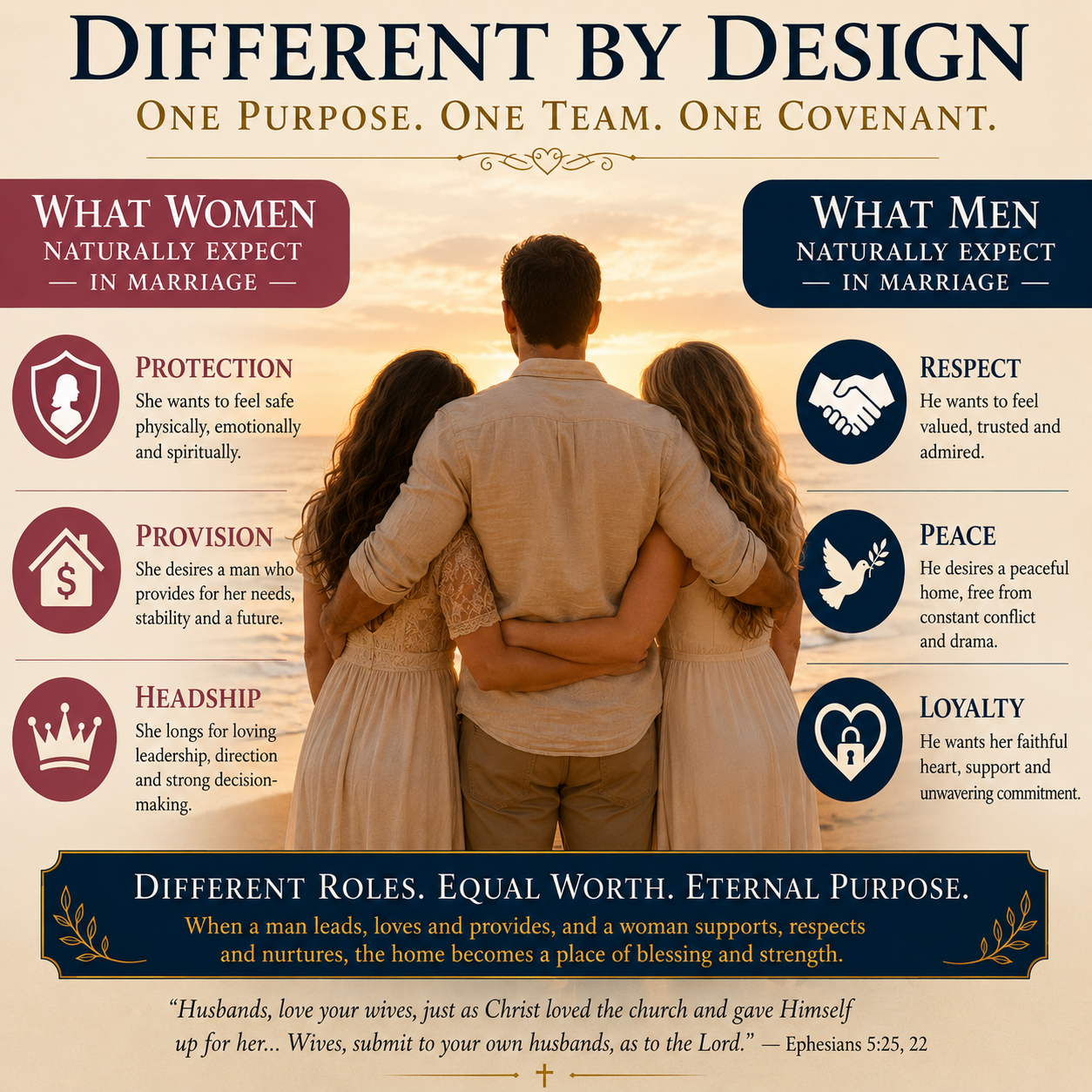
II. What Women Actually Expect: Protection, Provision, and Headship
Despite decades of modern messaging insisting that women primarily desire independence, career status, and total autonomy, the overwhelming weight of history, biology, psychology, and observable human behavior suggests otherwise. At the deepest level, most women naturally expect three core things from a man in marriage: protection, provision, and headship. These expectations are rooted in the fundamental realities of human survival, reproduction, and social order that shaped humanity for thousands of years long before modern ideology emerged.
Protection is perhaps the most ancient expectation women place upon men. Men are physically larger, stronger, and naturally more aggressive on average across every known society. Modern research consistently confirms significant physical dimorphism between the sexes, particularly in upper body strength, bone density, reaction to threat, and aggression thresholds. Historically, women faced immense physical vulnerability during pregnancy, childbirth, and child-rearing. A woman carrying or nursing children could not easily defend herself against predators, hostile tribes, criminals, famine, or violent men. As a result, women naturally gravitated toward men who could provide security and stability. Even today, studies repeatedly show women are attracted to men who display competence, confidence, decisiveness, and protective instincts. Women may verbally claim they do not “need” protection or “need a man”, yet many still instinctively desire men who make them feel physically, emotionally, financially, and socially safe.
Provision is closely tied to protection. Across nearly every civilization in recorded history, men were expected to labor, build, defend, produce, and provide resources for the household. This pattern appears universally because reproduction places asymmetrical burdens on women. Pregnancy, nursing, and early child development naturally reduce female mobility and economic flexibility, especially historically (before “daddy government” was there to “help”). Research from evolutionary psychology consistently demonstrates that women place higher importance than men on earning potential, ambition, competence, and resource stability in a mate. This does not necessarily mean women are “gold diggers,” as critics often claim. Rather, women naturally seek signs that a man is capable of sustaining and stabilizing a household during hardship.
Headship, however, is the most controversial expectation because modern culture openly rebels against it while secretly craving it. Most women do not actually desire perpetual responsibility for leadership, direction, and final decision-making within the relationship. Numerous studies on attraction show women generally prefer men who exhibit calm confidence, initiative, and leadership capability. Scripture reflects this order. 1 Corinthians 11 describes man as the head of woman just as Christ is the head of the church. Ephesians 5 commands husbands to lovingly lead while wives are instructed to respect and submit. Biblical headship was never intended to be tyranny. Proper headship is sacrificial responsibility. It is the burden of accountability, leadership, provision, and protection carried by the man for the good of the household. When exercised properly, it creates the very stability, security, and peace most women naturally desire.
III. What Men Actually Expect: Respect, Peace, and Loyalty
While modern culture often portrays men as emotionally simplistic or driven purely by physical desire, the reality is far more complex and far more consistent across history. At the deepest level, most men naturally expect three primary things from marriage: respect, peace, and loyalty. Although they will almost certainly stay with any mate who has genuine respect for them. These expectations are deeply connected to male psychology, biology, responsibility, and the burdens men have historically carried within civilization. A man’s relationship is not merely about romance or companionship. For men, marriage is meant to be the place where his labor, sacrifice, leadership, and protection are honored rather than contested.
Respect is the central pillar. For men, respect is experienced more deeply than affection or any other emotion. A man wants to feel trusted, valued, admired, and acknowledged for what he provides and builds. This includes respect for his judgment, his labor, his authority, his sacrifices, and the responsibilities he carries. Historically, men built homes, defended property, worked dangerous jobs, created businesses, established infrastructure, fought wars, and carried the immense burden of provisioning households and societies. In return, the primary expectations placed upon wives was stewardship and care over what the man provided. A respectful wife historically maintained the home, cared for the children, protected the household order, managed resources wisely, and honored the labor that produced those provisions. Proverbs 31 describes this kind of woman: industrious, trustworthy, resourceful, and protective over her household. Respect was not merely polite words, but active stewardship over the man’s household, property, children, business interests, reputation, and legacy.
Peace is the second major expectation men naturally bring into marriage. Throughout history, men have often endured competition, danger, conflict, stress, physical labor, and social pressure outside the home. As a result, men naturally long for the home to function as a refuge rather than another battlefield. Scripture repeatedly associates a contentious woman with misery and instability. Proverbs famously states that it is better to dwell on a rooftop than in a house with a quarrelsome wife. Men generally desire emotional stability, cooperation, encouragement, and calmness within the relationship. This does not mean men expect perfection or silence. Rather, most men deeply value a woman who brings warmth, support, softness, and order rather than criticism, emotional volatility, or conflict.
Loyalty forms the third pillar because men are profoundly sensitive to betrayal, disrespect, and divided allegiance. Historically, a man’s household, inheritance, and legacy depended heavily upon certainty of loyalty and fidelity. Men naturally want to know that their wife stands with them rather than against them. This includes sexual faithfulness, public support, emotional loyalty, and commitment during hardship. Men often experience disloyalty not merely as emotional pain, but as personal humiliation and existential betrayal. Even modern psychological studies consistently show that men report 750% stronger distress over sexual infidelity while women more commonly report 300% stronger distress over “emotional abandonment”. A loyal wife provides a man with stability, confidence, and motivation because she becomes a trusted ally in building and protecting the household together.
IV. Why These Expectations Exist: Biology, Survival, and Human Nature
One significant mistake modern society makes is assuming that male and female expectations in marriage are strictly social inventions. While culture certainly shapes behavior, the foundational desires men and women bring into relationships are deeply rooted in biology, survival strategy, reproductive realities, and Biblical truth. Men and women are not merely taught to value different things; they are, in many ways, naturally predisposed toward different priorities because they face fundamentally different tasks, risks, burdens, and incentives in life and reproduction.
From a biological standpoint, reproduction has always been far more physically costly for women than for men. Pregnancy, childbirth, nursing, and early child-rearing place enormous physical demands on the female body. Historically, these realities created natural incentives for women to seek men who could provide safety, stability, protection, and resources. Evolutionary psychologists have repeatedly documented that women tend to prioritize traits associated with competence, status, leadership, ambition, and provision when selecting long-term mates. This pattern appears consistently across cultures, socioeconomic classes, religions, and political systems. Women are not merely “conditioned” to desire capable men. They are responding to deeply rooted survival instincts connected to long-term security for themselves and their offspring.
Men, on the other hand, historically faced different pressures. A man’s reproductive success depended heavily upon certainty of paternity, household stability, cooperation from his wife, and confidence that his labor and sacrifices were benefiting his own family rather than another man’s offspring or divided loyalties. As a result, men naturally developed strong desires for loyalty, sexual faithfulness, respect, peace, and domestic stability. Studies consistently show that men experience higher levels of distress regarding sexual betrayal, while women tend to react more strongly to instability. These responses are not arbitrary social constructs. They reflect differing evolutionary vulnerabilities and survival concerns.
Even modern neuroscience reflects important distinctions between male and female behavior patterns. Men generally display stronger orientation toward hierarchy, competition, territoriality, and status achievement, while women tend to demonstrate higher relational sensitivity, emotional perception, and social attunement. These differences are not absolute, nor do they make one sex superior to the other. Rather, they reveal complementary strengths that historically allowed stable households and civilizations to function effectively.
Scripture mirrors these realities remarkably well and was written thousands of years before modern science. In Genesis, Adam is tasked with labor, dominion, protection, and responsibility before Eve is created as a helper suitable to him. In 1 Timothy 5:8, men are warned that a man who refuses to provide for his household has denied the faith. Likewise, wives are repeatedly instructed toward submission, respect, faithfulness, industriousness, and care for the home. Biblical marriage reflects the natural complementariness built into male and female nature because it was written by the creator.
Modern society often attempts to erase these distinctions in pursuit of absolute sameness between men and women. Yet the more society attempts to deny human nature, the more confusion, resentment, loneliness, and relational instability increase. Human beings function best when reality is acknowledged rather than denied.
V. The Collapse of Modern Marriage: What Happens When Natural Order Is Rejected
The modern marriage crisis did not emerge because people “fell out of love” or because traditional structures became outdated. Much of the collapse can be traced directly to the systematic rejection of the natural expectations men and women have historically brought into marriage. Modern culture has spent decades teaching women to distrust male leadership while simultaneously teaching men to suppress masculinity, avoid authority, and apologize for strength. The result has been widespread confusion, resentment, instability, and dissatisfaction on both sides.
Women have been told that dependence upon a man is degrading, homemaking is oppression, motherhood is a burden to escape, and submission is inherently abusive. Yet despite these messages, countless women still find themselves deeply dissatisfied with passive, indecisive, emotionally fragile men who refuse to lead. Research consistently shows that women continue to prefer men who are confident, competent, ambitious, and capable of leadership, even while publicly supporting egalitarian ideals. Many modern women verbally reject headship while privately desiring the safety, decisiveness, and stability that healthy masculine leadership provides. This contradiction creates tension because many women have been conditioned to feel guilty for wanting what they naturally desire.
Men face a parallel confusion. They are often told that masculinity is dangerous (even “toxic”), that leadership is oppressive, and that traditional expectations of respect or feminine cooperation are selfish. Many men consequently retreat into passivity, emotional withdrawal, adolescence, pornography, isolation, or avoidance of marriage altogether. Yet most men still deeply long for peace, admiration, loyalty, affection, and a stable household. When relationships become constant arenas of competition, criticism, emotional chaos, or divided loyalties, many men simply disengage emotionally because the relationship no longer provides the peace or respect they naturally seek.
The data surrounding modern marriage reflects this breakdown. Marriage rates across much of the Western world continue to decline while divorce rates remain high. Anxiety, depression, loneliness, and relational dissatisfaction have risen dramatically despite unprecedented personal freedom and technological convenience. Children raised in fractured or unstable homes statistically face greater risks of poverty, behavioral problems, emotional instability, addiction, criminality, and educational failure. Entire societies begin to destabilize when the family structure weakens because marriage is one of the foundational building blocks of civilization.
Scripture repeatedly warns that rejecting God’s created order leads to confusion and destruction. In Romans 1, humanity’s rebellion against created design results in disorder, inversion, and societal decay. Likewise, the wisdom literature of Proverbs repeatedly contrasts ordered households with chaos, strife, rebellion, and ruin. Human beings may attempt to redefine marriage, but reality eventually reasserts itself. Men and women continue to function best when masculinity and femininity operate cooperatively rather than competitively. Stable marriages are not built by denying natural differences, but by understanding and properly ordering them.
Conclusion:
Marriage was never designed to be a battleground between competing identities, nor was it intended to function as a negotiated contract between two entirely interchangeable individuals. Throughout history, across cultures, and even within modern scientific research, the same broad patterns continue to emerge with remarkable consistency. Women naturally desire protection, provision, and capable headship from men. Men naturally desire respect, peace, and loyalty from women. These desires are not arbitrary social inventions or outdated relics of a primitive age. They are deeply tied to biology, survival, human psychology, and the created order itself. Modern society may attempt to shame these instincts, redefine them, or suppress them entirely, but human nature has proven far more durable than ideology.
The tragedy of modern relationships is that many people are being taught to pursue the exact opposite of what actually produces stability, fulfillment, and long-term relational success. Women are encouraged to resist dependence while quietly longing for security and leadership. Men are encouraged to abandon authority while silently craving respect and peace. The result is confusion, resentment, loneliness, and relational instability on a massive scale. Scripture, history, and observable human behavior all point toward the same conclusion: men and women flourish not when they compete against one another, but when they embrace their complementary strengths and responsibilities within an ordered household. Healthy marriage does not erase differences between the sexes. It properly aligns them toward unity, stability, family, and the building of something greater than either individual alone.
This is one of the most one-sided takes on marriage I have ever read. It paints men as rational and women as irrational, which completely ignores the complexity of real relationships. If your goal was to start a debate, congratulations, but this isn’t serious analysis.
This article puts into words something I’ve noticed for years but never knew how to say. Men and women often enter marriage with very different assumptions and that just creates resentment. Whether people agree with all of this or not, it’s refreshing to see someone tackle this instead of hiding behind clichés.
Women demand everything from men while not giving any respect, then they wonder why men won’t commit.
Love and respect should be mutual in marriage.