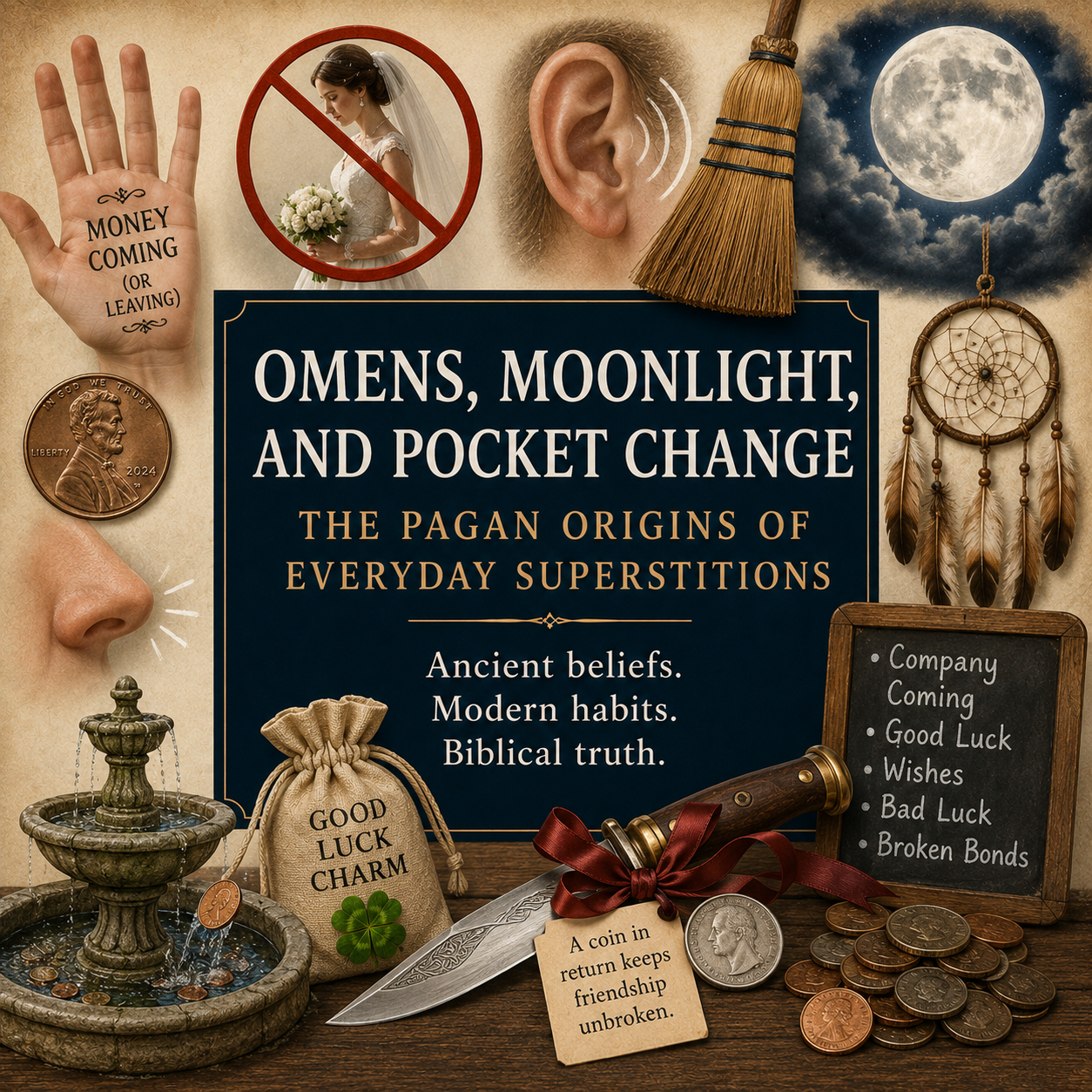
Ancient Fears, Modern Folklore
When a superstition has survived for centuries, most people have forgotten why they practice it. The ritual remains, but the reasoning is non-existent. A penny is picked up. A coin is tossed into a fountain. Someone scratches an itchy palm and wonders if money is coming. A knife is exchanged with a coin to preserve a friendship. Few (if any) participants can explain where these customs originated, but billions continue blindly performing them with little thought beyond “that’s just what people do.”
This is the final irony of superstition. The ancient world built elaborate religious systems around omens, charms, signs, spirits, and magical forces. While many contemporary people reject those religious systems they continue to preserve their rituals. The gods have vanished, the temples have crumbled, the myths are forgotten, and, yet the practices linger like ghosts of paganism hiding in plain sight. In this final installment, we examine ten more enduring superstitions and trace their origins, meanings, and survival into the modern world. As before, the biblical question is simple: does this custom encourage trust in God, or does it reflect humanity’s age-old desire to seek certainty, protection, and blessing apart from Him?
I. An Itchy Palm Means Money Is Coming
Widely recognized as the belief that an itchy palm signals incoming wealth. Depending upon the region, an itching right palm means money is coming, while an itching left palm means money is leaving, or vice versa. The details vary.
Its origins lie in ancient European and Romani folklore, where bodily sensations were interpreted as omens. Before modern medicine explained many physical conditions, people frequently assigned supernatural significance to ordinary experiences. A twitching eye, ringing ear, or itching hand could all be interpreted as messages about future events.
The palm became associated with money because it is the part of the body used to receive and exchange goods. Through sympathetic thinking, the sensation came to symbolize financial activity. If the hand itched, wealth must surely be on its way.
Over time the superstition spread throughout Europe and eventually into North America. Like many folk beliefs, it survived because occasional coincidences reinforced it. A man scratches his palm and later receives an unexpected payment. He remembers the one random hit and forgets the thousands of misses.
Scripture never encourages believers to interpret sensations as divine messages. Financial provision comes from God. Proverbs teaches diligence, stewardship, and wisdom. A thorough search of scripture unsurprisingly did not reveal an references to dermatological fortune-telling.
II. Seeing a Bride Before the Wedding Brings Bad Luck
Modern wedding traditions are filled with customs that participants follow without understanding. Among the most enduring is the belief that the groom should not see the bride before the ceremony.
Contrary to popular assumption, this custom has little to do with romance. Its roots lie in arranged marriages common in medieval Europe. Families negotiated marriages for economic, political, or social reasons. The bride and groom might barely know one another, or may have never met before the wedding day.
The concern was practical. If the groom saw the bride beforehand and found her less attractive than expected, he might attempt to cancel the arrangement. To prevent such disruptions, traditions developed that kept the couple apart until the ceremony was complete. Over time practical considerations merged with superstitious explanations. What began as risk management became “bad luck.”
As generations passed, the original purpose was lost. Modern couples who have dated for years, taken engagement photos together, and shared vacation memories still somehow act as though catching a glimpse of one another before the ceremony might anger the universe.
Scripture offers no support for the notion. Marriage is a covenant before God. The success of a marriage rests upon faithfulness, character, commitment, and obedience to God, and most certainly has nothing to do with whether the groom accidentally saw the bride ten minutes early.
The superstition survives because tradition outlives reason.
III. A Ringing in the Ears Means Someone Is Talking About You
Long before smartphones, social media, and group text messages, people still wanted to know what others were saying about them. The solution was simple: if your ears suddenly rang, someone must be talking about you.
The belief can be traced to ancient Greek and Roman traditions. Classical writers recorded folklore suggesting that unexplained sensations provided clues about unseen events. Ringing ears became associated with distant conversations, gossip, praise, or criticism. Some traditions even claimed the affected ear indicated whether the comments were favorable or unfavorable.
The logic reflected a common pagan worldview in which invisible forces constantly communicated through signs and omens. Nothing happened randomly. Every unusual sensation carried hidden meaning waiting to be deciphered.
As medical knowledge expanded, more reasonable explanations emerged. Ringing ears (known medically as tinnitus) can result from hearing damage, circulation issues, illness, aging, or countless other natural causes.
The appeal is obvious. People are naturally curious about what others think of them. The idea that the body might provide secret intelligence about distant conversations is both comforting and entertaining.
Scripture of course warns against obsession with gossip and speculation. Ecclesiastes 7:21–22 wisely advises believers not to concern themselves with every word spoken by others. Most people spend far less time discussing us than we imagine.
A ringing ear, more often than not, is simply biology reminding us that we are not as mysterious as we would like to believe.
IV. Sweeping Over Someone’s Feet Prevents Them from Marrying
Among the more unusual and bizarre superstitions still found in parts of the American South, the Caribbean, Africa, and Latin America is the belief that sweeping a broom across someone’s feet will prevent them from marrying. In some versions, the victim is destined to remain single forever unless a complicated counter-ritual is performed.
The superstition originated in various African folk traditions (VooDoo) that assigned spiritual significance to personal contact and household tools. In many cultures, the broom was regarded as a symbolic object associated with domestic authority, purification, and even magical protection.
The feet, meanwhile, held special significance in folk magic because they were believed to maintain a connection with a person’s destiny, life path, or future relationships. Sweeping across them supposedly disrupted that path, creating obstacles to marriage or family life.
As these traditions blended through migration and cultural exchange, the superstition evolved into the familiar warning idiotically repeated by parents and grandparents. Few people today could explain the reasoning, but still react with alarm when a broom brushes their shoes.
Scripture never attributes supernatural power to cleaning tools. Marriage depends upon God’s providence, personal choices, character, and circumstance. The notion that a stray broomstroke can alter someone’s romantic future belongs squarely in the realm of psychotic magical thinking.
Still, the superstition persists because it transforms an ordinary event into something dramatic. After all, “Please pick up your feet while I’m sweeping” lacks the same memorable impact as threatening lifelong bachelorhood.
V. Seeing a Penny and Picking It Up Brings Good Luck
“See a penny, pick it up; all day long you’ll have good luck.”
Few superstitions have been condensed into a more effective advertising slogan for themselves. Generations of children have eagerly retrieved pennies from sidewalks, parking lots, and grocery store floors under the assumption that fortune accompanies it.
The origins of the belief stretch back to ancient cultures that viewed metal as possessing protective qualities. Because metal was rare, valuable, and difficult to produce, it was associated with divine favor and protection against evil spirits. Finding a coin unexpectedly was interpreted as evidence that supernatural forces were watching over the finder.
Later European traditions reinforced the belief. Coins bearing the image of a ruler or symbolic figures were considered especially fortunate because they represented authority, prosperity, and blessing. Discovering one unexpectedly became an omen of future success.
The superstition evolved easily into modern society. The association between found money and good fortune remained. The fact that the average penny buys approximately nothing today has done little to diminish its mystical reputation.
Scripture certainly encourages gratitude for God’s provision, but it never teaches that blessing arrives through randomly discarded currency. Finding a penny may be pleasant. It may even save you from being one cent short at the self-checkout. It does not alter providence.
The true miracle is that anyone still bothers to bend over for a penny in an age when many people refuse to stop for a twenty-dollar bill unless it can be tapped with a smartphone.
VI. If Your Nose Itches, Company Is Coming
Another enduring folk belief claims that an itchy nose signals the imminent arrival of visitors. Depending upon the region, the expected company may be a friend, a stranger, or an unwelcome guest. Either way, the nose apparently possesses remarkable forecasting abilities.
The superstition emerged from the ancient tendency to interpret bodily sensations as omens. Before scientific explanations were available, people frequently believed the body functioned as a communication system for hidden forces. An itching hand meant money. A ringing ear meant gossip. An itching nose meant visitors.
The logic behind the specific connection is difficult to reconstruct because folklore often evolves without consistency. Some traditions linked the nose to social interaction because it occupies the center of the face and serves as a prominent feature during personal encounters. Others simply inherited the belief without explanation.
Regardless of its exact origin, the superstition spread widely throughout Europe and eventually into North America. Like many omens, it survived because occasional coincidences seemed to confirm it. If a guest arrived shortly after one’s nose began itching, the prediction was remembered. The countless failures were quietly forgotten.
Scripture never encourages believers to seek hidden messages in bodily irritation. If God wishes to communicate, He is fully capable of doing so without relying upon histamines and seasonal allergies. Most itchy noses result from dust, pollen, dry air, or irritation. While guests occasionally arrive afterward, the connection is chronological rather than supernatural.
The nose performs many important functions. Predicting visitors is not among them. For perspective the average person touches their nose 70-120 times per day.
VII. Throwing Coins into a Fountain Ensures a Wish Comes True
Few tourist attractions are more profitable than a fountain attached to a wish-granting legend. Every year millions of sheeple toss coins into pools, fountains, wells, and waterways while silently hoping their desires will somehow be fulfilled.
The practice dates back to ancient pagan religions that viewed springs, wells, and bodies of water as sacred locations inhabited by spirits, gods, or divine beings. Water represented life, fertility, cleansing, and mystery. Offerings were frequently deposited into these locations to secure favor from supernatural powers.
The Romans routinely cast coins into sacred springs. Celtic peoples offered jewelry and valuables to water deities. Similar customs appeared throughout Europe and the Near East. The underlying assumption was gifts presented to spiritual forces would produce desired outcomes.
As pagan religions disappeared, many of the sacred sites remained. The rituals persisted even after the gods associated with them were forgotten. Modern fountains inherited ancient religious functions while losing most of their theological explanations.
The result is the world’s most successful example of institutionalized spare-change collection.
Scripture repeatedly condemns attempts to purchase favor from spiritual powers. God is not bribed. Wishes are not granted because copper and nickel encounter chlorinated water.
The fountain superstition survives because it combines hope with action. People feel better after doing something, even when the action has no rational connection to the desired outcome. Ancient paganism called it an offering. Modern tourism calls it a tradition. The water remains largely unimpressed.
VIII. Sleeping with a Dream Catcher Protects Against Bad Dreams
Unlike many superstitions discussed in this series, the dream catcher originates from a specific indigenous tradition rather than a broad collection of folk beliefs. Among the Ojibwe people, dream catchers were handcrafted objects intended to filter spiritual influences during sleep.
According to traditional belief, beneficial dreams passed through the web while harmful dreams became trapped and dissolved with the morning sunlight. The object functioned as a form of spiritual protection rooted in a broader worldview involving spirits, dreams, and unseen influences.
As dream catchers entered mainstream culture during the twentieth century, they were increasingly detached from their cultural context. Today they are sold as decorative items, children’s room decorations, or general symbols of positive energy.
The progression illustrates a familiar pattern. Spiritual significance fades while symbolic value remains. Many who hang dream catchers today know little about their origins yet still associate them with protection, peace, and favorable dreams.
The Bible acknowledges that dreams occur, but it never teaches that objects possess the ability to regulate spiritual experiences during sleep. Protection comes from God, not from decorative webs suspended above a bed.
“I will both lie down in peace, and sleep; for You alone, O LORD, make me dwell in safety.” –Psalm 4:8
A dream catcher may reflect cultural artistry. But assigning supernatural protective power to it moves beyond appreciation and into superstition.
The object itself catches no dreams. At most, it catches dust.
IX. Strange Behavior During a Full Moon
No other superstition enjoys as much modern acceptance as the belief that people behave differently during a full moon. Emergency room workers report hearing it. Police officers hear it. Teachers hear it. Almost everyone knows someone convinced that human behavior becomes noticeably stranger whenever the moon is full.
The belief is ancient. The word “lunatic” derives from the Latin word luna, meaning moon. Greeks, Romans, and numerous other cultures believed lunar cycles directly influenced human emotions, mental health, and behavior. Because the moon visibly affected tides, many assumed it must also affect the human body.
Over time, stories accumulated. Crimes supposedly increased. Madness intensified. Sleep became difficult. Tempers flared. Werewolves transformed. Entire mythologies developed around lunar influence.
The problem is that repeated scientific studies have failed to find any evidence supporting most of these claims. While lunar light may have minor effects on sleep patterns under certain conditions, the dramatic behavioral changes described in folklore remain largely unsupported. Crime, emergency response, and healthcare data also do not support these claims.
Yet the superstition persists because unusual events are memorable. When something strange happens during a full moon, people notice. When nothing unusual occurs, nobody mentions it.
Scripture never attributes human morality, sanity, or behavior to lunar phases. The moon serves God’s purposes as part of creation, but it does not affect human conduct.
X. Never Gift a Knife Without Receiving a Coin in Return
Among the more charming superstitions still practiced in many cultures is the belief that a gifted knife will sever a friendship unless the recipient provides a coin in exchange. The coin transforms the gift into a purchase and supposedly prevents the relationship from being “cut.”
The custom appears throughout Europe, Scandinavia, Britain, and North America. Its roots combine symbolic thinking with older folk beliefs concerning sharp objects. Knives, swords, and blades carried spiritual significance because of their association with conflict, separation, and danger.
The symbolic connection was obvious. If a blade cuts physical objects, perhaps it can also cut emotional bonds. To prevent this outcome, a token payment converted the exchange into a transaction rather than a gift.
The superstition persisted because it provided a simple solution to an imagined problem. Many families continue the practice today, treating it as harmless tradition rather than genuine belief.
Compared with some of the superstitions examined in this series, this one is relatively benign. Nevertheless, it still reflects the broader assumption that symbolic rituals possess power over us.
Scripture teaches that friendships are maintained through loyalty, honesty, forgiveness, and love, not through financial loopholes. A friendship will not survive because someone paid a penny for a hunting knife. Nor will it fail because they forgot.
Relationships are strengthened by character.
Conclusion
Throughout this series, one truth has emerged: superstitions rarely arise from nowhere. They are the surviving fragments of older worldviews, remnants of ancient attempts to explain uncertainty, secure blessings, avoid misfortune, and manipulate fate. Whether through coins, charms, bodily sensations, celestial events, household objects, or symbolic rituals, humanity has always sought ways to gain control over a future that belongs to God.
Scripture offers a radically different perspective. The believer does not trust omens, signs, lucky objects, wishes, or rituals. He trusts the sovereign Lord who governs all things according to His wisdom and purpose. “Trust in the LORD forever, for in Yah, the LORD, is everlasting strength” (Isaiah 26:4). The ancient pagans looked for answers in itching palms, ringing ears, moonlit skies, and fountain waters. The Christian looks to God.
Series Complete
Part I: Luck,Omens and Folly
Part II: Signs, Wishes & Lucky Charms
Part III: Omens, Moonlight & Pocket Change