Introduction
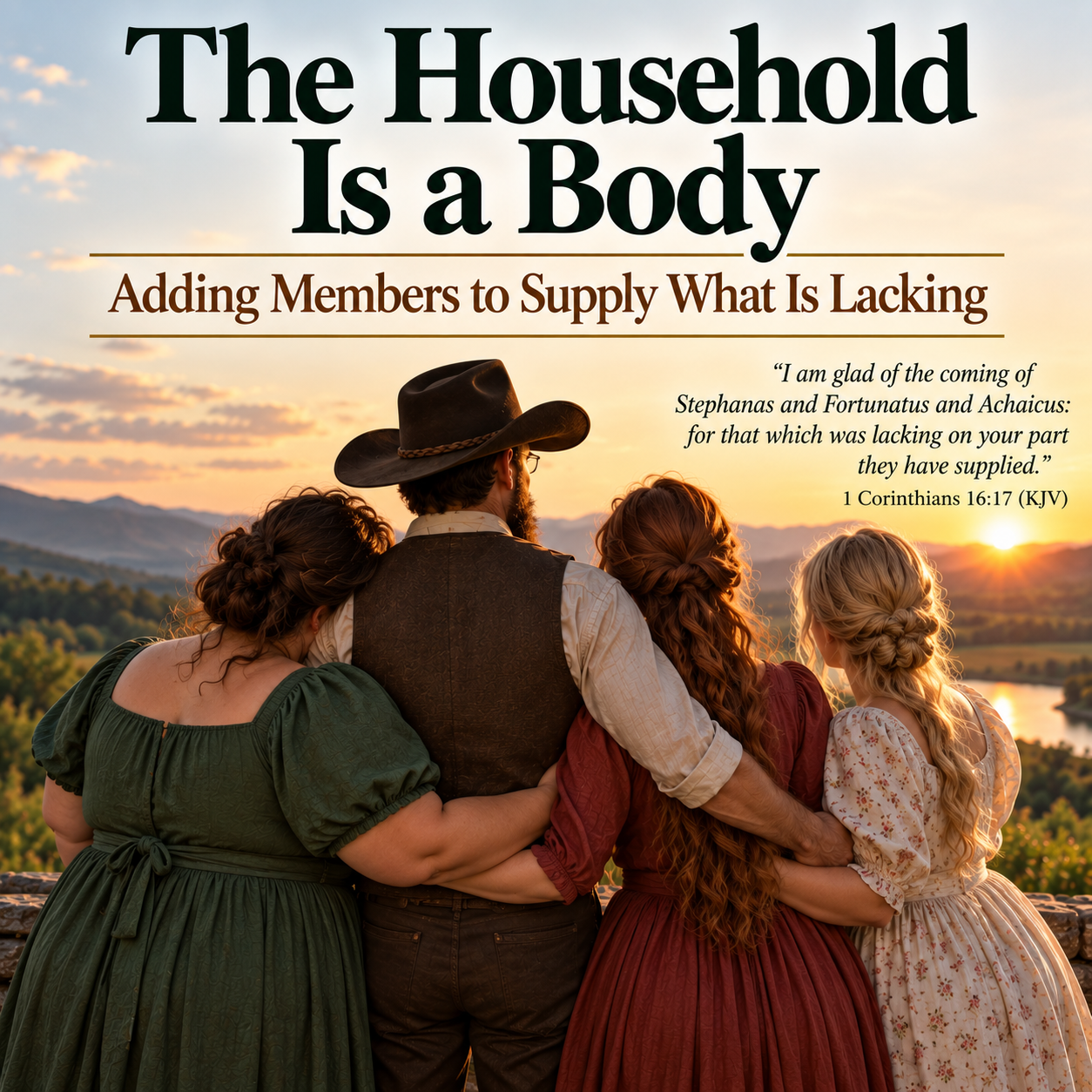
Plural marriage is usually discussed as though the question were numerical: How many wives may a man have? What a remarkably shallow question. Scripture never treats a household as a collection of interchangeable human units, and it certainly does not present additional responsibility as though God were handing out trophies for masculine achievement. A household is an organism of government, production, nurture, worship, education, hospitality, inheritance, and generational continuity. The more useful question, therefore, is not only whether another wife may be added, but what does her addition supply to the household that was previously lacking? What is the purpose? Paul provides a useful principle when he rejoices at the arrival of Stephanas, Fortunatus, and Achaicus: “for that which was lacking on your part they have supplied” (1 Corinthians 16:17, KJV). Paul was not discussing marriage, of course, but the principle is applicable: wise government recognizes deficiency and welcomes capable people who supply it.
That principle is even clearer when placed beside Paul’s theology of differing gifts. “Having then gifts differing according to the grace that is given to us,” he writes in Romans 12:6. Likewise, the body has many members, each performing a different function (1 Corinthians 12:12–27). Applied carefully by analogy to the household, the implication is straightforward. Human beings are all different. One woman may possess extraordinary patience with children; another may have exceptional administrative ability. One may thrive in hospitality and food production, another in education, medicine, business, accounting, agriculture, or artistic work. A plural household that merely multiplies identical capacities while ignoring its deficiencies has misunderstood the advantage of plurality. Adding another wife should enlarge not only the headcount but the competence, resilience, productivity, and ministry of the household. Otherwise, congratulations: you have discovered the ancient patriarchal art of creating more work without increasing productivity or capacity.
I. That Which Was Lacking, They Supplied
Paul’s statement in 1 Corinthians 16:17 does not disguise deficiency with soft language. Something was lacking, and the arrival of particular people supplied it. Immediately afterward he says, “For they have refreshed my spirit and yours: therefore acknowledge ye them that are such” (v. 18). Competent people were valuable because their presence accomplished something that absence could not. Modern culture treats admitting deficiency as weakness. Scripture is considerably less neurotic. Moses needed administrators (Exodus 18:17–26). The apostles needed qualified men to oversee daily distribution (Acts 6:1–6). Paul needed coworkers. The body needs members possessing different gifts and strengths. Biblical government repeatedly solves insufficiency by placing capable people where capability is required for the missions allocated.
A household should be examined with similar sobriety. Every family possesses finite labor, knowledge, time, energy, and aptitude. Research on household economics has long recognized specialization as one means by which families increase productive capacity, although modern economists debate how specialization should be distributed and how changing labor markets alter its advantages. The underlying principle remains: when people possess different comparative strengths, coordinated labor will accomplish more than everyone attempting every task equally. Apparently heaven did not receive the memo on equality.
This makes the selection of an additional wife considerably more serious than attraction alone. Proverbs 31 praises a woman whose competence spans textiles, commerce, property acquisition, agriculture, household administration, charity, and instruction. She is valuable not because she has a marital title but because “she looketh well to the ways of her household” (Proverbs 31:27). Scripture praises her productive capacity.
Thus, before expanding a plural household, a husband should be able to identify its deficiencies. Is the family weak in education? Administration? Hospitality? Agriculture? Childcare? Enterprise? Health? Community ministry? Domestic organization? The answer does not reduce a prospective wife to an employee; marriage entails covenantal, emotional, sexual, familial, and spiritual obligations far exceeding a division of labor. It does, however, reject the equally foolish notion that abilities are irrelevant.
Paul’s body analogy supplies the governing logic: “If they were all one member, where were the body?” (1 Corinthians 12:19). Difference creates complementary strength. Applied analogically rather than exegetically, the same principle offers a compelling model for plural household formation: do not merely add another member; recognize what is lacking, recognize what God has placed in her, and ask whether her gifts strengthen the whole household.
II. Complementarity, Not Redundancy
If the household is strengthened by differing gifts, then merely adding another person with exactly the same strengths (or weaknesses) does not necessarily remedy it. Paul asks, “If the whole body were an eye, where were the hearing?” (1 Corinthians 12:17). His point concerns the church, but the organizational principle is the same: a body composed entirely of its most impressive member would be grotesque rather than strong. Seven eyes do not make a better body. They make an exceptionally observant medical emergency. Likewise, a plural household should not be assembled by repeatedly selecting the same personality, aptitude, temperament, and interests simply because the husband happens to prefer that particular “type.”
Historically, large households survived through differentiated labor. Agricultural households especially required overlapping but distinct competencies: food preservation, textile production, dairying, gardening, animal husbandry, childcare, accounting, trade, nursing, and management of servants or dependent kin. Historian Laurel Thatcher Ulrich’s study of eighteenth-century New England women, Good Wives (1982), illustrates how extensive and economically significant women’s household production was. Such women were not decorative dependents awaiting instructions about supper. Their knowledge constituted part of the productive infrastructure of the household. The division of labor varied enormously but large households require broad competence.
Scripture presents women with noticeably different capacities. Abigail demonstrates extraordinary diplomacy, judgment, and crisis management (1 Samuel 25:14–35). Lydia is presented as a merchant and household head whose home becomes useful to the early Christian mission (Acts 16:14–15, 40). Priscilla participates with Aquila in explaining “the way of God more perfectly” to Apollos (Acts 18:26). The Proverbs 31 woman combines commerce, property management, manufacturing, charity, household oversight, and wisdom. Scripture clearly has room for female competence in more than one shape.
A husband considering another wife should therefore ask what she actually brings, not materially, but intellectually, temperamentally, reproductively, spiritually, domestically, and relationally. Perhaps the household already possesses excellent domestic organization but desperately lacks someone gifted in teaching. Perhaps agriculture flourishes while bookkeeping resembles an archaeological excavation. Perhaps several children require different educational approaches. Perhaps the family’s business interests have expanded beyond the administrative capacity of its present members.
This is not an argument for marrying a résumé. A woman is a covenantal member of the family, not an applicant for “Wife Division III, Benefits Included.” Character, faithfulness, affection, compatibility, and covenant remain indispensable. Yet pretending ability does not matter is equally absurd. Paul commands believers to recognize differing gifts (Romans 12:4–8). A wise patriarch should do likewise. The objective is not collecting wives who duplicate one another, but building a household whose members possess complementary strengths and whose combined capacities exceed what any one of them could accomplish.
III. Expansion Must Follow Capacity, Not Appetite
Recognizing that another woman possesses abilities lacking in the household does not automatically mean a man is prepared to marry her. There is an inconvenient word that tends to spoil grand ambitions: capacity. Scripture permits plural marriage in several contexts, but it never permits a husband to use expansion as an excuse for neglect. Exodus 21:10 establishes the principle: when another wife is taken, the first wife’s “food, her raiment, and her duty of marriage, shall he not diminish. Addition does not authorize subtraction. A man cannot enlarge his household beyond his capacity for provision.
This principle accords with a broader finding in organizational research: growth increases coordination costs. Economist Ronald Coase’s classic 1937 essay “The Nature of the Firm” argued that organizations expand only while the advantages of internal organization exceed the costs of coordinating additional activity. A family is not a corporation, obviously, but the underlying constraint is universal. Every additional relationship creates additional communication, scheduling, resource, and governance demands. A plural household therefore does not only gain another pair of hands; it creates another marital relationship requiring time, provision, affection, communication, protection, and integration into the existing family structure.
Scripture connects authority with demonstrated stewardship. Before a man is entrusted with church oversight, Paul requires that he be “one that ruleth well his own house” (1 Timothy 3:4). Paul then asks the sensible question: “For if a man know not how to rule his own house, how shall he take care of the church of God?” (v. 5). The immediate subject is ecclesiastical qualification, not plural marriage, but the principle of tested government applies naturally: greater responsibility follows demonstrated competence.
The same logic governs household expansion. Is the existing household financially stable? Are conflicts reasonably resolved? Are children receiving adequate instruction and paternal attention? Are present wives secure in their provision and place within the family? Does the husband possess sufficient discipline, administrative ability, and resources to govern a larger household without turning his home into an ecclesiastically themed reality television show?
A prospective wife may indeed supply something lacking in the family, as Stephanas, Fortunatus, and Achaicus supplied what was lacking for Paul (1 Corinthians 16:17). But she must not be recruited to compensate for deficiencies that are fundamentally the husband’s responsibility to correct. A new wife can expand a functioning household; she cannot magically transform incompetent government into competent government. Biblical expansion therefore requires two simultaneous realities: she should bring genuine strength to the body, and the existing body should possess the capacity to receive, honor, provide for, and properly integrate her.
IV. Do Not Recruit an Eye and Train Her to Be a Hand
One of the more foolish ways to build a strong household would be to recognize that a woman possesses a valuable ability absent from the family, marry her partly because of that strength, and then spend the next five years training it out of her. Yet families and organizations routinely make this mistake. They identify talent, bring it inside, and subsequently demand conformity. Paul’s body analogy cuts directly against such thinking: “If the whole body were an eye, where were the hearing?” (1 Corinthians 12:17). The strength of the body exists not despite differentiated functions but partly because of them. If God distributes different abilities among people, wise government does crush those differences because uniformity is easier to manage.
Modern organizational research teaches this principle. Management scholars have long distinguished between assembling people with complementary knowledge and merely duplicating existing competencies. Research on what psychologists call “functional diversity” suggests that groups gain access to broader information, perspectives, and problem-solving resources when members possess different backgrounds and skills, although those benefits depend heavily upon competent coordination. Diversity without order will produce conflict; order without meaningful differentiation will produce stagnation. The objective is neither chaos nor sameness, but coordinated difference. Scripture expressed the concept rather more elegantly two millennia ago: “there are diversities of gifts, but the same Spirit” (1 Corinthians 12:4).
A husband governing a plural family should therefore become a student of the women within his household. One may possess unusual patience and pedagogical instinct. Another may understand numbers, contracts, and enterprise. Another may have an instinctive grasp of nutrition, agriculture, hospitality, medicine, craftsmanship, or logistics. Temperament matters as well. Abigail’s discernment under pressure accomplished what Nabal’s wealth could not (1 Samuel 25). Proverbs 31 praises a wife because her judgment and industry create measurable household strength: “She considereth a field, and buyeth it” (v. 16), while “the law of kindness is in her tongue” (v. 26). Competence and femininity are hardly biblical enemies.
This also means that adding a wife should not begin with, “How quickly can I make her operate exactly like the others?” Household standards should certainly exist. Shared faith, moral expectations, mutual obligations, schedules, discipline, and governmental order are necessary because several distinct people must live as one family. But unity is not the same as uniformity.
There is a particular irony when an overextended household begins forcing its existing wives into roles for which they possess neither aptitude nor inclination simply because the work must be done, while those same women resist the addition of another wife who actually possesses the missing strengths. One wife struggles through bookkeeping she hates, another attempts to teach subjects she barely understands, another is buried beneath administrative work that exhausts her, and everyone complains that there are not enough hours in the day, yet the possibility of welcoming a woman who is naturally gifted in precisely those areas is treated as a threat rather than a relief. At that point jealousy has become an obstacle to the household’s proper functioning.
The existing wife effectively says, “I do not want this responsibility, I am not particularly good at this responsibility, I am overwhelmed by this responsibility, but I also do not want another woman here who could perform it well.” That is protecting her exclusivity at the expense of the household. If the entire argument of the body is that different members supply different functions, then insisting that the existing members continue performing functions poorly rather than permitting the body to gain the member it lacks is backward. A wise household should not make women miserable by demanding that every wife become competent at everything. It should cultivate what each woman does well, supply what she lacks through the strengths of others, and refuse to let jealousy turn necessary complementarity into unnecessary exhaustion.
The husband’s task is not to train interchangeable wives, but to recognize, discipline, coordinate, and cultivate distinct strengths toward a common household mission. If the family already has three excellent hands but desperately needs an eye, finding an eye and demanding that she become Hand Number Four rather defeats the purpose. A patriarch should not fear differentiated competence. He should learn to govern it. The mature plural household is stronger when its women are united in purpose while deliberately developed in the particular abilities through which each can supply what the others lack.
V. Her Strength Must Become the Household’s Strength
The final measure of an additional wife’s gifts is not whether she possesses impressive abilities, but whether those abilities become productive assets of the household as a whole. Paul’s theology of gifts repeatedly returns to this principle. “The manifestation of the Spirit is given to every man to profit withal” (1 Corinthians 12:7). Gifts are given for common benefit, not private distinction. Likewise, Peter instructs believers, “As every man hath received the gift, even so minister the same one to another” (1 Peter 4:10). Ability creates responsibility. The biblical question is Whom does her ability strengthen?
Specialization can increase efficiency, but specialization can also produce little kingdoms. The wife responsible for education may begin treating the children as exclusively her domain. The woman managing finances may hoard information because apparently QuickBooks confers hereditary nobility. Another may become territorial about the kitchen, garden, business, or family calendar. At that point division of responsibility has ceased producing cooperation and begun producing fiefdoms. Scripture’s body metaphor offers the corrective: “the eye cannot say unto the hand, I have no need of thee” (1 Corinthians 12:21). Distinct authority over a responsibility does not create independence from the body.
Historical households understood this interdependence from necessity. Before industrialization transferred much production outside the home, households commonly functioned as substantial economic units. Historian Peter Laslett’s work on preindustrial English households demonstrated that the household was an important unit of production, consumption, apprenticeship, service, and social organization. Individual tasks could be differentiated considerably, yet their products flowed toward the maintenance and advancement of the household. Bread baked, cloth produced, accounts maintained, children instructed, animals tended, and goods traded ultimately served a common institution and mission.
A well-governed plural family must recover that institutional consciousness. If one wife excels in education, her knowledge should elevate the educational culture of the entire family. If another understands nutrition and health, her competence should improve household practices. If another possesses business ability, her success should strengthen family enterprise and generational stability. Ideally, expertise also becomes transferable: the specialist leads without making everyone else helpless.
This returns us to Paul’s wonderfully practical statement: “that which was lacking on your part they have supplied” (1 Corinthians 16:17). The emphasis is upon supply. Their presence filled a deficiency and refreshed others. That should be a serious consideration when contemplating another marriage. The question is not whether another wife would make the household larger, more interesting, or more prestigious. Will her presence supply something genuinely lacking, and will the household provide a place where her gifts can mature and benefit everyone?
Plurality by itself is not strength. Ordered complementarity is. A wise patriarch does not collect wives; he builds a household in which distinct women, possessing distinct strengths, contribute those strengths toward one coherent family mission. Otherwise he has not constructed a body. He has merely assembled a crowd.
Conclusion: Build the Household, Not Just Enlarge It
The biblical principles considered here produce a far more serious vision of plural household formation than the caricature generally offered by either its critics or its enthusiasts. Scripture recognizes differentiated gifts (Romans 12:6), insists that a healthy body requires different members performing different functions (1 Corinthians 12:14–21), demands that increased responsibility never become an excuse for neglecting existing obligations (Exodus 21:10), and gives us Paul’s wonderfully uncomplicated appreciation for men who arrived and supplied an existing deficiency: “that which was lacking on your part they have supplied” (1 Corinthians 16:17). Applied analogically to plural marriage, these principles suggest that another wife should represent more than another name on the family roster. She enters with abilities, temperament, experience, knowledge, relationships, and productive capacity that will strengthen the entire household. A wise husband should therefore know his household well enough to identify what it possesses, what it lacks, what it can sustain, and what kind of woman would genuinely complement the women already in it. If he cannot identify the deficiency, cannot explain how expansion serves the household’s mission, and cannot demonstrate the capacity to govern what he already possesses, perhaps the immediate need is not Wife Number Next.
Ultimately, the objective is not the accumulation of women but the construction of a formidable, enduring, multigenerational household. Numbers are meaningless without order; plurality is unimpressive without productivity; authority is hollow without stewardship. The patriarchal household at its best should resemble Paul’s body: many members, differentiated functions, mutual dependence, coordinated labor, and one coherent purpose. One wife’s abundance supplies another’s lack; another contributes strength where the husband is deficient; each member becomes more capable because she belongs to something larger than herself. The husband’s responsibility is to perceive those gifts, provide the structure in which they can flourish, prevent specialization from degenerating into rivalry, and direct the household’s combined strength toward worship, children, hospitality, enterprise, ministry, inheritance, and generational continuity. Do not ask, “Can I add another wife?” Ask the considerably more important question: “What is lacking in this household, what does she uniquely supply, and am I capable of governing the greater thing we could become together?” When those questions can be answered soberly, plurality ceases to be mere multiplication and becomes what every healthy household should strive toward: different strengths brought under common purpose, each supplying what another lacks, until the whole becomes stronger than any of its members could have been alone.