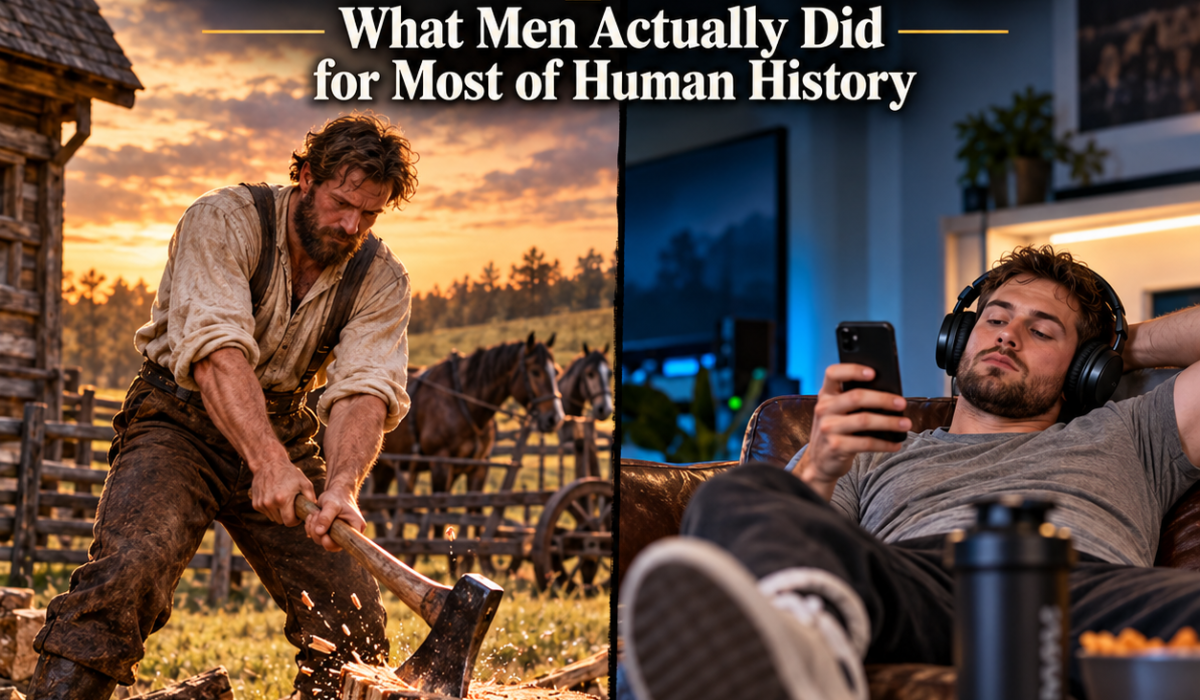
What Men Actually Did for Most of Human History
Introduction
In Part I, I examined how radically technology transformed women’s domestic labor. I now turn the same unforgiving historical lens toward men, and gentlemen, the comparison is not flattering. Again, for the sake of argument, we will work from the premise of an earth roughly 10,000 years old while recognizing that competing chronologies differ dramatically. The precise number changes nothing essential here. For nearly the entirety of recorded human civilization, the average man lived without automobiles, tractors, chainsaws, power drills, hydraulic equipment, electric saws, furnaces, hardware stores stocked with standardized parts, GPS, computers, telephones, YouTube tutorials, or a cheerful technician arriving Tuesday between noon and four because the toilet makes a funny noise. Civilization was built, cultivated, defended, repaired, transported, and maintained through human muscle, animal power, simple machines, accumulated skill, and an astonishing quantity of sweat.
Modern men inherited the fruits of that labor, and then most of us became spectators. We watch other men build houses on television. We watch other men hunt on YouTube. We pay another man to change our oil, sharpen our blades, repair our fences, replace our faucets, service our furnaces, cut our trees, grow our food, butcher our meat, and assemble the furniture delivered to our front doors. Meanwhile, the average American adult man spends hours each day consuming leisure media, and sedentary employment has replaced much of the occupational movement that characterized agricultural and industrial work. None of this means every historical man was a rugged frontiersman or that every modern man is incompetent (although most are). Specialists, merchants, scholars, clerks, priests, craftsmen, servants, and urban laborers have existed throughout history. But the broad historical pattern is that basic male life demanded a degree of physical capability and practical usefulness that modern infrastructure increasingly makes optional. Scripture’s command is correspondingly unsentimental: “If any would not work, neither should he eat” (2 Thessalonians 3:10).The historical expectation was remarkably simple: a grown man was required to be useful.
I. The Household Needed a Man Who Could Actually Do Things
For most of human history (99+%), a man’s home was not simply the place he returned to after work. His home was part of the work. Land had to be cleared, cultivated, drained, fenced, and maintained. Buildings required construction and constant repair. Wood needed to be felled, cut, split, hauled, stacked, and seasoned. Wells and drainage systems had to be dug. Animals required shelters and fences. Tools broke and needed handles, sharpening, repair, or replacement. Roads deteriorated. Roofs leaked. Wagons broke. Storms knocked things down. Winter arrived every year with absolutely no concern for whether a man was “going through a lot right now.”
American agricultural records illustrate how dominant this world remained surprisingly recently. In 1925, approximately 41 percent of the American workforce was employed in agriculture; by 2000, the figure had fallen below 2 percent. Mechanization transformed what remained. The USDA describes twentieth-century agriculture as undergoing enormous productivity gains as tractors replaced horses and increasingly sophisticated machinery reduced labor requirements. In other words, the disappearance of physically demanding farm labor from average male experience is not some ancient transition. It happened largely within the last few generations.
Before mechanization, however, muscle remained the machinery. The National Park Service’s descriptions of nineteenth-century farming document men plowing, planting, harvesting, constructing and repairing fences, maintaining buildings and equipment, caring for livestock, cutting timber, and performing the seasonal work required to keep farms functioning. Specialized trades existed, certainly, but rural necessity rewarded broad competence. A broken handle did not justify a forty-minute drive to Home Depot. A man repaired it, fashioned another, borrowed one, improvised, or discovered that tomorrow’s work was not getting done.
Scripture assumes this productive relationship between man and creation. Adam is placed in the garden “to dress it and to keep it” (Genesis 2:15). After the Fall, man’s relationship to provision becomes laborious: “In the sweat of thy face shalt thou eat bread” (Genesis 3:19). Paul later commands men to “work with your own hands” (1 Thessalonians 4:11). Biblical masculinity is therefore productive. It cultivates, protects, builds, provides, and maintains.
Strip away electricity, municipal water, supermarkets, mechanics, contractors, delivery services, GPS, power tools, and Google. What remains?
Your great-grandfather’s value to his household could be demonstrated by looking around the property. A depressing number of modern men would demonstrate theirs by pointing toward the Wi-Fi router and announcing that they know how to restart it.
II. Work Was Supposed to Hurt
Modern men frequently describe themselves as “exhausted” after spending eight hours in a climate-controlled building, sitting in an ergonomically engineered chair, staring at illuminated rectangles, and occasionally enduring the savage physical ordeal of walking to the conference room. Mental exhaustion is real, and sedentary work carries genuine health consequences, but historical perspective remains merciless. For most working men throughout agricultural and early industrial civilization, earning tomorrow’s bread required the sustained expenditure of physical strength.
Agriculture meant plowing, digging, sowing, harvesting, threshing, hauling, fencing, cutting timber, handling animals, repairing equipment, and working according to daylight, weather, and season rather than convenience. Industrialization did not immediately rescue men from physical hardship; it frequently relocated it. Men entered mines, foundries, logging camps, railroads, shipyards, mills, docks, construction sites, and factories. The U.S. Bureau of Labor Statistics describes early industrial working conditions as extraordinarily hazardous by modern standards. Around 23,000 industrial workers were killed in workplace accidents in 1913, equivalent to roughly 61 deaths per 100,000 workers. By 2023, the comparable fatal occupational injury rate was 3.5 per 100,000 full-time-equivalent workers.
Hours were different as well. Historical BLS studies show manufacturing employees around the turn of the twentieth century were working approximately 60 hours per week, while six-day schedules remained standard. Agricultural labor could be still less obedient to clocks. Crops did not stop ripening because forty hours had elapsed. Livestock did not recognize weekends. Harvest did not offer paid time off. A man’s workday was determined by what necessity required, and necessity was an employer with a notoriously poor human-resources department. For most of human history a man with a family would work 80-100 hours per week.
Scripture treats strenuous labor as an expected component of provision. Paul reminds the Thessalonians, “neither did we eat any man’s bread for nought; but wrought with labour and travail night and day” (2 Thessalonians 3:8). Proverbs contrasts diligent labor with the poverty produced by sloth: “In all labour there is profit” (Proverbs 14:23). The biblical ideal is not pointless suffering or reckless destruction of the body, but willingness to endure difficulty in pursuit of duty.
Modern machinery has mercifully removed tremendous amounts of physical suffering (for better or worse). But perhaps a civilization in which men once swung hammers for twelve hours can reasonably expect us to survive forty-five minutes at the gym without photographing it.
Our ancestors worked until their bodies became tired. We have become remarkably skilled at becoming tired before our bodies have done anything useful at all.
III. Danger Was Part of the Job Description
Historical masculinity developed in a world where danger could rarely be delegated to somebody else. This does not mean every farmer spent his evenings wrestling bears or repelling marauders from the front porch. Most men, most days, presumably preferred remaining alive. But basic male responsibilities routinely placed men around large animals, axes, saws, firearms, deep water, falling timber, unstable mines, furnaces, heavy machinery, construction, severe weather, and transportation systems with few (if any) of the safeguards modern people regard as normal. When something dangerous had to be done, the expectation was straightforward: men would do it.
The occupational record makes the point. The Bureau of Labor Statistics estimates that approximately 23,000 American workers died from occupational injuries in 1913, producing an estimated death rate around 61 per 100,000 workers. Modern workplace fatalities remain disproportionately male. In recent BLS data, men account for more than 90 percent of fatal occupational injuries, reflecting their continued concentration in dangerous industries such as logging, fishing, construction, transportation, agriculture, extraction, and protective services. The modern man who climbs electrical towers, fights fires, works offshore, cuts timber, mines coal, repairs power lines after hurricanes, or pours concrete forty stories above the street therefore retains something ancient: civilization still depends upon men willing to perform jobs from which sensible people instinctively recoil.
War added another dimension. Across civilizations, military obligation fell solely upon men. American experience alone stretches from colonial militias and the Revolution through the Civil War, two world wars, Korea, Vietnam, and subsequent conflicts. During World War II, more than 16 million Americans served in the armed forces, the overwhelming majority men. More than 400,000 American military personnel died. When the state believed civilization required defending, young men were expected to leave their homes and accept the possibility that they would not return.
Scripture similarly connects masculine duty with courage. David tells Solomon, “Be thou strong therefore, and shew thyself a man” (1 Kings 2:2). Paul commands the Corinthians, “quit you like men, be strong” (1 Corinthians 16:13, KJV). Courage is not the absence of fear; but the subordination of fear to obligation.
Modern civilization has made life extraordinarily soft. Seat belts, building codes, emergency medicine, workplace regulation, fire departments, weather forecasting, engineered machinery, and countless other improvements prevent suffering our ancestors simply endured.
The tragedy is not that modern men face less danger. The tragedy is that some have mistaken safety for the highest masculine virtue. A man need not manufacture unnecessary danger to prove himself. But he should remain the person who can be counted upon when danger arrives. Because when something goes bump in the night, nobody respects the husband who rolls over and whispers, “Honey, would you mind checking that?”
IV. A Husband Was Responsible Whether He Felt Like It or Not
Strength without responsibility is merely an impressive animal. The historical expectation placed upon a husband and father was not simply that he possess muscles, tools, land, or authority, but that he answer for the condition of his household. He was expected to secure provision, maintain property, protect dependents, teach children, plan for scarcity, manage resources, honor obligations, and solve problems before those problems became disasters. Adulthood brought duties that could not simply be abandoned because performing them had become unpleasant.
Provision illustrates the point. Before modern insurance systems, government benefits, consumer credit, pensions, and extensive institutional safety nets, the household carried far more economic risk. A failed harvest, injured animal, damaged roof, lost employment, illness, or winter shortage would become a family crisis. The responsible man therefore had to think beyond today. Grain was stored. Fuel was accumulated. Buildings were maintained. Tools were repaired before they failed completely. Debts mattered. Reputation mattered. Relationships with neighbors mattered. Competence functioned as a form of societal insurance.
Scripture shares this principle. Paul writes, “if any provide not for his own, and specially for those of his own house, he hath denied the faith” (1 Timothy 5:8). Joshua identifies household leadership with spiritual responsibility: “as for me and my house, we will serve the LORD” (Joshua 24:15). Abraham is commended because God knew that he would “command his children and his household after him” to keep the way of the Lord (Genesis 18:19). Biblical fatherhood is therefore not reducible to depositing money into a checking account. Provision matters, but so do instruction, discipline, foresight, example, and government of oneself.
That is where modern masculinity has become embarrassingly theatrical. A man can grow a beard, buy a truck, own seventeen firearms, deadlift impressive numbers, quote Marcus Aurelius on social media, and still leave every meaningful household responsibility to his wife. If everyone around you must compensate for your irresponsibility, your appearance is irrelevant.
Our ancestors faced circumstances we should be grateful not to face. But comfort has not repealed responsibility. A husband with automatic payroll, online banking, municipal utilities, supermarkets, power tools, modern medicine, GPS, insurance, and instant access to information possesses advantages his great-grandfather could scarcely imagine.
He therefore has far fewer excuses. Your family should not have to drag you toward adulthood. The roof may no longer require you to split shingles by hand, and dinner may no longer depend upon what you harvested. But the ancient question remains:
When something goes wrong in your household, are you the man everyone looks toward, or another problem everyone has to manage?
V. Then the Machines Arrived, and Men Got Comfortable Too
The technological revolution did not only liberate women from buckets, washboards, and stove-heated irons. It liberated men from axes, horses, hand drills, crosscut saws, shovels, and enormous quantities of backbreaking labor. Agricultural mechanization transformed farming. Internal-combustion engines replaced animal power. Tractors pulled implements that once required teams of horses and multiple laborers. Chainsaws turned hours of chopping and sawing into minutes. Excavators moved in an afternoon what generations of men once moved with picks, shovels, carts, and aching backs. Pneumatic tools, electric motors, hydraulic equipment, forklifts, cranes, power steering, electric starters, and cordless tools progressively multiplied what one man’s body could accomplish.
Then infrastructure removed still more labor. Furnaces replaced the daily management of household fires. Municipal water eliminated wells and pumps. Automobiles replaced enormous amounts of walking and animal transportation. Hardware stores supplied standardized materials. Professional trades became increasingly specialized. Telephones eliminated journeys made to exchange information. Computers automated calculations and paperwork. GPS meant a man no longer even needed to know where he was. Today, a homeowner can watch a ten-minute instructional video, order the necessary component without leaving his couch, and have it deposited on his porch tomorrow morning. Never in history has practical knowledge been more accessible. And somehow helplessness has increased exponentially.
We now have men who cannot change a tire despite carrying a device containing detailed instructions in their pockets. Men own garages containing thousands of dollars in tools they barely know how to use. Food arrives through an application, entertainment streams continuously into the house, thermostats maintain temperature, lawn equipment propels itself, and automobiles warn us when the tires need air. We have constructed a civilization in which a man can survive while understanding almost nothing about the systems keeping him alive.
That is technological achievement. It is also a spiritual temptation.
Christ’s parable of the talents condemns the servant who receives resources and produces nothing with them (Matthew 25:14–30). The principle extends beyond money: greater resources create greater opportunities for stewardship and greater responsibility. If machinery saves four hours of labor, the question becomes what we do with those four hours. Build something? Study? Train? Teach our children? Serve our neighbors? Strengthen our marriages? Develop another useful skill?
Or spend them playing video games, watching other men play sports while scrolling through videos of other men building things?
Technology should make capable men more capable. A power saw should multiply the carpenter, not replace him. The internet should multiply knowledge, not curiosity’s funeral. Modern prosperity has placed the productive capacity of kings into average hands.
Grandfather split wood because otherwise his children froze to death. His grandson owns a hydraulic splitter, a chainsaw, a pickup truck, heated gloves, and a weather app. And somehow he is still “too tired” to do anything meaningful.
Conclusion: You Inherited the Tools, Now Become Worthy of Them
None of this means the past was some masculine paradise to which sensible men should desperately attempt to return (although it is quite tempting). Men were crushed by machinery, buried in mines, killed by falling timber, crippled on farms, drowned at sea, maimed in factories, and sent home from wars in boxes (when their bodies came home at all.) Their work frequently destroyed their joints, lungs, hearing, backs, and hands. Modern safety standards, medicine, machinery, infrastructure, specialization, and automation could be blessings used to our advantage. Keep the chainsaw. Keep the tractor. Keep the power drill. For the love of all that is good, keep indoor plumbing. The point is that previous generations endured extraordinary difficulty because responsibility demanded it, while we increasingly treat generic inconvenience as though it were extraordinary suffering. They developed competence because incompetence carried consequences. They learned to build, repair, cultivate, navigate, protect, provide, improvise, endure, and finish what they started because households and communities depended upon men who could actually do things. We inherited the civilization those men built, along with machines that multiply our strength, information they spent lifetimes acquiring, medical care they could scarcely imagine, and tools capable of turning a day’s labor into an hour’s work. Our inheritance should have produced more capable men, not useless boys.
The question, therefore, is not whether you can reproduce your great-grandfather’s life. You should not need to. The question is what you are doing with everything he never had. Scripture says, “For unto whomsoever much is given, of him shall be much required” (Luke 12:48). That should haunt men today. You possess transportation faster than kings, information greater than ancient libraries, tools stronger than teams of laborers, communication spanning the planet, food requiring virtually no personal production, and machines performing work that consumed enormous portions of your ancestors’ lives. So what have you built with the difference? Can your family depend upon you? Can you repair anything? Grow anything? Build anything? Protect anyone? Teach your children? Control your appetites? Endure discomfort without becoming insufferable? Put down the telephone and work when nobody is watching? Lead when circumstances are difficult? Finish something difficult simply because it needs finishing? Masculinity has never been about beards, boots, trucks, muscles, weapons, cigars, or posting quotations about bears. It is about becoming the sort of man upon whom other people can safely place weight. We do not need to abandon modern civilization and return to splitting every board with an axe. We need to stop allowing modern civilization to make us soft, passive, dependent, and useless. Your ancestors survived without almost everything you possess. The least you can do is become a man worthy of having it.