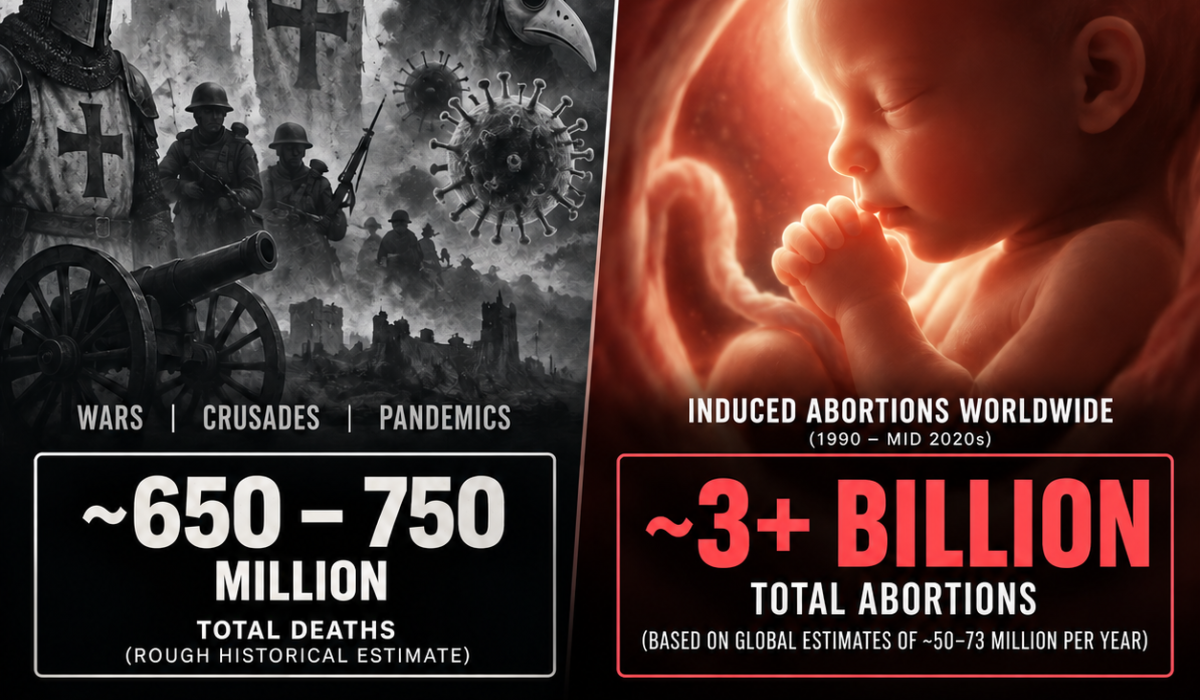
More Children Have Been Killed by Abortion Than Humanity Has Lost to All Its Wars, Crusades, and Pandemics Combined
Introduction
Human history has constructed an extensive vocabulary for catastrophe. We speak solemnly of the Black Death, recoil at the mechanized slaughter of the First World War, memorialize the tens of millions consumed by the Second, and recount the conquests of Mongols, Romans, Ottomans, Persians, and Europeans as chapters written in blood. We remember crusades, civil wars, genocides, revolutions, famines, and epidemics because the loss of human life demands remembrance. The numbers are staggering. The World Health Organization has placed the Black Death at roughly 40–75 million deaths, the Justinianic plague at 25–50 million, the 1918 influenza pandemic at 20–50 million, and smallpox across several centuries at approximately 500 million. Yet even these almost incomprehensible numbers pale in comparison when placed beside a form of human destruction so normalized that modern society refuses even to place its victims in the category of the dead.
We will proceed from a proposition that changes the entire moral arithmetic: human life begins at conception. Once accepted, abortion ceases to be a medical procedure, political controversy, or exercise of personal autonomy; it becomes the intentional murder of an already-existing human life. For purposes of the analysis that follows, we will further stipulate approximately 75 million conventional abortions annually, an additional 50 million post-conception deaths annually attributed to emergency contraception under the assumptions stated for this article, and approximately three billion induced abortions cumulatively across history. The exact accounting may forever remain beyond recovery, particularly where clandestine procedures and ancient populations are concerned. The central question, however, is not whether the final ledger differs by a few million, but whether civilization has developed a moral vocabulary capable of mourning battlefield deaths while excluding an incomparably larger class of human beings because they died before anyone heard them cry.
I. Before Counting the Dead, Decide Who Counts
Every calculation of human mortality begins with a philosophical decision disguised as a statistical one: Who qualifies for inclusion? A historian counting the dead at Waterloo does not subtract soldiers because they were young, unconscious, disabled, unwanted, or incapable of surviving independently. Their developmental condition is irrelevant to their humanity. If human life begins at conception, consistency requires applying the same principle to prenatal human beings. Their size, location, dependency, and stage of development describe circumstances of human existence; they do not establish the absence of human existence.
This premise radically alters the historical ledger. Modern abortion research estimates approximately 73.3 million induced abortions annually during 2015–2019, with an uncertainty interval of 66.7–82.0 million. Researchers arrived at these figures through Bayesian modeling incorporating surveys, official statistics, published studies, contraceptive information, and demographic data rather than counting officially reported procedures. Sixty-one percent of pregnancies during that period were estimated to end in abortion.
Conventional demographic terminology records abortion as a pregnancy outcome; the framework adopted here counts each abortion as the death of a human being because personhood is not postponed until birth. Scripture presents prenatal existence in personal language. David writes, “Thine eyes did see my substance, yet being unperfect,” while describing God’s knowledge of him during his formation in the womb. Psalm 139 therefore speaks not of meaningless biological material awaiting humanity, but of the same individual David existing through an earlier and unfinished stage of development. Genesis establishes the larger theological foundation: mankind bears the image of God.
Definitions determine what civilization permits itself to see. If the unborn are excluded before the arithmetic begins, abortion will never appear in a list of humanity’s great genocide events regardless of how many abortions occur. The conclusion has been embedded in the denominator.
But restore the conceived child to the human ledger and the picture changes immediately. Seventy-five million deaths per year would equal approximately 342,465 per day, 14,269 per hour, and 238 per minute. At that scale, abortion is an industrial-scale destruction of human life whose magnitude is the worst catastrophe our species has ever seen.
II. The Ledger of Human Catastrophe
Before abortion can be placed beside the great catastrophes of history, those catastrophes deserve to be considered on their own. Human beings have demonstrated an extraordinary capacity both to kill one another and to perish from forces beyond their control. Empires have marched armies across continents; religious wars have devastated populations; revolutions have consumed their own societies; and infectious diseases have erased communities faster than armies could conquer them. The numbers attached to these events are necessarily estimates, and even modern wars produce disputes over whether civilians, famine, disease, and indirect mortality belong in the final count. Nevertheless, the broad magnitude of history’s principal disasters can be reconstructed sufficiently to comprehend their scale.
Consider war first. The Mongol conquests are commonly associated with deaths numbering in the tens of millions. The Taiping Rebellion of nineteenth-century China likewise killed tens of millions. The Thirty Years’ War devastated Central Europe, while the Napoleonic Wars consumed millions more. Then industrial civilization transformed warfare. The First World War produced military and civilian deaths measured in the tens of millions. Barely two decades later came the Second World War (the bloodiest conventional military conflict in recorded history) with estimates generally ranging around 70–85 million deaths. The “Holocaust,” strategic bombing, massacres, starvation, disease, and unprecedented battlefield slaughter are parts of a catastrophe so enormous that humanity reorganized much of the international political order in its aftermath. (britannica.com)
Disease has been still more ruthless. The fourteenth-century Black Death destroyed an extraordinary portion of the populations it encountered. WHO historical material places its death toll around 40–75 million, while noting substantially higher estimates elsewhere. The same review places the Justinianic plague around 25–50 million, the 1918 influenza pandemic around 20–50 million, and cumulative smallpox mortality across centuries at approximately 500 million. (applications.emro.who.int) These were not statistics to the people who endured them. They were empty houses, orphaned children, abandoned farms, overflowing cemeteries, and communities watching neighbors die faster than graves could be dug.
Then come the crusades, religious wars, civil conflicts, colonial conquests, revolutions, genocides, rebellions, and innumerable lesser campaigns scattered throughout history. Their casualties range from thousands to millions. Some overlap with larger conflicts; some estimates include indirect mortality while others count only violent deaths.
We can deliberately grant history’s great catastrophes generous estimates and still ask what happens when their enormous combined ledger is placed beside the stipulated figure of approximately three billion abortions across human history. Three billion is not just another large number.
The chart that follows therefore serves an important purpose. Read the names slowly. Look at the wars, plagues, invasions, rebellions, crusades, and pandemics that generations have remembered as monuments to human suffering. Consider the lives represented by those numbers rather than allowing millions to become abstractions.
Then keep one number in mind:
3,000,000,000.
That is the number against which the ledger will ultimately be measured.
| Date | Event | Estimate |
| 499–449 BC | Greco-Persian Wars | 200,000 |
| 431–404 BC | Peloponnesian War | 300,000 |
| 334–323 BC | Alexander’s Conquests | 750,000 |
| 264–146 BC | Punic Wars | 1,400,000 |
| 58–50 BC | Gallic Wars | 850,000 |
| AD 66–136 | Roman–Jewish Wars | 1,500,000 |
| 165–180 | Antonine Plague | 5,000,000 |
| 184–280 | Three Kingdoms Wars | 34,000,000 |
| 249–262 | Plague of Cyprian | 3,000,000 |
| 541–549 | Plague of Justinian | 37,500,000 |
| 602–628 | Byzantine–Sasanian War | 500,000 |
| 632–750 | Early Islamic Conquests | 2,000,000 |
| 735–737 | Japanese Smallpox Epidemic | 1,500,000 |
| 755–763 | An Lushan Rebellion | 13,000,000 |
| 1096 | People’s Crusade | 15,000 |
| 1096–1099 | First Crusade | 100,000 |
| 1101 | Crusade of 1101 | 50,000 |
| 1147–1149 | Second Crusade | 75,000 |
| 1189–1192 | Third Crusade | 100,000 |
| 1202–1204 | Fourth Crusade | 30,000 |
| 1206–1368 | Mongol Conquests | 40,000,000 |
| 1208–1229 | Albigensian Crusade | 600,000 |
| 1212 | Children’s Crusade | 10,000 |
| 1217–1221 | Fifth Crusade | 30,000 |
| 1228–1229 | Sixth Crusade | 5,000 |
| 1230s–1280s | Northern/Baltic Crusades | 100,000 |
| 1248–1254 | Seventh Crusade | 30,000 |
| 1270 | Eighth Crusade | 10,000 |
| 1271–1272 | Ninth Crusade | 5,000 |
| 1337–1453 | Hundred Years’ War | 2,900,000 |
| 1346–1353 | Black Death | 57,500,000 |
| 1369–1405 | Conquests of Timur | 12,000,000 |
| 1419–1434 | Hussite Wars | 100,000 |
| 1455–1487 | Wars of the Roses | 70,000 |
| 1520s onward | American Smallpox Epidemics | 20,000,000* |
| 1545–1548 | Cocoliztli Epidemic | 10,000,000 |
| 1562–1598 | French Wars of Religion | 3,000,000 |
| 1576–1580 | Second Cocoliztli Epidemic | 2,250,000 |
| 1592–1598 | Japanese Invasions of Korea | 1,000,000 |
| 1618–1648 | Thirty Years’ War | 6,250,000 |
| 1618–1683 | Ming–Qing/Manchu Conquest | 25,000,000 |
| 1629–1631 | Italian Plague | 1,000,000 |
| 1642–1651 | English Civil Wars | 200,000 |
| 1656–1658 | Naples Plague | 1,000,000 |
| 1665–1666 | Great Plague of London | 100,000 |
| 1700–1721 | Great Northern War | 350,000 |
| 1720–1722 | Great Plague of Marseille | 100,000 |
| 1756–1763 | Seven Years’ War | 1,125,000 |
| 1770–1772 | Russian Plague | 75,000 |
| 1775–1783 | American Revolutionary War | 85,000 |
| 1792–1802 | French Revolutionary Wars | 1,250,000 |
| 1803–1815 | Napoleonic Wars | 4,750,000 |
| 1810s–1820s | Spanish-American Wars of Independence | 600,000 |
| 1817–1824 | First Cholera Pandemic | 300,000 |
| 1826–1837 | Second Cholera Pandemic | 500,000 |
| 1839–1860 | Opium Wars | 75,000 |
| 1846–1860 | Third Cholera Pandemic | 1,000,000 |
| 1850–1864 | Taiping Rebellion | 45,000,000 |
| 1853–1856 | Crimean War | 625,000 |
| 1855–1960 | Third Plague Pandemic | 12,500,000 |
| 1856–1873 | Panthay Rebellion | 1,000,000 |
| 1861–1865 | American Civil War | 735,000 |
| 1862–1877 | Dungan Revolt | 10,000,000 |
| 1863–1875 | Fourth Cholera Pandemic | 500,000 |
| 1864–1870 | Paraguayan War | 750,000 |
| 1870–1871 | Franco-Prussian War | 215,000 |
| 1881–1896 | Fifth Cholera Pandemic | 500,000 |
| 1889–1890 | Russian Flu | 1,000,000 |
| 1894–1895 | First Sino-Japanese War | 35,000 |
| 1899–1902 | Second Boer War | 87,500 |
| 1899–1923 | Sixth Cholera Pandemic | 800,000 |
| 1904–1905 | Russo-Japanese War | 150,000 |
| 1910–1920 | Mexican Revolution | 1,500,000 |
| 1912–1913 | Balkan Wars | 140,000 |
| 1914–1918 | World War I | 18,500,000 |
| 1917–1922 | Russian Civil War | 9,500,000 |
| 1918–1920 | Spanish Flu | 35,000,000 |
| 1927–1949 | Chinese Civil War | 6,500,000 |
| 1935–1936 | Second Italo-Ethiopian War | 530,000 |
| 1936–1939 | Spanish Civil War | 550,000 |
| 1937–1945 | Second Sino-Japanese War | 20,000,000 |
| 1939–1945 | World War II | 77,500,000 |
| 1945–1954 | First Indochina War | 500,000 |
| 1946–1949 | Greek Civil War | 130,000 |
| 1947 | Partition of India Violence | 1,100,000 |
| 1950–1953 | Korean War | 3,500,000 |
| 1954–1962 | Algerian War | 950,000 |
| 1955–1975 | Vietnam War | 3,000,000 |
| 1957–1958 | Asian Flu | 2,500,000 |
| 1960–1965 | Congo Crisis | 100,000 |
| 1960–1996 | Guatemalan Civil War | 200,000 |
| 1967–1970 | Nigerian/Biafran War | 2,000,000 |
| 1968–1970 | Hong Kong Flu | 2,500,000 |
| 1971 | Bangladesh Liberation War | 1,650,000 |
| 1975–1990 | Lebanese Civil War | 135,000 |
| 1975–2002 | Angolan Civil War | 650,000 |
| 1977–1992 | Mozambican Civil War | 1,000,000 |
| 1978–present | Afghan Conflicts | 2,000,000 |
| 1980–1988 | Iran–Iraq War | 750,000 |
| 1981–present | HIV/AIDS Pandemic | 45,000,000 |
| 1983–2005 | Second Sudanese Civil War | 1,500,000 |
| 1990–1991 | Gulf War | 62,500 |
| 1991–2001 | Yugoslav Wars | 135,000 |
| 1994 | Rwandan Genocide/Civil War | 800,000 |
| 1996–1997 | First Congo War | 200,000 |
| 1998–2003 | Second Congo War | 4,200,000 |
| 2001–2021 | Afghanistan War | 175,000 |
| 2002–2004 | SARS | 774 |
| 2003–2011+ | Iraq War | 200,000† |
| 2009–2010 | H1N1 Pandemic | 362,500 |
| 2011–present | Syrian Civil War | 550,000† |
| 2014–2016 | West African Ebola Epidemic | 11,300 |
| 2014–present | Yemen Conflict | 300,000† |
| 2019–present | COVID-19 | 7,000,000+ reported† |
| 2020–2022 | Tigray War | 300,000† |
| 2022–present | Russia–Ukraine War | Ongoing – no final toll |
III. Three Billion Missing Lives
Numbers eventually become too large for the human mind to comprehend. Ten deaths can be imagined. Ten thousand become a crowd. Ten million become an abstraction. Three billion scarcely resembles a number at all. Yet approximately three billion human lives have been deliberately ended through abortion across history. This figure is an historical estimate rather than a count recoverable from complete records. But the modern data demonstrate why cumulative totals become enormous so rapidly. The World Health Organization currently estimates approximately 73 million induced abortions worldwide every year, representing about 30 percent of all pregnancies and 65 percent of unintended pregnancies. A major WHO/Guttmacher modeling study similarly estimated 73.3 million abortions annually during 2015–2019, with an uncertainty interval of 66.7–82 million. Then an additional 50 million from plan B and other pills.
Pause over what 105 million actually means. It is approximately 342,465 per day, 14,269 per hour, and 238 per minute, or about two every second. At that rate, a population equivalent to the entire death toll of every war is reached within months. Approximately one billion abortions would accumulate in eight years. Three billion therefore represents forty years at 75 million annually, not an unimaginable span of antiquity, but less than a modern lifetime.
Nor are global abortion estimates simply totals copied from government registries. Researchers acknowledge that abortion data are incomplete in many countries and employ statistical models incorporating official statistics, surveys, published research, pregnancy intentions, demographic information, and other evidence. The WHO/Guttmacher estimates covering 1990–2019 were produced using a Bayesian framework specifically because direct reporting varies substantially between countries. This matters because clandestine abortion is increasing.
The stipulated calculation used here goes further. Approximately 150 million Plan B doses are sold annually, two-thirds are used, and half of those uses occur post-conception, producing an additional 50 million prenatal deaths each year. Conventional abortion and these post-conception losses together produce approximately 125 million intentional prenatal murders annually.
Honestly three billion looks rather conservative. Even the detractors will readily admit there has been at least 2 Billion.
Scripture asks: “Where is Abel thy brother?” Cain answered, “I know not: Am I my brother’s keeper?” (Genesis 4:9, KJV). The question reverberates because moral responsibility cannot be erased by refusing to acknowledge the victim. If conception marks the beginning of human life, billions of children do not disappear from history because their deaths occurred behind clinic doors, through pills, or before their mothers ever held them. They still belong in the ledger.
IV. The Dead We Mourn and the Dead We Refuse to Count
There is a peculiar inconsistency in modern civilization’s treatment of human death. We build monuments for soldiers, museums for genocide victims, memorials for terrorist attacks, and cemeteries for the casualties of war. We preserve photographs, recover names, identify remains, and teach children that behind every historical statistic stood an individual human being whose life possessed value. This instinct is correct. A million deaths are not fundamentally a statistic; they are one death multiplied a million times. Yet when the subject turns to abortion, the language changes. The victim disappears from the grammar. Instead of a human being murdered, a “pregnancy is terminated.” Instead of describing what is destroyed, society describes the “procedure” by which the destruction occurs.
The magnitude makes that linguistic distinction consequential. The World Health Organization estimates approximately 73 million induced abortions worldwide every year and reports that roughly 29 percent of all pregnancies end in induced abortion.
Another 50 million annual post-conception deaths attributed here to Plan B use, producing approximately 125 million intentionally terminated prenatal lives per year (approximately 60% of total pregnancies).
If conception marks the beginning of a human life, 100 million plus abortions every year constitute an extraordinary annual death toll. No speculative component is necessary to make that observation. At 125 million annually, approximately 1.25 billion abortions occur in a decade if the rate remains constant. Three decades at that rate produces 3.75 billion. The scale rapidly enters territory almost impossible to comprehend.
Scripture condemns the shedding of innocent blood. Proverbs declares that among the things the Lord hates are “hands that shed innocent blood” (Proverbs 6:17, KJV). The principle does not depend upon whether the victim was famous, powerful, useful, wanted, or capable of defending himself. Indeed, moral law is most severely tested where the victim possesses no power with which to demand recognition.
That is the center of the abortion question. The unborn cannot march, they cannot vote, they cannot testify before legislatures, erect monuments, write histories, or demand that their names be carved into stone. They depend entirely upon the living to decide whether they will even be counted.
They are human beings from conception, and refusing to count them does not change what we have done to them. It changes only the history we are willing to tell.
V. When the Ledgers Are Compared
Now place the ledgers beside one another. On one side stand the great killing fields and catastrophes of recorded history: ancient conquests, crusades, religious wars, imperial campaigns, civil wars, revolutions, the Mongol invasions, the Thirty Years’ War, the Napoleonic Wars, the Taiping Rebellion, two World Wars, Korea, Vietnam, and the countless conflicts surrounding them. Add the great pestilences: the Plague of Justinian, the Black Death, smallpox, cholera, the 1918 influenza pandemic, HIV/AIDS, COVID-19, and all other epidemics represented in the preceding chart. Their combined toll reaches into the hundreds of millions (Perhaps even one Billion). But no reasonable accounting makes these catastrophes anything less than an ocean of human suffering.
The Second World War alone killed approximately 70–85 million people. Historical WHO material places the Black Death around 40–75 million, the Justinianic plague around 25–50 million, and the 1918 influenza pandemic around 20–50 million. Smallpox, considered across centuries has been credited with approximately 500 million deaths. (britannica.com) (applications.emro.who.int) These numbers should horrify us. Nothing in this comparison diminishes them. Every corpse on every battlefield, every plague victim, every civilian buried beneath rubble, and every child carried to a mass grave represents an individual human tragedy.
But now place beside them the murder victims of abortion.
3,000,000,000 abortions.
Three billion deaths would equal approximately forty Second World Wars, using 75 million as a representative figure for that conflict. It would equal sixty pandemics killing 50 million people apiece. Even the extraordinary estimate of approximately 500 million cumulative smallpox deaths across centuries would have to occur six times over to equal three billion.
And the murder has not stopped.
At the stipulated rate of 75 million conventional abortions annually, another population equivalent to the approximate death toll of World War II disappears every year. Add in Plan B murders, the annual figure rises to approximately 125 million prenatal lives, meaning another billion deaths would accumulate in only eight years if those rates remained constant.
This is why abortion cannot coherently remain a historical footnote under a conception-based definition of human life. If the unborn child is human (and it is), then abortion is not merely comparable to humanity’s great episodes of mass death, it belongs in the accounting beside them. And under the cumulative premise adopted here, its estimated victims exceed the combined magnitude of the major wars, crusades, and pandemics assembled in our historical ledger.
Christ’s words establish a principle appropriate to victims who possess neither armies nor political influence: “Inasmuch as ye have done it unto one of the least of these… ye have done it unto me” (Matthew 25:40, KJV).
Conclusion: The Blood Beneath the Silence
History will not judge our civilization by the euphemisms it invented, but by the realities those euphemisms concealed. We rightly recoil at trenches filled with soldiers, cities reduced to rubble, villages emptied by conquest, and generations consumed by plague. We speak the names of Germany, Verdun, Hiroshima, the Black Death, and the killing fields with solemnity because human beings died there. Yet the human being in the womb belong to the same human family? If life begins at conception, there is no intellectually coherent reason to count the dead of Gettysburg, Normandy, the Somme, medieval Europe, or a plague-stricken city while excluding the child deliberately murdered before birth. Approximately three billion abortions across history dwarf even the extraordinary combined ledger of the major wars, crusades, and pandemics catalogued above. And the destruction continues at a scale measured not merely in millions per generation, but tens of millions every year. Scripture warned long before statistical modeling existed that God hates “hands that shed innocent blood” (Proverbs 6:17, KJV). Numbers can only expose the magnitude of what happens when that value is denied.
The final indictment, therefore, is against the astonishing moral contradiction required to mourn humanity selectively. We erect monuments to the dead while denying that other dead ever qualified for inclusion. We teach children that every victim of war matters, condemn ancient kings for slaughtering innocents, prosecute those who murder the defenseless, and insist that civilized societies are measured by how they protect the vulnerable, then construct an exception where human beings are most vulnerable of all. Three billion is not merely a statistic. It represents three billion beginnings interrupted, three billion human histories never permitted to unfold, and three billion voices that could never testify on their own behalf. Abel’s blood cried from the ground, and God asked Cain the question every generation will face: “Where is Abel thy brother?” (Genesis 4:9, KJV). Our generation will likewise leave an answer. Future civilizations may look upon our age and wonder how people who possessed ultrasound, genetics, embryology, advanced medicine, and unprecedented knowledge of prenatal development could see so clearly what was growing within the womb and still construct elaborate arguments for why it did not count. Wars eventually end. Crusades pass into history. Pandemics burn themselves out. But a civilization that makes peace with the murder of its own children has merely taught barbarism to speak politely.