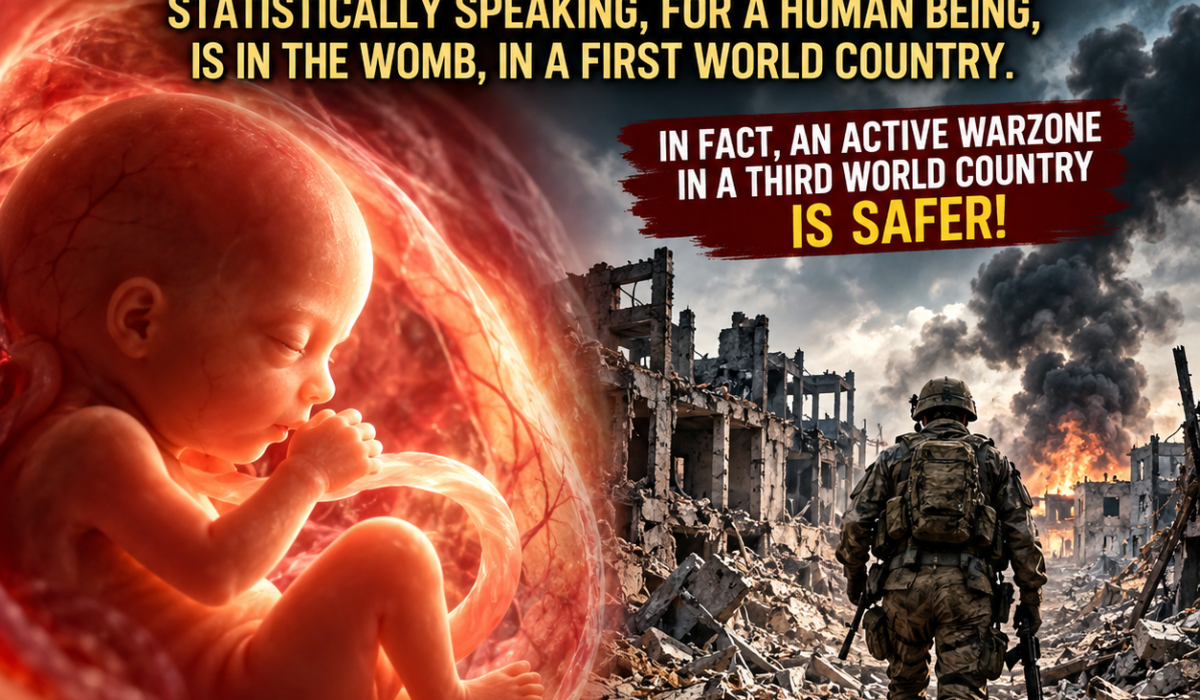
Why, Statistically Speaking, the Womb is More Dangerous Than a War Zone in a 3rd World Country.
Methodological Note: This article proceeds from several stipulated premises for purposes of argument. Among them are that individual human life begins at conception; that post-conception use of emergency contraception constitutes the termination of that life; that approximately 75 million induced abortions occur annually; that approximately 50 million additional post-conception losses result from emergency contraception. Some of these propositions are difficult to quantify on purpose. They are therefore assumptions of the argument. Uppsala University’s Uppsala Conflict Data Program estimated nearly 160,000 deaths from organized violence in 2024.
Introduction
Ask the average person to identify the most dangerous place on earth and his imagination immediately supplies the usual collection of horrors. Gaza. Ukraine. Sudan. A trench under artillery fire. A village caught between militias. Perhaps some miserable patch of ocean where the local fishermen die on the regular. These places are unquestionably dangerous. War has followed mankind from antiquity to the present, and Scripture observes that there is “a time of war, and a time of peace” (Ecclesiastes 3:8). The question is which environment gives an individual human being the poorest statistical prospect of emerging alive. The arithmetic is profoundly uncomfortable.
The thesis of this article is consequently simple and deliberately provocative: under the premises stated above, the most dangerous place on planet Earth for a human being is in the womb, and the paradox is especially striking when set against the safety, wealth, medicine, and technological sophistication associated with the developed world. Indeed, using the stipulated figures of this analysis, even participation in humanity’s war zones presents a dramatically smaller probability of death than conception presents of failing to reach birth. That sounds absurd only because modern statistics begin counting the human population after birth while abortion statistics inhabit a separate conceptual ledger. Move the starting line backward to conception and the picture changes radically. The same civilization capable of neonatal intensive-care units, fetal surgery, genomic medicine, and billion-dollar campaigns for human rights has constructed an extraordinary exception: the smallest human beings are excluded from the accounting. It is difficult to lose a statistical contest when your casualties are not permitted onto the scoreboard.
I. The Arithmetic We Prefer Not to Perform
Begin with numbers rather than rhetoric. The United Nations’ demographic estimates place annual global births at roughly 132 million in 2025. The World Health Organization, meanwhile, estimates approximately 75 million induced abortions every year, stating that roughly three in ten pregnancies end in induced abortion. Then add the 50 million annual post-conception deaths attributed to emergency contraception, together with the additional reproductive losses and we have an average death rate of 40%. The methodological point is these categories cannot simply be divided by annual live births as though births represented all conceptions. The denominator must be the estimated number of conceived human beings under the assumptions being employed.
Modern demographic language generally counts births, pregnancies, abortions, miscarriages, and contraceptive events in different statistical categories. That arrangement may be perfectly useful for public-health administration, but is philosophically inadequate the moment conception is understood as the beginning of an individual human life. Suddenly they become possible outcomes experienced by members of the same defined population: conceived human beings.
Now place beside this the spectacle of war. Uppsala University’s Uppsala Conflict Data Program estimated that nearly 160,000 people died from organized violence in 2024, which it described as the fourth-most violent year since the 1994 Rwandan genocide. That is horrifying. No sane person should trivialize it. Yet against a global population exceeding eight billion, 160,000 deaths constitute only a minute fraction of humanity. Even if, for purposes of this article, we accept the much broader premise that roughly one percent of mankind participates in or is directly exposed to confrontation activity annually, the resulting mortality risk remains nowhere remotely near the sixty-percent failure-to-survive rate between conception and birth.
And there lies the uncomfortable truth. An active warzone in a 3rd world country is vastly safer for any human being than a womb in a 1st world country.
A newly conceived human being begins existence facing odds that would make an infantryman cower in fear. The irony is almost too severe for satire: modern civilization surrounds pregnancy with ultrasound machines, obstetric specialists, prenatal vitamins, fetal monitoring, emergency surgery, and some of the finest medical technology humanity has ever possessed, and yet, by the moral accounting, survival to birth is only forty percent.
“Before I formed thee in the belly I knew thee,” declares Jeremiah 1:5. Our civilization has become extraordinarily good at not seeing what is in the womb.
II. When a War Zone Is Statistically Safer
There is something offensive about saying that a war zone can be safer than a womb. That is precisely why the comparison must be made. War is the cultural archetype of danger: artillery, drones, collapsing buildings, gunfire, mines, starvation, and men deliberately attempting to kill one another. Yet researchers correctly distinguish between the number of deaths and the rate of death. Our World in Data notes that dividing conflict deaths by the population at risk is useful because it tells us an individual’s probability of dying from conflict. In other words, “war is dangerous” is not a statistical measurement. Dangerous to whom, and at what rate?
Approximately one percent of the world’s population participates in or is directly exposed to war and confrontation activity annually. With humanity numbering more than eight billion, one percent represents roughly eighty million people. Approximately 160,000 annual deaths from organized violence would produce a crude mortality ratio of roughly 0.2 percent, approximately one death for every five hundred persons represented in the exposure group. The calculation is deliberately broad and inclusive to lessen the possible counter arguments: conflict researchers warn that civilian and combatant populations, exposure, geography, and definitions differ substantially so I went with the largest number available. Nevertheless, the comparison illustrates the scale involved.
The Uppsala Conflict Data Program recorded approximately 159,800 deaths from organized violence in 2024, during a year containing 61 state-based armed conflicts and eleven conflicts reaching UCDP’s threshold for “war.” It’s not like humanity was not enjoying some unprecedented outbreak of universal peace. Indeed, 2024 represented historically high conflict activity by post-1946 measures. Yet even amid that violence, the number killed remained a tiny proportion of the world’s population.
History makes the contrast more sobering. More than seven million soldiers died in the First World War, while more than twenty-one million combatants died in the Second World War. Those two catastrophes account for roughly three-quarters of conventional-war combat deaths recorded since 1800 in the historical dataset summarized by Our World in Data. These were killing fields on a scale almost beyond comprehension.
The difference between a 0.2-percent crude conflict mortality ratio and a 60-percent prenatal mortality proportion is approximately 300-fold (or 30,000%) Even multiplying the former several times over would scarcely rescue the comparison.
Isaiah condemned those who “call evil good, and good evil” (Isaiah 5:20). We have achieved something perhaps still stranger. We call one place a battlefield. We call the other healthcare.
III. Civilization’s Peculiar Definition of Safety
One might naturally assume that the wealthiest societies would provide the safest environment for human life at every stage. After all, developed nations possess antibiotics, sterile operating rooms, neonatal intensive-care units, fetal surgery, advanced imaging, abundant food, clean water, and emergency medicine that would have appeared miraculous to our ancestors. Maternal and infant survival have been transformed by these achievements. Yet technological capacity to preserve life does not produce a corresponding moral determination to preserve it. Our civilization has become extraordinarily proficient at keeping human beings alive while simultaneously redefining which human beings it believes must be kept alive.
Following World War II, abortion remained restricted throughout much of the world. Liberalization accelerated first in Eastern and Central Europe and then across developed nations during the 1960s and 1970s; scholars reviewing the period note that between 1950 and 1985, nearly all industrialized countries liberalized their abortion laws. In the United States the transformation was rapid. CDC records show just over 22,000 reported legal abortions in 1969. By 1972 (before Roe v. Wade) the number exceeded 586,000. Following Roe in January 1973, 615,831 legal abortions were reported that year. This was an extraordinary institutional change within only a few years.
Wealth does not, by itself, produce higher conventional abortion rates. A WHO/Guttmacher analysis estimated that during 2015–2019 high-income countries where abortion was broadly legal experienced about 21 abortions per 1,000 women aged 15–49, compared with 32 per 1,000 in high-income countries with greater legal restrictions. So rich countries do not have more abortions.
Developed civilization possesses unprecedented resources with which to protect prenatal human life while simultaneously possessing unprecedented technological and institutional mechanisms for deliberately preventing that life from reaching birth. Medicine can detect a fetal heartbeat, map chromosomes, photograph development in extraordinary detail, operate upon children before delivery, and sometimes save infants born months prematurely. And yet this sophistication has provided no immunity against moral contradiction.
“For what shall it profit a man, if he shall gain the whole world, and lose his own soul?” (Mark 8:36).
We gained the ability to see inside the womb. Then we spent decades arguing over whether what we saw possessed the right to remain there.
IV. The Invisible Dead: How Definitions Determine the Body Count
Statistics possess an overt weakness: before anything can be counted, someone must decide what qualifies for inclusion. That decision is often dishonest; every scientific discipline requires definitions. But definitions will determine the moral appearance of the resulting numbers. If human life begins at birth, prenatal death occupies one category. If meaningful human status begins at viability, the ledger changes again. If, as stipulated throughout this article, an individual human life begins at conception, then the denominator changes dramatically. Events conventionally separated into abortion, embryonic loss, and certain post-conception contraceptive events suddenly concern the fate of the same population: conceived human beings.
The Hippocratic Oath traditionally included the pledge, “I will not give to a woman an abortive remedy,” (nlm.nih.gov) Christianity developed an even more explicit tradition of prenatal moral concern. The Didache, generally dated to the late first or early second century, commanded: “you shall not murder a child by abortion nor kill that which is born.” (earlychristianwritings.com) Whatever disagreements surrounded embryology in antiquity, opposition to deliberately destroying developing human life is hardly an invention of twentieth-century American politics.
Scripture likewise treats life within the womb as sacred. David declares, “thou didst cover me in my mother’s womb” and describes his “unperfect” substance as already known by God (Psalm 139:13–16). Jeremiah is told, “Before I formed thee in the belly I knew thee” (Jeremiah 1:5). Luke describes John the Baptist as a brephos (a baby) leaping in Elizabeth’s womb (Luke 1:41–44). These passages are theological, obviously, but their anthropology is important: the being inside the womb is spoken of personally.
If approximately 75 million induced abortions occur annually and another 50 million conceived lives are lost through the post-conception emergency-contraception pharmaceutical mechanisms, that produces 125 million deaths per year before considering the additional underlying abortion categories. Compare that with the stipulated approximately 160,000 annual deaths from wars and confrontations. The former figure is roughly 800 times larger.
The comparison exposes the enormous power of classification. Kill 160,000 people amid gunfire, and governments commission reports, historians record the dead, journalists publish photographs, and memorials eventually bear their names.
Lose billions before birth, and whether civilization even calls them dead depends largely upon where it decided humanity’s accounting should begin. Perhaps the most effective way to make a death statistically disappear is not to conceal the body, but to declare that the body never existed.
V. When Progress Becomes a Euphemism for Power
Every civilization can be summed up by asking a single question: What may the strong do to the weak? Human history provides an unpleasant catalogue of answers. Infants were sacrificed in the ancient world; slaves were treated as property; conquered peoples were massacred; racial and ethnic classifications were invoked to exclude populations from protections. The recurring principle, however, is: injustice is considerably easier once the victim is assigned a status that places him outside the community’s protection. Power will never announce, “We have decided to mistreat human beings.” It will begin by narrowing the definition of those to whom society believes its obligations apply.
The twentieth century supposedly taught humanity particular suspicion toward such reasoning. The Universal Declaration of Human Rights opens by recognizing the “inherent dignity” and “equal and inalienable rights of all members of the human family.” (un.org) The principle is magnificent because inherent dignity is not supposed to depend upon usefulness, strength, independence, intelligence, popularity, or permission from somebody stronger. A right that exists only when another person wants you around is not inalienable.
If the unborn child is a living human organism (and if individual human life possesses inherent rather than conferred value) then size, dependency, location, and developmental maturity cannot determine whether intentional killing becomes permissible. Dependency certainly distinguishes a child from an adult. It does not distinguish a child from humanity. Newborns are dependent. The profoundly disabled are dependent. The elderly may become dependent. Human dignity cannot coherently rest upon one’s ability to pay rent and open pickle jars without assistance.
The Biblical standard is much simpler. Proverbs commands: “Open thy mouth for the dumb in the cause of all such as are appointed to destruction” (Proverbs 31:8). Christ repeatedly inverted hierarchies of power, identifying greatness with service and demanding protection of the vulnerable. Christianity’s moral question must ask whether they possess the authority.
And thus we return to our extraordinary statistical paradox. Modern men cross an active battlefield and face better odds than he faced during the first months of his own existence.
How does this fact not disturb us? We have armored vehicles for soldiers, humanitarian conventions for prisoners, shelters for refugees, international organizations for civilians, and laws protecting endangered animals.
We call ourselves advanced, while murdering innocent babies.
Conclusion: The Battlefield We Refuse to See
Strip away the euphemisms, political affiliations, medical terminology, and carefully separated statistical categories, and the argument arrives at a deeply uncomfortable conclusion. The most dangerous place on Earth for a human being is not a trench, a bombed-out city, a famine-stricken province, or a village caught between opposing armies. It is the womb. More provocatively still, it is the womb surrounded by all the advantages of modern civilization: electricity, clean water, hospitals, universities, advanced medicine, constitutional government, and enough technological sophistication to photograph a developing child in three dimensions before he has a name. Humanity recoils, rightly, from roughly 160,000 annual deaths attributed here to wars and confrontations, while we are murdering and discarding billions of babies.. Even allowing for the enormous methodological differences between these categories, the disparity is the point. We call the battlefield dangerous because we count its dead. We photograph them, identify them, investigate their deaths, publish casualty estimates, negotiate ceasefires, erect monuments, and teach succeeding generations their history. But if human life begins at conception, then our conventional accounting has excluded an immense population when that population is smallest, weakest, most dependent, and least capable of objecting to the terms of its exclusion. The modern world has not solved the ancient problem of the strong exercising power over the weak. We have simply acquired cleaner rooms, better vocabulary, and substantially more sophisticated paperwork.
The issue, therefore, is ultimately larger than abortion, contraception, demographic methodology, or even the deliberately shocking comparison with warfare. It concerns what civilization means when it speaks of human rights. If those rights are inherent, they cannot logically originate from wantedness, viability, independence, geography, or the permission of another human being. If they are instead bestowed by society, then they are not inherent rights at all; they are privileges granted by whoever presently possesses sufficient power to define the requirements. Scripture states: “Lo, children are an heritage of the LORD: and the fruit of the womb is his reward” (Psalm 127:3). The womb, in that conception, ought to represent sanctuary, the first home of humanity, the place where the strong shelter the weak because the weak cannot shelter themselves. And therein lies the indictment. A civilization cannot congratulate itself because its streets are peaceful, its hospitals immaculate, its armies restrained, and its citizens comparatively safe. The measure of civilization is not simply how comfortably the powerful live, but how faithfully they protect those possessing no power whatsoever. If an active war zone in the developing world can indeed offer better statistical prospects than humanity’s first home. We should respond by asking how the womb ever became so dangerous.