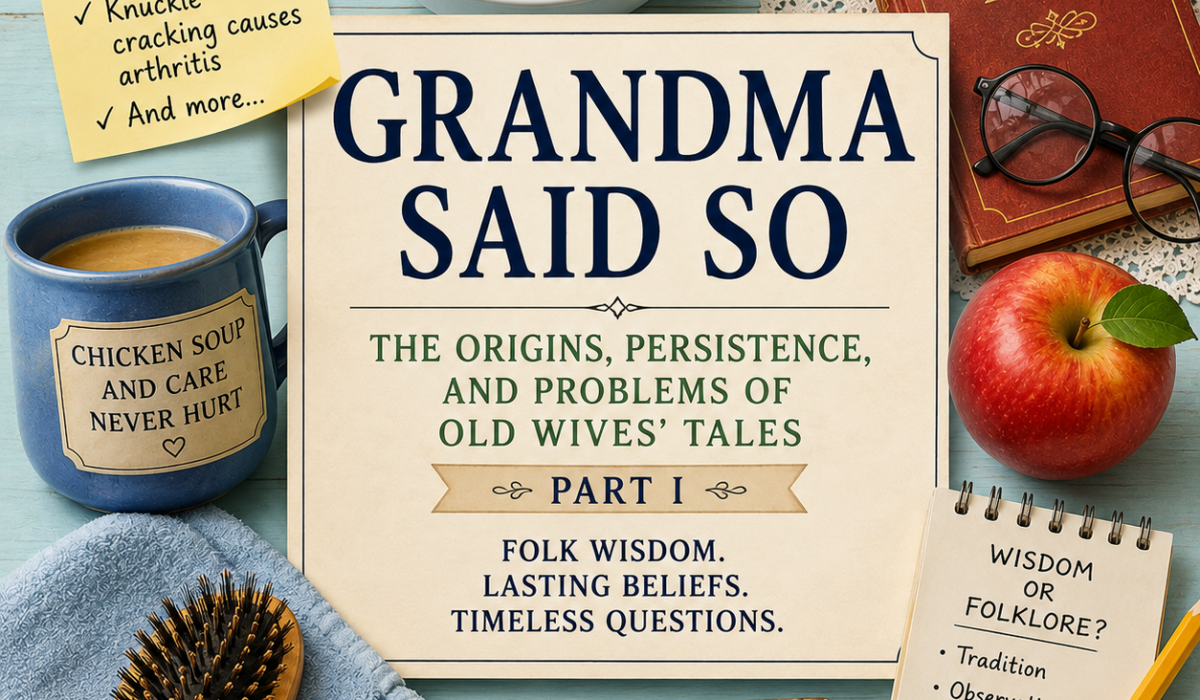
Folk Wisdom, Family Traditions, and the Problem of Being Wrong for a Century
Every culture possesses a collection of inherited wisdom passed from one generation to the next. Grandmothers share it with grandchildren, parents repeat it to children, and neighbors pass it across fences and church pews. Some of this wisdom is genuinely useful. Some is harmless entertainment. But much is simply wrong – spectacularly, stubbornly, and enduringly wrong!
The term “old wives’ tale” refers to traditional beliefs and pieces of folk wisdom that are accepted simply because they have been repeated for generations. Unlike many superstitions, old wives’ tales arise from attempts to explain health, sickness, nutrition, and everyday experiences. Nonetheless they share the same weakness as superstitions: conclusions drawn from observation without sufficient evidence. Sometimes they contain a grain of truth. Other times they are little more than historical guesswork that survived through repetition.
Scripture encourages wisdom, observation, and practical knowledge. The book of Proverbs praises understanding and discernment. However, biblical wisdom differs from folklore in one crucial respect: it seeks truth rather than tradition for tradition’s sake. Jesus warned, human traditions survive long after they cease to reflect reality (Mark 7:8). In this article, we examine seven enduring old wives’ tales related to health and medicine, exploring their origins, meanings, progression, and whether there is any truth hiding beneath the folklore.
I. Feed a Cold, Starve a Fever
Among the older medical sayings in the English-speaking world is the advice to “feed a cold, starve a fever.” The phrase dates back at least to the sixteenth century and likely originated from even older European medical traditions influenced by Greek humoral theory.
Ancient physicians believed illness resulted from imbalances among the body’s four humors: blood, phlegm, black bile, and yellow bile. Different illnesses were categorized as “hot” or “cold” conditions. A fever, being hot, was thought to require less nourishment so the body’s internal heat would diminish. A cold, considered a colder condition, supposedly required additional food to restore balance.
The advice spread through Europe and eventually became household wisdom throughout North America. Generations repeated it as established fact. A sick child with a runny nose was encouraged to eat, while a child with a fever might receive little nourishment until symptoms improved.
Modern medicine has abandoned this practice. Both colds and fevers place demands upon the body’s immune system. Adequate nutrition and hydration are beneficial in either case. Starving a fever generally accomplishes nothing beyond making an already miserable person even more miserable.
The persistence of this tale demonstrates how easily theories become cultural traditions. Few people repeating the phrase today have any knowledge of ancient Greek humoral medicine, yet they continue passing along its conclusions.
Scripture consistently portrays care for the sick as an act of compassion rather than deprivation. Fortunately, most modern grandmothers now recommend soup regardless of the diagnosis.
II. Going Outside with Wet Hair Will Make You Sick
One of the more frequently repeated tales is the claim that going outdoors with wet hair causes illness. Entire generations have been halted at the front door by concerned mothers convinced that damp hair and cold weather inevitably cause colds.
The origin of this belief lies in centuries of misunderstanding about how illnesses spread. Before the discovery of viruses and bacteria, people associated sickness with environmental factors. Cold weather, drafts, damp clothing, and wet hair were viewed as direct causes of disease rather than conditions that might indirectly influence comfort or overall health.
The reasoning seemed logical enough. Many respiratory illnesses occur during colder months. People frequently become chilled before developing symptoms. Therefore, cold exposure must be causing the sickness. The actual culprit (viral infection) remained unknown.
The belief persisted because of confirmation bias. Every time a child went outside with wet hair and later developed a cold, the connection seemed obvious. Meanwhile, the countless occasions when nothing happened were quickly forgotten.
Modern science has shown that colds are caused by viruses. While prolonged exposure to cold temperatures may place stress on the body, wet hair does not cause viral infections. You simply cannot catch influenza because you failed to fully dry your hair.
The tale survives because it reflects parental caution. Most parents would rather appear overly protective than insufficiently concerned. Scripture likewise encourages stewardship of the body, but wisdom requires distinguishing between genuine causes and imagined ones.
III. Cracking Your Knuckles Causes Arthritis
The sound of cracking knuckles has irritated parents, teachers, and spouses for generations. The accompanying warning is usually: “Stop that or you’ll get arthritis.”
This belief appears to have developed during the nineteenth and early twentieth centuries when medical understanding of joint health remained limited. Because arthritis affects the joints and knuckle cracking involves the joints, many assumed a connection existed.
The cracking sound contributed to the fear. It sounds unhealthy. Human beings generally assume that strange noises coming from their bodies indicate something has gone terribly wrong. A loud pop from the fingers certainly seems suspicious.
As the practice became associated with nervous habits, adults often used the arthritis warning as a deterrent. Whether the claim was true mattered less than whether it persuaded children to stop.
Scientific studies have struggled to find evidence that habitual knuckle cracking causes arthritis. The sound results from pressure changes and gas bubbles within joint fluid rather than bones grinding against one another. While excessive cracking can cause temporary discomfort, the dreaded epidemic of knuckle-induced arthritis has never materialized.
The tale remains popular because it offers a simple explanation for a complicated disease. Arthritis is common, painful, and difficult to prevent. Linking it to an obvious behavior provides a satisfying sense of control.
Scripture reminds us that wisdom begins with truth. A false explanation remains false even when repeated by every grandmother in town. In this case, the evidence suggests that the greatest injury caused by knuckle cracking is usually to the patience of nearby family members.
IV. Swallowing Gum Stays in Your Stomach for Seven Years
Every child who has accidentally swallowed chewing gum has likely heard the same alarming prediction: it will remain in your stomach for seven years(or forever).
The tale became widespread during the twentieth century as commercial chewing gum gained popularity. Parents understandably wanted children to use the product properly, and dramatic warnings proved more memorable than lengthy explanations about digestion.
The origin may also reflect older folk beliefs that difficult-to-digest materials remained trapped inside the body indefinitely. Since gum resists breakdown in the mouth and retains its texture after chewing, it seemed reasonable to assume the digestive system would struggle with it as well.
Fortunately, the human digestive tract is considerably more competent than the superstition suggests. While gum base is not fully digested, it generally passes through the body like many other indigestible materials. Seven years is an impressive sentence for a minor childhood mistake, but it bears little resemblance to biological reality.
The endurance of this tale highlights a common feature of old wives’ tales: exaggeration. The goal was not scientific accuracy but behavioral modification. “Please don’t swallow your gum” evolved into a frightening medical prophecy.
Scripture consistently condemns falsehood even when offered for practical purposes. Truth remains preferable to myth. Parents may have good reasons to discourage certain behaviors, but those reasons need not involve lies.
The good news is that most children survive their accidental gum-swallowing incidents. The bad news is that they often spend the next week imagining a permanent wad of bubblegum attached to their internal organs.
V. Reading in Dim Light Ruins Your Eyesight
Before the invention of bright electric lighting, generations of children were warned not to read in dim conditions for fear of permanently damaging their vision.
The belief emerged from a mixture of observation and misunderstanding. Reading in poor lighting often causes eye strain, fatigue, headaches, and discomfort. These effects are genuine and noticeable. The mistaken conclusion was that temporary strain inevitably produced permanent damage.
The concern intensified during the nineteenth century as literacy rates increased and inexpensive printed materials became widely available. Parents and educators worried about excessive reading and sought reasons to encourage moderation.
As a result, the warning became deeply embedded in family life. Many adults still feel a faint sense of guilt when reading by a lamp that is less than stadium-quality brightness.
Modern ophthalmology generally rejects the claim that dim lighting permanently damages healthy eyes. It can cause discomfort and temporary fatigue, but long-term vision loss is not the expected outcome. The eyes recover once lighting conditions improve.
The tale survives because it contains a kernel of truth. Reading in poor light can indeed be unpleasant. The leap from discomfort to permanent damage is where folklore departed from evidence.
Biblical wisdom values observation but also demands discernment. Temporary inconvenience should not be confused with lasting injury. Otherwise every uncomfortable experience becomes a medical diagnosis.
VI. Chicken Soup Cures Colds
Unlike many old wives’ tales, this one possesses more truth than fiction.
The belief that chicken soup helps combat illness appears in numerous cultures and stretches back at least two thousand years. Ancient Jewish writings mention chicken broth as a remedy for respiratory ailments. Similar traditions emerged throughout Europe, Asia, and the Middle East.
Part of the appeal is obvious. Warm soup provides hydration, nutrition, and comfort. Steam may temporarily ease congestion. A bowl of homemade soup also communicates care and concern, which can be surprisingly therapeutic when someone feels miserable.
Modern research has shown that chicken soup may offer mild anti-inflammatory benefits and help relieve certain cold symptoms. It does not destroy viruses or function as a miracle cure, but it can genuinely provide measurable relief.
This makes chicken soup one of the rare old wives’ tales that partially survived because it actually works (at least to a degree.)
The progression from folk remedy to scientific investigation demonstrates an important principle. Tradition should neither be blindly accepted nor automatically dismissed. Some inherited wisdom proves valuable when carefully examined.
Scripture praises practical care for the sick. While the Bible never prescribes chicken soup specifically, it consistently emphasizes compassion, nourishment, and hospitality.
Grandma may not have been practicing advanced immunology, but she understood something modern medicine forgets: comfort can be powerful medicine.
VII. An Apple a Day Keeps the Doctor Away
Perhaps no health proverb is more famous than “An apple a day keeps the doctor away.” The saying originated in nineteenth-century Wales, where an earlier version advised:
“Eat an apple on going to bed, and you’ll keep the doctor from earning his bread.”
The proverb emerged during a period when fresh fruit was increasingly associated with good health. Observant people recognized that diets containing fruits and vegetables generally produced better outcomes than diets consisting largely of processed grains, alcohol, and whatever questionable substance happened to be available.
Over time, the phrase evolved into its modern form and spread throughout the English-speaking world. Apples became symbolic of healthy living.
Unlike many folk sayings, this one contains considerable practical wisdom. Apples provide fiber, vitamins, antioxidants, and other beneficial nutrients. However, the proverb exaggerates the effect. No single food can guarantee health or eliminate the need for medical care.
The tale survives because it expresses a larger truth: consistent healthy habits matter. People often seek dramatic cures while ignoring ordinary disciplines that produce long-term benefits.
Scripture emphasizes stewardship, moderation, and wise living. Good health is influenced by countless small decisions rather than one magical solution.
The apple proverb remains popular because it points in the right direction, even if it oversells the product. An apple may not keep the doctor away forever, but it will do more for your health than a steady diet of doughnuts and wishful thinking.
VIII. Cold Weather Causes Colds
Few old wives’ tales have enjoyed greater longevity than the belief that cold weather causes colds. For centuries, parents have warned children to wear coats, avoid drafts, and keep their heads covered lest they catch a cold from exposure.
The origin of this belief predates the discovery of germs by thousands of years. Ancient Greek and Roman physicians attributed illness to environmental conditions, imbalances in bodily humors, or exposure to cold and dampness. Because respiratory illnesses appeared more frequently during colder seasons, the conclusion seemed obvious: cold weather must be the cause.
The progression of the tale was strengthened by observation. People noticed that colds were more common during winter. What they could not see were the viruses responsible for the illness. Without microscopes, correlation easily became causation.
Modern medicine has demonstrated that colds are caused by viruses. However, the old wives’ tale contains a small kernel of truth. During colder months, people spend more time indoors in close proximity to one another, allowing viruses to spread more efficiently. Cold, dry air also affects the body’s natural defenses.
Cold weather may create favorable conditions for viral transmission, but it does cause viruses out of thin air. Standing outside in January without a coat may make you uncomfortable, but it will not cause a cold.
Scripture consistently encourages wisdom and stewardship of the body. Dressing appropriately for the weather is prudent. Believing cold air creates sickness belongs more to folklore than medicine. The winter wind may be unpleasant, but it is not secretly carrying a cold-making machine.
IX. Coffee Stunts Your Growth
Another often repeated childhood warning is the claim that drinking coffee will stunt your growth. Entire generations grew up believing that a single cup of coffee might somehow prevent them from reaching their full height.
The origin of this tale appears to lie in the late nineteenth and early twentieth centuries, when coffee consumption became widespread and concerns about children’s health increased. Early health reformers opposed stimulants such as coffee and tobacco, grouping them together as undesirable habits. Because children were naturally expected to avoid adult behaviors, warnings about stunted growth proved an effective deterrent.
The progression accelerated as parents, teachers, and advertisers repeated the claim. The idea became so deeply embedded in popular culture that many adults continue to believe it despite decades of contradictory evidence.
Scientific studies have failed to demonstrate any meaningful connection between coffee consumption and reduced height. Human growth is influenced by genetics, nutrition, hormones, and overall health. While excessive caffeine may affect sleep quality or cause temporary side effects, it does not appear capable of shortening a person’s skeleton.
The persistence of this tale illustrates a recurring feature of old wives’ tales: exaggeration in service of a reasonable goal. Adults may have wanted children to avoid caffeine, but rather than explaining the concerns, they offered a lie.
Scripture says little about coffee specifically, though principles of moderation certainly apply. The greater lesson is that truth remains preferable to lies.
X. A Potato in Your Sock Draws Out Illness
Among the stranger entries in the catalog of folk remedies is the belief that placing slices of raw potato (or onion) inside one’s socks can draw toxins, sickness, fever, or infection out of the body.
The practice appears in various forms throughout Europe and North America and developed from older traditions involving sympathetic medicine. In many folk healing systems, certain objects were believed capable of absorbing illness. Potatoes, onions, bread, and other household items were placed near the body with the expectation that they would pull disease away from the patient.
The potato proved particularly popular because it changed appearance after prolonged contact with warm skin. As the vegetable darkened, dried out, or absorbed moisture, believers interpreted the transformation as evidence that toxins had been extracted.
The progression of the tale followed a familiar path. A person recovered after using the remedy. Recovery was attributed to the potato rather than the body’s immune system. The story was repeated and eventually became accepted wisdom.
Modern medicine has found no evidence that potatoes remove toxins through the feet. Human skin does not function as a waste-disposal chute for internal illness, nor do potatoes possess mysterious extraction capabilities. If they did, grocery stores would look very different.
Scripture encourages prayer, wisdom, and appropriate care for the sick. While potatoes remain useful for many purposes, supernatural detoxification is not among them.
The potato’s greatest contribution to medicine remains feeding hungry people. Its second-greatest contribution appears to be providing future historians with something amusing to write about.
Conclusion
The old wives’ tales examined in this article reveal an important reality about human nature. People are natural observers. We notice patterns, draw conclusions, and pass those conclusions to future generations. Sometimes those conclusions prove remarkably accurate. Other times they become enduring examples of how easily tradition can outrun evidence. The result is a mixture of wisdom, guesswork, exaggeration, and folklore that continues to shape daily thinking centuries after its origins have been forgotten.
The biblical approach is neither blind acceptance nor cynical dismissal. Instead, believers are called to test claims, pursue truth, and exercise discernment. “Test all things; hold fast what is good” (1 Thessalonians 5:21). Some old wives’ tales contain useful observations. Others belong beside broken mirrors and lucky rabbit’s feet in the museum of human imagination. The challenge is not preserving tradition but separating wisdom from folklore and truth from repetition.
Complete Series
Part I: Health, Sickness, and Folk Medicine
Part II: Pregnancy, Babies, and Generations of Guesswork
Part III: Weather, Wildlife, and Wisdom from the Front Porch