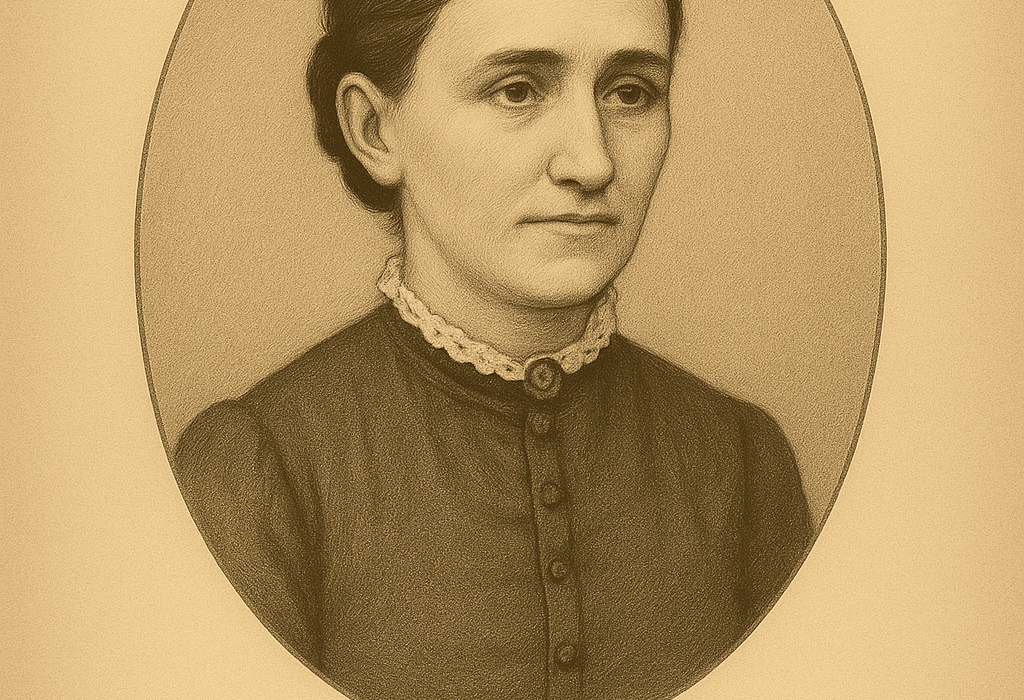
I have been fascinated with Nikola Tesla for as long as I can remember. His mind was lightning bottled in human form, a genius who seemed less a man and more a conduit of cosmic invention. For decades I have studied his life, read every biography I could find, and marveled at his visions of the future. Yet the deeper I dug into Tesla’s story, the more one figure emerged from the shadows, a woman almost invisible in the history books, yet indispensable to the man the world celebrates. His mother, Georgina “Đuka” Tesla, was the unseen engine who forged the discipline, endurance, and imagination that made Nikola possible.
To speak of Tesla’s brilliance without honoring the furnace that shaped it, his mother’s tireless, hidden labor, is to tell only half the story. The story of Nikola Tesla is known the world over. The eccentric genius, the wizard of electricity, the prophet of alternating current. But behind him stood a woman whose name most cannot pronounce and whose life modern ears would call unlivable. Raised without schooling, and remembered by her son as “indefatigable.”
She was illiterate. She never published a thing. She never gave a lecture. She never appeared on a podcast or launched a brand. Yet Nikola Tesla himself, the man whose brain ran on lightning, said: “Whatever I had accomplished in life was due to the influence of my mother’s guidance and genius.”
That sentence should stop the modern reader in their tracks. Because if you think the average woman today, latte in one hand, smartphone in the other, laundry piling up, Instacart order delayed, husband begging for attention, and children ignored or shipped off to public school has even a molecule of Đuka’s steel in her spine, you’re delusional.
Childhood of Sacrifice
Đuka was the eldest of eight children. At sixteen, just as her life might have blossomed into courtship or further training as a future wife, disaster struck. Her mother went blind. Suddenly, little Đuka was no longer just the daughter. She became the household’s surrogate mother, responsible for raising seven siblings and caring for her disabled mother on her own as her father grieved and worked 18 hour days to support his family alone.
Forget prom dresses, TikTok dances, or college “self-discovery years.” Imagine spending your late teens not at parties or summer camps, but hauling water, scrubbing floors, preparing food for ten mouths, mending clothes until your fingers bled, tending gardens, and keeping livestock alive, all before breakfast. That was Đuka’s youth. She sacrificed starting her own family to care for her siblings and her mother.
She learned discipline the hard way: not from motivational posters, not from a “self-care” influencer, but from necessity. And that steel, that unyielding capacity for sacrifice, was what she carried into her marriage and her motherhood. And all without any medications or “therapy”
Marriage and Household Dominion
In 1847, at age 25, she married Milutin Tesla, a Serbian Orthodox priest. This was not the life of a bishop’s palace or some grand estate. Their home in Smiljan was a two-room, single-story parish house, set on less than two acres of land. Two rooms. Seven people. Do the math.
There was no running water, no electricity, no air conditioning, no internet, no television, no delivery services, no refrigerator, and no modern cooking appliances. The fire had to be tended at all times, for warmth, for cooking, for survival. If it went out, you didn’t tap a button on a stove. You struck flint and rebuilt it, praying you had dry wood.
Milutin’s priestly stipend, after adjusting for today’s value, worked out to maybe $250 a week (around $200 was for the home). That was it. From this, Đuka ran the entire household. And by “ran,” I mean she orchestrated a full-scale domestic economy.
She grew food, raised animals, cooked every meal, milked cows, baked bread, chopped firewood, spun and wove textiles, embroidered clothing, repaired tools, cleaned, laundered, and disciplined children. She also directed the education and moral training of her children, all while inventing small household appliances and tools to make her work more efficient. She even bartered for labor, securing a full-time servant (paid partly in goods), and occasionally a seasonal helper at harvest.
Compare that to the modern housewife, who collapses if the Wi-Fi goes down for an afternoon, and cannot go 30-minutes without being glued to her screen!
A Day in the Life
Đuka rose between 4 and 5 a.m. every day. Before her children’s eyes opened, she had already stoked the fire, prepared bread, and made breakfast. The smoke of her chimney was the first signal of dawn seen in her parrish. She set the tone and the standard for her entire village.
After feeding her family, she assigned chores: older children hauling water, gathering kindling and firewood, or tending goats and chickens. She spun thread while keeping an eye on pots simmering over open flames. She repaired or made clothing while supervising lessons. She carried burdens on her back, her arms, and her mind, because literally everything depended on her vigilance.
The average modern woman struggles to fold a basket of laundry without streaming a podcast to “get through it.” Đuka did laundry by hand in icy rivers, scrubbing garments on stones until her knuckles cracked. She made clothes from the raw fibers of her sheep (after hand sheering them), not from a UPS delivery box. She preserved food without refrigeration. She raised children without screens, apps, or Google parenting blogs.
Her entertainment? Memorizing and reciting entire Serbian epic poems while working, keeping culture alive while stirring pots and mending garments. She could perform mental feats of memory that would shame most Ph.D.s today.
Where Was Her Husband?
Milutin Tesla was not absent in the modern deadbeat sense, he was a Serbian Orthodox priest. That meant his days were consumed with duties outside the home: conducting morning and evening services (daily), preparing sermons, teaching catechism, visiting parishioners, attending baptisms and funerals, keeping church records, writing correspondence, and mediating disputes in the community. His role was public, intellectual, and spiritual, and in the 19th-century Austrian Military Frontier, it was relentless.
Most days, he was physically present with his family only a couple of hours in the evening – if at all. The rest of the time, the survival of seven people on less than two acres of land rested squarely on Đuka’s shoulders.
But here is the truth: he could only do those things because he knew his wife carried the full burden of the home. Milutin could stand at the altar in confidence because Đuka was at the hearth in vigilance. He could walk the parish roads without fear because he knew she was managing the household economy, laundry, meals, gardens, livestock, firewood, repairs, schooling, children, clothing, textiles, and cleaning. He could pour his time into the parish because she poured herself out for the home.
If he was present in the house a couple of hours in the evening, it was only because the day had already been conquered by her labor. He stood in front of the parish with confidence because she stood behind the fire with vigilance. His priesthood was possible only because her household dominion was relentless. Without Đuka, his sermons go unwritten, his parishioners unvisited, his vocation undermined by a collapsing home. With her, he could appear serene and learned, because she was sweating, bleeding, and exhausting herself to hold everything together.
The Weight of Survival
Trips to the market were rare, perhaps once, maybe twice monthly. Everything else the family needed was grown, spun, woven, baked, butchered, bartered, or built at home. If they wanted flour, they ground grain. If they wanted clothes, they raised sheep for wool, spun the yarn, and wove the fabric. If they wanted milk or butter, they milked the cow by hand at dawn. Nothing arrived in a box, nothing came shrink-wrapped an nothing was outsourced.
Now take their average budget, the equivalent of about $200 a week in today’s money, and realize how thin that margin was. No restaurants, no Amazon, no Target runs, no streaming subscriptions, no electricity bill (just firewood), no internet bill (just survival). And here’s the kicker: the bulk of that money didn’t even go toward feeding the family. It went to feeding the animals. Sheep, chickens, cows, and horses all had to eat before anyone else did, because they were the very engines of survival. No fodder, no milk. No grain, no eggs. No hay, no wool. No horse, no plowing, no hauling, no transportation. The animals ate first, because they were the household’s machinery.
So Đuka stretched what little was left not only to clothe and feed seven people, but also to hire and/or barter labor, she maintained a full-time servant in addition to a seasonal helper at harvest. That was how iron-fisted her management had to be. Every coin and every crumb were leveraged to their maximum use.
And it worked. The household survived. More than survived: it became the soil from which sprang Nikola Tesla, the man who would dream electricity into a world still stumbling under gas lamps.
Genius in Disguise
Though illiterate, Đuka had a mind like a steel trap. She was known throughout her community for her inventive spirit and creative craftsmanship. She devised simple machines and tools to ease farming burdens, embroidered with unmatched skill, and preserved the dignity of her family under conditions that would have crushed weaker souls and nearly any modern woman.
Nikola himself admitted that his mind was a reflection of hers. “My mother invented and constructed all kinds of appliances. She wove the finest designs and possessed a memory beyond comparison. She could recite entire works of poetry, folk songs, and passages of Scripture without a single error.” Her memory was not casual, it was photographic, total, and living.
And here’s the uncomfortable truth for modern readers: that brilliance was born not in spite of her lack of schooling, but because of the uncluttered intensity of her life. She had no television flickering in the corner, no social media feeds dripping trivialities into her brain, no endless circle of “friends” distracting her with gossip. Her mind was free from digital noise and trivial entertainment, so it became a vault, capable of storing and recalling culture, scripture, and song with a precision that put most “educated” men to shame.
Modern feminists scream for “recognition,” demanding applause for simply existing. Đuka never demanded recognition. She did not tweet her embroidery or beg validation for memorizing verse. She simply lived, worked, and built her household with relentless discipline. And yet, her genius is stamped into the circuitry of the modern world through her son. If your phone glows in your hand today, if the grid hums around you tonight, it hums because a woman in a two-room parsonage lived without distraction and forged her son’s genius in the furnace of her own hidden brilliance.
Death and Legacy
Georgina “Đuka” Tesla died in 1892, having poured seventy years of labor into her family. Only one known photograph of her survives, a faint image of a stern but composed woman whose face bore the marks of firelight and toil.
No followers. No media presence. No glamour. No applause. No electricity, no modern convenience, no audience beyond the walls of her two-room house. And yet, from her hands came one of the greatest minds civilization has ever seen.
The modern woman scrolls TikTok while her dishwasher hums, her dryer spins, and her microwave beeps. She sighs about being “overwhelmed.”
Đuka Tesla ran an entire subsistence economy on two acres, in two rooms, with no machines, no running water, no help from her husband beyond evening hours, and only the discipline of her will to keep it all from collapsing.
This is what respect for home, husband, and family once looked like: sacrifice without complaint, invention without applause, rigor without escape. And if you want to understand Nikola Tesla, don’t start with lightning. Start with the woman who struck flint before dawn and carried fire until dusk, the woman who never stopped burning so that her household might live.