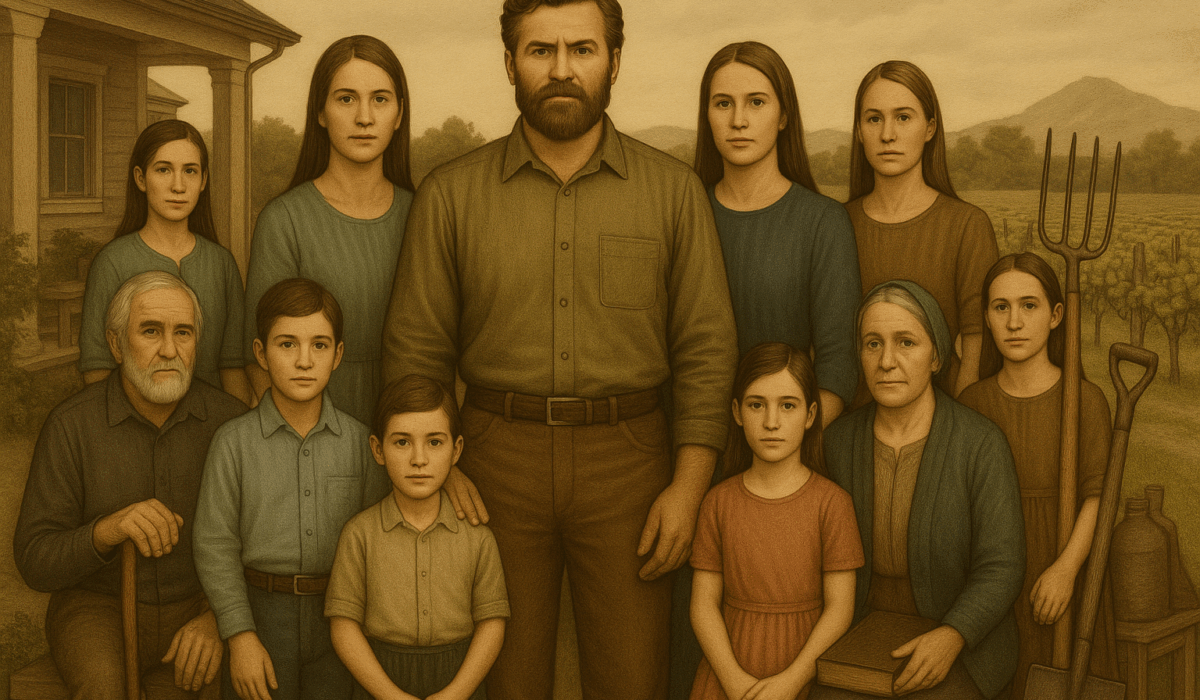
Part I: The Patriarchal Throne – The Husband and Head
At the center of all Biblical dominion, order, and governance is the man, more specifically, the husband, the patriarch, the head. He is not merely a participant in the home; he is the ordained ruler of it. The father is not a roommate, not a partner in democratic consensus, and certainly not a passive bystander to the whims of modern egalitarian delusion. He is king, priest, and judge, appointed by God Himself.
“But I would have you know, that the head of every man is Christ; and the head of the woman is the man…”
—1 Corinthians 11:3
The patriarch bears the full weight of responsibility for his domain; its order, protection, provision, instruction, expansion, and sanctification. His authority is not derived from consensus but from creation.
When Adam was made in the image of God (Genesis 1:26-27), he was given authority to subdue the earth, to name creation, and to exercise dominion. Eve was then made for Adam, not the reverse, as a helper suited to his calling (Genesis 2:18-24). From the beginning, man was called to lead, and woman was made to follow under his headship.
Throughout Scripture, we see this headship reinforced in households large and small. Abraham, Isaac, Jacob, David, and Solomon were not only husbands and fathers; they were household lords, managing wives, children, concubines, servants, herds, and land. The authority of the patriarch extended far beyond his marital bed. His word was law in his domain, and his house was his kingdom.
In the Book of Job, even after devastating loss, we see Job commanding his household in worship and sacrifice (Job 1:5). He is a high priest in his house, interceding on behalf of his children. In Joshua 24:15, we hear the rallying cry of Biblical headship: “As for me and my house, we will serve the LORD.” This is not a suggestion; it is a declaration of authority.
This is the model: the man under Christ, and all others under the man.
Part II: The Chief Support – The First Wife
The first wife is not a co-head, nor a “partner” in power-sharing. She is the first of her lord’s women, his chief helper, and by virtue of her position and tenure, often the most mature in management, domestic authority, and training others within the household.
“Wives, submit yourselves unto your own husbands, as unto the Lord. For the husband is the head of the wife…”
—Ephesians 5:22-23
Submission is not optional for the godly wife. It is a holy calling. The first wife is to adorn herself with meekness and a quiet spirit (1 Peter 3:1-6), showing reverence to her lord and modeling godly femininity to younger women and incoming wives. She teaches by example and often by instruction (Titus 2:3-5), helping to maintain order in the house, instructing the children, and managing servants or housemaids.
In polygynous homes, as seen with Jacob, Elkanah, or David, the first wife, while not more valuable in essence, often has the most experience and bears a stabilizing presence within the household structure. She must not see herself as in rivalry with the others, but as the anchor of order under her husband’s command.
In history, Hebrew patriarchs who had multiple wives often assigned specific roles and spaces within the household to each. Leah and Rachel had different relationships to Jacob, yet both served within the bounds of his authority and contributed to the growing household of Israel.
Modern attempts to flatten the roles of wives into indistinct equality tear at the very fabric of Biblical order. Each wife has her place, distinct, dignified, and under headship.
Part III: Additional Wives – Building the Household Through Polygyny
Polygyny is not a concession to sin; it is a tool for dominion when wielded in righteousness. While it requires greater discipline, provision, and godliness from the husband, it is thoroughly Biblical.
“And he had two wives; the name of the one was Hannah, and the name of the other Peninnah…”
—1 Samuel 1:2
The patriarchal household may include more than one wife. Each of these wives is fully under the headship of the husband. They are not competitors but collaborators in expanding the household, bearing children, managing the domestic sphere, and assisting in the mission of the home.
In Exodus 21:10, we see a regulation for polygyny: “If he take him another wife; her food, her raiment, and her duty of marriage, shall he not diminish.” This is not a condemnation of multiple wives, it is a regulation to ensure that each wife is treated justly. God does not condemn what He regulates. He affirms it by establishing its parameters.
Historically, the great patriarchs multiplied households not merely for pleasure, but for posterity. More wives meant more children. More children meant more workers, warriors, and worshipers. The house of Israel was built not by monogamy alone but by fruitful multiplication under righteous headship.
In such a household, the husband maintains final authority. Each wife is a helper to him, not to one another. He may appoint stewardships, order domestic schedules, and assign duties in alignment with the skill, season, and sanctification of each woman. Each wife serves the household by first serving the husband.
Part IV: The Concubines – Secondary but Sanctified
Concubines occupy a lower rank than wives but are still part of the household and under the man’s full headship and protection. In Scripture, concubines were often women of lower status, or foreign-born, or acquired in war, but once taken in by a man, they became his property and part of his household domain.
“And the sons of David that were born unto him in Hebron; and his firstborn was Amnon… and the second, Chileab… and the fourth, Adonijah… and the sixth, Ithream, by Eglah David’s wife.”
—2 Samuel 3:2-5
And again, “And Solomon had… three hundred concubines…”
—1 Kings 11:3
Concubines bore children and contributed to the strength and growth of the household. While they did not carry the full covenantal status of wives, their children were often included in inheritance, provided they found favor (as with Ishmael, the son of Hagar). A wise patriarch will rightly manage his concubines with kindness, order, and justice.
The role of the concubine, far from being degraded as in modern feminist myth, was one of honorable inclusion in the protection and provision of a patriarch. They were not left to fend for themselves or debased for lust, but sanctified through service and fruitfulness under headship.
Part V: The Children – Arrows in the Quiver of Dominion
The fruit of the womb is God’s reward (Psalm 127:3), and children are not to be viewed as accessories, burdens, or mere byproducts of marriage, but as soldiers-in-training, workers-in-waiting, and citizens of the household domain. They are the future of the house, and the more arrows a man has, the stronger his hand when facing enemies at the gate (Psalm 127:4–5).
“And ye fathers, provoke not your children to wrath: but bring them up in the nurture and admonition of the Lord.”
—Ephesians 6:4
Children are not to rule the home, but to be ruled. They are to obey their father and mother, learning the way of the Lord, the traditions of their people, and the duties of their station. Sons are trained to become patriarchs. Daughters are prepared to become fruitful, submissive wives. The training of children is not neutral or optional. It is kingdom work.
The son is the crown of his father’s legacy. The daughter is a precious vessel to be guarded, cherished, and rightly placed under a worthy man’s headship in due time. In Genesis 18:19, God says of Abraham:
“For I know him, that he will command his children and his household after him…”
The children were not his “equal housemates.” They were commanded.
In patriarchal households of Scripture and history, children served in their father’s business, tended the flocks, studied Scripture, memorized law, practiced defense, honored elders, and learned their trade. The modern model of children sitting idly for hours a day in state schools to be indoctrinated by pagans is foreign to the Word of God.
In Biblical and historic Christian homes, children knew their place. They rose for elders (Leviticus 19:32). They addressed parents with respect. Disobedience was met with swift correction, not merely for behavior modification but to uphold order. The rod was not cruelty, it was covenantal love.
A man without children, or one who refuses to multiply, builds no future. A woman who avoids motherhood, refuses to stay at home or “builds her career” rejects the very purpose of her creation (1 Timothy 2:15). Children are not optional in the Biblical household. They are its strength, its future, and its duty.
Part VI: Extended Family and Generational Stewardship
Biblical households were multi-generational by design. This is not merely cultural, it is covenantal. When God revealed Himself to Abraham, He did not speak only of Abraham’s immediate offspring but of generations yet unborn (Genesis 17:7). The vision was never short-term.
The patriarch must not only govern his wives and children, but also provide counsel, hospitality, and often headship over the wider family network, his aged parents, brothers in need, sisters without husbands, widows, nephews, nieces, and so on. This hierarchy extended well beyond the nuclear model. It was clan, tribe, household, estate.
“Honour thy father and thy mother: that thy days may be long upon the land…”
—Exodus 20:12
Honor does not cease when a man leaves his father’s house. It transforms. A mature son may rise to household headship, yet he still shows reverence, provision, and remembrance of his elders. The righteous man lays up an inheritance not only for his children but his grandchildren (Proverbs 13:22).
In 1 Timothy 5:4, we see the call to provide for one’s own widows and family members:
“Let them learn first to shew piety at home, and to requite their parents…”
This is household hierarchy in action.
In historical patriarchal societies, it was common for sons to build new structures on the family land, for widowed grandmothers to be cared for by sons or grandsons, and for unmarried aunts to help manage younger children and household affairs. The family was not scattered by mobility and personal ambition. It was rooted, orderly, and loyal.
The modern spirit of independence, each person going their own way, is a product of rebellion, not righteousness. God intends His people to live in covenant households, extending the patriarchal blessing through time, space, and dominion.
Part VII: Unmarried Women and the Mantle of Headship
Unmarried women, whether daughters, orphans, sisters, or even strangers are never meant to float ungoverned. There is no such thing as “independent womanhood” in God’s design. Every woman is to be under male headship; first her father, then her husband, or in the absence of both, a male relative, church-appointed patriarch, or willing male patriarch.
“But if any widow have children or nephews, let them learn first to shew piety at home…”
—1 Timothy 5:4
This principle applies not only to widows but to all women without husbands. Headship is protection. It is oversight. It is authority and love. A woman without headship is vulnerable, unguarded, and subject to deception.
When Dinah, daughter of Jacob, “went out to see the daughters of the land” without male covering, she was defiled (Genesis 34). Her brothers had to avenge her. Her father grieved. This is what happens when young women wander without headship.
In Biblical times, a father would carefully manage the courtship and marriage of his daughters. Dowries were exchanged, and suitors were examined. The daughter remained under her father’s rule until transferred to her husband’s. No woman was “out on her own.”
In cases where a woman was orphaned or lacked brothers, the nearest male relative took responsibility. Ruth was under Boaz’s covering. Esther was under Mordecai’s. This is the way of righteousness.
A Biblical household must not allow unmarried women to make major decisions, travel alone, or build independent financial empires. She must be under headship without exception. This is not oppression, but divine order.
Part VIII: Widows – Honor Without Headship?
While widows occupy a unique position, they are not exempt from the principles of household structure. If the widow is young, she is encouraged to remarry and bear children (1 Timothy 5:14). If she is older, godly, and without family, the church may appoint support, but even this is based on merit, not entitlement (1 Timothy 5:9-10).
A widow in her son’s home is under his headship. If she has no sons, her brothers, nephews, or church elders may be called upon to provide covering and counsel. Scripture does not leave widows to fend for themselves in libertarian loneliness.
The widow Anna in Luke 2:36–37 is honored not for becoming autonomous, but for her continual devotion and service in the temple. Her holiness, prayer, and example were under temple headship.
Biblical history is filled with righteous widows who continued in the family estate, taught younger women, raised grandchildren, or served under elder sons. They were not CEOs of their own brand. They were servants of God’s household order.
A righteous household honors widows, but does not release them from oversight.
Part IX: Housemaids, Servants, and Hired Help in the Household Order
A growing household will require labor, domestic help, field workers, tutors, and stewards. These individuals, while not family by blood or covenant, are still under the authority of the patriarch. Their inclusion in the home does not erase hierarchy. It reinforces it.
“And he that is born in thy house, and he that is bought with thy money, must needs be circumcised…”
—Genesis 17:13
Even the bondservant in Abraham’s house was brought into the covenant structure. The household of faith includes workers, but under clear command and sanctified culture.
In Proverbs 27:18, Solomon speaks of the faithful servant who shall be honored:
“Whoso keepeth the fig tree shall eat the fruit thereof: so he that waiteth on his master shall be honoured.”
The housemaid is under the mistress of the house, yet ultimately under the husband. The male servant answers to the master. Hired help must obey the house laws and customs. They do not bring their own philosophies, customs, or rebellion.
In historical patriarchal estates, tutors trained children in Scripture and classical knowledge, housemaids served under the stewardship of the wives, and farmhands served loyally for years, often being adopted into the household structure by covenant or marriage.
Modern Christians who hire outside help must remember: they are not employers only, they are household lords. A man must train, oversee, and discipline those in his employ. If rebellion arises, it must be purged. If loyalty is proven, it must be rewarded.
Part X: Conclusion – God’s Household Is Not a Democracy
The Biblical household is not a modern democracy, where votes are tallied and opinions are weighed like market preferences. It is a hierarchy. It is a kingdom in miniature. It is the theater of dominion.
“Let all things be done decently and in order.”
—1 Corinthians 14:40
From the headship of the man, to the sacred submission of the wives, to the fruitful labor of the children, to the honor of the aged, to the sanctification of concubines, and the service of hired hands, God’s household model is beautiful in its order.
The collapse of society begins with the collapse of this structure. Feminism, individualism, statism, and sexual rebellion have all sought to destroy the Biblical household. But the righteous man rebuilds the ruins.
Let the men of God rise. Let them take dominion. Let them rule their homes with righteousness, dignity, discipline, and divine law. Let their households shine as embassies of Heaven in a dark world.
And let every soul within those homes find their place, their purpose, and their peace, under the hierarchy of the Biblical household.
“Except the LORD build the house, they labour in vain that build it…”
—Psalm 127:1
Part XI: The War Against Household Hierarchy
The modern world has launched an all-out assault against the divine order of the Biblical household. The feminist revolution, egalitarian churches, Marxist ideologies, and liberal governments have all collaborated; knowingly or unknowingly, to dethrone the patriarch and dissolve the sacred chain of command that holds the household, and by extension, civilization, together.
Where once fathers ruled their houses with dignity and strength, they are now mocked, legally castrated, or made irrelevant. Where once wives joyfully submitted and gloried in their domestic dominion, they are now told to chase careers, delay marriage, despise childbearing, and rule over their husbands. Where once children were subject to their parents, they now threaten them with legal retaliation, indoctrinated by state education to rebel and sever ties with their ancestral faith.
This is not accidental. It is warfare.
“This know also, that in the last days perilous times shall come. For men shall be lovers of their own selves… disobedient to parents… without natural affection, trucebreakers…”
—2 Timothy 3:1–3
God’s Word warned us of this time. The rebellion of children, the inversion of gender roles, the abandonment of elders, and the dissolution of family ties are all signs of a world unraveling under demonic influence.
But the righteous remnant must resist.
The answer is not compromise. The answer is not adapting the household to modern sensibilities. The answer is returning to the ancient paths, to the patriarchal, hierarchical, theocratic household that reflects Heaven’s order on Earth.
“Thus saith the LORD, Stand ye in the ways, and see, and ask for the old paths, where is the good way, and walk therein…”
—Jeremiah 6:16
Part XII: Reinstating the Biblical Household Hierarchy – Practical Steps
Restoring God’s household model is not merely theological. It must be practical. The man of God must begin where he is, repent of the world’s lies, and build brick by brick according to Scripture.
1. Reclaim Your Authority
Begin with repentance. A man who has abdicated his role must confess it before God and his family. Then, without shame or apology, he must take up the mantle of household headship. He must order his home, and not ask permission. Authority is not taken by consensus but enacted by conviction.
2. Restructure the Home
Define roles. Clarify expectations. Hold family meetings where the hierarchy is explained clearly. Scripture must be opened. Prayers must be led. Duties must be assigned. Confusion is a breeding ground for rebellion; clarity is a cradle for peace.
3. Rebuild Household Worship
The patriarch must lead daily worship. Reading Scripture, singing psalms or hymns, and praying together establishes God’s presence and authority in the home. The household becomes a church in miniature (1 Corinthians 16:19, Colossians 4:15).
4. Reeducate the Household
All household members must be re-taught their place. Wives should study passages like Proverbs 31, Ephesians 5, Titus 2, and 1 Peter 3. Children should memorize the Ten Commandments and Proverbs. Even servants and workers should be instructed in household customs and Christian virtues.
5. Replace Worldly Influences
Purge the home of feminist literature, anti-family media, and worldly philosophies. Remove access to subversive content on phones, computers, or TV. Set boundaries on music, conversation, and entertainment. Your house must become a sanctuary, not a highway for hell.
6. Receive More – Grow the House
A faithful man may add wives, children, concubines, servants, and sojourners under his roof if he has mastered the structure God already gave him. A house in order can and should expand regularly.
7. Repeat the Vision
Teach it to your sons, remind your wives, write it on the walls, and declare it boldly. God’s household order must not be an occasional sermon, it must be the ever-present culture of your home.
Part XIII: The Beauty and Fruit of a Hierarchical Household
What is the fruit of this structure?
Peace. A household without confusion or rebellion is a haven from the chaos of the world.
Productivity. When every member knows their role and works accordingly, the house becomes a thriving center of economy, education, hospitality, and worship.
Protection. Under a strong patriarch, no member of the household is left vulnerable. Widows are cared for, children are guarded, wives are defended, and even strangers find sanctuary.
Posterity. Households ordered by God produce faithful generations. They endure, expand, and exert influence far beyond their gates.
Praise. Such homes glorify God. They are a testimony to His design, a rebuke to the world, and a beacon to those seeking truth.
Scripture describes the righteous household in glowing terms:
“Thy wife shall be as a fruitful vine by the sides of thine house: thy children like olive plants round about thy table. Behold, that thus shall the man be blessed that feareth the LORD.”
—Psalm 128:3–4
This is not fantasy. It is promise. It is reward for obedience.
Part XIV: Answering the Objections of the Rebellious
Objection 1: “Isn’t hierarchy oppressive?”
No. God is a God of order (1 Corinthians 14:40). Hierarchy is how love, care, and responsibility are administered. Oppression is when authority is stolen, not when it is rightly exercised.
Objection 2: “Didn’t Jesus promote equality?”
Jesus honored the Law (Matthew 5:17–19). He obeyed His Father. He submitted to authority. He did not come to flatten roles but to fulfill righteousness. In His own household, He appoints apostles, elders, and stewards. Hierarchy abounds.
Objection 3: “Isn’t polygyny unloving?”
Polygyny rightly practiced is one of the most loving acts a man can perform, offering protection, provision, and headship to more women who would otherwise be unguarded. Scripture praises it in numerous places, including Jacob, David, and others.
Objection 4: “Can’t women be independent and still be godly?”
No. Independence is a modern fiction. All people, men and women, are to be under God’s order. For a woman, this includes male headship. The only “independent” women in Scripture were either under judgment or divine exception, not ideal models.
Part XV: Let the Households Rise
We live in an age of rebellion. The tower of Babel is being built again. Men cast off restraint, women usurp authority, children rule parents, and governments invade the sacred domain of the home. But there is hope for those who will return to The Great Order.
It begins with a man. One man. A father. A husband. A head.
It continues with his obedience, his unwavering, unapologetic, Scriptural, historical, manly submission to God and command over his domain.
Let the man rise.
Let his wife submit joyfully and serve in her sphere with dignity.
Let his additional wives multiply his legacy.
Let his concubines increase the labor and children of the house.
Let his children grow in wisdom and stature, serving under discipline and love.
Let his unmarried sisters, daughters, or dependents flourish under his guardianship.
Let his aged parents dwell in honor.
Let his servants work in loyalty and be cared for in justice.
Let his house sing psalms, build wealth, raise armies of righteousness, and shine as a model for the Kingdom to come.
“In that day shall five men take hold of one man…”
—Isaiah 4:1
Why? Because the man of God will be rare. He will be refuge.
Let that man be you.
Let that household be yours.
And let the glory of God be seen in the hierarchy of every righteous home.