Summary: For those who lack the endurance to read what men used to write before attention spans died, Click here the short version
⚔️ Summary for the Slumbering
This article lays down a simple, inconvenient truth: a household without written law is not ruled, it is reacted to. God Himself set the pattern: He didn’t merely say His commandments; He wrote them, posted them, and enforced them with blessing and curse (Sinai, doorposts, Deut. 28). Writing is covenant, a public witness that ends excuses and stabilizes order.
History agrees: Hammurabi’s stelae, Rome’s household codes, the Apostles’ written commands, and the Reformers’ posted rules – all testify that leaders codify expectations if they plan to be obeyed beyond a single conversation or mood. Modern psychology even concedes the same: clear, visible, consistent rules produce peace and maturity.
Practically: spoken rules invite argument; written law brings clarity, trains children, shields wives from mood-based rulership, and creates legacy that outlives the man. But law without teeth is wallpaper: post it publicly, enforce it consistently, amend it only in writing. Answer the predictable whines (“legalism,” “controlling”) by noting: everyone submits to written law at work and on the road, why should the household be the lone lawless zone?
Verdict: Patriarchs write, post, and enforce. Anything less is abdication. Do it now: codify the rules, hang them where all can see, apply consistent discipline, and hand your sons a constitution they can inherit.
I. The Divine and Historical Precedent of Written Law
The Necessity of Writing: God Himself as the Example
If you want to understand the necessity of writing the law of your house, you must first look to God Himself. From the very beginning, He set the pattern: His law was not merely spoken, it was written.
Consider the moment at Mount Sinai. God thunders His commandments in fire, cloud, and trembling. Israel shakes with fear. But He does not stop at words. He carves them into permanence:
Exodus 31:18 (KJV):
And he gave unto Moses, when he had made an end of communing with him upon mount Sinai, two tables of testimony, tables of stone, written with the finger of God.
Here is the Almighty stooping to our level, giving His law in writing. Think about that: the One who created speech, who could have left His commandments in the air, chose instead to inscribe them into stone. Why? Because He knew human memory, human excuses, and human rebellion. He knew that spoken words could be twisted or forgotten. But stone endures.
If God Himself found it necessary to write down His laws for His children, what makes you think your household will flourish without written rules? Are you wiser than God? Stronger than stone? Or have you been deceived into thinking that your family can thrive on guesswork, impressions, and mood-based leadership?
No, the divine precedent is clear: the head of a people writes his law.
The Posting of the Law: Public, Visible, Constant
God’s instructions went beyond carving stone tablets. He commanded that His words be taught, repeated, and posted. His law was not a private journal entry for the father’s eyes alone; it was a public standard for the entire household.
Deuteronomy 6:6–9 (KJV):
6. And these words, which I command thee this day, shall be in thine heart:
7. And thou shalt teach them diligently unto thy children, and shalt talk of them when thou sittest in thine house, and when thou walkest by the way, and when thou liest down, and when thou risest up.
8. And thou shalt bind them for a sign upon thine hand, and they shall be as frontlets between thine eyes.
9. And thou shalt write them upon the posts of thy house, and on thy gates.
Notice the layers:
- In your heart – internal conviction.
- Teach them diligently to your children – vocal instruction.
- Talk of them daily – conversational reinforcement.
- Bind them to your body – physical reminders.
- Write them on your doorposts and gates – visible posting in the home.
God covers every angle. He knew Israel would drift if His law was not continually reinforced. He knew that silence breeds forgetfulness, and forgetfulness breeds rebellion. So He required fathers to literally engrave His commands into the architecture of their homes.
The implication for the patriarch today is unavoidable: if your household law is not visible, posted, and constant, you are not obeying God’s model. You are ruling less effectively than ancient Israelite peasants.
Written Law as Covenant
Why written law? Because writing is covenantal. Spoken words evaporate. Written words bind. Every covenant in Scripture, from Noah to Abraham to Moses to David, is sealed in writing. The Bible itself is a written covenant.
Consider the words of Moses:
Deuteronomy 31:24–26 (KJV):
24. And it came to pass, when Moses had made an end of writing the words of this law in a book, until they were finished,
25. That Moses commanded the Levites, which bare the ark of the covenant of the Lord, saying,
26. Take this book of the law, and put it in the side of the ark of the covenant of the Lord your God, that it may be there for a witness against thee.
Here, the written law itself is called a witness. It testifies. It holds the people accountable. It is not subject to memory or revisionist arguments. It stands as a fixed point of truth.
When you write the law of your household, you are creating a covenantal witness. You are making rebellion indefensible. You are declaring: This is the standard. This is our covenant. This is the order of this house.
Historical Witness: Hammurabi’s Code
Let’s leave Israel for a moment and look at the pagans. Even the godless understood the necessity of written law. Hammurabi, king of Babylon (c. 1754 BC), created one of the world’s oldest legal codes. He did not merely issue commands from his throne. He had them engraved in stone on large stelae and set up in public places.
The prologue to his code declared that these laws were given “so that the strong might not oppress the weak.” In other words, written law was protection, clarity, order. It ended excuses. It standardized justice.
Now imagine a father who shrugs at this. He expects his children to obey rules he has never defined. He disciplines inconsistently, changing the standard week by week. He allows his wife to argue, “But you never said that.” Brothers, understand this: such a man has less order in his house than Hammurabi had in pagan Babylon.
Is that really the standard you want to fall short of?
Roman Household Codes: The Paterfamilias
Move forward to Rome. The Roman household revolved around the authority of the paterfamilias, the father of the family. His rule was absolute. But absolute authority requires written order. Thus, Rome developed household codes, defining expectations for wives, children, and slaves.
This tradition influenced even the New Testament writers. Paul and Peter adopted the household code format to instruct Christian families. These were not “open conversations.” They were written, published rules for Christian households.
Ephesians 5:22–25 (KJV):
22. Wives, submit yourselves unto your own husbands, as unto the Lord.
23. For the husband is the head of the wife, even as Christ is the head of the church: and he is the saviour of the body.
24. Therefore as the church is subject unto Christ, so let the wives be to their own husbands in every thing.
25. Husbands, love your wives, even as Christ also loved the church, and gave himself for it;
Colossians 3:20–21 (KJV):
20. Children, obey your parents in all things: for this is well pleasing unto the Lord.
21. Fathers, provoke not your children to anger, lest they be discouraged.
Notice: these are written instructions, preserved for all Christian households. They are not whispers in a corner, they are published law for the people of God.
If Rome knew that order required codification, and if the apostles themselves committed household standards to writing, then what excuse does the modern patriarch have for not writing and posting his rules?
The Reformation Household Rules
Fast-forward to the Protestant Reformation. Reformers like Martin Luther understood that reformation begins at home. And a reformed home requires law. Luther wrote catechisms not only for churches but for fathers to teach in their houses. He instructed fathers to lead daily prayers, Scripture reading, and discipline.
This tradition birthed Hausväterliteratur, “Housefather literature.” These were manuals filled with written household rules: when to rise, when to work, when to pray, when to eat, when to sleep. Families were to see and know the structure. It was not left to “understanding” or “conversation.” It was posted and practiced.
In Reformation Europe, a father who did not post household rules was seen as negligent. His house was not godly, but chaotic. The same principle applies today.
The Pattern is Universal
Step back and survey the landscape:
- God wrote His law in stone.
- Israel posted His law on their homes and gates.
- Moses placed the law as a witness in the Ark.
- Hammurabi engraved laws in public stone.
- Rome codified household standards.
- The apostles wrote household codes in Scripture.
- The Reformers required written household rules.
Across cultures, times, and religions, the principle is the same: a people without written law cannot endure. And yet modern patriarchs, who should know better, often try to run their homes without it. They rule by whim. They govern by mood. They argue endlessly because nothing has been codified.
This is not strength, but weakness disguised as authority. It is chaos masquerading as leadership.
The case has been made from divine precedent and historical witness: written law is not optional. It is the foundation of authority. From Sinai to Babylon to Rome to Wittenberg, rulers have known: you cannot govern without posting law.
If you, as patriarch, want to be taken seriously, you must follow the same path. Write your household law. Post it in your home. Make it visible, constant, inescapable. For without written law, you will not have order, you will have endless debate, manipulation, and failure.
II: The Practical Necessity of Written Law in the Home
Spoken Law vs. Written Law
There is a vast difference between a command spoken in passing and a law written in permanence. Spoken law is fragile. It relies on memory, interpretation, and the willingness of others to admit what was said. Written law is strong. It stands as an impartial witness.
How many arguments in your house could have been ended before they even began if you had written law? How many times has your wife or child said: “You never told me that” or “That’s not what you said last week”? Without writing, you have no way to prove otherwise. Your authority is reduced to a matter of opinion.
This is not a new problem. God anticipated it. That is why He commanded Moses not only to speak His law, but to write it down and place it as a permanent testimony.
Deuteronomy 31:24–26 (KJV):
24. And it came to pass, when Moses had made an end of writing the words of this law in a book, until they were finished,
25. That Moses commanded the Levites, which bare the ark of the covenant of the Lord, saying,
26. Take this book of the law, and put it in the side of the ark of the covenant of the Lord your God, that it may be there for a witness against thee.
The law itself became a witness. If Israel claimed ignorance, the written word exposed their lie. The same principle applies to your household. Without written law, you invite endless excuses. With written law, you have an impartial standard.
The Household as a Kingdom
Your household is not merely a collection of individuals who happen to live under the same roof. It is a kingdom. You are the king. Your wife is the queen. Your children are subjects. The question is not whether you rule, but how. Do you rule by whim, or do you rule by law?
A king who rules by moods is not respected. His decrees shift daily. His people live in fear, not order. Such is the house where the father has no written law. One day the rule is bedtime at 9:00. The next day it is 10:00. One day he insists on dinner at the table. The next he tolerates chaos. His house is not a kingdom of peace but a circus of inconsistency.
But a king who writes his law rules with clarity. His people know what is expected. His authority is not arbitrary but structured. His enforcement is not unpredictable but consistent.
This is why written law is necessary: it transforms your authority from emotional reaction into established governance.
Law as Protection
One of the great lies of modernity is that rules are oppressive. In truth, rules are protective. The absence of rules does not produce freedom; it produces chaos, insecurity, and fear. Children raised without clear boundaries grow anxious and rebellious. Wives left without household order become manipulative and discontent.
Scripture makes this clear:
Proverbs 29:18 (KJV):
18. Where there is no vision, the people perish: but he that keepeth the law, happy is he.
A household without vision and law perishes. A household with law flourishes. The law is not your enemy. It is your family’s safety net.
Sociological Evidence: Why Rules Must Be Written
Even secular research confirms what Scripture and history already teach: families thrive when rules are clear, consistent, and posted.
- Baumrind’s Parenting Styles (1966–1991): Psychologist Diana Baumrind identified three main parenting styles: permissive (no rules), authoritarian (rules without warmth), and authoritative (rules with consistency and care). The healthiest, most well-adjusted children came from authoritative homes, those with clear, enforced rules.
- Journal of Family Psychology (2002): A study showed that households with clearly articulated and posted rules reported less conflict and stronger family cohesion. Families without visible rules reported confusion, arguments, and power struggles.
- Child Development Research (2010): Children raised with consistent boundaries had higher academic achievement, better social behavior, and lower rates of anxiety.
The data only confirms what the Bible has said for millennia: law brings blessing.
The Benefits of Written Household Law
1. Clarity: No Excuses, No Confusion
The number one excuse of rebels is ignorance. “I didn’t know.” “You never said.” Written law eliminates this excuse. It puts your rules beyond dispute. The wall testifies against rebellion.
This is why God told His people to post His laws on their homes:
Deuteronomy 11:20 (KJV):
20. And thou shalt write them upon the door posts of thine house, and upon thy gates:
The home itself was to be marked by visible law. Imagine how different your household would be if the rules of your house were posted boldly where no one could deny them.
2. Authority: The Law Speaks for You
Written law allows you to stop repeating yourself. Instead of constant nagging, you simply point to the posted rule. You are not the bad guy, the law is. And since the law is your word in writing, your authority remains intact.
This is what Moses meant when he said the law was a witness. It enforced itself.
3. Training: Children Raised Under Law
Children raised in a house with written law grow up knowing that rules are objective and binding. They learn to respect standards outside of themselves. They are not trained in relativism but in order.
Contrast this with children raised in lawless homes. They learn manipulation. They test boundaries constantly. They never know where the line is, so they live in tension and rebellion.
Ephesians 6:1–4 (KJV):
1. Children, obey your parents in the Lord: for this is right.
2. Honour thy father and mother; which is the first commandment with promise;
3. That it may be well with thee, and thou mayest live long on the earth.
4. And, ye fathers, provoke not your children to wrath: but bring them up in the nurture and admonition of the Lord.
The “nurture and admonition” Paul speaks of is not guesswork. It is structured discipline and clear instruction, written, taught, and enforced.
4. Legacy: Law Beyond the Man
When you die, your words die with you. But written law remains. Your children can carry the same posted rules into their own homes. Your daughters can honor the consistency they grew up with. Your sons can post the very same laws on their own walls.
Written law outlives you. It becomes a family tradition, even a generational legacy.
Examples from History and Culture
Hammurabi’s Legacy
We saw in Section I that Hammurabi posted his laws in stone. But consider the result: his code influenced civilizations for centuries. The fact that it was written preserved it for millennia. A father who refuses to write his household law is refusing to create a legacy.
Roman Order vs. Barbarian Chaos
The Romans despised the Germanic tribes not only for their violence but for their lack of written law. To the Romans, a people without written statutes were uncivilized. Likewise, a household without written rules is barbaric.
Reformation Discipline
During the Reformation, fathers who ran their houses without written rules were considered negligent. Luther and Calvin insisted that fathers train their children daily with written catechisms and posted prayers. They knew that without written guidance, the next generation would drift.
Answering the Excuses & Objections
Excuse 1: “Isn’t This Legalistic?”
When men sneer that written rules are “legalistic,” they reveal their own rebellion. Law is not the enemy. Paul says:
Romans 7:7 (KJV):
7. What shall we say then? Is the law sin? God forbid. Nay, I had not known sin, but by the law: for I had not known lust, except the law had said, Thou shalt not covet.
The law reveals sin. Without it, you cannot even define rebellion. Written rules are not legalism; they are the very means by which sin and obedience are defined.
Excuse 2: “Won’t My Wife Think I’m Controlling?”
If your wife resents law, she resents being ruled. That is not your problem, it is hers. A good wife rejoices when the standard is clear. She would rather live under posted rules than under the tyranny of unpredictable moods.
If she argues that written rules are “controlling,” ask her why she obeys traffic signs, tax codes, and work policies without complaint. She lives under written law everywhere else. Why should the household be the one place where law is unwelcome?
Objection 1: “Isn’t This Harsh?”
Modern ears recoil at the word “law.” They prefer “guidelines,” “principles,” or “family values.” But Scripture does not blush at law. The psalmist delights in it:
Psalm 19:7–8 (KJV):
7. The law of the Lord is perfect, converting the soul: the testimony of the Lord is sure, making wise the simple.
8. The statutes of the Lord are right, rejoicing the heart: the commandment of the Lord is pure, enlightening the eyes.
Law is not cruelty, it is clarity. Law is not harsh, it is merciful. It spares your wife and children the torment of guessing. It frees them from the anxiety of not knowing where the boundaries are.
The harshness is not in law, but in lawlessness. A lawless home produces fear, manipulation, and constant conflict. A lawful home produces peace.
Objection 2: “Won’t My Wife Resent It?”
If your wife resents written law, the problem is not the law but her rebellion. She lives under written law everywhere else, in her workplace, in her city, in her nation. She obeys speed limits, tax codes, and employee handbooks without complaint. Yet in the one place where law is most necessary, the household, she objects? That is not reason; that is rebellion.
A wife who loves order will rejoice in posted law. It tells her what is expected. It removes uncertainty. It protects her from being ruled by mood.
Practical Steps for Fathers
- Write Your Law Clearly
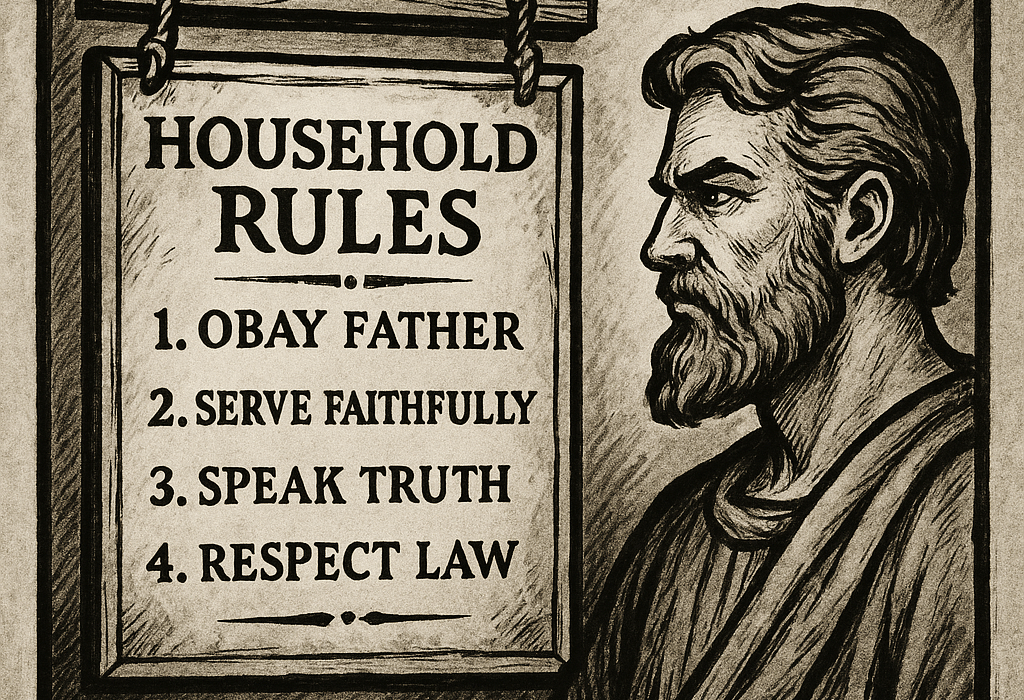
- Keep rules short and simple. Example: “No phones at the table. Bedtime at 9:00. Church attendance mandatory.”
- Keep rules short and simple. Example: “No phones at the table. Bedtime at 9:00. Church attendance mandatory.”
- Post It Publicly
- The law that lives in your notebook is no law. Put it on the wall. Kitchen, dining room, or entryway.
- The law that lives in your notebook is no law. Put it on the wall. Kitchen, dining room, or entryway.
- Enforce It Consistently
- A law ignored is no law at all. If you write it, you must back it every time.
- A law ignored is no law at all. If you write it, you must back it every time.
- Revise in Writing
- Moses refined case law. Kings issued decrees. You may adjust as needed, but always in writing.
- Moses refined case law. Kings issued decrees. You may adjust as needed, but always in writing.
The practical necessity of written household law is undeniable. Without it, you invite confusion, excuses, rebellion, and chaos. With it, you create clarity, authority, training, and legacy.
God commanded His people to post His laws on their homes. Hammurabi posted his laws in stone. Rome codified its households. The Reformers posted rules in their homes. Even modern psychology confirms: rules must be visible and consistent.
Why would you, as patriarch, imagine that your house will succeed where all others have failed? Without written law, you are not ruling, you are reacting. But with written law, you establish order, train your children, protect your wife, and leave a legacy of discipline.
III: Enforcing and Living by Written Household Law
The Final Step: Law Without Enforcement is No Law
You can carve commandments in stone. You can post them on your walls. You can declare them morning, noon, and night. But if you do not enforce them, they are nothing more than decorations.
A written law without enforcement is not law, it is wallpaper. A patriarch who writes but does not act is no better than the lazy king who issues decrees but never punishes rebellion. His household will quickly learn that the posted rules are a joke.
This is why Moses, after writing the law, did not stop at ink and parchment. He gathered Israel, read the law aloud, and declared blessings for obedience and curses for disobedience. The law carried teeth. It had consequences.
Deuteronomy 28:1–2 (KJV):
1. And it shall come to pass, if thou shalt hearken diligently unto the voice of the Lord thy God, to observe and to do all his commandments which I command thee this day, that the Lord thy God will set thee on high above all nations of the earth:
2. And all these blessings shall come on thee, and overtake thee, if thou shalt hearken unto the voice of the Lord thy God.
Deuteronomy 28:15 (KJV):
15. But it shall come to pass, if thou wilt not hearken unto the voice of the Lord thy God, to observe to do all his commandments and his statutes which I command thee this day; that all these curses shall come upon thee, and overtake thee:
Notice the clarity: blessing for obedience, curse for rebellion. The law was not optional. It was not a “suggestion.” It was binding, enforced, and serious. So too must the law of your household be.
How to Establish and Enforce Household Law
Step 1: Write It Clearly
Do not write vague generalities. Do not write philosophical musings. Write short, direct, enforceable rules. Examples:
- “No phones at the dinner table.”
- “Children in bed by 9:00 PM.”
- “Church attendance is mandatory.”
- “Chores must be completed before leisure.”
These are rules that can be enforced, not merely admired.
Step 2: Post It Publicly
God commanded Israel to post His law on doorposts and gates. Why? So that no one could plead ignorance. The same principle applies to your household. Post your law where all can see, dining room, kitchen, entryway.
Step 3: Enforce Consistently
A law unenforced is no law at all. If you ignore violations, you teach your family that your words are meaningless. Every time the law is broken, respond. Discipline swiftly, consistently, and without apology.
Ecclesiastes 8:11 (KJV):
Because sentence against an evil work is not executed speedily, therefore the heart of the sons of men is fully set in them to do evil.
If you delay enforcement, rebellion festers. Speedy discipline prevents escalation.
Step 4: Revise in Writing
Do not adjust rules by whim. If a rule must change, change it in writing. Issue an amendment. Post it clearly. Your family must see that law evolves only through written decree, not casual suggestion.
The Cost of Lawlessness
What happens when a patriarch refuses to write and enforce household law? The results are predictable:
- Children Manipulate – Without clear rules, they push boundaries constantly. They live in confusion and rebellion.
- Wives Argue – Without posted law, she insists on her own interpretations. Every correction becomes a debate.
- Fathers Weaken – Without law, you are reduced to nagging, pleading, and shouting. Your authority becomes laughable.
- The Household Collapses – A lawless home is not a home. It is a hotel of individuals sharing space.
Scripture warns:
Judges 21:25 (KJV):
In those days there was no king in Israel: every man did that which was right in his own eyes.
This is the state of the lawless household. Without written law, every member does what is right in his own eyes. The result is chaos.
The Blessing of a Lawful House
By contrast, a household with posted law enjoys peace. Everyone knows the standard. No one can argue ignorance. Discipline is consistent. Authority is respected.
Psalm 119:165 (KJV):
Great peace have they which love thy law: and nothing shall offend them.
Peace flows from law, therefore a lawful home is a peaceful home.
Legacy: Law Beyond the Man
The final reason to post written household law is legacy. Your voice will one day fall silent. But the written law will remain. Your children can carry it forward. Your grandchildren can inherit it.
Consider Joshua’s declaration:
Joshua 24:15 (KJV):
15. And if it seem evil unto you to serve the Lord, choose you this day whom ye will serve; whether the gods which your fathers served that were on the other side of the flood, or the gods of the Amorites, in whose land ye dwell: but as for me and my house, we will serve the Lord.
Joshua did not merely declare for himself. He declared for his house. His household was governed by covenantal law. That declaration has echoed for thousands of years because it was written.
Your written household law will outlive you. It will testify to your children and their children. It will become a family constitution, a standard of order across generations.
Historical Parallels
Hammurabi’s Enforcement
Hammurabi did not merely write laws; he enforced them with strict penalties. His code defined crimes and punishments clearly, leaving no room for doubt. This is why his code shaped civilizations for centuries.
Roman Discipline
Roman households thrived on written codes and consistent enforcement. The paterfamilias had authority over life and death, but his rule was structured by law. That consistency made Roman households stable across generations.
Reformation Practice
The Reformers knew that catechisms without enforcement were worthless. Fathers were expected to drill their children daily, with discipline for failure. Written prayers and rules were enforced, not merely admired. This created disciplined Protestant households that reshaped nations.
The Man Who Refuses
The man who refuses to write and enforce household law is not a patriarch. He is a placeholder. He is a male figurehead presiding over a lawless household. His wife mocks him. His children ignore him. His home collapses into chaos.
Such a man may boast of authority, but he has none. He has abdicated it by failing to codify and enforce it. He is not a king but a clown, not a patriarch but a pushover.
Enforcing written law is the final step of true patriarchal rule. Without it, your words are wind. With it, your household becomes a kingdom of peace and order.
God wrote His law, posted His law, and enforced His law with blessing and curse. Hammurabi wrote and enforced his code. Rome codified and enforced its household order. The Reformers posted and enforced household catechisms.
Will you do less in your own home?
Write your household law. Post it publicly. Enforce it consistently. Revise it only in writing. Leave a legacy that will outlive you. For without written law, your house is chaos. With written law, your house becomes what God intended: a kingdom of peace under a righteous patriarch.
Proverbs 3:1–2 (KJV):
1. My son, forget not my law; but let thine heart keep my commandments:
2. For length of days, and long life, and peace, shall they add to thee.
The time has come to restore God’s Great Order in our homes and families. That starts with posted household Laws!