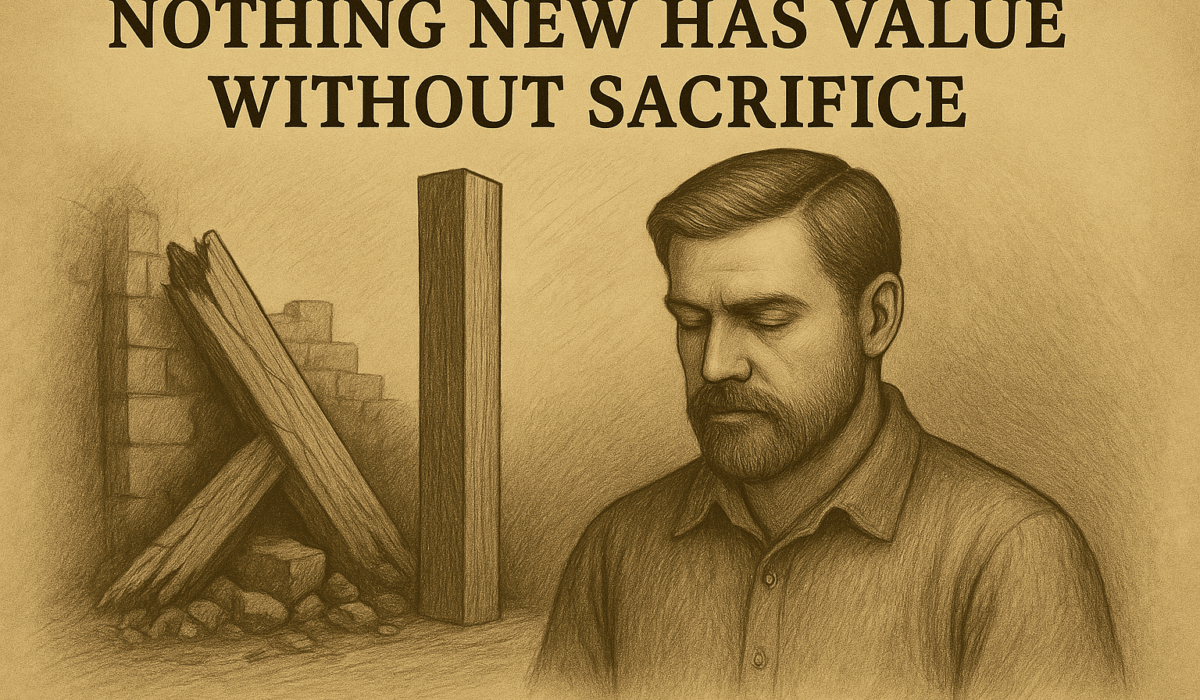
There is a lie baked so deeply into modern culture that even good men, church-going men, conservative men, fall for it without realizing it. It is the belief that newness itself carries value. That simply because something is “fresh,” “updated,” “innovated,” or “next,” it is therefore meaningful, transformative, or worthy.
Modern people are addicted to “new”- new goals, new relationships, new hobbies, new purchases, new resolutions – and yet their lives remain exactly the same. Hollow. Undisciplined. Unchanged. Why? Because newness without sacrifice is just novelty, and novelty is the cheapest, most disposable currency in existence.
A man can get something new every day and never grow an inch in stature. A woman can chase new experiences, new opportunities, new freedoms, and still remain the same rebellious, unformed creature she was ten years ago.
A household can buy new gadgets and new furniture and new décor and still be the same chaotic, undisciplined mess. The tragic truth is this:
New things only have value when the old is burned, buried, surrendered, or sacrificed to make room for them!
Anything obtained without significant loss is worthless. Anything gained without giving something up cannot transform you. Anything added without something subtracted eventually weighs you down, not lifts you up.
This is not merely a principle of masculinity or household order, it is a natural law. A divine law. A structural law of the universe as God made it. And modern people hate it because they hate paying the price. They want upgrades without funerals, blessings without death, glory without cost.
But that is not how God works, and it is not how men become kings.
I. Modern People Want Something For Nothing
We live in a culture of soft gains and easy dopamine. People collect “new” the way a child collects shiny rocks: not because they have any purpose for it, but because the sparkle momentarily distracts them from their own emptiness.
This is why the self-help world endlessly sells “new systems,” “new diets,” “new frameworks,” “new mindsets,” and “new hacks.” It’s why the marketplace is bloated with subscriptions and upgrades and version 2.0 and 3.0 and 4.0 of the same meaningless products. Modern people confuse change of scenery with change of character.
They believe:
- A new hobby will fix their lack of discipline.
- A new marriage will fix their inability to lead, or submit.
- A new church will fix their unwillingness to obey.
- A new job will fix their laziness.
- A new year will fix their lack of repentance.
But nothing new can change you as long as you drag your old self into it.
The man who refuses to sacrifice his comfort will get nowhere worth going. The woman who refuses to sacrifice her independence will never become a wife. The household that refuses to sacrifice chaos will never gain order. The church that refuses to sacrifice compromise will never regain power.
Modern people want addition without subtraction, but all real transformation requires subtraction first. Something must be cut away, crucified, or laid upon the altar. This is why the people who chase the most newness are often the most stagnant. They keep “starting fresh” without ever letting anything die.
They have novelty, not value. They have updates, not transformation. They have noise, not glory.
II. The Divine Pattern: God Gives Nothing Without Sacrifice
This principle is not a human invention. It is the divine architecture.
Everything God gives, everything, comes through sacrifice. There is not a single blessing in Scripture that arrives freely, cheaply, or without upfront cost.
1. Adam receives a wife only after giving up flesh and bone.
God did not hand Adam a woman while Adam reclined in the garden in a hammock of ease. The first marriage begins with a cut. A wound. A giving up. Something removed so something greater could be given.
A rib for a wife. A lesser thing for a greater one. Sacrifice precedes glory.
2. Israel receives the Promised Land only after loss.
Not just wandering, not just inconvenience, but the literal death of the entire old generation. God refused to carry forward what was unfit for the blessing. A nation was renewed only when the old, rebellious version was buried in the sand.
The new land required old men to die.
3. Every covenant requires shedding.
Blood. Animals. Grain. Obedience. Time. A covenant without sacrifice is not a covenant, it’s sentimentality.
4. Christ brings the New Covenant through ultimate sacrifice.
Not moral effort. Not “trying hard.” Not positive thinking. Blood!
Even salvation, the greatest newness ever offered to man, comes through the highest price ever paid. And yet modern Christians think they can receive everything God has for them at the price of nothing but mild inconvenience.
5. Even blessings require exchange.
Fertility requires obedience. Protection requires loyalty. Provision requires righteousness. God has no free gifts that do not cost you the death of something in your life.
He tears down before He builds up. He cuts away before He restores. He uproots before He plants anew. This is not harshness. This is love. God refuses to place precious things into hands still clinging to garbage.
III. The Masculine Reality: Men Are Forged By What They Lose
Men grow in direct proportion to what they surrender. Modern masculinity has become weak because modern men refuse to give up anything.
1. Strength requires sacrificing comfort.
You cannot build a powerful body while protecting your comfort. You cannot build spiritual muscle while protecting your laziness. You cannot build leadership while protecting your pride.
A man becomes a man by killing boyhood one piece at a time. There is no shortcut around that death.
2. Leadership requires sacrificing selfishness.
Men want to lead their households without giving up their irresponsibility. They want respect without giving up weakness. They want loyalty without giving up inconsistency.
A man cannot rule until he sacrifices the parts of himself unfit for rulership.
3. Marriage requires sacrificing childish independence.
A man cannot have a loyal, fruitful wife while clinging to bachelor habits. Marriage is the burial ground for self-indulgence. Fatherhood is the burial of the last remnants of personal ease.
Every son born to a man kills another fragment of his selfishness, and blesses him for it.
4. Dominion requires sacrificing distraction.
Men today want dominion, legacy, wealth, household authority – but they are unwilling to sacrifice their addictions, their time-wasters, their vices, their passivity. Dominion is expensive. Mediocrity is cheap.
The difference between a king and a boy is simple: A king sacrifices for his throne.
A boy sacrifices nothing and wonders why he never has one.
IV. The Feminine Counterfeit: Women Want Value Without Cost
Modern women worship “newness”, new freedoms, new experiences, new empowerment, while refusing to give up anything their grandmothers knew was required for honor.
They want:
- The title of Wife without the cost of obedience.
- The security of a Husband without the cost of submission.
- The glory of Motherhood without the cost of selflessness.
- The value of Femininity without the cost of restraint.
They want a high-value man without sacrificing independence, career idolatry, and emotional entitlement.
They want a peaceful marriage without sacrificing their combative spirit. They want a fruitful household without sacrificing their spending habits. They want masculine covering while still demanding masculine autonomy. They want something new without letting anything old die.
This is why so many modern women are spiritually and relationally bankrupt. Their hands are too full of ego to receive anything of worth.
A woman who refuses to give up anything can never become anything. She may grow older, but she will not grow wiser. She may gain experiences, but she will not gain virtue. She may collect titles, but she will not collect honor. A real wife is not formed by what she gains but by what she gives up:
- Independence
- Vanity
- Rebellion
- Emotional manipulation
- Consumerist entitlement
The woman who sacrifices these becomes a treasure to her husband. The woman who clings to them becomes a burden not worth having.
V. Cheap Newness VS. Costly Newness
All newness is not equal. Most newness sold today is counterfeit – empty, hollow, and meaningless!
Cheap Newness:
Cheap newness is dopamine-driven novelty. It offers stimulation, not transformation. Cheap newness includes:
- New clothes
- New gadgets
- New entertainment
- New Diets
- New resolutions
- New social circles
- New spiritual trends
It requires no sacrifice. Therefore it carries no weight. It changes nothing. Cheap newness distracts you from the old instead of replacing it. It numbs you instead of reforming you. It suppresses the need for change instead of producing it.
Cheap newness says, “Look, something different!” Costly newness says, “Look, something better.”
Costly Newness:
Costly newness is transformative. It demands the death of something inferior. Costly newness includes:
- Mastery
- Obedience
- Marriage
- Fatherhood
- Leadership
- Dominion
- Legacy
These things are not obtained – they are forged. They require:
- Giving up comfort
- Giving up ego
- Giving up impulse
- Giving up chaos
- Giving up sin
- Giving up selfish patterns
- Giving up excuses
Costly newness does not entertain, it elevates. It does not stimulate, it sanctifies. It does not distract, it disciplines. Modern people worship cheap newness because it is easier. Men of God pursue costly newness because it is glorious.
VI. Every Upgrade Demands A Funeral
Here is the truth modern people refuse to accept: Every upgrade demands a burial. You cannot add anything meaningful without removing something hindering.
1. You cannot build a disciplined life on undisciplined habits.
Some behaviors must die: A man who wants a disciplined life but refuses to sacrifice his undisciplined habits is like a builder trying to erect a fortress on wet sand. It doesn’t matter how impressive the blueprint is or how determined he feels in the moment, the structure will collapse because the foundation is rotten. Discipline is not something you add on top of your life; it is something you build from the ground up by killing the very patterns that made you weak in the first place.
Certain behaviors simply cannot coexist with greatness. Late nights spent drifting through entertainment or social media erode your focus. Laziness slowly hollows out your ambition until you can no longer distinguish desire from delusion. Porn strips your masculine fire and leaves you spiritually impotent. Overspending keeps you enslaved to the very world you claim to be rising above. Overeating dulls your edge and burdens your body with the weight of your own indulgence. Passivity poisons leadership at its root, turning potential kings into houseguests in their own homes.
These habits are not neutral. They are assassins. And if you let them live, they will kill everything you’re trying to build – your household, your confidence, your authority, your legacy. They will quietly bleed out your potential day after day until the man you were meant to be becomes nothing more than a memory of what could have been.
If you want a disciplined life, something must die, and it won’t be the dream. It will be the behaviors that sabotage it.
2. You cannot build a noble household on a rebellious woman.
A rebellious woman is not merely an inconvenience, she is a structural flaw. She is rot in the foundation, termites in the beams, a crack running through the load-bearing wall. You can decorate the house, buy new furniture, hang signs about “faith” and “family,” and pretend everything is fine, but the entire structure is compromised. Rebellion in a woman is not cosmetic; it is architectural. And no amount of male effort, affection, or provision can compensate for the instability she introduces.
A noble household, one marked by peace, fruitfulness, and generational stability – cannot be built on a woman who refuses to bow her will. Her rebellion will eat through every layer of order you try to establish: your leadership, your rules, your vision, and eventually your authority itself. If she does not sacrifice her rebellion, you will sacrifice your peace, your dignity, and eventually your sons’ respect for you. That is the exchange rate.
A rebellious woman does not destroy a household all at once; she does it slowly, subtly, through resistance, argumentation, laziness, emotional manipulation, and quiet sabotage. She drains masculine energy the way leaks drain a cistern: unnoticed until the shortage becomes undeniable. What could have been a kingdom becomes a battlefield. What could have been a garden becomes a thorn patch.
If her rebellion isn’t sacrificed, your peace will be. Every household runs on sacrifice, hers or yours. And only one kind produces life. One of them is going to die: her rebellion or your household. Choose wisely.
3. You cannot build leadership on weakness.
Weakness is not something a man can hide behind titles, good intentions, or inspirational quotes. It will expose him. It will undermine him. It will embarrass him in front of those he is responsible to lead. A weak man may have the desire to guide his household, but desire is not leadership. Leadership flows from strength, moral strength, spiritual strength, emotional strength, and practical strength. It requires a man whose backbone is made of something sturdier than wishes.
Trying to build leadership on weakness is like trying to command an army while trembling in your armor. No one follows a man they do not trust. No one trusts a man who cannot hold his own line. Weakness in a leader is not a private flaw; it is a public liability. A man who cannot command himself cannot command a household. A man who cannot master his own emotions cannot direct the emotions of a wife. A man who cannot conquer his own impulses cannot expect obedience from children. Leadership is built on the sacrifices you make before you ask anyone else to make them.
This is why cowardice must be crucified. This is why excuses must be buried. This is why the victim mentality must be dragged out behind the barn and put down like a diseased animal. Weakness always demands that others pay for it. Strength pays its own price first.
If you want to lead with authority, you must sacrifice the version of yourself that is unfit for authority. You must kill the timid man, the passive man, the easily offended man, the easily swayed man. Only then can the household trust the man who stands before them. Only then can your leadership carry the weight needed to build something that lasts.
4. You cannot install a new beam without tearing out the rotten one.
Every man who has ever built anything worth keeping knows this to be true: replacement always begins with removal. You don’t strengthen a structure by layering good wood on top of rot. You don’t reinforce a wall by pretending the cracks aren’t spreading. You don’t restore a house by painting over mold and hoping no one notices the smell. If the beam is rotten, it must come out – violently, decisively, and without nostalgia for what it used to be.
This is where most modern people fail. They want renovation without demolition. They want transformation without the mess. They want to add the new beam while leaving the old one in place, clinging to it as if the rot can somehow be convinced to behave. It doesn’t work. If you refuse the demolition, you sabotage the construction. The structure may stand for a moment, but its collapse is already scheduled.
Transformation is always a two-part process. First, something must end. A habit must be broken. A lie must be rejected. A pattern must be torn out at the roots. A version of yourself, or of your household, must be dismantled with intentional force. Only then can something new begin. Only then can God, or discipline, or vision, or leadership install the new beam that can actually carry weight.
But modern people only want the second half. They want the beginning without the ending. They want the blessing without the burial. They want the installation without the teardown. They want progress without pain, holiness without repentance, order without correction, and maturity without the death of childishness.
Kings embrace both. They don’t flinch at the demolition. They welcome it, because they understand that tearing out rot is not destruction – it is preparation. It is mercy. It is the necessary violence that makes the future possible. A man who refuses to remove the rotten beam will one day watch the roof come down on everyone he loves. A man who tears it out can build a fortress.
VII. Household Applications: Sacrifice Is The Foundation Of Order
This principle is not abstract. It applies ruthlessly to real households. It is not a philosophical idea meant for ivory towers or theological debates, it is a law that governs the atmosphere of your living room, the tone of your dinner table, the behavior of your children, and the spiritual climate under your roof. A household is either shaped by sacrifice or deformed by the refusal of it. The man who understands this law watches his home grow in strength, unity, and fruitfulness because he enforces the necessary deaths that make life possible. The man who ignores it becomes the foreman of a collapsing structure, wondering why nothing he builds stands upright for long. In a real household, something always dies: comfort or discipline, rebellion or peace, selfishness or stability. The only question is which one. This is not theory, it is architecture. It is the blueprint of every successful home since the beginning of creation.
To Men:
If you want to lead, sacrifice comfort. If you want respect, sacrifice weakness. If you want a disciplined household, sacrifice passivity. If you want a fruitful marriage, sacrifice selfishness. If you want loyal wives, sacrifice inconsistency. A household becomes what the man sacrifices for.
To Women:
If you want the glory of being a wife, sacrifice independence. If you want the protection of a strong man, sacrifice pride. If you want children who rise up and call you blessed, sacrifice vanity. If you want a peaceful home, sacrifice your tongue. If you want a noble marriage, sacrifice rebellion. A woman becomes a wife by what she surrenders, not by what she demands.
To the Household as a Whole:
Everything valuable in a household requires sacrifice. Order does not appear by accident, it is purchased by discipline. Unity is not maintained by sentiment, it is secured by humility and restraint. Fruitfulness comes from the daily surrender of comfort, not the pursuit of ease. Peace is won by the consistent sacrifice of pride, impulsiveness, and emotional excess. Stability is built by men who give up inconsistency and women who give up rebellion.
Inheritance is forged by parents who sacrifice selfishness today so their children can stand taller tomorrow. Generational faithfulness is not a miracle, it is the compounded result of thousands of small, unseen sacrifices over decades. A home where no one sacrifices becomes a war zone, each person clinging to their own desires until the house tears itself apart. But a home where everyone sacrifices becomes a kingdom, because every member understands that glory always requires a price.
VIII. The Inevitable Law: You Cannot Keep Everything And Gain Anything
This is the final point, the unavoidable conclusion of the whole matter: You cannot keep everything and gain anything.
Life is an exchange. Marriage is an exchange. Fatherhood is an exchange. Discipleship is an exchange. Dominion is an exchange. You trade up when you give up.
If you refuse the trade, you refuse the upgrade. Modern culture teaches people to cling to their old selves like a dragon hoarding junk. God teaches the opposite:
Let it die, and live. Let it burn, and rise. Let it go, and gain. Everything you want demands a price: If you pay it, the thing becomes treasure, If you refuse, the thing becomes fantasy.
The man who sacrifices becomes worthy. The man who refuses becomes forgettable. There is no path to glory without loss. There is no path to dominion without death. There is no path to becoming more without sacrificing who you used to be. Newness is only valuable when it costs something.
And for the man who understands this law, everything in life begins to align. Blessings become attainable. Order becomes non-negotiable. Household peace becomes the natural consequence of masculine obedience to the divine pattern.
Kings pay the price. Cowards don’t. And the world can always tell the difference.