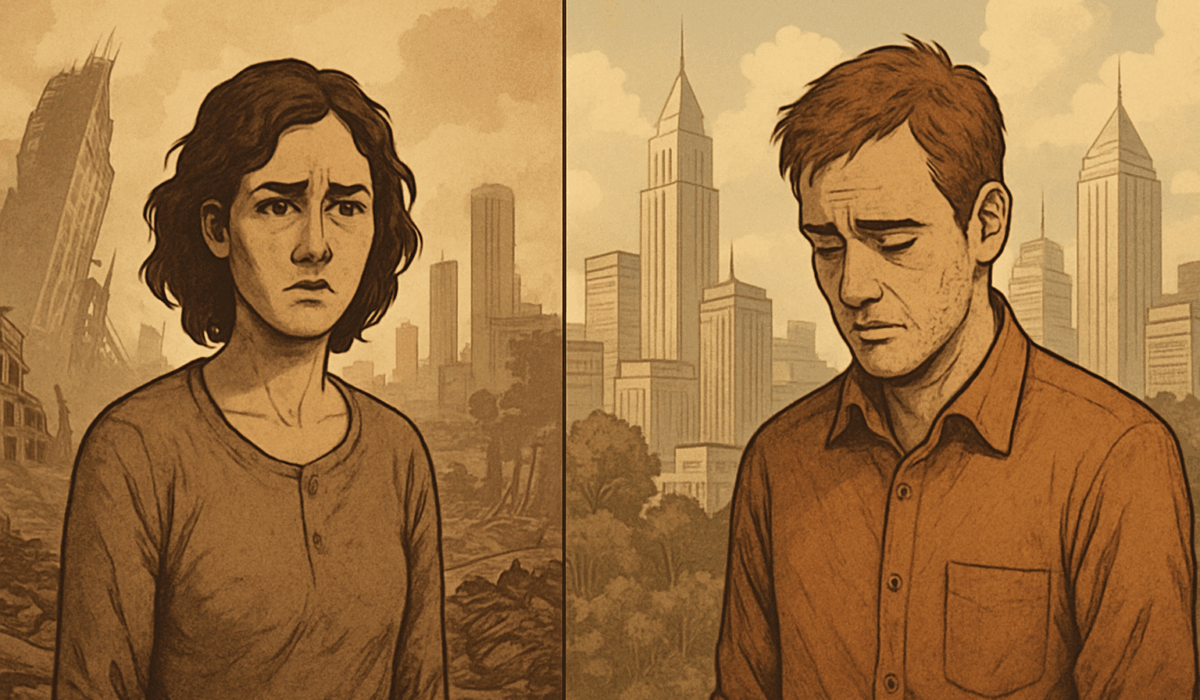
It’s a favorite feminist fantasy: “We don’t need men.” Social media is full of women swearing they could “totally survive without men”, usually while sipping coffee grown, harvested, shipped, roasted, packaged, and delivered by men, in a climate-controlled coffee shop powered by a grid maintained by men, tapping it into a phone designed, engineered, and assembled in a supply chain run mostly by men.
Cute.
Let’s run the numbers and strip the ideology from the equation. Not 100%, but 99%. That way we can be “fair” and keep the exceptional female welder, the occasional male kindergarten teacher, and whoever else people like to trot out as proof that “gender doesn’t matter.”
Here’s the thought experiment:
Scenario One – 99% of Men Vanish:
Civilization doesn’t ease into decline. It falls off a cliff. Within days, grocery store shelves are stripped bare, the water stops running, and the lights go out. The handful of men left are spread too thin to keep the system going. Law and order evaporate, and the wolves, human and otherwise, come out. Within weeks, a third of the population is dead. Within months, survivors are eating each other. Fast-forward a few years, and maybe 5% of women are still alive, scattered in pockets of chaos, clinging to the few remaining men, the very men they once mocked.
Scenario Two – 99% of Women Vanish:
Shock. Mourning. Panic for a few weeks. But the power stays on, food keeps moving, borders remain guarded. The 1% of women who remain are instantly the most valued people on earth. Artificial womb research and fertility research go into overdrive. Society mourns the loss but adapts, restructures, and eventually recovers. A couple generations later, civilization is not only intact, in some ways, it’s repaired.
This isn’t about superiority. It’s about reality. One sex builds the world, the other fills it. Both are essential for God’s design, but only one keeps food on the table and the lights on tonight.
The Numbers Don’t Lie
It’s fashionable to talk about “gender equality” as if men and women are simply interchangeable workers in one big social Lego set. But the truth is in the workforce distribution, and it’s not even remotely close.
In the U.S. today:
- Construction: ~96% male.
- Electrical power line workers: 99% male.
- Truck drivers: 92% male.
- Farmers and agricultural managers: 87% male.
- Oil, gas, and mining jobs: 97% male.
- Firefighters: 96% male.
- Military combat roles: Over 94% male.
- Police officers: 86% male.
And the list goes on, thousands of other truly essential positions are all sustained by men.
On the other side:
- Elementary and middle school teachers: 80% female.
- Nursing and healthcare support roles: 90% female.
- Social work: 85% female.
Here’s the point: if 99% of teachers vanish overnight, kids fall behind in school, which matters in the long term, but not to your survival this week. If 99% of truck drivers vanish overnight, no one in your city eats next week.
It’s not that one is more important in a moral sense, it’s that one keeps you alive today, the other shapes you for tomorrow. Without tomorrow’s builders, there is no tomorrow.
Civilization isn’t built on feelings, it’s built on infrastructure. And infrastructure is overwhelmingly male. This isn’t about ego, it’s about survival math.
So when we talk about removing 99% of one sex, we’re not making a philosophical point. We’re running a simulation, and the outcome isn’t close.
SCENARIO 1 – 99% OF MEN VANISH
Day 1-3: The Engine Seizes
It’s not an apocalypse movie. There’s no alien mothership or mushroom cloud, just an eerie, quiet absence. Ninety-nine percent of men are gone. No goodbyes. No bodies. Just gone.
By the end of the first day, panic hasn’t fully set in, yet. The lights are still on, the internet still works, the grocery stores still have food. But the clock is already ticking.
You don’t realize how many men you passed on your commute until they’re gone, the truck driver in front of you, the guy in the hard hat by the road crew, the uniformed cop on the corner. All missing.
Airports become parking lots. With 99% of pilots gone (over 90% male in real life), commercial air travel is over. Cargo planes sit grounded, which means global supply chains are dead before they can even sputter.
Water keeps flowing for a bit, municipal systems have reservoirs, and pumps run on timers, but no one is there to maintain them. Same with power. The grid runs on automation until something breaks… and something always breaks.
Day three is when the “women don’t need men” crowd starts going very quiet.
Week 1: Empty Shelves, Empty Streets
It doesn’t take a month for stores to empty, it takes days. Without men to drive the trucks, nothing arrives to replace what’s bought. Cities burn through their food supply in less than 72 hours.
The 1% of men left are either government VIPs, survivalists, or random holdouts, but they can’t possibly cover the work needed to keep a city running. And they instantly become targets.
Police presence? Gone. Over 85% of law enforcement was male. That thin blue line wasn’t perfect, but it was a deterrent. Now there’s nothing to stop the first wave of looting.
Hospitals quickly follow suit. Even if nurses are mostly female, the ER docs, paramedics, and maintenance crews are 85+% male. When the elevators stop working, when oxygen pumps break, when generators fail, people die in the dark.
Week 2: The Predators Take Over
The veneer of civility is paper-thin. Take away food, security, and the illusion of safety, and it tears like wet tissue.
Small, violent groups form fast. Without men to oppose them, predatory gangs seize control of neighborhoods. They’re armed, desperate, and completely unopposed.
The few men who remain are either enslaved by these groups for their skills, or desperately trying to survive and establish order.
Women begin fleeing cities en masse, thinking rural life will be safer. But rural areas depended on male farmers, ranchers, and mechanics. Now they’re just empty land without the hands to make it produce.
Week 3-4: Death in the Thousands, Then the Millions
Without refrigeration, food spoils. Without clean water, disease spreads.
The death toll spikes. Not in years, in weeks. A third of the population is gone within a month. Some starve. Some are killed for what they have. Some die of infections that no one can treat because antibiotics are in warehouses hundreds of miles away with no trucks to move them.
And then the cannibalism begins. Not as a bizarre outlier, but as a grim, common reality in the lawless zones.
By the end of the first month, every major city is a death trap. The survivors scatter into the countryside, but without men to hunt, farm, and defend, the wilderness becomes just another slow death sentence.
Year 1: Organized Collapse
By the time a full year passes, the initial chaos has hardened into something worse, organized chaos.
The first winter without functioning supply chains wipes out entire regions. Those who survived the violence of the early weeks now face starvation and exposure. The 1% of men who remain can’t farm enough to feed everyone, can’t guard enough to protect everyone, and can’t repair enough to keep shelter intact.
Power grids? Dead. Water treatment? Gone. Cities are shells inhabited by feral bands of survivors. The very technology that made urban life possible becomes useless junk.
Small warlord enclaves pop up, run not by strategic leaders but by the most ruthless and violent women who rose in the vacuum. It’s not feminist utopia, it’s the reign of the physically strong over the weak, and most of the “we don’t need men” crowd ends up as property, labor, or entertainment for their captors.
Medical care is a memory. Without men to mine, refine, and transport materials, hospitals have been stripped bare. Antibiotics, insulin, and heart medications are gone. Infection becomes a death sentence. A broken bone becomes a crippling injury.
Year 2-3: The Shrinking World
The population drops fast. Not just from violence and starvation, but from disease and untreated injury.
The average woman is now malnourished, under constant threat, and living with the daily work of foraging or scavenging. Calories come from what can be stolen or gathered, which means the diet is erratic and nutrient-deficient. Pregnancy rates plummet, and so does infant survival.
Even the few remaining men are a liability as much as an asset. They are either heavily guarded by small communities or ruthlessly hunted by others who see them as the only ticket to long-term survival.
The idea of “society” fades. Trade routes are gone. Language starts to fragment as regions become completely isolated. The internet is long dead. Books rot in abandoned libraries.
By year three, the population has shrunk to less than 20% of its pre-event size. Most of the loss is female.
Year 4-5: The Final Few
By now, only about 5% of the original female population remains, and that’s being generous.
The survivors are not the urban progressives who once scoffed at “toxic masculinity.” They’re hardened, brutal, suspicious of strangers, and deeply aware of what’s missing. Every surviving woman has lived through things that would have been unthinkable five years earlier.
And what’s missing is obvious: men. Not the idea of men, not the romanticized image, but the actual living, breathing workforce, protectors, builders, and fighters who once kept the predators at bay and the lights on.
Without men, civilization didn’t just decline, it died violently. The skyscrapers are still there, but they’re empty shells. Highways are cracked and overgrown. The last functioning tools are worn out, with no one left to replace them.
A few enclaves scrape by, hoarding what little knowledge and skill remains. But the world has regressed to a pre-industrial state, and with so few women left, even the survival of the species is uncertain.
SCENARIO 2 – 99% OF WOMEN VANISH
Week 1: Shockwaves
It happens the same way, quiet, sudden, no warning. One day, 99% of women are simply gone. The shock is instant and total. Homes are emptier. Schools are silent. Offices and neighborhoods feel hollow in a way no camera can capture.
For men, the first response isn’t panic about survival, it’s grief. Girlfriends, wives, daughters, sisters, mothers, gone. The emotional crater is massive.
Work still happens. Trucks still roll. Power plants still hum. Grocery shelves stay stocked. But every conversation carries the weight of the loss.
Social media becomes an open wound, tribute posts, frantic theories, conspiracy videos, and desperate searches for the missing.
Week 2-4: Stabilizing in the Storm
The initial chaos is emotional, not logistical. Yes, the population dropped by half overnight, but the half that remains is overwhelmingly responsible for keeping the physical systems of civilization running.
The lights stay on. The food keeps moving. Planes still fly. Military bases stay staffed. Police still patrol.
Certain industries feel the gap immediately, nursing, teaching, childcare, but they can adapt faster than people expect. The male minority in these fields steps up, and recruitment campaigns start pulling in new workers quickly.
There’s no looting on a mass scale. Crime doesn’t vanish, but society doesn’t unravel.
Year 1: Reorganization
The grief hasn’t gone away, but adaptation has begun. Men reorganize society with the understanding that reproduction is now the central priority for humanity’s long-term survival.
The 1% of women who remain are instantly the most protected, valued, and sought-after people on the planet. They are not paraded as trophies, they are guarded like national treasures.
Governments fast-track funding for reproductive technology. Artificial womb research, surrogacy programs, and cryopreserved embryo projects go into overdrive. Every lab that ever dabbled in bio-reproduction is now a top-priority military asset.
Agriculture, manufacturing, transportation, and utilities run as before. Some sectors even accelerate, freed from the distractions of culture war politics, men throw themselves into building, innovating, and securing what remains.
Year 2-5: The Future Takes Shape
By the second year, there are new trade routes and alliances based entirely on reproduction strategy. Artificial wombs begin small-scale operation, paired with carefully guarded female volunteers to sustain the next generation until full independence from natural gestation is possible.
Men continue to build. Cities remain functional. The global economy took a hit from losing half the consumer base, but it recovers. Wealth concentrates in resource-rich and technology-advanced nations, those with the infrastructure to support population regrowth.
Social order is firm. Male cooperation is high, not perfect, but generally united by the shared mission of species survival.
Generational Outlook: Restoration
Within 20-30 years, the artificial womb technology is perfected. The population is still lower than before, but it’s climbing again. The younger generation grows up in a world where the disappearance of women is history, not a daily wound.
Civilization is not just restored, in some ways, it’s more efficient, more united, and less chaotic. Without the constant cultural war over gender ideology, roles are clear: men build, protect, innovate, and reproduce through the systems they’ve developed.
And the most telling difference from Scenario 1? When 99% of men vanished, the survivors were scattered, starving, and fighting for scraps within months. When 99% of women vanished, the survivors were mourning, but they still had hot showers, working lights, and stocked shelves.
Why Men And Women Are Not Interchangable
One of the most dangerous lies in modern culture is that men and women are the same in all the ways that matter. Different bodies? Sure. Different “emotional wiring”? Maybe. But when it comes to what they contribute to the survival of society, we’re told they are equal, interchangeable, plug-and-play.
It’s a nice slogan. It’s also a death sentence if anyone ever tries to live it out.
Men and women are not designed to do the same things. They were never intended to be interchangeable cogs in a social machine. They are complementary by design, each doing what the other cannot. Remove either sex entirely, and the whole system collapses eventually… but how it collapses and how quickly it collapses tells you a lot about what each sex contributes.
Men: The Builders, Protectors, and Maintainers
Men, in the aggregate, carry the overwhelming share of society’s external labor, the physically dangerous, technically demanding, and logistically essential work that makes civilization possible in the first place.
This isn’t about IQ points or personal hobbies. It’s about the reality that in every country, in every culture, the bulk of infrastructure, defense, and resource extraction is male-driven.
Without men:
- The roads crack.
- The lights go out.
- The water becomes unsafe.
- Borders vanish.
- Shelves go empty.
- Hospitals shut down.
The point is not that women cannot do these things in isolated cases, it’s that they overwhelmingly do not and never have at the scale required to sustain a complex society.
Women: The Bearers of Life and Nurturers of the Next Generation
Women are the biological gatekeepers of the species. Men can produce sperm for most of their lives; women have a limited fertility window, and gestation requires their bodies. Every man who has ever lived was born of a woman.
Women are also the primary nurturers in the early years of life, and that’s not just tradition, it’s biology. Infants survive best when they have direct maternal care, especially in societies without advanced technology.
Without women:
- Birth rates drop to zero without intervention.
- Maternal bonding and breastfeeding vanish.
- Childhood care patterns shift dramatically.
And yet, the timeline is different. Without women, civilization can limp along for decades while artificial means of reproduction and childcare catch up. Without men, civilization stops functioning in days.
God’s Design Is Not Symmetrical
From the very beginning, the design was asymmetrical. Adam was created first, placed in the garden to work it and keep it (Genesis 2:15) before Eve was ever formed. When Eve was created, she was not made to duplicate Adam’s role, she was made as his helper, perfectly suited to complement his mission, not compete with it.
Mutual need does not mean mutual function. You can’t swap the roles and expect the same results. If men disappear, the mission stops immediately. If women disappear, the mission pauses until reproduction is restored.
This isn’t misogyny or misandry, it’s reality. And reality doesn’t bend just because modern people don’t like how it feels.
The Closing Blow:
Strip away the slogans, hashtags, and gender studies lectures, and here’s what you’re left with:
If 99% of men vanish, civilization collapses before the week is out. Within a month, millions are dead. Within a year, cities are graveyards. Within five years, barely 5% of women remain alive, scattered and starving in a world that has regressed to the law of the jungle.
If 99% of women vanish, civilization staggers, grieves, and reorganizes. The lights stay on. The food keeps moving. The borders hold. Within decades, reproduction is restored through technology, and the population begins to climb again.
One sex builds and maintains the machine. The other fills it with life. Both are vital to God’s design, but not in the same way, and pretending otherwise is a luxury only possible when the machine is running.
So the next time someone says “we don’t need men,” remember: Without men, you don’t have lights, clean water, food on the table, or anyone to stop the wolves at your door. Without women, you still have all of that, and the men will find a way to bring women back.
Equality? No. Mutual value? Yes. Interchangeable? Never.
Civilization is not an abstract idea. It is a living system built by calloused hands, guarded by broad shoulders, and sustained by minds willing to risk and bleed to keep the lights on. And if you can’t respect that, then you don’t deserve the world they’ve built for you.