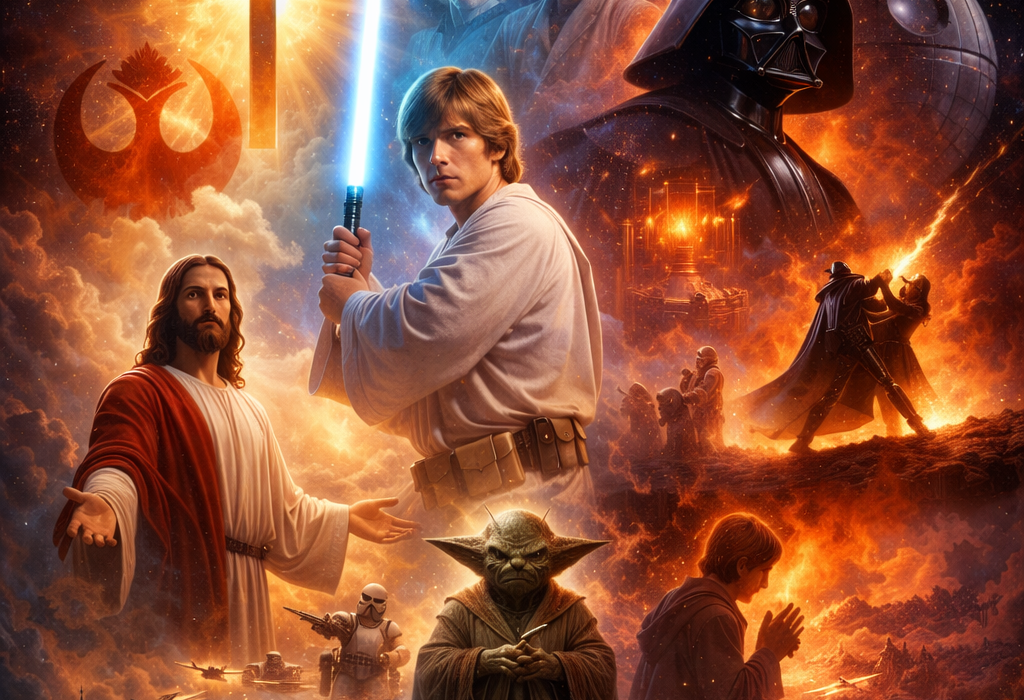
Introduction:
For nearly half a century, the Star Wars universe has captivated audiences across generations, and for good reason. To most viewers it is simply a thrilling space opera with heroes and villains, starships and battles, rebels fighting against an oppressive empire. Yet the enduring power of the story suggests something far deeper. Great stories do not survive for decades merely because they are entertaining; they endure because they resonate with patterns embedded in the sub-conscious human understanding of reality. Myths, epics, and sacred narratives throughout history have echoed the same structures: light and darkness, freedom and tyranny, humility and domination. These themes reflect the moral architecture of creation itself.
This is precisely why Star Wars is timeless. Beneath the grand spectacle lies a narrative framework that mirrors the ancient storytelling traditions from the time of creation onward. Its structure follows the same rhythm found in countless epics before it, including The Lord of the Rings by J. R. R. Tolkien. Both works are built on a triadic pattern, three acts that mirror the rise, fall, and restoration of order. In Star Wars this structure appears in the nine canonical films conceived by George Lucas, arranged as three trilogies. Each trilogy reflects a stage of the larger narrative: the fall of the Republic, the struggle against tyranny, and the ultimate restoration of balance. When examined carefully, the saga reveals a profound moral and structural pattern that echoes the deeper order woven into creation itself.
The evidence supporting this interpretation is vast, far more extensive than a single article could possibly contain. One could easily devote an entire series of books to exploring the symbolism, philosophy, and historical parallels embedded within the Star Wars narrative. From political structures and economic systems to spiritual traditions and mythic archetypes, the layers of meaning are immense. In the interest of brevity, however, we will focus only on some of the most obvious and unmistakable themes, patterns so clear and consistent that they alone are more than sufficient to demonstrate the deeper order at work within the story. By examining these elements through the framework of The Fall, The Struggle, and The Restoration, the underlying structure becomes impossible to ignore for anyone in possession of more than two brain cells.
I. The Fall
1. The Corruption of the Republic
At the beginning of the saga, the galaxy is governed by the Galactic Republic, a vast political union of thousands of star systems. On paper, it represents liberty, representation, and cooperation among independent worlds. A democratic senate exists, systems retain their identities, and power is theoretically distributed equally rather than concentrated. Yet beneath this appearance of order, the Republic is failing. Corruption, bureaucracy, and powerful financial interests have hollowed out the very institutions meant to preserve the liberty of the people established by the founders.
This deterioration is highlighted in The Phantom Menace, where the Senate proves incapable of responding decisively to the blockade of Naboo. Instead of acting to defend a member world, the Senate is gridlocked in procedure, committees, and endless debate. Chancellor Valorum himself admits the scale of the problem when he says, “The Republic is not what it once was.” What was meant to be a guardian of freedom has become paralyzed by its own overbearing structure.
Behind this paralysis stand powerful economic institutions such as the InterGalactic Banking Clan, the Trade Federation, and other corporate alliances. These organizations wield enormous influence over galactic politics. Their fleets rival those of governments, and their representatives sit within the political system. In many ways, they function less like businesses and more like sovereign powers. When conflict arises, these institutions are not merely observers, they actively shape events by financing wars, manipulating trade, and exerting pressure on the Republic’s leadership.
The story demonstrates a fundamental political truth: republics rarely collapse through sudden conquest. Instead, they decay slowly from within as bureaucracy expands, institutions weaken, and the people entrusted with power gradually trade responsibility for corruption. In this environment, a crisis (whether real or manufactured) becomes the perfect catalyst for transformation.
This is precisely the opportunity exploited by Palpatine, a senator from Naboo who quietly begins consolidating his influence. Publicly he presents himself as a humble servant of the Republic. Privately he is Darth Sidious, a Sith Lord orchestrating events from the shadows. By manipulating both political factions and financial powers, he creates the conditions necessary to dismantle the Republic.
The fall of the Republic therefore begins not with a battle, but with corruption.The institutions that once protected liberty have been infiltrated by evil powers and will be used as instruments of manipulation. The leaders become complacent, economic power has become intertwined with political authority, and by the time the Republic recognizes the danger, the transformation has progressed past the point of no return. The idea of the structure of freedom remains, but the substance has been hollowed out to the point it no longer has any authority.
History has shown repeatedly that when this process occurs, the rise of tyranny is close behind.
2. The Rise of Hidden Power
LIke most other real historical events, tyranny does not appear suddenly or openly. It emerges quietly, concealed behind respectable institutions and public offices. The rise of Emperor Palpatine illustrates this like watching a mirror of many corollary modern political figures. Before he became emperor, he was the little known Senator Palpatine of Naboo, he was calm, polite, and outwardly devoted to the Republic. Yet behind this unassuming exterior lies Darth Sidious, the true architect of the Republic’s destruction.
This dual identity is central to the theme of hidden power. The dark side in Star Wars rarely operates in the open, it hides, it manipulates, and it deceives. Palpatine orchestrates both sides of the Clone Wars while presenting himself publicly as the Republic’s protector. As Sidious, he commands the Separatist leadership. As Chancellor, he guides the Republic’s response to the very war he secretly created.
This strategy of internal division is devastating: creating a crisis so large that people willingly surrender their freedoms in exchange for security. In Attack of the Clones, the Senate grants Palpatine emergency powers to raise a clone army. Then, what begins as a temporary measure becomes the foundation of absolute authority. By the time the war reaches its climax in Revenge of the Sith, Palpatine’s control over the Republic’s military and political systems is nearly complete. Palpatine’s famous declaration captures the moment:
“In order to ensure the security and continuing stability, the Republic will be reorganized into the first Galactic Empire.”
With thunderous applause from the Senate, the Galactic Empire is born. The tragedy of the scene lies not only in the rise of tyranny, but in the fact that it occurs with the approval of those meant to defend its liberty. Senator Padmé Amidala observes the moment with quiet horror and delivers one of the most memorable lines in the entire saga:
“So this is how liberty dies… with thunderous applause.”
The transformation is nearly complete. A republic that once valued representation and balance of power has willingly placed itself under the authority of a single ruler. The institutions remain, but their purpose has changed. The Senate becomes ceremonial, and regional governors replace local leadership. Military power now ruthlessly enforces obedience to the galactic empire across the galaxy with extreme prejudice.
The most important lesson here is that tyranny disguises itself as order, security, and stability. It promises protection from chaos while quietly concentrating power in fewer and fewer hands. By the time the mask is removed, the machinery of control is already firmly in place. Thus the fall of the Republic is not simply the victory of a villain. It is the culmination of a long process in which hidden power gradually replaces open governance. The Empire does not conquer the Republic from the outside, it grows from within it.
3. The Temptation of Power
While political corruption and hidden manipulation drive the fall of the Republic, the deeper cause of the galaxy’s collapse lies in something far older and more universal: the temptation of power. The Star Wars saga consistently presents power as something seductive, promising control, security, and the ability to bend reality to one’s will. Yet the story also makes clear that the pursuit of power for its own sake ultimately leads to corruption and destruction.
This theme is embodied most clearly in the tragic story of Anakin Skywalker, the young Jedi believed to be the Chosen One destined to bring balance to the Force. Introduced in The Phantom Menace, Anakin begins as a gifted but humble boy with remarkable potential. The Jedi Council recognizes his extraordinary connection to the Force, but they also sense a dangerous vulnerability within him. Yoda famously warns:
“Fear is the path to the dark side. Fear leads to anger, anger leads to hate, hate leads to suffering.”
And that warning proves prophetic. Anakin’s fear of loss (particularly his fear of losing Padmé Amidala) becomes the emotional doorway through which the dark side enters his life. Palpatine, ever the patient manipulator, exploits this fear masterfully. Rather than confronting Anakin, he slowly convinces the young Jedi that the power of the dark side can prevent death itself. In doing so, he presents power not as domination, but as salvation.
The moment of transformation occurs in Revenge of the Sith, when Anakin finally abandons the Jedi and pledges himself to Palpatine. In that instant he becomes Darth Vader, the most feared enforcer of the Empire. What began as a desire to protect those he loved becomes a dark descent into tyranny and violence.
This arc reflects a timeless moral principle: evil rarely begins as a deliberate embrace of darkness. Instead, it often begins with seemingly noble intentions that become twisted through pride, fear, and the desire for control. The promise of unlimited power becomes irresistible when one believes it can be used for good. The Jedi themselves understand this danger. Their teachings emphasize discipline, humility, and service precisely because they recognize how easily power can corrupt even the most gifted individuals. As Yoda later warns Luke Skywalker:
“Once you start down the dark path, forever will it dominate your destiny.”
Thus the fall of Anakin mirrors the fall of the Republic itself. Both begin with noble ideals and immense potential. Both are slowly corrupted by fear and the temptation of power. And both ultimately become instruments of tyranny. By the end of the prequel trilogy, the galaxy has entered its darkest hour: the Republic has become an empire, the Jedi Order has been destroyed, and the Chosen One himself has become the very symbol of oppression.
The fall is complete. The age of struggle is about to begin.
II. The Struggle
1. The Rebellion of the Free
With the fall of the Republic and the rise of the Galactic Empire, the galaxy enters a long and oppressive phase. The Senate is eventually dissolved, regional governors enforce imperial rule, and dissent is crushed with overwhelming military force. Yet tyranny, no matter how powerful it may appear, always produces resistance from the devoted few. From the ashes of the Republic emerges a new movement dedicated to restoring liberty – the Rebel Alliance.
Unlike the Empire, which rules through fear and centralized authority, the Rebel Alliance is a coalition of independent systems, freedom fighters, and former senators who refuse to accept imperial domination. Leaders such as Mon Mothma, Leia Organa, and other dissidents organize scattered resistance cells into a unified rebellion. Their goal is not conquest or personal power; but the restoration of the Republic and the return of self-government to the galaxy. They selflessly place their lives on the line for the cause of liberty.
This contrast between the Empire and the Rebels highlights one of the central moral themes of Star Wars: the difference between power imposed through force and authority grounded in consent. The Empire governs through force and intimidation. Its massive fleets of Star Destroyers patrol the galaxy, and weapons like the Death Star serve as tools of terror meant to ensure obedience. Grand Moff Tarkin makes this strategy explicit when he explains that fear of the battle station will keep systems in line.
Meanwhile the Rebels operate according to a completely different philosophy. They possess far fewer resources and vastly smaller fleets, they rely on cooperation, courage, and shared purpose rather than coercion. Their pilots proudly wear the insignia of the rebellion, and their leaders speak openly about their cause. Even when forced to hide their bases for survival (such as the hidden headquarters on Yavin in A New Hope) their principles remain public and unmistakable.
The visual symbolism of the two factions reinforces this stark contrast. Imperial leaders frequently appear cloaked in dark robes or concealed behind armor and masks. Darth Vader is literally encased within a mechanical suit that hides his humanity and identity. By contrast, the heroes of the rebellion stand openly as themselves. Figures such as Luke Skywalker, Leia, and other rebel pilots fight without masks, their identities and loyalties clearly visible.
This imagery reflects an enduring moral pattern found in many mythic traditions: tyranny thrives in secrecy and concealment, while those who defend liberty stand openly in the light. While the Empire governs through intimidation and hidden manipulation, the Rebels fight through courage and steadfast conviction.
Though vastly outnumbered and outgunned, the rebellion represents something far more powerful than military strength – the unyielding inalienable human right for freedom.
2. The Preservation of Ancient Wisdom
Another crucial dimension of the struggle against the Empire is the preservation of knowledge, specifically, the ancient spiritual teachings of the Jedi Order. When the Empire rises to power in Revenge of the Sith, one of its first acts is the systematic destruction of the Jedi. Through Order 66, the clone army turns against the very guardians of peace it once served alongside, exterminating nearly the entire Order in a single coordinated betrayal. The Jedi Temple is seized, its archives destroyed or confiscated, and the traditions of the Force are driven nearly to extinction.
This is no accident, tyrannical regimes throughout history have always sought to eliminate the custodians of ancient wisdom. The Jedi represent more than warriors or diplomats, they embody a disciplined philosophy that teaches humility, restraint, and service. Such teachings stand in direct opposition to the Sith philosophy of domination and control. By destroying the Jedi, the Empire attempts to erase not just its enemies, but the very moral framework capable of resisting it.
Yet the knowledge does not disappear entirely. A few surviving Jedi escape the purge, including Obi-Wan Kenobi and Yoda. These two figures become living repositories of the ancient teachings. In exile, they quietly safeguard what remains of the Jedi tradition, waiting for the moment when the knowledge can be passed to a new generation. That opportunity arrives with the emergence of Luke Skywalker. When Luke first encounters Obi-Wan in A New Hope, the old Jedi begins training him in the ways of the Force. Obi-Wan explains the spiritual foundation of the galaxy in simple but profound terms:
“The Force is what gives a Jedi his power. It’s an energy field created by all living things. It surrounds us, penetrates us, and binds the galaxy together.”
This statement reflects the deeper metaphysical dimension of the saga. Beneath its political conflicts lies a worldview in which life itself is interconnected through a spiritual order. The Jedi’s task has always been to live in harmony with that order, serving as guardians rather than rulers.
The Empire, by contrast, rejects this philosophy fourthrightly. The Sith seek to dominate the Force rather than cooperate with it. Power is not something to be respected or balanced; but something to be seized and wielded without restraint. In the hands of the Empire, knowledge becomes a tool of control rather than wisdom.
By preserving the Jedi teachings, the surviving masters ensure that the spiritual foundation of the galaxy is not completely erased. Even in the darkest hour of imperial rule, the ancient wisdom survives, hidden, protected, and waiting to be rediscovered. Thus the struggle against tyranny is not fought only with fleets and armies. It is also fought through the preservation of truth, tradition, and moral knowledge. For without those foundations, even victory on the battlefield would prove meaningless.
3. The Battle for the Soul of the Galaxy
The struggle against the Empire is not fought only with starships and armies. Beneath the military conflict lies a far deeper battle, the struggle for the moral and spiritual direction of the galaxy itself. In Star Wars, every character is confronted with a fundamental choice between two opposing paths: the discipline of the light side or the seductive power of the dark side. This conflict is most vividly embodied in the relationship between Luke Skywalker and his fallen father, Darth Vader.
The Empire represents more than political tyranny; it represents a philosophy of domination. The Sith believe that power justifies itself, that strength is the ultimate virtue, and those who possess it have the right to rule with absolute authority. This worldview is summarized in the Sith doctrine often referred to as the Rule of Two, in which a master and apprentice continually seek greater power, even if that power ultimately leads them to betray one another. Loyalty, mercy, and restraint are considered weaknesses by this side.
The Jedi tradition teaches precisely the opposite. The Jedi believe that power must always be governed by discipline and humility. They serve the Force rather than attempting to dominate it. This is why Yoda repeatedly warns Luke that anger and hatred are the quickest paths to destruction. The dark side may offer immediate strength, but that strength comes at the cost of one’s soul.
The confrontation between Luke and Vader in Return of the Jedi illustrates this timeless moral conflict perfectly. Throughout the film, Emperor Palpatine attempts to manipulate Luke into embracing hatred and killing his father. The Emperor understands that if Luke strikes Vader down in anger, he will have taken the first step toward becoming a Sith himself.
At the height of the duel, Luke nearly gives in to this temptation. After overpowering Vader, he stands poised to deliver the final blow. Instead, he looks at his mechanical hand (mirroring the mechanical hand of his father) and realizes the path he is about to take. In a moment of profound clarity, he throws his weapon aside and declares:
“I am a Jedi, like my father before me.”
This act of refusal is the turning point of the entire saga. Luke rejects the seductive offer of domination that defines the Empire. He chooses mercy instead of vengeance, faith instead of hatred. In doing so, he demonstrates that the true power of the light side lies not in violence but in moral courage. And that courage is the only way to true freedom.
The Empire believes that power determines your destiny. Luke proves that destiny is determined by your choices. By refusing to become what the Emperor expects him to be, he breaks the cycle of corruption that began with the fall of the Republic and begins the path to restoration.
The battle for the galaxy is therefore not merely a struggle between fleets and armies. It is a struggle over the very nature of power itself, and over whether the future will be ruled by domination or by restraint.
III. The Restoration
1. Redemption and the Return of the Father
At the heart of the Star Wars saga lies one of the most powerful themes in all moral storytelling: redemption. The fall of Anakin Skywalker into the darkness of Darth Vader represents the deepest tragedy of the galaxy’s history. Yet the story does not end with corruption, the final movement of the saga reveals that even the most fallen among us may still choose to repent and return to the light. Though our actions have consequences, ultimately, where there is breath, there is hope.
Throughout the original trilogy, Luke Skywalker refuses to accept the idea that his father is beyond redemption. While others see Vader only as the Emperor’s ruthless and evil enforcer, Luke senses that something of Anakin still survives beneath the armor and mask. This conviction sets him apart from nearly every other character in the story. Where others see only the crimes of the past, Luke sees the possibility of restoration and pursues that intuition regardless of the possible outcome.
This belief becomes central to the climax of Return of the Jedi. When Luke willingly surrenders himself to Vader and the Emperor, he does so not as a warrior seeking victory, but as a son seeking reconciliation. He believes that confronting his father with compassion rather than hatred may awaken the humanity buried beneath years of darkness.
The Emperor, however, intends the encounter to end very differently. Emperor Palpatine attempts to provoke Luke into anger, hoping to repeat the same process that once corrupted his father Anakin. The strategy is clear: if Luke kills Vader in hatred, he will take his father’s place as the Emperor’s new apprentice and the cycle of evil will be perpetuated.
When Luke refuses and casts aside his weapon, Palpatine unleashes his full power upon him, striking him with devastating bursts of Force lightning. It is at this moment that the transformation of Vader finally occurs. Watching his son suffer, the buried conscience of Anakin Skywalker resurfaces. For years Vader served the Empire out of fear, anger, and submission to the dark side. Now he is forced to confront the consequences of that allegiance, the fact that his sins have been visited upon his son.
In a decisive act of sacrifice, Vader seizes the Emperor and throws him into the reactor shaft of the Death Star, destroying the Sith master and ending his reign. This act costs Vader his mortal life, but it restores his identity as Anakin Skywalker. In saving his son, he finally fulfills the prophecy of the Chosen One, bringing balance to the Force by destroying the Sith.
HIs redemption does not erase his past, but it proves that even the most corrupted life can still choose a different ending. Through Anakin’s final act, the cycle of tyranny that began with the fall of the Republic is broken. The father returns, not as Vader the tyrant, but as Anakin the redeemed.
2. The Collapse of Tyranny
When Darth Vader destroys Emperor Palpatine aboard the Death Star II in Return of the Jedi, the moment represents more than the death of a tyrant. It marks the collapse of the entire imperial structure that had dominated the galaxy for decades. Tyrannies often appear invincible, built upon immense military power and centralized authority, yet history repeatedly shows that such systems are far more fragile than they seem. When the individual at the center of that structure falls, the machinery of control can quickly begin to unravel.
The Galactic Empire had been designed around absolute tyranical authority. Every level of command ultimately answered to the Emperor himself. Regional governors enforced his will, fleets executed his orders, and fear served as the glue holding the system together. Grand Moff Tarkin had articulated this philosophy years earlier when he explained that fear of the Death Star would keep the star systems in line. The Empire ruled not through loyalty or consent, but through fear and intimidation.
But systems built on fear contain an inherent weakness: they depend entirely on the continued presence of the power that inspires that fear. Once that power is destroyed, the illusion of permanence fades. When the Emperor dies and the second Death Star is destroyed, the symbolic heart of imperial authority is shattered. People begin to realize there is hope, and the future starts looking brighter.
At the same time, the Rebel Alliance launches a coordinated assault against the imperial fleet. Led by figures such as Admiral Ackbar and supported by the ground assault on Endor, the rebels exploit the Empire’s sudden vulnerability. Without the Emperor’s direct command and without the protective shield around the battle station, imperial forces lose their strategic advantage.
The victory at Endor therefore represents more than a military triumph. It reveals the fundamental weakness of authoritarian systems. Empires often appear unstoppable because they possess vast armies, enormous weapons, and rigid hierarchies. Yet their reliance on centralized authority makes them susceptible to cascading failure. Remove the central figure or the central symbol of power, and the entire structure becomes a target.
By contrast, the rebellion’s strength lies in its decentralization. The alliance is composed of many independent groups and systems united by a shared commitment to freedom. If one leader falls, others rise. If one base is destroyed, another is established elsewhere. The rebellion is not dependent on a single figure or institution, but a shared vision of liberty.
Thus the fall of the Empire demonstrates a profound lesson about power: tyranny may dominate for a time, but systems built on fear cannot endure indefinitely. When courage and unity confront centralized oppression, even the most formidable empire will collapse in a single decisive moment.
3. The Restoration of Balance
With the death of Emperor Palpatine and the destruction of the second Death Star, the long shadow cast over the galaxy is lifted. The collapse of the Galactic Empire does more than end a regime of tyranny, it restores a fundamental balance that had been disrupted for generations. In the mythology of Star Wars, this balance is not merely political; but spiritual, moral, and cosmic.
From the earliest moments of the saga, the Jedi spoke of a prophecy surrounding Anakin Skywalker, the Chosen One who would “bring balance to the Force.” For many years, this prophecy appeared tragically mistaken. Anakin’s fall into darkness seemed to destroy the very order he was meant to protect. The Jedi were exterminated, the Republic was dismantled, and the Sith ruled the galaxy with tyrannical authority. Yet the prophecy was not wrong, it was simply misunderstood.
Balance did not come through the perfection of the Jedi Order or the dominance of the Republic. It came through the destruction of the Sith themselves. When Anakin ultimately turns against his master and sacrifices himself to destroy the Emperor, he fulfills the prophecy in the most unexpected way possible. The last Sith Lord is eliminated, and the corrupt lineage that had manipulated galactic history for centuries is finally extinguished.
In this sense, the restoration of balance mirrors the deeper moral structure that runs throughout the entire saga. Evil often appears overwhelming in the moment. Tyranny rises, institutions collapse, and darkness spreads across the world. Yet the story of Star Wars insists that such conditions can never be permanent. The moral order of the universe has a way of reasserting itself through the courage, sacrifice, and choices of a remnant people.
The victory at Endor marks the beginning of a new chapter for the galaxy. The Rebel Alliance celebrates its triumph, but the goal has never been simply to destroy the Empire. The ultimate objective is the restoration of a free and balanced order. In the years that follow, the rebel movement transforms into a renewed republic dedicated once again to self-governance and cooperation among the star systems.
Luke Skywalker now stands as the last trained Jedi, carrying forward the teachings preserved by Yoda and Obi-Wan Kenobi. Through him, the ancient wisdom of the Jedi Order survives and begins to take root once again.
Thus the saga concludes where it began, with the enduring balance between power and responsibility, freedom and order, light and darkness. The cycle of fall, struggle, and restoration is complete, demonstrating that while evil may rise for a season, it can never ultimately extinguish the deeper order woven into the fabric of creation.
Conclusion
The story of Star Wars endures not simply because of nostalgia, but because it echoes a deeper pattern embedded within both human storytelling and the structure of life itself. The saga follows a rhythm that has appeared in countless myths, sacred texts, and historical narratives: the fall of a once-just order, the long and painful struggle against tyranny, and the eventual restoration of balance through courage, sacrifice, and redemption. This pattern reflects the same moral architecture that has shaped civilizations and guided human understanding since the creation.
When examined through this lens, Star Wars reveals itself as far more than entertainment. It is a modern corollary that mirrors the eternal struggle between light and darkness, freedom and tyranny, humility and power. The empire rises, the rebellion fights, and balance is restored, not because of chance, but because the deeper order of creation ultimately asserts itself. The hidden structure of the galaxy is the same structure that governs every age: tyranny may ascend for a time, but it will always be confronted by the remnant: those willing to stand for freedom, liberty, and the light of truth.