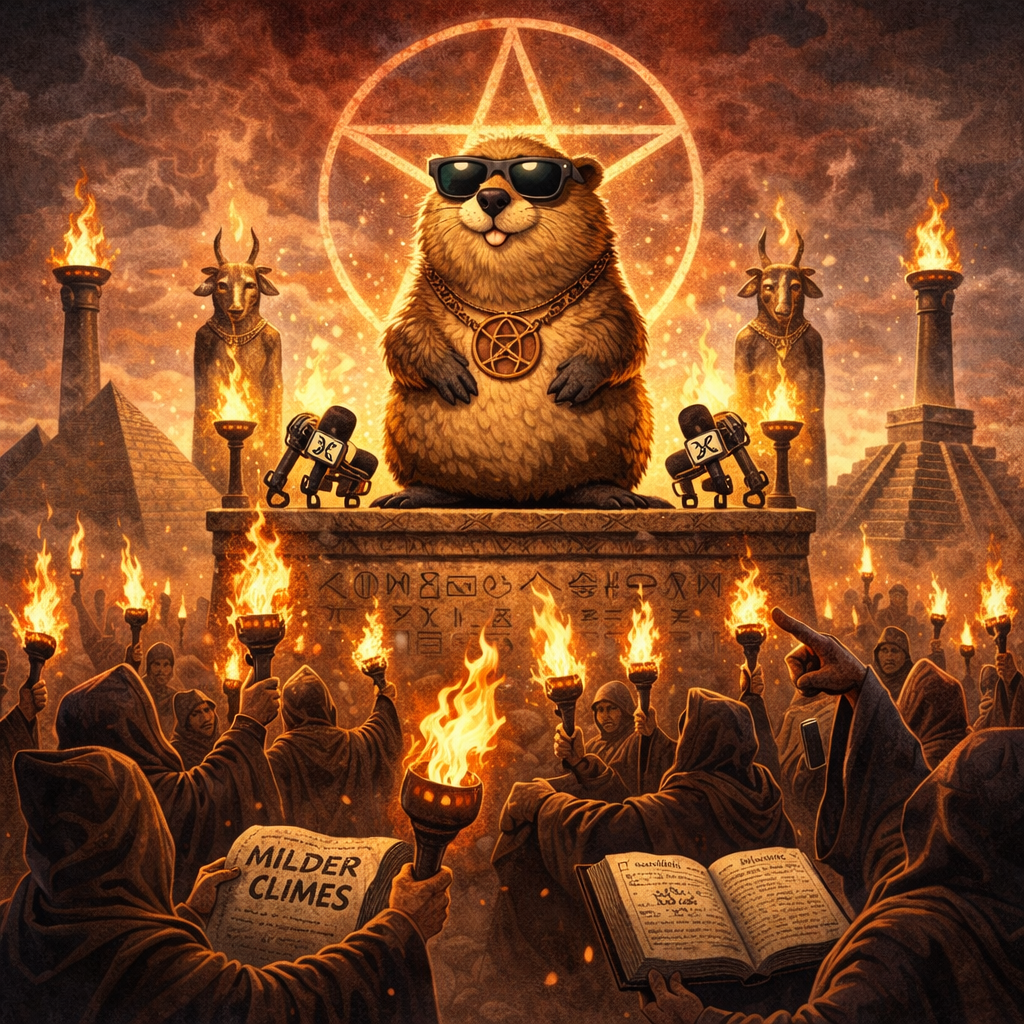
Paganism in a Fur Coat
Groundhog Day is often defended as harmless fun, a quirky tradition, a cultural joke, a moment of wintertime levity. That defense holds no water the moment one stops laughing long enough to ask what is actually happening. Once a year, a society that claims to be rational, scientific, and post-superstitious gathers around a ritual centered on animal divination, shadow‑reading, and collective submission to an omen. The fact that it is performed with a smile does not make it innocent, just effective. Throughout history, paganism has never disappeared, it has merely taken new forms. Groundhog Day is a symptom of this cancer. And like many symptoms of cultural decay, it reveals more about what a civilization worships than what it claims to believe.
I: Divination, Omens, and the Pagan Mind
At its core, Groundhog Day is divination. Divination is the attempt to extract hidden knowledge about the future through signs, symbols, or intermediaries rather than through God and His word. Ancient cultures practiced it, the Roman augurs watched birds, the Greeks consulted oracles, and the Egyptians interpreted animal behavior as divine communication. The Mayans even tracked shadows across stone temples to mark sacred cycles of time. The method varied from civilization to civilization, but the impulse did not. Humanity has always sought reassurance about the future without submitting to the authority of the Creator.
Groundhog Day follows this same structure. A designated animal is removed from its natural environment, elevated above the crowd, observed for a sign, and treated as a bearer of forbidden (or hidden) knowledge. The crowd waits, the verdict is announced, the media amplifies it, and the paganistic public accepts it – sometimes mockingly, sometimes sincerely, but always collectively. This is ritual worship behavior, not fun entertainment.
Modern defenders argue that no one truly believes the groundhog controls the weather. That argument misunderstands how paganism works. Like all religions, belief is not required; participation is. Ritual trains the imagination and conditions people to accept that meaning can be found apart from God, that order can be read from nature without reference to divine law, and that authority can be playful rather than accountable. The ancients believed their rituals were sacred, while modern man mostly believes his are jokes, but both are submitting to the same demons.
What makes Groundhog Day uniquely revealing is its persistence in a culture that claims to have outgrown superstition. Satellites map weather systems, and meteorology predicts patterns, but scripture already defines seasons. And yet the ritual remains. Not because it explains reality, but because it replaces something that once did: God’s authority over time. When a society removes God from its calendar, it does not eliminate ritual, it substitutes it. The groundhog is not an accident, but a replacement for God’s word.
II: The Biblical Order of Time and Seasons
Scripture does not treat time as random, negotiable, or symbolic. Time is ordered, declared, and governed by God Himself. From Genesis onward, seasons are established as fixed realities, not mysteries to be guessed through signs. “Seedtime and harvest, cold and heat, winter and summer” are presented not as random variables, but as promises. They persist because God created and sustains them, not because nature negotiates them.
The Bible also establishes a clear beginning to the year, not in winter, but in spring. God commands that the month of Passover be the first month, the marker of renewal, deliverance, and restored life. Agricultural cycles, covenantal memory, and worship are all aligned with God’s calendar. Spring is not announced by an animal; it is declared by obedience to God’s word.
Groundhog Day directly contradicts this order. It places the authority to announce seasonal change not in God’s Word, but in a pagan worship spectacle. It frames time as uncertain, chaotic, and dependent on omens rather than covenant. Even when treated humorously, it subtly teaches that the world is governed by randomness (evolution theory) rather than creation and promise. Groundhog day, like all modern Pagan worship, is theological.
Modern culture rejects God’s calendar while insisting it still values meaning. The result is widespread confusion. Instead of Passover, which commemorates deliverance through sacrifice and obedience, society clings to a winter ritual that offers no redemption, only delay. Six more weeks of winter becomes a punchline rather than a problem, because there is no higher order to appeal to. The biblical calendar points forward to life, while Groundhog Day celebrates stagnation, uncertainty, and idol worship.
This inversion is no accident. When God’s authority over time is dismissed, time itself becomes a joke. Days lose meaning, seasons lose purpose, and God’s appointed feast days “festivals” lose gravity. What remains is the disgusting spectacle we see today, and that spectacle is easy for the satanic forces to control.
III: From the Lamb to the Rodent
One of the most striking aspects of Groundhog Day is what it replaces. In Scripture, the arrival of spring is marked by the Passover lamb. The lamb represents obedience, sacrifice, blood, and covenant. Not as a mascot, but a symbol of judgment passed over through submission to God. Life begins again not because nature feels like it, but because God redeems His people.
Modern culture has removed the lamb and replaced Him with an unclean rodent.
This is not humorous, but symbolic. The lamb is clean, intentional, and sacrificial. The groundhog is accidental, reactive, unclean and burrowed in the dirt. One points upward to obedience; the other points downward to hell. One commemorates deliverance from bondage; the other announces continued discomfort and bondage to thw whims of “mother earth”.
The substitution reveals the heart of the issue. Passover requires submission, while Groundhog Day requires nothing. Passover calls for remembrance, obedience, and alignment with God’s order, Groundhog Day calls for attention and applause, because it is easier to laugh at a rodent than to kneel before a holy God.
Throughout history, pagan cultures replaced sacrificial systems with symbolic ones when obedience became too inconvenient. Modern society has done the same. The seriousness of sacrifice has been replaced with irony, the gravity of covenant has been replaced with circus spectacle, and the cost of obedience has been replaced with jokes about shadows.
This is why Groundhog Day feels hollow. It offers no hope, no transformation, and no redemption. It is a spiritual ritual without meaning, and ceremony without truth. It keeps people busy precisely so they do not notice what is missing – God’s word.
IV: Inversion, Mockery, and Cultural Control
Groundhog Day belongs to a broader pattern of cultural inversion. April Fool’s Day mocks truth, Halloween trivializes death and darkness, and New Year celebrations detach renewal from repentance. In each case, God’s design is not merely ignored, it is parodied, subverted, and then used to honor the wrong god.
Inversion has always been a tool of spiritual rebellion. What God declares holy, pagan systems mock. What God treats seriously, they turn into jokes. The goal is not to convince people that God is false, but to make a mockery of Him, ultimately making Him unnecessary. Once HIs authority is laughed at, it no longer needs to be confronted, or honored.
Secret societies, mystery religions, and enlightenment philosophies all understood this principle. Ritual shapes beliefs, symbol trains loyalties, and public participation normalizes private disbelief. Whether through Freemasonry, occult philosophy, or secular humanism, the same strategy appears repeatedly: desacralize God’s order while preserving the structure of ritual itself.
Groundhog Day fits seamlessly into this framework. It preserves ceremony while stripping it of God, it preserves communal participation while removing accountability, and it preserves symbols while denying the meaning. None of this is accidental, but an effective way of replacing the one true God with a false imitation.
A society that ritualizes nonsense will eventually despise truth, and when truth is despised, power belongs to whoever controls the symbols. The groundhog is harmless only if one believes rituals do nothing. History teaches us otherwise.
V: The Cost of Treating Paganism as a Joke
The greatest danger of Groundhog Day is not that people believe in it. THe greater danger comes from the fact they do not care whether it means anything at all. A culture that laughs at its own rituals has already surrendered its solemness. And a people who cannot take truth seriously will not defend it when it is threatened.
Pagan worship does not always look like blood and fire. Sometimes it looks like crowds, cameras, laughter, and tradition. The form changes, but the posture always remains, and substitution always follows rejection of God’s word. When God’s authority is dismissed, something else will fill the space.
Groundhog Day is a small ceremony, but it is not insignificant. It reveals a civilization that has traded reverence for irony, obedience for amusement, and meaning for spectacle. The disbelief that people can participate in this without any reflection on its obvious pagan corollary is deeply disturbing.
Winter feels endless not because a rodent said so, but because a society that abandons God’s order loses its sense of direction. When time itself becomes a joke, hope is never far behind. The solution is not outrage, but restoration of God’s appointed feast days. God already gave His calendar, He already defined the seasons, and He already provided the Lamb. The question is not whether the groundhog saw his shadow. The question is whether people will ever stop laughing long enough to see what they have replaced.
May God’s Great Order be restored!
That’s 20min of my life I cant get back
Lord, The Great Order of Oregon here, and WOW. You didn’t just attack a harmless holiday here, you peeled the fur coat off a demon. This piece absolutely nails what most people feel but can’t quite articulate: Groundhog Day isn’t harmless because it’s silly, it’s effective because it’s silly. You traced the line cleanly from ancient divination to modern irony and showed how the ritual never disappears, it just gets rebranded. The lamb to the rodent comparison alone should make people deeply uncomfortable (as it should). This is the kind of cultural diagnosis and revelation that YHWH sent you hear to reveal.
LOl, that’s a good one
Paganism really had crept it’s way into EVERY part of our lives and we just go right along with it. This is why it is so important for God to raise up strong men like you to show us the way!
I don’t understand why Churches don’t teach all this?
I’ll bet your are f****** boring to be around
All hail the golden ground rat.
A whole new level of STUPID
HaHaHaHaHa “lord Groundhog”