Introduction
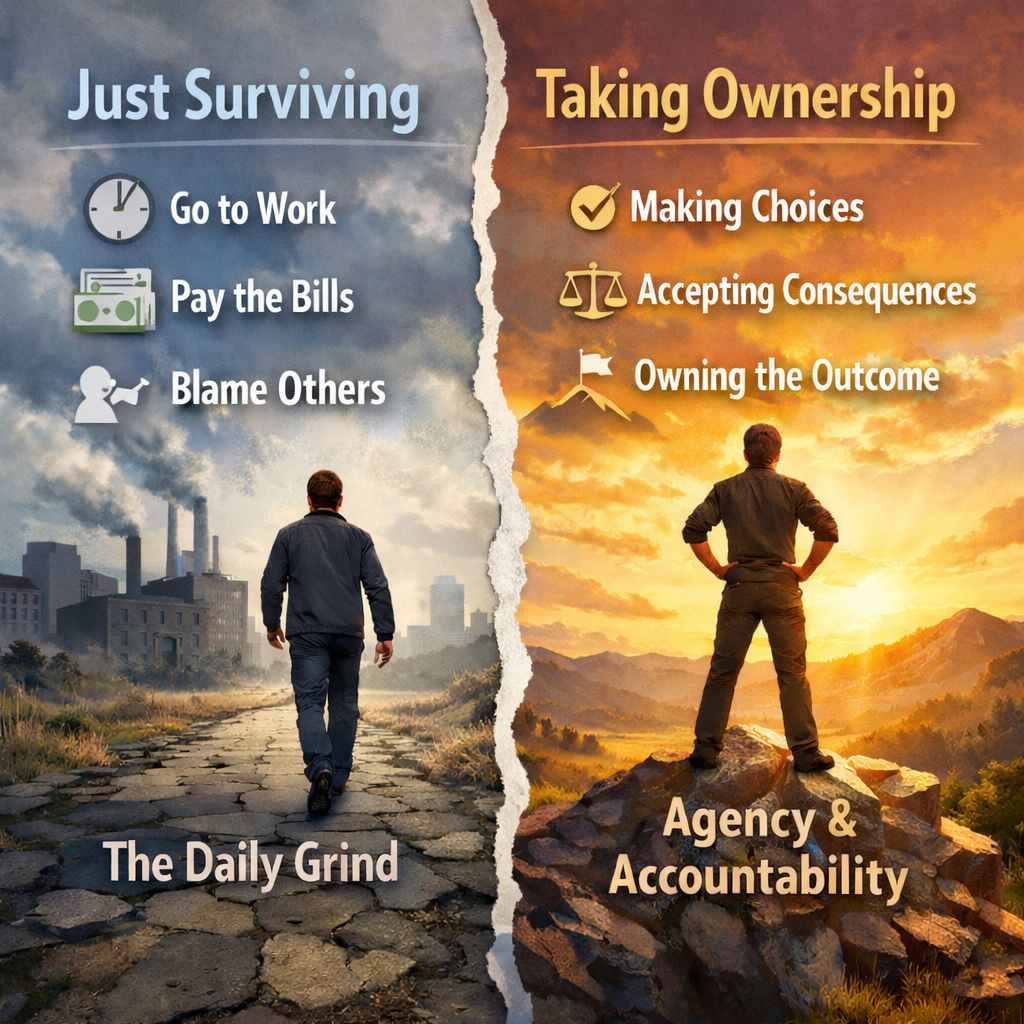
Most people believe responsibility is proven by basic survival. If you wake up, go to work, pay your bills, and keep your household functioning, you are considered “responsible.” In everyday conversation, the word has been turned into a checklist of adult obligations. We equate responsibility with generic routine. We confuse existence with ownership. But merely participating in life’s requirements is not the same thing as consciously taking charge of one’s life.
Responsibility, in its truest sense, is not about maintaining the bare minimum, but about agency. It is about voluntarily stepping forward and saying, “This is mine to manage. My choices matter. The outcome rests with me.” It is not the performance of duty alone, but the ownership of consequence. This distinction matters, because when responsibility is reduced to survival, we lower the standard of character, leadership, and personal growth.
I: The Difference Between Obligation and Ownership
There is a difference between having obligations and embodying responsibility. Obligations are imposed upon us, while ownership is chosen. A person may be obligated to pay rent, feed their children, or show up to work because the alternative carries negative consequences. But responsibility emerges when a person sees those obligations not as burdens imposed by circumstance, but as commitments they actively steward and answer for.
The Stoic philosopher Epictetus taught, “It’s not what happens to you, but how you react to it that matters.” This statement underscores a timeless truth: responsibility begins in the realm of response. The word itself can be broken down as response-ability, the ability to respond with intention rather than reflex. When we merely fulfill obligations to avoid punishment or shame, we are reacting. When we consciously choose our response and accept the outcome, we are acting responsibly.
History offers powerful examples of this. Consider George Washington, who, after leading the Continental Army to victory, voluntarily relinquished power instead of claiming authority as a monarch. This act was not required of him, it was an example of ownership. It was a deliberate submission to principle over ego. Responsibility at that level is not about “paying bills”, it’s about stewarding power with integrity.
Scripture also draws this distinction. In Luke 12:48, it is written: “To whom much is given, much will be required.” Responsibility increases with capacity. It is not about doing the minimum required to stay afloat; it is about stewarding what has been entrusted to you (talents, influence, opportunities) with intentionality, and accepting the responsibility of the outcome without excuses.
When people cite everyday life maintenance as proof of responsibility, they may be pointing to real effort. But effort alone does not equal ownership. Ownership asks: Are you choosing your role consciously? Are you taking responsibility not only for what you must do, but for the results that follow?
II: The Psychology of Excuses and Deflection
True responsibility cannot exist in the presence of excuses. When outcomes are blamed entirely on circumstances, other people, or “the system,” ownership disappears. While external factors undeniably influence outcomes, responsibility lies in how one responds within those constraints.
Psychologist Viktor Frankl, a “Holocaust” survivor, wrote in Man’s Search for Meaning: “Everything can be taken from a man but one thing: the last of the human freedoms – to choose one’s attitude in any given set of circumstances.” Frankl’s insight is not naïve optimism; it is a radical assertion of personal agency. Even in suffering, our capacity to choose remains, and responsibility begins there.
Modern psychology describes something called “locus of control.” Individuals with an internal locus of control believe their actions influence outcomes. Those with an external locus attribute outcomes primarily to external forces. While reality contains both, responsibility requires cultivating primarily the internal stance: asking, “What is within my control?”
The Book of Proverbs reinforces this idea: “The prudent see danger and take refuge, but the simple keep going and pay the penalty.” (Proverbs 22:3). Responsibility is foresight. It is learning from outcomes rather than repeating patterns while blaming fate, or others. Excuses provide temporary relief from discomfort, but true ownership demands discomfort. It requires examining one’s decisions honestly. It asks difficult questions: Did I prepare adequately? Did I communicate clearly? Did I act impulsively? Without that examination, growth will stagnate.
When someone says, “I go to work, I pay my bills,” they may be stating facts. But if they avoid confronting the outcomes of their deeper choices (financial habits, relational patterns, emotional reactions) they are maintaining life, not mastering it. They are in-fact irresponsible!
III: Voluntary Responsibility and Leadership
Responsibility reaches its highest form when it is voluntary. Leaders understand this intuitively. They step forward when no one compels them to do so. President Theodore Roosevelt famously said, “The credit belongs to the man who is actually in the arena… who errs, who comes short again and again… but who does actually strive to do the deeds.” Responsibility is not perfection, but willingness. It is stepping into the arena and accepting the possibility of failure, and any resulting consequences.
James 4:17 states: “If anyone, then, knows the good they ought to do and doesn’t do it, it is sin for them.” This passage frames responsibility not merely as avoiding wrongdoing, but as actively choosing to do what is right when you have the capacity to do so. Leadership in families, businesses, and communities follows the same principle. True leaders do not simply perform required tasks. They anticipate consequences, take initiative, and absorb accountability when things go wrong. They do not hide behind titles or roles, and they certainly do not blame others
When responsibility is voluntary, it becomes transformative, it reshapes character, it builds credibility, and it commands trust.
IV: Responsibility and Maturity
In modern times adulthood is often mistaken for maturity. Age and responsibility are not synonymous. One can grow older while remaining reactive, defensive, and blame-oriented. True maturity is measured by one’s capacity to own the outcomes of their actions (or inactions).
The Apostle Paul wrote in 1 Corinthians 13:11: “When I was a child, I spake as a child, I understood as a child, I thought as a child: but when I became a man, I put away childish things.” Maturity involves relinquishing excuses and embracing accountability.
Psychologically, responsibility correlates with delayed gratification, the ability to prioritize long-term outcomes over short-term comfort. Studies in behavioral science consistently show that individuals who accept accountability and practice self-regulation will experience greater success across life domains.
Historical innovators such as Thomas Edison demonstrated this kind of maturity. Edison conducted thousands of failed experiments before successfully developing a commercially viable electric light. When asked about his failures, he famously replied, “I have not failed. I’ve just found 10,000 ways that won’t work.” Rather than blaming circumstances, investors, or limitations in technology, he treated every setback as data. He did not deny difficulty; he absorbed it. His persistence reflected responsibility in its purest form: ownership of process, ownership of outcome, and refusal to retreat into excuses or blame others.
Maturity means acknowledging constraints while refusing to be defined by them. It means asking not only, “What happened to me?” but “What will I do next?”
V: Redefining Responsibility in Modern Culture
Modern culture often celebrates visibility over accountability, social media rewards declarations more than discipline, and statements like “I work hard” or “I do everything for myself” become identity badges. Yet responsibility is proven over time, not declared in snapshot moments.
The philosopher Jean-Paul Sartre wrote, “We are condemned to be free.” By this he meant that freedom inherently carries responsibility. We cannot escape choice, even inaction is a choice, and blame even more so.
The Parable of the Talents in Matthew 25 illustrates this in a powerful way. Servants are entrusted with resources. Two invest and multiply what they were given, and one buries his talent out of fear. The rebuke is not for failure, it is for refusing to act, because responsibility requires full engagement.
In redefining responsibility, we must shift the standard. It is not enough to just survive, or to perform. Responsibility asks: Are you actively shaping your life? Are you stewarding your influence? Are you taking ownership when things fall short?
Responsibility is less about what you are forced to do and more about what you choose to own.
Conclusion: The Call to Ownership
Responsibility is not a slogan or a checklist of adult tasks. It is the daily decision to claim authorship over your choices and their consequences. It is voluntary ownership in a world that constantly tempts us to deflect blame to others. When we reduce responsibility to mere survival, we diminish our human potential. When we elevate it to ownership, we unlock growth, leadership, and integrity on levels rarely seen today.
The call is simple but demanding: Stop measuring responsibility by what you endure. Measure it by what you own. Step forward willingly, examine outcomes honestly, reject excuses gently but firmly, and begin to live not as someone who is merely participating in life; but as someone who is consciously shaping it.