Introduction
Throughout Scripture, fasting appears wherever men and women of God sought clarity, repentance, victory, or divine intervention. Moses fasted forty days on Mount Sinai before receiving the Law. Elijah fasted on his journey to Horeb. Esther called a national fast before confronting the king. And Jesus Himself began His earthly ministry with a forty-day fast in the wilderness. Fasting is not an outdated fringe spiritual practice reserved for monks and mystics, it is a foundational discipline woven throughout the life of God’s people. Yet in modern Christianity, it has been quietly abandoned, or replaced by a softer, more comfortable religion that avoids hardship and spiritual exertion.
At its core, fasting is the deliberate denial of physical appetite in order to sharpen spiritual awareness and strengthen obedience. The Bible presents fasting as an act of humility before God, a weapon in spiritual warfare, and a discipline that subdues the flesh. As one theological reflection describes it, fasting is the act of abstaining from something good so that one may concentrate more fully on God. Yet fasting is more than a spiritual ritual. Throughout history (and increasingly in modern research) it has also been recognized for its physical and psychological benefits. Scientific studies show that structured fasting can improve metabolic health, reduce inflammation, improve blood sugar control, lengthen lifespan, and even support cardiovascular health.
This article explores fasting from every angle: biblical, historical, practical, physical, and spiritual. We will examine its role in family leadership, masculine discipline, biblical feasts, spiritual warfare, and the restoration of order in the Christian life. We will also confront the uncomfortable truth that the modern church rarely (if ever) fasts because modern believers rarely deny themselves. Yet the men and women who shaped history (biblical patriarchs, prophets, apostles, and reformers) understood something we have largely forgotten. Fasting is not weakness, but training for dominion.
I. The Biblical Foundation of Fasting
Fasting is not a modern spiritual experiment, but a deeply rooted biblical practice that appears throughout both the Old and New Testaments whenever God’s people sought repentance, guidance, deliverance, or spiritual strength. From the patriarchs to the prophets, from kings to apostles, fasting consistently appears alongside prayer as one of the most powerful disciplines available to believers. Yet unlike many modern spiritual trends, fasting was never presented as optional. It was assumed to be part of a faithful life before God.
The earliest biblical command connected to fasting appears in the Day of Atonement. In Leviticus, the Lord commanded Israel:
“And this shall be a statute for ever unto you: that in the seventh month, on the tenth day of the month, ye shall afflict your souls… for on that day shall the priest make an atonement for you, to cleanse you, that ye may be clean from all your sins before the Lord.” –Leviticus 16:29–31
The phrase “afflict your souls” has historically been understood by Jewish interpreters as fasting and self-denial. Even today, Yom Kippur remains the most widely observed fast in Judaism. The principle is clear: fasting is an outward act that reflects inward humility. It is the deliberate lowering of the body so the spirit may be lifted toward God.
Throughout Israel’s history, fasting frequently accompanied moments of national crisis. When the prophet Joel warned Israel of impending judgment, his solution was not political reform or military strength, it was repentance expressed through fasting.
“Therefore also now, saith the Lord, turn ye even to me with all your heart, and with fasting, and with weeping, and with mourning: And rend your heart, and not your garments…” –Joel 2:12–13
Notice the pattern: fasting was never meant to be an empty ritual. God rejected outward fasting that was not accompanied by genuine repentance. The prophet Isaiah delivered one of the strongest rebukes against hypocritical fasting in Scripture.
“Is not this the fast that I have chosen? to loose the bands of wickedness, to undo the heavy burdens… to let the oppressed go free… Is it not to deal thy bread to the hungry…?” –Isaiah 58:6–7
True fasting, according to God, produces transformation. It humbles the individual and restores justice within the community. In the New Testament, fasting intensifies. Before beginning His ministry, Jesus fasted forty days in the wilderness.
“Then was Jesus led up of the Spirit into the wilderness to be tempted of the devil. And when he had fasted forty days and forty nights, he was afterward an hungred.” –Matthew 4:1–2
Christ’s fast is not merely symbolic. It reveals the powerful truth that fasting prepares the believer for confrontation with evil. Immediately following this fast, Jesus faced temptation from Satan. His victory came not through physical strength, but through spiritual clarity and obedience to Scripture. Even more telling is what Jesus assumed about the future practice of fasting among His followers.
“Moreover when ye fast, be not, as the hypocrites… that they may appear unto men to fast… But thou, when thou fastest, anoint thine head, and wash thy face… and thy Father, which seeth in secret, shall reward thee openly.” –Matthew 6:16–18
Notice that Jesus did not say “if you fast.” He said “when you fast.” Fasting was expected. The early church continued this pattern. In the Book of Acts, leaders fasted before making major decisions.
“As they ministered to the Lord, and fasted, the Holy Ghost said, Separate me Barnabas and Saul… And when they had fasted and prayed, and laid their hands on them, they sent them away.” –Acts 13:2–3
The pattern is clear and unmistakable: prayer, fasting, and then clarity. From Moses to the apostles, fasting appears whenever God’s people sought divine direction. It humbled the flesh, sharpened spiritual perception, and prepared men and women to act with conviction. In other words, fasting was never merely about deprivation of food, it was about alignment with God’s will.
II. Fasting as Discipline: Mastery of the Flesh
One of the most overlooked purposes of fasting is the cultivation of discipline. At its simplest level, fasting forces a man (or woman) to confront the most basic human appetite: hunger. The body demands satisfaction. The stomach growls, energy dips, and irritation creeps in. Yet fasting requires a deliberate act of mastery, choosing obedience over your impulses. In this way, fasting becomes a training ground for dominion over the flesh. Scripture consistently teaches that the greatest battle a man fights is not against enemies outside him, but against desires within him. A man who cannot say “no” to his own appetites will rarely stand firm against temptation, pressure, or sin.
The Apostle Paul understood this principle. In writing about spiritual discipline, he compared the Christian life to the training of an athlete preparing for competition. Discipline is required, restraint is required, and mastery over the body is essential.
“24. Know ye not that they which run in a race run all, but one receiveth the prize? So run, that ye may obtain. 25. And every man that striveth for the mastery is temperate in all things. Now they do it to obtain a corruptible crown; but we an incorruptible. 26. I therefore so run, not as uncertainly; so fight I, not as one that beateth the air: 27. But I keep under my body, and bring it into subjection: lest that by any means, when I have preached to others, I myself should be a castaway.” –1 Corinthians 9:24–27
Paul speaks of keeping his body under and bringing it into subjection. The picture is one of deliberate control. The body is not meant to command the man, the man is meant to command the body. Hunger, fatigue, and physical craving are powerful forces, but Scripture never treats them as rightful masters. Fasting is one of the clearest ways to train that hierarchy. When a man voluntarily denies himself food for a time, he proves to himself that appetite does not rule him. This theme appears elsewhere in Scripture as well. The Bible repeatedly warns that a man ruled by appetite becomes spiritually dull and morally unstable.
“He that hath no rule over his own spirit is like a city that is broken down, and without walls.” –Proverbs –25:28
A city without walls is defenseless. In ancient times (and modern) it invited invasion, looting, and destruction. Solomon uses this image appropriately, a man who cannot govern his own impulses becomes spiritually exposed. Temptation enters easily, anger spills out quickly, and lust finds an open door. Discipline, on the other hand, builds walls of protection around the soul.
Historically, Christian thinkers recognized fasting as one of the most effective tools for cultivating this inner rule. The early church father John Chrysostom wrote, “Fasting is the support of our soul: it gives us wings to ascend on high.” Similarly, Martin Luther observed that fasting “subdues the flesh and prepares the spirit for prayer.” These observations were not mystical exaggerations; they reflected the practical reality that when the body is restrained, the mind becomes sharper and the spirit more attentive.
Modern research increasingly confirms these ancient insights. Studies in behavioral psychology show that individuals who practice voluntary restraint in one area often develop stronger self-control in others. This phenomenon, sometimes called discipline spillover, demonstrates that habits of restraint reinforce broader character formation. A man who regularly practices discipline (whether through training, structured eating, or fasting) develops greater control over speech, temper, and impulse.
There is also a distinctly masculine dimension to this discipline. Throughout history, rites of passage for men often included hardship, hunger, and deprivation. Military training programs, survival training, and even traditional monastic orders recognized the same truth: comfort breeds weakness, while controlled hardship builds resilience. Fasting fits squarely into this pattern. It is voluntary hardship with a spiritual purpose. Jesus also demonstrated this principle before beginning His ministry.
“1.Then was Jesus led up of the Spirit into the wilderness to be tempted of the devil. 2. And when he had fasted forty days and forty nights, he was afterward an hungred. 3. And when the tempter came to him, he said, If thou be the Son of God, command that these stones be made bread. 4. But he answered and said, It is written, Man shall not live by bread alone, but by every word that proceedeth out of the mouth of God.” –Matthew 4:1–4
Christ’s response reveals the purpose of fasting. Hunger speaks loudly, but it does not have the final authority. The Word of God does. When practiced faithfully, fasting trains believers to live by this hierarchy, spirit over flesh, obedience over appetite, and God’s Word over bodily cravings.
III. Fasting in the Household: Leadership, Family, and Biblical Order
Fasting is not exclusively a private spiritual exercise; it has profound implications for the household. Throughout Scripture, spiritual leadership within the family often begins with the discipline and humility of the man who leads it. When a husband and father practices fasting, he is doing more than denying himself food, he is modeling spiritual authority, self-control, and submission to God. The household watches the habits of its head. If the leader pursues comfort and indulgence, the family follows that pattern. But if the leader pursues discipline and obedience, the family learns reverence and order.
One of the clearest biblical examples of household leadership through spiritual discipline is found in the life of Ezra. Before leading the people of Israel back to Jerusalem, Ezra called the community to fast together so that they might seek God’s guidance and protection.
“21.Then I proclaimed a fast there, at the river of Ahava, that we might afflict ourselves before our God, to seek of him a right way for us, and for our little ones, and for all our substance. 22. For I was ashamed to require of the king a band of soldiers and horsemen to help us against the enemy in the way: because we had spoken unto the king, saying, The hand of our God is upon all them for good that seek him; but his power and his wrath is against all them that forsake him. 23. So we fasted and besought our God for this: and he was intreated of us.” –Ezra 8:21–23
Notice the language Ezra uses. The fast was not only for himself; it was “for us, and for our little ones.” The leader understood that the spiritual posture of the family affected the welfare of the entire community. When men humble themselves before God, the blessing and protection of God extends beyond the individual and into the household.
Scripture consistently places responsibility for spiritual leadership upon the man of the house. The discipline of fasting reinforces this role by training the leader to seek God before acting. A man who fasts regularly becomes slower to react emotionally and quicker to seek wisdom. This aligns with the biblical expectation that fathers teach and guide their families according to God’s law.
“6. And these words, which I command thee this day, shall be in thine heart: 7. And thou shalt teach them diligently unto thy children, and shalt talk of them when thou sittest in thine house, and when thou walkest by the way, and when thou liest down, and when thou risest up.” Deuteronomy 6:6–7
Teaching Scripture requires more than knowledge; it requires example. Children observe far more than they listen. When they see their father (or mother) willingly abstain from food in order to seek God, they learn that faith is not merely spoken, it is practiced. The home becomes a place where devotion is lived rather than merely discussed.
Historically, many Christian households practiced regular family fasting. In certain seasons of the church calendar, families would abstain from particular foods, share simpler meals, or devote time to prayer instead of normal routines. The purpose was not punishment or legalism, but orientation. Fasting reminded the family that life does not revolve around consumption, entertainment, or convenience. Life revolves around obedience to God.
Even short household fasts can have profound effects. A father might call for a day of fasting before making a major decision, before beginning a new venture, or when facing difficulty within the family. The act communicates something powerful: the household seeks God first. It teaches children that prayer and humility come before strategy and decision.
This pattern is visible even in times of national crisis within Scripture. When King Jehoshaphat faced a massive invading army, he did not immediately assemble troops. Instead, he called the entire nation to fast and seek the Lord first.
“3. And Jehoshaphat feared, and set himself to seek the Lord, and proclaimed a fast throughout all Judah. 4. And Judah gathered themselves together, to ask help of the Lord: even out of all the cities of Judah they came to seek the Lord.” –2 Chronicles 20:3–4
Leadership in Scripture consistently begins with humility before God. Fasting expresses that humility. It acknowledges that strength, wisdom, and protection ultimately come from the Lord.
When a household practices fasting (even occasionally) it begins to reorient its priorities. Meals become blessings rather than expectations, prayer becomes central rather than incidental, and gratitude replaces entitlement. In this way, fasting quietly restores order within the home: God first, the leader submitted to Him, and the family walking together in obedience.
IV. Fasting as Spiritual Warfare
Fasting is not only an act of humility or personal discipline; Scripture also presents it as a weapon in spiritual warfare. The Bible repeatedly reveals that there are moments when prayer alone is not enough, when deeper spiritual resistance requires deeper spiritual preparation. In these moments, fasting sharpens prayer, focuses the mind, and humbles the body so that the believer stands before God with greater clarity and dependence.
One of the clearest demonstrations of this principle appears during the ministry of Jesus. After the disciples failed to cast out a demon, they asked Christ privately why their authority had failed. His answer revealed that some spiritual battles require intensified spiritual preparation.
“19. Then came the disciples to Jesus apart, and said, Why could not we cast him out? 20. And Jesus said unto them, Because of your unbelief: for verily I say unto you, If ye have faith as a grain of mustard seed, ye shall say unto this mountain, Remove hence to yonder place; and it shall remove; and nothing shall be impossible unto you. 21. Howbeit this kind goeth not out but by prayer and fasting.” –Matthew 17:19–21
Christ’s words reveal a sobering reality: not all spiritual opposition is equal. Some struggles yield quickly to prayer and faith, while others require deeper spiritual preparation. Fasting, when combined with prayer, strengthens the believer’s focus and dependence on God. It removes distractions, humbles pride, and aligns the heart more closely with the will of God.
The prophet Daniel provides another powerful example of fasting connected to spiritual warfare. During a period of intense prayer and fasting, Daniel received a heavenly visitation explaining that unseen spiritual resistance had delayed the answer to his prayer.
“2. In those days I Daniel was mourning three full weeks. 3. I ate no pleasant bread, neither came flesh nor wine in my mouth, neither did I anoint myself at all, till three whole weeks were fulfilled.” –Daniel 10:2–3
Later in the chapter, the angel explained what had been occurring behind the scenes while Daniel prayed and fasted.
“12. Then said he unto me, Fear not, Daniel: for from the first day that thou didst set thine heart to understand, and to chasten thyself before thy God, thy words were heard, and I am come for thy words. 13. But the prince of the kingdom of Persia withstood me one and twenty days: but, lo, Michael, one of the chief princes, came to help me; and I remained there with the kings of Persia.” –Daniel 10:12–13
Daniel’s fast coincided with a spiritual conflict taking place beyond his human sight. His humility and persistence in prayer played a role in a spiritual struggle between angelic and demonic forces. This passage reminds believers that spiritual warfare is often invisible, yet very real. The New Testament reinforces this reality repeatedly. The Apostle Paul warned believers that the true battle of faith is not primarily against human enemies.
“For we wrestle not against flesh and blood, but against principalities, against powers, against the rulers of the darkness of this world, against spiritual wickedness in high places.” –Ephesians 6:12 (KJV)
If the conflict is spiritual, the weapons must also be spiritual. Prayer, fasting, repentance, and obedience become instruments through which believers seek God’s power against forces they cannot see.
Historically, many Christian leaders practiced fasting specifically during times of spiritual conflict. The early church frequently fasted before missionary journeys, during persecution, and when confronting serious doctrinal disputes. Even during periods of revival, fasting often accompanied intense prayer. Many of the great awakenings in church history were preceded by believers humbling themselves through fasting and repentance.
Fasting does not manipulate God or force His hand. Rather, it positions the believer in a posture of humility and dependence. It quiets the overbearing noise of daily life and turns the heart toward God with greater intensity. In spiritual warfare, clarity matters.
Ultimately, fasting reminds believers that victory does not come through human strength. The battle belongs to the Lord. Yet throughout Scripture, God repeatedly responds when His people humble themselves before Him. Fasting becomes one of the ways that humility is expressed, not as an empty ritual, but as a declaration that spiritual victory comes from God alone.
V. The Practical Practice of Fasting: Forms, Health, and Restoration
While fasting is deeply spiritual, it is also profoundly practical. Scripture presents fasting in several different forms, demonstrating that it is not a rigid ritual but a flexible discipline applied according to circumstance, need, and calling. Some fasts are short, some extended; some involve complete abstinence from food, while others involve the removal of certain foods or comforts. What unites them is not the exact method, but the purpose: humbling oneself before God and sharpening spiritual focus.
One of the simplest and most common biblical fasts is the normal fast, which involves abstaining from food while continuing to drink water. This type of fast appears frequently in Scripture. For example, when Queen Esther called the Jewish people to seek deliverance from destruction, she instructed them to fast together before she approached the king.
“15. Then Esther bade them return Mordecai this answer, 16. Go, gather together all the Jews that are present in Shushan, and fast ye for me, and neither eat nor drink three days, night or day: I also and my maidens will fast likewise; and so will I go in unto the king, which is not according to the law: and if I perish, I perish.” –Esther 4:15–16
Esther’s fast was intense and urgent. It demonstrated that fasting is often tied to moments of serious decision, danger, or national crisis. The goal was not physical suffering for its own sake, but spiritual clarity and divine favor.
Another biblical form is the partial fast, in which certain foods are avoided while basic nourishment continues. This type of fast appears in the life of Daniel. During a season of mourning and prayer, he deliberately limited his diet.
“2. In those days I Daniel was mourning three full weeks. 3. I ate no pleasant bread, neither came flesh nor wine in my mouth, neither did I anoint myself at all, till three whole weeks were fulfilled.” –Daniel 10:2–3 (KJV)
This form of fasting allowed Daniel to remain physically sustained while still practicing restraint and devotion. Many believers today adopt similar practices by abstaining from rich foods, sweets, alcohol, or other indulgences during periods of prayer.
Scripture also records supernatural fasts, though these are rare and clearly empowered by God. Moses fasted forty days while receiving the Law.
“And he was there with the Lord forty days and forty nights; he did neither eat bread, nor drink water. And he wrote upon the tables the words of the covenant, the ten commandments.” –Exodus 34:28 (KJV)
Likewise, Elijah and Jesus both fasted forty days during pivotal moments of divine preparation. These fasts were extraordinary and not presented as routine practices for ordinary believers. They remind us that fasting ultimately depends upon God’s strength, not merely human willpower.
Beyond spiritual benefits, fasting has increasingly been studied for its physical effects. Medical research in recent decades has shown that structured fasting can improve metabolic flexibility, support blood sugar regulation, and stimulate a cellular repair process known as autophagy, in which the body removes damaged cellular components. Studies from institutions such as the National Institute on Aging and research summarized in journals like The New England Journal of Medicine have explored how intermittent fasting may contribute to improved cardiovascular health, reduced inflammation, and improved insulin sensitivity.
These findings do not replace the spiritual purpose of fasting, but they illustrate something remarkable: practices embedded in Biblical tradition often align with biological wisdom. What Scripture presents as spiritual discipline often carries physical benefits as well.
Practically speaking, fasting can take many forms in daily life. Some believers practice a weekly fast, abstaining from food for one day each week. Others fast during specific seasons of prayer, before making major decisions, or during times of repentance. Even short fasts (such as skipping one or two meals) can create space for prayer, reflection, health benefits, and renewed focus.
Ultimately, fasting restores a sense of order to human life. It reminds us that food, comfort, and pleasure are blessings, not masters. When believers periodically step away from these things voluntarily, they rediscover a powerful truth: life is sustained not merely by what we consume, but by the God who provides it.
Conclusion
Fasting is one of the oldest disciplines practiced by the people of God, yet it remains one of the most neglected in modern Christianity. Throughout Scripture, fasting appears wherever men and women sought repentance, clarity, deliverance, or divine intervention. Prophets fasted before delivering warnings to nations. Kings called for fasting in times of crisis. Apostles fasted before appointing leaders and launching missionary work. Even our Lord Jesus Christ began His earthly ministry with a prolonged fast in the wilderness. Whenever God’s people desired to draw nearer to Him, fasting often accompanied prayer.
Fasting was never meant to be an empty ritual or public display. The prophets repeatedly condemned fasting that was done for attention. God does not respond to hunger alone; He responds to humility, repentance, and obedience. The true fast reshapes the heart. It trains the believer to put the spirit above the flesh, obedience above appetite, and devotion above comfort. When practiced faithfully, fasting becomes a tool that strengthens discipline, sharpens spiritual awareness, restores order within the household, and prepares believers to face both physical and spiritual challenges with deepened clarity and faith.
In a culture built on constant consumption, fasting stands as a quiet act of rebellion. It reminds the believer that life does not revolve around appetite, convenience, or entertainment. Life revolves around obedience to God. Through fasting, the believer reorders his priorities: God first, discipline over indulgence, and eternal truth over temporary satisfaction.
For this reason, fasting remains as relevant today as it was in the days of the prophets and apostles. It is a discipline that humbles the proud, strengthens the weak, and restores spiritual clarity in a distracted world. And for those willing to practice it faithfully, fasting continues to serve its ancient purpose, drawing the heart of man back toward the God who sustains him.
Call to Action
The truth is simple: less than 5% ofChristians today fast on a regular basis. Not because Scripture discourages it, but because modern comforts have replaced discipline. We live in a culture where food is constant, convenience is expected, and self-denial is treated as unnecessary or extreme. Yet the pattern of Scripture tells us the men and women who walked closely with God were not strangers to hunger. They fasted when they sought guidance. They fasted when they repented. They fasted when they faced danger. And they fasted when they needed clarity before acting. Fasting was not reserved for spiritual elites, it was part of a faithful life.
Jesus Himself assumed His followers would fast. In His teaching on prayer, giving, and fasting, He used the same language for each discipline.
“16. Moreover when ye fast, be not, as the hypocrites, of a sad countenance: for they disfigure their faces, that they may appear unto men to fast. Verily I say unto you, They have their reward. 17. But thou, when thou fastest, anoint thine head, and wash thy face 18. That thou appear not unto men to fast, but unto thy Father which is in secret: and thy Father, which seeth in secret, shall reward thee openly.” –Matthew 6:16–18
Notice that Christ did not say “if” you fast, He said “when.” The expectation was clear. Fasting would be part of the believer’s life, practiced quietly and sincerely before God.
So begin somewhere. You do not need to start with forty days in the wilderness. Start with a single meal. Skip lunch every day this week and spend that time in prayer. Or dedicate a full 24 hour day to fasting and seeking God’s direction. Fathers can even introduce the discipline gently within the household by leading the family in a simple fast before an important decision or season of prayer. The point is not performance; the point is obedience.
In a world drowning in excess, fasting restores perspective. It reminds us that our strength does not come from the abundance of our table but from the presence of our God. When believers willingly humble themselves in this way, they rediscover something the modern church has largely forgotten: discipline strengthens their faith.
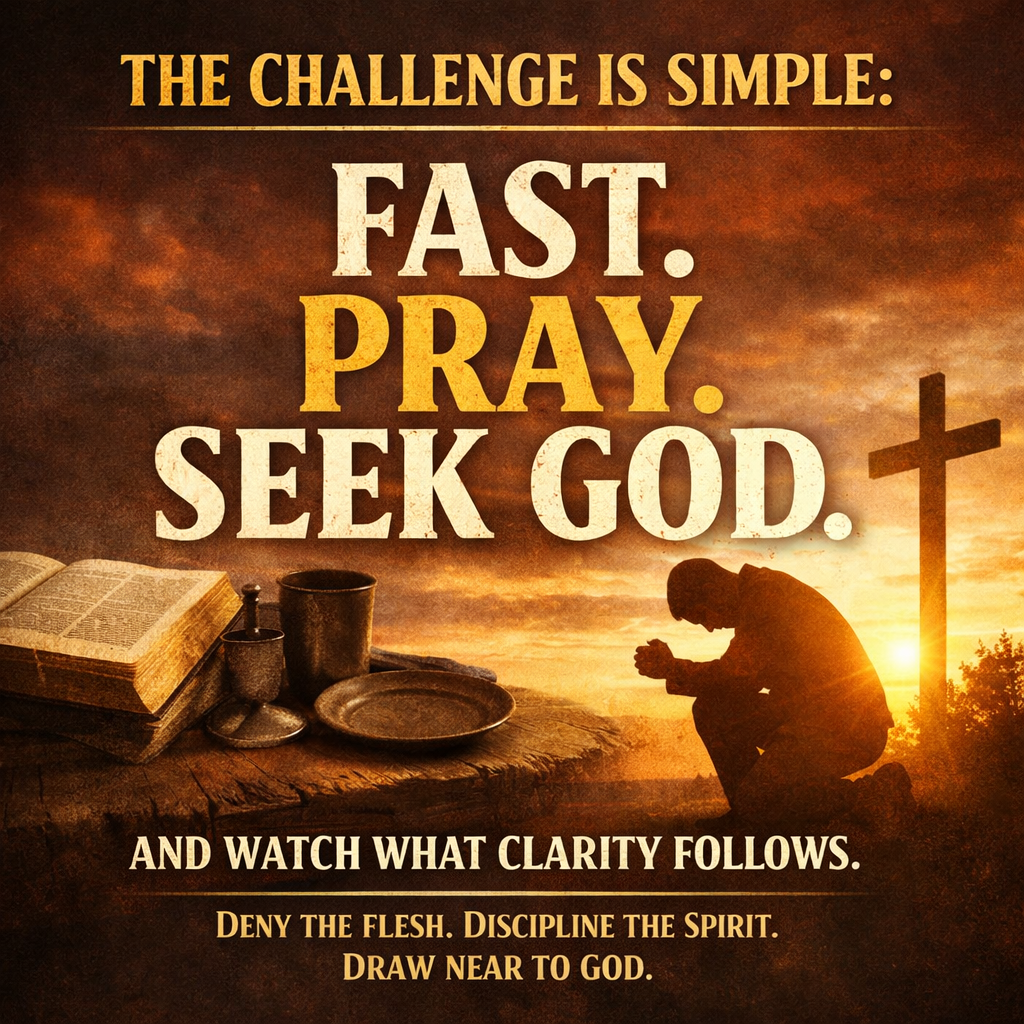
The challenge is simple. Fast, pray, seek God. And watch what clarity follows.
May God’s Great Order be restored!