Disclaimer
Not every man is called to polygyny. Not every man is called to the same number of wives. Some are called to one, some to none, and some to several. This article does not seek to lay down a law where Scripture has not written one. Instead, these are observations, patterns seen in the Word of God, reinforced in history, and affirmed in reason.
Acknowledgment
This line of thought, and the resulting article, was inspired by a conversation I had with Jacob Foulk. Our discussion sparked a deeper examination into the numbers associated with wives in Scripture, their symbolic meaning, and the practical realities that follow. What began as a casual thought quickly revealed itself to be a profound theme woven throughout God’s design for households.
I: The Symbolism of Numbers in Scripture and Marriage
When God wrote His Word, He did not waste ink. Every number, every sequence, every repeated pattern carries meaning. We live in a culture that treats numbers as cold mathematics, but in Scripture, numbers are theology. They are shorthand for divine realities, patterns by which heaven interprets earth. To study numbers in the Bible is not to drift into mysticism, but to trace the fingerprints of the Creator on the design of His world. And if marriage is one of God’s greatest designs, one of the earliest institutions He ever formed, then it too will bear the marks of numerical order.
The modern mind imagines marriage as one man, one woman, forever and ever, amen. But Scripture never makes such reductionist claims. Yes, one wife is legitimate and honorable. But one wife is not the pattern of perfection; it is the minimum threshold. In fact, when you begin to examine biblical numerology, you realize that one wife may be lawful but incomplete, two wives bring rivalry, three wives bring divine stability, four wives bring earthly fullness, and seven wives bring completion, the fullness of divine order expressed in a household. That is not speculation; it is the repeated testimony of the Bible’s mathematics.
The Number Seven: Divine Completion
The number seven saturates the Bible. It is not a trivial figure, but God’s favorite marker of completion and perfection. Creation is built on it: six days of labor, one day of rest. Israel’s calendar revolves around it: seven feasts, the seventh year sabbath, and the seven-times-seven Jubilee cycle. Heaven resounds with it: seven seals, seven trumpets, seven bowls in Revelation. When God wishes to signal “this is full, this is complete, this is perfected,” He stamps it with the number seven.
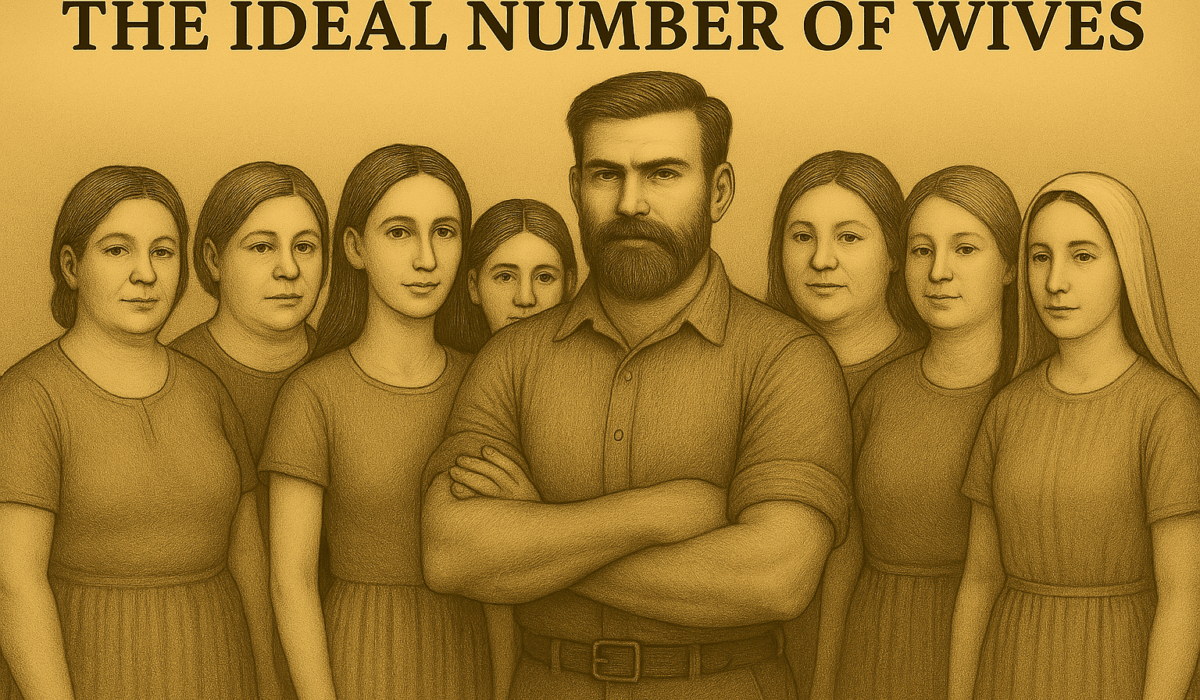
So when Isaiah prophesies in chapter 4: “Seven women shall take hold of one man”, he is not pulling a number out of a hat. He is giving us a prophetic image of marital completeness, of a household that reflects divine order. If one wife is lawful and four wives bring balance, then seven wives is the household perfected. Seven is the ideal, not in the sense that every man must reach it, but in the sense that seven is the symbolic number by which God marks completion. In marriage, as in creation, seven signals that the work is whole.
The Number Three: Divine Stability
Before we get to seven, we need to pass through three. The Bible is a book of trinities. God Himself is Father, Son, and Spirit. Christ rose on the third day. The priestly blessing is in three lines. The holiest objects were built on threes, the outer court, the holy place, and the holy of holies. Ecclesiastes 4:12 lays it out clearly: “A threefold cord is not quickly broken.”
Two is unstable. Cain versus Abel. Sarah versus Hagar. Leah versus Rachel. Duality breeds rivalry, envy, and instability. But once the third element enters, stability is created. What was wobbly becomes anchored. This is as true of households as it is of rope. Jacob learned this the hard way. With two wives, he endured endless strife. When the third wife entered, the rivalry balanced. And by the time he had four, the system stabilized. Three introduced divine order, four cemented earthly fullness. But it was three that shifted the balance from rivalry to stability.
Thus, three wives is not just “more” than two, it is categorically different. It transforms the household from rivalry into something stable, divine, and enduring.
The Number Four: Earthly Fullness
If three is divine, four is earthly. The number four is always tied to creation, geography, and universality. The four rivers flowed out of Eden. The four winds cover the whole earth. The four corners of the earth represent the totality of mankind. The four living creatures stand as symbols of all creation before the throne of God.
Applied to marriage, four means the household has reached fullness. Jacob’s four wives produced the twelve tribes of Israel (a multiple of 4), the fullness of the covenant nation. After Zilpah entered, the bickering of Leah and Rachel disappears from the narrative. The household stabilizes. There are no more “wife problems.” Rivalries remain among the sons, but the wives no longer dominate the story. Four wives created a full and functional system, an echo of the four corners of creation.
Thus, we see the progression: two is rivalry, three is divine stability, four is fullness. This pattern is not an accident. It is a testimony that marriage, like creation, follows the divine arithmetic.
One Is Lawful, But Not Complete
The Bible never forbids one wife. In fact, it honors monogamy. But the danger of modern thinking is assuming that the lawful minimum is the divine maximum. Just because one wife is legitimate does not mean one wife is the ideal. Nowhere in Scripture is “one wife only” prescribed as the pattern of perfection. Adam and Eve were the first couple, yes, but Adam and Eve were not the last word. The patriarchs who became the fathers of the covenant, Abraham, Jacob, David, were all polygynists. If one wife was the ideal, why would God build His nation on men with multiple?
One wife is sufficient for covenant legitimacy, but it is not sufficient to reflect divine order. In God’s arithmetic, one is not perfection. Seven is. Which is why Isaiah does not prophesy that “one woman shall take hold of one man.” He says seven!
This is where many scoffers roll their eyes. “Numbers? Really? You’re making doctrine out of math?” But these same scoffers already admit the importance of numbers when it suits them. They speak of the “Ten Commandments,” the “Twelve Apostles,” the “Three Persons of the Trinity.” They know instinctively that numbers in Scripture matter. They just don’t want to apply that logic to marriage because it threatens their fragile devotion to monogamy-only dogma.
The truth is that marriage is not arbitrary. It is covenantal arithmetic. Numbers matter because numbers mark the difference between rivalry and peace, between instability and fullness, between incompleteness and perfection. The Bible itself shows that the trajectory of polygyny follows the logic of its numbers:
- Two wives = rivalry.
- Three wives = stability.
- Four wives = fullness.
- Seven wives = perfection.
Anything less ignores the patterns God Himself embedded in His Word.
Marriage as Theology, Not Just Biology
Moderns reduce marriage to feelings and hormones. Scripture elevates marriage to theology. Paul says marriage is a “mystery” that reflects Christ and the Church (Ephesians 5:32). If Christ’s bride is one, she is still sevenfold in expression: seven churches, seven lampstands, seven messages in Revelation. The Church is both singular and plural, just as a man with multiple wives is both one household and many. Numbers do not detract from this mystery, they reveal it.
Marriage is not merely biology. It is a stage where theology plays out in flesh and blood. To ignore the numbers is to miss the script. The God who created the universe by number and measure also orders households by number and measure. And He left us the blueprint in the mathematics of His Word.
Numbers in Scripture are never random. They are God’s code for creation, covenant, and completion. When applied to marriage, they reveal a trajectory: from instability at two, to divine stability at three, to earthly fullness at four, and finally to perfection at seven. This is not a man-made scheme but a biblical pattern, reinforced by patriarchal precedent and prophetic vision.
One wife may be lawful. Two wives may be chaotic. Three wives may stabilize. Four wives may bring fullness. But seven wives, the number of divine completion, is the household perfected, the marriage that reflects the fullness of God’s order.
This is why Isaiah 4:1 is not a curiosity but a key: “Seven women shall take hold of one man.” The prophet was not describing chaos. He was describing order, divine order. And to see it is to see that even marriage is governed by God’s arithmetic.
II: The Prophetic Witness – Isaiah 4:1 and the Seven Wives
When men dismiss the idea of seven wives, they often claim, “There is no verse in the Bible that says a man should have seven.” But the reality is that there is one verse that comes closer than any other to spelling out the ideal in plain text, Isaiah 4:1.
“And in that day seven women shall take hold of one man, saying, We will eat our own bread and wear our own apparel: only let us be called by thy name, to take away our reproach.” (Isaiah 4:1, KJV)
For centuries, this verse has been shoved into the corner, treated as an odd curiosity or dismissed as an irrelevant prophecy. Yet if we actually let the text speak, it provides one of the strongest prophetic witnesses for seven wives as the ideal picture of order in a man’s household. Let us break it down.
The Context: Judgment and Restoration
Isaiah’s prophecy in chapter 3 is one of judgment. The women of Zion are condemned for their arrogance, their vanity, their sexual display, and their haughty rebellion. As judgment falls, men are slaughtered in battle, the mighty are stripped away, and Jerusalem collapses under divine wrath.
Then comes Isaiah 4:1: “In that day seven women shall take hold of one man.” What day? The day after judgment. The day when God has cut down the pride of men and women alike. The day when society is reeling from imbalance and devastation. In other words, Isaiah is describing a post-crisis restoration, when men are scarce, women are humbled, and order is sought.
It is in this setting that the number seven emerges, not one, not five, not ten, but seven, as the prophetic marker of restoration.
Why Seven?
If Isaiah only wanted to convey “many,” he could have said “a multitude of women” or “countless women.” But he didn’t. He said seven. That number carries symbolic weight throughout the Bible. Seven is the number of divine perfection, completion, covenantal wholeness. To say “seven women” is to say: “the complete number, the ideal arrangement, the fullness of God’s order.”
Thus, Isaiah 4:1 is not merely predicting desperate women scrambling for survival. It is portraying the divine pattern of restoration: a man as covenant head, seven women as his complete household.
Voluntary Submission & Removing Reproach
Notice also that the women in Isaiah’s vision are not coerced. They are not captured as spoils of war or dragged against their will. They take hold of the man. They come willingly, even desperately, offering to support themselves just to bear his name. They will bring their own bread, their own clothing, they only want covenant legitimacy.
This detail annihilates the caricature that polygyny is forced or degrading. Here, it is the women themselves who seek it out, because they know that attachment to a man of order is the only way to escape reproach. They understand something modern women despise: that glory is not found in independence but in belonging.
What reproach do they seek to escape? The reproach of barrenness, isolation, and disorder. In Scripture, a woman’s shame was not singleness, but fruitlessness. To be unwed and unfruitful was a disgrace. Thus, in Isaiah 4:1, seven women cling to one man because he alone can remove that reproach.
This is not about carnal lust. It is about covenantal identity. The women crave legitimacy, covering, and fruitfulness. They do not care about “fairness” or “equal rights.” They want order. They want to be named by a man. And the fact that seven of them unite under one man shows that this arrangement is not aberration, it is perfection.
Historical Fulfillments & Spiritual Typology
Some interpreters argue that Isaiah 4:1 found its literal fulfillment in the aftermath of wars where male populations were decimated. Indeed, history has seen countless examples:
- After the Babylonian conquest, the male population of Judah was drastically reduced.
- After the Roman wars, women outnumbered men by a wide margin in Judea.
- Even in modern times, after major wars, polygyny has naturally surged in societies where men are scarce.
But the prophecy is not merely about survival. The choice of seven shows that the Spirit was pointing to something more: the ideal. War creates the conditions, but prophecy reveals the divine pattern hidden in it.
Isaiah’s prophecy is not just sociological, it is theological. Marriage in Scripture always points beyond itself to Christ and His Church. If seven women join to one man, it foreshadows the reality that the one Christ is head over the sevenfold Church. Revelation confirms this: there are seven churches, seven lampstands, seven messages, all united under one Lord.
Thus, Isaiah 4:1 is both literal and typological. Literally, it describes women clinging to a man after judgment. Spiritually, it reveals Christ’s sevenfold bride. And in both senses, it affirms that seven wives is the symbol of divine completion.
Answering Objections
Critics will insist: “But this was judgment, not blessing!” True, but judgment is always a pruning for restoration. Just as exile purged Israel for future blessing, so too Isaiah 4:1 shows how disorder leads to order. The fact that God restores households through seven wives means that seven wives is not the curse but the cure.
Others will claim: “This is only symbolic.” But in Scripture, symbol and reality are intertwined. The Passover lamb symbolized Christ, but it was also a real lamb. The temple symbolized God’s dwelling, but it was also a real building. In the same way, seven wives in Isaiah 4:1 symbolizes perfection while also being a literal possibility.
“But won’t the wives be jealous?”
They are jealous at two. They stabilize at three. They stop bickering at four. Jealousy dissolves in plurality. Scripture itself proves it.
“But isn’t one wife enough?”
Enough for what? For legitimacy, yes. For divine perfection, no. Enough to reproduce, yes. Enough to reflect God’s order, no. One is lawful. Seven is ideal.
Implications for Today
Isaiah 4:1 is not locked in the past. It speaks to our time. We live in an age of judgment: feminism has gutted families, men are absent, women outnumber men in the churches, and reproach hangs heavy over childless, career-driven women. The stage is set for Isaiah’s vision to come alive again.
Already, we see hints of it. Women weary of failed independence are seeking strong men. Some are even willing to share if it means belonging to something real. Isaiah foresaw this: when society collapses, women will abandon their feminist delusions and grab hold of a man who can lead. Not any man. A man of order. And when they do, the number seven will not be random. It will be the signature of divine order reasserting itself.
Isaiah 4:1 is more than a curiosity. It is a prophetic witness to the perfection of seven wives under one man. It arises in judgment but points to restoration. It portrays women willingly embracing polygyny, not out of lust but out of desire for legitimacy. It ties directly to the symbolism of Christ and His sevenfold Church. And it sets the stage for understanding why seven is the ideal number of wives, not as a command for all, but as a pattern for those who see God’s order.
When seven women take hold of one man, Isaiah tells us, they will not ask for equality. They will not demand rights. They will not insist on personal fulfillment. They will only beg for his name, his covering, his order. That is not oppression, it is perfection. And it is the perfection of marriage itself, written in prophecy long before modern men dared to despise it.
III: The Patriarchal Patterns – Jacob, Solomon, and the Multiples of Seven
If numbers in Scripture are not accidents, then the marriages of the patriarchs were not accidents either. God could have established His covenant line through a single tidy marriage, but He didn’t. He chose to build His people through men with multiple wives. The fathers of the faith were not monogamy-only crusaders, they were polygynists. Their households were not just tolerated but blessed, and the very numbers of their wives bear testimony to divine design.
When we study Jacob and Solomon in particular, a striking pattern emerges: polygyny becomes more stable as wives increase, and the multiples of seven reinforce the idea that seven is God’s ideal for marital completeness. Let us examine the evidence.
Jacob: From Rivalry to Order
Jacob is perhaps the clearest case study in the progression of polygyny. His story shows us the arithmetic of wives in practice.
- Two Wives: Rivalry
Jacob began with Leah and Rachel. What followed was years of poisonous jealousy. Leah bore children while Rachel remained barren. Rachel envied Leah’s fertility; Leah resented Rachel’s favoritism. Their rivalry was so intense that it shaped the naming of their children, names like Naphtali (“my struggle”) and Issachar (“my hire”) testified to the bitterness between them. Two wives did not double the joy; it doubled the strife.
- Three Wives: Stability Introduced
When Rachel gave her maid Bilhah to Jacob, something shifted. Bilhah’s children gave Rachel a sense of participation in motherhood, easing her jealousy. Now the rivalry was triangulated, balanced. With three women, no single rivalry dominated. It is as Ecclesiastes says: “A threefold cord is not quickly broken.” The household, while still complex, began to stabilize.
- Four Wives: Fullness and Peace
When Leah responded by giving her maid Zilpah, the number rose to four. With four wives, the rivalry essentially disappeared. Each wife had her place, her children, her contribution. The story ceases to focus on wife drama and shifts to the sons, the future tribes of Israel. By four, the wives were settled into a functioning system. The household had reached fullness.
Jacob’s household proves the point: two wives create rivalry, three introduce divine stability, and four bring earthly fullness. Once Jacob had four, the dysfunction was absorbed into productivity. And through those four wives came the twelve tribes, the fullness of the covenant nation.
Solomon: Multiples of Seven
If Jacob shows us the progression, Solomon shows us the scale. Solomon’s marriages are usually portrayed as a cautionary tale, and they should be. But notice carefully: Scripture never condemns Solomon for polygyny itself. The sin was not “too many wives” in raw number. The sin was that his foreign wives turned his heart toward idolatry (1 Kings 11:3–4). The problem was spiritual, not mathematical.
And yet, even in Solomon’s excess, the numbers themselves are telling:
- 700 wives = 7 × 100 (Multiple of 7)
- 300 concubines = 3 × 100 (Multiple of 3)
This is not random. It is patterned. Seven, the number of divine perfection. Three, the number of divine stability. Both multiplied by one hundred, the number of fullness and multitude. Even in his disordered household, the numbers themselves proclaim divine arithmetic. Solomon’s marriages were a distorted reflection of perfection, not an abolition of it.
If anything, Solomon’s case strengthens the argument: when polygyny drifts into idolatry, the problem is not quantity but compromise. Seven as the base number still shines through. Solomon didn’t break God’s design by having many wives, he broke it by letting them lead him to false gods.
Multiples of Seven in the Line of David
Solomon wasn’t the only one. The line of David itself shows a recurring theme of multiples of seven. David himself had at least eight named wives, and likely more. His reign, filled with both triumph and failure, reflected the dangers of imbalance but also the legitimacy of plurality. Solomon’s 700 only exaggerated what was already woven into the covenant line.
Why does this matter? Because Jesus Christ, the ultimate Son of David, is consistently tied to sevens: seven churches, seven seals, seven trumpets. The household of David, littered with sevens and multiples of sevens, foreshadows Christ’s perfect household. The pattern is not incidental. It is covenantal.
Seven Churches, One Christ, Covenant Arithmetic
If Jacob shows us four as fullness, and Solomon shows us sevens multiplied, the New Testament ties it all together. In Revelation, Christ is portrayed as the Bridegroom of the Church. But that Church is expressed as seven: seven churches, seven lampstands, seven letters. One Christ, sevenfold bride.
This is the exact marital arithmetic Isaiah foresaw: “Seven women shall take hold of one man.” Christ is the one man, the seven churches are the seven women, and the union is covenant perfection. Thus, when a man takes seven wives, he is not indulging lust, he is reflecting the divine pattern of Christ and His Church.
The lesson is clear. Jacob shows that too few wives breed instability. Solomon shows that multiples of seven define order, even when abused. Revelation shows that sevenfold fullness is the picture of Christ’s covenant household. Together, they testify that polygyny is not random indulgence but covenant arithmetic.
- Two wives = rivalry
- Three wives = stability
- Four wives = fullness
- Seven wives = perfection
- Multiples of seven = excess, but still patterned
This progression is not cultural accident. It is divine design. God is revealing something about His order through the numbers in the patriarchal households.
Answering the Critics
Some will object: “But didn’t Solomon’s wives ruin him?” Yes, but again, the ruin came from idolatry, not polygyny. If Solomon had seven wives, all faithful to Yahweh, would his heart have been led astray? Not at all. The problem was the wrong women, not the number of women.
Others object: “But Jacob’s house was filled with strife.” True, when he had two wives. The strife eased at three and disappeared at four. The story itself confirms the point: polygyny grows more stable as wives are added. The rivalries dissolve in the plurality.
Still others protest: “But isn’t one wife enough?” Of course it can be. But enough is not the same as ideal. One is lawful. Seven is perfected. The Bible never calls one wife the pattern of completion, but it repeatedly uses seven to mark divine order. The difference is between sufficiency and perfection.
The patriarchal patterns are not random family dramas. They are Scripture’s testimony to divine arithmetic. Jacob’s household shows us the progression: two is rivalry, three is stability, four is fullness. Solomon’s household shows us the multiples of seven: seven as the base, one hundred as the multiplier, even in excess. And Revelation ties it together with Christ and His sevenfold bride.
The conclusion is inescapable: the ideal number of wives is seven. Not by arbitrary opinion, but by biblical pattern. Not as a command for all men, but as the prophetic witness of divine order. Jacob’s four proved stability. Solomon’s multiples proved the pattern. Christ’s seven proved the perfection. Together, they shout the same truth: seven wives is the household complete.
IV: Practical Realities – How More Wives Often Solve More Problems
The critics of polygyny often argue as if adding wives multiplies chaos. They imagine a man with many wives as some frazzled fool surrounded by nagging voices, endless catfights, and unmanageable drama. But reality, and Scripture, teach the exact opposite. The more wives a man has, the fewer problems he suffers. Polygyny is not a recipe for chaos, but the antidote to it. When properly ordered under a strong man, plurality diffuses rivalry, absorbs envy, and multiplies productivity. What looks like “complication” to the modern mind is actually stability in biblical arithmetic.
One Wife: Lawful but Fragile
One wife is legitimate. Adam had one Eve. Isaac had one Rebekah. A man with one wife is still a man. Yet a single wife, while lawful, is also fragile.
With only one wife, the man’s entire household rests on her alone. If she is faithful, orderly, and fruitful, the house may stand. But if she is barren, bitter, rebellious, or unstable, the entire structure wobbles. There is no ballast. There is no counterbalance. One wife means one point of failure.
This is why Proverbs repeatedly warns against the contentious woman: she is “like a continual dripping on a rainy day” (Prov. 27:15). If she is your only wife, you have no escape. Your household is bound to her mood swings, her obedience or lack thereof. One wife is enough for legitimacy, but it is not enough for resilience.
Two Wives: Rivalry
If one wife is fragile, two wives are combustible. Nearly every biblical example of two wives shows rivalry:
- Sarah vs. Hagar: jealousy, mistreatment, division.
- Rachel vs. Leah: envy, bitterness, constant striving.
- Peninnah vs. Hannah: provocation, mockery, anguish.
Two creates duality, and duality breeds comparison. Each wife sees the other as competitor rather than complement. The man becomes referee rather than ruler, caught in a tug-of-war between two jealous women. This is why critics often point to polygyny and say, “Look at the strife!”, because they stop at two. They see rivalry at two and assume more wives will make it worse. But the pattern of Scripture shows the opposite: the rivalry dissolves in plurality.
Three Wives: Stability Introduced
Three changes the equation. Ecclesiastes 4:12 declares: “A threefold cord is not quickly broken.” With three, rivalry cannot remain binary. No longer can one wife pour all her jealousy on one rival; now the attention is split, the dynamic triangulated. This balances the system.
Jacob saw this with Bilhah. Once Rachel had her maid producing children, her jealousy toward Leah lessened. The third wife created stability by redistributing the tension. Instead of being trapped in endless tug-of-war, the household found balance.
Three is not only “one more” than two. It is a categorical shift: from rivalry to stability. This is why three is consistently divine in Scripture, Father, Son, Spirit; resurrection on the third day; a threefold blessing; the three holy places in the tabernacle. Three stabilizes what two cannot. And in polygyny, three introduces divine balance into the home.
Four Wives: Fullness and Peace
With four, stability blossoms into fullness. The number four in Scripture is always tied to the completeness of creation: the four rivers of Eden, the four winds of heaven, the four corners of the earth. It signals wholeness, universality, completion in the earthly realm.
Jacob’s household again proves the point. Once Zilpah entered, bringing the number to four, the wife-rivalry vanished. The wives were settled, the bickering ceased, and the narrative moved on. From then on, the issues arose from the sons, not the wives. The wives were no longer the problem. Four created earthly fullness, a system that absorbed jealousy into productivity.
With four wives, no one woman can dominate. No two can monopolize the man’s attention. The plurality itself stabilizes the household. Far from increasing drama, four ends it.
Seven Wives: Perfection
If three stabilizes and four completes, seven perfects. Seven is the biblical number of divine completion: seven days of creation, seven feasts, seven trumpets, seven churches. When Isaiah prophesied that “seven women shall take hold of one man” (Isa. 4:1), he was not describing random chaos. He was describing the perfected household.
At seven, the plurality itself dissolves envy. Each wife knows she is part of a complete order. The household is no longer fragile, nor rivalrous, nor merely full, it is perfected. Seven wives is not “too many”; it is the number God Himself chose to signify marital restoration after judgment. It is the symbolic ideal, the point at which a man’s household reflects divine order in its fullness.
The Paradox of Polygyny
The great paradox of polygyny is this: what looks like more complication actually produces more stability.
One wife = lawful but fragile. Two wives = rivalry.Three wives = balance. Four wives = fullness. Seven wives = perfection.
The critics see Jacob’s rivalry with two wives and stop there. They refuse to read the story forward. They ignore that the rivalry disappears at four. They miss that Isaiah prophesied perfection at seven. They cling to the fragile minimum of one and call it “ideal,” when Scripture itself shows that more wives, rightly ordered, actually solve more problems.
This is not only theology but reality. History, anthropology, and plain common sense all confirm it.
- Checks and Balances: In a polygynous household, no single wife can monopolize the man. If one grows rebellious or manipulative, the others provide counterbalance. Her influence is diffused. She cannot hold the household hostage.
- Productivity: More wives mean more hands. Household duties, child-rearing, agriculture, business, all multiply. Instead of one exhausted woman, you have a team of women working in harmony under one head.
- Fruitfulness: One wife produces a handful of children. Seven wives can produce an entire legacy. In a world where children are wealth, security, and covenant continuity, this is not indulgence but wisdom.
- Emotional Balance: Modern men who dread “drama” fail to realize that drama is not multiplied by more wives, it is absorbed. In a one-wife household, all the man’s emotional life is tied to her moods. In a multi-wife household, his emotional weight is spread. The burden is lighter, not heavier.
- Social Reality: In times of war or famine, when men are scarce, polygyny is not only ideal but necessary. Isaiah 4:1 is not ancient history, it is prophecy of how women respond when society collapses. They will seek plurality because it is the only way to remove their reproach.
The practical reality of polygyny is the exact opposite of what critics assume. The more wives a man has, the fewer problems he suffers. One wife is fragile, two wives are rivalrous, three bring stability, four bring fullness, and seven bring perfection. This is not modern speculation but biblical arithmetic confirmed in practice.
The man who fears “too many wives” reveals that he is not a man strong enough to lead even one. But the man who embraces God’s order finds that each additional wife diffuses rivalry, multiplies fruitfulness, and perfects his household. Seven wives is not chaos, it is completion. And the only men who fear it are the ones unwilling to be men at all.
V: The Ideal of Seven – Symbol, Structure, and Sobriety
We have traced the biblical mathematics of wives: one as lawful but fragile, two as rivalry, three as divine stability, four as fullness, and seven as perfection. We have seen Jacob’s household, Solomon’s multiples, Isaiah’s prophecy, and Christ’s sevenfold Church. The conclusion is unavoidable: seven wives stands as the biblical ideal of marital completion. But before a man runs off to gather seven, there must be clarity. The ideal of seven is not a license for reckless indulgence, nor a command for every man, but a sober recognition of God’s pattern. Let’s explore what it means for seven to be the ideal, and how this ideal should be understood.
Seven as Symbol and Structure
The number seven in Scripture is always more than arithmetic, it is theology. Seven marks divine perfection, covenant completion, God’s stamp of order. The world was created in seven days. The feasts of Israel are built on sevens. Revelation’s visions are structured on sevens. When God seals His work, He seals it with seven.
Thus, when Isaiah prophesies “seven women shall take hold of one man” (Isaiah 4:1), he is not merely giving us a statistic. He is revealing a divine symbol. Seven women under one man is not only a sociological survival strategy, it is a theological picture of covenant order. It is a snapshot of divine completion in marriage.
The man with seven wives is not a freak of history but a reflection of divine pattern. His household, if rightly ordered, is a microcosm of God’s perfection, one head, sevenfold expression, complete in order and fruitfulness.
Seven is not only a symbol but a structure. It defines the architecture of a household. With seven wives, the household mirrors the seven churches of Revelation: one Lord, many lampstands, a unified yet diverse bride. Each wife brings her gifts, her children, her productivity. Together, they form a complete system.
This structure has practical benefits. With seven wives, there are enough women to share labor, to absorb jealousy, to provide checks and balances, to ensure fruitfulness, and to multiply productivity. No one woman can monopolize. No rivalry can dominate. The plurality itself creates equilibrium. Just as the body of Christ is many members yet one body, so too the sevenfold household is many wives yet one family.
Seven is not random. It is the number at which the household becomes a perfected organism, stable and complete.
Seven as Sobriety
But here is the warning: seven is not a playground. It is not an excuse for men to indulge their lusts under the pretense of “biblical order.” A man unfit to lead one wife is unfit to lead seven. A man who cannot govern himself cannot govern a household of completion.
This is why the ideal of seven requires sobriety. It is an ideal, not a mandate. It is a goal, not a toy. It is a picture of order for the strong, not a loophole for the weak. To proclaim seven as ideal is not to throw pearls before swine. It is to call men to rise up into the strength, discipline, and authority required to steward a perfected household.
Seven wives is not for boys chasing pleasure. It is for men who have mastered themselves, who carry vision, who walk in covenant headship. The man without backbone, without vision, without obedience to God, should never dare. For him, even one wife is too much.
Seven as Contrast and Balance
The modern world recoils at this truth. It praises “serial monogamy” (divorce and remarriage) while despising polygyny. It tolerates fornication, adultery, and sodomy but sneers at the idea of one man with multiple wives in covenant. Why? Because seven represents order, and the world thrives on chaos.
Seven wives under one man is the anti-thesis of feminism. It is the destruction of egalitarian lies. It is the reassertion of hierarchy, headship, and fruitfulness. A sevenfold household is not an experiment in modern “family diversity”, it is a restoration of biblical order. And that is precisely what the rebellious spirit of the age cannot abide.
To proclaim seven as ideal is therefore to strike at the heart of modern rebellion. It is to lift up God’s structure against the world’s chaos.
Seven is also balance. This is why seven resonates so strongly. It is enough to be full, not enough to be excessive. It is balanced, symmetrical, complete. The man with seven wives has reached a natural stopping point, the household is perfected. The numbers themselves say, “This is enough.”
Thus, seven is not merely ideal because it is symbolic. It is ideal because it is balanced. It represents the household in equilibrium, neither deficient nor distorted.
Seven as Christ’s Pattern – Not Mandate
Ultimately, seven wives is ideal because it mirrors Christ and His Church. In Revelation, Christ addresses seven churches. He holds seven stars, walks among seven lampstands, sends messages to sevenfold expressions of His one bride. The Church is singular yet sevenfold in expression.
The man with seven wives reflects this pattern. He is one head with sevenfold expression. He is Christ-like not in deity but in design, imaging Christ’s relationship to His perfected, sevenfold Church. His household is an icon of the greater mystery.
This is why Isaiah’s prophecy and Revelation’s vision fit together: seven women under one man, seven churches under one Christ. The pattern is the same. Seven is not arbitrary, it is Christological.
To be clear: seven is ideal, not mandate. Not every man is called to it. Not every era permits it. Not every circumstance requires it. Some men will remain with one wife, others with two or three. All are lawful. All may be blessed.
But in the arithmetic of Scripture, the number that shines as perfection is seven. To recognize this is not to despise smaller households but to honor the pattern of God’s order. It is not to force men into seven but to reveal that in God’s mathematics, seven is the number of completion.
Every man must discern his calling. Some are called to one wife. Some to none. Some to several. But those who see the pattern cannot deny it: seven is the ideal.
Conclusion
The mathematics of wives is not about counting bodies but about recognizing God’s patterns of order, stability, and fullness. The progression from one to seven shows that what men fear as “complicated” may in fact be what God intended as perfected. Yet this is not for every man, nor for every time. It is for those called, equipped, and willing to order their households after the structure God Himself imprinted into His Word and His world.
One wife may be lawful. Two may be rivalrous. Three may stabilize. Four may complete. But seven perfects. Seven is God’s stamp of order, His number of completion, His sign of a household in covenantal fullness. Not every man will reach seven. Not every man should try. But those with eyes to see will recognize the pattern: seven wives is not chaos but completion, not indulgence but order, not rebellion but reflection of Christ and His sevenfold bride.