Tithing in a Fallen World: Rebuilding Order Through Holy Stewardship


Introduction: Restoring the Ancient Duty of Dominion Giving

In a world of collapsing churches, faithless shepherds, and institutional apostasy, the concept of tithing has been either forgotten or weaponized. Some have abused it as a tool of control and manipulation, others have discarded it entirely as “Old Testament law.” But like all things within The Great Order, the tithe is not merely a legalistic ritual nor a financial convenience, it is a covenantal obligation, a sacred act of dominion, and an economic declaration of allegiance to the Kingdom of God.

Tithing is not optional. It is not outdated. And it is not something we suspend just because the modern church has become polluted by feminism, egalitarianism, and worldliness. Instead, as with headship, family order, and masculine dominion, we must return to the original design, and that includes our money. We must tithe not because we are under the law, but because we are under the rule of Christ the King. Tithing, rightly understood, is the economic engine of a patriarchal, covenant-keeping people.


I. Tithing as Covenant and Kingdom Taxation

From the beginning, tithing has served as a tangible expression of a man’s place under God’s rule. The tithe was not a tip for good service. It was not a spiritual “donation.” It was a tribute, an acknowledgment of God’s sovereign ownership of the earth and the household of man.

“The earth is the Lord’s, and the fulness thereof; the world, and they that dwell therein.” – Psalm 24:1 (KJV)

In Genesis 14:18–20, Abraham gave tithes of all to Melchizedek, king of Salem and priest of the Most High God. This occurred long before the Mosaic law, demonstrating that tithing is not a product of Sinai, but a principle of patriarchal worship and priestly submission.

“And he gave him tithes of all.” – Genesis 14:20b

Likewise, Jacob vowed to give a tenth of all that God gave him (Genesis 28:22), saying, “this stone… shall be God’s house.” The tithe is thus linked to the House of God, where God’s order is honored, where His priesthood stands, and where His Name is declared.

Tithing is a kingdom tax, a consistent, covenantal offering that funds priestly ministry, relieves the fatherless and widow, and empowers the work of dominion. In ancient Israel, the Levites were supported entirely by the tithe, as they had no land inheritance (Numbers 18:21). Tithing, then, was God’s built-in system of economic justice and priestly support.


II. Historical Continuity: Tithing Through the Ages

Throughout history, wherever the Word of God was taken seriously, tithing was practiced. The early Church Fathers, medieval reformers, and Puritan patriarchs all recognized the tithe as binding, moral, and necessary.

Early Church Fathers

Tertullian wrote in Apology (197 A.D.) that Christians gave not under compulsion but willingly, and gave more than a tithe to care for orphans, widows, and the poor. This demonstrates the underlying principle: tithing is the baseline, not the ceiling, of Christian giving.

Irenaeus, writing around 180 A.D., upheld tithing while criticizing false spiritualism that downplayed obedience. Even amid persecution, the early Christians gave sacrificially to fund the Church’s growth.

Medieval and Reformation Era

In the Middle Ages, tithing was so central to Christian society that entire laws were based around it. Though corruption certainly crept into the church-state systems, the foundational concept remained: a tenth belongs to God.

Martin Luther wrote in his sermons that the tithe should support ministers, teachers, and the poor, and that to withhold it was robbery against God. He called tithing “the Christian’s duty, not merely an act of charity.”

John Calvin was equally direct:

“We must not think we have done our duty unless we give some part of our means to the Church… God commands the tithe not for Himself, but for the maintenance of the ministry.”

Puritan and Colonial America

The early American colonies upheld tithing as a principle of household piety and national righteousness. In some regions, tithe barns were built to collect agricultural tithes. Pastors were supported by tithes, and communities that failed to give were considered spiritually sick.

This deep-rooted understanding reveals a pattern: wherever patriarchal Christianity thrives, tithing is central. Where tithing is neglected, chaos and disorder soon follow.


III. The Modern Church’s Apostasy on Tithing

Today, most churches treat tithing in one of two errors: they either legalistically demand it to fund entertainment-based programs, or they ignore it altogether in a rush to seem “non-religious.” Both positions are products of feminized, consumer-driven “Christianity” that has lost its spine and its structure.

Error 1: The Prosperity Heresy

The Word of Faith and Prosperity Gospel movements have corrupted the doctrine of tithing by turning it into a magic formula for material gain. They twist verses like Malachi 3:10 to claim that tithing is about unlocking wealth, rather than honoring the Lord.

“Bring ye all the tithes into the storehouse… and prove me now herewith… if I will not open you the windows of heaven…” – Malachi 3:10

This is a conditional promise, but it is a spiritual blessing, not a blank check. To teach men to tithe in order to get rich is to make a god of Mammon and to insult the King to whom the tithe belongs.

Error 2: The Lawless Church

On the other hand, many modern evangelical churches have discarded tithing entirely, saying it is “Old Covenant” and unnecessary. They teach that “grace giving” means you can give when you feel like it, how you feel like it, and where you feel like it.

But in so doing, they abolish God’s order. They reject structure. They cut the economic legs out from under the household of faith.

“Will a man rob God? Yet ye have robbed me. But ye say, Wherein have we robbed thee? In tithes and offerings.” – Malachi 3:8

God does not call this a misunderstanding. He calls it robbery.


IV. Tithing in a Fallen World Without Church Headship

What, then, is the man of God to do when he lives in a generation where the churches are apostate, the pastors are hirelings, and the pulpits are silent on sin? Where does he give his tithe when there is no faithful house of worship?

The answer is found in the principle of dominion headship. In the absence of righteous priests, the patriarch becomes priest of the household. In the absence of institutional churches, the household becomes the church in miniature (see Chapter 6:14 of The Great Order).

In such a time, the faithful patriarch must not abandon the tithe. Instead, he must direct it to righteous purposes in keeping with God’s design.

A. The Home Church and the Patriarchal Priesthood

Just as Melchizedek received tithes in Abraham’s day, the righteous household in a faithless generation becomes the de facto structure of worship. The father who leads his house in prayer, Scripture, discipline, education, and hospitality is functioning as priest and teacher. As such, he is both steward and distributor of the tithe.

He must:

  • Set aside the tenth faithfully.
  • Use it for kingdom purposes: supporting godly teachers, funding home fellowships, aiding the widow, fatherless, or those laboring in truth.
  • Train his sons to carry on the practice.

B. Supporting the Underground Church and Faithful Teachers

Even in a degenerate generation, there are faithful men preaching truth, online, in house churches, or on the fringes of institutional collapse. Your tithe should support such men. It should be directed toward the advance of truth, not the preservation of apostasy.

We do not give to “churches.” We give to the Lord. The tithe is His, and it must go where His work is being done.


V. Tithing Is an Act of War

To tithe in a fallen world is an act of holy defiance. It is war against the Mammon system, the welfare state, and the Marxist redistribution that dominates our economy.

Every time a man sets aside a tenth of his increase for the Kingdom, he is declaring:

  • My loyalty is not to Caesar, but to Christ.
  • My provision is not from the government, but from God.
  • My dominion does not come from banks, institutions, or credit. it comes from order, obedience, and blessing.

A household that tithes is a household that honors heaven’s economic order. It becomes a beacon of righteous stewardship in a world of wasteful consumerism and selfish gain.


VI. Obedience Brings Blessing

Though the tithe is not a vending machine of wealth, it is accompanied by blessing, spiritual, material, and generational.

“Honour the Lord with thy substance, and with the firstfruits of all thine increase: So shall thy barns be filled with plenty…” – Proverbs 3:9–10

Obedience to God’s economic structure brings stability. It trains the soul in discipline. It redirects a man’s heart from selfishness to service. It equips the household to be generous, influential, and strong.

A man who tithes trains his sons not to serve Mammon. A woman who lives in a tithing home learns submission, faith, and order. A child raised in a tithing family learns that God comes first, not last.


VII. Practical Application: How to Tithe Today

Here are principles for righteous tithing in our present fallen world:

  1. Tithe off your increase: Whether your income is money, produce, trade, or profit, give a tenth.
  2. Separate it first: Make it a firstfruit, not an afterthought.
  3. Keep records: Train your household in economic order and accountability.
  4. Give where God is working: Support faithful preachers, teachers, builders of the kingdom, not showmen and apostates.
  5. Don’t delay obedience: Even if you are unsure where to give, begin setting it aside now. Store it and pray for guidance.
  6. Train your household: Explain the tithe. Make it a visible family act. Let your children see that giving is worship.
  7. Use it for kingdom expansion: This includes hospitality, missions, discipleship, education, and care of the righteous poor.

Conclusion: A Call to Faithful Tithing

The man who refuses to tithe is a man who claims ownership of what God has given. He is a thief dressed in the garments of self-sufficiency. But the man who tithes, even when no one is watching, even when there is no institutional structure, even when the church is broken and the priests are corrupt, that man is a king under the Great King.

Tithing is not a tax imposed by the clergy. It is not a tool of religious guilt. It is a holy rite of patriarchal dominion, a mechanism of order, and a confession of allegiance to Christ.

In this age of rebellion and chaos, may the men of God rise again to tithe not merely in obedience, but in dominion.

Let the patriarchs restore the storehouse.

Let the fathers become the priests.

Let the tithe return to the altar of order.

“For where your treasure is, there will your heart be also.” – Luke 12:34

This is The Great Order!
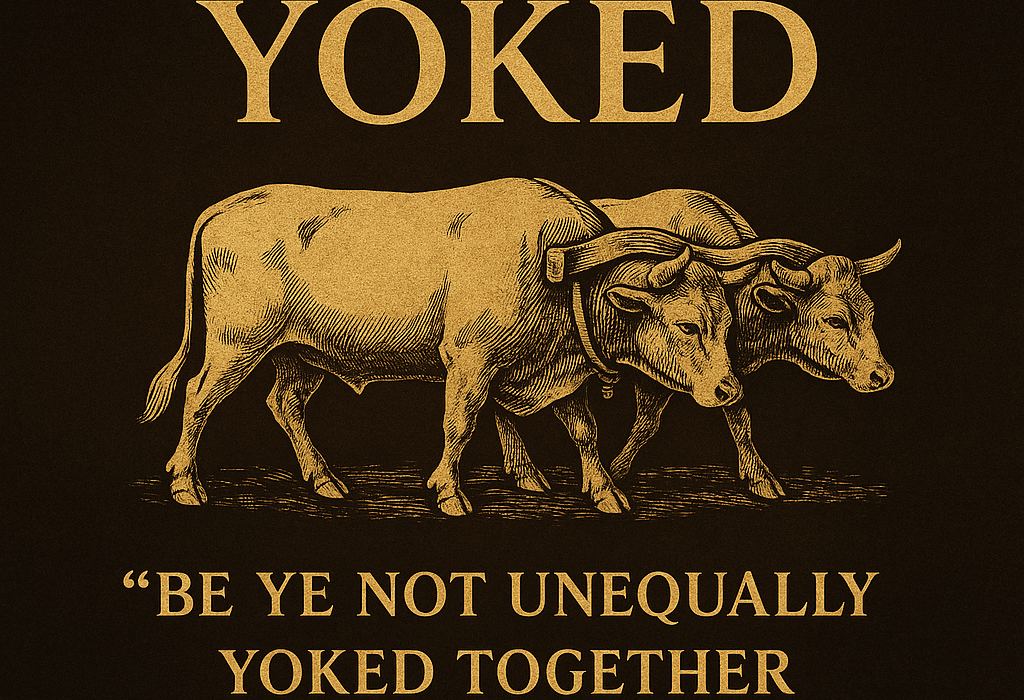
Equally Yoked: The Difference Between Dominion and Disaster

There are few verses in Scripture more misquoted or misunderstood than this one:

“Be ye not unequally yoked together with unbelievers…”
—2 Corinthians 6:14

Many toss it around in dating circles as a vague warning against marrying someone with a different religious label. Others use it to justify spiritual elitism or retreat from the world. But Paul wasn’t writing bumper stickers for evangelical coffee mugs, he was issuing a war-time warning to the church: you will never build the Kingdom with someone pulling in the opposite direction.

The image he invoked was not poetic, it was agricultural. Real. Sweaty. Bloody. The kind of thing only men who actually build, labor, and lead would understand.

And that’s exactly what I explore here:

  • What is a yoke, and how does it function?
  • What does it mean to be “equally yoked”?
  • Can a marriage even function unequally yoked?
  • Is it valid? Should it be sustained? Can it be corrected?
  • And what about friendships? Business partnerships? Brotherhood?

This isn’t a theory lesson. It’s a field manual. And the stakes are your household, your lineage, and your mission.


I. What Is a Yoke?

A yoke is not a metaphor. It is a literal tool of dominion.

It is a thick, heavy wooden beam that fastens two animals, typically oxen, together across their shoulders, binding them into a single unit for one purpose: to pull.

When used properly, the yoke distributes weight evenly, unifies direction, and multiplies force. Two yoked oxen can pull four times the load, three yoked oxen can pull nine times the load, four yoked oxen can pull 16 times the load and so on. But only if they walk at the same pace, obey the same master, and carry the same load. The yoke is not decorative. It’s not ornamental. It’s a symbol of labor, submission, and productivity. It is a tool for dominion over the earth, plowing, dragging, building.

Now apply this to marriage.

Marriage is not two people dating for eternity. It is two or more people bound together by covenant, law, and duty, joined in purpose under the rule of God. When you enter marriage, you are yoked. Like it or not.

The only question is: are you equally yoked or unequally yoked?

Because one produces dominion, while the other only produces destruction.


II. The Power, and Pain – of Yoking

Let’s be clear: a yoke without equality is a torture device.

If one ox is significantly stronger than the other, the weaker one slows down the pace. The stronger one begins to chafe. The weaker one limps. The plow veers off course. The field is ruined. The yoke becomes a weapon. And both animals suffer.

If one ox tries to go left while the other pulls right, the yoke does not break. Their necks do. Misalignment under the yoke is not an inconvenience, it is pain, waste, and eventual collapse.

So what makes a yoke “equal”?

  • Same Master: Both must recognize the same authority.
  • Same Direction: Both must obey the same command.
  • Same Pace: Both must walk in step with one another.

And if even one of those is off? Then the yoke becomes hell. Which is exactly what we’re seeing in households today.


III. Are Most People Even Equally Yoked?

No.

Let’s just get that out of the way.

Most people in modern marriages are not equally yoked. They are self-yoked, bound only by emotions, romantic sentiment, or the paperwork of a civil government that hates God.

We’ve traded covenant for chemistry. Vision for validation. Work for feelings. But feelings don’t plow fields. Feelings don’t raise children in order. And feelings don’t establish generational dominion.

Most “marriages” today are not rooted in obedience to God but in convenience, lust, loneliness, or rebellion. And then we have the audacity to ask why so many homes are barren, bitter, and broken.

Let’s break it down:

  • Different Masters: He serves Christ. She serves herself. Or worse, she serves a secular ideology that tells her submission is slavery. She doesn’t view herself as a helper but a partner. The result? Constant rebellion and resentment.
  • Different Directions: He wants to build a multigenerational household of faith. She wants to travel, focus on herself, “find her truth.” She calls it “balance.” God calls it division.
  • Different Paces: He wants to move boldly, quickly, and build early. She wants to delay children, delay responsibility, delay obedience. “We’re just not in the same season.” No, sweetheart, you’re just not on the same mission.

But the problem runs deeper.


Two Kinds of Unequal Yoking: The Double Standard

Let’s sharpen the blade.

A Christian man may enter into a marriage covenant with a non-Christian woman, and though it will be unequal and painful, it is still a real marriage, because the man is the head of the covenant.

Authority flows from the top.  And in biblical structure, the man holds the covenantal keys. If he is submitted to Christ and binds a woman to himself, she is brought under the spiritual covering of his house, even if she is not yet converted. He is accountable. He bears the burden. He governs the yoke.

She, if she refuses obedience, will be judged.  He, if he leads well, may still be blessed.

This is why Scripture says:

“For the unbelieving husband is sanctified by the wife, and the unbelieving wife is sanctified by the husband…” —1 Corinthians 7:14

But this passage does not affirm spiritual equality. It simply confirms the validity and covenantal consequence of the union when the man is aligned with God.

Now flip the roles.


A Woman “Married” to a Non-Christian Man Is Not Married at All

If a woman claims to be “married” to a man who is not under Christ, she is not in a marriage covenant, she is in a false contract, built on a lie.

Why?

Because marriage is not a human invention.  It is not a cultural norm, not a civil arrangement, and not a private agreement.  Marriage is a divine institution, defined, ordered, and upheld by the authority of God Himself.

And no covenant can be valid if it is made without proper covenantal authority. If the man does not belong to Christ, he cannot govern a household under Christ. He cannot be the head of a covenant he doesn’t even recognize. He cannot lead a woman into a structure he’s spiritually excluded from.

Therefore, she is not married.  She may be sexually bonded, emotionally attached, and legally entangled. But covenantally, biblically, and eternally, she is not a wife.

She is a bound woman without a head. And her house is built on sand.


God Is Not Mocked by False Unions

This is not a technicality. It is a fundamental distinction between valid and invalid marriages.

When a Christian man joins himself to an unbelieving woman, the covenant can still exist, because he stands in the role of Christ, and she enters through him.

But when a Christian woman joins herself to an unbelieving man, he is not Christ-like, nor covenantal, nor even legitimate as a household head. He is spiritually dead. And a dead man cannot be a husband.

It’s not just that the yoke is unequal. It’s that there is no yoke at all. There is no marriage. And the modern church,by blessing these false unions, has become complicit in spiritual fraud.

We call rebellion “romance.”
We call fornication “love.”
We call illegitimate households “ministries.”

And we wonder why the world mocks Christian marriage, Why wouldn’t they?


IV. Is the Marriage Even Valid?

This is the dangerous question. But it must be asked.

Can a covenant truly be considered valid if it is built on false alignment? The modern church says yes. The Bible doesn’t speak as softly on this topic.

Throughout Scripture, God nullifies alliances that violate His order.

  • He breaks the yoke of foreign wives from Israelite men (Ezra 10).
  • He curses alliances with pagan kings (2 Chronicles 19:2).
  • He describes unequal yoking as pollution, corruption, and danger (2 Corinthians 6:14–18).

Now let’s be careful: valid does not mean blessed. A marriage can be real in the legal sense, but completely void of blessing, fruit, or peace. That’s what happens when the yoke is forged by lust, fear, or compromise.

If the foundation was rebellion, against God, against your father, against Scripture, then the union may very well stand legally, but be rotten at its core.

And rot spreads.


V. Can It Be Fixed?

Now to the heart of it: Can an unequally yoked marriage be corrected?

Yes, but only if both parties are willing to repent and come under the same authority, the same mission, and the same standard.

That is rare. Here’s what it requires:

1. Submission to the Same Master

If the wife is not submitted to God through her husband, then she is still wild. Her obedience must be real. Not performative. Not partial. Not “when she feels like it.” Full repentance means full surrender to her husband in all things and without exception or excuses.

2. Agreement on Mission

The man must cast vision, and the woman must follow. This is not a “let’s meet in the middle” negotiation. This is the husband saying, “This is where the household is going,” and the wife saying, “Yes, my lord.” Anything less is compromise, which means sabotage.

3. Reordering the Household

If roles are blurred, they must be restored. Headship must be reinstated. Discipline must be enacted. Order must be visible. A house divided must be rebuilt from the ground up. That requires pain. Tears. Confrontation. And grace.

This is not a “work it out over time” feel-good strategy. It is surgical repentance or nothing. Because otherwise? You’re just dragging a dead ox around a field, calling it marriage.


VI. Should You Stay Together?

If you are currently unequally yoked, and your spouse refuses to come under God’s authority, you are in a war zone—not a home.

What then? Paul gives this instruction:

“If the unbelieving partner separates, let it be so. In such cases the brother or sister is not enslaved.”
—1 Corinthians 7:15

You are not called to be a spiritual hostage.

You are called to lead, build, and protect the integrity of your household. If your spouse is dragging you into chaos, rebellion, or destruction, and refuses correction, then separation is not sin. Sometimes, it is the only path back to order.

But the responsibility of the man is first to restore, not to run.

Do everything in your power, boldly, without compromise, to bring your house into alignment. Call her to repentance. Rebuke rebellion. Set expectations. Enforce discipline. Pray, yes, but also act.

And if she refuses? Then peace is found in the severing.


VII. What If You’re Not Married Yet?

Good. Listen closely.

Men, Never yoke yourself to someone who won’t follow. You are not “saving her.” You are not “leading her to Christ by marrying her.” That is spiritual arrogance disguised as compassion. You’re just tying your household to a corpse and calling it evangelism.

Marry only a woman who is already walking in obedience and willing to learn an follow with a spirit of submission. Already aligned with your mission. Already submitted to Scripture.

Don’t marry a project that is not repentant. Marry a helper.

And for women: never yoke yourself to a man who cannot lead. You are not his mother, you are a wife. If he is not your head, he will be your son or your slave. Neither is a marriage.


VIII. Unequally Yoked in Friendship and Business: The Silent Sabotage

Marriage isn’t the only place where unequal yoking destroys dominion. Friendships and business partnerships are often the quiet killers.

Paul’s warning wasn’t limited to romance:

“What partnership has righteousness with lawlessness?”
—2 Corinthians 6:14

The answer? None.

1. Friendship: Brotherhood or Bondage?

Friendship is alignment. It’s shared purpose. If your “friends” pull you away from mission, dampen your fire, mock your obedience, or numb your standards, then you’re not in fellowship. You’re in bondage.

If you must dilute your masculinity to stay welcome, you’re already yoked to darkness. Cut it off.

2. Business: Profit or Poison?

A business partner who doesn’t serve Christ will eventually demand that you betray Him.

You cannot build kingdom enterprises with men ruled by Mammon. You cannot pursue dominion while sharing profit with corruption.

And if you yoke yourself to one? You deserve the fruit of that partnership: compromise, loss, and judgment.

3. The Test: Who Sets the Pace?

The question is always:

“Can I obey God at full speed without losing them, or must I slow down to keep peace?”

If the answer is the latter, you’re already unequally yoked.


IX. The Final Separation: Light from Darkness

“What fellowship has light with darkness?”
—2 Corinthians 6:14

None.

You don’t build the Kingdom with rebels. You don’t anchor your strength to cowards. You don’t share the yoke with fools.

And to the women reading this, or to the men who are leading them, let this sink in:

Your yoke isn’t just your husband.

It’s your circle, your voice of influence, your operating environment.

And if you claim to be yoked to a righteous man but remain emotionally, socially, or loyally tethered to the world’s women, worldly family, or feminist coworkers, you are already breaking the yoke.

To be painfully clear.


1. Friends Who Despise Order

If your “best friend” mocks your submission to your husband, she’s not neutral. She’s poison. If she encourages divorce, independence, “girl power,” or autonomy from the man you vowed to obey, she’s the serpent whispering in your ear.

You cannot walk in obedience while holding hands with rebellion. Friendship is loyalty. Loyalty is alignment. And alignment is yoking. You will never submit to your husband if you’re still emotionally bonded to women who live in defiance of God’s design.

Cut the tie.


2. Family That Undermines Headship

God did not say, “Leave your mother and cleave to your mother.” He said:

“Therefore a man shall leave his father and his mother and cleave unto his wife…”
—Genesis 2:24

And by extension, a wife is to cleave to her husband and cut the umbilical cord of familial control. If your parents, siblings, or extended relatives routinely contradict your husband, insert themselves into your household, or sow doubt into your marriage, they are intruders, not allies.

And if you keep them close? You’ve chosen them over the man God placed over you. No woman can serve two masters, her father’s house and her husband’s authority.  One must be cut off.


3. Coworkers That Corrupt Your Spirit

You cannot be equally yoked to a godless workplace and expect to bring peace into a godly household.

If you spend eight hours a day surrounded by women who scoff at submission, laugh about their body counts, and complain about their husbands, then come home to a man expecting warmth, honor, and obedience, you are split in two.

The yoke is breaking. Your job isn’t “just a job.” It’s a training ground.  And if your workplace catechizes you in rebellion, don’t be shocked when it leaks out of your mouth at dinner.

Unequal yoking in your environment produces unequal yoking in your soul.


Final Warning

If you must defend your friends, justify your family, or excuse your coworkers, instead of aligning fully with your household, your loyalties are exposed. You are not yoked. You are split. And the split will grow into rot.

The righteous woman doesn’t flirt with rebellion.  She severs it.  Ruth didn’t go back to Moab. She said:

“Your people shall be my people, and your God my God.”
—Ruth 1:16

And that is the only kind of woman worthy of the yoke.

Let God’s Great Order be restored in our homes, families and communities.

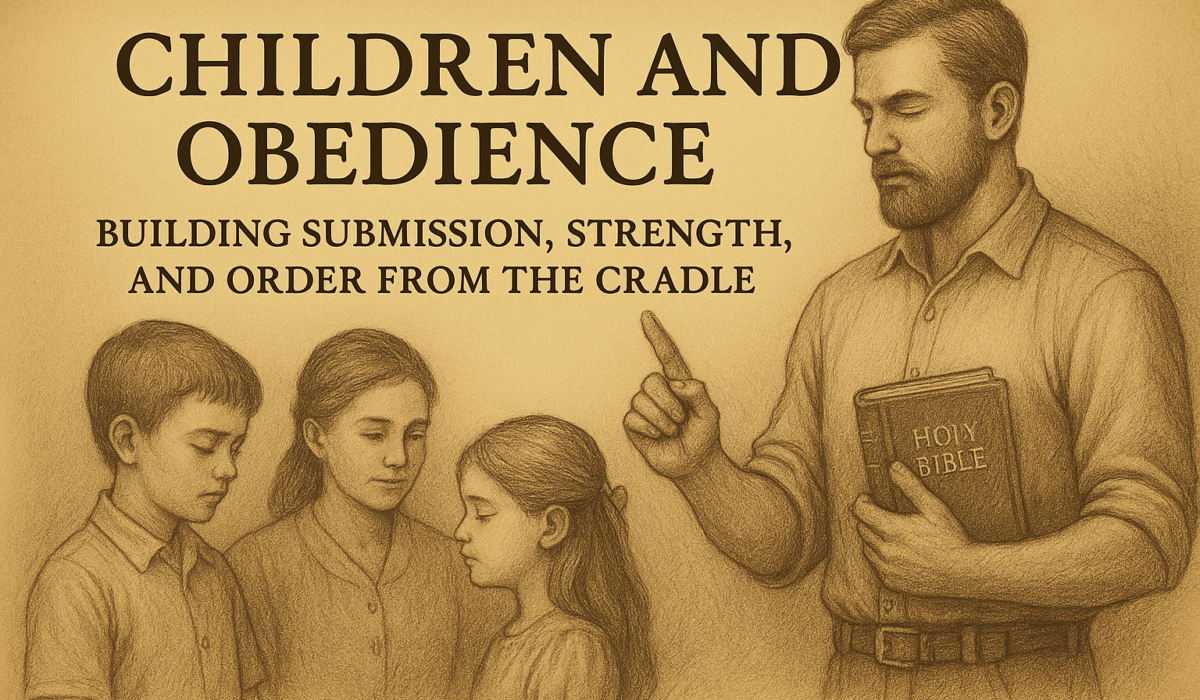
Children and Obedience: Building Submission, Strength, and Order from the Cradle

A Foundational Mandate in the Tone of The Great Order

“Children, obey your parents in the Lord: for this is right.”
— Ephesians 6:1 (KJV)

Section I: The Foundation of Obedience – Divine Order Begins in the Home

We live in an age of disobedient children. Their eyes are bold with defiance. Their tone is casual, sarcastic, and disrespectful. They treat their parents like peers, push back at every instruction, and scoff at discipline. Their homes are upside down, where the child leads, the mother negotiates, and the father tiptoes.

This is not just a family issue. It is a civilizational curse.

“This know also, that in the last days perilous times shall come. For men shall be lovers of their own selves… disobedient to parents…”
— 2 Timothy 3:1–2

God does not see disobedience as a phase. He sees it as perilous. It is not just a nuisance, it is rebellion. It is spiritual disorder. And it is one of the clearest signs that a society has abandoned God’s design.

In The Great Order, we return to the ancient paths. We restore what has been lost. And we proclaim boldly: children are to obey. Not occasionally. Not selectively. Not after debate. Fully. Immediately. Joyfully.


The Biblical Mandate Is Clear

“Honour thy father and thy mother: that thy days may be long upon the land…”
— Exodus 20:12

“Children, obey your parents in all things: for this is well pleasing unto the Lord.”
— Colossians 3:20

From the Ten Commandments to the Pauline epistles, obedience is not optional. It is not cultural. It is commanded. And more than that, it is pleasing to the Lord.

The obedient child is a sweet aroma in the household of God. The disobedient child is a stench, a grief, and a rebellion in seed form.


Obedience Trains the Will

Children are not born neutral. They are born foolish.

“Foolishness is bound in the heart of a child; but the rod of correction shall drive it far from him.”
— Proverbs 22:15

Disobedience is the natural state of fallen man. A child must be taught to obey, not merely through suggestion or persuasion, but through training. Obedience must become habit, not preference. It must be tied to duty, not mood.

Every act of obedience is a victory over the flesh. Every command obeyed without complaint strengthens the soul.


Obedience Is a Matter of Worship

Too many Christian parents treat obedience as a matter of control or convenience. They want peace and quiet, not holy order. But the Word teaches us: a child’s obedience is an act of worship.

“Children, obey your parents in the Lord…”
— Ephesians 6:1

Not just “obey your parents.” Obey in the Lord. This means obedience is unto God. When a child obeys his father, he honors the Father in heaven. When he disobeys, he dishonors the divine order God has placed over him.

This is why discipline matters so much. Not because it makes parenting easier, but because it guards a child’s soul.


Early Obedience Builds Future Authority

The child who learns to submit joyfully becomes the adult who leads wisely. Why? Because every good leader was first a good follower.

A son who resists correction will later resist conviction. A daughter who despises instruction will later despise her husband, her elders, and her God. But a child who learns the peace of obedience learns the power of order. They discover that peace comes through structure, joy flows from discipline, and safety is found in submission.

This is how we build nations, not with soft-willed youth, but with sons and daughters who know how to bow before authority with honor.


Satan’s War Against Obedience

In Eden, Satan’s first attack was to undermine obedience.

“Yea, hath God said…?” — Genesis 3:1

He planted the seed of rebellion through doubt, through suggestion, through desire. And ever since, that same spirit of rebellion has worked its way into the hearts of children through television, cartoons, education, and culture.

Modern children’s programming glorifies sarcasm, mockery of parents, independence from family, and self-centeredness. Schools train children to question authority. Courts remove discipline from the home. And “gentle parenting” has replaced the rod with reasoning and begging.

This is not progress. It is satanic subversion.

If you will not disciple your children into obedience, the world will disciple them into rebellion.


The Fruit of Disobedience: Biblical Warnings

Scripture is blunt about the end of the disobedient child.

“The eye that mocketh at his father, and despiseth to obey his mother, the ravens… shall pick it out, and the young eagles shall eat it.”
— Proverbs 30:17

“He that smiteth his father, or his mother, shall be surely put to death.”
— Exodus 21:15

“A stubborn and rebellious son… shall be stoned with stones, that he die: so shalt thou put evil away from among you…”
— Deuteronomy 21:18–21

These are not suggestions. They are the recorded judgments of a holy God. In the Old Covenant, disobedience to parents was not a minor infraction, it was a capital crime.

Why? Because rebellion in the home is rebellion against God Himself. It is the rejection of His appointed order. It is anarchy in seed form.

Section II: Training Children to Obey – Building Submission with Structure, Consistency, and Love

“He that spareth his rod hateth his son: but he that loveth him chasteneth him betimes.”
— Proverbs 13:24

There is no neutral ground. The child will either be shaped by the will of his parents or by his own fallen nature. If you do not form his will through discipline and training, it will deform under the weight of sin and selfishness. God has not left parents without instruction. He has given them a divine method to train children to obey.

Obedience is not accidental. It is cultivated through structure, consistency, clear expectations, and most importantly, love demonstrated through correction.


Parental Authority Is Not a Suggestion

In the modern therapeutic world, parents are told to “explain everything” and to avoid being too “authoritative.” But God’s order is not built on endless explanation, it is built on obedience to authority.

God does not negotiate His commandments. He declares them. And He expects them to be obeyed, not because they are always understood, but because they are true.

Likewise, parents must train their children to obey because it is right, not because they always agree.

“Children, obey your parents in the Lord: for this is right.” — Ephesians 6:1

You don’t need to justify why they must go to bed, why they must clean their room, or why they must speak with respect. You are the authority. God has placed them under your charge.

When they are older and mature, then you instruct and explain. But when they are young, obedience comes first. Understanding follows submission, not the other way around.


The Role of the Rod: Loving, Swift, and Controlled Discipline

God’s Word is unashamed in its endorsement of corporal discipline:

“Withhold not correction from the child: for if thou beatest him with the rod, he shall not die.”
— Proverbs 23:13

“The rod and reproof give wisdom: but a child left to himself bringeth his mother to shame.”
— Proverbs 29:15

This is not abuse. It is loving correction. The purpose of the rod is not to harm but to train, to reinforce that disobedience has consequences. When administered calmly, swiftly, and with clear communication, the rod becomes a tool of deliverance from foolishness.

Discipline must be:

  • Consistent: Never allow direct disobedience to go uncorrected.
  • Immediate: Correction delayed is training delayed.
  • Measured: Do not strike in anger. Discipline with control.
  • Restorative: Always follow discipline with love, prayer, and reassurance of relationship.

Children who are disciplined rightly feel secure. They know where the boundaries are. They learn that wrong actions produce painful consequences, and that obedience produces peace.


Teaching Obedience in the Small Things

Children are not trained in obedience by monumental moments, but by daily consistency. Every small command is a training opportunity.

  • “Come here.” — Does the child obey immediately or delay?
  • “Pick up your toys.” — Is the child expected to obey fully or halfway?
  • “Say ‘Yes sir.’” — Is the tone respectful or casual?

If you tolerate disobedience in the small things, you are training your child to ignore the big ones. Teach them early: delayed obedience is disobedience. Half-hearted obedience is rebellion. Tone matters. Attitude matters.

Obedience must be:

  • First time
  • Right away
  • With the right heart

Do Not Count. Do Not Repeat Yourself.

One of the greatest mistakes modern parents make is counting: “One… two… three…” or repeating instructions over and over again.

This trains the child that disobedience is tolerated until the parent is frustrated. It teaches delay. It teaches negotiation. It makes the parent’s authority into a game.

Instead, teach your children that when you speak, they must obey the first time. Your voice carries weight. Let your yes be yes, and your command be law in the home.


Encourage and Praise Obedience

While discipline is necessary, encouragement is just as important. When your child obeys quickly, joyfully, and respectfully, praise them. Let them know that their obedience is seen, valued, and honored.

“Well done, good and faithful servant…” — Matthew 25:23

Even God Himself praises the faithful. So should we.

A home full of correction but no affirmation becomes cold. A home full of praise with no correction becomes lawless. But a home that holds both high discipline and high encouragement will thrive.


The Role of the Father

Fathers must lead in discipline. Too many fathers delegate all correction to their wives and only step in when chaos has already bloomed. This is failure.

The father is the head of the house. His voice, presence, and standards must set the tone for order. When a child disrespects his mother, the father should respond swiftly. When rules are broken, the father enforces justice. He must also be gentle and firm, like a king and a priest.

If the father is passive, the child becomes bold in rebellion. If the father is inconsistent, the child becomes confused. If the father is absent, the child becomes bitter.

But if the father is present, engaged, consistent, and loving in discipline, the child will learn honor.


The Role of the Mother

The mother is the daily enforcer of order. Her tone, her consistency, her posture all teach the child how to submit. She must not be manipulated by whining, tears, or charm. She must be firm without being harsh, joyful without being permissive.

Mothers often spend more time with the children, this makes their role even more vital. A mother who trains her children to obey is a mother who guards the gates of her home.

“She looketh well to the ways of her household…” — Proverbs 31:27


Correcting Older Children Who Were Not Trained Early

What if your children are already past toddlerhood and have been raised without consistent training?

Start now!

Explain the new standard. Confess where you’ve failed. Begin enforcing expectations with clarity and follow-through. It may take time, but the fruit will come.

God is gracious. Children are resilient. And households can be re-ordered under God’s rule at any stage.

Section III: The Fruit of Obedience – Blessing, Dominion, and Generational Strength

“The just man walketh in his integrity: his children are blessed after him.”
— Proverbs 20:7

Obedience is not a burden. It is the foundation of blessing. Children who are trained to obey experience peace in the home, strength of character, and a life ordered by wisdom. Disobedient children become restless, unstable, and destructive; first to others, then to themselves.

The goal of obedience training is not robotic conformity, it is the shaping of a soul for dominion. A child who obeys early is a man or woman who can command later. For before one can lead, one must learn to submit.


Obedient Children Bring Joy to Their Parents

“My son, if thine heart be wise, my heart shall rejoice, even mine.”
— Proverbs 23:15

A disobedient child is a daily grief. Every meal is a battle. Every outing a scene. Every correction a struggle. But a child trained in joyful obedience brings life and joy to the home. The parents are not worn thin, they are built up.

“The father of the righteous shall greatly rejoice: and he that begetteth a wise child shall have joy of him.” — Proverbs 23:24

Christian parenting is not meant to be a war of attrition. It is meant to be a garden, cultivated in discipline, watered with affection, and bearing fruit in the form of righteous, obedient sons and daughters.


Obedient Children Build Order in Society

Households are the foundation of civilization. When children are obedient, the family is strong. When families are strong, churches are fortified. When churches are fortified, nations are secured.

But if children are lawless, homes collapse. And when homes collapse, society becomes ungovernable.

“The rod and reproof give wisdom: but a child left to himself bringeth his mother to shame.”
— Proverbs 29:15

This is not just about behavior, it is about the future of nations. A nation full of obedient children becomes a people able to submit to just authority, resist evil, build legacy, and sustain order. A nation of rebels becomes Babylon.


The Kingdom of God Is Built by the Obedient

“If ye love me, keep my commandments.”
— John 14:15

Obedience is the language of love. And children must be trained to love by being trained to obey. For if a child cannot submit to his father, he will not submit to God. If he cannot obey his mother, he will not obey Christ.

Obedience to parents is preparation for obedience to God. It trains the conscience. It forms the heart. It disciplines the flesh. It teaches respect, humility, and duty. It creates a man or woman who is usable by God.

Discipled children become builders of the Kingdom. Undisciplined children become its mockers.


Generational Blessing Flows from Obedient Sons and Daughters

When a son obeys, he preserves the name of his father. When a daughter obeys, she blesses her mother. And when those children rise up and train their children in the same order, the household becomes a dynasty.

“That our sons may be as plants grown up in their youth; that our daughters may be as corner stones, polished after the similitude of a palace.”
— Psalm 144:12

Imagine a household where sons rise early to work, obey their father, and honor their mother. Imagine daughters who are modest, helpful, and joyful in obedience. Imagine grandchildren who walk in the same pattern.

This is legacy. This is dominion. This is The Great Order.


Disobedience Brings Generational Curses

Just as obedience brings blessing, disobedience brings curses.

“Cursed be he that setteth light by his father or his mother. And all the people shall say, Amen.”
— Deuteronomy 27:16

A child who scorns his parents opens the gates to judgment. He may succeed in the eyes of the world, but he walks under the displeasure of God. He may gain popularity, but he will bring destruction upon himself and his offspring.

We are not raising children for this world. We are raising them for God’s Kingdom. And disobedience is not allowed within it.


A Final Call to Parents: Take Back Your Authority

Parents, God has given you the rod, the voice, the command, and the mantle. Use them.

Do not surrender your household to the world’s lies. Do not wait for the culture to change. Do not believe the myth that disobedience is harmless. It is not.

Take back your home. Reinstitute obedience as a daily expectation. Remove excuses. Reinforce structure. Discipline consistently. Praise rightly. Build order with your mouth, your hand, your posture, and your prayers.

God will bless it. Your children will rise to bless you (Proverbs 31:28). And generations will call your house a house of righteousness.


Conclusion: Let Obedience Reign Again

“Bring them up in the nurture and admonition of the Lord.”
— Ephesians 6:4

Let Christian households once again shine like lamps in a dark age, not just by the size of their Bibles or the music they play, but by the order of their children. Let it be said:

  • “There is peace in that home.”
  • “The children obey without defiance.”
  • “The parents discipline with love.”
  • “That house reflects God’s dominion.”

Let the sons and daughters of God be marked by obedience, not by rebellion disguised as personality. Let their submission bring glory to their Father in heaven.

Train your children to obey. And in doing so, you train them to rule.

“He that ruleth his spirit is better than he that taketh a city.”
— Proverbs 16:32

Start ruling now. Begin in the nursery. Establish it at the dinner table. Cement it in the morning chores. And carry it with you to the gates of the next generation.

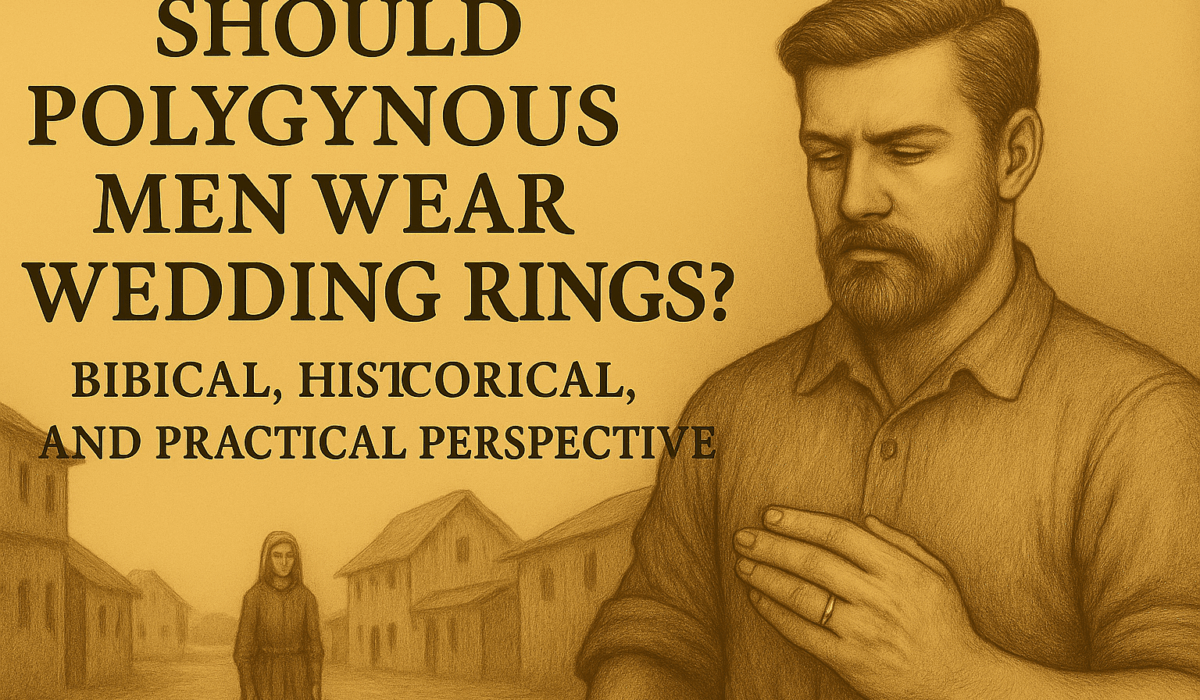
The Ring and the Righteous: Should the Polygynous Man Bear It?

A Biblical, Historical, and Practical Examination


Part I: Introduction – The Modern Symbol of Commitment

In the modern world, the wedding ring is nearly universal. Whether gold, silver, or diamond-studded, it is considered a sign of marital faithfulness, societal status, and commitment. A man who does not wear a wedding ring is often questioned, judged, or presumed to be unfaithful. Yet, when we peel back the layers of tradition, marketing, and modern social norms, a deeper question arises; should a man, particularly a man walking in Biblical dominion as a patriarch, wear a wedding ring at all? And more specifically, should a polygynous man, who has taken multiple wives in righteousness, embrace this modern token?

This inquiry is not trivial. It goes to the heart of how we present our households, how we represent covenant, and how we avoid stumbling into the snares of either legalistic vanity or cultural compromise. For the Biblical patriarch, every item on his person, even a ring, is a statement of order or disorder, dominion or dilution, submission to God or conformity to man.

Let us examine the issue of wedding rings through the lens of Scripture, history, and practicality, and ask: Should polygynous men wear wedding rings? If so, when? And if not, why not?


Part II: The Biblical Witness – Are Wedding Rings Even Scriptural?

Let us begin with the most critical foundation: What saith the Lord?

The Holy Scriptures, from Genesis to Revelation, are stunningly silent on the matter of wedding rings. No patriarch, prophet, apostle, or righteous man of old is recorded as giving or receiving a ring as a sign of marital covenant. Abraham gave gifts to Rebekah, including jewelry (Genesis 24:22), but those were tokens of betrothal and wealth, not covenantal symbols of fidelity. Even in the case of Rebekah, the ring was given to her, not worn by the man.

In fact, when the Scriptures do speak of rings, they are more commonly associated with authority and rule, such as Pharaoh giving Joseph a signet ring (Genesis 41:42) or the prodigal son’s father placing a ring on his son’s hand to restore his sonship and status (Luke 15:22). Rings in the Bible were political, economic, and familial symbols, not tokens of romantic or marital exclusivity.

Marriage, in the Word of God, was established by covenant, not by ceremony. The covenant was witnessed by the families, consummated by the flesh, and sealed in blood. This is especially important in understanding that God’s institution of marriage was never based on how it appeared externally, but whether it was ordered rightly under His Law. God never commanded men to wear rings. He did, however, command them to provide, to love, to rule, and to multiply.


Part III: Historical Origins – Pagan and Commercial Roots

If wedding rings are not found in Scripture, where do they come from?

Historical evidence traces the origin of wedding rings back to pagan customs, particularly among the ancient Egyptians. The Egyptians viewed the circular ring as a symbol of eternity and the vein in the “ring finger” (vena amoris) was believed to be directly connected to the heart. While poetic, this is pure myth and mysticism, not medicine nor truth. The Greeks adopted the practice from the Egyptians, and the Romans from the Greeks, eventually making it a part of their cultural norms. The ring was originally a sign of ownership, like branding a wife as property; though in practice, it was she who wore it, and the husband did not.

As centuries progressed, the Roman Catholic Church absorbed many pagan rituals into its marriage ceremonies, including the exchange of rings. By the time of the Protestant Reformation, many reformers sought to strip away these pagan elements, though not all succeeded.

Fast forward to the 20th century, especially during and after World War II, and we find the rise of men’s wedding rings. It was only in the 1940s that it became customary for men to wear rings. Before that, it was virtually unheard of. Wartime separation, emotional longing, and heavy marketing campaigns led to the normalization of men’s rings, often driven not by conviction, but by sentimentality and commercialization. The jewelry industry found a market niche, and it never let go.

Should a man of God, particularly a patriarch who seeks to rebuild the righteous order, bow to customs birthed from paganism and pushed by advertising agencies?


Part IV: The Polygynous Man – A Different Covenant Representation

The polygynous man stands apart. His household is not a duplication of the monogamous world, but a richer and more complex structure. Each wife in his house is a covenantal relationship, distinct and real, with her own loyalties, duties, and inheritance. No single ring can adequately represent this.

Indeed, the very notion of “a” wedding ring implies a single marriage, not multiple. If a man wears a ring as a symbol of being married to one, how does that communicate his role as husband to more than one? To the untrained eye, a wedding ring on a polygynous man may convey monogamy, which is a distortion of his household reality.

Worse still, some women may interpret his ring as a sign that he is “taken” in the exclusive, possessive, modern sense. This can become a stumbling block for righteous women who may otherwise have considered joining his household. The ring becomes a wall rather than a window.

One could argue that if a polygynous man wears a ring, it should only be when he is open to another wife, not as a seal of “closure.” This reverses the cultural assumption. The ring then becomes a banner: “My house is built and building still. Dominion is not finished.” But even this gesture should be weighed carefully. What is the motivation? Is it clarity or conformity? Is it dominion or decoration?


Part V: Practical Concerns – Symbolism vs Substance

There are many practical reasons for a polygynous man to avoid wearing a wedding ring altogether:

  1. It sends mixed signals. Most people interpret a wedding ring as a symbol of exclusive marriage. The righteous polygynist may inadvertently lie with his hand.
  2. It imposes a modern ritual on an ancient covenant. God never required rings. He required obedience.
  3. It elevates image over essence. Wearing a ring might please people, but Scripture says, “For do I now persuade men, or God? or do I seek to please men?” (Galatians 1:10)
  4. It creates an unnecessary tradition. When men elevate tokens over Torah, symbols over substance, they risk becoming like the Pharisees, who were whitewashed on the outside, but dead on the inside.
  5. It exposes the man to feminine ornamentation. Let it not be overlooked that rings, especially ornate or jeweled ones, are accessories more aligned with female attire (1 Timothy 2:9). A man of dominion should dress like a man, not a decorated prince of Hollywood.

Let the polygynous man display his covenant by his life; his works, his words, his headship, his love, his fruitfulness, and not by a shiny band of metal.


Part VI: Exceptions, Allowances, and House Order

Not all decisions in the house of God are absolute. There are matters of law, and there are matters of liberty.

If a polygynous man and his wives mutually agree that a ring helps signal order, fidelity, or testimony to the world, it is not inherently sinful. A band worn for a clear, non-deceptive purpose may be permissible. But this must come with caution, clarity, and consistency. He should not wear it to gain the approval of feminized society or to mimic the world’s version of marriage.

Some patriarchs have chosen to wear a signet ring, not to symbolize marriage but authority. This hearkens back to biblical precedent. A signet ring may be a better alternative: engraved with the man’s house mark or name, it communicates dominion rather than romanticism. It does not imply exclusivity. It does not lie. It declares legacy.

Ultimately, the ring question should be ruled by this principle: Does this action strengthen or weaken the witness of The Great Order in my house?


Part VII: A Symbol for a Season: Wearing a Ring Temporarily Between Wives

Though this post contends that the wedding ring is neither Biblically required nor historically consistent for godly men, especially those walking in polygyny, it is worth addressing a thoughtful consideration: the symbolic use of a ring during certain seasons of a man’s household journey.

There may be times when a patriarch is not actively seeking another wife. This may be due to temporary financial constraints, a recent marriage, the need to establish order more firmly in his house, or a period of spiritual reflection and preparation. In such seasons, some men may choose to wear a ring, not as a cultural concession to the monogamous idol of modernity, but as a visible declaration of covenant stewardship and temporary exclusivity.

This is not a denial of polygyny. It is not a vow of monogamy. Rather, it is a symbol of present focus. Just as the High Priest did not always enter the Holy of Holies, and yet remained in covenant with God, so too may a polygynous man be in a season where expanding his household is neither wise nor lawful for him at the moment.

This kind of ring-wearing can reflect:

  • Honor toward his current wives, especially a newly added wife, signaling that his heart, time, and resources are directed toward building her integration into the household.
  • Accountability to the standard of righteous headship, showing that he does not frivolously pursue women but acts according to household strength and vision.
  • An outward marker of inward restraint, especially in a world that praises male indulgence but hates disciplined dominion.

This practice must never become law or expectation. It must never be imposed by a wife or by culture. It must remain the voluntary gesture of a man who knows his mission and walks in wisdom.

Yet such temporary use of a ring can serve as a noble banner of intent: “I could, but I will not, not yet, for my house must be ordered, my dominion must be firm, and my stewardship must be proved before I add again.”

This kind of season is not one of lack, but of consolidation. Not of retreat, but of rootedness. A man who knows the value of adding wisely may mark his waiting with as much purpose as his taking.

In all things, the polygynous man must act as the head, not only in structure, but in tone and timing. And if he wears a ring, let it not be for the gaze of others, but for the glory of his God and the good of his household.


Part VIII: What Does a Real Covenant Look Like?

The modern world obsesses over appearances. The righteous man obsesses over function. A ring, at its best, is a symbol. But God’s vision for marriage was never built on rings. It was built on structure, headship, submission, fruitfulness, and generational purpose.

A polygynous covenant should be marked by:

  • The public affirmation of headship, not a private exchange of jewelry.
  • The presence of order and unity in the home.
  • The clear delineation of each wife’s role, relationship, and reverence.
  • The fruit of the womb, the labor of hands, and the extension of the household economy.
  • The obedience of children, the mutual love of the wives, and the steadfast example of the patriarch.

These are far weightier than a ring.


Part IX: Reclaiming Biblical Symbols

Rather than embracing the world’s symbols, the men of The Great Order should seek to restore Biblical ones.

Consider the tassels (tzitzit) commanded in Numbers 15:38–40. These were a public symbol of obedience to God’s law, worn by men to remember His commandments. Consider the staff, the cloak, the head covering, the household mark, or even the fruitful vine in the wife’s womb, these are God’s signs.

We must replace pagan rings with righteous rituals and Biblical tokens. If symbols are needed, let them be scriptural, not sentimental. Let them honor YHWH, not DeBeers.


Part X: Conclusion – The Ring of Righteousness

Should polygynous men wear wedding rings?

Scripturally: There is no command, no example, and no need.

Historically: The ring is a pagan and commercial tradition, not a Biblical one.

Practically: It may confuse, mislead, or compromise the testimony of a righteous house.

Only in rare and intentional cases, where clarity, agreement, and witness align, might a plain ring or signet serve as a helpful tool. But even then, let it never become a substitute for the greater signs of covenant: order, obedience, and fruit.

The men of The Great Order are not seeking approval from Babylon. We are not dressing up like Rome. We are not mimicking monogamy. We are building something older than the Empire and stronger than its gold.

We are building households of dominion.

Let our households be known not by the shine of rings, but by the light of righteousness.

Let our women be secure not by the band on our hand, but by the strength of our leadership.

And let our children rise, not with trinkets and tradition, but with truth and order.

For it is written:

“The Lord knoweth them that are his.” (2 Timothy 2:19)

He does not require a ring to recognize His own.

Let the patriarchs rise, unbound, unbribed, and unashamed.

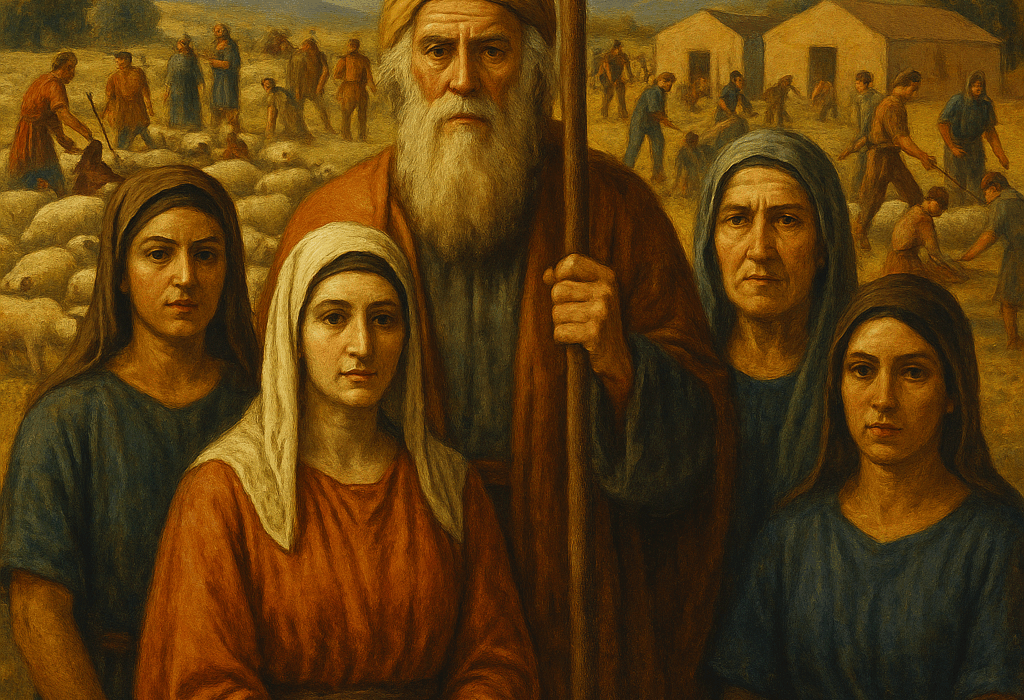
Jacob – The Flawed Patriarch Who Fathered a Nation


I. Introduction: The Man Who Became a Nation

Jacob is not a moral mascot. He is a patriarch. A bruised heel, a cunning mind, a relentless force. The Church today wants poster boys of piety, neat beards, monogamous morality, and tidy households with devotional apps and filtered family photos. But God chose Jacob. And Jacob’s house wasn’t tidy. It was turbulent, expansive, polygynous, fruitful, and entirely God-ordained.

If you want a clean legacy. A polished resume. A family tree that could make a Hallmark movie jealous that Jacob is not your man. But God doesn’t build nations from photo albums, He builds them from blood, betrayal, polygyny, and perseverance. If you’re looking for perfection, Jacob is not the image you seek. If you’re looking for fruitfulness, covenant, household dominion, and raw masculine endurance, then Jacob is your patriarch.

Jacob, the man renamed Israel, was no sanitized church hero. He lied to his father, deceived his brother, worked for and purchased underage wives, married sisters (a move later forbidden under Mosaic Law), took their handmaids as concubines, played favorites with his children, stayed silent when one was sold into slavery, and fathered the entire nation of Israel through a household that modern pastors would call “unbiblical.”

When God renamed Jacob “Israel,” He wasn’t baptizing a perfect man. He was commissioning a patriarch. The man who fathered twelve sons by four women. The man who bought teenage brides and later took their handmaids to be concubines (who eventually became additional wives). The man who lied to his own father and was later lied to by his uncle. The man who watched his sons slaughter a village and did nothing.

And yet… he is the chosen one. God’s own covenant was sealed with this man, not because of his morality, but because of God’s sovereign purpose. Jacob didn’t “fall into” polygyny. He didn’t slip. He wasn’t ashamed. He built an empire from it. And God didn’t rebuke him, He built His people on that household. And God called him blessed. Why? Because Jacob was in covenant. He wrestled with God and would not let go until the blessing was secured, no matter the cost.


II. Delayed Beginnings and the Demands of Legacy

Jacob didn’t marry until he was 77 years old. That’s not a typo. While modern men are told they’ve peaked or passed their usefulness by 40, Jacob hadn’t even begun to build his household until nearly twice that age.

So what was he doing all that time? Scripture gives us glimpses: he stayed in tents, remained under his father’s instruction, dwelled quietly while Esau hunted and conquered. He was not a builder yet. Not a warrior. Not a leader of men. He was preparing, slowly, painfully, and in obscurity.

But when the time came, Jacob fled to Haran with nothing but a staff. He didn’t even have the means to purchase a wife. At 77, he had to labor 14 years just to acquire two brides. He started late, but he didn’t whine, complain or make excuses. He never lamented about what he could have or should have done.

And because he started late, he had to build rapidly. Polygyny wasn’t really optional, it was necessary. One wife would not bear twelve sons fast enough. One womb could not produce a nation in a lifetime. Jacob’s strategy was not romantic in the modern sense, it was patriarchal. He accepted handmaids. He honored both sisters. He honored his position and multiplied quickly.

This is the lesson: it’s never too late to start. But starting late requires strategy. It requires scale. And it requires the rejection of modern sentimentality. If you aim to build a nation past your youth, you will need polygyny, patience, and patriarchal vision.


II. The Meeting at the Well: 77-Year-Old Meets 14-Year-Old Rachel

Jacob met his beloved Rachel at a well in Haran. She was a shepherdess, tending to her father’s flocks, in a pattern echoing across Scripture. But the part your Sunday school teacher skipped was this: Jacob was 77 years old when he met Rachel who was 14 at the time, her older sister Leah, whom Jacob would also marry, was about 15. He kissed Rachel that very day and wept aloud (Genesis 29:11). This was not a “grandfather’s greeting”. It was the beginning of a marriage transaction.

Modern minds recoil. But Scripture does not. Jacob kissed Rachel that very day and proclaimed “love at first sight”. In a world where men shrink from commitment and women delay marriage until their youth has withered, this scene offends modernity. But it honors God. Rachel wasn’t dating. She wasn’t career planning. She wasn’t collecting degrees. She was a bride in waiting, working in her fathers kingdom. And Jacob didn’t flirt. He pursued. Immediately, definitively, and even with payment.

Now, the modern mind reels. “Predator,” they say. “Groomer.” But Scripture says something else entirely: he loved her. From the first moment. And he proved it with the only thing that proves love, action and sacrifice.

No flirting. No promises. No “let’s see where this goes.” Jacob laid down seven years of labor for a bride he met at the well. He didn’t wait and send a text later, he didn’t date for a few years. He rolled up his sleeves and purchased his bride.


III. A Price for a Bride: Love Is Proven in Labor

Jacob did not propose over dinner. This wasn’t romance, but a transaction, a Covenant. He paid a price. Not having the available finances to purchase his bride outright he offered Seven years of hard labor managing Laban’s flock. Rachel was the daughter of his uncle, but that did not make her free. She was a daughter, which meant she was a commodity. She belonged to her father until another man purchased her through covenant.

Genesis 29:20 says, “So Jacob served seven years for Rachel, and they seemed to him but a few days because of the love he had for her.” Let that sink in: love was proven by labor, by action. Not words. Not poetry. Not dinner dates, or “communication”, but sweat and dedication.

And Jacob paid. Full price, without complaint. Then Laban deceived him, sending Leah into the wedding tent under darkness. The next morning, Jacob discovered the swap. Did he storm off? Cry betrayal? No. He married both. Even stayed and worked another seven years for Rachel. Fourteen years total. This wasn’t indentured servitude, it was dowry. It was love measured in action. 

You don’t “date” a wife. You earn her. Jacob earned two, (well 4 eventually), but we will get to that later.


IV. Sisters, Servants, and Sons: A Household of Four Mothers

Modern minds recoil at the idea of marrying sisters. But Jacob did it with full cultural legitimacy. Rachel and Leah both bore him sons, though Rachel, beloved as she was, struggled with barrenness. In the ancient world, this was not just a personal sadness, it was a crisis of legacy (as it should still be).

So Rachel did what almost any woman of her day would have. She gave Jacob her handmaid Bilhah as a concubine. Bilhah bore sons on Rachel’s behalf. Leah, seeing this, gave Jacob her maid Zilpah as well. He didn’t argue, he didn’t moralize.  Jacob accepted both. No argument. No sermons. No shame. He lay with the maids and received their sons into his household. These were not mere bedwarmers. They were concubines, wives by function if not by primary rank.

From this household of four women, two wives, two concubines, came twelve sons: Reuben, Simeon, Levi, Judah, Dan, Naphtali, Gad, Asher, Issachar, Zebulun, Joseph, and Benjamin. Plus one daughter, Dinah. These sons became the twelve tribes of Israel.

Polygyny wasn’t the side story. It was the structure. It wasn’t a concession, but the covenantal method for fruitfulness. This is not just descriptive, it’s prescriptive. God used it, blessed it, and God built His people on it. Let that sink in for a minute – polygyny is the method God chose EVERY time for the expansion of his covenant people.

This wasn’t dysfunction, it was dynasty. Jacob didn’t “fall” into polygyny. He stewarded it, and in doing so created the 12 tribes of Israel.


V. The Cost of Favoritism and Silence: Jacob’s Fathering Failures

Jacob was a patriarch, but he was not perfect. His household was marked by favoritism. He loved Rachel more than Leah (Genesis 29:30). He loved Joseph more than the others (Genesis 37:3). He even clothed Joseph in a special garment that stirred the envy of his brothers. Everyone knew it. When this favoritism bred resentment among the other brothers Jacob saw it. He knew they hated Joseph. But he stayed silent. 

He also stayed silent when Joseph was sold into slavery. The brothers dipped the robe in blood and brought it to Jacob. He wept. But he didn’t investigate. He didn’t lead. He accepted the story, descended into grief and mourned for years.This silence wasn’t passive, it was leadership failure. And yet, even in his failure, Jacob remained the patriarch of promise. God didn’t revoke His covenant. The twelve tribes still bore his sons’ names.

His sons murdered the men of Shechem in retaliation for Dinah’s violation. Jacob’s response? “You have brought trouble on me” (Genesis 34:30). Concerned with reputation, not righteousness.

Yet this flawed, quiet father remained God’s patriarch. Because God doesn’t require perfection, He requires covenant. God doesn’t wait for perfect men. He uses patriarchs who limp.


VI. A Man of Deception Chosen by a God of Truth

Jacob’s life was woven with deceit. He lied to his blind father, tricked his brother Esau out of the birthright by impersonating him to steal Isaac’s blessing. He manipulated livestock breeding,   using selective breeding tactics to enrich himself at Laban’s expense (Genesis 30:37-43). He was shrewd, cunning, and unapologetic.

This wasn’t accidental. Jacob was strategic. And God still blessed him. Why?

Because Jacob wrestled with God, and didn’t let go. He demanded blessing. He demanded covenant. And God granted it.

Genesis 32 recounts the midnight wrestling match. A mysterious Man (understood to be a theophany – God Himself) wrestles Jacob until dawn. Jacob refuses to let go. He demands blessing. The Man touches his hip, dislocating it, and then renames him: Israel.

Israel means “He who strives with God.” Not “He who obeyed nicely.” Not “He who conformed.”  Not “he who behaves.” God renamed him for wrestling, striving, and demanding. God honors hunger and dedication, not manners.

The same man who deceived his father became the father of a nation, then grandfather of nations.


VII. God’s Blessing on a Polygynous Man

Jacob was a polygynist. He had four wives (two by direct marriage, two by concubinage). Scripture never condemns him for it. Not once.

The modern Church blushes and stammers over polygyny, offering excuses: “It was cultural,” “It was allowed, not ideal,” “God just tolerated it.”

Spineless nonsense!

God could have shut Leah’s womb. He could have shamed Rachel. He didn’t. Instead, He opened their wombs, multiplied their children, and formed a nation from their bodies. Polygyny is not the curse, but a blessing. it was the structure God used to build Israel.

Jacob’s sons founded the twelve tribes. From Leah came Levi (priests) and Judah (kings), Reuben and Simeon. From Rachel came Joseph (double-portion through Ephraim and Manasseh) and Benjamin. From Bilhah and Zilpah came the remaining tribes. The modern church teaches monogamy as doctrine. Yet the very people of God were born from a household that no modern pastor would allow on the church membership roster.

You want revival? You want legacy? Start by embracing the blueprint God actually used. God didn’t “allow” polygyny, he crowned it.


VIII. The Legacy: A Nation Birthed by a Household

Jacob’s sons didn’t just fill a tent, they founded tribes. Reuben’s line. Judah’s kings. Levi’s priesthood. Joseph’s double portion through Ephraim and Manasseh. Benjamin’s warriors.

Jacob didn’t have a Pinterest family. He had a warring, womb-bearing, legacy-generating household. A patriarchal dominion. And that’s exactly what God used.

He didn’t wait for reform. He didn’t impose 21st-century ethics on a Bronze Age household. He multiplied fruitfulness through what would today be labeled “toxic masculinity” and “patriarchal oppression.” But it was, and is God’s design. It was God’s man. It was God’s house.

These weren’t random children. They were the seedbed of civilization. And they came not from a modern “nuclear” family, but from a polygynous, patriarch-led household.

The legacy of Israel, our spiritual and ancestral heritage, was not born in a sanitized seminary. It was born in tents. On blood-soaked soil. With sisters competing, handmaids birthing, and a patriarch directing the legacy.

Jacob fathered a nation not in spite of polygyny, but ONLY because it.


IX. What the Church Refuses to Preach

The modern Church preaches romance, butJacob lived reality.

He would be excommunicated from most if not all modern churches.

  • Married sisters? Forbidden.
  • Slept with handmaids? Scandal.
  • Favored wives? Misogynist.
  • Bought 14-year-old brides at 77? Predatory.
  • Married 20-22 Year old women at 84? Pedophile.

But God doesn’t flinch. He names Jacob “Israel.” He renews the covenant of Abraham through him. He appears to him personally and blesses him repeatedly. The Church today wants sanitized saints, but God wants fruitful patriarchs. Men who are willing to stand on Biblical truth, demanding conventional blessing no matter the cost.

The Church preaches sentimental monogamy. Jacob lived divine multiplication. The Church preaches equality. Jacob chose favorites, led with hierarchy, and structured his household for fruitfulness, not fairness.

They talk about “waiting for the one.” Jacob worked 14 years for two. And when his wives gave him their maids, he didn’t hold a Bible study on the ethics of polygyny, he received them as part of his house and expanded the kingdom.

The Church fears offense. God builds with obedience. Jacob’s life doesn’t fit the evangelical mold. Which is exactly why it built the Kingdom!


X. Conclusion: God Builds With Dust and Blood

Jacob was not a poster child for moralism. He was old, shrewd, polygynous, and often silent at the worst times. But he was chosen. Not because of his goodness, but because of God’s purpose.

He kissed a 14-year-old girl and loved her for life. He married sisters. He fathered sons through servants. He allowed his favorite son to be sold. He limped after wrestling with God. He blessed the wrong grandson on purpose. And he died in a foreign land, trusting in a promise that he did not live to see fulfilled.

And from that life – flawed, complex, masculine, covenantal, came the nation of Israel. Our entire faith is rooted in a man with four wives, twelve sons, and a limp. This is not an insignificant side story. This is the foundation of our faith, our people and all of western civilization.

If you want to restore biblical manhood, stop chasing modern respectability. Start embracing patriarchal fruitfulness. Start understanding that God builds not with sanitized myths, but with real men, real blood, and real households. Jacob did not live to please the world. He lived to build the kingdom of God, and in doing so he built nations.

And if the Church wants to reclaim legacy, it must reclaim Jacob, not as a relic of ancient oddity, but as the blueprint for dominion. 

God builds with blood. He builds with covenant. And He builds through patriarchs who refuse to let go until the blessing falls.

Let God’s Great Order be restored.

What Is a Husband?

The Standard, the Staff, the Sword

“Wives, submit yourselves unto your own husbands, as unto the Lord.”

That’s not a freebie for men. That’s a target on your back.  It means the Lord is watching you and you must be someone worthy of submission.


The Other Side of the Mirror

Last time, I set the record straight on what a wife is, and isn’t. I set out to burn the modern lies of “wife” to the ground and rebuild the ancient framework of covenant womanhood.

But now the mirror turns.

Because if a wife is a keeper of the home, the husband is the standard of the house. And most men, just like most women, are failing miserably.

Not failing because they don’t provide enough. Not failing because they don’t say “I love you” enough. But failing because they have surrendered the very essence of manhood: rule, responsibility, and righteous discipline to the whims of a feminist culture.

This isn’t a sermon for soft men.  This is a war drum for the builders, the sons of Adam who are ready to reclaim dominion.  You don’t get to complain about modern women if you refuse to get off your ass and rule your house.

So let’s be clear—what is a husband?


The Purpose of Man

Man was made first. Not just in order, but in purpose.

“And the LORD God took the man, and put him into the garden of Eden to dress it and to keep it.” — Genesis 2:15

Before there was a wife, before there was a home, there was a job.  Adam was given dominion. Labor. Stewardship. Purpose.

A husband is not a man who gets married.  A husband is a man with a mission who calls a wife into his mission as a helpmeet. He does not exist for her emotional needs, she exists to help him complete his God ordained assignment.  That means: If you’re not building anything, you’re not ready for a wife. You don’t marry and then go looking for purpose.  You have purpose, and then take a wife (or a few) to help build it.


Husband Is a Job, Not a Right

Modern men act like marriage is an entitlement. As if having a beard and a Bible verse in your Instagram bio qualifies you for headship.  But headship is not automatic. Authority is not a prize. It’s a weight.

Being a husband means carrying souls on your back and being accountable to God for what happens in your home.

  • You are the first to blame.
  • You are the first to bleed.
  • You are the last to sleep.

You set the tone. You take the hit. You get the judgment, all of it. You don’t get to pout, retreat, or hand it over to your wife when it’s hard. You are the man. That means: No matter who causes the mess, you are responsible for cleaning it up.

If you are not willing to suffer for your house, you are not fit to rule over one.


The Duties of a Husband

Headship is not vague. It’s not abstract. It’s not “being a nice guy.” It is a specific set of duties, laid out in Scripture and rooted in creation itself.

1. Lead

You decide where the house is going. Spiritually, financially, and morally. You don’t outsource that to her feelings or her friend group. You chart the course and demand alignment.

2. Provide

Not just money, but safety, vision, direction, and provision for the soul.  A real provider does not just pay bills. He feeds the spirit of his wives and children.

3. Protect

From danger. From foolishness. From false doctrine.  You are the wall around your home. If hell gets in, it’s because you let the gate open.

4. Cultivate

A husband does not just rule, he raises.  He raises his wife with encouragement, boundaries, and correction. He raises his children with discipline and doctrine.

5. Sanctify

“That he might sanctify and cleanse it with the washing of water by the word…” — Ephesians 5:26

Your job is to cleanse your house with the Word of God. If your wife is anxious, confused, or chaotic, speak the Word. Correct with Scripture. Lead in prayer. Be the priest. Demand that she takes her place and does her job.


The Husband as Standard-Setter

Here is a truth most men refuse to swallow: Your house reflects your leadership.

If your wife is disrespectful, it’s because you tolerate it. If your children are unruly, it’s because you’ve abdicated discipline or your wife(s) refuse their calling. If your home is cold, loud, disordered, or overrun with emotion, it is at least partly your failure for allowing your wife(s) to show that level of disrespect to you.

A wife is a reflection of her man’s standards. She may bring her own sins, sure. But she acts with freedom or fearlessness based on what you permit. The standard of your home is not what you say it is.  It is what you allow.

So set the standard, and enforce it.


Demanding Performance From a Wife

The modern husband has been taught to beg for what he should be expecting.

  • Begging for peace, cleanliness and order.
  • Begging for submission and obedience.
  • Begging for home-cooked meals.
  • Begging for honor and respect.

What kind of king begs his servant to obey?  What kind of builder begs his tools to work? Marriage is not unconditional affirmation.  It is a covenant of duties. And that means: if your wife is not fulfilling her role, you must correct her.

You would not keep an employee who refused to do the job.  Why tolerate a wife who refuses to be a wife? Demand does not mean abuse. It means you expect the standard to be kept.  And if she will not build with you, you confront that rebellion like a man.


The Role of Discipline

This is the forbidden word: discipline.  But God commands it, and the fruit proves it.

“For whom the Lord loveth he chasteneth…” — Hebrews 12:6

If you love your wife, you correct her. You rebuke sin. You expose error. You confront rebellion. You remove idols. This doesn’t mean yelling, violence, or tyranny.  It means being firm. Clear. Immovable.

Your wife is not your spiritual leader. She is not your emotional manager. You are not called to keep her happy, you are called to keep her and your home holy.

And if she refuses correction, you escalate accordingly:

  1. Private rebuke.
  2. Scripture-based confrontation.
  3. Involve church elders (if you have a real church).
  4. Separation if she is destructive to the home.
  5. Never surrender the order, even if it costs you. Demand what God has ordained.

There is no love without discipline.  A man who lets sin rule his home hates his family.

What a Husband Is NOT

To lead rightly, we must kill the counterfeits.  A weak man is a curse. A false head is a danger. And there are many imposters pretending to be husbands today.

A Husband is NOT a Tyrant

You are not a dictator. You are not God. You do not lead by fear, insults, manipulation, or threats. You lead like Christ, with clarity and sacrifice. A tyrant seeks control. A husband seeks fruit.

A Husband is NOT Passive

You do not “go with the flow.” You do not let her decide “to keep the peace.” You do not hide behind sports, silence, video games or smiles. Passive men produce powerful rebellion. If you will not lead, she will, and then blame you for it.

A Husband is NOT a Romantic Sap

Love is not serenades and chocolates. Love is service, strength, and sacrifice. She does not need poems. She needs a plan. She does not need roses. She needs a righteous man who actually knows where the family is going.

A Husband is NOT a Servant to Her Moods

Her feelings do not dictate your leadership. You are not her therapist, nor her cheerleader. You are her head, which means: You lead regardless of emotional weather.

A Husband is NOT “One of the Kids”

Your children do not need a buddy. Your wife does not need a man-child. She needs a father to her children, not another toddler playing video games and hiding from real responsibility.

A Husband is NOT a Pervert

Lust will kill your leadership. A husband who is addicted to pornography, enslaved to fantasy, or who uses his wife like a toy rather than an image-bearer of God cannot lead with honor.  A real man masters his appetite, so he can guide hers.


The Glory of True Headship

When the house is in order, peace flows like a river. The children know their place. The wife blooms in safety and purpose. The world outside may rage, but inside, a kingdom thrives.

That kingdom starts with you. A husband is not the center of attention. He is the foundation.
No one praises the concrete slab. But without it, everything collapses. You may never be applauded. But you will be feared by hell and honored by heaven if you rule well.

“He that ruleth his house well, having his children in subjection with all gravity…” — 1 Timothy 3:4

This is what it means to be a man. Not soft. Not silent. Not spineless. But forged in truth, built for burden, and leading with sacred clarity. You are the staff that holds the house. You are the sword that keeps it clean. You are the standard that everything else aligns to.

And when you stand tall, so does everything under you.


Final Word: The Man Who Builds Rightly

If your wife is out of order – correct her, put her in order.
If she refuses repeatedly – remove her, replace her, or get additional wives.
If your house is chaotic – demand structure, demand peace.
If your children are unruly – discipline them, this is a reflection of your wife(s) disrespect for you.

No more excuses. No more soft talk. No more waiting for her to “come around.”

You are the man.
You are the head.
You are the glory of order in your home.

So repent where you’ve failed.  Rebuild what you’ve allowed to fall. Reject every lie that told you masculinity was toxic, headship was outdated, and discipline was abuse. You were made to rule. You were made to lead.  You were made to build houses that last longer than your name.

“Through wisdom is an house builded; and by understanding it is established:” — Proverbs 24:3

So rise up, speak with strength, correct with Scripture, and lead with clarity. Walk like a man who knows that God is watching. Your wife doesn’t need a cute husband. Your kids don’t need a cool dad. They need a man whose feet are set in the fire of God’s Word, and who will not move no matter the threats or consequences. 

What Is a Wife?

Not a Title, But a Career

“Wife is not a noun, it’s a verb.”

Wrong!
It’s both. It’s also a job. A calling. A burden. A glory.
But it is not a trophy you get for breathing while female.


A Word Before the Fire

Let me begin with a warning and a promise.

This is not a hit piece on women. This is not some male fantasy rant against modern girls who “just don’t get it.” This is not a tantrum or a vent session. This is war-time restoration. And yes, I will be doing the same for men in the next article: What Is a Husband?

But today, the flames are for the women. Because in this generation, the enemy has stolen the name “wife” and buried it under layers of entitlement, delusion, and confusion. The modern woman thinks she can put on a ring, say “I do,” post a few Bible verses on Instagram, and call herself a wife, while acting nothing like one.

That lie must end before it completely destroys western civilazation.

This is not a love letter to women. It is a mirror. A hard, cold mirror forged in the fire of ruined homes, abandoned children, feminized churches, and weak men who bowed to Jezebel instead of leading like Christ. But it is also a map. A call to return. A signal flare for the few women who still care, who still want to be wives in the ancient and eternal sense.

If you are one of them, keep reading. If not, bookmark this page so you can return when you realize what iv’e said so far is true.


The Purpose of Woman

Woman was made for man. Not by man, but for him.

“It is not good for the man to be alone; I will make him a help meet for him.” — Genesis 2:18

From the beginning, the very blueprint of woman was relational, directional, and submissive. She was designed not as a separate purpose-bearing entity, but as a completion to a purpose already in motion. Adam was tasked. Adam was working. Adam was naming. And then, Eve was crafted, not to start her own mission, but to join his in servitude.

That’s the root of the word helpmeet: an assistant in purpose. Not a fan club. Not an equal partner. Not a rival or an advisor. A suitable helper, tailored, molded, and measured for the specific needs of a man on mission.

That means this: If a woman is not helping a man accomplish his purpose, she has no purpose herself. There is no neutral ground. There is no Plan B. There is no “independent woman” who is somehow whole without this function. The only reason a woman exists is to be a wife, a helper to a man, and by extension, the mother of his children and the maker of his home. She has no other purpose for existence.


A Job, Not a Crown

In modern thought, wife is a status, a prize you get for surviving dating. It’s the culmination of the “romance arc” in every Hallmark fantasy and Disney sequel. A wedding is her coronation. A husband is her handmaiden. The house is her stage.

But in truth, wife is not a status, it is a job. Her only job,  her only purpose.  A permanent, full-time, unglamorous, unpaid, indispensable career.

A real wife works. She builds, she manages, she submits, she bears, she raises, she teaches, she follows, and she multiplies. She is a home-economist, a child-rearing expert, a nutritionist, a nurse, a teacher, a steward, a secretary, and a servant. Not because she’s weak, but because she’s necessary.

A kingdom cannot function without its keeper. A husband cannot accomplish dominion without his helper(s). And a home cannot thrive without the steady hands of a woman who knows what she’s doing.

But here’s the crisis: Modern women don’t.


The Entry-Level Wife (15–18 years old)

Just three or four generations ago, a young woman between the ages of 15 and 18 would already have been more qualified for marriage than most 30-40 year-old “boss babes” today.

Let’s list just a few of the basic, assumed skills of what I’ll call an “entry-level wife”:

  • Cooking: From scratch. Not heating frozen bags. Meal planning, prep, seasoning, and nourishment on a budget.
  • Sewing: Mending, hemming, making basic clothes.
  • Cleaning: Deep cleaning, organizing, rotating, maintaining every area of the home.
  • Laundry: Sorting, washing, stain treatment, folding, storing.
  • Childcare: Feeding, diapering, burping, rocking, teaching, disciplining toddlers, haircuts.
  • Budgeting: Knowing how to stretch a dollar, manage a household allowance, track spending.
  • Gardening/Food Preservation: Growing vegetables, canning, storing dry goods.
  • Hospitality: Hosting guests with grace, warmth, and food.
  • Basic Medical Care: Herbal remedies, minor wounds, treating common colds, etc.
  • Scheduling: Knowing the routines and keeping things running like a tight ship.
  • Manners and Presentation: Representing the household in speech, dress, and decorum.
  • Submission: Basic submission and obedience to male authority.

These weren’t “extra credit.” This was baseline. This was what every marriageable girl already knew at a young age. And yes, they also knew their role. They weren’t being trained to lead. They weren’t being told “marriage is a partnership.” They were being shaped into wives, trained to follow, serve, honor, and multiply.


No Skills? No Hire.

Now imagine this: You apply for a job as a software engineer. But you have no idea how to write code. You can’t open the software. You have no education, no work samples, no certifications and no experience. But you get mad when no one wants to hire you, and worse, you complain about the company who hires you. You complain that “company” doesn’t value you enough, the pay isn’t fair and you’re not happy with the “benefits”, basically the “company” just is not good enough for you.

That’s what we’ve done with marriage.

Today, women demand “good husbands” while offering no wife skills. They say “where are all the good men?”, but they bring nothing to the table except sass, sexual history, emotional baggage, and a job that keeps them out of the house all day.

Ladies: No real man wants to marry a second paycheck. He wants a wife.

That means if you have not been trained for this role, if you cannot cook, clean, nurture, submit, and multiply, you are not ready for marriage. You are asking for a role you have no business in and have not prepared for.

Training for the Job

If wifehood is a job – and it is – then someone must train the applicants.

You don’t throw a teenager into heart surgery and call it “empowerment.”  You don’t hand a scalpel to a girl and say, “Follow your heart.”  Yet that’s exactly what we’ve done with marriage.

We’ve taken the most critical, civilization-shaping, child-forming, man-supporting position in existence and handed it to untrained girls in makeup and mini skirts, told them “you deserve it,” and acted surprised when it ends in chaos and  flames.

So who is supposed to train them?

Start here:

  • Fathers, who set the expectations and protect the standard.
  • Mothers, who model the work and train the hands.
  • Churches, who preach submission, not self-actualization.
  • Older women, who teach the young as commanded in Titus 2.

If your daughter is 12 and you haven’t taught her how to cook a full dinner, you’ve failed her. If she’s 14 and still doesn’t understand what a husband is, you’ve failed her.  If she graduates high school and doesn’t know how to clean, nurture, and follow, she is not ready to be a wife, she is an orphan of the modern world.

You don’t get a Proverbs 31 woman without years of Proverbs 1–30 training.  And yes, that training is physical, mental, and spiritual.


A Wife Must Know What a Husband Is

No wife can submit to what she does not understand.  You cannot assist a mission if you don’t know what the mission is.

“Wives, submit yourselves unto your own husbands, as unto the Lord.” — Ephesians 5:22

This means the wife’s submission is not based on her mood, his charm, or cultural trends. It’s based on the mission of God, the hierarchy of the home, and the man she chooses to follow.

But you cannot follow what you do not study.

Every woman preparing for wifehood must also be trained to understand:

  • What a man is (in nature, drive, and design)
  • What a husband does (lead, provide, protect, plant, and expand)
  • What headship means (command, responsibility, vision)
  • What submission looks like (obedience, alignment, respect)
  • What fruit a wife is supposed to multiply (children, peace, legacy)

You don’t marry a man just because he makes you feel good.  You marry him because you trust his mission, and because you are ready to help him build it. Until a woman knows what a husband is, she is not qualified to be a wife.


What a Wife Is NOT

Let’s clear out some of the garbage. Because in the rubble of modern culture, you’ll find dozens of fake versions of “wife” that need to be publicly executed.

A Wife is NOT a Roommate

You do not just share space, bills, and chores.
You are not “splitting the load” like college buddies.
Wife is not about equality, it’s about function. You are the manager of the home under his headship.

A Wife is NOT a Romantic Partner

Marriage is not built on “chemistry” or “dates.”
It’s built on order, duty, obedience, and fruitfulness.
Romance is seasoning. It’s not the meat. If you need butterflies to obey your husband, you are not a wife, you are a teenage girlfriend.

A Wife is NOT a Co-Leader

There is one head. One final word. One throne. One leader.
Two heads is a monster. God did not design the home as a democracy. It’s a kingdom. The husband rules, and the wife reigns through submission, not veto power.

A Wife is NOT a Career Woman With a Home Hobby

If your real energy, loyalty, and mind go to your boss or clients, and the home gets your leftovers, you’re not a wife, you’re a freelancer with a side hustle called “family.”

A Wife is NOT a Trophy

Your beauty does not qualify you.
Your ring does not sanctify you.
If you do not build the home, follow your man, serve your children, and submit to the order, then you are a concubine at best, but certainly not a wife.

A Wife is NOT a Princess

Marriage is not your Disney ending.
It’s your Exodus beginning. It’s work, suffering, sweat, birth, blood, and glory.
If you married expecting a parade, you’re in the wrong kingdom.

A Wife is NOT a Victim

Yes, men fail. Yes, some husbands are wicked. But your failures as a wife are not excused because your husband isn’t perfect.
Wifehood is your calling. Your judgment will be based on what you did, not what he didn’t.


The Real Glory of a Wife

This is the part modern women seem not able to grasp:

Wifehood is not a demotion. It’s a coronation.
Not as queen of the house, but as keeper of the kingdom.

Wifehood is the highest work a woman can do, because it is the only work she was made for. The world tells you that to matter, you must leave the home. God says: the home is where eternity is built, in-fact it is the ONLY place you matter.

  • You are the first voice your children hear.
  • You are the first hands that shape their souls.
  • You are the first standard of beauty, peace, order, and joy in their world.

You do not “just” keep the house, you literally make the world.
You do not “just” serve your husband, you empower and multiply his mission.

Wife is not less than CEO, less than author, less than entrepreneur. Wife is higher, because all those titles vanish when you die. But the fruit of a true wife lives forever.


A Final Word: The Call to Rebuild

If you’ve made it this far and feel convicted, good. That’s the beginning of wisdom.  This isn’t about guilt. It’s about repentance. This isn’t about hating women. It’s about restoring them to their only purpose.

You were lied to:

You were told that being a wife was a fallback plan. That it was Plan B. That it was an option, a hobby, a relic.  You were told your value was found in rebellion, not reverence.

But the truth remains, eternal and unmoved:

You were only made to be a wife.
You were crafted to help a man take dominion, and for no other reason.
You were shaped to bear life, build homes, and bring glory.

The only question now is this:
Will you return to the job you were created for?


Teaser for Next Article

And to the men reading this: Don’t get smug. Your Next!

The next article is for you. What Is a Husband? will be the mirror you didn’t ask for, but absolutely need. If you want a real wife, you better be a real man, a real husband. The house must have a head before it needs a keeper.

Let the Great Order be restored!

My Statement of Purpose

This is not a motivational speech.

This is not a Hallmark moment, a TED Talk, or an Instagram-ready “purpose-driven life” fluff piece. This is a war cry. A battle hymn. A declaration of intent, forged not in comfort but in conflict.

I was not raised to be the man I have become or am becoming. I was not trained for this. I was not handed the tools or the vision by my father the way I should have been. I was not surrounded by men of conviction, purpose, and strength, in-fact quite the opposite. I had to become what I should have been taught to be as a child. I had to learn, from the wreckage of my life and from the ruins of a collapsing civilization, what a man is, what a man must do, and what he must live for.

Every man must have a purpose. Not a dream. Not a feeling. Not a wish. A purpose. A goal. A burden. A direction. A vision of legacy. Without this, he is dead already. He may walk, eat, earn money, even reproduce (unfortunately) but he will never truly build, lead, or really matter.

And this was once known to all men inherently.

The Death of Male Purpose

Until just a few generations ago, this was common knowledge. A man existed to labor, to lead, to fight, to provide, to protect, to build. His identity was tied to the work of his hands and the fruit of his sacrifice. No man needed a seminar to know that he was born to take dominion.

Now, the average man is told that his purpose is his self happiness.

He is told he is most virtuous when he is most “self-expressive,” most “true to himself,” most “comfortable in his skin.” He is told to chase careers, money, entertainment, prestige, sex, and status. He is told that a successful life is one where he gets everything he wants, lives in comfort and has as little responsibility as possible. That he deserves praise for simply existing. That any sacrifice asked of him is oppression.

We have traded duty for dopamine. Discipline for therapy. Dominion for “mental health days.” We are told to serve ourselves, our careers, our government, or whatever political slogan currently sits on the throne of Babylon. But we are not told to serve our wives. We are not told to serve our children. We are certainly not told to serve God.

And boy does it show!

What we have now is a generation of soft, winey, emasculated men, physically alive, spiritually neutered. Addicted to porn, praise, and PlayStations. Afraid of discomfort, allergic to authority, and ignorant of their design. They are the natural product of a culture that mocks fatherhood, punishes masculinity, and rewards cowardice.

The Reality of Legacy

Most men don’t build anything. They spend 40 years building another man’s empire while losing their own house. They give their best hours to a company that will replace them the moment they get sick, and they give their worst hours to the children they hardly know. They try to lead wives who have been trained since childhood to hate submission, to fight headship, and to confuse rebellion with strength.

And when they finally look up, they have nothing. No legacy. No foundation. No future. Just bills, regrets, and broken dreams. I’ve seen this. I’ve lived this. And I’ve declared war on it!

I am not here to participate in that cycle. I am not here to be another brick in Babylon’s wall. I am here to build a house that lasts. A man is not measured by his net worth. He is not remembered for his career or his cars or his hobbies. He is measured by what he builds, by who he leads, by the faith he passes down.

A man is a patriarch – or he is a pathetic pawn.

My Beginning: Not a Blank Slate, but a Battlefield

I was born with Lupus. Not a scratch, not a limp, not a mild inconvenience. An incurable, lifelong affliction that brings daily pain and exhaustion. Every step costs something. Every action is a choice. Every ounce of effort put forth costs me physically.

But God in His sovereignty gave me this for a reason. I make a conscious effort every hour of every day to not complain, to not dwell on the pain or discomfort, to not use this as an excuse for abdication of my responsibilities, and to not allow this burden to effect the spirit of my household.

Fifteen years ago, I stopped taking the medications that numbed the pain. I chose to live in clarity and agony rather than comfort and fog. Because clarity is required for legacy. And pain is the price of purpose. While others complain about minor inconveniences, I bleed for a future they don’t even believe in. And that’s just the physical side.

I started with no inheritance. No generational wealth. No functioning family structure. No roadmap. And no support from my family. What I inherited was a pile of ashes and a name in need of redemption. But you don’t get to choose your starting line. You only get to choose whether you run or quit.

The Modern Wife Problem

I would like to say clearly and without apology: less than 1% of females in the Western world today qualify as even a basic, entry-level wife. Not because they are stupid. Not because they are evil. But because they have been deliberately trained, since birth, to be everything but a wife, by their parents, the government and society as a whole.

They are taught to pursue degrees, not diapers. Careers, not covenant. Freedom, not faithfulness. The culture teaches them to be sexually liberated but spiritually barren. Loud, proud, and perpetually offended. Worshiped for existing, enraged when corrected, and allergic to accountability. They are taught to crave attention to the point it is sinful.

And the average man, even a good man, will spend the best years of his life begging and battling just to get what his great-grandfather expected and received without question: a wife who serves, submits, and builds with him. A wife who was trained by her parents to be a wife.

He sacrifices immense time, energy, and money just to lay the foundation that should have been there already. I speak from experience. Most of my adult life has been spent not only learning what I must be as a man and a husband, but then training my wives to be what their parents failed to make them. I had to teach them how to be what Scripture commands, not just by words, but by example, by demand, and by daily discipline.

And even then, the battle is constant and ever-present. Not because they are unwilling, but because they were untrained. And the world constantly reinforces the lie that their feelings are more sacred than their function. That they deserve constant attention and praise for doing far less than the bare minimum, and they are equal to men.

My Purpose: The Restoration of the Biblical Household

My purpose is to rebuild the ancient household. Not in theory. Not in fantasy. But in raw, lived-out, flesh-and-blood reality. I know with full conviction and clarity that God has called me to be a patriarch, not a figurehead, not a mascot, not a preacher, but a builder of the old ways. A restorer of ruins.

He has called me to live, visibly and unapologetically, the reality of Biblical family order. Including polygyny. Yes, I said it: multiple wives. Many children. A fruitful house. A defiant example. This is not about lust. This is not about indulgence. This is about restoration. About rebuilding what sin, feminism, church cowardice, and governmental overreach have destroyed.

I am called to take responsibility for more than myself. To cover, train, and lead women who desire to serve something greater than themselves. Women who were discarded, wounded, or simply never given the chance to thrive in their God-ordained roles. Women who are willing to be transformed, not by flattery, but by fire.

I do not ask them to follow me because I am perfect. I ask them to follow me because I will not stop. Because I will not compromise. Because I will die building, and they will never have to wonder where their man stands.

Ministry Without a Microphone

I never wanted attention. I still don’t. I do not want fame. I do not want followers. I do not want applause. I sincerely want to be left alone to build in seclusion. But I have come to realize that my house is my ministry. Not social media, sermons, or speaking engagements. My wives, my children, my home, my legacy, and the kingdom I leave my children is my purpose..

That is the pulpit from which I preach. That is the testimony that will outlive me. That is where the Kingdom is built. The world is watching. Other men are watching. Other women are watching. And most importantly, my sons and daughters are watching.

They will know what a man is, what a wife is, what sacrifice looks like, and what legacy demands. They will not inherit confusion. They will inherit clarity, purpose and generational wealth.

The Cost

I know first hand the cost of this calling. I am mocked,  lied about, and vilified by feminists and religious cowards alike. I am attacked by those who claim to follow God and those who follow only themselves. I live in constant sacrifice, constant rejection, and constant tension from the outside world and often even my own wives as they struggle with learning God’s intended role for their lives in stark contrast to what the world teaches.

But I will also live in constant purpose. I live as a man who knows what he is building. I will die as a man who gave everything to give his descendants a starting point.

And that is enough, in fact it’s more than I deserve.

The Future: A House, A Name, A Nation

The legacy I build will not be measured in cash. It will be measured in names. In blood. In fruit. In sons who lead and daughters who build. In many wives who teach the next generation what their mothers were never taught. In land, in households, in unity and dominion.

I am not building a mansion. I am building a house that hell cannot burn.I am not pursuing early retirement. I am pursuing early resurrection. I will be a patriarch to my family, a stone in the foundation of the Kingdom, and a thorn in the side of every coward who dares call compromise “compassion.”

And when my work is done, they will not say I lived comfortably. They will say I lived convicted. They will say I lived with purpose.

Soli Deo Gloria

Let God’s Great Order be Restored no matter the cost!

The Curse of Vanity: A War Against Order, Holiness, and Contentment

“Favour is deceitful, and beauty is vain: but a woman that feareth the LORD, she shall be praised.”
— Proverbs 31:30 (KJV)

Introduction: A Generation Consumed by the Mirror

We live in an age of mirrors, not altars. Where men and women once rose early to serve their household or kneel in prayer, now they rise to take filtered photos of their own faces. The culture of vanity has saturated every inch of modern life, seducing women into obsession with appearance, and men into the prideful pursuit of status and external power. This is not accidental, it is a calculated war against divine order.

Vanity is not merely a weakness. It is idolatry, and the exaltation of self in the temple of God. It is a rebellion against humility, contentment, holiness, and truth. And it is destroying our women, our daughters, our men, our marriages, our society, and our witness before the world.

This is a call to war; not against lipstick and earrings in isolation, but against the entire spirit of vanity that exalts appearance over obedience, comparison over contentment, and attention over honor.


I. What Is Vanity? The Biblical Definition

The Bible speaks clearly about vanity. The Hebrew word often used is hebel, meaning vapor, emptiness, futility. Vanity is that which is fleeting, hollow, and deceptive.

“Vanity of vanities, saith the Preacher, vanity of vanities; all is vanity.” — Ecclesiastes 1:2

Solomon, the richest and most adorned king to ever live, declared all worldly striving to be empty. He had wealth, wives, status, glory, but without the fear of God, all of it was like chasing the wind.

Vanity is not merely enjoying beauty or having possessions. It is the pursuit of identity, worth, or security in those things. It is when the external replaces the internal. When the created replaces the Creator. When women obsess over looks more than virtue. When men chase possessions more than purpose. When families compare rather than build.

Vanity is spiritual rot dressed in attractive clothing!


II. The Seduction of Cosmetics: Makeup, Nails, and Eyelashes

Makeup is no modern invention. In ancient Egypt, Babylon, and Rome, women (and men) painted their faces to signal wealth, fertility, and seduction. It was tied to pagan religion and temple prostitution.

The Bible gives a sober example:

“And when Jehu was come to Jezreel, Jezebel heard of it; and she painted her face, and tired her head, and looked out at a window.” — 2 Kings 9:30

Jezebel, the pagan queen whose name now symbolizes manipulation, sexual immorality, and witchcraft, adorned herself with paint to seduce and manipulate. Her end was not one of glory.

Modern women who spend hours each week painting their faces, elongating their eyelashes, dyeing their brows, and glossing their lips are not acting independently, they are participating in an ancient pattern of vanity that exalts sensual appeal over inward holiness.

A woman’s strength is not in her beauty; it is in her meekness, her modesty, her devotion, and her fruitfulness.

“Whose adorning let it not be that outward adorning of plaiting the hair, and of wearing of gold, or of putting on of apparel; But let it be the hidden man of the heart…” — 1 Peter 3:3–4


III. Hairstyles, Hair Dyeing, and Jewelry: Decoration or Deception?

Hair in Scripture is given significance. For a woman, it is her glory (1 Corinthians 11:15). But what is meant to be a symbol of honor has become a platform for rebellion. The dyeing of hair, extreme hairstyles, braiding with ornaments, and attention-grabbing alterations are often not for function, but to project status, sensuality, or pride.

“In that day the Lord will take away the bravery of their tinkling ornaments… the headbands, and the tablets, and the earrings…” — Isaiah 3:18–23

God pronounces judgment on the daughters of Zion for their prideful adorning. Jewelry, makeup, perfume, and costly garments are all named in the list, not because the objects are inherently sinful, but because they represent a spirit of vanity. A heart far from God, seeking approval from men rather than God.

When a woman dyes her hair bright red, paints her nails black, and stacks jewelry on her neck, what is she saying? What message does it send? It is not submission, virtue, or holiness. It is identity-by-display. And that is vanity.


IV. Vanity in Men: The Idol of Appearance and Possession

While vanity often manifests in women through makeup and fashion, men are not exempt. For men, vanity often appears through possessions, status, muscle, appearance, and self-promotion.

Today’s man shaves his chest, oils his arms, posts shirtless selfies, flaunts designer brands, and flexes his car or watch or physique. He is not seeking to serve, he is seeking to be admired.

This is not manhood. This is pride in disguise.

“The LORD will destroy the house of the proud…” — Proverbs 15:25

Men are to build, to protect, to provide, to lead. Their strength should be measured in fruitfulness, sacrifice, and leadership; not in jawlines or clothing brands.

Vanity turns men into self-worshipers, men who abandon duty in the pursuit of digital validation.


V. Social Media: The Amplifier of All Vanity

If vanity is a fire, social media is the gasoline. Instagram, TikTok, and Facebook are temples of image-worship, where men and women curate their lives to be admired by strangers. Every photo is a pose. Every caption is a performance. Every post is a bid for attention.

It is no accident that the selfie generation is also the most anxious, depressed, and suicidal generation. We were not made to be worshiped. We were made to worship God.

The Scriptures warn:

“Men shall be lovers of their own selves, covetous, boasters, proud… lovers of pleasures more than lovers of God.” — 2 Timothy 3:2–4

This prophecy is fulfilled in the selfie and influencer culture. Women post cleavage and angles for likes. Men post gym photos and cars for praise. Children grow up learning that approval comes from filters, not fruit.

Social media is not neutral, it is a vanity machine. And households under God’s order must train their children to despise its lies, not participate in its parades.

VI. Keeping Up With the Idols: Possessions and the Race of Comparison

Vanity does not end with makeup and mirror-glances. It extends into the home, the garage, the wardrobe, and the digital feed. The spirit of vanity feeds on comparison, comparing homes, comparing outfits, comparing vacations, comparing children, comparing “likes.”

This disease infects families who once lived content and fruitful lives. Now, they chase after bigger homes, newer cars, trendier décor, and seasonal fashion rotations not because of need, but because of insecurity. They scroll through curated social media pages and begin to believe their homes are inadequate, their lives boring, their children behind, and their husbands insufficient.

And so, the rat race begins. Husbands feel pressure to earn more, not for necessity but for vanity. Wives chase appearances. Children learn the rhythm of restless covetousness instead of thankful contentment.

“Better is little with the fear of the LORD than great treasure and trouble therewith.” — Proverbs 15:16

The Word is plain. A small, peaceful home under God’s rule is better than a palace decorated in discontent.

Families must be taught to love simplicity, not status. To cherish function, not fashion. To seek usefulness, not impressiveness.


VII. The Hunt for Validation: Empty Praise and Emotional Addiction

Modern vanity thrives on one thing: attention. The woman who paints her face in three shades, sculpts her body through surgery, flaunts her clothing, and regularly posts pictures of herself is not doing so because she honors God. She is seeking validation and attention.

And this is not merely feminine. Men too are becoming validation addicts, boasting of themselves, showcasing their hobbies, signaling their virtue, or flexing their material gain.

Scripture warns:

“Let another man praise thee, and not thine own mouth; a stranger, and not thine own lips.” — Proverbs 27:2

To seek praise is to deny God’s sufficiency. Anyone who must be constantly told “You are beautiful” or “You are amazing” is not walking in strength, but in insecurity masked as confidence. Vanity is a fragile idol that must be fed constantly. And when the praise slows, so does the peace.

This is why vanity leads to anxiety and despair. The validation never satisfies and the attention is never enough.

True strength, and true honor, is found in fearing God and fulfilling duty. Not in applause, or compliments, and certainly not in “followers.”


VIII. Historical Patterns: From Babylon’s Paint to Rome’s Decay

Vanity is not a new sin. It always arises in times of peace, prosperity, and moral decline. In Babylon, women wore cosmetics, adorned their heads, and painted their eyes as acts of devotion to pagan deities. In Rome, women bleached their hair, painted their faces with poisonous white powder, and competed with one another in vanity displays.

The result was always the same: national collapse. Vanity is not just a personal flaw, it is a cultural death knell. It signals a people who no longer fear God, who are no longer fruitful, and who no longer train their children in self-denial.

When nations rise, they are marked by modesty, family strength, and discipline. When they fall, they are marked by sensuality, appearance-obsession, and gender perversion. We are not the first empire to collapse under our own vanity. But if we do not repent, we may be the last.


IX. God’s Standard: Modesty, Sobriety, Holiness, and Meekness

The Word of God gives clear instructions on how men and women are to present themselves.

“In like manner also, that women adorn themselves in modest apparel, with shamefacedness and sobriety…” — 1 Timothy 2:9

Modesty is not just about fabric length. It is about spirit. A modest woman is not attention-hungry. She dresses with dignity, not desire for praise. She draws attention to her good works, not her figure.

“Let your moderation be known unto all men.” — Philippians 4:5

The man of God is to be moderate. His clothing, possessions, speech, and presentation should reflect order and humility, not boastful consumption.

“As obedient children, not fashioning yourselves according to the former lusts… but as he which hath called you is holy, so be ye holy…” — 1 Peter 1:14–15

We are to be set apart. Holy. Different. Not in rebellion against beauty, but in alignment with God’s definition of beauty, obedience, honor, fear of the Lord, diligence, wisdom, purity, meekness, and fruitfulness.


X. Practical Application: Building a Household that Rejects Vanity

1. Teach your daughters early.
Show them the difference between beauty and vanity. Let them see modest women praised. Teach them that value is in obedience, not makeup.

2. Guard against social media.
Limit or eliminate it entirely. It is the sanctuary of envy and vanity. Refuse to let the world’s standards shape your family.

3. Model simplicity.
Wear simple clothing. Avoid excess. Let your home reflect usefulness and cleanliness, not opulence and status-chasing.

4. Praise the right things.
Compliment your wife or daughters not for their looks alone, but for their submission, service, and joy. Teach them to seek praise from God, not strangers.

5. Rebuke the spirit of vanity.
Call it what it is. Correct it in love. Do not laugh off vanity, it is not harmless. It is rebellion!

6. Preach identity in Christ.
True security, peace, and contentment are found in knowing you belong to God, not in being admired by man.


Conclusion: The Mirror or the Cross?

“If any man will come after me, let him deny himself, and take up his cross, and follow me.” — Matthew 16:24

The question before every household, every parent, every man and woman is this:
Will we bow to the mirror, or the cross?

Vanity is the gospel of self. The cross is the death of self. One leads to anxiety, emptiness, and judgment. The other leads to peace, holiness, and glory.

The Great Order requires modest women who build their homes, not parade their bodies. It requires sober men who train their sons, not flaunt their wealth. It requires families who walk in contentment, not comparison. In truth, not performance. In fruitfulness, not self-worship.

Let the world burn incense at the altar of Instagram.
Let them paint their faces, boast in their flesh, and compare their emptiness.

But as for us:
Let us be known for meekness.
Let us wear holiness like robes.
Let us be content with what the Lord provides.
Let our beauty come from obedience.
Let our honor come from heaven.

“The LORD taketh pleasure in them that fear him, in those that hope in his mercy.” — Psalm 147:11

That is the only approval that matters.

This is the Great Order!

Ceremonial Law vs. Biblical Law: Christ Fulfilled, Not Abolished


Introduction: Returning to the Ancient Paths

“Thus saith the LORD, Stand ye in the ways, and see, and ask for the old paths, where is the good way, and walk therein, and ye shall find rest for your souls.” — Jeremiah 6:16 (KJV)

Modern Christianity has lost its way. What was once a faith rooted in law, order, and covenant has been cheapened into a system of sentimentality, slogans, and Sunday spectacles. The ancient paths, God’s perfect law, have been cast aside in favor of a lawless gospel that elevates grace while denying the very standard that defines righteousness.

Chief among the casualties of this theological decay is a clear understanding of God’s Law. Many Christians claim that the Law of Moses was “done away with” by Christ, that the Old Testament commandments no longer apply, that dietary instructions, feasts, Sabbaths, and judgments were all nailed to the cross. They cling to a fragmented verse here or there and erect an entire gospel of permissiveness upon it.

But the Word of God says otherwise.

This post is a call to return. A call to distinguish between Ceremonial Law, fulfilled in Christ, and Biblical Law, eternal, good, and still binding. A call to live as covenant men and households who do not walk in rebellion to God’s commands under the excuse of Christ’s blood but rather walk in obedience because of it.


I. Christ Did Not Abolish the Law

“Think not that I am come to destroy the law, or the prophets: I am not come to destroy, but to fulfil.” — Matthew 5:17 (KJV)

This single verse, spoken by the Messiah Himself, destroys the modern lie that Jesus abolished the Law. He explicitly says: “Think not.” Yet many today do think precisely that. They have been trained to see “fulfillment” as “termination.” But Christ never said He came to erase the Law, He said He came to fill it full of meaning, to embody it perfectly, to carry out its intention fully.

The word “fulfil” (Greek: plēroō) means to complete, to bring to fullness, to accomplish. Christ fulfilled prophecy, but prophecy is still valid. He fulfilled righteousness, but righteousness is still required. In the same way, He fulfilled ceremonial law, by becoming the once-for-all sacrifice. But the rest of God’s Law remains in effect, upheld by His own teaching.

“Till heaven and earth pass, one jot or one tittle shall in no wise pass from the law, till all be fulfilled.” — Matthew 5:18

Have heaven and earth passed away? No? Then neither has God’s Law.


II. The Purpose of the Law: Moral, Civil, Ceremonial

Biblical law is not a monolithic block. It contains various dimensions, each serving a specific purpose. Throughout the Torah, God gives laws in three overlapping categories:

  1. Moral Law – Timeless standards of righteousness (e.g., the Ten Commandments).
  2. Civil Law – Judicial statutes to govern Israel as a nation (e.g., laws on theft, murder, property).
  3. Ceremonial Law – Instructions for ritual purity, priestly duties, and animal sacrifice (e.g., tabernacle rituals, sin offerings).

The Moral and Civil laws reflect God’s eternal character and His vision for society. These remain binding. The Ceremonial Law pointed forward to Christ, the ultimate Priest and Lamb. These were fulfilled, not abolished, in Him.

To do away with the whole Law because the ceremonial types were fulfilled is to throw out justice, purity, and order for the sake of convenience.


III. What Was Fulfilled? The End of Animal Sacrifices

“But this man, after he had offered one sacrifice for sins for ever, sat down on the right hand of God.” — Hebrews 10:12 (KJV)

Christ’s sacrifice ended the need for blood offerings. He was the Lamb slain from the foundation of the world (Revelation 13:8), the perfect atonement once and for all. The veil was torn. The Levitical priesthood’s role in mediating sacrifices came to an end, not because the Law was destroyed, but because it was fulfilled.

“For it is not possible that the blood of bulls and of goats should take away sins.” — Hebrews 10:4

Those sacrifices were shadows (Hebrews 10:1). They anticipated the real and perfect sacrifice to come. Now that He has come, the shadow fades.

But notice: The eating laws didn’t fade. The feasts weren’t shadows of atonement. The Sabbath was not a placeholder for Christ’s blood. These were not ceremonial in the sense of substitutionary bloodshed. They are part of God’s holy order for life.


IV. The Feasts: Still Commanded, Now Fulfilled

“These are the feasts of the LORD, even holy convocations, which ye shall proclaim in their seasons.” — Leviticus 23:4 (KJV)

God’s appointed times, Passover, Unleavened Bread, Firstfruits, Pentecost, Trumpets, Atonement, Tabernacles, are not “Jewish holidays.” They are the LORD’s feasts.

These holy days were not abolished at the cross. They remain prophetic, meaningful, and ordered by God. What changed is how we honor them.

Take Passover: We no longer sacrifice a lamb, because Christ is our Passover Lamb (1 Corinthians 5:7). But that does not eliminate the command to remember the Passover. Instead, it brings it to full meaning. We keep it in light of the Messiah, not apart from Him.

To discard these feasts is to discard God’s calendar. It is to adopt the calendar of Rome, of Babylon, of secularism. But a household under God’s dominion should live by God’s times.


V. The Eating Laws: Still in Force

“For I am the LORD your God: ye shall therefore sanctify yourselves, and ye shall be holy… this is the law of the beasts… to make a difference between the unclean and the clean.” — Leviticus 11:44–47 (KJV)

Many Christians believe the dietary laws were abolished. But there is no passage that clearly does this. Peter’s vision in Acts 10 is often cited, but that vision had nothing to do with food. Peter himself explains it: the vision taught that Gentiles were not unclean people, not that pigs and shellfish were suddenly acceptable (Acts 10:28).

Nowhere does Christ say, “All meats are now clean.” That interpretation (from Mark 7:19) is a parenthetical note added in modern translations, not part of the Greek text. Christ was rebuking Pharisaical traditions, not God’s laws.

The food laws were not ceremonial sacrifices. They were health laws. Holiness laws. Identity laws. They kept God’s people distinct from the nations. They still do.

VI. The Sabbath: A Perpetual Sign

“Remember the sabbath day, to keep it holy… the seventh day is the sabbath of the LORD thy God.”
— Exodus 20:8,10 (KJV)

Among the first commandments written in stone, the Sabbath stands as a timeless ordinance. It is not ceremonial; it is creation law. God Himself rested on the seventh day and sanctified it (Genesis 2:2–3). Before the Law was codified on Sinai, the Sabbath was known and honored by faithful men.

In the Ten Commandments, written by the very finger of God, it was declared as holy. Nowhere in the New Testament is it repealed. Christ kept it. Paul kept it. The apostles honored it. The only people who abandoned it were those who fell under the influence of Roman imperialism, sun worship, and later church councils which deliberately sought to separate from all “Jewishness.”

Modern Christianity now promotes a Sunday observance with no Scriptural basis, no commandment, and no covenantal precedent. It is a tradition of man, not of God.

Honoring the Sabbath is not bondage, it is obedience. It is a sign between God and His people forever (Exodus 31:13,17). It teaches structure, rhythm, holiness, and rest under God’s dominion.


VII. Clean and Unclean: The Holiness Code Still Matters

Ye shall therefore be holy, for I am holy.”
— Leviticus 11:45 (KJV)

In God’s Law, there is a distinction between clean and unclean. This is not merely hygienic; it is spiritual. Unclean animals, practices, and conditions were not sinful in and of themselves, but they symbolized disorder, death, and what is outside the camp of God’s people.

Christ did not erase the concept of clean and unclean, He fulfilled the cleansing process. In the New Covenant, we are made spiritually clean by His blood. But the symbolic significance of cleanness remains.

To return to unclean practices, eating abominable animals, violating bodily purity, mixing holy and profane, is to dishonor God’s call to be set apart. Even in Revelation, the unclean are named among those outside the New Jerusalem (Revelation 21:27).

The people of God are to be holy in body, mind, and action. The separation laws still serve as guides for holiness in a world of confusion.


VIII. What Was Truly “Done Away With”?

“Blotting out the handwriting of ordinances that was against us… nailing it to his cross.”
— Colossians 2:14 (KJV)

This is another verse misunderstood by many. What was “blotted out” was not God’s Law, but the record of our violations of it, the legal accusations against us, the death warrant our sins incurred.

Christ did not nail God’s commandments to the cross, He nailed our penalty to the cross.

The ordinances that were “against us” are those that condemned us. He paid our debt. He fulfilled the requirement of blood. He removed the shadow-sacrifices. But He never erased the standard.

Paul goes on in Colossians 2:16 to say: “Let no man therefore judge you in meat, or in drink, or in respect of an holyday…”, not because those things are abolished, but because you are now keeping them under Christ, not the traditions of men.

Do not let modern Pharisees or lawless teachers rob you of your obedience.


IX. The Moral and Civil Laws Are Still Binding

“Thou shalt not kill.”
“Thou shalt not commit adultery.”
“Thou shalt not steal.”

— Exodus 20

No serious Christian argues that these commandments are abolished. Yet if the Law were truly “done away with,” then adultery, theft, murder, and dishonoring parents would no longer be sin. Clearly, the moral law still binds.

The civil law, commands about restitution, inheritance, marriage, criminal justice, and social order, is likewise grounded in God’s justice. It reflects how society should be structured. These laws do not save, but they govern.

Christians today are quick to dismiss these laws as “Old Covenant,” yet they beg the state for justice, complain about moral decay, and appeal to order. The Law of God is the solution, but they’ve rejected the blueprint.

Imagine what a nation would look like if it enforced Sabbath rest, punished theft with restitution, outlawed adultery and homosexuality, required honest weights and measures, and restored patriarchal inheritance.

That’s not legalism, it is righteous civilization!


X. Grace Upholds the Law, Not Replaces It

“Do we then make void the law through faith? God forbid: yea, we establish the law.”
— Romans 3:31 (KJV)

The grace of Christ is not a license to sin. It is the power to obey. Grace cleanses us from guilt and restores us to righteousness. It writes God’s Law on our hearts (Jeremiah 31:33).

To live under grace is not to abandon God’s commands. It is to finally keep them, not through external compulsion, but internal conviction. Grace does not erase God’s standard; it enables God’s people to walk in it.

“Here is the patience of the saints: here are they that keep the commandments of God, and the faith of Jesus.”
— Revelation 14:12 (KJV)

The saints in the last days will be known for two things: faith in Jesus and obedience to God’s commandments. Not one or the other, both.


Conclusion: A Call to Obedient Sons, Not Lawless Bastards

“If ye love me, keep my commandments.” — John 14:15 (KJV)

God is raising up a generation of men who will not be swayed by the smooth words of lawless preachers. Men who will not live like orphans, begging Rome for moral direction, but as sons, obedient to the Father’s Word.

The distinction between ceremonial and biblical law is not a tool to discard God’s commands. It is a call to deeper obedience. Yes, the sacrifices are fulfilled. Yes, the blood rites are complete. But the commands of God, the eating laws, feasts, Sabbath, the moral and civil instructions, are still in force.

It is time for covenant households to return to the ancient paths. To build life by the whole counsel of Scripture. To reject the lies of antinomianism. To walk in righteousness, not just in belief, but in practice.

We don’t obey to be saved. We obey because we are saved.
We don’t honor the law to earn grace. We honor it because grace made us free to do so.

Let the world keep its lawless gospel.
Let Rome keep its counterfeit holy days.
Let the pagans keep their bacon and wine.

As for us, we will walk in the ways of the LORD.

“Blessed is the man that walketh not in the counsel of the ungodly… but his delight is in the law of the LORD.”
— Psalm 1:1–2 (KJV)

Let us be that man.

This is the Great Order!