Throughout Scripture, the home is not a place of passivity, but a center of dominion, production, and wisdom. The biblical wife is not an idle consumer, she is a producer, manager, and guardian of the household economy. Proverbs 31, Titus 2, and 1 Timothy 5 collectively paint a picture of a woman who is resourceful, industrious, and economically impactful.
I. A Commanded Role
In Titus 2:4–5, older women are instructed to teach the younger to be: “…keepers at home… that the word of God be not blasphemed.” This is not a mere suggestion, it is a divinely ordained responsibility. The Greek phrase used, oikourgos, implies a worker at home: a steward, not merely a presence. She is not just in the home, she is managing it with purpose.
Proverbs 31 reveals a woman who buys land, plants vineyards, strengthens her arms, weaves with skill, and supplies her household with food, clothing, and profit. This is not a delicate flower waiting to be served. She is the engine of household resilience.
II. Her Husband’s Glory
“The heart of her husband doth safely trust in her, so that he shall have no need of spoil” (Proverbs 31:11).
This means that because of her efforts, her husband doesn’t need to raid or plunder, her productivity fills that need. In a modern context, this would be equivalent to not needing second jobs, payday loans, or takeout dinners. The wife’s economy protects and multiplies the husband’s provision, she does not drain, waste or squander it.
III. Historical Household Economies
Historically, households were productive units. Before the industrial era, women were vital contributors: spinning wool, baking bread, growing herbs, preserving harvests, and managing goods. In Colonial America, for example, wives produced nearly 80% of what their families consumed.
In medieval manors, the mistress of the house oversaw food stores, seasonal harvest planning, textile production, and even medical care via herbs and poultices. These skills were essential, not hobbies, and were handed down generationally.
Even as recently as the Great Depression, families that survived were those in which the wife could stretch resources, grow food, make clothes, and barter.
IV. Wives of a Great Household
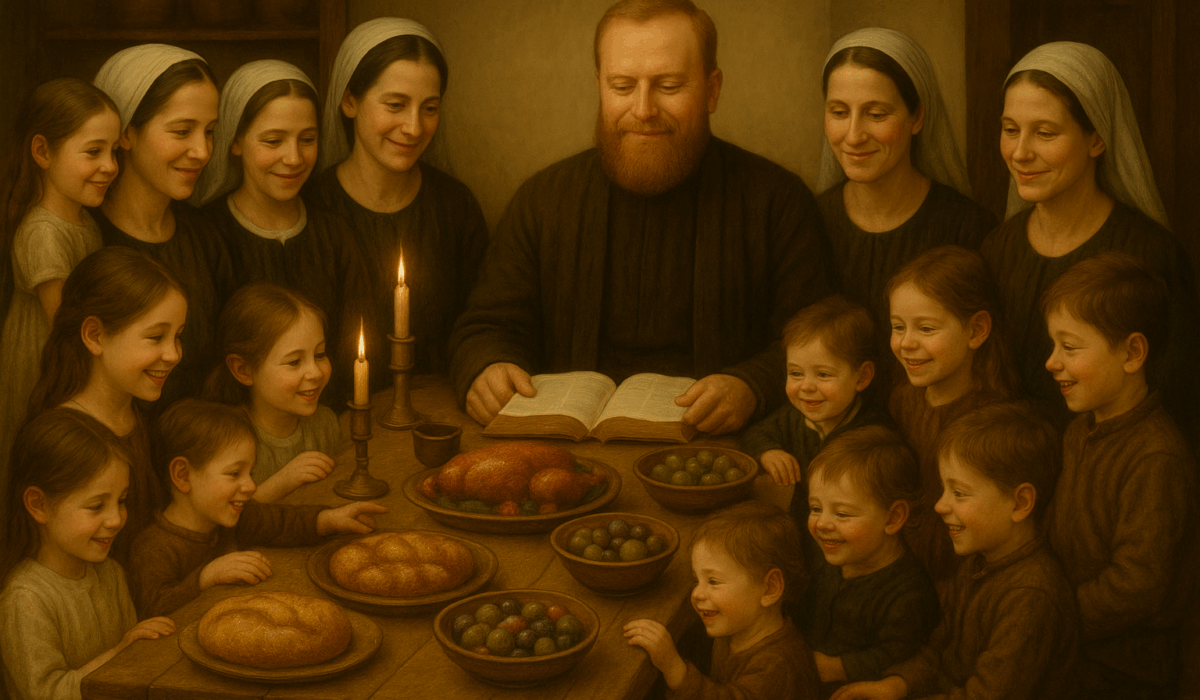
Let us consider the context of a large biblical household, a husband, two wives, and nine children. Such a home is not maintained by money alone. It is upheld by the wise management and productive labor of the wives.
In this model, the goal is that the wives combined would produce at least 25% of the household’s food and goods, with a target of 50%. This is not fantasy; it is ancient precedent.
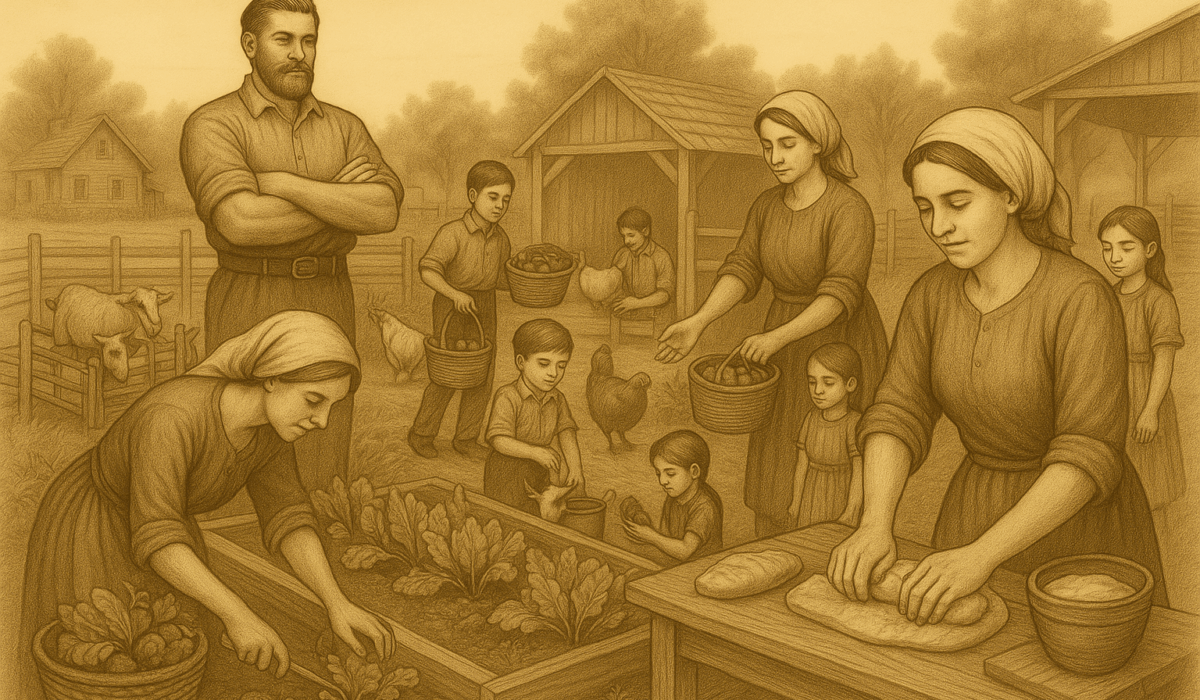
In an ideal climate and with just 600 square feet of garden space, a wife can grow hundreds of pounds of produce a year. With canning, fermenting, and preserving, this abundance carries through winter. Add bread-making, soap-crafting, meal planning, and haircuts, and the home becomes not just a place of consumption but of value creation.
V. The Daily Waste of Idleness
Let’s quantify what’s lost when this mandate is ignored. The estimates below are based on a 12-person household with 3 adults using the median amounts.
- Not gardening: -$6/day
- Store-bought bread: -$3/day
- No canning: -$2/day
- No bartering: -$3/day
- Buying clothes: -$3.25/day
- Store-bought cleaners: -$3.50/day
- Buying candles: -$0.50/day
- Children’s Haircuts: -$5.14/day
- No meal planning: -$2/day
- Energy waste: -$3/day
- No herb garden: -$1/day
- Coffee out: -$15/day
- Food delivery: -$5/day
- Streaming Media Filth: -$3/day
Total waste: $55.39/day
If that money were preserved and invested with just 8% annual growth, over ten years the family would gain:
$309,681.55
This is the cost of rejecting the woman’s dominion in the home, and this is just some of the waste. In the next section, we will explore how a 600 sq ft garden, in the hands of a skilled wife, can feed the family, reduce costs, and transform the family economy
VI. The 600 Square Foot Garden – Dominion from the Ground Up
The average American family considers gardening a hobby. In a righteous household, it is a strategy of dominion. With just 600 square feet, roughly the size of a small studio apartment or a 20’x30’ plot, wives can lay the foundation for economic transformation.
VII. What Can Be Grown
Assuming a temperate climate with 3-season growth, intensive gardening techniques such as vertical planting, square-foot gardening, and succession sowing allow for high-density food output. Here’s what a well-managed 600 sq ft garden can produce annually:
- Tomatoes: 150–200 lbs
- Leafy greens (lettuce, kale, chard): 100–150 lbs
- Beans (pole and bush): 50–100 lbs
- Root vegetables (carrots, beets, radish): 100–150 lbs
- Peppers: 30–60 lbs
- Summer squash/zucchini: 50–75 lbs
- Potatoes (grown vertically): 100–200 lbs
- Culinary herbs (basil, parsley, oregano, etc.): 10–20 lbs
- Total yield: 900ish lbs of food/year Caloric value: ~400,000+ calories
That’s roughly 25% of the total household food budget. Grown with only sweat and stewardship.
VIII. Techniques for Maximum Output
- Raised beds with rich composted soil
- Vertical growing using trellises and cages
- Companion planting to repel pests and optimize nutrients
- Succession planting for continuous harvests
- Rainwater collection and mulching to reduce watering needs
IX. Canning and Preserving the Surplus
Fresh produce is fleeting. Wise wives preserve the harvest:
- Water-bath canning for tomatoes, pickles, fruits
- Pressure canning for beans, squash, and broth
- Drying and preserving for potatoes, garlic, onions
- Freezing for greens and herbs
This ensures year-round food security and prevents dependence on fragile supply chains.
X. Cost and Value
Organic produce equivalent: ~$3–5 per pound
At 750 lbs × $4 avg = $3,008 value annually ($250.00 Monthly)
That’s just from the garden. When paired with home cooking, preservation, and trading with others, that space becomes a cornerstone of the household economy.
XI. Domestic Skill Sets – Building the Household Economy by Hand
The productive wife is not only a gardener, but also a builder of daily infrastructure, meeting family needs with her own hands. In a family of 12, every small saving multiplies, and every act of skillful provision compounds into generational wealth. These crafts, once considered basic to feminine maturity, are now revolutionary acts of household sovereignty.
A. Bread Baking: Daily Bread as Daily Wealth
A single loaf of artisan bread costs $5–$8 in today’s market. A wife can bake it for under $1.
- Skill Level: Beginner
- Startup Needs: Flour, salt, yeast/sourdough, standard oven
- Savings: $5–$8 per loaf × multiple loaves per week = $2,500+/year
Children raised with fresh bread, homemade butter, and warm hospitality are both healthier and anchored in memory. These skills become traditions.
B. Soap & Cleaner Making: Removing Dirt, Adding Value
Homemade soaps, laundry detergent, and all-purpose cleaners cost pennies to make and remove the need for toxic commercial chemicals.
- Ingredients: Lye, fat, baking soda, essential oils, vinegar
- Tools: Mold, crockpot or stovetop, safety gloves
- Savings: $3.50/day = $1,277.50/year
Soap-making can be batch-produced monthly, allowing for stockpiling and bartering.
C. Sewing & Mending: Stitching Wealth into Clothes
Mending ripped knees, hemming skirts, or making seasonal pajamas from patterns preserves clothing value and adds personal flair.
- Startup Needs: Sewing machine, thread, needles, patterns, scrap fabric
- Savings: $3.25/day = $1,186.25/year
- Advanced Skills: Dressmaking, uniform making, denim repairs, custom sizing
D. Meal Planning: Strategic Stewardship
Planning meals weekly prevents food waste, lowers stress, and maximizes use of homegrown and bulk-bought goods.
- Savings: $2.00/day = $730/year
- Time: 10–30 minutes/week
- Tool: Simple notebook, calendar, or app
E. Candle Making: Ambiance and Utility
In power outages or cozy evenings, beeswax or tallow candles are useful and beautiful. Homemade candles last longer and can be crafted with herbs or essential oils.
- Cost to make: ~$0.50
- Retail equivalent: $5–7 per candle
- Savings: $0.50-1.00/day = $200+/year
F. Haircuts: $20 Every 5-6 Weeks × 9 Children
A pair of quality clippers and some practice yields professional results and saves hundreds yearly.
- Savings: $5.14/day = $1,876.10/year
G. Bartering & Trading
Many women’s talents are uneven. One excels at sourdough, another at fermentation, another at sewing. Trading excess goods, sourdough starter, jams, soaps, baby clothes, builds local networks and replaces dollars with relationships.
- Estimated value exchanged: $3.00/day = $1,100+/year
These skills are not luxuries. They are acts of economic warfare against a system designed to make women idle consumers. When women take dominion, they decentralize the economy, disempower Babylon, and elevate their homes.
In the next section, we’ll look at utility reduction, modern traps (like delivery and streaming), and the compounded savings of household wisdom.
XII. Modern Traps, Utility Reduction, and Compounded Wisdom
The modern home bleeds money not through major catastrophe but by a thousand daily cuts. Women who fail to steward their homes allow the enemy to rule through convenience, subscription, and passive waste. But wise wives can turn these liabilities into savings that grow exponentially.
XIII. Utility Stewardship: Lowering the Burn Rate
Utilities drain silently, electricity, heating, water, gas, unless someone takes dominion. The keeper of the home must also be the manager of its consumption.
- Simple practices:
- Line-drying clothes
- Turning off unused lights and appliances
- Using crockpots and solar ovens
- Keeping doors closed
- Closing off unused rooms during the day
- Planning cooking times
- Cooking outdoors
- Strategic window insulation or coverings
- Bathing children together or with reused rinse water
- Daily Savings: $3.00/day = $1,095/year
XIV. The Lure of Delivery and Convenience Food
Ordering takeout, food delivery apps, and prepackaged meals are signs of household decline. These costs pile up especially in large families, where the economy of home cooking is exponential.
- Estimated cost per order: $25–$60
- Daily avoidance savings: $10.00/day = $3,650/year
Home-cooked meals from planned menus, rooted in your own garden and pantry, are not just frugal, they are feasts of obedience.
XV. Entertainment Addiction: Streaming and Screens
Households that stream Netflix, Disney+, Hulu, YouTube Premium, and Spotify are not merely wasting money, they’re outsourcing imagination. These platforms cost families spiritually and financially.
- Average cost: $60–$100/month across services
- Daily savings from cancellation: $3.00/day = $1,095/year
Replace screens with board games, books, prayer, reading aloud, nature walks, and family worship. This substitution saves money and souls.
XVI. Coffee Out: Latte Poverty
Modern adults often mistake $5 lattes for sanity breaks. Multiply that by three adults daily and you have an addiction disguised as necessity.
- 3 adults × $5/day = $15.00/day = $5,475/year
A wife who learns to make strong, hot, nourishing coffee at home not only saves money, she reclaims rhythm and ritual.
XVII. The Compounding Cost of Convenience
Let’s total what’s wasted by a household of 12 when dominion is rejected in these modern traps:
- Utility waste: $3.00
- Delivery food: $10.00
- Streaming: $3.00
- Coffee out: $15.00
Daily Loss: $31.00
At 8% interest, compounded over ten years, this becomes:
$181,613.17 in preventable financial hemorrhage.
Add that to the savings from Sections 5 and we’re over $400,000 in economic dominion reclaimed. This is not prosperity gospel. This is simply Biblical stewardship.
Section 5: Final Tally – Ten Years of Faithful Stewardship
The combined daily savings from faithful wife-led productivity in this average biblical household add up rapidly. Below is a breakdown of economic impact based on conservative daily savings:
- Gardening (600 sq ft) $8.25
- Baking fresh bread $7.00
- Canning & preserving $2.00
- Trading/bartering with others $3.00
- Sewing & mending clothes $3.25
- Homemade soaps/cleaners $3.50
- Homemade candles $0.75
- Cutting children’s hair (9 kids) $5.14
- Meal planning (reducing food waste) $2.00
- Reducing utility use (conservation) $3.00
- Growing culinary/medicinal herbs $1.00
- Not buying coffee (3 adults @ $5/day) $15.00
- Total Daily Savings $63.89
📈 Compound Impact Over 10 Years (8% Interest)
If the wives faithfully take dominion over these areas daily, the compounded financial effect over 10 years at just 8% interest is:
💰 Over $400,000 saved and reinvested.
This does not include the additional $145,623.17 saved from eliminating wasteful habits like food delivery, subscription entertainment, and unnecessary utility usage.
XVIII. Total Household Impact
$400,000 + $145,623 = $545,623 over ten years.
This is the legacy of wise women. Not one of luxury or vanity, but of faithfulness, frugality, and fruitfulness. Through the skills of her hands, the wisdom of her planning, and the labor of her love, the wife becomes the cornerstone of the household economy.
This is biblical. This is historic. And in an age of artificial ease, it is revolutionary.
Let her be praised.
“Give her of the fruit of her hands; and let her own works praise her in the gates.” – Proverbs 31:31
XIX. Beyond the Basics – Expanding the Household Economy and the Case for Multiple Wives
Everything covered thus far represents only the beginning, the minimum standard of productive stewardship. The truth is, the potential for wives to build and bless the household economy is vast. Once the basics are mastered, a household can expand into full-scale provision and even surplus.
A. Livestock and Animal Husbandry
- Chickens provide daily eggs, occasional meat, composting help, and pest control.
- Goats offer milk, manure, meat, and brush-clearing power.
- A dairy cow can sustain butter, yogurt, cream, and cheese needs for the entire family.
These are not rustic fantasies, they are practical, proven systems for food security and economic independence.
B. Home-Based Production and Sales
- Cheese, jams, breads, soaps, herbal salves, and sewn goods can be sold at local markets.
- Online platforms like Etsy or local co-ops allow for cottage-industry income.
- Children raised in these homes learn entrepreneurial thinking, not entitlement.
C. Strategic Frugality and Bulk Systems
- Couponing and bulk buying save thousands annually.
- Cloth diapering, reusable goods, and repair culture cut invisible costs.
- Bartering labor or goods turns excess into trade value without taxation.
XX. Why Multiple Wives?
A household of twelve, with nine children, is not a small operation. It is a small nation. To run it well requires hands, hearts, and laborers.
- Two wives can manage the foundational work, gardening, cooking, laundry, and children if they are focused and dedicated.
- Three, four or more can expand the system into livestock, artisan goods, elder care, or homeschooling leadership.
Each wife brings her strengths: one may sew, one may bake, one may teach, one may manage livestock. Polygyny allows for household diversification and scale. No single woman can do it all, but a wise household led by a righteous man can multiply talent across his wives.
This is not exploitative, it is biblical (Genesis 4:19, Exodus 21:10), practical, and historically normal. More wives mean more output, more unity, and more margin. The modern nuclear model of isolated exhaustion fails where biblical households flourish.
Conclusion: The home is an economy, a ministry, a legacy. Wives are not burdens, they are builders. And in a rightly ordered home, every act of productivity becomes an act of praise.
This is The Great Order!