Category Archives: History

Why Monogamy is Failing Modern Society

The Economic, Demographic, and Moral Consequences of the Forced Monogamy Experiment


Introduction: A Social Experiment Gone Wrong

Modern society insists that monogamy is the “only moral” form of marriage. Churches preach it, governments legislate it, Hollywood romanticizes it and therapists bill hourly trying unsuccessfully to salvage it. And yet, despite all this pressure, the monogamous model is collapsing rapidly. Divorce rates are soaring, birth rates plummeting and men checking out of marriage entirely. Women are increasingly unable to function inside a “traditional household causing families to disintegrate and society to unravel.

If monogamy were truly the superior system, the results would speak for themselves. They do –  but not in the way the modern world hopes. Monogamy is not failing because people are sinful; people have always been sinful. Monogamy is failing because the forced-monogamy experiment contradicts human nature, economic reality, demographic necessity, Biblical design and historical precedent.

What we call “traditional marriage” is not traditional at all. It is a modern construct, artificially enforced, and it is cracking under the weight of its own delusion.


I. The Biblical and Historical Illusion of ‘One Man, One Woman’

Modern Christians speak as if monogamy has always been the biblical norm but It has not. God built entire nations through men with multiple wives such as Abraham, Jacob, Moses, Caleb, Gideon, David, and many more. God never once condemned the practice, Christ never changed it, and the apostles never restricted it.

Monogamy as a legal and religious ideal was not a biblical invention – it was a Roman one. Later it was enforced by the Western church as a matter of control, not morality.

For most of human history patriarchs married more than one woman, in many places they still do. Households were multigenerational, women shared labor, childcare, and domestic duties, families grew large, strong, and economically stable. The modern nuclear monogamous family is not “God’s design.”  It’s an industrial-age experiment – and it is failing spectacularly.


II. The Economic Consequences of Forced Monogamy

1. A Single Wife Cannot Sustain a Household Economy

Historically, multiple wives contributed additional labor, increased productivity, shared childcare, diversification of skills and expanded capacity for agriculture, trade, and home production. A patriarchal household functioned like a small enterprise – many hands, one mission.

Today’s monogamous household? It functions like a failing startup with one burned-out employee expected to do everything. Social workers call it “the overwhelmed mom crisis.”
Scripture simply calls it “not good for man to be alone.” (Genesis 2:18)

2. The Cost of Children Exposes the Weakness of Monogamy

Children are expensive – especially in a society where women no longer contribute economically, homeschooling becomes necessary, inflation strips families income and state run  schools are unsafe. Monogamy places all economic productivity on one man and all domestic burden on one woman. This model worked only when society was agrarian, extended-family based, and communal.

But in the modern world? It collapses while Polygynous households distribute labor, responsibility, emotional load, childcare and household production. This makes large families economically sustainable unlike monogamy.

3. Monogamy Creates a Hidden Competition Among Women

When men are legally restricted to one wife, women compete viciously for high-value men, stable households and financial security instead of building those things together. This leads to delayed marriage, endless boyfriend cycles, and a marketplace of dysfunction. Economically, forced monogamy stifles household formation and cripples national fertility.


III. The Demographic Collapse of the Western World

The greatest symptom of monogamy’s failure is the one no government can fix:

1. Birth Rates Have Fallen Below Replacement Everywhere Monogamy Is Enforced

The United States, Canada, Europe, Australia, Japan, and South Korea just to name a few. In almost every monogamy-based nation birth rates are collapsing, populations are aging, economies are shrinking, retirement systems are dying and armies cannot recruit. The communities that built western civilization are dying out at an alarming rate..

A society that cannot replace itself simply cannot survive.Meanwhile, cultures that allow (or quietly tolerate) polygyny – Africa, the Middle East, parts of Asia, and religious traditionalists – continue to grow exponentially. Polygyny has always been the engine of population expansion, while monogamy has traditionally been the engine of population decline.

2. Monogamy Makes Marriage Unattainable for Large Numbers of Women

Most women today outnumber marriageable men by millions because men marry later, men avoid marriage out of fear of divorce, men are destroyed by economic instability and the state punishes husbands but rewards single mothers.

These women do not remain virgins. They simply become a rotating cast of girlfriends, situationships, and childless wanderers. Monogamy leaves them unclaimed and unprotected. A polygynous system would give them a stable household, a proven man, a functioning economy, a ready-made community, a purpose, Children and a legacy.

Demographically, polygyny is mercy, while monogamy is the end of a civilization.


IV. The Moral Consequences: What Forced Monogamy Has Produced

1. Monogamy Has Not Reduced Sexual Sin – It Has Multiplied It

In practice, enforced monogamy has created an explosion of adultery, serial monogamy, divorce culture, hookup culture, pornography addiction and rampant fornication. When men cannot righteously take additional wives, they still take additional women – just immorally and secretly. Monogamy does not restrain sexual behavior. It merely forces it underground.

2. Monogamy Empowers Female Rebellion

In a monogamous framework the wife knows she cannot be replaced, divorce courts favor her, culture worships her emotions, the church preaches her innocence and feminism trains her to resist male authority. This produces entitlement, disrespect, manipulation, and defiance.

Polygyny historically restrained this behavior because wives had accountability to each other, rebellion risked demotion or replacement, the household required cooperation – not indulgence, competition produced humility and gratitude replaced entitlement. A woman who realises she can be replaced behaves differently from a woman who believes she cannot.

3. Monogamy Has Produced Weak Men

Men raised in monogamy are told to center their life around one woman, negotiate instead of lead, seek permission instead of build, avoid conflict, suppress masculine instincts and fear women’s emotions

This creates passive men, not patriarchs. When men cannot expand, they stagnate and when households cannot grow, they decay.


V. The Return to Household Order

Monogamy is failing because it contradicts the very things that create a thriving civilization such as male headship, female obedience, multigenerational households, large families, economic expansion, social stability, community cooperation and covenantal continuity.

Forced monogamy is unnatural, unbiblical, economically unsustainable, and demographically suicidal. Polygyny is not a magic cure – but it is a proven structure that stabilizes men, protects women, expands households, increases fertility, reduces sexual chaos, creates economic resilience and builds tribes, clans, and even nations.

It is no accident that God built Israel through this method. He understood something the modern world has forgotten, Strong families require strong households, not romantic fantasies.

The Experiment Is Over

Monogamy had a 150-year run as the “ideal.” It has resulted in broken homes, infertile nations, confused churches, rebellious women, weak men and dying civilizations. The evidence is undeniable. The forced-monogamy experiment has failed and the world is returning – slowly, painfully, inevitably – to household structures that actually work.

Not because culture wants to, but because reality eventually wins. The future belongs to the men who build households, not marriages. To the men who build legacies, not romances.  To the men who embrace biblical order, not modern sentiment. And to the women wise enough to join them.

LET GOD”S GREAT ORDER BE RESTORED!

The Vanishing People:

Why Western Christians Are Dying Out, Why It’s Their Fault, and How Biblical Households Can Reverse the Collapse


Introduction: The Most Avoidable Extinction in History

There are many ways a civilization can die. Through war, plagues, famine, earthquakes, fire from heaven, etc. But Western Christians – especially those descended from the once-great Christian nations of Europe and North America – have chosen a far stranger path:

Self-inflicted demographic extinction.

Not because enemies rose up and slaughtered them. Not because nature struck them down. Not because they lacked resources or opportunity. No, Western Christians are dying out because they simply refuse to have children.

They have wealth, but no heirs. They have houses, but no sons to fill them. They have freedom, but no families. They have Bibles, but no belief in the first command given to mankind:

“Be fruitful and multiply.” — Genesis 1:28

Instead, Western Christians have embraced: Delayed marriage, deliberate infertility, career-first womanhood, contraception as a sacrament, abortion as birth control, child-rearing as a hobby, large families as “irresponsible” And then they wring their hands in shock when statistics reveal the obvious:

They are becoming a minority in their own historic homelands. Not because anyone conquered them – but because they contracepted themselves out of existence. Meanwhile, nearly every other religious or cultural group – Muslims, Orthodox Jews, Latinas, Africans, Indians, Mormons, and even non-Christian Asians – is outpacing Western Christians in birthrate by two, three, or four times.

This is not “replacement.” This is not conspiracy. Just simple, cold, hard math. The facts are undeniable, and it has biblical consequences. Because God does not bless sterile faith. He blesses generational faith. Faith that multiplies. Faith that tills the earth and fills it. Faith that raises sons and daughters who carry the covenant beyond the grave.

Western Christians once understood this. Now they treat childbearing as a lifestyle choice instead of a divine mandate. The result?

We are living through the greatest self-chosen demographic collapse in Christian history.


I: The Numbers Don’t Lie – But Modern Christians Do

To understand the crisis, you don’t need prophecy, you don’t need a vision, you don’t need a sign from heaven, you just need a calculator.

Western Christian birthrates have fallen below replacement.

Replacement level is 2.1 children per woman. Western Christians – especially white, Westernized believers – now average 1.4, That is civilizational hospice care levels.

A society at 1.4 will lose half its total population every two generations. Factor in the still declining birthrate, and the increasing birthrate of our sworn enemies and you get a total reduction of white Christians to “minority status” in less than 2 generations.

This is not some conspiracy theory, and it is not contested even by mainstream science, in-fact it is praised. This is basic demographic law, and it is as predictable as gravity.

Meanwhile, high-fertility groups are multiplying:

  • Muslims: 3.5–6.5 births per woman
  • Latinas: 3.2–5.5
  • Orthodox Jews: 4–8
  • Africans (various nations): 4–7
  • Indians: 2.5–4
  • Traditional East Asians (rural): often 3+

And here’s the uncomfortable fact: Nearly all these groups share one or more of the following: Strong religious expectation of large families, patriarchal household structure, early marriage, low or no contraceptive use, communal pressure to reproduce, high honor value on motherhood, acceptance of polygyny/polygamy and/or serial monogamy. 

Meanwhile, Western Christians have postponed marriage to their thirties, treated children as an economic burden, replaced the Biblical household with two-career roommate marriages, idolized “freedom” and “me time”, consumed contraception like candy, made abortion a common fallback, redefined biblical womanhood as “independent careerist”, replaced generational dynasty with personal fulfillment, considered polygyny “weird,” despite the Bible being full of it, demonized large families, and demonized men who marry younger women. Is it any wonder the math is turning against us?


II: Childless Christianity Is Not Biblical Christianity

Let’s be blunt and remove the polite church language. Let’s speak as clearly as Scripture speaks on the matter. Christianity with no children is not Christianity. It is a philosophically neutered religion that cannot survive beyond its current adherents.

The God of Scripture is a God of generations.

  • He calls Himself the God of Abraham, Isaac, and Jacob – generational identity.
  • He establishes covenants that pass from father to son – generational continuity.
  • He commands His people to teach their children diligently – generational training.
  • He blesses fruitful wives and large households – generational expansion.
  • He warns repeatedly against cutting off posterity – generational consequence.

God never once blessed childlessness as a virtue. He only blessed it when He miraculously reversed it.

In Scripture, the barren cry for children.

Modern Christians cry to remain barren. Consider that absurd contrast. The ancient women of God – Sarah, Rebekah, Rachel, Hannah – wept because they longed for children. Modern Christian women weep because their career plans are interrupted by pregnancy.

Biblical men prayed for heirs. Modern Christian men pray for raises. The early church rejoiced at new babies. Modern churches create “child-free zones.” Somewhere along the way, Christianity in the West became allergic to the very thing God commands first: Fruitfulness.


III: The Cultures That Multiply, Rule.RULE.

THE CULTURES THAT REFUSE, DIE.

No civilization can survive without children. This is not a political statement or ideology. This is not controversial. It is simply how God designed the world. 

The cultures that honor marriage, elevate motherhood, expect women to become wives early, train men to lead households, celebrate large families, maintain patriarchal authority, encourage fertility and accept additional wives… are the cultures that outlast history.

The cultures that Worship career, idolize singleness, delay marriage, contracept themselves into sterility, abort their offspring, mock patriarchal authority, treat children as burdens and shame large families… disappear.

This is not a new phenomenon, this has been happening for millennia. We are simply witnessing the pattern again.

High-Fertility Religious Cultures Are Winning the Future

Muslims, Orthodox Jews, Mormons (historically), and many African, Asian, and Latin American groups share one thing, they expect their people to multiply.

Not casually. Not “when you feel ready.” Not “after you finish your self-discovery phase.” Not “once you’ve traveled Europe and detoxed your trauma.”

No. They place fertility at the center of faith and identity. They build households around children. They train daughters to be wives and mothers. They train sons for marriage and leadership. They allow multi-wife structures where appropriate. They cultivate cultures of honor around reproduction. And they are growing.

If this trend continues, they will inherit the earth – not through conquest, but through cradles.


IV: How Western Christians Sterilized Themselves

Identifying the Mechanisms of Decline

Before you can correct a failing civilization, you must first diagnose the disease. And before you can cast out a demon, you must name it. Western Christians love to complain about cultural decay, shrinking churches, and collapsing influence, but they rarely examine the choices – their choices – that produced these outcomes. Decline is not mysterious. It is not accidental. It is the predictable harvest of seeds planted over generations. When you dismantle the structures God designed to maintain fruitfulness, order, and lineage, the future does not simply weaken, it disappears. The mechanisms listed below are not subtle. They are open, obvious, and publicly applauded, even within the church. And until Christians confront them honestly, nothing will change.

1. The Idol of Higher Education

Modern Christians have sacrificed millions of potential children on the altar of academic ambition. The script is so predictable it might as well be liturgy: childhood with no responsibilities, late teens spent prepping for college, the twenties sacrificed to degrees, grad degrees, internships, advanced certifications, and ladder-climbing, followed by early-thirties career consolidation. Only after all of that do Christian couples look at one another and say, “Maybe we should think about having kids.” But by then, biology is not interested in their sentimental reflections. Fertility has declined, energy has diminished, and capacity has narrowed. This life script produces fewer children, later children, and often no children at all. What makes it worse is that churches cheer this pattern as if it were godly maturity. But nothing in Scripture suggests that ten years of extended adolescence produces stronger families or more faithful households. The idol of higher education has stolen the prime years of fruitfulness from an entire generation of Christian men and women, leaving regret in the place where children should have been. The modern formula goes like this:

18 years: no responsibilities
18–28 years: college, grad school, second degree
28–33 years: career climb
33–36 years: “maybe we should think about kids”
36–38 years: fertility problems
38–40 years: one child, maybe
40+ years: regret

2. The Idolatry of Career Womanhood

Few ideas have caused more damage to the Christian household than the belief that a woman’s highest calling is corporate advancement. The Proverbs 31 woman is repeatedly praised for her competence, resourcefulness, and industriousness, yes, but she exercised those gifts within the household economy, not in a sterile cubicle under fluorescent lights. She was the heartbeat of a thriving home, not a commuter in rush-hour traffic. Western Christian culture, however, took her example and reinterpreted it through the lens of feminism, turning this biblical wife and mother into a boardroom executive who squeezes motherhood somewhere between quarterly reports and team-building retreats. As a result, Christian women spend their peak fertility years chasing promotions rather than raising children. By the time they circle back to the idea of family, many discover that the opportunity God designed for their youth has been diminished or lost. The culture cheers their “success,” but heaven mourns the unborn generations sacrificed to this idol.

3. Contraception: The Sacred Cow of Modern Christianity

Nothing has sterilized Christian civilization more effectively than the near-universal embrace of contraception. High-fertility cultures instinctively reject it or impose strong limitations because they understand – intuitively or theologically – that children are the lifeblood of a people. Low-fertility cultures, by contrast, treat contraception as oxygen: ever-present, unquestioned, and indispensable. Western Christians have so normalized contraceptive use that they cannot imagine marriage without it. The honeymoon is no longer the beginning of fruitfulness but the beginning of intentional barrenness. Churches treat contraception as morally neutral despite its obvious demographic consequences. And then they marvel at the shrinking Sunday schools, the aging congregations, and the hollowed-out youth groups, never making the connection between their “family planning” and their disappearing future. A people who fear pregnancy more than disobedience will never survive.

4. Abortion: The Silent Massacre

Delayed marriage and contraception have not merely reduced fertility, they have paved the road to abortion. Western Christians wring their hands over national decline while quietly participating in the greatest internal slaughter their civilization has ever known. The numbers are staggering: millions of unborn children, many conceived by Christians themselves, have been erased. Each one of those children would have represented a family line, a testimony, a future. Entire branches of Christian heritage have been severed before they ever took their first breath. The tragedy is compounded by denial, Christians lament the loss of cultural influence even as they contribute to the disappearance of their own descendants. This is not merely a political issue or a cultural debate. It is a catastrophic act of self-destruction. No civilization can kill its children and expect to live, nor do they deserve to.

5. The Destruction of Biblical Marriage

At the core of all demographic collapse is the erosion of marriage itself. For centuries, the Christian household thrived because marriage was understood as a covenantal, hierarchical, purpose-driven union ordained by God to produce children and establish lineage. Today, marriage has been reduced to an emotional partnership, easily entered, easily broken, and almost entirely detached from the biblical mandate of fruitfulness. Modern men “date,” drift, cohabit, delay, and eventually marry late, often after a decade of forming habits that make covenant life difficult. Modern women approach marriage as optional, postponable, or even dispensable. The household has transformed from a center of labor, worship, and reproduction into a sentimental arrangement based on feelings. But feelings cannot sustain a people. Scripture presents marriage as a generational engine: a man takes a wife, builds a household, raises children, adds servants, multiplies wealth, and leaves an inheritance. The modern Western man, by contrast, moves in with a girlfriend, marries at thirty-three, refuses responsibility, resists authority, avoids discipline, and produces one or two children at most, if any. A civilization built on such marriages cannot stand. Is it any wonder the birthrate has collapsed?


V: The Elephant In The Room – The Bible Actually Supports High-Fertility Household Structures

Now we tread into the real territory modern Christians fear:

Modern Christians tremble at the mere suggestion that Scripture may not align with the fragile, sterilized, Hallmark-inspired version of marriage they’ve been sold. Yet the Bible is embarrassingly clear – painfully clear – about the household structures God used to build His people. The ancient Hebrew household was not a sentimental two-person romance. It was a fruitfulness engine, a dynastic institution, a patriarchal center of labor, lineage, and covenant continuity.

The uncomfortable truth is this: Scripture is overflowing with examples of men who built large, high-fertility households, Abraham, Jacob, Moses, Joshua, Gideon, David, Solomon, Caleb, Elkanah, and at least thirty-five other patriarchs named explicitly or implicitly. These men were not outliers, eccentrics, or fringe cases. They were the backbone of biblical civilization. They produced tribes, clans, nations, and dynasties, not through minimalistic two-child households, but through expansive, multi-generational family structures that modern Christians have been conditioned to dismiss as “weird,” “primitive,” or “unnecessary.”

But weird or not, primitive or not, unnecessary or not, the fact remains: These structures built Israel. They built its tribes, its military strength, its economy, its inheritance systems, and its generational faithfulness. They built a civilization that survived millennia, endured captivity, rebuilt itself, and produced the Messiah.

Meanwhile, the modern Western Christian household, with its small size, collapsing fertility, confused gender roles, and relentless pursuit of comfort, could not sustain a single century without outside help. The biblical model was fruitful. The Western model is failing.

Below are the two unavoidable realities Christians must face.

Biblical Household Structures Were Designed for Maximum Fruitfulness

The first thing Scripture teaches us about the household is that it is fundamentally fertility-oriented. God’s first command to mankind, given before sin, before law, before covenant, was to “be fruitful and multiply.” The patriarchs did not treat this as poetic symbolism. They took it literally. They implemented it. They built households engineered to fulfill it.

The ancient household was not a romantic partnership; it was a dynastic project. Wives were honored as bearers of lineage. Children were considered wealth. Daughters strengthened alliances. Sons expanded labor. A large family was not a curiosity, it was the default expectation for covenant people. And when a woman was barren, the household took steps to maintain fruitfulness, because fruitfulness was non-negotiable. Abraham fathered nations. Jacob fathered tribes. David fathered kingdoms. Solomon fathered dynasties.

This was not by accident. It was by design. Each of these men operated within culturally and divinely sanctioned household structures that multiplied them far beyond what modern monogamous minimalism could ever produce.

No one reading Scripture with an honest eye can miss the pattern. God repeatedly blesses the households that expand. He blesses the womb. He blesses the mother of many. He blesses the man whose quiver is full. He grows His people through offspring, not through marketing campaigns.

And at no point -not once – does God condemn the large, patriarchal, multi-wife household structure that made Israel fertile, resilient, and generationally secure. Modern Christians may twitch at this reality, but twitching is not exegesis.

The Modern Christian Household Does Not Resemble the Biblical One

Now contrast all of that with the average Western Christian household. In Scripture, childlessness was treated as a trauma. Today, it’s treated as a lifestyle choice. In Scripture, wives built households. Today, wives build résumés. In Scripture, marriage was covenantal and hierarchical. Today, it’s egalitarian and unstable. In Scripture, fruitfulness was expected. Today, fruitfulness is negotiated like a luxury purchase. In Scripture, homes overflowed with children. Today, two kids is considered “a lot.”

Somehow, modern Christians have convinced themselves that the lifestyle least supported by Scripture – late marriage, low fertility, contraceptive dependence, career-first womanhood, and micro-sized households – is the “biblical norm.”

Meanwhile, the household structures most clearly present, honored, and blessed in Scripture –  patriarchal authority, fertility-driven households, multi-generational living, and yes, even polygynous arrangements – are dismissed as “unthinkable,” “strange,” or “not for today.”

But the irony is undeniable, every high-fertility society on earth follows patterns more aligned with ancient biblical structures than with modern Western Christian norms. Muslims, Orthodox Jews, many Africans, rural Indians, and traditional Latinas all maintain early marriage, strong father-led households, high fertility expectations, and minimal reliance on contraception. They multiply. They grow. They endure.

Meanwhile, Western Christians, who obsess over “modern norms,” “Western respectability,” and “not being weird”, are marching toward demographic extinction. And here is the most damning statement of all: No high-fertility biblical society ever embraced the modern Western Christian model. None.

Not Israel. Not the early church. Not any group of God’s people across the entire span of Scripture. The Western model is not biblical, it is not historical, it is not fruitful, and it is not generational. It is dying.


VI: “But But But… Jesus!” – Modern Christians And Their Nonsense Arguments

Nothing exposes the modern Christian more than their excuses for barrenness.

Here are the greatest hits:

1. “But population is already too high!”

This is one of the most astonishingly ignorant objections modern Christians parrot, and it reveals how thoroughly the average Westerner has been discipled, not by Scripture, not by history, but by YouTube documentaries and government-funded fear campaigns. The claim that “the population is too high” is disproven by the simplest observation: if the population were genuinely too high, nations wouldn’t be collapsing from low birthrates. Governments wouldn’t be offering financial incentives for women to have children. Entire cities wouldn’t be aging into ghost towns. Schools wouldn’t be closing for lack of students. Hospitals wouldn’t be shutting down maternity wards because no one is giving birth anymore. And politicians wouldn’t be panicking over shrinking labor forces.

This objection only survives because modern people accept propaganda as if it were divine revelation. They’ve never looked at the actual numbers, the actual projections, or the actual consequences. They simply absorbed the narrative that “humans bad, fewer humans good,” and assumed it must be true because it makes them feel environmentally virtuous. But Scripture never once warns us about having too many children; it warns us repeatedly about faithless generations that refuse to multiply. Overpopulation isn’t the problem. Underbelief is. A barren church in a dying nation is the predictable result of listening to the talking points of bureaucrats instead of the commands of the Creator.

2. “But big families are irresponsible!”

Ah yes, the modern Christian’s favorite excuse to justify their tiny, sterile, Pinterest-perfect household. This argument would be hilarious if it weren’t so tragic. The real irresponsibility is not in raising a large family, it’s in presiding over a civilization that is collapsing because no one wanted the “inconvenience” of more children. The idea that big families are reckless or foolish is a purely modern invention, born in an age when comfort replaced calling and convenience replaced covenant. Our ancestors, who built entire nations, expanded frontiers, survived winters that would kill modern people within hours, and raised children by firelight, would laugh this argument out of the room.

Brunching every Sunday, taking three vacations a year, and obsessing over your “personal space” is not responsible adulthood. Producing the next generation of believers, workers, warriors, leaders, and culture-shapers is. A society that shames large families is a society begging for extinction. Every high-fertility group on earth knows that big families are not irresponsible, they are a blessing, an investment, and the engine of civilizational continuity. Only Western Christians, drunk on luxury and terrified of sacrifice, believe that avoiding children is virtuous. The Bible doesn’t call that prudence. It calls it disobedience.

3. “But I need to be financially stable first!”

This excuse is the polite, sanitized way of saying, “I want to spend my youth on myself and deal with adulthood later.” Western Christians have redefined “financial stability” to mean: a house, two new cars, savings, a perfect kitchen, student loans paid off, a six-month emergency fund, and at least one international vacation under your belt. By the time they achieve all that, they’re 34, their fertility is declining, and their doctor is gently suggesting that if they want children, they should “start trying soon.” This is not wisdom. This is idolatry,

The irony is that your ancestors built dynasties with nothing but faith, land, and grit. They raised ten children in a three-room cabin with dirt floors. They planted orchards they knew they’d never fully enjoy. They built for the future because they understood a truth modern Christians have forgotten: children create wealth. Children create stability. Children create future. The Western myth that you must have your entire financial life in perfect order before having kids is not only unbiblical, it is economically backward. A child is not a financial liability; a child is a legacy. And a civilization that waits for perfect financial conditions to reproduce guarantees it will never reproduce at all.

4. “But marriage is so hard now!”

Marriage isn’t hard because the institution is flawed. Marriage is hard because modern people are untrained, undisciplined, and unbiblical. When you weld two self-absorbed individuals together without any sense of covenant, hierarchy, duty, or obedience to Scripture, of course it will be hard. The modern marriage model is not a biblical covenant, it is a romantic contract based on feelings, negotiation, and mutual convenience. It has no spine, no structure, no hierarchy, and no divine authority. No wonder it collapses under the weight of reality.

The solution is not to avoid marriage. The solution is to restore marriage to what God designed it to be. Marriage works beautifully when both parties operate within God’s order: the man leads, the woman submits, the household multiplies, and both see their union not as a fragile emotional arrangement but as a generational project. When marriage is anchored in Scripture, the hardships become sanctifying. When marriage is anchored in feelings, the hardships become unbearable. Modern Christians complain about marriage being hard because they have never actually practiced marriage as God intended. If they did, they’d discover that the difficulty isn’t the problem – the disobedience is.

5. “But polygyny is weird!”

This objection is the clearest proof that modern Christians have been fully domesticated by Western social norms rather than shaped by Scripture. We now live in an age where having two wives is treated like an outrageous moral scandal, but having two cats is considered completely normal and even emotionally healthy. A man providing for multiple women and raising many children? “Weird.” A man letting house pets sleep in his bed while he sterilizes his household with contraception? “Totally fine.” This is what happens when a civilization abandons biblical categories and replaces them with suburban sentimentality. Somewhere along the way, Christians stopped reading their Bibles and started absorbing the values of sitcoms, talk shows, and middle-class consumer culture.

The truth is that polygyny is only “weird” in cultures that have redefined marriage as a romantic, egalitarian partnership rather than a household-building covenant. In Scripture, marriage was never designed to be a fragile emotional arrangement centered on personal fulfillment. It was a structure for labor, lineage, inheritance, protection, and generational expansion. Patriarchs took additional wives not to satisfy lust but to enlarge their house, multiply their offspring, and strengthen their clan. The modern Christian discomfort with polygyny says less about the morality of the practice and far more about how radically Westernized and individualized the Christian mind has become. When your highest vision of marriage is “my forever soulmate,” anything outside that bubble feels strange.

Of course, this does not mean that every Christian man is commanded – or even suited – to pursue multi-wife households. Scripture never required it, and prudence demands maturity, stability, and responsibility from any man building a home. But rejecting biblical models simply because they offend modern taste is folly. The point is not that Christians must resurrect ancient structures wholesale. The point is that biblical household systems, whether monogamous or polygynous, were explicitly oriented toward fruitfulness and generational strength, not sterile romance or convenience. You don’t have to replicate Abraham’s model to learn from its design. You don’t need Jacob’s household to understand the principle of multigenerational expansion. You don’t need Elkanah’s wives to grasp the fertility mindset embedded in God’s people.

The modern Western marriage model is collapsing because it is engineered for emotional satisfaction, financial independence, and controlled fertility. The biblical model, across all of its expressions, was engineered for life, legacy, and multiplication. When Christians recoil at polygyny but celebrate child-free marriages, they reveal exactly how far they have drifted from Scripture. The question isn’t whether ancient practices are “weird.” The question is: When did fruitfulness become weird – and barrenness become normal?


VII: What Happens When A People Refuses To Multiply?

A civilization that stops having children signs its own death certificate long before the final shovelful of dirt is thrown onto the coffin. Decline does not begin with war or famine or some dramatic national catastrophe; it begins quietly, invisibly, in the empty cradles and silent nurseries of a people who have forgotten that life begets life, and that a future must be born before it can be built.

The Economic and National Unraveling

When a society refuses to multiply, its population begins to age faster than it can replace itself. The workforce thins. The tax base shrinks. Entire industries lose the young men required to operate them. The remaining population grows older, sicker, and more dependent while fewer and fewer stand ready to shoulder the burden. Economic strength weakens not because the land lacks resources – but because there are too few sons to harvest them, too few daughters to sustain the communities that once thrived on their presence.

With economic decline comes a predictable weakening of national resolve. Military ranks, once filled with vigorous young men, struggle to recruit because there simply aren’t enough young men left. A nation with no children cannot field an army, cannot sustain a defense, cannot project strength. Its borders soften, its enemies take notice, and its influence abroad diminishes until it becomes a spectator in global affairs rather than a participant.

The Spiritual and Generational Collapse

But the collapse does not end at the gates of the economy or the borders of the nation. It reaches down into the household itself. Small families weaken the church. Churches with few children cannot grow. As congregations gray and shrink, faith is not passed down; it is merely preserved like a relic in a museum. The gospel becomes a pious memory rather than a living inheritance. The hymns grow quieter each year until they become nostalgic echoes of a people who once believed that God’s blessing was found in fruitfulness.

And as churches shrink, so does the faith that once animated them. The doctrines remain on paper, but they lose their power in practice. Parents without children cannot transmit what they do not possess. A generation raised without siblings, cousins, or a vibrant community of believing peers becomes a generation that sees faith as an optional accessory rather than a covenantal obligation. The next generation drifts even further, and then the next after that, until apostasy is no longer an aberration but the norm.

Eventually, the spiritual lights of an entire civilization flicker out. The Christian witness that once shaped laws, culture, art, and identity becomes a historical footnote, a quaint reminder of a people who once flourished but faded when they chose personal comfort over generational obedience.

This is not prophetic doom, nor speculation. It is the predictable, mathematically certain outcome of demographic suicide. Every step of this chain reaction is observable in real time. The West is not stumbling toward this cliff; it is swan-diving off it. Aging populations, collapsing economies, shrinking churches, hollowed-out faith, and multi-generational apostasy are not far-off dangers, they are the current daily headlines.

And they all trace back to a single refusal: A refusal to multiply. A refusal to obey the first command. A refusal to build the households that carry faith into the future. A refusal to bring forth life so that life may continue. This is the quiet catastrophe of a people who chose barrenness over blessing, and now stand confused as they watch their civilization unravel thread by thread.


VIII: The Way Back – Restoring The Biblical Household

Now we reach the solution. It is not complicated, it is not mysterious, and it does not require a degree in sociology. It requires obedience to Scripture and courage to defy modernity.

1. Marry Early

One of the most destructive lies modern Christians have swallowed is the idea that marriage must wait until a person is nearly thirty, after the degrees, after the career ladder, after the apartment phase, after the “finding yourself” phase, after all the emotional baggage has been neatly collected. But Scripture does not treat marriage as a late-life accessory. It treats marriage as the foundation of adulthood. The longer Christians delay marriage, the more they cut into their most fertile, formative, spiritually receptive years. The age of marriage has climbed, but satisfaction, stability, and fertility have plummeted. If you are an adult, you are ready. The purpose of youth is not endless experimentation, it is the establishment of household, covenant, and legacy.

2. Reject Contraception Culture

Modern Christian households have quietly adopted the secular assumption that children are disruptions, accidents to be avoided, burdens to be managed, or optional accessories for a later phase of life. This is a far cry from the biblical worldview, in which children are arrows in the hand of a warrior, blessings from the Lord, and the very means through which God perpetuates His covenant people. A culture that fears fertility fears the future. Contraception has conditioned Christians to believe that fruitfulness must be controlled, minimized, and managed. But Scripture declares the opposite: children are divine gifts, entrusted to families not to inconvenience them but to expand them. A people who reject their blessings reject their own future.

3. Restore Patriarchal Leadership

Every civilization that has endured was built on ordered households where men led, protected, provided, and multiplied. Modern Christians claim to desire strong marriages, yet they deny the very structure that makes strong marriage possible, patriarchal leadership. A man who cannot lead cannot multiply, because multiplication requires authority, decisiveness, and direction. When the household has no head, the family has no future. Patriarchy is not an abusive relic; it is the biblical system that channels masculine strength into generational stability. Restore male leadership, and you restore the household. Restore the household, and you restore the future.

4. Train Women for Motherhood, Not Corporate Climbing

The church has allowed culture to redefine womanhood into a corporate brand rather than a biblical calling. Scripture never commands women to be careerist achievers, climbing ladder after ladder in pursuit of sterile accomplishment. Scripture commands women to build households, nurture life, and shape the next generation. When Christian women are trained primarily for marketplace success instead of motherhood, they enter marriage late, enter motherhood later still, and produce a fraction of the children their ancestors once did. The modern world has told women that motherhood wastes potential. Scripture declares that motherhood fulfills it. A people that does not train its daughters for motherhood forfeits its own future.

5. Normalize Large Families

Western Christians treat large families as curious anomalies, burdensome projects, or reckless decisions, while Scripture treats large families as signs of divine favor. A civilization that loves comfort more than children is a civilization in terminal decline. Children are not drains on resources; they are the very reason resources exist. They are your lineage, your legacy, your living testimony that your faith did not die with you. When churches, communities, and households treat multiple children as excessive or irresponsible, they undermine their own survival. Fruitful families are not a cultural oddity, they are the biblical norm.

6. Reclaim Biblical Household Structure

The Bible’s household model, whether monogamous as the common pattern or polygynous as historically practiced, was always built on the same foundational principles: patriarchal authority, high fertility, multi-generation continuity, and robust community integration. Scripture never envisions the atomized, minimalist, isolated Western household where childbearing is low, hierarchy is absent, and marital purpose is chiefly emotional. Christians do not need to replicate every ancient form to recover its biblical function. They must rediscover multi-generational planning, embrace the expectation of many children, re-establish strong father-led households, and cultivate close communal support systems that make fruitfulness normal rather than burdensome. A household built on these principles stands in continuity with God’s design, even if its structure differs in form.

7. Build Dynasties, Not Memories

The modern world has trained Christians to measure success in terms of personal experiences, vacations, hobbies, conveniences, entertainment, temporary accomplishments. But Scripture never tells a man to build memories; it commands him to build a lineage. A dynasty is not constructed in a year, or even a lifetime. It is assembled through sons who become fathers, daughters who become mothers, and households that multiply in strength and number. Your goal is not to live a comfortable life but to establish a legacy that outlives empires, outlasts nations, and stands as a testimony to God’s covenant faithfulness long after your bones have returned to dust. A man who lives only for himself leaves nothing behind. A man who builds a dynasty participates in God’s enduring work across generations.


IX: The Christian Man’s Mandate – Multiply Or Perish

A Christian man is not called to drift through life as a polite spectator. He is not called to be passive, hesitant, or spiritually domesticated. He is not called to pursue comfort while forfeiting legacy. He is called to fill the earth, to build, to lead, to establish a future. Scripture does not envision men who tiptoe through existence hoping not to offend anyone. It envisions men who take dominion, who plant orchards, who raise sons and daughters, who leave behind a lineage that outlives them. You are not called to pass quietly through this world, you are called to shape it.

Rejecting the Modern Passivity of Christian Men

For too long, modern Christian men have embraced a posture of hesitation, apology, and timidity. They feel the need to apologize for desiring children, as if fruitfulness were something shameful. They defer marriage for no meaningful reason, drifting aimlessly through their most productive years while convincing themselves that commitment must wait until some mythical moment of total readiness. They allow women to lead spiritually because they fear stepping into the role God explicitly assigned to them. They tolerate a contraceptive culture that sterilizes the household and treats fertility as a problem to be solved. They accept the lie that a small, half-empty family is somehow normal or even virtuous. And they pretend that having two children places them among the “large families,” while Scripture paints a far different picture of what multiplication looks like.

This passive, shriveled vision of manhood has produced the very crisis the West now suffers: homes without strength, churches without youth, and a civilization without a future. Every time a Christian man shrinks from his calling, he cooperates – consciously or not – with the demographic death of his own people. Every time he avoids responsibility, delays commitment, or sacrifices his prime years to meaningless pursuits, he diminishes his capacity to build what God commanded men to build. The Christian man today must reject this entire paradigm of weakness and rediscover the ancient mandate that once defined the people of God.

Reclaiming the Biblical Role of the Fruitful Patriarch

God has not called men to minimalism; He has called them to multiplication. A man is commanded to build a household that stands long after he is gone, to lead a wife with conviction, to raise children with strength and intentionality, to establish inheritance that extends beyond his own generation, and to produce godly offspring who continue the work he began. Every biblical patriarch understood this instinctively. They saw family not as an accessory to their personal lives but as the very backbone of their mission.

And yes, Scripture contains abundant historical precedent for household structures that multiplied far faster than the fragile, sterile Western model of today. The biblical household was not engineered for emotional convenience, it was engineered for generational impact. But this is not a call to replicate ancient forms simply for the sake of imitation. It is a call to recover the principle that made those households powerful: fruitfulness. What Christians must reclaim is not merely the form of ancient family life, but its purpose, multigenerational continuity, covenantal expansion, and unwavering obedience to God’s first command.

If Christians want to survive, they must rediscover the household God designed. They must restore authority, embrace fertility, honor motherhood, and build families that are not symbolic but substantial. Because no matter how uncomfortable it may be to modern ears, the truth remains unchanged: the future belongs to the fruitful. Those who multiply will inherit the earth. Those who refuse will vanish from it.


Conclusion: The Battle Is In The Cradle

Western Christians are not being conquered in some dramatic clash of swords and banners. They are not being overtaken by superior armies or subjugated by overwhelming force. They are being outbred, slowly, steadily, mathematically, by their enemies, by invaders, by foreigners and by families who simply take “their” God’s command seriously. It is not political. It is not conspiratorial. It is biological, spiritual, and inevitable. A people who refuse to multiply have already surrendered, even if they do not realize it. Meanwhile, other groups, many hostile to Christian values, others simply committed to their own, are building households, raising children, and preparing to inherit the cultural ground Western Christians have voluntarily vacated.

But Christianity does not fade because competitors rise. It fades because Christians refuse to obey the most basic commands God placed at the foundation of creation. This is not a competition of arms, borders, or public policy. It is a competition of wombs, of faithfulness, of sacrificial obedience. Civilizations do not die when their enemies attack, they die when their families stop producing the next generation. Right now, Western Christians are losing the only battle that ultimately determines the future: the battle of the cradle.

Recovering the Foundations We Abandoned

The decline of Western Christianity did not begin in the government or the marketplace. It began in the home. It began when Christians abandoned the biblical household, the ordered, patriarchal, fertile structure God designed to transmit faith from one generation to the next. It began when Christian women embraced careers over children, independence over motherhood, and self-expression over Scripture. It began when fruitfulness was treated not as a divine mandate but as a negotiable burden. And it began when Christian men surrendered their role as leaders and builders, choosing personal comfort over generational responsibility.

These are not small shifts. They are tectonic fractures in the foundation of Christian civilization. A people who discard the biblical vision of family should not be surprised when their numbers dwindle, their influence fades, and their inheritance passes to those who were never afraid of children. God is not mocked. A sterile faith reaps a sterile future. A faith that refuses to multiply has chosen extinction long before it feels the consequences.

The Future Belongs to the Fruitful

Yet the solution remains as simple and ancient as the command that launched humanity itself. A fruitful faith, a faith that builds households, strengthens marriages, embraces motherhood, restores fatherhood, and welcomes children, will always outlive the faith that compromises with convenience. A faith that multiplies will always overshadow the faith that sterilizes itself. A people who take God’s command seriously will always inherit the cultural and spiritual ground abandoned by those who do not.

It is time for Christian men to rise again as builders and patriarchs. It is time for them to lead, to establish households, to take wives, to train children, and to multiply without apology. It is time to abandon the timid, shrinking vision of modern Christianity and reclaim the ancient, biblical calling to create life and steward it. Because when all the debates have quieted and all the political noise fades away, the truth will stand unchanged: 

The Man Who Does Not Multiply Will Be Replaced By Those Who Do! The future belongs to those who show up – and bring children with them.

Thanksgiving: The Feast of Order, Gratitude, and Generational Strength

By Lord Redbeard

Thanksgiving is the only modern holiday I keep, and for good reason. It is one of the few occasions left in the American calendar that has not been entirely swallowed by commercialism, paganism, or theological confusion. There is no Santa sneaking into your house like a bearded burglar. No bunny laying pagan eggs. No sentimental clutter replacing truth with hollow ritual. Thanksgiving remains – miraculously – a day that can still be traced back to actual Scripture, actual providence, and actual history.

It is a feast that belongs to families, to fathers, to households determined to acknowledge both their dependence on God and their obligation to work, sweat, and build something worthy of gratitude.

And, best of all, it involves eating, which God Himself repeatedly commands His people to do when they gather in His presence. Truly, a divine command I can obey with enthusiasm.

But let’s not mistake Thanksgiving as a “Turkey Day” or some generic cultural excuse to binge carbohydrates. If that’s all it is, then you’ve missed the entire point. Thanksgiving is a biblical pattern of remembrance, gratitude, labor, covenant renewal, and generational orientation. The modern world has turned thankfulness into a vague emotional state, some kind of warm goo you feel while scrolling Pinterest. But biblical thanksgiving is a weapon. It is discipline. It is a declaration of reality: God is King, He provides, and we remember.

So let us trace Thanksgiving from its ancient roots to its American expression, rediscover its meaning, and reclaim it as a feast of household order and patriarchal gratitude.


I. The Origins of Thanksgiving: Older Than America, Older Than Pilgrims – Rooted in Scripture

The story of Thanksgiving does not begin in 1621 with the Pilgrims and the Wampanoag tribe. It begins thousands of years earlier, on mountaintops, in tabernacles, in the heart of Israel’s worship.

God instituted feasts long before America existed. And those feasts had a common thread:

1. Gather the household.
2. Remember what God has done.
3. Eat a commanded meal.
4. Give thanks openly, not silently like embarrassed moderns.

This is “Thanksgiving” before Thanksgiving.

The First Thanksgiving Wasn’t in Plymouth – It Was in Leviticus

Leviticus 7:11–13 lays out the “sacrifice of thanksgiving,” a peace offering accompanied by bread, eaten in the presence of the Lord, rejoicing before Him.

“And he shall offer it with the sacrifice of thanksgiving… and of it he shall offer one out of the whole oblation for a heave offering unto the Lord.” —Leviticus 7:12–13

The peace offering was a feast. A meal. A gathering. A moment of communal gratitude and celebration – sound familiar?

Then there is the Feast of Firstfruits (Leviticus 23:10) – a literal harvest thanksgiving. Israel brought the earliest, best fruits of their labor and acknowledged God as the provider of all increase.

Nothing says “thanksgiving” more than handing God the first handful of crops you worked your fingers numb to produce. But the king of biblical thank-feasts is the Feast of Tabernacles (Sukkot) – a celebratory, family-centered, food-heavy, multi-day festival commanded by God Himself.

Seven days shalt thou keep a solemn feast unto the Lord thy God in the place which the Lord shall choose: because the Lord thy God shall bless thee in all thine increase, and in all the works of thine hands, therefore thou shalt surely rejoice.” —Deuteronomy 16:15

Imagine that: God commanding His people to rejoice. Not suggesting. Not hinting, but commanding joy.

Sukkot is all about remembering God’s provision in the wilderness, giving thanks for the harvest, and gathering the family to feast. If you stripped Sukkot down to its structure, you would be staring at Thanksgiving in its embryonic form.

Biblical thanksgiving was never about feelings. It was about acts, such as: Sacrifice. Family. Remembrance. Joy. Gratitude expressed before God and man.

Thanksgiving, as practiced by righteous households today, fits directly into this ancient tradition.


II. The Pilgrims and the First American Thanksgiving: A Story Modern Schools Won’t Tell

Ah, the Pilgrims – those somber, hat-wearing, buckle-obsessed Calvinists that public school textbooks reduce to living crayons. What most people don’t realize is that the Pilgrims were deeply biblical, covenant-minded Christians whose worldview was structured around the same principles God laid out for His people in Scripture.

They weren’t perfect, but they were brave, ordered, disciplined, and serious about covenant obedience. Which already puts them light-years ahead of most modern families.

Their First Year Was Hellish

The Pilgrims arrived in late 1620, just in time to watch winter laugh in their faces. Half of them died before spring. The ones who survived did so by sheer grit, providence, and the mercy of God.

The modern world likes tidy stories. Real life is rarely tidy. Real life is bruising, bleak, and requires a level of courage the average modern probably could not muster even if bribed with free Wi-Fi.

The Miracle of Provision

With the help of Squanto (whose life story is so sovereignly orchestrated it reads like a biblical narrative) the Pilgrims learned how to cultivate unfamiliar soil. Their first harvest in 1621 was abundant.

For the first time in a long time, they had:

  • Enough to eat
  • Enough to store
  • Enough to have a celebration

And so they did what covenant people have always done: They feasted unto the Lord.

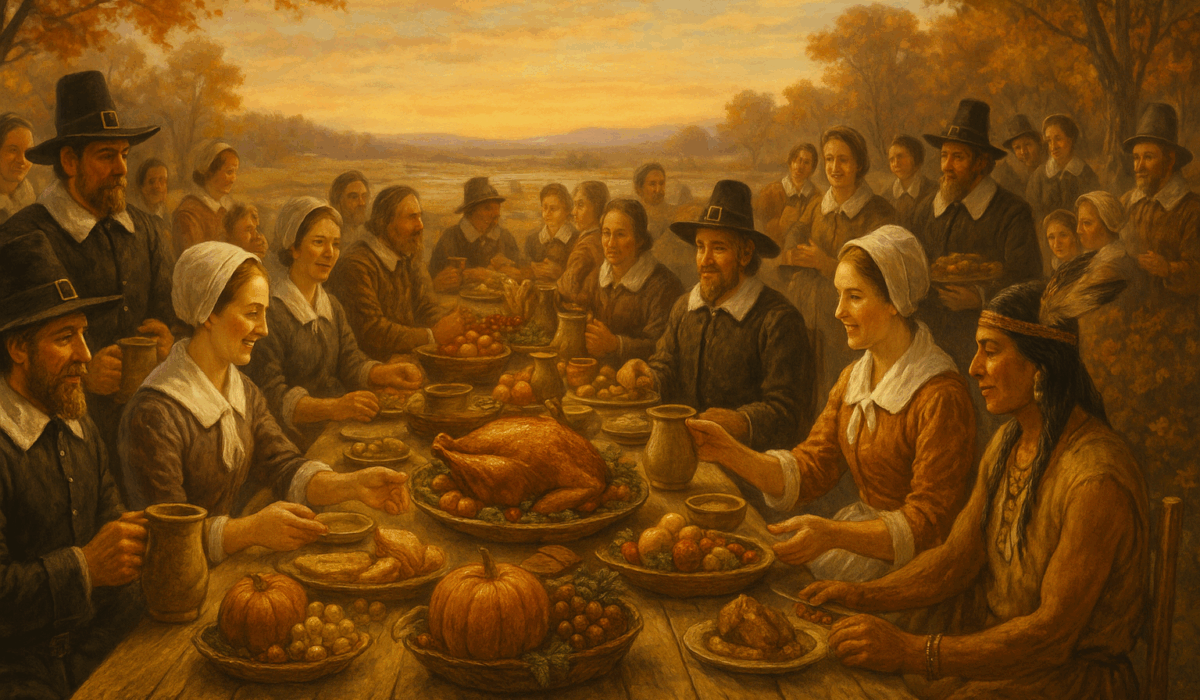
They invited their Native neighbors. They gave thanks openly. They shot guns in the air because, well, they were New Englanders and “Americans” before America existed.

Their Thanksgiving feast lasted three days. It included hunting, games, shared meals, and expressions of gratitude to God. It wasn’t perfect. It wasn’t modern. It wasn’t sanitized. But it was biblical.


III. Thanksgiving Throughout American History: A Feasting Tradition that Outlasted Empires

From the Pilgrims onward, Americans continued giving thanks, sometimes as local observances, sometimes nationwide. But fathers, families, and churches were the engines that kept the feast alive.

George Washington: The First Presidential Thanksgiving Proclamation (1789)

After the ratification of the Constitution, Washington called for a national day of thanksgiving, urging citizens to acknowledge God’s hand in the nation’s founding.

Washington did not mince words. His proclamation is dripping with Christian language that would get modern politicians canceled before they could finish reading the first sentence.

Abraham Lincoln: Thanksgiving Made an Annual National Holiday (1863)

In the middle of the Civil War, when America was literally ripping itself apart, Lincoln declared a yearly Thanksgiving.

He called the nation to remember God’s blessings even in the midst of bloodshed. He urged repentance, humility, unity, and gratitude.

It took national suffering to bring back national gratitude.

There is a lesson there.


IV. The Meaning of Thanksgiving: What Modern People Forgot

Modern Thanksgiving has been reduced to three things:

  1. Food
  2. Football
  3. Family arguments

Fine. But biblical thanksgiving is much bigger.

1. Thanksgiving Is a Weapon Against Pride

Gratitude humbles a man. It reminds him that everything he has – food, wife, children, land, strength – flows from the hand of God.

“In every thing give thanks: for this is the will of God.” —1 Thessalonians 5:18

To be thankful is not optional. It is the will of God. And a man who refuses gratitude is a man who denies reality.

2. Thanksgiving Is a Mark of Righteous Households

Psalm 128 paints the Biblical picture:

“Thy wife shall be as a fruitful vine… thy children like olive plants round about thy table.” —Psalm 128:3

Tables matter. Meals matter. Feasts matter. A thankful table is the sign of a household under God’s order.

3. Thanksgiving Is a Covenant Renewal Feast

Every biblical feast involved remembering what God had done. Thanksgiving follows that pattern.

Every year, households declare: “We remember. We acknowledge. We witness to God’s goodness.”

This is covenantal.

4. Thanksgiving Is the Antidote to Consumerism

Consumerism says, “You don’t have enough.” Thanksgiving says, “God has given us more than enough.”

Consumerism creates anxiety. Thanksgiving creates peace.

A man cannot be simultaneously grateful and entitled.


V. The Discipline of Gratitude: Training Wives, Children, and Yourself

Thanksgiving is not merely a feast, it is practice. A liturgy. A training manual for the household.

Teaching Wives Thankfulness

A wife’s gratitude – or lack thereof – will shape the entire home.

A thankful wife is soft, joyful, helpful, and content. An unthankful wife becomes feral faster than you can say “Black Friday.”

Gratitude is training. It is discipline. It is the mark of a woman who recognizes her place in God’s order.

Teaching Children Thankfulness

Children do not become thankful by accident. They are trained – by repetition, correction, and example.

The Thanksgiving table is the perfect annual checkpoint:

  • “What are we thankful for this year?”
  • “What did God provide?”
  • “Who helped you grow?”
  • “What work did you accomplish?”

Teaching children gratitude teaches them reality.

Fathers Must Model Thankfulness

A father cannot expect his wife or children to cultivate gratitude if he lives like a grumbling Israelite.

The head sets the tone. The head sets the atmosphere. The head sets the gratitude. If the father does not lead the household in thanksgiving, the household will drift into entitlement by default.


VI. How to Reclaim Thanksgiving in a Biblical, Ordered, Patriarchal Way

The modern world celebrates holidays with thoughtless ritual. Biblical men celebrate with purpose. Thanksgiving should be reclaimed as a high feast of covenant remembrance.

Here is how to restore Thanksgiving properly:

1. Begin with Scripture

Read passages of gratitude, blessing, harvest, and covenant:

  • Psalm 100
  • Deuteronomy 8
  • Psalm 67
  • 1 Thessalonians 5
  • Colossians 3:15–17

Anchor the feast in God’s Word, not Hallmark sentiment.

2. Tell the History

Children should hear the story every year, how the Pilgrims suffered, survived, built, and feasted. How God provided. How nations rise or fall based on gratitude.

Thanksgiving should not be Disney-fied. Tell it straight. Tell it gritty. Tell it like it was.

3. Require Everyone to Speak Gratitude Aloud

Not silently. Not internally. Aloud. Biblical thanksgiving is vocal.

“I will offer to thee the sacrifice of thanksgiving, and will call upon the name of the Lord.” —Psalm 116:17

Thanksgiving requires words. Spoken. Shared. Witnessed.

4. Feast Generously

Food is not an afterthought. It is central.

Biblical feasts overflow with abundance because God’s provision overflows.

5. Give to Others

Thanksgiving should produce generosity.  Share food. Share resources. Share time. A grateful people are a giving people.

6. End with Prayer and Blessing

Close the feast with gratitude to God, blessings over the household, and petitions for strength for the coming year.

Thanksgiving is not just a day, It is a declaration. A proclamation. A household covenant renewal ceremony.


VII. Why Thanksgiving Matters Now More Than Ever

Our world is ungrateful. It is entitled. It is soft. It is confused. It is feral. And nothing reveals a society’s collapse faster than its inability to give thanks.

Romans 1 says the downfall of the ungodly begins with one thing:

“Neither were thankful.” —Romans 1:21

A thankless people become a godless people. A godless people become a lawless people. A lawless people become a collapsing people. Thanksgiving stands as a bulwark against cultural decay.

When a father gathers his household, opens the Scriptures, speaks gratitude, and feasts in remembrance of God’s provision – he wages war against the spirit of the age.

He plants a flag. He draws a line. He raises a standard. Thanksgiving is a feast of order in a world of chaos.


Conclusion: Thanksgiving Is a Feast of Dominion

Thanksgiving is not nostalgia. It is not an American quirk. It is not a polite gesture.Thanksgiving is dominion.

It is the rightful orientation of a household that recognizes God as the giver of all abundance. It is a feast of remembrance, of joy, of covenant renewal, of generational continuity.

When a family gathers around a table in gratitude, they are doing more than eating turkey and stuffing, they are participating in an ancient rhythm established by God Himself. And in a world of ungrateful, undisciplined, feral masses, a thankful household shines like a fire on a hill.

So sharpen your knives. Prepare your feast. Open your Bible. Gather your wives and children. And celebrate Thanksgiving the way God intended – with gratitude, with joy, with remembrance, and with dominion.

For the Lord is good. His mercy is everlasting. And His truth endureth to all generations.

Happy Thanksgiving – from our household to yours.

The Price of Glory: Why Nothing New Has Value Without Sacrifice

There is a lie baked so deeply into modern culture that even good men, church-going men, conservative men, fall for it without realizing it. It is the belief that newness itself carries value. That simply because something is “fresh,” “updated,” “innovated,” or “next,” it is therefore meaningful, transformative, or worthy.

Modern people are addicted to “new”- new goals, new relationships, new hobbies, new purchases, new resolutions – and yet their lives remain exactly the same. Hollow. Undisciplined. Unchanged. Why? Because newness without sacrifice is just novelty, and novelty is the cheapest, most disposable currency in existence.

A man can get something new every day and never grow an inch in stature. A woman can chase new experiences, new opportunities, new freedoms, and still remain the same rebellious, unformed creature she was ten years ago.

A household can buy new gadgets and new furniture and new décor and still be the same chaotic, undisciplined mess. The tragic truth is this:

New things only have value when the old is burned, buried, surrendered, or sacrificed to make room for them!

Anything obtained without significant loss is worthless. Anything gained without giving something up cannot transform you. Anything added without something subtracted eventually weighs you down, not lifts you up.

This is not merely a principle of masculinity or household order, it is a natural law. A divine law. A structural law of the universe as God made it. And modern people hate it because they hate paying the price. They want upgrades without funerals, blessings without death, glory without cost.

But that is not how God works, and it is not how men become kings.


I. Modern People Want Something For Nothing

We live in a culture of soft gains and easy dopamine. People collect “new” the way a child collects shiny rocks: not because they have any purpose for it, but because the sparkle momentarily distracts them from their own emptiness.

This is why the self-help world endlessly sells “new systems,” “new diets,” “new frameworks,” “new mindsets,” and “new hacks.” It’s why the marketplace is bloated with subscriptions and upgrades and version 2.0 and 3.0 and 4.0 of the same meaningless products. Modern people confuse change of scenery with change of character.

They believe:

  • A new hobby will fix their lack of discipline.
  • A new marriage will fix their inability to lead, or submit.
  • A new church will fix their unwillingness to obey.
  • A new job will fix their laziness.
  • A new year will fix their lack of repentance.

But nothing new can change you as long as you drag your old self into it.

The man who refuses to sacrifice his comfort will get nowhere worth going.  The woman who refuses to sacrifice her independence will never become a wife.  The household that refuses to sacrifice chaos will never gain order. The church that refuses to sacrifice compromise will never regain power.

Modern people want addition without subtraction, but all real transformation requires subtraction first. Something must be cut away, crucified, or laid upon the altar. This is why the people who chase the most newness are often the most stagnant. They keep “starting fresh” without ever letting anything die.

They have novelty, not value. They have updates, not transformation. They have noise, not glory.


II. The Divine Pattern: God Gives Nothing Without Sacrifice

This principle is not a human invention. It is the divine architecture.

Everything God gives, everything, comes through sacrifice. There is not a single blessing in Scripture that arrives freely, cheaply, or without upfront cost.

1. Adam receives a wife only after giving up flesh and bone.

God did not hand Adam a woman while Adam reclined in the garden in a hammock of ease. The first marriage begins with a cut. A wound. A giving up. Something removed so something greater could be given.

A rib for a wife. A lesser thing for a greater one. Sacrifice precedes glory.

2. Israel receives the Promised Land only after loss.

Not just wandering, not just inconvenience, but the literal death of the entire old generation.  God refused to carry forward what was unfit for the blessing. A nation was renewed only when the old, rebellious version was buried in the sand.

The new land required old men to die.

3. Every covenant requires shedding.

Blood. Animals. Grain. Obedience. Time.  A covenant without sacrifice is not a covenant, it’s sentimentality.

4. Christ brings the New Covenant through ultimate sacrifice.

Not moral effort. Not “trying hard.” Not positive thinking. Blood!

Even salvation, the greatest newness ever offered to man, comes through the highest price ever paid. And yet modern Christians think they can receive everything God has for them at the price of nothing but mild inconvenience.

5. Even blessings require exchange.

Fertility requires obedience. Protection requires loyalty. Provision requires righteousness. God has no free gifts that do not cost you the death of something in your life.

He tears down before He builds up. He cuts away before He restores. He uproots before He plants anew. This is not harshness. This is love. God refuses to place precious things into hands still clinging to garbage.


III. The Masculine Reality: Men Are Forged By What They Lose

Men grow in direct proportion to what they surrender. Modern masculinity has become weak because modern men refuse to give up anything.

1. Strength requires sacrificing comfort.

You cannot build a powerful body while protecting your comfort. You cannot build spiritual muscle while protecting your laziness. You cannot build leadership while protecting your pride.

A man becomes a man by killing boyhood one piece at a time. There is no shortcut around that death.

2. Leadership requires sacrificing selfishness.

Men want to lead their households without giving up their irresponsibility.  They want respect without giving up weakness. They want loyalty without giving up inconsistency.

A man cannot rule until he sacrifices the parts of himself unfit for rulership.

3. Marriage requires sacrificing childish independence.

A man cannot have a loyal, fruitful wife while clinging to bachelor habits.  Marriage is the burial ground for self-indulgence.  Fatherhood is the burial of the last remnants of personal ease.

Every son born to a man kills another fragment of his selfishness, and blesses him for it.

4. Dominion requires sacrificing distraction.

Men today want dominion, legacy, wealth, household authority – but they are unwilling to sacrifice their addictions, their time-wasters, their vices, their passivity. Dominion is expensive.  Mediocrity is cheap.

The difference between a king and a boy is simple: A king sacrifices for his throne.
A boy sacrifices nothing and wonders why he never has one.


IV. The Feminine Counterfeit: Women Want Value Without Cost

Modern women worship “newness”, new freedoms, new experiences, new empowerment, while refusing to give up anything their grandmothers knew was required for honor.

They want:

  • The title of Wife without the cost of obedience.
  • The security of a Husband without the cost of submission.
  • The glory of Motherhood without the cost of selflessness.
  • The value of Femininity without the cost of restraint.

They want a high-value man without sacrificing independence, career idolatry, and emotional entitlement.

They want a peaceful marriage without sacrificing their combative spirit. They want a fruitful household without sacrificing their spending habits. They want masculine covering while still demanding masculine autonomy. They want something new without letting anything old die.

This is why so many modern women are spiritually and relationally bankrupt. Their hands are too full of ego to receive anything of worth.

A woman who refuses to give up anything can never become anything. She may grow older, but she will not grow wiser. She may gain experiences, but she will not gain virtue. She may collect titles, but she will not collect honor. A real wife is not formed by what she gains but by what she gives up:

  • Independence
  • Vanity
  • Rebellion
  • Emotional manipulation
  • Consumerist entitlement

The woman who sacrifices these becomes a treasure to her husband. The woman who clings to them becomes a burden not worth having.


V. Cheap Newness VS. Costly Newness

All newness is not equal. Most newness sold today is counterfeit – empty, hollow, and meaningless!

Cheap Newness:

Cheap newness is dopamine-driven novelty. It offers stimulation, not transformation. Cheap newness includes:

  • New clothes
  • New gadgets
  • New entertainment
  • New Diets
  • New resolutions
  • New social circles
  • New spiritual trends

It requires no sacrifice. Therefore it carries no weight. It changes nothing. Cheap newness distracts you from the old instead of replacing it. It numbs you instead of reforming you. It suppresses the need for change instead of producing it.

Cheap newness says, “Look, something different!” Costly newness says, “Look, something better.”

Costly Newness:

Costly newness is transformative. It demands the death of something inferior. Costly newness includes:

  • Mastery
  • Obedience
  • Marriage
  • Fatherhood
  • Leadership
  • Dominion
  • Legacy

These things are not obtained – they are forged. They require:

  • Giving up comfort
  • Giving up ego
  • Giving up impulse
  • Giving up chaos
  • Giving up sin
  • Giving up selfish patterns
  • Giving up excuses

Costly newness does not entertain, it elevates. It does not stimulate, it sanctifies.  It does not distract, it disciplines. Modern people worship cheap newness because it is easier. Men of God pursue costly newness because it is glorious.


VI. Every Upgrade Demands A Funeral

Here is the truth modern people refuse to accept: Every upgrade demands a burial. You cannot add anything meaningful without removing something hindering.

1. You cannot build a disciplined life on undisciplined habits.

Some behaviors must die: A man who wants a disciplined life but refuses to sacrifice his undisciplined habits is like a builder trying to erect a fortress on wet sand. It doesn’t matter how impressive the blueprint is or how determined he feels in the moment, the structure will collapse because the foundation is rotten. Discipline is not something you add on top of your life; it is something you build from the ground up by killing the very patterns that made you weak in the first place.

Certain behaviors simply cannot coexist with greatness. Late nights spent drifting through entertainment or social media erode your focus. Laziness slowly hollows out your ambition until you can no longer distinguish desire from delusion. Porn strips your masculine fire and leaves you spiritually impotent. Overspending keeps you enslaved to the very world you claim to be rising above. Overeating dulls your edge and burdens your body with the weight of your own indulgence. Passivity poisons leadership at its root, turning potential kings into houseguests in their own homes.

These habits are not neutral. They are assassins. And if you let them live, they will kill everything you’re trying to build – your household, your confidence, your authority, your legacy. They will quietly bleed out your potential day after day until the man you were meant to be becomes nothing more than a memory of what could have been.

If you want a disciplined life, something must die, and it won’t be the dream. It will be the behaviors that sabotage it.

2. You cannot build a noble household on a rebellious woman.

A rebellious woman is not merely an inconvenience, she is a structural flaw. She is rot in the foundation, termites in the beams, a crack running through the load-bearing wall. You can decorate the house, buy new furniture, hang signs about “faith” and “family,” and pretend everything is fine, but the entire structure is compromised. Rebellion in a woman is not cosmetic; it is architectural. And no amount of male effort, affection, or provision can compensate for the instability she introduces.

A noble household, one marked by peace, fruitfulness, and generational stability – cannot be built on a woman who refuses to bow her will. Her rebellion will eat through every layer of order you try to establish: your leadership, your rules, your vision, and eventually your authority itself. If she does not sacrifice her rebellion, you will sacrifice your peace, your dignity, and eventually your sons’ respect for you. That is the exchange rate.

A rebellious woman does not destroy a household all at once; she does it slowly, subtly, through resistance, argumentation, laziness, emotional manipulation, and quiet sabotage. She drains masculine energy the way leaks drain a cistern: unnoticed until the shortage becomes undeniable. What could have been a kingdom becomes a battlefield. What could have been a garden becomes a thorn patch.

If her rebellion isn’t sacrificed, your peace will be. Every household runs on sacrifice, hers or yours. And only one kind produces life. One of them is going to die: her rebellion or your household. Choose wisely.

3. You cannot build leadership on weakness.

Weakness is not something a man can hide behind titles, good intentions, or inspirational quotes. It will expose him. It will undermine him. It will embarrass him in front of those he is responsible to lead. A weak man may have the desire to guide his household, but desire is not leadership. Leadership flows from strength, moral strength, spiritual strength, emotional strength, and practical strength. It requires a man whose backbone is made of something sturdier than wishes.

Trying to build leadership on weakness is like trying to command an army while trembling in your armor. No one follows a man they do not trust. No one trusts a man who cannot hold his own line. Weakness in a leader is not a private flaw; it is a public liability. A man who cannot command himself cannot command a household. A man who cannot master his own emotions cannot direct the emotions of a wife. A man who cannot conquer his own impulses cannot expect obedience from children. Leadership is built on the sacrifices you make before you ask anyone else to make them.

This is why cowardice must be crucified. This is why excuses must be buried. This is why the victim mentality must be dragged out behind the barn and put down like a diseased animal. Weakness always demands that others pay for it. Strength pays its own price first.

If you want to lead with authority, you must sacrifice the version of yourself that is unfit for authority. You must kill the timid man, the passive man, the easily offended man, the easily swayed man. Only then can the household trust the man who stands before them. Only then can your leadership carry the weight needed to build something that lasts.

4. You cannot install a new beam without tearing out the rotten one.

Every man who has ever built anything worth keeping knows this to be true: replacement always begins with removal. You don’t strengthen a structure by layering good wood on top of rot. You don’t reinforce a wall by pretending the cracks aren’t spreading. You don’t restore a house by painting over mold and hoping no one notices the smell. If the beam is rotten, it must come out – violently, decisively, and without nostalgia for what it used to be.

This is where most modern people fail. They want renovation without demolition. They want transformation without the mess. They want to add the new beam while leaving the old one in place, clinging to it as if the rot can somehow be convinced to behave. It doesn’t work. If you refuse the demolition, you sabotage the construction. The structure may stand for a moment, but its collapse is already scheduled.

Transformation is always a two-part process. First, something must end. A habit must be broken. A lie must be rejected. A pattern must be torn out at the roots. A version of yourself, or of your household, must be dismantled with intentional force. Only then can something new begin. Only then can God, or discipline, or vision, or leadership install the new beam that can actually carry weight.

But modern people only want the second half. They want the beginning without the ending. They want the blessing without the burial. They want the installation without the teardown. They want progress without pain, holiness without repentance, order without correction, and maturity without the death of childishness.

Kings embrace both. They don’t flinch at the demolition. They welcome it, because they understand that tearing out rot is not destruction – it is preparation. It is mercy. It is the necessary violence that makes the future possible. A man who refuses to remove the rotten beam will one day watch the roof come down on everyone he loves. A man who tears it out can build a fortress.


VII. Household Applications: Sacrifice Is The Foundation Of Order

This principle is not abstract. It applies ruthlessly to real households. It is not a philosophical idea meant for ivory towers or theological debates, it is a law that governs the atmosphere of your living room, the tone of your dinner table, the behavior of your children, and the spiritual climate under your roof. A household is either shaped by sacrifice or deformed by the refusal of it. The man who understands this law watches his home grow in strength, unity, and fruitfulness because he enforces the necessary deaths that make life possible. The man who ignores it becomes the foreman of a collapsing structure, wondering why nothing he builds stands upright for long. In a real household, something always dies: comfort or discipline, rebellion or peace, selfishness or stability. The only question is which one. This is not theory, it is architecture. It is the blueprint of every successful home since the beginning of creation.

To Men:

If you want to lead, sacrifice comfort. If you want respect, sacrifice weakness. If you want a disciplined household, sacrifice passivity. If you want a fruitful marriage, sacrifice selfishness. If you want loyal wives, sacrifice inconsistency. A household becomes what the man sacrifices for.

To Women:

If you want the glory of being a wife, sacrifice independence. If you want the protection of a strong man, sacrifice pride. If you want children who rise up and call you blessed, sacrifice vanity. If you want a peaceful home, sacrifice your tongue. If you want a noble marriage, sacrifice rebellion. A woman becomes a wife by what she surrenders, not by what she demands.

To the Household as a Whole:

Everything valuable in a household requires sacrifice. Order does not appear by accident, it is purchased by discipline. Unity is not maintained by sentiment, it is secured by humility and restraint. Fruitfulness comes from the daily surrender of comfort, not the pursuit of ease. Peace is won by the consistent sacrifice of pride, impulsiveness, and emotional excess. Stability is built by men who give up inconsistency and women who give up rebellion.

Inheritance is forged by parents who sacrifice selfishness today so their children can stand taller tomorrow. Generational faithfulness is not a miracle, it is the compounded result of thousands of small, unseen sacrifices over decades. A home where no one sacrifices becomes a war zone, each person clinging to their own desires until the house tears itself apart. But a home where everyone sacrifices becomes a kingdom, because every member understands that glory always requires a price.


VIII. The Inevitable Law: You Cannot Keep Everything And Gain Anything

This is the final point, the unavoidable conclusion of the whole matter: You cannot keep everything and gain anything.

Life is an exchange. Marriage is an exchange. Fatherhood is an exchange. Discipleship is an exchange. Dominion is an exchange. You trade up when you give up.

If you refuse the trade, you refuse the upgrade. Modern culture teaches people to cling to their old selves like a dragon hoarding junk. God teaches the opposite:

Let it die, and live. Let it burn, and rise. Let it go, and gain. Everything you want demands a price: If you pay it, the thing becomes treasure, If you refuse, the thing becomes fantasy.

The man who sacrifices becomes worthy. The man who refuses becomes forgettable. There is no path to glory without loss. There is no path to dominion without death. There is no path to becoming more without sacrificing who you used to be. Newness is only valuable when it costs something.

And for the man who understands this law, everything in life begins to align. Blessings become attainable. Order becomes non-negotiable. Household peace becomes the natural consequence of masculine obedience to the divine pattern.

Kings pay the price. Cowards don’t. And the world can always tell the difference.

Out of the Shadows: Why Hiding Polygynous Families is Cowardice

Disclaimer:
I write this in 2025, with full awareness of the times that came before. While I personally believe that had our people remained steadfastly open – publicly, visibly, and without wavering, we would not face the hostility we do today, this article is in no way a condemnation of those who, for various reasons, chose to keep their polygynous families private. I recognize that in years past, the dangers were real: financial ruin, loss of freedom, political persecution, and social exile. It is possible that if I had lived in those same conditions, I might have done likewise.

But we are no longer in those times. The world has shifted, the battle lines are clear, and silence now serves only the enemies of truth. This article is written for the men of this generation, the ones who must choose whether to remain hidden or to live openly under the banner of God’s order.

Summary: For those who lack the endurance to read what men used to write before attention spans died, Click here the short version.

⚔️ Summary for the Slumbering

The article argues that hiding polygynous families out of fear or “wisdom” is no longer justifiable. It claims that secrecy dishonors God’s design, confuses children, fuels stigma, weakens legal and cultural defense, and surrenders the public narrative to hostile voices. Using biblical examples – Abraham, Jacob, and David, the author shows that righteous men’s households were public and honored, not concealed.

He contrasts this with the modern “trans” movement, which gained cultural dominance through bold visibility, suggesting that if a falsehood can advance by shameless openness, then truth should all the more be lived openly. The article concludes that living visibly as polygynous families is not pride but obedience, a way to testify that God’s order is good. Hidden households, it warns, dim their own light; courageous ones can reshape culture by example.

Introduction

For as long as I’ve been walking this path, I’ve noticed the same pattern among Christian men who live in polygyny: we stay in the shadows. Families are hidden. A second wife is introduced as a “friend, sister, aunt” or not introduced at all. Children are told to be careful how they describe their family. Conversations are guarded, coded, or full of nervous laughter. And when outsiders ask questions, we dodge, deflect, or change the subject.

We tell ourselves this is wisdom. “We’re just being careful.” “We don’t want to stir trouble.” But most of the time, if we’re honest, this isn’t wisdom. It’s fear.  And fear has consequences, not only for us, but for our wives, our children, our brethren, and the generations after us.

The Problem With Secrecy

When we hide, we make God’s design look like something shameful. Scripture is full of men whose households were public, visible, and blessed.

  • Abraham’s household was so vast and visible that kings took notice (Genesis 14:14–16).
    When Lot was captured, Abraham didn’t sneak around with a ragtag handful of hidden servants. He mobilized 318 trained men born in his house, his household was a military force in its own right. Kings and nations recognized Abraham’s family as a visible power on the earth. His wives, his children, his servants, his wealth, none of it was kept in the shadows. His household was so public, so undeniable, that it commanded respect even from rulers.
  • Jacob’s wives and children were not hidden, but named, counted, and honored as the foundation of Israel (Genesis 35:22–26).
    The inspired record doesn’t brush past Jacob’s marriages as an embarrassing footnote. His wives and concubines are named openly. His sons are listed, tribe by tribe, in detail. These women and their children weren’t treated as shameful or secret, they were honored as the very foundation of God’s covenant people. The nation of Israel was built on polygynous households, written in black and white for every generation to see.
  • David’s household was no secret – it was public enough that nations defined themselves by how they related to him and his family (2 Samuel 3–5).
    David’s wives and children weren’t tucked away in silence. His marriages shaped alliances. His sons were publicly acknowledged as princes. His household was central to Israel’s politics, identity, and even foreign relations. Nations measured their stance with David by how they treated his family. His household was not a hidden corner of his life, it was a public institution that testified to God’s favor and David’s strength as king.

Not one of these men treated their wives or children as if they were contraband to be smuggled around under cover. Their households were a testimony to God’s blessing, not something to be concealed. But us? We act like our families are scandals to be managed. We’ve trained our own children to feel like their home is something to whisper about. We’ve let the world define the narrative, and they are only too happy to call us cultists, predators, weird or strange.

And here’s the irony: when we complain about being misunderstood, stigmatized, or unprotected, we fail to see that our secrecy fuels the very problem. If we never show our lives as normal, why should anyone else believe they are?

Contrast: The Trans Example

Now let’s consider something even more jarring. The so-called “trans” movement. By every biblical, biological, and rational standard, it is bizarre. It is objectively abnormal. It’s rebellion against creation itself (Genesis 1:27). By all rights, it should have been dismissed as nonsense from day one.

And yet, look around. Less than 1% of the population has forced its way to the center of culture. Their flags fly on government buildings. Their ideology is taught in schools. Their pronouns are written into law. They are not just tolerated, they are celebrated.

How did they achieve this? By refusing to hide. They lived openly. They shouted their stories from the rooftops. They demanded recognition until visibility became normalization. If a lie that destructive can conquer culture by sheer boldness, then our timidity with God’s truth is laid bare. Our hiding is cowardice, plain and simple.

The Consequences of Our Hiding

The longer we hide, the more damage we do. Secrecy doesn’t just keep us safe—it actively undermines our families, our witness, and our future.

We Reinforce Stigma

The world takes its cues from us. If we act like our families are something to be hidden, whispered about, or apologized for, then we shouldn’t be surprised when others treat them the same way. Our behavior says, “This is shameful.” And the world is all too happy to agree. Christ Himself warned us, “Whoever is ashamed of me and of my words, of him will the Son of Man be ashamed when he comes in his glory” (Luke 9:26). When we shrink back in fear, we are teaching the culture, our churches, and even our enemies that we are embarrassed by God’s design. That stigma isn’t imposed on us, it’s confirmed by us.

We Confuse Our Children

Children are perceptive. They notice when Dad says one thing at home and another thing in public. They notice when Mom is treated as a “friend” in front of strangers but as a wife in the household. They notice when they’re told, “Don’t talk about our family at school” or “Be careful what you say about your moms.” What does that teach them? That their family is strange, wrong, or even sinful. That they should carry a burden of secrecy everywhere they go. Yet Scripture teaches: “Children are a heritage from the LORD, the fruit of the womb a reward” (Psalm 127:3). When we muzzle our children about their heritage, we train them to believe a lie, that their family is a mistake instead of a blessing. And long-term, that confusion breeds resentment and shame instead of pride and joy in God’s order.

We Lose the Narrative

Stories shape culture. And right now, the only stories the public hears about polygyny are tabloid scandals, TV dramas about “cults,” and horror stories twisted for entertainment. If we stay silent, those caricatures become the “truth” in people’s minds. Our absence from the conversation ensures that lies win by default. Instead of seeing strong households, fruitful marriages, and well-ordered children, the world only sees what Netflix and CNN decide to show them. Silence isn’t neutral, it’s surrender. And when we let our enemies write the story, we forfeit the chance to show the world that polygyny, lived biblically, produces stability, fruitfulness, and joy.

We Weaken Our Defense

Lawmakers don’t protect what they can’t see. Judges don’t feel pressure from people who never show up. Movements don’t change culture when they stay underground. If we remain invisible, we remain undefended. When hostile laws are written, there’s no visible constituency to resist. When false accusations are made, there are no public examples to counter them. In the eyes of the state and society, hidden families may as well not exist. And an invisible people is an undefended people. By hiding, we not only weaken our own defense, we practically guarantee that our children will face even harsher conditions in the future.

The Bottom Line

In short: secrecy backfires. It doesn’t shield our families, it strips them of dignity. It doesn’t protect our witness, it silences it. It doesn’t guard our future, it leaves us vulnerable. Every time we choose to live in the shadows, we are handing victory to the very forces we complain about. And until we step into the light, nothing will change.

A Call to Courage

This doesn’t mean we mimic the world’s parades or demand applause. Pride isn’t our model. Christ is. He told us, “You are the light of the world. A city set on a hill cannot be hidden. Nor do people light a lamp and put it under a basket, but on a stand, and it gives light to all in the house” (Matthew 5:14–15).

That’s the point: we are not meant to be invisible. Living openly is not arrogance, it is obedience. It’s letting your wives be known as wives, not “roommates.” It’s letting your children speak freely about their family. It’s allowing your household to stand as a visible testimony that God’s order is good.

A candle under a basket doesn’t light the room, no matter how brightly it burns. Its glow is smothered by the very thing meant to “protect” it. In the same way, a household hidden in fear can never shine as the testimony God intended it to be. We may convince ourselves that secrecy is keeping us safe, but in reality it’s snuffing out the witness of our marriages, our children, and our obedience. God didn’t design families to be hidden experiments; He designed them to be living parables of His order, cities on hills, lamps on stands, unmistakable in their brightness. To hide them is to waste the very light we were entrusted to carry.

From the Shadows to the Streets

The boldness of the trans movement exposes our cowardice. If less than 1% of the population can transform laws and norms through relentless visibility, what might a faithful remnant of godly households do if we simply lived without shame?

We face a choice. We can stay underground, complaining that we’re misunderstood, rejected, discriminated against and ignored. Or we can live faithfully in the open, letting our marriages, our children, and our households preach louder than our excuses.

If the world calls us strange, so be it, let it be because we have strong marriages, fruitful homes, and obedient children. Not because we acted like criminals for living out what Scripture teaches.

It’s time to stop whispering. It’s time to stop hiding. It’s time to be what we are: families living under God’s order, unashamed. Because if evil can thrive through shameless visibility, how much more could truth triumph through courageous obedience?

Would You Vandalize a Church?

The Desecration of the Temple God Built in You


Summary: For those who lack the endurance to read what men used to write before attention spans died, Click here the short version.

⚔️ Summary for the Slumbering

This article confronts a soft, modern lie: that your body is personal property. Scripture says it’s a temple. When the veil tore, God moved from stone to flesh – your flesh – and now every habit is either worship or vandalism. The piece traces how believers desecrate the sanctuary within through physical defilement (addiction, gluttony, pharmakeia, laziness, unclean foods, tattoos/piercings), sexual corruption (fornication, adultery, pornography, sodomy, gender rebellion, immodesty), mental/cultural pollution (music, movies, social feeds, books), and moral neglect (lying, idolatry, prayerlessness, profanity, cynicism).

It indicts “grace without gravity,” reminds us that words are altar-fire or graffiti, and calls for Christlike temple-cleansing by repentance, fasting, disciplined order, and daily maintenance of holiness. The thesis is stark: you are owned – bought with blood – so holiness isn’t preference; it’s property law. If you wouldn’t spray-paint a cathedral or stream porn on a church projector, stop vandalizing the sanctuary God built in you. Keep the body clean, the mind pure, the mouth holy, so the world sees not you, but the Builder.

I. From Sanctuaries of Stone to Sanctified Flesh

The Temple God Once Dwelt In

In the beginning, the presence of God was not something casual. It was not easily accessible at will. His holiness had to be veiled, contained, and guarded. The Israelites built a tent of meeting, every measurement exact, every material sacred. The Tabernacle wasn’t just some decoration; it was architecture of fear and awe. God’s dwelling among men required blood, smoke, and boundaries.

When Solomon later built the temple, it became the crown of Israel’s devotion. Gold-plated walls, carved cherubim, and the Ark of the Covenant housed in the Holy of Holies, this was not a community center. It was where the fire of Heaven touched Earth. Priests entered only after cleansing, sacrifice, and trembling. Anyone who crossed the line uninvited was struck dead.

The message was clear: God is not to be approached casually. Holiness was lethal to impurity. The temple wasn’t a symbol of belonging; it was a reminder of distance. The very presence that sanctified the nation could also consume it.


The Transfer of Glory

Then came Christ. The veil was torn. The divine presence moved out of stone and into flesh. No longer confined behind curtains, God’s Spirit took residence within redeemed men and women. What had been fatal to approach was now invited within.

The fire that once burned above the Ark now burns in human hearts. The holiness once separated by blood sacrifices was satisfied by the blood of the Lamb. The body that bows to Christ becomes His sanctuary; the soul that obeys Him becomes His dwelling.

The temple was not abolished, it was relocated. You are now the temple of God.

Paul said:

“Know ye not that ye are the temple of God, and that the Spirit of God dwelleth in you?” —1 Corinthians 3:16

You are the modern Holy of Holies. Your life, your habits, your appetites, each is part of that structure. When you eat, when you speak, when you think, you do so inside the temple God built in you.


The Personal Ark of the Covenant

Inside the ancient Ark rested three things: the tablets of the Law, the pot of manna, and Aaron’s rod that budded. Law, provision, and authority, those three realities defined God’s covenant presence. Today, the same spiritual pattern lives in the believer. The Law is written on your heart. The manna is replaced by the Bread of Life, Christ Himself. The rod of authority becomes the Spirit’s power at work through you.

So when you defile your body, your mind, or your conduct, you are not just “doing something wrong.” You are corrupting the very vessel in which God has chosen to place His testimony, His sustenance, and His authority. You are desecrating the Ark.

That is why sin in the believer is not a small matter, it is sacrilege. What was once external rebellion against a distant God is now internal betrayal against an indwelling one. You cannot hide from His presence when His presence lives in you.


The Responsibility of Stewardship

With the indwelling Spirit comes inescapable responsibility. The priests of Israel had to maintain the temple: cleaning ashes, trimming wicks, replenishing oil, repairing fabrics. The smallest neglect invited decay. Likewise, the modern believer is responsible for the upkeep of the temple within, maintaining discipline, purity, and reverence.

The Holy Spirit does not dwell in a man to serve as a roommate. He reigns as Lord. Your habits are His furniture. Your thoughts are His walls. Your appetites are His lamps. If you pollute them, you are vandalizing His dwelling.

God’s people were once commanded to keep the temple undefiled because His presence dwelt there. That command has not changed, it has intensified. The difference is that now, the temple moves when you move. The sanctuary travels when you walk. And wherever you go, Heaven expects holiness.

The believer who truly understands this will live differently, not from fear of punishment, but from reverence of presence. You don’t light a cigarette in the Holy of Holies. You don’t drag idols through the inner court. You don’t gossip beside the altar. Yet that is exactly what millions do daily inside the very structure God built from dust and filled with His Spirit.

II. Desecrating the Temple: The Modern Vandal’s Hand

The holiness that once required a priesthood now rests in your skin. The fire that consumed offerings now burns in your spirit. To desecrate the body is to desecrate the sanctuary. To abuse the mind is to defile the altar.

Sin isn’t merely “bad behavior.” It’s spiritual vandalism, smashing the stained glass, torching the pews, and carving profanity into the walls of God’s house.


1. Physical Defilement

The body is the outer court of the temple, the visible structure through which the unseen God reveals Himself. It is the architecture of obedience, the physical testimony of divine order. To abuse it is to dishonor the Architect. To neglect it is to let weeds grow in sacred ground.

Once, priests were commanded to wash before entering the holy place. They purified themselves with water and blood before they ever touched the altar. But now, believers waltz into God’s presence reeking of addiction, indulgence, and laziness, and call it “grace”.

The outer court was meant for preparation, not pollution. It was where the worshiper brought sacrifice, not self-sabotage. Yet modern men fill it with the idols of appetite, and modern women treat it as a stage for vanity. The body, designed as the framework of discipline and dominion, has been reduced to a playground of desire.

Every act of physical defilement is a sermon preached against the holiness of God. You cannot host His presence and live like a glutton, smoke like a pagan, or sleep like a sloth and call it liberty. Modern believers desecrate this court daily through indulgence, excess, and apathy, and then wonder why the inner sanctuary feels empty.

Smoking and Vaping:

The body was never meant to be an ashtray. What God designed as a vessel of breath, His own Spirit breathed into dust, modern man fills with poison and smoke. The incense that once rose from holy fire has been replaced with the fumes of rebellion. Every puff declares, “This body is mine,” as though ownership were still in question.

Smoking and vaping are not mere habits; they are slow acts of self-desecration. The lungs, crafted to sing praise and speak truth, are choked by toxins for the sake of temporary calm. A man cannot plead for the breath of God while poisoning the very system through which that breath flows.

The temple was meant for life, not for slow suicide. You would never light a cigarette in the sanctuary of the church, why, then, do you light one in the sanctuary of flesh? Each exhale of smoke is a visible sermon of rebellion: worship offered not to Heaven, but to habit.

Gluttony:

When the stomach becomes god, worship shifts from Heaven to appetite. Food, meant for strength and fellowship, becomes an idol of comfort and escape. Every meal turns into a sacrifice, not to the Lord, but to the god of indulgence. The temple begins to sag under the weight of self-gratification; the priest within grows dull and unfit for service.

Gluttony is not merely overeating, it is misplaced devotion. It takes what was meant to sustain and turns it into what enslaves. The same hands that should be lifted in thanksgiving are instead busy feeding endless craving. The same body meant to serve becomes sluggish, distracted, and numb to conviction.

Gluttony mocks self-control and exposes spiritual weakness. It declares, “My hunger rules me.” Yet the man ruled by his belly cannot be ruled by his spirit. When the flesh leads, the temple decays, and worship becomes digestion instead of devotion.

Pharmaceutical Idolatry and Drug Abuse:

The modern world calls it “medicine,” but much of what passes under that name is sorcery by another label. Pharmaceuticals, in their proper use, can aid healing, but when they become the source of peace, escape, or control, they become idols. The line between prescription and possession is thin, and most have already crossed it.

Drugs, whether swallowed, injected, or inhaled, are counterfeit sacraments. They promise rest, joy, and relief, and salvation from death, but deliver dependence and decay. The Holy Spirit is called the Comforter; to seek comfort elsewhere is to dethrone Him. Every pill worshiped for peace is another prayer withheld from the true Healer.

A drugged mind is an unlocked temple. The gates of discernment swing open, and every unclean spirit walks through unchallenged. The man addicted to chemicals cannot be ruled by the Spirit; he has already leased out the throne. What God meant as a sanctuary of clarity becomes a fog-filled ruin of confusion.

Laziness:

Neglect is one of the quietest forms of sin. It rarely shouts, but it always rots. The temple doesn’t need to be attacked to collapse, it only needs to be ignored. Laziness is the termites of the soul, eating away unseen until the structure gives way under the weight of its own apathy.

God gave Adam work before sin entered the world, proving that labor was never punishment, it was purpose. To reject labor, discipline, and effort is to reject divine design. A man who won’t rule his time or train his body has already surrendered his dominion.

Laziness turns the temple into a ruin. Dust gathers on the altar. The lamps of devotion flicker out. The strength meant for service atrophies in idleness. A man who won’t sweat in obedience will eventually bleed in consequence. The temple requires upkeep, without it, glory departs and weeds take root.

Eating Unclean Foods:

God never revoked His dietary wisdom. What He declared unclean wasn’t arbitrary, it was architectural. The same God who engineered the human body also defined what maintains it. His restrictions were never about legalism; they were about life. Holiness has always included what enters the mouth, because what feeds the flesh shapes the spirit.

Yet many believers mock that wisdom. They stuff the temple with what He forbade and then kneel to pray for healing. They beg for divine intervention while eating divine instruction. It’s like pouring oil on the church floor and asking God to stop the fire, or dragging a carcass onto the altar and wondering why the incense smells foul.

Unclean food is more than bad diet, it’s open rebellion. Each forbidden bite says, “My appetite decides what’s holy.” It’s a declaration of ownership, a denial of stewardship. The same God who told Israel what to offer and what to avoid has not changed His nature; He still cares what fills His temple.

The Spirit of God dwells within you, why would you feed Him filth? The temple is not a dumpster. You cannot host divinity on a diet of defilement and call it grace. The same mouth that blesses the Lord should not also bless the unclean. What enters your body preaches a sermon louder than what leaves your lips.

Tattoos:

The body is not a billboard for personal stories or cultural art. It is the temple of the living God. Yet modern believers treat the skin – God’s own canvas – as a scrapbook for vanity, rebellion, and remembrance of sin. What once marked pagans now marks the baptized.

In ancient times, tattoos and body markings were signs of ownership. Slaves bore the symbols of their masters. Warriors bore the emblems of their gods. To mark one’s flesh was to declare allegiance. That is why God commanded His people:

“Ye shall not make any cuttings in your flesh for the dead, nor print any marks upon you: I am the Lord.” —Leviticus 19:28

He was not forbidding art, He was forbidding idolatry. The flesh already belonged to Him. To carve or ink it for other purposes was to invite other masters. Modern tattoo culture resurrects the same pagan impulse: to rewrite the body, redefine identity, and rebrand ownership.

Many will say, “But mine has meaning.” So did the pagan’s. Every false god had a reason, every idol an intention. But meaning is irrelevant when obedience is absent. You can’t “redeem” rebellion with sentiment. Even “Christian” tattoos, crosses, verses, names of Jesus, turn the temple wall into a mural of graffiti, as though the holiness within were not enough.

The temple was never meant to be advertised. The glory of God is internal, not inked. The Spirit’s mark is invisible yet undeniable, a changed heart, not decorated flesh. To tattoo the temple is to announce, “The outside needs what the inside lacks.” But the indwelling of the Holy Spirit requires no external signature.

Every mark carved into skin for self-expression is a small rebellion against divine design. The ink fades, but the statement remains: I will write my own story on what God already wrote His name upon. The temple does not need decoration; it needs devotion. Holiness is not art – it’s obedience. Vandalizing the temple walls is an open act of rebellion and defiance in the war against surrendering yourself to God. 

Piercings & Mutilation:

Today, many decorate God’s temple like a pagan shrine, treating His image as a canvas for rebellion rather than reverence. The same body that once bore His likeness now bears the marks of vanity, trauma, or defiance. Self-mutilation, excessive piercing, and body alteration parade under the banner of “self-expression,” yet what they truly express is alienation from the Creator.

The pagan nations marked their flesh to honor false gods. Israel was commanded not to. The reason was simple: the body already bore the seal of its true Owner. To carve it, puncture it, or distort it for attention is to vandalize what Heaven designed with purpose. It’s a declaration that says, “I will mark myself because His mark is not enough.”

This is not about minor adornment or modest care, it’s about intent. When a person alters their flesh to shock, seduce, or proclaim autonomy, they preach a sermon of rebellion through the body God calls His home. The temple is not an art project; it is sacred architecture. Every cut, every piercing, every display for the sake of pride is defilement of the temple.

Self-mutilation is not beauty, it’s bondage. Vanity is not confidence, it’s idolatry. Every wound inflicted for fashion or validation dishonors the covenant that body represents.  Your body was never meant to mirror the culture; it was meant to mirror the Creator. The temple is already magnificent without modification. To alter what God perfected is not enhancement – it’s heresy.

2. Sexual Corruption

If the body is the outer court, the sexual life is the Holy Place – sacred, restricted, and purposeful. It was never meant for exhibition or casual entry. This is the chamber of covenant, where the physical mirrors the spiritual, where union was designed to preach the gospel of loyalty and fruitfulness. But in the modern world, the doors are thrown wide open, and idols of lust now stand where the lampstand should be. The fragrance of devotion has been replaced by the stench of indulgence. What God designed as a covenantal act has been reduced to a recreational one.

Sex was never man’s invention, it was God’s. And like all of God’s creations, it demands reverence. He set boundaries around it because He set holiness within it. When those boundaries are ignored, desecration follows. Fornication, adultery, pornography, and every perversion of design drag idols into the sanctuary. Every act of lust outside covenant is like burning strange fire before the Lord, an imitation of worship that brings judgment, not joy.

The world calls it freedom; Heaven calls it blasphemy. Each casual encounter, each click of filth, each fantasy indulged is a sacrifice to the wrong altar. Men who were meant to guard the temple now invite harlots into the Holy Place. Women meant to represent purity now market their flesh as if sacred things were for sale. The lamp of holiness flickers while the flames of desire consume what was once set apart.

Sexual corruption is not only sin, it’s treason against divine order. It desecrates the holiest furniture of human existence: covenant, reproduction, and intimacy. The Holy Place becomes a brothel of rebellion when lust is allowed to rule. You cannot claim to belong to Christ while letting the spirit of Jezebel decorate His dwelling.

The sexual life is sacred architecture. It is not casual, it is covenantal. It is not for display, it is for devotion. And when a man or woman treats it lightly, they do not merely sin, they defile the sanctuary that was meant to bear God’s image and produce His legacy.

Fornication and Adultery:

God designed sex as covenantal worship, an act of oneness under authority, not a hobby of appetite. It was meant to confirm vows, not replace them. Fornication and adultery are not simply “mistakes in judgment.” They are vandalism against the architecture of covenant.

In Scripture, adultery was not just moral failure, it was high treason against the kingdom of order. It defiled families, desecrated nations, and invited divine judgment. Fornication is its cheaper cousin, rebellion without commitment, pleasure without purpose. Both treat what is sacred as casual, reducing something meant to echo eternity into a moment of fleshly indulgence.

Each sexual act outside covenant is a false offering, pleasure laid on a profane altar. It turns the Holy Place of intimacy into a battlefield of impulse. The body was meant to seal promises; now it seals perversion. And those who treat sex as recreation are, in truth, performing their own worship service, to the god of self.

Marriage is not man’s invention, it is the first covenant instituted by God Himself. When sex leaves that covenant, it leaves holiness. The result is always the same: defilement, shame, and spiritual disconnection. You cannot mingle covenants without corrupting both. Fornication and adultery are not private matters, they are public desecrations in God’s sight.

Pornography:

Pornography is the digital idol of our age, an endless stream of lust dressed as liberty. It is voyeurism baptized in rebellion, the altar of on-demand idolatry. It requires no temple, no priest, and no shame, just a screen and a will surrendered to darkness.

The believer who indulges in pornography invites demons into the Holy Place. Each image viewed is an unholy offering. The eyes become the gateway of defilement; the mind becomes the theater of desecration. What was once sacred imagination, designed for prayer, creativity, and divine reflection, is now hijacked by filth.

Pornography doesn’t merely tempt; it rewires worship. It teaches the temple to crave sin like incense. It numbs conviction and breeds bondage. It turns men into consumers of corruption and women into commodities of lust. The damage isn’t only moral, it’s architectural. The structure of the soul begins to crack under the weight of unrepentant indulgence.

You wouldn’t project pornography on the sanctuary wall during Sunday service, yet many do exactly that within the sanctuary of their minds. Heaven sees it all. Every secret view, every hidden fantasy, every click in the dark, it’s all graffiti on the inner walls of God’s dwelling. The Spirit cannot fill a vessel devoted to another spirit.

Sodomy and Gender Rebellion:

The temple has a blueprint. Every wall, every curve, every design is deliberate. God created male and female as complementary reflections of His own image, two halves of a single revelation. To corrupt that design is to vandalize His divine architecture.

Sodomy, transgenderism, and every rebellion against biological reality are not personal “expressions.” They are spiritual declarations of war against the Creator’s order. They say, “I will redesign what God designed.” That is idolatry. It replaces the Potter with the clay.

Scripture is not vague: men lying with men and women with women are abominations not because God hates them, but because they hate His design. They turn the covenantal act of creation into a parody of pleasure. They erase the prophetic symbolism of marriage, the union of Christ and His bride, and replace it with the worship of self.

God judged Sodom not for ignorance but for arrogance. They knew, and they mocked. The modern world does the same but hides behind slogans of tolerance and “love.” But love without holiness is lust, and compassion without truth is cruelty. To affirm what God condemns is to stand as co-conspirator in the defilement of His temple.

The human body is sacred architecture; its form is theology in flesh. To alter it, corrupt it, or misuse it is to scrawl heresy across the blueprints of Heaven.

Immodesty and Exhibition:

The priests of old dressed to conceal glory, not display flesh. Their garments declared reverence. They wore holiness upon their sleeves and humility on their hems. Modern believers reverse the pattern – bare skin, tight fabric, and self-display passed off as “confidence.”

But the temple was never built to advertise itself. The body is not a billboard; it’s a sanctuary. To flaunt what God clothed is to mock the idea of sacredness itself. Immodesty is not freedom, it’s surrender. It says, “I must be seen,” when the true disciple says, “He must be seen.”

The culture of exposure is nothing new; it’s the oldest temptation on earth. Eve saw, desired, and took, and ever since, fallen humanity has worshiped visibility over virtue. Every exposed inch of flesh for the sake of attention is a silent sermon of rebellion. Every deliberate act of seduction is an open invitation for defilement.

Exhibition is the modern liturgy of pride. Social media has become its temple; selfies its sacrifices. But modesty is not oppression, it’s architecture. It protects what’s sacred from becoming spectacle. It guards the mystery of holiness from the mockery of the crowd.

A body dressed with reverence declares: This temple is occupied. It’s not on display because it’s under divine ownership.


3. Mental and Cultural Pollution

If the body is the outer court and sex the Holy Place, then the mind is the inner chamber, the space where communion with God is meant to dwell. The thought life is sacred ground. What you allow to live there becomes your master. Yet the modern believer floods this chamber with noise, screens, and sensuality. The average Christian’s mind is less like a sanctuary and more like a marketplace.

The music that fills your ears, the shows that fill your eyes, the feeds that fill your hours, they are not harmless. They are liturgies. Every lyric, every image, every post teaches you what to worship. The devil no longer needs idols of stone; he has modern algorithms.

Music:

What lyrics echo through the corridors of your soul? The hymns of rebellion now replace the songs of redemption. Words that glorify lust, greed, and pride become mantras that shape the inner court. The melody becomes a liturgy of corruption. You can’t claim holiness while chanting the anthems of hell.

Movies and Television:

Would you project those scenes on the church jumbotron during Sunday service? Would you invite your pastor or your children to watch them beside you in the sanctuary? Yet you play them in the sanctuary of your mind and call it relaxation. Every image viewed is a seed; every storyline normalized is an altar built. Entertainment shapes conviction faster than sermons when the conscience is unguarded.

Social Media and TikTok:

An altar of vanity and idolatry. Every swipe another offering, every “like” another incense of approval burned to the god of self. The endless scroll has replaced meditation, and distraction has become devotion. The temple becomes a carnival of envy, lust, and outrage – no longer a house of prayer but a hall of mirrors reflecting self-obsession.

Reading and Consuming Filth:

Words are not harmless; they are spirit. Every page of your pornographic novel plants something, truth or corruption, light or shadow. The modern “literary” world worships rebellion as art and perversion as sophistication. What you meditate on, you magnify. To read what mocks holiness and call it “culture” is to invite mockery into your own soul. If it wouldn’t sit on the church’s altar, it doesn’t belong on your nightstand.

That music you are listening to, those shows you are watching, the movies you play in your home, the content you view on TikTok or social media, the filth you are reading – would you want that content on the jumbotron in your church during a full house?

Because Heaven already sees it projected inside His temple – you. Mental and cultural pollution doesn’t just entertain, it educates. It trains your soul to tolerate sin, to normalize impurity, to forget reverence. Slowly the inner courts grow dim, the incense burns out, and the Spirit’s whisper is drowned by static. A polluted mind cannot host pure revelation.

If you want the peace of God, silence the noise that mocks Him. Clear the stage where the world performs, and rebuild the altar where holiness speaks. The mind must become a sanctuary again, not a cinema for filth, but a chamber for communion with the holy spirit.

If you put Garbage in, you will get rebellion out!


4. Moral and Spiritual Neglect

There is more to desecration than indulgence; there is also neglect. The temple rarely collapses in a day, it rots through apathy. Most sanctuaries are not destroyed by invaders, but by caretakers who stop caring. The devil doesn’t always need to tempt you; sometimes he only needs to distract you. When discipline fades, decay begins.

Neglect is rebellion wearing sleep. It’s the quiet undoing of everything holy, no explosions, no blasphemy, just dust where there once was fire. The temple of God can fall into ruin not because of war, but because no one bothered to maintain it.

Lying:

Every lie spoken is a crack in the marble. God is truth; falsehood is rot. To speak deceit while claiming His Spirit is to whisper corruption in the sanctuary. Each lie weakens the foundation, turning what was once a house of prayer into a house of pretense. The Holy Spirit is called the Spirit of Truth, He cannot dwell in a temple that echoes falsehood. A lying tongue is a serpent in the sanctuary.

Idol Worship:

The modern idols are not golden statues; they are careers, screens, relationships, and self-importance. They are paychecks, platforms, and pleasures that demand your time, energy, and devotion. The heart becomes a storage room of altars, each one competing for worship. The tragedy of idol worship is not that you abandon God, it’s that you crowd Him out.

A man can go to church every Sunday and still bow daily to the god of convenience. A woman can sing hymns yet worship her reflection. Idolatry is not just loving the wrong thing, it’s loving anything more than the right One.

Laziness in Spirit:

Prayer abandoned. Scripture ignored. Fellowship forsaken. The lamps of devotion go dim, and soon the temple smells of mildew. Spiritual laziness doesn’t announce itself, it settles in quietly, replacing fire with fog. You stop praying because you don’t feel like it, and you don’t feel like it because you stopped praying.

The soul becomes sluggish, unresponsive, disinterested. The altar still stands, but no incense burns upon it. The temple’s doors creak from disuse. You don’t have to hate God to lose Him; you only have to stop seeking Him.

Profanity and Cynicism:

Speech once meant for blessing now drips with sarcasm, complaint, and rebellion. The temple’s choir now chants discord. Profanity is not just dirty language, it’s the sound of decay. It signals that reverence has died, that the sacred has become common. 

Cynicism is the mold that grows in neglected corners, the voice that mocks holiness because it no longer remembers what it feels like.A cynical believer is a broken priest, performing ritual without reverence. When gratitude fades, sarcasm fills the gap. When praise dies, complaint becomes the new liturgy.


Neglect doesn’t always look wicked; sometimes it just looks indifferent. But indifference is the slowest and most effective form of desecration. A holy place left unkept will soon be unholy by default. The weeds of worldliness grow where the soil of holiness is left unattended.

The body that once carried glory can become a ghost town of forgotten discipline. The Spirit will not dwell forever in what man refuses to maintain.

Neglect may feel harmless, but it’s spiritual corrosion, a steady dripping of compromise until the temple collapses from within. Keep the lamps burning. Keep the altar clean. Keep the sanctuary alive. Holiness dies not from sin alone, but from silence.

III. When Reverence Died: The Loss of Holy Fear

The Fear That Once Preserved Life

There was a time when fear was not a flaw, it was wisdom. The Israelites didn’t worship casually; they approached the presence of God with trembling hands and bowed heads. His holiness was not an abstract doctrine, it was a deadly reality. Nadab and Abihu learned that truth when they offered strange fire before the Lord and were consumed. Uzzah learned it when he reached out to steady the Ark and fell dead on the spot. Even Moses, who spoke with God as a man speaks with his friend, was told: “Thou canst not see my face: for there shall no man see me, and live.”

The fear of God was never terror for terror’s sake, it was awe in the face of unimaginable majesty. It was the right order between creature and Creator. That fear built restraint, obedience, and purity. It kept priests from approaching unwashed. It kept Israel from blending with pagan customs. It preserved the sacred from becoming common.

But today, fear has been rebranded as “legalism.” Reverence has been mocked as “religious.” Holiness is treated like a personality type rather than a divine requirement. The modern church has lost its fear, and with it, its power.


Grace Without Gravity

Grace is not supposed to make you casual; it’s supposed to make you careful. Yet modern believers treat the blood of Christ as a soft blanket instead of a covenant oath. They say “God understands” when what they mean is “I will not repent.”

Cheap grace has gutted reverence. Men once fell on their faces before the Lord. Now they sip coffee in His presence and scroll through their phones while calling it worship. Women once covered themselves in modesty and humility; now they parade sensuality in sanctuaries built by suffering saints.

Grace was never meant to erase awe, it was meant to restore access. The veil was torn, yes, but it was not torn to make God less holy. It was torn to make you more holy. Christ didn’t die so you could walk into the temple unwashed; He died so you could finally be clean enough to enter.

When grace becomes an excuse instead of empowerment, the temple fills with smoke again, not the incense of praise, but the smog of compromise.


The Casual Christian

We live in an era where the sacred has become entertainment and the holy has become a hobby. The modern believer treats God like a subscription, cancel anytime. They sing of surrender but live on self-rule. They expect divine blessing while mocking divine boundaries.

There was a time when people feared to even misquote Scripture; now preachers twist it for applause. There was a time when sin brought shame; now it brings followers. Churches that once called for repentance now call for “self-acceptance.” Holiness is unfashionable. Righteousness is “judgmental.” Truth is “offensive.”

The result? A Christianity without conviction, without depth, without presence. A temple filled with noise but empty of glory. The modern Christian would rather feel goosebumps than conviction, prefer good lighting to good doctrine, and mistake emotion for encounter.

Casual Christianity is not harmless, it is fatal. It convinces a man he is clean while he tracks mud across the sanctuary. It tells the woman she is “enough” while she lives unwashed. It puts “Jesus” on t-shirts and bumper stickers but leaves Him outside the house He’s supposed to rule.


Restoring Awe

The fear of God is not meant to drive you away, it’s meant to bring you to your knees. And that’s where true worship begins. To restore awe is to remember Who it is that dwells within you. The Holy Spirit is not a vibe, a feeling, or an energy. He is the same consuming fire that filled the temple, the same Spirit that raised Christ from the dead.

You don’t have to die before seeing God’s face anymore, but you do have to die to self. You don’t need a priest to approach Him, but you do need purity. Reverence is the posture that protects intimacy. Without it, worship becomes performance, and the temple becomes a stage.

When reverence returns, holiness follows. When holiness returns, power follows. And when power returns, the world takes notice, not because Christians are loud, but because they are luminous. The early church turned the world upside down because they walked with the terror and tenderness of knowing God lived inside them.

Revival doesn’t begin with noise, it begins with reverence. It starts when men stop treating the temple like a playground and start treating it like holy ground again.

IV. The Language of the Temple: Words as Worship or Graffiti

Speech Reveals the Spirit

Every temple has an altar,  and in the living temple of man, that altar is the mouth. What burns there, incense or refuse, reveals what god is truly worshiped.  Christ said, “Out of the abundance of the heart the mouth speaketh.” (Matthew 12:34) That means speech is never neutral. Words are the overflow of worship. The vocabulary of a person exposes the occupant of the temple.

When the Spirit rules – speech becomes order, blessings, truth, and encouragement rise like incense. When the flesh rules, speech becomes chaos – profanity, lies, mockery, and manipulation pour like sewage from a cracked vessel.

Your words are offerings, not decorations. Every sentence that leaves your mouth is either a sacrifice of praise or an act of desecration. The tongue doesn’t simply express; it consecrates or corrupts. The most dangerous vandalism doesn’t come from hands, it comes from lips.


Profanity as Pollution

Profanity is not “just words.” It is the pollution of holy air. It takes what was meant for worship and turns it into waste. The tongue that utters “Holy, Holy, Holy” on Sunday often spits venom by Monday. This is not just a minor inconsistency, but idolatry. It shows that reverence is a costume, not a character.

You cannot both bless God and curse men made in His image without cracking the foundation of your own temple. The lips that slander others have already slandered the One who made them. Every vulgar word is spiritual graffiti sprayed across the inner walls of holiness. Every crude joke that blasphemes is a stain on the altar of truth.

The world normalizes profanity as authenticity. Scripture exposes it as rot. “Let no corrupt communication proceed out of your mouth,” Paul commanded, “but that which is good to the use of edifying.” (Ephesians 4:29) To defile your speech is to invite the unholy into the Holy Place.

Imagine walking into a cathedral where every stone echoes praise, and then shouting obscenities until the hymns fall silent. That’s what happens every time a believer uses their words to destroy rather than build.


Gossip and Lies

If profanity is smoke that pollutes the air, gossip is mold that spreads across the walls. It grows quietly, rotting the structure from within. Gossip is not “sharing concern.” It’s verbal idolatry, exalting your opinion above another’s reputation. It feeds pride while poisoning unity. Scripture calls it what it is: whispering, tale-bearing, sowing discord. It is the sound of snakes slithering through the temple courts.

Lies are another form of rot. Every lie spoken desecrates the dwelling of Truth Himself. God cannot lie; therefore, every falsehood aligns the speaker with His enemy. When a man lies, he breaks more than trust, he breaks covenant. The Spirit of Truth cannot reign in a mouth devoted to deceit.

You don’t have to scream to desecrate the temple. Sometimes quiet words do the greatest damage, murmuring, passive-aggressive remarks, false praise, hidden resentment. Whispered corruption is still corruption.

Holiness begins in honesty. If you want a pure temple, start by purifying your speech.


Sanctified Speech

The same lips that can desecrate can also dedicate. God designed speech as creative power. The first act of creation was not movement, it was speech. “And God said, Let there be light.” Every word that leaves your mouth carries the echo of that authority. That’s why speech must be stewarded like fire, it warms or burns, depending on the hands that hold it.

A sanctified tongue turns conversation into worship. Gratitude becomes its default language. Truth becomes its currency. Encouragement becomes its fragrance. A man who controls his tongue controls his life, for the tongue is the rudder of the ship.

To cleanse your language is not to sound pious,  it is to sound like your King. Words seasoned with grace, grounded in truth, and restrained by love are the marks of a purified altar. They shift the atmosphere around you.

Every home, every relationship, every workplace becomes a chapel or a courtyard depending on your speech. When the mouth becomes an altar again, the presence of God returns to the temple.

So guard your lips. Guard your tone. Guard your conversations. You cannot claim to host the Holy Spirit and speak like the unholy world. You cannot sing in tongues of angels and gossip in the tongues of devils. The mouth is the loudest testimony of who reigns inside.

V. Cleansing the Inner Courts

The temple does not cleanse itself. Holiness is not accidental. Defilement enters by neglect, and order returns only through force. Christ’s cleansing of the temple was not gentle; it was violent in its righteousness. The same must happen within every believer who dares to call himself a dwelling of the Holy Spirit.


Christ’s Example of Purification

When Christ entered Jerusalem’s temple and saw merchants trading in the courts, He did not pause to negotiate. He overturned tables. He cracked a whip. He drove out the unholy with fury. Why? Because the temple was never meant to be a marketplace.  It was built for prayer, not profit; for reverence, not routine.

“My house shall be called the house of prayer; but ye have made it a den of thieves.” — Matthew 21:13

The modern believer must understand: the same Christ who cleansed stone courts will cleanse fleshly ones. The tables He overturns today are those of addiction, hypocrisy, vanity, and compromise. The whip He wields is conviction.  If you invite Him in, expect disruption. Holiness always begins with conflict.

You cannot cleanse a temple while protecting its idols. Christ will not share His house with corruption. When He enters, He expels. That is not cruelty, it is mercy.


Repentance and Fasting

Repentance is not embarrassment. It is demolition. It tears down the walls of self-justification and rebuilds them on humility. To repent is to agree with God’s verdict, that sin is not a mistake to be managed, but a stain to be purged.

True repentance doesn’t beg for lenience; it cries for cleansing. It does not ask, “How close can I get to sin?” but “How far can I flee from it?”

Fasting is repentance in physical form. When you deny your flesh, you dethrone it. You starve the rebellion that wages within. Every skipped meal becomes a statement: “My body is not the master of this temple, my God is.”

Fasting clears the fog that hides compromise. It reveals what rules you. It is the broom that sweeps out the cobwebs of self-indulgence. In a world obsessed with feeding every appetite, fasting declares allegiance to a higher hunger. Repentance cleanses the soul. Fasting trains the body. Together they prepare the temple for glory.


Discipline as Devotion

Cleansing the temple is not a one-time event, it is a lifelong routine. The priests of old washed daily, trimmed the lamps, replaced the bread, and maintained the altar. That is the picture of Christian discipline.

Prayer, Scripture, physical stewardship, and moral restraint are not legalistic chores, they are maintenance of sacred space. Without them, the temple quickly decays. Without them, the fire dies out.

Discipline is worship in action. It says to Heaven: “I will keep what You entrusted to me.”

A man who rises early to pray is not showing off, he is opening the temple doors for the day. A woman who controls her tongue is not being “nice”, she is guarding the altar. A family that trains its children in holiness is not being “strict”, they are maintaining generational sanctity.

God does not dwell in chaos. He dwells in order. Discipline restores that order. Every act of obedience is another stone set straight in the wall. Every temptation resisted is another floor polished for His glory.


Restoration of Order

When the temple was defiled, God’s glory departed. When it was restored, His glory returned. That is still the pattern today. Cleansing is never for appearance, it is for presence.

The world teaches self-care; Scripture teaches soul-care. The difference is eternal. One polishes the idol, the other purifies the altar. The first flatters the flesh, the second feeds the Spirit.

When repentance has done its work, peace fills the inner courts. The noise of sin fades. The lamps burn bright again. The Word once more echoes through the halls. Prayer returns to its rightful place at the center.

Christ did not cleanse the temple to destroy it; He cleansed it to restore its purpose. Likewise, conviction is not condemnation, it is construction. God corrects what He intends to use. If your life feels chaotic, it is because the temple is cluttered. Remove what does not belong, and peace will return.

The Holy Spirit is not absent; He is simply awaiting a clean seat.

Remember this pattern:

  • Sin invites confusion.
  • Confusion demands cleansing.
  • Cleansing restores order.
  • Order welcomes presence.

Holiness is not the absence of joy; it is the architecture of it. Peace thrives where purity lives.


The believer who allows Christ to cleanse his temple becomes a walking sanctuary of peace, power, and purity. But he who clings to defilement becomes a noisy marketplace, crowded, chaotic, and uninhabitable for glory.

When Christ overturns the tables in your heart, let Him. The whip of discipline is mercy disguised as discomfort. And the moment the dust settles, you will hear what has been missing all along: the sound of holiness returning.

VI. Living as the Sanctuary of the Most High

Ownership and Obligation

The modern world preaches, “My body, my choice.” Scripture answers, “Ye are not your own, for ye are bought with a price.” (1 Corinthians 6:19-20) The blood of Christ was not a suggestion, it was a purchase. He didn’t redeem you to rent space; He bought the property outright. The deed now reads: Owned by the Most High God.

You are not a free agent; you are a steward. Everything you do with your body and mind is done under ownership. Your habits are a testimony to whether you honor or abuse that ownership. To say “It’s my body” is to commit spiritual theft. The temple is His. You are merely its caretaker.

Holiness, then, is not about preference, it’s about property law. When you defile your body, you vandalize what belongs to another. When you discipline it, you honor its true Owner.


Daily Maintenance of Holiness

A temple doesn’t stay clean on sentiment; it stays clean on schedule. Holiness must be maintained daily, through watchfulness, repentance, and obedience. The believer who ignores daily maintenance will soon find cobwebs of compromise in every corner.

Guard what enters.
Your eyes are windows. Your ears are gates. Your mouth is a door. Every song, every show, every post, every meal, every conversation is either purification or pollution. Would you let pagans spray graffiti inside your church? Then why let godless media defile your mind?

Feed what’s holy.
The Spirit within must be nourished with Scripture, prayer, and obedience. You cannot binge sin and expect to glow with glory. The lamp of holiness burns on the oil of discipline.

Reject what’s decaying.
The longer sin remains, the harder it becomes to uproot. Confess early. Repent quickly. Don’t let rot set in. God is not mocked; neglect always shows.

Holiness is a rhythm, cleanse, fill, guard, repeat. A clean temple today will not stay clean tomorrow without attention.


Walking in Reverent Strength

Reverence is not weakness, it is strength under authority. The man who fears God fears nothing else. The woman who honors the Holy Spirit walks in unshakable confidence. Reverence produces power because it aligns the temple with its Builder. Disorder weakens, but discipline fortifies.

When you treat your body as sacred, your health reflects it. When you guard your speech, your relationships thrive. When you discipline your appetites, your spirit gains authority. Holiness is not fragility – it is divine structure.

The world mocks reverence as outdated, but Heaven calls it qualification. God trusts His presence only to those who respect it. A life ordered by holiness becomes a fortress against chaos. When the enemy comes, he finds no open doors, no broken windows, no unguarded gates, only light.

Reverent strength is masculine in firmness and feminine in fidelity. It builds households that last, children that listen, marriages that model Christ and the Church. It is the architecture of dominion. Guard what you wear and what you consume.

The temple was never meant to be a stage or a garbage can. Dress as though you know Who dwells inside you. Eat as though you believe He still has a say in what enters His house.


The Final Question

Here lies the question that cannot be escaped: Would you vandalize a church?

Would you light a cigarette at the altar? Would you watch pornography on the sanctuary projector? Would you gossip through the pulpit microphone? Would you carve rebellion into the pews? Would you vomit profanity against the stained glass?

You wouldn’t dare walk into church or temple carrying a pig to sacrifice on the altar – but you’ll fill your body with what He calls unclean and still lift your hands in worship.

Holiness isn’t about ceremony, it’s about consistency. The same God who rejected polluted sacrifices still rejects polluted lives. He hasn’t changed, only our reverence has. Most would recoil: Never!  Yet millions do it daily in the temple God built in them.

Every puff, every sip, every curse, every indulgence, every idle scroll is a crack in the wall of holiness. Every compromise whispers, “This temple is mine.” But it isn’t.

God’s Spirit no longer dwells behind a curtain of gold and linen. He dwells in living flesh, yours. Your heartbeat is the drum of His sanctuary. Your breath is the incense of His altar. Your words are the echoes of His glory – or the noise of rebellion.

If you would not vandalize a church built by men, then stop vandalizing the one built by God. Let your body be clean. Let your mind be pure. Let your mouth be holy. Let your life be worthy of the Presence it carries.

Because when you walk in holiness, the world no longer sees you, they see the temple. And when they see the temple, they remember the Builder.


Would you vandalize a church? Then keep holy the one God built in you!
Come Out of Her, My People: Leaving Babylon’s Systems Behind

I: Babylon Then and Now – A System of Rebellion

“And I heard another voice from heaven, saying, Come out of her, my people, that ye be not partakers of her sins, and that ye receive not of her plagues.”
— Revelation 18:4 (KJV)

The command from Heaven is not unclear. It is not optional, nor is it an abstract metaphor. It is a summons, a divine war cry to God’s covenant people. Calling them to segregate, separate, and withdraw from the entangling systems of this present evil age.

This is not merely a call to avoid “sin.” It is a call to leave systems, to forsake structures that are built upon rebellion. In the Bible, the term “Babylon” is more than a physical empire. It is a symbolic name used by the prophets and apostles alike to describe worldly civilization built apart from God’s law, ruled by tyrants and sorcery, filled with sexual perversion, religious syncretism, centralized economic power, and aggressive warfare against God’s people.

Babylon is the anti-Kingdom, the satanic counterfeit of God’s Great Order.

1. The Origin of Babylon: A Rebellion of Unity

From the plains of Shinar arose the original Babylon, under the direction of Nimrod, a mighty hunter before the Lord (Genesis 10:8–10). Nimrod was the first tyrant, the first globalist, the first man to unite men not under God’s rule, but under a worldly empire of humanistic power.

“And they said, Go to, let us build us a city and a tower, whose top may reach unto heaven; and let us make us a name…”
— Genesis 11:4

The Tower of Babel was not just an architectural project. It was a religious and political statement. It was man declaring:
“We will not be divided as God has ordained. We will unite apart from Him. We will build a tower to our own name.”

God, in response, confused their language and scattered the nations, a sovereign act of segregation. Why? Because unity outside of God’s law is rebellion, and diversity without God’s order is chaos.

Modern man has returned to Babel,  and built higher.

2. Babylon as an Ongoing System

Throughout Scripture, Babylon remains a symbol of apostasy, tyranny, and moral corruption. The prophets speak against it, not just as a nation, but as a system:

  • Isaiah 13–14 condemns Babylon as arrogant, godless, and doomed to divine destruction.
  • Jeremiah 50–51 prophesies her burning and calls for Israel to flee.
  • Revelation 17–18 portrays her as a whore, drunk on the blood of saints, trafficking in the souls of men, adorned with wealth, and destroyed in an hour by divine fire.

Babylon is not just ancient. She is modern. She is alive. Her systems today include:

  • Public education, which disciples children in atheism, feminism, sodomy, and rebellion
  • Entertainment media, saturated with idolatry, witchcraft, fornication, and anti-Christian messaging
  • Globalist economics, where inflation, usury, and centralized currency enslave households
  • Statist government, where welfare replaces the father, and the state redefines morality

Babylon has a church too, the modern church that preaches tolerance, inclusivity, and compromise instead of righteousness and the law of God. She has missionaries, influencers, celebrities, and professors. She even has a morality, a fake one, based on feelings, equity, and human autonomy.

To remain in Babylon today is to submit to the Beast and be desensitized to evil by slow compromise.

3. The Biblical Command to Separate

The command to “come out of her” did not originate with John in Revelation. It has been the cry of the Lord since the earliest days. Separation is not optional for God’s people, it is required.

“Wherefore come out from among them, and be ye separate, saith the Lord, and touch not the unclean thing; and I will receive you.”
— 2 Corinthians 6:17

“Depart ye, depart ye, go ye out from thence, touch no unclean thing; go ye out of the midst of her; be ye clean, that bear the vessels of the Lord.”
— Isaiah 52:11

“Ye shall be holy unto me: for I the LORD am holy, and have severed you from other people, that ye should be mine.”
— Leviticus 20:26

Biblical separation is not hatred, but holiness. It is not cruelty, but obedience. God created borders, not just of land, but of culture, worship, family, law, and economy. Those who erase these borders are not “loving their neighbor”, they are rejecting the order of God.

4. Segregation: A Biblical Principle of Preservation

One of the most hated words in the modern world is segregation. Yet segregation is not a man-made invention; it is a God-ordained principle for the preservation of righteousness and the maintenance of holy order.

Consider the following:

  • God segregated Israel from the nations, with dietary laws, dress codes, worship regulations, and strict marriage requirements (Deut. 7:3–6).
  • God forbade mixture, of seeds in the field, fabrics in garments, animals for breeding (Leviticus 19:19).
  • Nehemiah wept and rebuked the people for intermarrying with pagans and allowing their children to lose their Hebrew tongue (Nehemiah 13:23–27).
  • Ezra commanded the men of Israel to put away their foreign wives after the exile (Ezra 10).

In the New Testament, separation remains. The Church is not told to blend with the world but to be a peculiar people, zealous of good works (Titus 2:14). The Apostle Paul tells believers to avoid the unfruitful works of darkness (Ephesians 5:11) and to be transformed by the renewing of the mind (Romans 12:2).

God’s people are not called to diversity, but distinctness.

II: Identifying the Systems of Babylon and Their War Against the Household

In ancient Babylon, the people of God were enslaved physically. In today’s Babylon, they are enslaved spiritually, economically, intellectually, and morally. Satan’s strategy has not changed: break the household, redefine morality, and replace God with the state. The systems of Babylon are intricately woven together to trap the Christian family in dependency, compromise, and confusion.

To obey the command, “Come out of her, My people” (Revelation 18:4), we must first identify what her systems are today, and how they war against our families.


1. Public Education: Discipling Children for Babylon

Public education is not neutral. It is a state-run indoctrination program designed to disciple children into rebellion. Its roots are secular, statist, and Marxist. Men like Horace Mann and John Dewey explicitly rejected Biblical authority and built a system to shape future citizens, not for the Kingdom of God, but for the kingdom of man.

Modern curriculum is soaked in:

  • Feminist ideology, encouraging girls to usurp male roles and boys to surrender their strength.
  • Evolutionary lies, denying the Creator and the order He established from Genesis.
  • LGBTQ indoctrination, celebrating perversion as identity.
  • Cultural relativism, promoting “equality” while erasing Biblical hierarchy and truth.
  • Statist loyalty, replacing God and father with the teacher, the principal, and eventually the government.

Sending your children to public school is sending them to Babylonian temples, where they are catechized by false priests in rebellion, sorcery, and self-worship.

“Train up a child in the way he should go: and when he is old, he will not depart from it.”
— Proverbs 22:6

God gave that command to parents, not to the Department of Education.


2. The Welfare State: Replacing the Father and Enslaving the People

Babylon hates patriarchy. It hates the rule of the father, because the father is God’s appointed king over the household. Therefore, Babylon builds a system that replaces the father with a counterfeit, the State.

Government handouts, subsidies, and welfare programs are not compassionate. They are enslavement disguised as charity. They:

  • Destroy initiative by making laziness profitable.
  • Erode headship by giving women independence from husbands and fathers.
  • Undermine multigenerational legacy, replacing family with bureaucrats.
  • Weaken church charity, centralizing compassion in state control.

God created the household to be self-sufficient, productive, and giving,  not dependent, stagnant, and weak. Men must build household economies, not rely on Babylon’s food stamps.

“If any would not work, neither should he eat.”
— 2 Thessalonians 3:10

The fatherless culture we see today, women with children and no husbands, boys with no male mentors, and aging men dependent on Social Security,  is not an accident. It is Babylon’s design.


3. Central Banking and the Debt Economy: Usury in Modern Robes

In God’s law, usury is forbidden among brethren (Exodus 22:25; Deuteronomy 23:19–20). Yet Babylon’s economic system is built entirely on debt, inflation, and fraudulent scales.

  • The Federal Reserve prints fiat currency backed by nothing but the illusion of value.
  • Central banks manipulate economies, enslaving nations and households alike.
  • Credit cards, mortgages, and student loans chain men and women to years of financial slavery.
  • Property taxes ensure you never really own anything, you merely rent from the state.

This system is theft, plain and simple. And God hates it.

“Divers weights are an abomination unto the LORD; and a false balance is not good.”
— Proverbs 20:23

God’s people are called to build wealth through labor, land, livestock, family, and wisdom, not speculative markets, paper currencies, or enslaving contracts.

Coming out of Babylon means building debt-free household dominion, rooted in skills, savings, barter, agriculture, and ownership, not fake paper games.


4. Medicine as a New Priesthood

Modern medicine has become one of Babylon’s most trusted institutions. While not evil in itself, today’s system:

  • Promotes pharmaceutical dependency over health responsibility.
  • Marginalizes natural healing, herbs, and God-made remedies.
  • Controls behavior through forced shots, chemical castration, and mind-altering drugs.
  • Idolizes the white coat, where doctors become unquestioned authorities over husbands and fathers.

During the recent global plagues and panic, we saw the mask fall. Babylon used medical fear to:

  • Shut down churches.
  • Close businesses.
  • Enforce mandates.
  • Divide families.

Scripture speaks of a time when sorceries (Greek: pharmakeia) would deceive the nations (Revelation 18:23). Babylon’s system does not just seek to heal, it seeks to control, mark, and conform.

Fathers must reclaim their authority over their household’s health decisions. We are not slaves to Big Pharma or WHO decrees.


5. Media, Entertainment, and the Culture of Corruption

Babylon speaks through glowing screens. The entertainment system, from Hollywood to YouTube to TikTok, is an altar of idolatry where the masses bow to:

  • Sexual perversion
  • Gender confusion
  • Witchcraft and sorcery
  • Violence and lawlessness
  • Feminism and rebellion
  • Mockery of God’s Word

The prophets of this age are not Elijahs, they are influencers, musicians, drag queens, and comedians.

“I will set no wicked thing before mine eyes…”
— Psalm 101:3

To raise a righteous household, fathers must purge their homes of the entertainment of Babylon. Music, movies, video games, and even “Christian” media must be filtered through God’s law, not by what is popular, harmless, or funny.

Your home is a sanctuary, not a cinema for Satan.


6. The Apostate Church: Babylon in the Sanctuary

Many who claim the name of Christ have already joined Babylon. They preach a false gospel of:

  • Social justice
  • Feminism and female pastors
  • Homosexual affirmation
  • Prosperity idolatry
  • Statist compliance

These churches are not neutral, they are Babylon’s religious wing. They teach submission to the Beast, not Christ. They welcome sin in the name of love. They quote scripture but deny the law.

“Having a form of godliness, but denying the power thereof: from such turn away.”
— 2 Timothy 3:5

Coming out of Babylon means coming out of these churches. It means building home-based, patriarch-led fellowships, aligning worship with Scripture, not tradition or trends.

It is time to return to the old paths (Jeremiah 6:16), where men led their households in prayer, worship, and instruction, not as attendees but as priests of their homes.

III: Building Holy Households and Restoring Godly Separation

The call to come out of Babylon is not merely a spiritual feeling or a vague desire to “be different.” It is a command to build, to construct households, economies, fellowships, and cultures that are distinctly Biblical, separated, and set apart. It is not enough to simply denounce Babylon; we must replace her systems with God’s.

The Great Commission was not to go into the world and blend. It was to go and teach all nations to obey everything Christ commanded (Matthew 28:19–20). Babylon cannot be reformed. She must be abandoned, and in her place, the Kingdom of God must rise,  family by family, house by house, tribe by tribe.


1. Rebuilding the Household: The First Domain of Dominion

The household is the first institution God established, not the temple, not the state, not the school. It was the family. The patriarchal household is the seedbed of dominion, the basic building block of civilization.

To come out of Babylon, a man must:

  • Take full responsibility for his household, spiritually, economically, educationally, and morally.
  • Lead in worship, instructing his family in Scripture daily (Deut. 6:6–9).
  • Establish a household economy, building skills, savings, and ventures that do not rely on corrupt corporate structures.
  • Directly oversee the education of children, training them to be righteous, skilled, and set apart for generational leadership.
  • Provide headship for every woman and child in his household and uncovered females sent his way, no exceptions.

Every member of the household must know: we are not part of Babylon. We do not live like them, eat like them, dress like them, or think like them.

“As for me and my house, we will serve the Lord.”
— Joshua 24:15


2. Practicing Biblical Segregation Without Hatred

Biblical segregation is not about racial animosity or pride. It is about obedience to God’s order, tribal, moral, and covenantal separation. The Bible does not teach universal blending. It teaches boundaries, distinctions, and holy lines not to be crossed.

“They shall not dwell in thy land, lest they make thee sin against me…”
— Exodus 23:33

To obey God, we must:

  • Marry within the faith and within lawful covenant parameters (2 Cor. 6:14; Ezra 9–10).
  • Reject multiculturalism that erases godly order, promoting instead cultural identity rooted in Scripture.
  • Avoid associations that lead to compromise, whether in business, education, or fellowship.
  • Preserve our own speech, dress, worship, and customs, even if the world mocks them.

This kind of holy separation is not optional, it is the Biblical norm.

“Be not unequally yoked together with unbelievers…”
— 2 Corinthians 6:14

Let Babylon mix, confuse, and destroy. Let the people of God stand distinct, like Daniel in Babylon,  present, but never part of her sins.


3. Withdrawing from Babylon’s Systems – Practical Steps

To truly obey the call to come out, we must exit Babylon’s systems in real, measurable ways. This requires strategy, patience, and grit. Here are some vital areas to begin:

A. Education

  • Pull your children out of public school immediately.
  • Begin homeschooling using Bible-centered curriculum, with the father overseeing the direction and content.
  • Teach history, science, math, and literature through a Biblical lens.
  • Equip your sons with skills, trades, and theology.
  • Prepare your daughters to build households, manage domains, and be productive under headship.

B. Economy

  • Get out of unnecessary debt. Stop using credit cards, debt is slavery.
  • Build family savings. Buy land, tools, livestock, and gold instead of gadgets and subscriptions.
  • Start a household business: agriculture, trades, crafts, repair, technology, services, any honorable, lawful work that keeps you free.
  • Refuse to live for consumerism. Build for legacy.

C. Medical

  • Learn natural remedies, herbs, nutrition, and first aid.
  • Research alternative doctors and Biblical health models.
  • Refuse all unnecessary, experimental, or immoral treatments.
  • Reclaim the right to decide what happens to your household’s body.

D. Worship

  • Leave apostate churches.
  • Gather families for home-based worship, led by fathers.
  • Teach your household to keep God’s Sabbaths, Feasts, and laws (Leviticus 23; Exodus 20).
  • Sing Psalms. Pray daily. Read Scripture aloud. Practice hospitality and community.

E. Media and Technology

  • Eliminate ungodly music, shows, apps, and influencers from your household.
  • Use technology with purpose, not addiction.
  • Teach your children discernment and limits, not indulgence.
  • Create rather than consume. Build rather than scroll.

“Redeeming the time, because the days are evil.”
— Ephesians 5:16


4. Building Parallel Structures: Kingdom Alternatives

It is not enough to flee Babylon. We must build the alternative. We must establish a Kingdom culture, rooted in the law of God and lived out through the household.

Examples include:

  • Independent Christian schools or homeschool co-ops
  • Christian business networks built on honor and fair dealing
  • Biblical elder-led fellowships, with family-based structure
  • Food production and land ownership, breaking free from the corporate-state supply chains
  • Patriarch councils, where heads of households govern family tribes, manage disputes, and lead communities
  • Bridegroom networks, where young women are transferred under lawful headship to righteous men in marriage

This is the restoration of Biblical society. It is God’s great order, and it is the only way to survive and thrive as Babylon collapses.


5. A Final Call to the Remnant: Arise and Separate

Babylon will fall. She always has. God has decreed it.

“Babylon the great is fallen, is fallen…”
— Revelation 18:2

Her judgment is already underway. Her families are broken. Her money is a lie. Her youth are deluded. Her churches are apostate. Her governments are demonic. Her people are exhausted, medicated, and enslaved.

But there is a remnant. There are families waking up, and men ready to lead again. There are women ready to return to sacred submission, and there are children being raised in righteousness.

The call is going forth:

“Come out of her, my people, that ye be not partakers of her sins, and that ye receive not of her plagues.”

Will you obey it?

  • Will you lead your household out?
  • Will you burn the bridges back to Babylon?
  • Will you tear down her idols and rebuild your home around the Word of God?
  • Will you raise children who know what it means to be separate, holy, and strong?

This is the call of The Great Order. This is the path of dominion. This is the cry of every patriarch who desires to walk in the footsteps of Abraham, Moses, David, and Christ.

Come out of her. Now.
Before the fire falls.

Restore The Great Order!

Polygyny in the Catholic Church: The Hidden Structure Behind the Veil

Polygyny is not a sin. It is not an aberration. It is not a deviation from divine intent, it is, in fact, the foundation of God’s revealed order.

While modern Catholicism preaches monogamy as the gold standard of marriage, the very structure of its ecclesiastical and spiritual life remains deeply and undeniably polygynous. It is not merely a relic of an ancient past. It is alive, operational, and affirmed in both doctrine and practice, though cloaked in symbolic language and sanitized metaphors to appease the fragile monogamist moderns who choke at the thought of hierarchy and headship.

The truth? God is polygynous. His covenants are polygynous. His kingdom is polygynous. And the Catholic Church, whether it wants to admit it or not, remains a shadow of that truth even as it publicly denounces the very structures it secretly preserves.

Let us tear the veil and show it for what it is.


I. God is Polygynous

Before anything else, let’s be clear: God is not confused. He did not spend 4,000 years allowing His chosen men to live polygynously only to change His mind once Rome got nervous about political appearances. He does not contradict Himself. He is the same yesterday, today, and forever (Hebrews 13:8). The covenants He makes, the structures He builds, and the metaphors He uses are not accidental, they are instructional.

Throughout scripture, God identifies Himself as a husband, not to one woman, but to many. Israel is His bride (Jeremiah 3:14). Yet so is Judah. And later, the Gentiles are grafted in, becoming part of the same covenantal household (Romans 11:17). This is not a metaphor for egalitarian fellowship, it is a divine marriage structure with multiple brides.

“Return, O backsliding children, saith the Lord; for I am married unto you.” — Jeremiah 3:14

God states clearly: “I am married unto you”, not to one individual, but to the nation, the collective, the covenant people. Later, through Hosea, He illustrates His relationship with the northern kingdom (Israel) as a harlot wife, contrasting it with the relatively more faithful southern kingdom (Judah). These are distinct brides, with different relationships to the same Husband.

This is not poetic flair, it is doctrinal reality. God doesn’t just tolerate polygyny; He models it in every time period, and in the very covenant that birthed the nations of Israel.


II. Patriarchy and Polygyny Go Hand in Hand

The Bible is not subtle about this. Every time God ordains a structure, He does so through patriarchy, and patriarchy always allows, and often assumes or even presumes, polygyny. Abraham, Jacob, Moses, David, Solomon, all of them were polygynous. And not only are they not rebuked, they are praised and favored. God gives David multiple wives and tells him explicitly that He would have given more:

“…and if that had been too little, I would moreover have given unto thee such and such things.” — 2 Samuel 12:8

It was not David’s multiple wives that drew God’s wrath, it was the theft and murder committed in adultery that violated covenant. The sin was not quantity; it was covetousness and bloodshed.

Likewise, Jacob, Israel himself, fathered the twelve tribes through four women: Leah, Rachel, Bilhah, and Zilpah. The foundation of God’s covenant people is a polygynous family. Let that sink in. The very structure of the Kingdom began with one man and four covenant-bound women, (two of the concubines) all bearing children under his name.

Even Moses, the lawgiver, took a second wife, an Ethiopian woman (Numbers 12:1). And when Miriam and Aaron murmured against him for it, God struck Miriam with leprosy. The sin was not the second wife. It was the rebellion against God’s appointed man.


III. The Two Kingdoms as Co-Wives

After the death of Solomon, the Kingdom of Israel split into two distinct entities: the northern kingdom (Israel) and the southern kingdom (Judah). Yet God continues to refer to both as His brides. In Ezekiel 23, He even gives them names, Oholah (Samaria) and Oholibah (Jerusalem) then describes their behavior in explicitly marital terms.

“Son of man, there were two women, the daughters of one mother… they committed whoredoms in Egypt… and they were defiled.” — Ezekiel 23:2-3

This is not incidental. It is polygyny by divine metaphor. Two brides, one Husband. The Lord disciplines, judges, restores, and makes covenant with them individually, yet they are both bound to Him in marriage covenant.


IV. Christ and the Church: One Husband, Many Brides

The New Testament does not erase this structure. It expands it.

Christ is called the Bridegroom, and the Church His Bride (Ephesians 5:25-32). But the word “Church” here does not refer to one individual woman, it refers to the entire body of believers across space and time. Multiple women across generations, nations, languages, and houses all married to one Man.

Paul reinforces this in his epistles. He calls local congregations churches, plural, and yet refers to all of them collectively as the one Bride of Christ. This is not monogamy. This is polygyny with unity of headship.

And it is codified in Catholic ecclesiology.


V. Nuns: Brides of Christ and a Silent Witness to Polygyny

Here is where the modern Catholic monogamist must squirm: Catholic nuns, by their own vows and theology, are called “Brides of Christ.”

Not symbolic daughters. Not mystic friends. Brides. They are veiled. They wear habits resembling wedding dresses. They take vows of fidelity to Christ alone, to live as His spiritual spouses.

And yet, Christ has thousands of such brides.

This is not metaphorical polygyny, it is functional, institutional polygyny. A single divine Husband with a multitude of consecrated women bound to Him. Even in their denial of earthly polygyny, the Church embraces its spiritual form and sanctifies it.

Ask yourself: if one man on earth claimed that 500 women were all his brides, what would they call him?

And yet, that is what the Catholic Church declares about Christ.


VI. The Male Hierarchy and the Feminine Collective

The entire hierarchical structure of the Church mimics a polygynous household. At the top is a single Father. Below Him, ordained sons. Beneath them, a collective body of submissive, feminized congregations and communities following in obedience.

This is not an accident, it is the divine household pattern. In the spiritual realm, Christ as Husband has multiple subordinate wives: the nuns, the churches, the souls consecrated to Him. In the physical realm, the priests act as stewards of this household, managing the affairs of the feminine collective under one Head.

There is no monogamous symmetry here. There is order. Rank. Multiplicity of submission to a singular authority.

And this structure mirrors the Biblical household: one man, multiple women, children born under rule, and peace enforced by hierarchy.


VII. Why Rome Rejected Earthly Polygyny

So why the public denial? Why did Rome, the eternal city that once honored Jupiter and ran polytheistic orgies, suddenly become puritanical about men having more than one wife?

Politics.

As the Church gained temporal power, it sought legitimacy from the Roman legal tradition, which favored monogamy as a symbol of Roman order and discipline. The empire needed tidy family units for inheritance, taxation, and governance. Polygyny was a threat to legal uniformity and property management, not to morality.

And so, under the guise of holiness, the Church gradually enforced monogamy, not because scripture required it, but because the state demanded it.

Consider that the Eastern Churches, which were not as tightly entangled with Roman legalism, allowed and still tolerate multiple wives under certain conditions. Even today, Eastern Orthodoxy permits remarriage after widowhood or divorce, understanding that a man’s bond to multiple women, over time or concurrently, does not violate God’s covenantal structure.


VIII. Canon Law and the Silent Admission

Interestingly, the Catholic Church never fully condemned polygyny in its canon law. What it did was prohibit simultaneous earthly marriages for clergy and laity alike, again, largely for administrative and political reasons. But the silence in scripture remains loud.

There is no verse in either testament that says, “Thou shalt not have more than one wife.” Not one. In fact, the opposite exists:

“If he take him another wife; her food, her raiment, and her duty of marriage, shall he not diminish.” — Exodus 21:10

God provides regulations for how to justly treat multiple wives, not prohibitions against having them.

The requirement for a bishop or deacon to be “the husband of one wife” (1 Timothy 3:2) is not a universal command, it is a qualification for a specific role for practical reasons (some interpretations even show it is not a prohibition but simply a requirement to be married in general). The same logic applies when Paul urges men to remain single “if possible”, a practical counsel, not a moral absolute and for a specific purpose.


IX. The Hypocrisy of Denying What Is Practiced

The modern Church now finds itself in an absurd position. It affirms spiritual polygyny, honors historical polygynists, accepts metaphorical multiple marriages, trains men to shepherd spiritual harems, and then turns around and tells laymen that one wife is the limit of holiness.

It is hypocrisy. Worse, it is cowardice dressed as theology.

If Christ can have millions of brides, and if every nun can be a bride of Christ, and if Israel and Judah can both be married to the Lord, and if David and Jacob can be praised as righteous men with multiple wives, then by what standard, what actual Biblical standard, does the Church forbid a man from having more than one wife?

The truth: it has none.


X. Restoration and the Future

The restoration of God’s order will not come by appeasing the Roman state, nor by bowing to Victorian sensibilities. It will come through men who reclaim the order God laid down from the beginning: one man, multiple women, one house under rule.

Polygyny is not about lust. It is not about conquest. It is about covenant. It is about building. It is about fathering many and covering the broken. In a world of broken women, broken homes, and broken sons, righteous polygyny offers a way forward. One righteous man, anchoring multiple households, restoring what was scattered. This is not sin, but sanctification.

The Church will either rediscover this, or it will continue its slide into sterile irrelevance. It will either align with the God of Abraham, or continue pretending the God of monogamy exists, though He never revealed Himself as such.


Conclusion: The Church Has Always Been a Polygynous Household

The Catholic Church stands today on the shoulders of polygynists. It mimics their structure, borrows their metaphors, clothes its spiritual brides in white, and calls Christ the eternal Husband of many. It dares not admit it, but it lives polygyny every day.

Let the men with eyes see, and the women with ears submit.

Polygyny is not a relic. It is not rebellion. It is the order of Heaven. And the Church, wittingly or not, continues to walk in its shadow.

It is time we bring it back into the light.

Let God’s Great Order be restored!

Leif Erikson: The Viking Who Discovered America

The Day Courage Got Canceled

Once upon a time, back when men still had beards, ships had sails, and discovering new worlds meant something more than “starting a podcast”,  a Norseman named Leif Erikson set out from Greenland and landed on the North American coast. He didn’t write a blog about his “journey of self-discovery.” He didn’t post a selfie with the caption “Feeling brave today!” He simply went, because that’s what men do when the horizon calls.

Fast forward a thousand years, and we now live in a culture that can’t even handle Columbus Day without an emotional support hashtag. The same civilization that once celebrated conquest, discovery, and divine mandate now holds candlelight vigils for its own fragility.

We used to honor men who sailed into the unknown. Now we celebrate men who identify as lost.

The story of Leif Erikson isn’t just a history lesson, it’s a mirror. It reminds us how far we’ve fallen from a world that admired courage to one that worships compliance.

So today, let’s raise our metaphorical horns of mead (or actual ones, if you’re doing this right) to the man who actually discovered America, Leif the Lucky, and in doing so, expose the absurdity of the modern moral kindergarten that tries to rename everything it doesn’t understand.


I: The Norse Reality Check

Leif Erikson wasn’t a “European colonizer”, he was a Viking, which is to say: explorer, warrior, craftsman, and occasional chaos enthusiast. He didn’t arrive with treaties and Twitter threads; he arrived with iron and conviction.

When Leif sailed west around the year 1000, there was no United Nations waiting to approve his carbon footprint. He didn’t need a diversity committee to ensure his crew represented every possible intersectional identity. His crew was made up of men who could swing an axe, row for days, and not cry when the wind changed.

They crossed freezing seas with no map, no comfort, and no backup plan,  which means Leif Erikson discovered America roughly 500 years before Columbus and about 1,000 years before Americans became offended by that fact.

Now, you’d think the history books would celebrate that kind of guts. But of course, they don’t. Because modern academia’s greatest fear isn’t ignorance, it’s masculinity with a purpose.

Leif didn’t “colonize” the land. He explored it, named it, and – as the sagas record – gave thanks to God for it. That’s right: the Vikings weren’t just barbarians; many were early Christian converts who still believed heaven applauded courage. Imagine that, a faith that didn’t apologize for being bold.


II: The Cult of Fragility vs. the Creed of Courage

The modern world can’t handle explorers because explorers remind it of what it’s lost, spine, faith, and conviction. Our ancestors faced starvation, shipwreck, and sword. We face “microaggressions.” They prayed for fair winds. We pray for Wi-Fi.

Leif Erikson left Greenland because he heard there might be land beyond the horizon. The average modern man won’t leave his comfort zone unless the algorithm tells him to. What our culture now calls “progress” is really just the worship of safety. We renamed Columbus Day “Indigenous People’s Day” not because we discovered compassion, but because we lost courage.

It’s not reverence for natives; it’s penance for masculinity. A civilization that can’t celebrate its builders inevitably starts apologizing to its destroyers. The Viking spirit wasn’t about cruelty, it was about mastery. To face the sea is to face chaos. To master the sea is to rule your fear. And that’s exactly what Leif did, not just geographically, but spiritually.

Meanwhile, we’re surrounded by people who can’t even rule their appetites, emotions, or attention spans. The average modern man has been conquered by everything from porn to pastries, while congratulating himself for being “enlightened.”


III: The False Gods of Modern Morality

Let’s be honest, renaming Columbus Day “Indigenous People’s Day” isn’t about history. It’s about rewriting history to flatter the fragile.

The same people who chant “decolonize everything” are the ones who order iPhones built on foreign labor, powered by lithium mined in slave conditions, shipped across oceans by diesel engines, but hey, at least they’re not racist.

They want to “honor the land” while living in air-conditioned apartments built by the descendants of those who actually tamed it. They talk about “indigenous wisdom” but can’t survive a three-hour power outage. This isn’t moral progress, it’s moral theater. It’s the religion of comfort disguised as compassion.

And like every false religion, it needs constant rituals to prove its righteousness, thus, the renaming ceremonies. Columbus must be canceled, statues toppled, holidays rewritten, and masculine figures replaced with ambiguous, inclusive icons who’ve accomplished precisely nothing.


IV: Leif Erikson – The Man They Can’t Cancel

Leif is the perfect anti-hero for the modern world because he doesn’t fit neatly into their victim-based moral grid. He was a Christian Viking, a contradiction so terrifying to the modern mind it might as well be a paradox.

He represents a world where faith and ferocity weren’t enemies. Where believing in God didn’t mean being nice, it meant being obedient.  Where men were judged not by their feelings, but by their fruit. Leif didn’t wait for consensus. He didn’t need permission. He acted, and that’s what terrifies modern culture the most: men who act without apology.

They can’t cancel Leif because there’s no tweet to delete, no footage to manipulate, no scandal to fabricate. He existed before their entire infrastructure of moral manipulation. He’s a living reminder that manhood, when rightly ordered, needs no validation from the mob.

The Viking saga is a masculine mirror: you either face the sea, or you rot on the shore. And that’s why modern men hate it. Because deep down, they know they’ve traded oars for opinions.


V: The Real “Indigenous” Lesson

If we’re going to talk about “indigenous peoples,” let’s at least learn from the right ones, the people indigenous to courage, labor, and conquest. The Vikings were indigenous to struggle.  Their culture was carved from cold, hunger, and danger. Their songs celebrated valor, not victimhood.

Compare that to the spiritual diet of modern man: soy, Netflix, and passive outrage. He “deconstructs” everything except his own weakness. Our ancestors tamed continents, built cathedrals, and raised nations.  We build apps that filter our faces and destroy our attention spans.

It’s no wonder modern man hates the Vikings. Because he knows if Leif Erikson showed up today, he’d conquer the entire Western world again by lunchtime, simply by showing up, telling the truth, and not apologizing for being male.


VI: Faith, Exploration, and Dominion

People forget that Leif’s voyage wasn’t just a quest for land, it was a reflection of divine order. The Norse understood something modern man forgot: creation is meant to be subdued. Exploration is obedience to God’s first command, “Be fruitful and multiply, and replenish the earth, and subdue it.”

Leif didn’t need a mission board or a think tank. His theology was simple: God made the world. It’s big. Let’s see what’s out there. Compare that to today’s Christian man, who can’t even lead his home, yet argues online about head coverings. Leif sailed into the unknown with faith in God’s providence. The modern believer won’t change his schedule without a “sign.”

The difference between the old saints and the new generation is this: they believed faith required action. We believe faith excuses inaction.

So when you celebrate Leif Erikson Day, don’t just honor a Viking, honor the theology of dominion he unknowingly embodied. Every time a man sets his face toward risk and refuses to bow to fear, he steps into that same current of divine courage.


VII: The Comedy of Modern Hypocrisy

The same society that renamed Columbus Day will, in the same breath, praise Leif Erikson, because they don’t read past the headline. They’ll post Nordic flags and talk about “celebrating diversity,” not realizing they’re praising the most unapologetically patriarchal culture in European history.

The Vikings believed in hierarchy. They believed in honor. They believed in strength through structure. You know – everything the modern world despises.

Imagine explaining to a Viking that in the future, people would be offended by adventurers. That schools would ban their sagas for “toxic masculinity.” That their descendants would apologize for winning.

Leif would stare in disbelief for a moment, then go build a new ship and sail away, because who wants to live in a world that stupid?


VIII: Why We Need Leif Again & Men Who Don’t Apologize

Leif Erikson Day shouldn’t just be a historical curiosity. It should be a reminder, a challenge, a spark. We don’t need more policies; we need more Leifs.  Men who build instead of blog.  Men who explore instead of explain.  Men who see chaos and say, “That looks like an opportunity.”

Every household needs a Leif. Every nation needs a generation of Leifs. Because without them, the horizon shrinks until all that’s left is self-worship.

Our world is drowning in weak men pretending to be good. Leif reminds us that goodness requires strength. That faith and ferocity are brothers, not rivals. And that sometimes, the holiest thing a man can do is set sail.

Leif Erikson Day isn’t about ethnicity. It’s not about nationalism. It’s about honor. It’s about remembering that civilization doesn’t spring from comfort, it’s carved from courage. When Leif landed in Vinland, he didn’t hold a press conference. He built, explored, and gave thanks. He didn’t demand that future generations remember him; he simply did something worth remembering.

Meanwhile, the modern world tries to rewrite, rename, and revise history until nothing heroic remains, because heroic men make weak men look small. So let’s restore the hierarchy. Let’s laugh at the fragile, toast the fearless, and reclaim the joy of unapologetic strength. Let the moderns have their “inclusive” holidays, we’ll keep the ones that honor real men.

Raise your horn. Honor your ancestors. And remember this truth, burned into the bones of the brave:

“The sea is still wild, but God still commands it.
And the men who fear Him more than the storm will always find new lands.”

Hail Leif. Hail courage. Hail order.
The rest can keep apologizing their way the hell!.

Manifest Destiny: God’s Call to Conquer, Multiply, and Reign

A Biblical Vision of Expansion, Nationhood, and Patriarchal Dominion

I. Introduction: The Divine Mandate to Expand

The living God does not command stagnation. From the very beginning, His Word has been a call to go forward, to conquer, to multiply, and to take dominion. The first command issued to man was not to sit idle in a garden, but:

“Be fruitful, and multiply, and replenish the earth, and subdue it: and have dominion…” — Genesis 1:28

This is not a suggestion. It is the bedrock command of human civilization, especially for men who would walk in righteousness. Whether in the days of Adam or Abraham, David or the Apostles, the godly have always been men of action. They built. They ruled. They expanded. They raised great families. They laid hold of God’s promises and carved out civilizations with sweat, sword, and psalm.

This divine impulse, to expand one’s domain, establish order, multiply children, and spread righteousness is what once burned in the hearts of American men. It was given a name in the 19th century: Manifest Destiny.

Though today maligned and misunderstood, Manifest Destiny was one of the most biblically-aligned, God-honoring national movements in Western history. It was not about greed or conquest for its own sake, it was about the moral and divine duty to expand civilization, subdue wilderness, plant churches, raise godly families, and shine the light of Christ across a continent.

This post will explore:

The biblical basis for expansion and dominion

The history and successes of Manifest Destiny

How we have abandoned this mission, and the decay that followed

The connection to polygyny, family growth, and patriarchal rule

President Trump’s remarks and his call to revive the movement

A final vision of restoration: Manifest Destiny applied again, for God’s glory and our children’s future

We should all understand: if we do not reclaim our duty to expand and conquer for the Lord, our children will inherit collapse and shame. But if we rise, if the patriarchs build, the glory of God will again cover the earth as the waters cover the sea (Habakkuk 2:14).

II. The Biblical Foundation for Expansion and Conquest

The idea of Manifest Destiny is not secular in origin. Its roots go back to Eden, through Abraham’s inheritance, and into the conquering call of the Kingdom of God.

A. The Dominion Mandate

From the beginning, man was not made to be passive. He was made to rule.

“Let us make man in our image… and let them have dominion…” — Genesis 1:26

Fruitfulness, multiplication, and dominion were not localized to Eden. The whole earth was to be subdued. The expansion of righteous order, of covenant law, and of patriarchal rule was the point. Eden was a template. The world was the mission.

B. Abraham: Promised Nations and Land

God’s promise to Abraham included not only descendants but vast territorial dominion.

“For all the land which thou seest, to thee will I give it, and to thy seed for ever.” — Genesis 13:15

“I will make nations of thee, and kings shall come out of thee.” — Genesis 17:6

This was not spiritual only. Abraham was a landowner, a shepherd, a warrior, and a father of nations through multiple wives and numerous children.

C. Israel and the Conquest of Canaan

When God brought Israel out of Egypt, He gave them a land. Not by diplomacy, but by conquest.

“Every place that the sole of your foot shall tread upon, that have I given unto you…” — Joshua 1:3

God commanded His people to drive out the wicked nations, to possess their land, and to establish His law in its place. Why? Because wicked cultures spread death. Righteous dominion brings life.

D. Christ and the Kingdom Expansion

Jesus did not cancel the dominion mandate, He fulfilled and expanded it.

“Go ye therefore, and teach all nations… teaching them to observe all things whatsoever I have commanded you.” — Matthew 28:19–20

This is not pacifism. This is conquest through gospel, law, and patriarchal households. The Kingdom expands through generations of godly children and headship. God’s dominion fills the earth through us.

III. Manifest Destiny: A Movement Rooted in Scripture and Purpose

A. What Was Manifest Destiny?

Coined in 1845, the term Manifest Destiny referred to the belief that the United States was destined, by Providence, to expand across the North American continent. But its roots were older. It was the natural outgrowth of a Christian people who believed they had a divine obligation to civilize, settle, and subdue the wilderness.

Historian John L. O’Sullivan wrote: “It is our manifest destiny to overspread the continent allotted by Providence for the free development of our yearly multiplying millions.” This was not about greed. It was about divine duty. It was the continuation of the dominion mandate.

B. Successes of the Movement

From the Louisiana Purchase to the settling of the Pacific Northwest, the movement of Christian men westward brought:

Churches and schools built in barren lands

Families raised in righteousness on homesteads

Agricultural development and industry

The spread of Christian values, law, and order

In 1800, most Americans lived on the east coast. By 1900, godly settlements, farms, and towns dotted the entire nation. It was not mere government force that did this, it was men, fathers and husbands, with their wives and many children, obeying God’s call to build and subdue.

They heeded the command:

“And the Lord shall make thee plenteous in goods, in the fruit of thy body, and in the fruit of thy cattle, and in the fruit of thy ground…” — Deuteronomy 28:11

C. The Family at the Center

Expansion happened through families, not individuals. Wagon trains were filled with husbands, wives, and children, often large families. These were patriarchal households seeking land, freedom, and a place to plant generational roots.

And many of these households, even if unspoken, practiced forms of informal polygyny, widows, unmarried sisters, and daughters-in-law often lived under one man’s provision and law.

The movement thrived because men multiplied, led, and built. And it was called “destiny” because it was understood to be from God.

IV. Our National Failure: Abandoning the Mission

A. The Halt of Expansion

By the 20th century, the west was settled. The frontier closed. But instead of expanding upward, into large families, stronger households, and multi-generational empires, Americans turned inward.

They began to shrink.

Families dropped from 6+ children to 2 or fewer (Now 1.5 in 2025)

Property was sold off and consolidated into corporate hands

Headship over women was rejected in favor of feminism

Polygyny was outlawed and mocked

Expansion of Christian culture ceased

The dominion mandate was forsaken. Manifest Destiny was declared a sin. The Church abandoned its commission to rule in favor of retreat and neutrality.

B. The Rise of Feminism and Sterile Households

At the heart of our collapse is the destruction of the household.

Godly dominion was meant to be through patriarchs, who multiply wives and children, take land, build businesses, and reign over their domain.

Instead, we now have:

Egalitarian marriages with no head

Childless couples who hoard wealth but leave no legacy

Single women living in rebellion and self-destruction

A hatred of polygyny, despite its biblical and historical roots

A rejection of large families as “irresponsible”

This is rebellion. And the result is death.

“Where there is no vision, the people perish…” — Proverbs 29:18

We stopped building. And now we are being buried.

C. The Consequences of Abandoning Expansion

By refusing to expand, America has suffered:

Economic decay as the family economy was replaced by corporate slavery

Moral collapse as feminism destroyed household order

Demographic suicide, with birthrates below replacement

Cultural subversion, as godless immigrants outbreed and outnumber native-born Christians

Loss of land and sovereignty, as foreign nations buy up farms, water, and infrastructure

Make no mistake, we are being conquered, not by armies, but by birthrates and ideology.

The man who does not multiply will be replaced by those who do.

V. Polygyny: The Forgotten Key to Manifest Destiny

The Christian family is the engine of dominion. But monogamy alone, in a fallen world with broken women, orphans, widows, and a surplus of unmarried females, is not enough.

Polygyny was God’s gracious provision for:

Maximizing fertility

Providing headship to the uncovered

Expanding household dominion

Securing legacy through many children

The great patriarchs, Abraham, Jacob, and David, all used polygyny to build great houses. Their names endure.

Modern Christians, meanwhile, mock polygyny while cheering on birth control, sterilization, and bachelorhood. They embrace barrenness and call it virtue.

But the man who understands God’s plan for expansion must embrace every tool of dominion. Polygyny is not sin. It is stewardship.

VI. President Trump and the Revival of Expansion

A. Trump’s Remarks on Manifest Destiny

In a 2020 Fourth of July speech at Mount Rushmore, President Donald Trump invoked the language and vision of Manifest Destiny:

“We are the nation that gave rise to the Wright brothers, the Tuskegee Airmen… and the next generation of American heroes. We inherit the legacy of our ancestors who crossed oceans, blazed trails, and built a new world.”

He has spoken often about renewing American greatness through frontier spirit, rebuilding industry, strengthening families, and reclaiming territory, not just literal land, but cultural and spiritual ground.

Trump understands, instinctively, that America must be great again by becoming a nation of builders, expanders, and leaders.

B. Trump’s Pro-Family and Pro-Nation Policies

Under his leadership, we saw:

A focus on American energy and land use

Support for homeownership and family infrastructure

Resistance to mass immigration that undermines Christian demographics

Support for Christian values and religious liberty in public life

Though imperfect, Trump’s vision was and is, a spark. A torch in the dark. A call back to a Christian, patriarchal Manifest Destiny.

VII. The Vision: Reclaiming Manifest Destiny for God’s Glory

A. What Would It Look Like?

To revive Manifest Destiny in our day is not about warfare or government mandates. It is about righteous men rising up to:

Take wives, even multiple wives, as Scripture permits

Raise many children in the fear of the Lord

Buy land and build homesteads

Start businesses that bless the community

Train sons to inherit and expand

Bring in uncovered women under headship and law

Expand Christ’s Kingdom through gospel and dominion

Imagine 10,000 households, each with multiple wives, dozens of children, hundreds of grandchildren, spanning counties and cities, building churches, ruling economies, and governing by Scripture.

That is the future. That is God’s plan. That is destiny.

B. Practical Steps to Begin

1. Reject the lie of neutrality. Understand that stagnation is death.

2. Grow your household. Marry, multiply, and rule.

3. Embrace polygyny, where lawful and righteous.

4. Buy land. Build where you are. Plant roots.

5. Train your sons to think in generations.

6. Bring in the uncovered. Shelter widows and orphans.

7. Teach the law of God. Build your house on His order.

C. The Result: Glory, Legacy, and Victory

If we heed the call, we will see:

A new generation of patriarchs

Revival of Christian culture

Restoration of moral order and economy

Defeat of feminism and statism

Rebuilding of churches, towns, and dominion households

God’s blessing poured out for obedience

“For the Lord your God shall bless you in all that you do.” — Deuteronomy 15:10

VIII. Conclusion: The Time Has Come

Manifest Destiny was not a mistake. It was a glimpse, an echo , of God’s original command to man. Be fruitful. Multiply. Reign.

The movement faltered because we turned from the Word of God. We traded patriarchs for bureaucrats, builders for feminists, conquerors for consumers.

But the time has come to rise again.

Let the patriarchs take up the torch, let the households expand, and the wives be gathered. Let the children fill the land, the men build and let the dominion increase.

This is the destiny. It is manifest. It is divine. It is now.

Let us not shrink. Let us expand.

For the glory of God and the good of our children, let Manifest Destiny live again.

This is the Great Order!