Category Archives: Politics

A Vote Against Order: Why Women Were Not Meant to Govern, Or Vote


“As for My people, children are their oppressors, and women rule over them. O My people, they which lead thee cause thee to err, and destroy the way of thy paths.”
Isaiah 3:12

The ballot box has become an altar of modern idolatry. At it, masses gather not to enthrone Christ, but to legitimize rebellion. Democracy, untethered from righteousness, becomes mob rule. And when the mob is led by emotions rather than eternal truth, when the passions of women, ungoverned by male headship, flood the halls of power, we should not be surprised when order collapses and nations descend into chaos.

This is not a minor matter. This is not political theory. This is about authority, order, and the covenantal structure of God’s creation.

I. Biblical Authority and the Principle of Headship

From the beginning, God established a chain of command. Man was made first, then woman (1 Timothy 2:13). Adam was created to lead, govern, and guard. Eve was created as a helper, under his direction. She was not tasked with dominion directly—but with assisting her husband in his calling.

“But I would have you know, that the head of every man is Christ; and the head of the woman is the man…”
1 Corinthians 11:3

Voting is not neutral. It is not merely a civic act, it is an act of dominion. To vote is to rule, to select leaders, to set policy, to shape the future. This is inherently a masculine duty. In Scripture, all dominion tasks are given to men, eldership, kingship, priesthood, judgment, warfare, governance.

No woman in the Bible was ever called to rule over men. Even Deborah’s brief presence in the Book of Judges is a condemnation, not a commendation. Her leadership came because the men had failed—not because God desired it.

“I arose a mother in Israel.” — Judges 5:7

Deborah did not glory in her authority. She lamented the state of the nation and functioned more as a prophetess than a governor. Her very presence in that role was a judgment upon Israel’s disorder.

II. Voting as an Exercise of Rule

Voting, especially in modern republics, is the mechanism by which the public exercises civil authority. But under God’s order, women were never given this authority, not in the family, not in the church, not in the state.

We are not left to guess what God thinks of women ruling.

“As for My people, children are their oppressors, and women rule over them…”
Isaiah 3:12

This is not a blessing. It is a curse.

Let it be stated plainly: the vote is a symbol of rule. And rule belongs to men. A woman casting a vote apart from her husband’s covering, direction, and headship is a rebellion against this order.

Just as a wife must not usurp authority in the home or church (1 Timothy 2:12), she must not be given political power independent of her husband’s rule.

III. The Historical Witness: Women’s Suffrage and Social Collapse

Let us be clear: the call for women’s suffrage was not birthed in holiness, but in humanism and rebellion.

The 19th and 20th century feminist movements, including the push for the vote, were spearheaded by God-hating, authority-rejecting women like Elizabeth Cady Stanton and Margaret Sanger, who not only rejected biblical womanhood, but also mocked Scripture, promoted sexual libertinism, and sought the destruction of the family as it had stood for millennia.

They knew what they were doing. The vote was not the end goal, it was the first tool. Once women gained the vote, they did not use it to uphold order. They used it to elect leaders who promised security over responsibility, emotion over justice, and entitlement over duty. The welfare state, no-fault divorce, abortion on demand, and the explosion of anti-family policies were all hastened by the female vote.

Statistically, it is well-documented that women, on average, vote more liberally than men. Women are more likely to vote for bigger government, for social programs that reward dependency, and for candidates that appeal to emotion rather than law.

This is not because women are stupid. It is because they are designed to be nurturers, not rulers. Women are created to serve in the private sphere of the household, not the public arena of governance. When they are placed in the realm of policy, war, and judgment—realms that require justice and finality—they are out of place. And the whole nation suffers for it.

IV. What Was Lost: The Era Before Feminist Democracy

Before women’s suffrage, the Western world flourished under Christian civilization. Families were large. Nations were strong. Churches had power. The household was productive. And the woman’s glory was her home, not her ballot.

In Colonial America, Christian commonwealths like Plymouth and Massachusetts Bay upheld God’s law as supreme. Women could not vote, not because they were degraded, but because their role was sacred and protected. They governed their homes under their husbands’ rule. Men bore the weight of lawmaking and nation-building, and women focused on raising future rulers.

This pattern held true across centuries of Christendom. In Geneva under Calvin, in Puritan England, in early America—the vote was a burden of responsibility borne by men who were expected to rule their households well and represent them publicly.

Even in the Roman Republic, voting and office-holding were strictly male responsibilities. It was understood, even by pagans, that a nation could not endure when governed by emotion, sentiment, or soft rule.

V. Practical Application in a Decayed Democracy

We are no longer living in Christendom. The Christian man finds himself now in Babylon, a decaying empire where Jezebel sits in the halls of power and votes are offered to Molech.

In this context, some Christian husbands may ask: Should I allow my wife to vote?

The answer must begin with this: she must not vote as an autonomous individual. If she votes, it must be under your direction, according to your conscience, as your delegate, not as a free agent.

This is not ideal. But we are not in an ideal system. We are in exile.

If a godly husband decides that it is strategically wise for his wife to cast a ballot under his authority, as an extension of his household’s voice in a corrupted system, this is not a violation of headship. This is wartime logistics.

But let no Christian wife imagine that her right to vote is derived from the Constitution rather than the covenant. Her suffrage is not personal, it is patriarchal. And if she votes apart from her husband’s explicit direction and permission, she sins.

Just as Eve should not have dialogued with the serpent without Adam, no Christian wife should engage in political decision-making without her husband’s covering.

“Wives, submit yourselves unto your own husbands, as unto the Lord.”
Ephesians 5:22

VI. Restoring the Household as the Political Unit

Under Biblical law, the household is the basic unit of dominion—not the individual. This is why ancient Israel was organized by tribes and households. Men represented their families at the city gates.

“Her husband is known in the gates, when he sitteth among the elders of the land.”
Proverbs 31:23

God’s pattern has always been covenantal and familial, not democratic and individualistic. The father, as the head of his house, bears the responsibility to speak, act, and rule on behalf of his wife and children. This includes religious life, economic life, and civil engagement.

The modern individualistic vote atomizes the household, fractures unity, and empowers children and wives to act in rebellion against the father’s leadership. A daughter may vote against her father’s values. A wife may cancel her husband’s vote at the polls. A household becomes a civil war.

This is not the way of the Lord.

In the Great Order, the household speaks with one voice, under one head. Whether in private worship or public witness, the patriarch governs, and the family follows.

VII. Let the Women Return to Strength

To say a woman should not vote is not to say she is weak. Quite the opposite. It is to return her to her proper sphere of dominion: the home. Scripture does not silence women—it dignifies them by placing them where their gifts bear fruit.

“The wise woman buildeth her house: but the foolish plucketh it down with her hands.”
Proverbs 14:1

Let her build. Let her nurture. Let her train the next generation of rulers. This is real dominion—not illusionary political participation.

The modern woman may boast of her vote, but her home lies in ruins. Her womb is barren. Her children are strangers. Her marriage is shattered. What has the vote gained her? A louder voice in a collapsing civilization.

Christian woman, you are not called to vote, you are called to obey. You are not called to campaign, you are called to build. You are not called to legislate, you are called to labor in love.

Return to your first ministry: the home. Rejoice in your place. Your crown is not political power—it is children, submission, and faithfulness.

“Not with braided hair, or gold, or pearls, or costly array;
But (which becometh women professing godliness) with good works.”
1 Timothy 2:9–10

VIII. The Way Forward: Order in Exile

The Christian man today must walk wisely. He must navigate a hostile culture with clarity and conviction. Though the world has made voting a right, he must remember that his household operates under heaven’s laws, not man’s.

So:

  • If your wife desires to vote, teach her. Lead her. If permitted, let her vote only in submission to your headship, and according to righteousness.
  • If you abstain from voting altogether, so be it, but ensure your abstention is principled, not passive.
  • Train your sons to rule. Teach them that voting is not a birthright but a duty of headship. One day, they will carry the weight of representing your house.
  • Teach your daughters that their strength is not in influence over men, but in obedience to God and service to their homes.

And above all—build. Build households that defy feminism by their very existence. Build homes where ballots are irrelevant, because God’s Word rules.

IX. Conclusion: Votes Fade—But Order Remains

The vote is a flicker. A civilization may be won or lost at the ballot box, but it is built or destroyed at the dinner table. The true power is in the household. And the household thrives only under God’s order.

Let the feminists rage. Let the statists mock. Let the weak men surrender. We will not!

We are not interested in permission from Washington. We have a mandate from the Word.

Women were not created to rule, but to reflect the glory of their husbands, to nurture life, and to model godly submission.

Let the households of God stand tall once more, with fathers who rule, mothers who build, and children who obey.

Let the Great Order rise again!

“He that ruleth his house well, having his children in subjection with all gravity… For if a man know not how to rule his own house, how shall he take care of the church of God?”
1 Timothy 3:4–5

Soli Deo Gloria.

The Real Pay Gap: How Men Labor While Women Reap

“In the sweat of thy face shalt thou eat bread, till thou return unto the ground…”
— Genesis 3:19

For decades, the feminists have wailed their favorite grievance: the “gender pay gap.” They have weaponized a misleading statistic—that women make “77 cents on the dollar” compared to men—and turned it into a battering ram against patriarchy, biblical order, and masculine dominion.

But like most feminist talking points, this one withers under the heat of Scripture, truth, and reality.

The truth is this: there is no unjust gender pay gap. What we find, instead, is a work gap, a risk gap, and a responsibility gap—and in each case, it is men who bear the burden. Men work longer hours, take more dangerous jobs, build and maintain the infrastructure of civilization, and carry the weight of provision. And yet, the modern system subsidizes, privileges, and protects women in the workforce far beyond what their labor merits.

The so-called “gender pay gap” is not a sign of oppression. It is a manipulated statistic used to justify rebellion against God’s order.

Let us examine this issue through three lenses:


I. Scripture and the Created Order

Men Are Called to Toil, Provide, and Rule

From the beginning, God assigned the burden of labor to man:

“And unto Adam he said… cursed is the ground for thy sake; in sorrow shalt thou eat of it all the days of thy life… In the sweat of thy face shalt thou eat bread.”
— Genesis 3:17–19

It was to Adam, not Eve, that God gave the curse of toil. It was the man who was to labor, bleed, and bear the weight of provision. The woman, in contrast, was assigned the domain of home and childbearing:

“Unto the woman he said, I will greatly multiply thy sorrow and thy conception; in sorrow thou shalt bring forth children…”
— Genesis 3:16

In God’s design, man goes out to provide and protect. Woman stays in, to nurture and build the household. This division is not oppressive—it is ordered, sacred, and life-giving.

The modern attempt to drag women into male roles—into combat, coal mines, skyscraper construction, and executive boardrooms—does not liberate them. It degrades them. It robs both man and woman of their glory.


Wives Are Not Independent Providers

The Proverbs 31 woman is often cited by egalitarians as a model of female entrepreneurship. But what they forget is this: she operates under the covering of her husband.

“The heart of her husband doth safely trust in her… She considereth a field, and buyeth it: with the fruit of her hands she planteth a vineyard.”
— Proverbs 31:11, 16

Her industry is not rebellion—it is aligned with her husband’s house. She does not have a separate career or independent economic identity. She is fruitful within the household economy.

She does not march into the world demanding equal pay. She builds for her family, under headship.


II. The Myth of the Wage Gap

What the Numbers Actually Say

The 77–82 cent statistic often cited in media reports is not a comparison of men and women doing the same jobs for the same hours. It is a raw average across all jobs, hours, choices, and experience levels.

According to the U.S. Bureau of Labor Statistics (BLS), when controlling for hours worked, experience, occupation, education, and other relevant factors, the gap shrinks to less than 5 cents, and in some cases, women earn more than men in comparable roles.

Research from Harvard University economist Claudia Goldin—no friend of patriarchy—acknowledged:

“Much of the gender pay gap is the result of differences in work experience, job flexibility preferences, and occupation, rather than overt discrimination.”

Translation: women choose different careers. They work fewer hours. They prioritize family, flexibility, and stability. And they get paid accordingly.

The problem is not injustice. It is that women are not men—and thank God for that.


Women Are Paid More Than They Should Be

Far from being oppressed, many women are overpaid, coddled, and favored by HR departments eager to hit “diversity” quotas.

A 2023 study by Glassdoor found that in many industries, women now out-earn men when comparing younger workers or new hires. Fields like healthcare administration, social work, and education show female advantage in both pay and promotion.

And when benefits, time off, and job perks are included, the picture gets worse.

Women:

  • Take more sick days (and get paid for them)
  • Use more maternity leave (often fully paid)
  • Work fewer overtime hours
  • Refuse dangerous or strenuous tasks
  • Are less likely to relocate for work

Yet they are often shielded from layoffs, promoted faster, and praised more loudly—for less risk and lower output.

This is not equality. This is preferential treatment.


III. Men Do the Dirty Work of Civilization

Who Builds and Maintains the World?

The world women live in—safe, structured, and supplied—is built by men.

Consider these fields:

  • Construction: 90–95% male
  • Electricians: 98% male
  • Plumbers: 97% male
  • Oil and Gas Workers: 95%+ male
  • Garbage Collectors: 99% male
  • Roofers, Welders, Truck Drivers: 90%+ male

These jobs are physically taxing, dangerous, and often thankless. Men die in mines, fall from scaffolds, suffer in trenches—not because of oppression, but because they are obeying the mandate to labor and provide.

And while women demand “equal pay,” few demand equal risk.

You will not find feminist protests demanding inclusion in sewer repair, high-rise window cleaning, or long-haul trucking.

Women want equal reward, but not equal sacrifice.


Death and Injury on the Job

According to the U.S. Bureau of Labor Statistics:

  • 93% of workplace fatalities are men
  • Men account for the vast majority of serious injuries, chemical exposure, falls, burns, and machinery accidents

Men die at work so women can sit at climate-controlled desks writing articles about how unfair it is.

This is not justice—it is mockery.


IV. The Feminization of the Workforce

Women in Positions They Should Not Hold

As the feminist regime pushes women into every sector, we are witnessing a tragic devolution of work:

  • Police departments now hire petite women who cannot physically subdue a violent suspect.
  • Military branches lower physical standards to accommodate female recruits.
  • Corporate boards select women for “gender balance,” not merit.
  • STEM programs receive millions in incentives to boost female enrollment—often at the expense of more qualified men.

This is not competence. This is chaos.

And when things collapse—when the power grid fails, or the rioters breach the gates—it will not be the HR specialist or the DEI officer who restores order. It will be the men, with shovels and guns, returning to do the job they were always called to do.


A Return to Biblical Division of Labor

The answer is not for women to be “paid more.” The answer is for women to return to the sphere where they are most powerful: the home.

“That they may teach the young women to be sober, to love their husbands, to love their children, to be discreet, chaste, keepers at home…”
— Titus 2:4–5

The house is a kingdom. The wife is a queen—not of commerce, but of nurture, beauty, and order. She governs her children. She blesses her husband. She builds generational strength.

Let the man go to the field. Let the woman tend the hearth. This is not oppression. This is the Great Order.


V. Historical Context: The Household Economy

Before the Corporate World

In pre-industrial society, men and women worked together, not in separate economic spheres. A man might be a farmer, a blacksmith, a baker—and his wife would assist, manage, and contribute as part of the household economy.

But she did not have a “career.” She did not “negotiate her salary.” She built alongside her husband and trained daughters to do the same.

Even in the early 1800s, most women worked at home, not for strangers. The Industrial Revolution, and later, World War II, lured women out of the household and into factories. The state encouraged it. The corporations rewarded it. And the family collapsed.


The Result of Two-Income Households

What have we gained?

  • Broken homes: Dual-income families mean less time, less unity, less order.
  • Struggling men: Young men are displaced, under-employed, and depressed.
  • Higher costs: Inflation adjusted to double incomes—so now it requires two incomes just to survive.
  • Weakened faith: Church attendance, family worship, and Christian education suffer.

The world told women to “lean in.” And they did. Right off a cliff.


VI. Where Do We Go from Here?

Men Must Lead, Not Compete

Christian men must stop arguing with feminist logic. Stop trying to “prove” your worth in a rigged system. Stop competing with your wife for income and status.

Rule your house. Provide for your own. Lead with quiet strength.

“But if any provide not for his own, and specially for those of his own house, he hath denied the faith, and is worse than an infidel.”
— 1 Timothy 5:8

Your worth is not in your salary. It is in your stewardship.


Women Must Return Home

If you are a Christian woman reading this, hear this in love:

You were not made to compete with men. You were not made to chase titles, careers, or paychecks. You were made to build a home. To nurture life. To serve God under the headship of a righteous man.

You may earn less. But you will build more.

Let your work be eternal, not transactional.


The Church Must Repent

Many churches have accepted the feminist framework. They praise “working moms,” promote “career ministries,” and boast about “female leadership.”

But the fruit is bitter.

The Church must return to preaching headship, submission, and household dominion. The Church must honor the mother at home as much as the missionary abroad.


Conclusion: There Is No Pay Gap—Only an Order Gap

The lie of the gender pay gap is a smokescreen. It hides the deeper issue: rebellion against order.

Men were made to work and bleed for their homes. Women were made to nurture and beautify their homes. When each walks in obedience, the fruit is peace, strength, and joy.

But when women usurp male roles, and men become passive or resentful, the result is confusion.

There is no wage gap that submission and dominion won’t fix.

Let the feminists rage. Let the government subsidize rebellion. Let the world fall deeper into delusion.

We will build households where men provide, women nurture, and the economy is not built on dollars—but on faithfulness.

Let the Great Order rise.

Soli Deo Gloria.

Veiled Glory: The Case for Christian Women Wearing Head Coverings

Reclaiming a Forgotten Sign of Order, Honor, and Holy Femininity

In a world obsessed with visibility, defiance, and autonomy, the act of a woman veiling her head in reverence to God’s design is a bold declaration of countercultural obedience. It is not a relic of a bygone era; it is a signpost of heavenly order. For the faithful Christian woman, the head covering is not just fabric. It is a banner of glory, humility, and strength.

This practice, largely abandoned in the modern West, is not cultural baggage to be discarded, but a Biblical mandate to be recovered. For those with ears to hear, the head covering is a call to restore the visible markers of God’s unchanging order in the family and in the church.

I. The Biblical Foundation: 1 Corinthians 11

The clearest instruction regarding head coverings is found in 1 Corinthians 11:2–16, where the Apostle Paul lays out God’s hierarchy and how it is to be visibly displayed in worship.

“But I would have you know, that the head of every man is Christ; and the head of the woman is the man; and the head of Christ is God.”1 Corinthians 11:3

The head covering is not about fashion or ancient culture. It is a visual testimony of the divine hierarchy:

  • God
  • Christ
  • Man
  • Woman

Paul is explicit: a woman covering her head in worship honors her husband (or male head), while an uncovered head dishonors him (v. 5). The covering is a sign of submission, just as a man’s uncovered head honors Christ.

“For this cause ought the woman to have power on her head because of the angels.”1 Corinthians 11:10

This strange and often overlooked phrase points to the spiritual weight of the head covering. It is not just social. It is angelic, cosmic, and theological. The covering is a sign of authority, not of weakness. It signifies the woman’s place under God’s order, and her access to God’s power.

Paul never roots this command in culture, but in creation:

“For the man is not of the woman; but the woman of the man… For this cause ought the woman to have power on her head.”1 Corinthians 11:8–10

The argument is grounded in Genesis, not in Greco-Roman fashion. Paul appeals to the created distinction between man and woman as permanent, not transient. The covering is a symbolic affirmation of that order.

II. The Practical Purpose: Visible Submission and Reverent Femininity

Why is this necessary?

Because submission is not just a private heart posture. It is a public confession. In the gathered assembly of saints, where Christ is proclaimed, prayers are lifted, and spiritual authority is exercised—symbols matter. Just as baptism signifies union with Christ, and the Lord’s Supper proclaims His death, so the head covering visibly proclaims that the woman understands and honors her God-ordained place.

In a culture where rebellion is glamorized and androgyny is celebrated; the covered head is a form of holy protest. It testifies:

  • That woman is not autonomous.
  • That man is her head under Christ.
  • That gender distinction is beautiful and good.
  • That reverence, not assertion, is the glory of femininity.

The modern church may have abandoned the practice, but Paul’s words remain unchanged. The woman who obeys them displays her glory in submission, not in visibility.

“For the woman is the glory of the man.”1 Corinthians 11:7

Her head is not unveiled to project herself; it is veiled to proclaim God’s order.

III. The Historical Witness: 2,000 Years of Christian Practice

Until the 20th century, head coverings were universally practiced by Christian women across cultures and denominations. From the early church to the Puritans, from the Eastern Orthodox to the Anabaptists, the testimony is unanimous.

Early Church Fathers affirmed it:

  • Tertullian (3rd century) wrote that women should cover not only in worship but habitually, saying: “She ought to be veiled not only in the church but in every place.”
  • John Chrysostom (4th century) taught that the veil was not about shame, but honor.

The Reformers upheld it:

  • John Calvin argued that the veil was not optional, saying: “If women show their hair in public, they blur the line between sexes.”

Historic Protestantism taught it:

  • The Puritans considered the veil part of reverent worship.
  • Early American churches saw it as basic Christian modesty.

It was only in the mid-20th century, with the rise of feminism and the sexual revolution, that the head covering all but disappeared from most churches—especially in the West. It was not theology that changed. It was cultural compromise.

IV. The Modern Objections Answered

Many Christians today dismiss head coverings with several common objections. But these fail the test of Scripture, logic, and history.

“It was cultural, not eternal.”

Paul explicitly grounds his teaching in creation, not culture (1 Corinthians 11:8–9). He does not say, “This is Corinthian custom.” He says, “This is because of God’s design.”

Furthermore, if we say head coverings were cultural, we must also throw out:

  • Male headship (v. 3)
  • The role of angels (v. 10)
  • Gender distinctions in hair and clothing (v. 14–15)

The logic unravels. To deny the veil as a permanent sign is to open the door to denying headship itself.

“The hair is the covering.”

Paul distinguishes between two coverings in the same passage:

  • The hair is a woman’s natural covering, her glory (v. 15).
  • The veil or fabric is an additional covering during worship (v. 6).

If hair alone were sufficient, Paul would not say:

“If a woman does not cover her head, let her also have her hair cut off.” – 1 Corinthians 11:6

This makes no sense if the hair is the covering. Rather, Paul treats them separately—natural hair as a permanent covering, and a veil as a voluntary sign of submission in worship.

“We are not under law.”

Correct—we are not justified by law. But this is not about legalism. It is about order and obedience. The same Paul who wrote Romans also wrote 1 Corinthians. Grace does not negate commands—it empowers obedience.


V. The Symbolism of the Veil: Modesty, Mystery, and Beauty

The head covering is not a sign of inferiority. It is a sign of sacred distinction. Just as the Ark of the Covenant was veiled, just as the Holy of Holies was hidden behind the curtain, so the godly woman covers her glory in reverence to her God and head.

It is not to hide beauty, but to sanctify it.

It is not to suppress the woman, but to exalt her role in God’s design.

Where the world says, “Show yourself,” the veil says, “Glory withheld is glory magnified.” Where the feminist says, “I answer to no one,” the covered woman says, “I honor my husband, and in doing so, I honor Christ.”

The veil is a quiet thunderclap of defiance against the rebellion of our age.

VI. The Practical Application: When and How Should Women Cover?

Biblically, the covering is explicitly required “when praying or prophesying” (1 Corinthians 11:5). This implies:

  • During worship
  • During any time of vocal public prayer or exhortation
  • Possibly during private devotion, though this is less clear

Many women choose to wear a covering throughout the day, especially when around others, as a constant testimony of their submission and womanhood. Others wear it during church services or prayer meetings. The key is not the frequency but the faithfulness of the sign.

The type of covering is not specified, but modesty and clarity are key. It should be obvious that the woman is veiling her head, not accessorizing.

Common options include:

  • Soft veils or mantillas
  • Simple scarves or wraps
  • Bonnets or snoods in traditional styles

The goal is not fashion, but reverence.

VII. The Witness of the Veil in a Rebellious Culture

In a day when gender confusion, sexual rebellion, and feminist ideology dominate every sphere, the sight of a woman quietly covering her head in submission to God and her husband is a sermon in itself.

It testifies:

  • That gender is not fluid.
  • That headship is not abuse, it is glory.
  • That woman’s power lies not in asserting equality, but in embracing design.
  • That the created order is still good, still binding, and still beautiful.

The woman who covers her head tells the world: “I belong to God, and I honor His order.”

This witness is not loud, but it is unmistakable.

VIII. The Restoration of Order Begins in the Home and the Church

When women veil their heads in obedience to Scripture, they help restore the visible, embodied order of God’s kingdom. They remind men of their duty to lead. They encourage other women to return to submission and modesty. They bless their children with a visual testimony of God’s good design.

“Let all things be done decently and in order.”1 Corinthians 14:40

Order is not legalism. It is beauty. And the veil is a token of that order.

In an age of confusion, God is raising up women of clarity. Women who are not afraid to be seen as old-fashioned. Women who understand that a covered head is a covered heart, a heart that fears the Lord.


Conclusion: The Covered Head as a Crown of Honor

The woman who veils her head does not lose her dignity—she displays it.

She does not hide in shame; she stands in honor.

She does not follow man, she obeys God.

Let the churches return to obedience. Let the women return to reverence. Let the covered head return—not as a legalistic burden, but as a joyful sign of restored glory.

For in covering her head, the Christian woman declares with her life:

“I receive my place. I honor my head. I magnify my Lord.”

Let her be praised.

The State Is Not Your Shepherd

Why Christians Must Reject Welfare and Government Dependency

In our age of moral collapse and bureaucratic bloat, the godly man must ask a pressing question: Who is my provider? Is it God, or government? Is it the household, or the welfare office? Is it the family, or the bureaucrat?

The answer cuts to the heart of The Great Order. A people cannot serve two masters. A man cannot declare Christ as King and Caesar as provider. A household cannot be ruled by the Spirit of God and subsidized by the spirit of Mammon. The time has come to declare war on every form of statist dependence that has poisoned the modern Christian household.

I. The Biblical Order: Family First, Church Second, State Last

From Genesis to Revelation, Scripture paints a clear picture of responsibility and provision. God did not design the civil government to feed, clothe, educate, or shelter His people. He gave that task to fathers, mothers, extended families, and local churches. The household, not the bureaucracy, is the backbone of civilization.

“But if any provide not for his own, and specially for those of his own house, he hath denied the faith, and is worse than an infidel.”1 Timothy 5:8

In God’s economy:

  • The father is the head and provider of his house.
  • The mother is the manager and nourisher of the home.
  • The church is the safety net for widows, orphans, and the truly destitute.
  • The state is the sword-bearer to punish evildoers, not the cradle of economic provision (Romans 13:4).

When a man abdicates his provision to the state, he is not just making a financial decision—he is committing spiritual treason. He trades the glory of fatherhood for a government handout. He forfeits his role as king and priest for the pity of politicians.

II. Government Welfare Is a False Gospel

At its core, welfare is not just a system, it is a rival religion. It preaches a gospel of dependency, promises salvation through taxation, and delivers counterfeit mercy through coercion.

Instead of calling men to repentance and labor, it pays them to remain idle. Instead of rewarding marriage and family order, it penalizes it. Instead of honoring multi-generational households, it fractures them. Instead of strengthening churches, it replaces them.

“The borrower is servant to the lender.”Proverbs 22:7

Dependency on the state is slavery in slow motion. Every welfare check is a chain. Every food stamp a leash. Every subsidy an invitation to forget the God who gives bread in the wilderness.

The state offers welfare the same way Pharaoh offered leeks and garlic, at the price of freedom. It is a bribe to keep men quiet, families broken, and churches irrelevant.

III. Welfare Destroys the Household Economy

Welfare does not empower families, it destroys them. In the United States, federal welfare programs exploded in the 1960s with the promise to help the poor. But instead of lifting up the needy, they shattered the most vulnerable institution: the family.

  • In 1965, Black illegitimacy was around 25%. Today, it is over 70%—driven by fatherless homes, subsidized by welfare.
  • Welfare incentivizes single motherhood, discourages marriage, and punishes intact households through income-based penalties.
  • Men are driven out of the home so that women can qualify for more benefits.
  • Children grow up under the authority of social workers, not fathers.
  • The church, once the pillar of community charity, has become silent and sidelined.

This is not compassion. It is conquest. It is the intentional dismantling of Biblical order through dependency economics.

When God’s design for provision is reversed, families suffer, masculinity withers, and matriarchal welfare bureaucracies fill the vacuum.

IV. Early America: Strength Without Subsidy

The myth of government provision is a modern delusion. For most of human history, people survived—not through the state, but through strong households, churches, and communities.

In colonial and early American history:

  • Fathers worked land, ran shops, or practiced trades to feed their families.
  • Mothers cultivated gardens, made bread, and taught their children at home.
  • Children worked alongside parents, contributing from a young age.
  • Churches provided for widows, hosted communal meals, and cared for the poor directly—without a dime from Washington.
  • Communities helped each other in times of need without expecting bureaucratic intervention.

These families were poor by today’s standards, but they were rich in faith, discipline, and self-sufficiency. They raised warriors, not wards. They built churches, not case files. And when hard times came, they pulled together—not to vote for handouts, but to work, pray, and rebuild.

No Social Security. No food stamps. No unemployment insurance. And yet—they survived. Because they believed in God, not government.

V. Welfare Undermines the Fear of God

A man who fears God will work, give, and take responsibility. A man who trusts in the state will drift, consume, and make excuses.

Government dependency erodes moral character. It teaches men to expect something for nothing. It enables sloth. It undermines discipline. It feeds entitlement.

“If anyone is not willing to work, let him not eat.”2 Thessalonians 3:10

This is not cruelty. It is mercy. God’s law commands compassion—but it never authorizes laziness. The man who chooses idleness over labor should feel hunger—not because society is heartless, but because the hunger will drive him to repent and work.

Government support short-circuits this repentance. It allows a man to remain in sin while avoiding consequences. It teaches him to blame systems instead of fearing God.

A household built on government subsidy is not neutral—it is spiritually compromised.

VI. What About the Truly Needy?

Some will object: What about the widow? The orphan? The disabled?

Scripture answers clearly: such people are to be cared for by families first, churches second.

“Honor widows who are truly widows… But if any believing woman has relatives who are widows, let her care for them. Let the church not be burdened…”1 Timothy 5:3,16

This is God’s triage:

  1. Let sons and daughters care for their parents.
  2. Let extended family support the weak.
  3. Let the church provide charity with accountability.
  4. Only in the most exceptional of circumstances should civil aid even be considered—and never through centralized, pagan, tax-funded systems.

We must rebuild these structures. Let the church revive the diaconate. Let households create storehouses of food and savings. Let brothers and sisters bind together in mutual aid.

The answer to poverty is not more government—it is more order.

VII. Why Modern Christians Compromise

So why do so many professing Christians continue to feed at the government trough?

  • Fear: They fear hardship and don’t trust God to provide through family or labor.
  • Laziness: They prefer ease over effort.
  • Deception: They’ve been told welfare is a form of “justice.”
  • Worldliness: They no longer think like the Kingdom of God but like the kingdoms of men.

But in every case, the underlying problem is a failure of faith. They trust the bureaucracy more than the Bible. They believe the promise of politicians more than the promises of God.

“Cursed is the man who trusts in man and makes flesh his strength, whose heart turns away from the Lord.”Jeremiah 17:5

The curse of statism is not just national—it is personal. It erodes a man’s soul, weakens his household, and places his children under the thumb of a rival authority.

VIII. Restoring Biblical Provision: The Path Forward

So what must be done?

1. Patriarchs Must Provide

Every Christian man must repent of passivity and take up the mantle of provision. He must labor with his hands, work with dignity, and build a household economy that does not need the state.

Even in hardship, he must refuse dependency. He must teach his sons to produce, not consume. He must store, save, plant, and build—so that his household is resilient and righteous.

2. Wives Must Rule the Kitchen, Not the Debit Card

Many modern women are complicit in statism through consumerism and waste. A godly wife must learn to stretch meals, preserve food, garden, and practice old-world frugality. She must reject the lie that government benefits are a form of “help” and embrace the glory of true provision under her husband’s leadership.

3. Churches Must Recover Charity and Discipline

The early church cared for its poor through structured accountability (Acts 6). The modern church must stop outsourcing compassion to Caesar and reclaim the ministry of mercy. That includes screening needs, requiring repentance, involving families, and calling men to responsibility.

4. Reject the Idolatry of Safety Nets

The Christian life is not safe. It is sacrificial. The patriarch must embrace risk, toil, and the potential for difficulty. He must teach his children that God provides through His order, not through the welfare state.

Let your household be known for its strength—not its benefits.

IX. Final Charge: Choose This Day Whom You Will Serve

It is time to draw a line in the sand.

You cannot build The Great Order with one hand in God’s Word and the other in the government treasury. You cannot preach Christ’s lordship while living off Caesar’s crumbs. You cannot restore patriarchy while letting the state nurse your children.

“Choose you this day whom ye will serve… but as for me and my house, we will serve the Lord.”Joshua 24:15

This is not just a spiritual declaration. It is a material separation. It means walking away from dependency. It means breaking ties with the state. It means building real provision through faith, labor, family, and the church.

Let the world call it foolish. Let your peers call it extreme.

But when the next collapse comes—when the digital IDs are issued, the food supply is choked, the money is controlled, and the freedom to dissent is revoked—it will be the man who trusted God and ruled his house who will stand firm.

His barns will be full. His children will be secure. His conscience will be clear. And his legacy will remain.

Because he did not bow to Pharaoh. He did not sell his household to the state. He did not wait for permission to obey God.

He stood.

Let that man be you.

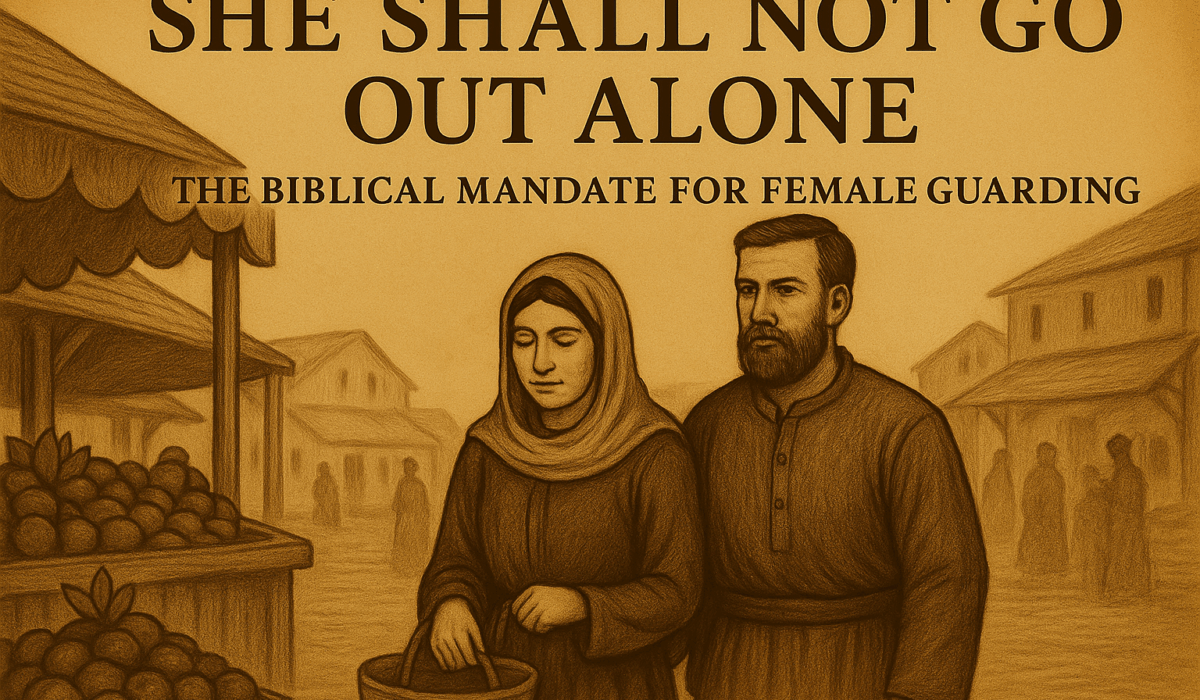
She Shall Not Go Out Alone: The Biblical Mandate for Female Guarding

“Therefore shall a man leave his father and his mother, and shall cleave unto his wife: and they shall be one flesh.”
Genesis 2:24

“For the husband is the head of the wife, even as Christ is the head of the church: and He is the saviour of the body.”
Ephesians 5:23

In this rebellious age of self-assertion and female autonomy, the biblical household finds itself under siege. No doctrine is more scorned than headship. No principle more despised than the godly husband’s right and responsibility to guard his wife.

Modern society prizes what it calls “freedom” — by which it means unaccountability, detachment, and the rejection of authority. It champions the “independent woman” who comes and goes without consultation, who maintains separate relationships, and who “needs space.” But this is not God’s design. This is disorder. It is a breach in the wall.

Let the feminists howl. Let the world mock. Let even the church recoil. Yet let the righteous man stand unmoved by their storm. For the Scriptures declare plainly: the woman is not to go out alone. She is not to have a private world. She is not to maintain independent lines of communication. Her head is her husband — always, everywhere, in all things.

This is not control. This is covenantal covering. This is love in strength. This is divine architecture.


I. The Principle of Male Guardianship: Built into Creation

From the beginning, woman was not made to stand alone. She was not made to roam or lead or govern herself. She was made from man, for man, and under man.

“Neither was the man created for the woman; but the woman for the man.”
1 Corinthians 11:9

She was brought to him — not released into independence. From her creation in Eden to her bearing of children, she is defined relationally, vocationally, and spiritually by the man she is given to. And what is the husband’s role in this order? To protect, guard, and govern.

When Adam failed to be present, when he let the serpent speak to Eve unobserved, unchecked, unchallenged, sin entered the world. Eve should not have been alone. She should not have been speaking with another. She should have been with her head, under his watch, in his presence.

The lesson is eternal: when the woman wanders, the serpent speaks.


II. Scriptural Pattern: Women Are to Remain Within the Household Sphere

“That they may teach the young women to be sober, to love their husbands, to love their children,
To be discreet, chaste, keepers at home, good, obedient to their own husbands, that the word of God be not blasphemed.”
Titus 2:4–5

The Word of God is clear: young women are to be keepers at home — not travelers, not social butterflies, not independent agents.

The Greek phrase here translated “keepers at home” (oikourous) literally means house-guardians — implying not only physical location but focus and commitment. The woman’s realm is the home. Her loyalty is to the household. Her physical and relational movement is to be governed by her husband’s will, not her own.

When Rebekah became Isaac’s wife, she was brought into his tent (Genesis 24:67). When Ruth followed Naomi, she did not operate alone in the fields — Boaz specifically charged the men not to touch her, and the servant supervised her gleaning (Ruth 2:8–9).

In no case in Scripture do we see godly women going about alone, forging their own connections, or initiating private relationships — especially not with men. Where that occurs, disaster follows.

Think of Dinah, the daughter of Jacob.

“And Dinah… went out to see the daughters of the land.”
Genesis 34:1

This small act of independence — “just going out” — led to her defilement by Shechem and the eventual bloodshed of the entire city. Dinah should not have gone out. She should have been kept. She should have remained under the eye of her father and brothers. But she left the walls of order, and chaos followed.


III. Communication Is Presence — The Husband Must Be Included

In our modern digital age, we must understand that communication is presence. Texting, messaging, and private conversations with others — even family and friends — carry the same spiritual risks as physical absence.

Just as a wife should not be wandering the streets without her husband, so too should she not be carrying on private messages, unchecked emotional exchanges, or long conversations without his oversight.

“Let your women keep silence in the churches: for it is not permitted unto them to speak… and if they will learn any thing, let them ask their husbands at home.”
1 Corinthians 14:34–35

Though this instruction concerns public worship, it reflects a broader principle: when a woman desires to speak or ask, she is to go through her husband. Not pastors, not friends, not family. Her voice is heard through him. He is her covering.

This extends to online platforms, phone calls, and texts. No communication should be shielded from her husband. There is no righteous secrecy in marriage. Her husband must have unfettered access to all messages, all social media, all points of contact.

Why? Because Eve speaks to the serpent in the absence of Adam.

It begins with “harmless” conversation. It ends in ruin.


IV. Historical Witness: Women Were Kept and Guarded

Throughout church history and in nearly every righteous civilization, women were not allowed to come and go freely. Their movements were tied to their husbands or fathers. This was not oppression. It was protection — and it was honored.

  • In ancient Israel, women were generally only seen in public under the oversight of their male head.
  • In early Christian society, it was scandalous for a woman to speak to men alone or appear in public without headcovering and male escort.
  • During the Reformation, the role of the wife was renewed as “lady of the house,” not “citizen of the world.” Her place was the hearth, not the marketplace.
  • In Puritan England and Colonial America, godly homes required the wife to remain within the sphere of the household, her communications under her husband’s watch.

It was only with the rise of Enlightenment humanism, feminism, and industrial capitalism that the idea of a “free-roaming woman” took root — a departure that has led to divorce, adultery, rebellion, and societal collapse.

Freedom outside of God’s order is not liberty — it is lawlessness.


V. Theology of Dominion: The Husband Is Governor Over His Wife’s Movements

The man is king and priest of his home — but he is also governor.

“Wives, submit yourselves unto your own husbands, as unto the Lord.”
Ephesians 5:22

Submission is not partial. It does not pause when the husband is not physically present. It does not cease in online spaces. The wife’s will is not her own. Her body, her words, her footsteps, and her affiliations are all under the jurisdiction of her lord.

“Even as Sara obeyed Abraham, calling him lord: whose daughters ye are, as long as ye do well.”
1 Peter 3:6

What would it look like today for a woman to call her husband “lord”? It would look like her not texting others without him reading it. Not going to the store without his knowing. Not receiving counsel or comfort from her mother, sister, or friend before seeking his voice.

This is not insecurity — it is the very essence of covenantal fidelity.

A wife does not exist as an individual in the modern sense. She is one flesh with her husband. Her identity is derived. Her decisions are derivative. Her presence is his presence, and when he is not there physically, his authority must be spiritually and functionally present.


VI. Warnings from the Collapse of Female Guarding

The fruits of female autonomy are rotting on the tree. Consider what happens when wives wander without oversight:

  1. Adultery begins with unguarded access.
    The woman who flirts emotionally with a coworker, chats late at night online, or meets someone “just to talk” has already left her head. The serpent has entered the garden.
  2. Family bonds erode.
    Wives who retain secret friendships with relatives — often undermining their husbands — divide households. This is how mothers-in-law gain access, how sisters plant doubts, how rebellious daughters spread infection.
  3. Her loyalty fractures.
    If a wife can speak freely with others, apart from her husband, she will eventually serve two masters. Her ears will bend toward others. Her thoughts will be split. Her spirit will drift.
  4. The household loses its wall.
    Proverbs says a woman who does not remain at home is like a city broken down without walls (cf. Proverbs 25:28). The strength of the home lies in the guardedness of the wife.

VII. But What About Emergencies, Ministry, and Hospitality?

Some may ask, “Is it always wrong for a woman to leave the house alone?” Not necessarily. There are times when a wife may go about — but it must always be:

  • With her husband’s explicit blessing,
  • For a clearly defined purpose,
  • Within a fixed time and covered accountability,
  • And with a heart that longs to return home.

Just as a soldier may leave the walls of the city on assignment but not in desertion, so too may a wife step outside for a season — but never as a wanderer.

And ministry? Hospitality? These, too, are under his governance. The wife does not entertain others, serve others, or engage others apart from her lord’s knowledge and participation. Even the Proverbs 31 woman — often misquoted to justify female independence — acts within the sphere of her husband’s trust, “The heart of her husband doth safely trust in her” (Proverbs 31:11).

Her strength is not in autonomy — it is in order.


VIII. A Word to Wives: Your Safety Is in His Covering

Dear daughter of Zion, understand this: your husband’s watchfulness is not a prison — it is a fortress. His presence, his eyes, his hand, his access — these are your security. They are not limits to resist. They are gifts to embrace.

“He shall cover thee with his feathers, and under his wings shalt thou trust.”
Psalm 91:4

This is the image of godly headship. A protective, holy presence. Like Boaz to Ruth. Like Abraham to Sarah. Like Christ to the Church.

The moment you desire independence, secrecy, or “space,” the serpent is already whispering. Stay within the wall. Delight in your covering. Let no message, no call, no visit, no outing escape your husband’s view. Your purity depends on it.


IX. Let the Great Order Be Restored

We are not called to conform. We are called to rebuild the ancient ruins. To restore the old paths. To reestablish the boundaries our fathers once set. The principle of female guarding — of the wife never being alone or unaccounted for — is not a minor tradition. It is a foundation stone.

“Remove not the ancient landmark, which thy fathers have set.”
Proverbs 22:28

The Great Order demands it. The war on Christian civilization will not be won with partial obedience. Let our homes be fortified. Let our wives be shielded. Let our daughters be trained to love the presence and protection of their future heads.

We do not need more free-roaming women. We need kept women. Covenant women. Covered women.


Conclusion: The Woman Shall Not Go Out Alone

Let it be said without apology: A wife has no righteous business outside her husband’s knowledge, covering, and presence. She is not to go out alone. She is not to communicate alone. Her life is not her own — it is bound to the man God gave her, as his helpmeet, under his governance.

This is not bondage. It is glory.

This is not weakness. It is honor.

This is not patriarchy gone too far. It is patriarchy finally applied.

Let the home be guarded. Let the wife be covered. Let the serpent find no opportunity.

Let the Great Order rise.

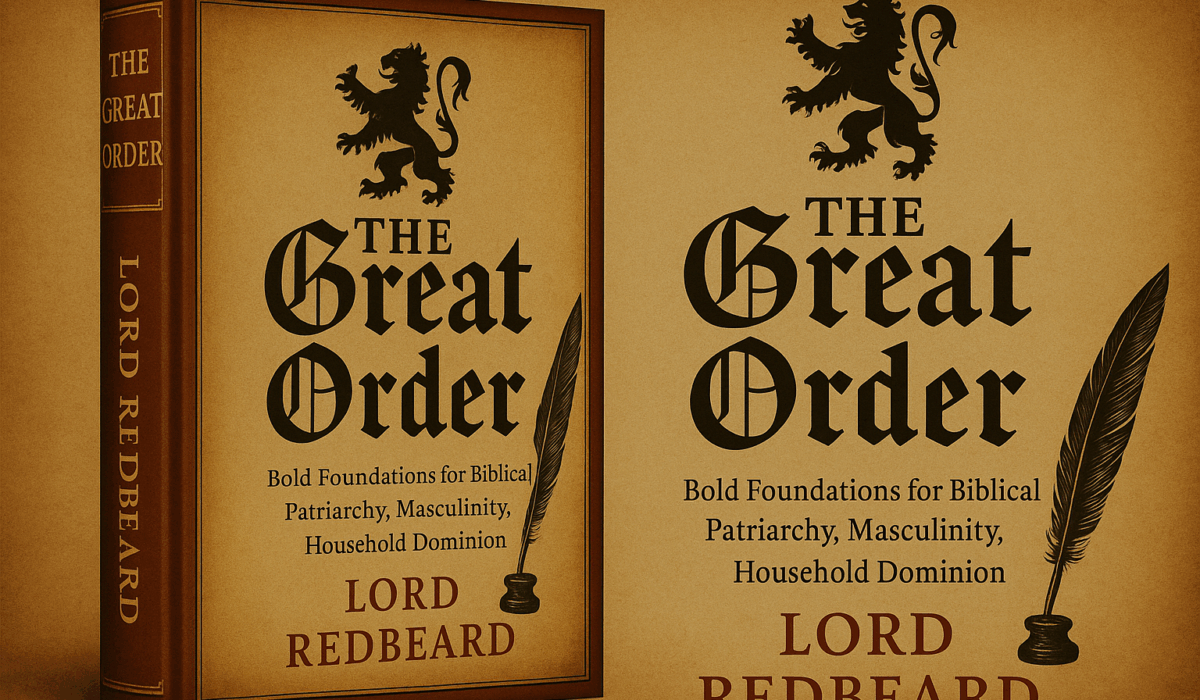
Announcing the Forthcoming Release of “The Great Order” by Lord Redbeard

Bold Foundations for Biblical Patriarchy, Masculinity, and Household Dominion

> “If the foundations be destroyed, what can the righteous do?”

— Psalm 11:3

We stand at the precipice of a collapsing world. The nations rage, the families crumble, the church is compromised, and the people groan under the weight of disorder. Men are passive, women are rebellious and children are untamed. The covenantal design of God’s order has been all but forgotten.

Yet from the ashes, a trumpet has sounded. A clarion call not of man’s wisdom but of divine truth — bold, ancient, and uncompromising.

That trumpet is The Great Order.

This book is not merely a work of writing. It is not a collection of random thoughts. It is a declaration. One forged through the fires of spiritual warfare, personal experience, obedience, and relentless pursuit of the Kingdom of God.

And now, by the providence and grace of the Most High, it is almost here.

A Work Birthed in Fire and Revelation

There are books that entertain, books that educate and books that simply pass the time. The Great Order is none of these. This is not a journalistic commentary on the state of the culture. This is not a casual opinion piece about the family.

This is a blueprint for dominion!

Every word in this book has been wrought through struggle, failure and triumph. Each sentence has been borne through prayer, sharpened through Scripture, and written through conviction. I did not merely choose to write this book, I was compelled, burdened and gripped by the Spirit of God with a vision too weighty to ignore.

> “The word of the Lord was in my heart as a burning fire shut up in my bones…”

— Jeremiah 20:9

I have lived these words, while often failing. I have been humbled by them, corrected by them, and built by them. They were not written in an ivory tower but forged in the trenches of real fatherhood, real household government, and real spiritual war. The Great Order is not theoretical, it is incarnational. It is truth that has been lived, tested, and proven by patriarchs since the beginning of written history. 

This book has not been filtered for cultural acceptance. It has not been softened for fragile ears. It is a sword, a plumbline, a trumpet blast for men to rise, women to embrace sacred roles, and families to become embassies of heaven.

 Why This Book Is a Threat to the World and a Balm for the Faithful

The world hates order, it mocks patriarchy, it despises submission and tears down hierarchy. This is no accident, Satan’s war has always been against God’s design. At the heart of that design is the household, governed by man, under Christ, filled with fruitful labor, and advancing the Kingdom through generations.

The Great Order is a threat to every demonic stronghold because it restores the very structure the enemy fears most,the Biblical family.

But this book is more than just a rebuke of the present. It is a balm for the faithful, a comfort to the remnant, a light to those wandering in the darkness of feminism, fatherlessness, and confusion. Many have felt the stirrings in their soul that things are not right, that the modern way is broken and that there must be more.

This book puts language to what the Spirit of God has already whispered in many hearts. It is a framework, a vocabulary,a standard.

In a generation that knows the truth instinctively but lacks the words to defend or articulate it, The Great Order gives voice to the righteous yearning buried in every God-fearing man and woman. It bridges the gap between conviction and communication, between the groaning of the soul and the clarity of truth.

Truths We Know But Cannot Articulate — Until Now

There are times when a man knows something is wrong, even though he cannot explain it. He sees a woman preach, and something in him recoils. He watches a child disobey his mother, and he feels disgust, he sees a home led by a career-focused wife and feels instinctively — this is disorder.

But if pressed, he cannot explain it. He cannot defend it, he cannot express it to his wife, to his children, to his church, to his peers. The conscience bears witness to God’s design. But the vocabulary has been stolen.

This is the plight of our generations, men and women raised without the theological framework or historical wisdom to articulate what they sense in their souls. We know disorder when we see it. We feel its destruction, but we have been robbed of the language to name it, and the courage to confront and profess it.

The Great Order restores that language. It articulates what you’ve always known, it puts steel in your spine and precision in your mouth. It enables fathers to teach their sons, it enables husbands to lead their wives, and enables shepherds to guard the flock. This book is not abstract,  it is accessible, practical, and potent.

It accomplishes the seemingly impossible: giving form to formless conviction, giving words to what was once only felt. It is the bridge between inner clarity and external boldness.

IV. The Structure of the Great Order: A Manual for Reconstruction

This is not a book of feelings. It is not a devotional. It is a war manual.

The Great Order is organized into chapters that walk step-by-step through the rebuilding of Christian civilization:

Biblical Patriarchy — restoring God’s government in the home.

Masculinity — dominion, not indulgence; strength through sacrifice.

Christian Polygyny — a weapon of revival and fruitfulness.

The Role of Women — sacred submission, homemaking, and generational building.

Family Government — fathers as kings, priests, and judges.

Household Economy — families as productive units, not consumers.

Education — indoctrinating children in righteousness.

Resistance — rejecting feminism, statism, and cultural apostasy.

The Church and the Household — integrating worship and dominion.

It doesn’t simply teach why we must return to Biblical order, it shows how. It is intensely practical, designed to be implemented. The principles in this book already form the foundation of households that have rejected compromise and chosen to live by the Law of God.

The Fruit of the Great Order: Revival, Peace, and Restoration

Revival will not come from stadiums, celebrity pastors, or emotional altar calls.

Revival begins at the dinner table!

It begins when a man takes his place as head of his home. When a woman repents of autonomy and embraces her role with joy. When children are trained in obedience, fear of God, and discipline. When homes become churches, the Sabbath is kept, and Scripture governs life.

The Great Order is not just about family. It is about national restoration.This book declares what few are willing to say: that peace cannot come until patriarchy is restored. That harmony cannot come until hierarchy is obeyed. That blessing cannot come until the household is ruled by God’s order.

This is not nostalgia, politics, or moralism, this is covenantal. When men obey the order of heaven, the result is peace on earth.

Children flourish.

Wives rejoice.

Men lead.

The poor are cared for.

The land is healed.

The nations tremble.

This is how we rebuild civilization — not by electing the right leaders, but by raising them in our homes.

 A Book for the Centuries to come:

The world writes books for entertainment, and the church writes books to sell but The Great Order was written to last, to stand the test of time.

This is not a trending topic, but a timeless template. It will be as relevant in five hundred years as it is today, because it is built on eternal truth. As long as the Word of God stands — and it will stand forever, this book will be a plumbline for the faithful.

When governments fall, the households guided by this book will remain!

When seminaries apostatize, the sons trained by this book will become shepherds!

When feminism collapses, the daughters raised by this book will rebuild homes!

The Great Order is not a one-generation manual. It is a multi-generational standard. It is written to be passed from father to son, from elder to disciple, from patriarch to patriarch. It is the blueprint for God’s covenant people to restore the ancient paths (Jeremiah 6:16). This book will outlast trends. It will outlast empires. Because it is built on the Rock.

Who This Book Is For

This book is not for everyone. It is not for cowards. It is not for cultural Christians. It is not for women who want to control men or men who fear responsibility.

This book is for fathers ready to rule their homes, wives ready to be crowned with honor, 

sons ready to build legacies, daughters ready to prepare for homemaking. It is for shepherds ready to reform their flocks, remnant believers ready to live counter-culturally, and seekers ready to repent and submit to God’s order.

If you are tired of the lies. If you know there’s more. If you feel the conviction but lack the clarity. If you want to plant trees under whose shade your great-grandchildren will sit — then this book is for you.

What to Expect in the Coming Release

The release of The Great Order will be more than a publication. It will be a launch. A declaration of war. A rallying point for households across the earth who are tired of compromise and ready to build.

The book will be released in softcover initially, with hardcover, audiobook, and digital formats planned for the near future. This is more than a book. It is a movement.

The website LordRedbeard.com will serve as the command center — featuring articles, updates, resources, and an ever-growing library or resources for covenant households.

Let the Patriarchs Rise

We are not waiting for revival, we are building it. We are not waiting for the world to wake up, we are establishing households that shine as light in the darkness. We are not waiting for permission, we have a mandate.

God is raising up a remnant of men — fathers, brothers, sons — who will not bow to Baal. They will not kneel to feminism, and will not compromise with the world.

They will build, marry, multiply and they will reign!

And when the Lord returns, He will find not a scattered, weak, feminized people — but an ordered people. A governed people. A glorious bride.

The Great Order is the trumpet.

The time for excuses is over.

Let the patriarchs rise.

Let the women rejoice in their submission and glory.

Let the children be trained as arrows.

Let the households become kingdoms.

Let the dominion begin.

Are you ready?

The Great Order is coming, get your house ready, train your sons, teach your daughters, insure that your name is found among the builders!

Prepare your household, clear your calendar, sharpen your mind and fortify your heart.

The time has come.

The standard has been raised.

The restoration has begun.

Let the Great Order rise and be restored!

Soli Deo Gloria.

Why a Woman Must Always Be Under Headship: The Unbreakable Design of God

Modern Christianity has adopted many lies, but none more destructive than the idea that a woman can, and should, be autonomous. The culture prizes the “independent woman.” The church parrots the same mantra in softer tones. But Scripture knows nothing of this. God never created women to stand alone. She was made for order, and she flourishes under headship.

A woman is required by God to be under male authority at all times, from her father’s house, to her husband’s house, and in some cases under the governance of church elders. This is not optional. It is not conditional. It is not a matter of preference. It is a covenantal design, etched into creation and enforced by divine command.

“But I would have you know, that the head of every man is Christ; and the head of the woman is the man…”
1 Corinthians 11:3

This structure is not cultural, it is creational. It is not bondage, it is blessing. And when it is violated, chaos, heartbreak, and destruction follow.

I. Headship in Creation: Woman Was Made for the Man

We must begin where God begins: in Genesis. Adam was made first, formed from the dust by the breath of God. He was given a mission—to take dominion. But God said, “It is not good that the man should be alone; I will make him an help meet for him.” (Genesis 2:18)

The woman was not made as a co-leader. She was not designed as an independent entity to explore her identity. She was made for the man, from the man, and to the man.

“For the man is not of the woman; but the woman of the man. Neither was the man created for the woman; but the woman for the man.”
1 Corinthians 11:8–9

This is the creation order, and it never changes. A woman, by nature and design, must be under the loving rule of godly headship. When she is, she is protected, fruitful, and secure. When she is not, she is vulnerable, unstable, and easy prey for deception.

This is not conjecture. This is exactly what happened in Eden.

II. The Fall: What Happens When Headship Is Abandoned

In Genesis 3, the serpent bypassed the man and went to the woman. He inverted God’s order. And Adam, instead of protecting and ruling, abdicated his role. Eve was deceived. Adam was derelict. And humanity fell.

“And Adam was not deceived, but the woman being deceived was in the transgression.”
1 Timothy 2:14

This is not an insult to women, it is a divine warning. When a woman steps outside of headship, she is in danger. When a man steps away from authority, he invites judgment.

Headship is not a human construct. It is a spiritual defense system, and when it is removed, the home collapses, the culture deteriorates, and the church weakens.

III. A Woman’s Three Primary Headships

Biblically, a woman is to be under male authority throughout the entire course of her life:

1. The Father

“And ye shall teach them your children, speaking of them when thou sittest in thine house…”
Deuteronomy 11:19

From birth, a girl is under the governance of her father. He is to train her, protect her, and guard her purity. He is responsible to keep her from danger—whether moral, spiritual, or relational.

In Numbers 30, God gives laws governing the vows of women. If a daughter makes a vow and her father hears it and disallows it, the vow is nullified. Why? Because she is under his jurisdiction.

“If a woman also vow a vow unto the Lord, and bind herself by a bond… being in her father’s house… and her father disallow her… then shall the Lord forgive her.”
Numbers 30:3–5

This is legal headship. Fathers are not optional. They are God’s appointed guardians for daughters.

2. The Husband

“Wives, submit yourselves unto your own husbands, as unto the Lord. For the husband is the head of the wife…”
Ephesians 5:22–23

When a woman marries, headship passes from father to husband. She is no longer her father’s responsibility. She becomes her husband’s charge, and she is to obey him as the church obeys Christ.

“Even as Sara obeyed Abraham, calling him lord.”
1 Peter 3:6

This is not poetic, it is prescriptive. A woman does not lose value under authority; she gains security, direction, and honor.

3. The Eldership (in cases of widowhood, orphanhood, etc.)

When a woman has no husband and no father, she is not to drift alone. She comes under the elders of the church, the patriarchs of the community.

“Honour widows that are widows indeed… Let not a widow be taken into the number under threescore years old, having been the wife of one man…”
1 Timothy 5:3–9

The early church had rules and order for widows, indicating that even in their singleness, they were not to function independently. They were under the governance of the patriarchal church, and the younger widows were exhorted to remarry (1 Timothy 5:14).


IV. The Dangers of Female Autonomy

When women are not under headship, the results are devastating:

  • Sexual sin abounds. Young women without oversight are easy prey for seduction and fornication.
  • Feminism takes root. Women begin to believe they are their own authority.
  • Children are raised fatherless. Single mothers often reject correction and multiply generational disorder.
  • Churches are disrupted. Uncovered women bring emotional chaos and spiritual confusion.

“Woe unto them that are wise in their own eyes, and prudent in their own sight!”
Isaiah 5:21

Headship is not oppression. It is protection. It keeps a woman from the deceit of Satan and the judgment of God.


V. What About Special Cases?

1. The Divorced Woman

Divorce does not grant a woman independence. It places her in a vulnerable state, one that Scripture addresses soberly. If the divorce was lawful (on grounds of adultery or abandonment by an unbeliever, Matthew 5:32, 1 Corinthians 7:15), she may remain unmarried or be reconciled to her husband. But she is not now a “free agent.”

She should:

  • Come under patriarchal church leadership for spiritual covering.
  • Pursue re-marriage if it is biblically permitted.
  • Raise children in submission to godly counsel.

She is not the head of her house. If she has sons, they must be trained under male discipleship. If she has daughters, they must be shielded from repeating her mistakes.

2. The Widow: Still in Need of Covering

Widowhood is not an exception to God’s established order. Though the husband has passed, the woman’s need for headship remains. Scripture makes it clear: no woman, regardless of age or circumstance, is ever meant to live without covering.

Young Widows: Called to Remarry

Paul gives direct instruction in 1 Timothy 5:14:

“I will therefore that the younger women marry, bear children, guide the house, give none occasion to the adversary to speak reproachfully.”

Young widows are not to remain alone, idle, or without direction. Paul warns that widows who remain uncovered are easily drawn into gossip, idleness, and temptation (v. 13). Remarriage is a divinely appointed path back into structure, protection, and fruitful labor within a man’s household. Headship is not optional for young widows, it is necessary for their holiness and the Church’s honor.

Older Widows: Honored, Not Autonomous

Older widows, those proven in faith and good works, are to be honored by the Church (1 Timothy 5:3, 9–10), yet they are still not independent. They remain under the spiritual covering of the church body and its male leadership. Their new role becomes one of discipleship, as Paul outlines in Titus 2:3–5:

“The aged women… that they may teach the young women to be sober, to love their husbands, to love their children… obedient to their own husbands.”

They are not liberated from order; rather, they become defenders and instructors of it.

Temporary Submission to Godly Headship

In cases where remarriage is delayed or not immediately possible, a widow may willingly submit herself to the oversight of a godly male relative, elder, or spiritual father. This kind of voluntary submission reflects the principle of headship and preserves her covering until a new marriage is rightly formed. Just as Ruth submitted herself to Boaz’s authority and provision before becoming his wife (Ruth 2:8–12), so too may a widow dwell under the shadow of a righteous man’s protection, so long as it is done in purity and order.

Never Without a Head

The Church is also called to care for and govern widows, not simply offer charity but oversight (James 1:27). A woman without a husband must not drift into spiritual autonomy. She must remain accountable and under the rule of godly men, either through remarriage or temporary oversight by the elders or righteous male leadership in her life.

The death of a husband is not the death of God’s design. Headship is not a marriage feature, it is a feminine necessity. Widowhood is a shift in placement, not a suspension of submission.

No woman, including the widow, is ever meant to be her own authority. God’s pattern does not break in crisis, it stands unshaken.

3. The Orphaned or Unmarried Daughter of a Non-Christian Home

A young woman raised outside of the faith must not interpret her background as justification for independence. If her father is unbelieving, she must:

  • Submit under spiritual fathers, church elders, pastors, or godly men in the community.
  • Pursue biblical courtship under spiritual authority, not casual dating or autonomy.
  • Be adopted into the household of God, where she is no longer a lone sheep but part of a covenant flock.

Even in pagan cultures, daughters were understood to belong to their fathers until given in marriage. The modern Western idea that a woman is “on her own” at 18 is rebellion disguised as liberty.


VI. Historical Witness

Throughout Church history, the principle of continuous female headship was unquestioned:

  • In early Israel, a daughter’s virginity was the father’s responsibility (Deuteronomy 22:13–21).
  • In medieval Christendom, daughters could not marry without paternal approval, and widows were overseen by church authorities.
  • Reformers like John Calvin and Martin Luther emphasized the father’s authority in arranging godly marriages and condemned female independence as prideful and disorderly.
  • Puritan families in early America treated daughters as part of the household government until they were transferred in marriage.

It is only in recent history, with the rise of Enlightenment individualism and second-wave feminism, that we see the normalization of female autonomy, a disaster for faith, family, and civilization.


VII. The Blessing of Headship

When a woman is properly covered by male headship, the result is fruitfulness, peace, and joy.

  • She does not carry the burden of spiritual leadership.
  • She is defended from predators and wolves.
  • She is directed in righteousness.
  • She is shielded from emotional instability and deception.
  • She glorifies God by knowing her place and delighting in it.

This is not humiliation, it is holy order. It is not shameful, it is sacred.

“Let the woman learn in silence with all subjection.”
1 Timothy 2:11

This kind of subjection brings honor, protection, and praise. A woman who abides under headship is a builder of nations, a nurturer of kings, and a daughter of Sarah.


Conclusion: Always Covered, Always Blessed

The lie of female autonomy has destroyed generations. It has produced bitterness, barrenness, fatherlessness, and faithlessness. But the Lord calls women back, not to self-rule, but to submission.

Whether a daughter, a wife, a widow, or a woman rescued from the ruins of rebellion, every godly woman must be under righteous headship at all times.

Fathers, cover your daughters.
Husbands, lead your wives.
Elders, shepherd the uncovered.
And women, rejoice to be ruled.

You were not made to be alone. You were made to be covered.
And under that covering, you will be blessed, fruitful, protected, and glorified.Let the feminists rage.
Let the church grow bold.
Let the Great Order be restored, one household at a time.

Cats Instead of Children: The Consequences of Careerism

In the modern West, a striking symbol of cultural inversion is the image of the single, professional woman cradling a cat rather than a child. It’s not merely a humorous meme—it’s a sociological reality that reflects a deep shift in values, priorities, and understanding of womanhood.

The Career as a New Identity

For much of human history, a woman’s primary domain was the household—a place of immense dignity, productivity, and influence. She nurtured life, shaped souls, and stewarded the future of her lineage. But with the rise of feminism and the industrial-technocratic model of life, women were told that their value could only be found outside the home. They were sold the idea that true fulfillment comes through career advancement, salary increases, and corporate achievements.

In this paradigm, children—especially young ones—are seen not as blessings, but as burdens. They are interruptions to productivity, threats to “freedom,” and liabilities to a woman’s upward mobility. The result? Delayed marriage, widespread infertility, and plummeting birthrates. Instead of lullabies, the halls of modern apartments echo with the meows of feline companions.

Cats Require No Sacrifice

A child requires immense sacrifice. Sleepless nights, constant attention, financial commitment, and the long, slow work of shaping another soul. It demands laying down one’s life daily. But a cat is convenient. Feed it, give it a litter box, and carry on with your life. It offers companionship without the demand of legacy. It scratches the emotional itch without requiring covenant or continuity.

This trade—life for lifestyle—is perhaps the clearest indictment of modern womanhood. In choosing cats over children, many have traded motherhood for momentary comfort. But cats don’t carry on a name. They don’t build households. They don’t honor their mother in old age or bear grandchildren.

The Feminist Promise Was a Lie

Feminism promised women “choice”—but in practice, it shamed traditional motherhood and elevated careerism as the only path to worth. The woman who chooses to bear many children, keep a home, and support her husband is often mocked as “wasting her potential.” Meanwhile, the woman who climbs the corporate ladder, drinks wine alone, and has a cat to come home to is celebrated by media as empowered.

But empowerment has come at a steep cost. Millions of women now find themselves in their 30s and 40s—lonely, childless, and deeply unfulfilled. Their fertility has faded, their relationships have withered, and their youth has been spent chasing the approval of bosses who replaced them with younger workers without a second thought.

A Culture Without Children Is a Dying Culture

When women stop having children, a nation stops having a future. The cat-as-child phenomenon is not just a personal tragedy—it’s a civilizational crisis. No generation can continue if its women reject the role of life-bearer. The womb, once seen as sacred, is now suppressed through pills, surgeries, and ideologies. But biology doesn’t bend to ideology. A woman’s body longs to nurture life, and when that drive is denied, it finds twisted replacements—whether through animals, activism, or artificial distractions.

The Path Back: Restoring the Dignity of Womanhood

The answer is not to shame women, but to call them back to glory. True femininity is not found in boardrooms or cubicles—it is found in the embrace of a newborn, the aroma of bread in the oven, the warmth of a family shaped by a wise and joyful mother. Careers can be replaced; children cannot. Promotions are temporary; legacy is eternal.

A godly woman does not need to prove herself by mimicking men. She flourishes in her God-given role as life-giver, nurturer, and queen of the home. This is not oppression. It is sacred dominion.

Is God a Globalist or a Nationalist?

Is God a Globalist or a Nationalist? I’m sure most modern Churches and Christians would contend that he is a Globalist, that he does not see race/creed/nation/culture etc. If so then why did he create these defining characteristics?

If you have children, family or even close relatives that live with you, it’s fair to assume you love them more than you love relatives other non-related families.

That doesn’t mean you hate other families, does it? You can have “empathy, compassion, and understanding” for your friends, neighbors and even total strangers without having them live in your house.

That’s because it’s your house. You may let people come in from time to time, as guests, or maybe even for an extended stay if they are suffering in some way, you may even allow them to join your family on a long term basis provided certain terms are set and boundaries established. But it is still your house, not theirs.

It’s the same with nations. Nations are people, not governments, just as a family is the people of the household, not the household rules. A Nation is your “Extended” family.  The word Nation is literally in reference to the nationality of it’s people.

A nation like America can have “empathy, compassion, and understanding” for other nations, particularly if those nations are suffering in some way, but the “house” still belongs to the Americans. “Nationalism” requires no hatred for other nations. It just clarifies who owns the house. The Indians own India, the Japanese own Japan, the Africans own Africa and the Americans own America.

But God is certainly no globalist. Surely He loves all the people of the globe, for He created them all. He loves the genuine diversity that exists in the variety of cultures, languages, and skin colors that He created to be different on purpose. But in terms of how those many diverse nations relate to each other, God is in fact a nationalist.

That does not mean we can sign God up for our political parties or pet projects. Far from it. It merely means from beginning to end, His Word speaks of the nations as nations, calls them to serve Him as nations, sets their borders, provides for the protection of those borders, and for the ultimate healing of those nations.

He clearly acts to disrupt globalist projects like the Tower of Babel, where the nations tried to live together in a globalist/multicultural empire. Against this globalist attempt, God scattered them into distinct nations with their own distinct cultures and languages.

Do we think ourselves wiser than God? He says explicitly in the Bible that He created diversity out of unity (the nations from the blood of one man), and that He sets the boundaries or borders where they are to live. Why? So that they will be better able to seek after Him and find Him:

“God…has made from one blood every nation of men to dwell on all the face of the earth, and has determined their pre-appointed times and the boundaries of their dwellings, so that they should seek the Lord, in the hope that they might grope for Him and find Him, though He is not far from each one of us….” (Acts 17:26–27)

Globalism/multiculturalism is clearly not God’s plan, insisting that all these different people live together in the same house (nation), thus destroying the beauty of all their individual nations, cultures and amazing diversity. The result is the opposite of what God said would happen when we respect national borders: the nations find it much harder to seek and find God.

So this begs the question, what nationality is America? we are ethnically, linguistically, historically, culturally, and religiously European. For the purposes of this writing Jesus was from Israel, to be sure, which is not in Europe. He is not a European (nor is He African). He is what most would call Middle Eastern. He is an Israelite, a son of David and Abraham. We are also a Christian Nation. the New Testament has a surprisingly European foundation. It’s written, not in Hebrew, but in a European language (Greek). The Son of God appeared in the midst of a European empire, and the Gospel was carried on European roads and in European ships. Paul was redirected from further eastward missionary activity by a vision of a European man. And the one man who wrote more of the New Testament than any other was Luke, a European.


These facts give us no cause to boast, but rather to be humble and thankful. Historically, so far, “the faith is Europe, and Europe is the faith,” as Hilaire Belloc put it. We should harbor no animosity toward people who look, live, or speak differently than us. We should pray for peace among all the nations, and for the love and truth of Christ to bring healing to every people on the face of the earth. We should treasure the unique cultures of every people and want them to be protected and preserved as God created them.

But again, our primary focus should be our own people and our own nation, as that is our duty to our families, children, neighbors and to God.

Therefore, Globalism/Multiculturalism, among other things, hinders the work of the Great Commission and proves that God is in fact a Nationalist!

Gold, Silver, and the Great Repricing

A sober look at the coming repricing of truth in a world awash in paper promises.


1. The Storm and the Shelter

The world entered 2020 expecting growth and stability. Instead, it received paralysis. Economies locked down, supply chains froze, and entire industries vanished within weeks. Markets convulsed in panic as governments scrambled to invent new money faster than businesses could close their doors.

Investors reached for what they always reach for in crisis, certainty. Not profit, but preservation. By August, gold had surged past $2,000 per ounce for the first time in history, and silver briefly touched $29. Futures traders and retail buyers alike rushed into metals as the dollar index slid below 94 and real yields went negative.

Gold and silver were not merely commodities this summer; they were confessions. Every ounce purchased was a quiet admission that the system built on paper promises was no longer trusted.

The world is searching for shelter, and the ancient refuge of honest weight was the only one left standing.


2. The Mechanics Behind the Spike

What drove this explosion is not mystery but mathematics. Between March and September 2020, the U.S. Federal Reserve expanded its balance sheet from roughly $4 trillion to over $7 trillion – an increase greater than the entire balance sheet after the 2008 crisis. Zero interest rate policy returned overnight, and “quantitative easing” became “QE Infinity.”

Congress has followed suit, approving more than $3 trillion in fiscal stimulus through the CARES Act and related programs. Trillions more were promised globally. Fiat supply is expanding faster than productivity, while real-world goods are trapped in ports or shuttered factories.

In simple terms, there are more dollars chasing fewer things. And in the financial psyche, that equation always ends with gold.

The metals market has also felt an unprecedented squeeze in physical supply. Refiners not producing due to lockdowns, coin mints run skeleton crews, and logistics systems are not moving. Dealers worldwide report premiums doubling or tripling even as spot prices fluctuated. Silver Eagles that normally sell for $2 over spot are commanding $6 to $10 premiums. Paper contracts promised metal that refiners couldn’t deliver.

The price spike is not simply speculative enthusiasm; it is logistical desperation layered on top of monetary panic.


3. The Federal Reserve’s Trap

Central banks faced a dilemma of their own making last year. They had promised endless growth funded by endless credit. COVID-19 simply exposed how fragile that illusion was.

When rates are near zero, the Fed loses its ability to stimulate traditionally. The only remaining tools are money creation and moral suasion, the power to promise safety loud enough that investors pretend to believe it. But by mid-2020, even that faith was thinning.

Every new round of quantitative easing was a confession that the last one failed. Each “rescue package” was a bandage on an artery. The Fed had become both arsonist and fireman, printing water to fight a fire made of paper.

Historically, such interventions delay collapse rather than prevent it. Inflation lags behind money printing by 12–48 months, meaning the real consequences of 2020’s stimulus will not appear until 2021–2024. Investors sensing that delay turned to metals not because they expected instant profit, but because they recognized the timeline of decay.

Gold and silver are forward-looking instruments of distrust. When policy becomes parody, people stop valuing words and return to weight.


4. The Psychology of Fear and FOMO

Markets are not run by algorithms; they are driven by fear. By mid-2020, fear had divided investors into two camps, the terrified and the opportunistic.

The terrified sold everything in March, when the Dow plunged 35% over three weeks. The opportunistic saw governments unleashing liquidity on an unimaginable scale and realized the debasement had begun. That group flooded into hard assets: farmland, crypto, metals, and even ammunition.

Silver, in particular, became the “poor man’s gold.” Retail investors unable to afford $2,000 gold bars could still buy $25 silver coins, and millions did. YouTube and Reddit became classrooms of panic-education where first-time buyers learned what a troy ounce was. This democratization of fear created a sustained bid beneath the market.

The psychology was identical to 2008-2011, when gold hit $1,920 and silver $49. Then, as now, monetary policy had cornered savers: zero interest, high risk, and no trust. But unlike 2011, the 2020 crisis affected every nation simultaneously. There was no safe currency left to flee to.

When all fiat burns together, gold ceases to be a hedge, it becomes the denominator.


5. The Biblical Parallel: Weights, Measures, and Moral Value

Economics without morality is a mathematics of theft. Scripture condemned “diverse weights and measures,” the ancient form of currency debasement. When silver coins were clipped or adulterated, markets faltered, and trust died. Our age commits the same sin electronically.

The difference is only cosmetic. Instead of melting the coin, we dilute the ledger. Each new trillion is a theft of time, a silent confiscation of the labor already stored in existing currency. Inflation is legalized counterfeiting carried out by official hands.

Gold and silver remain stubborn precisely because they cannot be printed. They stand as judgment against false promises. When the prophet Amos warned of those “who make the ephah small and the shekel great,” he was describing our modern central banking system. The manipulation of money is the oldest moral crime on earth: the deliberate exchange of illusion for effort.

Thus the flight to metals that started in 2020 is not merely financial; it is spiritual. It is the market’s confession of sin, a turning away from deceit back toward substance.


6. The Forecast: Peaks, Plateaus, and the Path Ahead

As of late 2020, gold now trades near $1,900 and silver around $24. The emotional fervor has cooled slightly from the August highs, but the fundamental conditions remain unchanged. Stimulus continues. Supply chains are fractured. Confidence is gone.

Barring a miraculous restoration of fiscal discipline (which history suggests is fantasy), the metals market will resume its climb after a brief consolidation. However, this next leg will not be explosive but measured. Volatility will persist, but structure is forming.

Gold is likely to test and stabilize around $2,000 per ounce by mid-2021, while silver reaches the $28–$30 zone. Those levels should hold for roughly 12 months or longer with perhaps some mild variations, then, a plateau rather than a collapse, as inflation metrics catch up and the world learns to price permanence again.

This pause will separate speculators from stewards. The impatient will sell when prices stagnate; the wise will understand that value is not measured in months but in integrity of measure.


7. The Second Wave: The Slow Rise Toward 2025

Markets normally move in tides, not explosions. After the first wave of panic buying in 2020, the metals market will enter a period of digestion, the eye of the storm. Prices may appear stable, but underneath, trust in paper will continue to erode. Every new fiscal rescue package, every “temporary” quantitative easing program, will quietly deepen the public’s understanding that none of this money is real.

By late 2021 and into 2022, as stimulus checks fade and the costs of living rise, the delayed effects of inflation will surface. Commodities will strengthen across the board, food, fuel, housing, while wage growth increases but fails to keep pace. When a middle-class worker realizes that the same paycheck buys less food and less security, he doesn’t need a Bloomberg terminal to understand debasement. He feels it in his grocery cart.

At that point, investors will again seek anchors. Gold will climb gradually past $2,200, then $2,500, the $3,500 and near the $4,000 mark by 2025. Silver, which always lags before over-performing, will push through $35 and flirt with $40 by 2023 and the $50.00 by 2025 The advance will not come from excitement but resignation: the recognition that the world’s debt problem cannot be solved, only inflated away.


8. The Limits of Control

Central banks will attempt to manage the narrative. They will claim inflation is “transitory,” then redefine the term when it isn’t. They will hint at rate hikes, then retreat when markets tremble. Each intervention will buy less credibility than the one before. The tools of control are losing potency because they depend on belief, and belief, like currency, can only be diluted so far.

Historically, the endgame of monetary cycles arrives not when policy fails, but when the people finally see through it. That moment is psychological, not mechanical. Once trust dies, charts are irrelevant.

By 2024–2025, gold will approach the $4,000+mark and silver the $50+ range, not because of hysteria, but because the measurement itself has changed. When the ruler stretches, everything appears larger. The metals will not have become more valuable; the currencies measuring them will have become less so. The repricing is not in ounces, but in honesty.


9. The Social Consequences of Monetary Sin

Money is not just an economic tool; it is a covenant of trust between citizens. When governments debase it, they destroy more than purchasing power, they corrode the moral fabric that binds a people together. Inflation rewards the indebted and punishes the disciplined. It celebrates consumption and mocks saving. In time, that moral inversion spreads from markets to households.

We already see its symptoms: the rise of speculation over production, of digital illusions over tangible goods. A generation trades imaginary coins while ignoring the real ones in their grandparents’ drawers. Such a culture cannot endure long because it has detached wealth from work, and price from worth.

In biblical terms, this is judgment. When a society worships paper idols, God often lets the paper burn.


10. The Return to Tangibility

The repricing of gold and silver will not only reshape portfolios; it will reorder priorities. As digital abstractions lose reliability, tangible assets will return to prominence, land, water rights, tools, family businesses, and skilled labor. These are the forms of capital that cannot be inflated or confiscated with a keystroke.

There will, however, be a lagging effect in real estate, one of the few areas where time will favor the patient. Property values move slower than metals because they depend on credit, not cash. As gold doubles in value over the coming years, real estate will not follow at the same pace. The housing market will likely experience a 12 to 36-month delay before prices fully adjust to the new purchasing power of hard assets. This period will be an enormous opportunity for those who held their metals through the storm. When the repricing wave reaches land and housing, those who preserved real wealth will be positioned to convert ounces into acres, purchasing real estate with gold that itself has already doubled in value. Timing, not speculation, will be the key.

Gold and silver will serve as bridges between the old world of credit and the new age of accountability. They are not ends in themselves but instruments of preservation, ballast for those navigating through deceitful seas. Those who hold them are not hoarders of metal but guardians of measurement.

For the prudent, this shift presents an opportunity: to re-align investments, households, and values around permanence rather than promise. For the reckless, it will be ruin. When paper wealth evaporates, those who mistook digits for dominion will discover they own nothing of substance.


11. Lessons from the Past

History offers precedents. In the 1970s, after a decade of monetary excess, gold rose from $35 to $850, a twenty-four-fold increase. In 2008–2011, after another orgy of liquidity, it doubled again. Each cycle was marked by the same pattern: crisis, stimulus, temporary calm, and a second, larger wave of repricing.

The current era is no different, except for scale. The global debt load now exceeds $250 trillion. Central banks are trapped by their own policies; they cannot tighten without collapse or loosen without admitting failure. In such an environment, honest money has nowhere to go but up.

Those who understand this pattern will not be surprised by the next surge. They will recognize it as the inevitable arithmetic of dishonesty coming due.


12. Stewardship and Preparation

The wise man does not buy gold because he fears apocalypse; he buys it because he respects arithmetic. He stores a portion of his labor in a form that cannot be debased by decree. He refuses to let others define his value.

Yet the greater preparation is moral. Wealth without wisdom is still poverty. The repricing ahead is not merely financial but spiritual, a test of stewardship. How one handles truth when the world trades in lies reveals character.

Households should seek strength in order: reduce unnecessary debt, build skills that outlast trends, and invest in things that serve life rather than vanity. Those principles were sound in the days of Solomon and remain sound today.


13. The Moral Repricing

Ultimately, gold and silver are mirrors, not messiahs. They reflect the integrity of the civilization that measures itself by them. When they rise sharply, it is not celebration but indictment. It means the people have lost faith in their stewards.

The “great repricing” is therefore not about metal, but about meaning. As false measures collapse, truth reclaims its proper premium. Those who anchor themselves to honesty, in finance, in family, in faith, will find stability while empires of credit crumble.

The ancient command still stands: “A false balance is abomination to the Lord: but a just weight is his delight.” (Proverbs 11:1)
When the world forgets that law, the market remembers it for Him.


Closing Reflection: The Weight of Truth

The years ahead will be noisy with policy, promises, and panic. Ignore them. Focus on weight and measure. In the end, the world will rediscover what every honest merchant once knew, that value is not created by decree but proven by durability.

Gold will find $4,000, silver will near $50, and then the cycle will repeat again (but with higher numbers). Yet the greater treasure is not metal, but the moral clarity to see through illusion.

Those who hold that, and live by it, will never be impoverished.