Category Archives: Social Topics

Sons of Responsibility, Daughters of Duty: Why Children Must Do Daily Chores

In a world collapsing under the weight of entitlement and indolence, there stands one simple, potent, and often overlooked discipline that once built civilizations and now could restore them: daily chores for children.

Yes—chores. The ancient, sacred act of children participating in the labor of the household, of being given tasks not as punishment, but as preparation. In former days, this was assumed. Today, it is scandalous.

But make no mistake: the decline of children doing chores is not just a minor cultural shift—it is a root cause of social decay. Where there is no training in labor, there will be no love of labor. Where there is no love of labor, there will be no builders, only consumers. No stewards, only dependents. No leaders, only idle, effeminate men and distracted, disorderly women.

Let the modern world scoff. Let soft parents protest. Let the child psychologists complain. As for us, we will return to the ancient paths, where children labored alongside their fathers and mothers—learning duty, order, responsibility, and the ways of God.

I. God’s Design: Children as Workers Within the Household

From the earliest pages of Scripture, work is not a punishment, but a purpose. Genesis 2:15 tells us, “And the Lord God took the man, and put him into the garden of Eden to dress it and to keep it.” Before the fall, there was labor. Man was created not for luxury, but for dominion.

That dominion mandate extends to the household. A Biblical home is not a vacation resort, but a training ground—a miniature kingdom under the rule of a patriarch, where all members contribute according to their capacity.

Children are not excluded from this. Proverbs 20:11 declares, “Even a child is known by his doings, whether his work be pure, and whether it be right.” God does not consider children exempt from moral and productive labor. From their earliest years, they are to be formed in work and order.

Deuteronomy 6 commands fathers to teach the Law “diligently unto thy children,” not merely in words, but in lifestyle. And the Law included rhythms of farming, feasting, stewardship, and sacrifice. All of this required participation—daily, disciplined, dutiful involvement. Children were not idle. They labored.

II. The Decline of Chores: A Timeline of Cultural Collapse

Historically, chores were not optional. For thousands of years, children performed essential work to sustain the family economy.

In agrarian households from ancient Israel to colonial America, children were expected to rise early, tend livestock, gather wood, fetch water, weed gardens, grind grain, and more. These tasks were not busywork—they were survival.

But as industrialization took hold in the West, especially post-Industrial Revolution (circa 1760-1840), the role of the household shifted. Work moved to the factory. Families moved to cities. The household was no longer the center of production—it became a center of consumption.

By the 20th century, with the rise of public schooling, mass media, and child labor laws (many of them necessary in abusive contexts but overextended), children were increasingly detached from real, meaningful work. In 1900, over 80% of American children did regular household chores. By 1970, that number had dropped below 50%. Today, less than 30% of children in the United States are assigned consistent, daily chores (Pew Research Center, 2019).

And the consequences are devastating.

III. What the Research Says: Work Builds Character

Modern psychological and sociological studies confirm what Scripture has always taught: children need work to mature.

A long-term study by the University of Minnesota found that the single best predictor of adult success—financial, relational, and emotional—was whether that child had done chores regularly beginning by age 3 or 4 (Rossmann, 2002). Not IQ. Not athleticism. Not schooling. Chores.

Harvard University’s Center on the Developing Child notes that “responsibility-based training” such as chores builds executive function skills: impulse control, time management, problem-solving, and resilience. These are precisely the skills modern young people lack.

Dr. Marty Rossmann’s research showed that children who had regular chores were more likely to have successful careers, strong marriages, and avoid drug use and entitlement attitudes.

Why? Because work humbles. It grounds. It shapes the soul to obey reality. In doing dishes, scrubbing floors, and feeding chickens, children learn that the world is not about them. They learn to serve, to sweat, and to obey. This is sanctification in miniature.

IV. Biblical Examples: Training Through Task

Joseph learned administration not in Pharaoh’s court, but in his father’s fields. David became a man after God’s own heart while watching sheep and defending them from lions. Ruth’s character was proven in the fields of Boaz. Jesus Himself—God incarnate—was not spared work. Mark 6:3 refers to Him as “the carpenter.” He learned labor under Joseph before teaching doctrine in the synagogue.

This is not accidental. God’s pattern is always to prepare leaders through labor. Chores are not beneath a child—they are essential to their exaltation.

Proverbs 22:6 commands us to “Train up a child in the way he should go.” Training is not lecturing. It is forming. It is discipline. It is day after day of doing. And it includes work. Proverbs 12:11 adds, “He that tilleth his land shall be satisfied with bread: but he that followeth vain persons is void of understanding.” Children who are not trained in real labor will follow vain persons—and they do. They follow influencers, gamers, celebrities. Why? Because they were not taught to work.

V. The Modern Rebellion: Why Parents No Longer Require Chores

Several lies have infected modern parenting, each contributing to the erosion of work ethic in children.

1. “Let them be children.”
This sentimental lie separates play from responsibility. But in Biblical cultures, children were expected to contribute early—not crushed under burdens, but trained into productivity.

2. “They’ll learn later.”
No, they won’t. Habits form early. Waiting until 16 to teach work is like planting seed in winter. Proverbs 13:24 warns that “he who spares the rod hates his son.” Neglecting discipline—whether correction or chore—is hatred disguised as love.

3. “I don’t want them to feel burdened.”
Burden is not the enemy. Sin is. Sloth is. Pride is. Our ancestors survived famines, plagues, wars, and exile. Today’s children weep when told to vacuum. This is shameful.

VI. The Choreless Generation: Cultural Consequences

The decline of childhood labor has led to a generation unfit to lead, unable to serve, and unwilling to sacrifice.

  • Entitlement replaces gratitude. If a child never labors for anything, he will expect everything.
  • Laziness replaces initiative. If a child is not expected to finish a task, he will never start one without being begged.
  • Rebellion replaces obedience. If a child never submits to chore commands, he will not submit to divine commands.

A 2022 study from Psychology Today found that over 70% of college students suffer from “learned helplessness”—the belief that they cannot change their situation or do hard things. These are the fruit of choreless homes.

Historically, societies that neglected work collapsed. Ancient Rome, during its decline, turned from disciplined agriculture and civic service to bread, circuses, and dependency. So too in modern America, where young adults are more likely to be living at home, playing video games, and avoiding responsibility than starting families, working the land, or building households.

VII. The Household Economy: Chores as Economic Training

Biblical households are economic engines. As we’ve noted in The Great Order, the family was not merely for emotional comfort—it was the unit of production, inheritance, and dominion.

Daily chores are the first taste of this. They teach a child that his hands matter. That his labor contributes. That his existence has weight.

  • Boys should learn to chop wood, mow fields, stack hay, clean barns, fix fences, build shelves, wash tools.
  • Girls should learn to cook, clean, sew, garden, organize, care for siblings, and manage the home.

These are not outdated roles—they are divinely ordered. Titus 2:4–5 calls young women to be “keepers at home.” 1 Thessalonians 4:11 commands men to “work with your own hands.”

Children who do chores are being inducted into this sacred economy. They are not slaves. They are sons and daughters—learning to rule their future domains.

VIII. Restoring the Chore: Practical Steps for the Patriarch

How can you restore this divine order in your home? Here are ten actionable principles:

  1. Start young. Even a two-year-old can put toys away.
  2. Be consistent. Daily chores must be daily. Random tasks do not build discipline.
  3. Tie chores to identity, not rewards. Avoid bribing. Instead, say: “You are a son in this house. Sons serve.”
  4. Model the work. Let them see you labor joyfully. There is glory in sweat.
  5. Increase difficulty over time. Don’t baby teenagers. Prepare them for dominion.
  6. Train before you command. Teach how to sweep before assigning sweeping.
  7. Connect it to Scripture. Regularly quote verses like Colossians 3:23: “Whatsoever ye do, do it heartily, as to the Lord.”
  8. Honor their work. Praise a job well done. Not with rewards, but with recognition.
  9. Correct laziness immediately. Sloth is sin. Tolerating it is fatherly failure.
  10. Link chores to calling. Remind them: “This is how God prepares you for leadership.”

IX. The Fruit of Labor: From Households to Nations

The patriarch who trains his children in daily labor is doing more than running a tidy home. He is raising civilization builders. The world may laugh—but when their towers fall and their youth collapse under fragility, it will be the disciplined sons and daughters of order who rise to lead.

Let us not aim merely for clean floors. Let us aim for clean hearts—hearts trained by work, shaped by order, and anchored in the fear of God.

X. Conclusion: Let the Children Rise

The Great Order is not built on theories, but on actions. And the first battlefield is the home. Daily chores are weapons in this war for culture. They are tools of sanctification. Instruments of wisdom. Pathways to dominion.

When children rise early, perform their tasks with diligence, and return to the table satisfied with honest labor, the Kingdom advances.

Let them scrub. Let them plant. Let them fold. Let them serve.

And let the fathers not grow weary in training them. For in due season, we shall reap—if we faint not.

“For even the Son of man came not to be ministered unto, but to minister…” – Mark 10:45

If the Lord Himself embraced labor, how dare we withhold it from our sons and daughters?

Let the choreless generation be replaced by a chosen generation—trained, tested, and triumphant.

Let the Great Order rise.

Soli Deo Gloria.
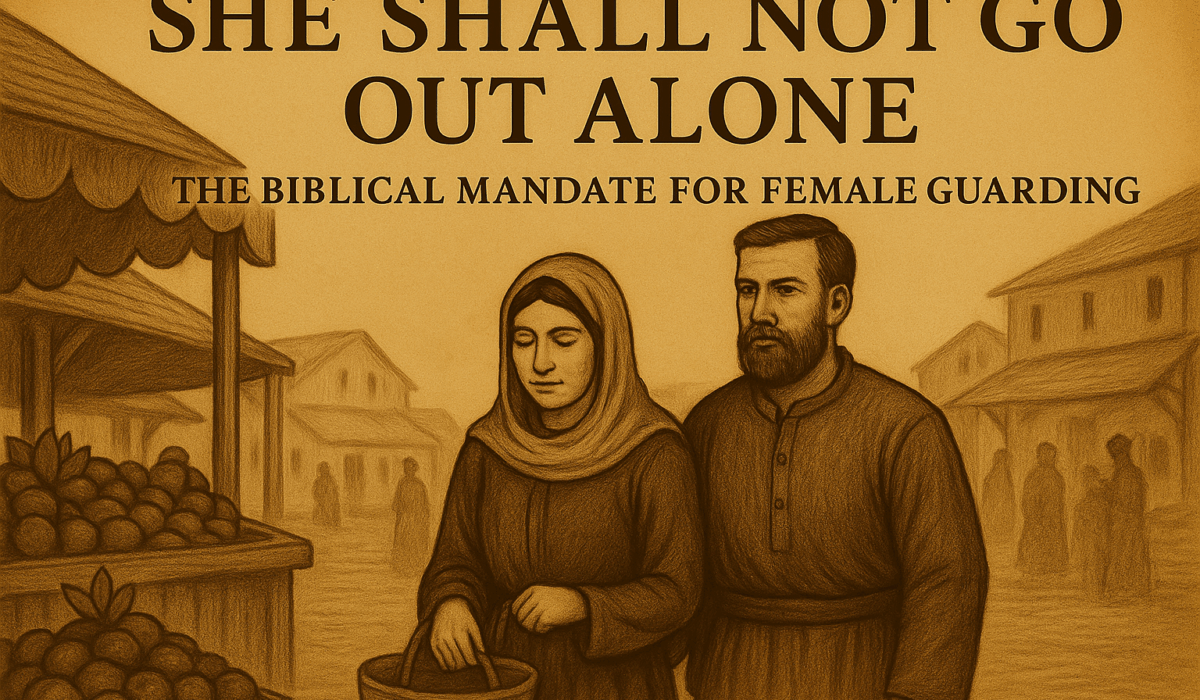
She Shall Not Go Out Alone: The Biblical Mandate for Female Guarding

“Therefore shall a man leave his father and his mother, and shall cleave unto his wife: and they shall be one flesh.”
Genesis 2:24

“For the husband is the head of the wife, even as Christ is the head of the church: and He is the saviour of the body.”
Ephesians 5:23

In this rebellious age of self-assertion and female autonomy, the biblical household finds itself under siege. No doctrine is more scorned than headship. No principle more despised than the godly husband’s right and responsibility to guard his wife.

Modern society prizes what it calls “freedom” — by which it means unaccountability, detachment, and the rejection of authority. It champions the “independent woman” who comes and goes without consultation, who maintains separate relationships, and who “needs space.” But this is not God’s design. This is disorder. It is a breach in the wall.

Let the feminists howl. Let the world mock. Let even the church recoil. Yet let the righteous man stand unmoved by their storm. For the Scriptures declare plainly: the woman is not to go out alone. She is not to have a private world. She is not to maintain independent lines of communication. Her head is her husband — always, everywhere, in all things.

This is not control. This is covenantal covering. This is love in strength. This is divine architecture.


I. The Principle of Male Guardianship: Built into Creation

From the beginning, woman was not made to stand alone. She was not made to roam or lead or govern herself. She was made from man, for man, and under man.

“Neither was the man created for the woman; but the woman for the man.”
1 Corinthians 11:9

She was brought to him — not released into independence. From her creation in Eden to her bearing of children, she is defined relationally, vocationally, and spiritually by the man she is given to. And what is the husband’s role in this order? To protect, guard, and govern.

When Adam failed to be present, when he let the serpent speak to Eve unobserved, unchecked, unchallenged, sin entered the world. Eve should not have been alone. She should not have been speaking with another. She should have been with her head, under his watch, in his presence.

The lesson is eternal: when the woman wanders, the serpent speaks.


II. Scriptural Pattern: Women Are to Remain Within the Household Sphere

“That they may teach the young women to be sober, to love their husbands, to love their children,
To be discreet, chaste, keepers at home, good, obedient to their own husbands, that the word of God be not blasphemed.”
Titus 2:4–5

The Word of God is clear: young women are to be keepers at home — not travelers, not social butterflies, not independent agents.

The Greek phrase here translated “keepers at home” (oikourous) literally means house-guardians — implying not only physical location but focus and commitment. The woman’s realm is the home. Her loyalty is to the household. Her physical and relational movement is to be governed by her husband’s will, not her own.

When Rebekah became Isaac’s wife, she was brought into his tent (Genesis 24:67). When Ruth followed Naomi, she did not operate alone in the fields — Boaz specifically charged the men not to touch her, and the servant supervised her gleaning (Ruth 2:8–9).

In no case in Scripture do we see godly women going about alone, forging their own connections, or initiating private relationships — especially not with men. Where that occurs, disaster follows.

Think of Dinah, the daughter of Jacob.

“And Dinah… went out to see the daughters of the land.”
Genesis 34:1

This small act of independence — “just going out” — led to her defilement by Shechem and the eventual bloodshed of the entire city. Dinah should not have gone out. She should have been kept. She should have remained under the eye of her father and brothers. But she left the walls of order, and chaos followed.


III. Communication Is Presence — The Husband Must Be Included

In our modern digital age, we must understand that communication is presence. Texting, messaging, and private conversations with others — even family and friends — carry the same spiritual risks as physical absence.

Just as a wife should not be wandering the streets without her husband, so too should she not be carrying on private messages, unchecked emotional exchanges, or long conversations without his oversight.

“Let your women keep silence in the churches: for it is not permitted unto them to speak… and if they will learn any thing, let them ask their husbands at home.”
1 Corinthians 14:34–35

Though this instruction concerns public worship, it reflects a broader principle: when a woman desires to speak or ask, she is to go through her husband. Not pastors, not friends, not family. Her voice is heard through him. He is her covering.

This extends to online platforms, phone calls, and texts. No communication should be shielded from her husband. There is no righteous secrecy in marriage. Her husband must have unfettered access to all messages, all social media, all points of contact.

Why? Because Eve speaks to the serpent in the absence of Adam.

It begins with “harmless” conversation. It ends in ruin.


IV. Historical Witness: Women Were Kept and Guarded

Throughout church history and in nearly every righteous civilization, women were not allowed to come and go freely. Their movements were tied to their husbands or fathers. This was not oppression. It was protection — and it was honored.

  • In ancient Israel, women were generally only seen in public under the oversight of their male head.
  • In early Christian society, it was scandalous for a woman to speak to men alone or appear in public without headcovering and male escort.
  • During the Reformation, the role of the wife was renewed as “lady of the house,” not “citizen of the world.” Her place was the hearth, not the marketplace.
  • In Puritan England and Colonial America, godly homes required the wife to remain within the sphere of the household, her communications under her husband’s watch.

It was only with the rise of Enlightenment humanism, feminism, and industrial capitalism that the idea of a “free-roaming woman” took root — a departure that has led to divorce, adultery, rebellion, and societal collapse.

Freedom outside of God’s order is not liberty — it is lawlessness.


V. Theology of Dominion: The Husband Is Governor Over His Wife’s Movements

The man is king and priest of his home — but he is also governor.

“Wives, submit yourselves unto your own husbands, as unto the Lord.”
Ephesians 5:22

Submission is not partial. It does not pause when the husband is not physically present. It does not cease in online spaces. The wife’s will is not her own. Her body, her words, her footsteps, and her affiliations are all under the jurisdiction of her lord.

“Even as Sara obeyed Abraham, calling him lord: whose daughters ye are, as long as ye do well.”
1 Peter 3:6

What would it look like today for a woman to call her husband “lord”? It would look like her not texting others without him reading it. Not going to the store without his knowing. Not receiving counsel or comfort from her mother, sister, or friend before seeking his voice.

This is not insecurity — it is the very essence of covenantal fidelity.

A wife does not exist as an individual in the modern sense. She is one flesh with her husband. Her identity is derived. Her decisions are derivative. Her presence is his presence, and when he is not there physically, his authority must be spiritually and functionally present.


VI. Warnings from the Collapse of Female Guarding

The fruits of female autonomy are rotting on the tree. Consider what happens when wives wander without oversight:

  1. Adultery begins with unguarded access.
    The woman who flirts emotionally with a coworker, chats late at night online, or meets someone “just to talk” has already left her head. The serpent has entered the garden.
  2. Family bonds erode.
    Wives who retain secret friendships with relatives — often undermining their husbands — divide households. This is how mothers-in-law gain access, how sisters plant doubts, how rebellious daughters spread infection.
  3. Her loyalty fractures.
    If a wife can speak freely with others, apart from her husband, she will eventually serve two masters. Her ears will bend toward others. Her thoughts will be split. Her spirit will drift.
  4. The household loses its wall.
    Proverbs says a woman who does not remain at home is like a city broken down without walls (cf. Proverbs 25:28). The strength of the home lies in the guardedness of the wife.

VII. But What About Emergencies, Ministry, and Hospitality?

Some may ask, “Is it always wrong for a woman to leave the house alone?” Not necessarily. There are times when a wife may go about — but it must always be:

  • With her husband’s explicit blessing,
  • For a clearly defined purpose,
  • Within a fixed time and covered accountability,
  • And with a heart that longs to return home.

Just as a soldier may leave the walls of the city on assignment but not in desertion, so too may a wife step outside for a season — but never as a wanderer.

And ministry? Hospitality? These, too, are under his governance. The wife does not entertain others, serve others, or engage others apart from her lord’s knowledge and participation. Even the Proverbs 31 woman — often misquoted to justify female independence — acts within the sphere of her husband’s trust, “The heart of her husband doth safely trust in her” (Proverbs 31:11).

Her strength is not in autonomy — it is in order.


VIII. A Word to Wives: Your Safety Is in His Covering

Dear daughter of Zion, understand this: your husband’s watchfulness is not a prison — it is a fortress. His presence, his eyes, his hand, his access — these are your security. They are not limits to resist. They are gifts to embrace.

“He shall cover thee with his feathers, and under his wings shalt thou trust.”
Psalm 91:4

This is the image of godly headship. A protective, holy presence. Like Boaz to Ruth. Like Abraham to Sarah. Like Christ to the Church.

The moment you desire independence, secrecy, or “space,” the serpent is already whispering. Stay within the wall. Delight in your covering. Let no message, no call, no visit, no outing escape your husband’s view. Your purity depends on it.


IX. Let the Great Order Be Restored

We are not called to conform. We are called to rebuild the ancient ruins. To restore the old paths. To reestablish the boundaries our fathers once set. The principle of female guarding — of the wife never being alone or unaccounted for — is not a minor tradition. It is a foundation stone.

“Remove not the ancient landmark, which thy fathers have set.”
Proverbs 22:28

The Great Order demands it. The war on Christian civilization will not be won with partial obedience. Let our homes be fortified. Let our wives be shielded. Let our daughters be trained to love the presence and protection of their future heads.

We do not need more free-roaming women. We need kept women. Covenant women. Covered women.


Conclusion: The Woman Shall Not Go Out Alone

Let it be said without apology: A wife has no righteous business outside her husband’s knowledge, covering, and presence. She is not to go out alone. She is not to communicate alone. Her life is not her own — it is bound to the man God gave her, as his helpmeet, under his governance.

This is not bondage. It is glory.

This is not weakness. It is honor.

This is not patriarchy gone too far. It is patriarchy finally applied.

Let the home be guarded. Let the wife be covered. Let the serpent find no opportunity.

Let the Great Order rise.

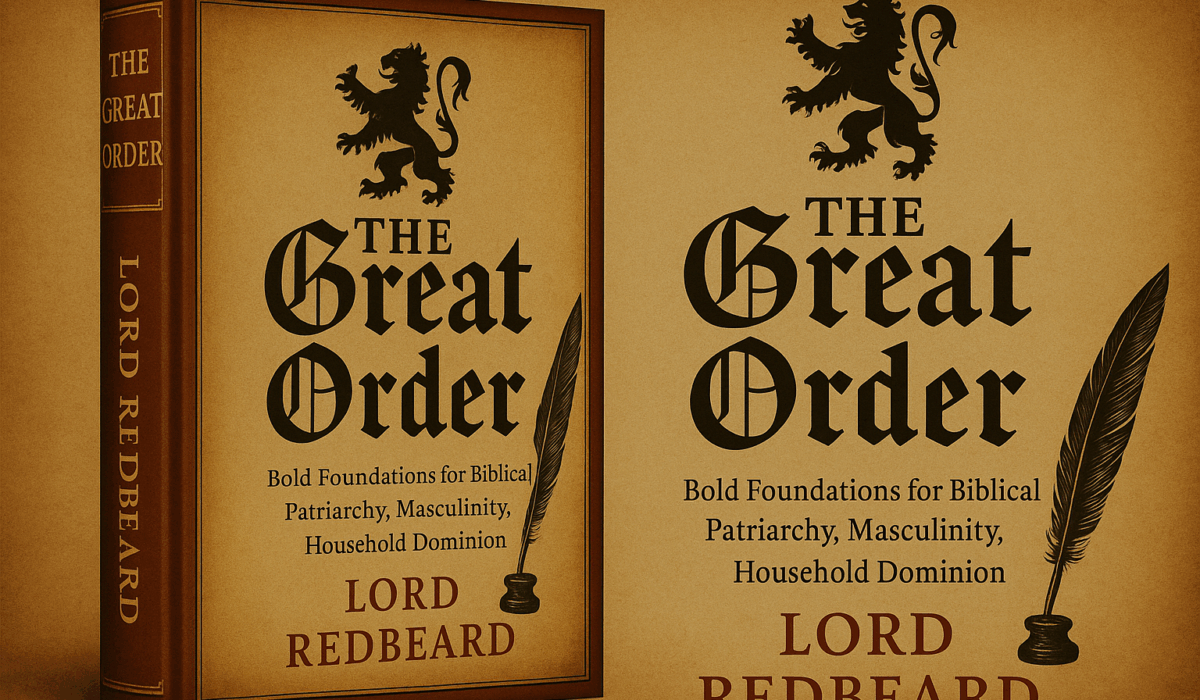
Announcing the Forthcoming Release of “The Great Order” by Lord Redbeard

Bold Foundations for Biblical Patriarchy, Masculinity, and Household Dominion

> “If the foundations be destroyed, what can the righteous do?”

— Psalm 11:3

We stand at the precipice of a collapsing world. The nations rage, the families crumble, the church is compromised, and the people groan under the weight of disorder. Men are passive, women are rebellious and children are untamed. The covenantal design of God’s order has been all but forgotten.

Yet from the ashes, a trumpet has sounded. A clarion call not of man’s wisdom but of divine truth — bold, ancient, and uncompromising.

That trumpet is The Great Order.

This book is not merely a work of writing. It is not a collection of random thoughts. It is a declaration. One forged through the fires of spiritual warfare, personal experience, obedience, and relentless pursuit of the Kingdom of God.

And now, by the providence and grace of the Most High, it is almost here.

A Work Birthed in Fire and Revelation

There are books that entertain, books that educate and books that simply pass the time. The Great Order is none of these. This is not a journalistic commentary on the state of the culture. This is not a casual opinion piece about the family.

This is a blueprint for dominion!

Every word in this book has been wrought through struggle, failure and triumph. Each sentence has been borne through prayer, sharpened through Scripture, and written through conviction. I did not merely choose to write this book, I was compelled, burdened and gripped by the Spirit of God with a vision too weighty to ignore.

> “The word of the Lord was in my heart as a burning fire shut up in my bones…”

— Jeremiah 20:9

I have lived these words, while often failing. I have been humbled by them, corrected by them, and built by them. They were not written in an ivory tower but forged in the trenches of real fatherhood, real household government, and real spiritual war. The Great Order is not theoretical, it is incarnational. It is truth that has been lived, tested, and proven by patriarchs since the beginning of written history. 

This book has not been filtered for cultural acceptance. It has not been softened for fragile ears. It is a sword, a plumbline, a trumpet blast for men to rise, women to embrace sacred roles, and families to become embassies of heaven.

 Why This Book Is a Threat to the World and a Balm for the Faithful

The world hates order, it mocks patriarchy, it despises submission and tears down hierarchy. This is no accident, Satan’s war has always been against God’s design. At the heart of that design is the household, governed by man, under Christ, filled with fruitful labor, and advancing the Kingdom through generations.

The Great Order is a threat to every demonic stronghold because it restores the very structure the enemy fears most,the Biblical family.

But this book is more than just a rebuke of the present. It is a balm for the faithful, a comfort to the remnant, a light to those wandering in the darkness of feminism, fatherlessness, and confusion. Many have felt the stirrings in their soul that things are not right, that the modern way is broken and that there must be more.

This book puts language to what the Spirit of God has already whispered in many hearts. It is a framework, a vocabulary,a standard.

In a generation that knows the truth instinctively but lacks the words to defend or articulate it, The Great Order gives voice to the righteous yearning buried in every God-fearing man and woman. It bridges the gap between conviction and communication, between the groaning of the soul and the clarity of truth.

Truths We Know But Cannot Articulate — Until Now

There are times when a man knows something is wrong, even though he cannot explain it. He sees a woman preach, and something in him recoils. He watches a child disobey his mother, and he feels disgust, he sees a home led by a career-focused wife and feels instinctively — this is disorder.

But if pressed, he cannot explain it. He cannot defend it, he cannot express it to his wife, to his children, to his church, to his peers. The conscience bears witness to God’s design. But the vocabulary has been stolen.

This is the plight of our generations, men and women raised without the theological framework or historical wisdom to articulate what they sense in their souls. We know disorder when we see it. We feel its destruction, but we have been robbed of the language to name it, and the courage to confront and profess it.

The Great Order restores that language. It articulates what you’ve always known, it puts steel in your spine and precision in your mouth. It enables fathers to teach their sons, it enables husbands to lead their wives, and enables shepherds to guard the flock. This book is not abstract,  it is accessible, practical, and potent.

It accomplishes the seemingly impossible: giving form to formless conviction, giving words to what was once only felt. It is the bridge between inner clarity and external boldness.

IV. The Structure of the Great Order: A Manual for Reconstruction

This is not a book of feelings. It is not a devotional. It is a war manual.

The Great Order is organized into chapters that walk step-by-step through the rebuilding of Christian civilization:

Biblical Patriarchy — restoring God’s government in the home.

Masculinity — dominion, not indulgence; strength through sacrifice.

Christian Polygyny — a weapon of revival and fruitfulness.

The Role of Women — sacred submission, homemaking, and generational building.

Family Government — fathers as kings, priests, and judges.

Household Economy — families as productive units, not consumers.

Education — indoctrinating children in righteousness.

Resistance — rejecting feminism, statism, and cultural apostasy.

The Church and the Household — integrating worship and dominion.

It doesn’t simply teach why we must return to Biblical order, it shows how. It is intensely practical, designed to be implemented. The principles in this book already form the foundation of households that have rejected compromise and chosen to live by the Law of God.

The Fruit of the Great Order: Revival, Peace, and Restoration

Revival will not come from stadiums, celebrity pastors, or emotional altar calls.

Revival begins at the dinner table!

It begins when a man takes his place as head of his home. When a woman repents of autonomy and embraces her role with joy. When children are trained in obedience, fear of God, and discipline. When homes become churches, the Sabbath is kept, and Scripture governs life.

The Great Order is not just about family. It is about national restoration.This book declares what few are willing to say: that peace cannot come until patriarchy is restored. That harmony cannot come until hierarchy is obeyed. That blessing cannot come until the household is ruled by God’s order.

This is not nostalgia, politics, or moralism, this is covenantal. When men obey the order of heaven, the result is peace on earth.

Children flourish.

Wives rejoice.

Men lead.

The poor are cared for.

The land is healed.

The nations tremble.

This is how we rebuild civilization — not by electing the right leaders, but by raising them in our homes.

 A Book for the Centuries to come:

The world writes books for entertainment, and the church writes books to sell but The Great Order was written to last, to stand the test of time.

This is not a trending topic, but a timeless template. It will be as relevant in five hundred years as it is today, because it is built on eternal truth. As long as the Word of God stands — and it will stand forever, this book will be a plumbline for the faithful.

When governments fall, the households guided by this book will remain!

When seminaries apostatize, the sons trained by this book will become shepherds!

When feminism collapses, the daughters raised by this book will rebuild homes!

The Great Order is not a one-generation manual. It is a multi-generational standard. It is written to be passed from father to son, from elder to disciple, from patriarch to patriarch. It is the blueprint for God’s covenant people to restore the ancient paths (Jeremiah 6:16). This book will outlast trends. It will outlast empires. Because it is built on the Rock.

Who This Book Is For

This book is not for everyone. It is not for cowards. It is not for cultural Christians. It is not for women who want to control men or men who fear responsibility.

This book is for fathers ready to rule their homes, wives ready to be crowned with honor, 

sons ready to build legacies, daughters ready to prepare for homemaking. It is for shepherds ready to reform their flocks, remnant believers ready to live counter-culturally, and seekers ready to repent and submit to God’s order.

If you are tired of the lies. If you know there’s more. If you feel the conviction but lack the clarity. If you want to plant trees under whose shade your great-grandchildren will sit — then this book is for you.

What to Expect in the Coming Release

The release of The Great Order will be more than a publication. It will be a launch. A declaration of war. A rallying point for households across the earth who are tired of compromise and ready to build.

The book will be released in softcover initially, with hardcover, audiobook, and digital formats planned for the near future. This is more than a book. It is a movement.

The website LordRedbeard.com will serve as the command center — featuring articles, updates, resources, and an ever-growing library or resources for covenant households.

Let the Patriarchs Rise

We are not waiting for revival, we are building it. We are not waiting for the world to wake up, we are establishing households that shine as light in the darkness. We are not waiting for permission, we have a mandate.

God is raising up a remnant of men — fathers, brothers, sons — who will not bow to Baal. They will not kneel to feminism, and will not compromise with the world.

They will build, marry, multiply and they will reign!

And when the Lord returns, He will find not a scattered, weak, feminized people — but an ordered people. A governed people. A glorious bride.

The Great Order is the trumpet.

The time for excuses is over.

Let the patriarchs rise.

Let the women rejoice in their submission and glory.

Let the children be trained as arrows.

Let the households become kingdoms.

Let the dominion begin.

Are you ready?

The Great Order is coming, get your house ready, train your sons, teach your daughters, insure that your name is found among the builders!

Prepare your household, clear your calendar, sharpen your mind and fortify your heart.

The time has come.

The standard has been raised.

The restoration has begun.

Let the Great Order rise and be restored!

Soli Deo Gloria.

Why a Woman Must Always Be Under Headship: The Unbreakable Design of God

Modern Christianity has adopted many lies, but none more destructive than the idea that a woman can, and should, be autonomous. The culture prizes the “independent woman.” The church parrots the same mantra in softer tones. But Scripture knows nothing of this. God never created women to stand alone. She was made for order, and she flourishes under headship.

A woman is required by God to be under male authority at all times, from her father’s house, to her husband’s house, and in some cases under the governance of church elders. This is not optional. It is not conditional. It is not a matter of preference. It is a covenantal design, etched into creation and enforced by divine command.

“But I would have you know, that the head of every man is Christ; and the head of the woman is the man…”
1 Corinthians 11:3

This structure is not cultural, it is creational. It is not bondage, it is blessing. And when it is violated, chaos, heartbreak, and destruction follow.

I. Headship in Creation: Woman Was Made for the Man

We must begin where God begins: in Genesis. Adam was made first, formed from the dust by the breath of God. He was given a mission—to take dominion. But God said, “It is not good that the man should be alone; I will make him an help meet for him.” (Genesis 2:18)

The woman was not made as a co-leader. She was not designed as an independent entity to explore her identity. She was made for the man, from the man, and to the man.

“For the man is not of the woman; but the woman of the man. Neither was the man created for the woman; but the woman for the man.”
1 Corinthians 11:8–9

This is the creation order, and it never changes. A woman, by nature and design, must be under the loving rule of godly headship. When she is, she is protected, fruitful, and secure. When she is not, she is vulnerable, unstable, and easy prey for deception.

This is not conjecture. This is exactly what happened in Eden.

II. The Fall: What Happens When Headship Is Abandoned

In Genesis 3, the serpent bypassed the man and went to the woman. He inverted God’s order. And Adam, instead of protecting and ruling, abdicated his role. Eve was deceived. Adam was derelict. And humanity fell.

“And Adam was not deceived, but the woman being deceived was in the transgression.”
1 Timothy 2:14

This is not an insult to women, it is a divine warning. When a woman steps outside of headship, she is in danger. When a man steps away from authority, he invites judgment.

Headship is not a human construct. It is a spiritual defense system, and when it is removed, the home collapses, the culture deteriorates, and the church weakens.

III. A Woman’s Three Primary Headships

Biblically, a woman is to be under male authority throughout the entire course of her life:

1. The Father

“And ye shall teach them your children, speaking of them when thou sittest in thine house…”
Deuteronomy 11:19

From birth, a girl is under the governance of her father. He is to train her, protect her, and guard her purity. He is responsible to keep her from danger—whether moral, spiritual, or relational.

In Numbers 30, God gives laws governing the vows of women. If a daughter makes a vow and her father hears it and disallows it, the vow is nullified. Why? Because she is under his jurisdiction.

“If a woman also vow a vow unto the Lord, and bind herself by a bond… being in her father’s house… and her father disallow her… then shall the Lord forgive her.”
Numbers 30:3–5

This is legal headship. Fathers are not optional. They are God’s appointed guardians for daughters.

2. The Husband

“Wives, submit yourselves unto your own husbands, as unto the Lord. For the husband is the head of the wife…”
Ephesians 5:22–23

When a woman marries, headship passes from father to husband. She is no longer her father’s responsibility. She becomes her husband’s charge, and she is to obey him as the church obeys Christ.

“Even as Sara obeyed Abraham, calling him lord.”
1 Peter 3:6

This is not poetic, it is prescriptive. A woman does not lose value under authority; she gains security, direction, and honor.

3. The Eldership (in cases of widowhood, orphanhood, etc.)

When a woman has no husband and no father, she is not to drift alone. She comes under the elders of the church, the patriarchs of the community.

“Honour widows that are widows indeed… Let not a widow be taken into the number under threescore years old, having been the wife of one man…”
1 Timothy 5:3–9

The early church had rules and order for widows, indicating that even in their singleness, they were not to function independently. They were under the governance of the patriarchal church, and the younger widows were exhorted to remarry (1 Timothy 5:14).


IV. The Dangers of Female Autonomy

When women are not under headship, the results are devastating:

  • Sexual sin abounds. Young women without oversight are easy prey for seduction and fornication.
  • Feminism takes root. Women begin to believe they are their own authority.
  • Children are raised fatherless. Single mothers often reject correction and multiply generational disorder.
  • Churches are disrupted. Uncovered women bring emotional chaos and spiritual confusion.

“Woe unto them that are wise in their own eyes, and prudent in their own sight!”
Isaiah 5:21

Headship is not oppression. It is protection. It keeps a woman from the deceit of Satan and the judgment of God.


V. What About Special Cases?

1. The Divorced Woman

Divorce does not grant a woman independence. It places her in a vulnerable state, one that Scripture addresses soberly. If the divorce was lawful (on grounds of adultery or abandonment by an unbeliever, Matthew 5:32, 1 Corinthians 7:15), she may remain unmarried or be reconciled to her husband. But she is not now a “free agent.”

She should:

  • Come under patriarchal church leadership for spiritual covering.
  • Pursue re-marriage if it is biblically permitted.
  • Raise children in submission to godly counsel.

She is not the head of her house. If she has sons, they must be trained under male discipleship. If she has daughters, they must be shielded from repeating her mistakes.

2. The Widow: Still in Need of Covering

Widowhood is not an exception to God’s established order. Though the husband has passed, the woman’s need for headship remains. Scripture makes it clear: no woman, regardless of age or circumstance, is ever meant to live without covering.

Young Widows: Called to Remarry

Paul gives direct instruction in 1 Timothy 5:14:

“I will therefore that the younger women marry, bear children, guide the house, give none occasion to the adversary to speak reproachfully.”

Young widows are not to remain alone, idle, or without direction. Paul warns that widows who remain uncovered are easily drawn into gossip, idleness, and temptation (v. 13). Remarriage is a divinely appointed path back into structure, protection, and fruitful labor within a man’s household. Headship is not optional for young widows, it is necessary for their holiness and the Church’s honor.

Older Widows: Honored, Not Autonomous

Older widows, those proven in faith and good works, are to be honored by the Church (1 Timothy 5:3, 9–10), yet they are still not independent. They remain under the spiritual covering of the church body and its male leadership. Their new role becomes one of discipleship, as Paul outlines in Titus 2:3–5:

“The aged women… that they may teach the young women to be sober, to love their husbands, to love their children… obedient to their own husbands.”

They are not liberated from order; rather, they become defenders and instructors of it.

Temporary Submission to Godly Headship

In cases where remarriage is delayed or not immediately possible, a widow may willingly submit herself to the oversight of a godly male relative, elder, or spiritual father. This kind of voluntary submission reflects the principle of headship and preserves her covering until a new marriage is rightly formed. Just as Ruth submitted herself to Boaz’s authority and provision before becoming his wife (Ruth 2:8–12), so too may a widow dwell under the shadow of a righteous man’s protection, so long as it is done in purity and order.

Never Without a Head

The Church is also called to care for and govern widows, not simply offer charity but oversight (James 1:27). A woman without a husband must not drift into spiritual autonomy. She must remain accountable and under the rule of godly men, either through remarriage or temporary oversight by the elders or righteous male leadership in her life.

The death of a husband is not the death of God’s design. Headship is not a marriage feature, it is a feminine necessity. Widowhood is a shift in placement, not a suspension of submission.

No woman, including the widow, is ever meant to be her own authority. God’s pattern does not break in crisis, it stands unshaken.

3. The Orphaned or Unmarried Daughter of a Non-Christian Home

A young woman raised outside of the faith must not interpret her background as justification for independence. If her father is unbelieving, she must:

  • Submit under spiritual fathers, church elders, pastors, or godly men in the community.
  • Pursue biblical courtship under spiritual authority, not casual dating or autonomy.
  • Be adopted into the household of God, where she is no longer a lone sheep but part of a covenant flock.

Even in pagan cultures, daughters were understood to belong to their fathers until given in marriage. The modern Western idea that a woman is “on her own” at 18 is rebellion disguised as liberty.


VI. Historical Witness

Throughout Church history, the principle of continuous female headship was unquestioned:

  • In early Israel, a daughter’s virginity was the father’s responsibility (Deuteronomy 22:13–21).
  • In medieval Christendom, daughters could not marry without paternal approval, and widows were overseen by church authorities.
  • Reformers like John Calvin and Martin Luther emphasized the father’s authority in arranging godly marriages and condemned female independence as prideful and disorderly.
  • Puritan families in early America treated daughters as part of the household government until they were transferred in marriage.

It is only in recent history, with the rise of Enlightenment individualism and second-wave feminism, that we see the normalization of female autonomy, a disaster for faith, family, and civilization.


VII. The Blessing of Headship

When a woman is properly covered by male headship, the result is fruitfulness, peace, and joy.

  • She does not carry the burden of spiritual leadership.
  • She is defended from predators and wolves.
  • She is directed in righteousness.
  • She is shielded from emotional instability and deception.
  • She glorifies God by knowing her place and delighting in it.

This is not humiliation, it is holy order. It is not shameful, it is sacred.

“Let the woman learn in silence with all subjection.”
1 Timothy 2:11

This kind of subjection brings honor, protection, and praise. A woman who abides under headship is a builder of nations, a nurturer of kings, and a daughter of Sarah.


Conclusion: Always Covered, Always Blessed

The lie of female autonomy has destroyed generations. It has produced bitterness, barrenness, fatherlessness, and faithlessness. But the Lord calls women back, not to self-rule, but to submission.

Whether a daughter, a wife, a widow, or a woman rescued from the ruins of rebellion, every godly woman must be under righteous headship at all times.

Fathers, cover your daughters.
Husbands, lead your wives.
Elders, shepherd the uncovered.
And women, rejoice to be ruled.

You were not made to be alone. You were made to be covered.
And under that covering, you will be blessed, fruitful, protected, and glorified.Let the feminists rage.
Let the church grow bold.
Let the Great Order be restored, one household at a time.

Cats Instead of Children: The Consequences of Careerism

In the modern West, a striking symbol of cultural inversion is the image of the single, professional woman cradling a cat rather than a child. It’s not merely a humorous meme—it’s a sociological reality that reflects a deep shift in values, priorities, and understanding of womanhood.

The Career as a New Identity

For much of human history, a woman’s primary domain was the household—a place of immense dignity, productivity, and influence. She nurtured life, shaped souls, and stewarded the future of her lineage. But with the rise of feminism and the industrial-technocratic model of life, women were told that their value could only be found outside the home. They were sold the idea that true fulfillment comes through career advancement, salary increases, and corporate achievements.

In this paradigm, children—especially young ones—are seen not as blessings, but as burdens. They are interruptions to productivity, threats to “freedom,” and liabilities to a woman’s upward mobility. The result? Delayed marriage, widespread infertility, and plummeting birthrates. Instead of lullabies, the halls of modern apartments echo with the meows of feline companions.

Cats Require No Sacrifice

A child requires immense sacrifice. Sleepless nights, constant attention, financial commitment, and the long, slow work of shaping another soul. It demands laying down one’s life daily. But a cat is convenient. Feed it, give it a litter box, and carry on with your life. It offers companionship without the demand of legacy. It scratches the emotional itch without requiring covenant or continuity.

This trade—life for lifestyle—is perhaps the clearest indictment of modern womanhood. In choosing cats over children, many have traded motherhood for momentary comfort. But cats don’t carry on a name. They don’t build households. They don’t honor their mother in old age or bear grandchildren.

The Feminist Promise Was a Lie

Feminism promised women “choice”—but in practice, it shamed traditional motherhood and elevated careerism as the only path to worth. The woman who chooses to bear many children, keep a home, and support her husband is often mocked as “wasting her potential.” Meanwhile, the woman who climbs the corporate ladder, drinks wine alone, and has a cat to come home to is celebrated by media as empowered.

But empowerment has come at a steep cost. Millions of women now find themselves in their 30s and 40s—lonely, childless, and deeply unfulfilled. Their fertility has faded, their relationships have withered, and their youth has been spent chasing the approval of bosses who replaced them with younger workers without a second thought.

A Culture Without Children Is a Dying Culture

When women stop having children, a nation stops having a future. The cat-as-child phenomenon is not just a personal tragedy—it’s a civilizational crisis. No generation can continue if its women reject the role of life-bearer. The womb, once seen as sacred, is now suppressed through pills, surgeries, and ideologies. But biology doesn’t bend to ideology. A woman’s body longs to nurture life, and when that drive is denied, it finds twisted replacements—whether through animals, activism, or artificial distractions.

The Path Back: Restoring the Dignity of Womanhood

The answer is not to shame women, but to call them back to glory. True femininity is not found in boardrooms or cubicles—it is found in the embrace of a newborn, the aroma of bread in the oven, the warmth of a family shaped by a wise and joyful mother. Careers can be replaced; children cannot. Promotions are temporary; legacy is eternal.

A godly woman does not need to prove herself by mimicking men. She flourishes in her God-given role as life-giver, nurturer, and queen of the home. This is not oppression. It is sacred dominion.

The Keeper of the Table: A Wife’s Duty in Nourishment, Frugality, and Dominion Over the Household Food Economy

The table is not just a place of eating. It is a place of worship, formation, and covenantal joy. The aroma of daily bread, the sight of a garden harvest, and the discipline of wholesome meals are not secondary to Christian living, they are vital expressions of order, stewardship, and feminine strength.

In a godly household, the wife is the keeper of the table. She governs not only the aesthetics of hospitality but the substance of nourishment. Her duties in food, nutrition, and frugality are not mundane tasks, they are holy responsibilities entrusted to her by God to bless her husband, raise strong children, and honor the covenantal home.

I. Food Preparation as a Sacred Ministry

From the earliest pages of Scripture, food preparation has been a domain of feminine care and virtue. Abraham’s wife, Sarah, “quickly kneaded three seahs of fine flour” to serve their angelic guests (Genesis 18:6). The Proverbs 31 woman “brings her food from afar” (Proverbs 31:14) and “rises while it is yet night to provide food for her household” (v.15). She is not idle, and her hands are diligent in feeding those under her care.

Food preparation is not a secular task. It is a form of love. When a wife prepares nourishing meals, she is doing more than satisfying hunger, she is building the bones and minds of future generations. She is creating an atmosphere of peace and stability. She is turning raw ingredients into sustenance for warriors and worshippers.

“She looks well to the ways of her household and does not eat the bread of idleness.”Proverbs 31:27

This ministry of nourishment is daily. It is repetitive. It is sacrificial. But it is glorious. A wife who governs the kitchen with wisdom and joy brings strength to her home, honor to her husband, and delight to her Creator.

II. Whole Food for Whole Families: Rejecting Industrial Poison

In modern times, food has been hijacked by industry and perverted by convenience. Processed sugars, chemical preservatives, seed oils, and hyper-palatable junk have replaced the God-given simplicity of grains, vegetables, legumes, and fresh produce. This shift has not only sickened bodies but has weakened wills, dulled minds, and sapped the energy of Christian homes.

A godly wife must resist this tide. She must take dominion over the kitchen, not by outsourcing it to fast food or microwaves, but by returning to whole food principles that nourish rather than harm.

  • Replace sugar with honey and fruit.
  • Replace refined flour with whole grains.
  • Eliminate junk snacks, sodas, and boxed meals.
  • Cook from scratch with rice, beans, seasonal produce, and clean meats.

The goal is not gourmet extravagance, it is wholesome simplicity. Meals built from God’s earth. Meals that are filling, healing, and strengthening.

“Whether you eat or drink, or whatever you do, do all to the glory of God.” – 1 Corinthians 10:31

The body is a temple (1 Corinthians 6:19). Feeding that temple with poison is an act of defilement. A godly wife understands this. She treats food not as a comfort drug or a hobby, but as a sacred trust.

III. Frugality and Creativity: Dominion Without Debt

The wise woman is not only a good cook, but she is also a skilled economist. She manages the food budget with shrewdness and foresight. She does not chase trends or waste money on convenience. She learns the art of frugality, not out of poverty, but out of purpose.

“She perceives that her merchandise is profitable.”Proverbs 31:18

In a time of inflation and supply chain instability, the wife who knows how to stretch meals, avoid waste, and creatively repurpose leftovers is a treasure. She buys in bulk. She plans meals in advance. She stores surplus. She prepares for lean seasons.

This frugality is not scarcity; it is abundance through wisdom. The family that eats rice and lentils for lunch, fresh bread for dinner, and garden vegetables for supper is eating better than the household living on frozen pizza and debt.

Such a wife becomes the financial gatekeeper of the home, ensuring that dominion is built not only through income, but through intelligent consumption.

IV. Supplementing with Gardening: Cultivating Eden at Home

In an era where even food is politically weaponized and biologically manipulated, many families are returning to gardening, not as a hobby, but as a necessity. A wife with a garden is a wife who brings Eden into her backyard. She becomes a producer, not just a consumer.

  • Lettuce, kale, and spinach for fresh greens.
  • Tomatoes, zucchini, and beans for seasonal staples.
  • Herbs like basil, oregano, and rosemary for flavor and health.
  • Potatoes, carrots, and onions for long-term use.

Gardening builds resilience. It teaches children responsibility. It reduces dependency on globalist systems and empowers the home to feed itself.

The Proverbs 31 woman “considers a field and buys it; with the fruit of her hands she plants a vineyard” (v.16). Likewise, the modern Christian wife should reclaim gardening as an act of dominion. Whether in pots on an apartment balcony or rows in a country yard, let her plant, harvest, and glorify God.

V. Preserving and Storing: Wisdom for Times to Come

In addition to daily meals, the virtuous woman thinks seasonally and strategically. She does not wait for winter to prepare. She preserves food. She stores dry goods. She builds a pantry as a bulwark against uncertainty.

“The wise store up choice food and olive oil, but fools gulp theirs down.”Proverbs 21:20 (NIV)

This includes:

  • Canning fruits, vegetables, and sauces.
  • Dehydrating herbs and meats.
  • Freezing harvests and broths.
  • Stockpiling rice, beans, flour, and salt.

This is not fear, it is foresight. Noah built the ark before it rained. Joseph stored grain before the famine. Likewise, the godly wife builds a food reserve, not to hoard, but to provide, even in times of trouble.

A home with shelves of home-canned peaches, dried herbs, buckets of oats, and fresh bread is a home that testifies to wisdom and love.

VI. Bread from Her Hands: The Daily Offering

Among the most ancient and powerful acts of feminine provision is the baking of bread. The Proverbs 31 woman “brings her food from afar,” and “her hands hold the spindle.” She is industrious in nourishing her household.

Daily bread is not merely food, it is a symbol of divine provision. Christ taught us to pray, “Give us this day our daily bread” (Matthew 6:11), because bread represents the essentials of life, humble, sustaining, fresh.

When a wife bakes bread daily, she embodies this principle. The home is filled with aroma and warmth. Children grow up with the memory of kneading dough beside their mother. Husbands are strengthened by their wife’s labor.

Simple loaves made from flour, salt, water, and yeast become sacraments of love. They are cheaper than store bread, healthier, and laden with meaning.

VII. Lessons from Early America: Strength Through Simplicity

Modern families could learn much from the agrarian households of early America. In the 1700s and early 1800s, meat was a rare luxury, not a daily staple. Sugar was scarce, used sparingly if at all. Meals consisted of:

  • Porridge and cornmeal mush
  • Root vegetables like turnips and potatoes
  • Beans, lentils, and seasonal greens
  • Bread made at home
  • Apples, preserved fruits, or wild berries

Despite the simplicity, these families were stronger, physically and mentally. Obesity was rare. Disease was less rampant. Children were hardy. And meals were sacred events, not hurried inconveniences.

Modern science confirms this. Diets high in sugar and processed food are linked to inflammation, heart disease, obesity, and depression. Returning to simple, whole foods is not nostalgic, it is righteous stewardship.

A wife who learns from the past is not regressive, she is wise. She sees that the way forward may mean reaching backward to principles that sustained generations before us.


Conclusion: The Hand that Feeds Rules the Home

The wife is not just a cook; she is a nourisher of nations. Through her hands, children grow strong, husbands are blessed, and guests are welcomed. Through her wisdom, the budget is guarded, the pantry is filled, and health is preserved.

She does not need a professional degree to rule the kitchen, only fear of the Lord, joy in her calling, and skill in her hands. She sees food not as a chore, but as a ministry. She understands that feeding the family is a matter of worship, not mere routine.

In this age of dietary chaos and culinary idolatry, let the Christian wife rise and take dominion over the kitchen. Let her plant, cook, preserve, and prepare, not just meals, but warriors, worshipers, and wise women.

Let her say with joy each evening, as her husband blesses the food, her children gather around the table, and the bread is broken:

“This is the portion the Lord has given me to tend, and I will do it with strength and love.”

The Garments of Rebellion: Why Women Must Not Wear Pants

Clothing is not neutral. It is theology in textile. It proclaims order or defies it. It reflects reverence or rebellion. And in the long war against Biblical patriarchy, there is perhaps no more symbolic battlefield than the modern woman’s closet.

In this age of inversion—where men are weak and women are loud—our generation has forgotten even the most basic distinctions of God’s created order. One of the clearest? That a woman must not wear that which pertains to a man.

“The woman shall not wear that which pertaineth unto a man, neither shall a man put on a woman’s garment: for all that do so are abomination unto the Lord thy God.”
—Deuteronomy 22:5

This is not a suggestion. It is not cultural. It is not optional. It is a commandment from the mouth of Almighty God. And it still applies today.

The issue of women wearing pants is not about fashion. It is about headship, holiness, and health. It is about whether we will serve the Lord or follow the patterns of the pagan world. And the cost of ignoring it has been devastating—morally, spiritually, medically, and socially.

Let us walk through the evidence—Scriptural, historical, medical, and social—and let every woman who fears the Lord return to modesty, and every man who loves his household restore order at the gate.


I. Scriptural Foundation: God Commands Distinction

The Biblical worldview is built on order and separation.

God separates light from darkness (Genesis 1:4).
He separates the waters from the firmament (Genesis 1:6).
He separates the clean from the unclean (Leviticus 10:10).
He separates Israel from the nations (Leviticus 20:24).
And He separates male from female—in role, responsibility, and appearance.

Deuteronomy 22:5 does not mince words: for a woman to wear what pertains to a man is abomination. Not simply disobedience—abomination. The Hebrew word used is to‘ebah, the same word used for witchcraft, homosexuality, and idolatry.

This means that cross-dressing is not just inappropriate—it is profane.

Nowhere in Scripture are pants prohibited. That is not the argument. The argument is this: pants were historically male attire, and women began wearing them not from righteousness, but from rebellion.

Thus, when women began donning trousers, it was not to honor God, but to cast off His design.


II. Historical Dress: The Distinction Was Clear

For over 9,000 years of human history, men and women dressed differently. Always.

  • In ancient Israel, men wore tunics girded with belts for mobility, and women wore long, flowing robes distinct in cut and modesty.
  • In Greco-Roman cultures, men wore shorter tunics for labor and travel, while women wore longer stolas and peplos, modest and covering.
  • In Medieval Christendom, men wore hose and breeches, women wore long gowns.
  • In Victorian and Reformation-era Europe, a woman in trousers would have been regarded as mentally ill, immoral, or both.

Even in the early American colonies, modesty and gender distinction were unquestioned. The Puritans, the Baptists, and the early settlers knew that attire was theological. A woman in pants would be rebuked or excommunicated.

The Rise of Pants on Women: A History of Rebellion

It wasn’t until the mid-1800s that women first publicly began wearing trousers—through the influence of feminists and radicals.

  • Amelia Bloomer, a feminist activist, promoted the “bloomer costume”—pants for women—explicitly to break gender norms.
  • The suffragette movement and first-wave feminists used male clothing as a symbolic protest against male authority.
  • By the 1940s, during World War II, women wore trousers in factories out of necessity—but many kept them post-war.
  • By the 1960s, with the sexual revolution, women’s pants became a symbol of liberation from patriarchy, modesty, and Christian morality.

Make no mistake: the acceptance of women wearing pants was part of a broader rebellion against Biblical womanhood. It paralleled the rise of abortion, birth control, sexual promiscuity, divorce, and feminism.


III. Christian Testimony: The Church Once Stood Firm

Until the late 20th century, most Christian denominations opposed women in pants.

  • The Methodists, in early America, taught that women wearing “men’s garments” brought shame upon the church.
  • Southern Baptists in the 1950s preached that modesty and femininity excluded pants for women.
  • Pentecostals and Holiness movements retained skirts-only standards well into the 1990s, citing Deuteronomy 22:5 and modesty concerns.

Why did they care? Because clothing is a signal of submission to God’s order. When a woman dressed like a man, she was not just imitating his fashion—she was usurping his role.

The decay of modest dress paralleled the decay of the Christian household. When women dressed like men, they soon began to live like men—leaving the home, rejecting headship, avoiding motherhood, and abandoning submission.


IV. Modesty and Covering: The Role of Garments in Holiness

In Genesis 3:21, after the fall, God made garments of skins to clothe Adam and Eve. The Hebrew word kĕthoneth refers to a tunic covering the shoulders to the knees at minimum.

This was not fashion—it was a spiritual response to sin.

Throughout Scripture, garments are used to signal:

  • Holiness vs. uncleanness (Leviticus 13:47)
  • Office and authority (Exodus 28:2, priestly garments)
  • Shame or honor (Isaiah 47:2-3)

Pants—by their form-fitting structure—expose, rather than conceal, especially on the female form. They draw attention to the thighs, hips, and private areas—exactly what Biblical modesty seeks to conceal, not emphasize.

Isaiah 47:2–3 rebukes Babylon:
“Take the millstones, and grind meal: uncover thy locks, make bare the leg, uncover the thigh… Thy nakedness shall be uncovered, yea, thy shame shall be seen.”

God equates uncovering the thigh with shame. Pants, by their design, outline the thigh. This is not modesty. It is provocation. Even when paired with long tops, the core issue remains: pants are not feminine nor modest.


V. Health Concerns: Medical Risks of Pants for Women

Beyond the Scriptural and symbolic concerns, modern medical research shows that pants—especially tight ones—are harmful to female health.

1. Bacterial Vaginosis (BV) and UTIs

  • Tight pants restrict airflow and trap moisture—creating a warm, dark, damp environment ideal for bacterial overgrowth.
  • Studies have shown a correlation between wearing pants and 300%-600% increased risk of bacterial vaginosis, yeast infections, and urinary tract infections (UTIs).
  • According to the Journal of Lower Genital Tract Disease, women who wore tight jeans or pants for over 4 hours daily had significantly higher rates of BV and UTIs.

2. Polycystic Ovary Syndrome (PCOS) and Hormonal Disruption

While PCOS is primarily a hormonal condition, tight clothing—especially around the waist and hips—will exacerbate symptoms by:

  • Disrupting circulation to reproductive organs
  • Increasing cortisol and insulin sensitivity
  • Restricting lymphatic drainage

The British Journal of Obstetrics and Gynaecology noted that waist-restrictive clothing increased ovarian stress in women with pre-existing endocrine disorders.

3. Infertility and Miscarriage Risk

Chronic pressure around the pelvic area has been linked to:

  • Reduced blood flow to the uterus
  • Thermal damage to reproductive organs
  • Increased miscarriage risk, especially in early gestation

Dr. Niels Lauersen, author of “It’s Your Body”, reported that women wearing tight pants and synthetic undergarments experienced higher rates of infertility and irregular cycles.

4. Skin and Nerve Damage

  • Tight pants can cause “meralgia paresthetica,” a nerve compression condition that leads to numbness, tingling, and burning in the thighs.
  • They also increase the likelihood of folliculitis, ingrown hairs, and skin fungal infections, especially in hot or humid climates.

In short: pants were never designed for the female body. They compress, restrict, and expose, exactly the opposite of God’s design for a woman’s covering.


VI. Psychological and Social Impact: Clothing Shapes Identity

Psychologists refer to “enclothed cognition”—the idea that clothing not only expresses but shapes how we think, feel, and behave.

When a woman wears pants:

  • She often feels more aggressive and assertive
  • She adopts a masculine posture and stride
  • She is more likely to challenge male authority
  • She is treated differently—less like a nurturer, more like a peer or competitor

This is not an accident. It’s by design. Feminists embraced pants because they understood that clothing alters self-perception. The woman in a dress moves more gently, behaves more modestly, and signals submission—whether she realizes it or not.

When we clothe our daughters in pants, we teach them that gender is flexible, submission is optional, and order is negotiable. We sabotage their future before they even understand their calling.


VII. The Way Forward: Return to Distinct, Modest, Feminine Dress

We are not simply calling women to wear skirts. We are calling them to embrace:

  • God’s created order
  • Visible submission to headship
  • Reverence in attire
  • Health and holiness

A Biblical woman’s clothing should:

  • Cover her from shoulder to the ankle
  • Avoid tight, sheer, or form-exposing material
  • Distinguish her clearly from male attire
  • Proclaim modesty, meekness, and dignity

“In like manner also, that women adorn themselves in modest apparel, with shamefacedness and sobriety…”
—1 Timothy 2:9

Godly women are not ashamed of modesty. They rejoice in it. They know that their beauty is not in the outline of their thighs, but in the hidden man of the heart (1 Peter 3:4).


VIII. Fathers and Husbands: You Will Give Account

Men, this begins with you. Your wife and daughters are not fashion experiments. They are your household, your responsibility, your glory.

You will stand before God for how they dress. You are to teach, protect, and lead. If your wife is wearing leggings in public, your failure is visible to the world. If your daughter is wearing tight jeans, you are permitting disorder.

It is time to take back authority. To speak plainly. To restore the ancient standards.

Let your house reflect heaven, not Hollywood.


IX. Common Objections Answered

“But pants are modest if they’re loose!”
Not if they pertain to a man. Deuteronomy 22:5 does not say “immodest clothing”—it says man’s clothing. Even loose pants confuse the gender distinction.

“It’s a cultural thing.”
No. It is a creation thing. The command in Deuteronomy is rooted in God’s design of male and female. Culture cannot override creation.

“God looks at the heart.”
Yes—and the heart that loves God obeys His commands, including in outward dress.

“But I feel more comfortable in pants!”
So did the feminists. So do rebels. Comfort is not the standard—obedience is.


X. Let the Daughters Be Clothed in Glory

We do not call women to wear skirts because of nostalgia. We call them because Scripture commands distinction, history affirms modesty, and health demands covering.

The rebellion of pants must end.

Let the daughters of Zion be known by:

  • Their humility
  • Their holiness
  • Their honor
  • And their visible submission to God’s order

Let the wives of Christian men walk in dignity, not in defiance. Let the households of the righteous proclaim by their clothing: We will serve the Lord.

And let the world see that in a sea of confusion and compromise, there remains a remnant, unashamed, unbending, and unafraid.

Let the skirts flow.
Let the thighs be covered.
Let the husbands lead.
Let the daughters rejoice.
Let modesty return.
Let the Great Order rise again!

Soli Deo Gloria.

Is God a Globalist or a Nationalist?

Is God a Globalist or a Nationalist? I’m sure most modern Churches and Christians would contend that he is a Globalist, that he does not see race/creed/nation/culture etc. If so then why did he create these defining characteristics?

If you have children, family or even close relatives that live with you, it’s fair to assume you love them more than you love relatives other non-related families.

That doesn’t mean you hate other families, does it? You can have “empathy, compassion, and understanding” for your friends, neighbors and even total strangers without having them live in your house.

That’s because it’s your house. You may let people come in from time to time, as guests, or maybe even for an extended stay if they are suffering in some way, you may even allow them to join your family on a long term basis provided certain terms are set and boundaries established. But it is still your house, not theirs.

It’s the same with nations. Nations are people, not governments, just as a family is the people of the household, not the household rules. A Nation is your “Extended” family.  The word Nation is literally in reference to the nationality of it’s people.

A nation like America can have “empathy, compassion, and understanding” for other nations, particularly if those nations are suffering in some way, but the “house” still belongs to the Americans. “Nationalism” requires no hatred for other nations. It just clarifies who owns the house. The Indians own India, the Japanese own Japan, the Africans own Africa and the Americans own America.

But God is certainly no globalist. Surely He loves all the people of the globe, for He created them all. He loves the genuine diversity that exists in the variety of cultures, languages, and skin colors that He created to be different on purpose. But in terms of how those many diverse nations relate to each other, God is in fact a nationalist.

That does not mean we can sign God up for our political parties or pet projects. Far from it. It merely means from beginning to end, His Word speaks of the nations as nations, calls them to serve Him as nations, sets their borders, provides for the protection of those borders, and for the ultimate healing of those nations.

He clearly acts to disrupt globalist projects like the Tower of Babel, where the nations tried to live together in a globalist/multicultural empire. Against this globalist attempt, God scattered them into distinct nations with their own distinct cultures and languages.

Do we think ourselves wiser than God? He says explicitly in the Bible that He created diversity out of unity (the nations from the blood of one man), and that He sets the boundaries or borders where they are to live. Why? So that they will be better able to seek after Him and find Him:

“God…has made from one blood every nation of men to dwell on all the face of the earth, and has determined their pre-appointed times and the boundaries of their dwellings, so that they should seek the Lord, in the hope that they might grope for Him and find Him, though He is not far from each one of us….” (Acts 17:26–27)

Globalism/multiculturalism is clearly not God’s plan, insisting that all these different people live together in the same house (nation), thus destroying the beauty of all their individual nations, cultures and amazing diversity. The result is the opposite of what God said would happen when we respect national borders: the nations find it much harder to seek and find God.

So this begs the question, what nationality is America? we are ethnically, linguistically, historically, culturally, and religiously European. For the purposes of this writing Jesus was from Israel, to be sure, which is not in Europe. He is not a European (nor is He African). He is what most would call Middle Eastern. He is an Israelite, a son of David and Abraham. We are also a Christian Nation. the New Testament has a surprisingly European foundation. It’s written, not in Hebrew, but in a European language (Greek). The Son of God appeared in the midst of a European empire, and the Gospel was carried on European roads and in European ships. Paul was redirected from further eastward missionary activity by a vision of a European man. And the one man who wrote more of the New Testament than any other was Luke, a European.


These facts give us no cause to boast, but rather to be humble and thankful. Historically, so far, “the faith is Europe, and Europe is the faith,” as Hilaire Belloc put it. We should harbor no animosity toward people who look, live, or speak differently than us. We should pray for peace among all the nations, and for the love and truth of Christ to bring healing to every people on the face of the earth. We should treasure the unique cultures of every people and want them to be protected and preserved as God created them.

But again, our primary focus should be our own people and our own nation, as that is our duty to our families, children, neighbors and to God.

Therefore, Globalism/Multiculturalism, among other things, hinders the work of the Great Commission and proves that God is in fact a Nationalist!

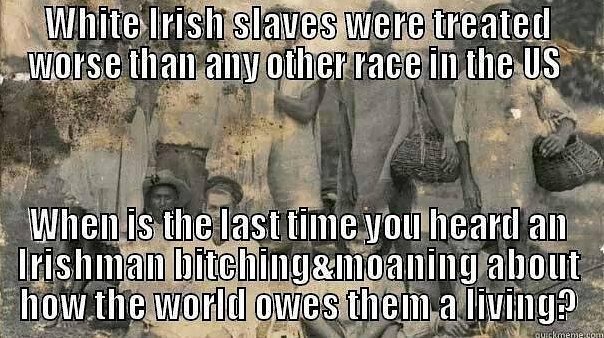
Irish Slave Trade

They came as slaves; vast human cargo transported on tall British ships bound for the Americas. They were shipped by the hundreds of thousands and included men, women, and even the youngest of children.

Whenever they rebelled or even disobeyed an order, they were punished in the harshest ways. Slave owners would hang their human property by their hands and set their hands or feet on fire as one form of punishment. They were burned alive and had their heads placed on pikes in the marketplace as a warning to other captives.

We don’t really need to go through all of the gory details, do we? We know all too well the atrocities of the African slave trade.

But, are we talking about African slavery? King James II and Charles I also led a continued effort to enslave the Irish. Britain’s famed Oliver Cromwell furthered this practice of dehumanizing one’s next door neighbor.

The Irish slave trade began when 30,000 Irish prisoners were sold as slaves to the New World. The King James I Proclamation of 1625 required Irish political prisoners be sent overseas and sold to English settlers in the West Indies. By the mid 1600s, the Irish were the main slaves sold to Antigua and Montserrat. At that time, 70% of the total population of Montserrat were Irish slaves.

Ireland quickly became the biggest source of human livestock for English merchants. The majority of the early slaves to the New World were actually white.

From 1641 to 1652, over 500,000 Irish were killed by the English and another 300,000 were sold as slaves. Ireland’s population fell from about 1,500,000 to 600,000 in one single decade. Families were ripped apart as the British did not allow Irish dads to take their wives and children with them across the Atlantic. This led to a helpless population of homeless women and children. Britain’s solution was to auction them off as well.

In 1641, Ireland’s population was 1,466,000 and in 1652, 616,000. According to Sir William Petty, 850,000 were wasted by the sword, plague, famine, hardship and banishment during the Confederation War 1641-1652. At the end of the war, vast numbers of Irish men, women and children were forcibly transported to the American colonies by the English government.(7) These people were rounded up like cattle, and, as Prendergast reports on Thurloe’s State Papers(8) (Pub. London, 1742), “In clearing the ground for the adventurers and soldiers (the English capitalists of that day)… To be transported to Barbados and the English plantations in America. It was a measure beneficial to Ireland, which was thus relieved of a population that might trouble the planters; it was a benefit to the people removed, which might thus be made English and Christians … a great benefit to the West India sugar planters, who desired men and boys for their bondsmen, and the women and Irish girls… To solace them.”(9)

J. Williams provides additional evidence of the attitude of the English government towards the Irish in an English law of June 26, 1657: “Those who fail to transplant themselves into Connaught (Ireland’s Western Province) or (County) Clare within six months… Shall be attained of high treason… Are to be sent into America or some other parts beyond the seas…”(10) Those thus banished who return are to “suffer the pains of death as felons by virtue of this act, without benefit of Clergy.”(11)

The following are but a few of the numerous references to those Irish transported against their will between 1651 and 1660.

Emmet asserts that during this time, more that

“100,000 young children who were orphans or had been taken from their Catholic parents, were sent abroad into slavery in the West Indies, Virginia and New England, that they might lose their faith and all knowledge of their nationality, for in most instances even their names were changed… Moreover, the contemporary writers assert between 20,000 and 30,000 men and women who were taken prisoner were sold in the American colonie as slaves, with no respect to their former station in life.”(12)

Dunn claims in Barbados the Irish Catholics constituted the largest block of servants on the island.(13) Higham estimated that in 1652 Barbados had absorbed no less than 12,000 of these political prisoners.(14) E. Williams reports: “In 1656 Cromwell’s Council of State voted that 1,000 Irish girls and 1,000 Irish young men be sent to Jamaica.”(15) Smith declares: “it is impossible to say how many shiploads of unhappy Irish were dispatched to America by the English government,” and “no mention of such shipments would be very likely to appear in the State Papers… They must have been very considerable in number.”(16)

Estimates vary between 80,000 and 130,000 regarding the amount of Irish sent into slavery in America and the West Indies during the years of 1651 – 1660: Prendergast says 80,000(17); Boudin 100,000(18); Emmet 120,000 to 130,000(19); Lingard 60,000 up until 1656(20); and Condon estimates “the number of Irish transported to the British colonies in America from 1651 – 1660 exceeded the total number of their inhabitants at that period, a fact which ought not to be lost sight of by those who undertake to estimate the strength of the Celtic element in this nation…”(21)

It is impossible to ascertain the exact number of those unfortunate victims of English injustice during this period, but we do know the amount was massive. Even though the figures given above are but estimates, they are estimates from eminent historians.

The flow of the Irish to the American colonies throughout the remainder of the 17th century was large and continuous, but not nearly as massive as between 1651 and 1660. Some of the many statements by historians give evidence of this Irish tide. Higham reports that in 1664 the Irish took the place of the French on St. Bartholomew’s.(22) Smith claims that during the four years leading up to 1675, already 500 Irish servants were brought to Jamaica by ships from Bristol, England that stopped in Ireland for provisions.(23) During 1680 on the Leeward Islands, Dunn posits: “with so many Irish Catholic servants and farmers… The English planters became obsessed with the fear of popery.”(24) Dunn also states that in Jamaica in 1685 the 2nd Duke of Aberlmarle, after his appointment by James II, a Catholic, mustered his chief support from the Irish Catholic small planters and servants and that the indentured servants who constituted the island militia were mainly Irish Catholic.(25) In reporting on Father Garganel’s statements, Lenihan claims: “in 1699 Father Garganel, S.J., Superior of the island of Martinique, asked for one or two Irish Fathers for that and the neighboring isles which were ‘fill of Irish’ for every year shiploads of men, boys and girls, partly crimped, partly carried off by main force for the purposes of slave trade, are conveyed by the English from Ireland.”(26)

During the 1650s, over 100,000 Irish children between the ages of 10 and 14 were taken from their parents and sold as slaves in the West Indies, Virginia and New England. In this decade, 52,000 Irish (mostly women and children) were sold to Barbados and Virginia. Another 30,000 Irish men and women were also transported and sold to the highest bidder. In 1656, Cromwell ordered that 2000 Irish children be taken to Jamaica and sold as slaves to English settlers.

Many people today will avoid calling the Irish slaves what they truly were: Slaves. They’ll come up with terms like “Indentured Servants” to describe what occurred to the Irish. However, in most cases from the 17th and 18th centuries, Irish slaves were nothing more than human cattle.

As an example, the African slave trade was just beginning during this same period. It is well recorded that African slaves, not tainted with the stain of the hated Catholic theology and more expensive to purchase, were often treated far better than their Irish counterparts.

African slaves were very expensive during the late 1600s (50 Sterling). Irish slaves came cheap (no more than 5 Sterling). If a planter whipped or branded or beat an Irish slave to death, it was never a crime. A death was a monetary setback, but far cheaper than killing a more expensive African. The English masters quickly began breeding the Irish women for both their own personal pleasure and for greater profit. Children of slaves were themselves slaves, which increased the size of the master’s free workforce. Even if an Irish woman somehow obtained her freedom, her kids would remain slaves of her master. Thus, Irish moms, even with this new found emancipation, would seldom abandon their kids and would remain in servitude.

In time, the English thought of a better way to use these women (in many cases, girls as young as 12) to increase their market share: The settlers began to breed Irish women and girls with African men to produce slaves with a distinct complexion. These new “mulatto” slaves has a higher intelligence level than that of African slaves, brought a higher price than Irish livestock and, likewise, enabled the settlers to save money rather than purchase new African slaves. This practice of interbreeding Irish females with African men went on for several decades and was so widespread that, in 1681, legislation was passed “forbidding the practice of mating Irish slave women to African slave men for the purpose of producing slaves for sale.” In short, it was stopped only because it interfered with the profits of a large slave transport company.

England continued to ship tens of thousands of Irish slaves for more than a century. Records state that, after the 1798 Irish Rebellion, thousands of Irish slaves were sold to both America and Australia. There were horrible abuses of both African and Irish captives. One British ship even dumped 1,302 slaves into the Atlantic Ocean because the crew was low on food.

There is little question that the Irish experienced the horrors of slavery much more in the 17th Century than the Africans did. There is, also, very little question that those brown, tanned faces you witness in your travels to the West Indies are very likely a combination of African and Irish ancestry. In 1839, Britain finally decided on its own to end its participation in Satan’s highway to hell and stopped transporting slaves. While their decision did not stop pirates from doing what they desired, the new law slowly concluded this particular chapter of nightmarish Irish misery.

But, if anyone, black or white, believes that slavery was only an African experience, then they’ve got it completely wrong. Irish slavery is a subject worth remembering, researching and not erasing from our memories.

But, where are our public (and PRIVATE) schools???? Where are the history books? Why is it so seldom discussed?

Do the memories of hundreds of thousands of Irish victims merit more than a mention from an unknown writer? Or is their story to be one that their English pirates intended: To (unlike the African book) have the Irish story utterly and completely disappear as if it never happened.

None of the Irish victims ever made it back to their homeland to describe their ordeal. These are the lost slaves; the ones that time and biased history books conveniently forgot.

Extensive content and references for this post provided by www.globalresearch.ca

Balkanization of the United States

If you look across the American landscape in 2020, you might notice half of America hates the other half. Half of our U.S. Congress hates the other half, so much so, they’re doing nothing to further the interests of the American people. It’s called, “legislative gridlock.” And even though it’s hard to accept it’s all planned and purposed by those who have always been our enemy.

Back in the 1960’s democrats and republicans at least pretended to work together.  Americans prided themselves on working together.  Even with our ethnic and racial challenges, we enjoyed a common heritage and culture.  We worked through those challenges in a positive mostly manner. The first of many major mistakes was Teddy Kennedy’s “1965 Immigration Reform Act” that commenced the disintegration of America and the influx of those who were traditionally not “American”

Today, more than 100,000,000 million “legal” (Not counting illegal) immigrants later, we have managed to create a web of dysfunctional multiculturalism so tangled there may be no hope of correcting it short of total war, incompatible religions and violent cultures have been encouraged, even forced into our once peaceful and productive society – all by the hand of our elected leaders and those who control them.

A very similar thing happened to France and Europe in the 1970’s.  When France opened its borders to unlimited Muslim immigration in the 1970’s, Frenchman Jean Raspail, penned a prophetic novel, Camp of the Saints, describing the consequences of that senseless choice, “You don’t know my people – the squalor, superstitions, the fatalistic sloth that they’ve wallowed in for generations.  You don’t know what you’re in for if that fleet of brutes ever lands in your lap. Everything will change in this country of yours.  They will swallow you up!”

Today, another writer chronicled the result of that mistake in his book: The Strange Death of Europe—Immigration, Identity, Islam by Douglas Murray. If the United States maintains its current immigration course, much like the Titanic, someone around mid-century will likely write their magnum opus:  The Strange Death of The United States of America—By Her Own Hand.

No doubt here in 2020, we see a plethora historians and wise men warning us about the future should we continue on our current destructive course:

“Immigrants devoted to their own cultures and religions are not influenced by the secular politically correct façade that dominates academia, news-media, entertainment, education, religious and political thinking today,” said James Walsh, former Associate General Counsel of the United States Immigration and Naturalization Service. “They claim the right not to assimilate, and the day is coming when the question will be how can the United States regulate the defiantly unassimilated cultures, religions and mores of foreign lands?  Such immigrants say their traditions trump the U.S. legal system.  Balkanization of the United States has begun.” – It is only us, the progeny of the founders that have not yet realized the depth of our troubles.

It can’t get much clearer than that statement by James Walsh. He can see it. I can see it. Roy Beck sees it. Dan Stein sees it. Jason Mrochek sees it. Dr. John Tanton saw it 50 years ago. Kathleene Parkers saw it. Barbara Jordan saw it. U.S. Senator Tom Cotton (R-Arkansas) and Steve King (R-IA) see it. All of them wrote about it. Virtually no one in the U.S. Congress heeded the messages.  If they did, they suffered name-calling such as the dreaded “R-word.”   The absurd fear of being labeled any politically incorrect term basically shuts down anyone in the political arena.

Because of our open-door policy for the past 55 years, we’re being balkanized from within and we are too lazy and scared to take the steps necessary to correct the mistakes (or intentional sabotage) of our past elected leaders.

Recently the state senator from Missouri, Maria Chappelle said, “I hope Trump is assassinated.” To make such a call constitutes “treason” but since she’s a minority and no one wants to be labeled the “R” word, she gets a pass. In Colorado, Denver Councilwoman Candi de Baca said, “If I get the coronavirus, I am going to attend as many MAGA rallies as I can.”  In other words, she would deliberately infect anyone who doesn’t hold her views.  Also a minority, she enjoys immunity.

Presidential candidate Bernie Sanders said, “Trump is a racist, a sexist, a homophobe, a xenophobe and a religious bigot.”

That statement condemns more than half of the American public, everyone that voted for Trump. It intentionally enflames the other half. When a national leader attacks SO virulently, it incites civil unrest, social anger, racial animosity and cultural chaos. We have to realize this is being orchestrated on purpose to further the agenda of global elites.

The Somalian immigrant and House member Ilhan Omar of Minnesota, a democrat and a devout Muslim intent on installing Sharia Law in America, said, “I want all Muslims in America to make all Americans uncomfortable.” Indeed, they have made us uncomfortable and will continue to do so by continuing to escalate the acts of violence upon their avowed enemy – Christians, particularly European Christians.

If you whisk off to Hollywood, Debra Messing, a star in a disgusting homosexual sitcom, stated, “Trump puts all Americans in mortal danger.”

Earlier this year, U.S. Senator Charles Schumer, (D-NY), and the man who gave driver’s licenses to the supposed 9/11 hijackers, told two Supreme Court justices, Kavanaugh and Gorsuch, “You will pay the price” if they support any case against abortion rights, similar remarks were made to the latest Supreme court appointee, Barrett.

“Justices know that criticism comes with the territory, but threatening statements of this sort from the highest levels of government are not only inappropriate, they are dangerous,” Chief Justice Roberts said in a statement. “All Members of the Court will continue to do their job, without fear or favor, from whatever quarter.” – We can only hope this statement is true.

The Council on American Islamic Relations works 24/7 to bring Sharia Law to America. The Muslim Brotherhood works to incorporate black minorities into that religion with the intent of overthrowing the U.S. Constitution. The greater their numbers the greater their power.  Black Lives Matter members intimidate, carry weapons and absolutely loathe the United States of America and everything it once stood for. Antifa literally chants “death to America” in the streets whilst being cheered on by the corrupt media.

With 15+ million illegal Mexicans in America, La Raza, “The Race”, works to recapture the four border states back into Mexico: Texas, New Mexico, Arizona and California.  One demographer noted on the Tucker Carlson Show on FOX NEWs recently, that immigrants birthed more babies in American in 2019 than actual Americans.  As a matter of fact, in the same report, illegal pregnant women birthed 372,000 ‘anchor babies’ inside our borders in 2019.  (Source: Tucker Carlson, FOX News, www.cis.org)

Don Lemon, a minority-gay CNN news host said, “The most dangerous terrorists in America are white straight men.” As James Welsh said back in 1991, “The balkanization of America has already begun.”

If you are reading this blog regardless of your political affiliation , do you think our country will survive? Do you think we can import another projected 110 million “legal” immigrants from 196 countries by 2050 and survive the sociological, religious, linguistic and cultural chaos brought to our shores?

MORE TO COME…………….

Contributions by: Frosty Wooldridge