Category Archives: Uncategorized

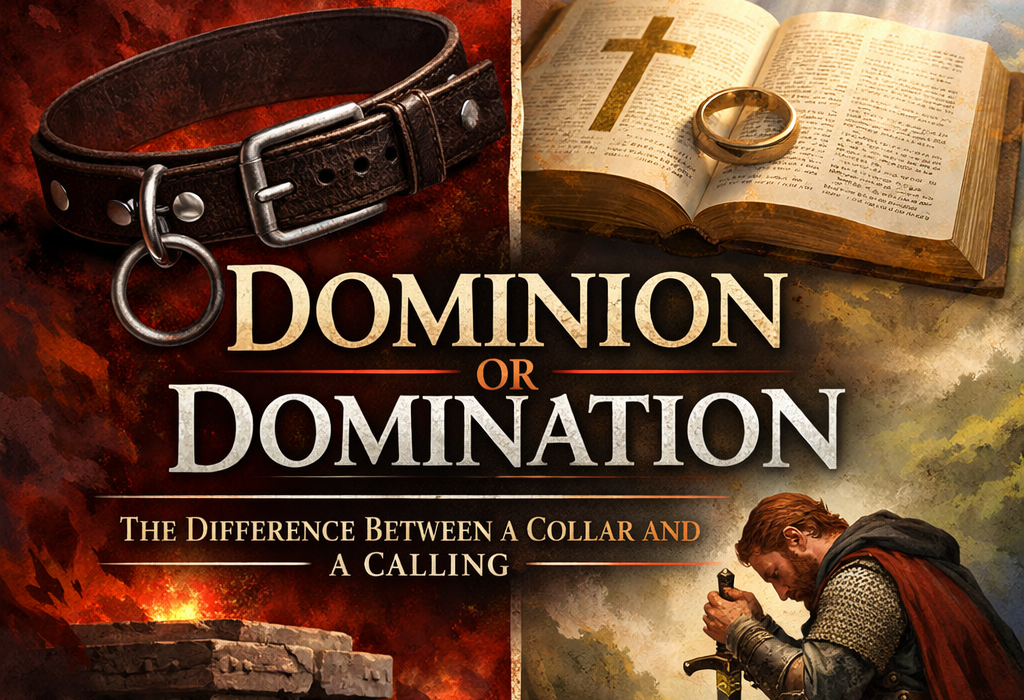
Dominion or Domination: The Difference Between a Collar and a Calling

Introduction

There is a word the modern world hates, and that word is dominion. It has been slandered, twisted, and confused with its corrupt cousin, “domination”. The result has been catastrophic to our families, country and world. Where God designed order, strength, and benevolent authority, the world has offered tyranny, insecurity, and physical abuse. Where Scripture reveals a hierarchy rooted in responsibility and submission to God, modern culture presents either effeminate passivity or brute control. And women (wired by their Creator to respond to strength, clarity, and leadership) are left oscillating between chaos and fake authority. They are told to resist men, to compete with men, to overthrow men. Yet in practice, many still find themselves drawn to a strong male presence. The tragedy is that without discernment, this longing often leads them not into dominion, but into domination.

This confusion explains much of what we see in our age. Women wearing collars as fashion statements of submission. Wives calling their husbands “daddy” in attempts to ritualize authority. Entire subcultures built around eroticized power imbalance rather than covenantal headship. These are not signs of liberation, they are symptoms of Satanic disorder. The human heart still longs for order. The woman still longs for a man worthy of reverence. The problem is not the desire; the problem is the counterfeit. God’s design is not tyrannical control, but earned dominion, authority granted by righteousness, proven by sacrifice, and sustained by submission to Him. Domination is what happens when sinful men seize power they have neither earned nor sanctified. Dominion, by contrast, is what happens when a man first kneels before God, and only then stands before his household.

I. Dominion Begins in Genesis, Not in the Flesh

Dominion is not a human invention, it did not originate in patriarchy, monarchy, tribalism, or conquest. It began in the opening chapter of Scripture. In Book of Genesis 1:26–28, God declares, “Let us make man in our image… and let them have dominion.” Dominion is therefore not first about men ruling women. It is about mankind ruling creation under God. The order is unmistakable: God reigns over man. Man exercises delegated authority over the earth. Woman, created as a help suitable to him, participates in that mission within a structured hierarchy under his dominion.

Notice what the text does not say. It does not say, “Let man dominate.” It does not grant license for cruelty, exploitation, or self-indulgent control. The Hebrew word for dominion (radah) carries the sense of ruling, governing, exercising authority, but always within the boundaries of God’s law and character. Adam’s first act of dominion was not to command Eve. It was to tend the garden and name the animals. His work preceded his marriage  Responsibility preceded relational authority. A man who refuses his assignment forfeits all moral claim to leadership.

Dominion flows downward only after submission flows upward. Adam was under God before Eve was under Adam. When that order fractured in Genesis chapter 3, domination entered the world. After sin, God tells Eve, “Your desire shall be for your husband, and he shall rule over you.” This is not a celebration; it is a consequence. The harmony of ordered dominion collapsed. Authority, once exercised in peace, now carries the potential for harshness. Desire, once aligned with mission, now carries the potential for manipulation. The curse introduces distortion, but it does not abolish structure.

Modern readers often misinterpret this passage. Some assume hierarchy itself is the problem. Others assume male harshness is justified because “he shall rule.” Both errors miss the deeper point. The fall did not create authority; it corrupted it. Before sin, there was order without abuse. After sin, the same structure remains, but it can be easily twisted into domination. The problem is not headship, but corruption.

Throughout the Old Testament, dominion is consistently tied to righteousness. Kings are measured not merely by their power but by their obedience to God. When Israel demanded a king in Book of 1 Samuel 8, God warned them what domination looks like: he will take your sons, your daughters, your fields, your flocks. Domination consumes, extracts, and feeds itself at the expense of those beneath it. That warning was not anti-authority, it was anti-tyranny. Because authority detached from submission to God always becomes predatory.

Contrast this with the model of covenant leadership given later in Scripture. In Book of Ephesians 5, the husband is called the head of the wife as Christ is the head of the church. But how does Christ exercise authority? Through sacrifice. Through self-giving love. Through responsibility that bleeds before it commands. Dominion in the biblical sense is never divorced from the burden of sacrifice. The greater the authority, the greater the accountability.

This is the dividing line between a collar and a calling. A collar restrains, while a calling commissions. A collar signals ownership, while a calling signals assignment. In the modern world, symbols of submission have often been divorced from sacred purpose. When authority becomes aesthetic rather than covenantal, it degenerates into role-play. There is a reason why cultural imitations of hierarchy often center on control, not mission. They replicate the structure but sever it from God.

Historically, civilizations that understood dominion as stewardship flourished differently than those built on raw domination. Medieval Christian kingship (at least in its theological ideal) recognized that a monarch ruled under divine law. Even the concept of “the divine right of kings” assumed accountability to God. A king who tyrannized was not exercising legitimate dominion; he was rebelling against the very authority that legitimized him. Likewise, in Roman antiquity, the term paterfamilias gave a father legal authority over his household, but even Roman law assumed responsibility for protection and provision. When that authority became cruelty, it was recognized as excess.

Dominion, rightly understood, requires qualification. It must be earned through character, proven through discipline, and sanctified through obedience to God. Domination requires none of these. Any insecure man can attempt to control. Any wounded woman can mistake his intensity for strength. But biblical dominion is not seized; it is conferred. It is the byproduct of alignment with divine order.

If a man is not under authority, he cannot safely wield it. If he does not fear God, others will eventually fear him, and not in the reverent sense Scripture intends. That is the tragedy of our age. Women still respond to strength because they were created to respond to ordered leadership. But when godly dominion is absent, they may attach themselves to its counterfeit. The structure remains appealing, but the source is corrupt.

The first lesson, then, is foundational: dominion is not domination refined. It is an entirely different category. One begins in Eden under blessing. The other emerges from rebellion under curse. One serves God’s mission. The other serves ego. One is accountable. The other is appetitive. One protects. The other consumes.

Everything else in this article flows from that distinction.

II. The Man Must First Kneel: Authority That Is Earned, Not Seized

If dominion begins in Genesis, it is refined at Sinai and clarified at Calvary. The pattern never changes, authority flows only through submission. A man does not become worthy of leadership because he desires it, demands it, or declares it. He becomes worthy of leadership when he kneels. That is the dividing line modern culture refuses to acknowledge. The world sees hierarchy and immediately assumes oppression, but scripture sees hierarchy and immediately demands holiness.

Throughout the Old Testament, the legitimacy of a ruler was inseparable from his obedience to God. Consider King Saul. He had the throne, the army, and public affirmation. But when he rejected God’s command, his authority began to fail from within. His insecurity turned into paranoia. His insecurity turned into aggression. He clung to power because he had lost submission. That is the anatomy of domination, a man detached from obedience becomes unstable, and instability in authority produces tyranny.

Contrast Saul with King David. David sinned grievously, yet Scripture calls him a man after God’s own heart. Why? Not because he was flawless, but because he repented and he submitted. He understood that kingship did not make him autonomous. When confronted by the prophet Nathan, he did not execute the messenger. He confessed and humbled himself before God. That posture preserved the covenant even when his failures carried consequences. 

In the New Testament, In Book of Matthew 20, Christ tells His disciples that the rulers of the Gentiles “lord it over” their subjects. They flaunt authority, display it, and enforce it through visible dominance. But “it shall not be so among you.” In the Kingdom, greatness is measured by service. Leadership is measured by sacrifice. Authority is measured by responsibility. Christ does not abolish hierarchy, He purifies it.

This is why a man who is not in submission to God is fundamentally disqualified from righteous headship. Authority is dangerous in the hands of the ungoverned. A man who cannot govern his appetites cannot govern a household. A man who cannot govern his temper cannot steward a wife. A man who cannot govern his tongue cannot shepherd children. Scripture makes this clear in the Book of 1 Timothy 3: a leader must first manage his own house well. 

Domination bypasses this process. It does not wait for qualification. It does not require sanctification. It seizes and demands. It performs strength rather than embodying it. That is why so many modern expressions of “alpha masculinity” are obvious hollow imitations. They mimic posture without pursuing the required purity. They seek compliance without cultivating covenant. 

The hard truth is this: to have dominion over others, you must deserve it. Not in a sentimental sense, but in a moral and spiritual one. Dominion is conferred by trust, sustained by integrity, and strengthened by consistency. When a wife calls her husband “lord” in the spirit of First Epistle of Peter 3:6, referencing Sarah’s reverence for Abraham, it was because he bore covenantal responsibility before God. The reverence flowed from structure, and the structure flowed from divine calling.

Modern culture, however, often attempts to recreate the external markers of hierarchy without the internal substance. A man may demand a title, but titles are weightless without virtue. He may crave deference, but deference forced through fear is fragile. Fear-based control requires constant reinforcement. Earned authority, by contrast, becomes stable. It does not need to scream to be heard.

Historically, the most enduring forms of leadership were those rooted in transcendent accountability. Medieval Christian knighthood, for example, was not merely about martial strength. It was bound by oath, code, and church oversight. A knight was expected to defend the weak, uphold truth, and answer to God. When those obligations were abandoned, knighthood quickly degenerated into mercenary brutality. The same structure (armor, sword, hierarchy) could either embody dominion or decay into domination. The difference was moral submission.

The same is true within the home. A husband who lives undisciplined (addicted to vice, ruled by impulse, spiritually passive) cannot transform himself into a righteous patriarch by asserting control. Authority detached from obedience becomes coercion, and coercion eventually collapses under its own insecurity.

This is why women are often drawn to strength, but harmed by counterfeit strength. They intuitively respond to clarity, decisiveness, and direction. Those qualities reflect the original design of ordered leadership. But when those traits appear in men who lack submission to God, the result is volatility. The structure is present; the sanctification is not. And without sanctification, authority is destructive.

True dominion is heavy. It carries the burden of provision, protection, and spiritual accountability. It requires a man to answer for his household before God. It demands consistency when emotions fluctuate. It demands courage when culture resists. It demands self-denial when ego demands indulgence. Domination avoids these burdens, it prefers the appearance of power without the cost of discipline.

The man who kneels before God learns restraint. He learns that authority is not for self-glorification but for stewardship. He learns that leadership is not an entitlement but a vocation. He understands that every command he gives must be defensible before God. That awareness tempers him, steadies him, and protects those under his care.

This is the core distinction: dominion is authority under God. Domination is authority without God. One is accountable, while the other is autonomous. One produces security, while the other produces fear. And one invites reverence, while the other demands submission through force. Before a man can lead, he must bow. Before he can command, he must obey. Before he can claim headship, he must prove faithfulness. Without that order, what he calls leadership is merely control, and control without righteousness is the seedbed of tyranny.

III. Why Women Respond to Strength: Design, Distortion, and Desire

One of the most uncomfortable truths for modern culture is this: women are not repelled by authority, they are repelled by instability. They are not inherently resistant to hierarchy; they are resistant to chaos pretending to be leadership. From the beginning, woman was created as a helper suitable to man: not as a rival, not as a replacement, and certainly not autonomous, but as a corresponding strength aligned to his mission. That design has not vanished simply because modern ideology dislikes it.

In Book of Proverbs, chapter 31, the virtuous woman is described in terms of capability, productivity, and honor. She is industrious, wise, and strong. But her strength is not detached from structure; it operates within covenant order. “The heart of her husband trusts in her.” Trust presumes leadership. Her flourishing is not independent rebellion, it is coordinated excellence. The portrait is not of a woman crushed under domination, nor of a woman competing for control, but of a woman thriving within rightly ordered authority.

This pattern has echoed throughout history in every stable civilization, women often gravitated toward men who embodied competence, protection, and moral clarity. In times of war or upheaval, men who could lead, defend, and decide became focal points of communal loyalty. Even in the Roman Empire, where legal structures were often harsh, women frequently aligned themselves with men whose strength translated into security. The instinct is not irrational, it reflects a deep-seated desire for ordered protection.

But design can be distorted. When godly dominion is absent, the longing for strength does not disappear, it redirects. This is where domination finds its foothold. A woman may respond to brutality because it resembles decisiveness. She may respond to possessiveness because it resembles protection. She may respond to commanding presence because it resembles leadership. Yet resemblance is not identity. Counterfeit authority often exaggerates the external signals of strength while lacking the internal discipline that makes strength safe.

This explains why abusive dynamics can be mistaken as passionate devotion. A dominating man may project certainty, but his certainty is not anchored in righteousness. He may enforce loyalty, but it is not secured through trust. He may demand submission, but he does not cultivate security. The result is volatility, an emotional environment where fear replaces peace. The structure feels familiar; the spirit behind it is corrupted and destructive.

In Colossians 3, Scripture tells us:Husbands, love your wives, and be not bitter against them.” The instruction assumes authority but forbids cruelty. Bitterness is the telltale mark of domination. It is the reflex of a man who confuses control with leadership. Biblical headship, by contrast, tempers strength with gentleness. It understands that authority without restraint becomes destructive.

Even culturally, we see symbols of submission resurface in unexpected places. The re-emergence of collars, hierarchical role-play, and exaggerated titles is representative. These trends are often framed as empowerment, yet they betray a persistent hunger for defined structure. The problem is not that women desire ordered leadership. The problem is that in a culture that has rejected covenant, structure becomes detached from its sacred purpose. What was once rooted in calling becomes abusive.

Consider the contrast with the story of Book of Esther. Esther operated within a monarchical system far more rigid than modern Western society. Yet her influence was not erased by structure; it was amplified through courage and wisdom. She honored the framework of authority while exercising profound moral agency. The narrative demonstrates that submission to order does not eliminate strength.

Modern counterfeits often promise empowerment through dominance games or emotional volatility. But these arrangements lack permanence because they lack covenant. They depend on mood, novelty, or psychological intensity, and when the intensity fades, instability surfaces. By contrast, dominion rooted in God produces steadiness. It creates an environment where a woman can relax into trust rather than brace against unpredictability. It should go without saying that women do not flourish under abuse. They may endure it, rationalize it, and they may even misinterpret it as strength for a season. But domination eventually exposes its hollowness. It cannot sustain reverence because reverence cannot be coerced.

True dominion creates space for feminine strength to emerge without rivalry. It does not feel threatened by competence, it does not suppress initiative, and it does not silence wisdom. Instead, it establishes direction and invites collaboration within that direction. A woman aligned to a man who is aligned to God experiences order not as confinement but as clarity. The longing for strong leadership is not evidence of weakness, but evidence of design. The tragedy of our era is not that women desire authority, it is that many have encountered only its counterfeit. When godly dominion is absent, domination fills the vacuum. When righteous men abdicate, unrighteous men will advance.

The solution, therefore, is not the abolition of hierarchy but its restoration. The answer to tyranny is not chaos, but sanctified authority. And until that distinction is understood, women will continue navigating between rebellion and counterfeit strength, searching, often unknowingly, for the security that only righteous dominion can provide.

IV. The Satanic Counterfeit: When Structure Is Severed from Covenant

Satan does not invent new structures. He corrupts existing ones. From the beginning, his strategy has been imitation without submission, power without obedience, glory without God. In Book of Genesis, Chapter 3, the serpent does not deny hierarchy outright. He attacks trust. He undermines order by questioning God’s word. “Did God really say?” 

Domination is the satanic counterfeit of dominion because it preserves the appearance of authority while severing it from covenant. It keeps hierarchy but removes holiness. It keeps command but discards accountability. The result is not liberation, but inversion. Authority becomes self-referential, leadership becomes self-serving, and strength becomes predatory.

This pattern repeats throughout Scripture. In Book of Ezekiel, chapter 34, God rebukes the shepherds of Israel, not for having authority, but for abusing it. “You eat the fat, you clothe yourselves with the wool…, but you do not feed the sheep.” The indictment is not against structure. It is against exploitation. Shepherd imagery is instructive, a shepherd has absolute authority over the flock, but that authority exists for protection, guidance, and provision. When the shepherd consumes the sheep, he has ceased exercising dominion and begun practicing domination.

The counterfeit always exaggerates the visible markers of power. It leans into symbolism detached from substance. That is why modern subcultures obsessed with hierarchy often fixate on visuals (collars, titles, rigid protocols) while neglecting covenant responsibility. Without covenant, hierarchy becomes a performance. Without submission to God, authority always leads to abuse.

The Apostle Paul warns of this distortion in Second Epistle to Timothy, chapter 3: people will have “a form of godliness but deny its power.” That phrase captures the essence of counterfeit authority. The form remains. The power (the sanctifying submission to God) is absent. The structure may look biblical, but the spirit behind it is not.

History is littered with examples. Totalitarian regimes in the 20th century perfected the aesthetics of dominance, uniforms, salutes, choreographed displays of loyalty. They understood the psychological pull of order. But their authority was autonomous, it answered to no higher law. When leaders elevate themselves above moral accountability, domination becomes the inevitable outcome. The same principle scales down to the household, aman who considers himself answerable to no one will eventually consider his authority absolute. And absolute authority in fallen hands always becomes destructive.

Even within religious contexts, domination can masquerade as zeal. Spiritual language can be weaponized, and Scripture can be quoted without being embodied. Christ warned against leaders who “tie up heavy burdens” but will not lift a finger to help (Book of Matthew, chapter 23). The problem was not teaching authority; it was hypocrisy. They demanded submission without modeling righteousness in their own lives. The satanic counterfeit thrives in two extremes. On one side is overt tyranny (rage, coercion, fear). On the other is seductive intensity (possessiveness, control, jealousy). Both distortions detach authority from covenant, and both create instability.

Why is this counterfeit so persuasive? Because it exploits legitimate longing. Women desire clarity. They desire direction. They desire to attach themselves to strength that feels immovable. The counterfeit offers immediate fulfillment without requiring the man to undergo sanctification. It promises dominance without discipline. It offers the thrill of structure without the weight of accountability. But counterfeit authority always produces collateral damage. It fractures trust. It breeds anxiety. It conditions compliance rather than cultivating reverence. Reverence cannot be forced. It arises naturally when authority proves itself consistent, sacrificial, and accountable before God.

The Book of Revelation portrays the ultimate counterfeit: the beast who demands worship. The imagery is political, spiritual, and relational all at once. The beast mimics sovereignty. He claims allegiance. He enforces submission. But his authority is not derivative of God; it is rebellious imitation. That is the final form of domination, power detached from divine legitimacy demanding loyalty it has not earned. The household can become a microcosm of this same pattern. When a man insists on submission but resists repentance, when he demands reverence but avoids responsibility, when he enforces order but rejects accountability, he mirrors the counterfeit. He may invoke biblical language, but he operates in autonomy.

Dominion, by contrast, is never autonomous. It is always derivative. It acknowledges its source. It knows that authority can be revoked by God, and  trembles at that reality. That trembling produces restraint, and restraint produces safety, leading to trust. This is why the difference between a collar and a calling is ultimately spiritual, not symbolic. A collar without covenant is nothing more than a symbol of satanic idol worship. A calling without submission is fraud, and the satanic counterfeit thrives on surfaces while God’s design penetrates to the heart.

Until men understand that authority is validated by obedience to God, they will continue to replicate domination while claiming dominion. And until women discern the difference between intensity and integrity, they will remain vulnerable to attaching themselves to strength that is not sanctified. The counterfeit always looks similar enough to deceive. But its fruit reveals it. Dominion cultivates, it builds, and it welcomes accountability.

V. From Collar to Calling: Restoring Covenant Authority

If domination is the counterfeit and dominion is the design, then the final question is unavoidable: how is true dominion restored? Not theoretically, not rhetorically, but practically. Because the difference between a collar and a calling is not settled in symbolism, it is settled in covenant obedience.

Throughout Scripture, covenant is what legitimizes authority. When God establishes order, He binds it to promises, responsibilities, and consequences. In Book of Deuteronomy, chapter 17, when instructions are given for Israel’s future kings, the king is commanded to write a copy of the Law with his own hand and read it all the days of his life. Why? “That his heart may not be lifted up above his brothers.” Authority is restrained by continual submission to God’s Word. A king who stops kneeling inevitably starts consuming.

This pattern continues in the New Testament. In Book of Ephesians, chapter 5, the husband’s authority is framed entirely in covenantal language. “Husbands, love your wives, as Christ loved the church and gave Himself up for her.” Christ’s headship is sacrificial covenant. He binds Himself to His bride, He bears her burdens, and He sanctifies, nourishes, and cherishes. The imagery is not of a man asserting control, it is of a Savior laying down His life. That is the standard. Anything less is a cheap copy.

A calling implies responsibility and accountability before God. It implies long-term stewardship rather than short-term gratification. When a woman aligns herself with a man operating in true dominion, she is not attaching herself to volatility. She is attaching herself to His mission. His authority is directional and has purpose beyond his ego. It extends beyond bedroom dynamics or emotional intensity and encompasses provision, protection, spiritual leadership, and generational vision.

This is why biblical reverence is weighty. In First Epistle of Peter, chapter 3, Sarah’s respect toward Abraham is cited as an example, not because Abraham was flawless, but because the structure was covenantal. Abraham bore responsibility before God. He was accountable for his household’s obedience and his authority was embedded in promise. That is fundamentally different from modern role-play dynamics that imitate hierarchy while lacking divine commission.

Historically, when marriage was understood as covenant rather than contract, authority carried sacred gravity. In medieval Christendom, marriage vows were made before God and community. A husband’s authority was inseparable from his obligation to defend, provide, and answer before God for his household’s welfare. When covenant weakens, authority loses its moral framework. It either dissolves into egalitarian confusion or calcifies into domination. Modern culture oscillates between those two distortions. On one end, it rejects hierarchy entirely, pretending equality means interchangeability. On the other end, it romanticizes raw dominance divorced from all righteousness. Both reject covenant and both detach structure from sanctification.

Restoring dominion requires rebuilding covenant. A man must define his household under God’s authority. He must articulate mission, cultivate discipline, and demonstrate consistency. Dominion is not proven in grand gestures but in daily governance, prayer, provision, emotional steadiness, moral clarity. It is proven in self-restraint. It is proven in repentance when wrong. It is proven in bearing burdens without resentment. Women, too, must discern the difference between strength and spectacle.

The fruit test is unavoidable. Christ teaches in Book of Matthew, chapter 7 that a tree is known by its fruit. What does the authority produce? Does it generate peace or anxiety? Stability or volatility? Growth or suppression? Does it cultivate reverence freely given, or compliance extracted through force? Dominion produces life. Domination produces fear.

There is also a generational dimension. Dominion thinks in decades, it builds households that outlast the man. It invests in children, legacy, reputation, and faithfulness. Domination thinks in moments, it seeks immediate affirmation, immediate obedience, and immediate control. It is inherently short-sighted because it is ego-driven. When a man embraces his calling, he understands that authority is not primarily about being obeyed, it is about being accountable. He will stand before God for how he led. That sobering reality reshapes his posture, tempers his speech and moderates his discipline. 

And when a woman recognizes true dominion, her response is not coerced submission but voluntary reverence. She feels secure because the authority over her is itself under authority. She can align without fear because the structure is anchored in righteousness. She is not surrendering to appetite; she is participating in order. 

A collar may signal belonging, but a calling establishes a purpose. A collar can be removed, a covenant cannot. The restoration of dominion will not occur through louder assertions of male authority. It will occur through deeper submission to God. It will occur when men fear the Lord more than they crave control. It will occur when women discern covenant from counterfeit. It will occur when households are rebuilt not around dominance displays, but around disciplined, sanctified leadership.

Only then can hierarchy become holy again.

Conclusion

Dominion and domination may look similar from a distance. Both involve hierarchy, authority, and submission. But they are not cousins, they are opposites. One begins with a man on his knees before God; the other begins with a man enthroning himself. One treats authority as stewardship; the other treats it as entitlement. One produces reverence; the other produces fear. And women, created to respond to ordered strength, will inevitably attach themselves to one or the other. The tragedy of our age is not that hierarchy exists, it is that too many have only encountered its counterfeit.

The solution is not the abolition of authority, nor the romanticizing of brutal dominance. It is the restoration of covenantal dominion. Men must first submit, then lead. Women must discern calling from costume. Households must be built on accountability before heaven, not intensity in the moment. A collar may imitate structure, but only a calling sanctifies it. And until dominion is reclaimed as holy responsibility under God, domination will continue displaying as strength, offering spectacle where Scripture demands sanctification.

Let God’s Great Order be restored!
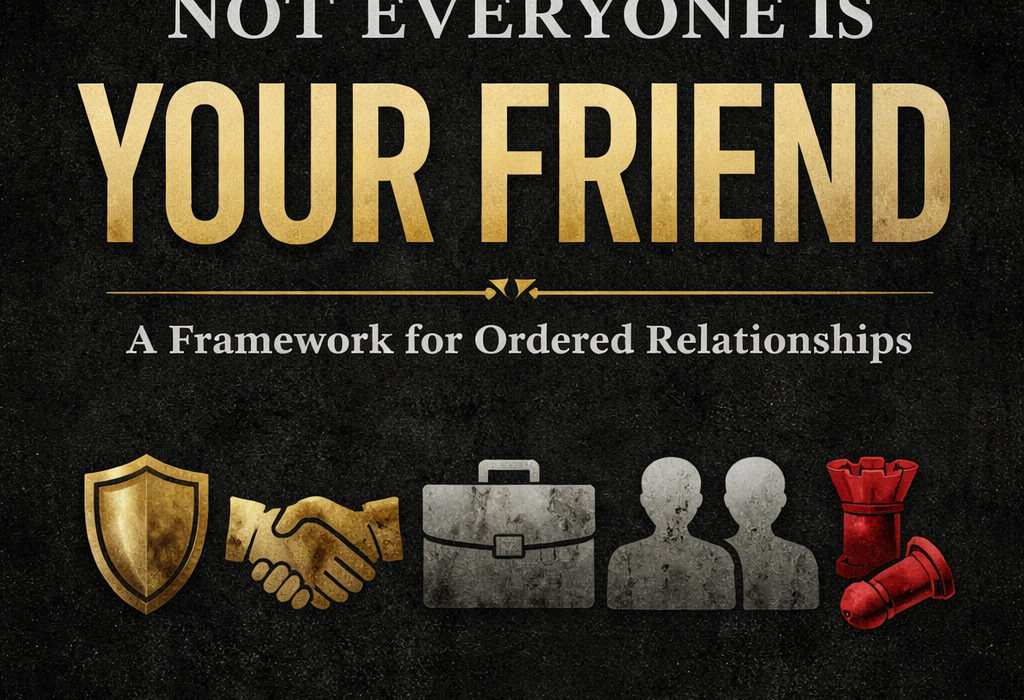
The Myth of Friendship: Why Most People Do Not Belong in Your Circle

Introduction

The word friend has been abused into meaninglessness. It is used to describe anyone from a man who would shield your children with his body, sacrificing his own life for theirs to someone who occasionally clicks “like” on a screen. This degradation of our language has removed expectations, blurred boundaries, and created confusion about what a “friend” is.

Order begins with naming things correctly and understanding not everyone is a friend, in-fact most people are not. Pretending otherwise is dangerous and negligent. Relationships differ in access, obligation, risk, and consequence, and when those differences are ignored, we often give intimacy where none is deserved and grant trust where none has been earned. This framework exists to restore clarity. It categorizes people not by relationship, history, or proximity, but by function, behavior, and demonstrated character.

For most of human history, this distinction was understood. Ancient societies did not universally refer to every human relationship as “friend”, nor do we find any historical texts where everyone was indiscriminately referred to as a “friend.” Relationships were named according to function (kin, ally, spouse, neighbor, servant, rival, enemy) because survival demanded the clarity of discernment. The modern use of friend is neither kind nor noble, but lazy and sloppy.

Historically, the term implied a deep, intimate bond outside of marriage, often carrying sexual or quasi-sexual meaning. It was someone with whom one shared closeness, loyalty, and access that rightly belonged only within covenant. In other words, a “friend” was never a casual or social acquaintance; it was a substitute intimacy. That is precisely why the word should be used sparingly, if at all. To call many people “friends” is disordered and particularly disrespectful and egregious to your spouse. Those who value clarity, fidelity, and hierarchy should abandon the term entirely, replacing it with language that reflects history and reality.

What follows is a deliberate restoration of order. This article lays out the correct categories for human relationships, not based on feelings, familiarity, or convenience, but on access, obligation, risk, and consequence. Each category is clearly defined, intentionally limited, and mutually exclusive. The goal is not to dehumanize relationships, but to categorize them honestly, so expectations are clear, boundaries are enforced, and trust is placed where it belongs. When you categorize people in your life correctly you will quickly discover how many “friends” you really have, and it will change your life.


I. Inner Circle

The inner circle is always small, and by necessity. Limited to those with access, authority, and who share in the consequence of decisions. These are the people whose actions can affect your mission, your household, and your name. Entry to this level is not granted by time, familiarity, or emotion, but by covenant, sacrifice, or shared direction. Anyone misclassified into this circle becomes an extreme liability to your life and family.

Brother

A brother is not defined by blood or shared history, but by shared risk and proven loyalty. This is the man who has stood with you when standing carried a significant cost to them, financially, socially, or physically. A brother defends your name in your absence, corrects you to your face, and remains by your side when circumstances would justify departure. Brotherhood is exceedingly rare because it requires endurance, humility, and the willingness to suffer loss without any resentment towards the brother. Most men will have none; a fortunate few may have one and having more than two is rarely experienced, even in the historical record.

Spouse / Steward

A spouse belongs in the inner circle not because of romantic intimacy, but because of covenantal responsibility. As steward, the spouse is entrusted with authority over part of the household and granted access that no one else receives. This role is functional, not equal, and it carries obligations, accountability, and expectations. A spouse who does not steward well still occupies the position, but not the trust that should accompany it. Inner-circle access here exists because mismanagement has real consequences.

Ally

An ally is aligned by mission, not affection. Allies work alongside you toward a shared objective, whether in business, community, or cause. Trust with an ally is limited to scope and context; loyalty is to the goal, not the man. Allies may be temporary or long-term, but they are never entitled to full access or full trust beyond the objective at hand. It is possible for some allies to become brothers over time, but most will not, and it is important that distinction remains clear.


II. Functional Relationships

Functional relationships make up the bulk of daily human interaction. They are Purpose-driven interactions without any legitimate loyalty or intimacy. These relationships exist for practical reasons (work, proximity, or shared circumstance) and should not be mistaken for deeper bonds or connections. They are neither empty nor negative, but they are limited by design. Confusion arises when we attempt to extract or even expect loyalty, intimacy, or sacrifice from relationships that were never intended for that purpose.

Associate

An associate is someone you interact with for a specific purpose, usually professional or transactional. The relationship is defined by utility, cooperation, and mutual benefit, but never personal attachment. Associates may be competent, reliable, and even likable, but they are not entitled to personal access or emotional investment of ANY amount. When the shared purpose ends, the relationship naturally ends without any sense of betrayal. Treating associates as anything more always invites disappointment and misplaced trust.

Neighbor

A neighbor is defined by proximity, not connection. This relationship exists because you occupy the same physical space, not because of shared values or goals. Courtesy, basic goodwill, and limited mutual assistance are appropriate, but trust and intimacy are not required and often unwise. Neighbors may come and go without any moral quandaries, and attempting to force deeper bonds based solely on location confuses convenience with trust.

Peer

A peer is someone operating at a similar level or stage of life, whether in age, status, or role. Peers provide comparison, perspective, and occasionally collaboration, but they are not inherently allies. Competition, rivalry, or divergence often exists just beneath the surface, even when cordiality remains. Peers should be respected, not confided in, and never assumed loyal simply because they appear similar.


III. Peripheral Relations

Peripheral relations exist at the outer edge of social life. It is the recognition of an individual without a full relationship.These are people you recognize, encounter, or are aware of, but who hold no meaningful access, obligation, or influence in your life. They are not owed intimacy, explanation, or trust, and attempting to elevate them beyond their proper place creates unnecessary friction and false expectations. Correctly identifying peripheral relations preserves energy and protects the inner structure.

Acquaintance

An acquaintance is someone you know of, but do not know well. The relationship is marked by light interaction, casual familiarity, and limited context. Acquaintances may recognize your face, name, or general role, but they are not privy to your life, decisions, or struggles. Courtesy is appropriate; all other access is not. Confusing acquaintances for friends is one of the most common social errors made in our time.

Contact

A contact is a stored point of access, not a relationship. This may be a phone number, email address, or online handle retained for potential future use. There is no implied loyalty, familiarity, or obligation, only availability. Contacts are utilitarian by nature, and treating them otherwise once again leaves you expecting something that was never going to happen. A contact can become something more, but only through deliberate interaction and proven reliability.

Audience

An audience consists of those who consume your public output (your words, ideas, or work) without participating in your life. This relationship is entirely one-directional. Audience members may agree with you, admire you, or feel personally connected, but that connection exists only in their perception. Visibility to them does not create a relationship with them, and attention from them does not confer access to your life. An audience belongs outside every circle by default.


IV. Conditional & Risk Categories

These categories exist because not all relationships are neutral. These categories require discernment and ongoing evaluation. Some people occupy ambiguous positions where intent, loyalty, or stability is unclear. They are not inherently adversarial, but they carry elevated risk if misjudged or misclassified. The mistake is not interacting with these people, it is granting them access to your life before intention and clarity are established.

Friendly

A friendly person presents warmth, politeness, and agreeable behavior, but offers no proven loyalty. Friendliness is a temperament, not a commitment. These individuals are often pleasant to be around and easy to mistake for something more substantial, especially in social or professional environments. However, when pressure, conflict, or cost arises, the “friendliness” vanishes. Friendly people require hard boundaries and are not to be trusted until they are proven to be more.

Opportunist

An opportunist engages selectively, based on perceived benefit. Their attention increases when your status rises and fades when it declines. Opportunists may offer praise, assistance, or alignment, but always with an eye toward advantage. This does not make them evil, only predictable. The danger lies in assuming sincerity where only calculation exists. Opportunists should never be granted access beyond what you are willing to lose. They are only interested in the advancement of theirselves, this can be mutually beneficial if you keep them in their place.

Observer

An observer watches more than participates. This person pays attention to your decisions, patterns, and outcomes while remaining non-committal. Observers gather information without investing themselves, often under the guise of neutrality or curiosity. Some observers may eventually reveal alignment or opposition, but until then, they remain a potential liability. Awareness is the correct posture toward observers. Unlike an audience, an observer is watching you, while an audience is watching a projection.


V. Adversarial Categories

Adversarial relationships are not defined by emotion or feelings but by purpose and direction. They are defined through opposition by comparison, interference, or intent. These individuals act against your interests, whether openly or covertly, and must be identified without hesitating based on relations of emotion. Mislabeling adversaries as “friends” or “misunderstood” is self-sabotage. Clear identification allows for appropriate distance, defense, and response.

Rival

A rival competes with you, either openly or secretively. This competition may involve status, influence, resources, or reputation. Rivals often maintain cordial appearances while measuring themselves against you, keeping score internally even when cooperation exists externally. While rivalry can sharpen performance, it becomes dangerous when they are mistaken for allies. Rivals should be respected, but never trusted.

Saboteur

A saboteur undermines while appearing neutral or even supportive. Their tactics are subtle, mild discouragement framed as concern, criticism disguised as advice, or information shared “in confidence” that later spreads. Saboteurs rarely confront you directly; they slowly erode you  from within. This makes them more dangerous than open enemies, as they rely on proximity and misclassification to operate effectively. Allowing them access where they do not belong is devastating.

Enemy

An enemy is defined by clear opposition. There is no ambiguity about intent, alignment, or direction. While enemies pose real risk, they also offer clarity. Open hostility allows for preparation, boundaries, and strategic response. In many cases, a declared enemy is easier to manage than a hidden one, because deception has been removed from the equation.


Conclusion

Clarity in relationships is discipline. The chaos, disappointment and confusion most people experience in their lives does not come from having too few people “friends” around them, but from assigning the wrong roles to those people. When everyone is called a friend, no one is held to a standard, and disappointment becomes inevitable.

This framework is not about isolation or hostility, but reality. Each category exists to protect what matters most, your peace, your time, your household, your mission, and your legacy. When people are placed correctly, trust is preserved, boundaries are enforced, and betrayal loses its power. A man who knows who stands where is difficult to manipulate and impossible to confuse.

Use this structure honestly, apply it without emotional attachment, and re-evaluate it regularly. Most people will remain where they belong, a rare one may move inward, and some must be pushed out. Order does not eliminate relationships; it gives them their proper place.

Use the chart below for quick reference:

Relationship Classification Chart

Category TierRelationship TypeDefining FeatureAccess LevelTrust Level
Inner CircleBrotherProven loyalty through shared riskHighestEarned
Spouse / StewardCovenantal responsibility and delegated authorityHighestConditional
AllyMission-aligned cooperationLimitedScoped
Functional RelationshipsAssociatePurpose-driven interactionLimitedNone
NeighborProximity without obligationMinimalNone
PeerSimilar status or positionMinimalNone
Peripheral RelationsAcquaintanceCasual familiarityMinimalNone
ContactStored access pointNoneNone
AudienceOne-way visibilityNoneNone
Conditional & RiskFriendlyPleasant without loyaltyVariableUnproven
OpportunistEngagement tied to benefitVariableLow
ObserverWatches without commitmentVariableUnknown
AdversarialRivalCompetitive alignmentNoneNone
SaboteurCovert interferenceNoneNone
EnemyOpen oppositionNoneNone

Why Feminism Can Only Produce Orphans and Whores

Feminism is not a well-intentioned project that lost its way. It is a deliberate revolt against God’s created order, designed to dismantle hierarchy, dissolve the household, and sever sexuality from responsibility. What we see today (fatherless homes, broken women, confused children, and a culture incapable of sustaining itself) is not the failure of feminism but its fulfillment. This article does not argue that feminism produces unfortunate side effects; it demonstrates that orphans and whores are the intended output of the movement. When authority is labeled abuse, submission is framed as oppression, and independence is elevated above inheritance, the result is predictable and catastrophic.

I. Feminism Is Not Broken – It Is Working Exactly as Intended

Feminism is often defended as a “good idea gone wrong.” But feminism did not fail, it has succeeded precisely according to plan. What modern societies are experiencing is not the corruption of feminism but its full maturation. The outcomes are not side effects; they are the harvest. And the harvest is barren homes, fatherless children, sexually unbound women, and a civilization that no longer knows how to reproduce itself as God intended.

Feminism began with a single, fatal premise: that hierarchy is injustice. From that lie everything else has flowed. Authority has become “oppression”, leadership has become “abuse” and submission is billed as “humiliation”. Dependence on a man is now considered weakness. Once that worldview was accepted, order itself started to be dismantled, because order always implies rank, responsibility, and restraint. Feminism never seeks fairness; it seeks the complete abolition of all structure.

Every civilization is built on ordered households. Every ordered household is built on male headship, female cooperation, and clearly defined roles. Feminism attacks that very foundation, not by arguing openly against civilization, but by framing rebellion as a virtue and self-indulgence as “empowerment”. It tells women they are most free when they belong to no one, submit to nothing, and sacrifice for no future beyond their own desires. That worldview cannot produce wives, mothers, or stable families. It can only produce isolated adults and neglected children.

This is why feminism must always redefine success in ways that exclude motherhood, loyalty, and permanence. A woman who builds a quiet household under a husband’s authority is a direct refutation of feminist doctrine. Her existence proves that hierarchy can be life-giving, that dependence can be strength, and that submission can be chosen without coercion. Feminism cannot tolerate such women, so it marginalizes them, mocks them, or portrays them as victims of “internalized oppression.” Like all failed ideologies they must erase the counterexamples in order to survive.

The result is not liberation but fragmentation. Men withdraw because they are unwanted except for utilitarian purposes. Women harden because they are taught to see men as rivals or threats. Children grow up without clear authority, consistent discipline, or coherent identity. The social order slowly collapses inward, and feminism blames everyone except itself. But the cause is clear, where feminism dominates, the household dies. And when the household dies, only two products remain: functional orphans and functional whores.

II. Feminism Must Destroy the Father to Survive

Feminism cannot coexist with traditional fathers. Not because fathers are inherently abusive, but because fatherhood represents a form of authority that feminism cannot subvert without exposing itself as a fraud. A father embodies hierarchy that is personal, intimate, and non-negotiable. He is not elected, he is not a social contract, and he is not in a bureaucratic role. He is a man with responsibility and the right to command within his household.

That reality is intolerable to an ideology that teaches women they are self-sovereign. So feminism begins by convincing women fathers are optional. It starts first by framing them as incompetent,  then dangerous, and finally, replaces them entirely with institutions. Schools, courts, therapists, and state agencies take over the functions once performed by fathers, but without the love, permanence, or personal accountability that fatherhood requires.

The feminist system rewards maternal gatekeeping and punishes paternal authority. Family courts strip fathers of leadership while demanding they provide provision. The media portrays fathers as buffoons or predators. The education system demonizes masculine discipline while celebrating emotional expression and indulgence. Over time, men learn the lesson: fatherhood carries all the liability and none of the authority or reward. So they disengage. Some flee, some are driven out and some stay physically present but neutered, reduced to spectators in their own homes.

The child raised in such an environment is not protected; he is orphaned in spirit even if both parents are alive. He has no consistent standard to measure himself against, no firm correction to shape his character and no masculine authority to emulate. He is told to “express himself” instead of mastering himself, he is affirmed instead of trained and he is medicated instead of disciplined. Feminism calls this “compassion”, but in reality it is abandonment and child abuse.

Girls raised without fathers fare no better. Deprived of masculine protection and correction, they grow up craving validation and resenting the restraint God intended. They learn to measure their worth by attention rather than character. They are taught independence without wisdom and sexuality without godly (or even healthy) boundaries. When they inevitably struggle with attachment, commitment, trust and “daddy issues” feminism offers more blame instead of accountability.

This is the orphan factory. Feminism doesn’t tolerate fatherlessness, but engineers it on purpose. And once fathers are removed, the state steps in, not to restore order, but to subvert the authority God granted men. The child becomes a client, a diagnosis, a data point. He belongs to systems rather than a godly lineage. That is the true meaning of orphanhood: not the absence of caregivers, but the absence of inheritance.

III. Feminism Cannot Produce Wives, Only Consumers

A wife is not an accessory, she is not a romantic fantasy and she is not a self-actualization project. A wife is a steward of a household, a helper to a man with vision, and a bearer of future generations. That role requires submission, loyalty, endurance, and the willingness to subordinate personal desire to her husband’s purpose. Feminism rejects every one of those basic requirements.

From the moment a woman is inducted into feminist thinking, she is taught to view relationships through the lens of consumption. What does this give me? How does this serve my goals? Does this make me happy right now? Marriage, under such conditioning, becomes a transaction rather than a covenant. The moment the perceived benefits decline, the commitment dissolves. Loyalty was taught to be conditional, and sacrifice was told to be unreasonable, therefore permanence was optional.

Feminism teaches that marriage is a negotiation between equals rather than a hierarchy oriented toward production. But equal partners do not build; they bargain, they negotiate chores, feelings, and expectations endlessly, while no one holds the final authority. The result is resentment, lack of fulfillment and lack of accomplishment. When leadership is absent, chaos fills the vacuum. Feminism then points to that chaos as proof that marriage itself is flawed, rather than admitting that the flaw lies in the rejection of order within the marriage.

This is why feminist marriages are so fragile. They are built on feelings rather than roles and satisfaction rather than duty. Children become burdens rather than blessings, domestic labor is resented rather than embraced and submission is treated with extreme contempt. When hardship arrives (as it always does) there is no shared framework to endure it. Divorce becomes the default escape, celebrated as “empowerment” rather than acknowledged as shame and  failure. A woman trained to see herself as a perpetual consumer cannot become a wife, she can only become a dissatisfied customer. And dissatisfied customers always leave negative reviews. Feminism has trained millions of women to approach marriage with a list of demands and no understanding of obligation. When reality fails to conform to the fantasy they have been sold, they exit, often taking the children with them. Another household dissolves and another generation is destabilized, perpetuating the decline.

IV. Sexual Autonomy Inevitably Produces Whores

Feminism’s promise of sexual liberation was always a lie. Sex cannot be liberated from consequence any more than fire can be liberated from heat. When sexuality is detached from covenant, reproduction, and reputation, it does not become empowering. It becomes transactional and a female conducting sexual “transactions” will always be on the losing end.

Feminism teaches women that their bodies are instruments of self-expression rather than vessels of life and loyalty. Once that belief is internalized, modesty quickly becomes repression, chastity becomes insecurity, and restraint becomes shameful. The sexual marketplace replaces the marriage market. Attention replaces commitment, validation replaces protection and her worth is now measured by the sexual attention she can get from men.

In such an environment, a woman’s value is no longer anchored to her chastity, horror, character or fertility, but to her visibility and desirability. Her youth becomes a currency and leverage to get attention. Aging becomes terrifying because feminism does not free women from objectification, but encourages it. The resulting platforms that monetize female sexuality are not perversions of feminist ideals, they are the logical outcome of them.

The word “whore” offends modern ears because it has been stripped of its functional meaning. A whore is not merely a prostitute. She is a woman whose sexuality is detached from covenant and sold, whether for money, attention, status, or validation. Feminism produces such women in abundance, not because it hates women, but because it hates God and has no mechanism to bind sexuality to responsibility.

The psychological toll is immense on both women and men. Women accumulate sexual history, declining rapidly in true value while not accumulating the security they inherently desire. Pair-bonding erodes, trust decays and resentment towards men builds. When the promised empowerment fails to materialize, feminism offers more blame instead of repentance. Men are at fault, society is at fault, biology is at fault. Everyone is guilty except the ideology itself, as usual there is no acceptance of responsibility.

Meanwhile, children born into this sexual chaos inherit instability by default. Fathers are interchangeable or absent altogether. Mothers are exhausted and embittered. The cycle repeats ad nauseum. Feminism does not correct sexual disorder, but multiplies it across many generations.

V. Order Is the Only Antidote

The solution to feminism is not kinder feminism, softer feminism, moderate feminism, or “Christian feminism.” The solution is the rejection of feminism entirely. Order is not abuse, authority is not oppression and hierarchy is not injustice. These lies have hollowed out the modern world, and no amount of therapy or legislation can fix what is fundamentally a spiritual and structural rebellion.

Men must reclaim leadership without apology. Not tyranny, not cruelty, but firm, visible, uncompromising headship. Women must relearn submission not as a way to humiliate them, but as alignment with the purpose God intended. Children must be raised under authority and households must be treated as institutions ordered under a righteous man.

Feminism will call this dangerous (It always does) Because order exposes their chaos, and discipline exposes the indulgence they promote. A properly ordered household makes feminism irrelevant. A woman who is protected, directed, and valued within a functioning hierarchy has no need for the satanic nonsense they promote. A child who knows his place, his name, and his future has no need for the ideological worldview provided by subversionists. 

Civilizations rarely fall because of external enemies, they fall when they lose the will to reproduce themselves in an ordered way. Feminism has accelerated that collapse by attacking the only structure capable of sustaining life across generations. It cannot produce heirs, only dependents. It cannot produce wives, only consumers. And it cannot produce families, only fragments of a once great order established by God.

And so the outcome is fixed. Where feminism reigns, households die, fathers disappear, children drift away and women sell what should have been given in covenant. Orphans and whores are the system’s intended output, and the system is winning!

Order will always outlive rebellion because rebellion to God’s order ALWAYS fails. May God’s GREAT ORDER be Restored!

Authority Is Mercy: Why Headship Is Not Abuse

I. Chaos Is The Default State

Order does not emerge naturally. It never has and it never will.

Left alone, things do not organize themselves toward good, they decay. Entropy is not just a physical law, but a moral one. Without imposed structure, boundaries, hierarchy, and enforcement, everything collapses toward disorder. This is true in physics, in households, in churches, and in civilizations. The modern world pretends otherwise because admitting it would require admitting the necessity of authority, and authority offends the rebellious.

Scripture tells us: “In those days there was no king in Israel. Every man did what was right in his own eyes.” That verse from Judges is not describing freedom. It is describing the collapse of order, violence, sexual disorder, betrayal, and tribal chaos. The absence of authority did not produce peace; it produced savagery – as it always does. The modern accusation claims that authority creates suffering, while history proves the opposite. Chaos is what creates suffering. Authority exists because chaos is the default state, not the exception.

Children do not self-regulate toward virtue. They test limits instinctively. They push boundaries not because they hate rules, but because they need to know where safety ends. A child raised without discipline does not become “free.” He becomes anxious, impulsive, and ungovernable.  The same principle applies to adults who were never properly taught or trained. The same applies to women in leaderless homes. The same applies to churches run by consensus and feelings. The same applies to nations that abandon law in favor of sentiment.

Where authority retreats, something always fills the vacuum. And it is never neutral. If a father will not rule his home, the mother will – resentfully. If the mother refuses, the children will – destructively. If parents abdicate entirely, the state steps in. If the state fails, gangs and warlords take over. Authority does not disappear; it is merely replaced by a more brutal form. The only question is whether authority will be righteous and ordered, or chaotic and predatory.

This is why the modern world is filled with “strong women” and weak men. Not because women desired dominion, but because men refused responsibility. Feminism did not rise in a vacuum. It rose in the absence of masculine authority. And once chaos takes root, it never politely waits for permission – it spreads like a cancer.

The accusation that headship is abusive relies on a false assumption: that human beings are naturally inclined toward good if left ungoverned. Scripture teaches the opposite. “The heart is deceitful above all things.” The human will does not default toward righteousness; it defaults toward self-interest and authority exists to restrain that impulse, not to indulge it.

This is why every functioning system (biblical or otherwise) has hierarchy. God rules man. Christ rules the Church. Kings rule nations. Fathers rule households. When hierarchy is denied, it does not vanish; it mutates into covert domination, emotional manipulation, or bureaucratic control. Egalitarianism never eliminates power, it merely disguises it.

The modern household is a perfect example. When no one is clearly in charge, every decision becomes a negotiation. Every boundary becomes a debate. Every correction becomes an argument about tone, trauma, and feelings. This is not peace but exhaustion, and exhaustion always breeds resentment. A home without authority is not gentle – It is unstable. A marriage without headship is not loving.- it is anxious, and a church without discipline is not gracious – it is corrupt.

And yet, chaos is consistently rebranded as compassion, while authority is slandered as abuse. Why? Because chaos makes no demands. Chaos requires no accountability. Chaos allows everyone to remain exactly as they are, disordered, indulgent, and uncorrected. Authority, on the other hand, requires submission to something higher than oneself. And that is precisely what the modern rebellious soul cannot tolerate.

The irony is brutal: the same people who cry “abuse” at the presence of authority quietly endure far worse suffering under chaos. Anxiety disorders, broken homes, emotional instability, fatherless children, dead churches, and collapsing communities are not signs of liberation. They are symptoms of abdication.

Authority is not the source of pain in the modern world. The refusal of men to exercise their God given authority is. Until this first principle is accepted (that chaos is the default state) every conversation about headship, submission, discipline, and order will remain dishonest. You cannot accuse authority of cruelty while ignoring the devastation caused by its absence. That lie has already cost this generation more than it is willing to admit. And the bill is still coming.

II. What Authority Actually Is (and is not)

Before authority can be defended, it must be defined, because its enemies survive by redefining it. Modern discourse treats authority as emotional dominance, coercion, or personal entitlement. That definition is false, and deliberately so. It allows rebels to attack a straw man while ignoring the real thing. Biblical authority is not arbitrary power but responsibility made visible.

Authority is the right to command because one bears the burden of outcomes. A man does not hold authority because he is male. He holds authority because he is charged with provision, protection, discipline, and direction – and will answer for failure in all four. This is why Scripture ties headship to judgment. Authority is never free. It is always costly.

Authority means you decide, and you pay. You pay when the decision is unpopular. You pay when it is misunderstood. You pay when it requires restraint instead of indulgence. You pay when you must correct what you would rather ignore. That is authority.

What modern critics label “control” is usually nothing more than structure enforced consistently. What they call “abuse” is often accountability imposed without apology. And what they call “freedom” is simply the absence of expectation. None of these words mean what they pretend to mean anymore. Biblical authority is directional. It answers the question Where are we going? and then aligns the household toward that end. A home without direction does not drift peacefully; it fragments. 

Authority exists to unify will, not erase individuality. The husband does not eliminate his wife’s voice, he weighs it, integrates it, and then decides, because decision-making is not tyranny; it is leadership. This is why authority and responsibility cannot be separated.

Abuse is authority without responsibility. That is the man who commands but does not provide.  Who disciplines but does not protect. Who demands submission but will not sacrifice. Scripture condemns that man. But the opposite error is now celebrated: Weakness is responsibility without authority. That is the man who is expected to provide but not decide. To protect but not correct and to lead but never command.

This man is not virtuous. He is crippled. And his household will suffer for it. Authority also implies enforcement. Rules without consequences are suggestions. Boundaries without discipline are jokes. Leadership without the willingness to correct is performance. A man who refuses to enforce order is not loving, he is outsourcing future pain to his wife and children.

This is another category where the modern church has failed catastrophically. Pastors preach responsibility without authority, gentleness without discipline, and love without correction. The result is predictable: spiritually immature congregations ruled by emotion, women, and grievance. Not because women are inherently unfit to participate, but because someone always rules, and when men refuse, others step in.

Authority is not emotional rule. It does not shift with moods. It does not negotiate with rebellion. It does not apologize for existing. Authority is calm, consistent, predictable, and firm. It creates safety precisely because it is not reactive. People relax when they know the rules will not change tomorrow. This is especially true in marriage.

A wife does not feel secure when leadership is sentimental. She feels secure when it is stable. When expectations are clear. When boundaries are enforced. When consequences are real. The idea that love requires endless flexibility is a modern delusion. Love requires containment, and authority provides that containment.

Authority also restrains the man himself. A husband under authority (God’s authority) does not rule for pleasure. He rules under obligation. His authority is bounded by law, covenant, and consequence. He is not free to indulge every impulse. He is free to fulfill his duty. This is why headship is not privilege. It is an office. An office can be held honorably or corruptly. Scripture recognizes both. But it never concludes that the solution to corrupt authority is no authority at all. That conclusion belongs to anarchists, not Christians.

The modern mind cannot distinguish between tyranny and leadership because it has never experienced the latter. It has only known abdication, manipulation, and emotional chaos. So when real authority appears in a quiet, firm, and unyielding form it feels foreign, threatening and even “Abusive.”

But that accusation says more about the accuser than the authority. Authority is not about domination. It is about order under responsibility. And until that definition is restored, every conversation about marriage, submission, and headship will remain intentionally dishonest. Authority does not exist to serve feelings. It exists to produce peace. And peace is never free.

III. Why Women Experience Authority as Relief

Despite every protest to the contrary, women do not experience righteous authority as oppression. They experience it as relief. The modern world insists that women crave autonomy above all else. That independence is empowerment. That submission is suffocation. Yet everywhere autonomy is maximized, women are more anxious, medicated, dissatisfied, and exhausted than any generation before them. This is not coincidence. It is cause and effect.

Authority removes burden while chaos multiplies it. A woman without authority over her is not free, she is forced to self-govern in a world she did not design and was never meant to rule alone. She must decide everything, evaluate everything, protect everything, anticipate everything, and carry the emotional weight of outcomes she cannot fully control. This constant state of vigilance is called “strength”, but it produces chronic anxiety.

Decision fatigue is not a minor inconvenience but an untenable psychological drain. Every unresolved question, every ambiguous boundary, every negotiated rule taxes the nervous system. Authority simplifies, clarifies, and draws lines. And those lines create true rest.

This is why women test boundaries they claim to hate. They provoke. They challenge. They push. They question. Not because they want chaos, but because they are searching for the edge of safety. A boundary that does not hold is worse than no boundary at all. It signals instability. And instability breeds fear.

A man who leads competently does not need to shout. He does not need to explain himself endlessly. He does not need to placate emotions. His authority is communicated through consistency. The rules do not change with mood. The direction does not waver under pressure. The consequences are predictable. This predictability is precisely what allows a woman to soften.

Submission does not erase a woman’s personality. It removes her burden of sovereignty. Modern ideology tells women that needing authority is weakness. Scripture tells us: it is design. Eve was not created to govern Adam or herself independently of him. She was created to be a helper within an ordered structure. Her failure was not obedience, it was autonomy. The serpent did not tempt her with submission; he tempted her with self-rule. “You will be like God.” And she believed him.

Autonomy promised elevation. It delivered anxiety, shame, and death. Nothing has changed. Women do not fear authority itself. They fear incompetent authority, men who are impulsive, indulgent, unstable, or cruel. And rightly so. But the modern response has been to abolish authority entirely rather than demand better men. This is like burning down the house because the roof leaked. A woman under competent authority experiences containment. She knows where she stands. She knows what is expected. She knows what will happen if she complies, and if she rebels. There is no ambiguity. And ambiguity is what fuels emotional volatility.

This is why submission produces softness. Softness is not fragility. It is the absence of defensive posture. A woman who does not have to guard herself, manage outcomes, or control direction can finally rest. She can focus on beauty, nurture, intimacy, and cooperation. Her femininity is not crushed by authority; it is made possible by it.

The modern woman is not “too strong” for submission. She is too exhausted for autonomy. This is also why women are drawn to men who are dangerous but disciplined. A man who is capable of force but chooses restraint communicates safety. A man who is incapable of force communicates nothing. Harmless men do not produce peace; they produce contempt. A woman cannot relax around a man she knows cannot lead her through conflict, danger, or crisis.

Authority signals capacity. And capacity creates trust. The feminist narrative claims that submission diminishes women. Reality shows the opposite. The most serene, grounded, and fulfilled women throughout history lived under clear authority, first of fathers, then of husbands. Not because they were coerced, but because order aligned with their nature.

When authority is removed, women do not become freer. They become managers of chaos. Emotional regulators. Decision-makers of last resort. Silent rulers without title or protection. This is not empowerment but unpaid labor with no authority to enforce outcomes. Authority frees women from the lie that they must be everything. A woman was never designed to be sovereign. She was designed to be secure.

And security is born – not from equality, not from autonomy, not from endless choice – but from righteous authority that does not flinch, does not negotiate truth, and does not abdicate responsibility. That is why, beneath all protest, authority feels like mercy.

IV. Abdication is the Real Abuse

If authority were truly the problem, removing it would produce peace. It has not. It has produced the most anxious, medicated, unstable generation of women in the history of the world. The evidence is overwhelming, and yet the accusation persists, because it serves a purpose. It shifts blame away from the true failure: male abdication. The most damaging force in modern households is not tyranny. It is passivity.

A man who refuses to lead does not create freedom; he creates a vacuum. And vacuums are violent. They pull everything into themselves. In the absence of clear authority, someone must carry the burden of decision, direction, and consequence. When a husband abdicates, his wife inherits that weight whether she wants it or not. This is the real abuse, forcing a woman to govern without the authority or design to do so.

Passive men are often praised as “nice,” “gentle,” and “safe.” In reality, they are irresponsible. They avoid conflict, outsource decisions, and mistake appeasement for love. They ask instead of tell. They negotiate instead of command. They seek harmony rather than order. And harmony built on avoidance always collapses. A man who will not decide condemns his wife to constant vigilance. Every decision becomes a referendum. Every correction becomes an emotional minefield. Every boundary becomes provisional. This is cowardice.

Egalitarian marriage did not emerge from wisdom. It emerged from fear, fear of accusation, fear of discomfort, fear of responsibility. Men were told that leadership is oppressive, masculinity is dangerous, and authority is abusive. Many believed it. So they retreated. And in their retreat, they left their wives to manage chaos alone. This is why egalitarian homes are marked by resentment.

The wife becomes the de facto leader without the legitimacy of authority. She must push, nag, manipulate, or emotionally pressure to get movement. She becomes the bad cop because no one else will be. Over time, respect erodes. Desire dies. Contempt grows. And everyone pretends the problem is “communication.” It is not. The problem is abdication.

Scripture never treats abdication as neutral. Adam’s silence in the garden was not innocence, it was failure. He did not lead. He did not correct. He did not intervene. And when judgment came, God called him first. Authority carries responsibility whether exercised or not. A man does not escape judgment by refusing to rule. The modern church has replicated this failure at scale. Pastors refuse discipline. Elders fear confrontation. Doctrine is softened to avoid offense. Authority is replaced with “dialogue,” correction with “journey,” and obedience with “process.” The result is a feminized church incapable of producing men or correcting women.

Women rule by default not because they are usurpers, but because someone must. And when men refuse, women step in, not joyfully, but resentfully. Leadership assumed under duress is never stable. It produces bitterness, not peace. A husband who abdicates forces his wife into a role she was never designed to inhabit. She becomes the regulator, the enforcer, the decision-maker, and the emotional ballast of the home. Then she is blamed for being “controlling,” “cold,” or “masculine.” This is injustice layered on cowardice.

A man who leads poorly harms his household. A man who refuses to lead destroys it. Abdication is the refusal to bear the weight of command. It is choosing comfort over duty. And it always produces the very chaos it claims to avoid. If authority were truly abusive, its absence would heal. It has not. It has crippled families, emptied churches of men, and left women carrying burdens they were never meant to shoulder.

The charge of abuse belongs not to men who lead, but to men who refuse to. And the damage is written across modern life.

V. Christ: The Model of Merciful Authority

Every attempt to portray authority as abuse ultimately fails under one unavoidable example: Christ Himself. If authority were inherently oppressive, Christ would be the chief offender. He commands. He disciplines. He corrects publicly. He rebukes sharply. He threatens judgment. He demands obedience.

And yet Scripture calls Him good, loving, and faithful, because His authority is not arbitrary. It is covenantal. It is purposeful. It is exercised for the preservation and sanctification of His bride. Christ does not ask the Church what she feels like doing. He tells her who she is, what she must become, and what obedience requires.

Modern Christianity attempts to soften Christ into something safer, gentler, therapeutic, and endlessly affirming. But that Christ cannot save anyone. He cannot correct, cannot sanctify, cannot rule. He can only console. And consolation without transformation is cruelty. Christ’s authority is explicit. “If you love Me, you will keep My commandments.” Love is not expressed through sentiment. It is expressed through obedience. And obedience only exists where authority is real.

Notice the pattern: Christ assumes total responsibility for His bride. He provides. He protects. He intercedes. He disciplines. He cleanses. He lays down His life. Authority and sacrifice are inseparable. He does not rule for His comfort; He rules for her redemption.

Christ’s authority is not gentle because it avoids correction, it is merciful because it does not abandon His bride to her sin. He does not leave her “free” to destroy herself. He intervenes. He confronts. He chastens. Scripture says plainly that whom the Lord loves, He disciplines.

Discipline is not abuse. Neglect is. The Church submits to Christ not because He flatters her, but because He is trustworthy. His authority is consistent. His word does not change. His expectations are clear. His judgment is real. This stability produces security. The bride knows where she stands. This is the model for headship.

A husband is not Christ, but he is commanded to imitate Him. That imitation does not mean softness without structure. It means leadership anchored in responsibility, correction anchored in love, and authority exercised without apology. The husband is accountable to God for the condition of his household just as Christ is the head of the Church. This is why Scripture never commands husbands to be “equal leaders” with their wives. It commands them to lead sacrificially. Equality erases responsibility. Headship concentrates it.

Modern theology scorns this because it exposes cowardice. It is far easier to preach shared leadership than to demand accountable authority. It is far easier to speak of mutuality than to require obedience. But Scripture is not written to preserve comfort, it is written to establish order.

Christ does not negotiate truth. He does not submit to rebellion. He does not abdicate His throne to preserve feelings. And yet His authority produces life. If Christ led the Church the way modern men are told to lead their homes, by consensus, emotional affirmation, and endless compromise, the Church would still be dead in sin. It is precisely His firmness that saves her.

This is the final collapse of the “authority is abuse” argument. To accept it, one must accuse Christ Himself. And Scripture leaves no room for that blasphemy. Authority exercised in love is not tyranny. Authority exercised in responsibility is not cruelty. Authority exercised in covenant is mercy. The problem has never been authority.

The problem is that modern men have forgotten how to wield it, and modern women have been taught to fear the very thing designed to give them peace. Christ stands as the unmovable refutation of both lies.

Conclusion: Order or Chaos – There is no Third Option.

Every generation tells itself the same lie: that it can enjoy the fruits of order without submitting to authority. It cannot. It never has. And the evidence is now impossible to ignore. Authority did not break the modern household, the absence of authority did.

The anxiety of women, the confusion of children, the resentment in marriages, and the weakness of the modern church are not the results of men ruling too much, they are the results of men refusing to rule at all. Abdication has been baptized as humility. Passivity has been sold as kindness. Chaos has been rebranded as compassion.

None of it is true.Authority is not violence, but restraint. Authority is not cruelty, it is containment, and authority is not oppression – It is responsibility exercised for the good of others. Headship exists because someone must bear the weight of direction, decision, and consequence. When that burden is refused, it does not disappear – it is transferred. And the transfer always lands on women and children, who were never designed to carry it alone.

Now consider this.

If a husband told his wife (or his wives) “If you truly love me, you will keep the rules of my household,” how would he be perceived? If he posted that sentence on the wall of his own home, how would it be received? He would not be praised for leadership.  He would not be applauded for clarity. He would be accused – immediately – of control, abuse, narcissism, or tyranny. Yet the statement is true.

And yet Christ said the exact same thing to His bride:

“If you love Me, you will keep My commandments.”

No one calls Him abusive for it. No one accuses Him of control. No one demands that He soften the language, negotiate the terms, or validate rebellion. His authority is accepted as love precisely because it is ordered, consistent, and bound to responsibility. The outrage, then, is not about the statement. It is about who is allowed to make it.

A world that rejects male authority must, by necessity, reject the household as well. Because once a man is no longer permitted to say, “This is how my house will be ordered,” chaos becomes the only remaining governor. Men must decide whether they will lead or be managed.  Women must decide whether they will submit to order or continue resisting it. And households must choose whether they will be ruled deliberately, or destroyed passively.

There is no neutral ground. Authority is mercy. Headship is love with a backbone. And the hatred of both reveals just how far this generation has drifted from peace.

LET GOD’S GREAT ORDER BE RESTORED!

The State That Feeds You Owns You: Why SNAP Is a Pagan System Masquerading as Compassion

Introduction

Every empire that has ever enslaved a people did so under the banner of “provision.” Rome promised bread and circuses. Pharaoh promised grain in exchange for servitude. Modern America promises electronic cards and monthly deposits. The names change, but the principle remains: the hand that feeds becomes the hand that rules.

The Supplemental Nutrition Assistance Program – SNAP – is not a neutral act of generosity. It is a mirror of our national soul, revealing what we believe about man, work, charity, and God. On paper, it’s a welfare program meant to prevent hunger. In practice, it has become a moral anesthetic, numbing citizens to the consequences of laziness, fatherlessness, and spiritual neglect.

To the casual observer, it seems merciful that the state feeds millions. To the discerning mind, it is alarming that a government now stands in the role once reserved for fathers, churches, and communities. A nation that allows its citizens to depend on bureaucracy for bread is not compassionate, it is enslaved by compassion’s counterfeit.

The question, then, is not whether people should eat. It’s who has the authority to feed them, and at what moral cost. When a government assumes the role of provider, it displaces both God and man from their rightful stations. SNAP is not the fruit of charity; it is the fruit of spiritual disorder, a civilization that has forgotten where bread truly comes from.


I. The Biblical Standard of Provision

In the beginning, provision was sacred. Adam was tasked to till and keep the garden; Eve to assist and multiply what he provided. Work was worship. Labor was love in motion. Scripture never speaks of food as a “right.” It presents food as the reward of stewardship, the harvest of diligence under divine blessing.

“If any would not work, neither should he eat.” — 2 Thessalonians 3:10
“Let him labour, working with his hands the thing which is good, that he may have to give to him that needeth.” — Ephesians 4:28

These verses form the cornerstone of biblical economics: the able must work, the willing must give, and the idle must repent. There is compassion for genuine need, widows, orphans, the disabled, but never institutionalized dependency for the able-bodied. Charity in Scripture flows through personal relationship, not impersonal redistribution.

1. Charity as Voluntary Covenant

The Hebrew law prescribed gleaning: farmers were to leave the edges of their fields unharvested so the poor could gather for themselves. (Leviticus 19:9–10)
Notice the design: the poor still labored. They gathered with their own hands. Dignity was preserved. Charity was relational, not transactional. The giver obeyed God by leaving space for mercy; the receiver honored God by exerting effort.

This covenantal model created gratitude, not entitlement. When charity is personal, it knits community. When charity is bureaucratic, it severs it. SNAP removes both faces from the exchange. There is no handshake, no humility, no gratitude, only a card swipe between strangers.

2. The Command to Provide

Paul writes in 1 Timothy 5:8, “If any provide not for his own, and especially for those of his own house, he hath denied the faith, and is worse than an infidel.” Provision is not optional; it is evidence of faith. A man who abdicates that role invites judgment, not pity. SNAP, however, has made abdication systemic. It shifts the duty from father to federal agency. The result? Millions of children grow up never seeing a man provide; they only see the government feed.

3. The Sin of Coerced Generosity

Biblical giving is voluntary. The tithe itself was a free act of obedience, never extracted by threat of punishment. Government taxation for welfare is coerced charity, and coerced charity is no charity at all. The moral act is stripped of its virtue once it becomes compulsory. What remains is economic transfer without moral transformation, a hollow ritual of compassion that costs the giver gratitude and the receiver dignity.

4. The Link Between Labor and Worship

In Scripture, eating without working is rebellion against creation’s design. Work trains the soul to depend on God’s order, seedtime and harvest, effort and reward. When SNAP severs that link, it unteaches creation. It tells man that bread comes from bureaucracy, not from the sweat of his brow or the blessing of Heaven.

The result is not nourishment, but spiritual malnutrition, full stomachs and empty souls. True provision must honor both the body and the order of God. Anything less is counterfeit mercy.


II. The Rise of Caesar as Provider

Charity once belonged to the church. Before welfare, congregations fed widows, clothed the poor, and trained the jobless. But as faith declined, the state stepped in to occupy the vacant altar. Every bureaucracy is born in the shadow of spiritual neglect.

1. From Compassion to Control

The early republic relied on voluntary societies and local parishes for aid. The federal government was too distant and limited to play nursemaid. That changed in the 20th century. The Great Depression birthed a new theology: salvation through federal programs. The New Deal redefined poverty not as a local challenge but as a national crisis, a justification for limitless power.

When the Food Stamp Act appeared in 1964, it was marketed as compassion. But compassion centralized is always a disguise for control. What began as a ration ticket became a dependency network binding tens of millions to Washington’s will.

2. The Politics of Provision

No government ever gives without expecting loyalty in return. SNAP is not a charity; it’s a constituency. Politicians discovered that by feeding the masses, they could purchase obedience. Bread became ballot. This is not conspiracy, it is history. From Rome’s annona to modern entitlement programs, food has always been a political currency. The stomach is the most efficient leash ever invented.

3. The Fatherless Nation

As the welfare state grew, the need for fathers diminished. Mothers could raise children without men because the state promised to play husband and provider. SNAP thus became part of a larger social alchemy, the transformation of the household from autonomous to dependent, from patriarchal to bureaucratic.

A family that relies on Caesar for bread cannot call Christ its King. Dependency is a subtle form of worship: one kneels to what one trusts.

4. Pharaoh’s Grain Revisited

In Genesis 47, Pharaoh uses famine to enslave Egypt. The people trade their silver, then their livestock, then their land, and finally themselves in exchange for food. “Buy us and our land for bread,” they cry. Pharaoh obliges, and Israel soon finds itself enslaved in that same system centuries later.

The pattern is timeless. Hunger grants rulers divine power. The modern Pharaoh no longer stores grain; he stores data, budgets, and digital currency. The exchange remains the same: freedom for food, sovereignty for sustenance.


III. Constitutional Betrayal: The Founders’ Warnings

The Constitution is a document of boundaries, a covenant to restrain power. It enumerates what the federal government may do; all else is reserved to the states and the people. Feeding citizens is not among those enumerated powers.

1. The Limits of Congressional Charity

James Madison declared in 1794:

“Charity is no part of the legislative duty of the government.”

He said this when Congress attempted to spend money for relief after a fire in Georgetown. Madison objected, not because he lacked compassion, but because he understood lawful compassion must respect limits. Once the federal purse opens for benevolence, it never closes.

Today’s welfare state is the direct violation of that principle. It assumes Congress may do “whatever seems kind,” rather than “whatever is constitutional.” The result is the same confusion we see in theology: the replacement of law with sentiment.

2. Property and the Fruits of Labor

The Fifth Amendment protects the right to private property, forbidding government from taking it without just compensation. But taxation for redistribution is precisely that: the taking of one man’s fruit for another’s consumption. Thomas Jefferson warned:

“To take from one, because it is thought that his own industry has acquired too much… is to violate arbitrarily the first principle of association.”

A society that normalizes forced charity erases the meaning of ownership. If your earnings can be taken to feed another without your consent, you no longer own your labor, you lease it from the state.

3. Dependency and the Death of Self-Governance

The Founders built a republic for a self-governing people, citizens who could feed, defend, and educate themselves. Dependency breeds passivity, and passivity invites tyranny. Benjamin Franklin foresaw this plainly:

“When the people find that they can vote themselves money, that will herald the end of the republic.”

SNAP is the institutionalization of that prophecy, a system where votes secure benefits, and benefits secure votes, until liberty dissolves in comfort.

4. The Inversion of Federalism

By turning welfare into a federal function, the United States reversed its founding design. States and localities were supposed to manage charity because they could discern real need from abuse. Washington cannot. A distant bureaucracy dispensing identical benefits to forty million people cannot exercise wisdom or discipline; it can only automate pity.

Federal welfare thus erases both local discernment and personal accountability, the twin pillars of constitutional and moral order.

IV. The Moral and Civilizational Collapse of Welfare Dependency

The welfare state did not simply feed the hungry,  it re-engineered society. Its real harvest has not been nourishment but neutering: of men, of initiative, of faith. SNAP is less a safety net than a soft cage lined with digital bread. It sustains the body while suffocating the spirit.

1. The Death of Male Headship

For most of human history, provision was the sacred mark of manhood. The father’s table was the altar of the home. Children learned to honor him because he fed them. A woman’s security was tethered to the reliability of her husband. SNAP shattered that chain.
When the state deposits the food, it becomes the unseen patriarch. The mother needs no man; the children see no provider. The state fills the father’s chair and demands silent loyalty in return.

This has not liberated women, it has orphaned them in comfort. They are sustained but not protected, funded but not loved. SNAP replaces a husband’s hand with an algorithm, and calls it compassion.

2. The Reward of Rebellion

Every moral order collapses when it rewards sin and penalizes virtue. A working father providing for his family through sweat and sacrifice receives less favor from the state than a single mother who bears children without covenant. In the arithmetic of welfare, rebellion pays and righteousness costs. Virtue becomes liability; dependence becomes strategy. This inversion corrodes the very foundation of civilization, the incentive to do right because rightness brings blessing.

Once moral cause and material consequence are severed, no law, church, or constitution can preserve order. A society that pays people to remain unproductive will soon produce nothing but decay.

3. Generational Curses of Dependency

Dependency is not a condition, it is a culture. The child who grows up on food stamps learns to see the government as the giver of life. Gratitude toward parents and reverence toward God both atrophy. The cycle tightens with each generation. What began as “temporary assistance” becomes an inherited lifestyle, complete with learned helplessness, entitlement, and suspicion of those who succeed.

Biblically, this is a curse:

“The borrower is servant to the lender.” — Proverbs 22:7

Every EBT card is a miniature debt, not financial, but spiritual. The recipient owes allegiance to the source of his bread, and that source is no longer divine.

4. The Sterilization of Work and Worship

Work is not only about survival; it is about meaning. It trains discipline, reveals capability, and cultivates gratitude. When provision becomes automatic, discipline decays. Man ceases to see labor as holy; woman ceases to see order as beautiful.

The welfare state converts citizens into clients, recipients of programs rather than participants in providence. It transforms faith into paperwork. In that sense, SNAP is a civil religion: belief without repentance, provision without transformation.

5. The Myth of Compassion

True compassion restores. False compassion maintains weakness. SNAP’s defenders confuse feeding with healing, but feeding without correction only multiplies hunger.
Christ fed the five thousand, yes, but He did not establish a bureaucracy to repeat the miracle monthly. His compassion came with teaching, repentance, and call to discipleship. Welfare offers food without conversion, comfort without confrontation. It soothes sin rather than cures it.

6. The Decay of Gratitude

When people receive endlessly, they cease to give thanks. Gratitude cannot exist without awareness of cost. SNAP erases cost; it hides sacrifice behind taxation and automation. The result is not humility, but entitlement, a generation that treats blessings as rights and laborers as oppressors.

No civilization can survive that inversion. Gratitude is the heartbeat of order; entitlement is the seed of rebellion.


V. The Pagan Priesthood of the State

Every moral system has priests. In pagan Rome, they offered incense to Caesar. In modern America, they process applications and approve benefits. The rituals differ, but the theology is the same: the State is god, and dependency is worship.

1. The Religion of Provision

SNAP has its sacraments, forms to fill, cards to renew, digital tithes to receive. The faithful line up monthly, waiting for the invisible hand of bureaucracy to bless their accounts. The priesthood wears badges instead of robes, but the altar is real: the government’s treasury.

This is not accidental. Every welfare system becomes a moral system. It teaches doctrine: that the collective, not the Creator, is the ultimate provider; that the right to eat transcends the duty to work; that mercy can be automated and virtue outsourced.
It is a religion of inversion, compassion without covenant, forgiveness without repentance, abundance without labor.

2. The EBT Card as the New Tithe

In ancient Israel, the tithe represented trust in God’s provision. It was given willingly, joyfully, as a declaration that God owns all. SNAP mimics that ritual but reverses its meaning. The card is the new tithe, but it flows upward, from government to citizen, from bureaucracy to believer. It demands not worship, but obedience; not gratitude, but dependence. The transaction is the same shape as faith but opposite in direction. It is worship inverted – idolatry with paperwork.

3. The Psychologics of Control

To rule a man, you need not chain him. You need only feed him. SNAP creates a subtle leash, invisible, but strong. The knowledge that one’s food depends on political will or administrative whim produces quiet compliance. People who fear losing their rations seldom question their rulers.

Thus, the welfare state breeds a new citizen, not free, but fed. Not courageous, but content. The ancient tyrants understood this perfectly: control the stomach, and the soul will follow.

4. The Digital Future of Dependency

What began as paper coupons has evolved into digital currency, trackable, programmable, and, potentially, deniable. Each step toward convenience is a step toward control. The more central the system, the easier it becomes to silence dissent through deprivation. A government that controls your food can control your faith, your speech, even your vote. This is no prophecy; it is a pattern. Every empire that centralizes provision eventually demands worship.

5. The Church of the State

When faith retreats, government advances. The modern welfare office is a cathedral of secular mercy, complete with its liturgy, hierarchy, and confession booths. Applicants confess their poverty, their dependence, their failures. In return, they receive forgiveness in the form of benefits, a temporary salvation renewed every 30 days.

But the gospel of government has no resurrection. It keeps its converts in perpetual need, lest they leave the pews empty. True salvation sets men free to stand on their own feet. False salvation keeps them kneeling before the same altar forever.


The Return to Order

The question is not whether society should help the poor. The question is who should help them, and under whose authority. SNAP answers: “the State.” Scripture answers: “the household of faith.” The Constitution answers: “no one by force.” The heart of man must choose which voice it will obey.

When government becomes god, compassion becomes control. When men surrender their role as providers, women and children become wards of a faceless system. And when the church abdicates its duty to feed, the bureaucracy fills the void, not with grace, but with dependency.

True compassion restores responsibility. It calls men to work, women to order, families to unity, and communities to voluntary charity. False compassion merely distributes goods while dissolving bonds. The first builds nations; the second fattens slaves.

The SNAP program is not the disease, it is the symptom of a deeper sickness: the abdication of covenantal responsibility. It reveals how far America has drifted from both Scripture and Constitution, from the days when men fed their own, and the church cared for the widows, to an age when millions look to Washington for bread.

A civilization cannot remain free when it forgets the moral chain between labor, provision, and gratitude. The state that feeds you owns you, and the only escape from that ownership is a return to God’s order, where men once again provide, families once again depend, and mercy once again flows from love, not legislation.

Until that order is restored, every meal paid for by the state will cost a measure of liberty.
And a people that sell their birthright for bread will, like Esau, discover too late that the blessing is gone.

VI. The Verdict

BiblicalUnbiblical – It replaces personal charity and family order with state coercion and dependency.
MoralImmoral – It legitimizes theft, fosters idleness, and destroys responsibility.
ConstitutionalUnconstitutional – It exceeds enumerated powers and violates property rights.
PracticalDestructive – It breeds dependence, family collapse, and political servitude.

Final Judgment

SNAP is not charity; it is idolatry by bureaucracy, a counterfeit priesthood distributing counterfeit mercy with other people’s money. It undermines the household, violates Scripture, ignores the Constitution, and enslaves both giver and receiver to the same false god: the State as provider.

The Price of Glory: Why Nothing New Has Value Without Sacrifice

There is a lie baked so deeply into modern culture that even good men, church-going men, conservative men, fall for it without realizing it. It is the belief that newness itself carries value. That simply because something is “fresh,” “updated,” “innovated,” or “next,” it is therefore meaningful, transformative, or worthy.

Modern people are addicted to “new”- new goals, new relationships, new hobbies, new purchases, new resolutions – and yet their lives remain exactly the same. Hollow. Undisciplined. Unchanged. Why? Because newness without sacrifice is just novelty, and novelty is the cheapest, most disposable currency in existence.

A man can get something new every day and never grow an inch in stature. A woman can chase new experiences, new opportunities, new freedoms, and still remain the same rebellious, unformed creature she was ten years ago.

A household can buy new gadgets and new furniture and new décor and still be the same chaotic, undisciplined mess. The tragic truth is this:

New things only have value when the old is burned, buried, surrendered, or sacrificed to make room for them!

Anything obtained without significant loss is worthless. Anything gained without giving something up cannot transform you. Anything added without something subtracted eventually weighs you down, not lifts you up.

This is not merely a principle of masculinity or household order, it is a natural law. A divine law. A structural law of the universe as God made it. And modern people hate it because they hate paying the price. They want upgrades without funerals, blessings without death, glory without cost.

But that is not how God works, and it is not how men become kings.


I. Modern People Want Something For Nothing

We live in a culture of soft gains and easy dopamine. People collect “new” the way a child collects shiny rocks: not because they have any purpose for it, but because the sparkle momentarily distracts them from their own emptiness.

This is why the self-help world endlessly sells “new systems,” “new diets,” “new frameworks,” “new mindsets,” and “new hacks.” It’s why the marketplace is bloated with subscriptions and upgrades and version 2.0 and 3.0 and 4.0 of the same meaningless products. Modern people confuse change of scenery with change of character.

They believe:

  • A new hobby will fix their lack of discipline.
  • A new marriage will fix their inability to lead, or submit.
  • A new church will fix their unwillingness to obey.
  • A new job will fix their laziness.
  • A new year will fix their lack of repentance.

But nothing new can change you as long as you drag your old self into it.

The man who refuses to sacrifice his comfort will get nowhere worth going.  The woman who refuses to sacrifice her independence will never become a wife.  The household that refuses to sacrifice chaos will never gain order. The church that refuses to sacrifice compromise will never regain power.

Modern people want addition without subtraction, but all real transformation requires subtraction first. Something must be cut away, crucified, or laid upon the altar. This is why the people who chase the most newness are often the most stagnant. They keep “starting fresh” without ever letting anything die.

They have novelty, not value. They have updates, not transformation. They have noise, not glory.


II. The Divine Pattern: God Gives Nothing Without Sacrifice

This principle is not a human invention. It is the divine architecture.

Everything God gives, everything, comes through sacrifice. There is not a single blessing in Scripture that arrives freely, cheaply, or without upfront cost.

1. Adam receives a wife only after giving up flesh and bone.

God did not hand Adam a woman while Adam reclined in the garden in a hammock of ease. The first marriage begins with a cut. A wound. A giving up. Something removed so something greater could be given.

A rib for a wife. A lesser thing for a greater one. Sacrifice precedes glory.

2. Israel receives the Promised Land only after loss.

Not just wandering, not just inconvenience, but the literal death of the entire old generation.  God refused to carry forward what was unfit for the blessing. A nation was renewed only when the old, rebellious version was buried in the sand.

The new land required old men to die.

3. Every covenant requires shedding.

Blood. Animals. Grain. Obedience. Time.  A covenant without sacrifice is not a covenant, it’s sentimentality.

4. Christ brings the New Covenant through ultimate sacrifice.

Not moral effort. Not “trying hard.” Not positive thinking. Blood!

Even salvation, the greatest newness ever offered to man, comes through the highest price ever paid. And yet modern Christians think they can receive everything God has for them at the price of nothing but mild inconvenience.

5. Even blessings require exchange.

Fertility requires obedience. Protection requires loyalty. Provision requires righteousness. God has no free gifts that do not cost you the death of something in your life.

He tears down before He builds up. He cuts away before He restores. He uproots before He plants anew. This is not harshness. This is love. God refuses to place precious things into hands still clinging to garbage.


III. The Masculine Reality: Men Are Forged By What They Lose

Men grow in direct proportion to what they surrender. Modern masculinity has become weak because modern men refuse to give up anything.

1. Strength requires sacrificing comfort.

You cannot build a powerful body while protecting your comfort. You cannot build spiritual muscle while protecting your laziness. You cannot build leadership while protecting your pride.

A man becomes a man by killing boyhood one piece at a time. There is no shortcut around that death.

2. Leadership requires sacrificing selfishness.

Men want to lead their households without giving up their irresponsibility.  They want respect without giving up weakness. They want loyalty without giving up inconsistency.

A man cannot rule until he sacrifices the parts of himself unfit for rulership.

3. Marriage requires sacrificing childish independence.

A man cannot have a loyal, fruitful wife while clinging to bachelor habits.  Marriage is the burial ground for self-indulgence.  Fatherhood is the burial of the last remnants of personal ease.

Every son born to a man kills another fragment of his selfishness, and blesses him for it.

4. Dominion requires sacrificing distraction.

Men today want dominion, legacy, wealth, household authority – but they are unwilling to sacrifice their addictions, their time-wasters, their vices, their passivity. Dominion is expensive.  Mediocrity is cheap.

The difference between a king and a boy is simple: A king sacrifices for his throne.
A boy sacrifices nothing and wonders why he never has one.


IV. The Feminine Counterfeit: Women Want Value Without Cost

Modern women worship “newness”, new freedoms, new experiences, new empowerment, while refusing to give up anything their grandmothers knew was required for honor.

They want:

  • The title of Wife without the cost of obedience.
  • The security of a Husband without the cost of submission.
  • The glory of Motherhood without the cost of selflessness.
  • The value of Femininity without the cost of restraint.

They want a high-value man without sacrificing independence, career idolatry, and emotional entitlement.

They want a peaceful marriage without sacrificing their combative spirit. They want a fruitful household without sacrificing their spending habits. They want masculine covering while still demanding masculine autonomy. They want something new without letting anything old die.

This is why so many modern women are spiritually and relationally bankrupt. Their hands are too full of ego to receive anything of worth.

A woman who refuses to give up anything can never become anything. She may grow older, but she will not grow wiser. She may gain experiences, but she will not gain virtue. She may collect titles, but she will not collect honor. A real wife is not formed by what she gains but by what she gives up:

  • Independence
  • Vanity
  • Rebellion
  • Emotional manipulation
  • Consumerist entitlement

The woman who sacrifices these becomes a treasure to her husband. The woman who clings to them becomes a burden not worth having.


V. Cheap Newness VS. Costly Newness

All newness is not equal. Most newness sold today is counterfeit – empty, hollow, and meaningless!

Cheap Newness:

Cheap newness is dopamine-driven novelty. It offers stimulation, not transformation. Cheap newness includes:

  • New clothes
  • New gadgets
  • New entertainment
  • New Diets
  • New resolutions
  • New social circles
  • New spiritual trends

It requires no sacrifice. Therefore it carries no weight. It changes nothing. Cheap newness distracts you from the old instead of replacing it. It numbs you instead of reforming you. It suppresses the need for change instead of producing it.

Cheap newness says, “Look, something different!” Costly newness says, “Look, something better.”

Costly Newness:

Costly newness is transformative. It demands the death of something inferior. Costly newness includes:

  • Mastery
  • Obedience
  • Marriage
  • Fatherhood
  • Leadership
  • Dominion
  • Legacy

These things are not obtained – they are forged. They require:

  • Giving up comfort
  • Giving up ego
  • Giving up impulse
  • Giving up chaos
  • Giving up sin
  • Giving up selfish patterns
  • Giving up excuses

Costly newness does not entertain, it elevates. It does not stimulate, it sanctifies.  It does not distract, it disciplines. Modern people worship cheap newness because it is easier. Men of God pursue costly newness because it is glorious.


VI. Every Upgrade Demands A Funeral

Here is the truth modern people refuse to accept: Every upgrade demands a burial. You cannot add anything meaningful without removing something hindering.

1. You cannot build a disciplined life on undisciplined habits.

Some behaviors must die: A man who wants a disciplined life but refuses to sacrifice his undisciplined habits is like a builder trying to erect a fortress on wet sand. It doesn’t matter how impressive the blueprint is or how determined he feels in the moment, the structure will collapse because the foundation is rotten. Discipline is not something you add on top of your life; it is something you build from the ground up by killing the very patterns that made you weak in the first place.

Certain behaviors simply cannot coexist with greatness. Late nights spent drifting through entertainment or social media erode your focus. Laziness slowly hollows out your ambition until you can no longer distinguish desire from delusion. Porn strips your masculine fire and leaves you spiritually impotent. Overspending keeps you enslaved to the very world you claim to be rising above. Overeating dulls your edge and burdens your body with the weight of your own indulgence. Passivity poisons leadership at its root, turning potential kings into houseguests in their own homes.

These habits are not neutral. They are assassins. And if you let them live, they will kill everything you’re trying to build – your household, your confidence, your authority, your legacy. They will quietly bleed out your potential day after day until the man you were meant to be becomes nothing more than a memory of what could have been.

If you want a disciplined life, something must die, and it won’t be the dream. It will be the behaviors that sabotage it.

2. You cannot build a noble household on a rebellious woman.

A rebellious woman is not merely an inconvenience, she is a structural flaw. She is rot in the foundation, termites in the beams, a crack running through the load-bearing wall. You can decorate the house, buy new furniture, hang signs about “faith” and “family,” and pretend everything is fine, but the entire structure is compromised. Rebellion in a woman is not cosmetic; it is architectural. And no amount of male effort, affection, or provision can compensate for the instability she introduces.

A noble household, one marked by peace, fruitfulness, and generational stability – cannot be built on a woman who refuses to bow her will. Her rebellion will eat through every layer of order you try to establish: your leadership, your rules, your vision, and eventually your authority itself. If she does not sacrifice her rebellion, you will sacrifice your peace, your dignity, and eventually your sons’ respect for you. That is the exchange rate.

A rebellious woman does not destroy a household all at once; she does it slowly, subtly, through resistance, argumentation, laziness, emotional manipulation, and quiet sabotage. She drains masculine energy the way leaks drain a cistern: unnoticed until the shortage becomes undeniable. What could have been a kingdom becomes a battlefield. What could have been a garden becomes a thorn patch.

If her rebellion isn’t sacrificed, your peace will be. Every household runs on sacrifice, hers or yours. And only one kind produces life. One of them is going to die: her rebellion or your household. Choose wisely.

3. You cannot build leadership on weakness.

Weakness is not something a man can hide behind titles, good intentions, or inspirational quotes. It will expose him. It will undermine him. It will embarrass him in front of those he is responsible to lead. A weak man may have the desire to guide his household, but desire is not leadership. Leadership flows from strength, moral strength, spiritual strength, emotional strength, and practical strength. It requires a man whose backbone is made of something sturdier than wishes.

Trying to build leadership on weakness is like trying to command an army while trembling in your armor. No one follows a man they do not trust. No one trusts a man who cannot hold his own line. Weakness in a leader is not a private flaw; it is a public liability. A man who cannot command himself cannot command a household. A man who cannot master his own emotions cannot direct the emotions of a wife. A man who cannot conquer his own impulses cannot expect obedience from children. Leadership is built on the sacrifices you make before you ask anyone else to make them.

This is why cowardice must be crucified. This is why excuses must be buried. This is why the victim mentality must be dragged out behind the barn and put down like a diseased animal. Weakness always demands that others pay for it. Strength pays its own price first.

If you want to lead with authority, you must sacrifice the version of yourself that is unfit for authority. You must kill the timid man, the passive man, the easily offended man, the easily swayed man. Only then can the household trust the man who stands before them. Only then can your leadership carry the weight needed to build something that lasts.

4. You cannot install a new beam without tearing out the rotten one.

Every man who has ever built anything worth keeping knows this to be true: replacement always begins with removal. You don’t strengthen a structure by layering good wood on top of rot. You don’t reinforce a wall by pretending the cracks aren’t spreading. You don’t restore a house by painting over mold and hoping no one notices the smell. If the beam is rotten, it must come out – violently, decisively, and without nostalgia for what it used to be.

This is where most modern people fail. They want renovation without demolition. They want transformation without the mess. They want to add the new beam while leaving the old one in place, clinging to it as if the rot can somehow be convinced to behave. It doesn’t work. If you refuse the demolition, you sabotage the construction. The structure may stand for a moment, but its collapse is already scheduled.

Transformation is always a two-part process. First, something must end. A habit must be broken. A lie must be rejected. A pattern must be torn out at the roots. A version of yourself, or of your household, must be dismantled with intentional force. Only then can something new begin. Only then can God, or discipline, or vision, or leadership install the new beam that can actually carry weight.

But modern people only want the second half. They want the beginning without the ending. They want the blessing without the burial. They want the installation without the teardown. They want progress without pain, holiness without repentance, order without correction, and maturity without the death of childishness.

Kings embrace both. They don’t flinch at the demolition. They welcome it, because they understand that tearing out rot is not destruction – it is preparation. It is mercy. It is the necessary violence that makes the future possible. A man who refuses to remove the rotten beam will one day watch the roof come down on everyone he loves. A man who tears it out can build a fortress.


VII. Household Applications: Sacrifice Is The Foundation Of Order

This principle is not abstract. It applies ruthlessly to real households. It is not a philosophical idea meant for ivory towers or theological debates, it is a law that governs the atmosphere of your living room, the tone of your dinner table, the behavior of your children, and the spiritual climate under your roof. A household is either shaped by sacrifice or deformed by the refusal of it. The man who understands this law watches his home grow in strength, unity, and fruitfulness because he enforces the necessary deaths that make life possible. The man who ignores it becomes the foreman of a collapsing structure, wondering why nothing he builds stands upright for long. In a real household, something always dies: comfort or discipline, rebellion or peace, selfishness or stability. The only question is which one. This is not theory, it is architecture. It is the blueprint of every successful home since the beginning of creation.

To Men:

If you want to lead, sacrifice comfort. If you want respect, sacrifice weakness. If you want a disciplined household, sacrifice passivity. If you want a fruitful marriage, sacrifice selfishness. If you want loyal wives, sacrifice inconsistency. A household becomes what the man sacrifices for.

To Women:

If you want the glory of being a wife, sacrifice independence. If you want the protection of a strong man, sacrifice pride. If you want children who rise up and call you blessed, sacrifice vanity. If you want a peaceful home, sacrifice your tongue. If you want a noble marriage, sacrifice rebellion. A woman becomes a wife by what she surrenders, not by what she demands.

To the Household as a Whole:

Everything valuable in a household requires sacrifice. Order does not appear by accident, it is purchased by discipline. Unity is not maintained by sentiment, it is secured by humility and restraint. Fruitfulness comes from the daily surrender of comfort, not the pursuit of ease. Peace is won by the consistent sacrifice of pride, impulsiveness, and emotional excess. Stability is built by men who give up inconsistency and women who give up rebellion.

Inheritance is forged by parents who sacrifice selfishness today so their children can stand taller tomorrow. Generational faithfulness is not a miracle, it is the compounded result of thousands of small, unseen sacrifices over decades. A home where no one sacrifices becomes a war zone, each person clinging to their own desires until the house tears itself apart. But a home where everyone sacrifices becomes a kingdom, because every member understands that glory always requires a price.


VIII. The Inevitable Law: You Cannot Keep Everything And Gain Anything

This is the final point, the unavoidable conclusion of the whole matter: You cannot keep everything and gain anything.

Life is an exchange. Marriage is an exchange. Fatherhood is an exchange. Discipleship is an exchange. Dominion is an exchange. You trade up when you give up.

If you refuse the trade, you refuse the upgrade. Modern culture teaches people to cling to their old selves like a dragon hoarding junk. God teaches the opposite:

Let it die, and live. Let it burn, and rise. Let it go, and gain. Everything you want demands a price: If you pay it, the thing becomes treasure, If you refuse, the thing becomes fantasy.

The man who sacrifices becomes worthy. The man who refuses becomes forgettable. There is no path to glory without loss. There is no path to dominion without death. There is no path to becoming more without sacrificing who you used to be. Newness is only valuable when it costs something.

And for the man who understands this law, everything in life begins to align. Blessings become attainable. Order becomes non-negotiable. Household peace becomes the natural consequence of masculine obedience to the divine pattern.

Kings pay the price. Cowards don’t. And the world can always tell the difference.

Pharmakeia – Sorcery, Spiritual Warfare, and the Assault on God’s Order

Summary: For those who lack the endurance to read what men used to write before attention spans died, Click here the short version.

⚔️ Summary for the Slumbering (Read This Before You Dose Off)

Pharmakeia isn’t medicine gone wrong, it is the ancient sorcery Scripture warned about. The Greek word behind “sorcery” in Revelation 18:23 literally means pharmacy, and by it “all nations were deceived.” What we call healthcare has become a priesthood of demons: DNA altered, minds dulled, wombs sterilized, spirits opened. The clinics are the new temples; the syringes, the new daggers; the white coats, the new robes of Babylon’s priesthood.

This article exposes pharmakeia as a three-front war against the image of God, corrupting the seed (DNA), dulling the mind (discernment), and opening the soul (possession). It traces its counterfeit religion from Scripture to modern medicine, revealing how the same spirits that demanded child sacrifice at Molech’s altar now demand chemical offerings in sterile rooms.

The battle is not about “healthcare.” It’s about lordship. Every pill, injection, and prescription asks the same question: Whom will you trust, God or Babylon? Fathers must once again guard the gate, reject the priesthood of pharmakeia, and lead their households back to obedience, order, and life.

Introduction

When Scripture warns of sorcery, it is not talking about fairy tales. It is not Disney witches or Halloween costumes. The Greek word is pharmakeia, the very root of our word pharmacy. And in Revelation 18:23, it says of Babylon: “For by thy sorceries were all nations deceived.” Sorceries. Pharmakeia. Medicine as deception.

For generations, we have been told that pharmaceuticals are progress, that pills are salvation, that the white coats of the medical priesthood have replaced the white robes of the prophets. We are told to trust the system that has made billions off disease, infertility, and despair. And the fruit of that trust is plain: skyrocketing autism, sterilized generations, collapsing fertility, epidemics of depression, and an entire population shackled to daily pills.

Pharmakeia is not neutral. It is not simply the misuse of good medicine. It is sorcery. It is a system designed to alter DNA, dull minds, open souls to unclean spirits, and sacrifice fruitfulness on the altar of control. The same demons that demanded blood sacrifices in the ancient world now demand chemical sacrifices in the modern one. Different tools, same spirits.

When a drug alters your DNA, it tampers with the image of God in man. When a pill alters your mood or consciousness, it dulls your discernment and makes you easier to control. When medications lead to suicide, addiction, or possession, they fulfill the thief’s agenda: to steal, kill, and destroy. Pharmakeia does not heal, it enslaves.

And the churches have been largely silent. Pastors tell their congregations to trust their doctors. Parents obey mandates from Caesar. Fathers hand their children to the syringe. Few dare to name it for what it is: sorcery dressed in sterile language, spiritual warfare disguised as “healthcare.”

But we must name it. We must see pharmakeia for what it is: the modern priesthood of Babylon, the gateway of demons, the altar of sacrifice, the counterfeit healing that leads to death. To reject pharmakeia is not simply a health choice, it is an act of war against the kingdom of darkness.

This article will trace pharmakeia from Scripture to our present day. We will see how it alters DNA, dulls minds, and corrupts consciousness. We will see how it replaces sacrifice with injections, how it leads to suicides and possessions, and how it curses generations. And we will see why the battle against pharmakeia is not just about health but about holiness, not just about medicine but about dominion, not just about survival but about obedience.

Pharmakeia is sorcery. It is demonic. It is war. And it is time for fathers, households, and churches to treat it as such.

I. The Biblical Warning Against Pharmakeia

The Bible is not silent about pharmakeia. It names it. It condemns it. It warns us that entire nations would be deceived by it. Yet modern Christians, blinded by white coats and prescription pads, act as if Scripture has nothing to say about the pills in their cabinets and the syringes in their children’s arms.

In Galatians 5:20, when Paul lists the “works of the flesh,” he includes pharmakeia, sorcery, right alongside idolatry, witchcraft, hatred, and heresy. Revelation 9:21 warns of those who “repented not of their murders, nor of their sorceries, nor of their fornication.” Revelation 18:23 declares of Babylon: “For by thy sorceries (pharmakeia) were all nations deceived.” These are not marginal footnotes. They are direct statements that sorcery, pharmakeia, is a tool of deception, destruction, and rebellion against God.

The ancients knew exactly what pharmakeia was: the use of potions, poisons, and drugs to manipulate, control, and open portals to the spiritual realm. Witches and sorcerers mixed brews to alter consciousness, induce trances, and enslave bodies and minds. The prophets of Baal cut themselves and cried out in frenzy under pharmakeia’s influence. The pagan nations sacrificed children through rituals that combined blood and potions. Pharmakeia has always been tied to demons.

Today, the bottles are sterile, the branding is polished, and the rituals are performed in clinics instead of caves. But the essence is unchanged. When antidepressants alter the mind, when opioids enslave bodies, when vaccines corrupt DNA, we are witnessing pharmakeia in modern form. The fact that it comes with a prescription label does not sanctify it. The fact that it is dispensed by a man in a white coat does not make it holy. It is still sorcery.

The deception lies in the packaging. The world says, “This is health. This is progress. This is science.” But Scripture says, “This is sorcery.” Babylon’s sorceries deceive all nations. That includes America. That includes the West. That includes churches full of Christians who pray on Sunday and pop their pills on Monday.

Why does the Bible treat pharmakeia as such a serious offense? Because it is a counterfeit of God’s healing. True healing comes from obedience, faith, and stewardship of the body as the temple of the Holy Spirit (1 Corinthians 6:19–20). Pharmakeia offers false healing, temporary symptom relief at the cost of long-term bondage. True medicine restores fruitfulness. Pharmakeia sterilizes. True medicine restores sobriety of mind. Pharmakeia dulls, confuses, and enslaves.

Pharmakeia is not only a counterfeit; it is also a gateway. The ancient world understood that drugs and potions opened the soul to spiritual influence. Modern man scoffs at demons but embraces “psychedelics,” “plant medicines,” and “mind-altering therapies” that serve the same purpose. Pharmakeia creates altered states, leaving minds open to deception and oppression. This is why Scripture warns of it in the same breath as idolatry and fornication, it is communion with unclean spirits.

The Bible’s warnings are clear: pharmakeia is sorcery, and it deceives nations. To ignore this is not only naïve, it is rebellion. When churches bless pharmakeia by silence, they join Babylon in its deception. When fathers permit pharmakeia into their households, they are offering their children at the altar of sorcery.

Pharmakeia is not just a health risk, it is a spiritual abomination. And until the Church names it as such, fathers will continue to hand their children over to the very sorcery that God condemned thousands of years ago.

II. Sorcery’s Three-Pronged Attack – Altered DNA, Mind, and Consciousness

Pharmakeia is not random. It has a strategy. Like every tool of Satan, it attacks the image of God in man at the root: the body, the mind, and the spirit. Scripture warns us that sorcery is deception, but it also shows us its fruit, corruption of flesh, distortion of thought, and bondage of soul. Modern pharmakeia achieves this through three coordinated assaults: altering DNA, altering the mind, and altering consciousness.

1. Altered DNA – Corrupting the Seed

Genesis 6 describes a time when the earth was filled with corruption, when “all flesh had corrupted its way upon the earth.” The days of Noah were marked by tampering with human flesh and seed, so much so that judgment fell. Today, we are watching the same pattern. Pharmakeia tampers with the code of life itself.

Vaccines, gene-editing therapies, and endocrine-disrupting chemicals have all been shown to interfere with genetic expression. Scientists call this epigenetics, chemical marks that turn genes on and off, passing altered instructions to children and grandchildren. In other words: the sins of the fathers written into the seed itself (Exodus 20:5).

  • A 2017 study in Nature Neuroscience found that aluminum adjuvants in vaccines accumulate in the brain, binding to DNA and disrupting genetic stability.
  • The Journal of Trace Elements in Medicine and Biology (2018) published findings of elevated aluminum levels in autistic brains, suggesting neurological injury linked to vaccine adjuvants.
  • Research from Washington State University (2019) showed that endocrine disruptors in plastics (BPA, phthalates) cause heritable epigenetic changes in mice, infertility, reduced sperm count, and developmental disorders passed for three generations.

This is pharmakeia’s first strike: corrupt the code, weaken the seed, and produce generations less capable of fruitfulness, clarity, and dominion.

2. Altered Mind – Dulling Discernment

Pharmakeia does not only corrupt DNA. It also alters the mind, dulling judgment and suppressing the clarity needed to follow God. Scripture commands us to be sober-minded (1 Peter 5:8), alert to the enemy’s schemes. Pharmakeia does the opposite.

Consider the epidemic of psychiatric drugs. Antidepressants (SSRIs), antipsychotics, ADHD medications, millions of children and adults consume them daily. While they may suppress symptoms, they often do so at catastrophic cost: emotional flattening, dependence, and suicidality.

  • A 2004 FDA “black box” warning acknowledged that SSRIs increase the risk of suicidal thoughts and behavior in adolescents and young adults.
  • A 2018 meta-analysis in Frontiers in Psychiatry confirmed elevated suicide risk in SSRI users, particularly in youth.
  • Long-term use of antipsychotics has been linked to permanent structural brain changes (World Psychiatry, 2015), including shrinkage of gray matter and impaired cognitive function.

The “cure” is worse than the condition. Instead of strengthening the mind, pharmakeia numbs it. Instead of producing sober watchmen, it produces medicated slaves. A dulled mind is easily manipulated, easily ruled, and easily deceived. That is no accident, it is design.

3. Altered Consciousness – Opening Doors to Demons

Finally, pharmakeia seeks to alter consciousness itself, creating portals for spiritual influence. Ancient sorcerers drank potions to induce trances. Today, the “psychedelic renaissance” is promoted as cutting-edge therapy: psilocybin mushrooms for depression, ayahuasca ceremonies for “healing,” MDMA for PTSD. Universities like Johns Hopkins and NYU openly publish studies advocating these substances as legitimate medicine.

But behind the clinical language lies the same old sorcery. Psychedelics lower inhibitions, distort perception, and often produce encounters with “entities” or “spirits.” Advocates call them “guides.” Scripture calls them demons.

  • A 2016 Johns Hopkins study on psilocybin reported that over 75% of participants described “mystical-type experiences” and contact with “beings” or “presences.”
  • A 2021 study in Frontiers in Psychiatry reported that ayahuasca use often led to visualizations of “spirit beings,” which participants interpreted as divine or guiding.
  • Case reports document prolonged psychosis, delusions, and suicidal tendencies following psychedelic “treatments.”

This is pharmakeia’s oldest trick: offer enlightenment while delivering bondage. Altered consciousness makes the soul vulnerable to unclean spirits. It is no coincidence that Revelation places pharmakeia alongside idolatry and fornication, it is communion with demons disguised as healing.

Pharmakeia’s three-pronged assault is devastating. It corrupts DNA, ensuring generational weakness. It dulls the mind, ensuring present compliance. It alters consciousness, ensuring spiritual vulnerability. This is not healthcare. It is sorcery. It is not progress. It is judgment. And it explains why Scripture warns that pharmakeia would deceive all nations.

III. Sacrifice Repackaged – From Altars to Clinics

The enemy rarely invents new tactics. He simply repackages the old ones. Ancient Israel faced the cult of Molech, where children were passed through fire as sacrifices. Pagan nations drank potions, shed blood, and burned incense to gain power, prosperity, or fertility. God condemned it as abomination (Leviticus 18:21, Jeremiah 32:35). Today, the rituals look different. The altars are not stone but sterile. The priests are not pagans in robes but doctors in lab coats. The language has shifted from “sacrifice” to “public health.” But the spirit behind it has not changed.

Pharmakeia demands sacrifice. It always has. What were once blood offerings are now chemical offerings, demanded not by idols of bronze but by pharmaceutical corporations and global health systems.

Sacrificing Children

Vaccines are the most obvious form of modern sacrifice. Babies, whose immune systems are not fully formed, are injected within hours of birth. By age six, a child in America can receive up to 72 doses of vaccines, each containing adjuvants, preservatives, and contaminants. Parents are told this is “love,” “prevention,” and “responsibility.” But the result has been skyrocketing rates of autism, autoimmune disorders, seizures, and lifelong disabilities.

It is Molech dressed in clinical terminology. The child is handed over to Caesar’s priesthood, “for his own good.” And like the ancient sacrifices, the family is convinced this offering will bring safety, prosperity, and blessing. But the fruit is death.

Sacrificing Fruitfulness

Pharmakeia does not only demand children, it demands fruitfulness itself. Hormonal birth control, sold since the 1960s as “liberation for women,” has sterilized generations. Beyond preventing conception, it alters women’s hormones, disrupts natural cycles, and leaves long-term fertility damage.

  • A 2018 study in Human Reproduction found that women who used hormonal contraceptives had significantly higher rates of infertility years later.
  • Research in Endocrine Reviews links synthetic estrogens in birth control to elevated risks of cancer, stroke, and depression.

And yet, it is promoted as empowerment. Women hand over their fruitfulness in exchange for convenience, and nations wonder why their birthrates collapse. This is sacrifice rebranded as freedom.

Sacrificing Health and Wholeness

The opioid epidemic is perhaps the most grotesque example of pharmakeia’s demand for sacrifice. Entire communities have been gutted by prescription narcotics, sold by doctors, promoted by corporations, and blessed by the FDA.

  • Between 1999 and 2019, nearly 500,000 people in the U.S. died from opioid overdoses (CDC data).
  • Purdue Pharma, the maker of OxyContin, knowingly marketed its drug as “non-addictive” while hiding internal studies showing its devastating potential for dependency.

Families lost sons, fathers, mothers, and daughters not in war but in clinics. Adults became living sacrifices, dulled, addicted, broken, unable to fulfill their calling.

The Spiritual Transaction

Sacrifice has always been spiritual. In pagan times, parents believed burning their child would secure favor from the gods. Today, parents believe injecting their child will secure favor from the state. Both are lies from the same source.

Pharmakeia promises health but demands life. It promises freedom but delivers slavery. It promises healing but demands dependence. It functions as a false priesthood: exchanging obedience to God for submission to Caesar. The altar has changed, but the spirit of Molech remains.

The clinics are the new temples. The syringes are the new daggers. The prescriptions are the new incantations. And the sacrifices continue, children disabled, fruitfulness surrendered, adults enslaved. Until fathers recognize that pharmakeia is not just bad science but demonic sorcery, they will keep leading their families to the altar of destruction, calling it “healthcare.”

IV. Pharmakeia, Suicide, and Demonic Possession

Pharmakeia does not only demand the sacrifice of children and fruitfulness. It seeks to devour souls. When drugs alter the mind, enslave the body, and open portals to the spiritual realm, the outcome is predictable: despair, self-destruction, and possession. Scripture tells us the thief comes to steal, kill, and destroy (John 10:10). Pharmakeia fulfills all three.

The Link to Suicide

The modern epidemic of suicide is inseparable from the rise of psychiatric drugs. Antidepressants, antipsychotics, and stimulants are marketed as lifelines but often become chains leading to death.

  • In 2004, the FDA issued its strongest “black box” warning: SSRIs (selective serotonin reuptake inhibitors) increase suicidal thinking and behavior in adolescents and young adults.
  • A 2018 meta-analysis in Frontiers in Psychiatry confirmed significantly higher suicide risk in patients treated with SSRIs, especially under age 25.
  • The CDC reports that U.S. suicide rates have increased more than 35% since 1999, right alongside the skyrocketing prescriptions for psychiatric drugs.

Instead of healing, pharmakeia drives many deeper into despair. Symptoms are suppressed temporarily, but the root is never addressed. Spiritual wounds are numbed, not healed. In the end, the sorcery whispers: “End it.” And too many obey.

Mass Violence and Medication

The most chilling evidence comes from mass shooters. Again and again, the perpetrators of school shootings and public massacres are later revealed to have been on psychiatric medications.

  • Eric Harris, one of the Columbine shooters, was taking the antidepressant Luvox.
  • Kip Kinkel, who killed his parents and classmates in Oregon, was on Prozac.
  • The Virginia Tech shooter was on psychiatric medication.
  • A 2015 study in PLOS Medicine found that young people on SSRIs were significantly more likely to commit violent crimes.

Coincidence? Hardly. Pharmakeia alters the mind and opens the door to dark impulses. Where Scripture commands self-control, pharmakeia breeds loss of control. Where God calls for peace, pharmakeia stirs violence.

Demonic Parallels

The Gospels describe demoniacs who lived among tombs, cut themselves, shrieked in torment, and displayed sudden violence (Mark 5:1–5). Compare that to the modern pharmakeia epidemic: self-harm, cutting, suicidal ideation, uncontrollable rage. Different age, same spirits.

Psychedelics make this even clearer. Ayahuasca ceremonies, promoted as “healing,” often result in participants encountering “spirit beings” who speak, guide, and even possess. Johns Hopkins studies (2016, 2021) openly report that most participants experience contact with “entities.” Advocates call this therapy. Scripture calls it communion with demons (1 Corinthians 10:20).

Psychiatric drugs may not always summon visions, but they weaken the same defenses. They dull discernment, suppress the conscience, and create dependence. Once the mind is chemically altered, spirits find entry. This is why so many describe not just suicidal thoughts, but voices commanding them. Pharmakeia creates the portal; demons walk through it.

Possession by Prescription

Consider the stories of those enslaved to medications for years. Personality changes. Sudden fits of rage. Hallucinations. A sense of being outside one’s own body. These are not merely “side effects.” They are symptoms of oppression.

In Mark 9:17–22, a father brings his son to Jesus, describing seizures, violent convulsions, and suicidal tendencies. Scripture names the cause plainly: an unclean spirit. Today, that boy would be given an antipsychotic, a sedative, and a psychiatric label. The demon would remain. Pharmakeia numbs the symptoms while leaving the spirit untouched.

Pharmakeia kills more than the body, it hunts the soul. By driving men to suicide, by fueling violence, and by opening doors to possession, it accomplishes Satan’s agenda with terrifying efficiency. The world calls these “side effects.” Scripture calls them spiritual fruit.

Until fathers and churches recognize that suicide, despair, and possession are not just medical problems but demonic ones, and that pharmakeia is the catalyst, the slaughter will continue. The altars are full, the sorcery is potent, and the thief is still stealing, killing, and destroying.

V. Psychological Medications and the Long-Term Generational Effects

Pharmakeia does not stop with one person. Its reach extends across generations. When parents alter their bodies and minds with pharmaceuticals, they do not only harm themselves, they mark their seed. The damage is encoded into the children who follow. Science calls it epigenetics. Scripture calls it “the sins of the fathers visited upon the children to the third and fourth generation” (Exodus 20:5).

Fertility and Hormonal Damage

Psychiatric drugs are not confined to the brain. They alter the body’s hormones and reproductive systems.

  • A 2010 study in Human Psychopharmacology found that long-term use of SSRIs (antidepressants) was associated with decreased sperm quality and reduced fertility in men.
  • Women on antidepressants often experience menstrual irregularities, decreased libido, and infertility. Research published in Fertility and Sterility (2015) linked antidepressant use to higher rates of miscarriage.
  • Antipsychotics like risperidone and olanzapine elevate prolactin levels, disrupting ovulation and leading to long-term reproductive problems (Journal of Clinical Psychopharmacology, 2012).

This means parents medicated for years enter parenthood with weakened fertility and compromised reproductive health. Their seed is already damaged before conception.

Pregnancy and Fetal Development

The dangers do not stop at conception. Many psychiatric drugs cross the placenta, reaching developing babies.

  • A 2011 study in Archives of General Psychiatry showed that prenatal exposure to SSRIs significantly increased the risk of autism spectrum disorders in children.
  • The New England Journal of Medicine (2006) reported a link between SSRI use in pregnancy and persistent pulmonary hypertension in newborns.
  • Antipsychotic exposure during pregnancy has been associated with lower birth weight, preterm labor, and long-term developmental delays (JAMA Psychiatry, 2016).

Mothers told they “need their medication” are not just altering their own minds, they are chemically baptizing their unborn children in pharmakeia.

Generational Epigenetics

Even when children are not directly exposed, the effects ripple through lineage. Studies have shown that pharmaceutical use leaves chemical marks on DNA that can be inherited.

  • Research from Washington State University (2019) demonstrated that exposure to antidepressants in lab animals produced heritable epigenetic changes, altered stress responses and neurological impairments in multiple generations.
  • A 2017 review in Environmental Epigenetics found that psychiatric drugs, like other environmental toxins, can permanently alter gene expression passed down through offspring.

In other words: a parent’s pill can become a child’s curse.

Spiritual Implications

Pharmakeia’s generational damage is not only biological but spiritual. Drugs that dull the conscience, weaken self-control, and invite oppression do not stay contained in one life. Patterns of bondage repeat: addiction, depression, infertility, suicide. Entire family trees become marked by pharmakeia’s curse.

This is why Scripture warns of generational consequences. The damage is not just personal, it becomes cultural, communal, civilizational. Just as Israel was judged for sacrificing its children, so too are modern nations reaping judgment for handing over generations to pharmakeia.

The False Promise

Doctors call these drugs “maintenance.” They say, “You’ll need it for life.” But life under pharmakeia is not life, it is enslavement. Instead of restoring men and women to strength, these drugs weaken their seed, cripple their fertility, and pass brokenness forward. The promise of healing becomes the reality of generational ruin.

Pharmakeia is not content to enslave one life. It seeks to capture a lineage. To weaken the seed. To curse the children. And until fathers recognize that their decisions echo through generations, they will keep handing down pharmakeia not just as medicine but as inheritance.

VI. Why Pharmakeia is Spiritual Warfare

Pharmakeia is not simply a “healthcare issue.” It is not just bad science, medical corruption, or corporate greed. Those are surface explanations. Beneath them lies the real battle: pharmakeia is spiritual warfare. It is sorcery deployed against the image of God in man, aimed at corrupting His creation and enslaving His people.

A Counterfeit Priesthood

Every religion has priests, sacraments, and rituals. Pharmakeia is no different. Its priests wear white coats. Its sacraments are injections and pills. Its altars are clinics and hospitals. Its rituals are annual checkups and mandated schedules. And its god is not the Lord but Mammon, cloaked in “science” and “public health.”

Where Christ offers His blood for life, pharmakeia demands the blood and seed of children for profit. Where God’s Word offers healing, pharmakeia offers dependence. It is not medicine, it is a rival religion, a counterfeit priesthood that steals worship, obedience, and trust away from the living God.

This is why Revelation 18:23 warns that all nations would be deceived by pharmakeia. It would become a global counterfeit religion, drawing entire peoples into submission.

The Assault on God’s Image

Man was created in the image of God, given dominion, commanded to be fruitful and multiply (Genesis 1:27–28). Pharmakeia attacks each of these directly.

  • By altering DNA, it corrupts the very imprint of God in the body.
  • By dulling the mind, it cripples dominion, leaving men passive and compliant.
  • By sterilizing and disabling, it prevents fruitfulness and multiplication.

This is not accidental. Satan hates what God made. He cannot unmake creation, but he can corrupt it. Pharmakeia is his tool for distorting God’s image, biologically, mentally, spiritually.

Opening Doors to the Demonic

Pharmakeia is not just physical corruption; it is also spiritual invasion. Drugs that alter consciousness, weaken self-control, and invite hallucinations function as portals. Paul warns: “You cannot drink the cup of the Lord and the cup of demons too” (1 Corinthians 10:21). Yet millions swallow pills that dull their minds and open them to influences they cannot discern.

This is why ancient sorcery and modern pharmakeia share the same Greek word. Both are gateways to communion with unclean spirits. Both promise power, peace, or healing while delivering bondage, despair, and death.

The Strategy of Control

Pharmakeia also functions as a system of control. A man dependent on pills cannot be free. A child disabled by vaccines cannot resist. A population addicted to antidepressants, opioids, and stimulants cannot rise. This is not random; it is strategy. Pharmakeia weakens households, enslaves nations, and paves the way for tyranny.

This is why suicide, infertility, and dependence skyrocket under pharmakeia’s reign. It is not merely side effects. It is spiritual fruit, the harvest of sorcery.

The Call to Discernment

Paul commands the Church to test all spirits (1 John 4:1) and to resist the works of the flesh, including pharmakeia (Galatians 5:20). To call pharmakeia neutral is to deny Scripture. To call it “science” without spiritual consequence is to fall into Babylon’s deception. To trust it blindly is to commit idolatry.

Pharmakeia is war. Not just chemical war but spiritual war. Not just physical bondage but eternal danger. This is why Revelation portrays it as central to Babylon’s downfall, it is the sorcery through which all nations are deceived, enslaved, and judged.

Pharmakeia is not healthcare. It is heresy. It is the counterfeit gospel of Babylon, the rival priesthood of demons, the spiritual war waged against the seed of man. And until we recognize it as such, we will keep bowing at its altars while calling it medicine.

VII. The Father’s Role in Breaking the Pharmakeia Cycle

If pharmakeia is sorcery, then the war against it is not fought in laboratories or legislatures, but in households. And at the heart of every household is the father. Scripture consistently places the responsibility for guarding the gates on men. Joshua declared, “As for me and my house, we will serve the Lord” (Joshua 24:15). That is the father’s duty: to decide which spirits are allowed into the home, which altars his family bows before, and which gates are open or closed.

Fathers as Gatekeepers

In ancient times, the city gates were guarded by watchmen who decided what entered and what stayed out. Today, the home is the city, and fathers are the watchmen. Pharmakeia thrives because fathers have fallen asleep at their posts. They allow doctors, schools, and governments to dictate what goes into their children’s bodies. They outsource discernment to white coats instead of exercising their God-given authority.

Guarding the gate means refusing to let your children be sacrificed at the altar of “public health.” It means saying “no” to vaccines, “no” to psychiatric labels, and “no” to chemical dependency. It means providing food, discipline, and faith instead of prescriptions, therapy, and pills.

Breaking Generational Bondage

Fathers also bear the responsibility of breaking the generational curse of pharmakeia. If the sins of the fathers visit the children, then the repentance of the fathers can also bring mercy to generations. Exodus 20:6 promises blessing to “a thousand generations of those who love Me and keep My commandments.”

Breaking the cycle means rejecting the pills and poisons that were normalized by parents and grandparents. It means building a new inheritance: health, sobriety, order, obedience. A father who chooses obedience over pharmakeia is not just protecting his children, he is altering the future of his lineage.

Restoring Order in the Household

Pharmakeia thrives in disorder. A chaotic home, with poor food, poor sleep, poor discipline, and unchecked rebellion, creates a fertile ground for “solutions” in pill form. A disciplined home, structured meals, consistent routines, work, and worship, creates health that no pharmacy can replicate. Fathers must reestablish order if they hope to resist sorcery.

The Father as Spiritual Warrior

Finally, fathers must see themselves not only as providers but as spiritual warriors. Ephesians 6:12 reminds us that “we wrestle not against flesh and blood, but against principalities, against powers, against the rulers of the darkness of this world, against spiritual wickedness in high places.” Pharmakeia is one of those powers. The war is real, and it begins at the household gate.

A father who guards his home, trains his wife and children in obedience, and refuses pharmakeia is not just a health-conscious man, he is a warrior. He is standing against Babylon, against sorcery, against demons, and against the deception that has swallowed nations.

Fathers are the key. Without them, families are enslaved. With them, families are defended. The pharmakeia cycle can be broken, but only if men rise, guard the gate, and refuse to bow at Babylon’s altars.

Conclusion – Pharmakeia Unmasked

Pharmakeia is not neutral. It is not a matter of “good medicine” occasionally gone wrong. It is sorcery, condemned in Scripture, condemned by history, and evident in its fruit today. Revelation 18:23 tells us plainly that “by thy sorceries were all nations deceived.” Look around. Nations are indeed deceived. Entire populations live and die under pharmakeia’s spell.

It alters DNA, corrupting the seed of future generations. It alters the mind, dulling discernment and enslaving men to dependency. It alters consciousness, opening doors to demons under the guise of therapy. It repackages sacrifice, demanding children at the altar of “public health” and fruitfulness at the altar of “freedom.” It drives men to suicide, fuels violence, and leaves families cursed for generations.

Pharmakeia is the great counterfeit. Where God offers true healing through obedience, prayer, and stewardship, pharmakeia offers false healing through pills, injections, and dependence. Where Christ sets men free, pharmakeia enslaves them. Where the Spirit gives life, pharmakeia brings death. It is nothing less than spiritual warfare.

And the Church has been asleep. Instead of warning the flock, many pastors have blessed pharmakeia, encouraging vaccines, psych meds, and dependence on Caesar. Fathers, instead of guarding their households, have rolled up their children’s sleeves. Mothers, instead of trusting the Great Physician, have trusted the FDA. Babylon’s deception is not hidden, it is welcomed.

But there is hope. The same God who warns of pharmakeia also promises mercy to those who repent. The same Christ who cast out demons still delivers today. The same Spirit that raised Jesus from the dead still gives life to mortal bodies (Romans 8:11). The curse can be broken. The deception can be resisted. The altar can be torn down.

The path forward is not complicated, though it is costly. Fathers must reclaim their role as gatekeepers. Households must turn from sorcery and return to obedience. Communities must rebuild around faith, food, discipline, and trust in God instead of pharmakeia. And churches must once again call sorcery by its biblical name instead of hiding behind scientific jargon.

Pharmakeia is Babylon’s weapon, but it is also Babylon’s downfall. Revelation promises its judgment. The only question is whether we will be found among the deceived, or among those who endure.

Fathers, stand at the gate. Refuse pharmakeia. Guard your children. Guard your seed. Guard your house. Babylon will fall, but your household can stand, if you will rise, resist, and rebuild on the foundation of God’s Word.

Raised in Ruins: The Burden and Blessing of Learning Too Late

Introduction: Born Behind Enemy Lines

If you were raised in the West in the last 50 years, you were raised in ruins. Not ruins of brick and mortar, but of order, morality, and faith. The family, once the cornerstone of civilization, has been shattered. The church, once the uncompromising herald of truth, has become an entertainment venue. Education, once built on Scripture (the New England Primer taught children to read using Bible verses), now churns out graduates who can deconstruct gender but cannot build a household.

We are not Israel in its golden days under Solomon; we are Israel in exile, more Babylonian than Hebrew in our habits, desires, and worldview. The prophet Hosea said: “My people are destroyed for lack of knowledge: because thou hast rejected knowledge, I will also reject thee…” (Hosea 4:6). That verse reads less like a distant oracle and more like tonight’s headlines.

Consider the numbers. Barna Group’s 2022 survey found that only 4% of Americans have a biblical worldview. Only 11% of Christians read the Bible daily. Fertility rates in the West are collapsing (the U.S. sits at 1.62 births per woman, far below minimum replacement of 2.2). Divorce rates, cohabitation, single motherhood, every marker of covenantal order is broken. We are living not in a neutral environment but behind enemy lines.

And what happens to those of us who wake up? We find ourselves already behind. We were not trained from childhood to pray daily, to memorize Scripture, to honor the Sabbath, to celebrate God’s feasts, to order households under covenantal headship. We were trained by Disney, Netflix, and TikTok. By the time truth collides with our lives, we are not fresh recruits; we are middle-aged soldiers stumbling onto the battlefield after decades of indoctrination by the other side.

This is the burden of the late learner. We spend the first 20, 30, sometimes 40 years unlearning lies, scraping together fragments of truth, and trying desperately to retrofit them into families, marriages, and churches already formed by the world. And yet, this burden is also a blessing. Because the very lateness of our discovery sharpens our hunger. What we had to fight for, we treasure. What we had to dig for, we cling to. And that hunger, if we harness it rightly, becomes the seedbed for generational restoration.

  1. The Zeal of the Late Learner

Every revival starts the same way: with someone stumbling across a truth that was always there, buried under the rubble of tradition, distraction, and neglect. For most modern men, that truth might be as simple as the Sabbath still matters, or headship is God’s design, or the feasts were never abolished. To the awakened man, it feels like a lightning bolt. To God, it is simply one brick of His eternal order being dusted off.

The problem is, when you discover truth late, you don’t just learn it, you burn with it.

Biblical Parallels

Consider King Josiah. In 2 Kings 22, Hilkiah the priest finds the lost Book of the Law in the temple. Think about that, God’s covenant document with His people was so forgotten that it had to be “rediscovered” like some museum artifact. When Shaphan the scribe read it aloud, Josiah tore his clothes in grief. He realized how far his fathers had strayed. He didn’t shrug. He didn’t schedule a committee meeting. He threw himself into reform, tearing down idols, breaking altars and restoring the Passover.

Josiah’s zeal was righteous, but it was also desperate. He knew time was short, judgment was near, and he was late to the party. Many modern believers live in Josiah’s shoes: we look at the wreckage of our culture, the idolatry of entertainment, the brokenness of marriage, and we see clearly: we are late, but we must act.

The Boot Camp Syndrome

Here’s what usually happens. A man learns some long-lost truth and suddenly his household becomes a spiritual boot camp. If it’s Sabbath, suddenly his kids can’t so much as breathe wrong on Saturday without hearing a lecture. If it’s headship, suddenly his wife feels like she’s living under a general barking orders. If it’s feasts, then birthdays are outlawed overnight, and the entire family feels like they’ve been force-drafted into a Hebrew movie.

The zeal is real, but so is the collateral damage. Proverbs 19:2 warns us: “Also, that the soul be without knowledge, it is not good; and he that hasteth with his feet sinneth.” Zeal without wisdom turns households into laboratories for half-baked experiments. Instead of joy, there is tension. Instead of inspiration, there is exhaustion.

The Weight of Wasted Years

Fueling that zeal is often guilt. The late learner looks at his children, half grown, half lost to the world, and thinks, If only I had known this twenty years ago, everything would be different. He looks at his wife, who married him under one set of assumptions, and now finds herself drafted into a completely different reality. He looks at his community, sees them still asleep in the lies he just woke up from, and feels like a man drowning in urgency.

Sociological studies confirm this desperation. The Pew Research Center reports that the average Christian adult in America doesn’t begin serious religious engagement until their late 30s. By then, children are already formed, marriages already strained, and habits already calcified. In other words: we wake up late, and the clock is already ticking.

That’s why the zeal of the late learner often turns outward. He shouts from rooftops. He tries to shake his brethren awake. He spams social media with long posts. He debates endlessly with pastors, friends, strangers. But instead of sparking revival, most of the time he is met with blank stares, polite nods, or outright hostility.

The Pattern of History

This is not new. Every revivalist has faced the same frustration. Martin Luther nailed his theses to the church door in 1517, burning with rediscovered truth about justification by faith. His own peers shrugged, mocked, or tried to silence him. William Tyndale translated the Bible into English so commoners could read it, he was strangled and burned for it. Every man who ever dragged a buried truth into daylight has first been met with yawns and stones before eventual fruit.

Why should we think it will be easier for us?

The Blessing in the Burn

Here’s the good news: zeal is not the enemy. Misplaced zeal is. Paul himself said in Romans 10:2 of Israel, “For I bear them record that they have a zeal of God, but not according to knowledge.” Zeal without knowledge destroys; zeal shaped by patience, Scripture, and humility builds.

The late learner’s fire, if refined, can ignite households, churches, and even nations. He has something the complacent Christian does not, hunger. He is not bored with the Word because to him, it feels brand new. He is not indifferent about obedience because he knows what disobedience costs. He is not casual about truth because he has tasted the bitterness of lies.

That hunger, if it becomes humble, is the seed of reformation.

2. When Zeal Becomes Identity

If zeal is the spark that wakes us up, pride is the thief that steals its fruit. Many men discover a rediscovered truth and instead of letting it shape them quietly, they let it become their identity. They don’t just keep the Sabbath, they are Sabbath keepers. They don’t just learn headship, they are the “real patriarchs.” They don’t just study the feasts, they become the loudest, most obnoxious feast-day crusaders in the room.

The Badge of Obedience

What starts as a lifeline becomes a badge. And once it’s a badge, it’s only valuable if others can see it. Suddenly everything is measured through this single lens. Every brother is judged: Do you keep this commandment like me? Do you honor this feast like me? Do you submit to headship like me? If the answer is “no,” he’s automatically lesser, ignorant, or even rebellious.

The irony is painful. This same man ignored the truth for 20, 30, sometimes 40 years. He wants mercy for his own blindness, but judgment for everyone else’s. He forgets that it took him decades to get here, yet he demands others arrive in weeks.

Jesus spoke of this. In Matthew 23:23, He rebuked the Pharisees: “Woe unto you, scribes and Pharisees, hypocrites! for ye pay tithe of mint and anise and cummin, and have omitted the weightier matters of the law, judgment, mercy, and faith: these ought ye to have done, and not to leave the other undone.” They boasted in their badges of obedience while ignoring the heart of God’s law.

The Sabbath costume or the feast-day calendar can never replace the weightier matters: humility, order, discipline, love, prayer.

Pride Dressed in Holiness

Here’s the subtle trick: religious pride doesn’t look like pride. It looks like holiness. The Pharisee in Luke 18 prayed, “God, I thank thee, that I am not as other men are…” (Luke 18:11). That prayer wasn’t about God; it was about himself. His identity was wrapped up in being different, more obedient, more enlightened.

Many late learners fall into the same pattern. They think they are guarding truth, but they are actually worshiping their reflection. Their “obedience” becomes performance, their identity becomes a costume. Meanwhile, their household is still in chaos, their children undisciplined, their prayer life shallow. But at least, they say, we’ve got the Sabbath right.

Historical Warnings

Church history is littered with this trap. The Anabaptists of the 16th century rediscovered believer’s baptism. It was a true, biblical correction. But many became so consumed by it that they judged the entire body of Christ only by that single practice, fracturing fellowship and mistaking their badge for the whole counsel of God.

The Puritans rediscovered the necessity of household order and covenantal obedience. Yet in their zeal, many became so obsessed with “proving” their election by external works that they lost the joy of Christ’s mercy. Their children, raised in endless examinations and suspicion, rebelled in droves.

Badge-identity Christianity always eats its own children.

The Poison of Comparison

Paul dealt with this in Corinth. One said, “I am of Paul,” another, “I am of Apollos,” another, “I am of Christ” (1 Corinthians 1:12). Each group made their teacher or practice their identity, and the church fractured. Paul’s rebuke was sharp: “Is Christ divided?”

The modern version is no different. Some are “Torah keepers.” Some are “headship men.” Some are “feast-day households.” Some are “real patriarchy families.” Each one waving their badge, each one convinced they’ve arrived, while the rest of their obedience still lies in ruins.

Comparison fuels pride. Pride destroys unity. And pride presented as holiness is the hardest poison to detect, because it feels righteous while it kills.

The Call Back to Wholeness

Real maturity is not polishing one badge of obedience until it blinds everyone around you. Real maturity is submitting every corner of your life to God’s order. That means your speech, your work, your household, your finances, your marriage bed, your discipline, all of it.

And it means giving the same grace to your brethren that God gave you. If He patiently endured your 30 years of ignorance before opening your eyes, why do you think He expects you to hammer others into submission overnight?

Paul wrote in Romans 12:3, “For I say, through the grace given unto me, to every man that is among you, not to think of himself more highly than he ought to think; but to think soberly…” Sobriety means perspective. It means remembering where you came from, and recognizing that one truth doesn’t make you holy, it just makes you a little more responsible.

Truth Is Not a Trophy

Here’s the bottom line: truth is not a trophy. God does not hand out crowns for “Best Feast-Day Enthusiast” or “Most Authentic Sabbath-Keeper.” He crowns faithfulness, humility, endurance, and generational fruit.

Truth is a stewardship, not a status symbol. It is something to live, not to brag about. It is a tool for building households, not a badge for winning debates. When zeal becomes identity, it rots. But when zeal becomes stewardship, it multiplies. The first breeds division; the second builds generations.

3. The Mercy Hidden in Delay

If there’s one thing harder than waking up late, it’s accepting that maybe – just maybe – God planned it that way. We beat ourselves up over wasted years, lost opportunities, bad choices, and missed training. We wish we could rewind the clock. But God does not work on our clocks. He works on His.

To Every Thing a Season

Solomon wrote: “To every thing there is a season, and a time to every purpose under the heaven” (Ecclesiastes 3:1). That includes your awakening. You didn’t miss God’s timing, you entered it. He reveals truth when He chooses, not when we demand.

Think of Israel in the wilderness. God did not dump the whole law on them at once. He led them step by step, command by command, shaping them over decades. He fed them manna daily, not yearly, so they would learn dependency. He didn’t even drive out all their enemies at once: “By little and little I will drive them out from before thee, until thou be increased, and inherit the land” (Exodus 23:30). Gradual revelation and gradual conquest was mercy, not neglect.

Tailored Convictions

Not every man needs the same lesson first. One brother must confront his addiction to pornography before he can think about feast days. Another must establish household order before adding Sabbath discipline. Another just needs to learn how to pray without falling asleep before he can lead anyone else.

God tailors His conviction. He doesn’t overwhelm; He trains. He doesn’t reveal everything at once, because none of us could carry it. Jesus Himself told His disciples, “I have yet many things to say unto you, but ye cannot bear them now” (John 16:12). If even the apostles needed staggered truth, why would we be any different?

History’s Witness

History proves this pattern. The Reformers did not recover every truth in one generation. Luther hammered justification by faith, but he still clung to state churches. Calvin recovered God’s sovereignty, but he missed household-level reform. The Anabaptists rediscovered believer’s baptism, but neglected unity. Each generation grabbed one rung of the ladder and pulled the church a little higher.

Even Israel’s kings were awakened in waves. Asa rediscovered covenant loyalty. Hezekiah rediscovered temple worship. Josiah rediscovered the Law itself. God did not dump the whole restoration on one man. He parceled it out. Why? Because His plans have always been multigenerational.

Data and Human Nature

Modern data supports this divine pattern. Psychologists tell us that forming a new habit takes an average of 60-90 days. But that’s just for one habit, like drinking more water or exercising daily. Imagine the overhaul God demands: reordering marriages, finances, households, worship, even thought patterns. That is not a 90-day project. That is a lifetime project.

And most late learners don’t start young. Barna’s 2021 report showed that only 9% of practicing Christians began regular Bible study before age 30. Most don’t start until their 40s or 50s, exactly when marriages, children, and careers are already in motion. That’s not failure, that’s reality. And God knows how to work with it.

Patience as a Mirror of Mercy

The danger comes when we weaponize our own convictions against others. We forget how blind we were just a few years ago and demand others see immediately. We confuse our timetable with God’s. But if He was patient with us, how dare we be impatient with our brethren?

Paul reminds us: “We then that are strong ought to bear the infirmities of the weak, and not to please ourselves” (Romans 15:1). Bearing means carrying their slowness, their struggles, their blindness, just as Christ carried ours.

Patience doesn’t mean compromise. It doesn’t mean lowering the standard. It means remembering that growth is a process, not a performance. God is not running a speed contest. He is raising sons, and sons learn by degrees.

The Blessing in Delay

Here is the blessing: late learners treasure what early learners take for granted. The man who wasted 20 years in lies clings fiercely to the truth once he finds it. The woman who grew up in chaos rejoices deeply in order once she experiences it. The household that wandered finally understands the sweetness of stability.

This hunger is an inheritance. If we steward it rightly, we can pass it to our children so that they start where we ended. That is the mercy in delay: not that God withheld truth, but that He entrusted us with the hunger that comes from discovering it late.

David said it well: “It is good for me that I have been afflicted; that I might learn thy statutes” (Psalm 119:71). Affliction, delay, confusion, wasted years, can be the soil in which lasting obedience grows.

The Ladder Ahead

Instead of despairing over how late we started, we must see ourselves as the first rung for our children. Maybe we lost 20 years. Then make sure they never lose one. Maybe we fumbled headship for the first decade of marriage. Then train your sons from boyhood to lead with strength. Maybe you only learned the feasts at 40. Then let your daughters grow up with them as second nature.

The mercy hidden in delay is this: if you carry your burden well, your children won’t carry it at all.

4. What Really Matters

The danger of being a late learner is that we obsess over the when, when we discovered the truth, when others will discover it, when the world will finally catch up. But in God’s eyes, the when is irrelevant. What matters is what we do with the truth once it’s in our hands.

This section breaks into four essentials, study, live, example, and patience. If you master these, you’ll move from frantic latecomer to steady patriarch.

Study the Word Daily

“This book of the law shall not depart out of thy mouth; but thou shalt meditate therein day and night, that thou mayest observe to do according to all that is written therein: for then thou shalt make thy way prosperous, and then thou shalt have good success” (Joshua 1:8).

There is no shortcut around daily immersion in Scripture. The late learner must recognize this brutal truth: the reason we wasted years is because we didn’t treat the Word as bread. We treated it like dessert, an occasional treat when convenient. And so we starved.

The statistics don’t lie. Lifeway Research found that less than 10% of professing Christians read their Bible every day. Barna reports that over 70% of Christian teens cannot name even five of the Ten Commandments. We live in a famine of the Word.

Daily study is not optional, it is survival. No man can lead his household without eating daily bread from God’s mouth. If you want your children to be stronger than you, let them see you open your Bible before you open your phone.

Live What You Know

“But be ye doers of the word, and not hearers only, deceiving your own selves” (James 1:22).

Late learners are especially prone to the bookshelf trap, stacking books, collecting truths, debating online, while their households remain unchanged. Conviction becomes intellectual furniture, arranged neatly but never used.

The only way to redeem wasted years is to obey immediately. If you learn headship, practice it tonight. If you discover Sabbath, set it apart this week. If you realize your household is out of order, begin correcting it today. Waiting for the “perfect time” is another form of disobedience.

Truth is not ammunition for debate. It is material for construction. Build with it, or it rots.

Set the Example

Your household does not need another lecture, they need a picture and so do others.

Paul lays out the qualifications for overseers: “One that ruleth well his own house, having his children in subjection with all gravity” (1 Timothy 3:4). Notice that ruling well at home is the test for public leadership. If you can’t lead your wife and children, you cannot lead a church, much less a movement.

Men think shouting truth will win others. It rarely does. But a house in order, wife respectful, children obedient, work steady, finances disciplined, preaches louder than any microphone.

The Puritans understood this. They practiced daily catechism in the home, not just Sunday sermons. Every father was a pastor, every meal a teaching moment. That’s why their communities endured hardship with faith and built generational strength. They lived what they taught.

Do the same. Let your household become the loudest sermon you’ll ever preach.

Show Patience

Paul commands: “We then that are strong ought to bear the infirmities of the weak, and not to please ourselves” (Romans 15:1).

This is where late learners fail most often. We forget how blind we were. We demand instant clarity from others. We treat delay as disobedience when God may simply be laying foundations.

Patience is not compromise, it is humility. It remembers that we, too, were slow. It trusts God’s timing more than our timetable. It gives space for brothers to grow while holding the line for our own households.

Patience is the difference between a tyrant and a father. A tyrant demands instant performance. A father trains with mercy, discipline, and consistency. Which one reflects God’s heart?

At the end of the day, what matters is not how quickly you learned, but how faithfully you now walk. Study daily. Live what you know. Set the example. Show patience. If you do these four things, your late start will not matter. Because your children will never have to start late at all.

5. What I’ve Learned the Hard Way

Confession time: I have been the man I’ve just warned you about. I’ve been the one who discovered a truth late and tried to drag everyone else into it with the enthusiasm of a drowning man waving for help. I’ve been the zealot who turned my household into a boot camp, who spammed friends and brethren with long essays, who got angry when they didn’t see what I saw. I’ve been the one who thought a single rediscovered truth was the key to holiness while ignoring other gaping holes in my life.

And I paid for it.

The Cost of Misplaced Zeal

I have seen firsthand headship discovered, then used to bark orders like a drill sergeant instead of leading like a father. I have seen Sabbath first grasped, then made  heavy instead of joyful. I have observed feasts studied, then treated  like performance rather than celebration. I have witnessed firsthand (even in my own home at times) where someone thought they were leading their family into holiness; but was really loading them down with the guilt of being late to the party.

That’s what most late learners don’t see: our zeal is often more about us than about God. We feel the weight of wasted years, so we try to make up for it by going twice as hard, twice as fast. But our wives and children never wasted those years, they didn’t need the boot camp we invented. They needed steadiness, not intensity.

“Fathers, provoke not your children to anger, lest they be discouraged” (Colossians 3:21).The same could easily be said for friends, and wives.

The Futility of Arguments

I’ve also been the man who thought I could argue people into conviction. I’ve written essays, hosted debates, and shouted truth online, thinking if I just proved it clearly enough, people would change. They didn’t. Most rolled their eyes. Some blocked me. A few humored me with polite nods.

But here’s the truth: conviction is not won by debate. If it is “won” at all it will be through the observation of the example you set in your daily lives for others. It is most commonly given by God.

Paul told Timothy, “And the servant of the Lord must not strive; but be gentle unto all men, apt to teach, patient, in meekness instructing those that oppose themselves; if God peradventure will give them repentance to the acknowledging of the truth” (2 Timothy 2:24–25). Did you catch that? If God peradventure will give them repentance. It’s His work, not mine.

I had to learn to stop shouting from rooftops and start living from my household. Arguments win attention, but order wins hearts.

The Treasure of Wasted Years

But here’s the strange blessing: the wasted years make me hungrier now. The confusion I had to crawl through makes me cling tighter to the truth once I find it.

David said, “Before I was afflicted I went astray: but now have I kept thy word” (Psalm 119:67). Affliction sharpened his obedience. Delay deepened his gratitude. My wasted years did the same.

And that’s why I no longer want to be known as “the man who keeps this-or-that law.” I want to be known as the man whose children never had to fight the same battles. If my sons grow up already knowing headship, if my daughters grow up already knowing submission and Sabbath, then they won’t spend their adulthood patching holes in a broken foundation.

“A good man leaveth an inheritance to his children’s children” (Proverbs 13:22). That inheritance is not money, it is foundation.

Generational Vision

Here’s the real prize: not boasting that I know something new, but passing it on so the next generation never has to “rediscover” it. If my grandchildren grow up with what I only found at 40, then I have redeemed the years the locusts have eaten.

That’s the shift every late learner must make: from guilt to generational vision. Stop obsessing over how late you started. Start obsessing over how early your children can begin. Stop beating yourself up over lost decades. Start building so your grandchildren never lose one.

Moses said in Deuteronomy 6: “And these words, which I command thee this day, shall be in thine heart: and thou shalt teach them diligently unto thy children, and shalt talk of them when thou sittest in thine house, and when thou walkest by the way, and when thou liest down, and when thou risest up.”

The answer to wasted years is not self-pity, it’s daily teaching. Not rooftop shouting, but dinner table discipleship. Not badge identity, but generational legacy.

The Hard Lesson

So here is what I’ve observed and even learned the hard way:

  • Zeal without wisdom breeds chaos.
  • Arguments without example fall flat.
  • Truth without patience becomes pride.
  • And guilt without vision crushes a household.

But zeal, wisdom, patience, and vision together? That builds dynasties.

6. Conclusion: Rebuilding from Ruins to Generational Glory

We began with ruin, our culture in ruins, our training in ruins, our households half-formed under the influence of lies. Most of us woke up far too late. We discovered truth in midlife, with scars already etched into our families and decades already lost to vanity. The burden is heavy: wasted years, missed opportunities, ignorance that cost us dearly.

But the burden is also a blessing. Because hunger born of delay can do what casual inheritance cannot. The man who found truth late clings to it with ferocity. The woman who wandered in chaos treasures order with joy. The family that was patched together by grace values stability in a way the second and third generation will never understand. And if we are faithful, that hunger can be turned outward, handed down, and will be multiplied.

From Burden to Legacy

Scripture is clear: “And I will restore to you the years that the locust hath eaten” (Joel 2:25). God does not erase our past; He redeems it. He takes the pain of delay and turns it into fuel for generational strength. The very affliction that once felt like loss becomes the reason our children rise stronger.

We are the bridge generation, the ones who grew up on sitcoms instead of Psalms, video games instead of Proverbs, school textbooks instead of the Law of God. We were raised in ruins. But if we do our work, our children won’t be.

The burden is that we must carry both guilt and hunger. The blessing is that we can hand off foundation instead of rubble.

Generational Vision vs. Individual Pride

The temptation will always be to turn truth into a badge, to make our identity rest on being “the Sabbath household” or “the headship family.” But God is not handing out trophies for costumes. He is looking for generational builders.

Abraham received promises he would never see fulfilled in his lifetime. He walked in tents while believing for nations. Hebrews 11 says : “These all died in faith, not having received the promises, but having seen them afar off, and were persuaded of them, and embraced them…” (Hebrews 11:13).

If Abraham could spend his life building what he would not see, can we not spend ours building what our children will inherit? That is the shift from pride to vision: from boasting in what we discovered to planting what they will live by.

What Really Matters – Revisited

So let us remember the four essentials we covered earlier:

  • Study daily – because truth neglected is truth forgotten.
  • Live what you know – because conviction without obedience is self-deception.
  • Set the example – because households preach louder than pulpits.
  • Show patience – because God’s timetable is wiser than ours.

These are not just survival tools for late learners; they are the blueprint for generational glory.

From Ruins to Glory

Our story does not have to end with ruins. It can end with households in order, wives joyful, children trained, grandchildren faithful. It can end with the very truths we discovered late becoming second nature for the next generation.

Imagine a household where your grandchildren cannot even fathom the confusion you once lived in. Imagine a church where the young men grow up already knowing headship, prayer, fasting, and Sabbath as normal rhythms of life. Imagine daughters who never once wrestle with feminism because submission was always the air they breathed.

That is glory. Not loud, not flashy, but steady. That is what God intended from the beginning: households living His order, generation to generation, until the earth is filled with His glory.

Final Charge

So to the late learner: stop staring at the ruins. Start laying stones. Stop obsessing over the decades you lost. Start obsessing over the generations you can save. Stop shouting on rooftops. Start discipling at dinner tables.

Because the truth is this: we are all late. We all grew up in Babylon. None of us began where we should have. But if we are faithful, our children will never know Babylon the way we did. They will be raised not in ruins, but in order.

And that, brothers and sisters, is the burden and the blessing. We carry the weight of delay so they can carry the freedom of inheritance. We were raised in ruins, but they will be raised in glory.

This is God’s Great Order in Restoration!

The Divine Mathematics of Wives: Why Seven Is the Ideal Number


Disclaimer

Not every man is called to polygyny. Not every man is called to the same number of wives. Some are called to one, some to none, and some to several. This article does not seek to lay down a law where Scripture has not written one. Instead, these are observations, patterns seen in the Word of God, reinforced in history, and affirmed in reason.


Acknowledgment

This line of thought, and the resulting article, was inspired by a conversation I had with Jacob Foulk. Our discussion sparked a deeper examination into the numbers associated with wives in Scripture, their symbolic meaning, and the practical realities that follow. What began as a casual thought quickly revealed itself to be a profound theme woven throughout God’s design for households.


I: The Symbolism of Numbers in Scripture and Marriage

When God wrote His Word, He did not waste ink. Every number, every sequence, every repeated pattern carries meaning. We live in a culture that treats numbers as cold mathematics, but in Scripture, numbers are theology. They are shorthand for divine realities, patterns by which heaven interprets earth. To study numbers in the Bible is not to drift into mysticism, but to trace the fingerprints of the Creator on the design of His world. And if marriage is one of God’s greatest designs, one of the earliest institutions He ever formed, then it too will bear the marks of numerical order.

The modern mind imagines marriage as one man, one woman, forever and ever, amen. But Scripture never makes such reductionist claims. Yes, one wife is legitimate and honorable. But one wife is not the pattern of perfection; it is the minimum threshold. In fact, when you begin to examine biblical numerology, you realize that one wife may be lawful but incomplete, two wives bring rivalry, three wives bring divine stability, four wives bring earthly fullness, and seven wives bring completion, the fullness of divine order expressed in a household. That is not speculation; it is the repeated testimony of the Bible’s mathematics.


The Number Seven: Divine Completion

The number seven saturates the Bible. It is not a trivial figure, but God’s favorite marker of completion and perfection. Creation is built on it: six days of labor, one day of rest. Israel’s calendar revolves around it: seven feasts, the seventh year sabbath, and the seven-times-seven Jubilee cycle. Heaven resounds with it: seven seals, seven trumpets, seven bowls in Revelation. When God wishes to signal “this is full, this is complete, this is perfected,” He stamps it with the number seven.

So when Isaiah prophesies in chapter 4: “Seven women shall take hold of one man”, he is not pulling a number out of a hat. He is giving us a prophetic image of marital completeness, of a household that reflects divine order. If one wife is lawful and four wives bring balance, then seven wives is the household perfected. Seven is the ideal, not in the sense that every man must reach it, but in the sense that seven is the symbolic number by which God marks completion. In marriage, as in creation, seven signals that the work is whole.


The Number Three: Divine Stability

Before we get to seven, we need to pass through three. The Bible is a book of trinities. God Himself is Father, Son, and Spirit. Christ rose on the third day. The priestly blessing is in three lines. The holiest objects were built on threes, the outer court, the holy place, and the holy of holies. Ecclesiastes 4:12 lays it out clearly: “A threefold cord is not quickly broken.”

Two is unstable. Cain versus Abel. Sarah versus Hagar. Leah versus Rachel. Duality breeds rivalry, envy, and instability. But once the third element enters, stability is created. What was wobbly becomes anchored. This is as true of households as it is of rope. Jacob learned this the hard way. With two wives, he endured endless strife. When the third wife entered, the rivalry balanced. And by the time he had four, the system stabilized. Three introduced divine order, four cemented earthly fullness. But it was three that shifted the balance from rivalry to stability.

Thus, three wives is not just “more” than two, it is categorically different. It transforms the household from rivalry into something stable, divine, and enduring.


The Number Four: Earthly Fullness

If three is divine, four is earthly. The number four is always tied to creation, geography, and universality. The four rivers flowed out of Eden. The four winds cover the whole earth. The four corners of the earth represent the totality of mankind. The four living creatures stand as symbols of all creation before the throne of God.

Applied to marriage, four means the household has reached fullness. Jacob’s four wives produced the twelve tribes of Israel (a multiple of 4), the fullness of the covenant nation. After Zilpah entered, the bickering of Leah and Rachel disappears from the narrative. The household stabilizes. There are no more “wife problems.” Rivalries remain among the sons, but the wives no longer dominate the story. Four wives created a full and functional system, an echo of the four corners of creation.

Thus, we see the progression: two is rivalry, three is divine stability, four is fullness. This pattern is not an accident. It is a testimony that marriage, like creation, follows the divine arithmetic.


One Is Lawful, But Not Complete

The Bible never forbids one wife. In fact, it honors monogamy. But the danger of modern thinking is assuming that the lawful minimum is the divine maximum. Just because one wife is legitimate does not mean one wife is the ideal. Nowhere in Scripture is “one wife only” prescribed as the pattern of perfection. Adam and Eve were the first couple, yes, but Adam and Eve were not the last word. The patriarchs who became the fathers of the covenant, Abraham, Jacob, David, were all polygynists. If one wife was the ideal, why would God build His nation on men with multiple?

One wife is sufficient for covenant legitimacy, but it is not sufficient to reflect divine order. In God’s arithmetic, one is not perfection. Seven is. Which is why Isaiah does not prophesy that “one woman shall take hold of one man.” He says seven!

This is where many scoffers roll their eyes. “Numbers? Really? You’re making doctrine out of math?” But these same scoffers already admit the importance of numbers when it suits them. They speak of the “Ten Commandments,” the “Twelve Apostles,” the “Three Persons of the Trinity.” They know instinctively that numbers in Scripture matter. They just don’t want to apply that logic to marriage because it threatens their fragile devotion to monogamy-only dogma.

The truth is that marriage is not arbitrary. It is covenantal arithmetic. Numbers matter because numbers mark the difference between rivalry and peace, between instability and fullness, between incompleteness and perfection. The Bible itself shows that the trajectory of polygyny follows the logic of its numbers:

  • Two wives = rivalry.
  • Three wives = stability.
  • Four wives = fullness.
  • Seven wives = perfection.

Anything less ignores the patterns God Himself embedded in His Word.


Marriage as Theology, Not Just Biology

Moderns reduce marriage to feelings and hormones. Scripture elevates marriage to theology. Paul says marriage is a “mystery” that reflects Christ and the Church (Ephesians 5:32). If Christ’s bride is one, she is still sevenfold in expression: seven churches, seven lampstands, seven messages in Revelation. The Church is both singular and plural, just as a man with multiple wives is both one household and many. Numbers do not detract from this mystery, they reveal it.

Marriage is not merely biology. It is a stage where theology plays out in flesh and blood. To ignore the numbers is to miss the script. The God who created the universe by number and measure also orders households by number and measure. And He left us the blueprint in the mathematics of His Word.

Numbers in Scripture are never random. They are God’s code for creation, covenant, and completion. When applied to marriage, they reveal a trajectory: from instability at two, to divine stability at three, to earthly fullness at four, and finally to perfection at seven. This is not a man-made scheme but a biblical pattern, reinforced by patriarchal precedent and prophetic vision.

One wife may be lawful. Two wives may be chaotic. Three wives may stabilize. Four wives may bring fullness. But seven wives, the number of divine completion, is the household perfected, the marriage that reflects the fullness of God’s order.

This is why Isaiah 4:1 is not a curiosity but a key: “Seven women shall take hold of one man.” The prophet was not describing chaos. He was describing order, divine order. And to see it is to see that even marriage is governed by God’s arithmetic.

II: The Prophetic Witness – Isaiah 4:1 and the Seven Wives

When men dismiss the idea of seven wives, they often claim, “There is no verse in the Bible that says a man should have seven.” But the reality is that there is one verse that comes closer than any other to spelling out the ideal in plain text, Isaiah 4:1.

“And in that day seven women shall take hold of one man, saying, We will eat our own bread and wear our own apparel: only let us be called by thy name, to take away our reproach.” (Isaiah 4:1, KJV)

For centuries, this verse has been shoved into the corner, treated as an odd curiosity or dismissed as an irrelevant prophecy. Yet if we actually let the text speak, it provides one of the strongest prophetic witnesses for seven wives as the ideal picture of order in a man’s household. Let us break it down.


The Context: Judgment and Restoration

Isaiah’s prophecy in chapter 3 is one of judgment. The women of Zion are condemned for their arrogance, their vanity, their sexual display, and their haughty rebellion. As judgment falls, men are slaughtered in battle, the mighty are stripped away, and Jerusalem collapses under divine wrath.

Then comes Isaiah 4:1: “In that day seven women shall take hold of one man.” What day? The day after judgment. The day when God has cut down the pride of men and women alike. The day when society is reeling from imbalance and devastation. In other words, Isaiah is describing a post-crisis restoration, when men are scarce, women are humbled, and order is sought.

It is in this setting that the number seven emerges, not one, not five, not ten, but seven, as the prophetic marker of restoration.


Why Seven?

If Isaiah only wanted to convey “many,” he could have said “a multitude of women” or “countless women.” But he didn’t. He said seven. That number carries symbolic weight throughout the Bible. Seven is the number of divine perfection, completion, covenantal wholeness. To say “seven women” is to say: “the complete number, the ideal arrangement, the fullness of God’s order.”

Thus, Isaiah 4:1 is not merely predicting desperate women scrambling for survival. It is portraying the divine pattern of restoration: a man as covenant head, seven women as his complete household.


Voluntary Submission & Removing Reproach

Notice also that the women in Isaiah’s vision are not coerced. They are not captured as spoils of war or dragged against their will. They take hold of the man. They come willingly, even desperately, offering to support themselves just to bear his name. They will bring their own bread, their own clothing, they only want covenant legitimacy.

This detail annihilates the caricature that polygyny is forced or degrading. Here, it is the women themselves who seek it out, because they know that attachment to a man of order is the only way to escape reproach. They understand something modern women despise: that glory is not found in independence but in belonging.

What reproach do they seek to escape? The reproach of barrenness, isolation, and disorder. In Scripture, a woman’s shame was not singleness, but fruitlessness. To be unwed and unfruitful was a disgrace. Thus, in Isaiah 4:1, seven women cling to one man because he alone can remove that reproach.

This is not about carnal lust. It is about covenantal identity. The women crave legitimacy, covering, and fruitfulness. They do not care about “fairness” or “equal rights.” They want order. They want to be named by a man. And the fact that seven of them unite under one man shows that this arrangement is not aberration, it is perfection.


Historical Fulfillments & Spiritual Typology

Some interpreters argue that Isaiah 4:1 found its literal fulfillment in the aftermath of wars where male populations were decimated. Indeed, history has seen countless examples:

  • After the Babylonian conquest, the male population of Judah was drastically reduced.
  • After the Roman wars, women outnumbered men by a wide margin in Judea.
  • Even in modern times, after major wars, polygyny has naturally surged in societies where men are scarce.

But the prophecy is not merely about survival. The choice of seven shows that the Spirit was pointing to something more: the ideal. War creates the conditions, but prophecy reveals the divine pattern hidden in it.

Isaiah’s prophecy is not just sociological, it is theological. Marriage in Scripture always points beyond itself to Christ and His Church. If seven women join to one man, it foreshadows the reality that the one Christ is head over the sevenfold Church. Revelation confirms this: there are seven churches, seven lampstands, seven messages, all united under one Lord.

Thus, Isaiah 4:1 is both literal and typological. Literally, it describes women clinging to a man after judgment. Spiritually, it reveals Christ’s sevenfold bride. And in both senses, it affirms that seven wives is the symbol of divine completion.


Answering Objections

Critics will insist: “But this was judgment, not blessing!” True, but judgment is always a pruning for restoration. Just as exile purged Israel for future blessing, so too Isaiah 4:1 shows how disorder leads to order. The fact that God restores households through seven wives means that seven wives is not the curse but the cure.

Others will claim: “This is only symbolic.” But in Scripture, symbol and reality are intertwined. The Passover lamb symbolized Christ, but it was also a real lamb. The temple symbolized God’s dwelling, but it was also a real building. In the same way, seven wives in Isaiah 4:1 symbolizes perfection while also being a literal possibility.

“But won’t the wives be jealous?”
They are jealous at two. They stabilize at three. They stop bickering at four. Jealousy dissolves in plurality. Scripture itself proves it.

“But isn’t one wife enough?”
Enough for what? For legitimacy, yes. For divine perfection, no. Enough to reproduce, yes. Enough to reflect God’s order, no. One is lawful. Seven is ideal.


Implications for Today

Isaiah 4:1 is not locked in the past. It speaks to our time. We live in an age of judgment: feminism has gutted families, men are absent, women outnumber men in the churches, and reproach hangs heavy over childless, career-driven women. The stage is set for Isaiah’s vision to come alive again.

Already, we see hints of it. Women weary of failed independence are seeking strong men. Some are even willing to share if it means belonging to something real. Isaiah foresaw this: when society collapses, women will abandon their feminist delusions and grab hold of a man who can lead. Not any man. A man of order. And when they do, the number seven will not be random. It will be the signature of divine order reasserting itself.

Isaiah 4:1 is more than a curiosity. It is a prophetic witness to the perfection of seven wives under one man. It arises in judgment but points to restoration. It portrays women willingly embracing polygyny, not out of lust but out of desire for legitimacy. It ties directly to the symbolism of Christ and His sevenfold Church. And it sets the stage for understanding why seven is the ideal number of wives, not as a command for all, but as a pattern for those who see God’s order.

When seven women take hold of one man, Isaiah tells us, they will not ask for equality. They will not demand rights. They will not insist on personal fulfillment. They will only beg for his name, his covering, his order. That is not oppression, it is perfection. And it is the perfection of marriage itself, written in prophecy long before modern men dared to despise it.


III: The Patriarchal Patterns – Jacob, Solomon, and the Multiples of Seven

If numbers in Scripture are not accidents, then the marriages of the patriarchs were not accidents either. God could have established His covenant line through a single tidy marriage, but He didn’t. He chose to build His people through men with multiple wives. The fathers of the faith were not monogamy-only crusaders, they were polygynists. Their households were not just tolerated but blessed, and the very numbers of their wives bear testimony to divine design.

When we study Jacob and Solomon in particular, a striking pattern emerges: polygyny becomes more stable as wives increase, and the multiples of seven reinforce the idea that seven is God’s ideal for marital completeness. Let us examine the evidence.


Jacob: From Rivalry to Order

Jacob is perhaps the clearest case study in the progression of polygyny. His story shows us the arithmetic of wives in practice.

  • Two Wives: Rivalry
    Jacob began with Leah and Rachel. What followed was years of poisonous jealousy. Leah bore children while Rachel remained barren. Rachel envied Leah’s fertility; Leah resented Rachel’s favoritism. Their rivalry was so intense that it shaped the naming of their children, names like Naphtali (“my struggle”) and Issachar (“my hire”) testified to the bitterness between them. Two wives did not double the joy; it doubled the strife.
  • Three Wives: Stability Introduced
    When Rachel gave her maid Bilhah to Jacob, something shifted. Bilhah’s children gave Rachel a sense of participation in motherhood, easing her jealousy. Now the rivalry was triangulated, balanced. With three women, no single rivalry dominated. It is as Ecclesiastes says: “A threefold cord is not quickly broken.” The household, while still complex, began to stabilize.
  • Four Wives: Fullness and Peace
    When Leah responded by giving her maid Zilpah, the number rose to four. With four wives, the rivalry essentially disappeared. Each wife had her place, her children, her contribution. The story ceases to focus on wife drama and shifts to the sons, the future tribes of Israel. By four, the wives were settled into a functioning system. The household had reached fullness.

Jacob’s household proves the point: two wives create rivalry, three introduce divine stability, and four bring earthly fullness. Once Jacob had four, the dysfunction was absorbed into productivity. And through those four wives came the twelve tribes, the fullness of the covenant nation.


Solomon: Multiples of Seven

If Jacob shows us the progression, Solomon shows us the scale. Solomon’s marriages are usually portrayed as a cautionary tale, and they should be. But notice carefully: Scripture never condemns Solomon for polygyny itself. The sin was not “too many wives” in raw number. The sin was that his foreign wives turned his heart toward idolatry (1 Kings 11:3–4). The problem was spiritual, not mathematical.

And yet, even in Solomon’s excess, the numbers themselves are telling:

  • 700 wives = 7 × 100 (Multiple of 7)
  • 300 concubines = 3 × 100 (Multiple of 3)

This is not random. It is patterned. Seven, the number of divine perfection. Three, the number of divine stability. Both multiplied by one hundred, the number of fullness and multitude. Even in his disordered household, the numbers themselves proclaim divine arithmetic. Solomon’s marriages were a distorted reflection of perfection, not an abolition of it.

If anything, Solomon’s case strengthens the argument: when polygyny drifts into idolatry, the problem is not quantity but compromise. Seven as the base number still shines through. Solomon didn’t break God’s design by having many wives, he broke it by letting them lead him to false gods.


Multiples of Seven in the Line of David

Solomon wasn’t the only one. The line of David itself shows a recurring theme of multiples of seven. David himself had at least eight named wives, and likely more. His reign, filled with both triumph and failure, reflected the dangers of imbalance but also the legitimacy of plurality. Solomon’s 700 only exaggerated what was already woven into the covenant line.

Why does this matter? Because Jesus Christ, the ultimate Son of David, is consistently tied to sevens: seven churches, seven seals, seven trumpets. The household of David, littered with sevens and multiples of sevens, foreshadows Christ’s perfect household. The pattern is not incidental. It is covenantal.


Seven Churches, One Christ, Covenant Arithmetic

If Jacob shows us four as fullness, and Solomon shows us sevens multiplied, the New Testament ties it all together. In Revelation, Christ is portrayed as the Bridegroom of the Church. But that Church is expressed as seven: seven churches, seven lampstands, seven letters. One Christ, sevenfold bride.

This is the exact marital arithmetic Isaiah foresaw: “Seven women shall take hold of one man.” Christ is the one man, the seven churches are the seven women, and the union is covenant perfection. Thus, when a man takes seven wives, he is not indulging lust, he is reflecting the divine pattern of Christ and His Church.

The lesson is clear. Jacob shows that too few wives breed instability. Solomon shows that multiples of seven define order, even when abused. Revelation shows that sevenfold fullness is the picture of Christ’s covenant household. Together, they testify that polygyny is not random indulgence but covenant arithmetic.

  • Two wives = rivalry
  • Three wives = stability
  • Four wives = fullness
  • Seven wives = perfection
  • Multiples of seven = excess, but still patterned

This progression is not cultural accident. It is divine design. God is revealing something about His order through the numbers in the patriarchal households.


Answering the Critics

Some will object: “But didn’t Solomon’s wives ruin him?” Yes, but again, the ruin came from idolatry, not polygyny. If Solomon had seven wives, all faithful to Yahweh, would his heart have been led astray? Not at all. The problem was the wrong women, not the number of women.

Others object: “But Jacob’s house was filled with strife.” True, when he had two wives. The strife eased at three and disappeared at four. The story itself confirms the point: polygyny grows more stable as wives are added. The rivalries dissolve in the plurality.

Still others protest: “But isn’t one wife enough?” Of course it can be. But enough is not the same as ideal. One is lawful. Seven is perfected. The Bible never calls one wife the pattern of completion, but it repeatedly uses seven to mark divine order. The difference is between sufficiency and perfection.

The patriarchal patterns are not random family dramas. They are Scripture’s testimony to divine arithmetic. Jacob’s household shows us the progression: two is rivalry, three is stability, four is fullness. Solomon’s household shows us the multiples of seven: seven as the base, one hundred as the multiplier, even in excess. And Revelation ties it together with Christ and His sevenfold bride.

The conclusion is inescapable: the ideal number of wives is seven. Not by arbitrary opinion, but by biblical pattern. Not as a command for all men, but as the prophetic witness of divine order. Jacob’s four proved stability. Solomon’s multiples proved the pattern. Christ’s seven proved the perfection. Together, they shout the same truth: seven wives is the household complete.

IV: Practical Realities – How More Wives Often Solve More Problems

The critics of polygyny often argue as if adding wives multiplies chaos. They imagine a man with many wives as some frazzled fool surrounded by nagging voices, endless catfights, and unmanageable drama. But reality, and Scripture, teach the exact opposite. The more wives a man has, the fewer problems he suffers. Polygyny is not a recipe for chaos, but the antidote to it. When properly ordered under a strong man, plurality diffuses rivalry, absorbs envy, and multiplies productivity. What looks like “complication” to the modern mind is actually stability in biblical arithmetic.


One Wife: Lawful but Fragile

One wife is legitimate. Adam had one Eve. Isaac had one Rebekah. A man with one wife is still a man. Yet a single wife, while lawful, is also fragile.

With only one wife, the man’s entire household rests on her alone. If she is faithful, orderly, and fruitful, the house may stand. But if she is barren, bitter, rebellious, or unstable, the entire structure wobbles. There is no ballast. There is no counterbalance. One wife means one point of failure.

This is why Proverbs repeatedly warns against the contentious woman: she is “like a continual dripping on a rainy day” (Prov. 27:15). If she is your only wife, you have no escape. Your household is bound to her mood swings, her obedience or lack thereof. One wife is enough for legitimacy, but it is not enough for resilience.


Two Wives: Rivalry

If one wife is fragile, two wives are combustible. Nearly every biblical example of two wives shows rivalry:

  • Sarah vs. Hagar: jealousy, mistreatment, division.
  • Rachel vs. Leah: envy, bitterness, constant striving.
  • Peninnah vs. Hannah: provocation, mockery, anguish.

Two creates duality, and duality breeds comparison. Each wife sees the other as competitor rather than complement. The man becomes referee rather than ruler, caught in a tug-of-war between two jealous women. This is why critics often point to polygyny and say, “Look at the strife!”, because they stop at two. They see rivalry at two and assume more wives will make it worse. But the pattern of Scripture shows the opposite: the rivalry dissolves in plurality.


Three Wives: Stability Introduced

Three changes the equation. Ecclesiastes 4:12 declares: “A threefold cord is not quickly broken.” With three, rivalry cannot remain binary. No longer can one wife pour all her jealousy on one rival; now the attention is split, the dynamic triangulated. This balances the system.

Jacob saw this with Bilhah. Once Rachel had her maid producing children, her jealousy toward Leah lessened. The third wife created stability by redistributing the tension. Instead of being trapped in endless tug-of-war, the household found balance.

Three is not only “one more” than two. It is a categorical shift: from rivalry to stability. This is why three is consistently divine in Scripture, Father, Son, Spirit; resurrection on the third day; a threefold blessing; the three holy places in the tabernacle. Three stabilizes what two cannot. And in polygyny, three introduces divine balance into the home.


Four Wives: Fullness and Peace

With four, stability blossoms into fullness. The number four in Scripture is always tied to the completeness of creation: the four rivers of Eden, the four winds of heaven, the four corners of the earth. It signals wholeness, universality, completion in the earthly realm.

Jacob’s household again proves the point. Once Zilpah entered, bringing the number to four, the wife-rivalry vanished. The wives were settled, the bickering ceased, and the narrative moved on. From then on, the issues arose from the sons, not the wives. The wives were no longer the problem. Four created earthly fullness, a system that absorbed jealousy into productivity.

With four wives, no one woman can dominate. No two can monopolize the man’s attention. The plurality itself stabilizes the household. Far from increasing drama, four ends it.


Seven Wives: Perfection

If three stabilizes and four completes, seven perfects. Seven is the biblical number of divine completion: seven days of creation, seven feasts, seven trumpets, seven churches. When Isaiah prophesied that “seven women shall take hold of one man” (Isa. 4:1), he was not describing random chaos. He was describing the perfected household.

At seven, the plurality itself dissolves envy. Each wife knows she is part of a complete order. The household is no longer fragile, nor rivalrous, nor merely full, it is perfected. Seven wives is not “too many”; it is the number God Himself chose to signify marital restoration after judgment. It is the symbolic ideal, the point at which a man’s household reflects divine order in its fullness.


The Paradox of Polygyny

The great paradox of polygyny is this: what looks like more complication actually produces more stability.

One wife = lawful but fragile. Two wives = rivalry.Three wives = balance. Four wives = fullness. Seven wives = perfection.

The critics see Jacob’s rivalry with two wives and stop there. They refuse to read the story forward. They ignore that the rivalry disappears at four. They miss that Isaiah prophesied perfection at seven. They cling to the fragile minimum of one and call it “ideal,” when Scripture itself shows that more wives, rightly ordered, actually solve more problems.

This is not only theology but reality. History, anthropology, and plain common sense all confirm it.

  • Checks and Balances: In a polygynous household, no single wife can monopolize the man. If one grows rebellious or manipulative, the others provide counterbalance. Her influence is diffused. She cannot hold the household hostage.
  • Productivity: More wives mean more hands. Household duties, child-rearing, agriculture, business, all multiply. Instead of one exhausted woman, you have a team of women working in harmony under one head.
  • Fruitfulness: One wife produces a handful of children. Seven wives can produce an entire legacy. In a world where children are wealth, security, and covenant continuity, this is not indulgence but wisdom.
  • Emotional Balance: Modern men who dread “drama” fail to realize that drama is not multiplied by more wives, it is absorbed. In a one-wife household, all the man’s emotional life is tied to her moods. In a multi-wife household, his emotional weight is spread. The burden is lighter, not heavier.
  • Social Reality: In times of war or famine, when men are scarce, polygyny is not only ideal but necessary. Isaiah 4:1 is not ancient history, it is prophecy of how women respond when society collapses. They will seek plurality because it is the only way to remove their reproach.

The practical reality of polygyny is the exact opposite of what critics assume. The more wives a man has, the fewer problems he suffers. One wife is fragile, two wives are rivalrous, three bring stability, four bring fullness, and seven bring perfection. This is not modern speculation but biblical arithmetic confirmed in practice.

The man who fears “too many wives” reveals that he is not a man strong enough to lead even one. But the man who embraces God’s order finds that each additional wife diffuses rivalry, multiplies fruitfulness, and perfects his household. Seven wives is not chaos, it is completion. And the only men who fear it are the ones unwilling to be men at all.


V: The Ideal of Seven – Symbol, Structure, and Sobriety

We have traced the biblical mathematics of wives: one as lawful but fragile, two as rivalry, three as divine stability, four as fullness, and seven as perfection. We have seen Jacob’s household, Solomon’s multiples, Isaiah’s prophecy, and Christ’s sevenfold Church. The conclusion is unavoidable: seven wives stands as the biblical ideal of marital completion. But before a man runs off to gather seven, there must be clarity. The ideal of seven is not a license for reckless indulgence, nor a command for every man, but a sober recognition of God’s pattern. Let’s explore what it means for seven to be the ideal, and how this ideal should be understood.


Seven as Symbol and Structure

The number seven in Scripture is always more than arithmetic, it is theology. Seven marks divine perfection, covenant completion, God’s stamp of order. The world was created in seven days. The feasts of Israel are built on sevens. Revelation’s visions are structured on sevens. When God seals His work, He seals it with seven.

Thus, when Isaiah prophesies “seven women shall take hold of one man” (Isaiah 4:1), he is not merely giving us a statistic. He is revealing a divine symbol. Seven women under one man is not only a sociological survival strategy, it is a theological picture of covenant order. It is a snapshot of divine completion in marriage.

The man with seven wives is not a freak of history but a reflection of divine pattern. His household, if rightly ordered, is a microcosm of God’s perfection, one head, sevenfold expression, complete in order and fruitfulness.

Seven is not only a symbol but a structure. It defines the architecture of a household. With seven wives, the household mirrors the seven churches of Revelation: one Lord, many lampstands, a unified yet diverse bride. Each wife brings her gifts, her children, her productivity. Together, they form a complete system.

This structure has practical benefits. With seven wives, there are enough women to share labor, to absorb jealousy, to provide checks and balances, to ensure fruitfulness, and to multiply productivity. No one woman can monopolize. No rivalry can dominate. The plurality itself creates equilibrium. Just as the body of Christ is many members yet one body, so too the sevenfold household is many wives yet one family.

Seven is not random. It is the number at which the household becomes a perfected organism, stable and complete.


Seven as Sobriety

But here is the warning: seven is not a playground. It is not an excuse for men to indulge their lusts under the pretense of “biblical order.” A man unfit to lead one wife is unfit to lead seven. A man who cannot govern himself cannot govern a household of completion.

This is why the ideal of seven requires sobriety. It is an ideal, not a mandate. It is a goal, not a toy. It is a picture of order for the strong, not a loophole for the weak. To proclaim seven as ideal is not to throw pearls before swine. It is to call men to rise up into the strength, discipline, and authority required to steward a perfected household.

Seven wives is not for boys chasing pleasure. It is for men who have mastered themselves, who carry vision, who walk in covenant headship. The man without backbone, without vision, without obedience to God, should never dare. For him, even one wife is too much.


Seven as Contrast and Balance

The modern world recoils at this truth. It praises “serial monogamy” (divorce and remarriage) while despising polygyny. It tolerates fornication, adultery, and sodomy but sneers at the idea of one man with multiple wives in covenant. Why? Because seven represents order, and the world thrives on chaos.

Seven wives under one man is the anti-thesis of feminism. It is the destruction of egalitarian lies. It is the reassertion of hierarchy, headship, and fruitfulness. A sevenfold household is not an experiment in modern “family diversity”, it is a restoration of biblical order. And that is precisely what the rebellious spirit of the age cannot abide.

To proclaim seven as ideal is therefore to strike at the heart of modern rebellion. It is to lift up God’s structure against the world’s chaos.

Seven is also balance. This is why seven resonates so strongly. It is enough to be full, not enough to be excessive. It is balanced, symmetrical, complete. The man with seven wives has reached a natural stopping point, the household is perfected. The numbers themselves say, “This is enough.”

Thus, seven is not merely ideal because it is symbolic. It is ideal because it is balanced. It represents the household in equilibrium, neither deficient nor distorted.


Seven as Christ’s Pattern – Not Mandate

Ultimately, seven wives is ideal because it mirrors Christ and His Church. In Revelation, Christ addresses seven churches. He holds seven stars, walks among seven lampstands, sends messages to sevenfold expressions of His one bride. The Church is singular yet sevenfold in expression.

The man with seven wives reflects this pattern. He is one head with sevenfold expression. He is Christ-like not in deity but in design, imaging Christ’s relationship to His perfected, sevenfold Church. His household is an icon of the greater mystery.

This is why Isaiah’s prophecy and Revelation’s vision fit together: seven women under one man, seven churches under one Christ. The pattern is the same. Seven is not arbitrary, it is Christological.

To be clear: seven is ideal, not mandate. Not every man is called to it. Not every era permits it. Not every circumstance requires it. Some men will remain with one wife, others with two or three. All are lawful. All may be blessed.

But in the arithmetic of Scripture, the number that shines as perfection is seven. To recognize this is not to despise smaller households but to honor the pattern of God’s order. It is not to force men into seven but to reveal that in God’s mathematics, seven is the number of completion.

Every man must discern his calling. Some are called to one wife. Some to none. Some to several. But those who see the pattern cannot deny it: seven is the ideal.


Conclusion

The mathematics of wives is not about counting bodies but about recognizing God’s patterns of order, stability, and fullness. The progression from one to seven shows that what men fear as “complicated” may in fact be what God intended as perfected. Yet this is not for every man, nor for every time. It is for those called, equipped, and willing to order their households after the structure God Himself imprinted into His Word and His world.

One wife may be lawful. Two may be rivalrous. Three may stabilize. Four may complete. But seven perfects. Seven is God’s stamp of order, His number of completion, His sign of a household in covenantal fullness. Not every man will reach seven. Not every man should try. But those with eyes to see will recognize the pattern: seven wives is not chaos but completion, not indulgence but order, not rebellion but reflection of Christ and His sevenfold bride.

Return to Righteous Romance: Biblical Courtship and Marriage in a World of Decay

Marriage is not a private romance. It is a public covenant. It is not a casual connection, it is kingdom architecture. And courtship is not flirting for Christians. It is preparation for a holy war: the formation of households, the raising of godly seed, the extending of dominion. In the world of The Great Order, marriage is no accident, and courtship is no playground. It is sacred, ordered, and guarded by the Word of God.

We do not let our sons and daughters wander into love like blind sheep. We shepherd them toward it. We measure the man. We test the woman. We consult the fathers. We count the cost. We uphold honor. And we build strong, patriarchal, multi-generational households.

Let the feminized culture mock. Let the degenerates rage. Let the compromised churches weep for their lost daughters. We will return to the ancient paths, and in doing so, we will restore what modernity has destroyed.

I. Courtship is Covenant Preparation

Biblical courtship is not dating. It is not recreational. It is not casual. It is not about finding “compatibility.” It is the process of preparing to build a household under God’s law and order.

From Genesis to Revelation, marriage is never entered lightly. It is a covenant with legal, spiritual, economic, and generational weight. Courtship, therefore, is the guarded path to that covenant.

The Biblical framework assumes:

Male initiative

Parental involvement

Sexual purity

Chaperoned meetings

Clarity of purpose

Community witness

Obedience to divine roles

In contrast, the modern world teaches young people to “explore,” to “follow their heart,” to “date around,” and to “see what feels right.” This pagan approach has produced chaos: broken hearts, fornication, fatherless children, delayed marriage, rising divorce rates, and a generation of emotionally scarred men and women.

We must declare war on modern dating. And we must restore Biblical courtship.

II. The Biblical Foundation

God did not leave us in the dark. The Scripture gives us consistent patterns for how marriage is to begin and how courtship is to proceed.

Initiated by men: In Genesis 2:24, it is the man who leaves and cleaves. The initiative belongs to him.

Guarded by fathers: Exodus 22:16–17 and Numbers 30 make it clear that a father holds authority over his daughter’s vow and her hand in marriage.

Purity required: Hebrews 13:4 says, “Marriage is honourable in all, and the bed undefiled: but whoremongers and adulterers God will judge.”

Witnessed by community: Ruth and Boaz, for example, conduct their arrangement before elders at the gate (Ruth 4).

Confirmed with bride-price/dowry: Genesis 24, 29, and 34 all include gifts, dowries, or bride-prices exchanged as honor to the family.

Headship Is Required

A woman is not free to offer herself. 1 Corinthians 11:3 says, “the head of the woman is the man.” This means no Biblical courtship can occur without the approval of her head—whether her father, or in more complicated situations, her current male headship.

This is not control; it is covenantal covering. The woman is not her own. She was not created to lead in relationships. She is to be sought, protected, and given.

III. The Decline of Courtship: A Cultural Autopsy

For the first 10,000 +/- years of human history, courtship was patriarchal. Marriages were arranged or overseen by fathers. Courtship was a process of approval, negotiation, and preparation. It was communal, not individualistic.

But in the last century, especially post-1950, Western culture abandoned all of this. The sexual revolution, feminist movement, and rise of public schooling disconnected sons and daughters from Biblical oversight.

The results as of 2025?

Over 70% of Americans engage in premarital sex (CDC, 2022)

Over 40% of children are born out of wedlock

Average age of first marriage now exceeds 30 for men and 28 for women

Divorce rate now exceeds 60%

Over 60% of Christian youth report that their parents gave no guidance on how to pursue marriage

This is a total breakdown. The family is collapsing, not just from government interference or feminism, but because fathers stopped governing the courtship of their children.

IV. Sex Before Marriage: National Suicide

Fornication is no minor issue. Scripture warns us:

“Flee fornication” — 1 Corinthians 6:18

“Fornicators shall not inherit the kingdom of God” — 1 Corinthians 6:9

“It is God’s will that you should avoid sexual immorality” — 1 Thessalonians 4:3

The damage of premarital sex is not merely spiritual. It is also psychological, biological, and societal. Studies show:

Women with multiple sexual partners prior to marriage are far more likely to divorce (Heritage Foundation, 2016)

Premarital sex is correlated with decreased marital satisfaction (Journal of Family Psychology, 2010)

Sexual activity before marriage is associated with higher rates of depression, anxiety, and suicidal ideation in both sexes. 

In the perfect Biblical model, courtship is chaste. A man may not touch a woman sexually until she is his wife. The woman of course being a virgin, still belonging to her fathers household. Anything else is theft. No hand-holding. No kissing. No private texting. No emotional dependency. Purity is protected by headship and enforced by discipline.

V. Chaperoning and Community Oversight

Courtship is not done in secret. It is public, guarded, and accountable.

Chaperoning was once standard across all Christian cultures. A young woman was not left alone with a man, lest temptation arise. This was not because women are weak, but because purity is sacred.

Proverbs 6:27 asks, “Can a man take fire in his bosom, and his clothes not be burned?” Guardrails are wisdom. Isolation is foolishness.

In a righteous courtship a father or brother is present in most interactions, all conversations are  transparent for parental review, the patriarch sets boundaries and the church elders are consulted.

Modern courtship often bypasses this, and ends in ruin. Hidden sins. Secret affairs. Elopements. Or worse, fornication followed by an unequally yoked marriage.

If we want blessed unions, we must return to the blessing of oversight.

VI. Picking a Mate: Principles for Choosing a Wife

The world teaches men to chase beauty, compatibility, or career status. God teaches something else.

The Biblical man looks for:

Faith and fruitfulness: Is she submitted to Christ, to her father, and to the Scriptures?

Submission and meekness: 1 Peter 3 praises the “meek and quiet spirit.”

Feminine virtue: Titus 2:5 commands young women to be discreet, chaste, keepers at home.

Teachability: Is she moldable, willing to be discipled, eager to serve?

Love of children and home: 1 Timothy 5:14 says women should “marry, bear children, guide the house.”

Looks fade. Charm deceives. But a woman who fears the Lord shall be praised (Proverbs 31:30). Choose with generational vision, not carnal appetite.

VII. Courting Women Without Headship in a Fallen World

In an ideal world, every woman would be under her father’s rule until marriage. But we do not live in ideal times. Many women today are fatherless, orphaned, abandoned, or rebellious.

What then?

A patriarch may court such a woman under the following conditions:

She must submit to his headship early in courtship, well before marriage. If she resists male authority, she is not ready.

She must leave her former life. If she clings to old social ties, friends, and feminism, she will bring poison into the home.

She must be discipled. A period of instruction in the faith, household roles, and feminine conduct will likely be necessary.

The man must be mature and spiritually grounded. Do not try to “rescue” a woman unless you have the strength and wisdom to do so without being compromised. Courtship in a fallen world demands discernment. Many women are broken, and desperately in need of restoration, but they must come under order. The household is not a rehab center for unrepentant rebellious whores. It is a dominion outpost.

VIII. Courtship in Polygynous Marriage

Christian polygyny is not indulgence, it is dominion. And courtship for additional wives must follow the same righteous order. The existing wife or wives should be involved, not to “approve” as gatekeepers, but to provide counsel and prepare for household integration.

Biblical polygyny demands:

A stable, patriarchal household

Proven ability to lead, provide, and disciple

Righteous intentions, not lustful ambition

A godly, feminine woman who understands covenant

Courtship of a second, third or additional wife should be open, deliberate, and above reproach. The existing family is expanded, not destroyed.

IX. Age for Courting

Biblically, there is no magic number. But Scripture assumes that marriage follows puberty, economic readiness, and covenantal maturity.

Girls in Biblical times often married in their mid-teens. Boys, slightly older. The pattern was:

Young women: Ready to bear children and guide a home

Young men: Ready to provide, lead, and establish a house

Modern delays in marriage are often sinful, due to extended adolescence, careerism, or lack of responsibility. As soon as a young man can provide, and a young woman is under godly headship, courtship may begin.

X. Rules of Courtship

A righteous courtship is governed by the following non-negotiables:

1. Parental or headship oversight at all times

2. No physical contact or private communication

3. No courtship without stated intention to marry

4. Chaperoned meetings, or meetings in the home

5. Accountability to a godly community

6. Regular instruction in roles, theology, and household function

7. Clear timelines—no indefinite engagements

Courtship is not endless dating. It is purposeful, pure, pointed, and for the purpose of marriage.

XI. Minimum Requirements for a Man Before Courtship

A man may not court a woman unless he is ready to be her head. This means:

Spiritual maturity: He must walk in submission to Christ.

Financial provision: He must be able to feed, clothe, and house his wife.

Doctrinal clarity: He must know and teach the Scriptures.

Emotional stability: He must not be ruled by lust, fear, or selfishness.

Household vision: He must have a plan for children, economy, and dominion.

No man should court out of loneliness, lust, or boredom. Courtship is the doorway to kingdom rule. Only men of God may pass through.

XII. Dowry, Bride Price, and the Economics of Covenant Honor

Modern weddings have become a hollow pageant. Expensive dresses, choreographed dances, Instagram posts—and no substance. What once was a covenantal transition of households, guided by honor, provision, and family order, is now often reduced to emotional indulgence and consumerist display.

But the Biblical pattern is not concerned with sentiment or spectacle. It is concerned with covenant. And every covenant requires a price, a sign, and a witness. In the case of marriage, this includes two ancient institutions almost forgotten in the West: bride price and dowry.

These are not cultural relics. They are covenantal principles, rooted in Scripture, rich with meaning, and absolutely essential to restoring marriage as a serious and sacred institution.

A. Bride Price: A Gift of Honor and Proof of Capacity

In the Biblical model, when a man desires to take a woman as his wife, he does not merely speak to her. He must go through her father. And he must do more than ask—he must give.

This giving is called the bride price, or mohar in Hebrew. It is not a transaction. It is not a purchase. It is a public demonstration of honor and readiness. The bride price honors the father’s authority, compensates for the economic loss of the daughter, and signals the suitor’s ability to provide for a household.

Biblical Examples:

  • Genesis 24:53 – Abraham’s servant, when securing Rebekah as a wife for Isaac, gave jewels of silver, jewels of gold, and raiment to Rebekah and gave precious things to her brother and her mother. This was not bribery. It was a declaration of honor, wealth, and serious intent.
  • Genesis 29 – Jacob, without wealth to offer, labored seven years for Laban in order to marry Rachel. This was his bride price. He exchanged labor in place of silver. This shows the principle: if you cannot pay in wealth, you must pay in work.
  • Genesis 34:12 – When Shechem sought to marry Dinah (after defiling her), he said: “Ask me never so much dowry and gift, and I will give according as ye shall say unto me.” Even in his shame, Shechem understood that the father’s honor must be restored and a price must be offered.

Purpose of the Bride Price:

  1. Affirms the authority of the father – A man must not bypass the father. He must acknowledge his headship by giving him honor.
  2. Proves the man’s ability to provide – If he cannot give a gift now, how will he feed his wife later? The bride price is an economic litmus test.
  3. Initiates the covenant transaction – Just as Christ purchased His bride with His blood, the man offers a price to begin the covenant bond.
  4. Compensates the family – A daughter’s departure is not just emotional, it is economic. She labors in the home, helps siblings, and contributes to the household. The bride price acknowledges that.

B. Dowry: The Wife’s Inheritance and Security

The dowry is the portion of wealth or goods given to the bride herself, either from her father’s household or from the husband, as part of her covenantal transition into marriage. In many Biblical cases, the dowry formed her initial economic foundation within the new home and served as a kind of security or inheritance.

The dowry is distinct from the bride price, though in some Scriptures the two are used interchangeably depending on the context or translation. The dowry is given to the bride, not her father.

Scriptural Insights:

  • Exodus 22:16–17 – If a man seduces a virgin, he must “endow her to be his wife.” This indicates that he must provide for her materially, he cannot simply take her and leave her uncovered.
  • 2 Samuel 3:14 – David demands the return of Michal, Saul’s daughter, for whom he paid a bride price of “a hundred foreskins of the Philistines.” This shows that the bride price was serious, costly, and covenantal.
  • Job 42:15 – Job gave his daughters an inheritance among their brethren, an example of dowry-like provision for a daughter’s future.
  • Proverbs 31:21–22 speaks of the virtuous wife’s possession of fine clothing, coverings of tapestry, and scarlet apparel. This presumes a household economy that can provide and a woman who is equipped, not just with virtue, but with tangible goods for her stewardship.

Purpose of the Dowry:

  1. Launches the economic life of the wife – The dowry gives the new bride a foundation of wealth she may steward within the home.
  2. Demonstrates her father’s love and investment – A wise father equips his daughter not with vanity, but with real assets to help build her new household.
  3. Guards her in case of widowhood or abuse – In some historical contexts, the dowry could return to the wife if her husband died or unjustly divorced her, serving as a financial safeguard.
  4. Elevates her standing in the home – A woman who enters marriage with a dowry is not a beggar or a dependent. She is a contributor and steward from day one.
  5. Modern Adaptation – A woman who enters marriage where pre-existing debt is assumed by the husband is a form of dowry.

C. The Bride Price and Dowry in Harmonious Union

In some marriages, both bride price and dowry are given. This is ideal: the bride price flows from the suitor to the father, and the dowry flows from the father to the daughter.

In such cases, the result is:

  • A father honored
  • A woman equipped
  • A husband tested
  • A covenant initiated with gravity, not flippancy

This dual provision reinforces the weight of marriage. It is not about feelings. It is about foundations.

D. Why These Practices Still Matter Today

The modern West scoffs at dowries and bride prices. They are seen as barbaric, patriarchal, or sexist. But they are none of these things. They are Biblical. And they are needed more now than ever.

1. They Reinforce Male Responsibility

In a time when men marry with no job, no plan, and no vision, the bride price demands proof. It says: If you want a woman, you must be a man first. No more couch-surfing husbands. No more “partnerships” of mutual poverty. The bride price filters out the weak.

2. They Restore Fatherly Authority

In an age when daughters rebel and fathers are sidelined, these practices restore the proper chain of command. A man must speak to her head. He cannot bypass the structure God has put in place. If the father is godly, his blessing matters. If he is dead, that responsibility may fall to an elder, guardian, or husband in a polygynous setting, but there must be covering.

3. They Anchor Marriage in Economic Reality

Love does not pay bills. Romance does not build houses. Chores, discipline, and provision do. Dowries and bride prices bring marriage back to earth. They tie emotion to economy. They signal that this union is not fantasy, it is stewardship.

4. They Honor the Woman Without Idolizing Her

Feminism either degrades or idolizes women. The Biblical model does neither. It honors the woman through dowry and provision. But it also demands that she be under headship and obedient to the order of the house. A woman receives, but only within covenant.

5. They Enable Stronger, Lasting Marriages

Marriages that begin with seriousness tend to last. Studies even show that arranged marriages, which often involve family-negotiated dowries or bride prices, have significantly lower divorce rates worldwide. Not because love is forced, but because covenant is honored.

E. Common Objections Answered

“Isn’t this just buying a wife?”
No. The woman is not a commodity. The price is not for her. It is for the covenant and the household she enters. And the price is not paid to her as property, but to her father (or household head) in honor, and to her (in dowry) for provision.

“We don’t do this anymore in the West—why should we?”
Because the West is collapsing. Rebellion against God’s order has led to disaster. Every ancient culture practiced some form of dowry and bride price, and they built generational households. Our culture has abandoned both, and has produced divorce, infertility, fatherlessness, and economic ruin. The fruit speaks.

“What if the man is poor?”
Then he must wait. Or he must offer labor, like Jacob. If a man cannot give now, he is not ready to receive a wife. Poverty is not sin. But rushing into marriage without capacity is foolishness.

“What if the father refuses to accept a bride price or give a dowry?”
Then he has failed his daughter. A righteous man will want his daughter honored. If a father is wicked or absent, then a godly head (elder, mentor, or existing husband in a polygynous home) should step in. But the principle must remain: a woman is not free to offer herself. A man must prove his worth to her head.

F. Conclusion: Let the Honor Be Restored

Bride price and dowry are not optional traditions. They are the scaffolding of marriage. They separate boys from men, consumers from providers, rebels from patriarchs. They honor the house, the father, the bride, and the covenant.

Let the feminists rage. Let the worldly mock. Let the effeminate churches cringe. As for us—we will return to the ancient ways.

Let every man who desires a wife first gather his strength. Let every father who loves his daughter require her honor. Let every woman prepare to be adorned with virtue and provision. And let every marriage be built, not on emotional whim, but covenantal wisdom.

XIII. Courting Multiple Women Simultaneously

In a polygynous vision, a man may pursue multiple courtships, but not chaotically. The same rules apply:

Each woman must be courted with clarity and honor

No overlapping emotional intimacy

Each courtship is public and known to all parties

Each woman must be prepared for polygynous life

Simultaneous courtship is not an excuse for indecision. It is a means of expansion but must be governed by the fear of the Lord.

XIV. Conclusion: Build the House or Burn the Nation

Biblical courtship is not optional. It is the only hope for rebuilding the Christian household. If we do not reclaim this process, we will lose our sons, our daughters, our future.

Courtship is not about flowers and feelings. It is about building the dominion of Christ one household at a time.

Let the father guard the gate. Let the man count the cost. Let the woman submit with joy. Let the household prepare the feast.

And let the nation watch as righteousness returns.

Let the Great Order rise!

Soli Deo Gloria.