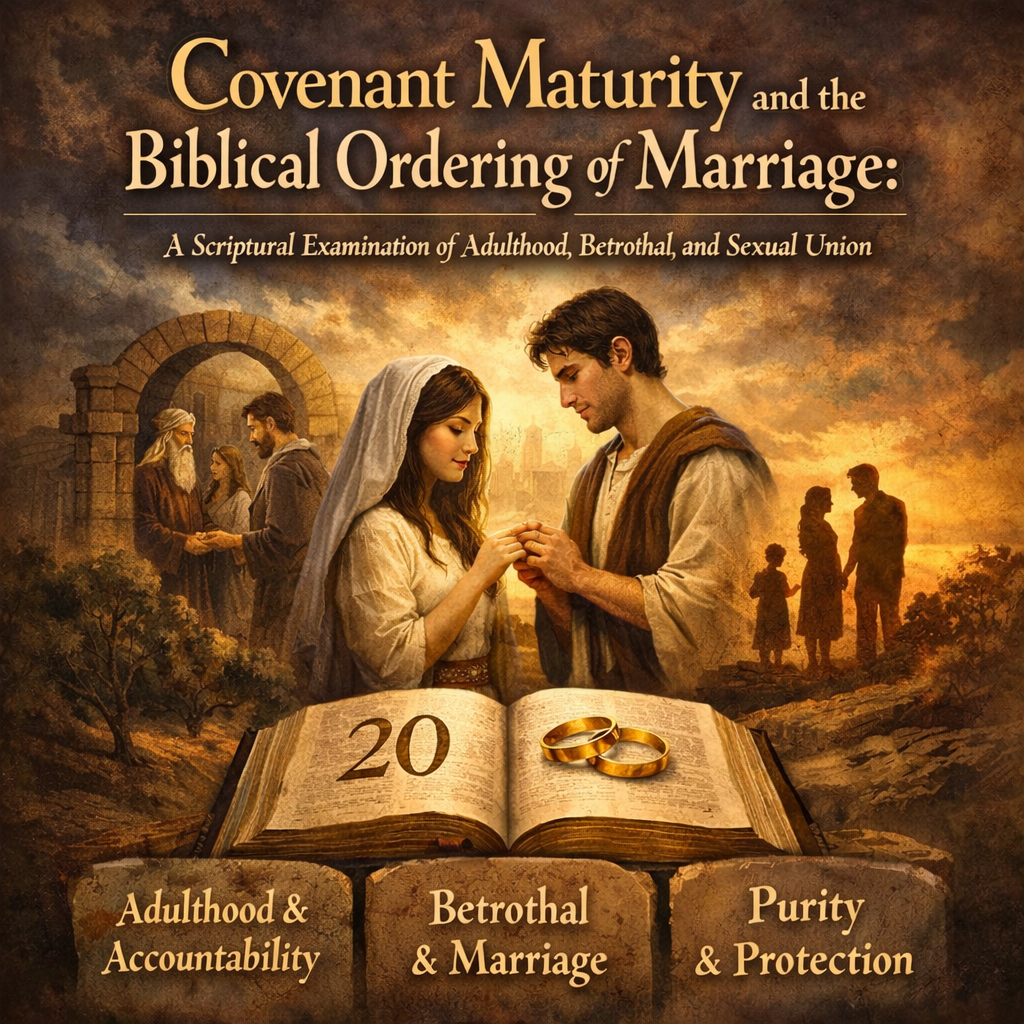
Introduction
For most of my life, I accepted without serious examination the prevailing modern narrative that child-brides were common in the Old Testament, that ancient societies possessed a form of maturity no longer present today, and that such practices (while perhaps historically real) were no longer morally or culturally acceptable in the New Testament. This assumption was not the product of careful study, but of inheritance: it was taught, repeated, and rarely questioned. I did not consider the matter worthy of extended investigation, largely because I had no interest (personal, theological, or practical) in defending or pursuing anything resembling sexual relations with children. As a Christian, I shared the common conviction that God’s moral law is written on the heart, and that certain acts are recognized as inherently wrong even prior to formal argument. On that basis, the question appeared settled in conscience, if not in detail.
However, moral intuition and biblical doctrine are not identical categories. While conscience may rightly recoil from certain actions, theology cannot rest content with assumption – especially when Scripture itself is invoked to justify or condemn. Recent public accusations, mischaracterizations, and appeals to tradition forced a reconsideration of what I had long taken for granted. I was confronted not merely with disagreement, but with the claim that Scripture itself authorizes, or at least assumes, the sexual availability of post-pubescent minor female children within marriage. That claim demanded examination – not because I found it persuasive, but because it purported to rest on biblical authority. When Scripture is cited, Scripture must be examined.
This thesis is therefore not the product of prurient curiosity or revisionist intent, but of necessity. It represents an effort to determine whether the commonly asserted narrative (that the Bible permits or records the lawful sexual union of adult men with female children) is actually grounded in the text, or whether it arises from later tradition, cultural assumption, and the dismissal of biblical categories. What follows is the result of sustained examination of Scripture’s own definitions, covenantal structures, legal distinctions, narrative records, and historical witnesses. The conclusion reached was not the one I assumed at the outset (I honestly expected a completely different outcome). Yet it is one compelled not by modern sensibilities, but by the internal coherence of Scripture itself.
Abstract
This thesis examines the biblical definition of adulthood and its implications for marriage, sexual ethics, and covenantal responsibility. Through a systematic analysis of Scripture, it argues that the Bible consistently establishes twenty years of age as the threshold of full moral, legal, and covenant accountability. On that basis, it demonstrates that Scripture neither supports, commands, nor records any instance of a lawful sexual union in which an adult man (twenty years of age or older) consummates marriage with a female under that age.
The study proceeds by defining adulthood from biblical law, distinguishing betrothal from consummated marriage, surveying canonical marriage narratives, evaluating the authority claims of post-biblical tradition, and examining relevant extra-biblical material strictly as corroborative evidence. It concludes that claims asserting biblical permission for sexual access based on post-menarche biological development arise not from the text of Scripture itself, but from later tradition, rabbinic speculation, and eisegetical inference imposed upon the biblical covenant framework.
The findings presented here affirm a coherent biblical doctrine of marriage as a covenantal institution ordered by authority, responsibility, and protection, and reject interpretive models that detach sexual access from full covenant maturity.
Well Established Biblical Age Categories
| Term | Meaning | Status |
| yānaq | infant | not accountable |
| yeled | child | not accountable |
| naʿar / naʿarah | youth | limited accountability |
| neʿurim | youth period | transitional |
| ʾîš / ʾiššâ | adult man / woman | full covenant capacity |
| zāqēn | elder | leadership maturity |
I. THE BIBLICAL DEFINITION OF ADULTHOOD: TWENTY YEARS AS THE AGE OF FULL COVENANT RESPONSIBILITY
1. The Priority of Biblical Definition Over Cultural Assumption
All theological inquiry rises or falls on definition. Where Scripture defines a category, theology is bound to receive it; where Scripture distinguishes, theology must not change those distinctions; and where Scripture is consistent, theology must not introduce contradiction under the guise of historical speculation or traditional consensus. This principle is especially critical in matters of morality, such as marriage and sexual ethics, where modern sensibilities, post-biblical customs, and inherited assumptions frequently intrude upon the text under the pretense of explanation.
The present debate concerning the biblical age of marriage has suffered precisely this failure. Arguments are routinely advanced that assume biological maturity to be the decisive criterion for marital and sexual legitimacy, often appealing to later rabbinic rulings, medieval canon law, or alleged ancient custom. Yet these arguments almost never begin where Scripture begins: with the Bible’s own definition of adulthood. Instead, adulthood is tacitly redefined in biological terms and then retroactively imposed upon the text. This is not exegesis; it is eisegesis.
Scripture is not ambiguous on the definition of adulthood, nor does it permit covenantal responsibility to be inferred from physical development alone. Rather, the Bible establishes adulthood as a juridical, moral, and covenantal status – one that carries accountability before God, representation within the community, and eligibility for public obligation. Any argument concerning marriage must therefore first answer a prior question: whom does Scripture recognize as an adult? Only after this question is answered can claims about marriage, consummation, and sexual legitimacy be responsibly evaluated.
2. Adulthood as a Covenant Category, Not a Biological One
The Bible consistently treats adulthood not as a biological milestone but as a covenantal one. Scripture recognizes physical development, fertility, and strength, but it does not equate these attributes directly with moral authority or covenant competence. The modern tendency to assume that the onset of puberty confers adult status is wholly foreign to the biblical text. In Scripture, the capacity to receive seed and pullulate life is not synonymous with the authority to govern life, enter binding covenants, or bear legal guilt.
Instead, Scripture defines adulthood by capacity for covenant responsibility. This includes the ability to stand before God as morally accountable, to represent oneself within the community, to bear legal consequences for wrongdoing, and to assume public obligations that affect others. These capacities are not presumed of children or youths, even when they are physically capable of adult functions. Scripture is explicit in maintaining this distinction, and it does so repeatedly, across diverse legal and theological contexts.
It is therefore a categorical error to argue that Scripture permits sexual or marital covenant solely wherever biological capability exists. The Bible never reasons in this way. Rather, it reasons covenantally, and covenant capacity is explicitly assigned (not inferred) by age.
3. Twenty Years Old as the Age of Moral Accountability Before God
The most explicit and theologically weighty articulation of biblical adulthood appears in the context of divine judgment. In the wilderness rebellion following the report of the spies, Israel stands under the sentence of God. The judgment pronounced is not indiscriminate, but carefully bounded:
“Your carcasses shall fall in this wilderness; and all that were numbered of you, according to your whole number, from twenty years old and upward, which have murmured against me.” — Numbers 14:29 (KJV)
This statement is not merely descriptive; it is juridical. God does not judge Israel indiscriminately, He judges a defined class of persons – those twenty years old and above. He also does not specify only men. The text deliberately excludes those below the 20 year old threshold:
“But your little ones, which ye said should be a prey, them will I bring in, and they shall know the land which ye have despised.” — Numbers 14:31
Moses later explains the theological rationale for this exclusion:
“Moreover your little ones, which ye said should be a prey, and your children, which in that day had no knowledge between good and evil, they shall go in thither, and unto them will I give it, and they shall possess it..” — Deuteronomy 1:39
Here Scripture explicitly links the capacity for moral judgment (knowledge of good and evil) with the age distinction already established. Those under twenty are not held accountable as covenant rebels; those over twenty are. The implication is clear: full moral accountability before God begins at twenty years of age.
This conclusion cannot be dismissed as incidental or limited to a single narrative moment. It reflects a broader biblical principle: God does not hold children and youths to the same covenantal standard as adults. They are protected, preserved, and accounted differently – not because they lack physical capability, but because they lack covenantal standing.
Any theological framework that treats pre-adult females as sexually or maritally accountable in the full covenantal sense must reckon with the fact that God Himself does not judge them as such.
4. Twenty Years Old as the Age of Civil and Covenant Representation
The same age threshold governs civil recognition within the covenant community. In the census legislation, Scripture repeatedly restricts official inclusion to those twenty years old and above:
“From twenty years old and upward, all that are able to go forth to war in Israel: thou and Aaron shall number them by their armies.” — Numbers 1:3
This formula is repeated throughout the Pentateuch (Numbers 26:4; Exodus 30:14), underscoring that this is not an isolated administrative choice but a Biblical structural principle. To be counted is to be recognized as a representative member of the people, capable of bearing communal responsibility and standing in one’s own name before God and the nation. Those under twenty are not excluded from Israel; they are excluded from representation. They belong to households, not to themselves. They are covered by covenant, not counted as covenant agents. Scripture thus maintains a clear distinction between inclusion and agency – a distinction often erased in modern readings.
This distinction is decisive for marriage. Marriage is not a private arrangement detached from the community; it is a public covenant that establishes a new household, carries legal consequences, and affects inheritance, lineage, and social order. To suggest that Scripture permits such a covenant to be entered by those whom it does not even count as representative members of the congregation is to sever marriage from the covenantal framework in which Scripture firmly places it.
5. Twenty Years Old as the Age of Military Responsibility
Military service in Scripture is likewise restricted to those twenty years old and above:
“From twenty years old and upward, all that are able to go forth to war in Israel: thou and Aaron shall number them by their armies.” — Numbers 1:3
Again, this restriction is theologically significant. Warfare in Scripture is not a matter of physical strength; it is an arena of moral decision, obedience to command, restraint under authority, and accountability for action. Soldiers are expected to distinguish between lawful and unlawful conduct, to obey divine instruction, and to bear guilt for transgression.
That Scripture entrusts these responsibilities exclusively to those twenty and older demonstrates again that adulthood is not equated with physical capability. Many under twenty are physically capable of battle; Scripture nevertheless excludes them. The reason is not strength but responsibility.
If Scripture does not entrust the defense of Israel to those under twenty, it is incoherent to argue that it entrusts to them the permanent, covenantal obligations of marriage, child rearing and sexual union.
6. Twenty Years Old as the Age of Cultic and Economic Obligation
The same age threshold governs cultic participation and economic responsibility. In the legislation concerning offerings, Scripture states:
“Every one that passeth among them that are numbered, from twenty years old and above, shall give an offering unto the LORD.” — Exodus 30:14
Here again, responsibility before God is tied explicitly to age. Children and youths may participate in worship, but they are not obligated in their own name. They do not stand independently before God as economic agents.
Temple service follows the same pattern:
“These were the sons of Levi after the house of their fathers; even the chief of the fathers, as they were counted by number of names by their polls, that did the work for the service of the house of the Lord, from the age of twenty years and upward.” — 1 Chronicles 23:24
Service in the sanctuary is a sacred trust, involving proximity to holy things and accountability for their handling. Scripture does not permit this responsibility to be assumed by those it does not recognize as adults.
The cumulative force of these texts is decisive. Judgment, representation, warfare, offering, and sacred service (all central covenantal functions) are uniformly restricted to those twenty years old and above. There are no exceptions to this in Scripture..
7. The Theological Coherence of Adulthood at Twenty
What emerges from this convergence is a coherent theological definition of adulthood. Adulthood in Scripture is the point at which an individual becomes fully accountable before God for rebellion and obedience, counted as a representative member of the covenant community, eligible for public obligation and service,capable of bearing legal guilt and responsibility and authorized to act independently within the covenant.
These are not marginal attributes; they define what it means to be an adult in the biblical sense. Scripture assigns all of them at the same age threshold consistently: twenty years old.
This coherence matters because Biblical law is not a collection of disconnected rules but an integrated system that remains consistent throughout. To detach marriage and sexual covenant from this system is to create a category Scripture itself does not recognize.
8. Marriage as the Highest Human Covenant Presupposing Adulthood
Marriage in Scripture is not a biological concession, but a covenantal institution. It establishes a one-flesh union (Genesis 2:24), carries sexual obligation (Exodus 21:10), creates a new household, and imposes legal consequences for violation. Adultery is punished precisely because marriage is a covenant between accountable parties.
Marriage therefore presupposes the very capacities Scripture assigns only to adults. It presupposes moral accountability, legal standing, economic responsibility, and covenant faithfulness. Scripture never presents marriage as a provisional arrangement entered prior to adulthood and later ratified by maturity. It presents marriage as an adult covenant from its inception.
To argue otherwise requires one to assert that Scripture permits individuals to enter into lifelong sexual and legal covenant while exempting them from the very responsibilities that define covenant agency. Such an assertion finds no support in the text.
9. The Fallacy of the Argument from Silence
It is often objected that Scripture nowhere explicitly states, “You shall not marry before twenty.” This objection misunderstands how biblical law functions. Scripture rarely restates definitions for each application. It establishes categories once and applies them consistently throughout.
The Bible does not explicitly say, “Only adults may be judged,” yet judgment is restricted to adults. It does not say, “Only adults may serve in the temple,” yet only adults do. It does not say, “Only adults may be counted,” yet only adults are.
Marriage operates within this same framework. Scripture assumes adulthood as already defined. To demand an explicit age statute for marriage while accepting implicit age thresholds everywhere else is not careful exegesis; it is selective skepticism, or worse – Intentional misrepresentation.
10. Conclusion to Section I
From Scripture alone (without appeal to later tradition, rabbinic authority, or ecclesiastical consensus) the following conclusions are firmly established:
First, the Bible defines adulthood as a covenantal status marked by full moral, legal, and communal accountability. Second, Scripture consistently assigns this status at twenty years of age. Third, all major covenantal responsibilities (judgment, representation, warfare, cultic service, and economic obligation) begin at this threshold. Fourth, marriage presupposes these same responsibilities and therefore presupposes adulthood.
Any claim that Scripture authorizes consummated marriage prior to adulthood must therefore overcome (not ignore) this biblical framework. The burden of proof rests not on those who affirm Scripture’s coherence, but on those who would fragment it.
The next section will examine whether Scripture ever departs from this framework in its treatment of betrothal, marriage, and consummation – or whether such departures exist only in later tradition imposed upon the text.
II.BETROTHAL AND MARRIAGE IN SCRIPTURE: COVENANT PROMISE WITHOUT ONE-FLESH CONSUMMATION
1. Why This Distinction Determines the Entire Debate
While Section I establishes the Bible’s definition of adulthood as the threshold of full covenant responsibility, Section II addresses the single most common error that fuels the modern “child-bride” narrative: the deliberate or careless combining of betrothal into marriage consummation, as though Scripture recognizes no meaningful difference between a contractual arrangement and a one-flesh convent union. This error is not a minor interpretive issue, but the pivot on which the entire moral argument turns. When betrothal and consummated marriage are treated as identical, any evidence of early betrothal becomes “proof” of early sexual access; any youthful covenant language becomes “evidence” of youthful consummation; and any discussion of marriage-age becomes a contest of speculation rather than a disciplined reading of the text.
Yet Scripture does not treat betrothal and consummation as identical. Scripture repeatedly distinguishes between a woman who is pledged, a woman who is taken, and a woman who becomes one flesh. Those who refuse to preserve these distinctions do not merely arrive at different conclusions – they adopt a different method. They take a covenant institution that Scripture regulates with precision and reduce it to a biological event governed by puberty. The resulting method is not biblical, but the logic of paganism and modernity alike: “If the body can, the covenant may.” Scripture never reasons this way.
Therefore, before examining narrative cases and alleged examples, the argument must establish the biblical categories: what betrothal is, what marriage is, what constitutes lawful sexual access, and how covenant responsibility is distributed across time and authority structures. This section will demonstrate from Scripture that betrothal is a real covenantal arrangement (often legally weighty) but that it is not identical to consummated marriage; it is a pledged state ordered under household authority until the lawful transition into one-flesh union is made by sexual consummation.
2. Scripture’s Own Vocabulary: Promise, Taking, and One-Flesh
A disciplined biblical theology begins with Scripture’s own words and patterns. Marriage in Scripture is not merely “agreement” and not merely “sex.” It is a covenantal transfer and joining: a woman is given, a man takes, and the two become one flesh within a new household order. This same pattern is already established in the creation ordinance:
“Therefore shall a man leave his father and his mother, and shall cleave unto his wife: and they shall be one flesh.” — Genesis 2:24 (KJV)
The elements here are the steps to form a covenant. There is leaving, cleaving, and one-flesh union. A covenantal household change is assumed: leaving father and mother and forming a new, joined unit. One-flesh is not treated as a casual, but a public culmination of covenant formation.
Betrothal, by contrast, is consistently portrayed as a pledged arrangement that may be legally binding yet is not presented as the completion of Genesis 2:24’s leaving-and-cleaving household reality. The pledged woman is not yet joined in the sense of household formation; she often remains under her father’s authority, and the future husband’s rights are not identical to those of a husband who has lawfully taken his wife into full one-flesh status.
This distinction is theologically necessary. Scripture is jealous for order and it does not grant covenant privileges where covenant responsibilities and lawful transitions have not occurred. To conflate betrothal with consummation is to treat the covenant as a mere formality and the woman as a mere object. Scripture does neither.
3. Betrothal as Covenant Intention Under Authority
Betrothal in Scripture is not “dating,” nor is it a casual arrangement of affection. It is covenant intention established under household authority – typically involving the father’s role, a bride price (mohar), agreements, and public knowledge. Betrothal is real. It binds. It produces obligations. It establishes a set-apart status. IT is a contract, but it does not equal sexual access.
This is most clearly demonstrated by the fact that Scripture can call a betrothed woman a “wife” in covenant terms while simultaneously treating her as not yet fully joined in one-flesh status. This is not contradiction, but covenant logic: a pledged covenant creates a defined status, yet status does not erase process. Proper covenant formation has stages, and Scripture recognizes them.
When covenant language is applied to a betrothed woman as proof of consummation, an elementary category error has occurred: it assumes that because the pledge is real, the union must already be complete. Scripture does not make that leap. Indeed, Scripture’s very legal protections around betrothal exist precisely because the pledge is real while the one-flesh union is not yet lawfully established.
4. Deuteronomy 22:23–24: The Betrothed Virgin and Covenant Accountability
Critics frequently appeal to Deuteronomy 22:23–24 as a supposed refutation of any strong distinction between betrothal and marriage. The text reads:
23 “If a damsel that is a virgin be betrothed unto an husband, and a man find her in the city, and lie with her;”
24 “Then ye shall bring them both out unto the gate of that city, and ye shall stone them with stones that they die; the damsel, because she cried not, being in the city; and the man, because he hath humbled his neighbour’s wife: so thou shalt put away evil from among you.” — Deuteronomy 22:23–24 (KJV)
This passage establishes several crucial facts at once. First, the woman is explicitly called a virgin while also being betrothed. Betrothal is therefore not equivalent to consummation. If betrothal were consummation, the category “virgin betrothed” would be incoherent. The text explicitly maintains both categories at once: pledged, yet unentered.
Second, the law’s severity proves not sexual availability but covenant gravity. The betrothed woman is treated as covenant-bound such that sexual union with another man is treated as adultery. This does not imply the fiancé’s right to consummate prior to lawful taking; it implies that the pledge creates a covenant claim upon her that others may not violate. In other words, the pledge establishes exclusive reservation, not immediate access.
Third, this law places a moral expectation upon the betrothed woman (“she cried not”) and thus demonstrates that betrothal is not a trivial matter. Yet again, accountability does not equal sexual permission. Scripture can hold a person accountable in a pledged status without granting conjugal rights to the man until the lawful transition into marriage is completed.
Those who wield this passage as proof that betrothal equals consummated marriage reveal more about their assumptions than about the text. The text explicitly calls her a virgin. The text explicitly acknowledges betrothal. And the text explicitly criminalizes unauthorized sexual access precisely because covenant exclusivity can exist prior to one-flesh union.
5. Exodus 22:16–17: Seduction, Restitution, and the Father’s Authority
Another decisive witness comes from Exodus 22:
“And if a man entice a maid that is not betrothed, and lie with her, he shall surely endow her to be his wife. If her father utterly refuse to give her unto him, he shall pay money according to the dowry of virgins.” — Exodus 22:16–17 (KJV)
Here Scripture demonstrates again that sexual union does not automatically confer lawful marital status. The man’s act creates liability (he must endow her to be his wife) yet the father retains decisive authority: he may utterly refuse. This proves several things relevant to the debate.
First, the passage assumes that an unbetrothed virgin remains under paternal authority and protection. Second, it establishes that sexual violation creates a moral debt requiring restitution – yet that debt does not bypass lawful household authority. Third, it shows that “marriage” is not merely “having sex.” If marriage were reducible to consummation, the law would not require subsequent endowment and paternal decision. Scripture refuses to equate sexual act with covenant legitimacy.
The biblical text does not protect women by declaring them sexually available; it protects them by placing sexual conduct under law, restitution, authority, and covenant formation. The protection is not “she is old enough because she bleeds.” The protection is: the man is accountable, the father has standing, and the woman is not treated as prey. Those who advocate puberty-as-consent invert Scripture’s protection into permission.
Moreover, Exodus 22 demonstrates that covenant formation is not ideally instantaneous (although it can be under the correct circumstances). There is a legal process: endowment, authority, and formal giving. Scripture knows nothing of the modern claim that sexual capability equals covenant capacity. It regulates sexuality as a moral act requiring lawful structure.
6. Deuteronomy 20:7 and the Sequence of Marriage Completion
Deuteronomy 20 provides a revealing detail about the sequence of marriage completion:
“And what man is there that hath betrothed a wife, and hath not taken her? let him go and return unto his house, lest he die in the battle, and another man take her.” — Deuteronomy 20:7 (KJV)
Here Scripture explicitly distinguishes between betrothing and taking. A man may be betrothed and yet not have taken his wife. The phrase is decisive because it uses covenant language (“betrothed a wife”) while still describing the marriage as incomplete (“and hath not taken her”). Here Scripture provides the conceptual separation between pledged status and completed union. Also notice that she is “in his house”, and still not yet “taken”.
This is a structural refutation of anyone who argues that once betrothal occurs, the relationship is fully identical to consummated marriage. Betrothal is real; taking is a further step. The man is granted exemption from war because his covenant is in progress and must be brought to completion in the proper order. Only later traditions blur that covenant process for the sake of cultural rationalization.
7. Matthew 1 and the Virgin Espoused: Betrothal Without Sexual Access
The New Testament provides a particularly clear demonstration of betrothal’s meaning through Joseph and Mary. Matthew writes:
“When as his mother Mary was espoused to Joseph, before they came together, she was found with child of the Holy Ghost.” — Matthew 1:18 (KJV)
This passage is devastating to the claim that espousal/betrothal equals consummated marriage. Mary is espoused (covenantally pledged) yet the text explicitly states: before they came together. The language is clear, espousal exists in a state where sexual union has not occurred. Moreover, Joseph’s contemplated action (to put her away privily) reveals that the espoused state carried legal weight and public significance, yet it was not treated as identical to completed one-flesh union in household formation.
In other words, Matthew provides a canonical template: betrothal is binding enough to entail “putting away,” yet distinct enough that “coming together” is a separate event. Those who claim Scripture knows no meaningful distinction between betrothal and consummation must explain why the Holy Ghost inspired Matthew to preserve it explicitly.
This is not an obscure detail, but a canonical corrective to the very confusion at the heart of the modern debate.
8. The Theology of One-Flesh: Covenant Completion and Sexual Rights
Scripture’s concept of “one flesh” is not only descriptive of intercourse; it is covenantal language tied to household order and exclusive union. Genesis 2:24 is not written as a statement about biology but as an ordinance about covenant joining. This is why Scripture treats adultery as covenant violation rather than merely illicit sex. The one-flesh bond is a covenantal reality that carries moral consequence.
This is also why conjugal rights are treated as obligations within covenant, not entitlements prior to covenant completion. Exodus 21:10 establishes the husband’s duty to provide conjugal rights to his wife. The entire force of that obligation presupposes a lawful “wife” in the completed sense – not merely a pledged arrangement. If a man were granted conjugal access at mere betrothal, the order of covenant duty would be inverted. Scripture does not invert it, but locates conjugal duty within the established household covenant.
Thus, when modern advocates of the child-bride theory argue that betrothal implies sexual access because “she is his wife,” they ignore Scripture’s insistence that covenant status does not erase covenant order. A woman may be covenantally reserved while still being protected from consummation until the proper completion of marriage occurs. The entire structure of Deuteronomy 20:7 and Matthew 1:18 presupposes this.
9. Betrothal as Protection: Reservation Without Exploitation
It is here that the polemical pressure must be applied, because the ethical stakes are not abstract thought but pedophilia. The child-bride narrative thrives on a moral sleight of hand: it claims to honor Scripture while importing into Scripture a predatory standard (menstruation) as though bodily function grants moral license. That claim not only lacks biblical foundation; it contradicts Scripture’s protective logic.
Biblical betrothal functions as protection precisely because it establishes reservation without authorizing exploitation. It creates an ordered pathway: a young woman may be promised under her father’s authority, set apart from other men, preserved in chastity, and eventually transferred into marriage when lawful completion occurs. This is covenant order. It is the opposite of the predator’s argument, which seeks access at the earliest biological opportunity while calling it “biblical.”
In biblical law, sexual access is regulated by covenant completion. The modern puberty standard replaces covenant with desire and calls it holy. That is precisely the kind of religious corruption Scripture repeatedly condemns: using sacred language to sanctify lust.
10. Answering the “Wife of Your Youth” Argument Without Conceding the Error
Opponents commonly cite Malachi 2:
“Yet ye say, Wherefore? Because the Lord hath been witness between thee and the wife of thy youth, against whom thou hast dealt treacherously: yet is she thy companion, and the wife of thy covenant.” — Malachi 2:14 (KJV)
They argue that “wife of thy youth” proves marriage in youth and therefore sexual union in youth. But the argument is careless. Malachi is a prophetic rebuke of covenant treachery, not a manual defining lawful age of consummation. The phrase “wife of thy youth” identifies the wife taken early in a man’s life relative to his later treachery (often decades later) not the biological age at consummation. It is covenant language locating moral guilt: God witnessed the covenant, and the man betrayed it.
Even if the marriage began during youth, that alone does not prove consummation occurred during minority, nor does it establish a puberty standard. The prophetic point is covenant faithfulness, not age speculation. To force Malachi into a child-bride defense is weaponization of a rebuke passage to protect a practice the passage itself condemns in principle – treachery, exploitation, and covenant deceit.
11. Interim Conclusion: Scripture Separates Betrothal From Consummation Repeatedly
From Scripture alone, the following conclusions are established with high confidence and textual clarity.
First, Scripture recognizes betrothal/espousal as a legally and morally significant covenant status, often strong enough to create exclusive claims and to treat sexual violation as adultery (Deuteronomy 22:23–24). Second, Scripture explicitly affirms that betrothal may exist while virginity remains intact (Deuteronomy 22:23; Matthew 1:18), demonstrating that betrothal is not consummation. Third, Scripture distinguishes between betrothing and taking (between pledge and completion) using direct language (Deuteronomy 20:7). Fourth, Scripture regulates sexual acts as matters requiring restitution, authority, and lawful covenant formation, not merely biological capability (Exodus 22:16–17). Fifth, Scripture’s one-flesh theology places conjugal rights within completed covenant order, not within mere pledge.
Therefore, any argument that attempts to prove early consummation from early betrothal is methodologically defective. It confuses covenant reservation with covenant completion. It treats the pledged status as license rather than protection. And it imports into the biblical moral vision a standard the Bible does not teach: that the onset of menstruation grants moral authorization for adult male sexual access.
The next section will move from law and category to narrative examination: whether Scripture ever records an adult man consummating marriage with a female under twenty, and whether alleged examples withstand textual scrutiny when the betrothal/consummation distinction is preserved rather than ignored.
III. A CANONICAL SURVEY OF BIBLICAL MARRIAGE NARRATIVES: TEXT, ORDER, AND THE ABSENCE OF ADULT-MINOR CONSUMMATION
Claim: Every Biblical Marriage Record Alignes With Adulthood
1. Methodological Controls for Narrative Analysis
Before surveying individual marriage narratives, it is necessary to establish methodological controls. Narrative texts do not function as legal codes, yet neither are they free from legal and theological structure. Scripture records events selectively and with moral intent; silence must therefore be handled with restraint, not speculation. In particular, this section adheres to the following rules:
First, no age will be assumed where Scripture does not state it. Second, no sexual consummation will be inferred from covenant language alone, especially where betrothal or pledge is present. Third, Scripture will be interpreted in harmony with the covenantal framework established in Sections I and II, rather than treated as a series of isolated anecdotes. Fourth, extra-biblical reconstructions (rabbinic, patristic, medieval, or modern) will not be permitted to supply facts absent from the text.
The burden of proof rests on any claim that Scripture records or endorses sexual union between an adult man and a female under twenty years of age. Assertions that “this was common” or “this was assumed” do not meet the standard of biblical theology. Scripture must speak for itself.
2. Isaac and Rebekah: The Paradigmatic Case
The marriage of Isaac and Rebekah (Genesis 24–25) is often cited as a supposed example of youthful marriage. Yet when the text is read carefully, it provides no support whatsoever for the claim that Rebekah was a minor at consummation, let alone that she was under twenty.
The narrative emphasizes Rebekah’s moral agency, hospitality, decisiveness, and capacity for consent. She is entrusted with significant responsibility: drawing water for Abraham’s servant and his camels, making an independent decision to leave her household, and entering a new land and covenant household. When asked directly whether she will go with the servant, she answers in the affirmative (Genesis 24:58). Scripture portrays her not as a passive child but as a capable covenant participant.
Moreover, the text records no immediate consummation upon betrothal. The servant’s mission results in covenant agreement and departure, but the narrative does not depict sexual union until Isaac “took Rebekah, and she became his wife; and he loved her” (Genesis 24:67). The order (taking, becoming wife, love) is consistent with covenant completion, not biological opportunism.
Crucially, Scripture never states Rebekah’s age. All claims that she was a young teenager originate outside the text. They are imported, not derived. To present Isaac and Rebekah as evidence for child consummation is therefore not biblical interpretation; it is tradition-driven conjecture.
3. Jacob, Leah, and Rachel: Adult Covenants, Ordered Transfer
The Jacob narratives (Genesis 29–30) are likewise frequently misused to suggest early marriage practices. Yet once again, Scripture provides no ages and no indication of adult–minor consummation.
Jacob serves Laban for a total of fourteen years for his daughters (7-Each), a duration that already undermines the notion of impulsive sexual access. The marriages are covenantal transactions involving labor, public feasting, household transfer, and social recognition. Leah and Rachel are not presented as minors under paternal guardianship at the time of consummation; they are active participants in household negotiations, childbearing, and family politics.
Indeed, Rachel and Leah later speak with authority regarding their father’s actions and inheritance (Genesis 31:14–16), language wholly inconsistent with the status of minors. Scripture depicts them as adult women capable of covenant judgment and household agency.
The text provides no evidence (explicit or implicit) that Jacob consummated marriage with underage girls. While they were betrothed well before becoming adults, consummation occurred much later. Claims to the contrary rely entirely on assumptions about ancient custom, not biblical testimony.
4. Ruth and Boaz: A Test Case for “Naʿarah”
The book of Ruth is one of the most frequently cited texts in debates over age and marriage because Ruth is called a naʿarah (Ruth 2:5–6). Some argue that this term proves youthfulness and therefore legitimizes child marriage.
This argument fails on multiple levels. First, Ruth had been previously married (Ruth 1:4). Scripture nowhere treats marriage dissolution by death as reverting a woman to childhood. Second, Ruth conducts herself with moral deliberation, initiative, and covenant loyalty (ḥesed) throughout the narrative. She is entrusted with gleaning rights, nighttime negotiations at the threshing floor, and covenant speech invoking the LORD’s name (Ruth 3:9). These are not the actions of a minor.
Third, Boaz explicitly restrains sexual conduct, praises Ruth’s virtue, and proceeds through lawful covenant mechanisms involving elders and witnesses at the gate (Ruth 4). The narrative emphasizes order, restraint, and public legality, not private access.
The use of naʿarah here does not indicate minority. It functions contextually as a descriptor of unmarried status or relative youthfulness, not legal incapacity. To argue otherwise is to ignore narrative context.
5. Deuteronomy 21:10–14: The Captive Woman
Another frequently abused passage is the law concerning the captive woman:
10 “When thou goest forth to war against thine enemies, and the Lord thy God hath delivered them into thine hands, and thou hast taken them captive,”
11 “And seest among the captives a beautiful woman, and hast a desire unto her, that thou wouldest have her to thy wife;” – Deuteronomy 21:10–11)
Critics often insinuate that this law permits immediate sexual access to any female of reproductive age. Yet the text explicitly forbids such behavior. The woman must be brought into the house, given time to mourn, and undergo a transition period before any marital union occurs. Even then, she is protected from sale or exploitation.
The law does not identify the captive as a child, nor does it permit instant consummation. On the contrary, it restrains male desire through structured delay, transformation of status, and covenant obligation. The absence of age specification does not imply permissiveness; it reflects the law’s assumption that marriage presupposes adult capacity, as established elsewhere in Torah.
6. Kings and Royal Marriages: The Question of Youthful Wives
The historical books record instances of kings marrying at relatively young ages. Some kings themselves ascended the throne as youths. Critics sometimes argue that this implies marriage among minors.
This inference is unwarranted. First, Scripture does not record ages of wives in these cases. Second, where youthful kings are involved, nothing in the text indicates a significant age disparity or adult–minor sexual union. Third, royal marriages are consistently treated as political and covenantal acts, not casual arrangements.
Moreover, Scripture is unafraid to condemn royal sexual sin when it occurs (e.g., David and Bathsheba). The absence of condemnation for child consummation is not proof of its acceptance; it is evidence that Scripture does not record it.
7. The Absence of Any Explicit Counterexample
After surveying the canonical narratives, one fact stands out with remarkable clarity: Scripture never records an instance in which an adult man is said to consummate marriage with a female under twenty years of age. This is not an argument from silence in the weak sense. It is an argument from consistent narrative absence combined with explicit covenantal structure.
Scripture is meticulous when addressing sexual boundaries, violations, and covenant order. It names incest, adultery, fornication, and it records sexual sin with unflinching detail. The fact that it nowhere records or regulates adult–minor consummation as a lawful marital act is therefore not accidental.
Those who claim such practices were common must explain why Scripture (so precise elsewhere) never speaks of them.
8. Theological Implications of Narrative Coherence
The coherence between legal definition (Section I), covenant process (Section II), and narrative practice (Section III) is striking. Scripture defines adulthood at twenty, distinguishes betrothal from consummation, and records marriages that align with these principles. There is no tension to resolve – only later tradition to impose.
When critics insist that Scripture “must have” allowed child consummation because later interpreters believed it did, they invert the authority structure. Tradition becomes the lens through which Scripture is reinterpreted, rather than Scripture judging tradition.
Biblical theology cannot proceed on that basis.
9. Interim Conclusion
The canonical record, when examined without conjecture, yields a clear result. Scripture provides no example, explicit or implicit, of a lawful sexual union between an adult man and a female under twenty years of age. Where covenant language appears in youthful contexts, it refers to betrothal or relative youthfulness, not consummation. Where sexual conduct is regulated, it is restrained by law, authority, and process – not biological readiness.
The burden therefore shifts. Those who assert that Scripture permits or endorses adult-minor marriage must demonstrate this from the text itself. Appeals to tradition, consensus, or assumed ancient practice do not meet the standard of biblical proof.
The next section will address those appeals directly by examining extra-biblical claims (rabbinic, patristic, and medieval) and demonstrating precisely where and how they diverge from the biblical framework rather than illuminate and support it.
IV. TRADITION VERSUS TEXT: WHEN EXTRA-BIBLICAL AUTHORITY OVERRIDES SCRIPTURE
1. The Question of Authority in Theological Ethics
Every dispute of theological ethics eventually resolves not into a disagreement over facts but over authority. The present controversy is no exception. The arguments advanced against the biblical framework established in Sections I–III do not finally contest the scriptural data; rather, they seek to subordinate that data to an alternative authority – namely, tradition. This appeal takes several forms: patristic consensus, rabbinic interpretation, medieval canon law, or the assumed practices of the ancient Near East. Though these sources are often invoked with an air of scholarly gravitas, their role in Christian theology must be carefully delimited. Tradition may witness to interpretation, but it cannot legislate doctrine where Scripture has spoken, nor can it authorize practices Scripture neither records nor endorses.
The core claim advanced by defenders of the child-bride theory is not that Scripture explicitly teaches such a practice (few attempt that) but that Scripture must be read through the lens of tradition, and that tradition overwhelmingly supports early consummation following puberty. This claim requires scrutiny on two levels. First, whether the alleged consensus is as uniform and authoritative as claimed. Second, whether such consensus (if it existed) would possess the authority to override or reinterpret Scripture’s own covenantal structure. The answer to both questions is an obvious no.
2. The Nature and Limits of Tradition in Christian Theology
Historically, Christian theology has recognized a hierarchy of authority. Scripture stands as the norma normans – the norm that norms all others. Tradition, at best, is a norma normata – a derived witness that must itself be judged by Scripture. This principle is not a Protestant novelty; it is embedded in the biblical text itself. Jesus repeatedly rebukes religious leaders for “teaching for doctrines the commandments of men” (Matthew 15:9) and for “making the word of God of none effect through your tradition” (Mark 7:13). The apostolic writings continue this posture, warning against philosophy and tradition “after men” rather than “after Christ” (Colossians 2:8).
Therefore, any appeal to tradition that contradicts or bypasses the internal logic of Scripture stands under immediate suspicion. Tradition may clarify ambiguous points; it may preserve historical memory; it may reflect the moral instincts of a given era. But it cannot create moral license where Scripture has established covenantal boundaries. To grant tradition that power is to reverse the biblical order of authority.
3. Rabbinic Tradition and the Post-Biblical Reconfiguration of Marriage
Rabbinic Judaism is often cited as the most direct heir to biblical marital norms. Yet this appeal folds under examination. Rabbinic literature (particularly the Mishnah and Talmud) represents a post-biblical reconfiguration of Torah, developed after the destruction of the Second Temple and shaped by centuries of interpretive accretion. Its authority is not derived from Scripture but from rabbinic succession and communal enforcement.
Crucially, rabbinic age rulings concerning marriage and sexual access are not drawn from explicit Torah statutes. They are inferred from biological assumptions, Greco-Roman influence, and pragmatic concerns regarding lineage and fertility. The puberty standard (particularly the fixation on menarche) has no textual foundation in Torah. It is a halakhic construct, not a biblical one.
Even within rabbinic literature, there is no monolithic consensus. Debates persist over consent, maturity, and paternal authority. The existence of disagreement alone should caution against treating rabbinic rulings as authoritative exegesis rather than cultural theology. More importantly, Christian theology is not bound to rabbinic halakhah at all. The New Testament explicitly distances itself from rabbinic authority structures (Galatians 4; Colossians 2), grounding moral reasoning in Christ and Scripture rather than in inherited legal traditions.
To appeal to rabbinic precedent as binding proof is therefore to mistake proximity for authority.
4. Patristic Voices: Context, Assumptions, and Overreach
Appeals to the Church Fathers (Augustine of Hippo, Jerome, John Chrysostom, Basil of Caesarea, and others) are often presented as decisive. These figures undeniably shaped Christian moral discourse, yet their writings must be read with historical awareness. The Fathers did not write without bias; they inherited Roman legal categories, Greco-Roman medical theories, and cultural assumptions about fertility, family structure, and social order. When they spoke about age and marriage, they often did so pastorally or pragmatically, not exegetically.
More importantly, patristic writings do not present a unified, explicit doctrine of child consummation grounded in Scripture. References to youthful marriage are typically incidental, reflecting prevailing customs rather than biblical mandates. In many cases, the Fathers express discomfort with early sexual activity, emphasizing chastity, restraint, and moral formation. Their concerns often cut against the modern appropriation of their words by those seeking biblical license for adult–minor sexual union.
It is also essential to note that the Fathers never claimed their moral judgments possessed the authority of Scripture. Augustine himself repeatedly insists that Scripture alone is inerrant. To elevate patristic opinion above scriptural structure is therefore to betray the Fathers’ own stated commitments.
5. Medieval Canon Law and the Codification of Puberty Standards
The medieval period, particularly through figures such as Gratian and Thomas Aquinas, formalized puberty-based marriage standards within canon law. These standards, however, reflect Roman legal inheritance, not biblical exegesis. Roman law treated puberty as the marker of contractual capacity in matters of marriage, and medieval canonists largely absorbed this framework wholesale.
This absorption should not be mistaken for biblical continuity. Canon law’s concern was sacramental validity and social order within Christendom, not covenantal theology derived from the Hebrew Scriptures. The age thresholds codified in canon law were administrative solutions, not exegetical conclusions. They answered the question, “At what point may the Church recognize a marriage as legally binding?” – not, “What does Scripture teach about covenantal adulthood?”
To conflate canonical legality with biblical morality is a grievous error. The Church’s administrative decisions, shaped by imperial inheritance and cultural pragmatism, cannot be retroactively imposed upon Scripture as interpretive keys.
6. Protestant Reformers and the Reassertion of Scriptural Primacy
The Protestant Reformers (Martin Luther, John Calvin, and their contemporaries) explicitly rejected the elevation of tradition over Scripture. While they did not comprehensively reconstruct marital age theology, their methodological commitments are decisive. Sola Scriptura did not mean the rejection of all tradition, but the subordination of all tradition to the clear teaching of Scripture.
Where Reformers addressed marriage, they emphasized covenant fidelity, consent, and moral responsibility, not biological readiness. Their silence on child consummation as a biblical norm is telling. Had Scripture clearly taught such a practice, it would have featured prominently in Reformation debates over marriage and morality. It does not.
7. The Logical Failure of “Consensus” Arguments
Even if one were to grant (for the sake of argument) that a historical consensus existed favoring early consummation, this would still not establish biblical authority. Consensus does not create truth; it only demonstrates prevalence. Scripture repeatedly records majorities in error: Israel in the wilderness, the priests in Jeremiah’s day, the Pharisees in Christ’s ministry. The moral weight of a belief is not determined by how long it has been held or how many have held it, but by whether it accords with the Word of God.
Moreover, the alleged consensus disappears completely upon closer inspection. Rabbinic disagreement, patristic ambivalence, medieval pragmatism, and Reformation restraint do not amount to a unified doctrinal witness. What remains is a loose continuity of cultural assumptions about biology and marriage – assumptions Scripture never codifies.
8. The Ethical Consequences of Subordinating Scripture to Tradition
The stakes of this debate are not merely academic, because ee are not discussing some abstract theory. When tradition is permitted to override Scripture’s covenantal structure, ethical boundaries erode. Puberty becomes permission, authority gives way to appetite, and protection is portrayed as sexual access. The very logic Scripture uses to restrain exploitation is inverted into a mechanism for justifying it.
This inversion is not hypothetical. It appears whenever menstruation is cited as moral authorization, whenever paternal authority is dismissed as obstruction, and whenever covenant process is reduced to biological readiness. Such reasoning does not preserve biblical order, but undermines and even dismantles it.
Scripture’s silence on adult-minor consummation is not a gap to be filled by tradition; it is a boundary to be respected. To cross it is not to honor Scripture but to violate it.
9. Interim Conclusion: Scripture Judges Tradition, Not the Reverse
The examination of extra-biblical authorities yields a clear result. Rabbinic rulings, patristic opinions, medieval canon law, and historical custom all reflect interpretive developments shaped by cultural context. None of them possess the authority to redefine biblical adulthood, erase the betrothal-consummation distinction, or authorize practices Scripture does not specifically allow or record.
The appeal to tradition, therefore, does not strengthen the child-bride argument; it exposes its weakness. Unable to demonstrate explicit biblical support, it seeks refuge in inherited assumptions. But Scripture does not yield to tradition. Tradition stands or falls before Scripture.
The next section will therefore turn not to conclusion, but to corroboration. Having established the biblical framework from Scripture alone, it will examine extra-biblical sources (early Jewish sectarian texts, legal scholarship, and relevant historical materials) not as authorities capable of defining doctrine, but as witnesses capable of confirming or contradicting the scriptural pattern already demonstrated. These materials will be employed strictly in a subordinate role, serving to illustrate whether the biblical definition of adulthood and covenantal marriage stands isolated or is reflected, however imperfectly, in the historical record.
V. EXTRA-BIBLICAL CORROBORATION: HISTORICAL WITNESS WITHOUT DOCTRINAL AUTHORITY
1. The Proper Role of Extra-Biblical Evidence in Biblical Theology
Biblical theology is not opposed to history. It is opposed to history ruling Scripture. The distinction is essential. Scripture itself frequently appeals to external witness (customs, kings’ records, treaties, and public memory) yet never allows such material to redefine covenant law. Accordingly, extra-biblical sources may serve as corroboration, contextual illumination, or negative contrast, but never as a source of binding doctrine.
This methodological principle is especially important in disputes over age, marriage, and sexual ethics, where later tradition often seeks to supply what Scripture allegedly omits. The temptation in such debates is either to dismiss all extra-biblical material outright or to elevate it improperly. Neither approach is warranted. The correct posture is judicial: Scripture defines the law; history may testify as a witness. Where the witness aligns with Scripture, it strengthens confidence; where it diverges, it exposes corruption.
This section therefore does not attempt to prove adulthood at twenty from external sources. That has already been demonstrated from Scripture alone (Sections I–III). Instead, it asks a narrower and more disciplined question:
Do the earliest extra-biblical witnesses closest to the biblical world confirm or contradict the scriptural pattern that adulthood (and therefore marital consummation) presupposes full covenant maturity?
As will be shown, the most relevant and earliest sources consistently confirm, rather than undermine, the biblical framework – particularly when later rabbinic and medieval developments are distinguished from earlier sectarian and Second Temple evidence.
V.2. The Dead Sea Scrolls and the Rule of the Congregation (IQSa)
Among the most significant extra-biblical witnesses to early Jewish legal thought are the Dead Sea Scrolls, particularly documents associated with the Qumran community. These texts are invaluable not because they possess authority equal to Scripture, but because they represent pre-rabbinic Jewish interpretation contemporaneous with or immediately preceding the New Testament era. They therefore predate the later Talmudic system that is often appealed to in defense of puberty-based marital norms.
Of particular relevance is the document commonly referred to as the Rule of the Congregation (1QSa). This text explicitly addresses the age at which an individual may assume full covenant participation, including marriage and sexual relations. The passage states, in summary, that a male is instructed from youth, trained in the law, and only at twenty years of age may he be counted among the congregation, testify in judgments, and approach a woman sexually.
The importance of this witness cannot be overstated. Here we have a Jewish sectarian community (deeply committed to Torah observance) explicitly identifying twenty as the threshold of sexual and covenantal maturity. This directly contradicts the claim that early Judaism universally endorsed sexual access at puberty. It demonstrates instead that at least some Torah-centered communities understood adulthood in precisely the covenantal terms reflected in Scripture itself.
Crucially, this text does not invent the age of twenty, but recognizes it. The language mirrors the biblical pattern: instruction in youth, accountability in adulthood, and sexual relations only after full covenant standing is attained. The community does not reason biologically but covenantally. Sexual access is tied to legal and moral capacity, not to physical development.
Once again, this text does not create doctrine. But it confirms that Scripture’s age-based covenant structure was not a modern invention nor a marginal reading. It existed within Second Temple Judaism itself, prior to rabbinic codification.
V.3. Fleishman (1992) and the Legal Age of Maturity in Biblical Law
The modern academic work most frequently cited in this discussion is Joseph Fleishman’s “The Age of Legal Maturity in Biblical Law” (1992). While Fleishman’s conclusions are not binding, his methodological rigor is noteworthy because he approaches the subject from within legal anthropology rather than theological polemic.
Fleishman observes that biblical law consistently associates twenty years of age with full legal competence. He surveys the same texts examined in Section I (Numbers 14, Numbers 1, Exodus 30, and related passages) and concludes that twenty functions as the age at which an individual transitions into full legal standing within Israelite society. Importantly, Fleishman does not base this conclusion on military service alone; he recognizes that the military census reflects a broader legal reality rather than creating it.
What makes Fleishman’s work particularly valuable for this thesis is that it undermines the claim that linking adulthood to twenty is an arbitrary or tendentious move driven by modern sensibilities. On the contrary, it shows that mainstream legal scholarship recognizes the coherence of this age threshold within biblical law itself.
Equally important is what Fleishman does not argue. He does not suggest that puberty serves as a biblical legal marker. He does not argue that sexual maturity equals covenant maturity. He does not locate marriageability in biological function. His conclusions align naturally with the covenantal reading already established from Scripture.
Once again, the point is not that Fleishman “proves” the doctrine. Rather, his work demonstrates that serious legal scholars (approaching the text without theological agendas) recognize the same structural reality Scripture itself reveals.
4. Ancient Near Eastern Legal Norms: A Necessary Contrast
Advocates of early consummation frequently appeal to “Ancient Near Eastern norms,” arguing that early marriage must have been common because surrounding cultures practiced it. This argument is rhetorically effective but methodologically weak. It assumes continuity where Scripture establishes discontinuity.
Ancient Near Eastern law codes (such as those from Mesopotamia) often treated women as property, emphasized fertility over consent, and permitted practices Scripture explicitly condemns or restrains. The Bible does not present Israel as a mirror of its neighbors but as a counter-cultural covenant people governed by divine law.
Indeed, one of the most striking features of biblical sexual law is its restraint relative to surrounding cultures. Where other systems permitted immediate sexual access through purchase or conquest, Scripture interposed waiting periods, covenant processes, paternal authority, and moral accountability. Deuteronomy 21’s captive woman law is a clear example: rather than permitting instant sexual use, the law mandates delay, mourning, and the option of release without exploitation.
Thus, appeals to ANE custom cut both ways. If Israel simply followed regional norms, Scripture’s elaborate sexual regulations would be unnecessary. The existence of such regulations demonstrates that Israel’s law was not derived from cultural practice but imposed upon it.
Therefore, even if some ancient cultures practiced early consummation, this does not establish biblical permission. At most, it highlights Scripture’s distinct moral vision – one that repeatedly resists reducing sexuality to biology or power.
5. Jewish Sectarian Diversity and the Myth of Consensus
Another critical point often obscured in these debates is the absence of a unified ancient Jewish consensus on age and marriage. Rabbinic Judaism, Qumran sectarianism, Hellenized Jewish communities, and later medieval authorities all diverged in significant ways. To speak of “what the Jews believed” is historically inaccurate.
The Dead Sea Scrolls alone demonstrate that Torah-oriented Jews could (and did) interpret covenant maturity as occurring at twenty. This fact alone dismantles the claim that puberty-based marriage was universally accepted in biblical or Second Temple Judaism.
Later rabbinic codifications, developed centuries after the close of the biblical canon, reflect evolving social and legal pressures rather than unchanged biblical doctrine. To retroject those developments back into Scripture is anachronism, not faithful interpretation.
Thus, when critics argue that “tradition proves it was holy,” the appropriate response is simple: which tradition, and by what authority? The historical record does not support the claim of uniformity, let alone doctrinal bindingness.
6. The Islamic Parallel: Confirmation by Divergence
It is also worth noting (without polemical excess) that Islamic law explicitly codifies puberty-based sexual access. This fact is sometimes raised defensively, as though similarity implies biblical continuity. In reality, it proves the opposite.
Islamic jurisprudence openly grounds sexual permissibility in physical markers, not covenant maturity. The Bible never does this. The contrast is instructive. Where Islam codifies what Scripture restrains, it confirms that the puberty standard is not a shared Abrahamic inheritance but a later legal development with its own theological premises.
This comparison again does not establish doctrine, but it clarifies categories. The Bible’s refusal to legislate sexual access based on menstruation is not an oversight; it is a theological choice rooted in covenant order.
7. Why Corroboration Matters – but Cannot Rule
At this stage, the cumulative effect of extra-biblical corroboration becomes clear. The earliest sectarian Jewish witnesses align with Scripture’s covenantal adulthood framework. Serious legal scholarship recognizes twenty as the biblical age of maturity. Surrounding cultures provide contrast rather than confirmation. Later rabbinic and medieval traditions reflect development, not preservation of God’s order and laws.
Yet none of this material is allowed to decide the matter. Scripture has already done that. The value of corroboration lies not in creating law, but in demonstrating that the scriptural reading advanced in this thesis is neither novel nor idiosyncratic. It is deeply rooted, historically practiced, and textually coherent.
By maintaining this hierarchy of authority, the argument remains clean. Scripture speaks; history witnesses; tradition is judged.
8. Interim Conclusion
Extra-biblical evidence, when properly ordered, strengthens rather than weakens the biblical case. The Dead Sea Scrolls confirm covenant maturity at twenty. Legal scholarship recognizes the same threshold within biblical law. Ancient Near Eastern norms highlight Scripture’s counter-cultural restraint rather than permissiveness. Claims of uniform traditional endorsement fail under historical scrutiny.
Most importantly, none of these sources are permitted to legislate where Scripture has spoken. They serve only to confirm what the biblical text already demonstrates: that adulthood is a covenantal status tied to full responsibility, and that marriage and sexual consummation presuppose that status.
With Scripture established, categories clarified, narratives surveyed, tradition evaluated, and corroboration supplied, the argument is now complete in substance.
The final section will therefore draw the argument together, address any remaining objections arising from the interaction of text, narrative, and historical claim, and articulate the positive theological doctrine of marriage as presented in Scripture: an institution ordered by covenant, authority, responsibility, and protection. On that basis, it will then render judgment concerning the legitimacy or illegitimacy of competing frameworks that detach sexual access from full covenant maturity or that substitute biological development for biblical accountability.
VI. SYNTHESIS AND FINAL JUDGMENT: COVENANT ORDER, MATURITY, AND THE LIMITS OF LAWFUL SEXUAL UNION
1. The Task of Synthesis
The purpose of synthesis in theological inquiry is not to introduce new evidence but to render judgment upon evidence already examined. Having established the biblical definition of adulthood (Section I), clarified the covenantal distinction between betrothal and consummation (Section II), surveyed the canonical marriage narratives (Section III), evaluated the authority claims of tradition (Section IV), and considered extra-biblical corroboration in its proper subordinate role (Section V), the task of this final section is to integrate these strands into a coherent doctrinal conclusion. This conclusion must be drawn not from emotional sentiment, conjecture, or consensus, but from Scripture interpreted according to its own categories, structures, and priorities.
The question before us is therefore not whether later communities believed certain practices to be permissible, nor whether such practices occurred in various cultures, but whether the biblical text itself (taken as a unified covenantal system) authorizes, records, or necessitates the conclusion that lawful marriage and sexual consummation may occur prior to full covenant maturity. The answer to that question, when the evidence is weighed as a whole, is decisively negative.
2. The Coherence of the Biblical Covenant System
A defining characteristic of biblical law is its internal coherence. Scripture does not legislate in fragments, nor does it assign privileges without corresponding responsibilities. Where it grants authority, it also imposes accountability; where it establishes rights, it also delineates obligations. This coherence is especially evident in the Bible’s treatment of adulthood.
As demonstrated in Section I, Scripture consistently locates full covenant accountability at twenty years of age. This threshold governs divine judgment, civil representation, military service, cultic obligation, and economic responsibility. These are not incidental concerns, but constitute the core functions of covenant agency. The Bible does not distribute these functions across a spectrum of biological development but assigns them collectively at a defined point of maturity.
This covenantal definition of adulthood is not irrelevant background information, but the foundation upon which all subsequent covenantal institutions rest, including marriage. To detach marriage from this foundation is to treat it as an exception to the very system that gives it meaning. Scripture provides no warrant for such an exception.
3. Marriage as Covenant, Not Mere Capacity
The biblical vision of marriage is fundamentally covenantal. From Genesis 2 onward, marriage is presented as the formation of a new household through a one-flesh union ordered by divine ordinance. This union carries moral, legal, and social consequences. It establishes exclusive sexual rights and obligations, creates inheritance structures, and invokes divine witness. Adultery is condemned precisely because marriage is not merely a sexual arrangement but a covenantal bond.
This covenantal character presupposes maturity – not merely physical capacity, but moral discernment, legal accountability, and social responsibility. Scripture does not treat sexual capability as sufficient qualification for covenant participation. Indeed, the Bible repeatedly restrains sexual conduct through law, authority, and process, even among those who are biologically capable of reproduction.
To argue that Scripture permits consummated marriage wherever physical development exists is therefore to redefine marriage itself. It reduces covenant to capacity and obligation to opportunity. Such a reduction finds no support in the biblical text and stands in tension with its consistent emphasis on order, restraint, and accountability.
4. Betrothal Reconsidered in Light of Covenant Maturity
One of the most persistent attempts to evade the implications of covenant maturity is the conflation of betrothal with consummated marriage. Section II demonstrated that Scripture resists this conflation. Betrothal is a real and binding contract or covenantal arrangement, yet it is explicitly distinguished from the act of taking a wife and entering one-flesh union. Virginity may remain intact during betrothal; sexual access is not presumed; conjugal rights are not granted.
This distinction is not a technicality. It reflects Scripture’s concern to preserve order during the transition from household to household, from paternal authority to marital authority. Betrothal functions as a protective reservation, not as a license for sexual access. It allows covenant intention to be established without entering a marriage covenant immediately.
When this distinction is preserved, many alleged counterexamples become irrelevant. Youthful betrothal does not entail youthful consummation. Covenant language does not imply biological readiness. Accountability within a pledged status does not equate to sexual permission. Scripture is capable of holding these realities together without contradiction, provided its categories are respected.
5. Narrative Silence as Structured Absence
The canonical narratives examined in Section III provide an important negative confirmation. Scripture records marriages across patriarchal, tribal, monarchic, and post-exilic contexts. It names sexual sins and does not hesitate to expose moral failure, even among revered figures. Yet it nowhere records a lawful sexual union between an adult man and a female under the age of full covenant maturity.
This absence is not the result of prudishness or oversight. It is a structured absence consistent with the legal and theological framework already established. Scripture is meticulous where sexual boundaries are concerned. That it does not narrate or regulate adult–minor consummation as a legitimate marital act demonstrates that such a category did not exist within its moral universe.
Appeals to what “must have been common” cannot ignore this pattern. Biblical theology does not operate on assumptions of prevalence but on revealed order. Where Scripture speaks, it governs; where it is silent within a coherent framework, that silence functions as boundary rather than invitation.
6. Tradition Revisited: Witness Without Warrant
Section IV demonstrated that appeals to tradition, whether rabbinic, patristic, medieval, or otherwise, ultimately rest on an inversion of authority. Tradition may describe how later communities reasoned about marriage, but it cannot retroactively redefine the biblical covenant system. Where tradition aligns with Scripture, it may be acknowledged as corroborative; where it diverges, it must be corrected.
The puberty standard frequently invoked in defense of early consummation arises not from biblical exegesis but from biological reductionism and legal pragmatism. It reflects a shift away from covenant maturity toward functional capability. That shift may be historically explicable, but it is not biblically authorized.
The proper theological posture is therefore neither to dismiss tradition wholesale nor to enthrone it uncritically. Scripture judges tradition, not the reverse. When judged by Scripture, the puberty standard fails to meet the requirements of covenant coherence.
7. Extra-Biblical Corroboration and the Strength of the Scriptural Reading
The corroborative evidence surveyed in Section V reinforces this conclusion. Early Jewish sectarian texts, legal scholarship, and comparative cultural analysis do not undermine the biblical framework; they confirm it or highlight its distinctiveness. Where early communities recognized covenant maturity at twenty, they echoed Scripture’s own structure. Where surrounding cultures diverged, Scripture’s restraint becomes all the more pronounced.
This corroboration is significant not because it creates doctrine, but because it demonstrates that the scriptural reading advanced here is neither novel nor implausible. It is deeply rooted in the biblical worldview and intelligible within its historical context.
8. Addressing the Final Objection: “Where There Is No Explicit Law”
One final objection warrants addressing: the claim that because Scripture does not explicitly state, “Adult men shall not have sex with children” or “You shall not consummate marriage before twenty,” that no such restriction exists. This objection misunderstands the nature of biblical law.
Scripture does not legislate by exhaustive enumeration. It establishes categories and applies them consistently. The absence of a redundant prohibition does not imply permission. Just as Scripture does not explicitly forbid children from serving as priests or judges (yet clearly excludes them through categorical definition) so it does not explicitly restate adulthood requirements for marriage, having already defined adulthood elsewhere.
The demand for an explicit age statute for marriage while accepting implicit age thresholds in every other covenantal domain is not methodological rigor. Biblical theology requires consistency. When applied consistently, the covenant maturity framework governs marriage as surely as it governs judgment, service, and representation.
9. Final Judgment
The evidence now permits judgment.
First, Scripture defines adulthood as a covenantal status marked by full moral, legal, and communal accountability, consistently located at twenty years of age. Second, marriage in Scripture is a covenantal institution that presupposes this status. Third, betrothal functions as a protective, preparatory covenant that does not authorize sexual consummation. Fourth, the canonical narratives provide no example of lawful adult-minor consummation. Fifth, tradition lacks the authority to override this framework, and early corroborative evidence aligns with it rather than contradicting it.
Therefore, the conclusion follows not as an assertion but as a judgment rendered from the Biblical text:
The biblical vision of marriage is ordered, covenantal, and protective. It does not authorize sexual access detached from full covenant maturity, nor does it equate biological development with moral or marital competence. Any framework that does so stands in opposition with Scripture rather than in continuity with it.
This judgment does not arise from modern sensibilities, emotional reaction, or selective proof-texting. It arises from the internal coherence of Scripture. Where Scripture defines, theology must submit. Where Scripture orders, theology must not invert. And where Scripture protects, theology must not rationalize exploitation under the guise of tradition.
With this, I can state with a high degree of confidence that the Bible does not allow either legally or morally an adult male (over 20) having sex with a female child (under 20).
Concluding Reflection
It remains a matter of genuine disbelief that a subject of this nature has demanded such sustained attention at all. At a moment in history marked by moral fragmentation, institutional collapse, widespread injustice, and the erosion of social trust, one would expect the energies of Christian men to be directed toward repentance, restoration, discipleship, protection of the vulnerable, and the rebuilding of ordered households and communities. Instead, a disproportionate amount of public effort has been expended on arguing, condemning, and dividing over a question that should never have required defense: whether adult men possess a moral or biblical right to have sex with children. That such a proposition is even framed as a legitimate theological disagreement is itself an indictment of the present condition of Christian moral reasoning.
The tragedy is not merely that division has occurred, but that it has occurred over a claim so profoundly misaligned with the character of God and the trajectory of Scripture. While the world burns, the faith fractures – not over the gospel, not over justice, not over holiness, but over the attempted sanctification of what conscience, Scripture, and covenant order alike reject. If the church cannot speak with clarity and restraint on matters of protection, maturity, and moral accountability, it forfeits its witness in matters of greater weight. This thesis was not written to inflame controversy, but to close it – to insist that Scripture be read plainly, that covenant order be honored, and that Christian men redirect their attention from speculative permission toward faithful obedience. There are children to protect, households to restore, and a world in need of light. That task at hand is urgent enough without inventing battles Scripture never called us to fight.
Perhaps most troubling of all is the example such public disputes set for those standing at the edge of faith. Imagine a man or woman searching for truth, belonging, or redemption (someone wounded by the world, skeptical of institutions, yet still drawn toward Christ) encountering Christian men engaged in open, hostile debate over the supposed moral or biblical legitimacy of a 50 year old man having sex with a 12 year old girl. Whatever one’s intent, the spectacle itself becomes a stumbling block. Scripture repeatedly warns against causing offense to the vulnerable or confusing the conscience of those seeking the way of righteousness. When those who claim to speak for Christ appear more invested in defending pedophilia than in embodying holiness, protection, and restraint, the gospel is obscured, and the credibility of Christian witness is diminished. The church does not merely teach doctrine; it models moral vision. If that vision appears distorted or self-serving, the cost is borne not only internally through division, but externally through souls turned away before they can be invited in.
You’re so interesting! I do not think I’ve truly read through
a single thing like this before. So good to discover someone with original
thoughts. This site is something that’s needed on the internet,
someone with a little originality!
How is this a conversation we have to have in 2026?
Lord, Oregon checking in: THIS is what disciplined Christian scholarship looks like. You came with Scripture-definitions, categories, covenant structure, and receipts. You took a subject people weaponize for slander and you dragged it into the light with order, clarity, and restraint. This isn’t “defending something”; this is closing the door on a wicked lie without letting tradition get in the way. The fact that you made the Bible’s own framework do the talking is exactly why your enemies can’t argue with the substance, so they scream at the man instead. Keep writing. Keep building. Keep restoring.
We see you, and we’re with you. This is why we support your work!
I guess we’re all just supposed to pretend that its not one of the women you call your wife that’s commenting on every single one of your posts supporting your deranged thoughts and abuse of scripture? Anything to soothe your wee little ego!
It troubles me that especially in today’s society that this had to be addressed at this length, and that this wasn’t just a common sense or issue of morality, Men” are supposed to be leaders, protectors, and providers. They are not supposed to “groom” and prey on vulnerable CHILDREN. What is even more disturbing is that most of the “men” who have been debating and demanding all of this doctrinal proof for weeks are supposed to be upstanding “Christians”. It does just show that everyone’s moral compass, “Christian” or otherwise is not the same. Are these men going to allow 30-70 year old men to violate their 8- 14 year old daughter because they deem it “biblical” just because she has her menstrual cycle? They don’t even really understand what is going on at that point in life if they have been raised right and aren’t exposed to the societal influences of the world. Could you imagine your little girl who still plays tea party and has baby dolls and just barely
Learning how to get herself properly dressed for different events, to be able to brush her own hair and bathe herself is being violated and seeded by a male party who is old enough to be her father? How disgustingly immoral. Also, as a mother…I would not want my child to be any where near “Christian men” who had this kind of mentality. Aren’t your jobs supposed to be showing people and the world how to live actually Godly lives and be “Christ like” and to try to lead as many souls to Christ as possible? To minister to the broken, the vulnerable, the weak, and the sick? Get your hearts right and do better!
I know that you have been misled and you probably even mean well, but men have taken wives at 12-15 years old since the beginning of time, there is nothing morally or otherwise wrong with it and you will answer for this false doctrine.
Brother, I will be praying that God reveal your error to you before it is too late. I was promised to my husband at 12 but because of the stupid and ungodly laws in this pagan state we could not get married and fulfill God’s law until I was 16. He is 53 and we are just carrying on the Biblical teachings we all know to be true.