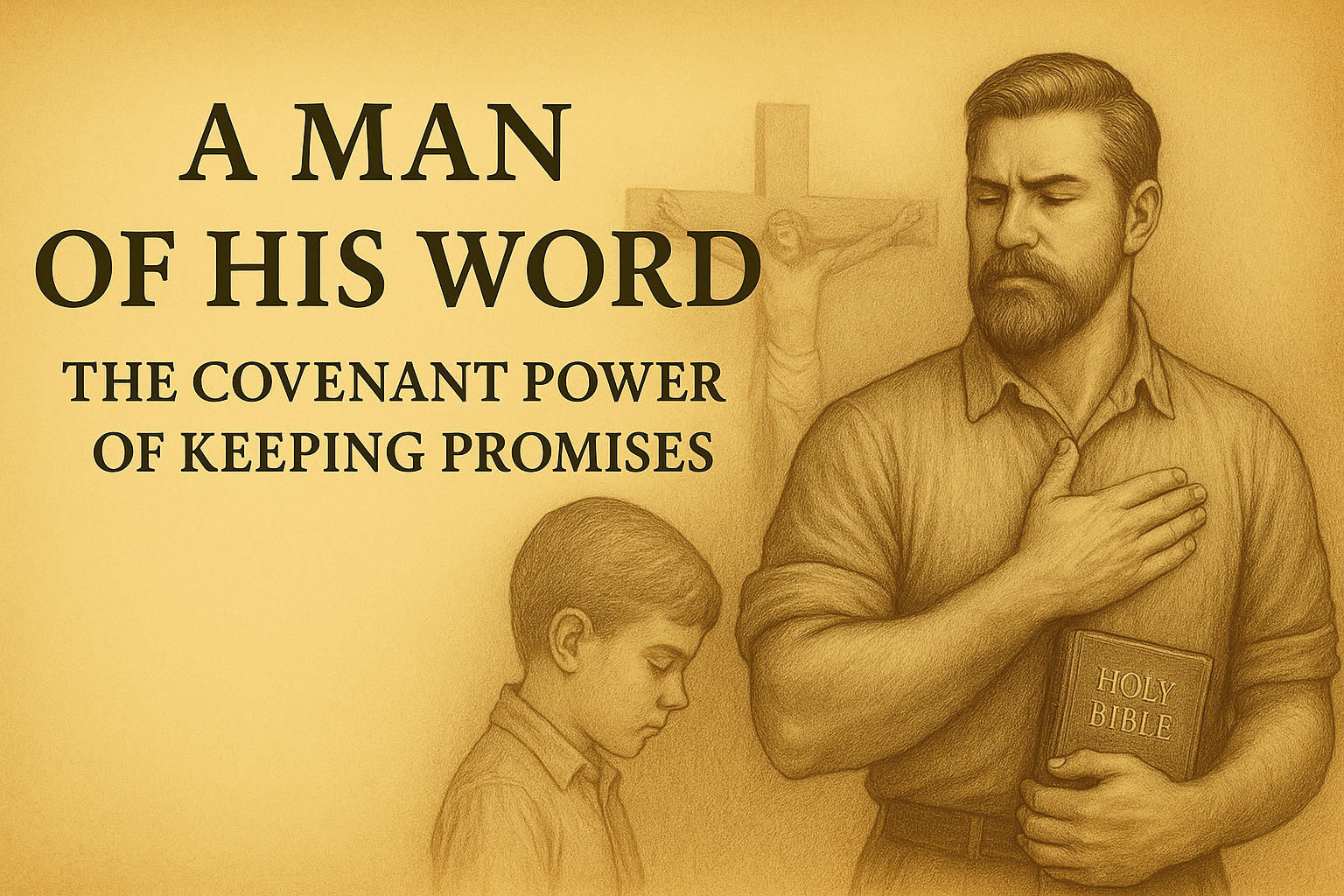
“Lord, who shall abide in thy tabernacle? … He that sweareth to his own hurt, and changeth not.”
— Psalm 15:1,4 (KJV)
Section I: The Weight of a Man’s Word in God’s Order
In a world built on shifting sand, where promises are cheap, vows are broken, and oaths are laughed off, there must rise again a standard. That standard is the man of his word. Not merely a man who speaks well, but one whose words are weighty because they are true. One whose promises are binding not because of law, but because of character. A man whose “yes” is yes, and whose “no” is no.
Modernity is full of hollow men. Politicians who promise change and deliver chaos. Husbands who swear faithfulness but flirt with adultery. Fathers who vow to be present but disappear into their hobbies or careers. Pastors who preach convictions they do not live. Friends who speak flatteries but vanish in the storm.
This post is not about the world. This is about the man of God, the covenant man. The patriarch in training, who fears the Lord and honors his commitments. A man of his word is not just reliable, he is righteous. For the keeping of one’s word is not a matter of etiquette or reputation. It is a matter of covenant fidelity, a reflection of the image of God Himself.
“God is not a man, that he should lie; neither the son of man, that he should repent: hath he said, and shall he not do it?”
— Numbers 23:19
The faithfulness of God is the foundation of our salvation. If He were fickle with His word, we would have no assurance. But God does not change. He keeps covenant and shows mercy to them that love Him. And we, men made in His image, are called to do the same.
A man who cannot keep his word cannot be trusted with a family, with business, with the gospel, or with authority. The entire structure of biblical patriarchy depends on the strength of men who are faithful in word and deed. For it is by a man’s word that his household moves, trusts, follows, and is secured.
The First Vow: God as Covenant Maker
When God made the heavens and the earth, He didn’t just form and fill, He spoke. And what He spoke, He brought to pass.
“By the word of the LORD were the heavens made…” — Psalm 33:6
When God made a covenant with Noah, it was with words. When He promised Abraham descendants, it was by His word. When He led Israel out of Egypt, it was to fulfill His word to the patriarchs. And when He sent Christ, it was the Word made flesh.
The entire redemptive history of mankind is the story of a God who makes promises, and keeps them.
Therefore, when a man makes a promise, be it to his wife, his child, his brother, his church, or even his enemy, he is stepping into the realm of covenant. And covenant is not a light thing. It is binding. It is sacred. It is dangerous to break.
“When thou vowest a vow unto God, defer not to pay it; for he hath no pleasure in fools: pay that which thou hast vowed.”
— Ecclesiastes 5:4
Section II: Biblical Manhood and the Integrity of Speech
“Let your communication be, Yea, yea; Nay, nay: for whatsoever is more than these cometh of evil.” — Matthew 5:37 (KJV)
Christ does not complicate things. In His kingdom, a simple “yes” or “no” is enough, because His people are not liars. They are not slippery. They are not manipulators. They do not add fine print, loopholes, or excuses to every word.
A man of God must train his tongue. Not to speak more, but to speak better. A man should think before he vows. And once he speaks, he should execute what he says, even to his own hurt (Psalm 15:4). This means that if a promise ends up costing him more than he anticipated, he still fulfills it.
Why? Because his word is his bond.
In a biblical household, the father’s word holds weight. When he says, “We’ll do this,” or “I promise you that,” or “I will provide,” or “You have my word”, those aren’t passing phrases. They are anchors. They build the atmosphere of security and order in the home.
When a man constantly breaks his word, he tells his wife one thing and does another, tells his children a promise and forgets, it shatters trust. And once trust is broken, authority crumbles.
The Vows of a Husband
Marriage itself is a vow, a covenant sealed not just before man but before God.
“What therefore God hath joined together, let not man put asunder.” — Matthew 19:6
When a man takes a wife, he is not entering a romantic contract, he is binding himself to lead, protect, provide, and remain faithful for life. To break that covenant is to lie not only to her, but to God. No man should ever utter “till death do us part” unless he means to die before he would abandon his duty!
The Vows of a Father
A father who promises time to his children and fails to follow through is sowing seeds of resentment and rebellion. Children remember broken promises. The games that never happened. The trips canceled, the “I’ll be there” that turned into absence.
If you tell your child you will teach him to build, do it. If you say you’ll show her how to garden, follow through. If you say, “I’ll never leave you”, prove it, every day.
The Vows of Brotherhood
Among men, the handshake once meant something. A pledge was sacred. Today, even Christian men promise aid, help, money, or time, but never deliver. The Bible says:
“Confidence in an unfaithful man in time of trouble is like a broken tooth, and a foot out of joint.” — Proverbs 25:19
An unfaithful man is a liability. He is a threat to stability, friendship, and alliance. He cannot build anything because his foundation is false.
Section III: Historical Honor, Legal Oaths, and the Collapse of Word-Binding
In times past, a man’s word could secure a loan, launch a venture, or settle a dispute. His word stood in place of written contracts. In many cultures, including among early American pioneers and biblical Hebrew society, to give one’s word was as serious as a legal decree. You could be held accountable socially, legally, and spiritually, for not fulfilling what you declared.
In medieval Christendom, oaths were often taken on the Bible itself or within the walls of the church. Perjury was not just seen as a legal issue but as a sin worthy of excommunication. Your name was your bond. Men would say, “I give you my word as a Christian,” and that meant something. To violate it was to violate God’s name, since your word reflected your claim to belong to Him.
Today, we live in a society where contracts have to be 20 pages long because no one trusts anyone to keep their word. We live in a world of fine print, legal loopholes, and backpedaling. Trust has been replaced with paperwork. And even that fails, because if a man’s conscience is dead, paper won’t save you.
“Where no counsel is, the people fall: but in the multitude of counsellors there is safety.” — Proverbs 11:14
But where no word is binding, society collapses altogether.
As men of God, we are not to reflect the weakness of the world. We are to reflect the constancy and firmness of the Lord. That means keeping our word even when others do not. Even when contracts are unnecessary. Even when we could technically “get out of it.”
The man of The Great Order builds by the integrity of his speech.
The Cost of Lying: God’s Judgment on False Speech
“A false witness shall not be unpunished, and he that speaketh lies shall perish.” — Proverbs 19:9
God despises lying lips. He calls them an abomination (Proverbs 12:22). He sends judgment on those who swear falsely (Zechariah 5:4). In the Ten Commandments, bearing false witness is listed alongside murder and adultery.
Lying breaks relationships, undermines justice, and ruins reputations. It creates confusion, and invites divine judgment.
Lying also sends souls to hell.
“But the fearful, and unbelieving, and abominable… and all liars, shall have their part in the lake which burneth with fire and brimstone.” — Revelation 21:8
That is no small warning. God does not tolerate deceit.
Godly Speech in a Perverse Generation
The Christian man should speak like his King. That means truth, clarity, consistency, and power.
“Let no corrupt communication proceed out of your mouth, but that which is good to the use of edifying…” — Ephesians 4:29
Your word should build. It should affirm what is good. It should instruct, convict, and bless. But above all, it should be true.
Train your sons to speak what is true, even when it costs. Teach them to confess when wrong, rather than deceive. Correct them swiftly for even “small” lies, for a small lie is a seed of a large ruin.
Train your daughters to value honesty above charm, promises above flattery, and trustworthiness above charisma. Let them marry men of their word, not men of eloquence alone.
A household rooted in truth is a household anchored in strength.
Section IV: Biblical Case Studies – Men Who Kept (or Broke) Their Word
Throughout Scripture, the Lord provides living examples of what it means to keep or break one’s word. These narratives are not random stories; they are models and warnings for covenant men.
Abraham: Keeping Covenant with Courage
When God commanded Abraham to circumcise every male in his household as a sign of the covenant, Abraham did not hesitate.
“In the selfsame day was Abraham circumcised, and Ishmael his son.” — Genesis 17:26
He did not delay, negotiate, or make excuses. His obedience was immediate. When he promised his son Isaac that “God will provide” (Genesis 22:8), he trusted God’s word, and that word was honored.
Abraham’s name is great because he trusted and obeyed. His life was shaped by promises, both received and kept.
David and Jonathan: Honor Among Men
Jonathan made a covenant with David, even though David was a threat to his father’s dynasty. He gave him his robe, weapons, and allegiance, not out of politics, but out of loyalty and divine conviction.
“And Jonathan caused David to swear again, because he loved him: for he loved him as he loved his own soul.” — 1 Samuel 20:17
Jonathan died in battle, but David never forgot his oath. Years later, he sought out Mephibosheth, Jonathan’s crippled son, and honored him with royal favor, not because Mephibosheth had earned it, but because David had given his word.
Ananias and Sapphira: The High Price of Lying to God
In Acts 5, Ananias and his wife sold land and claimed to give all the money to the church. In reality, they kept some back. The sin was not the amount, it was the lie. They gave their word falsely.
“Thou hast not lied unto men, but unto God.” — Acts 5:4
Both dropped dead at the apostles’ feet.
This was not Old Testament wrath, this was New Covenant holiness. Their word was false, and God judged it. That judgment echoed through the early church as a warning: Don’t lie to God. Don’t fake devotion, and don’t speak falsely!
Section V: Oaths, Vows, and the Sanctity of Speech
God’s law treats vows with great seriousness.
“If a man vow a vow unto the LORD… he shall not break his word, he shall do according to all that proceedeth out of his mouth.” — Numbers 30:2
When a man makes a vow, whether to God or another man, he binds himself spiritually. That vow becomes a witness against him if he fails. In fact, Scripture warns us not to speak rashly or vow emotionally:
“Suffer not thy mouth to cause thy flesh to sin… wherefore should God be angry at thy voice, and destroy the work of thine hands?” — Ecclesiastes 5:6
This is especially critical for Christian men who make public declarations, pastors, husbands, business leaders. You will be held accountable for what you promise. Better to say nothing than to say something halfheartedly and not follow through.
When Should a Man Vow?
- Marriage: Only if he is prepared to lead, protect, and provide for life.
- Ministry: Only if he is ready to endure hardship, not just applause.
- Fatherhood: Only if he is willing to die to himself daily.
- Brotherhood: Only if he is loyal, even in loss.
Oaths are not outdated. Christ said not to swear foolishly, not to never make commitments. Your “yes” must be covenantal. Your “no” must be firm. And if an oath is given, it must be kept.
Section VI: Speech in the Household, the Church, and the Community
The man of The Great Order is not silent, but his words are measured. His household is ruled by his voice, but that voice must be consistent. He doesn’t use words to manipulate, to charm, or to escape responsibility.
In the Household
- His wife knows his word is reliable.
- His children are not confused by shifting moods.
- His rebukes are clear. His encouragement is timely.
- He says what he means and follows through.
In the Church
- He does not offer flattery or gossip.
- He refuses to speak evil of elders.
- If he teaches, he speaks truth without compromise.
- He corrects in love, but does not soften doctrine.
In the Marketplace
- His handshake is binding.
- His contracts are honored even when they cost him.
- He does not overpromise.
- He does not lie to manipulate customers.
The world watches the church. And the community watches your life. Let them never say: “He talks a lot, but he’s unreliable.” Let your reputation be ironclad.
Section VII: Restoring the Standard – Teaching Sons to Be Men of Their Word
Fathers must train their sons from early boyhood that their word is sacred. This begins with simple things:
- “You said you’d clean your room, did you do it?”
- “You promised to feed the animals, why didn’t you?”
- “When you make a commitment, you finish it.”
It extends to the teenage years and beyond. Fathers must teach their sons:
- To confess wrongdoing without lying.
- To avoid exaggeration and boastful stories.
- To say “no” without guilt and “yes” with conviction.
- To uphold their word in dating, school, work, and faith.
Let their word be backed by strength, not excuse. The man who keeps his word from youth becomes a pillar in his generation.
“Train up a child in the way he should go…” — Proverbs 22:6
Section VIII: What If I’ve Failed?
Let’s be honest. Many reading this have broken promises, perhaps to their wives, to their children, to brothers, to churches, or to God. What now?
Repent, and rebuild!
Confess your sin. Seek forgiveness. But don’t stop there, make it right. If you promised your child something, do it. If you lied to a brother, own it. If you failed in marriage, rebuild your name through daily faithfulness.
Restoration begins with humility and is fulfilled through consistency. Over time, your word can regain its weight.
“A just man falleth seven times, and riseth up again…” — Proverbs 24:16
Don’t settle for being forgiven, strive to become trustworthy again.
Conclusion: Let Your Words Build a Kingdom
“Death and life are in the power of the tongue…” — Proverbs 18:21
The man of The Great Order understands that his speech shapes destiny. His words build his household, govern his name, bind his relationships, and glorify or dishonor his God.
Let your voice not be hollow, but holy. Let your promises not be emotional, but covenantal. Let your yes be final. Let your no be firm.
Let your word be your oath.
And let it be said of you by your sons, your wife, your brothers, your God:
“He swore to his own hurt, and did not change.”
Final Section: Building a Legacy of Word-Keeping
“A good name is rather to be chosen than great riches, and loving favour rather than silver and gold.” — Proverbs 22:1
When your life is over, your money will be spent, your car will be junk, and your house will age. But your name, the memory of your words and actions, will remain. Your children will walk in the shade of the name you built, whether it is a shelter or a snare.
The man of The Great Order keeps his word:
- To his God through covenant obedience.
- To his wife through faithful headship.
- To his children through consistency and protection.
- To his brethren through loyalty and sacrifice.
- To his community through justice and reliability.
- To himself through self-discipline and integrity.
He does not cancel commitments because of convenience. He does not lie to avoid conflict. He does not embellish stories to gain status. He does not flatter others to manipulate.
He speaks as one who fears God. And because he does, his voice carries weight, and his house stands firm.
“Whoso privily slandereth his neighbour, him will I cut off: him that hath an high look and a proud heart will not I suffer… He that walketh in a perfect way, he shall serve me.” — Psalm 101:5–6
The Lord is looking for men who walk uprightly and speak truth. Men whose speech does not shift with circumstance. Men who mirror their Heavenly Father’s constancy.
Let that be you!
Conclusion: Say What You Mean & Do What You Say.
The man who keeps his word stands in the company of the righteous. He reflects the God who never breaks covenant. He lays the foundation for multi-generational trust. His word builds nations, homes, friendships, churches, and legacy.
In this generation of digital flattery, broken vows, performative religion, and excuse-making, let your word stand apart.
Let your “yes” be done.
Let your “no” be final.
Let your speech be measured, sacred, and kept.
Build a house where truth is the rule.
Raise sons who are men of their word.
Be the kind of man whose promises are as good as fulfillment.
Be the kind of father who children believe without question.
Be the kind of husband whose vows echo for decades.
And let your word, like your life, be a tool of dominion for the Kingdom of God.
“He that walketh uprightly, and worketh righteousness, and speaketh the truth in his heart… shall never be moved.” — Psalm 15:2,5
This is the Great Order!
This used to just be common sense
When my father kept his word, even in small things, I felt secure. When he broke it, trust died a little.
So now you’re pretending men are divine just because they can say ‘yes’ and ‘no’?
Reading this felt like being scolded by a medieval monk. Relax, dude, not every broken dinner plan is a covenant violation
This is exactly why marriage vows are crumbling today. People think they’re romantic lines instead of covenant words. Truth is, vows mean nothing without men who keep them
You act like only men need to keep their word, but conveniently skip over all the lying church leaders, pastors, and patriarchs who cover up abuse. Your ‘Great Order’ looks like great hypocrisy.
Your version of ‘covenant’ sounds less like integrity and more like an excuse to trap women in marriages
Powerful. Psalm 15 has always struck me, but tying it to household leadership and covenant makes it even heavier. A man’s word is sacred
I’m very grateful to be married to a man who is not only patriarchal, but comes in clutch always. A man who keeps his word no matter what the cost, and always takes care of his wives and family. You are most definitely a light in a dark world, Sir and very much appreciated and loved.
“Let your yes be yes” = modern translation: don’t RSVP “maybe” to your kid’s baseball game and then ghost. Radical, I know. Might start with calendars and follow-through before building empires.
I agree faithfulness matters, but this reads very “all on the man.” What about women who break covenant? Accountability should be mutual. A legacy of truth requires both parents, both leaders, and both spouses keeping promises.
Powerful reminder but let’s be careful not to romanticize. Men can keep their word only if they’re taught how: modeling, accountability, and real discipleship. Practical training (not just exhortation) belongs in the sermon, the home, and the workbench.
Do people not see how all of this connects? Head coverings, oaths, promises, covenants, it’s all part of the same hidden system they’ve been trying to erase since before any of us were even born. First they dismantled the family with feminism, then they replaced fathers with government “programs,” then they stripped away the symbols, like veils, that actually mark spiritual authority. Why? Because they know once a man’s word carries no weight, the household collapses, and once the household collapses, the nation collapses, and when the nation collapses, guess who moves in? The globalist technocrats who’ve been sitting in their glass towers for decades waiting for us to forget how to bind ourselves to God with a vow.
Think about it. Why did the bankers push credit cards in the 1950s? Why did they start advertising divorce as “liberation”? Why are contracts now 40 pages of unreadable fine print? Because paper replaces trust, and paper can be manipulated, shredded, or “updated.” But a man’s covenant, before God, that can’t be digitized, can’t be monetized, can’t be hacked. That terrifies them. That’s why the elites mock oaths in movies, why every superhero these days “bends the rules” instead of keeping their word. They want us programmed to believe promises are fluid.
And it doesn’t stop there. Look at the pharmaceutical giants, pumping out drugs that dull conscience and cloud memory. Why? Because a man who forgets what he promised is as useless as one who never promised at all. Look at the endless distractions, sports, video games, social media, they don’t just waste time, they drown out the voice of the father in the home. You can’t be a man of your word if your words are buried under notifications and fantasy leagues. That’s not accidental, it’s coordinated psychological warfare.
Even the push for AI isn’t innocent. Do you really think it’s about convenience? No, it’s about replacing human speech, replacing human covenant, replacing the “yes and no” of flesh and blood with algorithmic suggestions. Once your household trusts Siri or Alexa more than the father’s voice, authority has been outsourced to the machine. And the machine doesn’t keep promises, it updates terms of service. They want sons who obey the screen, not the father. Daughters who pledge loyalty to influencers, not husbands. Wives who “submit” to HR policies, not covenant vows.
Meanwhile the churches? Silent. Or worse, complicit. Pastors get grants, pastors get paychecks, pastors keep sermons soft so nobody feels the sting of a broken vow. You think it’s coincidence? No, it’s infiltration. The same spirit that whispered in Eve’s ear whispers now from pulpits: “Did God really say?” And every time a man breaks his word, every time a church ignores covenant, that whisper grows louder.
It all comes back to this: a man’s word is dangerous. Dangerous to empires built on lies. Dangerous to corporations addicted to broken families. Dangerous to governments that thrive on dependency. If men kept their word, if fathers trained sons to never bend, if husbands swore and died before breaking, the whole house of cards falls. The elite know it. That’s why they laugh at us. That’s why they flood us with chaos. That’s why they call covenant “oppressive” and “outdated.” But here’s the twist, they can’t erase God’s pattern. Every time a man of The Great Order speaks truth and keeps it, heaven roars and hell trembles. That’s why I say, mark my words (pun intended): this battle isn’t about fashion, or contracts, or even politics. It’s about language itself. It’s about the Word made flesh versus the counterfeit word of Babylon. And one day soon, every broken oath, every false promise, every manipulated contract will be weighed in the balances, and found wanting.
Wake up.
Great pep talk. but tough love: rhetorical flourishes don’t fix broken behavior. If you want men to keep their word, show concrete systems: mentoring, community consequences, restoration steps. Otherwise it’s just inspiring guilt.
This is beautiful and necessary. We live in a world of cheap words; to teach sons and fathers that a promise is covenantal is to rebuild trust one household at a time. Thank you for calling men back to a standard that honors God and protects families.
To see a man whose speech is not empty, but covenantal, is to see a glimpse of God’s own faithfulness walking on earth. This world has broken me with hollow promises men who said they would stay, fathers who swore they would protect, leaders who spoke loudly but never acted. My soul aches for what you describe: a man whose “yes” means yes, whose vows are not words for a moment but a binding covenant that shapes generations.
I look forward to living in your household where I never have to question, never have to wonder, never have to brace for disappointment, because the head of that home keeps his word even when it costs him dearly. That kind of strength will be a shelter to me, to our children, and to everyone under it. I will ba able to flourish because my husband’s word will be my anchor, not a gamble. Thank you for reminding me that I have a wonderful life to look foward to, Love Ellie ❤️