“It is good for a man that he bear the yoke in his youth.”
— Lamentations 3:27 (KJV)
Section I: Rejecting the Lie of Prolonged Childhood
The modern West has created a generation of idle, entitled, and emotionally unstable children; not by accident, but by design. Childhood has been extended into the twenties. Work has been delayed until adulthood. Responsibility has been withheld under the false belief that children should only play, consume, and be entertained until they are “ready.”
This lie is unbiblical, unhistorical, and ultimately destructive.
The Scriptures present an entirely different vision: children are to be trained through labor. They are not to be coddled, but formed. Not entertained, but equipped. Childhood is not an escape from responsibility, it is the furnace where strength is forged.
“Even a child is known by his doings, whether his work be pure, and whether it be right.” — Proverbs 20:11
Children are moral agents. They are not blank slates or decorative ornaments. God judges their work. He watches their diligence. And He has given them families, not merely for nurture and affection, but for training, discipline, and preparation.
To neglect giving children work is not compassion. It is sabotage.
The Secular Invention of “Childhood”
Historically, children worked. In agricultural societies, they helped in the fields as soon as they could walk. In biblical culture, sons worked with their fathers, daughters with their mothers. Childhood was not a phase of prolonged indulgence, it was a stage of apprenticeship.
It was the Industrial Revolution that began shifting labor from family fields to centralized factories. In reaction, new laws were passed to protect children from exploitation, and rightly so. But with that protection came a new social construct: the idle child. The state took work from the child and replaced it with schooling without responsibility, entertainment without contribution, and rewards without merit.
Today, children are taught to sit still for eight hours, consume content, press buttons, and “follow their dreams.” But they are not taught to build. To serve. To fix. To work with their hands. To shoulder burdens. To do their duty.
This is not progress. It is bondage.
Biblical Examples of Children in Labor
The Bible is not silent on children and work. It assumes, even commands, childhood labor as part of godly formation.
- Joseph was seventeen and already managing flocks, reporting on the work of his brothers (Genesis 37:2).
- David, the youngest of eight, was left alone with the sheep while his brothers went to war, he was a working shepherd boy (1 Samuel 16:11).
- Jesus, the Son of God, submitted to His earthly father Joseph, working as a carpenter until age thirty (Mark 6:3).
- Timothy, a young man trained from childhood in Scripture and ministry, was appointed by Paul to significant leadership; because his labor began early (2 Timothy 3:15).
Children who are given responsibility early become strong, capable, and dependable. Children who are raised in idleness grow weak, confused, and rebellious.
Why the Modern Church Resists This Truth
Many Christian parents have swallowed the world’s lie that “children should enjoy their youth.” What they really mean is: “Let them waste time before reality hits.” They believe work will make their children bitter, that discipline will drive them away, that chores will damage their emotions.
But the Bible says the opposite:
“Chasten thy son while there is hope, and let not thy soul spare for his crying.” — Proverbs 19:18
“Foolishness is bound in the heart of a child; but the rod of correction shall drive it far from him.” — Proverbs 22:15
If foolishness is bound in their heart, then work is part of the cure. Work disciplines the flesh, focuses the mind, and awakens the conscience.
Idleness: A Breeding Ground for Sin
When children are idle, they become restless. When they are restless, they are tempted. The sin of Sodom began with pride, fullness of bread, and abundance of idleness (Ezekiel 16:49).
Idle sons become perverse. Idle daughters become vain. Idle children become depressed. The hands that do not swing hammers will eventually swipe screens, write curses, or cause destruction.
But a child who learns to labor is a child who becomes a blessing:
“The father of the righteous shall greatly rejoice: and he that begetteth a wise child shall have joy of him.” — Proverbs 23:24
Section II: Training Through Labor – Theology, Skill, and Obedience in the Home
“And these words, which I command thee this day, shall be in thine heart: And thou shalt teach them diligently unto thy children…” — Deuteronomy 6:6–7 (KJV)
The home is the first and greatest training ground for dominion. Fathers are not called to merely shelter their children or provide luxuries, they are called to equip them for rule, stewardship, and righteousness. One of the greatest tools God has given for this purpose is labor.
Work is not a punishment. It is not a necessary evil. It is part of the divine image.
“And the LORD God took the man, and put him into the garden of Eden to dress it and to keep it.” — Genesis 2:15
Before sin entered the world, Adam was a worker. He was made to labor. And just as he was commanded to subdue the earth, so too are his sons. Every child of Adam is born with a purpose, to cultivate, produce, and build. But this must be taught. It must be modeled. It must be demanded.
The Father’s Role: Assigning the Yoke Early
Scripture says:
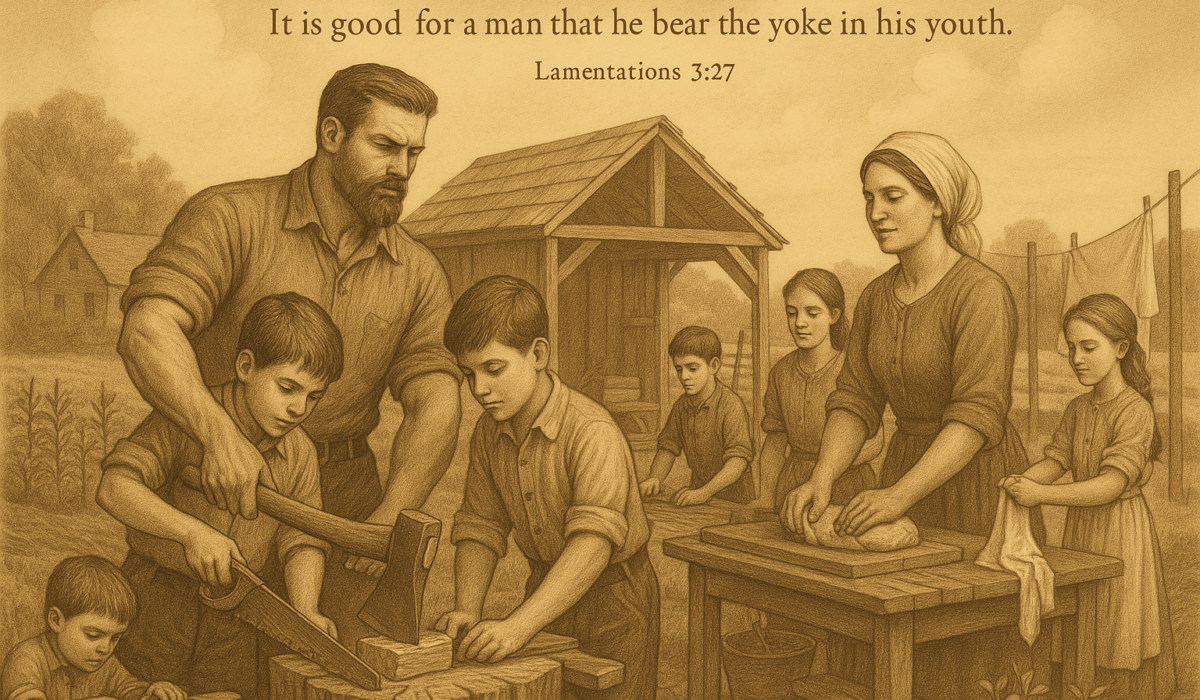
“It is good for a man that he bear the yoke in his youth.” — Lamentations 3:27
Why? Because the yoke forms him. The yoke disciplines him. The yoke gives him direction, rhythm, and a sense of identity. Just as an ox is trained to carry weight from an early age, so must our sons and daughters be taught to shoulder real responsibility while they are still tender.
A father who gives his child only comfort is preparing him for ruin. But a father who gives his child burden, not crushing, but challenging, prepares him for dominion.
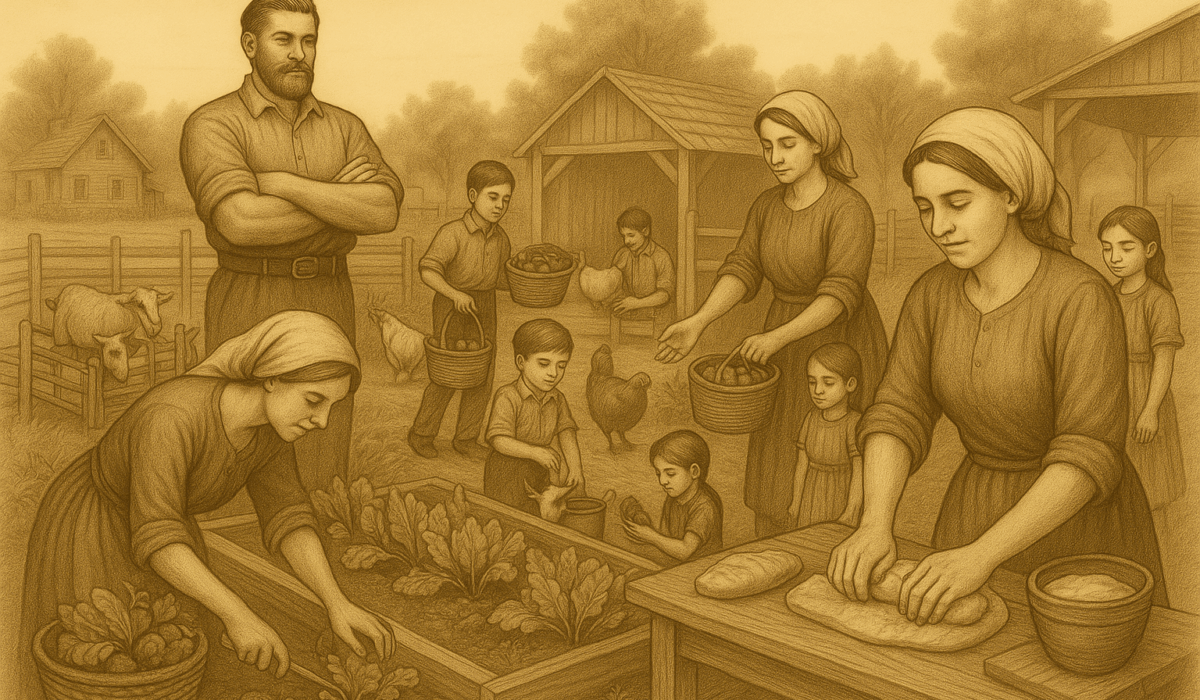
Let your son carry wood, not just toys. Let your daughter manage the kitchen, not just her closet. Let your children rise with purpose, not lounge with entertainment.
The Mother’s Role: Building the Work Culture of the Home
Mothers are not just nurturers; they are household governors. The Proverbs 31 woman “looketh well to the ways of her household, and eateth not the bread of idleness” (v.27). She delegates, manages, and trains her daughters (and sons) in the art of dominion through domestic economy.
It is the mother who should teach her daughters how to:
- Clean thoroughly and joyfully
- Cook with skill and order
- Care for younger siblings with patience
- Manage time, tidiness, and emotional control
The daughters of Zion must learn early that productivity is a gift, not a burden. That making bread is better than making videos. That cleaning is training, not punishment.
Sons Must Be Apprentices
Every father should view his sons as future builders, of homes, of businesses, of legacies. Sons must be taught not merely in theory, but in practice. What they learn with their hands becomes a law written on their hearts.
Start young:
- Age 4–6: picking up toys, helping sweep, fetching tools
- Age 7–9: raking leaves, sorting nails, washing dishes
- Age 10–13: chopping wood, mowing, organizing supplies, managing small tasks alone
- Age 14–18: assisting in family business, learning a trade, building projects, taking ownership of chores
Work should grow with them, not wait for them. They don’t need part-time jobs at 16 if they’ve had full-time duty since they were six. By the time they are young men, they should already be providers-in-training.
Daughters Must Be Builders of Households
Today’s daughters are taught to dream of offices and college dorms. But God’s design is for them to build homes (Titus 2:5). This means their labor training must center on domestic dominion.
Daughters should not be raised to be ornamental or idle. They should be trained to:
- Rise early and prepare meals
- Care for children and elderly
- Maintain cleanliness and order
- Plan menus, budgets, and schedules
- Sew, mend, preserve, bake, and manage
This is not slavery, it is glory. The wise woman builds her house (Proverbs 14:1). The modern woman destroys it with idleness and excuses.
Chores Are Not Punishment – They Are Purpose
Many modern parents treat chores as punishment or points-based systems. This is backwards. Chores are not punishment; they are a participation in dominion. They are training for life.
Your children should not be paid to clean their own rooms, to fold their own clothes, or to do basic tasks that serve the family. These are duties. To turn duty into bribery is to raise mercenaries, not sons and daughters.
Rather, train them to see that their labor serves the household. Their effort contributes to order. Their tasks are worthy, meaningful, and good.
Let your home have a culture of labor, not grudging, but joyful. Sing as you work. Encourage as they toil. Reward not just results, but right attitudes.
Dangers of the Screen-Slave Generation
Technology is not neutral. It offers endless temptation for idleness, entertainment, and emotional disconnection. Children who are glued to screens do not build anything – they consume everything.
Parents must be ruthless in protecting their children’s attention span, manual skills, and work ethic. Screens erode all three.
Establish strict limits:
- No phones or tablets for young children
- No entertainment before labor is done
- Weekday screen-free hours
- No screens in bedrooms
Then fill the vacuum with work. Not busywork, but productive labor. Let them build. Let them clean. Let them plan. Let them help. Let them fail. Let them sweat.
This is how strength is formed. This is how order is built.
Let’s continue with Section III, focusing on the fruit, legacy, and long-term transformation that comes through training children to work.
Section III: The Fruit of Labor – Raising Builders, Not Consumers
“Train up a child in the way he should go: and when he is old, he will not depart from it.” — Proverbs 22:6
The man who trains his children to work is not simply maintaining a clean home; he is preparing a multigenerational legacy. Children who are trained to labor do not grow up needing handouts, therapy, or institutional micromanagement. They grow up bearing burdens, for themselves, for others, for the Kingdom.
The laboring child becomes the productive man. The responsible daughter becomes the fruitful wife. The disciplined son becomes the dependable patriarch.
This is the harvest of faithfulness: children who are not liabilities, but arrows in the hand of a warrior (Psalm 127:4).
Children Who Work Become Confident
One of the great plagues of our time is the insecurity of youth. Teenagers today are anxious, fragile, and afraid of responsibility. Why? Because they’ve never built anything. They’ve never proven themselves in real work.
But give a child a meaningful task, and let him conquer it. Let him mow the lawn alone. Let him change the oil with you. Let her plan the family meal and serve it. Let them paint the fence or build the shed.
And then praise them not for their existence, but for their accomplishment.
“Well done, thou good and faithful servant…” — Matthew 25:21
They will begin to walk taller, speak bolder, and live freer. Confidence is not born of compliments, but of conquest.
Children Who Work Become Grateful
Idleness breeds entitlement. Children who are given everything without effort become selfish, whiny, and thankless.
But a child who works for what he has learns gratitude. When he cleans the barn, he thanks God for the roof. When she kneads the bread, she cherishes every slice. When he sweats over the garden, he rejoices at the harvest.
Children must feel the weight of contribution before they can appreciate provision. The child who contributes to the home honors the home.
Children Who Work Become Disciplined
Labor trains the will. It molds impulse. It teaches that the body does not rule the soul. That tiredness is not an excuse. That emotions are not the master.
When a child learns to work when they don’t feel like it, they learn the secret of godly manhood and womanhood: obedience without delay.
“He that hath no rule over his own spirit is like a city that is broken down, and without walls.” — Proverbs 25:28
Work becomes the wall. It builds strength inside, not just outside.
Children Who Work Become Mission-Ready
The Church is weak because her households are weak. Her households are weak because her men are weak. And her men are weak because they were raised to play, not to labor.
But a generation of trained children is a generation ready for mission.
- They do not fear sweat.
- They do not faint under pressure.
- They do not collapse emotionally.
- They do not need applause.
- They do not outsource maturity.
They are trained to serve, build, and defend.
Common Objections Answered
“But children need time to be kids!”
Children need to be trained. There is no contradiction between labor and joy. A boy who works hard laughs harder. A girl who serves faithfully sings louder. The child who labors well lives fully.
“But I want my child to have what I didn’t!”
Give your child what you needed, not what you lacked. If what you lacked was character, wisdom, and purpose, then build that. Not toys.
“But they’ll resent me if I make them work.”
They’ll resent you far more if you raise them weak, directionless, and addicted to comfort. Children remember two things when they grow: the standards you held, and whether you held them in love.
A Household of Labor Is a Household of Glory
“Let them also learn to maintain good works for necessary uses, that they be not unfruitful.” — Titus 3:14
In the godly home, children are not accessories, they are apprentices. They are not burdens, they are blessings. But they must be discipled, and that begins with labor.
Raise them to:
- Rise early and give thanks
- Tend the garden and care for animals
- Clean their rooms and manage their belongings
- Cook meals and serve one another
- Study the Word and help the weak
- Carry burdens and correct errors
- Respect hierarchy and uphold honor
This is not legalism. This is love.
“For whom the Lord loveth he chasteneth…” — Hebrews 12:6
Love does not coddle, it commands. Love does not spoil, it strengthens.
Conclusion: Let the Children Build
We do not have time to raise another generation of consumers, narcissists, or soft rebels. The world is burning. The Kingdom is advancing. And the sons and daughters of God must be trained to build, defend, and conquer.
That starts now, in your home, with your hands, and with your expectations.
Give your children work. Give them responsibility. Give them burden. And give them the joy that only comes from finishing a task in faith.
Raise laborers.
Raise leaders.
Raise arrows.
Raise saints.
And let the world see what a household under God’s dominion can produce.
“I have no greater joy than to hear that my children walk in truth.” — 3 John 1:4
This is The Great Order!