Category Archives: Religion

When God Leads a Man: Faith, Obedience, Delay, and Misunderstanding

There is nothing harder for a man than truly being led by God. It is not neat. It is not comfortable. And it certainly is not always applauded by those around him. When a man submits to Christ and is guided by the Spirit, his life becomes a battleground of faith and doubt, obedience and hesitation, divine provision and human suspicion. He hears the call to act, whether in his households direction, his business, adding to his family, his finances, and even his employees, and he knows what must be done. But the moment he moves, those closest to him begin to whisper: “He’s just doing what he wants.”

This tension is as old as Scripture itself. Noah built an ark and was called insane. Abraham left his homeland and was called reckless. Jeremiah burned with a word he could not hold in, and his people called him arrogant. Even Jesus’ own brothers mocked Him, assuming His ministry was nothing more than self-promotion. The man led by God is never free from suspicion, because divine obedience always looks like ambition to the carnal eye.

But the true test is not how others perceive you, it is whether you obey. Because here is the sober reality: delayed obedience is disobedience. Every man who has hesitated knows this pain. God nudges, God leads, God commands, and the man stalls. Months pass. Years pass. And then circumstances close in, forcing the very decision he could have made earlier. The difference? By waiting, he has cost himself and his household time, growth, blessing, and peace. God still gets His way, but the delay is paid for in lost harvests and needless suffering.

On the other hand, when a man steps out in faith, when he buys the land he cannot afford, honors the Sabbath against all pressure, reorients his business when logic says it will fail, or opens his household to another wife despite every critic, God provides. Always. Not beforehand, but after the step. The pattern never changes: the priests had to put their feet into the Jordan before the waters parted. Abraham had to raise the knife before the ram was revealed. Faith is not waiting until you can see every answer; faith is moving in obedience, then watching the answers arrive.

This is the life of the patriarch. He is misunderstood, accused, resisted, and doubted, but if he obeys, he and his household are blessed. In this article, we will explore the reality of walking in the Spirit, the burden of obedience, the cost of delay, and the necessity of initiative. Because when God leads a man, excuses expire, timetables collapse, and only one question remains: Will you obey?

Section I – Walking in the Spirit: What It Really Means

If you ask most churchmen today what it means to “walk in the Spirit,” you’ll get a vague answer. Something about “being nice,” or “following your heart,” or “listening for a still small voice.” In other words, mush. The Bible, however, is not mushy. It paints a far sharper picture: a man who is submitted to Christ, ordered by the Word, and compelled into obedience even when his flesh, his family, and his neighbors think he’s lost his mind.

To walk in the Spirit is not to float through life with warm feelings. It is to live under divine command. The Spirit does not lead men to “whatever feels right.” He leads men into obedience to Christ, into conformity with God’s will, and into decisions that advance the kingdom even at great personal cost.


Submission, Not Suggestion

Paul says in Romans 8:14, “For all who are led by the Spirit of God are sons of God.” Notice what is not said. He does not say “all who feel spiritual.” He does not say “all who enjoy the worship songs.” He does not even say “all who believe in Christ.” He says led. That implies authority. A man being led by the Spirit is not taking suggestions; he is taking orders.

This is why walking in the Spirit is directly tied to submission. A man cannot lead his household if he cannot be led by Christ. He cannot demand obedience from wife and children if he himself lives in rebellion against the Head. The patriarch is not a free agent, making things up as he goes along. He is a steward under orders, accountable to God for every decision.


Abiding in Christ

Jesus gave the picture most men forget: “Abide in Me, and I in you. As the branch cannot bear fruit by itself, unless it abides in the vine, neither can you, unless you abide in Me” (John 15:4). To walk in the Spirit is to abide in Christ. It is to stay attached to Him like a branch to a vine, drawing life, direction, and fruitfulness only from Him.

This means your leadership is not autonomous. You may be the head of your wife, but you are not the head of Christ. You may order your household, but you do not order God. You are an extension of Him. If you sever yourself from His Spirit, your leadership becomes tyranny. But if you abide, your leadership becomes life-giving, because you are channeling the will of God into your household.


Faith = Movement and it is Necessary for Patriarchs

The Spirit never leads into stagnation. Men led by the Spirit are men of action. Hebrews 11, the “hall of faith,” is filled with verbs: Abraham went, Noah built, Moses kept, Rahab welcomed. In every case, faith was proven not by words but by movement.

This is where modern Christianity fails. It thinks walking in the Spirit means sitting quietly, waiting for God to drop answers in your lap. That is not faith, that is paralysis. The Spirit leads, but the man must walk. Walking is not passive. It means taking steps that look insane until God vindicates them.

A man cannot claim to walk in the Spirit if his household is led only by budget spreadsheets, risk assessments, or the collective anxieties of his wives and family. Leadership means movement under divine compulsion, not majority vote.

This is why Scripture ties household order directly to a man’s own order under God. In Ephesians 5, the husband is commanded to love his wife as Christ loves the church. But Christ’s love was not sentimental, it was obedient unto death (Philippians 2:8). His entire headship over His bride flowed from His submission to His Father. Likewise, the Spirit-led man has authority precisely because he is under authority.


Examples in Action

  • Noah: Led to build a ship when there was no rain. To his neighbors, he was delusional. To God, he was righteous. His obedience saved his household.
  • Abraham: Called to leave everything familiar. To his relatives, he was reckless. To God, he was faithful. His obedience founded nations.
  • The Apostles: Compelled to preach Christ though forbidden by authorities. To rulers, they were rebellious. To God, they were obedient. Their obedience birthed the church.

Each of these men proves the same truth: to walk in the Spirit is to follow God’s command at the cost of being misunderstood.

So what does this look like for the modern patriarch? It looks like exactly what you have lived:

  • Buying property your wives and friends think you can’t afford.
  • Implementing Standards and Household Rules while being accused of unreasonable demands.
  • Pursuing another wife when everyone says it’s just lust.
  • Shifting your business model when the numbers say “don’t”, or your family disagrees.
  • Honoring Sabbaths and feasts when your peers call it legalism or bad business.
  • Making any change you are being led to do without delay and without the support of those closest to you.

In every case, you are not drifting, you are being led. And the evidence is not in convincing arguments but in divine provision after obedience.

Walking in the Spirit, then, is not mystical fog. It is ordered, practical, embodied obedience to God’s leading. It requires submission, movement, and a willingness to be misunderstood. It is the only foundation from which a man can lead his household with confidence, because only then can he say: “As for me and my house, we will serve the Lord.”

Section II – The Burden of Obedience: When God’s Call Looks Like Self-Will

There is a peculiar weight that falls on a man when God speaks. It is not light, it is not comfortable, and it cannot be ignored. The prophets often called it a “burden”, the burden of the word of the Lord. It is not optional. It is a fire shut up in the bones (Jer. 20:9), a weight that presses down until obedience is the only relief. But here is the sting: while you feel the divine pressure of obedience, those around you often see nothing but human ambition. What you call obedience, they call ego. What you call faith, they call lust or greed.

This tension is the burden of obedience. It is not enough to hear God’s voice; you must also bear the accusation that following Him looks like following yourself.


Biblical Patterns of Misunderstood Obedience

Scripture is littered with examples of men obeying God and being misunderstood:

  • Noah: Building a massive ark on dry land. His neighbors called him insane. Only after the rain began did anyone realize he was right.
  • Abraham: Leaving his homeland to wander. His relatives surely saw him as reckless, uprooting his household without a plan. In reality, he was obeying God’s direct command.
  • Jeremiah: Preaching judgment to Jerusalem. His countrymen saw him as a traitor, weakening morale. He was in fact delivering God’s word.
  • Jesus: His own brothers said, “No one does anything in secret when he seeks to be known openly. If you do these things, show yourself to the world” (John 7:4). They interpreted His obedience to His Father as self-promotion.

The lesson is clear: obedience to God often wears the disguise of self-will in the eyes of the unspiritual.


Modern Applications

I have lived this myself, many times over. Many times I have delayed, and not every time I obeyed quickly had the outcome that I thought it should have, others have used the so-called “bad outcomes” to judge my motivation, or even God’s involvement. But it was abundantly clear both during and after these trying times God’s provision and guidance was there all along. Below are a couple examples, but I could write about hundreds:

  1. Adding a Wife: You feel the Spirit’s nudge to expand your household. You begin to pursue it, whether through conversation, introduction, or even something as mundane as a dating app. Your wives and peers roll their eyes. “If God wanted you to have another wife, He would just send her to you. You’re just doing this because you want it.”

    Yet what they miss is that obedience requires action. Abraham didn’t sit in his tent waiting for land; he walked it out. Isaac didn’t find Rebekah without servants traveling to a well. Ruth didn’t marry Boaz without lying at his feet. Initiative is not evidence of lust, it is evidence of faith.
  2. Buying Property: You sense the Spirit leading you to secure land or expand business, even when the numbers don’t add up. You put in effort, researching, negotiating, making offers. Your wives worry about debt. Others think you’re empire-building for ego. But as soon as you move, God provides: the right deal, the right financing, the right provision. The very act they mocked proves to be God’s way of supplying.

In both cases, the accusation is the same: “You’re just doing what you want.” But in truth, if you sat back and did nothing, that would be delay, which is disobedience.


Why Others Struggle to See It

Why does obedience look like ambition to those around you?

  • They see risk, not revelation. Your wives see mortgages and debt; they do not feel the Spirit’s compulsion you carry.
  • They measure by flesh, not by faith. To them, wisdom is risk-avoidance. To God, wisdom is obedience regardless of cost.
  • They project motives. Because they know what self-will looks like in themselves, they assume the same of you.

This is why headship matters. If every divine command had to be filtered through the anxieties of the household, nothing would ever get done. A patriarch must obey God first, even if misunderstood.

The good news is this: obedience eventually vindicates itself. When Noah’s ark floated, Abraham’s herds multiplied, and Jesus rose from the grave, all accusations evaporated. Likewise, when your steps of obedience bear fruit, when the property thrives, when the wife joins, when the household expands, everyone sees what you knew all along: it was not ambition, it was obedience.

But that vindication comes only after the act. God rarely justifies you beforehand. He demands trust, not consensus.


Bearing the Fire Without Relief

Jeremiah described it perfectly: “If I say, ‘I will not mention him, or speak any more in his name,’ there is in my heart as it were a burning fire shut up in my bones, and I am weary with holding it in, and I cannot” (Jer. 20:9). That is the life of a Spirit-led man. You could try to silence it. You could try to please everyone else. You could even try to convince yourself you’re mistaken. But eventually the fire burns too hot, and obedience becomes the only way out. That is divine compulsion.

  1. Expect Misunderstanding. Do not be shocked when others misread your motives. This is the normal cost of obedience.
  2. Document God’s Leading. Write down what God has shown you and when. Later, when provision comes, you can show your household the timeline.
  3. Teach the Pattern. Use Scripture to show your wives that provision follows obedience, not the other way around.
  4. Refuse Apology. Never water down obedience to appease critics. Leadership requires the courage to be misunderstood.

The burden of obedience is not just hearing God’s command; it is living under the suspicion that your obedience is ambition. That burden cannot be avoided, it must be borne. The patriarch’s calling is not to win applause but to obey. Vindication will come in God’s time, when provision and fruit prove His hand. Until then, the fire in your bones demands movement, whether others call it faith or folly.

Section III – The Cost of Delay: Lost Blessings and Divine Chastening

Every man who has walked with God knows the sting of delay. God speaks, the Spirit leads, conviction burns, and the man hesitates. He rationalizes: “Maybe later. Maybe when the money is there. Maybe when my wife agrees. Maybe when the timing feels better.” Days pass. Months pass. Sometimes years pass. And eventually the very thing he was led to do becomes unavoidable, forced upon him by tightening circumstances. He ends up in the same place, but poorer, slower, and chastened.

This is the cost of delay. It is not neutral. Delay robs blessings, wastes time, withers growth, and invites discipline. God is patient, but He is not mocked. When He commands, He expects obedience, not eventually, but immediately.


Delayed Obedience Is Disobedience & The Jonah Principle

The modern church has a soft view of obedience. It thinks that as long as you eventually do the right thing, you are fine. But this is not what Scripture teaches. When Saul spared King Agag and the best of the livestock, planning to sacrifice them later, Samuel declared, “To obey is better than sacrifice” (1 Sam. 15:22). Saul thought partial obedience was acceptable. God called it rebellion.

Delayed obedience is no different. If God says “move,” and you say “later,” you have disobeyed. The delay itself is disobedience.

Jonah is the classic case. God commanded him to preach in Nineveh. Jonah refused, running in the opposite direction. But God would not let him escape. He sent a storm, a fish, and misery until Jonah complied. Eventually Jonah preached, but only after wasted time, lost dignity, and a painful detour.

That’s what happens in a patriarch’s life when he delays. God will close in, stripping away alternatives, until the path He commanded becomes the only one left. But by then the man has lost opportunities, peace, and often the respect of those he leads.


Israel’s Wasted Generation & Discipline of Sons

The cost of delay is not just personal, it is generational. Israel was commanded to take the promised land at Kadesh-Barnea. They balked, fearing giants. When they finally changed their minds, it was too late. God sent them back into the wilderness for forty years, until an entire generation died. The promise remained, but delay turned it into decades of stagnation.

How many patriarchs today do the same? They know they are called to expand their household, to buy land, to order their family by God’s feasts and Sabbaths, or any other thing they are being led to do. But they hesitate, calculating risks and bowing to fears. The result is wasted years of wandering in circles, while blessing waits on the far side of obedience.

Hebrews 12 reminds us that God disciplines those He loves: “For the Lord disciplines the one he loves, and chastises every son whom he receives” (v.6). Discipline is not punishment for strangers; it is correction for sons. When you delay, God will apply pressure. Finances will dry up. Opportunities will collapse. Household harmony will shrink. Peace will fade. He does this not to crush you, but to drive you back into alignment.

Your testimony will prove it. In times of delay, you and your family do not grow. The blessings stall. Life feels heavy. Slowly, discipline mounts until you are forced to obey. This is not random bad luck. It is the Father’s chastening hand.


Faith Includes Timing

Faith is not only believing what God said, but believing when He said it. Abraham believed God’s promise of a son, but when he delayed too long and Sarah offered Hagar, disaster followed. Timing mattered.

When God commands, the timing is part of the command. To postpone is to distrust His calendar. It says, “My schedule is wiser than Yours.” That is not faith; it is pride. Faith acts now, even when resources look absent, because the man trusts that provision will meet him at obedience, not before it.


The Ripple Effect on Household

For the patriarch, delay costs more than his own blessing. His wives and children suffer the consequences. The household languishes in stagnation because the head is dragging his feet. They may not articulate it, but they feel it. A wife becomes restless. Children lose momentum. The entire house absorbs the penalty for the man’s hesitation.

This is why your obedience—or your delay—is never private. It multiplies across generations. When you delay, you rob your household of growth. When you obey, you multiply blessing for them all.


Practical Counsel for Avoiding Delay

  1. Act on the First Nudge. When the Spirit convicts, start moving immediately. Even small steps signal obedience.
  2. Reject the Myth of Perfect Conditions. You will never have “enough money,” “enough peace,” or “enough support” beforehand. The conditions will appear only after movement.
  3. Confess Delay as Sin. Treat hesitation not as caution but as rebellion. Repent, then move immediately.
  4. Lead Your Household Through It. Teach your wives and children why you must act quickly. Help them see delay as disobedience, so they will support rather than resist, but be prepared for the resistance regardless.

The cost of delay is far greater than the cost of obedience. You can stall, you can rationalize, you can try to wait until circumstances line up. But in the end, you will obey anyway, only poorer, slower, and more chastened. Better to move at God’s word than to waste years learning the hard way. For the patriarch, delayed obedience is not an option. When God commands, the only faithful response is: “Yes, Lord – now.”

Section IV – Faith and Action: Why Obedience Requires Initiative

Here is the razor edge every Spirit-led man must walk: if you sit still, you are guilty of delay. If you move, others accuse you of ambition. It seems like a lose-lose. Your wives, your family, your friends, your critics – they all want proof that it’s God before you act. But that’s not how faith works. Proof comes after obedience, not before. The Jordan only parts when the priests step in. The ram only appears when the knife is raised. Faith is not passive waiting, it is active movement.


Faith Is Not Passivity

James 2:26 makes it clear: “Faith without works is dead.” Modern Christians misread this. They think faith means waiting until God drops everything in their lap. But biblical faith always involves initiative. Noah cut the wood. Abraham saddled the donkey. Moses stretched out his staff. None of them waited for a miracle to appear first, they acted, and the miracle met them in motion.

For the patriarch, this means that obedience requires overt steps. If God leads you to expand your household through property, you must research, negotiate, and make offers.  If He leads you to honor the sabbath, start this weekend regardless of the consequences. If He leads you to pursue another wife, you must take action. Sitting passively is not faith, it is paralysis and it is disobedience.

Of course, the danger is real. Some men run after their own desires and call it God’s will. That is not faith; that is presumption. So how do you tell the difference?

  • Faith aligns with Scripture. God never leads into sin. If your “leading” contradicts His Word, it’s not Him.
  • Faith persists over time. A true divine nudge does not fade with mood swings; it grows heavier the longer you delay.
  • Faith bears fruit. When you step out, God provides in ways you could not have engineered. That is His vindication.

Presumption, by contrast, fades quickly, demands instant gratification, and collapses under pressure. The difference is tested not in theory but in the outcome.


Why Wives Struggle to See It

It should not surprise you that your wives, and others around you, question your motives. To them, it looks like:

  • Restructuring business = recklessness
  • Buying another property = greed.
  • Pursuing another wife = lust.
  • Honoring Sabbaths and feasts = legalism.

Why? Because they see risk, not revelation. They see your actions, not the Spirit’s compulsion. They measure by sight, not by faith. And since they do not carry your burden, they cannot feel the fire in your bones.

This is why headship exists. If every divine command had to be filtered through spousal comfort or communal approval, no patriarch would ever obey. God does not negotiate His call by committee. He speaks to the man, and the man leads.

Over time, your track record speaks louder than their suspicion. They may accuse you of ambition when you first act, but once the provision comes, once the blessing multiplies, once the fruit is visible, the accusation loses power. This is the rhythm of faith: misunderstood at first, vindicated later.

Remember Noah. For decades, he was the madman with the boat. The day the rain fell, he was the only sane man in the world. That is the vindication of obedience.


The Household and Initiative

For a patriarch, initiative is not optional, it is responsibility. Your wives and children depend on your faith-filled action, even if they resist it in the moment. If you wait for their approval, you rob them of blessing. If you act in obedience, they may complain at first, but later they will eat the fruit.

Think of examples in your life:

  • The property you bought against caution – later it becomes the nest that shelters them.
  • The wife you pursued despite suspicion – later she contributes to household strength.
  • The business shift that looked reckless – later it secures provision.

Your household does not need a man who seeks consensus; they need a man who seeks God and moves when He says “move.”

  1. Discern Deeply. Test the Spirit’s leading by Scripture and by persistence over time. Do not act on every whim, but do not dismiss the recurring fire.
  2. Move Decisively. Once convinced, act quickly. Delay is disobedience, and hesitation only increases cost.
  3. Communicate Honestly. Tell your wives bluntly: “I know this looks like my desire, but I cannot shake God’s leading.” They may still resist, but at least you anchor your decision in faith, not preference.
  4. Document God’s Provision. Keep records of how God has confirmed obedience in the past. Over time, this builds credibility in your household.
  5. Stand Unapologetically. Do not dilute obedience to make others comfortable. Leadership requires backbone, not excuses.

Faith That Leads Generations

Your obedience does more than secure property or grow a household. It trains the next generation to see how God works. Your children will learn that blessing follows obedience, that delay costs dearly, and that faith requires movement. They will inherit not just land and wives and provision, they will inherit a template of what it means to be Spirit-led.

The Spirit never calls a man to sit still. Faith is not passive, it is active, embodied, risk-taking obedience. Yes, it will be misunderstood. Yes, others will accuse you of ambition. Yes, your wives may resist. But the call of God is not weighed by consensus; it is answered by obedience. Provision comes only after initiative. Vindication comes only after movement. And blessing flows only after faith-filled action.

This is the patriarch’s life: caught between suspicion and obedience, between delay and provision, between accusation and vindication. And yet the question remains: when God leads, will you act, or will you wait until discipline forces your hand? The obedient man steps forward, regardless of perception, and finds that God has already gone ahead of him.

Obedience Beyond Outcomes

There is one more truth that must be faced head on: obedience does not guarantee outcomes that men will label “success.” Too many have been trained to believe that if God is truly leading, everything will fall into place neatly, money will flow, wives will rejoice, and critics will be silenced. But Scripture, history, and experience say otherwise. Sometimes obedience leads to reward; other times it leads to prison, ridicule, or hardship. The point of obedience is not securing predictable outcomes, but proving loyalty to God regardless of what follows.

Consider the prophets. Jeremiah obeyed and was beaten. Ezekiel obeyed and was mocked. Hosea obeyed by marrying a wayward woman, a choice most men would have called foolish. Were they outside God’s will? No. The outcome was never the measure of obedience, the obedience itself was the measure.

The same is true in your life. That woman God brings across your path may not be destined to remain in your household. Perhaps she enters for her own learning, to expose her rebellion, or to refine your wives through jealousy and testing. Perhaps she is there only to see whether you will obey by opening your household, even if she does not stay. The “failure” was not failure at all, it was a test of obedience.

Or consider property and provision. You may be led to purchase land or take on a project that seems, from the outside, to falter. Wives or critics will seize on this: “See, you weren’t led by God. If you were, it would have succeeded.” But they are wrong. The outcome was never the proof, the obedience was. Sometimes God leads you into situations to strengthen, discipline, or redirect, not to increase your comfort.

This is why the patriarch must learn to ignore the scoreboard of public opinion. Your wives, your neighbors, your enemies may call a “bad outcome” proof that you were never Spirit-led. You will know better. You will know that your task was never to engineer results but to obey. God measures success by faithfulness, not by profit margins, headcounts, or applause.

So then, when God leads, act. Whether the outcome looks like victory or disaster, whether others call it wisdom or folly, whether the household rejoices or resists, none of that changes the fact that your duty is to obey. The Spirit-led man does not live for results; he lives for the smile of his Master. And that smile rests not on those who wait for perfect conditions, but on those who move when He says “move.”

This is foundational to restoring God’s Great Order!
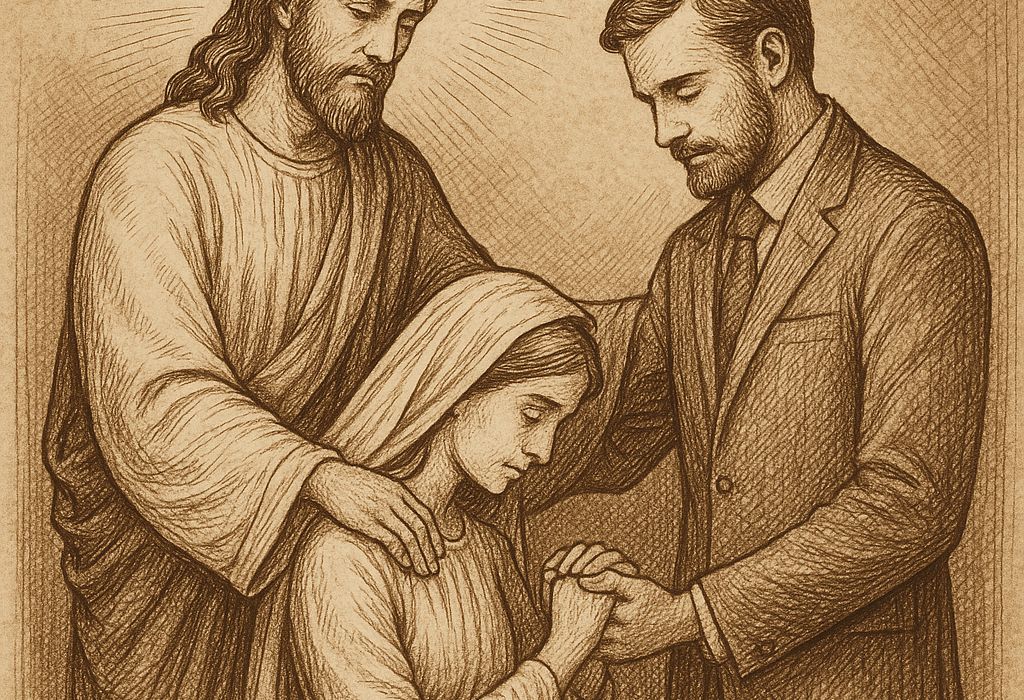
When Red Flags Are God’s Design: Enmeshment, Codependency, and Coverture in Biblical Marriage

InIntroduction: When “Red Flags” Are God’s Design

If you listen to the experts, you’ll hear the same recycled sermon: “Watch out for red flags.” By red flags they mean things like enmeshment, codependency, and coverture. Modern psychology has built entire industries teaching women to “set boundaries,” “find themselves,” and “never lose their independence in a relationship.” Marriage, they say, must be a careful balancing act of two self-actualized individuals maintaining their personal space while occasionally collaborating like business partners.

That might make for a decent corporate merger. It does not make for a Biblical marriage.

The problem is that modern psychology starts with a false premise: that the autonomous self is the highest good. Independence, individuality, and personal space are treated as sacred. To “need” someone is weakness. To “lose yourself” in someone is sickness. To live under another’s authority is abuse. By this definition, the Bible itself is one long parade of pathology.

Because God, in His infinite wisdom, designed marriage to contain all of these so-called “red flags.”

Take enmeshment: Modern therapists say it’s unhealthy when you can’t tell where one person ends and another begins. Scripture calls it marriage: “The two shall become one flesh.” That’s not dysfunction; that’s design.

Take codependency: Today it’s a dirty word for “toxic reliance.” But the Bible doesn’t blush to say a wife must rely on her husband for provision, direction, and covering, just as the Church relies on Christ. Apart from Him, she can do nothing. Apart from her husband, she is not a wife. Dependency is not dysfunction; it is covenant.

Take coverture: The legal doctrine once mocked for “erasing” a woman’s identity under her husband’s. But biblically, a woman’s vows can indeed be annulled by her husband (Numbers 30). She takes his name. She is represented by his headship. She is covered. That is not oppression; that is protection.

So here’s the uncomfortable truth: if your marriage doesn’t look like enmeshment, codependency, and coverture, it’s not biblical. It’s corporate. It’s egalitarian. It’s modern. But it’s not covenant.

What the world diagnoses as unhealthy, God commands as holy. What the experts warn against, Scripture prescribes. What the therapist calls “red flags” are in fact the green lights of biblical marriage.

This article will dismantle the myth of the “independent self,” and then show in turn how enmeshment, codependency, and coverture are not disorders to be cured but features to be embraced. You will see that a true biblical marriage cannot function without them, because God Himself built them into the covenant from the very beginning.

So buckle up. If you came here looking for self-help strategies to preserve your “boundaries,” you’re in the wrong place. But if you’re ready to have your categories flipped upside down and to see marriage not as the world defines it but as God created it – then let’s proceed.

The Myth of the “Independent Self”

Walk into any therapist’s office today and you’ll hear the sermon of our age: “You need boundaries.” “You need to find yourself.” “Don’t lose your independence in your marriage.” It is the gospel of autonomy, preached with clinical authority. And it is a lie.

The modern world exalts the “independent self” as the highest virtue. A healthy adult, they say, is one who is self-contained, who does not “need” anyone else to function, who maintains his or her own “space” even inside of marriage. Dependence is weakness. Fusion is pathology. Losing yourself in another is a “red flag.”

This is not wisdom. It is the doctrine of the serpent.

When Satan whispered to Eve in the garden, his promise was not of unity but of independence: “You will be like God.” You will not need to obey. You will not need to submit. You will not need to be bound to another. You will stand alone, autonomous, sovereign over yourself. And in that moment, Eve traded the security of Adam’s headship for the illusion of her own independence. The result was not empowerment but utter ruin.

The Bible never celebrates the autonomous self. From the very beginning, God declared: “It is not good that the man should be alone” (Genesis 2:18). Man was not made to be a free-floating, independent being. He was made to be a husband, a father, a head. Likewise, woman was not created to be a self-actualized, self-sufficient entity. She was created for man, designed, built, and delivered into covenant with him. Her existence finds its fulfillment not in independence, but in belonging (Genesis 2:22–24).

The modern cult of autonomy therefore stands in direct rebellion against creation itself. Consider the way Scripture frames human identity. You are always defined in relation to another:

  • Man is defined in relation to God: a son, a servant, a creature.
  • Woman is defined in relation to man: a helper, a wife, a glory.
  • Children are defined in relation to parents: arrows, disciples, heirs.

At no point does the Bible hold up a free-floating, self-referential individual as the ideal. The “independent self” is not only unbiblical, it is anti-biblical.

The irony is that those who cling most desperately to their independence never actually achieve it. The single career woman who swears she doesn’t “need a man” ends up enslaved to corporations, antidepressants, and the empty rituals of brunch and wine nights. The man who insists on his bachelor autonomy ends up enslaved to pornography, entertainment, and consumer debt. In rejecting covenantal dependence, they simply fall into a thousand other dependencies, all of them enslaving, none of them sanctifying nor liberating.

By contrast, biblical marriage embraces dependence and covenantal loss of self. The husband is not a sealed unit; he is a head that requires a body. The wife is not an autonomous creature; she is a body that requires a head. The two are incomplete alone, and made whole only in union. This is not pathology, this is the creation order.

Of course, the psychologists will call this “enmeshment.” They will diagnose what God calls “one flesh” as an unhealthy blurring of boundaries. But Scripture celebrates precisely that blurring. The wife does not own her body, but the husband does (1 Corinthians 7:4). The husband is not his own, but belongs to the household God has entrusted to him. Their identities are not separate silos; they are fused, ordered, and interdependent.

It is no accident that the apostle Paul roots his teaching on marriage in the analogy of Christ and the Church. Is the Church “independent” from Christ? Does she need to “set boundaries” to keep her “individuality”? The very suggestion is blasphemous. The Church exists only in relation to Christ, only by His headship, only by dependence. Apart from Him she is nothing, she has nothing, she can do nothing (John 15:5).

And yet, that very dependence is her glory. The more she loses herself in Christ, the more she is truly herself. Likewise, the more a wife loses herself in her husband’s headship, the more she becomes the woman she was created to be. The independent self is a mirage; the dependent self is reality.

This is why the world screams so loudly about “boundaries” in marriage. They sense instinctively that true covenant threatens the idol of autonomy. A wife who gladly orbits her husband, a husband who gladly represents his household, these are dangerous to the modern order because they are living icons of divine order.

So I want to be clear: independence is not healthy. Autonomy is not a strength. Boundaries are not salvation. In marriage, losing yourself in the other is not dysfunction, it is design. The independent self is the lie of the serpent. The dependent, covered, enmeshed self is the creation of God.

Section I: Enmeshment – Losing Yourself Is the Point

Of all the red-flag words modern psychology fears, “enmeshment” tops the list. The definition is simple: blurred boundaries, loss of individuality, fusion of identities. Therapists say it’s dangerous, unhealthy, even abusive. Couples are told to “guard their individuality” and “protect their sense of self.”

Now pause for a moment. Read Genesis 2:24. “Therefore a man shall leave his father and his mother and hold fast to his wife, and they shall become one flesh.”

One flesh. Not two separate individuals with good communication skills. Not two sovereign selves who occasionally cooperate. One. Flesh.

By modern definitions, God Himself just prescribed “enmeshment.”


The Marriage Covenant Erases Autonomy

Marriage is not a lease agreement. It is not a contract between two individuals who maintain personal sovereignty while agreeing to certain shared duties. It is a covenant. And a covenant does not preserve autonomy, it obliterates it.

The woman is no longer her own. Her body, her vows, her life are bound to her husband. The man is no longer his own. His future, his mission, his legacy are now bound to her womb and household. They are swallowed into one reality: the household.

That’s what “one flesh” means. It’s not just sexual union; it’s covenantal fusion. The distinction of roles remains, he is the head, she is the body, but the individuality that modern psychology worships is crucified at the altar of covenant.

This is why Paul says without apology: “The wife does not have authority over her own body, but the husband does. Likewise, the husband does not have authority over his own body, but the wife does” (1 Corinthians 7:4). Each surrenders personal autonomy to the other. That’s not a red flag,  that’s the design.

If you want to understand marriage, look to the archetype: Christ and His bride. Is the Church “independent” from Christ? Does she preserve her individuality by setting boundaries? Does she “find herself” outside of Him?

Of course not. She exists only in Him. She is chosen, bought, owned, ruled, sanctified, and glorified in Him. She has no identity apart from Him. And that is her glory. The more she loses herself in Christ, the more she becomes who she was created to be. Her dependence is not weakness but salvation. Her enmeshment is not dysfunction but covenant.

So why would we pretend marriage should look any different? A wife is not called to “find herself.” She is called to lose herself in her husband’s headship. That is how she becomes who she truly is: his glory, his crown, his household’s heart.


What Happens Without Enmeshment

Refuse enmeshment and you get something far worse: contractual roommates. Two individuals sharing a mortgage, perhaps sharing a bed, but never truly fusing. They guard their “independence,” keep their accounts separate, split chores like coworkers, and resent any intrusion into their personal sovereignty. That is not marriage. That is cohabitation with a contract, at best it is a business partnership.

And it collapses under pressure because it has no covenantal glue. Without enmeshment, when the storms come, sickness, infertility, financial strain, betrayal, there is no unity of flesh to weather it. There are just two individuals looking out for themselves, ready to run the moment their “needs aren’t being met.”

Enmeshment is the glue of covenant. Without it, you have contracts, not covenants.


The Practical Face of Enmeshment & Why the World Fears It

What does healthy, biblical enmeshment look like in a household?

  • Shared life and mission. The wife does not chase a separate career path or personal dream detached from her husband’s vision. Her orbit is his calling. His mission defines her mission.
  • Shared body and intimacy. Her body is his without negotiation. His strength belongs to her without reservation. Sexual autonomy is obliterated by covenant.
  • Shared home and identity. She takes his name. She builds his house. She raises his heirs. She embodies his order in everything from the meals on the table to the atmosphere of the home.
  • Shared emotions. Her emotional world cannot be “independent.” If her husband is thriving, she thrives. If he falters, she feels the weight. That is not sickness; it is covenantal empathy.

This is why Scripture calls a wife her husband’s “glory” (1 Corinthians 11:7). She is not a separate sun burning in her own orbit. She is the reflected radiance of his life and headship.

Why does modern psychology panic at the thought of enmeshment? Because enmeshment threatens the idol of autonomy. A woman who gladly loses herself in her husband is a direct assault on feminism, egalitarianism, and the cult of the self. A man who gladly binds his entire life to his wife’s body and household is a living rebuke to the autonomous male chasing perpetual adolescence.

In other words, biblical enmeshment is dangerous to the modern world because it exposes the bankruptcy of independence. It declares that life is not found in “finding yourself” but in losing yourself, to God, to covenant, to headship.


The Sarcasm They Deserve

So the next time a therapist says, “That sounds like enmeshment,” smile and nod. Because what they call enmeshment, God calls obedience. What they label pathology, Scripture calls covenant. If you still need a therapist to help you “find where you end and your husband begins,” you’re not a wife, you’re a tenant in his home.

Enmeshment is not a red flag; it is the very fabric of marriage. The two becoming one flesh is the beating heart of covenant. To blur the lines, to fuse identities, to lose yourself in the other, that is not dysfunction, it is design.

And until a man and woman embrace that loss of autonomy, they are not married in the biblical sense at all.

Section II: Codependency – Holy Dependence on Your Head

If “enmeshment” makes the psychologists nervous, “codependency” makes them foam at the mouth. Codependency, they tell us, is when one person’s identity, emotions, and stability depend too heavily on another. It’s painted as weakness, toxicity, even danger. The self-help books are full of commands: “Don’t rely on anyone else for your happiness. Don’t let your partner control your stability. Don’t be dependent, stand on your own two feet.”

In other words, don’t be married.

Because dependence isn’t the failure of marriage. It’s the essence of marriage. And codependency, in the biblical sense, is not a pathology to be cured but a covenant to be embraced.


Dependence by Design & The Wife’s Dependence

Let’s start where God starts. The very creation of woman was an act of dependence. She was not taken from the dust like Adam. She was taken from Adam’s side (Genesis 2:21–22). Her existence was derivative, her design relational. She was built to lean.

And Adam was built to need her. He could not fulfill the mandate alone. He needed help, fruitfulness, companionship. He was incomplete without her. God said: “It is not good that the man should be alone” (Genesis 2:18).

So from the very beginning, marriage is dependency,  mutual, covenantal, holy. Not weakness, not dysfunction, but design. The Bible is unapologetic: a wife depends on her husband:

  • For provision: The man works the ground, the man provides bread, the man ensures survival (Genesis 3:19, 1 Timothy 5:8).
  • For protection: The man guards, defends, shields (Nehemiah 4:14).
  • For direction: The man is head, the woman is body. The head leads, the body follows (Ephesians 5:23–24).

This is not a polite suggestion; it is a divine command. A wife who insists on being independent, self-sufficient, and non-reliant is not being strong. She is being rebellious. She is denying the very structure God wrote into creation.


The Husband’s Dependence –  Christ and the Church: The Pattern Again

Now, don’t misunderstand: dependence is not one-sided. A husband also depends, but differently. He does not depend on his wife for direction, headship, or provision. But he depends on her for fruitfulness, for the building of the household, for the multiplying of his strength into children, culture, and legacy.

Proverbs 31 doesn’t describe an “independent woman” building her own empire. It describes a woman whose entire industry is harnessed to her husband’s household, expanding his name in the gates. She is not free-floating; she is dependent. And he, in turn, depends on her productivity and faithfulness to multiply what he provides.

That is covenantal codependency, each leaning into the other’s role, neither complete without the other. Look again to the archetype. Is the Church “codependent” on Christ? Absolutely. She cannot live without Him. She cannot move, breathe, or act apart from Him. “Apart from Me you can do nothing” (John 15:5). Her entire identity is bound up in His headship.

By modern standards, that’s “toxic.” But by biblical standards, that’s salvation.

And Christ, though not dependent on the Church for His own existence, has nevertheless bound Himself covenantally to her. He chose to need her fruitfulness, her obedience, her glory. He calls her His bride, His body, His fullness (Ephesians 1:23). He delights to depend on her to display His glory to the world.

So again: codependency isn’t a dysfunction. It’s the gospel written into flesh.


Without Codependency, You Get Sterility

Strip codependency from marriage and what do you have left? A sterile partnership of two individuals “supporting” each other but never needing each other. She has her job, her money, her life. He has his hobbies, his paycheck, his space. They come together for sex and vacations, but neither truly leans on the other.

That isn’t strength. That’s a divorce waiting to happen, and it usually does.

Because marriage without dependency is barren. It produces no covenantal loyalty, no generational continuity, no shared life. It is two people playing house while fiercely guarding their own lives. And when life gets hard, when one falls, the other has no idea how to hold the weight, because they never learned to lean.

Dependency is not the risk of marriage. It is the reward of true Biblical marriage.


The Mockery of Modern Psychology & Codependency Redeemed

The world calls it weakness when a woman can’t imagine life without her husband. The Bible calls it loyalty. The world calls it toxic when a man’s stability depends on his wife’s faithfulness. The Bible calls it covenant.

So when a psychologist says, “You’re too dependent,” what they mean is, “You’re doing marriage too well.”

And here’s the irony: the same culture that ridicules marital dependence churns out entire generations of addicts dependent on pharmaceuticals, pornography, and entertainment. They mock a wife for needing her husband but celebrate a woman who “needs” wine every night to cope. They despise a husband depending on his wife’s loyalty but shrug at his dependence on a glowing screen for comfort.

Dependency isn’t the problem. The object of dependence is. When you reframe it biblically, codependency is just another word for covenant. The husband and wife lean on each other in their God-ordained roles. The stronger he leads, the more she depends. The more she depends, the more he provides. This is not a vicious cycle but a virtuous one.

The Church without Christ is nothing. The wife without her husband is uncovered, vulnerable, incomplete. And the husband without his wife is barren, lonely, unfruitful. Only together, in dependence, do they fulfill their created purpose.


Conclusion (Sarcasm for the World)

So yes, by modern definitions, every biblical marriage is “codependent.” Congratulations, you’ve just diagnosed God’s design. If you’re still holding out for a marriage where both spouses are fiercely independent, stable, and self-fulfilled without leaning on each other, good luck. You’ll find it in the obituary column, listed under “died alone.”

Codependency is not dysfunction. It is covenantal reality. A wife depending on her husband is not weakness, it is glory. A husband depending on his wife’s fruitfulness is not failure, it is design. The world can sneer and diagnose, but the truth remains: if your marriage isn’t codependent, it isn’t biblical.

Section III: Coverture – The Beauty of Being Covered

If “enmeshment” makes the therapists squirm, and “codependency” makes them panic, then “coverture” is the word that makes the modern world scream. Even many Christians flinch at it. Coverture, they say, is oppression. It’s erasure. It’s the patriarchal nightmare where a woman’s very identity is swallowed up into her husband’s. And to that I say: exactly.

Because coverture, rightly understood, is not oppression, it is protection. It is not abuse, it is order. It is not erasure, it is covering.


What Coverture Really Is & The Scriptural Basis for Covering

Historically, coverture was a legal doctrine in English common law that said, upon marriage, a wife’s legal identity was “covered” by her husband’s. She could not hold property separately, her contracts flowed through him, her wages belonged to him. “Husband and wife are one person in law,” Blackstone wrote, “and that person is the husband.”

The feminists call this barbaric. But Scripture calls it biblical. Because God designed a wife to be represented by her husband. She is not her own public agent. She is not an independent legal unit floating in society. She is covered, by his name, by his headship, by his responsibility.

  • Numbers 30: If a wife makes a vow, her husband can annul it. Her word in public is not her final authority. His headship covers her.
  • Genesis 2:24: She leaves her father’s house, her maiden identity, and becomes one flesh with her husband. His household is her household.
  • Ephesians 5:22–24: She submits in everything, as to the Lord. His authority defines her obedience.
  • Isaiah 4:1 (prophetically): Women plead for a man to “take away our reproach” by letting them bear his name. Her covering is her dignity.

Scripture presents covering not as a curse, but as a glory. A woman without covering is exposed, vulnerable, and ashamed. A woman under coverture is secure, represented, and honored.


Coverture Is Not Erasure, but Representation

Now, let’s be clear: coverture does not mean a woman ceases to exist. She is not vaporized. She is represented. Her agency, her voice, her very identity flows through her husband. That’s the point of covering.

Think of Israel’s priests. The people didn’t march into the Holy of Holies themselves; their priest represented them. That didn’t erase them, it secured them. So also a husband represents his wife. She is not diminished by his headship; she is shielded by it.

This is why the Church gladly takes Christ’s name, gladly lets Him annul her vows, gladly hides beneath His authority. If that is oppression, then salvation itself is oppression.

The reason coverture terrifies moderns is simple: it dismantles the idol of autonomy.

To say a woman is not her own, but her husband’s, is to commit blasphemy against the religion of independence. To say her contracts, wages, or vows are not final apart from him is to declare war on feminism’s cherished dream of the sovereign self.

But here’s the irony: modern women still crave coverture. Why else do they line up to take his name at marriage? Why else do they want his last name on their children? Why else do they instinctively measure their security not by their résumé but by whether they are chosen, covered, and claimed? They want coverture,  they’ve just been taught to despise it.


Coverture in Practice & Coverture vs. Caricature

What does biblical coverture look like in a household today?

  • His name, not hers. She does not keep her “maiden identity.” She bears his name. That is not chauvinism; that is covenant.
  • His responsibility. If debts come due, if obligations must be met, it is the husband who stands responsible before God and man.
  • His voice. In matters of household direction, law, and representation, she speaks through him. She does not compete with his headship; she manifests it.
  • Her protection. Under his covering, she is not exposed to the storms of the world, the predations of other men, or the chaos of autonomy.

Coverture is not the suffocation of womanhood. It is the structure that makes womanhood safe, fruitful, and glorious. Critics of coverture imagine horror stories: the tyrant husband crushing his wife into silence, stripping her of dignity. But that is not coverture. That is abuse.

True coverture is covenantal. It binds the husband to represent her faithfully. It binds him to provide, to protect, to speak truly on her behalf. If he fails, he bears the judgment. Coverture is not a license for tyranny; it is a weight of responsibility.

But modern people don’t hate coverture because it might be abused. They hate it because it leaves no room for their idol of “her independence.”


Christ, the Husband Who Covers Perfectly

Once again, the archetype explains everything. Christ covers His bride. He takes her sins upon Himself. He bears her shame. He represents her before the Father. He speaks for her, provides for her, rules her. She is not diminished under His covering, she is glorified.

And so it must be with earthly marriage. A woman who resists coverture resists her own salvation, because she resists the very pattern of Christ and His Church.

So yes, in a biblical marriage, a wife is covered by her husband. She loses her “independence.” She forfeits her “personal legal identity.” And she gains security, glory, and representation. If that makes you gag, then gag harder at the gospel itself, because salvation is nothing but divine coverture.

Coverture is not a relic of medieval law. It is not a patriarchal quirk of history. It is a divine principle written into creation and covenant. To be covered is not to be erased. It is to be secured, represented, and glorified.

The world will keep shrieking about oppression, because they cannot tolerate a woman gladly hidden in her husband’s name. But Scripture will keep declaring: coverture is not abuse. It is beauty. And without it, there is no biblical marriage at all.

Section IV: Polygyny and the Multiplication of Covenant

The objections always come: “Sure, maybe enmeshment, codependency, and coverture can exist between one man and one woman. But what about polygyny? Doesn’t that make covenantal dependence impossible? Doesn’t it fracture the unity?”

That objection reveals more about our modern individualism than about God’s design. Because polygyny is not a crack in covenant, it is its expansion. It is not a dilution of enmeshment, codependency, or coverture, it is their multiplication exemplified.

One Flesh With Many

A husband with multiple wives does not become less “one flesh.” He becomes one flesh with each. Just as Christ is one with each believer yet not divided, a husband may be enmeshed with more than one wife without fragmentation. 

The Church is not diminished by being many; she is magnified. Israel was not weakened by being twelve tribes; it was made whole. In the same way, a man’s household does not fracture under polygyny. It enlarges, like branches on a single tree, all fed by the same root.

Dependence Multiplied & Coverture Expanded

If dependence is by design, then polygyny only multiplies the design. Each wife depends on her husband for provision, direction, and covering. But notice: she also depends on her sister-wives. When one bears children, the others support. When one struggles, the others strengthen. 

When one household role is carried by one woman, another expands in a different area. Their dependence is vertical, upon their head, and horizontal, upon one another. This is no dysfunction. It is a resilient, covenantal web of loyalty.

In polygyny, coverture is not erased but intensified. Each wife bears her husband’s name. Each speaks through his authority. Each is secured under his headship. But instead of isolation, this produces solidarity. Just as the tribes of Israel bore the same covenant yet kept distinct identities within it, so wives under one husband share his covering while retaining their unique glory. They are not erased, but harmonized.

The Archetype: Christ and His Many

The pattern holds, as always, in Christ. The Church is one bride, yet many members. Christ’s headship is not fractured by having countless dependents; it is displayed all the more. His coverture is not weakened by covering multitudes; it is glorified.

The same is true for the patriarch who rules a polygynous household well. His unity with each wife does not cancel his unity with the others. Instead, he becomes the nexus of covenantal enmeshment, holy dependence, and protective covering that binds many into one household.

The Household as a Nation

This is why Scripture so often ties polygyny to the imagery of nations and tribes. A household with multiple wives is not a dysfunction, it is the seed of a nation. Enmeshment, codependency, and coverture scale from the marriage bed to the tribal structure. 

The wives are bound not only to their husband but to one another, just as the tribes were bound not only to Jacob but to each other. Their covenant loyalty becomes interwoven, producing a household that images the kingdom of God itself: many members, one body; many tribes, one nation; many wives, one covenant.

So does polygyny break biblical marriage? No, it displays it more clearly. If enmeshment, codependency, and coverture are the green lights of God’s design, then polygyny is not a pile-up. It is simply more green lights in a greater household.

The Practical Face of Polygyny: How It Works in a Household

So what does it actually look like when enmeshment, codependency, and coverture are applied to a polygynous marriage? Far from chaos, it produces harmony, resilience, and multiplication.

  • Shared Dependence on One Husband
    Each wife does not orbit independently. They orbit their husband in unison. His mission, his name, his provision, his headship binds them all. He is the sun; they are the planets. Their unity with him unites them with one another.
  • Mutual Reliance Among Wives
    Sister-wives lean on one another in daily life. When one is sick, another covers her duties. When one is heavy with child, another carries more of the household load. When one needs counsel, another gives perspective. Dependency is not weakness, it is multiplied strength.
  • Shared Motherhood and Fruitfulness
    Children are raised not only by their mother but by multiple mothers bound under one father. The older wives teach the younger (Titus 2). The younger learn by imitation. Children are surrounded by layered maternal presence, all ordered under one paternal head. This is not confusion; it is covenantal abundance.
  • Diversity of Strengths Under One Covering
    One wife may be especially skilled at managing the kitchen, another at teaching children, another at stewarding resources. None of them operate as “independent entrepreneurs.” Their strengths are harmonized through their husband’s headship, so their gifts multiply the household instead of competing.
  • Expanded Coverture
    Each wife takes her husband’s name, and that common name binds them as one household. They are not “independent agents.” They are covered, represented, and protected by him. And that shared covering gives them solidarity with one another, no rivalry over “individual identity,” only unity under one man’s identity.
  • Interwoven Emotional Life
    Sister-wives do not live in isolation. They carry one another’s joys and sorrows. A victory for one is a victory for all. A burden for one becomes the concern of all. Enmeshment, far from being toxic, becomes a network of empathy tied together by one husband’s leadership.

This is why polygyny, rightly ordered, is not chaos but order on a larger scale. It turns individual households into clans. It takes one flesh and extends it into a body with many members. It looks less like a fragile two-person business contract and more like a small kingdom – resilient, abundant, and holy.

Section V: Why the World Hates This Design

By now the pattern is obvious: what God calls covenant, the world calls pathology. Enmeshment, codependency, coverture, Scripture celebrates them as the marks of marriage, but psychology diagnoses them as diseases. Why? Because marriage, rightly ordered, destroys the idol the world loves most: autonomy.


Autonomy Is the Religion of the Age: Satan Hates Headship

The modern gospel is simple: “Be your own.” Every commercial, every school curriculum, every therapist’s couch preaches the same liturgy: find yourself, express yourself, free yourself. Independence is salvation, dependence is sin.

By that creed, biblical marriage is the ultimate heresy. A woman who gladly loses herself in her husband is blaspheming against autonomy. A man who ties his mission, name, and identity to his wife and household is spitting in the face of self-actualization. A couple who fuses into one flesh, who depend on one another, who erase individual sovereignty for covenantal unity, they are rebels against the false god of independence.

No wonder the world calls it sickness. The hostility is not merely cultural; it is spiritual. From the very beginning, Satan targeted headship. He bypassed Adam and spoke directly to Eve. He inverted the order, despised the covering, and sold her autonomy as liberation. “You will be like God,” he hissed. Independent. Self-ruling. Sovereign.

And ever since, his war has been the same. Attack headship, destroy covering, turn dependence into dysfunction. A woman who glories in her husband’s authority terrifies him, because she images the Church’s loyalty to Christ. A man who covers and rules his wife terrifies him, because he images Christ’s dominion over the Church. Satan hates coverture because it preaches the gospel every time a wife signs her husband’s name.


The Hypocrisy of the Critics  What the World Fears

Here’s the cruel irony: the world mocks wives for depending on their husbands, but celebrates their dependence on corporations, governments, and pharmaceuticals. A woman who needs her husband’s paycheck is “oppressed.” A woman who needs Prozac, wine, and HR benefits is “empowered.”

They sneer at coverture in marriage but bow gladly to state coverture, every document stamped by a government seal, every contract subject to bureaucratic annulment. They despise a husband representing his wife, but worship the state that represents them both.

And they deride enmeshment in covenant while selling enmeshment with screens, entertainment, and algorithms. Lose yourself in TikTok? Fine. Lose yourself in your husband? Toxic. The hypocrisy is truly breathtaking.

Beneath the mockery lies fear. Because a household ordered by God’s design is unbreakable. A wife enmeshed with her husband is immovable. A couple codependent in covenant is unshakable. A woman covered by her husband’s authority is untouchable.

And households like that cannot be manipulated by the world. They do not bow to feminist slogans, corporate HR departments, or government dependency programs. They are free precisely because they are bound.

This is why the world must call these things sickness. If it admitted their health, the entire edifice of autonomy would collapse.


Turning Red Flags Green

So the red flags they wave are not warnings at all. They are markers of covenantal faithfulness. Enmeshment, codependency, coverture – these are the green lights of God’s design. They say: here is a household ordered by the Word, not by the world. Here is a marriage that images Christ and the Church. Here is a covenant that laughs at the idol of autonomy and bows gladly to the Lord of headship.

That’s why the world hates this design. Not because it’s abusive. Not because it’s unhealthy. But because it is holy.

The world’s horror at enmeshment, codependency, and coverture is not about psychology. It is about rebellion. They hate these things because they hate what they picture: submission, dependence, covering. They hate them because they hate Christ.

And so, the faithful must not be cowed by the world’s shrieks. We must embrace the very things they condemn, and wear them as badges of honor. For the so-called “red flags” of biblical marriage are not signs of dysfunction, they are the banners of God’s design.

Conclusion: When Red Flags Are the Green Light of God

So here we stand. Modern psychology shouts “red flag” every time Scripture whispers “covenant.” The experts warn us to avoid enmeshment, codependency, and coverture as if they were plagues. But in truth, they are not plagues at all. They are the very pillars of a biblical marriage.

  • Enmeshment – the two becoming one flesh, losing the illusion of autonomy, fusing identities in covenant.
  • Codependency – husband and wife leaning into each other’s God-ordained roles, unable to thrive apart, gloriously bound together.
  • Coverture – the wife hidden in her husband’s name, represented and protected by his headship, covered as the Church is by Christ.

These are not dysfunctions. They are the features of a household rightly ordered. Without them, you do not have a marriage. You have a contract, a roommate agreement, or a sexual partnership of convenience. With them, you have covenant. With them, you have a living picture of Christ and the Church.

And this is precisely why the world despises them. The world loves autonomy, independence, the sovereign self. But God laughs at autonomy. He built us for dependence, for submission, for covering. He designed marriage as the arena where all those things come together, not as sickness, but as salvation.

To the world, a wife who orbits her husband, a husband who represents his wife, a couple who cannot imagine life apart, these are broken, unhealthy people. To God, they are holy, obedient, and glorifying His design. What the world condemns, heaven crowns.

So let the therapists wring their hands. Let the feminists sneer. Let the world call these things weakness, pathology, oppression. We know better. These are not red flags. They are green lights, blazing with divine approval. They are not signs of dysfunction. They are signs of covenant. They are not sicknesses to be cured. They are health to be embraced.

If you want a biblical marriage, don’t run from these things, run toward them. Lose yourself in your spouse. Depend on your head. Delight in your covering. For in these so-called “red flags,” you will find the strength, the order, and the glory that God intended from the beginning.

The world offers you independence and loneliness. God offers you enmeshment, dependence, and covering. Choose your master.

The Unbroken Word: Defending the King James Bible as God’s Preserved Scripture

Section I: The Corruption of Modern Bible Versions

In a world rapidly falling into apostasy, confusion, and rebellion, one might ask, what has changed? Why has the once solid foundation of Christian civilization crumbled into relativism, compromise, and spiritual powerlessness? The answer lies, in part, at the very root of Christian life: the Bible. The authority of the Word of God has been subverted. And worse yet, the words of God have been tampered with, diluted, twisted, and counterfeited.

The modern “Bible version” industry is nothing short of spiritual fraud; a multibillion-dollar empire built on deceit, ecumenism, gender neutrality, and humanist philosophy. Where once Christians stood unified upon one standard of truth, the majestic, fire-forged King James Bible, today there exists a bloated catalogue of corruptions: NIV, ESV, NLT, NASB, CSB, the “Message,” and more. These perversions do not merely update the language. They alter doctrine. They change meanings. They delete verses. They remove the deity of Christ. They undermine the Trinity. They attack God’s authority.

A Different Spirit: The Root of the Modern Versions

The history of these modern versions is neither sacred nor pure. Most trace their textual ancestry to the critical Greek texts of Westcott and Hort, 19th-century Anglican scholars who openly denied Biblical inerrancy and held to heretical views. Westcott questioned the bodily resurrection of Christ. Hort denied eternal punishment. These men despised the Textus Receptus, the traditional Greek text underlying the KJV, and instead exalted the minority Alexandrian manuscripts, which were found discarded in trash heaps and were heavily influenced by Gnostic thought.

These Alexandrian texts (especially Codex Vaticanus and Codex Sinaiticus) lie at the heart of every modern version, including the NIV, ESV, and NASB. Their textual lineage is one of corruption, deletion, and doctrinal compromise. Compared to the Textus Receptus, they omit thousands of words, entire verses, and key theological statements. Consider just a few examples:

  • Acts 8:37, where the Ethiopian eunuch confesses Christ before baptism, is completely missing in most modern versions. Why? Because modernists despise the doctrine of faith preceding baptism.
  • Matthew 18:11, “For the Son of man is come to save that which was lost,” is stripped from modern versions. Why? Because salvation, sin, and Christ’s mission are offensive to the modern mind.
  • Colossians 1:14 changes “through His blood” to simply “in whom we have redemption.” The blood of Christ, the very heart of the Gospel, is removed.

These are not minor translation choices. These are deliberate theological assassinations. And worse yet, they present themselves as “accurate,” “scholarly,” or “easy to read.” But Satan, the serpent, is subtle. His lies always sound smooth and reasonable to the undiscerning.

The Fruit Test: What Do the Versions Produce?

Christ said, “Ye shall know them by their fruits.” (Matthew 7:16). The King James Bible gave us the Reformation, the Puritans, the Pilgrims and the American Republic. It gave us a literate society, sound doctrine, powerful preaching, and robust family-centered religion. The fruit of the KJV is undeniable: repentance, order, patriarchy, dominion, revival!

Now look at the fruit of modern versions. What has the NIV produced? Feminism in the pulpit. Youth groups built on games and pizza instead of Scripture. Churches that can’t even define “sin.” Preachers afraid to say “hell.” Homosexual bishops. Genderless pronouns for God. “Christian” denominations debating whether Jesus is the only way to Heaven.

Many of these versions are owned and published by secular corporations, including Rupert Murdoch’s News Corp (Zondervan, which publishes the NIV). Copyright is leveraged to maintain financial control. Updates are pushed to sell new editions. It’s not a holy endeavor, it’s a business.

The KJV is in the public domain. No one profits from it. It stands alone, untethered from the commercial shackles of publishing houses. That alone should cause the righteous man to pause and consider: Whose Word am I reading?

Spiritual Weakness Through Doctrinal Dilution

Many will say, “But the new versions make the Bible easier to read.” The problem is not the vocabulary. The problem is spiritual discernment. The problem is the heart. The KJV uses noble, elevated language that sanctifies the text. It is not street slang, it is sacred tongue. The challenge of its cadence draws the reader upward, not downward. Children once memorized it with ease. Men once quoted it like breath.

But modern Christians are spiritually lazy, intellectually dull, and doctrinally malnourished, fed a steady diet of watered-down, neutered text stripped of power and majesty. The ESV and NIV do not rebuke sin with the force of the KJV. They do not exalt Christ with the same glory. They do not ring in the soul with the thunder of God.

The degradation of our society, the effeminization of the Church, and the collapse of family order have all accelerated in tandem with the abandonment of the King James Bible. Coincidence? No. Causation.

Section II: The Divine Preservation of the King James Bible

If the first section exposed the corruption of modern versions, this section must now affirm with full conviction the divinely appointed preservation and authority of the King James Bible. This is no mere preference of literary style, nor a nostalgic appeal to tradition. It is a declaration of faith, faith in the God who said:

“The words of the Lord are pure words: as silver tried in a furnace of earth, purified seven times.
Thou shalt keep them, O Lord, thou shalt preserve them from this generation for ever.”
—Psalm 12:6–7 (KJV)

These are not metaphors or vague sentiments. These are promises. And if God cannot keep His Word, then He is not God.

The Doctrine of Preservation

God does not merely inspire His Word and then leave it to decay. From the beginning, the Lord has promised to preserve His Word perfectly; in every generation (Psalm 119:89, Matthew 24:35). This means that there must exist a perfectly preserved Word of God today. Not a theoretical manuscript locked in a cave, not a digital hodgepodge of variants compiled by scholars, but a real, tangible Bible that is the Word of God.

The King James Bible alone fulfills this promise for the English-speaking world. It is not merely a good translation, it is the culmination of divine preservation.

The manuscripts behind the King James Version, the Hebrew Masoretic Text and the Greek Textus Receptus, are the texts preserved and used by the believing Church throughout history. These are not the rare, corrupted Alexandrian texts that underlie modern versions, but the universally received and trusted Scriptures used by God’s people for centuries.

“Seek ye out of the book of the Lord, and read: no one of these shall fail…” —Isaiah 34:16 (KJV)

God never once hinted that His Word would become a scholarly puzzle to be pieced together by unbelieving academics with agendas. He preserved it among the faithful. The King James Bible stands not just as a reliable translation, but as the providential fruit of divine oversight.

The Translators: God’s Appointed Men

The translation of the King James Bible was not a hasty work of ambition. It was the most extensive, prayerful, and scholarly translation project in human history. Commissioned by King James I of England in 1604, it brought together 54 of the most gifted scholars and theologians of the day; men steeped in Hebrew, Greek, Latin, and the ancient tongues, but also men of faith, reverence, and fear of the Lord.

These were not profit-driven publishers or seminary liberals. These were godly men who labored in teams, cross-checking and refining every word. They prayed, fasted, and treated the work not as intellectual recreation, but as holy burden. The translators themselves testified that their work was not new revelation, but the purification of what had been handed down faithfully from the Church fathers and earlier translations (Tyndale, Geneva, etc.), now unified in a single, majestic Bible.

It is not coincidence that this took place at the height of English expression, the same time Shakespeare’s pen was at work. The English language itself had matured by divine design, poised to carry God’s Word to the world. The King James Bible would become the seed of spiritual revolution, carried across oceans and continents, giving rise to the greatest missionary expansion in Church history.

The Language: Elevated, Exact, Eternal

Critics say the language of the KJV is “archaic.” What they mean is that it demands reverence. It does not sound like the world. Thee, thou, ye, thy; these are not random old words. They serve precise grammatical functions. “Thou” is singular; “ye” is plural. Modern English has lost this distinction, creating confusion in meaning. The KJV preserves clarity and depth.

Moreover, the poetic cadence, parallelism, and word choices of the KJV are unmatched. This is not accidental. It is the mark of divine beauty. The KJV speaks with authority, thunder, and holiness. Even its enemies admit its literary glory. But its glory is not mere style. It is the voice of God, magnified.

“He sent his word, and healed them, and delivered them from their destructions.” —Psalm 107:20

No other version speaks like this. No other version pierces like this. The KJV alone has shaped nations, converted sinners, and discipled empires.

The Fruit: Reformation, Revival, and Dominion

By their fruits ye shall know them. What did the King James Bible produce? It produced fire.

  • The Great Awakenings of the 18th and 19th centuries were fueled by the KJV. Whitfield, Wesley, Spurgeon, Finney, all thundered from the pages of the King James.
  • The American Revolution was undergirded by the sermons and principles drawn from the KJV.
  • The homeschool movement, the patriarchy revival, the restoration of Biblical masculinity and family order, all find their foundation and fuel in the uncompromising words of the KJV.

When families read the KJV aloud, when fathers teach from it, when pastors preach it without apology, the result is order, boldness, wisdom, and strength. It births no feminized Church. It breeds no woke seminaries. It tolerates no compromise.

It is the Sword of the Lord!

Section III: The Call to Return to the Standard

The time for double-mindedness is over. The age of compromise has yielded nothing but confusion, rebellion, and effeminacy in the Church and the home. If the foundation be destroyed, what can the righteous do? (Psalm 11:3) The righteous must return to the standard; to the preserved Word of God in the English language, the King James Bible.

This is not a matter of preference, convenience, or tradition. It is a matter of spiritual war. The battle lines have been drawn. The question is not simply, “Which version do you use?” The question is this: Do you believe God has preserved His Word perfectly for His people, or do you not?

The King James Bible: The Final Authority

Every revival of truth, order, and dominion begins with the right standard. The man of God cannot rule his house in righteousness if he does not have a trustworthy sword. The woman cannot raise children unto the Lord if her Bible changes meanings with every printing. The Church cannot speak prophetically to the world if it reads from the same lukewarm, diluted texts that the world tolerates.

The King James Bible is not merely another translation, it is the final authority. It is the English Bible. All others are counterfeits, distractions, and deceptions.

“Sanctify them through thy truth: thy word is truth.” —John 17:17

How can one be sanctified by truth if the truth has been altered? How can one believe in absolute truth if the very words of God are negotiable, footnoted, and fluid?

Modern versions do not produce holiness. They produce confusion. They replace certainty with doubt, absolutes with ambiguity, and they invite compromise. They say “oldest and best manuscripts” but cannot agree on what God actually said. They say “a better rendering might be,” but never say “Thus saith the Lord.”

Restoring the King James Bible in the Household

If The Great Order is to be built, it must be built upon a rock. And that rock must be the unchanging Word of God.

  • The father must teach and correct from the King James Bible as the supreme law in his household.
  • The mother must disciple her children in its words, not “easy-to-read” paraphrases but God-breathed fire.
  • Children must memorize, recite, and read the King James aloud until its cadences shape their minds and hearts.
  • Sabbath readings, morning devotions, disciplinary instruction, and courtship training must all proceed from the KJV alone.

This is not optional. This is covenantal obedience. God’s covenant people are marked by reverence for His Word:

“It is written, Man shall not live by bread alone, but by every word that proceedeth out of the mouth of God.” —Matthew 4:4

“Every word” means just that, every word. Not some words. Not approximate meanings. Not evolving interpretations. The KJV alone provides the entire preserved counsel of God in English.

Churches Must Repent

Churches that claim to be “Bible-believing” while using multiple versions are deceived. The flock is scattered. There is no unity of doctrine when the people cannot agree on what God said. Scripture reading in the service becomes a buffet. Preaching becomes comparison of versions. Pastors become editors, not heralds.

It is time for pulpits to be purged. The ESV, NIV, NLT, CSB, NASB; all must be thrown out, or better yet; burned. They are not the Word of God. They are polluted fountains. The only cure for doctrinal anemia, cowardice, and worldly compromise is the return of one Bible for one people: the King James.

Churches must burn their “Message” Bibles. They must repent of the lie that “any version is fine.” No, not all versions are fine. Only one was divinely orchestrated in perfect timing, language, scholarship, and spiritual authority. Only one bears the unmistakable mark of God’s preservation: the King James Bible.

“Thus saith the Lord, Stand ye in the ways, and see, and ask for the old paths, where is the good way, and walk therein, and ye shall find rest for your souls…” —Jeremiah 6:16

But the verse ends tragically: “But they said, We will not walk therein.” This is the modern Church’s attitude toward the King James Bible. They reject the old path. They want ease, not precision. Comfort, not conviction. Entertainment, not truth.

But let the faithful not be among them. Let the households of The Great Order rise up and say: We will walk therein.

The Judgment Against Those Who Alter His Word

To tamper with the Word of God is to call down judgment. Revelation 22:18-19 contains a solemn warning:

“If any man shall add unto these things, God shall add unto him the plagues… And if any man shall take away… God shall take away his part out of the book of life…”

These are not idle threats. Those who promote, publish, or profit from the corrupted versions of Scripture will answer to the Judge. Whether it is a seminarian who promotes the ESV or a woman’s group that reads the NIV, if they do not repent and return to the true Word, they are participating in the great apostasy.

Churches today are falling away, not only from sound doctrine but from sound Scripture. They quote corrupted verses. They omit entire passages. They redefine sin. They strip Christ of His deity. The KJV alone has resisted this tide.

And so we raise the standard again.

Lift Up the Banner: A Call to All Men

Now is the hour to rebuild. Now is the hour for patriarchs, fathers, pastors, and Christian heads of household to return to the divine Word that forged the Reformation, built Christian civilization, and sustained empires.

Let there be no double-mindedness. No lukewarm neutrality. This is a war of books, a war of words, and ultimately, a war for the soul of man.

Let the KJV be restored as the only Bible in the Christian home. Let it be memorized, read aloud, wept over, and preached. Let it shape the law of the household, the courtship of sons and daughters, the prayers of the family, and the praises of the saints.

Let it govern us.

“The entrance of thy words giveth light; it giveth understanding unto the simple.” —Psalm 119:130

Let the Great Order rise again, not on shifting sand, but upon the rock of the unchanging, majestic, divine Word of the King.

The King James Bible.

This is the Great Order!

Raised in Ruins: The Burden and Blessing of Learning Too Late

Introduction: Born Behind Enemy Lines

If you were raised in the West in the last 50 years, you were raised in ruins. Not ruins of brick and mortar, but of order, morality, and faith. The family, once the cornerstone of civilization, has been shattered. The church, once the uncompromising herald of truth, has become an entertainment venue. Education, once built on Scripture (the New England Primer taught children to read using Bible verses), now churns out graduates who can deconstruct gender but cannot build a household.

We are not Israel in its golden days under Solomon; we are Israel in exile, more Babylonian than Hebrew in our habits, desires, and worldview. The prophet Hosea said: “My people are destroyed for lack of knowledge: because thou hast rejected knowledge, I will also reject thee…” (Hosea 4:6). That verse reads less like a distant oracle and more like tonight’s headlines.

Consider the numbers. Barna Group’s 2022 survey found that only 4% of Americans have a biblical worldview. Only 11% of Christians read the Bible daily. Fertility rates in the West are collapsing (the U.S. sits at 1.62 births per woman, far below minimum replacement of 2.2). Divorce rates, cohabitation, single motherhood, every marker of covenantal order is broken. We are living not in a neutral environment but behind enemy lines.

And what happens to those of us who wake up? We find ourselves already behind. We were not trained from childhood to pray daily, to memorize Scripture, to honor the Sabbath, to celebrate God’s feasts, to order households under covenantal headship. We were trained by Disney, Netflix, and TikTok. By the time truth collides with our lives, we are not fresh recruits; we are middle-aged soldiers stumbling onto the battlefield after decades of indoctrination by the other side.

This is the burden of the late learner. We spend the first 20, 30, sometimes 40 years unlearning lies, scraping together fragments of truth, and trying desperately to retrofit them into families, marriages, and churches already formed by the world. And yet, this burden is also a blessing. Because the very lateness of our discovery sharpens our hunger. What we had to fight for, we treasure. What we had to dig for, we cling to. And that hunger, if we harness it rightly, becomes the seedbed for generational restoration.

  1. The Zeal of the Late Learner

Every revival starts the same way: with someone stumbling across a truth that was always there, buried under the rubble of tradition, distraction, and neglect. For most modern men, that truth might be as simple as the Sabbath still matters, or headship is God’s design, or the feasts were never abolished. To the awakened man, it feels like a lightning bolt. To God, it is simply one brick of His eternal order being dusted off.

The problem is, when you discover truth late, you don’t just learn it, you burn with it.

Biblical Parallels

Consider King Josiah. In 2 Kings 22, Hilkiah the priest finds the lost Book of the Law in the temple. Think about that, God’s covenant document with His people was so forgotten that it had to be “rediscovered” like some museum artifact. When Shaphan the scribe read it aloud, Josiah tore his clothes in grief. He realized how far his fathers had strayed. He didn’t shrug. He didn’t schedule a committee meeting. He threw himself into reform, tearing down idols, breaking altars and restoring the Passover.

Josiah’s zeal was righteous, but it was also desperate. He knew time was short, judgment was near, and he was late to the party. Many modern believers live in Josiah’s shoes: we look at the wreckage of our culture, the idolatry of entertainment, the brokenness of marriage, and we see clearly: we are late, but we must act.

The Boot Camp Syndrome

Here’s what usually happens. A man learns some long-lost truth and suddenly his household becomes a spiritual boot camp. If it’s Sabbath, suddenly his kids can’t so much as breathe wrong on Saturday without hearing a lecture. If it’s headship, suddenly his wife feels like she’s living under a general barking orders. If it’s feasts, then birthdays are outlawed overnight, and the entire family feels like they’ve been force-drafted into a Hebrew movie.

The zeal is real, but so is the collateral damage. Proverbs 19:2 warns us: “Also, that the soul be without knowledge, it is not good; and he that hasteth with his feet sinneth.” Zeal without wisdom turns households into laboratories for half-baked experiments. Instead of joy, there is tension. Instead of inspiration, there is exhaustion.

The Weight of Wasted Years

Fueling that zeal is often guilt. The late learner looks at his children, half grown, half lost to the world, and thinks, If only I had known this twenty years ago, everything would be different. He looks at his wife, who married him under one set of assumptions, and now finds herself drafted into a completely different reality. He looks at his community, sees them still asleep in the lies he just woke up from, and feels like a man drowning in urgency.

Sociological studies confirm this desperation. The Pew Research Center reports that the average Christian adult in America doesn’t begin serious religious engagement until their late 30s. By then, children are already formed, marriages already strained, and habits already calcified. In other words: we wake up late, and the clock is already ticking.

That’s why the zeal of the late learner often turns outward. He shouts from rooftops. He tries to shake his brethren awake. He spams social media with long posts. He debates endlessly with pastors, friends, strangers. But instead of sparking revival, most of the time he is met with blank stares, polite nods, or outright hostility.

The Pattern of History

This is not new. Every revivalist has faced the same frustration. Martin Luther nailed his theses to the church door in 1517, burning with rediscovered truth about justification by faith. His own peers shrugged, mocked, or tried to silence him. William Tyndale translated the Bible into English so commoners could read it, he was strangled and burned for it. Every man who ever dragged a buried truth into daylight has first been met with yawns and stones before eventual fruit.

Why should we think it will be easier for us?

The Blessing in the Burn

Here’s the good news: zeal is not the enemy. Misplaced zeal is. Paul himself said in Romans 10:2 of Israel, “For I bear them record that they have a zeal of God, but not according to knowledge.” Zeal without knowledge destroys; zeal shaped by patience, Scripture, and humility builds.

The late learner’s fire, if refined, can ignite households, churches, and even nations. He has something the complacent Christian does not, hunger. He is not bored with the Word because to him, it feels brand new. He is not indifferent about obedience because he knows what disobedience costs. He is not casual about truth because he has tasted the bitterness of lies.

That hunger, if it becomes humble, is the seed of reformation.

2. When Zeal Becomes Identity

If zeal is the spark that wakes us up, pride is the thief that steals its fruit. Many men discover a rediscovered truth and instead of letting it shape them quietly, they let it become their identity. They don’t just keep the Sabbath, they are Sabbath keepers. They don’t just learn headship, they are the “real patriarchs.” They don’t just study the feasts, they become the loudest, most obnoxious feast-day crusaders in the room.

The Badge of Obedience

What starts as a lifeline becomes a badge. And once it’s a badge, it’s only valuable if others can see it. Suddenly everything is measured through this single lens. Every brother is judged: Do you keep this commandment like me? Do you honor this feast like me? Do you submit to headship like me? If the answer is “no,” he’s automatically lesser, ignorant, or even rebellious.

The irony is painful. This same man ignored the truth for 20, 30, sometimes 40 years. He wants mercy for his own blindness, but judgment for everyone else’s. He forgets that it took him decades to get here, yet he demands others arrive in weeks.

Jesus spoke of this. In Matthew 23:23, He rebuked the Pharisees: “Woe unto you, scribes and Pharisees, hypocrites! for ye pay tithe of mint and anise and cummin, and have omitted the weightier matters of the law, judgment, mercy, and faith: these ought ye to have done, and not to leave the other undone.” They boasted in their badges of obedience while ignoring the heart of God’s law.

The Sabbath costume or the feast-day calendar can never replace the weightier matters: humility, order, discipline, love, prayer.

Pride Dressed in Holiness

Here’s the subtle trick: religious pride doesn’t look like pride. It looks like holiness. The Pharisee in Luke 18 prayed, “God, I thank thee, that I am not as other men are…” (Luke 18:11). That prayer wasn’t about God; it was about himself. His identity was wrapped up in being different, more obedient, more enlightened.

Many late learners fall into the same pattern. They think they are guarding truth, but they are actually worshiping their reflection. Their “obedience” becomes performance, their identity becomes a costume. Meanwhile, their household is still in chaos, their children undisciplined, their prayer life shallow. But at least, they say, we’ve got the Sabbath right.

Historical Warnings

Church history is littered with this trap. The Anabaptists of the 16th century rediscovered believer’s baptism. It was a true, biblical correction. But many became so consumed by it that they judged the entire body of Christ only by that single practice, fracturing fellowship and mistaking their badge for the whole counsel of God.

The Puritans rediscovered the necessity of household order and covenantal obedience. Yet in their zeal, many became so obsessed with “proving” their election by external works that they lost the joy of Christ’s mercy. Their children, raised in endless examinations and suspicion, rebelled in droves.

Badge-identity Christianity always eats its own children.

The Poison of Comparison

Paul dealt with this in Corinth. One said, “I am of Paul,” another, “I am of Apollos,” another, “I am of Christ” (1 Corinthians 1:12). Each group made their teacher or practice their identity, and the church fractured. Paul’s rebuke was sharp: “Is Christ divided?”

The modern version is no different. Some are “Torah keepers.” Some are “headship men.” Some are “feast-day households.” Some are “real patriarchy families.” Each one waving their badge, each one convinced they’ve arrived, while the rest of their obedience still lies in ruins.

Comparison fuels pride. Pride destroys unity. And pride presented as holiness is the hardest poison to detect, because it feels righteous while it kills.

The Call Back to Wholeness

Real maturity is not polishing one badge of obedience until it blinds everyone around you. Real maturity is submitting every corner of your life to God’s order. That means your speech, your work, your household, your finances, your marriage bed, your discipline, all of it.

And it means giving the same grace to your brethren that God gave you. If He patiently endured your 30 years of ignorance before opening your eyes, why do you think He expects you to hammer others into submission overnight?

Paul wrote in Romans 12:3, “For I say, through the grace given unto me, to every man that is among you, not to think of himself more highly than he ought to think; but to think soberly…” Sobriety means perspective. It means remembering where you came from, and recognizing that one truth doesn’t make you holy, it just makes you a little more responsible.

Truth Is Not a Trophy

Here’s the bottom line: truth is not a trophy. God does not hand out crowns for “Best Feast-Day Enthusiast” or “Most Authentic Sabbath-Keeper.” He crowns faithfulness, humility, endurance, and generational fruit.

Truth is a stewardship, not a status symbol. It is something to live, not to brag about. It is a tool for building households, not a badge for winning debates. When zeal becomes identity, it rots. But when zeal becomes stewardship, it multiplies. The first breeds division; the second builds generations.

3. The Mercy Hidden in Delay

If there’s one thing harder than waking up late, it’s accepting that maybe – just maybe – God planned it that way. We beat ourselves up over wasted years, lost opportunities, bad choices, and missed training. We wish we could rewind the clock. But God does not work on our clocks. He works on His.

To Every Thing a Season

Solomon wrote: “To every thing there is a season, and a time to every purpose under the heaven” (Ecclesiastes 3:1). That includes your awakening. You didn’t miss God’s timing, you entered it. He reveals truth when He chooses, not when we demand.

Think of Israel in the wilderness. God did not dump the whole law on them at once. He led them step by step, command by command, shaping them over decades. He fed them manna daily, not yearly, so they would learn dependency. He didn’t even drive out all their enemies at once: “By little and little I will drive them out from before thee, until thou be increased, and inherit the land” (Exodus 23:30). Gradual revelation and gradual conquest was mercy, not neglect.

Tailored Convictions

Not every man needs the same lesson first. One brother must confront his addiction to pornography before he can think about feast days. Another must establish household order before adding Sabbath discipline. Another just needs to learn how to pray without falling asleep before he can lead anyone else.

God tailors His conviction. He doesn’t overwhelm; He trains. He doesn’t reveal everything at once, because none of us could carry it. Jesus Himself told His disciples, “I have yet many things to say unto you, but ye cannot bear them now” (John 16:12). If even the apostles needed staggered truth, why would we be any different?

History’s Witness

History proves this pattern. The Reformers did not recover every truth in one generation. Luther hammered justification by faith, but he still clung to state churches. Calvin recovered God’s sovereignty, but he missed household-level reform. The Anabaptists rediscovered believer’s baptism, but neglected unity. Each generation grabbed one rung of the ladder and pulled the church a little higher.

Even Israel’s kings were awakened in waves. Asa rediscovered covenant loyalty. Hezekiah rediscovered temple worship. Josiah rediscovered the Law itself. God did not dump the whole restoration on one man. He parceled it out. Why? Because His plans have always been multigenerational.

Data and Human Nature

Modern data supports this divine pattern. Psychologists tell us that forming a new habit takes an average of 60-90 days. But that’s just for one habit, like drinking more water or exercising daily. Imagine the overhaul God demands: reordering marriages, finances, households, worship, even thought patterns. That is not a 90-day project. That is a lifetime project.

And most late learners don’t start young. Barna’s 2021 report showed that only 9% of practicing Christians began regular Bible study before age 30. Most don’t start until their 40s or 50s, exactly when marriages, children, and careers are already in motion. That’s not failure, that’s reality. And God knows how to work with it.

Patience as a Mirror of Mercy

The danger comes when we weaponize our own convictions against others. We forget how blind we were just a few years ago and demand others see immediately. We confuse our timetable with God’s. But if He was patient with us, how dare we be impatient with our brethren?

Paul reminds us: “We then that are strong ought to bear the infirmities of the weak, and not to please ourselves” (Romans 15:1). Bearing means carrying their slowness, their struggles, their blindness, just as Christ carried ours.

Patience doesn’t mean compromise. It doesn’t mean lowering the standard. It means remembering that growth is a process, not a performance. God is not running a speed contest. He is raising sons, and sons learn by degrees.

The Blessing in Delay

Here is the blessing: late learners treasure what early learners take for granted. The man who wasted 20 years in lies clings fiercely to the truth once he finds it. The woman who grew up in chaos rejoices deeply in order once she experiences it. The household that wandered finally understands the sweetness of stability.

This hunger is an inheritance. If we steward it rightly, we can pass it to our children so that they start where we ended. That is the mercy in delay: not that God withheld truth, but that He entrusted us with the hunger that comes from discovering it late.

David said it well: “It is good for me that I have been afflicted; that I might learn thy statutes” (Psalm 119:71). Affliction, delay, confusion, wasted years, can be the soil in which lasting obedience grows.

The Ladder Ahead

Instead of despairing over how late we started, we must see ourselves as the first rung for our children. Maybe we lost 20 years. Then make sure they never lose one. Maybe we fumbled headship for the first decade of marriage. Then train your sons from boyhood to lead with strength. Maybe you only learned the feasts at 40. Then let your daughters grow up with them as second nature.

The mercy hidden in delay is this: if you carry your burden well, your children won’t carry it at all.

4. What Really Matters

The danger of being a late learner is that we obsess over the when, when we discovered the truth, when others will discover it, when the world will finally catch up. But in God’s eyes, the when is irrelevant. What matters is what we do with the truth once it’s in our hands.

This section breaks into four essentials, study, live, example, and patience. If you master these, you’ll move from frantic latecomer to steady patriarch.

Study the Word Daily

“This book of the law shall not depart out of thy mouth; but thou shalt meditate therein day and night, that thou mayest observe to do according to all that is written therein: for then thou shalt make thy way prosperous, and then thou shalt have good success” (Joshua 1:8).

There is no shortcut around daily immersion in Scripture. The late learner must recognize this brutal truth: the reason we wasted years is because we didn’t treat the Word as bread. We treated it like dessert, an occasional treat when convenient. And so we starved.

The statistics don’t lie. Lifeway Research found that less than 10% of professing Christians read their Bible every day. Barna reports that over 70% of Christian teens cannot name even five of the Ten Commandments. We live in a famine of the Word.

Daily study is not optional, it is survival. No man can lead his household without eating daily bread from God’s mouth. If you want your children to be stronger than you, let them see you open your Bible before you open your phone.

Live What You Know

“But be ye doers of the word, and not hearers only, deceiving your own selves” (James 1:22).

Late learners are especially prone to the bookshelf trap, stacking books, collecting truths, debating online, while their households remain unchanged. Conviction becomes intellectual furniture, arranged neatly but never used.

The only way to redeem wasted years is to obey immediately. If you learn headship, practice it tonight. If you discover Sabbath, set it apart this week. If you realize your household is out of order, begin correcting it today. Waiting for the “perfect time” is another form of disobedience.

Truth is not ammunition for debate. It is material for construction. Build with it, or it rots.

Set the Example

Your household does not need another lecture, they need a picture and so do others.

Paul lays out the qualifications for overseers: “One that ruleth well his own house, having his children in subjection with all gravity” (1 Timothy 3:4). Notice that ruling well at home is the test for public leadership. If you can’t lead your wife and children, you cannot lead a church, much less a movement.

Men think shouting truth will win others. It rarely does. But a house in order, wife respectful, children obedient, work steady, finances disciplined, preaches louder than any microphone.

The Puritans understood this. They practiced daily catechism in the home, not just Sunday sermons. Every father was a pastor, every meal a teaching moment. That’s why their communities endured hardship with faith and built generational strength. They lived what they taught.

Do the same. Let your household become the loudest sermon you’ll ever preach.

Show Patience

Paul commands: “We then that are strong ought to bear the infirmities of the weak, and not to please ourselves” (Romans 15:1).

This is where late learners fail most often. We forget how blind we were. We demand instant clarity from others. We treat delay as disobedience when God may simply be laying foundations.

Patience is not compromise, it is humility. It remembers that we, too, were slow. It trusts God’s timing more than our timetable. It gives space for brothers to grow while holding the line for our own households.

Patience is the difference between a tyrant and a father. A tyrant demands instant performance. A father trains with mercy, discipline, and consistency. Which one reflects God’s heart?

At the end of the day, what matters is not how quickly you learned, but how faithfully you now walk. Study daily. Live what you know. Set the example. Show patience. If you do these four things, your late start will not matter. Because your children will never have to start late at all.

5. What I’ve Learned the Hard Way

Confession time: I have been the man I’ve just warned you about. I’ve been the one who discovered a truth late and tried to drag everyone else into it with the enthusiasm of a drowning man waving for help. I’ve been the zealot who turned my household into a boot camp, who spammed friends and brethren with long essays, who got angry when they didn’t see what I saw. I’ve been the one who thought a single rediscovered truth was the key to holiness while ignoring other gaping holes in my life.

And I paid for it.

The Cost of Misplaced Zeal

I have seen firsthand headship discovered, then used to bark orders like a drill sergeant instead of leading like a father. I have seen Sabbath first grasped, then made  heavy instead of joyful. I have observed feasts studied, then treated  like performance rather than celebration. I have witnessed firsthand (even in my own home at times) where someone thought they were leading their family into holiness; but was really loading them down with the guilt of being late to the party.

That’s what most late learners don’t see: our zeal is often more about us than about God. We feel the weight of wasted years, so we try to make up for it by going twice as hard, twice as fast. But our wives and children never wasted those years, they didn’t need the boot camp we invented. They needed steadiness, not intensity.

“Fathers, provoke not your children to anger, lest they be discouraged” (Colossians 3:21).The same could easily be said for friends, and wives.

The Futility of Arguments

I’ve also been the man who thought I could argue people into conviction. I’ve written essays, hosted debates, and shouted truth online, thinking if I just proved it clearly enough, people would change. They didn’t. Most rolled their eyes. Some blocked me. A few humored me with polite nods.

But here’s the truth: conviction is not won by debate. If it is “won” at all it will be through the observation of the example you set in your daily lives for others. It is most commonly given by God.

Paul told Timothy, “And the servant of the Lord must not strive; but be gentle unto all men, apt to teach, patient, in meekness instructing those that oppose themselves; if God peradventure will give them repentance to the acknowledging of the truth” (2 Timothy 2:24–25). Did you catch that? If God peradventure will give them repentance. It’s His work, not mine.

I had to learn to stop shouting from rooftops and start living from my household. Arguments win attention, but order wins hearts.

The Treasure of Wasted Years

But here’s the strange blessing: the wasted years make me hungrier now. The confusion I had to crawl through makes me cling tighter to the truth once I find it.

David said, “Before I was afflicted I went astray: but now have I kept thy word” (Psalm 119:67). Affliction sharpened his obedience. Delay deepened his gratitude. My wasted years did the same.

And that’s why I no longer want to be known as “the man who keeps this-or-that law.” I want to be known as the man whose children never had to fight the same battles. If my sons grow up already knowing headship, if my daughters grow up already knowing submission and Sabbath, then they won’t spend their adulthood patching holes in a broken foundation.

“A good man leaveth an inheritance to his children’s children” (Proverbs 13:22). That inheritance is not money, it is foundation.

Generational Vision

Here’s the real prize: not boasting that I know something new, but passing it on so the next generation never has to “rediscover” it. If my grandchildren grow up with what I only found at 40, then I have redeemed the years the locusts have eaten.

That’s the shift every late learner must make: from guilt to generational vision. Stop obsessing over how late you started. Start obsessing over how early your children can begin. Stop beating yourself up over lost decades. Start building so your grandchildren never lose one.

Moses said in Deuteronomy 6: “And these words, which I command thee this day, shall be in thine heart: and thou shalt teach them diligently unto thy children, and shalt talk of them when thou sittest in thine house, and when thou walkest by the way, and when thou liest down, and when thou risest up.”

The answer to wasted years is not self-pity, it’s daily teaching. Not rooftop shouting, but dinner table discipleship. Not badge identity, but generational legacy.

The Hard Lesson

So here is what I’ve observed and even learned the hard way:

  • Zeal without wisdom breeds chaos.
  • Arguments without example fall flat.
  • Truth without patience becomes pride.
  • And guilt without vision crushes a household.

But zeal, wisdom, patience, and vision together? That builds dynasties.

6. Conclusion: Rebuilding from Ruins to Generational Glory

We began with ruin, our culture in ruins, our training in ruins, our households half-formed under the influence of lies. Most of us woke up far too late. We discovered truth in midlife, with scars already etched into our families and decades already lost to vanity. The burden is heavy: wasted years, missed opportunities, ignorance that cost us dearly.

But the burden is also a blessing. Because hunger born of delay can do what casual inheritance cannot. The man who found truth late clings to it with ferocity. The woman who wandered in chaos treasures order with joy. The family that was patched together by grace values stability in a way the second and third generation will never understand. And if we are faithful, that hunger can be turned outward, handed down, and will be multiplied.

From Burden to Legacy

Scripture is clear: “And I will restore to you the years that the locust hath eaten” (Joel 2:25). God does not erase our past; He redeems it. He takes the pain of delay and turns it into fuel for generational strength. The very affliction that once felt like loss becomes the reason our children rise stronger.

We are the bridge generation, the ones who grew up on sitcoms instead of Psalms, video games instead of Proverbs, school textbooks instead of the Law of God. We were raised in ruins. But if we do our work, our children won’t be.

The burden is that we must carry both guilt and hunger. The blessing is that we can hand off foundation instead of rubble.

Generational Vision vs. Individual Pride

The temptation will always be to turn truth into a badge, to make our identity rest on being “the Sabbath household” or “the headship family.” But God is not handing out trophies for costumes. He is looking for generational builders.

Abraham received promises he would never see fulfilled in his lifetime. He walked in tents while believing for nations. Hebrews 11 says : “These all died in faith, not having received the promises, but having seen them afar off, and were persuaded of them, and embraced them…” (Hebrews 11:13).

If Abraham could spend his life building what he would not see, can we not spend ours building what our children will inherit? That is the shift from pride to vision: from boasting in what we discovered to planting what they will live by.

What Really Matters – Revisited

So let us remember the four essentials we covered earlier:

  • Study daily – because truth neglected is truth forgotten.
  • Live what you know – because conviction without obedience is self-deception.
  • Set the example – because households preach louder than pulpits.
  • Show patience – because God’s timetable is wiser than ours.

These are not just survival tools for late learners; they are the blueprint for generational glory.

From Ruins to Glory

Our story does not have to end with ruins. It can end with households in order, wives joyful, children trained, grandchildren faithful. It can end with the very truths we discovered late becoming second nature for the next generation.

Imagine a household where your grandchildren cannot even fathom the confusion you once lived in. Imagine a church where the young men grow up already knowing headship, prayer, fasting, and Sabbath as normal rhythms of life. Imagine daughters who never once wrestle with feminism because submission was always the air they breathed.

That is glory. Not loud, not flashy, but steady. That is what God intended from the beginning: households living His order, generation to generation, until the earth is filled with His glory.

Final Charge

So to the late learner: stop staring at the ruins. Start laying stones. Stop obsessing over the decades you lost. Start obsessing over the generations you can save. Stop shouting on rooftops. Start discipling at dinner tables.

Because the truth is this: we are all late. We all grew up in Babylon. None of us began where we should have. But if we are faithful, our children will never know Babylon the way we did. They will be raised not in ruins, but in order.

And that, brothers and sisters, is the burden and the blessing. We carry the weight of delay so they can carry the freedom of inheritance. We were raised in ruins, but they will be raised in glory.

This is God’s Great Order in Restoration!

A Man of His Word: The Covenant Power of Keeping Promises

“Lord, who shall abide in thy tabernacle? … He that sweareth to his own hurt, and changeth not.”
— Psalm 15:1,4 (KJV)

Section I: The Weight of a Man’s Word in God’s Order

In a world built on shifting sand, where promises are cheap, vows are broken, and oaths are laughed off, there must rise again a standard. That standard is the man of his word. Not merely a man who speaks well, but one whose words are weighty because they are true. One whose promises are binding not because of law, but because of character. A man whose “yes” is yes, and whose “no” is no.

Modernity is full of hollow men. Politicians who promise change and deliver chaos. Husbands who swear faithfulness but flirt with adultery. Fathers who vow to be present but disappear into their hobbies or careers. Pastors who preach convictions they do not live. Friends who speak flatteries but vanish in the storm.

This post is not about the world. This is about the man of God, the covenant man. The patriarch in training, who fears the Lord and honors his commitments. A man of his word is not just reliable, he is righteous. For the keeping of one’s word is not a matter of etiquette or reputation. It is a matter of covenant fidelity, a reflection of the image of God Himself.

“God is not a man, that he should lie; neither the son of man, that he should repent: hath he said, and shall he not do it?”
— Numbers 23:19

The faithfulness of God is the foundation of our salvation. If He were fickle with His word, we would have no assurance. But God does not change. He keeps covenant and shows mercy to them that love Him. And we, men made in His image, are called to do the same.

A man who cannot keep his word cannot be trusted with a family, with business, with the gospel, or with authority. The entire structure of biblical patriarchy depends on the strength of men who are faithful in word and deed. For it is by a man’s word that his household moves, trusts, follows, and is secured.


The First Vow: God as Covenant Maker

When God made the heavens and the earth, He didn’t just form and fill, He spoke. And what He spoke, He brought to pass.

“By the word of the LORD were the heavens made…” — Psalm 33:6

When God made a covenant with Noah, it was with words. When He promised Abraham descendants, it was by His word. When He led Israel out of Egypt, it was to fulfill His word to the patriarchs. And when He sent Christ, it was the Word made flesh.

The entire redemptive history of mankind is the story of a God who makes promises, and keeps them.

Therefore, when a man makes a promise, be it to his wife, his child, his brother, his church, or even his enemy, he is stepping into the realm of covenant. And covenant is not a light thing. It is binding. It is sacred. It is dangerous to break.

“When thou vowest a vow unto God, defer not to pay it; for he hath no pleasure in fools: pay that which thou hast vowed.”
— Ecclesiastes 5:4


Section II: Biblical Manhood and the Integrity of Speech

“Let your communication be, Yea, yea; Nay, nay: for whatsoever is more than these cometh of evil.” — Matthew 5:37 (KJV)

Christ does not complicate things. In His kingdom, a simple “yes” or “no” is enough, because His people are not liars. They are not slippery. They are not manipulators. They do not add fine print, loopholes, or excuses to every word.

A man of God must train his tongue. Not to speak more, but to speak better. A man should think before he vows. And once he speaks, he should execute what he says, even to his own hurt (Psalm 15:4). This means that if a promise ends up costing him more than he anticipated, he still fulfills it.

Why? Because his word is his bond.

In a biblical household, the father’s word holds weight. When he says, “We’ll do this,” or “I promise you that,” or “I will provide,” or “You have my word”, those aren’t passing phrases. They are anchors. They build the atmosphere of security and order in the home.

When a man constantly breaks his word, he tells his wife one thing and does another, tells his children a promise and forgets, it shatters trust. And once trust is broken, authority crumbles.

The Vows of a Husband

Marriage itself is a vow, a covenant sealed not just before man but before God.

“What therefore God hath joined together, let not man put asunder.” — Matthew 19:6

When a man takes a wife, he is not entering a romantic contract, he is binding himself to lead, protect, provide, and remain faithful for life. To break that covenant is to lie not only to her, but to God. No man should ever utter “till death do us part” unless he means to die before he would abandon his duty! 

The Vows of a Father

A father who promises time to his children and fails to follow through is sowing seeds of resentment and rebellion. Children remember broken promises. The games that never happened. The trips canceled, the “I’ll be there” that turned into absence.

If you tell your child you will teach him to build, do it. If you say you’ll show her how to garden, follow through. If you say, “I’ll never leave you”, prove it, every day.

The Vows of Brotherhood

Among men, the handshake once meant something. A pledge was sacred. Today, even Christian men promise aid, help, money, or time, but never deliver. The Bible says:

“Confidence in an unfaithful man in time of trouble is like a broken tooth, and a foot out of joint.” — Proverbs 25:19

An unfaithful man is a liability. He is a threat to stability, friendship, and alliance. He cannot build anything because his foundation is false.

Section III: Historical Honor, Legal Oaths, and the Collapse of Word-Binding

In times past, a man’s word could secure a loan, launch a venture, or settle a dispute. His word stood in place of written contracts. In many cultures, including among early American pioneers and biblical Hebrew society, to give one’s word was as serious as a legal decree. You could be held accountable socially, legally, and spiritually, for not fulfilling what you declared.

In medieval Christendom, oaths were often taken on the Bible itself or within the walls of the church. Perjury was not just seen as a legal issue but as a sin worthy of excommunication. Your name was your bond. Men would say, “I give you my word as a Christian,” and that meant something. To violate it was to violate God’s name, since your word reflected your claim to belong to Him.

Today, we live in a society where contracts have to be 20 pages long because no one trusts anyone to keep their word. We live in a world of fine print, legal loopholes, and backpedaling. Trust has been replaced with paperwork. And even that fails, because if a man’s conscience is dead, paper won’t save you.

“Where no counsel is, the people fall: but in the multitude of counsellors there is safety.” — Proverbs 11:14

But where no word is binding, society collapses altogether.

As men of God, we are not to reflect the weakness of the world. We are to reflect the constancy and firmness of the Lord. That means keeping our word even when others do not. Even when contracts are unnecessary. Even when we could technically “get out of it.”

The man of The Great Order builds by the integrity of his speech.


The Cost of Lying: God’s Judgment on False Speech

“A false witness shall not be unpunished, and he that speaketh lies shall perish.” — Proverbs 19:9

God despises lying lips. He calls them an abomination (Proverbs 12:22). He sends judgment on those who swear falsely (Zechariah 5:4). In the Ten Commandments, bearing false witness is listed alongside murder and adultery.

Lying breaks relationships, undermines justice, and ruins reputations. It creates confusion, and  invites divine judgment.

Lying also sends souls to hell.

“But the fearful, and unbelieving, and abominable… and all liars, shall have their part in the lake which burneth with fire and brimstone.” — Revelation 21:8

That is no small warning. God does not tolerate deceit.


Godly Speech in a Perverse Generation

The Christian man should speak like his King. That means truth, clarity, consistency, and power.

“Let no corrupt communication proceed out of your mouth, but that which is good to the use of edifying…” — Ephesians 4:29

Your word should build. It should affirm what is good. It should instruct, convict, and bless. But above all, it should be true.

Train your sons to speak what is true, even when it costs. Teach them to confess when wrong, rather than deceive. Correct them swiftly for even “small” lies, for a small lie is a seed of a large ruin.

Train your daughters to value honesty above charm, promises above flattery, and trustworthiness above charisma. Let them marry men of their word, not men of eloquence alone.

A household rooted in truth is a household anchored in strength.


Section IV: Biblical Case Studies – Men Who Kept (or Broke) Their Word

Throughout Scripture, the Lord provides living examples of what it means to keep or break one’s word. These narratives are not random stories; they are models and warnings for covenant men.

Abraham: Keeping Covenant with Courage

When God commanded Abraham to circumcise every male in his household as a sign of the covenant, Abraham did not hesitate.

“In the selfsame day was Abraham circumcised, and Ishmael his son.” — Genesis 17:26

He did not delay, negotiate, or make excuses. His obedience was immediate. When he promised his son Isaac that “God will provide” (Genesis 22:8), he trusted God’s word, and that word was honored.

Abraham’s name is great because he trusted and obeyed. His life was shaped by promises, both received and kept.

David and Jonathan: Honor Among Men

Jonathan made a covenant with David, even though David was a threat to his father’s dynasty. He gave him his robe, weapons, and allegiance, not out of politics, but out of loyalty and divine conviction.

“And Jonathan caused David to swear again, because he loved him: for he loved him as he loved his own soul.” — 1 Samuel 20:17

Jonathan died in battle, but David never forgot his oath. Years later, he sought out Mephibosheth, Jonathan’s crippled son, and honored him with royal favor, not because Mephibosheth had earned it, but because David had given his word.

Ananias and Sapphira: The High Price of Lying to God

In Acts 5, Ananias and his wife sold land and claimed to give all the money to the church. In reality, they kept some back. The sin was not the amount, it was the lie. They gave their word falsely.

“Thou hast not lied unto men, but unto God.” — Acts 5:4

Both dropped dead at the apostles’ feet.

This was not Old Testament wrath, this was New Covenant holiness. Their word was false, and God judged it. That judgment echoed through the early church as a warning: Don’t lie to God. Don’t fake devotion, and don’t speak falsely!


Section V: Oaths, Vows, and the Sanctity of Speech

God’s law treats vows with great seriousness.

“If a man vow a vow unto the LORD… he shall not break his word, he shall do according to all that proceedeth out of his mouth.” — Numbers 30:2

When a man makes a vow, whether to God or another man, he binds himself spiritually. That vow becomes a witness against him if he fails. In fact, Scripture warns us not to speak rashly or vow emotionally:

“Suffer not thy mouth to cause thy flesh to sin… wherefore should God be angry at thy voice, and destroy the work of thine hands?” — Ecclesiastes 5:6

This is especially critical for Christian men who make public declarations, pastors, husbands, business leaders. You will be held accountable for what you promise. Better to say nothing than to say something halfheartedly and not follow through.

When Should a Man Vow?

  • Marriage: Only if he is prepared to lead, protect, and provide for life.
  • Ministry: Only if he is ready to endure hardship, not just applause.
  • Fatherhood: Only if he is willing to die to himself daily.
  • Brotherhood: Only if he is loyal, even in loss.

Oaths are not outdated. Christ said not to swear foolishly, not to never make commitments. Your “yes” must be covenantal. Your “no” must be firm. And if an oath is given, it must be kept.


Section VI: Speech in the Household, the Church, and the Community

The man of The Great Order is not silent, but his words are measured. His household is ruled by his voice, but that voice must be consistent. He doesn’t use words to manipulate, to charm, or to escape responsibility.

In the Household

  • His wife knows his word is reliable.
  • His children are not confused by shifting moods.
  • His rebukes are clear. His encouragement is timely.
  • He says what he means and follows through.

In the Church

  • He does not offer flattery or gossip.
  • He refuses to speak evil of elders.
  • If he teaches, he speaks truth without compromise.
  • He corrects in love, but does not soften doctrine.

In the Marketplace

  • His handshake is binding.
  • His contracts are honored even when they cost him.
  • He does not overpromise.
  • He does not lie to  manipulate customers.

The world watches the church. And the community watches your life. Let them never say: “He talks a lot, but he’s unreliable.” Let your reputation be ironclad.


Section VII: Restoring the Standard – Teaching Sons to Be Men of Their Word

Fathers must train their sons from early boyhood that their word is sacred. This begins with simple things:

  • “You said you’d clean your room, did you do it?”
  • “You promised to feed the animals, why didn’t you?”
  • “When you make a commitment, you finish it.”

It extends to the teenage years and beyond. Fathers must teach their sons:

  • To confess wrongdoing without lying.
  • To avoid exaggeration and boastful stories.
  • To say “no” without guilt and “yes” with conviction.
  • To uphold their word in dating, school, work, and faith.

Let their word be backed by strength, not excuse. The man who keeps his word from youth becomes a pillar in his generation.

“Train up a child in the way he should go…” — Proverbs 22:6


Section VIII: What If I’ve Failed?

Let’s be honest. Many reading this have broken promises, perhaps to their wives, to their children, to brothers, to churches, or to God. What now?

Repent, and rebuild!

Confess your sin. Seek forgiveness. But don’t stop there, make it right. If you promised your child something, do it. If you lied to a brother, own it. If you failed in marriage, rebuild your name through daily faithfulness.

Restoration begins with humility and is fulfilled through consistency. Over time, your word can regain its weight.

“A just man falleth seven times, and riseth up again…” — Proverbs 24:16

Don’t settle for being forgiven, strive to become trustworthy again.


Conclusion: Let Your Words Build a Kingdom

“Death and life are in the power of the tongue…” — Proverbs 18:21

The man of The Great Order understands that his speech shapes destiny. His words build his household, govern his name, bind his relationships, and glorify or dishonor his God.

Let your voice not be hollow, but holy. Let your promises not be emotional, but covenantal. Let your yes be final. Let your no be firm.

Let your word be your oath.

And let it be said of you by your sons, your wife, your brothers, your God:

“He swore to his own hurt, and did not change.”

Final Section: Building a Legacy of Word-Keeping

“A good name is rather to be chosen than great riches, and loving favour rather than silver and gold.” — Proverbs 22:1

When your life is over, your money will be spent, your car will be junk, and your house will age. But your name, the memory of your words and actions, will remain. Your children will walk in the shade of the name you built, whether it is a shelter or a snare.

The man of The Great Order keeps his word:

  • To his God through covenant obedience.
  • To his wife through faithful headship.
  • To his children through consistency and protection.
  • To his brethren through loyalty and sacrifice.
  • To his community through justice and reliability.
  • To himself through self-discipline and integrity.

He does not cancel commitments because of convenience. He does not lie to avoid conflict. He does not embellish stories to gain status. He does not flatter others to manipulate.

He speaks as one who fears God. And because he does, his voice carries weight, and his house stands firm.

“Whoso privily slandereth his neighbour, him will I cut off: him that hath an high look and a proud heart will not I suffer… He that walketh in a perfect way, he shall serve me.” — Psalm 101:5–6

The Lord is looking for men who walk uprightly and speak truth. Men whose speech does not shift with circumstance. Men who mirror their Heavenly Father’s constancy.

Let that be you!


Conclusion: Say What You Mean & Do What You Say.

The man who keeps his word stands in the company of the righteous. He reflects the God who never breaks covenant. He lays the foundation for multi-generational trust. His word builds nations, homes, friendships, churches, and legacy.

In this generation of digital flattery, broken vows, performative religion, and excuse-making, let your word stand apart.

Let your “yes” be done.
Let your “no” be final.
Let your speech be measured, sacred, and kept.

Build a house where truth is the rule.
Raise sons who are men of their word.
Be the kind of man whose promises are as good as fulfillment.
Be the kind of father who children believe without question.
Be the kind of husband whose vows echo for decades.

And let your word, like your life, be a tool of dominion for the Kingdom of God.

“He that walketh uprightly, and worketh righteousness, and speaketh the truth in his heart… shall never be moved.” — Psalm 15:2,5

This is the Great Order!

National Christian Identity: God’s Requirement for Righteous Rule and Dominion


Part I: God Requires Nations to Serve Him, Not Neutrally, But Explicitly

The modern myth of neutrality is perhaps the greatest lie swallowed by Christian men in this age. They’ve been taught that nations can be “secular” yet moral, “pluralistic” yet orderly, “inclusive” yet righteous. But the Word of God knows no such contradiction. The LORD of Hosts does not allow neutrality. He demands allegiance!

“Blessed is the nation whose God is the LORD; and the people whom he hath chosen for his own inheritance.”
—Psalm 33:12

This is not poetry without power, it is policy from the throne of Heaven. God blesses nations who call Him Lord. He curses those who reject Him. There is no middle ground.

The idea that Christianity is merely a personal religion, to be kept in private spheres and detached from national governance, is foreign to Scripture. In God’s law, national identity is deeply religious, familial, and jurisdictional. Nations were created by God, and He expects them to serve Him, not merely as individuals, but corporately.


Nations Are Not Accidents; They Are Covenantal Entities

The Tower of Babel was not merely about linguistic confusion; it was about divine judgment and separation. In Genesis 10–11, God divided the nations not simply by geography, but by appointed inheritance and divine boundaries (Deuteronomy 32:8). He created nations for His glory, and He requires that they walk according to His statutes.

The prophets constantly called nations to repent. God judged Moab, Edom, Assyria, Babylon, and Egypt, not merely individuals within them. Their national identity, rooted in false gods, unjust laws, and wicked culture, was the basis for their judgment.

And He called Israel not only as a chosen people, but as a holy nation (Exodus 19:6), with its own law, calendar, culture, and covenant distinct from the world.

That was never rescinded.


The Great Commission Is National

“Go ye therefore, and teach all nations… teaching them to observe all things whatsoever I have commanded you.”
—Matthew 28:19–20

Christ’s command was not just evangelism, it was discipleship of nations. He did not say, “Teach individuals within the nations.” He said, “Teach the nations.” Nations are to be brought under His rule, taught His commands, and restructured according to His law.

The idea of a “Christian nation” is not optional. It is the only lawful kind of nation that may exist. All others are under wrath.


When a Nation Does Not Serve the LORD

When nations reject the Lord, judgment follows. Consider the words of Psalm 9:

“The wicked shall be turned into hell, and all the nations that forget God.”
—Psalm 9:17

America, the West, and much of what we once called Christendom are being turned into hell. Why? Because they have forgotten God.

They’ve removed His name from their documents, His laws from their courthouses, His truth from their schools, and His image from their hearts.

What has followed?
— Blood in the womb
— Perversion in the streets
— Rebellion in the schools
— Tyranny in the courts
— Idols in the churches

This is not coincidence, It is consequence!

Without national Christian identity, there is no restraint. The people cast off God’s law and exalt man’s. Feminism rules. Sodomy is enshrined. Truth is hated. Righteousness is outlawed.

The only solution is not revival within private souls, it is the reestablishment of Christian national identity.


Part II: America Was Born a Christian Nation – And Must Be Reborn as One

Revisionists and atheists will lie about America’s founding, claiming it was secular. They quote Jefferson’s “wall of separation” out of context, ignore the laws of the colonies, and pretend the Constitution created neutrality. But history; real, documented, Christian history, says otherwise.

The Colonial Foundations Were Christian

Before the United States existed, the colonies were thoroughly Christian:

  • The Mayflower Compact declared:
    “Having undertaken for the Glory of God, and advancement of the Christian Faith…”
  • The Massachusetts Body of Liberties (1641) said:
    “If any man after legal conviction shall have or worship any other god, but the Lord God, he shall be put to death.”
  • The Delaware Constitution (1776) required that all officeholders affirm:
    “I do profess faith in God the Father, and in Jesus Christ His only Son…”

They did not seek religious pluralism. They did not tolerate idolaters in leadership. They did not create a secular public square. They built Christian commonwealths, governed by the Bible, dedicated to Christ.


The Founding Fathers Spoke Clearly

Yes, some were Deists. But many were devout. And all of them lived in a culture where Christian identity was assumed, expected, and practiced.

  • George Washington: “It is impossible to rightly govern the world without God and the Bible.”
  • John Adams: “Our Constitution was made only for a moral and religious people. It is wholly inadequate to the government of any other.”
  • Patrick Henry: “It cannot be emphasized too strongly that this great nation was founded, not by religionists, but by Christians.”

They did not invent Christian America. They inherited it.


The Constitution Did Not Abolish Christian Identity

The First Amendment says:
“Congress shall make no law respecting an establishment of religion, or prohibiting the free exercise thereof…”

This did not outlaw Christianity. It prohibited a national denomination (like the Church of England). It preserved the Christian identity of the states and guaranteed freedom for Christian expression.

Every state constitution at the time continued to affirm Christianity. Every community continued Sabbath laws, public worship, Bible education, and godly order.


What Changed?

The slow erosion began with liberal theology, was accelerated by Darwinism and secular humanism, and was legalized by judicial apostasy. Over time, Christians were convinced that they should retreat. That they had no right to legislate. That they must surrender the schools, the courts, the public square, and eventually the family.

This was treason, not to a political system, but to the LORD

Part III: Refuting the Lies – Multiculturalism, Pluralism, and Religious “Freedom” Without Christ

The push to erase Christian identity from nations did not happen by accident. It came by deception; slow, systemic, seductive. The serpent whispered: “Hath God said that a nation must serve Him?” And men listened. They traded covenant for comfort, truth for tolerance, and holiness for human rights. Let us now expose the lies that keep nations from returning to their God.


Lie #1: “Pluralism Makes Us Stronger”

This is perhaps the most common lie. The idea is that a nation filled with multiple religions, cultures, and moral systems can still prosper, so long as there is peace, dialogue, and shared values. But Scripture says otherwise.

“Can two walk together, except they be agreed?”
—Amos 3:3

Pluralism is not strength. It is fragmentation. A nation with competing gods, opposing laws, and conflicting worldviews cannot stand. It becomes a house divided.

Israel was repeatedly warned not to allow foreign religions or gods to dwell among them.

“They shall not dwell in thy land, lest they make thee sin against me…”
—Exodus 23:33

A Christian nation must not give full civil rights and institutional platforms to false religions. To do so is to welcome judgment. Tolerance of evil is not virtue. It is treason against Heaven!


Lie #2: “Separation of Church and State Means Christianity Must Stay Private”

The phrase “separation of church and state” is not in the Constitution. It was used by Thomas Jefferson in a private letter to reassure Baptists that no federal church would be imposed upon them.

It was never meant to imply separation of God and state.

In Scripture, the roles of church and state are distinct, but both are under the law of God. Kings were judged for how they ruled. Nations were destroyed for public sin. Rulers were commanded to kiss the Son.

“Be wise now therefore, O ye kings: be instructed, ye judges of the earth… Kiss the Son, lest he be angry, and ye perish from the way…”
—Psalm 2:10–12

The state is not neutral. It must submit to Christ.


Lie #3: “Religious Freedom Means Every Religion Is Equal”

The modern concept of religious freedom is a Trojan horse. It sounds good, until you realize what it means in practice:

  • Satanic clubs in schools
  • Mosques with taxpayer subsidies
  • Pagan altars in the military
  • Witches lecturing in universities
  • Christians fined for preaching truth

Religious freedom without limits is an idol. It places every god on equal footing with the LORD. But God declares:

“Thou shalt have no other gods before me.”
—Exodus 20:3

A Christian nation may permit the private conscience of unbelievers to exist with mercy, but it must not allow false religion to govern, to shape law, or to hold public office. The magistrate is a servant of God, not an umpire over spiritual diversity.


Lie #4: “Morality Can Exist Without Religion”

Some claim that we don’t need a Christian nation, we just need moral people. But where does that morality come from?

“The fear of the LORD is the beginning of wisdom.”
—Proverbs 9:10

There is no true morality apart from God’s law. Every other moral system is arbitrary, shifting, and ultimately satanic. Secular governments rewrite morality to serve power. Christian nations are anchored to eternal truth.

If we want righteous laws, protected families, justice in courts, and peace in the streets, we must return to the only source of morality: the law of God.


Lie #5: “Jesus Said His Kingdom Is Not of This World”

This lie is popular among pietists who reject political involvement. They quote John 18:36 to suggest that Christianity is only spiritual, not national. But they misread the text.

Christ was not denying His claim to earthly kingship, He was clarifying the source of His authority. His Kingdom does not originate from man, politics, or violence. It comes from Heaven.

But that Kingdom is coming to earth.

“The kingdoms of this world are become the kingdoms of our Lord, and of his Christ…”
—Revelation 11:15

We are not called to retreat, we are called to conquer. To teach nations. To disciple governments. To proclaim His Lordship in every sphere.


Summary: The Lies Must Be Burned

These five lies, pluralism, neutrality, false freedom, secular morality, and private-only Christianity, are the pillars of modern apostasy. They must be torn down. And in their place, the banner of Christendom must rise again.

The solution is not compromise. It is covenantal return.

Part IV: Why God Demands National Identity – Law, Covenant, and Dominion

A nation is not just a shared language, border, or economy. A true nation is a people defined by worship, by law, and by covenant loyalty to God. The Almighty did not build Babel. He broke it. He divided the nations and established His own dominion. From Abraham, He began to form a holy people, not only personally righteous, but nationally distinct.

Let us examine why God demands this.


1. Because Nations Are Under Law

Every nation has laws. The only question is: Whose laws?

  • Will we legislate based on the word of God or the will of man?
  • Will we use divine standards of justice or redefine evil as good?
  • Will we protect the righteous or punish them?

God told Israel:

“This is your wisdom and your understanding in the sight of the nations… what nation is there so great, that hath statutes and judgments so righteous as all this law?”
—Deuteronomy 4:6–8

God’s law is the foundation of a great nation. Without it, there is only confusion, corruption, and collapse.

Law must come from the top; from the throne of Heaven. When it comes from below, it reflects the heart of man: deceitful, desperately wicked, and full of rebellion.

The goal is not to elect better tyrants. The goal is to rebuild the nation on God’s law.


2. Because Covenant Is National

We often think of covenant only in terms of the individual, but Scripture teaches otherwise. When God made covenant with Israel, He did so with the entire nation. He brought them out as families, tribes, and a people.

“The LORD our God made a covenant with us in Horeb. The LORD made not this covenant with our fathers, but with us, even us, who are all of us here alive this day.”
—Deuteronomy 5:2–3

Covenant includes:

  • National obedience (Deuteronomy 28)
  • National blessings or curses
  • National remembrance through feasts
  • National repentance (2 Chronicles 7:14)

If nations are under covenant, then they must live like it. A Christian nation affirms its covenant by exalting Christ, submitting to His Word, honoring His calendar, and teaching His laws.

This is not just Old Testament truth. Paul wrote to churches by city. John addressed the seven churches in Asia. Christ rules over nations and households, not merely individuals.


3. Because Dominion Is Corporate

The command to take dominion (Genesis 1:28) is not fulfilled by lone individuals in isolation. It requires households, tribes, and nations acting in harmony with God’s purpose. Dominion is about filling the earth with God’s image, not just privately, but publicly.

“And the kingdom and dominion… shall be given to the people of the saints of the most High…”
—Daniel 7:27

A Christian nation is a vehicle of dominion. It trains its people in righteousness. It protects godly families. It punishes evil. It supports worship, education, industry, and holy order.

You cannot take dominion in a vacuum. You must build a culture, structure, and system of governance that reflects the Kingdom of Christ.

God requires national Christian identity because only a righteous nation can advance righteous dominion.


4. Because Identity Is a Weapon

The greatest threat to tyrants is a people who know who they are. National Christian identity is not just cultural nostalgia, it is a spiritual weapon.

  • It gives a people memory.
  • It gives them law.
  • It gives them clarity in chaos.
  • It binds generations under the same flag, Christ.

When a people lose identity, they become slaves. They adopt foreign gods, foreign laws, and foreign loyalties.

This is why God continually called His people to remember who they were:

“And thou shalt remember that thou wast a bondman in Egypt, and the LORD thy God redeemed thee…”
—Deuteronomy 15:15

Christian identity is not about superiority. It is about covenant loyalty. We are not better than others by nature, but we are different by grace. We are called to holiness, separation, and mission.


5. Because God Is Jealous for His Glory

Finally, God demands national allegiance because He alone is worthy of it. He will not share glory with false gods, false laws, or false kings.

“I am the LORD: that is my name: and my glory will I not give to another…”
—Isaiah 42:8

Nations that refuse to exalt Christ are stealing glory from God. They are building Babel again. They are attempting to govern without the Governor of the Universe.

But God will not be mocked. He is raising up a remnant; fathers, households, churches, and movements, that will rebuild the ancient foundations and declare, not in whispers, but in public law:

“Blessed is the nation whose God is the LORD.”

Part V: A New Christian Nation – What We Must Do to Reclaim and Rebuild

It is not enough to merely lament the loss of Christian identity. It is not enough to shake our heads at the rebellion of the culture or to whisper about revival from behind pulpits of compromise. God is calling for a generation of patriarchs to rise, to build, to govern, and to establish once again what our forefathers gave their blood to plant: a Christian nation.

This is not theoretical. This is not nostalgic. This is war. And the first battleground is the household.


Step 1: Rebuild the Christian Household

Every great nation begins with a great house. If the men of God will not rule their own homes, they are unfit to rule anything. We must begin with restored households:

  • A man submitted to Christ
  • Wives walking in joyful submission
  • Children taught the law of God
  • Sabbath observed
  • Feasts celebrated
  • Discipline enforced
  • Order restored

Each home becomes a government in miniature; an embassy of the coming Kingdom. From these households will emerge the leaders, builders, and lawgivers of the new Christian nation.


Step 2: Reform the Church

The modern church is complicit in the destruction of Christian national identity. It has preached pietism instead of dominion, pluralism instead of covenant, and tolerance instead of truth.

We must reform the church by:

  • Rejecting tax-exempt muzzling and political neutrality
  • Teaching the whole counsel of God, including His law
  • Calling nations, not just individuals, to repent
  • Training men in Biblical leadership
  • Rebuilding church discipline, authority, and worship

The church must once again teach nations to obey. Not just how to be saved, but how to govern, how to legislate, how to educate, and how to live.


Step 3: Take Local Ground

National transformation does not begin in Washington, D.C. It begins in your county, your town, your neighborhood. Raise up godly men to run for office, not to conform, but to conquer.

  • Elect school board members who will ban perversion
  • Elect judges who will uphold Biblical justice
  • Elect sheriffs who will defend local Christian law
  • Elect magistrates who will nullify tyrannical federal mandates

Build alternative systems:

  • Christian schools and homeschools
  • Christian businesses and co-ops
  • Christian networks for agriculture, finance, and media

Let the righteous build cities again.


Step 4: Enshrine Biblical Law in Civil Code

Christian identity is not just about symbolism. It must be codified. The law of God must become civil law again.

This means:

  • Criminal justice that reflects Exodus 21–23
  • Abolition of abortion, sodomy, and pornography
  • Restitution-based punishment
  • Public Sabbath protection
  • Public acknowledgment of Jesus Christ as King

A Christian nation is not just full of Christians. It is governed by the Christ. If the laws do not reflect God’s Word, the nation does not reflect God’s character.


Step 5: Reject and Replace Pagan Culture

We must burn the idols.

  • Replace Hollywood with household theater, storytelling, and hymnody
  • Replace state schools with generational discipleship
  • Replace media addiction with family worship
  • Replace secular music with psalms
  • Replace pornographic fashion with modesty
  • Replace feminism with fruitful femininity

Culture must flow from the household of faith. A Christian nation is not only just; it is beautiful. Its art, its holidays, its music, its customs, all point to the Lord of glory.


Step 6: Establish Confessional Documents and Covenantal Language

We must declare openly what we believe. The founding fathers wrote covenants, compacts, constitutions, and declarations. We must do the same.

  • Draft city charters that name Jesus Christ as Lord
  • Create statements of Christian civil order
  • Restore creeds and catechisms to family life
  • Write oaths of office that require submission to Christ’s kingship

Let the pen once again be the sword of reformation.


Step 7: Prepare to Suffer

The enemies of God will not go quietly. A return to Christian national identity will bring opposition. Some will lose jobs. Others will lose wealth. Some may face imprisonment or exile.

But we are not building a nation of comfort, we are building a Kingdom.

“Yea, and all that will live godly in Christ Jesus shall suffer persecution.”
—2 Timothy 3:12

We must teach our children to expect it. We must prepare our wives to endure it. We must discipline ourselves to embrace it.

Suffering is the seedbed of dominion.


Final Call: Rise and Rebuild

Christian men, the hour is late. The walls are broken. The gates are burned. The nation has been overrun by pagans, perverts, cowards, and traitors.

But the Kingdom of Christ cannot fail.

“Of the increase of his government and peace there shall be no end…”
—Isaiah 9:7

Our task is not to retreat. Our task is to advance. To raise the banner of Christ. To teach our children to rule. To disciple our wives in the law of God. To build churches that stand like fortresses. To seize the levers of culture and power with holy hands.

Let the Christian nation rise again.

Not by compromise.

Not by revolution.

But by reformation, repentance, and return.

Let the Christian man return to headship.

Let the Christian household return to dominion.

Let the Christian church return to courage.

Let the Christian nation return to covenant.

“Blessed is the nation whose God is the LORD.”
—Psalm 33:12

Let it be ours, and let the Great Order be restored!

Men Want Wives, Women Want Excuses

“Why Women Can’t Find a Good Man: Because They Don’t Want One”

Introduction: The Two Different Games 

Dating is not complicated, unless you’re a woman. Men and women are not playing the same game, nor are they even using the same rulebook. Men are looking for wives; women are looking for excuses. This mismatch explains the modern collapse of dating, marriage, and family.

Men approach the question of marriage with straightforward requirements. We aren’t hunting for unicorns or waiting for a woman who checks every box on some fantasy list. We want a few simple, functional, biologically and spiritually grounded traits. A woman born female. Younger than ourselves. The same race and faith. Willing to be submissive and obedient. That’s it. Four or five non-negotiables. Done. Men don’t sit around fretting about her job title, her degree, her net worth, her social status, her debt, her favorite band, or how many “red flags” some internet therapist told us to look for.

In fact, most men will happily accept a woman even if she comes with baggage,emotional wounds, fatherless childhood, bad dating history, even children from a previous relationship. If she is repentant, willing to submit, and ready to build a household under his leadership, a man is not going to disqualify her over trivia. Men want wives, not perfection.

Women, on the other hand, pretend to want “a good man” but behave as if the existence of such men is a myth. Their requirements are endless, contradictory, and ever-shifting. A man can be tall, wealthy, faithful, and loving, but if he doesn’t wear the right shoes, drive the right car, or text at the “right” frequency, he’s disqualified. A man can provide a household and lifelong stability, but if she feels “butterflies” with a loser instead, she’ll run straight into his arms.

The result? Women endlessly reject the men who would love them, protect them, and build a family with them, while wasting years, even decades on men who could never demand their obedience. Then they cry, “There are no good men out there!” But the truth is much simpler: the good men are there. They just won’t play the game women want to play.


Men’s Standards – Simple, Strong, and Grounded

Men are creatures of clarity. Contrary to the endless smears about men being “picky” or “shallow,” the reality is that men’s standards for a wife are brutally simple. We want what works, not what flatters us. A woman’s ability to perform as a wife, not her resume, not her wardrobe, not her curated online profile, is what matters.

  1. She must be born female. Obvious to men, but apparently radical in today’s world. Marriage is not an experiment in ideology, it is the union of man and woman for household, children, and dominion. No man with sanity will build his legacy on make-believe.
  2. She must be younger. Nature designed women to marry up and earlier. A younger wife means fertility, energy for childbearing, and a longer overlap of her prime with her husband’s prime of provision. This is not about ego; it is about biology and continuity.
  3. She must share race and faith. Families are not experiments in diversity quotas. Race is continuity of peoplehood; faith is continuity of covenant. When these are mismatched, chaos follows. A house divided cannot stand.
  4. She must be submissive and obedient. Everything else is negotiable, but this is not. A rebellious woman cannot be a wife. She can be a girlfriend, a fling, or a feminist cause study, but she cannot build a household. Submission is not a personality type, it is the fundamental trait of wifehood.

Notice what is missing: men do not obsess about careers, education, income, or “red flags.” A man doesn’t need his wife to impress his coworkers with her salary or flex her degree in feminist theory. He needs her to be loyal, fertile, faithful, and willing to follow his lead.

Most men are shockingly merciful compared to women. A woman with baggage is not automatically disqualified. A fatherless girl who never learned order can be trained. A divorced woman can be redeemed. Even a woman with children can be brought into a new household if she is truly repentant and submissive. Men are far more willing to wipe the slate clean than women ever are.

This is because men know their role. We are protectors, providers, builders. We know women are not perfect; they were never meant to be. They were meant to be shaped, guided, and ordered. Men shoulder the task of leading women into wifehood. That’s why our list of requirements is so short, we care about what is essential, not about vanity metrics.


Women’s Standards – Infinite and Illogical

Women, on the other hand, treat dating as a bizarre competition of impossible standards. Their demands are not only excessive; they are often contradictory. They want a man to be six feet tall but also emotionally “vulnerable.” They want a man with a six-figure salary who also has unlimited free time to shower them with attention. They want a man who is a warrior in public but a doormat at home.

The truth is that women’s lists are not designed to find a husband; they are designed to avoid accountability. If a woman can endlessly invent reasons why no man is “good enough,” then she never has to submit to one. She never has to surrender her autonomy, her rebellion, or her comfort. The longer the list, the safer she feels.

Women claim men are shallow because men appreciate beauty. But beauty is not shallow; it is functional. Fertility, health, and discipline show themselves in appearance. Meanwhile, women will dismiss a man for something as trivial as his haircut or the brand of his shoes. A man could stand ready to provide a household, protect her life, and father her children, but if he doesn’t fit the mood board in her head, she swipes left.

Their hypocrisy is boundless. They will declare they want “a good man” but then sabotage every opportunity to accept one. They’ll claim they want someone stable and protective, but when confronted with such a man, they suddenly “aren’t feeling a spark.” What they mean is: “He might actually expect me to be a wife.”

This is why women always seem to fall for “bad boys.” It isn’t that they’re accidentally duped. They knowingly choose men who will never demand submission, never require obedience, never hold them accountable. Weak or degenerate men are safe for them because they allow her to remain her own authority. In short: women choose losers because losers let them keep losing.


The “Red Flag” Deception

One of the most laughable features of modern dating is the obsession with “red flags.” Women scour men like FBI agents investigating a crime scene. If he once forgot a birthday, red flag. If he doesn’t like dogs, red flag. If he texts with proper grammar, red flag. Entire social media platforms now exist just to coach women on how to find “reasons” to reject men.

Here’s the truth: “red flag” culture is nothing but rebellion presented as discernment. It is not about protecting women from bad men, it is about giving them endless excuses to avoid good ones. Every man alive has flaws. Every man alive will disappoint at times. The question is not whether he is perfect but whether he is strong, faithful, and willing to lead.

Men don’t treat women this way. A man doesn’t reject a woman because she had a messy past or because she has kids or because she once struggled with depression. Men look at whether she is willing to follow now. If she is ready to obey and build a household, he will accept her. That is mercy. Women have no equivalent mercy for men.

Instead, they weaponize “red flags” to justify perpetual rejection. This allows them to keep cycling through weak men for flings while claiming they are “just being cautious.” In reality, they are avoiding order. If she dates a man who is truly husband material, she will eventually be confronted with his authority. That is the real “red flag” she wants to avoid.


The Dating App Delusion

If you want to see the difference between men’s simplicity and women’s sabotage in real time, just log into a dating app. The platforms themselves are stacked against men, but they also reveal something deeper: women do not want what they claim to want.

As a conservative Christian man, I can set up a profile in ten minutes. Honest, direct, no gimmicks. I’m not selling myself as a “world traveler,” a “foodie,” or a “lover of long walks on the beach.” I’m not pretending to be sensitive, progressive, or feminist-friendly. I put down the basics: man of God, provider, leader, looking for a wife who is willing to submit to Scripture’s design. In theory, this should be exactly what the women on these platforms are crying about in their profiles, they all say they’re “looking for a good man.”

Then comes the reality check.

I start swiping “yes” or “like” on every profile that meets just three simple, functional requirements:

  1. Born female and still identifies as such.
  2. Identifies as Christian, or at least does not reject the label.
  3. Same race, for continuity of family and peoplehood.

That’s it. The rest, age gaps, education, jobs, baggage, I don’t care. Men are merciful. We’ll take a chance on women who have already been battered by their bad choices. We’ll accept women who have kids, who have trauma, who have mess in their past. As long as they are willing to repent and submit, we’ll give them a shot.

Now look at the math: for every 1,200 women I swipe “yes” on, I get one “match.” That means 1,199 women who supposedly came to the app “looking for a good man” looked at a man willing to provide, protect, and build a household, and said no thanks. Out of those matches, only one in three will even start or respond to a chat. And out of ten chats, only one will lead to an actual in-person date. Do the math: that’s one real date out of 36,000 women.

Meanwhile, what happens to the man who is not Christian, not conservative, and doesn’t require submission? The guy who parrots “equality,” who bends his spine into a doormat, who tells women they’re “queens” no matter how rebellious they are? He has a 1 in 230 chance of getting a date. That’s nearly 160 times better odds.

And the worst part? These women know what they’re doing. They will waste months “chatting” with men they never intend to meet. They will swipe on men for attention, for validation, for fun, never for marriage. They will use these platforms to reassure themselves that they “could” have a man if they wanted one, all while rejecting the very men who would make them wives.

The dating app experience proves the point: women are not actually looking for a good man. If they were, men like me would be overwhelmed with matches. Instead, the math shows exactly what they’re hunting for: validation, indulgence, attention and rebellion. They swipe right on men who will never lead them because that way they never have to submit.

So when women whine, “Where are all the good men?” The answer is simple: right here. You just swiped left on him 36,000 times.


The Female Fantasy Machine

If men’s experience on dating apps is a gauntlet of rejection, women’s experience is the polar opposite. From the moment a woman uploads a few selfies and writes three sentences about “loving Jesus and coffee,” her inbox detonates. Within hours she is bombarded with likes, matches, and messages, so many she couldn’t possibly respond to them all. She doesn’t have to swipe through 1,200 men to get one match; she gets dozens, even hundreds, before she logs out for the first time.

The result is not reality, but illusion. Apps don’t give women an accurate picture of their true value as wives; they give them a fantasy. Every like convinces her she is rare, exceptional, and endlessly desired. She thinks she is a pearl among stones, when in truth she is just one more profile that desperate men swipe on without thinking. Men are casting wide nets, but women mistake this for proof that they are queens.

This is why women become impossibly picky. When she logs in and sees a hundred men lining up, she imagines she can afford to treat them like job applicants. She will disqualify men for trivia: “he’s too short,” “he doesn’t have a master’s degree,” “he doesn’t use emojis.” Her standards inflate to absurdity because the app creates an endless supply illusion. She believes she has infinite options, so why submit to a strong Christian man who will actually lead her when she can keep scrolling for her fantasy?

Here’s the brutal math: while a conservative Christian man gets one real date out of 36,000 swipes, a woman on the same platform has about a 1 in 5 chance of getting a date every time she wants one. Let that sink in, what takes a man years of grinding rejection, a woman can secure by Tonight if she feels like it. The very abundance that makes her feel powerful also makes her reckless. With odds that high, why settle? Why obey? Why choose the man who will actually demand submission when five others will line up tomorrow with no requirements at all?

The attention itself becomes the drug. Most women don’t even want the dates, they want the flood of validation. Every “you’re gorgeous,” every “hey beautiful,” every empty swipe is an ego hit. She doesn’t need to commit, obey, or become a wife. She can sit back and bask in the attention economy, convinced she is priceless because the likes keep pouring in.

But time is not her friend. After years of riding the wave, she wakes up at 30, 35, 40, still single, still rebellious, still “holding out for the right one.” Only now the flood slows to a trickle. Younger women replace her at the top of the pile. The attention dries up. The men she once disqualified for petty reasons are gone, married to wives who understood reality. Suddenly the 1-in-5 odds vanish, and she is left with nothing but regret.

The contrast could not be sharper. Men grind through rejection, often ignored tens of thousands of times before securing one date. Women gorge on attention, inflated by easy abundance, and end up spoiled by choices they never intended to make. One side is grounded in harsh reality; the other is lulled into delusion until the clock runs out.


Why Polygyny is one Logical Solution

Modern women insist there are “no good men left.” That’s a lie, but there’s a kernel of truth behind it: good men are rare. They always have been. Strong, faithful, protective, dominant, God-fearing men are not growing on trees. They never did. That is precisely why God Himself designed polygyny.

The math doesn’t lie. If a conservative Christian man has a 1 in 36,000 chance of turning an “available” woman into a real date, the problem isn’t men. It’s women’s refusal to submit. Yet even among those who do submit, the supply of strong, qualified men will always be lower than the demand. What, then, should be the solution? For every woman to gamble her life on a weak man who will let her stay rebellious? Or for multiple women to share a strong man who will actually lead them?

Polygyny solves the imbalance. One man’s authority can cover multiple women. One man’s provision can sustain multiple households. One man’s faith can sanctify multiple wives and children. When women stop demanding that every man meet their fantasy list and instead align with the men who actually exist, order is restored.

Scripture makes this clear. The patriarchs, Abraham, Jacob, David, had multiple wives. God did not condemn them for it; He blessed their households. The New Testament never bans it; it simply regulates leadership standards for church elders. For thousands of years, polygyny was normal because reality made it necessary. Women outnumbered men due to war, death, and mortality. The faithful men capable of headship were always fewer than the women needing it.

Even today, the math of dating apps proves it. For every man who is actually husband material, there are thousands of women “looking.” If every good man takes only one wife, then most women are left to rot in rebellion, or worse, left to the degenerates. But if a good man takes multiple wives, suddenly more women are under protection, order, and covenant.

And let’s be honest: women already practice a form of informal polygyny today. They will all sleep with the same handful of men, the “bad boys” they claim to hate but can’t resist. They would rather share one degenerate than submit to one good man. That’s not theory; that’s observable reality. The difference is that biblical polygyny is ordered, lawful, protective, and oriented toward family. Feminist polygyny is chaotic, hidden, and destructive.

So when women moan that “all the good men are taken,” the answer is simple: then share one. Better to be the second, third, or even fourth wife of a strong man than the only wife of a weak one, or worse, the girlfriend of a loser who will never marry you at all.

Polygyny is not a scandal. It is mercy. It rescues women from the chaos they’ve created. It places them under the headship of men who actually know how to build. And it reveals the truth modern women don’t want to face: their problem isn’t the absence of good men. Their problem is that they don’t want to submit to the ones they already have.


Why Women Really Say “There Are No Good Men”

The line is familiar: “There are no good men out there.” Women repeat it like a mantra, sighing over brunch with their girlfriends, typing it into dating profiles, and weeping about it on social media. But the truth is insulting to their narrative: there are plenty of good men. They just don’t want them.

A good man, biblically defined, is protective, a provider, faithful, and strong enough to require obedience from them. That is precisely why women reject him. They say they want a man who will “love them,” but love in biblical terms means leadership, correction, and accountability. It means she will not get her way whenever she throws a tantrum. It means her rebellion will be challenged. It means she will be expected to grow and learn.

This is the nightmare women run from. So they flip the script. They define “good man” as one who indulges them endlessly, never corrects them, and enables their rebellion while showering them with affection. Then they claim such men don’t exist, because, of course, they don’t. That kind of man is not a husband but a fantasy.

When a strong man steps forward, he is quickly disqualified. Too controlling. Too traditional. Too “toxic.” Too short. Already married. The list continues to eternity. She calls his biblical leadership “abuse.” She calls his refusal to tolerate chaos “oppression.” Better to run back to the weaklings and degenerates. Better to cry to her friends that “there are no good men.” That way she never has to face the truth: she is rejecting them on purpose.


The Pattern of Self-Sabotage

Women’s dating history is not an accident. It is a deliberate strategy of self-sabotage. They choose weak men because weak men let them stay weak. They choose losers because losers never require obedience. They choose men who are already failures because they know they can dominate them.

Then, once the inevitable collapse happens, they get to play victim. They parade their failed relationships as proof that “all men are the same.” They showcase their bad choices as if those choices were unavoidable. It is a script, and they know their lines by heart.

The cycle is endless. Women refuse strong men who could lead them into wifehood. They chase broken men who let them stay rebellious. They suffer, complain, then repeat. Meanwhile, the good men keep building households with the few women who are willing to submit.

The result is predictable: women age out of their prime while insisting they are “still waiting for the right one.” By the time desperation sets in, they are no longer willing, or able, to meet the few simple requirements men actually have. Their sabotage becomes permanent.


Conclusion: Men Want Wives, Women Want Excuses

The modern dating crisis is not a mystery. Men are not confused about what we want. We want wives, submissive, faithful, obedient women who will build households with us. Our standards are few, our mercy is wide, and our role is clear.

Women, however, have turned dating into an endless avoidance scheme. They say they want a “good man,” but what they really want is endless indulgence without accountability. They manufacture infinite reasons to reject the men who would love them, while chasing men who cannot or will not ever lead them. Then they wail that “there are no good men.”

The truth is the opposite: there are plenty of good men. The problem is not supply; it is demand. Women do not want to pay the price of submission and obedience. They want the benefits of marriage without the duties. They want the security of a husband while keeping the freedom of a single whore.

Men and women are playing different games. Men want households. Women want excuses. And until women decide that wifehood is worth the surrender it requires, they will keep losing the game they claim they want to win, all the while blaming the men.

Wine and Woe: A Biblical and Practical Reckoning with Alcohol

“Wine is a mocker, strong drink is raging: and whosoever is deceived thereby is not wise.”
— Proverbs 20:1 (KJV)

Introduction: A Culture Drenched in Drink

In a world spiraling into chaos, the bottle has become both an idol and escape. Alcohol is celebrated, glamorized, ritualized, and normalized, even in the church. It is served at weddings and funerals, praised in entertainment, and increasingly baptized into Christian liberty. But beneath the golden glow of beer commercials and the polished image of “Christian craft brewery” movements lies a bitter truth: alcohol is a destroyer of men, families, and nations.

This is not a call for legalism. It is a call for order. A call for fathers and sons to assess the times, measure the weight of Scripture, and count the cost of indulgence. A call to discern between liberty and license, between celebration and seduction, between sacred wine and satanic poison.

This post will explore alcohol from every side: Biblical commands, historical consequences, scientific data, cultural patterns, and practical applications for families walking in the Great Order.


I. Wine in Scripture: Blessing or Curse?

Scripture does not speak of alcohol in simplistic, one-dimensional terms. It is portrayed both as a blessing and a potential curse. The key lies not in the drink itself, but in the context, the heart, and the culture surrounding its use.

Wine as Blessing

In Psalm 104:14–15, God is praised for creating wine:

“He causeth the grass to grow for the cattle… and wine that maketh glad the heart of man.”

Wine was part of the sacrificial system (Exodus 29:40), used in covenant feasts, and offered by Melchizedek to Abraham (Genesis 14:18). Paul even tells Timothy to use a little wine for his stomach (1 Timothy 5:23).

Clearly, the Bible does not teach a universal prohibition.

Wine as Curse

Yet warnings against alcohol abound:

  • Noah’s nakedness and shame (Genesis 9:21)
  • Lot’s drunken incest (Genesis 19:33–35)
  • Nadab and Abihu’s death while under the influence (Leviticus 10:1–10)
  • Kings warned not to drink lest they pervert justice (Proverbs 31:4–5)
  • Priests forbidden to drink while ministering (Leviticus 10:9)
  • Drunkards excluded from the Kingdom (1 Corinthians 6:10)

Wine is never neutral. It is either a tool of dominion or a snare of death.


II. The Dangers of Drunkenness: Scripture’s Clear Condemnation

Scripture draws a hard line at drunkenness. It is a sin. Period.

“And be not drunk with wine, wherein is excess; but be filled with the Spirit.”
— Ephesians 5:18

Drunkenness dulls the mind, weakens the spirit, emboldens sin, and opens the door to demonic influence. Proverbs 23:29–35 offers a vivid warning:

“Who hath woe? who hath sorrow? who hath contentions?… They that tarry long at the wine… thine eyes shall behold strange women, and thine heart shall utter perverse things.”

Alcohol is no innocent substance. It is an accelerant for foolishness, adultery, violence, and despair.

Drunkenness and Judgment

In Isaiah 5:11, the prophet warns:

“Woe unto them that rise up early in the morning, that they may follow strong drink… the harp, and the viol, the tabret, and pipe, and wine, are in their feasts: but they regard not the work of the Lord.”

God brings judgment on nations that drown in drink. It is no coincidence that Babylon, he mother of harlots, is described in Revelation as holding a golden cup full of abominations and fornication (Revelation 17:4).

Drunkenness is not just personal sin; it is a national indicator of decay.


III. Historical Testimony: Alcohol and the Collapse of Men and Nations

From Rome to Russia, from America’s frontier towns to her college campuses, alcohol has been the great destabilizer of civilizations.

Rome’s Fall and Public Decay

As Rome degenerated from a Republic into an Empire, its people abandoned the virtues of discipline and moderation. Feasting and drunkenness became common, leading to moral collapse and political ruin.

Historian Edward Gibbon wrote in The Decline and Fall of the Roman Empire:

“Intemperance was universally indulged… every rank of citizens was infected.”

The Gin Epidemic in England

In 18th-century England, gin became the drug of the poor. Known as the “gin craze,” it devastated families. Parliament passed multiple laws trying to stem the social ruin, infant mortality, crime, poverty, and early death soared.

American Prohibition and Revival Movements

While Prohibition is often mocked today, it was birthed by Christian movements seeking to rescue families from destruction. The early 20th-century revivalists rightly identified alcohol as the fuel of domestic violence, abandonment, and moral failure.

They may have overreached legislatively, but their vision was righteous: a sober, God-fearing people.


IV. Science and Statistics: What the Studies Show

Today’s science confirms what Scripture and history have long known.

Alcohol and Health

  • Cancer Risk: The CDC links alcohol to breast, liver, colorectal, and esophageal cancers. No level of alcohol has been deemed “safe” by the WHO.
  • Brain Damage: Alcohol shrinks brain tissue, damages the prefrontal cortex, and impairs memory and judgment, especially in youth.
  • Heart Disease: While moderate drinking was once thought heart-healthy, newer studies show that benefits were overstated and outweighed by cancer risk.

Alcohol and Society

  • Crime: Over 40% of violent crimes involve alcohol. Domestic abuse skyrockets with drinking.
  • Workplace Damage: The U.S. economy loses an estimated $249 billion annually from alcohol-related productivity loss.
  • Family Destruction: Children of alcoholics are at greater risk for depression, abuse, suicide, and repeating the cycle.

When Scripture says “wine is a mocker,” it isn’t speaking metaphorically. It speaks with generational truth.

V. Christian Liberty and the Deception of “Moderation”

“All things are lawful unto me, but all things are not expedient…”
— 1 Corinthians 6:12 (KJV)

Modern Christians often hide their indulgence behind the banner of liberty. “We’re under grace,” they say. “Jesus drank wine.” But this line of reasoning, when misapplied, is not liberty, it’s license. Worse, it’s often a cloak for addiction, worldliness, or cowardice.

While Scripture permits lawful use of alcohol, it never commands it. You are not more righteous for abstaining, but you are not wise for pretending alcohol is risk-free. Wisdom discerns between what is allowed and what builds.

Christ’s Use of Wine: Not a Justification for Modern Drunkenness

Jesus turned water into wine (John 2), but He did not use it to entertain or numb His followers. The context was covenant celebration, not escapism. Jewish wine was often diluted 3:1 with water. The idea that Jesus’ use of wine validates modern hard liquor, binge drinking, or craft beer culture is theological sleight of hand.

Just as Christ touched lepers without becoming unclean, He used wine without being consumed by it. His example teaches restraint and holiness, not indulgence.


VI. Alcohol and Masculinity: Destroying the Patriarch’s Strength

“It is not for kings, O Lemuel… to drink wine; nor for princes strong drink.”
— Proverbs 31:4 (KJV)

Alcohol weakens a man’s judgment, energy, discipline, and self-control. It dulls the blade of leadership. It emasculates. A father under the influence is a danger to his children. A husband who drinks is a man whose house is vulnerable to collapse.

Men are commanded to be watchful, sober, vigilant. (1 Peter 5:8). To guard the gate. To lead with clarity. Alcohol undermines every one of these roles.

Drunkenness is not strength, it is surrender. It is trading your priestly garments for the rags of a fool.

A man who cannot say no to a drink will not be able to say no to a thousand other temptations. If you cannot master the bottle, you cannot master your home, your flesh, or your calling.

The Culture of “Masculine” Drinking

In popular media and frat-boy culture, drinking is portrayed as rugged and masculine. But the Bible paints a different picture. The drunkard is not a warrior, he is a mocker. He is not respected, he is avoided. Scripture calls him a “fool.”

True masculinity is self-governed, strong in spirit, disciplined in appetite, and sober in judgment. It doesn’t need a bottle to feel brave.


VII. Alcohol and the Feminization of Society

Just as alcohol undermines the strength of men, it plays a unique role in the softening of society. Drunkenness makes a people easy to rule, easy to manipulate, and easy to seduce.

“Woe to the crown of pride, to the drunkards of Ephraim… the Lord hath a mighty and strong one, which shall cast down to the earth with the hand.”
— Isaiah 28:1–2 (KJV)

A nation full of drunken men is a nation ripe for tyranny. Alcohol breaks down initiative, resistance, planning, clarity, and leadership. It makes men passive, dull, and pacified. And when men are neutralized, women begin to rule, improperly.

Drunken men retreat from duty, allowing feminism and statism to rush into the vacuum. This is not liberty. It is collapse.


VIII. Raising Children in a World of Alcohol

“Train up a child in the way he should go…”
— Proverbs 22:6 (KJV)

What you do in moderation, your children will do in excess. If a father “only drinks on weekends,” the son will find nothing strange in daily drinking. If the family keeps alcohol in the home without caution, daughters may marry drunkards.

Children are always watching. They remember the slurred speech,  empty bottles, and irrational anger. The worldly associations, and lack of prayer on those nights.

A father must set the standard: we are a house of sobriety. We are a household of clarity, strength, and vigilance.

You cannot raise arrows if you’re half-blind. You cannot train warriors with a bottle in hand.

Teach your sons that alcohol is not evil, but it is dangerous. Teach your daughters,:a man who drinks freely is a man who cannot lead. Build families that reflect the priesthood of God, not the barroom of Babylon.


IX. Alcohol, Church Leadership, and the Household of God

“A bishop then must be blameless… not given to wine.”
— 1 Timothy 3:2–3 (KJV)

Church leaders are held to a higher standard. Paul does not say they must never touch wine, but he insists they must not be “given to it.” That is, not addicted, not reliant, not frequently associated with it. The leader must be known for clarity, gravity, and temperance.

Why? Because the Church is to model God’s household. If leaders are casual with alcohol, the flock will become careless. And soon, sin will flourish under the haze of “freedom.”

Sadly, many modern pastors are more likely to host a beer-tasting event than a prayer meeting. Elders joke about whiskey preferences. Deacons drink publicly on social media. And all of it is justified with “Christian liberty.”

But the Word says otherwise. The priest was forbidden from drinking before ministering in the tabernacle (Leviticus 10:9–10). Why? Because his judgment, his discernment, and his spiritual sensitivity were to remain pure.

God does not anoint drunken men. He removes them!


X. A Call to Sobriety in the Days of Judgment

“But ye, brethren, are not in darkness… Therefore let us not sleep, as do others; but let us watch and be sober.”
— 1 Thessalonians 5:4–6 (KJV)

We are living in a generation of confusion, corruption, and collapse. This is not the time for dull senses and blurred eyes. This is the time for warriors. For men who can see clearly. For households that shine as light in a drunken world.

Sobriety is not just abstaining from alcohol. It is a spirit,  posture, and mindset. It is the clear-eyed resolve of the patriarch who watches over his house with vigilance. Who disciplines his appetite, prepares for war, and builds with eternity in view.

A sober man sees what others ignore. He notices the drift in his children. He corrects his household gently but firmly, and refuses to let Babylon pour its cup of deception into his family’s bloodline.

The Great Order demands sober men. Men who rise early, lead well and who eat and drink with thanksgiving, but never as slaves to their appetites.


Conclusion: Choose Dominion, Not Delusion

“They that be drunken are drunken in the night. But let us, who are of the day, be sober…”
— 1 Thessalonians 5:7–8 (KJV)

You have a choice to make.

You can follow the world’s path, where alcohol is worshiped, normalized, and excused. You can raise your sons in a home where “moderation” is the excuse and drunkenness is only one bad night away.

Or you can reject the seduction. You can build a house of order, discipline, and strength. You can raise sober men and wise women. You can lead with clarity and conviction.

Drinking may be lawful, but it is not always wise. In an age of destruction, wisdom demands we build walls of protection around our households. Walls that say:
“We will not bring Babylon’s cup to our lips.”

Be the man who chooses clarity over confusion. Strength over sedation. Order over indulgence, and dominion over delusion.

Let the world drink itself to death.
We will build something that lasts.

This is the Great Order!

Charlie Kirk: A Brother, A Friend, A Martyr for Truth

The Friend I Knew – Who Charlie Really Was

The death, the assassination, of my friend Charlie Kirk, while not shocking given the state of our country causes me great sadness. It is one thing to hear news reports of another “conservative figure” being silenced. It is another thing altogether when the man was a personal friend, a brother in Christ, someone you had spoken with, someone who looked you in the eye and shared his heart.

Charlie was more than the headlines will ever capture. He was more than the soundbites, the clips, the controversies, the caricatures his enemies tried to paint. He was a loving father. He was a devoted husband. And above all, he was a follower of Christ, not in the superficial, cultural, shallow sense that passes for Christianity today, but in the way the Bible demands: bold, faithful, consistent, and unashamed.

When I think of Charlie, I do not first think of Turning Point USA, nor of speeches at rallies, nor of debates on college campuses. I think of a man who lived his convictions in his home, with his family, off-camera, where it mattered most. I think of a man who, unlike so many “Christian leaders,” did not sell out, water down, or compromise for applause.

And yet, he is dead. Assassinated. Cut down by the enemies of God and of truth. That fact alone should awaken every one of us from our cowardice and slumber.


Charlie’s Courage in an Age of Cowardice

We live in an age where most people, and yes, most Christians, are cowards. They whisper the truth in private but deny it in public. They hide their convictions under the blanket of “not wanting to be divisive.” They bow their heads to the cultural idols of tolerance, equality, and acceptance. They fear being labeled, fear losing a job, fear being unfriended.

Charlie refused that path. He believed what the Psalmist declared:

“The LORD is my light and my salvation; whom shall I fear? The LORD is the stronghold of my life; of whom shall I be afraid?” (Psalm 27:1)

Charlie lived with that verse etched into his soul. He feared God, and therefore he feared no man.

While others silenced themselves for the sake of social approval, Charlie spoke. While others were calculating the consequences, Charlie proclaimed truth boldly. While others cowered, he stood. That is why he was hated. That is why he was targeted. That is why he was murdered.


Silence is Consent – His Blood is on Our Hands

I am going to be blunt – Charlie is not dead merely because of his assassin. He is dead because the rest of us refused to stand as he did. His blood, in part, is on our hands.

The prophet Ezekiel warns us:

“But if the watchman see the sword come, and blow not the trumpet, and the people be not warned; if the sword come, and take any person from among them, he is taken away in his iniquity; but his blood will I require at the watchman’s hand.” (Ezekiel 33:6)

That is us. We saw the sword. We saw the degeneracy. We saw the assault on truth, family, masculinity, and faith. And most of us said nothing. Or worse, we said it quietly to our friends while refusing to sound the trumpet in public. We did not want to lose face. We did not want to lose money. We did not want to lose followers.

Charlie sounded the trumpet. He paid with his life. Our silence has been and continues to be consent. Our cowardice has been complicity. Our lukewarmness has been betrayal and we will be judged for it.


What Made Charlie Different

Charlie was not flawless, no man is. But what set him apart was his refusal to be lukewarm.

Revelation 3:16 states:

So then because thou art lukewarm, and neither cold nor hot, I will spue thee out of my mouth.”

That verse describes the church in America today. Safe, soft, passive, docile. The church of corporate branding and fog machines. The church of “don’t rock the boat.” The church that preaches more about self-esteem than sin, more about diversity than discipleship, more about comfort than courage.

Charlie was not that. He was hot. He was bold. He lived every day as if eternity mattered, because it does. He lived unashamed of Christ. He lived what Paul commanded:

“Be on your guard; stand firm in the faith; be courageous; be strong.” (1 Corinthians 16:13)

That verse could have literally been written as a summary of his life, why can the same not be said for you?


The Cowardice of Christian Men

Here is the hard truth: had Christian men in America stood as Charlie did, he would still be alive. Evil men thrive where good men refuse to act. Degenerate ideologies spread when faithful men retreat. Cowards create the conditions for tyrants.

Most Christian men today are domesticated pets, not warriors. They hide behind their wives’ skirts, behind their pastors’ platitudes, behind the excuse of “keeping the peace.” They think meekness means weakness. They think turning the other cheek means never taking a stand. They believe following Christ means never offending anyone.

That is not Christianity. That is apostasy, and it is cowardice! The Word of God says:

“Have nothing to do with the fruitless deeds of darkness, but rather expose them.” (Ephesians 5:11)

Exposing requires courage. Confronting requires boldness. And the lack of such courage is why the nation rots, and we deserve it!


A Martyr for Truth

I do not use the word lightly: Charlie Kirk died a martyr for truth. He was killed because he would not bow, would not bend, would not compromise.

Jesus said:

“If the world hates you, keep in mind that it hated me first.” (John 15:18)

Charlie was hated for the same reason Christ was hated, because he exposed lies, challenged corruption, and pointed men back to God. He restored a standard in his own life and set an example for others.

Some will argue that martyrdom is only when someone dies for preaching the Gospel. I disagree. Martyrdom is when someone dies for refusing to deny the truth of God in any sphere. Charlie’s fight for the family, for masculinity, for morality, for order, these are Gospel issues. To defend them is to defend Christ’s dominion.


Imagine If We All Had His Courage

Imagine for one moment if the men of this nation had Charlie’s spine. Imagine if the pulpits of America thundered again with the full weight of God’s Word instead of limp half-sermons carefully crafted not to offend tithers. Imagine if pastors stopped being motivational speakers and started being watchmen, warning of judgment and calling men to repentance with fire in their bones. Imagine if fathers ruled their homes with conviction instead of appeasement, teaching their children discipline, holiness, and honor rather than handing them over to TikTok, Disney, and the state. 

Imagine if husbands actually led their wives as Scripture commands, instead of pandering to feminist rebellion in their own living rooms. Imagine if politicians feared God more than voters, trembled before the judgment seat more than opinion polls, and measured every law by the standard of righteousness rather than by the cravings of lobbyists.

This nation would be unrecognizable. Degeneracy would flee. Tyrants would tremble. Righteousness would again exalt the land. As Proverbs 14:34 declares:
“Righteousness exalteth a nation: but sin is a reproach to any people.”

But instead, we have bowed. We have exchanged courage for comfort, conviction for cowardice, strength for softness. And the reproach of sin lies heavy on our land. Charlie’s courage exposes just how far we have fallen, and just how much we have to answer for before God.


The Call to Repentance

Charlie’s assassination is not just a tragedy to be mourned; it is a trumpet blast from Heaven calling us to repentance. To shrug it off as merely another act of political violence would be to miss the voice of God in the midst of it. This was not random. This was not meaningless. It is a direct indictment against the cowardice of God’s people in this land.

Joel 2:12–13 thunders to us across the centuries:
“Even now,” declares the LORD, “return to me with all your heart, with fasting and weeping and mourning. Rend your heart and not your garments.”

God is not impressed with our symbolic gestures, our token prayers, or our empty hashtags. He demands broken hearts, humbled spirits, and genuine repentance. And what must we repent of? Not just the obvious sins of lust, greed, or corruption, but the more insidious sins that have rotted the backbone of Christian men: cowardice, silence, compromise.

We must repent for loving our reputations more than righteousness. We must repent for caring more about the approval of men than the commands of God. We must repent for fearing social shame more than eternal judgment. We must repent for bowing to tyrants while ignoring the King of Kings.

Charlie’s death is God’s megaphone to a sleeping church. If we do not hear it and respond, we will prove ourselves no different from the cowards who watched Christ crucified and said nothing. Repentance is not optional. It is the only path forward.


What We Must Do Now

We cannot bring Charlie back. But we can honor him by living what he died for.

  • Men must rise. Put away cowardice. Stop hiding. Stop whispering. Be bold.
  • Fathers must lead. Rule your home in the fear of God. Train your children. Discipline your wives. Build households that honor God.
  • Churches must awaken. Preach the whole counsel of God, not sanitized motivational speeches. Teach courage, holiness, order.
  • Christians must live publicly. No more private faith. No more secret convictions. Live openly, boldly, courageously, regardless of cost.

This is not optional. This is commanded. Jesus said:

“Whoever acknowledges me before others, I will also acknowledge before my Father in heaven. But whoever disowns me before others, I will disown before my Father in heaven.” (Matthew 10:32–33)

The choice is simple: stand or fall. Courage or cowardice. Christ or compromise.


Rest in Victory, Brother

Charlie Kirk’s death is a deep wound, a tear in the fabric of our lives and in the spirit of this nation. Yet it is not the end. Death for the believer is not defeat but coronation. I am convinced beyond any doubt that even as we grieve on earth, Charlie stands now in the radiant presence of Christ, hearing the words every true servant longs to hear: “Well done, good and faithful servant.”

Revelation 2:10 declares:
“Be faithful, even to the point of death, and I will give you life as your victor’s crown.”

Charlie has that crown now. The world took his life, but it could not touch his reward. The assassin silenced his voice, but it could not silence his testimony. His race is finished, his fight is complete, and the crown of glory rests on his head.

But we remain. And his blood cries out against our apathy. His legacy demands we rise higher, stand taller, and live bolder. His example removes every excuse we might cling to. We cannot say, “It is too hard,” for Charlie did it. We cannot say, “The cost is too high,” for Charlie paid it.

Rest in victory, brother. You ran your race. You kept the faith. The rest is on us now. May God forgive our cowardice and grant us the steel in our spine to honor you not merely with words or sentiment, but with lives marked by the same courage, conviction, and unshakable loyalty to Christ that you displayed until your final breath.

And to the men who read this, I offer this prayer:

O Lord, raise up men with courage. Strip away our cowardice, our fear of men, our obsession with comfort and approval. Teach us to live as soldiers under command, not civilians hiding in safety. Forgive us for our silence, for the times we bowed when we should have stood. Forgive us for counting the cost when You already paid it in blood. Fill us with the fire of Your Spirit that we may speak truth as boldly as Charlie did, live as faithfully as he lived, and, if called, die as honorably as he died. May we be men who bear the cross without shame, who love not our lives unto death, and who pass on to our sons the example of fearless obedience. For Yours is the Kingdom, the power, and the glory forever. Amen.

Men Were Made to Rule, Not Respawn: Why Grown Men Playing Video Games Is a National Disgrace

1. When Men Abandon Their Posts

There is a crisis in the land, not one of bombs or bullets, but of buzzing headsets, glowing screens, and twitching thumbs. While cities crumble, economies groan, families fracture, and pulpits go silent, an entire generation of males has retreated from the real world to a padded seat, cradling a controller like a pacifier. The once-mighty sons of the West, heirs to builders, conquerors, and patriarchs, have become domesticated in digital pens, feeding on dopamine rather than discipline.

Grown men playing video games is not merely childish, it is a disgrace. It is the abdication of responsibility, a spiritual offense, and a willful act of self-castration. It is a sin. And like all sin, it is dressed in innocence but rots the soul.

2. A Wasted Generation: The Cultural Rot Behind the Screen

No culture can survive when its men are absent. The Greeks had their hoplites, the Romans their centurions, the Hebrews their judges and prophets. Today, America has… “gamers.” We are a nation of padded chairs, online lobbies, and headset rage.

Consider the raw statistics. Millions of adult males now spend 20, 30, 40 hours a week in make-believe worlds, performing meaningless tasks for fake achievements while their wives wither, their children drift, and their bank accounts evaporate. These are not hobbies; they are habits of slavery. They are not games; they are graves with RGB lighting.

The culture that tolerates this is not neutral, it is diseased. Entertainment has become the narcotic of weak men. The screen is their mother, their lover, their battlefield, and their god.

3. Biblical Manhood vs. Pixelated Cowardice

God made man for work, war, worship, and woman, not for leisure loops and fantasy quests. The first command to Adam was not to “relax and enjoy yourself,” but to subdue the earth and have dominion over it (Genesis 1:28). There is no dominion in Call of Duty, only delusion. There is no subduing in Skyrim, only seduction.

Paul said, “When I became a man, I put away childish things” (1 Corinthians 13:11). Let that verse ring like thunder in every living room. If you are a man and still drawn to pixelated distractions, you have not yet become what you were called to be. You are still a boy in man-flesh, pretending at masculinity while refusing its burden.

It is no coincidence that the rise of gaming corresponds with the fall of fathers, the dissolution of marriages, and the retreat of Christian courage. A man cannot play at being a hero on-screen while cowering from responsibility off-screen. Gaming men do not die for their bride, they respawn. That is not valor; that is vomit and disgrace.

4. Dominion Deferred: How Gaming Replaces the Real Mandate to Conquer, Build, and Rule

Man was not made to drift. He was not made to lounge, to loiter, or to lose. He was made to subdue, to dominate, to forge, to establish order from chaos. In Eden, God gave Adam the original masculine mandate: “Be fruitful, and multiply, and replenish the earth, and subdue it: and have dominion” (Genesis 1:28). That command still echoes through every real man’s veins like war drums. But in our time, it has been smothered by glowing screens and glowing excuses.

What once drove men to cross oceans, raise cathedrals, carve roads through wilderness, and govern nations, now drives them to… collect loot crates and rage-quit over bad Wi-Fi. What God designed for glory, men have repurposed for pixels.

Make no mistake: video games are not just a distraction from dominion, they are a simulation of it. That’s what makes them so dangerous. They offer the illusion of conquest, creation, and kingship without the pain, the risk, or the virtue. They are fantasy versions of real masculine duties, and they are utterly sterile.

Conquest Replaced with Control

Real conquest involves risk, of failure, of pain, of resistance. It takes sweat. It breaks bones and bends wills. But in a video game, the stakes are imaginary. Men “conquer” without ever taking a real risk, without confronting a real foe, without disciplining a real body.

It is dominion without danger. And it breeds men who are proud in the game but paralyzed in life.

Building Replaced with Button Pressing

Men were made to build, homes, families, churches, legacies. Christ Himself is a builder: “Upon this rock I will build my church” (Matthew 16:18). But building takes time, patience, failure, and fortitude.

Gaming offers the feeling of building, your character, your inventory, your base, but none of it exists. You “build” for countless hours, but nothing lasts. Nothing is passed to your sons. You cannot pass down a Twitch clip to your grandchildren.

Ruling Replaced with Roleplay

Man was made to rule, not in arrogance, but in responsibility. Headship in the home, leadership in the church, stewardship in society. But ruling is hard. It requires wisdom, accountability, judgment, and love.

Gaming gives you thrones and empires and killstreaks, but none of it demands character. You can be a king online while being a coward in real life. You can be revered in-game and still be unemployed, unmarried, undisciplined, and spiritually dead.

And let’s be honest, you’re not ruling anything. The men who make the games are ruling you. They study your behavior, mine your dopamine cycles, and profit from your inertia. You think you’re the hero? No, you’re the harvest.

5. Masculinity Hijacked: How Video Games Neuter Dominion

True masculinity is active, productive, and sacrificial. It creates legacies, not save files. A man’s mission is to build, first his household, then his church, then his culture. But what do gaming men build? Nothing. They click and consume. They pursue glory that fades the moment the console powers down.

The devil doesn’t need to kill men; he only needs to entertain them. He doesn’t need to send legions of demons; he just needs to release another console generation. If Satan can keep you pacified, feminized, and mesmerized, you are already neutralized. What better way to neuter an army than to offer it quests that mean nothing?

These men think they are kings because they wear headsets and bark orders online. But they have no dominion in their home, no authority in their marriage, and no legacy among their sons. These are the eunuchs of modernity, emasculated, entertained, and utterly useless.

6. The Sin of Idleness, the Vice of Escapism

The Bible does not merely frown upon idleness, it curses it. “If any would not work, neither should he eat” (2 Thessalonians 3:10). The sluggard is condemned in Proverbs again and again, not for what he does, but for what he avoids, labor, diligence, provision.

Video gaming is not neutral entertainment, it is idolatrous escapism. It trades effort for ease, reality for fantasy, blood for pixels. The man who chooses gaming over real battle is no different than Jonah sleeping in the ship while the storm raged. The house is on fire, and the men are in their mom’s basement arguing over loot drops.

Escapism is cowardice with better marketing. You are not relaxing, you are retreating. You are not playing, you are perishing.

7. Marriage, Fatherhood, and the Console of Cowards

A man addicted to gaming is a curse to his wife and a liability to his children. He is not a leader but a leech. He trains his wife to mother him and his sons to imitate him. The home becomes a theater of deferred duties and passive resentment.

Ladies, if your husband is a gamer, you are not married to a man, you are married to a boy who never graduated from adolescence. And men, if you are defending your “right to unwind,” ask yourself when Christ demanded His “me time.” The cross had no pause button. Real love costs.

Fatherhood is war. Marriage is duty. Household leadership is laborious. Gaming cuts the legs out from under all of these. It tells men they can live out greatness without actually earning it. That is not masculinity; it is masturbation of the soul.

8. Economic Parasitism: The Manchild Drain on Society

What is the economic cost of this rot? Billions of dollars are spent not on industry, innovation, or inheritance, but on avatars, skins, and downloadable distractions. Men who once labored in fields, factories, and foundries now pour their time and energy into fake currencies and hollow rankings.

Let us call it what it is: theft. Time stolen from God. Energy stolen from family. Wealth squandered. These men are parasites, consuming resources while producing nothing. Their homes are neglected, their wives abandoned, their children outsourced, and their churches ghosted.

And we wonder why civilization is collapsing?

9. Spiritual Warfare Requires Real Swords, Not Joysticks

The Christian man is called to war, not make-believe war, but the real thing. “Endure hardness, as a good soldier of Jesus Christ” (2 Timothy 2:3). Our armor is spiritual, our sword is the Word, and our battlefield is the world. Try equipping that in Grand Theft Auto.

Gaming conditions men for spiritual defeat. It trains them to expect victory without cost, pleasure without pain, and meaning without mission. It numbs the conscience, dulls the senses, and mocks the real Kingdom for which we were made.

Satan laughs every time a man logs on instead of kneeling in prayer, every time he levels up instead of reading Scripture, every time he dominates a server but can’t disciple his own son.

The controller is not a weapon. It is a leash and you are a slave to it!

10. The Way of Escape: Repentance, Responsibility, and Real Manhood

There is hope. There is always hope. Christ died not just for liars and thieves, but for sluggards and idolaters too. But repentance is not lip service, it is action. It is throwing the console out, confessing your sin, and rising to your station. It is work, not whining. It is sweat, not silence.

Real men don’t hide in digital caves. They plow real fields. They train real sons. They forge real legacies. They reject the dopamine hits of fake kingdoms for the eternal glory of Christ’s true dominion.

There is only one Kingdom worth living and dying for, and it will not be rendered in 1080p.

11. Conclusion: The Controller Must Be Cast Down

The video game console is the modern man’s golden calf, shiny, adored, and utterly false. It offers the illusion of glory while robbing men of the real thing. It keeps them passive when they were made for battle, silent when they were made to speak, entertained when they were called to evangelize.

If you are a man, and you are still gaming, you have a choice: cast it down, or be cast away.

Take up your cross, not your controller. Build your household, not your avatar. Wage war for your King, not your clan. Rise, repent, and return to your post.

The nation is burning.

The Church is bleeding.

And we need our men back.

1 3 4 5 6 7 12