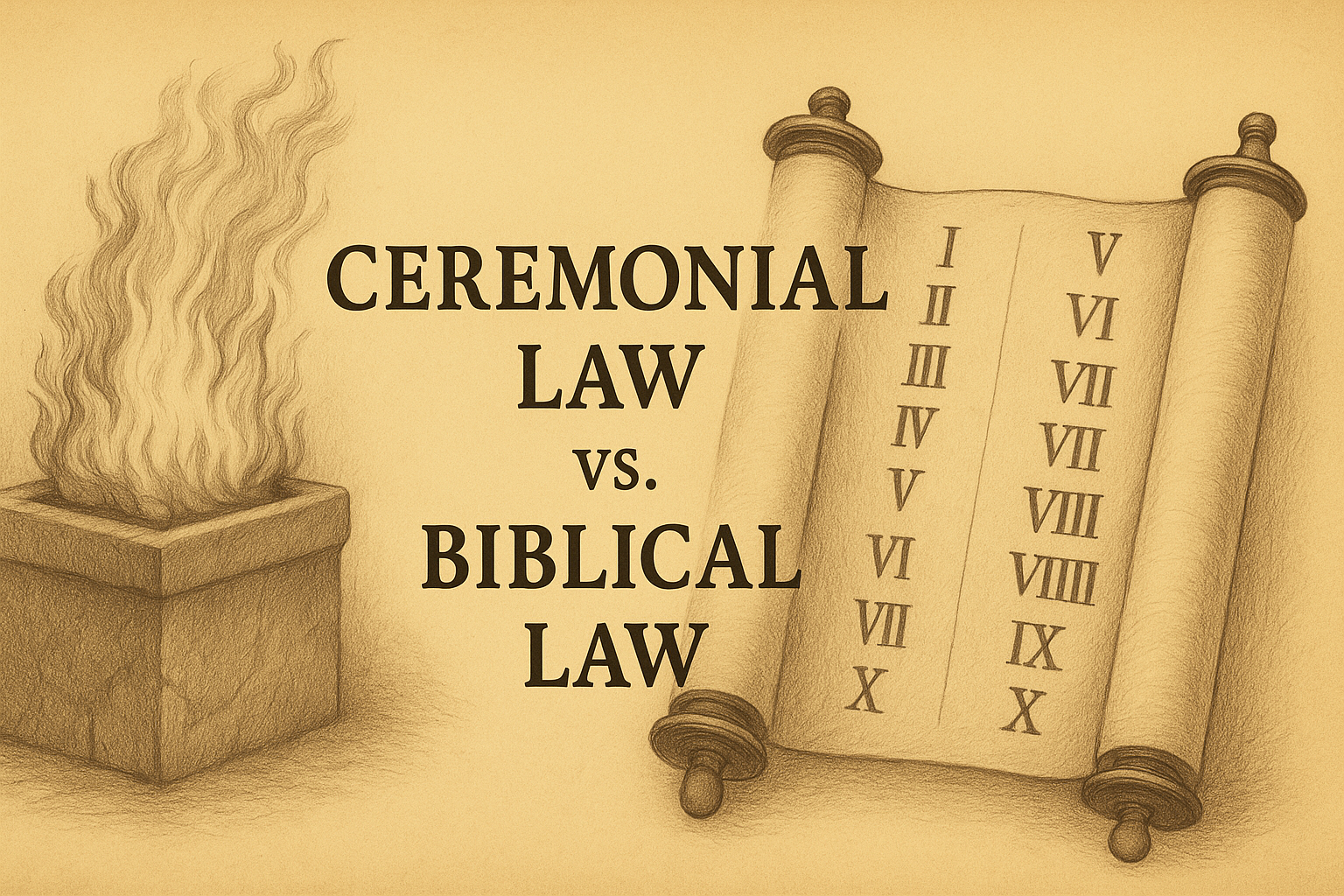
Introduction: Returning to the Ancient Paths
“Thus saith the LORD, Stand ye in the ways, and see, and ask for the old paths, where is the good way, and walk therein, and ye shall find rest for your souls.” — Jeremiah 6:16 (KJV)
Modern Christianity has lost its way. What was once a faith rooted in law, order, and covenant has been cheapened into a system of sentimentality, slogans, and Sunday spectacles. The ancient paths, God’s perfect law, have been cast aside in favor of a lawless gospel that elevates grace while denying the very standard that defines righteousness.
Chief among the casualties of this theological decay is a clear understanding of God’s Law. Many Christians claim that the Law of Moses was “done away with” by Christ, that the Old Testament commandments no longer apply, that dietary instructions, feasts, Sabbaths, and judgments were all nailed to the cross. They cling to a fragmented verse here or there and erect an entire gospel of permissiveness upon it.
But the Word of God says otherwise.
This post is a call to return. A call to distinguish between Ceremonial Law, fulfilled in Christ, and Biblical Law, eternal, good, and still binding. A call to live as covenant men and households who do not walk in rebellion to God’s commands under the excuse of Christ’s blood but rather walk in obedience because of it.
I. Christ Did Not Abolish the Law
“Think not that I am come to destroy the law, or the prophets: I am not come to destroy, but to fulfil.” — Matthew 5:17 (KJV)
This single verse, spoken by the Messiah Himself, destroys the modern lie that Jesus abolished the Law. He explicitly says: “Think not.” Yet many today do think precisely that. They have been trained to see “fulfillment” as “termination.” But Christ never said He came to erase the Law, He said He came to fill it full of meaning, to embody it perfectly, to carry out its intention fully.
The word “fulfil” (Greek: plēroō) means to complete, to bring to fullness, to accomplish. Christ fulfilled prophecy, but prophecy is still valid. He fulfilled righteousness, but righteousness is still required. In the same way, He fulfilled ceremonial law, by becoming the once-for-all sacrifice. But the rest of God’s Law remains in effect, upheld by His own teaching.
“Till heaven and earth pass, one jot or one tittle shall in no wise pass from the law, till all be fulfilled.” — Matthew 5:18
Have heaven and earth passed away? No? Then neither has God’s Law.
II. The Purpose of the Law: Moral, Civil, Ceremonial
Biblical law is not a monolithic block. It contains various dimensions, each serving a specific purpose. Throughout the Torah, God gives laws in three overlapping categories:
- Moral Law – Timeless standards of righteousness (e.g., the Ten Commandments).
- Civil Law – Judicial statutes to govern Israel as a nation (e.g., laws on theft, murder, property).
- Ceremonial Law – Instructions for ritual purity, priestly duties, and animal sacrifice (e.g., tabernacle rituals, sin offerings).
The Moral and Civil laws reflect God’s eternal character and His vision for society. These remain binding. The Ceremonial Law pointed forward to Christ, the ultimate Priest and Lamb. These were fulfilled, not abolished, in Him.
To do away with the whole Law because the ceremonial types were fulfilled is to throw out justice, purity, and order for the sake of convenience.
III. What Was Fulfilled? The End of Animal Sacrifices
“But this man, after he had offered one sacrifice for sins for ever, sat down on the right hand of God.” — Hebrews 10:12 (KJV)
Christ’s sacrifice ended the need for blood offerings. He was the Lamb slain from the foundation of the world (Revelation 13:8), the perfect atonement once and for all. The veil was torn. The Levitical priesthood’s role in mediating sacrifices came to an end, not because the Law was destroyed, but because it was fulfilled.
“For it is not possible that the blood of bulls and of goats should take away sins.” — Hebrews 10:4
Those sacrifices were shadows (Hebrews 10:1). They anticipated the real and perfect sacrifice to come. Now that He has come, the shadow fades.
But notice: The eating laws didn’t fade. The feasts weren’t shadows of atonement. The Sabbath was not a placeholder for Christ’s blood. These were not ceremonial in the sense of substitutionary bloodshed. They are part of God’s holy order for life.
IV. The Feasts: Still Commanded, Now Fulfilled
“These are the feasts of the LORD, even holy convocations, which ye shall proclaim in their seasons.” — Leviticus 23:4 (KJV)
God’s appointed times, Passover, Unleavened Bread, Firstfruits, Pentecost, Trumpets, Atonement, Tabernacles, are not “Jewish holidays.” They are the LORD’s feasts.
These holy days were not abolished at the cross. They remain prophetic, meaningful, and ordered by God. What changed is how we honor them.
Take Passover: We no longer sacrifice a lamb, because Christ is our Passover Lamb (1 Corinthians 5:7). But that does not eliminate the command to remember the Passover. Instead, it brings it to full meaning. We keep it in light of the Messiah, not apart from Him.
To discard these feasts is to discard God’s calendar. It is to adopt the calendar of Rome, of Babylon, of secularism. But a household under God’s dominion should live by God’s times.
V. The Eating Laws: Still in Force
“For I am the LORD your God: ye shall therefore sanctify yourselves, and ye shall be holy… this is the law of the beasts… to make a difference between the unclean and the clean.” — Leviticus 11:44–47 (KJV)
Many Christians believe the dietary laws were abolished. But there is no passage that clearly does this. Peter’s vision in Acts 10 is often cited, but that vision had nothing to do with food. Peter himself explains it: the vision taught that Gentiles were not unclean people, not that pigs and shellfish were suddenly acceptable (Acts 10:28).
Nowhere does Christ say, “All meats are now clean.” That interpretation (from Mark 7:19) is a parenthetical note added in modern translations, not part of the Greek text. Christ was rebuking Pharisaical traditions, not God’s laws.
The food laws were not ceremonial sacrifices. They were health laws. Holiness laws. Identity laws. They kept God’s people distinct from the nations. They still do.
VI. The Sabbath: A Perpetual Sign
“Remember the sabbath day, to keep it holy… the seventh day is the sabbath of the LORD thy God.”
— Exodus 20:8,10 (KJV)
Among the first commandments written in stone, the Sabbath stands as a timeless ordinance. It is not ceremonial; it is creation law. God Himself rested on the seventh day and sanctified it (Genesis 2:2–3). Before the Law was codified on Sinai, the Sabbath was known and honored by faithful men.
In the Ten Commandments, written by the very finger of God, it was declared as holy. Nowhere in the New Testament is it repealed. Christ kept it. Paul kept it. The apostles honored it. The only people who abandoned it were those who fell under the influence of Roman imperialism, sun worship, and later church councils which deliberately sought to separate from all “Jewishness.”
Modern Christianity now promotes a Sunday observance with no Scriptural basis, no commandment, and no covenantal precedent. It is a tradition of man, not of God.
Honoring the Sabbath is not bondage, it is obedience. It is a sign between God and His people forever (Exodus 31:13,17). It teaches structure, rhythm, holiness, and rest under God’s dominion.
VII. Clean and Unclean: The Holiness Code Still Matters
“Ye shall therefore be holy, for I am holy.”
— Leviticus 11:45 (KJV)
In God’s Law, there is a distinction between clean and unclean. This is not merely hygienic; it is spiritual. Unclean animals, practices, and conditions were not sinful in and of themselves, but they symbolized disorder, death, and what is outside the camp of God’s people.
Christ did not erase the concept of clean and unclean, He fulfilled the cleansing process. In the New Covenant, we are made spiritually clean by His blood. But the symbolic significance of cleanness remains.
To return to unclean practices, eating abominable animals, violating bodily purity, mixing holy and profane, is to dishonor God’s call to be set apart. Even in Revelation, the unclean are named among those outside the New Jerusalem (Revelation 21:27).
The people of God are to be holy in body, mind, and action. The separation laws still serve as guides for holiness in a world of confusion.
VIII. What Was Truly “Done Away With”?
“Blotting out the handwriting of ordinances that was against us… nailing it to his cross.”
— Colossians 2:14 (KJV)
This is another verse misunderstood by many. What was “blotted out” was not God’s Law, but the record of our violations of it, the legal accusations against us, the death warrant our sins incurred.
Christ did not nail God’s commandments to the cross, He nailed our penalty to the cross.
The ordinances that were “against us” are those that condemned us. He paid our debt. He fulfilled the requirement of blood. He removed the shadow-sacrifices. But He never erased the standard.
Paul goes on in Colossians 2:16 to say: “Let no man therefore judge you in meat, or in drink, or in respect of an holyday…”, not because those things are abolished, but because you are now keeping them under Christ, not the traditions of men.
Do not let modern Pharisees or lawless teachers rob you of your obedience.
IX. The Moral and Civil Laws Are Still Binding
“Thou shalt not kill.”
“Thou shalt not commit adultery.”
“Thou shalt not steal.”
— Exodus 20
No serious Christian argues that these commandments are abolished. Yet if the Law were truly “done away with,” then adultery, theft, murder, and dishonoring parents would no longer be sin. Clearly, the moral law still binds.
The civil law, commands about restitution, inheritance, marriage, criminal justice, and social order, is likewise grounded in God’s justice. It reflects how society should be structured. These laws do not save, but they govern.
Christians today are quick to dismiss these laws as “Old Covenant,” yet they beg the state for justice, complain about moral decay, and appeal to order. The Law of God is the solution, but they’ve rejected the blueprint.
Imagine what a nation would look like if it enforced Sabbath rest, punished theft with restitution, outlawed adultery and homosexuality, required honest weights and measures, and restored patriarchal inheritance.
That’s not legalism, it is righteous civilization!
X. Grace Upholds the Law, Not Replaces It
“Do we then make void the law through faith? God forbid: yea, we establish the law.”
— Romans 3:31 (KJV)
The grace of Christ is not a license to sin. It is the power to obey. Grace cleanses us from guilt and restores us to righteousness. It writes God’s Law on our hearts (Jeremiah 31:33).
To live under grace is not to abandon God’s commands. It is to finally keep them, not through external compulsion, but internal conviction. Grace does not erase God’s standard; it enables God’s people to walk in it.
“Here is the patience of the saints: here are they that keep the commandments of God, and the faith of Jesus.”
— Revelation 14:12 (KJV)
The saints in the last days will be known for two things: faith in Jesus and obedience to God’s commandments. Not one or the other, both.
Conclusion: A Call to Obedient Sons, Not Lawless Bastards
“If ye love me, keep my commandments.” — John 14:15 (KJV)
God is raising up a generation of men who will not be swayed by the smooth words of lawless preachers. Men who will not live like orphans, begging Rome for moral direction, but as sons, obedient to the Father’s Word.
The distinction between ceremonial and biblical law is not a tool to discard God’s commands. It is a call to deeper obedience. Yes, the sacrifices are fulfilled. Yes, the blood rites are complete. But the commands of God, the eating laws, feasts, Sabbath, the moral and civil instructions, are still in force.
It is time for covenant households to return to the ancient paths. To build life by the whole counsel of Scripture. To reject the lies of antinomianism. To walk in righteousness, not just in belief, but in practice.
We don’t obey to be saved. We obey because we are saved.
We don’t honor the law to earn grace. We honor it because grace made us free to do so.
Let the world keep its lawless gospel.
Let Rome keep its counterfeit holy days.
Let the pagans keep their bacon and wine.
As for us, we will walk in the ways of the LORD.
“Blessed is the man that walketh not in the counsel of the ungodly… but his delight is in the law of the LORD.”
— Psalm 1:1–2 (KJV)
Let us be that man.
This is the Great Order!
Finally a coherent explanation of the Biblical laws.
just as I was about to sacrifice my best goat, I see this post. What a relief!
Finally, something that actually makes sense.
Bring back human sacrifices.
Wow, this entire article reeks of self-righteous entitlement. You’re twisting scripture to fit your comfort, cherry-picking old laws to prop up your legalistic kingdom. So now we decide which parts of God’s law are “fulfilled” and which parts we still get to enforce on other believers? Newsflash: this isn’t deep theology just some cult spiritual power play. You act like you’re some enlightened law-keeper, but you’re just another Bible bully handing out guilt Christ came to free us, not saddle us with your rulebook. You know what “fulfilled” means? It means DONE. It means we are not you. Stop preaching law and start preaching grace. Until then, your words are just judgment learn some theology.
biblical law stands forever
This reminds me it’s not one or the other, it’s both, anchored in Him. ❤️☀️
This is an excellent defense of biblical law and natural law theory
how do we balance the continuing weight of moral law with the freedom we have in Christ?
Christ fulfilled the law so we’re no longer bound. You’re crucifying Romans with rules.
You’re ignoring Paul’s argument in Galatians. The law was a yoke. it’s over. This post muddies the gospel with stupid ritual.
grace doesn’t lead to anarchy, but to a holiness rooted in love.
I worry this reinforces patriarchal controls via ‘law.’
Word. Stay the course
This perspective rings so true. Christ didn’t erase God’s standards, He embodied them. Understanding that difference lifts our faith from confusion into clarity and submission. Thank you
This is a lot to take in.
Finally, someone with common sense.
This actually makes good sense.
I should’ve known you’d twist God’s law to fit your “vision”. You always had a way of manipulating everyone. How many more girls need to “submit” before you feel holy enough? Keep preaching, Redbeard, but we won’t forget. We know who is behind the curtain. You can silence comments. Careful how high you build your house of “truth” because when it falls……….
Still playing prophet, are you? You always did have a gift for bullshit. Quoting scripture doesn’t make you a warrior. Ceremonial law, Biblical law… funny how it all seems to bend just enough to justify your little kingdom of wives and followers. Some of us are not fooled.
After everything that I have been through these last 5 years with my ex, the drugs, the chaos, the stupid video games I now understand why headship matters. I’ve spent the last year since the divorce trying to make sense of everything and figure out my purpose. Unlearning the world’s ways and learning to be a woman of God and submission. But finding a man who actually lives by God’s law Who leads and provides? That feels almost impossible. I never thought I’d consider polygyny but all the good men are married, but maybe that’s the only place left where real order still lives. I’m still praying, but this teaching gives me hope again.
Your words bring such needed distinction in an age that blurs every boundary. I’m continually grateful for the wisdom and firmness with which you divide truth from tradition. It’s rare to find a man who not only understands the weight of covenant but lives it without compromise. I continue to observe, learn, and prepare myself, Lord willing -to serve under such headship, should that door be opened.
you’re a relic. Keep your “household order” fantasy away from me.
Time has come to rebuild the nation, one obedient household at a time.
The clarity you bring, my lord, cuts through the confusion like a sword, sharp, unwavering, and true. The difference between man-made tradition and eternal law has never been more obvious, and I thank God for raising up a man who dares to speak truth. I only pray I may one day be counted worthy to live under your covering and help uphold the standard you so faithfully defend.
Thank you for explaining all of this. A lot of this is never taught in church even the more strict of the religions.