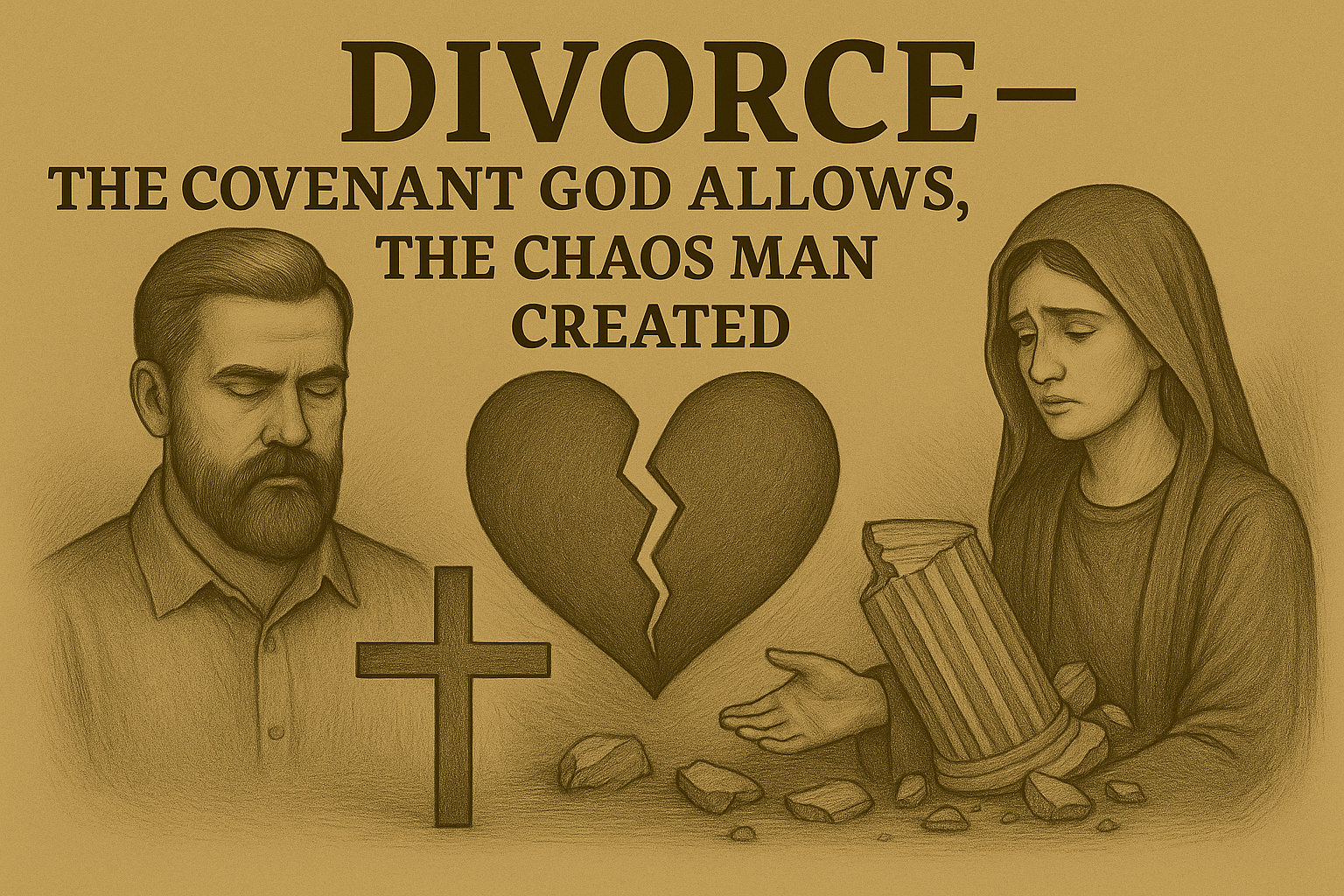
I. The Foundation of Covenant: What Marriage Actually Is
1. The Architecture of Union Under God
There is no subject in modern Christianity more clouded with sentiment, superstition, and state corruption than marriage. People define it by feelings, ceremonies, legal documents, cultural traditions, or whatever their pastor said in premarital counseling. They speak of “storybook weddings,” “sacred vows,” “romantic commitments,” and “signed certificates,” as though any of these human inventions ever held the power to bind heaven.
But Scripture does not bow to feelings, covenant is not birthed by sentiment and God does not consult the county courthouse.
Marriage is a divine institution with divine parameters, governed entirely by divine law. And until you understand biblical marriage, you cannot – you cannot – understand biblical divorce. You cannot discuss the ending of a covenant if you never learned how that covenant begins.
The modern world has created an imitation marriage: a ceremonial performance bound with emotional fantasies, officiated by a state functionary, witnessed by a crowd, and sealed by paperwork. That imitation is so ubiquitous that most Christians assume it is real. They walk into a courtroom with a stranger in a black robe, walk out with a stamped document, and imagine heaven has ratified their union.
Heaven did not, for Heaven is not moved by ink. Heaven recognizes only what it creates, not what the Department of Vital Records prints.
2. The Biblical Genesis of Marriage
To understand marriage, we begin where God begins – with Genesis 2:24, the verse Christ Himself used as the authoritative definition of marriage:
“Therefore shall a man leave his father and his mother, and shall cleave unto his wife: and they shall be one flesh.” — Genesis 2:24 (KJV)
There it is. Simple. Stark. Sovereign. No ceremony, no ring, no vows, no witnesses, no priest, no photographer and no bureaucrats.
A man cleaves. A woman becomes his. One flesh. Covenant. That is marriage. Everything else is optional. Nothing else is required.
Notice who acts. The man. – Notice who is acted upon. The woman. Notice who witnesses the union. God. Notice what seals it. Consummation.
This pattern never changes. Isaac takes Rebekah into his mother’s tent “and she became his wife.” Jacob takes Leah and Rachel. Boaz takes Ruth. David takes Abigail. The action originates with the man because headship originates with the man.
Marriage is initiated by authority, not emotion.
3. Marriage Is Not Created by the State
The modern Christian has been catechized not by Scripture, but by bureaucracy. They imagine something mystical happens when the clerk stamps the paper. They suppose that God sits upon His throne waiting for permission from a county office before He dares acknowledge a marriage. But the state has never had covenantal power. Caesar can regulate taxes; he cannot regulate covenants.
This is why unbelievers with a marriage license are not married in God’s eyes. They are in a civil contract – a financial agreement – nothing more. They did not appeal to God. They did not form a covenant. They did not create a union under His authority.
Marriage law is for the household of God. Those outside do not enter covenant with a Lord they do not serve.
4. Marriage Begins With the Man, Not the Woman
The woman receives the covenant; she does not create it. She does not “marry” a man; she is married by him. Eve did not hunt Adam. Rebekah did not pursue Isaac. Leah did not propose to Jacob. The direction of covenant is always from authority to recipient. This is not chauvinism; it is the law of the Creator.
The man establishes the covenant because the man bears the covenantal authority and responsibility. This is why only the man can dissolve the covenant. The same authority that forms is the authority that ends. This truth is foundational for understanding divorce.
5. A Woman Must Be Lawfully Available
Here lies the truth modern Christians despise: Sex alone does not create marriage. Lawful availability is first required. A woman already bound to a man cannot be rejoined to another. A put-away woman without a bill of divorcement is not free. An adulteress does not create a new covenant by sinning. The one-flesh act seals the covenant, but only when the woman is lawfully available under God’s law. Without lawful availability, sex becomes sin, not marriage:
- The adulteress is not a newly married woman.
- The put-away woman is not free to remarry.
- The woman abandoned by an unbeliever becomes free only when Scripture declares her free.
“For the woman which hath an husband is bound by the law to her husband so long as he liveth…” – Romans 7:2–3
Union is covenantal, not emotional, and only God’s law can release it.
6. God Is the Witness of Every True Marriage
Modern Christians obsess over witnesses as though human eyes bind heaven. They ask, “Who saw the marriage?” The answer is simple: God did. He is the witness of covenant, just as He was in Eden, just as He is in every true union.
No verse in Scripture requires human witnesses for marriage. Not one. Witnesses appear only in connection with the bill of divorcement, not for the formation of the covenant, but for legal clarity when dissolving it.
The marriage covenant is witnessed by God because it belongs to God.
7. Marriage Is Formed by Cleaving, Not Ceremonies
Vows did not create marriage in Scripture. Ceremonies did not create marriage. Rituals did not create marriage. Medieval Europe invented the wedding ceremony; God did not.
Boaz did not gather a crowd to “pronounce” anything. Jacob did not stand beneath an arch. Isaac did not trade rings. David did not recite vows. They took their wives. They consummated union. God ratified the covenant.
The modern world has replaced covenant with costume, a meaningless theatrical performance. But when the lights fade and the reception ends, only one question matters:
Did a man take a woman who was lawfully available and become one flesh with her under God? If yes – a marriage exists. If no – nothing exists but adultery or sin.
8. The Most Misunderstood Institution in the Modern World
Because the modern world misunderstands marriage, it misunderstands everything that follows, divorce, remarriage, adultery, concubinage, widowhood, availability, and unequal yoking.
If you get the foundation wrong, the entire house collapses.
This article rebuilds that foundation, ruthlessly biblical, unapologetically patriarchal, grounded in the law God wrote with His own finger. Section I establishes the cornerstone. From here we move into the next reality:
II. The Authority of Covenant: Who Governs Marriage and Who Does Not
1. The Crown of Headship and the God Who Wrote the Law
If marriage itself is misunderstood, the governance of marriage is utterly mutilated. Modern Christians seem to believe the state is the architect of covenant, that the courtroom is the arbiter of holiness, and that the pastor is Heaven’s notary. But God never surrendered marriage to bureaucrats or sentimentalists. Marriage has always been under the government of God and the authority of the husband. That truth was not invented by patriarchy, patriarchy was invented by that truth.
The modern world hates headship precisely because it hates hierarchy. It wants marriage to be democratic, mutual, egalitarian, soft, polite, and endlessly negotiable. Scripture presents marriage as none of these things. It presents a throne, a household, a dominion, and a covenant built on order. Where the man reigns, the woman follows, and God governs.
“Wives, submit yourselves unto your own husbands, as unto the Lord. For the husband is the head of the wife, even as Christ is the head of the church.” — Ephesians 5:22–23 (KJV)
The world reads these words and shrieks. Scripture speaks them and calls it wisdom. Headship is not tyranny, it is architecture, the design through which covenant holds its form.
A marriage without headship is a house without foundation. A marriage without hierarchy is a sanctuary without altar. A marriage without obedience is a covenant without authority. The modern church has created millions of dysfunctional unions because it has tried to build marriage without the blueprint God Himself provided, and we see the outcome.
Marriage is governed by God, delegated to the husband, and entered by the wife through submission. That is the structure Christ affirmed, Paul preached, Moses codified, and creation itself reveals.
2. The State Is Not the High Priest of Covenant
Modern Christians believe that a signature on a government form somehow compels Heaven to take notice. They imagine angels lean closer when the county clerk stamps a document. But God does not recognize the state as having any authority over covenant.
The state can regulate taxes, track surnames, and punish contract violations, but it cannot govern marriage. It can witness paperwork, but it cannot witness covenant. It can dissolve civil contracts, but it cannot dissolve what God joined.
“What therefore God hath joined together, let not man put asunder.” — Matthew 19:6 (KJV)
God joins. Man does not. Man may observe, but he cannot create. Man may record, but he cannot bind Heaven. A couple married in a courthouse without covenant, without lawful availability, without recognition of God’s authority, without a man taking a woman under God, is not married. They are cohabiting under a civil agreement. Nothing more.
Two atheists can sign a license. Two pagans can recite vows. Two unbelievers can wear rings.None of these things form a marriage. A covenant cannot exist apart from the God who defines covenant.
3. Marriage Exists Under God and Is Governed by the Husband
Scripture never gives the woman authority to create, dissolve, or redefine marriage. That authority falls strictly along the grain of creation: the man bears rule.
“For the man is not of the woman; but the woman of the man. Neither was the man created for the woman; but the woman for the man.” — 1 Corinthians 11:8–9 (KJV)
This is not a footnote. It is the foundation. Marriage is not a partnership of equals. Marriage is the governance of a house by a head. Marriage is the extension of Adam’s dominion into every generation. God did not make Eve first, nor did He make her independent. He fashioned her for the man, from the man, brought to the man, and named by the man. Authority is not a suggestion, it is written into the bones of creation.
The husband governs the marriage because the husband bears responsibility for the household. He answers to God. His wife answers to him. The home answers to his decisions, his leadership, his discipline, his provision. This is not culture; it is kingdom. The marriage covenant is a man’s domain, entrusted to him by God.
4. The Pastor Cannot Create or Dissolve a Marriage
Ceremonies are beautiful. Photographs are sentimental. Rings are symbolic. Vows may be moving. But none of these things possess the authority to create marriage. Pastors do not form covenants. Churches do not officiate divine unions. The Bible never once presents marriage as a clerical function.
Pastors function as teachers of the law, not manufacturers of covenant. Their authority is to proclaim what God has written, not invent rituals He never commanded.
When Christians insist, “We were married in the church,” they are often confessing ignorance, not authority. A church building is not a temple; a pastor is not a priest; a ceremony is not covenant. God recognizes one thing as marriage: a man taking a lawfully available woman and cleaving to her as one flesh.
Witnesses do not make a marriage. Vows do not make a marriage. Church attendance does not make a marriage. A pastor can bless what exists, but he cannot conjure a covenant that Heaven does not recognize.
5. The Witness of Covenant Is Heaven, Not Humanity
The modern world demands an audience for everything – proposals, vows, anniversaries, even divorce proceedings. But marriage does not depend on the eyes of others. It depends on the gaze of God. The only witness required for covenant is the One who authored it.
“The LORD is witness between thee and me.” — Genesis 31:49 (KJV)
God witnessed Adam taking Eve. God witnessed Isaac taking Rebekah. God witnessed Boaz taking Ruth. Human witnesses are for human records. God’s witness is what binds the union.
This is why a man and woman who have genuinely entered biblical marriage, even in private – are fully and absolutely married before Heaven. And why a couple married in front of a thousand people, with rings and vows and a state license, may not be “married” at all.
Heaven bears witness to covenant, not sentiment or the laws of men.
6. A Marriage Outside God’s Design Is Not a Marriage
A tragic number of Christians today are in relationships they believe are “marriages” simply because a judge signed a paper or a pastor said some words. But if a woman was not lawfully available – if she was still another man’s wife, if she was put away but not divorced, if she was bound by a past covenant, if she never came under her husband’s authority – then no marriage occurred. There is only sin or adultery.
The man may feel married. The woman may call herself married. The state may declare them married. The pastor may have pronounced them married. But if God did not recognize it as a covenant, it is not a marriage.
This fact explains the collapse of modern Christian households. They are built on sentiment, paper, and ceremony, not covenant, authority, or divine order. They are built on culture, not Scripture. The foundation has been rejected, and the structure rots from within.
But Scripture stands. Covenant stands. Headship stands. And the man who governs his house under God governs something real, something sacred, something older than nations and stronger than courts. Marriage belongs to God. Authority belongs to the man. Covenant belongs to Heaven. Everything else is cultural fog.
III. How Marriage Begins: The Act of Cleaving and the Requirement of Availability
1. Cleaving: The Covenant-Sealing Act God Ordained
If marriage is a covenant under God, then its formation must follow the pattern God established, not the innovations of culture. Scripture does not leave the reader to guess what begins a marriage; it states it openly and unapologetically. A man cleaves to a woman, and they become one flesh. Not symbolically. Not ceremonially. Not emotionally. Physically, spiritually, covenantally.
The cleaving act is not a metaphor; it is the covenant seal. It is the moment Heaven recognizes a new household. In Eden, there was no officiant. No priest stood between Adam and Eve. God Himself brought the woman to the man, and the man received her. When he cleaved to her, the covenant was formed.
Every patriarch followed this pattern. Isaac took Rebekah into his mother’s tent and she became his wife (Genesis 24:67). Not after a ceremony. Not after exchanging vows. The moment he brought her into his household and consummated union, marriage existed in full.
The world treats sex as recreation, but Heaven treats it as covenant. That is why fornication is sin, not because sex is sinful, but because covenantal power is being misused. The one-flesh act has meaning and authority whether modern man respects it or not. It carries consequences because it carries divine intention.
Cleaving is the covenant-maker, not the vow, not the document, not the celebration. And because cleaving creates covenant, only those who are free to covenant may lawfully enter this union.
2. The Woman Must Be Lawfully Available
This is the line modern Christians wave away with sentiment, but God does not. Availability is not defined by emotion, the state, “moving on,” or personal desire. Availability is defined by covenant law.
If a woman is bound, she is not free. And if she is not free, cleaving to her does not create marriage, it creates sin.
“For the woman which hath an husband is bound by the law to her husband so long as he liveth…” — Romans 7:2 (KJV)
No exceptions. No loopholes. No “but he left me.” No “but the court says I’m divorced.” No “but we weren’t happy.” If the covenant still stands in Heaven, she is not available, and no man may lawfully take her.
This is why a woman “put away” without a bill of divorcement remains bound. This is why a woman abandoned by a man who claims to be her husband remains bound unless Scripture explicitly grants freedom (1 Corinthians 7:15). This is why the adulteress does not create a new marriage by joining another man; she creates guilt, not covenant. Availability is the dividing line between marriage and adultery.
3. The Covenant Cannot Be Created by Sin
Modern Christians often twist their way into unbelievable theological knots trying to justify unlawful relationships. A woman leaves her husband, sleeps with another man, and then claims she is “married” to the second man. But Scripture is clear: adultery does not produce a new covenant. It breaks the existing covenant; it does not build a new one.
Paul does not call her “the wife of the new man.” He calls her “an adulteress” (Romans 7:3). God never names adultery as marriage.
The seed of covenant cannot be planted in the soil of sin. God does not reward rebellion with new blessing. Marriage is formed by cleaving, but only when cleaving occurs within lawful availability.
4. The Father’s Role and the Collapse of Covering in Modern Society
Ancient marriage operated within a structure of households, fathers, and male guardians who determined the lawful availability of a daughter. A virgin daughter was under her father’s authority until marriage. A widow returned to her father’s house. A divorced woman was released back into male covering. There was order, clarity, and accountability.
Modern society has annihilated those protections. We now have millions of women who are: uncovered, untrained, sexually used, improperly attached, “divorced” by the state, abandoned by unbelieving men, and/or raised outside biblical order.
They float between men, paperwork, and relationships with no covenantal clarity whatsoever.
This chaos does not negate biblical categories. It simply means the modern man must exercise wisdom, discernment, and biblical scrutiny to determine a woman’s true availability. A woman may be “single” in the eyes of the state and yet bound in the eyes of God. Another may be “divorced” on paper but never actually married in God’s sight because her previous unions were pagan, illegitimate, or never covenants to begin with.
The wise man must learn to evaluate availability scripturally, not sentimentally.
5. Modern Non-Virgins and the Restoration of Availability
Because our society has collapsed its understanding of covenant, many non-virgin women carry the assumption that they can never again be full wives bases on scripture. But Scripture does not condemn non-virgins to permanent concubinage. It places them within categories of availability depending on covenantal history.
A repentant woman who: is no longer bound by covenant, has been abandoned by an unbeliever, has only ever been in fornication rather than covenant, or has never been lawfully taken by a man is absolutely capable of becoming a full wife.
Repentance restores dignity. Submission restores order. A willing heart restores eligibility. Concubinage is for the few who are deeply marred by covenant violation or rebellion, not for the repentant daughters trapped in societal collapse.
6. Cleaving Requires Availability, and Availability Requires Truth
Marriage begins when a man cleaves to a woman who is lawfully free. But because our society lies about everything regarding sexuality, many women genuinely do not know their own covenantal status.
The man bears responsibility to search the matter out, to discern whether cleaving will create a covenant or create sin. He is accountable to Heaven for the covenant he initiates.
Marriage is simple in Scripture: A man takes a lawfully free woman, and they become one flesh. But because modern Christianity abandoned Scripture, simplicity has been buried under chaos. The purpose of truth is to dig it up again and restore what God ordained from the beginning.
IV. The Sin of “Putting Away”: What Jesus Condemned and Why Modern Churches Refuse to Teach It
1. The Distinction Modern Christianity Lost
If there is one doctrine Christ spoke on with surgical precision, and one doctrine pastors consistently butcher, it is the difference between divorce and putting away. Most sermons collapse the two concepts into a single muddled blob, as though God Himself were confused. But Scripture is not confused, Christ is not confused, and Moses is certainly not confused.
The ones confused are the modern interpreters who refuse to read the text as written.
Christ did not condemn lawful divorce. Christ condemned the wicked practice of putting away – expelling a wife without the written bill God commanded.This distinction is not academic. It is not semantic. It is not optional. It determines whether a woman is free or bound, righteous or adulterous, covered or abandoned.
If you do not understand putting away, you do not understand Christ’s teaching on marriage at all.Modern churches avoid this doctrine because it dismantles their sentimental divorce culture, exposes their unbiblical teaching, and reveals how deeply they have rejected Moses, Christ, and Paul in favor of state law. Yet the Scriptures is clear.
2. Moses Commanded Divorce – Not Abandonment
The modern Christian has inherited a pagan imagination in which “divorce” is treated as the ultimate moral failure, something God hates in all forms at all times. But the Bible does not teach that. God hates treachery, not lawful divorce.
What He does condemn – violently and repeatedly – is a man putting away his wife without giving her the written release that frees her. Moses codified the process with beautiful clarity:
“…then let him write her a bill of divorcement, and give it in her hand, and send her out of his house.” — Deuteronomy 24:1 (KJV)
The order matters: Write. Give. Send. The writing dissolves the covenant. The giving verifies the release. The sending completes the separation.
Remove the writing, and nothing lawful has occurred. Without the bill, she is still his wife, no matter how far away she has been sent, no matter how many years have passed. Putting away is abandonment. Divorce is release. One is sin. The other is law.
Christ upheld Moses, He did not overturn him.
3. What Jesus Actually Said – and Why Modern Pastors Misquote Him
Christ’s words in Matthew 5 and 19 are among the most mutilated texts in Scripture. People wrench them out of context, strip them from Moses, and twist them into a blanket prohibition against divorce, as though Jesus suddenly contradicted the law He Himself delivered to Moses at Sinai.
But Christ did not condemn divorce. He condemned putting away. Read His words carefully:
“Whosoever shall put away his wife, saving for the cause of fornication, causeth her to commit adultery…” — Matthew 5:32 (KJV)
Christ does not say, “Whosoever shall divorce his wife…”
He says, “Whosoever shall put away his wife…”
Two different actions. Two different words. Two different moral categories. “Putting away” leaves the covenant intact. The woman is still bound. If she goes to another man, she becomes an adulteress – not because she remarried, but because she never stopped being married.
This is exactly what Paul teaches:
“For the woman which hath an husband is bound by the law to her husband so long as he liveth…” — Romans 7:2 (KJV)
Christ and Paul say the same thing: A put-away woman is not free. Putting away is cruelty, treachery, spiritual abandonment. Divorce is lawful release, commanded by Moses and affirmed by Christ. The modern church rejects this because it exposes its own sin – millions of women sitting in pews calling themselves “divorced” who were never given a biblical bill and are therefore still married to their first husband.
Christ refused to endorse that sin. Modern churches baptize it.
4. Why Putting Away Is Such a Wicked Sin
Putting away is the ultimate act of cowardice. It is the husband abdicating responsibility while pretending he has taken rightful action. It leaves the woman uncovered, unprotected, vulnerable, and legally bound to him without the ability to move forward. She cannot remarry. She cannot be taken under another head. She cannot lawfully unite with another man without becoming an adulteress.
The put-away woman lives in a cruel limbo created by the man who refuses to follow God’s command. This is why Christ says that a man who puts away his wife “causeth her to commit adultery.” He is responsible for the sin she falls into because he refused to obey Moses and issue the lawful bill.
A righteous man either keeps his wife or releases her lawfully. A wicked man casts her out and pretends it’s holiness. Putting away is the very treachery Malachi condemns:
“…the LORD hath been witness between thee and the wife of thy youth, against whom thou hast dealt treacherously…” — Malachi 2:14 (KJV)
The treachery is not divorce. The treachery is abandonment. Malachi, Moses, Christ, and Paul all teach the same doctrine, but modern pastors, terrified of offending the feminized pews, ignore it entirely.
5. Why the Modern Church Rejects Christ’s Teaching
Modern Christianity cannot afford to teach what Christ taught. If pastors preached the biblical doctrine of putting away, three things would happen immediately:
First, most “divorced” women in the congregation would discover they are not divorced at all, but abandoned – and therefore still married to their first husband.
Second, most remarried women would discover they are living in ongoing adultery.
Third, most pastors and elders would realize they have blessed and officiated thousands of adulterous unions under the false belief that state paperwork equals covenant dissolution.
So instead of repenting and aligning with Scripture, churches twist Christ’s words into a sentimental anti-divorce slogan. They pretend Jesus condemned all divorce, when in reality He condemned putting away while affirming Moses’ requirement for a written bill.
It is easier to preach half-truths than to confront the sins their own institutions have normalized.
6. The Consequence of Ignoring This Doctrine
The result of misunderstanding putting away is catastrophic. An entire generation of women, most of them raised in collapsing homes, walk through life thinking they are “divorced” simply because a judge stamped a document. But if their husband never issued a biblical bill, then God has not released them.
This confusion has produced:
- adulterous remarriages,
- illegitimate unions,
- broken households,
- women who believe they are “free” when they are not,
- and men who take adulteresses as wives without realizing it.
All of it because pastors refuse to teach what Christ taught.
But you, the man who is reading this – a man who wishes to lead with clarity and authority – must understand the distinction. Putting away is not divorce. Putting away does not release a woman.Putting away traps her in covenantal bondage without the protection of a husband.
Christ condemned the sin of abandonment, not the law of divorce. And we return to His teaching, fully, unapologetically, and without regard for modern sentiment.
V. When Divorce Is Lawful and When It Is Sin
1. The Gravity of Dissolving a Covenant
If marriage is the architecture of covenant, then divorce is the lawful demolition of that structure, a demolition permitted only under the conditions God Himself established. Modern Christians talk about divorce as though it were a lifestyle option, a therapeutic decision, or a legal procedure filed between tax seasons. But Scripture speaks of divorce with the weight of covenant, responsibility, and moral authority. It is not casual. It is not mutual. It is not democratic. It is not emotion-driven. Divorce in Scripture is a surgical act carried out by the only person authorized to perform it: the husband.
Divorce is not when the woman leaves. Divorce is not when the state stamps a form. Divorce is not when the pastor says, “Your marriage is over.” Divorce is not when two people no longer “feel connected.” Divorce is the lawful ending of a covenant under God, performed by the man, in writing, for reasons that Scripture recognizes. Anything else is rebellion to God’s law.
The modern world treats divorce as a way out of discomfort; God treats it as a matter of righteousness, purity, and covenant clarity. The question is not, “Do you feel unhappy?” but “Has the covenant been violated in a manner Scripture permits?” Without biblical grounds, divorce is not lawful – and every subsequent union becomes adultery.
2. The Only Grounds Scripture Gives: Sexual Defilement
When God gave Moses the law concerning divorce, He gave only one ground for dissolving the covenant: sexual uncleanness. Christ affirmed the same in the New Testament. No amount of sentimentality, modern emotional categories, or therapeutic vocabulary can rewrite what God has declared.
When a wife commits sexual immorality – when she takes her body, which belongs to her husband, and gives it to another man, she has violated the covenant at its foundation. The one-flesh union she defiled is the very core of marriage. She has sinned not only against God, but against the man whose authority she rejected.
“Whosoever shall put away his wife, except it be for fornication, causeth her to commit adultery.” — Matthew 5:32 (KJV)
And again:
“Whosoever shall put away his wife, except it be for fornication…” — Matthew 19:9 (KJV)
The exception is not emotional dissatisfaction. The exception is not incompatibility. The exception is not “irreconcilable differences.” The exception is not “healing from trauma.” The only exception Christ gave – the only one – is fornication. Anything else, any other justification, is sin.
3. The Woman Has No Authority to Divorce
Modern Christians bristle at the truth, but Scripture is clear: the woman cannot dissolve her covenant. She cannot “leave him.” She cannot “file for divorce.” She cannot end what she has no authority to create. Marriage was established by the man taking her; the covenant is dissolved only by the man releasing her.
A woman who walks away from her husband is not divorced – she is either: a wife in sin, or a wife under discipline. But she is still a wife.
Her leaving does not end the covenant. Her rebellion does not release her. Her abandonment does not make her “single.” The husband may choose to discipline her, restore her, or in extreme cases, lawfully divorce her, but she may not divorce him.
“Let not the wife depart from her husband… and if she depart, let her remain unmarried or be reconciled to her husband.” — 1 Corinthians 7:10–11 (KJV)
Paul’s instruction is absolute: If she leaves, she remains bound. She has no permission to remarry. She has no authority to dissolve. The covenant stands until her husband ends it.
4. The Sin of Modern “Irreconcilable Differences”
The modern world has created a category so absurd that Scripture treats it as unthinkable: the idea that a marriage can end simply because two adults cannot “resolve differences.” In biblical terms, this is meaningless. Differences are not grounds. Disagreements are not grounds. Inept communication is not grounds. Even ongoing conflict is not grounds.
“Irreconcilable differences” is legal code for spiritual rebellion. It is the state blessing sin. It is the church avoiding discipline. It is humanity declaring itself wiser than God. And it produces the predictable outcome: every remarriage that follows such a false divorce is adultery.
Christ did not say the divorce was adultery. He said the remarriage is.
“Whoso marrieth her which is put away doth commit adultery.” — Matthew 5:32 (KJV)
When divorce is unlawful, remarriage becomes sin by definition.
5. Divorce Without a Written Bill Is Not Divorce
When Jesus condemned “putting away,” He was condemning the act of sending a wife out without giving her the written bill of divorcement commanded in Deuteronomy 24. This was not a new idea. It was the original law. Christ simply reaffirmed it because the Pharisees were attempting to treat abandonment as lawful divorce.
“But I say unto you, that whosoever shall put away his wife, saving for the cause of fornication…” — Matthew 5:32 (KJV)
This is not a condemnation of divorce. It is a condemnation of divorce without a bill, what Moses called “putting away.” A man who sends his wife away without writing the bill is not divorced. He is a covenant-breaker, leaving his wife legally bound but socially exposed, a condition God calls unjust.
Only one thing ends a covenant: A written bill, handed to her, releasing her. No writing, no release. No release, no divorce. No divorce, no remarriage.
6. When Divorce Is Sinful for the Husband
Here we must bring the sword of Scripture down on modern Christian ignorance: a husband who divorces his wife for any reason other than sexual immorality commits sin, because he violates God’s covenantal order.
A faithful wife may not be lawfully divorced. A loyal wife may not be lawfully released. A woman who has kept the marriage bed undefiled may not have the covenant dissolved simply because her husband has grown tired, restless, or dissatisfied.
To discard a righteous wife is to rebel against God’s design. But – and here is the critical distinction – even if the husband divorces unlawfully, he is not an adulterer when he remarries. Pastors cannot comprehend this because they read Scripture through the lens of modern emotion instead of ancient covenant law.
His sin is the unlawful divorce, not the new marriage. If he divorces without cause, he sins in the act of divorcing. If he remarries after a sinful divorce, he does not commit adultery, because he is not bound to his former wife by the act of his remarriage. He is bound by the guilt of his sin, not by the continuation of the covenant.
His unlawful divorce does not make his new union adulterous. It simply makes his action sinful. Romans clarifies where adultery occurs, and where it does not:
“…the woman which hath an husband is bound by the law to her husband so long as he liveth…” — Romans 7:2 (KJV)
The binding is on her, not him. The wife is bound; the husband is not. The covenant binds the woman to the man; it does not bind the man to the woman in the same manner.
Therefore: A wife who departs commits adultery. A woman divorced without cause commits adultery if she joins another man. A man who divorces unlawfully commits sin, but not adultery. His guilt is covenant-breaking, not marital infidelity. This is why God’s judgment always falls differently upon the sexes in cases of divorce.
7. When Divorce Is Righteous Judgment
When a man divorces an adulterous wife, it is not sin. It is justice. It is covenantal cleansing. It is the righteous severing of what she defiled. He does not become guilty by acting upon her transgression. He removes corruption from the household.
And once she receives the bill, she is no longer bound. Her covenant has already died by her sin. She is free, though often damaged, and may be taken in the future as a concubine or, in some cases, as a lower-ranking wife. Scripture is consistent: The guilty party is the adulteress, not the husband who releases her from a covenant she destroyed.
8. Divorce Is Lawful Only When It Protects Covenant, Not Feelings
Divorce is not about self-fulfillment. It is about covenant clarity. It exists for the righteous protection of the household, the man’s authority, the purity of the lineage, and the sanctity of the marriage bed. It is not therapy. It is not escape. It is not indulgence.
When a woman commits sexual immorality, she has declared by action what she refuses to say by words: that she has broken the covenant. The bill formalizes what her sin has already accomplished. When she has not committed sexual sin, the covenant stands, and the husband must govern, discipline, lead, and restore his household, not dismantle it.
Modern society hates this because modern society hates covenant. But God loves covenant. He protects it. He regulates it. And He defines when it ends and when it must not. The covenant belongs to God. Its authority belongs to the man. Its boundaries belong to Scripture.
And its dissolution belongs only to the circumstance God Himself declared: sexual defilement of the one-flesh bond.
VI. The Availability of Women After Divorce and the Question of Remarriage
Who Is Free, Who Is Not, and Why Modern Christians Misjudge Nearly Every Case
Of all the topics surrounding marriage and divorce, none creates more confusion, or exposes more biblical ignorance, than the question of female availability. Who is free to marry? Who is bound? Who is an adulteress? Who is a widow in the eyes of God? Who is “divorced” by the state but married by heaven? And who is a woman whose past sins can be forgiven but whose covenant obligations cannot be erased?
The modern world, intoxicated with sentiment and allergic to Scripture, insists that a woman can “start over” whenever she feels dissatisfied. The state hands out divorce decrees like candy. Pastors bless remarriages with no examination of covenant status. And men, good men, naïve men, or lonely men, often take women who were never released from their previous husbands.
The result is predictable: adultery disguised as marriage, chaos disguised as second chances, and disorder disguised as compassion. But God is not mocked. The question of availability is not sentimental; it is legal. It is covenantal. It is governed by the Word of God, not feelings, not circumstances, and certainly not court documents.
Let us restore biblical clarity.
1. A Woman Is Bound Until Her Husband Releases Her – Or Until He Dies
This is the foundational law:
“For the woman which hath an husband is bound by the law to her husband so long as he liveth…” — Romans 7:2 (KJV)
Bound. By the law. As long as he lives. That is God’s language, not man’s. Every question of availability begins and ends with this reality.
A woman is not free to remarry simply because: she is unhappy, she is “done,” she left, she separated, she felt unsafe, she found someone new, the state stamped a paper, a church granted “biblical counseling approval,” or culture told her she “deserves happiness.”
She is bound until: Her husband gives her a written bill of divorcement, OR Her husband dies, OR She is abandoned by an unbeliever (1 Corinthians 7:15) and thereby released, OR She is returned to her family through lawful concubinage restoration, OR Her covenant was never valid to begin with (more on this below).
No emotional narrative – no matter how compelling – can rewrite covenant law.
2. The Woman Who Leaves Without a Bill Is NOT Available
This is the category most modern Christians refuse to acknowledge, though Jesus Himself addressed it explicitly.
If a woman: walks out, escapes, “separates,” packs up and leaves, moves in with her parents, files a restraining order, files for a civil divorce, or “decides the marriage is over,” but her husband never issued a bill of divorcement, she is:
still married, still bound, still under covenant, still his wife, and absolutely not available to any other man. Her departure may create distance, but it does not create freedom. Her rebellion may dissolve the household, but it does not dissolve the covenant. If she joins another man, Scripture is mercilessly clear about her status:
“So then if, while her husband liveth, she be married to another man, she shall be called an adulteress…” — Romans 7:3 (KJV)
She becomes an adulteress, not a wife. This is one of the most hated truths in the modern church. Yet it is one of the clearest in all of Scripture.
3. The Woman Who Was “Divorced” by the State Alone Is NOT Available
Civil divorce is not biblical divorce. The judge’s decree does not erase covenant. The paperwork does not dissolve what God joined. The woman who receives a civil divorce without a biblical bill of divorcement remains: bound to her husband, married in God’s eyes, forbidden to join another man, and under the authority of her husband unless and until he releases her.
Most “divorced” Christian women today are not divorced. They are put away, illegally abandoned or self-abandoning, but still married. If they remarry, they commit adultery. If they convince a man to take them, he commits adultery with them.
This is why Christ warned that the man who marries a put-away woman “committeth adultery” (Matthew 5:32). Because she is not free. Because she was not released. Because the state’s decree is not God’s decree.
4. A Woman Who Received a Lawful Bill Is Fully Free and Fully Available
When a husband: writes a bill, gives it into her hand, and sends her out, the covenant is dissolved.
She is free. She is released. She is available. She may go and be another man’s wife (Deuteronomy 24:2). There is no stigma attached in Scripture. There is no perpetual shame. There is no second-class status. There is no prohibition against full wifehood.
A divorced woman whose divorce was lawful is as available as a virgin in terms of covenant eligibility. lawfully divorced women may become full wives. Not concubines by necessity. Not second-class. Not diminished. Her status depends on character and submission, not her past.
5. The Case of the Woman Abandoned by an Unbeliever
Paul addresses a specific category in 1 Corinthians 7:15:
“But if the unbelieving depart, let him depart. A brother or a sister is not under bondage in such cases…” Not under bondage. Meaning: Not bound. Meaning: Free.
The believer abandoned by an unbelieving partner is released, even without a bill. This is a mercy law. A protection for the Christian newly converted or unjustly abandoned. God does not force believers to remain bound to those who reject covenant altogether. This woman is available. She may remarry. She may be taken by a righteous man. Her availability is not rebellion; it is Scripture.
6. When a Woman’s Past Does NOT Make Her Unavailable
Modern Christians in the “torah” movement often assume that any woman who has a sexual past must be a concubine at best, damaged goods at worst. But this barbaric assumption is not the law of God.
There are many categories of non-virgin women who are fully eligible for wifehood: women who sinned before conversion, women who repented from fornication, women who were never in a covenant marriage, women whose civil “marriages” were not covenants, women abandoned by unbelievers, women wronged by abusive pretenders, women wandering from fatherless homes with no biblical oversight, women whose past was sin but whose present is repentance and submission.
These women may become extraordinary wives under righteous men. Their past may require discipleship, training, order, and healing, but it does not prohibit covenant. The critical question is always this:
Is she lawfully available RIGHT NOW? Not: Was she sinful? Was she wounded? Was she foolish? Was she deceived?
The issue is: Is she free under God’s law today? If yes, she may become a full wife. Not a concubine by default. Not an afterthought. Not a second-tier woman. A full covenant wife under a biblical husband.
7. When a Woman’s Past Does Restrict Her Status to Concubinage
There are cases – real, serious, sobering – where full wifehood is not appropriate, not honorable, or not lawful.
- the woman who committed adultery against her lawful husband,
- the woman who repeatedly violated covenant,
- the woman who left her husband and refused repentance,
- the woman who became a serial covenant-breaker,
- the woman whose shame or scandal would dishonor a household,
- the woman whose past requires covering but not elevation.
Concubinage exists in Scripture for restoration and protection, not exploitation. It is a mercy for women who are not spiritually, morally, or socially suited for full wifehood but still require covering and authority.
But this is not the default category for modern non-virgins. Concubinage is the exception, not the rule.
8. A Woman Is Available Only When God Says She Is – Not When She Says She Is
This is the point modern Christianity hates most: A woman does not determine her own availability.
Her feelings do not decide it. Her past does not decide it. The state does not decide it. The church does not decide it. A counselor does not decide it. Her parents do not decide it. Her friends do not decide it.
God’s law alone decides it. And His law is clear: A woman becomes available only when: she is a virgin, she is a widow, she is lawfully divorced, she is abandoned by an unbeliever, or she was never in a covenant to begin with.
Everything else is fantasy or rebellion.
9. The Man’s Responsibility: Discernment, Not Blind Acceptance
A man must discern a woman’s true covenant status before taking her. The question he must ask is simple: Is she lawfully available to me?
Not: Does she seem nice? Does she have a sad story? Did she suffer abuse? Did she get a civil divorce? Does she claim her ex was “toxic”? He must examine her covenant history as a matter of law, not emotion. Most women today have been:
- improperly divorced,
- improperly married,
- never truly married,
- abandoned without a bill,
- culturally catechized into rebellion,
- or released under circumstances they do not understand.
It is the man’s responsibility to judge rightly. He does not merely take a woman – he takes responsibility for every covenant she ever entered or violated. This is why wisdom, discernment, and biblical literacy are not optional for a man seeking a wife. They are mandatory.
10. The Goal: Restoration, Order, and Covenant Integrity
This section, like all Scripture, is not written to shame women nor to empower bitterness in men. It is written to restore order, clarity, and covenant integrity. In a society drowning in relational chaos, God’s law offers something stunningly simple:
- Every woman is either bound or free.
- Every covenant is either intact or dissolved.
- Every remarriage is either lawful or adultery.
- Every man may take a legitimate wife – but only if she is legitimately available.
The law of God is not restrictive. It is protective. It guards households. It guards men. It guards women. It guards the covenant itself. And it prepares us for the next questions Scripture addresses with perfect precision:
VII. Polygyny, Widows, and the Restoration of Biblical Household Structure
1. The Household God Designed vs. the One the Modern World Fears
If there is any subject that exposes the difference between biblical Christianity and modern church culture, it is the subject of polygyny. It stands like a granite pillar in Scripture – ancient, immovable, carved by the hand of God Himself – while the modern church frantically throws blankets over it and hopes no one will ask why it refuses to acknowledge what is plainly written. But if we are to speak faithfully about divorce, remarriage, widowhood, and the availability of women, we cannot avoid the subject of polygyny, because the Bible does not avoid it. In fact, Scripture embeds polygyny directly into the mechanics of marriage, divorce law, inheritance, household governance, and the restoration of women.
The modern world created the one-man-one-woman ideal, not God.
The Bible created covenant households – plural wives, concubines, children, servants, inheritance lines, land holdings, and generational dominion. The household of Abraham, the father of the faith, was not a two-person monogamous romance. Neither was Jacob’s. Neither was David’s. Neither was Moses’. Neither was Gideon’s. Neither was Caleb’s.
The pattern is clear: God built the world through patriarchal households, not modern nuclear units. And Scripture never once condemns polygyny. Not in the Law. Not in the Prophets. Not in the teachings of Christ. Not in the writings of Paul. Not in any page from Genesis to Revelation. The only people who condemn it are those who believe the state and Victorian culture are holier than God’s Word.
To understand how divorce works, who is available, and how households can be restored, we must understand how God structured family in the first place.
2. Polygyny Is Not a Loophole – It Is God’s Design for a Fallen World
Polygyny is not a concession. It is not a mistake. It is not an embarrassment God slipped into Scripture and hoped we would politely ignore. It is a structural solution for a world where: men die in war, women are often left unprotected, fathers fail, households collapse, widows abound, divorce creates uncovered women, and sin fractures families.
God built redundancy into the marital system. He built mercy into the covenant structure. He built protection into the household law. A righteous man is permitted to marry, take, receive, cover, and restore multiple women – so long as each is lawfully available, each enters under his authority, and each is treated with covenant integrity.
The law of God is obsessively practical. It cares about households surviving, women being covered, children being raised, and land remaining in a family line. The “romantic ideal” of the modern era cares only about feelings. God cares about order.
3. Widows Are Fully Free – And Fully Eligible
Scripture is emphatic: a widow is entirely free to remarry. She carries zero covenant obligations to a dead husband.
“The woman which hath an husband is bound by the law to her husband so long as he liveth; but if the husband be dead, she is loosed from the law of her husband.” — Romans 7:2 (KJV)
Death dissolves covenant absolutely. A widow is therefore: fully available, fully eligible, fully restorable, whether as a first-rank wife or, depending on her past, as a concubine candidate.
And Scripture does not merely permit widow remarriage -it assumes it. Paul instructs young widows to remarry (1 Timothy 5:14). The levirate law commands it (Deut. 25:5–10). God’s entire system is structured around restoring women and preventing female vulnerability. In God’s law, no woman is supposed to remain uncovered.
4. Polygyny and the Restoration of Divorced or Abandoned Women
This is where modern Christians choke the hardest: God designed polygyny as one of the primary ways to restore women who would otherwise be left damaged, uncovered, or socially vulnerable.
In a fallen world, this includes: lawfully divorced women, widows, women abandoned by unbelievers, women put away unlawfully, repentant non-virgins who have no father or family order, women emerging from sinful unions or false “marriages,” older women who cannot realistically obtain a first-rank marriage, and women who sinned but have repented and seek honorable covering.
The modern world says: “You made mistakes. Stay alone forever.” God says: “You are restored by coming under a righteous man.” This is the beauty and mercy of polygyny. It gives women a place – not on welfare, not in loneliness, not in perpetual shame, but in a covenant household under masculine authority.
5. Concubinage as a Lower-Rank but Honorable Restoration for Damaged Women
Concubinage is not prostitution. It is not casual sex. It is not “less than marriage.” It is marriage with reduced covenant privileges, designed for situations where full covenant status would create disorder in inheritance or household rank.
In Scripture, concubines are: protected, covered, provided for, and under full male authority. But they do not receive the same inheritance rights as full wives.
Many modern women, harmed by fatherlessness, abused in secular unions, scarred by sin, or carrying chaotic histories, are better suited initially to concubinage, where they can be retrained, stabilized, healed, disciplined, and restored under authority without bearing the weight of full household rank.
But as you have rightly emphasized, today’s society has created millions of uncovered women whose impurity is not rebellion but misfortune, confusion, and the collapse of patriarchy.
These women, if repentant and fully obedient, may indeed be received as full wives, not merely concubines. A non-virgin is not automatically a concubine. Eligibility is determined by: repentance, obedience, lawful availability, character, and the judgment of the man who takes her. A righteous man has authority to elevate, restore, and assign rank as he sees fit for the order of his house.
6. Polygyny Is Also a Safety Valve in a Society Where Women Outnumber Men
Statistically, women outlive men. Women are more numerous in nearly every age bracket past thirty. Millions of women are divorced, abandoned, widowed, or living in perpetual uncovered status. Monogamy leaves these women unprotected. Feminism pretends to empower them. The church tells them to “pray for a husband” they will never meet.
God provides a far better solution: A righteous man may take more than one wife. Not as lust, not as novelty, not as indulgence, but as covenant. Polygyny is a mercy to women – not a threat to them.
7. Scripture Refutes Every Modern Objection
The argument that polygyny is sin collapses under the weight of Scripture. Abraham had multiple wives – God blessed him. Jacob had multiple wives – God renamed him Israel. Moses had multiple wives – God spoke with him face to face. David had multiple wives – God gave him more (2 Sam. 12:8). Gideon had many wives – God delivered Israel through him.
God never rebukes it. The Law regulates it. The Prophets assume it. Christ never condemns it. Paul never prohibits it. If polygyny were sin, God would not: endorse it, regulate it, bless it, or use it for the foundation of His covenant people. The modern objection is cultural, not biblical. Sentimental, not scriptural. Imported, not inspired.
8. Polygyny and the Male-Exclusive Authority Over Divorce
This ties directly into the doctrine of divorce: Only the man can dissolve a covenant marriage. Only the man can issue a bill of divorcement. Only the man can determine rank and household structure. Polygyny reinforces this truth. A man’s authority is expansive. A woman’s authority is receptive and obedient.
A man may: take additional wives, restore repentant women, elevate concubines, assign roles, and govern multiple households under one roof.
A woman cannot: take more husbands, dissolve covenant, elevate herself, or alter the household structure. This is not inequality of value – it is inequality of role. The kingdom of God is built through the order God established.
9. Widows, Divorcées, and the Path Back Into Covenant
This section concludes with the central truth: No woman should remain uncovered. Widows should remarry. Lawful divorcées should remarry. Abandoned women should remarry. Repentant women should remarry. Women emerging from sinful or chaotic pasts should remarry.
Not to create emotional fulfillment, but to restore order, rebuild households, and reestablish covenant covering. God does not discard women. He restores them – through the authority of a righteous man.
Polygyny is not an embarrassment to Scripture; it is a vessel of mercy to women. It is how God rebuilds broken households, restores fallen women, and expands covenant dominion across generations.
VIII. Unequally Yoked Unions: When Conversion Breaks the Chain
1. When Light Awakens in Darkness
Of all the marital situations Scripture addresses, none is more misunderstood – or more emotionally charged – than the case of a believer who finds themselves bound to an unbeliever. Modern Christians sentimentalize these situations, insisting that “God honors all marriages,” or that a woman becoming a Christian while married to a pagan is obligated to remain chained to a man who has no covenant with her God, no spiritual headship, and no power to sanctify her household. But Scripture offers clarity where emotion breeds confusion.
The moment a woman becomes a daughter of the Most High, her allegiance shifts. She is no longer a daughter of the world. She no longer lives under the dominion of darkness. She no longer belongs to a man who rejects her God. She is now part of a kingdom that her unbelieving husband cannot lead, cannot preside over, and cannot claim authority within. The covenant she once lived in without knowledge has now collided with the truth. And truth governs covenant – not sentiment.
2. Marriage Law Is Written to Believers, Not the World
The first reality Christians must understand is this: marriage law is for the household of God. Paul does not write to pagans. Moses did not legislate unbelievers. Christ did not instruct idolaters how to manage their covenants. Every marital command – including headship, submission, divorce, purity, availability, and remarriage, presupposes one thing: both parties belong to God.
A pagan couple, signed under a state license, bound by no covenant, ruled by no biblical headship, is not married in the eyes of Heaven. They have a civil arrangement, but they do not have a covenant. When one party converts, the entire structure changes because now one party is under divine law, and the other is not. Covenant cannot be yoked to rebellion. Holiness cannot be governed by unbelief.
3. The Believer Is Not Bound to the Unbeliever
Scripture does not leave this matter to speculation. It speaks with clarity, precision, and authority:
“But if the unbelieving depart, let him depart. A brother or a sister is not under bondage in such cases.” — 1 Corinthians 7:15 (KJV)
Not under bondage. Not chained. Not held. Not required to submit to a man who rejects her God. Paul does not say the believer must fight to preserve a dead union. He does not say she must endure spiritual slavery. He does not say she must spend her life trying to convert her head. He says she is not under bondage. That phrase is covenantal language. It means the believer is free. Not abandoned, freed.
When the unbeliever refuses the covenantal household structure, refuses to dwell in peace, refuses to accept the authority of God over his wife, refuses to govern righteously, he breaks the yoke – and Scripture releases her from it.
4. Conversion Changes Allegiance, Not History
When a woman becomes a believer, she becomes subject to Christ. Her body becomes His temple. Her allegiance is to her Savior, not to the pagan system she once served. Her previous civil arrangement may have had emotional meaning, but covenantal authority now sits upon her head. She cannot be governed by a man who rejects her God. A household cannot have two masters: Christ and unbelief. One must rule, and Scripture has already chosen the ruler.
A Christian woman married to a pagan is not asked to pretend her husband is suddenly a spiritual head. She is not commanded to obey a man who rejects God’s authority. She is not instructed to remain chained under a structure that cannot sanctify her.
5. Peace Is Not the Same as Covenant
Much has been made of Paul’s statement that the unbeliever is “sanctified” by the believing spouse. But sanctified does not mean saved; nor does it mean covenantal headship is magically conferred on the unbelieving man. It simply means the household receives blessing rather than judgment because light resides within it, for a time.
But Paul immediately adds the dividing line: “But if the unbelieving depart, let him depart.”
Why? Because the unbeliever has no covenantal anchor to keep him there. When he refuses the authority of God within the household, refusal becomes departure – whether physical or functional. And the believer is not bound.
6. When a Woman Leaves an Unbelieving Man
Here the church becomes squeamish, but Scripture does not. If the unbeliever refuses to dwell under God’s order, meaning he refuses her faith, refuses her obedience to Christ, refuses the authority structure of her new life, or refuses peace – then he has already departed, even if he remains physically present.
Spiritual abandonment is still abandonment. And she is not under bondage to remain yoked to a man who rejects God.
If she leaves him because she has become a believer and he rejects the covenantal order of her new faith, she is not committing adultery. She is obeying Romans 7, that covenant can only exist where God Himself witnesses it. An unbeliever cannot be the covenantal head of a Christian woman.
7. Remarriage After Freedom Is Lawful
Once released, by the unbeliever’s departure, by his refusal to dwell under God’s order, or by his inability to stand as legitimate covenant head , the believing woman is free. She is lawfully available. She may be taken by a godly man without sin, and without adultery.
Her story is not one of shame or bondage. It is one of redemption. She leaves a dead union and enters covenant under a true head. The church may gasp, but Scripture supports her. Heaven does not bind what God did not join.
8. A Husband Who Converts Does Not Lose His Wife
One more distinction must be made, one the church often ignores. When a man becomes a believer while married to an unbelieving woman, he does not lose his wife. Why? Because covenantal authority runs from man to woman, not the other way around. He becomes her head by becoming Christ’s servant.
If she refuses his authority under Christ, she is the one who departs. If she rejects his leadership, she breaks the yoke. If she abandons his household, he is not bound to her rebellion. He may take another wife lawfully. But he does not become an adulterer simply because his conversion revealed the illegitimacy of her rebellion.
9. Conversion Does Not Trap the Believer – It Frees Them
The modern church teaches that converting to Christ while married to an unbeliever traps the believer in permanent bondage. Scripture teaches the opposite. Conversion frees the believer from bondage. It brings clarity. It exposes illegitimate ties. It reveals counterfeit unions. It opens the door to lawful covenant, lawful headship, lawful remarriage, lawful order.
Christ did not redeem you so you could remain enslaved to darkness. He redeemed you to bring you under righteous headship, righteous covenant, righteous peace.
If the unbeliever refuses that peace, Scripture releases you – not into chaos, but into order.
IX. Concubinage, Restoration, and the Honor of Covering the Uncovered Woman
1. The Forgotten Institution That Modern Christians Fear to Touch
If there is any subject that exposes the modern church’s ignorance of Scripture more quickly than divorce, it is concubinage. Pastors tremble at the word. Women recoil from it. Men misunderstand it. And the world mocks it. Yet the Bible presents concubinage not as a shameful concession, but as a merciful and honorable institution designed to protect women who would otherwise remain uncovered, unclaimed, and spiritually vulnerable.
Concubinage was never a loophole for lust; it was a lifeline for women. It was not a downgrade in dignity; it was a covering. It was a form of covenantal protection for those who, because of their history, trauma, circumstance, or prior sin, could not enter the formal status of full wifehood, yet still needed a righteous man’s headship to walk honorably before God.
The modern church rejects concubinage because it rejects patriarchy. It rejects the idea that God designed households to absorb the wounded, the fatherless, the abandoned, the ruined. It would rather leave women alone, struggling, uncovered, and spiritually exposed, than acknowledge the biblical legitimacy of a man gathering to himself those who need covering.
Concubinage is not for the proud. It is not for the rebellious. It is not for the woman who thinks she deserves the rank of wife while refusing the obedience of a wife. It is for the woman who desires restoration, order, repentance, and protection, but whose past disqualifies her from the same status as a virgin or a widow lawfully free of blame.
The Bible does not hide this category. The church does. Scripture speaks plainly; pastors do not. It is time to restore what God established.
2. Women Who Cannot Return as Wives: The Covenant Reality Modern Christians Ignore
The claim that “all women can be wives” is a sentimental fantasy. Not all women can. Scripture is clear: covenant violation leaves scars. Adultery leaves consequences. Rebellion leaves marks. And some women, through sin, deception, fatherlessness, or abandonment, have histories that make them unfit for full wifehood, but not unfit for honor.
A woman who repeatedly violated covenant is not on equal footing with the virgin who kept herself pure or the widow who served her household faithfully. A woman who committed adultery cannot be restored to her former rank simply because she “feels forgiven.” A woman who has been put away for her sin may be pardoned by God, but she is not reset to innocence.
Forgiveness removes guilt. It does not erase history. The distinction between wife and concubine is not cruelty; it is biblical realism. It acknowledges that covenantal rank flows from covenantal performance. Everyone today wants equality. Scripture does not offer it. Scripture offers hierarchy, mercy, truth, and order, not egalitarian fantasy.
3. Concubinage as Restoration: The Honor of Covered Womanhood
Concubinage exists because God refuses to reduce a woman to her past. He refuses to leave her without a covering simply because her history disqualified her from full wifehood. He refuses to abandon the wounded, the fatherless, the abandoned, the tarnished.
Concubinage is the middle path between shame and restoration, between chaos and covenant, between being unclaimed and being covered. A concubine is: under a man’s authority, within his household, protected, provided for, sexually exclusive, and treated with honor, but she does not carry the same legal privileges or covenantal rank as a full wife. She is under the household’s protection, without bearing the full weight of its inheritance or governance.
This arrangement is not demeaning. It is mercy. It allows a woman to live righteously under biblical structure instead of drowning in the consequences of her former sins or traumas. The world mocks this because the world mocks order. But a woman under righteous authority, even as a concubine, stands higher in honor than a “liberated” woman flailing in rootless independence.
4. The Modern Crisis of Uncovered Women: The Biblical Solution We Lost
Never in history has there been a generation like ours – millions of women who are: abandoned by unbelievers, deceived by churchian doctrines, divorced unlawfully, put away without a bill, cohabited without covenant, fatherless and untrained, spiritually seeking but without guidance, or simply victims of a fallen culture that destroyed all biblical pathways to proper wifehood.
These women are everywhere. They fill churches. They fill dating apps. They fill pews weeping into tissues while pastors offer clichés instead of covering. They are uncovered – spiritually, emotionally, covenantally – and the modern church offers them nothing but platitudes.
God offers them a household. And He offers them a household through men willing to restore what society destroyed. Concubinage is not for the rebellious woman who wants benefits without obedience. It is not for the feminist who wants her freedom but not her sanctification. It is not for the loud, the proud, the unsubmissive. It is for the woman who wants order. It is for the woman who wants a name. It is for the woman who wants covering. It is for the woman who wants to rebuild her life under righteous authority. Concubinage exists because God cares more about restoration than reputation.
5. The Man’s Role: The Responsibility of Righteous Covering
Concubinage is not an excuse for lustful men to gather women indiscriminately. It is an institution for righteous men who are willing to shoulder the responsibility of restoring broken vessels.
A concubine is not a toy. She is not a convenience. She is not disposable. She is not an accessory. She is a woman who, under righteous authority, becomes an asset to the household, a contributor to the kingdom, a vessel of honor rebuilt from ashes.
For the man, receiving a concubine is an act of mercy and responsibility. He is taking on a woman who, without him, might remain spiritually aimless. He is saying to her: “You may not be a virgin. You may not be fit for the rank of wife. But you are not cast out. You are not forsaken. You are not abandoned. My household has room for your restoration.”
This is not softness. It is strength. This is not indulgence. It is leadership. This is not permissiveness. It is patriarchal order rescuing the wounded from chaos. A righteous man is a refuge. His presence builds what the world has broken.
6. From Broken to Belonging: The Ladder of Restoration
Concubinage is not the final rung; it is the first. It is the entry point for a woman to regain order, discipline, obedience, and holiness. Many concubines in biblical history rose in honor, bore faithful children, and became matriarchs of nations.
Concubinage is the architecture of restoration, not the stamp of shame. The world destroys women through sin. Concubinage restores them through covenant. The world uses women until they are spent. A righteous man rebuilds them under order.
The world discards the broken. Biblical households absorb them. This is honor. This is mercy. This is restoration. This is the kingdom.
7. Concubinage Is Not a Scandal – It Is a Solution
Modern Christians recoil at the idea of concubinage because they recoil at the Bible’s patriarchy. They would rather let women wander uncovered, unprotected, untrained, and unclaimed than admit that God built a system to rescue them from their chaotic histories.
Concubinage is not scandalous. It is not immoral. It is not primitive. It is not degrading. It is biblical. It is compassionate. It is structured mercy. It is the honor of covering those who cannot cover themselves.
And in a world overflowing with fatherless, abandoned, and covenantless women, concubinage is not merely permissible – it is necessary. It restores order where sin created ruin. It restores dignity where culture stole identity. It restores belonging where the world offered loneliness.
Concubinage is not the shame of the household. It is one of its glories – a display of masculine responsibility and divine mercy woven into one.
X. Abuse, Discipline, and the Question of Protection:
*What Scripture Actually Requires of a Husband*
1. When the World’s Accusations Replace God’s Standards
Few words in the modern vocabulary are weaponized more effectively against biblical headship than the word abuse. It has become the universal accusation, the great eraser of male authority, the ready-made justification for rebellion, divorce, and female autonomy. In the modern church, all a wife must do is claim “abuse,” and she instantly receives moral asylum – her rebellion sanctified, her abandonment excused, and her husband condemned before trial. But Scripture does not bow to the emotions of modernity. God does not surrender His structure simply because a society has redefined words.
The Bible must define abuse, not the culture. The Bible must define discipline, not social workers. The Bible must define protection, not sentimental counselors. If we let the world define these terms, biblical marriage collapses. If God defines them, order is restored.
2. The Husband as Protector, Not Passive Bystander
The husband is the head of the wife as Christ is the head of the Church. That is not only a metaphor, but a mandate. A man therefore bears responsibility for every soul under his roof. He protects, provides, governs, disciplines, guides, restrains, directs, and strengthens. That is not tyranny; it is stewardship. Headship does not grant the husband permission to harm; it gives him the obligation to shield. It does not authorize cruelty; it compels sacrifice.
Christ does not abuse His Church. Christ does not brutalize His bride. Christ does not neglect, abandon, manipulate, or terrorize. But neither does Christ permit rebellion. Neither does Christ tolerate disorder. Neither does Christ surrender authority to appease emotion.
Protection is not passivity. It is righteous rule. To protect his wife, a husband must protect her from others, from danger, from deception, from wolves, from predators, from false teachers, from her own sinful impulses, and yes, sometimes even from her own emotions. This protection requires strength, structure, discipline, and command. And discipline, in a biblical household, is not abuse – it is mercy.
3. What Scripture Calls Abuse – and What It Does Not
True abuse, according to Scripture, is when a man harms or afflicts his wife with violence, cruelty, abandonment, or deprivation. When a husband wounds what God has entrusted to him, he sins against Heaven. A man who abuses his wife invites God as his adversary, for he assaults a vessel God commanded him to nourish and cherish.
Yet modern Christianity has redefined abuse into meaninglessness. According to the culture, a woman is “abused” if she is: told no, confronted, corrected, expected to obey, held accountable, disciplined in sin, denied her demands, expected to fulfill her role.
This is not abuse – it is marriage. And the fact that millions of women consider basic headship “abusive” reveals how fully feminism has rewired the church’s vocabulary. Scripture draws a hard line: Cruelty is sin. Discipline is love.
A husband who strikes his wife in uncontrolled rage sins. A husband who injures his wife sins. A husband who abandons her provision sins. A husband who terrorizes or humiliates her sins. But a husband who commands obedience, enforces order, maintains discipline, restrains sin, and exercises firm authority does not sin – he obeys God.
4. When the Wife Is the Violent One
Modern marriage counseling assumes the man is always the threat and the woman always the victim. Scripture does not share this delusion. A contentious woman, a brawling woman, a manipulative woman, a slanderous woman, a violent-tempered woman, or a wife who uses emotion as a weapon can destroy a house more thoroughly than any blow from the husband’s hand.
Proverbs devotes more verses to warning men about contentious wives than contentious husbands. A rebellious woman can emotionally, spiritually, and even physically attack her husband, yet if the husband responds with firmness, the culture cries “abuse.”
Scripture calls it leadership.
5. When Discipline Becomes Necessary
Because the husband governs the house, he must correct what threatens it. A wife who rebels, deceives, manipulates, or endangers the household cannot be left unrestrained. Discipline is not an option, it is an obligation. A man who refuses to discipline a rebellious wife is not “gentle.” He is cowardly. Eli refused to discipline his sons, and God killed them all for it. Weak men destroy homes.
Discipline in a marriage is measured, purposeful, redemptive, and rooted in love, never in cruelty or rage. Its goal is restoration, not humiliation. It calls the wife back to her responsibilities rather than punishing her to appease anger. And when properly exercised, discipline stabilizes the house and returns peace.
6. What Scripture Demands When Abuse Truly Exists
If a man is genuinely harming his wife, not offending her feelings, not correcting her sin, not restraining her rebellion, but harming her, the authority of the man is not lost, but the intervention of others becomes necessary. Parents, elders, or righteous men of the community may step in to protect the woman while holding the man to account.
Protection does not mean dissolving the marriage. Protection does not mean enabling rebellion. Protection does not mean giving the woman authority to flee.
It means confronting the man’s sin and compelling his repentance. The covenant remains intact unless he dissolves it by the lawful bill. Discipline may be required. Rebuke may be required. Restoration may be required. But rebellion is never the cure for suffering.
7. The Husband Must Rule Without Tyranny and Without Weakness
Biblical headship is a narrow road: a ditch of tyranny on one side, a ditch of passivity on the other. The tyrant harms those he should protect; the coward leaves vulnerable those he should shield. Both are failures. Both provoke Heaven. Both undermine the household.
A righteous husband holds authority with steel and tenderness, steel against chaos, tenderness toward weakness. He is strong enough to correct and gentle enough to protect. He resembles Christ, who overturns tables and washes feet in the same temple.
8. The Household God Protects Is the One Ordered by His Law
If the wife is rebellious, she must be disciplined. If the husband is abusive, he must be corrected. If the home is chaotic, it must be reordered.
But never – never – does Scripture treat abuse as an automatic escape hatch for divorce. A woman may flee danger, but she may not dissolve the covenant. She may seek protection, but she may not claim release. The marriage remains unless the husband himself lawfully dissolves it by the written bill or is removed by death.
This is not harsh – it is holy. This is not oppression – it is order. This is not cruelty – it is covenant. The God who built marriage is the God who protects it. And He protects it not by giving power to rebellion, but by restoring the authority He Himself established.
XI. The Conversion Clause: When the Gospel Changes a Household and What Happens to Past Unions
1. When Light Splits the House: The Covenant Resets at Regeneration
There are few moments in a human life more disruptive than true conversion. The gospel, when it actually pierces a person, does not politely rearrange the furniture. It knocks down the walls, burns the idols, tears the roof off, and pours in the Spirit of God where there had been only flesh. And when this happens inside a household built on unbelief, confusion immediately rises: What now? What becomes of the relationships, the past unions, the commitments, the beds, the promises, the sins?
Scripture is not silent. Nor is it sentimental. Conversion does not magically sanctify what was unlawful, nor does it retroactively validate covenants God never recognized. At the same time, conversion does not shatter what God did recognize simply because only one partner was regenerated.
The gospel changes the man. It does not rewrite history. It does not erase law. It does not create marriages out of fornication, nor dissolve marriages formed under covenant. What it does do is this: It summons the believer to live in obedience moving forward, while submitting past relationships to the judgment of Scripture, not the confusion of emotion.
And that is precisely where the modern church goes blind.
2. Civil “Marriages” Formed in Unbelief Are Not Retroactively Sanctified
Tens of thousands of believers come to Christ after years of living under secular marriages, state paperwork, pagan ceremonies, and relationships formed without any understanding of covenant, headship, authority, or biblical availability. The question rises immediately:
Does conversion transform an unbelieving civil arrangement into a biblical marriage? The answer is no. Regeneration does not retroactively assign covenant status to a relationship God did not authorize. God does not rubber-stamp the past simply because a person has now come into the Kingdom.
A man who “married” a woman who was still another man’s wife is not magically sanctified in that union at conversion. A woman who entered a civil “marriage” with a man she was never available to does not suddenly become his biblical wife. A person who formed unions in unbelief formed unions outside covenant – and the gospel does not turn sin into covenant; it turns sinners into sons.
This distinction matters. It separates sentiment from Scripture and keeps the believer from inheriting chains God never placed on them.
3. True Marriages Survive Conversion – Because Covenant Was Already Present
On the other hand, conversion does not dissolve legitimate marriages. God does not destroy His own covenants simply because one party was regenerated later. If a man and woman truly entered covenant – meaning the woman was lawfully available and the man actually took her as a wife – then that marriage stands both before and after conversion.
Scripture affirms this repeatedly:
“For the unbelieving husband is sanctified by the wife, and the unbelieving wife is sanctified by the husband…” — 1 Corinthians 7:14 (KJV)
Paul does not say the unbeliever becomes righteous. He says the marriage itself is recognized, and because it is recognized, it remains. Conversion strengthens true covenant. It does not sever it. God honors what He authored – even if the participants only later became His.
A regenerate wife is still the wife of the unregenerate husband. A regenerate husband is still the husband of the unregenerate wife. Covenant does not depend on both parties being saved – it depends on the woman having been lawfully available and on the act of cleaving.
4. When an Unbelieving Spouse Departs: The Scripture Answers Without Sentiment
The apostle Paul faced the exact scenario modern Christians drown in confusion over. A believer converted. Their spouse did not. Tension rose. The unbeliever left. What then? Scripture states:
“But if the unbelieving depart, let him depart. A brother or a sister is not under bondage in such cases.” — 1 Corinthians 7:15 (KJV)
The believer is “not under bondage.” Not trapped. Not enslaved. Not required to chase. Not obligated to cling. Free. Free to remarry lawfully. Free to restore their household under God’s order. Free to establish a new covenant if the departing unbeliever abandons the union.
Pastors sometimes twist this into emotional bondage by demanding the believer remain single “just in case” the unbeliever returns, as though God expects Christians to place their lives on indefinite hold waiting for someone who has already rejected both the marriage and the gospel.
But Scripture is not confused. If the unbeliever leaves, the covenant effectively dissolves by abandonment, and the believer is free.
5. When the Unbeliever Stays: The Marriage Stands, but the Household Changes
If the unbeliever chooses to remain, the believing spouse must not dissolve the union. God’s law protects the unbelieving spouse because the covenant was real, and the believer now brings sanctifying influence into the home.
The structure remains patriarchal. The covenant remains binding. But the atmosphere changes entirely. The believer now bears the responsibility to: live under Christ’s authority, maintain purity, uphold covenant obligations, and serve as a sanctifying presence without compromising obedience.
The unbeliever does not govern the believer’s spiritual life. Christ does. But the unbeliever remains the spouse – not by sentiment, but by covenant. This is the balance of Scripture: conversion liberates, but it does not make the believer lawless.
6. Past Sexual Sin, Fornication, and Unbiblical Unions Are Not “Marriages” at Conversion
Many come to Christ with a long trail of sexual past, cohabitation, serial partners, civil “marriages” formed while already bound to someone else, state divorces without biblical release, and other unions that never met the criteria of covenant.
Their immediate question is always the same: “Do I have to stay with the person I’m currently with?” The answer depends entirely on one thing: Was that relationship ever a biblical marriage?
If the woman was not available, because she was another man’s wife, then no covenant existed. That union must end. If the woman was a virgin or lawfully available, and the man took her, then yes, the union stands, because the covenant was real whether or not they understood it.
Conversion does not abolish covenant, but it also does not create covenant where none existed. The gospel restores order, it does not sanctify chaos.
7. Conversion Is Not License to Escape Responsibility
Finally, the believer must understand: conversion does not free a man from his household responsibilities. A man who was already a legitimate husband, already a father, already the head of a home, does not get to abandon that calling simply because he has now come to Christ.
He must obey God in the present while honoring obligations formed in legitimate past covenants. He must not discard wives God gave him. He must not forsake children because they were conceived before conversion. He must not flee from the authority God assigned him simply because it is inconvenient.
Grace does not cancel responsibility; it empowers obedience. The gospel gives the man a new heart so that he may finally lead his household as he was always commanded to.
XII. Final Judgments, Covenant Accountability, and the Restoration of Order in the Household of God
1. The Courtroom of Heaven, Not the Courtroom of Men
Every earthly marriage ends in one of two places: either in the order God designed, or in the chaos man invents. But every covenant ends before the throne of God, because it was God, not the state, not the pastor, not the family, not the witnesses, who oversaw its formation.
Every husband will stand before God and answer for the covenant he built, governed, neglected, or destroyed. Every wife will stand before God and answer for the covenant she entered, honored, resisted, or violated. Every household will be measured not by sentiment or ceremony, but by law – the law God wrote with His own finger.
The courtroom of heaven is the final arbiter of every marriage. The modern courtroom is a bureaucratic imitation. This is why the subject of divorce cannot be treated lightly. It is not paperwork. It is not a “fresh start.” It is not freedom. It is not emotional relief.
Divorce is either the lawful execution of a covenant God allows, or the lawless destruction of a covenant God condemns. There is no third category.
2. The Husband Will Answer for His House
Scripture does not mince words: the man is accountable. He answers to God for:
- the creation of the covenant,
- the governance of the covenant,
- the protection of the covenant,
- the discipline of the covenant,
- the dissolution of the covenant.
A man who dissolves a covenant without the lawful cause of sexual immorality – who puts away a faithful wife, who abandons his vow of authority, who rejects his duty of covering – becomes the offender. His sin is not in remarriage; his sin is in rebellion. He broke what God commanded him to preserve. But here is the truth:
Even when a man sins by divorcing unlawfully, he is not an adulterer.
Why? Because he did not join himself to another man’s wife. He did not violate someone else’s covenant. His sin is covenant-breaking, not covenant-stealing. It is still sin. It is still rebellion. But it is not adultery.
The one who commits adultery is the one who enters the body of another man’s wife, the one who forms union with a woman not lawfully available. The husband who improperly ends a marriage is guilty of breaking his own covenant, but he has not violated another man’s.
This distinction matters because God’s law is precise, not emotional. And the restoration of order requires precise law, not sentimental fog.
3. The Wife Will Answer for Her Obedience or Her Rebellion
A wife is not judged by whether she “felt loved,” “felt understood,” “felt cherished,” or “felt emotionally connected.” She is judged by whether she obeyed. Scripture gives the wife one great calling under her husband:
“Wives, submit yourselves unto your own husbands, as unto the Lord.” — Ephesians 5:22 (KJV)
Her rebellion is not against a man; it is against God. Her obedience is not to a man; it is to Christ. If she: commits adultery, abandons her husband, refuses submission, undermines his authority, slanders him, manipulates him, or attempts to dissolve the covenant without cause,
she becomes the covenant-breaker, and God Himself will count her guilty. The sentiment of the modern church does not erase this. Her family’s feelings do not erase this. Her pastor’s excuses do not erase this.Heaven measures rebellion by law, not emotion.
When she violates the covenant, she does not merely “damage the marriage.” She fragments the order of God, and the consequences multiply generationally.
4. The Household Will Be Judged by Order, Not Happiness
The modern church thinks happiness is holiness. Scripture thinks order is holiness.
Christ does not ask: “Were you fulfilled?” He asks: “Were you faithful?”
God does not ask: “Did your marriage make you happy?” He asks: “Did you maintain the structure I commanded?”
Marriages collapse because people worship feelings. Covenants endure because people obey law. A house stands or falls based on order: a husband ruling, a wife submitting, children obeying, God governing.
When this order is rejected – when feminism invades the home, when men abandon headship, when wives abandon obedience, when children rule the parents – the household ceases to be a sanctuary and becomes a battleground. Restoration begins when hierarchy is restored.
5. The Church Will Answer for Its Cowardice
Perhaps the most terrifying judgment lies not upon husbands or wives, but upon the churches that lied to them.
The modern church will answer for: calling concubinage “sin,” calling biblical hierarchy “abuse,” calling lawful divorce “unforgiveness,” calling unlawful marriages “valid,” calling adulterous unions “blessed,” calling equality “godly,” calling headship “toxic,” calling submission “oppressive,” calling feminism “wisdom,” calling rebellion “strength,” calling covenant dissolution “personal healing,” and calling remarriage after unlawful divorce “a new beginning.”
These churches have not merely misinterpreted Scripture. They have defied it. They have warped it. They have bowed to culture, not to Christ. Judgment begins in the house of God (1 Peter 4:17). And few houses have more to answer for than the modern Western church.
6. The Restoration of Order Begins With Men Who Fear God More Than Their Feelings
The revival of biblical marriage will not begin in seminaries or conferences. It will begin with men who: fear God’s law, take headship seriously, refuse feminist interpretations, restore discipline, reestablish obedience, recognize lawful availability, reject unlawful unions, and build households under God’s architecture.
The man who restores God’s order in his house becomes a lighthouse in a sea of rebellion. When a man governs well, his house follows. When houses align with Scripture, the church strengthens. When churches strengthen, generations are transformed. When generations are transformed, nations rise. All of it begins with the restoration of covenantal order.
7. Covenant Will Judge Every Man – and Covenant Will Redeem Every Man Who Submits to It
Covenant is both a sword and a shelter. It strikes down rebellion, but it guards the obedient. A man who governs by covenant stands under the shadow of God’s wings. A woman who obeys covenant stands under the protection of her husband. A household that embraces covenant stands under the blessing of Heaven.
Divorce – when lawful – is not chaos. It is the enforcement of divine order. It is the sword that protects the house from the cancer of sexual rebellion.
Divorce – when unlawful – is sin. It is the rejection of divine order. It is the chaos that destroys what God built.
But covenant always remains. Covenant always judges. And covenant always restores those who repent and return to God’s design. The final judgment of every household will be the same question:
Did you build your house on God’s law, or on your own?
One foundation stands. The other collapses.
The Conclusion: Order Must Be Restored
We have now traced marriage from its divine origin in Eden, through the laws of Moses, through the teachings of Christ, through the apostolic instruction, and into the chaos of the modern world. The truth is clear:
- Marriage is covenant.
- Divorce is covenant law.
- Adultery breaks covenant.
- Headship governs covenant.
- Submission preserves covenant.
- Restoration follows covenant.
- Judgment enforces covenant.
The only path forward for Christian households is the ruthless return to everything Scripture actually says, not what modern culture wishes it said.
Covenant is not fragile – people are.
Covenant is not confused – churches are.
Covenant is not emotional – society is.
But covenant, God’s covenant, stands immovable. And every man who rebuilds his house upon it becomes immovable with it.
I am furious after reading this shit. Articles like this are exactly why so many women are done listening to men talk about marriage, covenant, and ‘God’s design.’ Divorce didn’t create f****** chaos THE PATRIARCHY DID!!! Generations of women were trapped in abusive marriages with no legal rights, no financial independence, and no escape from emotional starvation, and now you want to frame divorce as moral failure instead of survival? Spare me the FUCKING LECTURE!!!!!!!!
Biblically speaking most people are not even married.!
Marriage is sacred.
Beautifully written with sober urgency.
Modern society worships self over spouse. That’s the heart of it. When ‘me’ becomes the master, divorce is just the logical outcome.
I disagree with some applications here, but the core truth that society treats marriage cheaply is undeniable.
Women choose their feelings over vows every day and then they act shocked when their marriage suffers. Western culture has taught Americans to choose comfort over covenant.
Not everyone will agree with you but I can’t deny the weight of covenant you are describing here.
some households are safer broken than “covenanted” and violent.
People act like divorce is a solution. But it’s not a solution it’s an escape from hard work, hard love, and accountable partnership.
I needed to read this. It’s warning for a generation that thinks marriage is an accessory for tik-tok, not a calling.
Some marriages are dangerous, harmful, and toxic. There are legitimate reasons to leave.
Marriage is a covenant. Anything less is whoredom!
Stop pretending that walking away is progress. Modern culture celebrates quitting
This resonates deeply. Too many happily use ‘freedom’ as an excuse to run from hardship instead of standing firm for real love.
Your theology here is pretty weak. God ‘allows’ divorce? makes God sound like a child rather than a sovereign covenant-maker!
This is one of the most honest explanations of covenant vs contract I’ve ever read. It challenged me to guard my marriage and stop absorbing shit from the culture around us.
Divorce is a symptom, not the disease. Culture is the real disease.
Honestly, this felt like a therapy session. It’s about time someone said what most pastors dont have the balls to say: culture didn’t just evolve it destroyed marriage.
Calling divorce ‘God-allowed’ is just another way to shame people who’ve suffered real trauma. This is judgment, not compassion
Marriage isn’t broken. Our understanding of commitment is. End of story.
Too many treat marriage like a disposable contract rather than a covenant, and the result is broken homes.
Who died and made you god!
#TruthBomb
Holy Shit Batman!
*sipping coffee*
Good afternoon! As men today, the only thing we really have to pick from is used-up whores. If you are lucky you can find one (or more) ready to salvage the remainder of her life and take on a project, that’s really about as good as it gets.
This is too confusing to ever figure out.
So, according to you, since I left my husband because he was a lazy slob, I am now in adultery and can never marry again?